



Abstract
Research from various countries has shown that incumbents in legislative elections raise and spend more money when they face a tougher contest. A statistical analysis of Chilean candidates’ campaign finance disclosures shows the opposite: an inverse relationship between incumbent spending and electoral competitiveness. This occurs because Chile's deputies are relatively limited in their influence over policy and pork and because the congressional electoral system makes most competitive contests relevant only to the intra-coalitional balance of power. This account implies that political finance is as much a function of political systems and the supply of contributions as it is candidates’ demand for funds, and motivates several hypotheses about campaign finance in Chile. Among others, the analysis confirms that incumbents and challengers compete on a level playing field, spending similar amounts of campaign finance. The paper also illustrates that incumbents and challengers fare equally well in Chile's “secret” donation system.
Introduction
In 2003, Chile enacted legislation to regulate the financing of electoral campaigns. The main goal of the reform was to bring transparency to campaign finance through disclosure regulations. Candidates for all elected offices must detail their campaign expenditures – which are subject to spending limits – and itemize their campaign income, identifying each donation and donor. The reform also created an innovative “secret” donation system, which funnels donations through SERVEL (for Servicio Electoral) so that candidates cannot know who has given them donations. While secret donors are not disclosed, the amount of secret money collected by each candidate is also made public.
This paper 1 analyzes the disclosures for the two Chamber of Deputies elections since the reform and makes three significant findings about electoral competition and campaign financing in Chile. First, in competitive elections, incumbency does not provide a financial advantage: incumbents and challengers spend equally and collect equal amounts of donations, including secret donations. Second, incumbents spend more of their own money when they face stronger, better-financed running mates. This is not surprising – incumbents should be more inclined to spend from their own pocketbooks when they are challenged. What is striking, however, is that despite spending more “own money”, threatened incumbents still spend less money than other, safe incumbents – a pattern which contrasts starkly with other countries. In the United States, for example, it has long been noted that incumbents who face stronger challengers spend more money than incumbents who face weaker challengers (Jacobson 1978). Cox and Thies’ (1998) study of pre-1993 Japanese elections found a similar pattern regarding incumbent spending: ruling-party candidates spent more money when they faced stronger competition. Research suggests similar patterns in countries that have more recently adopted campaign finance regulations, such as Brazil, Ireland, and Finland. 2
The author would like to thank Gary Cox, Gary Jacobson, Patricio Navia, Matthew Shugart, and two anonymous reviewers for their valuable comments on previous versions of this paper. The usual disclaimer applies.
Though they are not focused squarely on predicting incumbent spending, see the studies by Samuels (2001a), Benoit and Marsh (2008), and Arter (2009).
Why is Chile different? It is not because vulnerable deputies lack a demand for funds or do not recognize the threat, as their greater self-financing suggests. Rather, their low spending stems from the supply side of the political finance marketplace, which is relatively uninterested in financing such candidates due to two features of Chile's political system. The first is Chile's “binominal” electoral system, which tends to concentrate electoral competition within rather than across the two main political coalitions, the center-left Concertación and the right-leaning Alianza. Electoral competition that is primarily intra-coalitional, with incumbents competing first and foremost against their own running mates, solicits neither a high level of political and economic interest nor a large amount of political finance. Even so, threatened incumbents 3 would still be able to spend heavily if they were able to amass political donations for their individual influence over policy and pork. But this is undermined by a policymaking system which concentrates political and budgetary power in the executive branch and allows the executive to garner legislative support without having to buy congressional votes with pork. Put together, Chilean deputies do not have the same abilities as their counterparts in other countries to accelerate campaign spending in the face of competition. To the contrary, when competition is fierce, they must contend with their same-coalition listmates for funding. As a result, the average threatened incumbent is unable to spend much more campaign money than either his within-list challenger or other incumbents with safer seats.
In general, this paper uses “threatened incumbent” to describe a deputy who faces a strong within-list challenger, but it will not ignore the threats incumbents face from candidates on other lists.
In all, therefore, this essay offers a detailed analysis of campaign finance in Chilean elections and a theory linking the cost of competitive elections and the financial inequality between incumbents and challengers to political systems and the supply side of the political finance marketplace. After introducing Chile's new campaign finance regulations, the paper develops a series of hypotheses about campaign financing in Chile's congressional elections. Statistical analyses of the disclosure data then demonstrate strong support for the hypotheses. The conclusion discusses implications for Chile and beyond.
Prior to legislation passed in 2003, there were no regulations on campaign funding in Chile aside from a prohibition on televised advertisements, which accompanied state-provided television time for parties. The 2003 Ley No. 19.884 Sobre Transparencia, Limite y Control del Gasto Electoral aims above all to bring transparency to political finance, although, as its name suggests, it also includes limits on campaign spending. 4 The spending limits vary across electoral districts with the number of registered voters, which varies due to malapportionment. In the 2005 Chamber elections, the median limit was 95 million CLP, about USD 181,000. Candidates who spend beyond their spending limits are subject to administrative fines based on the amount of over-spending, however candidates are allowed to exceed their spending limits by the amount of money that they have themselves contributed to their campaigns. Also, candidates are required to return any unspent campaign income to contributors or, if the contributors cannot be identified, to their parties. As a result, nearly every candidate spends what he or she raises. 5
The reform was passed in the wake of the “MOP-GATE” and “Caso Coimas” corruption scandals. On the background to the reform, see Navia (2004). The reform introduced what seems to be the most comprehensive disclosure system in Latin America (see Griner and Zovatto 2004). In addition to the provisions described in the text, the reform created a post-electoral subsidy for candidates’ campaigns, which entitles a candidate to a reimbursement of his unpaid expenses up to .03 UF per vote he obtained in the election. Based on the performance of the average Alianza or Concertación Chamber candidate in 2005, this amounts to a subsidy of roughly 12.6 million CLP, or 13 percent of the median district's spending limit. Political parties and independent candidates also receive a subsidy in advance of the election of .01 UF for each vote they obtained in the previous congressional election. In the case of independent candidates and parties that did not compete in the previous election, the pre-electoral subsidy is based on performance of the worst-performing party in the previous election.
The few exceptions are those candidates who happen to raise more than their spending limits in secret donations. These candidates transfer some of their income to their parties to stay below the spending limit.
The disclosure regulations stipulate that candidates must submit detailed campaign income and expenditure reports thirty working days after the election. 6 Candidates must disclose all of their campaign income, though they do not list the names and amounts for either “anonymous” or “secret” donations. Anonymous donations are small donations less than twenty unidades de fomento (UF), an inflation adjusted unit of account. During the 2005 election campaign, one UF was equal to CLP 17,527 (roughly USD 33), making the maximum allowable anonymous contribution CLP 350,558 (USD 667). The sum total of a candidate's anonymous contributions also cannot exceed 20 percent of his spending limit.
The disclosures cover the official campaign period, before which campaigning is legally prohibited.
“Secret” donations are larger donations (>20UF) that contributors give to SERVEL, which transfers the money to candidates’ bank accounts without listing the source of the money so that candidates do not know who has supported their campaigns. 7 Taken from Ackerman and Ayres’ (2004) Voting with Dollars, the idea is to limit the corrupting influence of campaign donations on legislative behavior. To properly conceal donations from candidates, the amount of each individual donation must be disguised along with its source, which SERVEL does by transferring contributions weekly in a lump sum, each time withholding a random portion of the contributions for the following week's transfer. 8
This system was unique among the world's regulatory frameworks until New Zealand introduced a similar (albeit more limited) system in 2007.
Of course, even if candidates cannot fully verify who has donated to their campaigns, they can still have a good idea, especially if they receive only a small amount of secret money from SERVEL.
Chile's regulations still allow donors to make direct contributions to candidates. In-kind donations of goods and services are allowed and always treated as “public” donations, meaning that candidates are required to list the size and source of the donation in their disclosure reports. Direct cash donations larger than 20UF (of any size) are also allowed, but they must be larger than the secret donation maximum (which for Chamber candidates is either 800UF or 10 percent of the candidate's spending limit 9 ) and they are subject to the same publicity requirement. This means that cash donors can make their contributions in one of three ways: (a) small, direct, and non-public, (b) “medium,” indirect, and secret, or (c) large, direct, and public.
In 2005, 800UF was roughly USD 26,000. This secret donation maximum is also the minimum for cash “public” donations. Donors are limited in the total amount of secret donations they can contribute to a party's candidate.
Finally, certain types of cash donations must be “public” regardless of their size. These include loans from financial institutions, money from political parties, and money from the candidate's personal finances.
Like all disclosure systems, Chile's is not perfect. The most obvious shortcoming is that SERVEL cannot audit candidates’ finances. Instead, it can only examine candidates’ reports for consistency with the law – a flaw pointed out by several observers (Valdés 2005; Izquierdo 2005; Fuentes 2008; Urcullo and Moya 2009). But the disclosures are quite detailed and comprehensive by comparative standards, and the rules do not create much reason to lie about campaign spending given that spending limits are somewhat high, the penalties for overspending are not, and that candidates are permitted to overspend their limits by spending their own money. The system also creates little reason to lie about campaign income when contributions from businesses are legally permitted 10 and when donors who would like to hide their contributions can actually do so by donating through the secret system. Lastly, there is no reason to expect that the reports’ inaccuracies will be systematic and patterned in a way that produces bias in favor of our hypotheses, which appear below.
Donations are permitted from businesses so long as they have not received or do not stand to receive a significant proportion (the exact amounts specified by law) of their income from the state.
Chile's “binominal” electoral system elects two legislators per district from lists limited to two candidates each. 11 Voters vote for individual candidates, and the total number of votes cast for each list determines how many seats each list wins using the d'Hondt system. 12 In practice, this means that the first and second lists (i.e., the lists with the greatest and second-greatest number of votes in a district) each receive one seat unless the first list wins twice as many votes as the second list, thus winning both seats or “doubling.” Although candidates on the same list (“listmates”) may benefit from working cooperatively – securing one or two seats – to the extent that they are interested in winning seats for themselves, they compete against each other. This is because whenever a list wins only one seat, it is awarded to the candidate with the most votes.
The binominal system is used to elect both deputies and senators. This paper will focus on deputies because there are too few senate elections to enable statistical analysis.
For a description of the d'Hondt system, see Cox (1997).
When the conditions for strategic voting are met (see Cox 1997), the system allows up to six viable candidates per district: two on each of three viable lists. However, the number of viable competitors in Chamber elections has tended to be fewer because the Alianza and Concertación dominate Chilean politics – in most districts, they take the two seats without much challenge from other lists. 13 Moreover, in only a few districts do either of the coalitions have enough support to potentially double the other. Together, this means that (i) the balance of legislative power hinges on a small number of districts (i.e., those where a double may occur or where a third list might take one of the seats) and (ii) competition in most districts occurs less between lists than between listmates – that is, within the coalitions.
In the 2005 and 2009 Chamber elections, the two coalitions combined received 91 percent and 86 percent of the vote, which translated into 99 percent and 96 percent of the 120 seats, respectively.
Although the balance of legislative power hinges on a small number of districts, it has until the most recent elections been easy to anticipate that the Concertación would win more doubles and thus a majority of the Congress, which meant that there was little uncertainty regarding majority control. The 2009 elections were different in this regard, as internal divisions within the Concertación had caused them to lose majority control during the previous term and because public opinion had been abandoning the coalition. 14 The result of the election was that the Concertación fell from six to zero doubles in 2009 versus 2005 (while the Alianza doubled in one district in each election). Despite this important shift, most districts continue to provide a safe seat for each coalition and therefore little ability for voters to alter the coalitional balance of legislature power.
In fact, defections from the coalition caused them to lose their majority prior to the election. The Concertación's troubles stemmed partly from its long reign in power – it had long lost its luster and its internal divisions had intensified (see Luna and Mardones 2010). The Alianza was the main beneficiary, and was able to match the Concertación's vote-getting performance in the election, beating the coalition by a single seat.
It is worth noting that in districts where the coalitions actually compete against each other, there is seldom much within-list competition. Instead, it is often clear which candidate will be the more dominant listmate on each list. In a district where a double is a possibility, clarity regarding which is the “marginal” candidate and which is the safe winner or safe loser can be beneficial to a coalition, as it reduces the prospects for intense within-list competition precisely where the coalition needs to cooperate against the opposition. 15 Therefore, it is not surprising that the coalitions pay very close attention to nominations, which they control at the national level. Unlike districts where a double is possible, the coalitions can be more at ease about within-coalition competition in districts where they are sure to win one and only one seat. The more popular parties in each coalition welcome these contests, but in the interest of coalitional unity they may cede some districts to their smaller partners by nominating weak candidates (Siavelis 2005). Naturally, the smaller parties put their favored candidates – many of whom are incumbents – in districts where they face little intra-coalitional competition as this guarantees their election. Put differently, many incumbents, especially those in the smaller parties, have relatively safe seats.
Carey and Siavelis (2005) argue that the Concertación uses selective incentives to induce strong candidates (with high opportunity costs) to districts where there is double potential but where they were likely to be the lesser listmate, and thus vulnerable. For an alternative view, however, see Navia and Garrido (2005).
As the coalitions must determine how many and which districts will be ceded to which parties, as well as which parties will face off where a duel is unavoidable, the politics surrounding nominations are protracted and difficult. 16 The Alianza may have an easier time of it as they consist of only two parties, National Renovation (Renovación Nacional – RN) and the larger and more conservative Independent Democratic Union (Unión Demócrata Independiente – UDI). In most districts, the Alianza nominates one candidate from each party, although sometimes a list will have only one candidate alongside a non-affiliated independent. The Concertación also runs some independents, and in the 2009 elections they welcomed the Communist Party (Partido Comunista – PC) to a few of their lists. Normally, however, the competition within Concertación lists occurs between candidates of two of its four parties: the Christian Democrats (Partido Demócrata Cristiano – PDC), the Socialist Party of Chile (Partido Socialista de Chile – PSC), the Social Democratic Radical Party (Partido Radical Social Demócrata – PRSD), and the Party for Democracy (Partido por la Democracia – PPD).
The Concertación parties are often further aligned into sub-pacts. Nominations are structured so that members of a sub-pact do not compete directly against each other in any district, if possible, but instead only against other members of the coalition.
It is significant that the coalitions normally avoid running two candidates of the same party as listmates as this means that within-list competition is interparty competition. In countries where within-list competition is intraparty competition, the demand for campaign finance can be quite high because money is effective in building the personal vote that is needed to beat one's running mates (Carey and Shugart 1995; Cox and Thies 1998; Samuels 2001a). That Chile's within-list competition is between parties – and strong and programmatic parties at that – implies that each candidate's campaign will be somewhat more limited in its ability to attract voters who prefer the candidate's listmate. This should soften the demand for campaign finance, though perhaps not by much. There is still a strong personal component to Chile's elections, in part because the competition is intra-coalitional and in part because many of the candidates are well-known individuals in politics. Indeed, it is clear that individual campaigns and campaign spending remain important determinants of Chile's within-list contests (Díaz et al. 2006; Morales and Piñeiro 2010).
But regardless of candidates’ demand for funds, most campaigns will not attract heavy financing simply because the contests have little relevance for the coalitional balance of power. And while political parties might like to support their vulnerable candidates with finance, they also wish to avoid an arms race with their coalition partners, which would be costly in resources as well as unity. Therefore, however much parties may seek to help their vulnerable candidates, they are likely to refrain from directly bankrolling their campaigns.
These fundraising limitations might not matter much if individual legislators had a large influence over policy or if they have the power to provide substantial amounts of pork (see Samuels 2002). But such influence and financing is compromised by what may be the most executive-centered system of presidential government in Latin America. In regular policymaking, for example, the constitution endows the president with the ability to partially veto and amend legislation passed by Congress, and it further protects that veto with an override provision that requires a two-thirds vote of members of Congress (Alemán and Schwartz 2006). 17 Significantly, the weakness of Chile's Congress extends to budgeting. The constitution specifies that the Congress can only reduce the levels of expenditures that exist in a budget proposal, which is drafted by the executive branch. Deputies can still lobby the government for a larger budget or for more spending on particular items, but they are not in a position to dictate spending priorities (Baldez and Carey 2001). Of course, this type of concentration of power within the executive branch will not curtail pork if that is what deputies demand and if that is the “currency” the president must provide to buy congressional support. But this is not necessary in Chile, where the legislature is structured by the two coalitions, where parties are cohesive and workable, 18 and where pork is not so important to deputies’ careers or reelection rates. As a result, compared to their counterparts in other countries, Chilean deputies are lacking in two key sources of finance that are often used to battle challengers: contributions from access-oriented donors and contributions that stem from the provision of pork.
Presidential changes must be approved by Congress to become law, otherwise only the non-vetoed portions of the bill become law.
See Cox and Morgenstern's (2002) discussion of “workable” assemblies and the conditions under which pork becomes a currency in executive-legislative bargaining.
This discussion suggests that congressional elections attract more campaign contributions when individual legislators have significant control over policy and pork and when candidates’ elections are important to the balance of power in the legislature. When neither applies (a) campaign spending levels will be low, (b) there will not be a strong, positive relationship between incumbents’ electoral vulnerability and incumbent spending, and (c) incumbents will have less of a financial advantage over their competitors. Note that these propositions are driven by the supply side of the political finance marketplace – threatened incumbents’ “low” spending relative to challengers or safe incumbents stems from fundraising limitations, not a weak demand for campaign funds or a failure to recognize their vulnerability. Put the other way around, if incumbents in some countries are able to greatly outspend challengers or accelerate campaign spending when they are threatened (thus creating a positive correlation between electoral vulnerability and spending), it is because the political finance marketplace is willing to supply their campaigns with a generous amount of campaign finance. Because the circumstances in Chile make suppliers less motivated to finance congressional contests, we hypothesize the following:
Chile's congressional elections will exhibit relatively low levels of spending.
Spending by threatened incumbents will not greatly exceed spending by either (a) their within-list challengers or (b) other, safe incumbents. 19
Two comments on this hypothesis. First, it might be rephrased for cross-national analysis as: the relationship between competitiveness and incumbent spending will be smaller in countries where the political system makes the supply side of the political finance marketplace less amenable to financing the campaigns of threatened incumbents. Second, note that the second part of H2 may be affected by Chile's campaign finance regulations – by barring candidates from saving money for the next election, safe incumbents may spend more than they feel is necessary. However, note that this potential bias in favor of H2 only occurs if safe incumbents raise (and subsequently spend) more than they otherwise would. This may not occur given that deputies are not magnets for campaign contributions, that the prohibition against saving undermines the incentives to engage in “excess” fundraising, and that incumbents with secret money can transfer funds to their parties. Regardless, the issue does not seem to present empirical difficulties since the analysis shows that safe incumbents – like threatened incumbents – do not spend heavily.
Going further, if incumbents are unlikely to attract a large amount of campaign finance when they need it most – when they face strong challengers – then we also expect:
Compared to incumbents with safe seats, threatened incumbents will spend more of their own money on their campaigns.
Note the tension between H2 and H3: If threatened incumbents spend a considerable amount of “own money” then their total spending will not be low. A similar threat applies to both H2 and H3 if political parties should bankroll the campaigns of their candidates in competitive within-list races. But I have already cast doubt on the notion that parties heavily finance their candidates in competitive within-coalition contests, so we hypothesize:
Candidates in competitive within-list races will not receive more money in direct financial transfers from their political parties, as opposed to candidates with safe seats.
If the first three hypotheses are predicated on the assumption that threatened incumbents are not awash in campaign contributions, what might we suppose about the money that they do collect? Given that Chilean candidates compete primarily against their running mates, the donations will be from people who are interested in seeing the candidate win at the expense of another member of the same coalition. Many of these donors may prefer to not reveal the fact that they are taking sides within their coalition, and so choose to make their contributions through the secret donation system. The trend may be even more pronounced for challengers who compete against a sitting deputy. This suggests:
A disproportionate amount of the money given to competitive candidates – especially strong challengers – will be donated through the secret system rather than directly and publicly.
Put differently, H5 predicts that threatened incumbents and their challenger listmates will have a larger ratio of secret donations to public donations, as compared to other candidates. While this hypothesis is based on the notion that some donors to marginal candidates will prefer to keep their donations confidential, it does not deny the possibility that donors to other candidates (e.g., incumbents with safe seats) may also enjoy the confidentiality of the secret system. For this reason, and because cash donations up to certain size must be through the secret system, this final hypothesis is approached with cautious optimism.
The analysis below will focus on testing the hypotheses that predict differences in campaign finance across candidates (i.e., H2-H5). The hypotheses will be subjected to statistical analysis with multivariate regression as well as graphical analysis, which is done in part to identify any unanticipated patterns in the data. The dependent variables are aspects of candidates’ finances that are drawn from their disclosures, and in most cases the main explanatory variable will be a candidate's expected electoral vulnerability as measured by the within-list vote margin from the election in question. 20 Electoral results are used a proxy for expected competitiveness because there are no superior measures available. 21 This will be uncontroversial in the graph-based analysis, but for our statistical tests we must assume that our measure is sufficiently independent of the effect of campaign spending on electoral outcomes. There is at least one obvious reason to support this assumption: most of the hypothesis testing will not pertain to total spending but to specific components of campaign income. To appreciate this point, suppose we find that incumbents who did poorly in the election were statistically more likely to spend significant sums of their own money on their campaigns. Our natural interpretation would be that incumbents’ expected results caused their own spending – not that their own spending was the cause of their poor performance.
All data are available on SERVEL's website, <http://www.servel.cl>.
Polling data would be ideal, but systematic district-level polls have not been conducted for Chamber elections.
However, the assumption is also reasonable with respect to total spending considering that incumbents should be interested in fighting to retain their seats, that they should be able to anticipate whether they will face stiff competition or not, and that their campaign spending will only have marginal effects on their ability to collect votes. These assumptions are commonplace. In fact, they underlie Jacobson's (1978) well-known finding that incumbents in US House do worse the more they spend. No one interprets this pattern as money causing incumbents to lose votes. Rather, the pattern occurs because incumbents spend more money when they face strong challengers and because the greater expense is incapable of producing much improvement in electoral results. Lest we doubt this interpretation and maintain that spending easily buys votes, consider the implications. One is that candidates and parties should spend wildly. Yet, consider Chile: we will see that most Chilean candidates spend less than 50 percent of their spending limits, threatened incumbents included. Another implication is that campaign activities should be very successful in persuading and mobilizing voters to vote for particular candidates or parties, which means also that parties with less money should lose handily to parties with more money. Yet, voter turnout rates in Chilean elections have been low over the past several electoral cycles, Chilean partisans are not so weakly attached to their parties, and – to be blunt – no amount of campaign spending is going to convince a Socialist voter to vote for the UDI or vice versa. The point is that campaign spending differences reflect differences in partisanship and electoral expectations much more than they create differences in electoral outcomes. It follows that we can use our competitiveness variables to predict campaign expenditures without serious identification problems. 22
If our task were the reverse – to estimate the effect of spending on election results – the identification problem would be severe and other methodologies would be required.
Differences in candidates’ campaign spending can first be assessed with Figure 1, which shows an incumbent's spending (as a percent of the spending limit) alongside his percent of the within-list vote for lists that ran one incumbent and one challenger in the past two elections. Values near 50 percent indicate a competitive within-list race, while high values indicate an easy within-list victory and lower values indicate a decisive within-list defeat. Incumbents who were reelected are marked by a triangle, while those who lost their elections are marked with a circle. This presentation makes clear that all incumbents who received less than 50 percent of the within-list vote lost their reelection bids, while all but one of the incumbents who won their within-list contests were reelected. This underscores the importance of within-list competition in Chilean elections – in the vast majority of districts, within-list contests are what determine the composition of congress. It is also clear that incumbents cannot take those contests lightly: almost 20 percent were defeated by their challenger listmates.
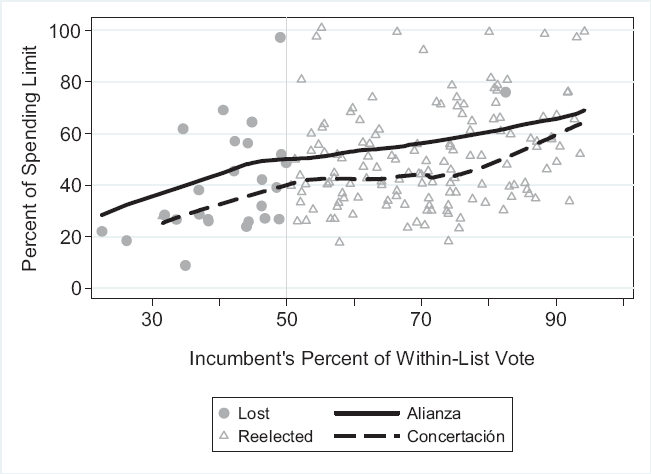
Campaign Spending of Chamber Incumbents by Closeness of Within-List Contest, 2005 and 2009
The figure also provides lowess lines (similar to a running average) for Alianza and Concertación incumbents. These show that even in a close within-list race, the average Alianza incumbent spends only about 50 percent of his spending limit. The average Concertación incumbent spends even less – about 40 percent of the limit, which in the typical district translates into no more than 40 million CLP (or USD 76,000). In comparative perspective, this seems to be a low level of spending. Consider that the average incumbent in the 2006 Brazilian Chamber of Deputies elections spent almost three times as much (with expenditures around BRL 480,000 or USD 200,000), while competitive incumbents in US congressional districts routinely spend over a million dollars. 23 Also, while the average incumbent in the 2007 Finnish parliamentary elections spent less – about EUR 38,000 – it was for only 6,500 votes (or EUR 5.85/vote). In Chile, the corresponding figure – the average incumbent's expenditures divided by the average incumbent's votes – is considerably smaller, about USD 2.76/vote. Of course, these observations are only suggestive, as a full analysis might need to consider factors such as the total number of candidates running per seat, the total amount of money spent per seat or vote, and adjustments for purchasing power parity. However, it does seem that the data support the cross-national hypothesis (H1) that Chilean congressional elections do not exhibit heavy campaign spending.
The data for Brazilian campaigns are available on the website of the Tribunal Superior Eleitoral at <http://www.tse.gov.br>. The Finnish data are available through the Ministry of Justice at <http://www.vaalit.fi>.
Another observation to take from Figure 1 is that incumbents in both coalitions spend more when they have won their within-list contests by wide margins, while those who are in more competitive races spend less money. This is evidence in favor of H2 because it contrasts starkly with what has been found in other countries, where incumbents in more competitive races spend more money.
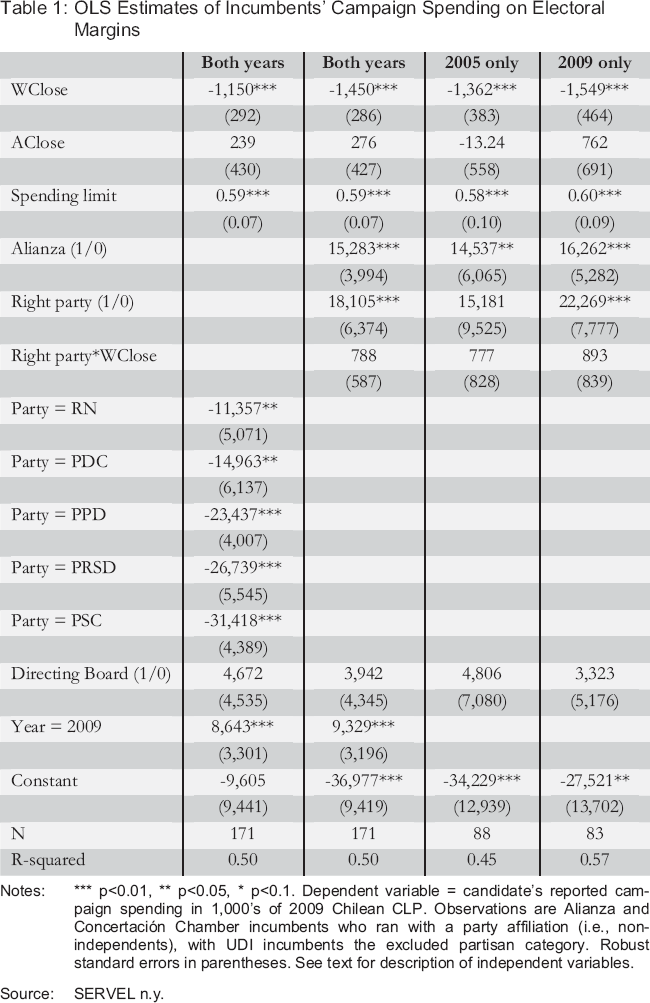
To assess whether this cross-incumbent pattern is robust to other factors that affect levels of spending, I regress incumbents’ spending (in 1,000's of CLP) on two electoral margins, WClose and AClose. The former is the negative of the absolute value of the percent of the district vote that a candidate would have to gain/cede to his listmate for a within-list tie. WClose can thus only be negative, and an increase in the variable corresponds to a closer, more competitive within-list race. Similarly, AClose captures the closeness of the across-list race – a variable that was not considered in the previous section in order to facilitate analysis. It is constructed in a similar fashion, such that larger values correspond to a closer across-list race, in which the incumbent's list was closer to either winning or losing a seat to another list. The regression model is given by (1), in which i‘s spending (yi) is a function of the two proximity variables (with coefficients α1 and α2), a constant (α0), a stochastic term (ei), and a series of control variables (Xi) with a vector of coefficients β. 24
I also estimated models that included an interaction of the two electoral variables, but this neither added predictive power nor altered the strength or substance of the findings reported throughout the paper.

The first column of Table 1 provides the OLS estimates of equation (1) with control variables for election year, a candidate's spending limit (in 1,000's of 2009 CLP), the candidate's political party, and an indicator for whether the incumbent had previously served on the Chamber's Directing Board (Mesa Directiva). 25 Because UDI incumbents are the excluded partisan category, all of the party dummies are negative and statistically significant predictors of incumbent spending. The results also show that incumbent spending is greater in 2009 (versus 2005) and positively correlated with the candidate's spending limit, but that it has no strong relationship with either board membership or the closeness of the across-list race. 26 Most importantly, the results show that the pattern in Figure 1 is statistically significant, with the closeness of the within-list contest negatively related to incumbent spending. The coefficient on WClose indicates that for each percent of the district vote that an incumbent gets closer to a within-list tie, he spends 1.150 million fewer CLP (~USD 2,200). This may not be a large difference, but considering that incumbents in other countries spend more money when they are close contests, it is dramatic.
OLS Estimates of Incumbents’ Campaign Spending on Electoral Margins
Notes:
p<0.01
p<0.05
p<0.1.
Dependent variable = candidate's reported campaign spending in 1,000's of 2009 Chilean CLP. Observations are Alianza and Concertación Chamber incumbents who ran with a party affiliation (i.e., non-independents), with UDI incumbents the excluded partisan category. Robust standard errors in parentheses. See text for description of independent variables.
Source: SERVEL n.y.
Board membership is less important than the fact that such leadership positions tend to be given to politically important deputies, who are likely to attract more finance.
That AClose is insignificant is consistent with the fact that there are relatively few Alianza and Concertación lists that are on the cusp of winning or losing a seat, but it also indicates that incumbents on those few marginal lists do not spend significantly more than other incumbents. Because these points hold throughout, the analysis will focus on within-list competition and mostly ignore lists that were “across-list competitive.”
The remaining columns in Table 1 show that the results hold given an alternative specification. In this model, PDC and UDI incumbents are differentiated from others in their coalition by the indicator Right Party, and this variable is interacted with WClose. 27
In these models, when Alianza=0, the excluded partisan category is a collection of non-PDC Concertación incumbents (i.e., PPD, PRSD, and PS). When Alianza=1, the excluded category are RN incumbents.
The interaction is meant to explore whether “Right Party” incumbents lose money at a slower rate than other incumbents as within-list margins approach zero. Although the difference is not statistically significant, this is indeed the case: Right Party incumbents lose money less than half as fast (-1,450 + 788 = −662) as non-Right Party incumbents (-1,450) as within-list margins approach zero. However, the WClose effect for Right Party remains statistically different from zero at the p<.01 level. Similar results obtain in the third and fourth columns, which estimate the same regression separately for each election year. In each and every model, tougher within-list contests are associated with less incumbent spending.
Figure 2 provides another look at incumbent spending. The graph shows spending trend lines for Alianza and Concertación incumbents and challengers, excluding those on lists where the within-list winner took more than 70 percent of the within-list vote (because such lists tend to exhibit high spending by the winner and low spending by the loser). The figure makes apparent that on internally competitive lists, incumbents and challengers spend similar amounts of money. In fact, the dashed lines show that there is almost no difference in spending for the average incumbent versus the average challenger. (The other data shown in Figure 2 – candidates’ secret money – will be discussed below.)
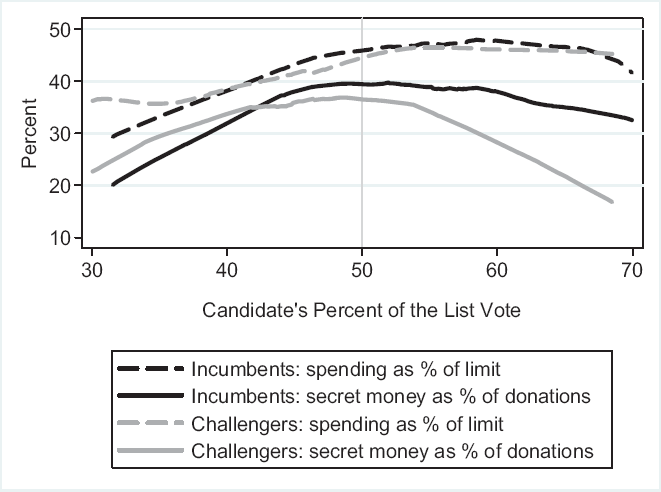
Campaign Spending and Secret Money for Alianza and Concertación Chamber Candidates, 2005 and 2009
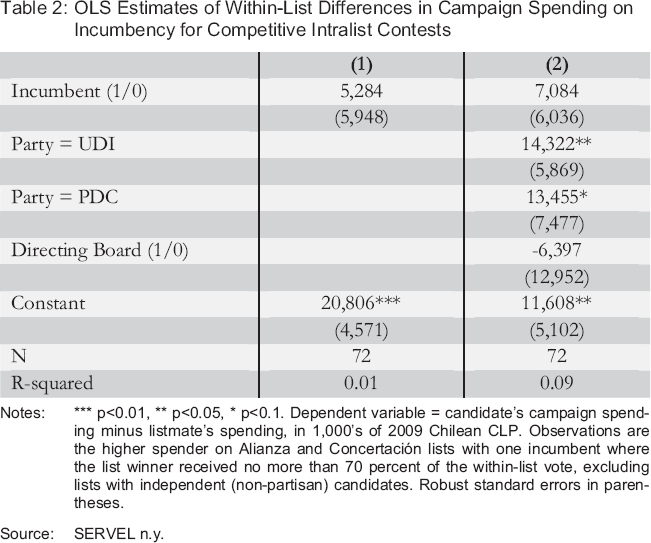
While Figure 2 does not indicate whether there are spending differences between incumbents and their challenger listmates, such a possibility is dismissed by the statistical results given by Table 2. The model is similar to (1), except the dependent variable is now a candidate's spending minus her listmate's spending, again in 1,000's of 2009 CLP. Negative values are dropped, which means that each observation in the model corresponds to the higher spender on the list – some were incumbents, others were challengers. (In other words, the observations are now spending differences between listmates, which is why there are half as many observations.) In the results given in the first column, the constant term indicates that the higher-spending candidate spent on average 20 million CLP more than his listmate, but the insignificant coefficient on the incumbency dummy demonstrates that it does not matter whether this candidate was the incumbent or the challenger. This finding is robust to inclusion of control variables. The second model shows that UDI and PDC candidates spent more than their listmates, but incumbency remains an insignificant predictor of which listmate spent more money. In other words, on internally competitive lists partisanship – not incumbency – predicts which candidate was the greater spender.
OLS Estimates of Within-List Differences in Campaign Spending on Incumbency for Competitive Intralist Contests
Notes:
p<0.01
p<0.05
p<0.1.
Dependent variable = candidate's campaign spending minus listmate's spending, in 1,000's of 2009 Chilean CLP. Observations are the higher spender on Alianza and Concertación lists with one incumbent where the list winner received no more than 70 percent of the within-list vote, excluding lists with independent (non-partisan) candidates. Robust standard errors in parentheses.
Source: SERVEL n.y.
Figures 3 and 4 provide selected types of campaign income for Concertación and Alianza Chamber incumbents, respectively. The secret money will be discussed in the next section, so for now the focus is the own money and party money. With respect to the former, there is a pattern that supports H3: Threatened incumbents spend more of their own money than safe incumbents. The evidence is clear – own spending increases as one moves from right to left on the figures, peaking near a within-list tie. Incumbents who are on the cusp of winning or losing spend more of their own money on their campaigns.
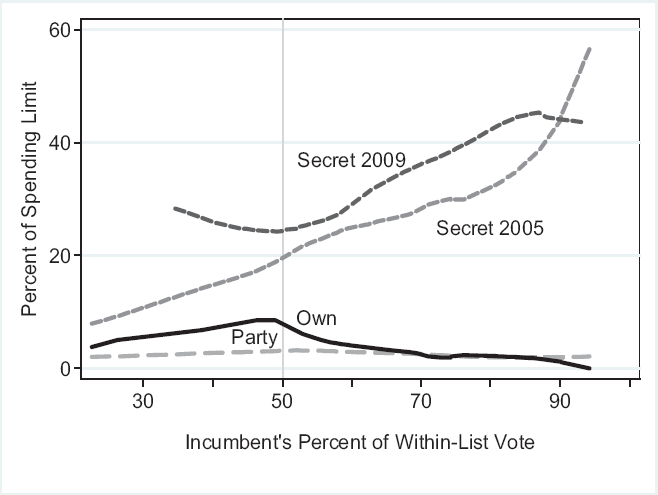
Sources of Campaign Income for Alianza Incumbents by Closeness of Within-List Contest
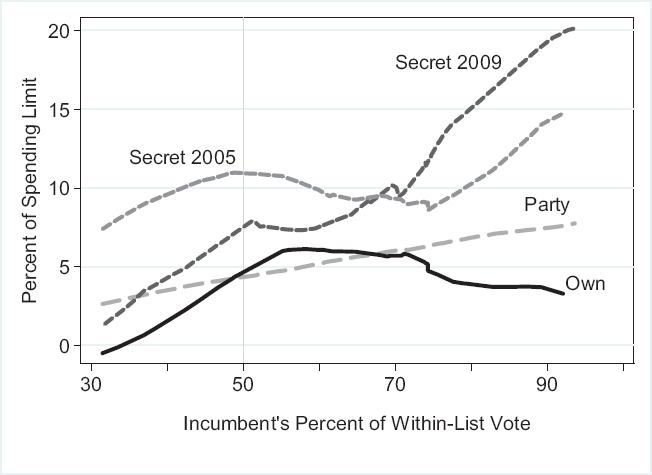
Sources of Campaign Income for Concertación Incumbents by Closeness of Within-List Contest
The data also support H4: Parties do not give much more money to threatened incumbents than to other incumbents. In fact, the opposite would seem to be the case in the Concertación, where safe incumbents receive more party money than threatened incumbents. This trend is more apparent than real, however. It occurs because the types of incumbents who win their within-list contests by wide margins tend to be from the Concertación's smaller, more left-leaning parties, which are much more likely to make substantial financial contributions to their candidates’ campaigns. 28
If we define a large party contribution as a donation larger than 10 percent of the candidate's spending limit, the proportion of incumbents that received such contributions by party are as follows: PSC 44 percent, PRSD 36 percent, UDI 11 percent, PPD 9 percent, RN 8 percent, PDC 6 percent.
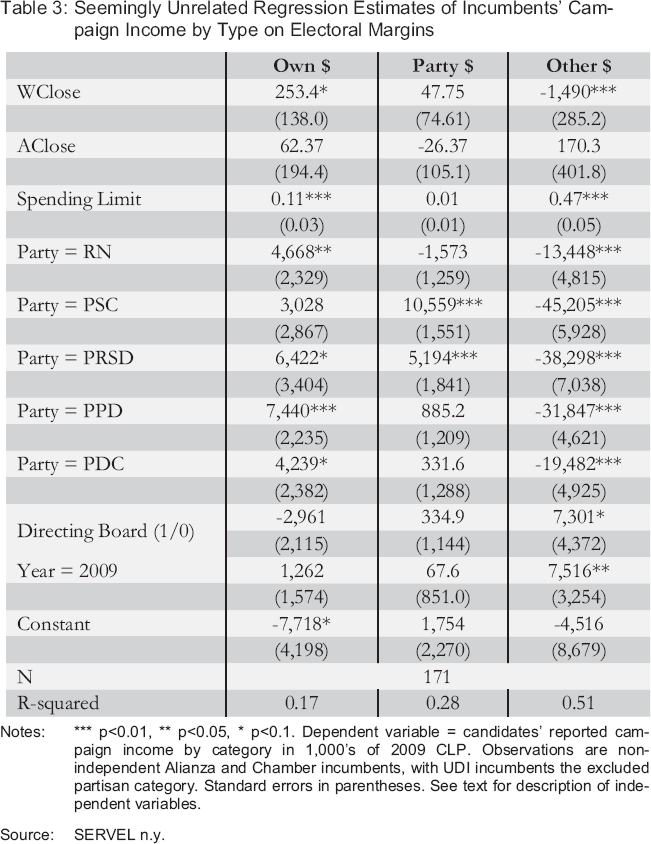
In the statistical test, I evaluate the hypotheses about own money and party money simultaneously with a multiple equation model and Seemingly Unrelated Regression (SUR). The model consists of three equations, one for own money, one for party money, and a third for all other campaign income (“other money”), each taking as a form similar to equation (1). The reason for the three equation approach – as opposed to (say) analyzing own money as a percent of campaign income – is that it allows us to assess whether a change in the proportion of own money is due to changing amounts of own money, changing amounts of other money, or both simultaneously. The reason to estimate the equations with SUR is that the errors of the three equations are correlated, and SUR allows for more efficient estimation by taking into account cross-equation correlation in the stochastic terms. 29 The main cause of the cross-equation error correlation is that the three sources of money are substitutes for each other: Collecting more from one source means that a candidate can get by with less from another source.
The SUR results show that the errors are indeed correlated. In both models shown, non-independence can be rejected at the p<.05 level or better.
The results, given in Table 3, show three things. First, party money is not driven by electoral margins but by partisanship: compared to UDI incumbents (the excluded category), PSC and PRSD incumbents receive more party money. Second, incumbents in more competitive lists raise less “other money” – for each percent of the district vote closer to a tie, they lose 1.49 million CLP. And third, controlling for partisan and other differences, incumbents’ own spending is statistically related to the closeness of the within-list contest. The coefficient on WClose indicates that for each percent of the district vote that he is closer to a within-list tie, the average incumbent spends an extra CLP 253,400 of his own money.
Seemingly Unrelated Regression Estimates of Incumbents’ Campaign Income by Type on Electoral Margins
Notes:
p<0.01
p<0.05
p<0.1.
Dependent variable = candidates’ reported campaign income by category in 1,000's of 2009 CLP. Observations are non-independent Alianza and Chamber incumbents, with UDI incumbents the excluded partisan category. Standard errors in parentheses. See text for description of independent variables.
Source: SERVEL n.y.
Therefore, together with the results from the previous section, we find that (a) threatened incumbents spend less money than safe incumbents despite the fact that they are spending more of their own money and raising the same amount of party money, and (b) threatened incumbents spend more of their own money as a percent of their spending limits (Figures 3 and 4) not just because they raise less other money, but also because they spend more own. If not for this last finding, we might suspect that threatened incumbents do not face fundraising difficulties at all, and that the spending pattern is driven by safe incumbents who simply collect too much money that they must either spend or return to their contributors. But, the results suggest a different interpretation: threatened incumbents recognize their vulnerability and so they spend more of their own money on their campaigns (and perhaps also more of their time on campaigning and fundraising). Presumably, other people recognize the vulnerability, too. But few seem willing to offer much help, for threatened incumbents do not outspend either their challenger listmates or other incumbents with safe seats.
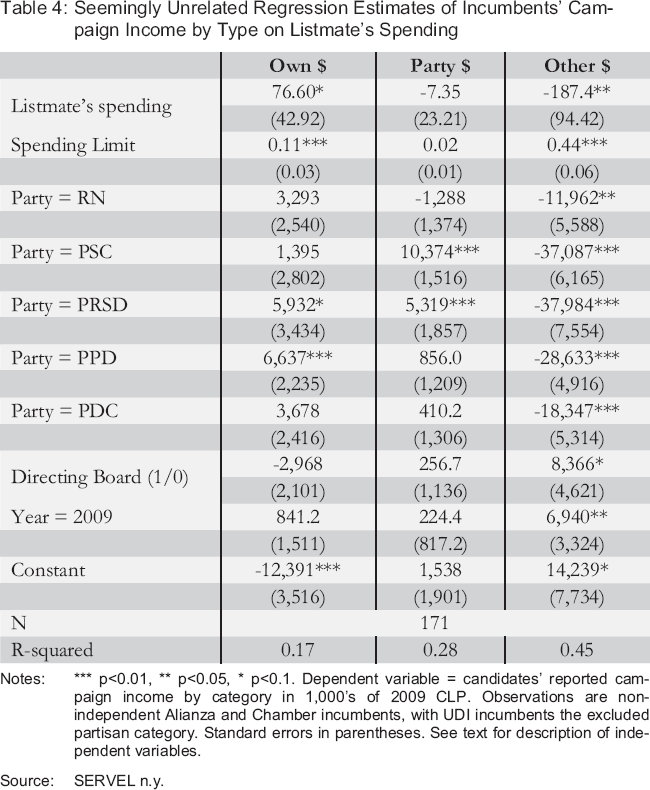
Another way to demonstrate that incumbents spend their own money in reaction to the threat posed by their listmate is to use the challengers’ expenditures as the explanatory variable. This test is given by a second set of SUR results in Table 4, where the incumbents’ income sources are regressed on his listmate's (non-own) campaign spending. 30 The results show that a challenger's spending is indeed a strong predictor of the incumbent's own spending. The coefficient indicates that for each additional percent of the spending limit spent by the listmate, the incumbent spends an additional 76,600 CLP of his own money. Also, there is again support for H4: within-list competition does not predict an incumbent's party money.
Seemingly Unrelated Regression Estimates of Incumbents’ Campaign Income by Type on Listmate's Spending
Notes:
p<0.01
p<0.05
p<0.1.
Dependent variable = candidates’ reported campaign income by category in 1,000's of 2009 CLP. Observations are non-independent Alianza and Chamber incumbents, with UDI incumbents the excluded partisan category. Standard errors in parentheses. See text for description of independent variables.
Source: SERVEL n.y.
Own money is excluded from the listmate's spending because it may be a sign of weakness more than strength. The listmate's spending is expressed as a percent of the spending limit because the model includes a control for the spending limit in pesos. It would invite a multicollinearity problem to put the two variables in the same units.
A return to Figure 2 provides evidence in support of the fifth hypothesis. The graph shows secret money as a percent of non-party and non-own donations raised by Alianza and Concertación incumbents and challengers on one-incumbent lists. The lowess fits of the data show the secret money curves to be concave with a maximum near the middle of the graph. This means that candidates on internally competitive lists tend to raise a greater proportion of their money through the secret system, as compared to candidates who win or lose their lists by wider margins. The curve is also steeper for challengers as opposed to incumbents, which implies that within-list competition is particularly important for challengers with respect to the collection of secret money. Both of these trends were anticipated by the secret money hypothesis. However, they do not seem strong enough to be statistically significant.
Table 5 provides OLS estimates of candidates’ secret money (as a percent of non-own and non-party income) regressed on incumbency status and electoral margins using the same observations as Figure 2. The results in the first two columns show that the closeness of the within-list race is positively associated with the proportion of donations that are secret, but it is not statistically significant for either challengers (first column) or incumbents (second column). Therefore, we cannot statistically affirm that competitive candidates receive more of their donations through the secret system. However, it is clear that a candidate's propensity to collect secret money is strongly related to her political leanings. The results in the third column show that compared to the average non-PDC Concertación candidate, who collects roughly 9 percent of her contributions through the secret system (indicated by the constant term), PDC and RN candidates collect triple and quadruple that amount, respectively. UDI candidates collect even more – almost 60 percent of their donations are made through the secret system. Unlike the partisan dummies, the incumbency dummy is insignificant – incumbents are no different than challengers in their ratio of secret-to-non-secret campaign contributions.
OLS Estimates of Percent Secret Money on Incumbency and Electoral Margins
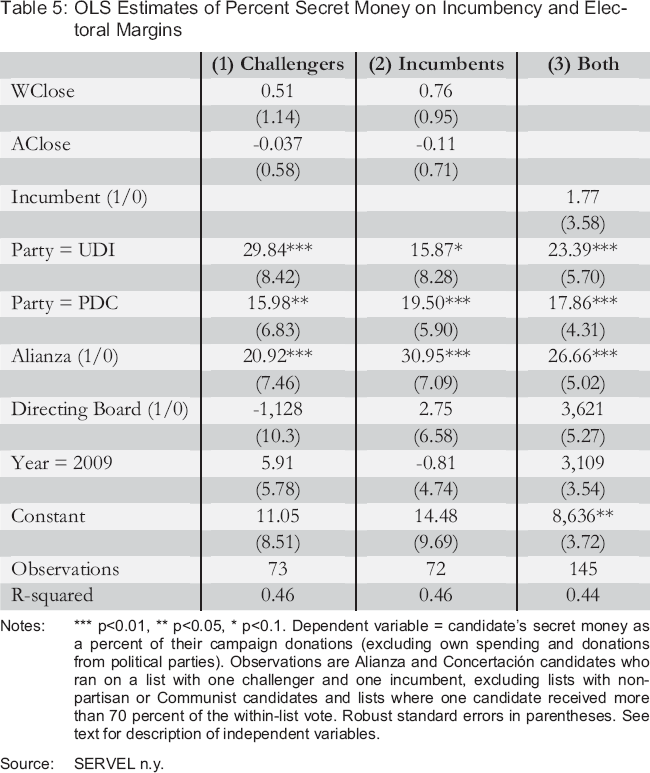
OLS Estimates of Percent Secret Money on Incumbency and Electoral Margins
Notes:
p<0.01
p<0.05
p<0.1.
Dependent variable = candidate's secret money as a percent of their campaign donations (excluding own spending and donations from political parties). Observations are Alianza and Concertación candidates who ran on a list with one challenger and one incumbent, excluding lists with non-partisan or Communist candidates and lists where one candidate received more than 70 percent of the within-list vote. Robust standard errors in parentheses. See text for description of independent variables.
Source: SERVEL n.y.
A return to Figures 3 and 4 provides some additional information about incumbents’ secret money, including how it varied by election year. The figures do not show secret contributions in relation to other donations, but it is clear that strong incumbents in both coalitions collected a good amount of secret donations. It is also evident from Figure 3 that Alianza incumbents raised more secret money in 2009 as opposed to 2005. The surge seems to be across-the-board, for threatened and safe incumbents alike, which may reflect the greater expectations that the coalition would control the Chamber or simply a secular trend towards more expensive elections. Among Concertación incumbents, however, the shift in secret money across election years was uneven, with a reduction in secret money collected by threatened incumbents and a rise in secret money collected by safe incumbents. A plausible explanation for the difference is that competition within the Concertación was more cutthroat in 2005, when the coalition was expected to retain its majority, than in 2009, when its chances of winning a Chamber majority seemed much lower. As more elections pass, it will be possible to assess the regularity of this apparent phenomenon – that is, money's shift to and from within-coalition battles with the likelihood that the coalition will control the Chamber. But, even if within-Concertación contests were able to attract money in 2005, they still did not have enough gravitational pull to produce expensive elections. The political context of these elections and their importance to the division of power in the larger political system are simply not favorable to the development of large campaign war chests.
More and more countries are beginning to introduce disclosure regulations and bring transparency to the financing of campaigns. This has started to improve our understanding of the role of money in elections, but political finance remains under-researched and there is much we do not know – particularly with regard to political finance markets and the determinants of campaign spending. Moreover, the few studies that do exist have centered on political environments like Brazil's, where legislators are known for their ability to secure particularistic policy. There, incumbents provide pork in order to fill their campaign coffers (Samuels 2002) and politician-financier exchanges have proliferated (Samuels 2001b). Cox and Thies’ (1998) findings for pre-1993 Japan – that ruling party incumbents were able to accelerate campaign spending with (intraparty) competition (cf. Samuels 2001c) – also rest on policy influence and machine-like politics.
However, political finance markets exhibit different patterns where legislators have less influence over policy and where individual contests matter less to the distribution of power in the political system. The finding that threatened incumbents in Chile outspend neither their challengers nor incumbents who have safer seats contrasts sharply with the research on Japan, Brazil, and the United States. It also makes apparent that candidates’ demand for funds alone does not make for expensive campaigns – also important are political systems and the supply side of the political finance marketplace, which bestow different capabilities upon lawmakers to accelerate campaign spending in the face of competition. Therefore, as research begins to examine political finance markets in other countries and in cross-national perspective, it should attend to factors that influence the supply side of the marketplace, including legislative powers over policy and the connections between electoral systems and district-level competitiveness.
One of the reasons it is important to understand political finance markets is their relevance for campaign finance inequalities. When incumbents can greatly outspend challengers, for example, it protects them from competition and undermines the ability of elections to serve as instruments of representation and accountability. We have seen that this type of inequality is not a problem in Chile – incumbents and challengers are on a financially-level playing field, and indeed many incumbents lose their reelection bids to challengers. Of course, this competitiveness is largely internal to the coalitions, affecting only the within-coalition composition of the legislature. But this may make the point more relevant. Campaign spending has a greater impact on electoral performance when the political differences between candidates are smaller (Carey and Shugart 1995; Cox and Thies 1998; Samuels 2001a), which means that deputies’ spending could provide them significant protections from their within-coalition competitors. It is therefore fortunate that deputies cannot easily accelerate their campaign expenditures in response to intra-coalitional competition.
The statutory limits on spending and contributions also do not seem to disadvantage Chilean challengers given that their spending is on par with incumbents’ spending and that very few challengers spend anything close to their spending limits. Moreover, it is unlikely that lower limits would disadvantage challengers: Since many are as well-known in their districts as the incumbents they seek to defeat, they probably do not reap much better returns to spending than incumbents (see Johnson 2012). But this is not an argument for lower limits. Given the modest spending in Chile's congressional elections, lower limits do not seem necessary, especially since they would increase candidates’ incentives to lie about their campaign finances.
Beyond competitiveness, concerns about campaign finance center on the ability of campaign contributions to influence policymaking in corrupt or inappropriate ways. It is very difficult to gauge how much campaign contributions influence the behavior of politicians, and this paper has not attempted such a task. However, it stands to reason that Chile's secret donation system as it is currently designed is probably less relevant than the political system in stemming quid pro quos. The concentration of power in the executive branch and the party-structured nature of congressional politics undercut the ability of campaign contributions to influence policy outcomes generated through interbranch relations. Still, Chile's secret donation system is deserving of future research, at very least in order to clarify the motivations of those who make their contributions through the system.