



Abstract
Objective indicators suggest that economic and political conditions improved in Chile between the country's democratization in 1990 and 2011. Average incomes increased, poverty rates decreased, and the number of positive reviews of Chilean democratic institutions rose. Despite this progress, massive student-led protest waves in 2006 and 2011 demonstrated high levels of subjective discontent in Chile. This paper proposes a three-part explanation for the paradoxical emergence and escalation of the post-Pinochet-era Chilean student protests, and, in so doing, contributes to the broader understanding of social movements and political action. The first two parts of the argument relate to generational change. Firstly, a gap between expectations and capabilities provoked discontent amongst a new generation of Chilean students. Secondly, the new generation's collective identity as “la generación sin miedo” (the fearless generation) motivated the students to turn discontent into political action. Thirdly, government and student actor agency influenced the variance in protest strength between 2005 and 2011.
Introduction
In April 2006, high school students started the largest wave of protests in Chile since the country's return to democracy in 1990. The protests reached their peak on 30 May 2006, when nearly one million students and sympathizers participated in demonstrations across Chile. By the end of May, over 950 high schools throughout the country were participating in protest demonstrations (Ruiz 2007: 40). The students’ demands combined specific issues, such as the costs of college entrance exams and student transportation cards, with broader calls for comprehensive reforms to the education system. Support for the students stretched across society; some surveys indicated that 87 percent of Chileans approved of the movement (Franklin 2006).
In 2011, the student protests reemerged with even more force, as Chilean university students led the largest wave of protests since the country's return to democracy. The protests raged on until the end of November 2011, often drawing tens or hundreds of thousands of Chileans to the streets. The Universidad de Chile's Casa Central, the most emblematic university building in Chile, was occupied by students for nearly seven months – the longest school occupation in more than one hundred years of the university's student federation's history (Figueroa 2012). The students’ grievances centered on “educación pública, gratuita y de calidad” (free, public, and quality education) and “no al lucro” (no to profits), which called for an end to profiting in higher education. As in 2006, the 2011 student movement drew a high level of approval from the populace; 90 percent of Chileans supported the students’ demands (Simonsen 2012: 102).
The student protest waves of 2006 and 2011 are especially noteworthy because of their broader context. Since the fall of Augusto Pinochet's nearly 17-year military dictatorship in 1990, Chile has often been viewed as an economic and political success story in Latin America. Average incomes have increased substantially since democratization, poverty rates have plummeted, and the country's democratic institutions have received exceptionally strong reviews (Freedom House 2014; Polity IV Project 2012). 1
For background on Chile's democracy since 1990, see Angell 2010.
This makes the student protests puzzling. Why did such powerful and broadly supported demonstrations emerge at times when social and political indicators were so positive? Why did the mass mobilizations emerge in 2006 and reemerge in 2011, as opposed to other times? This paper seeks to help resolve these puzzles, and, in so doing, will also contribute to the broader debates on why people protest.
My argument is divided into three parts. The first two parts relate to a generational shift in Chile. First, I argue that a divergence between expectations and capabilities provoked discontent amongst the generation of Chileans that reached student age in the mid-2000s. Rapid economic growth and increased education access inflated expectations during the post-Pinochet era; high tuition rates, segregated access to quality schools, and inequality all served to restrict actual capabilities. I argue that this discontent was a necessary but not sufficient factor in explaining the protest waves.
Second, the new generation that reached student age in the mid-2000s, unlike many of their Pinochet-era predecessors, 2 did not fear that protest could be a destabilizing force for Chile's democracy. “La generación sin miedo” (the fearless generation) became a generational collective identity that motivated protest action.
“Pinochet-era” Chileans refers to all those who lived through the experience of the dictatorship first-hand. The term distinguishes this group from those born after the authoritarian regime, referred to in this paper as post-Pinochet-era Chileans.
The generational arguments place the movement emergence in the mid-2000s. The third part of my argument uses actor agency to explain the variance in the strength of the protests between 2005 and 2011. On the government side, I argue that Michelle Bachelet's administration elevated student expectations with her 2005 presidential campaign, which centered on participation, and her education reform commitments made in 2006. Bachelet's administration frustrated these expectations by originally seeking to delegitimize the student movement and then failing to follow through on 2006 commitments. Sebastián Piñera's administration escalated the 2011 protest wave by using repressive tactics. By employing three frame alignment strategies – frame bridging, frame amplification, and frame extension – Chilean students were able to convert discontent into massive mobilizations that drew broad citizen support in 2006 and 2011 (Snow et al. 1986).
There is an important body of existing literature for understanding the recent student protests in Chile. Donoso (2013) offered an excellent study on the emergence of the 2006 high school protests. Von Bülow and Ponte (2015) looked at the development of the Chilean student movement between 2005 and 2013, focusing on the interaction between the movement and political parties. Somma and Bargsted (2014) took an historical approach to explain the growing disconnect between social movements and Chilean political institutions.
The present paper offers new contributions to the existing literature in terms of methodology and argument. The methodology engages theoretical literature on social movements, while also using extensive field research to capture the perspectives of a diverse spectrum of students and other Chileans that represent distinct generations in Chile. The methodology offers a long-term, historical approach that emphasizes how Chilean political history – before, during, and after the dictatorship – impacted the student protests, without discarding how recent actor agency itself has impacted political events. In terms of argument novelty, the existing literature has not systematically analyzed the impact of generational factors on the post-dictatorship student movement.
Looking beyond Chile, this paper adds to the long history of literature on student activism in Latin America (Scott 1968; Liebman, Walker, and Glazer 1972; Levy 1981; Pensado 2012). It also contributes to the broader social movement literature on why protests emerge and escalate. The Chilean student case offers an opportunity to study why discontent is generated and why protests occur in seemingly unlikely contexts; namely, in the context of growing economies and thriving democracies.
The theoretical contributions of the present paper can be broken down by the three parts of the argument. First, the literature has largely discredited the “classical model” of social movements, a psychologically-based explanation for protests originally argued by scholars like Ted Gurr (1970), for not considering the resources and organization needed for protests to emerge. Although the classical model is overly simplistic and ignores the political nature of protests and the importance of organizations (McAdam 1982: 16), it is still useful for understanding how subjective discontent is generated as objective circumstances improve. I disagree with resource mobilization theorists who go to the opposite extreme of classical theorists, denying that political discontent has any impact and focusing principally on political context and resources (Jenkins and Perrow 1977; McCarthy and Zald 1977). The puzzle of the Chilean student protests cannot be understood without examining how rising expectations led to student discontent. Discontent is not a sufficient explanatory variable for protest mobilization, but it is a necessary factor.
Part two of my argument suggests that social movement scholars should devote more attention to generational life experiences and their impact on political beliefs and actions, especially in the formation of collective identities. Pinochet-era Chileans were apprehensive towards protest action during the transition to democracy because of their generational experiences with dictatorship. Students from the post-Pinochet generation were more inclined to lead a massive protest movement because, as the first generation born into democracy, they held new perspectives on protest, which led to the formation of an impactful collective identity.
Finally, part three argues that agency – that is, the decisions and actions taken by individuals – matters. Economic factors, generational experiences, and other outside circumstances influence the probability of protest action, but a protest's escalation, magnitude, and duration ultimately depend on agency. The case study corroborates the theory that repression is counterproductive in democratic contexts (Carey 2006), and it also shows the importance of using Snow et al.'s (1986) frame alignment processes for attracting protest adherents and building citizen support.
Research Methods
The theoretical propositions of this paper are further supported and developed by various types of data and pertinent scholarship, including interviews, survey data, presidential discourses, media coverage of the protests, and other relevant books and articles. I conducted interviews in Santiago, Chile on two separate occasions: from July to December of 2012 and for 10 weeks during the summer of 2013. During these two periods I conducted a total of 48 face-to-face, semi-structured, qualitative interviews with student protests leaders and participants, non-student actors, and Pinochet-era Chileans (in order to further explore the hypothesis on generational dynamics). Claudio Orrego, Chilean politician and former student leader, was interviewed in January 2014 in Notre Dame, Indiana.
I do not claim that this is a representative sample of Chilean student movement actors, although I did make efforts to obtain responses from a broad range of individuals pertinent to the theses of this paper, including student protest participants, movement leaders, and some actors outside of the movement. Two criteria were emphasized during the selection of student interviewees: (1) soliciting a diverse spectrum of opinions (high school and university students; private, public, and professional schools; affiliated and unaffiliated with political parties; actors from different periods of the movement) and (2) speaking with leaders of the movement. As such, the student protest interviewees represented 15 universities and high schools from Chile (with a focus on Santiago), and the interviewees’ periods of participation in the movement spanned the entire post-dictatorship period from 1990 through 2013. Twenty of the student interviewees had held leadership positions at their respective student federations, including several current and former presidents or officers of FECh (Federación de Estudiantes de la Universidad de Chile – Student Federation of the Universidad de Chile) and FEUC (Federación de Estudiantes de la Universidad Católica de Chile – Student Federation of Universidad Católica), historically the two most important university-level organizations. The non-student interviewees included university administrators, professors, journalists, and members of organizations of parents who supported the student movement. All interviews were voice recorded, transcribed or synthesized, and translated by the author. The names and brief descriptions of all 49 interviewees and the dates of the interviews can be found in the Appendix.
FECh (through the Archivo y Centro de Documentación FECh) provided access to archived newspaper articles and other historical information related to the protests. At the Chilean National Congressional Library (Biblioteca del Congreso Nacional de Chile), I reviewed presidential discourses that referenced education and the student protests.
Dependent Variable
The present paper uses the terms social movement, protest, political protest, mobilization, and demonstration more or less interchangeably. The dependent variable is the magnitude of the student protests from 1990 through 2011. The years 2006 and 2011 are deemed critical, peak years for the movement and are used as the focus of this study.
Comprehensive quantitative information on the student protests during the 1990s is not available. However, the 1990s (with the exception of 1997) are widely considered a period of low Chilean student protest mobilization. During 1997, students of public universities, principally Universidad de Chile, participated in protests related to public university financing, specifically aimed against the “Ley Marco de Universidades Estatales” (Framework Law of State Universities). The 1997 wave of student protests is not regarded as equivalent to the 2006 and 2011 protest waves for two reasons. First, the movement did not have broader education reform demands or active support from a broader spectrum of actors (the demands were centered on a specific issues that affected public universities and the protagonists were almost exclusively public university students). Second, the magnitude of the mobilizations (3,000–4,000 students in the largest march) was not comparable to that of later protest waves (Tamayo 2012: 127).
Quantitative information on the protests is available from 2000 onwards. Figure 1 shows the number of protest events with education demands from 2000 through 2011. Figure 2 shows the number of mass mobilizations (protest events with at least 10,000 participants) and the highest number of participants in a protest each year during the period. The source is a dataset collected by Nicolás Somma, 3 using newspapers, radio, websites, and social movement organizations (inter-rater agreement levels were approximately 90 percent).
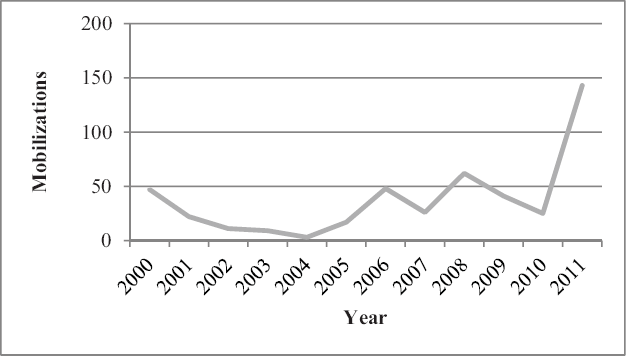
Protest Events with Education Demands
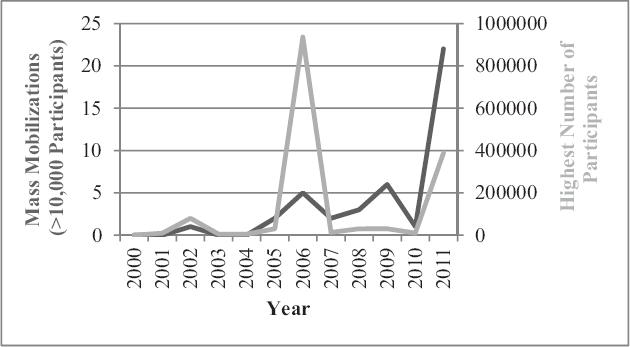
Magnitude of Education Protest Events
Dataset on protest events from “The diffusion of collective protest in Chile (2000–2012)” project (CONICYT-FONDECYT Iniciación a la Investigación/ 11121147, Chile; PI: Nicolás Somma).
Figures 1 and 2 support the argument of this paper that the new generation of students led more mobilizations and mass mobilizations beginning in the mid-2000s than in earlier periods. Though 47 education-related mobilizations occurred in 2000, no event during that year drew more than 500 participants. Only one education mobilization prior to 2005 drew over 10,000 participants.
The justification for studying the protest wave in 2011 is evidenced in the figures, as there were unprecedented numbers of mobilizations and mass mobilizations. The year 2006 was selected because it redefined mass education mobilizations, drawing unprecedented numbers of protest adherents, and because the demands and concessions in 2006 contributed to subsequent mobilizations in 2008, 2009, and 2011.
The high school mobilizations in 2006, known as the Pingüinos (“penguins”) movement because of the students’ black and white school uniforms, took place mainly between the end of April and the end of May. Following the 30th May national strike that drew 935,700 participants across the country, the Bachelet administration temporarily co-opted the student movement by granting some immediate concessions, and by creating a presidential advisory committee on education for tackling broader reforms. The driving force for many of the protests in 2008 and 2009 (years of significant mobilization) was discontent with the failure to follow through on the promises of 2006. Many students felt that the creation of the LGE (Ley General de Educación – General Law of Education), Bachelet's major concession, was not a significant improvement and did not respond to the original demands of the Pingüinos movement. Furthermore, the principal university student movement actors in 2011 were essentially “grown-up,” disenfranchised Pingüinos. The Pingüinos had reached university and they were distrustful of politicians who had previously promised them substantive education reform, but had not delivered (more details in chapter “Variance from 2005 to 2011”). Thus, 2006 is a significant year to study because of the magnitude of the protests (though short-lived) and because the year was a precursor for later significant protest waves.
Recent Chilean Political History
A comprehensive understanding of the 2006 and 2011 protest waves requires an historical perspective on events that began long before 2006. On 11 September 1973, a military coup overthrew Salvador Allende's government, bringing General Augusto Pinochet to power. Pinochet's military dictatorship immediately banned political parties and sought to paralyze civil society. During the first decade of the regime, opposition activity moved underground, as public expressions of civilian opposition were met with severe repression (Lavanchy 2008; Garretón 1988). With this strict repression, a long history in Chile of using mass protest to express social demands was broken (Somma and Bargsted 2014).
Spurred on by a national economic crisis in the early 1980s, civil society reemerged forcefully with a cycle of “protestas nacionales.” These massive national protests, the principal strategy of the opposition to Pinochet from 1983–1986, brought together popular sectors, student organizations, unions, and both moderate and radical leftist party coalitions (De la Maza, Ochsenius, and Robles 2004: 22–24). As had been the case for decades before the military coup, civil society and political parties established close ties. Many Chilean students and young people held double militancy as part of political parties and social organizations. The principal opposition student organizations – FECh and the high school student organization FESES (Federación de Estudiantes Secundarios de Santiago) – were formed in the framework of institutionalized parties. Candidate lists for student federation elections followed the programs of national parties and were closely monitored by national party leadership (Muñoz 2011: 116–117).
In 1986, triggered by the escalating violence of the mobilizations and an especially gruesome July protest in which two protesters were burned alive by the military, main opposition parties (with the exception of the radical leftist sectors) decided that the mass mobilization strategy was becoming too costly. The violence associated with the protests was seen as creating uncertainty and fear, which helped legitimize the Pinochet regime's calls for law and order and its claims that the opposition was increasingly radicalizing (Oxhorn 1994: 52–53). Thus, as 1988 approached, a consensus was reached amongst the opposition to accept the military's institutional parameters and participate in the 1988 national plebiscite. 4
The 1980 Constitution stated that after eight years, the military regime would hold a national referendum to decide whether the Pinochet regime should continue. If Chileans voted in favor of continuing the military regime in the national plebiscite, Pinochet would continue governing for eight more years. If Chileans voted “No” to the regime, Pinochet would step down and democratic presidential elections would be held the following year (1989). An alternative option originally supported by some sectors of the opposition was to boycott the elections to deny the military any legitimacy gained from receiving a new mandate.
To avoid the factionalism that had contributed to the 1973 coup, the opposition formed the Concertación por el No, a united opposition front that eventually consisted of 17 political parties. While social demands and the input of mass actors were subordinated to emphasize negotiations amongst the political elites of the Concertación (Oxford 1994: 55–56; Saavedra 2013: 228–229), political parties and social organizations remained united by the common goal of defeating Pinochet and restoring democracy (Somma and Bargsted 2014: 211). On 5 October 1988, the opposition coalition won the national plebiscite: 55.99 percent voted “No” to the military regime, while 44.01 percent voted in favor of its continuance. One year later, the Concertación's candidate, Patricio Aylwin, won the presidential election, officially transitioning Chile from a nearly 17-year military regime to democracy.
The institutionalized, coalition-building approach of the Concertación proved to be a successful strategy for ending the Pinochet regime. However, the negotiated nature of the transition to democracy initiated a process of consolidation of power by Chilean party elites and a deactivation of civil society; this process continued throughout the first three democratic administrations of the 1990s and early 2000s. 5 Specifically, three factors explain the elite-centered politics and deactivated civil society of the transition: the parameters set by the military regime, the emphasis placed on stability by leaders of the Concertación, and civil society actors’ self-moderation and disinterest in political protest.
The first three administrations of the transition were Patricio Aylwin (1990–1994), Eduardo Frei (1994–2000), and Ricardo Lagos (2000–2005).
First, given that the transition to democracy was negotiated, the first Concertación governments had to honor certain terms set by the military regime. Thus, Congress included nine “designated Senators” until 1998, which were selected by the armed forces (four), the Supreme Court (three), and the president (two). Augusto Pinochet remained commander-in-chief until 1998, after which he became senator-for-life. The binomial parliamentary system, combined with constitutional measures passed by Pinochet before leaving office (“leyes de amarre”), made super-majorities a necessity and an obstacle for passing reform in education and other areas. Because of these regime-imposed institutional barriers, the Concertación had to negotiate with the opposition and build broad coalitions to advance legislation; the coalition could not realistically pursue a far-reaching reform agenda or respond readily to civil society demands.
However, the Concertación's restricted reform agenda and disconnect with civil society during the transition went beyond the specific obstructions set by the military regime. Cognizant of the destabilizing experience of hyperpolarization in the early 1970s, a central goal of the first three governments of the Concertación was governability and stability (Silva 2004; De la Maza, Ochsenius, and Robles 2004). In pursuit of this goal, these first administrations deliberately broke ties with social organizations and conducted an elite-centered form of politics focused on consensus-building and negotiation (Saavedra 2013; De la Maza, Ochsenius, and Robles 2004). Some social movement leaders from the 1980s were incorporated into these elite circles, as the opposition had now become the government (Somma and Bargsted 2014: 211). However, key leaders of the student movement of the 1980s found themselves boxed out of the new political scene. Few students from that generation were offered positions of power in the Concertación (Tamayo 2012). As Carolina Tohá, vice-president of FECh from 1986 to 1988, stated, under the new governance of the Concertación, “Our generation was pushed aside […].” Alejandro Goic, leader of the youth wing of the Socialist Party at his university in the 1980s, said that although he was experienced in politics and had served as a 1980s movement leader, there was no place for him or his friends in the new political game of the transition (Lavanchy 2008).
Civil society actors themselves also played a role in the social movement deactivation. Some actors felt a responsibility to limit demands placed on the governments of the transition; others simply felt satisfied with the arrival of democracy and were disinterested in further political activism. Claudio Orrego, the first president of FEUC after the return of democracy, stated,
We knew we had restrictions; that we could not ask for everything. It really demanded a lot from our generation to get democracy back, and we didn't just want to give it out because we were too extreme in our demands. (interview, 29 January 2014)
Similarly, Dafne Concha, who later became actively involved in the student movement as president of the Coordination of Parents and Guardians for the Right to Education (Corpade), said that she and others avoided citizen activism during the 1990s because, as she stated, “we had this desire to not lose the democratic space that we had, because we did not want to return to the dictatorship” (interview, 27 June 2013). This concern with moderating demands in the 1990s was commonly expressed by interviewees for this project and was further supported by interviews conducted by De la Maza, Ochsenius, and Robles (2004: 76–81).
After a nearly 17-year military regime and a difficult fight for democracy, others felt satisfied with democracy. Manuel Inostroza, president of FECh in 1990, noted that the principal motivation of the organization from its formation in 1984 until 1989 was to protest the dictatorship. Inostroza also expressed that, having reached the goal of democracy, it was difficult to motivate students to continuing mobilizing for other causes. People wanted to move on with their lives outside of political activism (interview, 24 June 2013).
In short, three actors played a role in the relatively deactivated civil society of the first three transitional democratic governments in Chile. The military regime imposed barriers that limited civil society's role in the political system, the Concertación broke ties with social organizations, and many social movement actors either self-moderated demands or became depoliticized.
Generation Shift
Beginning in the mid-2000s, Chilean civil society reactivated with mass student mobilizations (see Figure 2). I argue that the principal structural, macro-political explanation for the emergence of these mass student mobilizations was a generational shift, which was impactful in two ways. First, economic and educational factors between the return of democracy and the mid-2000s created a gap between expectations and capabilities, which created discontent amongst the new generation; young people who reached student age (their teenage and young adult years) in the mid-2000s felt discontented. Second, being the first generation of students born after the dictatorship, the post-Pinochet generation did not share predecessors’ fears regarding protest action, and this lack of fear was transformed into a motivating collective identity.
Rising Expectations
The idea that the rising expectations of Chilean students caused them to feel discontent follows the “classical model” of social movements originally presented by scholars such as Kornhauser (1959), Lang and Lang (1961), Smelser (1962), and Gurr (1970) (as cited in Jenkins and Perrow 1977). Gurr (1970) argued that individuals feel a sense of injustice when they perceive a gap between what they believe they are entitled to (expectations) and what they are able to obtain (capabilities). The growth of Chile's economy and increased access to education caused rising expectations amongst the post-Pinochet generation. School segregation, high tuition rates, and the unequal distribution of Chile's wealth held capabilities below expectations. The result was discontent.
Chile's economy grew robustly after the return of democracy in 1990. GDP per capita (PPP, expressed in “international dollars”) started at “dollars” 4,493 in 1990 and grew to “dollars” 15,517 by 2006 (The World Bank 2014). These substantial increases in income had an impact on the Chileans’ demands. In line with Inglehart's (1997) scarcity hypothesis, many Chileans in 1990 still placed the strongest value on meeting basic physiological needs. However, as the economy grew and many Chileans rose to the middle class, the economic restrictions of poverty were lifted. Having the means to take day-to-day physiological needs for granted, more Chileans now had middle-class demands and expectations.
As Rocío Rodriguez, a law student and active protest participant at Universidad de Chile, stated, with the drop in poverty Chileans moved from demanding “una casa y comida” (a house and food) to things such as education and culture (interview, 29 May 2013). Pablo Ortúzar, research director for the Instituto de Estudios de la Sociedad, reflected that past success generated the contradictions and demands of the present. Economic growth led to an expanded middle class that pressured the political system for reforms, such as free university education, which Ortúzar characterized as “totally middle class” in nature (interview, 28 June 2013).
Along with the general increase in income and expansion of the middle class came a significant increase in access to the education system for the new generation of students. In a May 2005 national address, President Ricardo Lagos stated:
[…] Chilean higher education has changed. Up from 200,000 young people in 1990, there are 600,000 young people today. Today, I am very proud to say, of every ten young people at university, seven, seven are the first generation in their family to reach university. (Bicentenario Congreso Nacional Chile 2006)
Increased access to education was not unique to the university level. By 2003, Chile had reached primary school coverage rates of nearly 100 percent, and secondary school coverage of about 88 percent (Waissbluth 2011: 54).
Due to this increase in coverage, more Chileans expected that their children would have the opportunity to reach higher education. In 1999, 48 percent of parents with children in primary schools believed that their children would reach university level; by 2009, that number had increased to 85 percent. The significant rise in these expectations applied even to the poorest families; for families of the lowest quintile income bracket, this figure rose from 18 percent to 63 percent (Urzúa 2012). A university education was no longer believed to be reserved for the wealthier or better-performing students.
Access to higher education created an expectation for social mobility and a higher quality of life. However, beginning at the primary and secondary school level and continuing to the universities, students were segregated by socioeconomic status. In 2000, one out of every 10 children from high-income families attended public schools, one-third attended partially subsidized schools, and over half went with the generally superior private option. In contrast, 70 percent of vulnerable, poor students attended the lower quality public schools (Simonsen 2012: 62–63). The impact of family income and school choice was reflected in standardized testing. Applying the Duncan index of dissimilarity 6 to the 2009 PISA (Programme for International Student Assessment) international test scores, 7 Chile's scores were the second most segregated, based on socioeconomic status, out of 65 participating countries.
The Duncan index of dissimilarity calculates the evenness of the distribution of outputs across distinct groups. In this case it measures the evenness of PISA scores across distinct socioeconomic groups.
PISA is a world-wide standardized test administered by the Organisation for Economic Co-operation and Development (OECD). It measures the academic performance of 15-year-olds.
Educational segregation based on income continued to the university level. In Chile, admission to universities is centered on the results of a standardized test, the Prueba de Selección Universitaria (PSU) (Siavelis 2012). In 2012, scores on the PSU ranged from around 175 to 850 for the reading and math sections. Students coming from public schools scored an average of almost 100 points lower (470 points) than those from private schools (568 points) (Marco 2014). Thus, public school students, generally from poorer backgrounds, were handicapped when it came to accessing Chile's elite universities. Given that Chilean families financed 85.4 percent of their university education fees in 2011 (the global average was 31 percent), paying to send children to non-elite universities was a financial burden that sent many families into debt (Siavelis 2012).
As summarized by Nataly Espinosa, 2011 student body president of Universidad Católica de Valparaíso, the education system generated “a false promise of mobility” (interview, 7 July 2013). While the increase in education access inflated Chilean expectations of social mobility, school segregation and high tuition rates inhibited actual capabilities. Expectant that their lives could be positively transformed by securing a university degree, many students, graduates, and their families were let down by the reality of the education system.
Also contributing to the frustration of expectations was the unequal nature of Chile's economic growth. In every single student interview conducted in the summer of 2013, students mentioned the unequal distribution of the country's wealth as a critical issue in fueling grievances. For many students, the source of anger stemmed from Chile having the wealth to make a greater contribution to education, but not doing so. In the eyes of the students, Chile did not have a lack of wealth and resources, just a lack of fair distribution.
While students may have had instrumental incentives for stressing inequality as a grievance (as elaborated in the later section on “Frame Amplification”), statistics show that lack of wealth distribution was a significant issue in Chile. According to the Gini coefficient of income inequality, Chile was the most unequal of the 31 countries that made up the OECD in 2011 (The Economist 2012). Among OECD member countries, the mean income of the richest 10 percent of a population was an average of nine times higher than the average income of the poorest 10 percent; Chile had a proportion of 27 to 1 (OECD 2011). The combined wealth of just four Chilean individuals and their families was over USD 40 billion, around 25 percent of Chile's total GDP (Solimano 2011: 22).
Objective indicators do not dictate feelings of injustice; perceptions do. Thus, fairly privileged people often feel discontent with their situation (Blumberg 2009: 18). This was the case in Chile. As well as improving the lot for post-Pinochet generation students, rapid economic growth and increased access to education heightened the students’ expectations regarding social mobility. A segregated education system, high tuition rates, and unequal distribution of wealth restricted capabilities. As a result, the new generation of students, though far more fortunate than its predecessors, felt discontented.
From Discontent to Protest
The factors that created heightened and frustrated expectations explain the causes of the students’ discontent and help demonstrate why discontent was present, even as Chile was growing in prosperity and living conditions were improving. This is important because discontent is a necessary condition for generating mass protest movements. However, discontent is not sufficient. Because the costs of collective action outweigh the benefits – other things being equal – aggrieved individuals rarely protest. It is even less common for discontented individuals to mount mobilizations that reach the magnitude of the student protests in 2006 and 2011 (McCarthy and Zald 1977: 1214–1215; Lichbach 1998).
Therefore, in order to understand the rise in student mobilizations beginning in the mid-2000s, it is necessary to do more than simply establish that there was discontent. Understanding the protests requires an explanation of why Chilean students acted on their grievances despite collective action disincentives. I argue that this explanation lies in another generational characteristic: being born after the Pinochet dictatorship. The impact of this generational characteristic was two-fold. First, unlike their predecessors, students of the post-Pinochet generation did not fear that protest action would destabilize Chilean democracy. Second, “la generación sin miedo” (the fearless generation) became a collective identity that united students and motivated them to take protest action.
Political Generations
The literature on generational identities enriches understanding of the actions and identities of both Pinochet-era Chileans and the post-Pinochet generation. First, many scholars have looked at the specific effects of political violence on generational identity. Humphrey (2003) argued that violence transforms the worldviews and social relationships of those who are victims of it, creating a group-wide, post-traumatic identity for survivors of the terror. Edelman et al.'s (2003) study of the brutal Argentine dictatorship of the 1970s found that both direct and indirect victims of the terror were impacted by the traumatic experience in the long term. Hite, Collins, and Joignant (2013: 34) affirmed that the memory of political trauma can affect national politics decades into the future. Kiewiet de Jonge's (2013) empirical testing of a lifetime learning model on 18 Latin American democracies indicated that experiences with protest and violent conflict impacted citizens’ attitudes toward democracy throughout their lifetimes.
The conflict-ridden, polarized politics of the early 1970s, the military coup, and Pinochet's violent dictatorship impacted the actions of Chileans in the long term. These experiences engendered Pinochet-era Chileans to be highly concerned with democratic stability and to be apprehensive towards potentially destabilizing protest action during the transitional years of democracy.
However, political violence is not the only force that affects generational identity. Karl Mannheim (1952) argued that formative experiences, more broadly, create political generations with distinguishing perspectives that endure over time. Sears and Brown (2013: 77–78) cited three specific case studies to exemplify this point: (1) those people who entered the U.S. electorate in the 1930s (during President Roosevelt's New Deal program) were more likely to vote and identify with the Democratic Party in the 1950s; (2) European and American protesters of the 1960s carried their “left-liberal” tendencies for years after the protests ended; and (3) traumatic childhoods for those born between 1900 and 1915 in Germany partially explain the broad support for the Nazi regime. The attitudes of post-Pinochet Chileans were formed by experiences after the dictatorship, so their perspectives towards democracy and protest action were distinct from those of their parents and grandparents.
Furthermore, there is a connection between collective generational identities and social movements. Polleta and Jasper (2001: 285) defined collective identity as an individual's “connection with a broader community, category, practice, or institution. It is a perception of a shared status or relation […].” Many social movement scholars have argued that collective identity creates affective connections between group members that “oblige one to protest along with or on behalf of them” (Polleta and Jasper 2001: 290). “La generación sin miedo” (the fearless generation) was a collective generational identity that connected students from the post-Pinochet generation. This was an especially forceful identity for inspiring protest action because it evoked sentiments of fearlessness and inspired democratic political action.
La generación sin miedo (The Fearless Generation)
There was broad consensus amongst student interviewees that their birth into democracy was an important generational characteristic. Twenty-eight of the 32 post-Pinochet-generation students with whom I discussed this generational variable thought that their birth into a democratic country was important in explaining why their generation became protagonists of the largest mass mobilizations since the Pinochet dictatorship. Birth post-Pinochet was important for two reasons. First, it was a negative virtue; it signified a lack of apprehensive attitudes regarding protest action. José Soto, 2011 president of the student federation of the emblematic Instituto Nacional secondary school, echoed a common sentiment amongst his peers, stating,
[…] Obviously it was a generation born without the trauma of dictatorship. We weren't born with state of sieges and soldiers in the streets […] for the generation born during the dictatorship, fear existed, latent fear. (interview, 20 June 2013)
According to Soto and others, post-Pinochet-era Chileans did not worry about the potentially destabilizing consequences of protest action as their predecessors had.
Second, “la generación sin miedo” or “hijos de la democracia” (children of democracy) defined the collective identity of post-Pinochet generation students. Many student interview subjects saw this as a characteristic of the new generation's collective identity that distinguished them from their predecessors. Some examples are provided below.
Daniel Yevénes:
We are the children of people that lived through the dictatorship. And though we hear narrated stories by our parents, we don't share their fear. We don't fear anything because we didn't live what they lived through. (interview, 4 June 2013)
Bastián de Nordenflycht:
[Generational change] was decisive. I say that because I come from a communist family that was always pursued during the dictatorship […]- My father was assassinated and my mother was tortured. But we [the younger generation] did not live this danger of being in the street and not knowing if you would die the next day.
Bastián added that although he is sometimes fearful of the police: “I have to fight for my values” (interview, 4 June 2013).
César Valenzuela, spokesperson of ACES (Association of Secondary Students) in 2006:
You know what happened? Due to that horrible dictatorship that we had, many of the previous generations, collapsed. The generation of no estoy ni ahí [disinterest] emerged, of conformism […]. But we are the children of democracy, born in democracy, and we are going to continue fighting for what we consider just. (cited in Quintero 2006)
Like any collective identity, “la generación sin miedo” identity was important because it established the concept of “we;” it created a unifying connection amongst this student generation that provided a characteristic that distinguished it from other generations (Tamayo 2012: 32). But this was a particularly effective collective identity for inspiring protest mobilization because it evoked ideas related to fearlessness, democracy, and political action: “we don't fear anything,” “I have to fight for my values,” “children of democracy […] fighting for what we consider just.” For the students, being born into democracy was used as a justification for not being fearful and for fighting for democratic values; it was a reason to feel empowered and take action.
Given the prominence of this concept in student slogans and in the media in 2006 and 2011, it is logical to suspect a significant social construction aspect of this collective identity. However, an analysis of the extent to which “la generación sin miedo” was an identity tactfully constructed by student movement leaders, as opposed to an identity innately felt by students, goes beyond the objectives of this study. The point is that this collective identity, whether emphasized to serve instrumental student movement goals or not, impacted the sentiments of students and ultimately contributed to participation in protest action.
In short, there are two reasons why the new generation's birth after the Pinochet dictatorship contributes to explaining the emergence of the mass student protests in the mid-2000s: (1) students born into democracy did not fear political protest was a destabilizing force for democracy as their predecessors had, and (2) this lack of fear was transformed into a collective identity that inspired protest action.
Variance from 2005 to 2011
Rising, frustrated expectations generated discontent amongst Chilean students, even as conditions objectively improved in Chilean society. Those who reached student age in the mid-2000s were more likely to convert their discontent into protest because of their birth post-Pinochet and the related generational collective identity. These explanations place the emergence of the student mobilizations to start in the mid-2000s. The next step is to explain student mobilization variance from the mid-2000s through 2011. Why did this generation's mass student mobilization emerge specifically in 2006, and why did it reemerge with increased intensity in 2011?
I argue that the emergence and escalation of the two major protest waves is understood by looking at government and student actor agency. While structural factors set the stage for a mass protest wave, agency – individual choices and actions – ultimately determined the movement's timing and magnitude. On the government side, I focus on actions taken by both the Bachelet and Piñera administrations. The Bachelet administration twice elevated and aggravated student expectations by failing to follow through on promises. These actions contributed to the emergence of protests in 2006 and to the intensified reemergence in 2011. The Piñera administration's use of repression contributed to protest escalations in 2011. Student actors employed framing tactics to expand the base of protest participants and to draw broad citizen support for the movement.
During her presidential campaign in 2005, Michelle Bachelet emphasized political participation and a government of the citizens. As Bachelet stated in the introductory “Letter to Chileans,” as part of her official government program that she published during the 2005 campaign,
My candidacy surged spontaneously from the support of the citizens. It didn't surge from a negotiation behind closed doors nor a party conclave. This program reflects these origins of my candidacy. (Bachelet 2005: 3)
Rhetoric emphasizing inclusion and participation was repeated throughout Bachelet's presidential campaign, and it led students to see an opportunity for mobilization around their cause (Donoso 2013: 21; Von Bülow and Ponte 2015).
However, at the beginning of her presidency in 2006, Bachelet refused to recognize the legitimacy of the high school students’ protests for education reform. Throughout April and May, Bachelet either ignored the student movement or denounced it. In the annual 21 May presidential address (a moment when students highly anticipated Bachelet to address education reform), Bachelet ignored substantive demands and legitimate protest and focused solely on denouncing the violent acts that had occurred during some of the protests (Bicentenario Congreso Nacional Chile 2006; Doñoso 2013). The refusal to recognize the legitimate goals of a social movement with significant citizen backing was widely seen as hypocritical to values preached by Bachelet, and the opposition sentiment generated by this hypocrisy helped the Pingüinos to garner support from both students and outside actors (Lavanchy 2008). Nine days after Bachelet's speech downplaying and delegitimizing the type of citizen participation that she had previously promoted in her campaign, the high school students held a national strike that mobilized nearly one million students and citizens.
On 1 June 2006, two days after the national strike, Bachelet's strategy changed. She addressed the nation with substantive education reform proposals. In addition to responding to the more immediate demands of the students, she established the Consejo Asesor Presidencial para la Calidad de la Educación (Presidential Advisory Council for the Quality of Education). The advisory council consisted of a diverse group of 81 members that included rectors, teachers, parents, and high school and university student leaders (Valdebenito 2011). The council met throughout the year and on 11 December 2006 it published a 252-page final report with recommendations for education reform.
In the short term, Bachelet's concessions worked to “co-opt” the student movement, a concept Piven and Cloward (1979) described as political leaders channeling protesters in to institutionalized or less disruptive frameworks. The offers from Bachelet created factions between students who wanted to continue demanding more and those who thought the concessions were sufficient (Doñoso 2013: 12), and some students were incorporated into the institutionalized politics through the creation of the presidential advisory council.
In the longer term, Bachelet's promised reforms only led to frustrated student expectations and provoked subsequent waves of protests. The reforms proposed by the Presidential Advisory Council for the Quality of Education were discussed in Congress throughout the following year, and on 13 November 2007, the Concertación and the right-wing coalition (La Alianza) agreed upon a set of reforms to Chile's education system. At the forefront of the agreed-upon reforms was a replacement of the Organic Constitutional Law of Teaching (Ley Orgánica Constitucional de Enseñanza – LOCE) with the General Law of Education (Ley General de Educación – LGE). However, the reforms being negotiated in Congress did not respond to the original demands of the students (Von Bülow and Ponte 2015). Thus, during 2008 and 2009, as Congressional deliberations over the details of LGE were taking place, high school and university students, professors, parents, and teachers returned to the streets in protest of the bill (El Ciudadano 2009). The mobilizations attracted significant support, but did not generate the magnitude or impact of the 2006 and 2011 protest waves. The LGE was passed on 12 September 2009.
The students’ dissatisfaction did not disappear upon passage of the law. As student leaders pointed out, many of the university students propelling the 2011 protest wave were disaffected former Pingüinos (interview, Fernanda Sandoval, 20 June 2013; interview Leonardo Jofré, 5 June 2013; Jackson 2013: 61). And “traición” (betrayal) was the buzzword for many interviewees discussing Bachelet and the aftermath of the Pingüinos’ 2006 movement. The 2006 protest wave was an important defeat that planted “una semilla de rabia ” (a seed of anger) in the students that continued to grow until 2011 (interview with Leonardo Jofré). The students vowed to inspire change on their own and never again be tricked into the promised reforms of the political elites (interview, Claudio Castro, 28 November 2012). Thus, while some student leaders argued that the election of Sebastián Piñera – a right-of-center billionaire businessman who represented the neoliberal economic model – polarized the education issue and provided a boon for the protests in 2011 (interview, Julio Maturana, 9 November 2012), others argued that the reemergence of protests was related to the past betrayals by Bachelet's center-left government (interview Nicolás Grau, 14 November 2012; Von Bülow and Ponte 2015).
While Bachelet's broken promises help explain the protest escalation in 2006 and subsequent reemergence in 2011, the Piñera administration's repressive tactics contributed to the unprecedented protest escalation in 2011. There were three especially critical moments of repression that escalated the magnitude of the protests in 2011.
Reaction: The repression was widely seen as unwarranted, and after that day, the movement took on “a national and transversal character” (Jackson 2013: 67-68).
Reaction: That night, citizens showed resistance to the repression and sympathy for the students by staging a “cacerolazo,” a form of protest in which adherents bang pots and pans from the windowsills of their homes (Figueroa 2012: 141–143). Five days later, on 9 August, students led a march that drew 148,000 participants. The repression gave new life to a movement that had been beginning to lose its direction (Figueroa 2012: 140).
Reaction: The death of Manuel and the subsequent controversial investigation and sentence of Miguel Millacura led to allegations of police impunity. 8 Justice for Manuel and his family was incorporated into the students’ broader message of justice in Chilean society, and the incident generated more citizen sympathy for the movement's cause (interview, Gerson Gutiérrez).
Millacura's sentence was recently reduced to 400 days as it was concluded that the shots were fired into the air without the intent to kill. For more on the case, see: www.latercera.com/noticia/nacional/2014/05/680-577738-9-muerte-de-manuel-gutierrez-ex-sargento-de-carabineros-es-condenado-a-tres-anos.shtml (4 November 2015) and www.theclinic.cl/2015/05/20/rebajan-condena-de-ex-sargento-millacura-por-muerte-de-manuel-gutierrez/ (4 November 2015).
The specific actions taken by the Bachelet and Piñera administrations have theoretical implications beyond the Chilean case. First, classical model theorists argue that discontent is an equation of expectations and reality. The Bachelet example shows that political actors, along with structural, macro-political factors, can influence this equation by elevating expectations. Second, findings on the relationship between repression and protest action are mixed (Carey 2006: 1). However, Carey's (2006) study of nine African and Latin America countries found that specifically in democratic contexts, government repression is generally reciprocated with more protests. The Piñera administration example corroborates Carey's findings and his specific conclusion that “Citizens in democracies generally resist hostile government behavior by taking protest action themselves” (Carey 2006: 8).
Student agency was also critical. Snow et al.'s (1986) concept of frame alignment processes – the aligning of individual's interests and beliefs with a social movement's goals, activities, and ideology – helps explain how Chileans students in 2006 and 2011 expanded their pool of protest participants and drew broad citizen support. Specifically, the students employed three of Snow et al.'s (1986) frame alignment strategies: frame bridging, frame amplification, and frame extension.
Frame Bridging
Frame bridging is the process by which a social movement organization connects with other organizations or individuals that share the sentiments or ideologies of the movement, but were previously unaffiliated with the movement (Snow et al. 1986: 467–468). High school student organizational changes facilitated frame bridging for the Pingüinos in 2006. The Coordinating Assembly of Secondary School Students (ACES) was formed in the early 2000s to replace two highly criticized high school student organizations: the Assembly of Student Councils of Santiago (ACAS) and the Federation of Secondary School Students of Santiago (FESES). Seeking to break with the hierarchical nature of these groups, ACES adopted an inclusive decision-making process characterized by mass assemblies (Donoso 2013). The horizontal methodology and representative nature of the organization led to the participation of formerly inactive students from diverse ideological, geographical, and socioeconomic backgrounds (Donoso 2013: 6; García-Huidobro 2007: 3–4; interview, Luis Thielemann, 23 October 2012).
Seeing the support for the ACES method of organization and given the common student grievance over the forgotten SEREMI of Education proposals, another organization, the Association of Municipal Student Organizations of Santiago (ACAS), banded together with ACES in late 2005, creating a single organization called the Assembly of Secondary School Students of Santiago (AES) (Donoso 2013: 9; interview, José Soto, 20 June 2013). The bridging between formerly unincorporated high school students and preexisting student organizations allowed the Pingüinos movement to draw from a much larger pool of student adherents in 2006 and act as a united front across different sectors.
For CONFECh (Confederation of Chilean Students) in 2011, frame bridging included connecting with private university federations, high school students, the Colegio de Profesores (the teachers’ union), organizations of parents, and unaffiliated students. All of these actors had a vested interest in education reform, but had not always coordinated their efforts.
CONFECh had historically been a confederation that grouped together the student organizations of traditional, public institutions of higher education in Chile. Private university students participated in a separate organization called MESUP (Movement of Students of Superior Private Education). In 2011 the leaders of CONFECh and private university leaders decided to collaborate (Jackson 2013: 73; interview, Fernanda Sandoval, 20 June 2013; interview, Bastián de Nordenflycht, 4 June 2013). As a result of the collaboration, the first mobilizations of 2011 came from a private university (Universidad Central in Santiago), private university student leaders were included in CONFECh decision-making, and “no al lucro” (no to profits) – the idea that Chile's private universities should not be exploited for profits – became one of the main themes of the 2011 student movement.
Frame bridging also entailed branching out beyond the universities. University students coordinated their actions and messages with secondary student organizations throughout the protest season. Outside of the student network, CONFECh conducted regular meetings with the Colegio de Profesores (the teachers’ union) and the associations of parents (Jackson 2013: 72). Consequently, teachers participated with students in protest events and parents formed protest organizations in support of the education reform movement.
Finally, CONFECh and the secondary school students used social networks to build bridges to individuals who were not within their organizations’ traditional channels of communication. Mario Jarpa, a law student at Universidad de Chile who actively participated in the 2011 protests, related that he would not have known about many of the 2011 protests that he attended without Facebook groups, and he used Face-book to further spread the word to his friends (interview on 29 May 2013). Many interviewees related that Facebook group events were critical to the massiveness of the student protests of 2006 and 2011.
Frame Amplification
The second frame alignment process applicable to 2006 and 2011 is frame amplification. Specifically applicable to the Chilean case is value amplification, which is a movement organization's effort to appeal to people using “the identification, idealization, and elevation of one or more values presumed basic to prospective constituents” (Snow et al. 1986: 469).
Chilean students drew support from the broader public by appealing to a basic value that went beyond the specifics of education reform: equality. In 2006, one of the Pingüinos’ main slogans was “todo para ellos, nada para nosotros” (everything for them, nothing for us); in 2011, the students called for “educación pública, gratuita y de calidad” (public, free, and quality education) as a means of leveling the playing field in Chilean society. Through both of these messages, the student movement was a proponent of a more equal society in a country with extremely high levels of income inequality. Partly due to this value appeal, which applied to many Chileans, the students garnered support for their demands from large proportions of the Chilean public: 87 percent (2006) and 90 percent (2011) at the protests’ peaks (Franklin 2006; Simonsen 2012: 102).
Frame Extension
Chilean students also created alternative incentives for potential movement adherents who were not inspired by normative appeals. Snow et al. (1986: 472) referred to this third frame alignment process as frame extension; a process by which social movement organizations “elaborate goals and activities so as to encompass auxiliary interests not obviously associated with the movement in hopes of enlarging its adherent base.”
Frame extension is not especially applicable to 2006, but the technique of occupying high schools offered supplementary social incentives unrelated to the movement's primary objectives. Even if a student did not support the normative cause, there were social incentives to participate with friends in school-wide activities.
In 2011, frame extension was more elaborate and intentional. The students invented entertaining and spectacular forms of protest in order to incentive participation and attract public attention. At the “Thriller for Education,” students dressed up as zombies and conducted a flash mob to Michael Jackson's “Thriller” to represent Chile's dead education system. The “Besatón” was a countrywide kissing marathon. Student couples across Chile gathered in public places, kissing and hugging for 1800 seconds to represent the 1.8 billion Chilean pesos required from the government to achieve free public education in Chile. Apart from providing entertainment incentives for observers and participants, the creative protest events attracted international media attention from sources such as The New York Times, The Washington Post, and The Economist.
Using these three framing tools, students in 2006 and 2011 converted discontent and a unifying collective identity into exceptionally massive protest waves with broad citizen support.
Conclusion
This paper was written with two primary goals in mind. The first was to understand a paradox: the emergence of massive student protest waves in Chile in the context of strong democratic indicators and a thriving economy. The second goal was to draw from this paradox to contribute to a broader understanding of social movements and political action. My contributions, as related to these empirically and theoretically based goals, can be divided into three parts.
First, I argue that Chilean students felt discontent because of a gap between their expectations and their reality. I argue that discontent is a necessary but not sufficient factor for explaining social movement emergence.
Second, I argue that a new generation of Chileans born after the dictatorship was not fearful of protest action destabilizing democracy, and this fearlessness was transformed into an impactful collective identity. Experiences impact generational identity and political action in the long term, and collective generational identities can help individuals overcome collective action costs.
Third, I argue that Chilean government and student actors determined the timing and magnitude of the 2006 and 2011 protests through their agency. Government actions can escalate discontent; repression is potentially counterproductive in democratic contexts; frame bridging, frame amplification, and frame extension are important tools available for social movement actors.
Future research on the Chilean student protests should challenge my arguments and explain the evolution of the student protests since 2011. Research within and outside of Chile should build on our understanding of discontent, political trauma, collective identity, repression, actor agency tactics and student and social movements more broadly.
Footnotes
Interview Subjects
Alberto Mayol (5 July 2013). Dr. Mayol is a sociology professor at Universidad de Chile. He studies social movements in Chile and has written two books related to the Chilean student protests, El derrumbe del modelo (2012) and No al lucro (2012).
Alberto Moya (10 June 2013). Alberto is an industrial engineering student at Universidad de Santiago de Chile; he started participated in student marches in June of 2011.
Álvaro Opazo (21 June 2013). Álvaro is an engineering student at Universidad Técnica Federico Santa Maria at the Santiago campus. He was a student federation leader at his high school in 2006 and at his university in 2011.
Andrés Fielbaum (12 September 2012). Andrés was general secretary of FECH in 2012 and president of FECH in 2013. He was also actively involved in the movement in earlier years.
Bastián de Nordenflycht (4 June 2013). Bastián is a sociology student at Universidad Central in Santiago. He participated in the 2006 mobilizations at his high school, and he began participating again in 2011 at the university. He was a protest leader at Universidad Central in 2011.
Camila Sepúlveda (26 June 2013). As president of the student federation at the high school, Carmela Carvajal de Prat, Camila was one of the principal leaders of the 2011 protests. She continues participating in student mobilizations as a student at Universidad de Chile.
Claudia Osorio (9 October 2012). Claudia began participating in the protests at her high school, Colegio San Viator, in 2011 and she was in charge of public relations for Aces in 2012.
Claudio Castro (28 November 2012). Claudio was student president of the Federation of Students of the Universidad Católica (FEUC) in 2006.
Claudio Orrego (27 January 2014). Claudio is a member of the Christian Democratic Party who ran for president in the 2013 elections. He was student president of the Federation of Students of the Universidad Católica (FEUC) in 1990.
Constanza Guajardo (26 September 2012). Constanza is a political science student at Universidad Católica in Santiago. She began participating in the student protests in 2011.
Cristián Hernández (11 June 2013). Cristián studies mathematics and computation education at Universidad de Santiago de Chile and has participated in the protests since entering the university in 2011.
Cristián Pailamilla (10 June 2013). Cristián is a history student at the Universidad de Santiago de Chile. He began participating in the Pingüinos movement in 2006 as a student at the emblematic high school, Liceo Aplicación, in Santiago. He continued protesting as a college student in 2011.
Dafne Concha (27 June 2013). Dafne is president of the Coordination of Parents and Guardians for the Right to Education (Corpade), an organization that has been actively involved in supporting the student protests since 2011.
Daniel Yevénes (4 June 2013). Daniel is an industrial design student at Universidad Tecnológica Metropolitana (UTEM). He began protesting in 2001 while still a high school student at Instituto Nacional in Santiago. He was leader of his faculty's Center of Students during the 2011 protests, protest participant as student at the emblematic Instituto Nacional in 2006, and student leader at Universidad Tecnológica Metropolitana in 2011.
Daniela Guajardo (13 June 2013). Daniel is a law student at the Universidad de Chile who has participated in the university student mobilizations since 2011.
Felipe Betancourt (24 June 2013). Felipe was president of the Federation of Students of the Universidad Católica (FEUC) in 2008.
Felipe Gallardo (21 August 2012). At the time of the interview, Felipe was a Masters student at Universidad de Chile; he participated in protests in 2011.
Felipe Venegas (10 June 2013). Felipe is an international studies student at Universidad de Santiago de Chile. He started participating in the student movement in 2011.
Fernanda Sandoval (20 June 2013). Fernanda was a leader of the 2011 movement as vice-president of the federation of students at Universidad Diego Portales.
Francisca Córdova (12 June 2013). Francisca is a law student at Universidad de Chile. She participated in the high school protests in 2006 and at the university level in 2011.
Gerson Gutiérrez (4 September 2012). Gerson is a university student who has been actively involved in the student protests since 2011. His 16-year-old brother, Manuel Gutiérrez, was shot by Chilean police and died while watching the student protests outside his house in Macul, Santiago.
Harold Mayne-Nicholls (16 August 2012). He is a journalist, former president of the Chilean national soccer league, a former FIFA official, and a concerned parent.
Ignacio Bustamente Ramirez (27 August 2012). Ignacio is a graduate of the Universidad de Chile who participated in protests as a student and remains actively involved in the student protests and other social movements.
Jaime Sanchez (12 June 2013). Jaime is a parent of two children who study at Instituto Nacional; he is involved in the parent organization at the high school.
Jorge Las Heras Bonetto (9 July 2013). Dr. Bonetto, currently a professor of medicine at Universidad Diego Portales in Santiago, was a rector at Universidad de Chile from 2006 to 2010. He was an Argentine student leader in the 1960s while studying at Universidad Nacional de Córdoba in the 1960s.
José Soto (20 June 2013). José started actively participating in the student movement in 2008. He was one of the central leaders of the 2011 protests as student president of the Instituto Nacional.
Julio Maturana (9 November 2012). Julio is an engineering student at Universidad de Chile who participated in the 2011 protests and became executive secretary of FECh in 2012.
Leonardo Jofré (13 June 2013). Leonardo started high school in 2006, served as general secretary at the Instituto Nacional in 2007, and was active in the 2011 protests as a law student at Universidad de Chile.
Luis Thielemann (23 October 2012). Luis participated in student government in various capacities from 2001 through 2005 and was involved in FECh from 2006 through 2008. He was leader of FECh from 2006 through 2008.
Manuel Inostroza (24 June 2013). Dr. Inostroza was president of the student federation at Universidad de Chile (FECH) in 1990. He served as superintendent of health during the first Bachelet administration and is currently a professor of medicine at Universidad Andrés Bello in Santiago.
María José Gaona (12 June 2013). María is a journalism student at the Universidad de Chile. She participated in protests at her high school in 2006 and at the university level in 2011.
Mario Jarpa (29 May 2013). Mario studies law at Universidad de Chile, and he has participated in the protests since 2011.
Marisol del Castillo (29 May 2013). Marisol is a law student at Universidad de Chile. She has actively participated in the student movement since 2006.
Martin Castillo (28 June 2013). Martin was president of engineering students at Universidad de Chile in 2013. He began participating in the student movement in 2010.
Moisés Paredes (4 June 2013). Moisés has been a participant and leader of the student movement since 2011. He attends the high school, Arturo Alessandri Palma, in Santiago.
Nataly Espinosa Salomón (7 July 2013). Nataly is a graduate of Universidad Católica in Valparaíso. She was president of the university's student federation in 2011.
Nicolás Grau (14 November 2012). Nicolás was student president of the Federation of Students of Universidad de Chile (FECh) in 2006.
Pablo Facusse (18 June 2013). Pablo was involved in student government at the Instituto Nacional in 2006. He has since participated in protests as a student at Universidad ARCIS (Arts and Social Sciences) in Santiago.
Pablo Ortúzar (28 June 2013). Pablo is director of research at the Santiago-based think tank Instituto de Estudios de la Sociedad and is a professor of sociology and anthropology at Universidad Católica in Santiago.
Patricia Muñoz (9 July 2013). Dr. Muñoz is dean of medicine at Universidad Diego Portales in Santiago.
Pedro Pablo Glatz (8 July 2013). Pedro was vice-president of FEUC in 2013.
Raúl Ojeda (30 May 2013). Raúl is a teacher at Colegio Sagrados Cora-zones de Manquehue in Santiago.
Rebeca Gaete (25 October 2012). Rebeca has been participating in the student movement at Universidad de Chile since 2006. She has occupied several leadership positions including general secretary of FECH in 2013.
Rocío Rodríguez (29 May 2013). Rocio is a law student at Universidad de Chile who has participated in the student mobilizations since entering the university in 2008.
Samuel Navarro (12 June 2013). Dr. Navarro is a mathematics professor at Universidad de Santiago de Chile.
Sergio Grez (31 October 2012). Dr. Grez is a professor of history at Universidad de Chile; he specializes in the history of Chilean social movements.
Stefano Bordoli (17 June 2013). Stefano is a law student at Universidad de Chile. He opposes the strategy of occupations and strikes, but has participated in student marches.
Veronica Muñoz (27 May 2013). Veronica is a professional journalist for the Federation of Students of the Universidad Católica (FEUC). Her daughter has been involved in the student protests.