



Abstract
Why has protest participation seemingly exploded across much of Latin America in recent years? How do individual- and country-level characteristics interact to explain the rise of contentious politics in countries like Argentina, Brazil, and Venezuela? I contend that the recent wave of protests in Latin America is the result of trends in community engagement and institutional development across the region's young democracies. Specifically, I argue that low-quality institutions in democratic regimes push an increasingly large number of civically active Latin Americans toward more radical modes of political participation, as governments’ abilities to deliver on citizens’ expectations fail to match the capacity for mobilization of active democrats. Drawing on cross-national surveys of Latin America, I test this argument, finding that an interactive relationship between community engagement and ineffective political institutions helps explain the recent spike in protest activity in certain cases and the vast differences in protest participation observed throughout the region.
Introduction
Despite widespread belief that contentious protests would shift from being the norm to the exception with the consolidation of democracy (e.g. Hipsher 1998; Eckstein 2001) and passage of purportedly demobilizing neoliberal reforms (e.g. Kurtz 2004; Oxhorn 2009), the past decade is peppered with examples of large-scale protest movements across Latin America – many of which have had important consequences for democratic politics in the region (e.g. Silva 2009; Bellinger and Arce 2011; Boulding 2014). Indeed, the recent salience of mass protests has been such that if a casual observer of Latin American politics assumed there was a band of disgruntled demonstrators banging pots and pans on every street corner south of the Rio Grande, it would be hard to blame her. Yet the reality is that for every Latin American country that is engulfed in intense cycles of protest (e.g. Argentina, Bolivia, and Peru), there is another where contentious tactics are seldom utilized and citizen participation is primarily channeled through formal political institutions (e.g. Costa Rica, Uruguay, and Panama).
These highly disparate trends in protest activity across Latin America offer an important opportunity to better understand variation in terms of contentious politics in a region where much of the existing research suggests we should find very little. Why has protest participation exploded in certain countries while not in others in recent years? More specifically, how do individual- and country-level characteristics interact to explain why some individuals protest while others do not?
I attempt to answer these questions by focusing on the interaction between individuals’ access to organizational resources and institutional context. I argue that, ceterus paribus, citizens engaged in community organizations are more likely to protest than are those individuals with low levels of involvement in civic life. Thus, one element for understanding protest across Latin America in recent years can be found in the region's socioeconomic and demographic trends, which reveal higher percentages of educated, formally employed, and socially connected individuals than at any time in history. However, this is only part of the story. For while these citizens will channel their energies through formal modes of political participation in political systems with strong, reasonably well-functioning representative institutions, the same individuals are more likely to turn to protest when living in countries where political institutions fail to provide effective democratic representation. Conversely, such institutional failings will have little effect on a disengaged citizenry, and this therefore helps explain low levels of protest in contexts where few citizens are involved in civic life. In evaluating this interaction of institutional context and community engagement, Latin America offers an ideal collection of cases that vary across both of these critical dimensions.
A key contribution of this work, then, is to highlight the interaction between institutional context and patterns in community engagement with respect to individuals’ proclivity to engage in contentious tactics. In a series of cross-national analyses of individual-level survey data, I find that neither individual-level characteristics nor institutional-setting features alone fully explain protest behavior. Rather, only when viewed together do we have a more complete picture of why protest seems to be more common in certain Latin American regimes than in others.
The Rise of Community Engagement in Latin America
From an economic standpoint, the twenty-first century has been good to most Latin American countries. Buoyed by new trade relationships with China and other East Asian countries, Latin America's largely commodity-based economies have grown at unprecedented rates in the new millennium. From 2003 to 2007 Latin American countries experienced an average GDP growth rate of 6 percent, marking the most successful five-year period of growth in the post–World War II era (Ocampo 2008). In 2010, while the advanced industrialized world was still mired in a severe economic crisis, Latin American economies expanded by about 6 percent (World Bank 2012; see Figure 1). Latin America has not only achieved economic growth, it has also made gains in terms of poverty reduction and education. The region's poverty rate dropped from 44 percent in 2002 to 33 percent in 2008 (ECLAC 2013), while the number of Latin Americans with tertiary degrees rose from 9 percent in 1990 to 14 percent in 2009 (World Bank 2013).
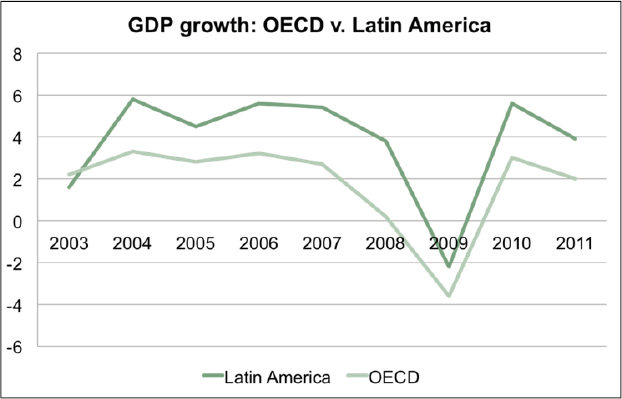
Economic Growth in Latin America, 2003–2011
In conjunction with these advances in socioeconomic development, electoral democracy has finally consolidated its status as the only legitimate regime type in the region. Despite democratic “backslides” in countries like Venezuela, Ecuador, and Nicaragua (Weyland 2013), no country in the region has undergone a full-scale reverse transition to authoritarianism. Moreover, there is evidence that Latin Americans have become more active democrats in recent years. According to cross-national surveys, Latin Americans overwhelmingly support democracy as the best form of government and, since 2004, have become increasingly interested in politics, active in elections, and participatory in their communities (LAPOP 2004–2012).
The expansion of access to the Internet and social media has also had important consequences for politics in the region, with five Latin American countries ranking in the global top 10 in terms of social network “engagement” (hours spent per month) and social media increasingly being utilized for political purposes (The Economist 2013; Valenzuela, Arriagada, and Scherman 2012). The end result of all of these trends is that Latin America has become a region where many (but not all) citizens are highly engaged in democratic politics and their communities via interpersonal and virtual activities – perhaps more than at any other point in the region's history. 1
“Community” and “civic” engagement will be used interchangeably throughout this paper, which is in keeping with the literature on the topic.
How might recent trends in socioeconomic development and increases in community engagement relate to protest? In the 1970s scholars began to shift their attention from grievance-based explanations of protest (e.g. Gusfield 1968; Gurr 1970) to the causal mechanisms that might explain why grievances translate into collective action in certain cases but not in others. 2 Instead of drawing on relative deprivation ar- guments, the “resource mobilization” approach offers attempts to explain such cases by taking into account the socioeconomic factors that underpin the formation and sustainability of social movements. For scholars adhering to this particular theoretical construct, the primary determinants of whether or not social movements emerge and are successful lie in a particular movement's access to the organizational resources necessary for mobilization (McCarthy and Zald 1973, 1977). According to Jenkins,
Despite this trend in the protest literature, some recent work has delved into the potential causal influence of specific types of grievances in spurring protest involvement (Finkel and Muller 1998). Land and income inequality (Muller and Seligson 1987, Sen 2002, Jenkins, Jacobs, and Agnone 2003), neoliberal reforms and associated austerity measures (Walton and Ragin 1990; Arce 2008; Roberts 2008; Silva 2009; Bellinger and Arce 2011), and political repression or exclusion in authoritarian regimes (Loveman 1998, Bunce 2003) have all been attributed causal weight in spurring mass mobilizations. Moreover, journalistic accounts of virtually any episode of mass mobilization – from Occupy Wall Street to the Arab Spring to the recent protests in Brazil – tend to focus on the grievances being voiced by demonstrators as a primary causal factor rather than longer-term economic and political trends.
the formation of movements is linked to improvements in the status of aggrieved groups, not because of grievances […] but because these changes reduce the costs of mobilization and improve the likelihood of success. (Jenkins 1983: 532) 3
In particular, the resource mobilization school received a boom from studies on the US civil rights movement published in the 1960s and 1970s. While in many ways, blacks in the United States encountered the same grievances they had faced during the decades prior to this time period, access to organizational resources changed drastically in the direct lead-up to the civil rights movement. Indeed, it seemed that increased urbanization, the growth of historically black universities, and an expanding black middle class led to the removal of traditional paternalistic social relations between (particularly, Southern) whites and blacks and paved the way for a thriving national movement (McAdam 1982; Jenkins 1983).
In Latin America studies have found that citizens who are more highly educated, interested and active in politics, and connected to civil society organizations are the most likely to engage in protest (e.g. Booth and Seligson 2009; Moreno and Moseley 2011; Boulding 2014). Moreover, numerous in-depth analyses have outlined how specific shifts in organizational linkages between individuals and groups helped spur the mobilization of contentious movements in the region (e.g. Walton and Ragin 1990; Eckstein 2001; Yashar 2005; Garay 2007). Thus, it would seem that, at the individual-level, the resource mobilization approach partially explains which individuals are more likely to protest in Latin America, especially in an era when more citizens have access to organizational tools than ever before. Yet at the aggregate level, the resource mobilization approach predicts (successfully as applied by Dalton, van Sickle, and Weldon 2010) that rates of protest participation are highest in the most economically developed contexts, where more citizens possess the organizational resources to build movements and articulate their interests. This perspective is at odds with a case like Bolivia, for example, which ranks as Latin America's most contentious country (LAPOP) while also being one of the region's most underdeveloped. Moreover, while countries like Peru, Argentina, and Ecuador have grown rapidly in recent years and played host to numerous mass demonstrations, other countries like Uruguay and Costa Rica have grown at impressive rates but failed to register high protest numbers. Therefore, while resource mobilization clearly helps explain current trends in protest activity across Latin America at the individual level, it falls short in capturing why individuals in certain countries in the region are so much more contentious than others.
The Persistence of Flawed Institutions
Latin America is a region populated by regimes of varying democratic quality (e.g. O'Donnell 1993; Diamond 2002; Levitsky 2002; Gibson 2006; Tommasi and Spiller 2007; Levitsky and Murillo 2009; Levine and Molina 2011; Scartascini and Tommasi 2012). 4 Although every country in the region aside from Cuba is widely characterized as a formal, electoral democracy (though some regimes, like Venezuela, probably require additional adjectives (Collier and Levitsky 1997)), Latin American regimes differ substantially in how effectively their formal political institutions channel participation and implement public policy.
Democratic quality can be defined as the extent to which regimes adhere to democratic norms like “freedom, the rule of law, vertical accountability, responsiveness, and equality” (Diamond and Morlino 2004: 21).
Much of the recent literature on Latin American democratic political institutions has focused on institutional weakness in countries across the region and how such weakness might contribute to poor representation outcomes and policy output. According to Levitsky and Murillo (2009), two dimensions define institutional weakness: enforcement and stability. In many Latin American countries, the formal “rules of the game” (North 1990) often change or are not enforced. For example, presidents in countries like Argentina, Venezuela, and Ecuador, among others, have sought to change reelection laws in order to remain in power. Many presidents in the region have also pursued “court-packing” strategies – despite explicit legal prohibitions against doing so – to attempt to establish political control over the judicial branch or have eliminated the autonomy of their respective central banks (e.g. Helmke 2002; Boylan 2001). This degree of institutional uncertainty often has dire consequences for the quality of public policy as it encourages shortsightedness among government officials, who in many cases are not qualified for the positions they hold (Spiller and Tommasi 2007).
Shortcomings related to institutional weakness and poor governance are manifested in Latin Americans’ attitudes. Despite widespread support for democracy as a form of government across the region, confidence in key regime institutions like political parties, legislatures, and law enforcement remains low in many Latin American countries (Booth and Seligson 2009). In addition, even though Latin America has experienced unprecedented economic growth and reductions in poverty, satisfaction with public services like education, healthcare, and transportation continues to be comparatively low (LAPOP 2012). High crime rates plague many countries in the region, increasingly so in Venezuela, Mexico, and much of Central America (Ceobanu, Wood, and Ribeiro 2011; Bateson 2012). Thus, it would appear that a gap has emerged between Latin Americans’ demand for democracy and the supply of democracy (Brat-ton, Mattes, and Gyimah-Boadi 2005), as diffuse support for democracy has been consolidated while criticism of specific regime actors and dissatisfaction with government performance has persisted and in some cases increased (Booth and Seligson 2009).
Within the protest literature, the potential relationship between institutional context and protest has been discussed and even empirically tested. Specifically, scholars employing the “political opportunities” approach have sought to uncover the political mechanisms that allow previously unexpressed grievances to materialize. This might entail a focus on how processes of democratization and political liberalization or, within existing democracies, how the role of political parties, labor unions, or important legal decisions structure potential protest activity (Huntington 1968; Tilly 1978; McAdam 1982; Kitschelt 1986; Brockett 1991). Others have compared rates of protest in contexts characterized by different levels of democratic “openness,” positing a curvilinear relationship between political openness and protest (Eisinger 1973; Tilly 1978, 2006; Muller and Seligson 1987). According to this logic, protest movements arise and flourish more frequently in moderately open regimes, where public opposition is tolerated and widespread but representative institutions do not fully facilitate effective participation, than in regimes at either end of the openness spectrum (Eisinger 1973; Tilly 1978).
Empirical work on the impact of political institutions on protest participation has produced mixed results. In their cross-national study utilizing data from the World Values Survey, Dalton, van Sickle, and Weldon (2010) find that more democratic, high-functioning (i.e. “open”) institutional contexts produce higher rates of protest participation than do authoritarian regimes or weakly institutionalized democracies (see also Norris 2002). However, in recent studies of Latin America, scholars have shifted toward examining how weak political institutions in democracies can push citizens toward adopting contentious tactics (e.g. Boulding 2010, 2014; Machado, Scartascini, and Tommasi 2011; Arce and Mangonnet 2012; Arce 2014). A focus on more specific features of national level political institutions by Machado, Scartascini, and Tommasi (2011) in their study of Latin American democracies reveals that institutional weakness actually increases the prevalence of protest participation within that regime. Boulding's research examines diversity in participation tactics utilized by NGOs, finding that NGOs are more likely to encourage protest participation in weakly institutionalized contexts, where voting and other types of formal participation are viewed as less effective. Scholars have also found that electoral losses tend to foment more “protest potential” in new democracies than in established ones (Anderson and Mendes 2006) and that neoliberal reforms can spark contentious participation under democracy in Latin America (Silva 2009; Belliger and Arce 2011).
Despite the considerable contributions of these recent studies, a single-minded emphasis on institutional characteristics as the decisive determinant of contentious participation seems to ignore the critical role that swelling rates of community engagement have played in producing protest across Latin America. Protest movements have failed to gain traction in a long list of countries with low-quality institutions, including those with authoritarian regimes where representational institutions are nonexistent or ineffective but grassroots engagement is limited. Moreover, protests often materialize in countries with “good” institutions, as was the case in Chile in 2011 and in the United States during the Occupy Wall Street movement, due in part to the dense organizational networks that exist in such democracies. For this reason, I argue that any cross-level explanation of protest must factor in individual-level communityengagement, as these critical organizational linkages serve as a necessary condition for any potential institutional effect on contentious politics. 5
Boulding's work investigating how second-level institutional characteristics condition the participation patterns of NGOs represents an excellent contribution to both our understanding of Latin American NGOs and the conditioning effect of institutions on patterns of participation. However, we still have not fully unraveled how political environments interact with a host of mass-level indicators of engagement to explain protest participation, nor how citizens’ assessments of institutional quality and public-service provision affect contentious participation. This paper, therefore, represents an extension of a similarly interactive theoretical framework to (1) a larger number of cases and (2) a larger universe of repertoires of community activism and engagement. NGO activity falls within the realm of community engagement and should motivate protest in weak institutional settings for the reasons enumerated above. However, I argue that it is not unique in this regard, as other forms of community activism, interest in politics, and education have similar stimulative effects.
Contentious Engagement in Flawed Democracies
In the face of trends related to community engagement and institutional quality in contemporary Latin America, I argue that a combination of high levels of civic engagement among citizens and ineffective political institutions precipitates more radical modes of political participation, as regimes’ abilities to deliver on citizens’ expectations fail to match the mobilization capacity of the citizenry. Thus, where individuals are engaged in civic life and interested in politics but institutional quality is low (e.g. unresponsive or inconsistent representational vehicles, fickle systems of checks and balances, and weak rule of law), protest emerges due to the inability of formal political institutions to adequately channel and respond to the voices of active democratic citizens.
Politically active individuals utilize protest as a means to more forcefully exert their influence on the regime given their mistrust of formal political institutions and the lack of efficacy they perceive in operating through conventional vehicles. Thus, contrary to the traditional perspectives that protest movements are either largely precipitated by the alienation of economically deprived segments of society, or that protest is a healthy by-product of liberal democracy and economic development, I argue that in contemporary Latin America protest has become part of politically active citizens’ participation “repertoire” (Tilly 1986) – that is, the set of options at the disposal of collective actors – in systems devoid of effective political institutions.
While the term “community engagement” might seem like a synonym for “protest participation” rather than part of the causal explanation of protest, it in fact refers to the extent to which citizens are knowledgeable about and interested in political issues and are connected to the types of social and political networks that can serve to foment collective action. The degree of community engagement in a given context is thus well measured by survey items used to gauge political interest and involvement, membership in local organizations, and exposure to political information-sharing via social networks. In contexts where institutions are high performing, we expect that highly engaged citizens will participate in politics primarily through formal (or “conventional”) vehicles, where their concerns will be adequately addressed at little personal cost. However, where representative institutions are weak, high levels of community engagement will be expected to give rise to a different type of participation, as citizens come to believe that formal institutions do not adequately represent their interests or respond to their claims and thus pursue more aggressive, likely costlier, tactics. In sum, weak political institutions alone do not necessarily guarantee that protests will occur; rather, it is the combination of weak institutions and a readily mobilized citizenry that produces societies with high levels of protest.
The specific mechanisms that determine how well regimes channel and respond to popular demands might include the quality of party representation, the effectiveness of governments in implementing policy and providing public services, and the extent to which rule of law institutions provide citizens with equal protection under the law (Kitschelt 1986; Przeworski 2010; Machado, Scartascini, and Tommasi 2011; Scartascini and Tommasi 2012). 6 Political institutions in Latin American democratic systems vary greatly in terms of their ability to offer citizens a representational outlet and their capacity to translate citizens’ policy preferences into government output. For example, while political parties have been relatively programmatic in Chile, Uruguay, and Costa Rica, party platforms and ideological positions vacillate wildly in Argentina, Peru, and Paraguay, and clientelistic linkages pervade (Kitschelt et al. 2010; Arce 2014). In Venezuela, Ecuador, and Nicaragua, the executives have long possessed the power to act unilaterally and basically render legislative bodies inconsequential, whereas the presidents in Uruguay and Chile wield considerably less power to rule by decree and must adopt more collaborative tactics when pursuing policy agendas (e.g. Mainwaring 1990). Chile boasts effective law enforcement and low levels of corruption, but Argentina, Mexico, and Brazil are characterized by police corruption and weak judicial and legal institutions despite having similar levels of economic development to Chile (e.g. Seligson 2006). Where such formal institutions fail to perform the roles ascribed to them on paper, I argue that frustrated citizens are more likely to pursue alternative forms of claim-making in order to be heard.
In their 2011 piece Machado, Scartascini, and Tommasi argue that where institutionalized modes of participation are deemed unproductive, citizens adopt “alternative political technologies” as a more direct means of obtaining representation (also see Scartascini and Tommasi 2012).
Nonetheless, focusing solely on the role of institutions overlooks a key piece of the puzzle: community engagement – that is, individual-level linkages to mobilizing structures like community organizations or social media. My emphasis on this concept as a conditioning variable in this process comes from the literature on resource mobilization and protest (e.g. McCarthy and Zald 1977; Tilly 1978; Jenkins 1983). Engaged citizens are more likely protestors for two reasons. First, they are more likely to have access to the key organizational tools required for communicating and mobilizing. Second, through their active involvement in political and nonpolitical organizations, they have more exposure to the relative strengths and weaknesses of formal institutional structures, which provides them with information about the necessity and/or effectiveness of protest participation.
At the individual level, then, aggrieved citizens first look to the formal political institutions in place to channel their demands. If they respect those formal vehicles and believe they can obtain some response from the government by voting, writing a letter to their representative, or supporting a political party, they see less need to take to the streets and protest given the relatively lower costs of formal participation. Where those institutions are deemed unresponsive, individuals must turn to other options to voice their claims. However, only when individuals have access to the types of community networks that can help mobilize contention will that frustration with formal institutional outlets translate into action. In sum, whereas a minimal level of community engagement is in many ways a prerequisite for protest participation, the effect of institutions is conditional on these mass-level factors. Although community engagement should predict protest participation in most settings, it should have a particularly strong impact on contentious behavior in weak institutional contexts.
Data and Measurement
To test the theoretical framework proposed above, I use data from the Latin American Public Opinion Project's (LAPOP) AmericasBarometer surveys from 2008, 2010, and 2012, which consist of representative national surveys of individuals from 24 countries in Latin America and the Caribbean. The key dependent variable comes from a question that asks respondents whether they participated in a street march or public demonstration during the previous 12 months. 7
See Appendix for specific question wording for all variables included in the analysis and the summary statistics for each variable.
Figure 2 displays the percentage of respondents who participated in a protest from 2008 to 2012 in each Latin American country included in the AmericasBarometer biannual surveys. Clearly, significant variation exists in the region in terms of the extent to which protest has been adopted as a form of political participation. Bolivia had the highest rate of protest participation in Latin America at 19 percent, followed closely by Argentina, Peru, and Haiti. Bolivia also experienced the most contentious single-year rate of participation, with nearly 30 percent participation in 2008. These results immediately cast doubt on the notion that high levels of development produce high levels of protest, as Haiti and Bolivia are among the poorest nations in the Americas, while in countries such as Jamaica, Panama, and El Salvador, protest appears to be extremely uncommon, with barely 5 percent of citizens registering participation.
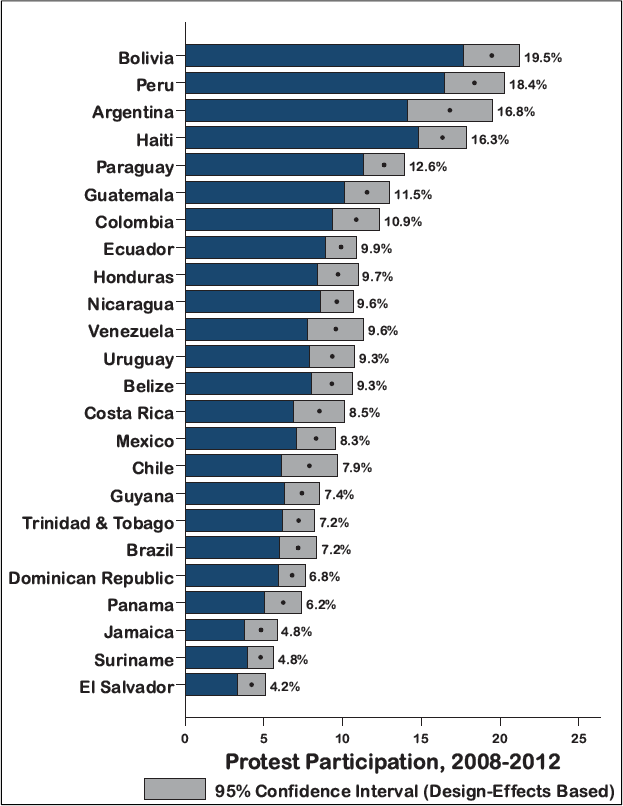
Percent of Respondents Who Participated in a Protest, 2008–2012
The data used in the present study is superior to the cross-national data on protest participation employed in other studies for two primary reasons. First, the current study is uses data from the AmericasBarometer surveys from 2008 to 2012, which all specify a time frame of the past 12 months when inquiring about protest participation – something that other cross-national projects like the World Values Survey have not always done. Questions that fail to establish a time frame cannot be certain to measure current levels of protest participation, but instead likely capture an individual's lifetime account of protest activity. Such data are likely to indicate higher rates of protest participation in older democracies, where protesting has been permitted for many years, even if current levels are not particularly high.
Although these data do not demonstrate present levels of protest, the predictors of protest (e.g. community activity, wealth, and even levels of education) do reflect current conditions. This temporal disconnect between the independent and dependent variables then casts doubt on the meaning of findings that are based on this measure of protest activity – such as those based on World Values Survey data from before 2005. 8
In the most recent version of the World Values Survey questionnaire available online (2005) the question now includes the phrase “during the last five years.” However, all previous surveys – which have been used in the studies cited above, including the key study by Dalton, van Sickle, and Weldon (2010) – only ask respondents whether they have ever participated in any of the enumerated activities, without limiting responses to a certain time period.
Second, the AmericasBarometer survey offers multiple time points at which we can evaluate the determinants of protest participation for each country, which helps remedy any potential bias related to an outlier year for a particular country and increases the number of observations for second-level variables. For example, protest participation was relatively low in Chile in 2010 (and seemingly before, though we lack AmericasBarometer data to confirm) but skyrocketed to 11 percent in 2012, placing it in the top five in the region. Therefore, one round of surveys can capture an anomalous moment in a country's history given the often sporadic nature of large protest events. By taking into account results from three separate surveys, the present study provides a more balanced view of a country's proclivity to protest over time that is less subject to exceptional years and episodes of mass contention.
At the individual level the key independent variable for capturing community engagement is an index that gauges the frequency with which citizens participate in local organizations. Respondents were asked how often they attended meetings for a variety of community organizations during the previous year, including community improvement associations, parent organizations, professional associations, religious groups, and political parties. The response options provided were “Never,” “Once or Twice a Year,” “Once or Twice a Month,” and “Once a Week.” I then coded the response levels from 0 (“Never”) to 3 (“Once a Week”) and added the five variables to form a single “engagement” index, which was then rescaled as 0–100. I argue that this variable effectively measures the extent to which individuals are engaged in community activities and have access to the organizational structures that have been demonstrated to help facilitate collective action by a number of recent studies on resource mobilization and protest in Latin America (e.g. Garay 2007). Indeed, several of the countries with the highest rates of community engagement in the region – for example, Bolivia and Haiti – are also among the most contentious (see Appendix).
At the individual level I also include variables for interest in politics, level of education, and use of social media to share or receive political information – each of which measures an individual's capacity for being mobilized and thus serves as a proxy for the resource mobilization approach (see Dalton, van Sickle, and Weldon 2010). In addition, I draw from questions on support for key political institutions and satisfaction with public services to shed light on how perceptions of political institutions influence individuals’ proclivity to protest. To control for competing theories regarding the influence of specific grievances on protest participation, I include individual-level variables for presidential approval, evaluations of individuals’ personal economic situations, evaluations of the national economic situation, and socioeconomic status. 9 Interpersonal trust is also included, as many argue that trust in one's fellow citizens increases an individual's probability of protesting (e.g. Inglehart 1989; Dalton, van Sickle, and Weldon 2010).
In addition to arguments regarding the more general economic determinants of protest across national contexts and individuals (e.g. Dalton, van Sickle, and Weldon 2010), these variables provide proxies for several Latin American– specific theories focusing on how corruption scandals (particularly those linked to particular presidents) and short-term economic shocks can drive individuals to protest (e.g. Smulovitz and Perruzzoti 2000; Hochstetler 2006; Pérez-Liñan 2007). While it is not my intention to explicitly contradict these studies, it would seem necessary to adequately address their findings in any model specification that seeks to understand protest participation across the region. Indeed, one might argue that many of these theories fall under the umbrella of declining system support, which is very much in keeping with the notion that when individuals lose faith in formal institutions (e.g. due to some sort of massive corruption scandal), they become increasingly motivated to adopt more contentious strategies.
For the second-level variables (i.e., country-level variables) on institutional quality, I turn to the World Bank's Worldwide Governance Indicators (WGI). The WGI offers measures on six dimensions of governance, three of which are relevant to this study: Voice and Accountability, Government Effectiveness, and Rule of Law. These measures represent the views of business, citizens, and elite survey respondents, and are based on “30 individual data sources produced by a variety of survey institutes, think tanks, non-governmental organizations, international organizations, and private sector firms” (WGI website). These indicators offer the best combination of coverage across countries and time and rigorous measurement techniques for the countries included in the AmericasBarometer survey – though the indicators are certainly not without drawbacks (see Kaufmann, Kraay, and Mastruzzi 2007). Descriptions of each dimension from the creators of the indicators can be found in the Appendix.
Each of these three dimensions captures an important component of institutional quality and is tested individually as a second-level predictor of protest participation. 10 Voice and Accountability helps gauge the extent to which individuals can effectively participate in politics and obtain representation in government, while Government Effectiveness measures regime transparency and capacity in the making and implementation of public policy. Rule of Law gauges how well regimes offer citizens equal protection under the law, which is a crucial characteristic of effective democratic governance. I also combine the three variables to create an additive index called the Institutional Quality Index, which I use in the analyses below as an indicator of the institutional environment in which individual citizens operate.
For country values on each of these indicators, please see the table in the Appendix.
In Figure 3 countries are listed in terms of their average Institutional Quality Index score for the period 2008–2012. Chile leads the region in terms of institutional quality with a score of 1.2. 11 Unsurprisingly, Haiti and Venezuela score lowest at −1.2 and −1.1, respectively, while a large group of Latin American countries hover around zero. These scores indicate that even though democracy predominates in the region, the quality of political institutions and governance varies greatly, with the majority of regimes not living up to modern standards of liberal democracy.
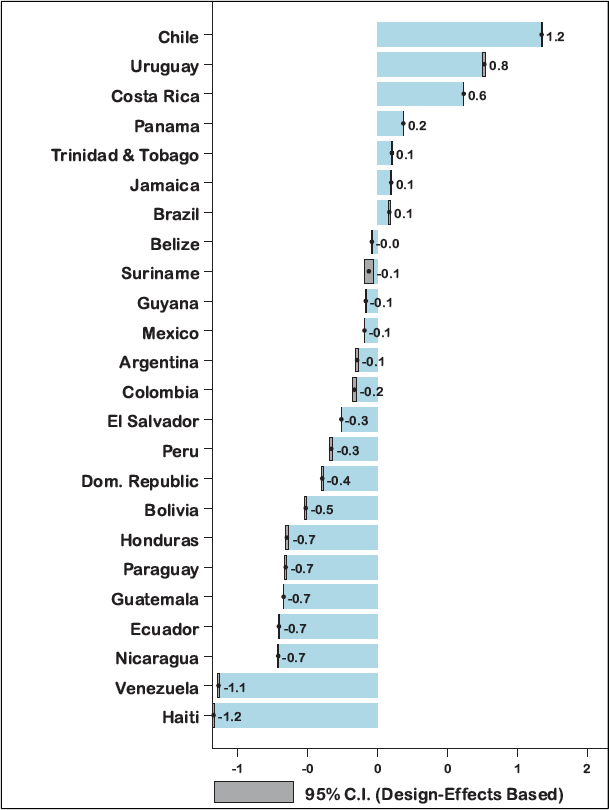
Mean Institutional Quality Scores, 2008–2012
As a reference point, the score for the United States during this time period was 1.39.
As controls, I include second-level measures of human development, inequality, and economic growth during the year of the survey. These variables serve to evaluate grievance-based explanations of contentious politics as well as to provide assurance that the causal effects of variation in institutional quality on protest participation are not a function of an omitted variable linked to both institutional quality and protest levels.
Analysis
The dependent variable in this analysis is protest participation, measured at the individual level. I begin with two individual-level models of protest across Latin America that highlight the microfoundations of protest behavior. In the second set of models, I then incorporate the national-level variables discussed above in order to assess the impact of these second-level institutional factors on individual-level protest participation.
Individual-Level Models
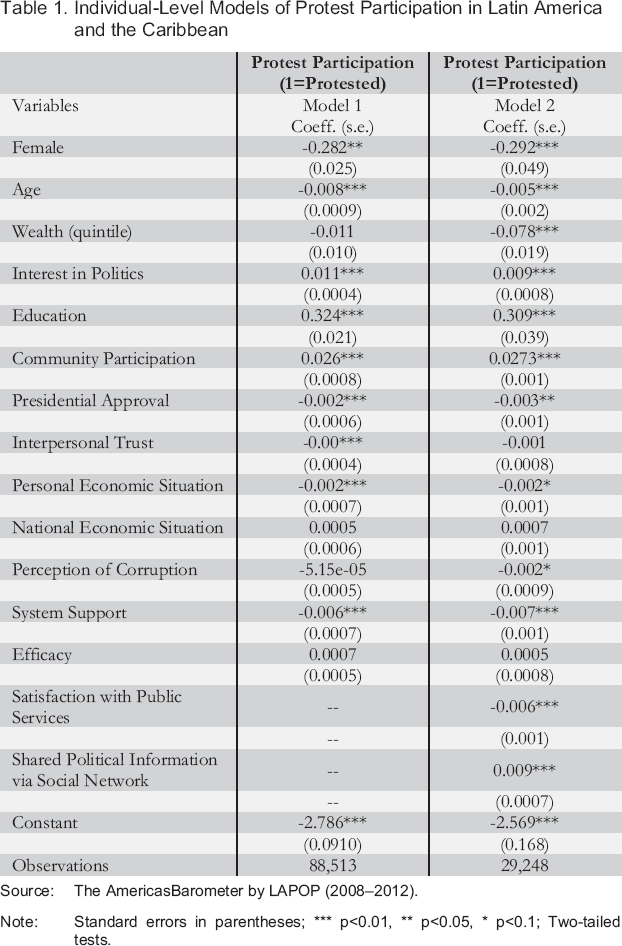
Table 1 displays the results from the first set of models, each of which employs logistic regression given the dichotomous nature of the dependent variable. 12 In Model 1 we see that several variables emerge as strong predictors of protest participation, none more so than Community Engagement. An increase from the 0 to 50 on the Community Engagement scale nearly triples an individual's probability of protesting when holding other covariates at their means (see Figure 4). 13 Moreover, a person at the highest value in terms of community activism is more than four times more likely to participate in a protest than someone in the lowest quintile when holding other variables constant at their means. In keeping with the resource mobilization approach to explaining protest participation, education and interest in politics also have strong positive effects on the probability of participating in a protest. At the individual level, then, engagement certainly plays a decisive role in motivating protest participation.
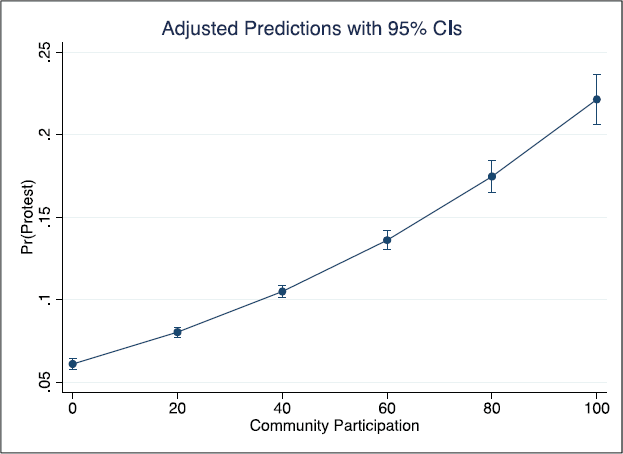
Predicted Probabilities Based on Changes in Levels of Community Engagement
Individual-Level Models of Protest Participation in Latin America and the Caribbean
Source: The AmericasBarometer by LAPOP (2008–2012).
Note: Standard errors in parentheses;
p<0.01,
p<0.05,
p<0.1; Two-tailed tests.
These logistic regression models account for the complex nature of the survey data, which include stratification and clustering. Both models were also run including fixed effects for countries and years, with Uruguay and 2012 as the baseline. However, given that this did not affect results, those coefficients are not reported in Table 1. All countries are weighted to an equal N.
Predicted probabilities are calculated using Stata 12's “margins” command while holding other variables in the model at their mean. Graphs were made using the “marginsplot” command, which graphs the results from “margins.”
On the other hand, several variables seem to decrease Latin Americans’ likelihood of participating in a protest. Net of other factors, women are less likely to participate in a protest, and age has a significant negative impact on protest participation as well. Perhaps most importantly for the purposes of this paper, System Support has a significant negative effect on the probability of taking part in a protest march or demonstration – which means that individuals who view key regime institutions more positively are less likely to protest, while those with more negative evaluations are more likely to protestor.
Even though this effect is far less substantive than that of Community Engagement, moving from the lowest quintile in terms of system support to the highest results in a 25 percent decrease in the probability of participating in a protest (from .12 to .9).
One individual-level finding that seems to hint at a potential cross-level interaction between institutional quality and civic engagement is the interaction between System Support and Community Engagement (Figure 5). 14 As predicted, low support for the system and high engagement produce the highest probabilities of participating in a protest. Perhaps most interesting about this interaction though is the extent to which the effect of low system support is conditional on at least a moderate level of community involvement. At minimal levels of Community Engagement, no decrease in System Support seems to increase the probability of protesting; however, even with a slight increase in Community Engagement, the effect of System Support surfaces.
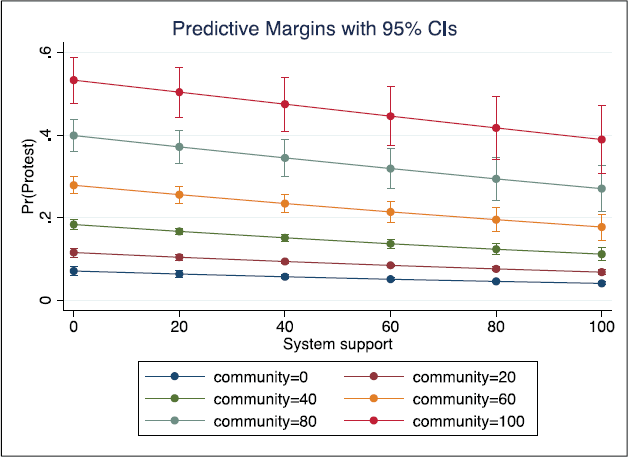
Predicted Probabilities: Interaction between System Support and Community Engagement
These predicted probabilities were derived from inserting an interaction term into Model 1; thus, all of the variables appearing in Table 1 were held at their mean when calculating predicted probabilities.
Model 2 adds variables for information sharing via social networks and satisfaction with public services to the equation. Each of the questions that serve as the bases for these two variables was only asked in 2012, meaning that the number of observations drops substantially. However, both variables have significant effects on an individual's probability of protesting. The findings show that an increase in satisfaction with public service provision decreases the odds of protesting, whereas those who actively share or receive political information through social networks are nearly three times more likely to participate in a protest than those who do not when holding other variables at their means and modes. The effect of evaluations of public services mirrors the effect of system support – that is, a lack of faith in formal political institutions and the state's competence in providing for citizens’ welfare is associated with higher protest participation. Information sharing via social networks appears to have a similar mobilizing effect to community engagement, political interest, and education.
In sum, based on these predictive models of protest participation in Latin America from 2008 to 2012, it appears that citizens who are actively engaged in their communities – namely, those who are interested in politics, participate in community organizations, and share political information via the Internet – and citizens who have negative views of key regime institutions and public services are the most likely protestors. 15 While these initial findings comport with the theoretical approach outlined above, the more important test of how institutional environment shapes participation repertoires requires a multilevel approach, which follows in the next section.
In any attempt to propose and test a causal argument using cross-sectional data, endogeneity is justifiably a concern. In this case the most plausible alternative explanation would be that protest actually increases community engagement, in that demonstrations might link formerly unassociated protestors to established civic organizations. Replacing a potentially problematic variable with an instrument unrelated to the outcome variable can help solve this problem (Sovey and Green 2011). A two-stage least squares model instrumenting for protest with ideology (an instrument deemed “not weak”) coupled with a Hausman test somewhat assuages concerns that the causal arrow flows from community engagement to protest and not the other way around, as I was unable to reject the null hypothesis of exogeneity. However, I include results from an instrumental variables regression model that instruments for community engagement in the Appendix. While the predicted effect of community engagement on protest is somewhat attenuated, it remains one of the strongest predictors in the model.
Multilevel Models
In the second set of models country-level variables were added to each model and multilevel fixed-effects logistic regression models were estimated to account for variation between countries during the three survey years under consideration. In other words, the second-level variables listed in each model describe “country years” – namely, the national context in which individuals from each round of the AmericasBarometer responded to the survey questions. The results for eight models of protest participation are presented in Table 2. In addition to the individual-level variables that proved consequential in the regional analyses presented above, second-level economic variables serve as controls in each model. Variables for the WGI indicators of institutional quality were added one at a time in the first four models in Table 2, and then interaction terms were inserted in the last four models.
Multilevel Models of Protest Participation in Latin America and the Caribbean
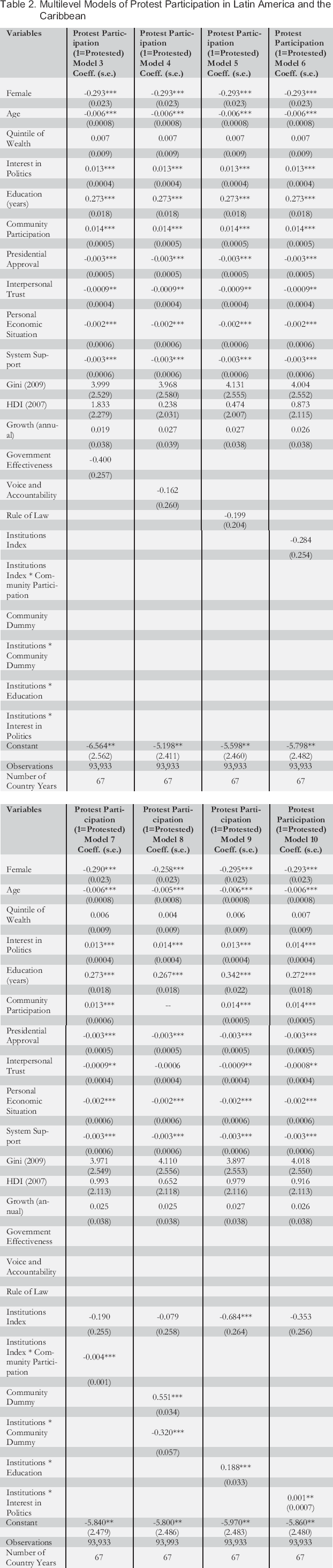
First, it should be mentioned that the second-level economic variables included here seem to play a relatively minor role in explaining individual-level protest dynamics in Latin America during the time period under consideration. 16 Neither inequality nor human development nor GDP growth during the year of the survey emerge as significant predictors of protest participation, which raises questions about the general arguments regarding the macrolevel economic conditions under which protests are most likely to occur (e.g. Dalton, van Sickle, and Weldon 2010). Although individuals’ perceptions of their personal economic situation do continue to carry some weight, as do negative performance evaluations of the current president, wealth is not a strong predictor of participation, and the substantive effects of economic evaluations pale in comparison to those of variables measuring political interest and engagement (see below). However, the lack of results for the economic variables does not mean that economic grievances fail to play any role in motivating instances of contentious behavior; rather, it indicates that many citizens experiencing economic hardship choose not to protest, while others in comfortable economic situations choose to do so. Moreover, perhaps some other specific macroeconomic trend (e.g. unemployment, inflation, or a currency devaluation) influences individuals’ proclivities to protest in ways that these relatively general measures of economic well-being cannot capture. Indeed, the results of individual evaluations of personal economic situation and the sitting president would support this notion. Yet through this combination of country-level and individual-level controls for economic factors, I feel confident that the results for institutional factors and community engagement presented below are not simply picking up on an omitted grievance-related variable.
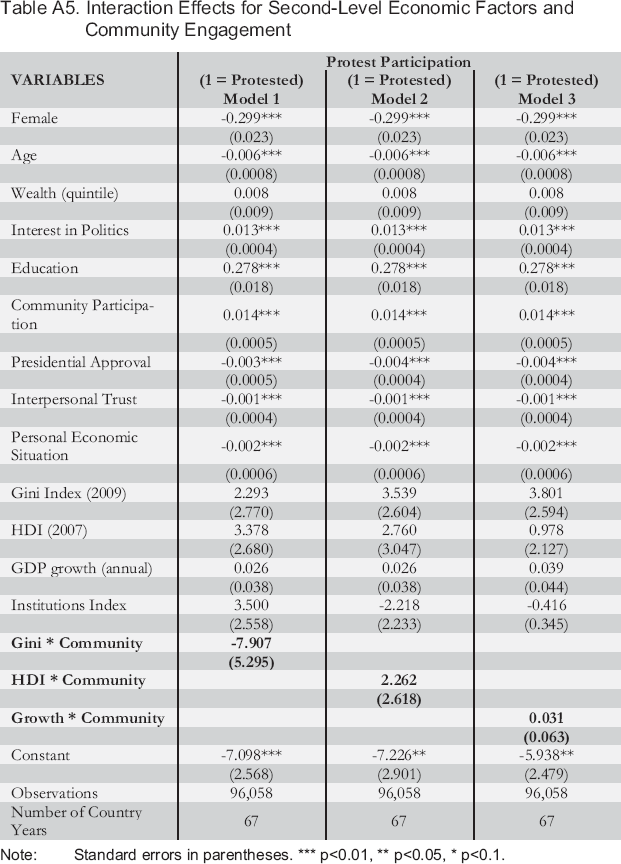
In response to feedback on an earlier draft of this paper, I have included three models in the Appendix that test the hypothesis that economic context has a similarly conditional influence on protest participation to the interactive relationship between community engagement and institutional factors. This would make intuitive sense given that if institutional weakness only exerts a stimulative impact on individuals who are already connected to mobilizing organisms, economic stagnation, too, might only activate protests among similarly engaged citizens. However, I find no such significant interactive effect.
The relationship between institutional context and protest participation is a thornier one to interpret. In each of the first four models, it appears that the institutional variables – while having the predicted negative sign – fail to attain statistical significance as predictors of protest involvement. This would seem to indicate that institutional environment itself does not have a significant impact on the probability that individuals within that context will protest when controlling for other individual-and aggregate-level factors, which contradicts the findings of Machado, Scartascini, and Tommasi (2011).
However, the theory I put forth in this paper is an interactive one, whereby institutions interact with community engagement to affect individuals’ likelihood of adopting contentious political behaviors. In Model 7 I interact the Institutional Quality Index, a country-level variable, with Community Engagement, an individual-level variable. The coefficient is negative and is statistically significant at the 1 percent level. The fact that the effect of the Institutional Quality Index is insignificant in this model indicates that it is not an important predictor of protest where Community Engagement equals zero. However, the significance of the interaction's coefficient indicates that this changes as the two interacted variables’ values change.
Figure 6 displays the predicted probabilities of participating in a protest depending on variation in institutional context and community engagement. By graphing changes in the predicted probabilities, we can clearly observe that the causal impact of institutional context changes drastically depending on community engagement levels, and vice versa. Where Community Engagement equals zero – that is, citizens have no ties to any of the five types of civic organizations referred to in the questions that make up the index – the Institutional Quality Index has no effect on the probability of protesting. However, as community engagement increases, the causal importance of institutional context begins to emerge. Where Community Engagement equals 50, it seems that citizens in low-quality institutional settings become substantially more likely to protest when holding other individual- and second-level variables at their means and modes. Where community involvement is high, the differences in probabilities are even starker; indeed, whereas a maximally engaged individual in a low-quality institutional environment (Institutional Quality Index = −1) possesses a .48 probability of participating in a protest, that same individual in a high-quality institutional environment only possesses a .26 probability of participating. Thus, active citizens are nearly twice as likely to protest in low-quality institutional contexts compared to high-quality institutional contexts.
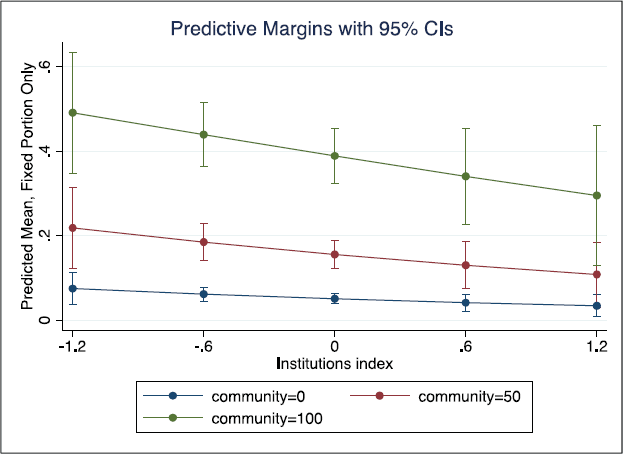
Predicted Probabilities: Interaction between Institutional Context and Community Engagement
As a robustness check, Model 8 offers a similar interaction term with an alternative coding of the community engagement variable. I use the variable Community Engagement Dummy to identify those individuals who were at least minimally participative in one community organization (coded as 1) and those who possessed no ties to local community groups (coded as 0). 17 Throughout Latin America roughly 22 percent of respondents were completely unengaged in their communities, while 78 percent were at least minimally participative.
This alternative coding of the engagement variable controls for the possibility that a small number of hyperengaged citizens (e.g. individuals who are active in three or more community organizations) are driving the results.
Predicted probabilities for this interaction are presented in Figure 7. Again, it appears that the causal import of community engagement and institutional quality are highly dependent on one another. Engaged citizens in low-quality institutional environments are almost twice as likely to participate in a protest as their counterparts in high-quality institutional settings. Moreover, while engaged citizens are more than twice as likely as unengaged people to protest in weak institutional settings, that difference is not nearly as glaring in strong institutional settings. Unengaged citizens are almost equally likely to participate in protests regardless of institutional context. Put simply, it seems that weak political institutions push the politically engaged toward protest participation while having very little effect on the contentious behaviors of unengaged citizens.
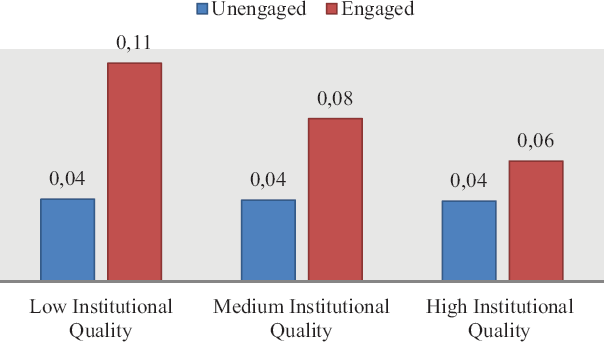
Predicted Probabilities: Unengaged versus Engaged Citizens
Models 9 and 10 include interaction terms with the Institutional Quality Index, on the one hand, and Education and Interest in Politics, respectively, on the other. In each of these two models the coefficient term for the interaction is significant. Both Education and Interest in Politics interact similarly with the Institutional Quality Index as they do with Community Engagement in that each becomes a stronger predictor of protest participation in weak institutional contexts, particularly in the case of Interest in Politics. For entirely uninterested or uneducated citizens, institutions fail to exert much influence on their probability of protesting; however, as Interest in Politics and Education increase, the causal import of institutional quality increases. The significant effects of interactions between institutions and civic engagement, education, and interest in politics corroborate Boulding's findings with regard to NGOs (2010, 2014) and also indicate that NGO activity might simply serve as another example of a larger universe of organizational connections that fuel protest participation in distinct political environments – much in line with the core arguments of resource mobilization. In other words, it might not necessarily be the nature of NGOs specifically that motivates protest in weak democracies, but rather access to organizational resources more generally.
Finally, as a point of illustration, I compare the effects of community engagement on protest participation in Argentina and Chile. As corroborated by the Institutional Quality Index, Chile is known for possessing the strongest democratic institutions in Latin America, while its Andean neighbor has long been characterized by institutional instability (Machado, Scartascini, and Tommasi 2011). Figure 8 shows the difference between the two countries in terms of the extent to which Community Engagement predicts Protest.
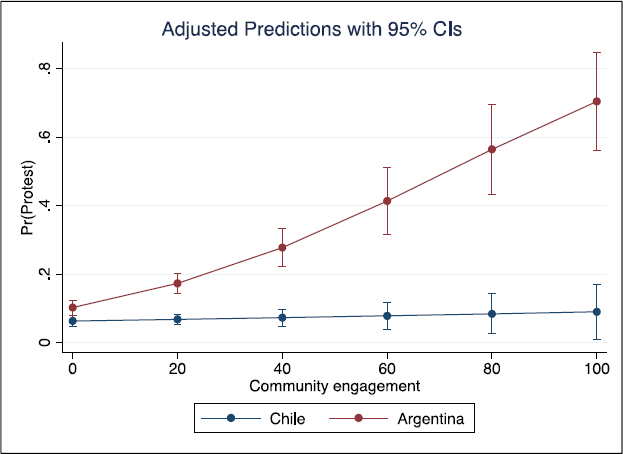
Civic Engagement and Protest: Argentina versus Chile
Holding other variables at their means in the base individual-level model presented above, community activism exerts a powerful positive effect on an individual's probability of protesting in Argentina, but not in Chile. Thus, it appears that in weak institutional contexts, civic engagement is strongly associated with protest participation. However, when individuals are not tied to these organizations or routinely exposed to the failings of the democratic system (Community Engagement = 0), institutions fail to exert much influence on contentious behavior.
Conclusion
This paper constitutes an effort to understand how regional economic and political trends have produced variation in terms of protest in Latin American democracies. The findings here suggest that there is an interactive relationship between individual-level sociopolitical factors and country-level institutional characteristics. Low-quality political institutions have an important positive effect on protest participation, but only among citizens who are at least minimally engaged in political life. In other words, low-quality institutions alone cannot determine whether or not an individual decides to attend a protest. Rather, the combination of high levels of individual-level political engagement and community involvement, on the one hand, and low-quality institutional environments where citizens feel underrepresented by formal democratic institutions, on the other hand, greatly increase the probability that citizens will resort to contentious tactics to make their voices heard.
Rather than putting forth one variable or set of causal factors as the driving force behind contentious politics, I offer a more nuanced interactive theory that combines two seemingly contradictory phenomena (i.e. dysfunctional institutions and high civic engagement) to explain protest. From a normative standpoint, the takeaway from this paper is a bit complicated. Virtually any scholar would argue that community engagement serves as a positive force in democracies, and that individuals across Latin America and other regions are only capable of participating in protests because of massive gains in political liberalization made during the last four decades and recent socioeconomic advances that have seemingly laid the foundation for a rise in civic activism.
Both points are correct. However, the massive wave of democratization that has taken place since the 1970s has also produced a multitude of regimes where elections occur and basic civil liberties are observed, but where formal representative institutions fall short in terms of effectively channeling mass participation and public opinion. The results presented here suggest that when formal institutions fail to meet the needs of a highly engaged and determined populace, engaged citizens will adopt other means to make their claims. Mass-level democratic engagement has outpaced the consolidation of high-quality formal institutions in many Latin American regimes, creating a gap in terms of citizens’ demands for democratic representation and the supply thereof. Thus, while Latin American citizens are becoming more democratic in many ways, the regimes they inhabit are not – the swelling rates of protest across the region are symptomatic of this dichotomy.
Moving beyond twenty-first century Latin America, these findings might also help understand how gains in social development and civic engagement, coupled with low-quality formal political institutions, could lie at the root of mass protests in other regions and time periods. Indeed, an increase in political engagement and the use of social media to share political information clearly played an important role in the Arab Spring countries, where citizens began to demand institutional reforms that made leaders more accountable to the citizenry. In Europe citizens in Greece and Spain – both of which possess a myriad of educated and engaged citizens – have been not only devastated by a severe economic recession, but also frustrated by their inability to make themselves heard by policymakers amid EU-prescribed austerity measures. Even going back to the civil rights movement and antiwar demonstrations in the 1960s and 1970s in the United States, protests were seemingly led by increasingly active and informed citizens faced with exclusionary or non-responsive political institutions. Thus, this paper casts light on a broader set of phenomena and informs scholars as they attempt to understand the causes and consequences of future episodes of protest participation across the world.
Footnotes
Appendix
Interaction Effects for Second-Level Economic Factors and Community Engagement
| VARIABLES | (1 = Protested) Model 1 | Protest Participation (1 = Protested) Model 2 | (1 = Protested) Model 3 |
|---|---|---|---|
| Female | -0.299 *** (0.023) | -0.299 *** (0.023) | -0.299 *** (0.023) |
| Age | -0.006 *** (0.0008) | -0.006 *** (0.0008) | -0.006 *** (0.0008) |
| Wealth (quintile) | 0.008 (0.009) | 0.008 (0.009) | 0.008 (0.009) |
| Interest in Politics | 0.013 *** (0.0004) | 0.013 *** (0.0004) | 0.013 *** (0.0004) |
| Education | 0.278 *** (0.018) | 0.278 *** (0.018) | 0.278 *** (0.018) |
| Community Participation | 0.014 *** (0.0005) | 0.014 *** (0.0005) | 0.014 *** (0.0005) |
| Presidential Approval | -0.003 *** (0.0005) | -0.004 *** (0.0004) | -0.004 *** (0.0004) |
| Interpersonal Trust | -0.001 *** (0.0004) | -0.001 *** (0.0004) | -0.001 *** (0.0004) |
| Personal Economic Situation | -0.002 *** (0.0006) | -0.002 *** (0.0006) | -0.002 *** (0.0006) |
| Gini Index (2009) | 2.293 (2.770) | 3.539 (2.604) | 3.801 (2.594) |
| HDI (2007) | 3.378 (2.680) | 2.760 (3.047) | 0.978 (2.127) |
| GDP growth (annual) | 0.026 (0.038) | 0.026 (0.038) | 0.039 (0.044) |
| Institutions Index | 3.500 (2.558) | -2.218 (2.233) | -0.416 (0.345) |
|
|
|
||
|
|
|
||
|
|
|
||
| Constant | -7.098 *** (2.568) | -7.226 ** (2.901) | -5.938 ** (2.479) |
| Observations | 96,058 | 96,058 | 96,058 |
| Number of Country Years | 67 | 67 | 67 |
Note: Standard errors in parentheses.
p<0.01,
p<0.05,
p<0.1.