



Abstract
For 20 years following the 1989–1990 democratic transition, Chilean politics was characterized by stable forms of party-based political representation, relatively low levels of social mobilization, and a technocratic consensus around a neoliberal development model that generated rapid and sustained, albeit highly unequal, patterns of economic growth. This sociopolitical matrix was challenged, however, when hundreds of thousands of students and their supporters took to the streets to protest against educational inequalities, while smaller numbers of protestors mobilized around a plethora of other labor, environmental, and indigenous rights claims. This wave of social protest occurred in a context of growing detachment of Chilean citizens from traditional parties and representative institutions, and it punctured the aura of inevitability and consensus that surrounded the country's economic model. The ground-swell of popular protest signified the end of a posttransition political era in Chile and the dawning of a new one defined by the repoliticization of social and economic inequalities, including vigorous debates about the social pillars of the neoliberal model and the reach of social citizenship rights. The Chilean case sheds new light on the processes by which inequalities come to be politicized or depoliticized in different structural, institutional, and ideational contexts.
Introduction
Challenges to democratic representation in contemporary Chile reflect, in part, a growing detachment of citizens from political parties and other formal representative institutions. This detachment, however, cannot simply be attributed to generalized political apathy or a withdrawal from political affairs. Instead, for many citizens and social groups, detachment from formal institutions is coupled with an increased propensity to engage in collective action – that is, to mobilize politically – both outside and against party-mediated channels of interest representation. The mass protest movements of the second decade of the twenty-first century are the most visible manifestation of this extrainstitutional sociopolitical mobilization, and they demonstrate its inclination toward contentious modes of collective action and demand articulation (see McAdam, Tar-row, and Tilly 2001). 1
The author would like to thank Carolina Segovia, Cristóbal Rovira Kaltwasser, and Rosanna Castiglioni for their helpful comments on an earlier draft of this paper.
The editors of this special issue would like to acknowledge support from the Chilean Millennium Science Initiative (project NS130008).
As Tarrow suggests, contentious forms of collective action are intrinsically related to representational deficiencies. That is, they are employed by people “who lack regular access to representative institutions” and “act in the name of new or unaccepted claims” (Tarrow 2011: 7). Such deficiencies lie at the heart of social protest in contemporary Chile, as in other Latin American countries that experienced mass protests in recent decades (Roberts 2014). While a diverse array of social actors have engaged in protest activities in Chile – including students, workers, indigenous groups, and environmental activists – all have articulated claims that found little expression in the mainstream party organizations that dominated electoral and policy-making arenas under the post-1990 democratic regime. Most of these claims were related to the “social deficits” of the neoliberal development model that Chile's mainstream parties largely retained following the transition from military rule. Indeed, challenges to social and economic inequalities embedded within the neoliberal model have provided a type of “master frame” (Snow and Bedford 1992) for diverse forms of contentious collective action outside formal channels of representation – a pattern that has previously been seen in other Latin American countries like Argentina, Venezuela, Bolivia, and Ecuador (Silva 2009). As such, the politicization of inequality – or, as explained below, its repoliticization – is central to understanding the challenges confronted by representative institutions in contemporary Chilean democracy.
For 20 years following the 1990 regime transition, Chilean democracy was characterized by stable forms of party-based political representation, relatively low levels of social mobilization, and a technocratic consensus around neoliberal policies that generated rapid and sustained, yet highly unequal, patterns of economic growth. All three dimensions of this sociopolitical matrix were challenged, however, when hundreds of thousands of students and their supporters took to the streets in 2011 to protest against educational inequalities, while smaller numbers of protestors mobilized around a plethora of other labor, environmental, and indigenous rights claims (see Donoso and von Bülow 2017). Breaking with a quarter century of relative societal quiescence and institutionalized political competition, this new wave of social protest outflanked Chile's party system to the left and punctured the aura of inevitability and consensus that surrounded the highly touted economic model. Although neither the activist networks nor the grievances they articulated were new to Chilean politics, their newfound capacity to mobilize large numbers of citizens to march, protest, occupy public spaces, and disrupt everyday activities marked a sea change in the national political arena.
Indeed, the groundswell of popular protest signified the end of the posttransition political era and the dawning of a new one defined by the repoliticization of social and economic inequalities. Although inequalities were not entirely absent from the political agenda during the posttransition era, they were addressed in a highly technocratic fashion that de-emphasized distributive conflict as an axis of partisan competition and largely eliminated it as a focal point of social mobilization. This technocratic depoliticization changed abruptly when students rebelled en masse and forced Chile's partisan and representative institutions to open new debates around the social pillars of the neoliberal model, the reach of social citizenship rights, and even the very constitutional foundations of the post-1990 democratic order.
The Chilean case, then, is tailor-made for understanding how inequalities come to be politicized or depoliticized in different structural, institutional, and ideational contexts. Although politicization has structural underpinnings in extant patterns of social stratification, it is inevitably a historically contingent, agency-centered political process that is driven forward by social and political actors. These actors are generally collective in nature and potentially located at a wide range of different structural positions. A politicization process can assume top-down or bottom-up forms and is subject to a myriad of organizational expressions and institutional channels that mediate between these different levels.
This paper thus problematizes the process of politicizing inequalities, breaking with recent influential work that assumes the character and intensity of distributive conflicts can be deduced directly from underlying structures of inequality (see Boix 2003; Acemoglu and Robinson 2006). Following a more constructivist logic, I argue that the politicization of inequalities is neither a given nor a structural imperative; it is, instead, a contingent and varying outcome of historically situated processes of sociopolitical mobilization, competition, and conflict. Political agency is central to such processes, which are heavily conditioned by the social construction and strategic behavior of collective actors like political parties, civil society organizations, and social movements.
Where partisan and electoral competition do not politicize inequalities – that is, where parties ignore or downplay distributive outcomes and compete on the basis of other forms of political differentiation – the political agenda may be strikingly divorced from underlying structural inequalities. Such depoliticization, however, is largely predicated on societal quiescence, as it is susceptible to social and political mobilization outside established representative institutions by collective actors who articulate claims that mainstream parties do not recognize or accept. Chile's governing parties, for example, downplayed structural inequalities in the education system by trying to expand access to private higher education, believing that tuition credits and student loans would create new educational opportunities and enhance individual social mobility. The student movement, by contrast, mobilized around claims for fundamental institutional reforms that would eliminate private profits from the education system and establish free universal public education – demands that went far beyond the limited measures that were initially entertained by the political establishment.
To explain these dynamics, this article traces the process by which inequalities were first depoliticized and then repoliticized during Chile's contemporary democratic period, focusing on the interplay between institutional and societal actors – in particular, political parties and social movements. I then draw from public opinion survey data to analyze protest behavior at the microlevel and explore its demographic, political, and attitudinal correlates. The analysis demonstrates that the activation of concerns related to social needs and inequalities lies at the heart of recent cycles of contentious politics in Chile. While much of this activation occurs outside established partisan channels, some of it also takes place among party members or sympathizers who support more vigorous state efforts to address social problems.
Conceptualizing the Politicization of Inequality
The politics of inequality have occupied a prominent place on Chile's political landscape for most of the past century, although they have played out in remarkably diverse and shifting ways. Managing social and economic inequalities has been a central concern of Chilean democratic governments since the 1920s, and distributive conflicts were at the heart of democratic breakdowns – and subsequent periods of authoritarian closure – in the 1920s and 1970s. Even by Latin American standards, the ebbs and flows of Chilean politics have been heavily conditioned by cyclical patterns of politicizing and depoliticizing inequalities, which have created marked cohort and generational effects in the national body politic.
These cyclical patterns help to shed light on the limitations of dominant theoretical approaches to the study of democracy and inequality. Building on the pioneering formal model of Meltzer and Richard (1981), the celebrated studies of Boix (2003) and Acemoglu and Robinson (2006) make two critical assumptions: (1) that democratic regimes respond to the policy preferences of the median voter, and (2) that these preferences naturally incline toward redistributive measures under conditions of inequality, since the income of the median voter is necessarily lower than the mean income in society when wealth is concentrated among the few. For all their game-theoretic, microanalytic rigor, such rationalist approaches ultimately rest on highly structuralist foundations, as regime and distributive outcomes are both derived from the aggregation of individual preferences based on structural locations on the income scale. Political institutions, then – whether democratic, authoritarian, or revolutionary – are treated as a function of distributive conflict.
As in any structuralist approach, these works lack an appreciation for the relative autonomy of the political sphere and the role of political agency, including the ideational underpinnings of strategic behavior. When politics is factored in, both of the aforementioned assumptions are rendered highly contingent and variable; democratic regimes may not respond to the policy preferences of the median voter, and popular majorities may not express preferences – much less mobilize politically – for redistributive outcomes. A wide array of institutional, behavioral, and ideational factors can cause democratic outcomes to deviate from structurally derived rationalist assumptions. From above, these assumptions largely ignore the potential distortionary effects of concentrated wealth on democratic institutions and policy-making processes, since economic elites possess a wide array of wealth-based political resources, access, and influence that can compensate for their limited numbers (Winters 2011; Gilens 2012). From below, these assumptions radically discount the political challenges of aggregating individual preferences behind a majoritarian collective project for redistributive outcomes. The latter, for example, is often undermined by (i) patterns of patron-clientelism that induce low-income voters to prioritize particularistic benefits over broader redistributive measures, (ii) political competition focused on widely shared valence issues (such as economic growth, clean government, or law and order) rather than divisive positional issues (such as redistribution), or (iii) the political salience of nonredistributive cultural issues and identities for many low-income citizens.
Indeed, as Schattschneider emphasizes (1960: 101–110), social and economic inequalities can have an exclusionary political effect: by skewing the functioning of democratic institutions and the content of public policy toward the interests of the well-to-do, they alienate and deactivate the poor, who disproportionally abstain from democratic participation even when they possess formal suffrage rights. Furthermore, as Castillo (2012) demonstrates in the Chilean case, some degree of inequality tends to become “normalized” and even justified by both elite and popular sectors, rather than serving as a focal point of democratic contestation.
Finally, even where popular majorities do prefer redistributive outcomes, such preferences are not automatically aggregated and channeled into institutional and policy-making arenas. Political organization is essential to translate the weight in numbers of lower class groups into a coherent political force, inevitably posing significant collective action problems to any redistributive project (Ansell and Samuels 2014: 41–42). Patterns of civic and partisan organization are thus crucial for determining whether and how the redistributive interests of popular sectors achieve effective institutional representation (see Huber and Stephens 2012).
There are no guarantees, then, that democratic competition will turn on distributive issues or that social and economic inequalities will even be politically salient. Where lower classes are politically fragmented or disorganized, incorporated politically through elite-controlled clientelist networks, or mobilized through valence issues or cultural appeals that do not entail redistributive commitments, democratic institutions may very well reproduce or even accentuate structural inequalities. This conclusion is an analytical complement to recent work that challenges Boix (2003) and Acemoglu and Robinson (2006) by arguing that the origins of democracy can often be found in efforts to regulate and institutionalize elite competition rather than in redistributive pressures from below (Haggard and Kaufman 2012; Ansell and Samuels 2014).
Whatever the origins of democracy, however, economic elites inevitably confront the challenge of safeguarding their minority interests in institutional settings of majority rule. The dominant strategy for elite actors is thus to depoliticize inequalities – that is, to preclude distributive issues from becoming a focal point of democratic contestation by popular majorities. Such depoliticization has two central components. First, it requires that partisan and electoral competition revolve around issues or competitive axes that lower the salience of distributive conflicts and do not cleave the electorate along class lines. The aforementioned patterns of clientelist, valence, or cultural competition that cut across class lines are thus likely to be favored by elite actors who seek to minimize redistributive pressures from below. In other words, parties with elite core constituencies seek to mobilize working- and lower-class support through clientelist linkages or an emphasis on valence issues like economic growth, “modernization,” or law and order. Second, depoliticization requires the containment of social and civic mobilization outside the partisan/electoral arena by actors pursuing redistributive goals. Since democratic rights and liberties preclude a reliance on coercive instruments of demobilization, effective containment is likely to rest on the political and organizational fragmentation of popular sectors and the collective action problems they face.
Naturally, such depoliticization is hard to sustain in contexts of acute social and economic inequalities such as those found in Latin America. Both social and political actors are sure to try to politicize inequalities by making distributive issues a focal point of democratic contestation. Politicization occurs from the top-down when political parties or leaders are able to mobilize significant blocs of voters behind redistributive platforms and thus structure electoral competition and public policy-making processes around rival positions on distributive issues. Politicization can also occur from the bottom-up when social movements, civic organizations, or strategically positioned societal stakeholders acquire sufficient mobilizational capacity to influence national policy-making agendas or induce institutional actors to respond to their claims. Such effects are especially likely where social movements are capable of disrupting everyday activities through large-scale social protests, strikes, street blockades, or occupations of public or private sites.
As explained in a recent report by the United Nations Development Programme (UNDP 2015b: 15), politicization entails an attempt to incorporate an issue into the political field of collective decision making. Absent politicization issues are typically relegated to the private spheres of family or interpersonal relations, civic engagement, or market exchanges. They are not, in other words, subject to the regulatory intervention of collective decision-making procedures under democratic institutions. To politicize, therefore, inevitably involves conflict between societal actors who seek to keep an issue in the private domain and those who aim to inject it into the public sphere where it can be subjected to collective decision-making processes. Politicization is first and foremost a process of expanding the political sphere of collective decision-making and reshaping the policy-making agenda.
This conceptualization of politicization is especially instructive for understanding the politics of inequality in contemporary Chile. Chile's post-1990 democratic regime not only inherited a political landscape where parties, labor unions, and other social actors who traditionally politicized inequalities had been heavily repressed; it also inherited a highly privatized and commodified market economy that relegated a wide range of social outcomes to the private sphere, at least partially insulating technocratic rulers from popular democratic demands. Although all of Latin America adopted neoliberal macroeconomic structural adjustment policies in the 1980s and 1990s (Edwards 1995; Lora 2001), Chile went the furthest in constructing the “social pillars” of Polanyi's “market society” (Polanyi 1944) through the liberalization of labor markets and the large-scale privatization of health care, education, and social security. These social pillars – education in particular – have been at the forefront of recent efforts to repoliticize inequalities in Chile, where leftist parties and social movements have sought to redefine basic services as universal social citizenship rights that are subject to collective decision-making processes, rather than private goods that are allocated unequally by the marketplace.
Dictatorship, Democracy, and Depoliticization in Chile
Chile has a long and storied tradition of politicizing inequalities under democracy. Unlike any other country in the Western Hemisphere, Chile developed both mass-based socialist and communist parties (the Partido Socialista de Chile, PSCh, and the Partido Comunista de Chile, PCCh), which both had strong ties to organized labor by the 1930s. These parties participated in three consecutive center-left Popular Front governments until the Radical Party-led coalition dissolved and the PCCh was repressed as the Cold War spread to Latin America in the late 1940s. After a period of fragmentation and decline, a reorganized PSCh joined the PCCh in a new leftist electoral coalition in the late 1950s, which eventually elected Salvador Allende to the presidency in 1970 – the first elected Marxist head of state in the history of Latin America. Arguably the most radical experiment in democratic socialism the world has ever seen, the Allende government moved quickly to redistribute large land-holdings, nationalize banks and basic industries, increase wages, and launch redistributive social programs. Allende's reforms triggered widespread mobilization by labor and peasant unions and community organizations along with a furious countermobilization by business interests – which declared a capital strike – and their middle- and upper-class allies (see Stallings 1978; Winn 1986). Chile under Allende thus presented an especially acute form of the class-based distributive conflicts theorized by Boix (2003) and Acemoglu and Robinson (2006), but tempered in most real-world democratic settings.
The 1973 military coup that demolished Allende's “democratic road to socialism” was intended not only to reverse his socialist reforms but to employ overwhelming military force to repress the parties and unions that backed them, demobilize their grassroots constituencies, and impose an authoritarian political order that was closed to societal claims (Remmer 1980). By 1975 the military regime had begun to impose the economic corollary to this coercive depoliticization: the most doctrinaire and comprehensive program of neoliberal structural adjustment that Latin America had ever seen. Implemented by University of Chicago– trained Chilean technocrats who were insulated from societal pressures by military rule, these neoliberal reforms dismantled trade protections and price controls, privatized industries and social services, slashed public spending and employment, and liberalized labor and capital markets (Foxley 1983; Silva 1996).
With leftist parties banned and driven underground by Pinochet's secret police, and with peasant and labor unions in steep decline (Roberts 1998), Chile's veritable market revolution encountered little organized resistance during its initial phase of implementation. Massive resistance erupted in 1983, however, following the collapse of the liberalized financial system and the onset of a severe recession in the midst of the region-wide debt crisis. After a decade of coercive deactivation, Chilean society quickly remobilized as the economic crisis weakened the dictatorship, provoking internal dissention within the ranks of the military regime and among its technocratic and business supporters (see Silva 1996). The call for a day of national protest by the copper workers’ federation in May 1983 sparked a three-year uprising against the dictatorship and its economic model, which entailed broad participation from a wide range of labor, women's, youth, human rights, and community organizations. Increasingly, however, shantytown youth comprised the core of the protest movement as political violence escalated, with intensified military repression and the emergence of a PCCh-backed armed insurgency (Garretón 1989b).
This resurgence of social mobilization coincided with a revival of opposition parties, with the centrist Christian Democrats (PDC) and a moderate faction of the deeply splintered PSCh spearheading an effort to negotiate a regime transition with civilian representatives of the dictatorship. Thus, opposition forces were split between those who believed that mass protest and popular insurrection could drive the regime from power, and those who thought popular insurrection against a professional military was futile and that a negotiated transition offered the only path away from the dictatorship. The turning point came in late 1986 and into 1987, when the protest movement began to wane, the economy began a long-term recovery, and the dictatorship moved to implement plans for a 1988 plebiscite on Pinochet's rule under the terms of the regime's 1980 constitution. With the regime opening spaces for parties to regain legal status and resume political activities, a 16-party coalition of centrist and moderate left opposition parties known as the Concertación poured its energy into the plebiscite campaign, hoping to defeat the dictatorship where it was weakest: in the polling booth. Unable to sustain the protest movement and its strategy of popular rebellion when institutional channels were beginning to open, the PCCh reluctantly and belatedly joined the plebiscite campaign, but it remained outside the Concertación alliance (see Roberts 1998).
Chile transitioned to democracy when the opposition coalition defeated Pinochet in the 1988 plebiscite, negotiated a package of constitutional reforms with the regime, and proceeded to win competitive presidential elections in December 1989. However, along three critical dimensions, the logic of the regime transition and the balance of power that undergirded it erected formidable obstacles to the politicization of inequalities under the new democratic regime.
First, despite the negotiation of constitutional reforms, the military regime left behind a series of authoritarian enclaves and institutional restrictions on popular sovereignty that would limit political and economic reforms under the new government of the Concertación. Most prominently, the Constitution allowed Pinochet to appoint a bloc of senators who gave conservative forces an unelected majority in the upper house of Congress, while electoral legislation established an ingeniously disproportional binomial system of representation that kept the PCCh outside of Congress and enabled the overrepresentation of the country's second largest electoral bloc – the conservative alliance between the National Renovation (Renovación Nacional, RN) and the Independent Democratic Union (Unión Demócrata Independiente, UDI). Even though it possessed an electoral majority, the center-left governing coalition could therefore not adopt reforms on its own; no legislation could pass without the support of conservative members of Congress who were affiliated with parties that were staunch defenders of Pinochet's legacy. This conservative legislative veto placed major constraints on institutional and socioeconomic reforms under the new democratic regime.
Second, although the center-left parties that comprised the Concertación had been bitter opponents of the “Chicago Boys” neoliberal model and its attendant inequalities for most of the authoritarian period, they cautiously backed away from this critical stance during the period of regime transition. In part, this reflected the dynamism of the Chilean economy that had become evident by the second half of the 1980s, including the rapid development of new agricultural and natural resource-based export sectors. It was also attributable a shift within the regime to a less doctrinaire and more pragmatic technocratic leadership team following the financial collapse of 1982–1983 (Silva 1996). At a time when neighboring countries in Latin America were still mired in debt and inflationary crises and embracing versions of Chile's free market reforms to stabilize their own economies, Chile's accelerating growth and price stability helped to reinforce business support for Pinochet and his neoliberal model. Indeed, it ensured that much of the business sector would vigorously oppose any regime transition that threatened continuity of the neoliberal model.
Recognizing that business cooperation would be vital to political and economic stability under a new democratic regime, the Concertación parties tempered their criticisms of neoliberalism, acknowledged the new dynamism in the Chilean economy, and sought to reassure business elites that their interests would be protected in any process of regime transition. They backed away from the protest movement of the mid-1980s, and the newly reunified PSCh moved toward the center to align with the PDC, making a definitive break with their historic allies from the PCCh and its stridently antineoliberal, quasi-insurrectionary line (Garretón 1989a). In the process the parties of the Concertación channeled activists from social spheres into more institutionalized electoral activities that did not require sustained popular mobilization (Oxhorn 1995). They pledged to address social needs within the parameters of the neoliberal model itself, so as to avoid a return to the class and ideological polarization of the Allende period. Once in office, they adopted a technocratic approach to social policy and increased spending on targeted poverty relief programs without politicizing class inequalities, promising major redistributive measures in election campaigns, or mobilizing popular constituencies outside the electoral arena as a counterweight to elite interests (see Torcal and Mainwaring 2003). As Soto Zamorano (2016) demonstrates, the platforms and discourse of the Concertación in the first decade following Chile's regime transition did not emphasize inequality per se but rather focused on poverty reduction and enhanced social mobility through a more inclusive pattern of economic growth.
Third, this depoliticization of inequalities from above, in the partisan sphere, was complemented by social demobilization from below. The combination of political repression, economic crisis, and market restructuring had decimated the ranks of the labor and peasant movements at the core of Allende's experiment, while Pinochet's labor law placed ongoing restrictions on unionization and collective bargaining (Roberts 1998; Kurtz 2004). Likewise, the shantytown youth and other prodemocratic social movements behind the 1983–1986 protest cycle largely demobilized as traditional parties reemerged and “contentious politics” gave way to institutionalized forms of partisan and electoral competition (McAdam, Tarrow, and Tilly 2001; Oxhorn 1995). With (i) the dictatorship removed as a focal point for varied forms of opposition protest, (ii) institutionalized channels of representation opening, and (iii) the dominant parties prioritizing political pacts and economic stability, the restoration of democratic civil and political liberties after 17 years of dictatorship did not generate a surge of social mobilization around redistributive claims. Although labor unions, Mapuche indigenous organizations, and student activists articulated claims that challenged existing inequalities, none possessed the mobilizational capacity to force mainstream parties to accept their demands or to disrupt daily life and public institutions until their claims were addressed in policy-making arenas. As O'Donnell and Schmitter (1986) theorize, the “resurrection of civil society” occurred before the regime transition itself – indeed, it was indispensable in driving the transition process forward – but it quickly subsided once institutional actors and channels had been restored.
Nevertheless, when inequalities were finally repoliticized in Chile some 20 years later, it would occur primarily along this third dimension of social mobilization from below, and largely in opposition to the first two dimensions of regime and partisan institutions. It is to that process that I now turn.
Social Protest and Repoliticization
The sociopolitical and institutional landscape that congealed during Chile's democratic transition proved to be highly resilient, especially in comparison to the political turmoil and institutional fluidity found in much of the rest of Latin America. Elsewhere in the region democratic regimes and party systems, rather than a military dictatorship, assumed responsibility for imposing structural adjustment policies during the economic crises of the 1980s and 1990s, and these institutions bore the attendant political costs. These costs were especially severe in countries where labor-based populist or leftist parties had taken the lead in the adoption of market reforms that clashed with their traditional statist and redistributive platforms. In countries like Venezuela, Argentina, Bolivia, and Ecuador such patterns of “bait-and-switch” liberalization dealigned party systems programmatically and left them without institutionalized channels to dissent from market orthodoxy. This dissent was eventually channeled into mass-based, anti-systemic forms of social and electoral protest in the late 1990s and the first decade of the twenty-first century, culminating in a series of presidential resignations, the partial or complete breakdown of traditional party systems, and the election of populist outsiders or new “movement parties” from outside the political establishment (see Silva 2009; Roberts 2014).
Chile, it appeared, had escaped such a fate. Chile was the only country in the region to consolidate a comprehensive program of market reforms under a military dictatorship, insulating parties from the direct political costs of managing structural adjustment. When the parties returned to office in 1990, the country was in the early stages of a long-term cycle of rapid market-driven growth, which allowed the Concertación to put new energy and resources into social programs without running the risks of major redistributive efforts. After the election of the PDC's Patricio Aylwin in 1990, the Concertación was able to negotiate a modest increase in the income tax with conservative members of Congress, allowing for a gradual rise in social spending on housing, health, and family allowance programs (Weyland 1997). Although Congress blocked efforts by the government to adopt significant reforms to the labor code that would have expanded collective bargaining and encouraged unionization, the booming economy allowed wages to increase and employment to expand. Poverty rates thus fell sharply after 1990, even if the Gini index of income inequality remained stubbornly high (World Bank 2002).
In the short term, rising living standards undoubtedly helped Chile avoid the kinds of social mobilization and mass protest that other countries in the region experienced during periods of ongoing economic hardship. Likewise, electoral stability was encouraged by the deep sociopolitical cleavage between pro- and anti-Pinochet blocs that structured competition and “sorted” the electorate under the new democratic regime (Valenzuela, Somma, and Scully forthcoming). This cleavage had both regime and economic components, as it divided authoritarians from democrats as well as supporters from opponents of the neoliberal model. To be sure, the economic component of this cleavage “softened” as the PSCh broke with the PCCh, moved into an alliance with the PDC, and grudgingly accepted the macroeconomic tenets of the neoliberal model. The cleavage was never erased, however, as the left-wing of the Concertación continued to advocate labor and social policy reforms that diverged from the neoliberal orthodoxy of conservative parties, the UDI in particular.
As poverty rates fell and Chilean society became more affluent, both the Concertación and its conservative opponents began to discuss inequality themes more openly in their platforms and electoral campaigns in the second decade of democratic rule. Although both coalitions advocated expanding opportunities for education and employment in a context of steady economic growth, the left wing of the Concertación was also willing to frame the issues in terms of citizenship rights to basic social goods (Soto Zamorano 2016). This subtle shift in elite political discourse helped to place social and economic inequalities on the political agenda, cautiously politicizing them from the top-down. It did so in a way, however, that was relatively consensual and technocratic. This technocratic approach avoided sharply polarizing the public policy-making arena or triggering social mobilization from below.
In the second democratic decade the leadership of the Concertación also shifted leftward with the election of PSCh presidents Ricardo Lagos and Michelle Bachelet, following two PDC presidents in the 1990s. Reforms under Lagos eliminated the institution of designated senators and introduced a new program of universal coverage for basic health care needs, while Bachelet adopted a new public pension plan to expand social security to sectors of society that were excluded from or inade-quately covered in the private pension system. Both PSCh presidents, therefore, reformed one of the privatized and commodified social pillars of the neoliberal model, pushing public policy in the direction of universal social citizenship rights (see Pribble 2013). However, these reforms maintained the technocratic logic of public policy making in Chile as they provided little impetus for social mobilization.
Nonetheless, this sociopolitical landscape of institutional stability, gradual technocratic social reform, and ongoing social demobilization began to show strains over the course of Bachelet's term in office (2006–2010). At the institutional level the stability of partisan and electoral competition contrasted with growing signs of societal detachment from established parties and representative institutions; this was the case especially among young people who had come of age politically since the regime transition. This could be seen in declining levels of partisan identification and participation in election campaigns, both of which ranked near the bottom in the Latin American region. In the 2010 surveys of the Latin American Public Opinion Project (LAPOP), Chile paradoxically ranked last in the region with a mere 11.6 percent of respondents sympathizing with a political party despite its electoral stability (Luna, Zechmeister, and Seligson 2010: 170). Voter registration and turnout plummeted after the democratic transition, especially among youth; the percentage of the voting-age population that voted dropped steadily from 86 percent in 1989 to 59.6 percent in 2009 (UNDP 2015a: 34). By the end of Bachelet's first administration, Chileans ranked last in Latin America in relation to the percentage of survey respondents who expressed an interest in politics (28.6 percent) and second lowest in relation to the percentage who said they had attended a municipal government or council meeting (4 percent) (Luna, Zechmeister, and Seligson 2010: 135, 143).
In many respects, this detachment from established representative institutions was in keeping with Schattschneider's (1960) expectations regarding the alienating and deactivating effects of egregious inequalities. Among a subset of the population, however, detachment did not necessarily indicate a withdrawal from politics altogether; to the contrary, it was a prelude to a reactivation of civil society around a series of issues and social claims that mainstream parties had largely neglected. As documented by Somma and Medel (2017), social protest activity steadily increased after 2003–2004, culminating in the surge of educational and environmental protests in 2011–2012. Students, subcontract workers, indigenous groups, and environmental activists were at the forefront of this social mobilization, which expanded the scope of the policy-making debate and sharpened the differences between rival forces in a way that was unprecedented under the new democratic regime.
This trend toward increasing social mobilization reflected several subtle shifts in the Chilean political context in the second decade of democracy. The threat of reverting to authoritarian rule clearly receded over time as the democratic regime consolidated and successfully managed economic growth. Indeed, the aging former dictator Pinochet spent his final years under house arrest waging legal battles to avoid trial for human rights violations. As such, the regime cleavage between authoritarians and democrats eroded over time, and the extreme caution that marked the early posttransition period waned. Meanwhile, the health care and pension reforms of PSCh presidents Lagos and Bachelet focused new attention on social citizenship rights but also exposed the limitations of these rights under the prevailing neoliberal model, despite rapid and sustained economic growth under a succession of center-left governments. These limitations, especially in the spheres of education and labor rights, became focal points of social mobilization and political contestation under Bachelet, the fourth (and final) administration of the Concertación.
Therefore, social and economic inequalities were largely repoliticized by societal actors from below and from outside the party system, which is in sharp contrast to Chile's pre-1973 democratic experience. Indeed, repoliticization increasingly occurred in opposition to traditional parties altogether. Although detachment from mainstream parties took place across the political spectrum, the repoliticization of inequalities essentially outflanked the party system on the left. Detachment and outflanking are thus related but distinct phenomena. Outflanking to the left had two principal dimensions: one programmatic, one organizational. First, on the programmatic front, it signified the articulation of claims that were substantially more challenging to market orthodoxy than those supported by the PSCh and its allied offshoot, the Party for Democracy (PPD), within the Concertación. As Castillo, Madero-Cabib, and Salamovich (2013) demonstrate, programmatic differentiation among the mainstream parties of the left and right had progressively faded in Chile, but the protest movements broke the trend toward convergence and revived programmatic contestation. For example, the copper-mining movement of subcontract workers launched the longest labor strike in the democratic period in 2007, pressing claims for bonuses and collective bargaining rights that challenged the “entire legal framework” undergirding Chile's neoliberal model of “flexibilized” labor relations (Donoso 2013b: 2–3). Similarly, the “Patagonia Without Dams” environmental movement, which sparked major protests against hydroelectric projects in 2011, criticized the subordination of environmental concerns to economic development goals and the profit motives of domestic and transnational private energy companies (Schaeffer 2017).
However, programmatic outflanking to the left was most dramatic in the education sector, a social pillar of the neoliberal model that the Concertación's cautious technocratic reforms had left largely intact. Although successive governments of the Concertación had launched new programs of targeted spending on schools in low-income districts and subsidized an expansion of the school day, “there was never any attempt to alter the general structure of the education sector” (Pribble 2013: 97). Education had been decentralized and partially privatized by the military regime in the early 1980s, and the process of privatization deepened following the democratic transition; the percentage of elementary and middle school students in public schools decreased from nearly 80 percent in 1980 to less than 60 percent in 1990, and it continued to fall under the Concertación to around 40 percent in 2010 (Bidegain Ponte 2015: 193). Students in poor municipalities typically remained in low-quality public schools, while middle-class families struggled to cover tuition charges at publicly subsidized private schools with selective admissions requirements. Although the percentage of students pursuing postsecondary education increased sharply as for-profit private universities, vocational schools, and technical institutes proliferated – offering widely varying qualities of education – government subsidies and scholarship programs were unable to equalize access to higher education or prevent tuition debt burdens from rising. As the Organisation for Economic Co-operation and Development (OECD) (2004: 254–255) reported, Chile's education system “was consciously class-structured” and “highly stratified” in terms of access to quality education at all levels of instruction; students from lower-income families and public school backgrounds were largely excluded from leading institutions of higher education by the combination of steep tuition fees and competitive admissions standards.
The student rebellion took direct aim at the privatized, market-based logic of this education system, which both reflected and reproduced class inequalities in Chilean society. In April 2006 small-scale protests by high school students angered by the collapse of a public school roof and delays in the delivery of school transport passes quickly swelled into a much larger series of demonstrations against educational inequalities. Marches associated with a national student strike culminated in violent clashes with the police and over a thousand arrests in early May. When newly elected President Bachelet criticized the unrest, student organizations responded with a wave of sit-ins that paralyzed hundreds of schools and mobilized over 130,000 secondary students (Donoso 2013b: 10–11). Although Bachelet quieted the so-called Pingüino Rebellion – named so because the students wore black-and-white uniforms – by creating an advisory commission to dialogue with student and teacher representatives and developing a proposal for education reforms, the package of reforms that finally worked its way through Congress in 2009 was so watered down that it left intact the basic structure of the privatized education system (Pribble 2013: 104–105).
Widely interpreted as a betrayal by the student movement (Bidegain Ponte 2015: 252–255), the 2009 education reform set the stage for the 2011–2012 explosion of protests by university students against Bachelet's conservative successor, Sebastian Piñera. If the Concertación's 20-year cycle in office had left deep structural inequalities intact, the prospects for significant redistributive reform would be clearly diminished under a new conservative administration that staunchly supported the neoliberal model. As the window for redistributive reform closed and the moderate left went from being the government to being the opposition, student activists triggered the largest and most sustained cycle of social mobilization the country had seen since the mid-1980s. Hundreds of universities and secondary schools were closed by student occupations, and over 900 demonstrations occurred across the country on a national day of protest in August 2011 (Guzman-Concha 2012: 410).
With support from teachers’ unions, professors, and the national labor confederation, the student movement called for an end to for-profit education and demanded free universal public education at all levels of instruction. These demands clearly outflanked the party system on the left programmatically as they demanded structural reform of the highly privatized education system, and not merely new forms of government spending or quality improvements like the Concertación had offered. This politicization of inequality also outflanked the party system to the left organizationally, as the political leadership of both secondary and university student organizations moved progressively leftward over time. Following the democratic transition, student activists from the PDC and the PSCh assumed leadership roles in the major student federations; however, by the latter part of the 1990s and the first part of the twenty-first century PCCh student leaders and independent radical left networks known as “social collectives” were moving into the forefront. With their staunch criticisms of the education system, their emphasis on organization through popular assemblies, and their preference for confrontational forms of protest over negotiations with the government, the PCCh and independent left networks controlled two-thirds of the university student federations represented in the powerful Confederation of Chilean Students (CONFECH) by 2005 (Bidegain Ponte 2015: 235). They also played central roles in the 2006 and 2011 student uprisings (Donoso 2013a: 6–7). Indeed, even the PCCh lost ground to independent left groups in the student movement as it joined a reconfigured center-left alliance with the old parties of the Concertación in advance of the 2013 elections that returned Bachelet to the presidency.
As such, the politicization of inequalities in Chile was embedded within a complex, highly contradictory process of societal detachment from established parties and representative institutions. For some Chileans, institutional detachment undoubtedly reflected an apolitical withdrawal from public affairs of any sort. For others, however, it reflected an alienation from institutions that had largely ceased to offer meaningful alternatives for issues of major importance to their daily lives – particularly those related to social needs and inequalities. This latter subgroup was, in fact, highly political; at the very least, it was available for oppositional forms of political mobilization around these social claims. Other citizens continued to identify with established parties but nonetheless supported protest activities that pressured these parties to respond more aggressively to social claims.
Social Claims and the Activation of Protest Behavior: An Analysis of Survey Data
These tendencies are evident in the 2015 national survey of Chilean citizens by the Universidad Diego Portales, which included questions on political attitudes and participation, including participation in protest activities. 2 In the survey 12.1 percent of respondents claimed to have participated in at least one of five different types of protest activity in the previous year: strikes, demonstrations, street blockades, property damage, or the occupation of a building. As seen in Table 1, over a third of protest participants (36.9 percent) identified with a political party, more than double the rate of party identifiers (17.6 percent) among nonprotestors. Therefore, citizens who protested were more, not less, likely to identify with political parties, but they engaged in protest activity to articulate claims that remained poorly represented or to pressure established institutions to be more responsive.
Social Protest and Party Identification
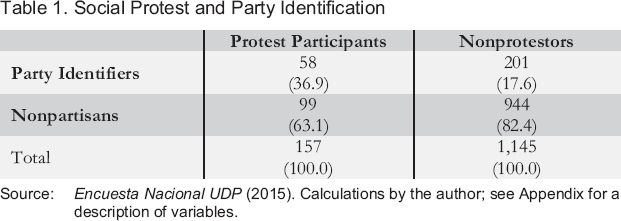
Source: Encuesta Nacional UDP (2015). Calculations by the author; see Appendix for a description of variables.
The survey is available at <http://encuesta.udp.cl/>. Calculations reported in this paper are based on the author's analysis of the survey data. See the Appendix for a description of variables.
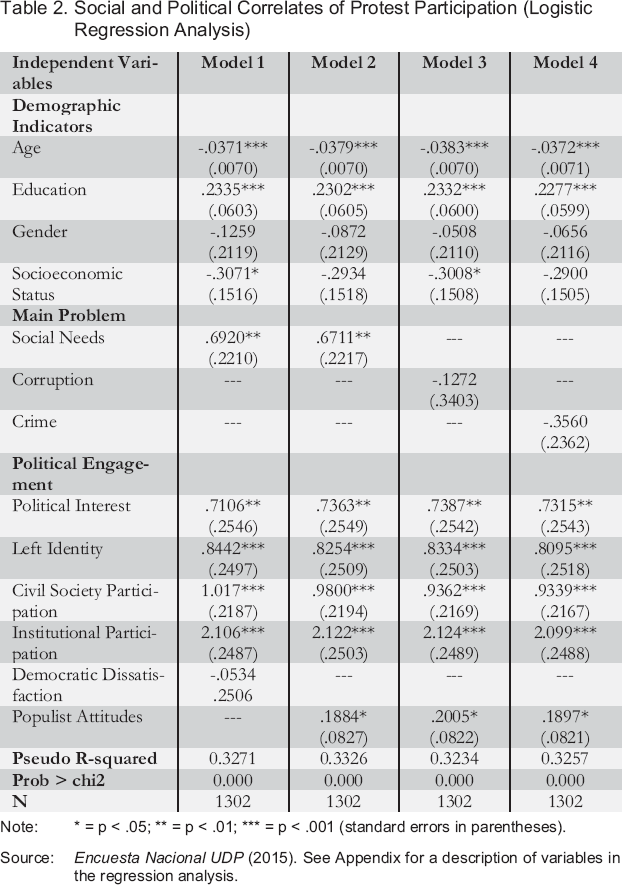
Indeed, statistical analysis of the survey results demonstrates that protestors in Chile tended to be highly engaged in civic life, left-leaning politically, and deeply concerned with the so-called social deficits of the neoliberal model. Table 2 presents results from a series of logistic regression models on protest participation, which tested the effects of various social and political factors while controlling for demographic influences. As would be expected in a context of widespread student mobilization, age is negatively correlated with social protest, indicating that young people are more likely to take to the streets. Whereas gender has no statistically significant effect on protest, education has a strong and consistent relationship: protest is more common among citizens with higher levels of education, which likely serves as a facilitator of political engagement.
Social and Political Correlates of Protest Participation (Logistic Regression Analysis)
Note:
= p < .05;
= p < .01;
= p < .001 (standard errors in parentheses).
Source: Encuesta Nacional UDP (2015). See Appendix for a description of variables in the regression analysis.
Once education is controlled for, however, socioeconomic status has a statistically significant negative association with protest participation in two of the four regression models and falls just short of significance in the other two models. The widespread perception that Chile's contemporary social movements are predominantly middle class in character thus appears to be somewhat misleading; in fact, the findings reported here suggest that better-educated working- and lower-middle-class youth are the most active protest participants. These social groups are likely to have strong aspirations for upward mobility, and they look to the government to address social problems that hold them back. Indeed, protest participants manifest a strong belief that social needs are the most important problems facing the country.
A dummy variable identifying respondents who named a specific social need or service (i.e. education, health care, pensions, housing, the environment, transportation, or public works) as the principal problem facing the country is positively related to protest behavior and statistically significant at the .01 level. 3 Respondents who identified corruption or crime as the most important problem, on the other hand, were less likely to protest – although the regression coefficients for these indicators are not statistically significant.
Interestingly, these concrete social needs, which are closely tied to specific government policies (or the lack thereof) weighed more heavily on protest participation than did broader or more abstract economic concerns such as poverty, inequality, and employment, for which outcomes are heavily conditioned by macroeconomic forces beyond the government's control.
The statistical analysis also suggests that protest behavior is often an extension of other forms of civic engagement and not simply an expression of alienation or discontent. Here, protest participants had higher levels of political interest and were more likely to politically self-locate on the left despite the presence of a PSCh president at the time the survey was conducted. 4 They were also more likely to belong to diverse political and nonreligious civil society organizations such as unions, parties, professional associations, neighborhood councils, charitable associations, and sports or cultural groups. Likewise, protestors were more likely to have participated in democratic institutional channels like party meetings or convincing others to vote. Interestingly, protestors were not more inclined to express dissatisfaction with the performance of democracy, but their participatory ethos is marked by populist tendencies. For instance, they had a strong faith in the political subjectivity of “the people” and were skeptical of a professionalized political establishment that claims to speak and act on behalf of the people. Protest participation is thus positively related to an index of populist attitudes in the regression models.
Virtually identical results are obtained if an indicator for identification with Bachelet's Nueva Mayoría coalition replaces leftist identity in the regression models. Protestors, in short, are more likely to identify with the governing coalition than citizens who do not protest.
These statistical results are indicative of the central challenges to democratic representation in contemporary Chile: (i) representative institutions are (to date) politically stable but increasingly shallow in their social roots; (ii) a highly activated and politicized subset of the population operates within an overarching context of political withdrawal or detachment; and (iii) at least part of this activated subsector retains linkages to established parties while pressuring them to deepen redistributive social reforms and expand social citizenship rights. Consequently, although much social mobilization and protest has occurred outside and against the dominant parties of the post-1990 democratic regime, it has yet to spawn an electorally competitive new “movement party” such as the Movimiento al Socialismo (MAS) in Bolivia, much less a populist outsider such as Hugo Chávez in Venezuela or Rafael Correa in Ecuador. At the time of writing (late 2016), social protest had yet to be translated into the kind of electoral protest that is the surest indicator of a full-fledged crisis of democratic representation.
Instead, social mobilization pulled the established center-left coalition back to the left programmatically, at least partially reactivating the left–right policy cleavage that had progressively faded over the course of the democratic period (Castillo, Madero-Cabib, and Salamovich 2013). Bachelet's “New Majority” expanded the old Concertación by incorporating the PCCh into its electoral and governing alliance and competing in 2013 elections on a platform that embraced much of the student movement's demands. The second Bachelet administration proceeded to implement a major tax reform to help fund social programs, replace the binomial electoral system with a more proportional system of representation, and propose rewriting the military's constitution. By early 2016, it had pushed through Congress a major education reform that was designed to eliminate fees and selective admissions requirements in state-subsidized schools and provide free university education to some 165,000 low-income students. Although other parts of the government's education reform package remained pending – including the renationalization of municipal schools – the third of the four “social pillars” of the neoliberal model is clearly in transition under Bachelet. Indeed, the market-based logic of privatized education has lost significant ground to a more universalistic conception of education as a right of social citizenship. Not surprisingly, Bachelet's reforms have been staunchly opposed by business and conservative sectors of Chilean society, which are the primary beneficiaries and most ardent defenders of the neoliberal model.
Whereas the pension and health care pillars of neoliberalism were reformed by state technocrats in the absence of significant social mobilization, the education pillar became the focal point of a new politicization of inequality in Chilean society, to which democratic institutions were slow to respond. Although mass protest activity has tapered off from its peak in 2011–2012, social and economic inequalities have clearly returned to the forefront of the political agenda; indeed, according to the 2015 Latinobarómetro survey, only 5 percent of Chileans said that the distribution of income in their society was just, the lowest percentage in the region (Latinobarómetro 2015: 67). Chile's partisan and governing institutions have demonstrated a renewed responsiveness to these societal concerns, but it is yet to be determined whether this belated response is sufficient to reverse the steady erosion of their capacity to articulate and represent societal interests. The fraying of the sociopolitical matrix implanted during the 1989–1990 regime transition has left the country in unchartered political waters; the churning of these waters by the politicization of inequalities is sure to be a driving force in the years ahead.
Conclusion
Although many formal models of democracy assume that partisan and electoral competition turn on distributive conflicts, the Chilean case suggests that the politicization of inequality is neither natural nor inevitable; in fact it may vary substantially over time. Party systems and regime institutions may downplay inequalities in an effort to forge a national consensus or foster technocratic efficiency, but in so doing they create representational deficiencies that can induce societal actors to articulate and mobilize redistributive claims in extrainstitutional settings. So conceived, depoliticization is an unstable institutional equilibrium in contexts of acute inequality. Chile sustained such an equilibrium for the better part of two decades following its 1990 regime transition. However, this equilibrium was shattered by the groundswell of student and popular protest in recent years. In the process, this groundswell presented fundamental new challenges to one of Latin America's most resilient and stable party systems. Therefore, challenges to representative institutions in Chile consist not only of societal withdrawal or detachment but also of the extrainstitutional mobilization of new actors. These actors articulate redistributive claims that were largely unrecognized by established parties and thoroughly incompatible with the social pillars of the neoliberal model they constructed.