



Abstract
News media are an important factor in any democratic society. Research focused on developed democracies has paved the way for analysis in the context of less well-developed democracies. The project endeavors to continue that investigation into whether and how news media consumption affects democratic behavior among individuals in a region comprised of developing democracies: Latin America. Employing rich survey data available from the 2008 Latin American Public Opinion Project, traditional analyses are used to test one of the most basic questions for political communication researchers: Does news media consumption motivate or depress political participation? The results indicate that, on average, news media mobilize political participation, albeit to different degrees per medium and participation type. This seems to happen because those media socialize Latin Americans to value political participation.
Introduction
Democracy requires an informed electorate to function optimally (Aristotle 1997; Dahl 1998). Today, the majority of information consumed by individuals comes via news media (Bartels 1993; Price and Zaller 1993; Iyengar and McGrady 2007). Over the last 30 years researchers have sought to understand the impact of news media consumption on individual attitudes and behaviors (Iyengar and Kinder 1987; Nelson, Claw-son, and Oxley 1997; Norris 2000). The result of that body of research indicates that news media can affect the information people receive (McCombs and Shaw 1972; Corry 1986; Iyengar and McGrady 2007), how they feel about that information (Herman and Chomsky 1988; Krosnick and Kinder 1990; Hetherington 1996), and how they then behave politically (Norris 2000).
As with most investigations of political behavior and political communication, the majority of scholarly efforts have focused on more democratically developed regions, such as the United States and Europe (see, for example, Norris 2000). Over the past 20 years, however, this line of inquiry has expanded to include democratically developing regions like Latin America – the primary focus of this study. The research conducted in less developed contexts has benefitted from those groundbreaking studies carried out in more developed regions and has thus rapidly increased our depth of knowledge and understanding of news media consumption and political behavior. This research project looks to add to that growing body of scholarship by employing robust survey data to identify whether news media consumption in Latin America is related to more or less political participation. Put another way, it seeks to ascertain whether news media consumption mobilizes Latin Americans or instead lulls them into a malaise that dampens participation.
Latin America provides an ideal set of cases to explore how news media consumption affects individuals in developing democracies. The countries included in this cross-national study share many traits, which include colonial history, language, religion, culture, media industry development, and democratic institutions. 1 Although the durations of democracy of the Latin American countries included in this study appear to be highly variable, each nation qualifies as a developing democracy relative to all democratic states in the world (Diamond 2008). Those similarities allow us to focus on individual-level characteristics, like news media consumption and political participation, without too much concern for gross contextual differences. This is not to say that Latin American states are identical, only that they are similar enough to serve as an excellent sample with which to conduct classic comparative research on that which impact individuals in younger democracies.
An obvious exception is Brazil. For an example of similarities and differences across a selection of Latin American countries, see Booth and Seligson (2009: Chapter 3). Albarran (2009) provides a thorough description of the media industries in Latin America, revealing that their developmental and present characteristics are largely similar.
Political communication research consistently contends that media consumption affects behavior (Comstock et al. 1978; Bartels 1993; Delli-Carpini 2012) and attitudes (Jamieson and Cappella 2008). While it is important to know whether some effect is present, the direction and strength of that effect also deserves attention. Early research supported the notion that media effects on participation were minimal (see Iyengar and McGrady 2007: 197). As research proliferated, the potential impact of media consumption was increasingly emphasized and research seemed to follow suit, as content analysis and experiments consistently revealed stronger-than-minimal effects (see Nelson, Clawson, and Oxley 1997). Today, political communication research is highly nuanced. The effect of the media is often understood through mediated pathways (Norris 2000) that cement the relationship of news media and politics while introducing event- and behavior-specific considerations. These considerations call into question the generalizability of this line of research while simultaneously enhancing the perceived pervasiveness of media effects.
Political communication research in Latin America has expanded greatly in the last 30 years. However, that growth reflects the added nuance revealed by research in other contexts. As such, Latin American political communication scholars tend to address more limited questions – for instance, country-, event-, and behavior-specific questions. Some research has focused on understanding media industries and journalism in various Latin American states and their relationship with political institutions and policy (Fox 1988; Waisbord 2000; Fox and Waisbord 2002). Much of that scholarship made clear that Latin American media industries, while similar to those in more developed countries, have their own regional characteristics, which must be taken into account. 2 Other research has looked at specific elections and the role played by the media therein, finding that media productions affected the elections in clear and purposeful ways (Lawson and McCann 2004; Boas 2008). Some studies have taken a strictly individual-level approach to try to understand how media consumption affects the political behavior of Latin Americans and have revealed a connection between media consumption and attitudes/ behaviors (Perez-Linan 2002; Salzman and Aloisi 2009; Salzman and Salzman 2010). Each of these strands of research has added to our overall understanding of political communication as well as establishing a line of scholarship that is distinctly Latin American. 3 This research project hopes to add to that body of knowledge by considering the effects of various news media types on individuals across the entire region. Because this is a potentially monumental task, this study looks to answer one of the fundamental questions of individual-level political communication research: Does media consumption foster political mobilization or malaise?
An example of a characteristic that is an important driver of journalistic behavior is the penalties associated with slander and libel, which are criminal instead of civil in nature (Salzman and Salzman 2009). Not all characteristics change the effect of these industries, but it is important to keep these differences in mind.
For instance, the research done by Boas (2005) on the media and populism is of particular interest to scholars of Latin American politics and political communication.
The distinction between mobilization and malaise is a basic but important one to make. Some earlier research in this area found that individuals who consumed media outputs were less trusting of politicians and the political system because of “a combination of bad news, attack journalism and negative politics” (Newton 1999: 578). These conditions resulted in low efficacy and subsequently less political participation (Cappella and Jamieson 1997). Like those who embraced “malaise,” advocates of mobilization also identified an important mediating factor between media consumption and political behavior: political interest (Delli Carpini 2004; Stromback and Shehata 2010). Recognizing the importance of political interest, more and more researchers began to focus on the mediating role of political interest and eventually accepted a circular relationship where news media consumption, political interest, and political behavior are all interrelated (Norris 2000). Indeed, political communication research in Latin America has shown a clear relationship between news media consumption and political interest (Salzman 2012). If news media consumption in Latin America is shown to mobilize participation, it is likely that political interest should theoretically be considered a part of that dynamic. That political interest is part of individuals’ mental processing is important. But what is it about news media that would affect individuals to begin with?
The Socializing Power of the Mass Media
According to Thompson (1995: 10), “In all societies human beings engage in the production and exchange of information and symbolic content.” This production and exchange is typically done via the media. In order for the reception of media outputs to affect individuals, there must be some power exchange. 4 News media purposely convey information and symbolic content to an extent that exceeds other media types, such as entertainment media.
According to Michael Mann (1986), there are four classes of power: economic, political, coercive, and symbolic. Each type of power can affect individuals to the point of motivating behavior. To understand how news media consumption might affect individuals, we focus on symbolic power.
Symbolic actions may give rise to reactions, may lead others to act or respond in certain ways to pursue one course of action rather than another, to believe or disbelieve, to affirm their support for a state of affairs or to rise up in collective revolt (Thompson 1995: 17).
This symbolic power is the mechanism that induces certain behaviors by individuals or groups.
Mass media affect individual behavior in part through socialization – that is, by helping to produce or shape attitudes among citizens. Thompson (1995: 26) lays out five characteristics of mass communication that he defines as “the institutionalized production and generalized diffusion of symbolic goods via the fixation and transmission of information or symbolic content.” The first characteristic he refers to is the technical and institutional means of production and diffusion, which is the technical, business, and innovation side of the telecommunications industry. The second characteristic is the commodification of symbolic forms, whereby those mass communication media are given symbolic or economic value. In this study, I focus on the symbolic value of democracy via the promotion of events and behaviors associated with democratic institutions. The third characteristic is the recognition of the separation of the processes of production and reception. Although Thompson acknowledges that recipients do not normally exercise much direct influence on media outputs, it would be wrong to consider media consumers simply as passive watchers, listeners, or readers. Rather, they actively engage with what is presented to them and process it in a given context. This is particularly true for Internet use. The fourth characteristic of mass communication is the extension of symbolic forms across time and space. The fifth characteristic is the public spreading of symbolic forms. The essence of mass communication is lodged in the symbolic forms it produces, the values placed on those symbolic forms, and the distribution of those forms across time and space and within the purview of the public.
Even if those symbolic forms are given value and distributed throughout society, how do we know that they will affect individuals? When provided information, individuals learn (Miller 2005). When provided with valuable symbolic forms, individuals are enabled “to reorder the spatial and temporal features of social organization, and to use these reordered features as a means of pursuing their objectives” (Thompson 1995: 31). Operating in an explicitly political environment, I expect individuals provided with information and valuable symbolic forms to react in accordance with that information and those symbolic forms.
News Media Consumption and Political Participation in Latin America: Expectations
Democracy requires political participation (Cohen 1971). Individuals require information and motivation to participate politically. In modern societies information is best provided via news media (Downs 1957). Assuming that news media do indeed perform as Thompson argues, individuals not only receive the information discussed by Downs, but they also attach symbolic value to certain prevalent ideas that are consistently conveyed via news media. News media that reference democracy and democratic institutions, such as elections, place a high “value” on those ideas and events while also providing information that is essential for participation. If this is truly the case, then news media consumption should mobilize individuals to participate. Additionally, the amount of news media consumed should influence the potential effect of those media in a positive direction.
In democracies political participation is multidimensional (Booth 1979). Elections are necessary but insufficient for establishing a consolidated democracy. This project thus considers the effect of news media consumption on four types of political participation: discussing politics, voting, attending meetings of local government, and protesting. Discussing politics and voting are forms of participation that are more traditionally associated with democracy writ large. Attending meetings and protesting are not immediately thought of when studying democracy, but certainly capture what it means to live in a participatory political system. The personal investment of each of the four forms of political participation ranges from casual (discussing politics) to formal (voting). There is also variation in the degree to which participation is localized (attending meetings) and/or conflictual (protest). Each of these forms of participation may be affected by democratic news media. But are Latin American news media actually democratic?
In her research on media in new democracies, Katrin Voltmer suggests that the political role of media in developed democracies is evidenced in three ways (Voltmer 2006: 5). First, the media provide a “market place for ideas.” Second, they provide information to encourage enlightened citizenship. Third, the media are a “public watchdog.” Generally speaking, the democratic performance of news media in Latin America is a mixed bag according to Freedom House's press freedom ratings (Freedom House 2008). Nonetheless, news media cover politics and political events in all Latin American states (Albarran 2009). That coverage heightens the symbolic value of politics and political events. 5 Given the heightened value of politics, Latin Americans that consume more news media should be mobilized to engage in more political behavior than nonconsumers. A positive relationship between news media consumption and political behavior is expected for each type of news media and all forms of political participation analyzed herein.
For instance, Salzman and Aloisi (2009: 53) wrote the following: “We find that many newspapers provide information with regard to [political] events. In recent days Colombian newspapers have mounted an intense campaign against President Uribe amid economic difficulties in the country. On more than one occasion, El Espectador and El Centro de Medios Independientes have diffused the location and time of political reunions and citizens’ protests. Many other Spanish language news media in Central America regularly provide information about political participation opportunities. These come in the form of general event information. For example, the lead story on April 9, 2008, in a nationally distributed Nicaraguan newspaper, La Prensa, discussed security considerations for a protest march that was to take place that day. Not only did the story discuss the security issues but it also listed the time and location of the march. By providing exact time and location information, these news media stories encourage event participation.”
Hypothesis: Latin Americans who consume more news media will report greater political participation of all kinds than Latin Americans who consume less news media.
Research Design
The central question of this research focuses on the relationship between consuming various news media and democratic behaviors in a developing democratic region: Latin America. To uncover the presence or absence of that relationship, I employ the 2008 Latin American Public Opinion Project (LAPOP) survey dataset. 6 The survey responses were gathered cross-nationally in 18 Latin American countries: Mexico, Guatemala, Honduras, El Salvador, Nicaragua, Costa Rica, Panama, Colombia, Peru, Bolivia, Ecuador, Argentina, Chile, Brazil, Venezuela, Uruguay, Paraguay, and the Dominican Republic. Whereas other forms of data (e.g., voter turnout data) rely on population aggregates, which do not allow for inference based on individual characteristics, this study employs survey data with a large sample size, which permits individual-level comparison between “all” individuals. 7 Besides respondents’ level of political activity and awareness, I wanted data that also included individuals living in more remote areas. As survey sampling is often subject to cost concerns, excluding rural populations is commonplace because it is much more expensive per interview. The 2008 LAPOP dataset, however, includes all segments of the population (rural, urban, rich, middle class, and poor) so as to approximate a national probability sample. The LAPOP data thus appears to adequately address those sampling concerns.
To increase the precision of the sampling results, I used stratified sampling, which involves dividing the target populations (Latin Americans) into basic units (Latin American countries) and subunits (regions within Latin American countries). These may be further stratified into sampling frames (such as clusters of households or blocks or neighborhoods). The sample of respondents was then selected from within each subunit in proportion to their overall share of the national population. This approach ensured that no individuals from any area were automatically excluded from the study and that the samples taken are generalizable. Stratification encourages respondent selection to be country, region, community, neighborhood, and household specific. Even when the household was selected, random interviewee selection within that household was ensured by the use of the “next birthday” method. Once interviewees were selected, carefully trained interviewers conducted face-to-face interviews with them. Anticipating the refusal of some respondents to cooperate, an estimate of noncoverage was included, and an over-sample was drawn to compensate for that. 8
I thank the Latin American Public Opinion Project (LAPOP) and its major supporters (the United States Agency for International Development, the United Nations Development Program, the Inter-American Development Bank, and Vanderbilt University) for making the data available online at <www.lapopsurveys.org>.
The term “‘all’ individuals” refers to respondents that are old enough to vote. Although that age is 18 in most countries, there are exceptions. For instance, Nicaraguans can vote at 16. Therefore, Nicaraguans are sampled at the ages of 16 and 17 whereas Mexican sampling begins at 18.
Despite the quality of the survey data used in this research project, criticisms regarding the use of survey data in political communication research abound. One such criticism hinges on the supposition that individuals tend to overreport the amount of news that they consume (Price and Zaller 1993; Prior 2009). However, it is worth noting that frequency estimation is potentially problematic for all survey responses that require individuals to recount the number of times that they have done something (Tourangeau, Rips, and Rasinski 2000). While that may in fact be true in the context of developed democracies, recent studies have shown self-reported media measures in Latin America to be highly varied and lacking obvious systematic bias (Salzman 2011; Salzman and Albarran 2011). However, if most respondents overreported news media consumption, “never use media” responses should be disproportionately small. In Latin America, Salzman (2011) finds that self-reported rates of never using newspapers is about 30 percent; never consuming radio news, approximately 17 percent; and never consuming television news, around 5 percent.
To test the relationship between news media consumption and political behavior, I conduct a number of statistical tests that all aim at identifying correlations between survey responses. Due to the dichotomous and ordered nature of the dependent variables, the statistical tests employed herein are standard logistic and ordered logistic regression models (Long and Freese 2003). Predicted probabilities are calculated for each of the primary variables of interest that are statistically significant.
The dependent variable discussing politics is a single survey item that measures how respondents rate their frequency of political discussion with others. The variable is scaled from 1 to 5, with 1 meaning “never” and 5 representing “daily.” Voting is a dichotomous variable that indicates whether respondents voted in the last presidential election. A “yes” is scored 1 and a “no” is scored 0. Attending meeting is a single item response that inquires about the respondent's participation in a town hall meeting in the past year. A “yes” is scored 1 and a “no” is scored 0. Protesting is a single item response that determines the extent to which respondents participated in protests in the last year. A “sometimes” is scored 3; an “almost never,” 2; and a “never,” 1.
The primary individual-level independent variables of interest in this research project identify the regularity of news media consumption per individual per medium. Four different news media are included in this study: television, radio, newspaper, and the Internet. 9 Television news consumption reveals the regularity of television news media consumption. Newspaper consumption identifies how often the respondent reads the newspaper. Radio news consumption measures the amount of news consumed via the radio. Internet news captures the regularity of Internet use for the purpose of gathering news. Each of these is scored 0 to 3 (“never” to “daily”) according to the degree of regularity with which the respondent consumes that specific news medium. I expect each news media consumption variable to be positively related to each democratic behavior dependent variable.
Prior research has clearly shown that the consumption of news media is systematically related to qualities of individuals, such as ability, interest, and expectations (Salzman 2011; Salzman and Albarran 2011). Because of these consumer-specific differences, each medium should be included separately of one another. It should be noted that 2008 is the last year that LAPOP included each media type separately. As of 2010, news media has been combined into a single variable.
Control Variables
It is axiomatic in social scientific research that individuals’ basic attributes can affect their preferences and behavior (see Almond and Verba 1963). For that reason, I include variables that measure an individual's age, gender, and level of education. Age is a count variable ranging from 16 to 101 years. Female denotes an individual's gender, with the value 1 assigned to women and 0 to men. Education identifies the amount of education in years completed by the respondent and is scaled from 0 to 18.
For reasons similar to those related to other demographic conditions, the amount of wealth that respondents have may also influence their attitudes. Therefore, I include a wealth variable that is an additive measure of various items that respondents may or may not own. These items include a television, a refrigerator, a landline phone, a cellular phone, a vehicle (up to three), a washing machine, a microwave, a motorcycle, potable water in the house, a bathroom in the house, and a computer. 10 The variable scores respondents on a scale of 0 to 13 depending on the number of possessions they claim to possess.
This measure is intended to replace the typical income question. This meliorates concerns of misreporting or refusal to report often associated with income questions. The use of household wealth also circumvents issues related to individuals such as family members who have no income of their own yet live a lifestyle reflective of the income of their family. For an example of a study that uses a similar measure, see The Legitimacy Puzzle in Latin America (Booth and Seligson 2009).
Community size variables are included to test the effect of the size of the community in which an individual lives on that individual's news media consumption. It is important to include these variables because access to news media varies across community sizes (Rockwell and Janus 2003). 11 The measures for community size are coded into five dichotomous variables: rural, small city, medium city, big city, and capital. These variables are derived from the values recorded by the survey administrator. 12 For each country, the exact parameters of the community size variable were calculated according to relative population size and geographical distribution. 13 For the purposes of the statistical tests, I use the rural variable as my baseline case to which the other community variables are compared.
As Rockwell and Janus (2003) make clear, variation in location can affect the ability to receive certain media. Areas that are more remote or that are generally difficult to get to may have problems receiving newspapers. It is that location, then, that affects newspaper readership.
Because the survey administrator recorded the community size response, this ensures that individual perception of community size is not being measured. Instead the environmental reality of the size in which an individual lives is what the score represents. The use of dummy variables, instead of a single ordered variable, is important to account for the potential of a nonlinear relationship that would otherwise be assumed by using an ordered variable.
One example, reported by a LAPOP representative as being a typical criterion, denoted a big city as having a population in excess of 50,000, a medium city ranged from 25,000 to 50,000, and a small city was less than 25,000 (but not rural).
With the basic demographic and location control variables included herein, I also include other measures that may explain variation in the dependent variable and potentially supplant the effect of our primary variables of interest – namely, the news media consumption variables. The first variable that I include to ensure proper specification of the model is trust in media. It is intuitively plausible that the degree to which an individual trusts the domestic news media industry may variably shape the impact that news media consumption has on that individual's attitudes and behavior. 14 For instance, an individual who has low levels of trust in the media may remain skeptical of the functioning of democratic institutions regardless of reports stating that they are operating well. Or they may doubt that elections were free and fair even if news media report them as being free and fair. That lack of trust undermines the ability of news media to impact an individual's support for democracy. Trust in media is a single-item response that measures the degree to which individuals trust media on a scale of 1 to 7, with 7 indicating “a lot” of trust.
For an in depth look at this measure see Layton (2012).
The second of the additional control variables is political knowledge. Like education, political knowledge can shape individuals political attitudes and behaviors. Also, knowledge may undermine the significance of news media consumption as those with more knowledge tend to seek more news (Norris 2000). Political knowledge is an additive index of dichotomous responses to five general questions about politics and institutions in the respondent's country as well as politics in other countries. The respondent receives a score of 1 for each correct response and 0 for each incorrect response. The respondent's scores are then added together to create the index political knowledge, which ranges from 0 to 5. 15
The five knowledge questions form an index with a scale reliability coefficient of 0.72, indicating that the questions form a coherent index.
Accounting for the contextual realities that could affect survey respondents is important for clearly understanding individuals’ political behaviors. These contextual conditions are captured in a series of measures employed in the analyses. A primary variable of interest is the degree of press freedom present in a country. When testing the effect of news media consumption on individuals’ behaviors, it is important to account for constraints on that industry. I employ a measure of media freedom that is assigned equally to each respondent living in a specific context (country). The media freedom variable is taken from Freedom House's 2008 Press Freedom Index. It is an additive index that individually rates the legal, political, and economic environments of the media industries in each country. The index is scaled from 0 to 100 per country but has been inverted, with higher scores now indicating greater media freedom. Other contextual measures that may shape individuals’ political attitudes and behaviors include democratic duration, development, and communication development. Support for democracy may very well be contingent upon how long that country has experienced democracy. 16 Therefore, I employ the variable democratic duration (a count measure of the number of years of democracy per country) to capture that experience. This measure is taken from Smith (2005) and adapted to include the years up to and including 2008 and has a range of 10 to 57 years.
Mishler and Rose (2001) discuss the varying influence of democratic development on support for the regime. Similarly, I expect democratic duration to affect support for democracy more broadly.
The relative level of development per context may variably affect the way that individuals perceive their governing structure. I thus include the variable development, which goes beyond aggregate economic measures and captures multiple areas of human development. The development variable is taken from the United Nations Human Development Index, which has been described as follows:
The HDI […] is a summary composite index that measures a country's average achievements in three basic aspects of human development: health, knowledge, and a decent standard of living. Health is measured by life expectancy at birth; knowledge is measured by a combination of the adult literacy rate and the combined primary, secondary, and tertiary gross enrolment ratio; and standard of living by GDP per capita (PPP US$) (United Nations 2008).
Scores range from 0 to 1, with higher scores indicating greater levels of development. I employ a single measure of development as aggregate development measures can be strongly correlated, often to the point of being collinear. Because using multiple highly correlated development measures would cause problems for my statistical models, I draw on the Human Development Index for its ability to capture multiple aspects of country-level development.
The development of the communications system is expected to influence the ability of individuals to consume news media. The communication development variable is an index that measures the availability and accessibility of information and communication technology (ICT) in a country. The ICT development index (IDI) is a composite of three sub-indexes and identifies access, use, and skills. The communication development variable employs the access subindex, which is a composite measure of fixed telephone lines, mobile telephone subscriptions, international Internet bandwidth per Internet user, the proportion of households with a computer, and the proportion of households with Internet access. The measure was normalized, rescaled, and weighted. 17 Higher access subindex scores denote greater ICT development, as it relates to the ability of individuals to access information.
The IDI was compiled and produced by the International Telecommunication Union (2009). For more information, visit <https://www.itu.int/ITU-D/ict/publications/idi/material/2009/MIS2009_w5.pdf> (30 July 2015).
Results and Analysis
The results of the statistical tests are revealing with regard to determining whether news media consumption mobilizes or demobilizes political participation in Latin America. Before going into detail about each statistical result, I will offer a brief summary. Consuming news media of various types mobilizes Latin Americans to participate politically. The notable exception to these positive statistical correlates is that Latin Americans who use the Internet to gather information are less likely to vote. However, it should be noted that Internet news consumption increases the likelihood of engaging in the three other forms of political participation. In addition to being statistically significant, many of these findings are also substantively significant. The predicted probability results illuminate major differences in the likelihood of participating politically (or not) when the consumption of a news media type is varied from its minimum value to its maximum value. That result further illuminates the effect of media consumption, with all but one of those effects being to mobilize Latin Americans to participate. Now I will present the findings in greater detail.
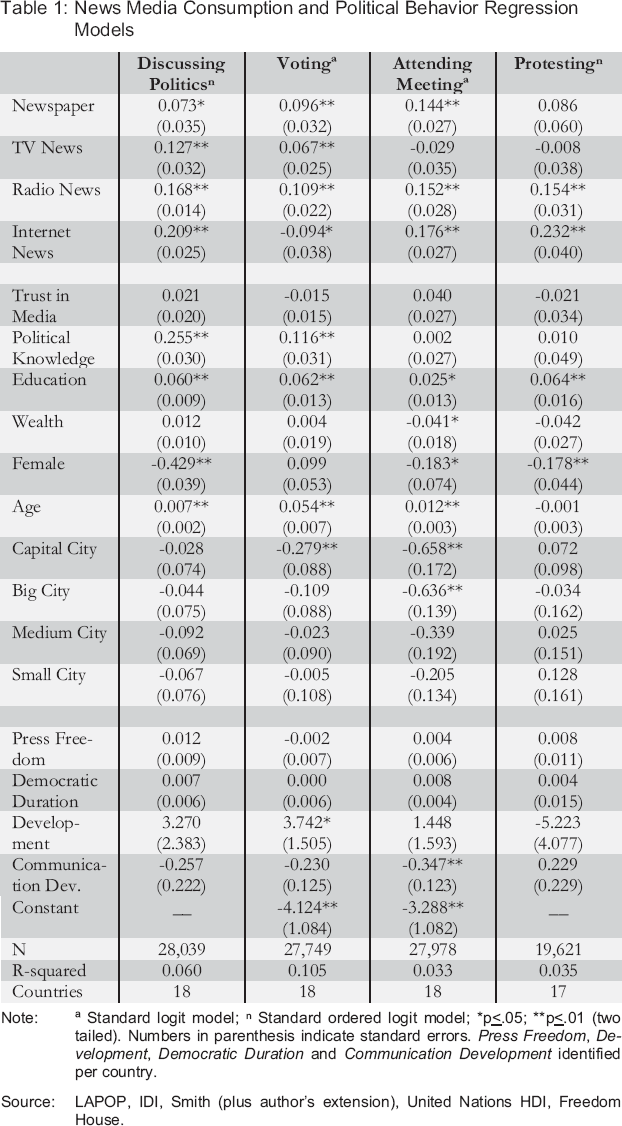
The statistical analyses here seek to identify the effect of news media consumption on Latin Americans’ political participation. The results are displayed in Table 1. In general, the models performed well. The R-squared values are 0.060 for discussing politics (n = 27,749), 0.105 for voting (n = 28,039), 0.033 for attending meeting (n = 27,978), and 0.035 for protesting (n = 19,860). 18 I feel that the results carry enough weight to allow for confident analysis.
News Media Consumption and Political Behavior Regression Models
Note:
Standard logit model;
Standard ordered logit model;
p05;
p.01 (two tailed). Numbers in parenthesis indicate standard errors. Press Freedom, Development, Democratic Duration and Communication Development identified per country.
Source: LAPOP, IDI, Smith (plus author's extension), United Nations HDI, Freedom House.
News media consumption is hypothesized to positively affect Latin Americans’ political participation, including their discussing of politics. As expected, the results of the ordered logistic regression reveal positive and significant coefficients for each of the news media consumption independent variables. Consuming each type of news media increases the possibility of discussing politics with others. For this most basic form of political engagement, news media are mobilizers. The predicted probability calculations reveal that when each news media consumption measure is varied from its minimum value (“never”) to its maximum value (“daily”), the probability of individuals reporting “never” discussing politics drops from the baseline of 31.4 percent to 27.9 percent for newspaper readers, 23.8 percent for television news watchers, 21.7 percent for radio listeners, and 19.7 percent for Internet news consumers. In each case the decrease in “never” discussing politics is redistributed between the “monthly,” “weekly,” and “daily” responses.
Note that no respondents from Chile are included in the Protesting model, as that question was not asked in the Chile iteration of the LAPOP survey.
Looked at another way, varying each type of news media consumption from its minimum to its maximum value sees the proportion of respondents who claim to “never” discuss politics decrease by 14.3 percent (newspaper), 24.2 percent (television), 30.9 percent (radio), and 37.3 percent (Internet). Therefore, it is clear that the results of the survey data analysis are statistically and substantively significant. If we consider the substantive effects for each response option, the impact can range from quite small (see the “rarely” column in Table 2) to quite large (see the “daily” column in Table 2). So when it comes to Latin Americans discussing politics, there is strong evidence that news media mobilize that behavior by increasing among individuals the symbolic value of the topics they cover.
Predicted Probabilities for the Direct Model of Discussing Politics (in Percent)
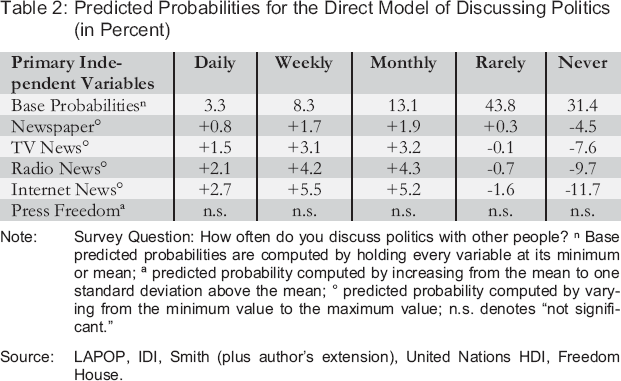
Note: Survey Question: How often do you discuss politics with other people? n Base predicted probabilities are computed by holding every variable at its minimum or mean;
predicted probability computed by increasing from the mean to one standard deviation above the mean;
predicted probability computed by varying from the minimum value to the maximum value; n.s. denotes “not significant.”
Source: LAPOP, IDI, Smith (plus author's extension), United Nations HDI, Freedom House.
The statistical findings regarding news media consumption and voting 19 are also in line with the expectations articulated in the hypothesis, albeit with one notable exception (see Table 1). While traditional news media (television, radio, newspapers) appear to mobilize individuals to vote, Internet news is negatively correlated with voting. That is, Latin Americans who gather information via the Internet report voting less than those who do not use the Internet for such purposes. This finding, which reveals an apparent malaise effect, is notable but not surprising.
Most countries in Latin America have compulsory voting laws on the books. However, voter turnout is still highly variable as there are issues with enforcement of these laws.
According to prior research, Internet news consumers are separable from traditional news media users (Salzman and Albarran 2011). The results of the regression model in Table 1 appear to reiterate that Internet use is distinct from other forms of news media consumption. What could explain this phenomenon? First, it could stem from the fact that the Latin American Internet news consumer demographic may be disproportionately young, which is significant given that younger individuals vote less than older individuals. Second, research on news media consumption correlates have revealed that Latin Americans who have less trust in the media consume more Internet news (Salzman and Albarran 2011). If these individuals’ skepticism extends to the political and social systems, it would be reasonable to expect a large proportion of Internet news consumers to not participate in an institutionalized form of political behavior like voting but instead engage in less institutionalized political behaviors. Their lack of trust in the system is heightened via Internet use, which demobilizes voting participation in a manner similar to that illuminated by Cappella and Jamieson (1997).
The magnitude of the effects of news media consumption on voting behavior reveals strong substantive effects. Varying the measure for Internet news consumption from “never” to “daily” increases the probability of not voting from the baseline of 28.2 percent to 34.4 percent, which represents an increase of over 20 percent. Listening to radio news diminishes nonvoting behavior by almost 25 percent (probability of not voting drops from 28.2 percent to 21.4 percent). Watching television news had the weakest substantive impact but still saw the probability of not voting decrease by 13.5 percent. Reading newspapers daily as opposed to never saw the probability of not voting decrease by 19.1 percent. 20
Of course, the magnitude is diminished if we consider the effect on “yes” responses to the “Did you vote?” question. But the impact still ranges from 5 to 10 percent.
Predicted Probabilities for the Direct Model of Voting (in Percent)
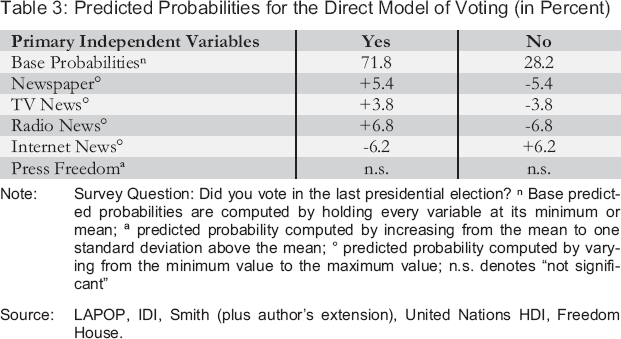
Note: Survey Question: Did you vote in the last presidential election? n Base predicted probabilities are computed by holding every variable at its minimum or mean;
predicted probability computed by increasing from the mean to one standard deviation above the mean;
predicted probability computed by varying from the minimum value to the maximum value; n.s. denotes “not significant”
Source: LAPOP, IDI, Smith (plus author's extension), United Nations HDI, Freedom House.
Looking at whether news media consumption affects whether citizens attend local government meetings, we find evidence of mobilization for each media type except television – for which there were no statistically significant results. So why does consuming various amounts of television news exhibit no statistical effect?
It is well established that news media vary in their production quality and content (Iyengar and McGrady 2007). Of the four news media types considered here, television news provides the least amount of information (Stromback and Shehata 2010). Television news is also national in scope, which could lead it to overlook more localized political events such as local government meetings (which are the focus of the survey question). Newspapers and the Internet potentially provide consumers with more information and reporting that covers various levels, such as the national, regional, and local levels. Radio news is more locally oriented and is thus more likely to provide information on local political events and meetings (Agosta 2007). Therefore, it should come as no great surprise that television news consumers do not report attending meetings of local government more often than nonconsumers.
The predicted probabilities in Table 4 reveal remarkably similar effect magnitudes when varying news media consumption from minimum to maximum levels – and these effects are substantial. With each news media consumption variable set at its minimum, the base probability that a survey respondent would report having attended a meeting of local government during the previous year is 9.7 percent. Varying news media consumption to the maximum level increases the probability of a “yes” response by about 50 percent. Changes in the “no” response were less substantive, but hardly negligible.
Predicted Probabilities for the Direct Model of Attending Meetings (in Percent)
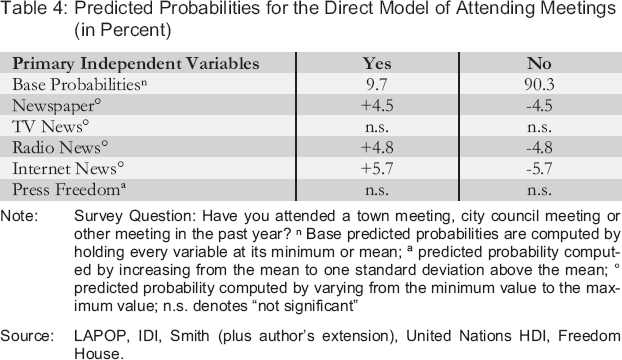
Note: Survey Question: Have you attended a town meeting, city council meeting or other meeting in the past year? n Base predicted probabilities are computed by holding every variable at its minimum or mean;
predicted probability computed by increasing from the mean to one standard deviation above the mean;
predicted probability computed by varying from the minimum value to the maximum value; n.s. denotes “not significant”
Source: LAPOP, IDI, Smith (plus author's extension), United Nations HDI, Freedom House.
The results of the protesting model (see Table 5) were more mixed than any of the other three participation models. Only radio or Internet consumption has a statistically significant effect on protest participation in Latin America, whereas watching television news and reading newspapers have no statistically significant bearing. Again, it is useful to look at the nature of the news media type when trying to understand these findings.
The nature of television news is unlikely to inspire any behavior that requires as much initiative and investment as protesting. Television news reports on demonstrations tend to air after they have occurred. Furthermore, in the event that they air before the event, such reports may only offer inadequate discussions of the motivations behind protests, thus being insufficient to inspire participation. The lack of statistical significance in the newspaper–protest relationship is somewhat surprising and lacks a clear explanation.
Internet news consumption and listening to radio news are statistically significant and positively related to protest participation. Prior research offers at least two explanations for this: First, radio news consumers are poorer and live in more rural areas (Salzman 2011). Second, Internet news consumers are younger and more skeptical of domestic media (Salzman and Albarran 2011). Both these sets of attributes are common among protesters. Newspaper consumers are less likely to engage in protest behavior and typically do not come share the marginalized status associated with other news media consumers. Thus understanding the role played by news media consumption in inspiring protest (unlike other forms of political participation) may require focusing on the media user rather than the media itself.
The predicted probabilities in Table 5 again reveal an effect magnitude that is substantively significant. Varying Internet news consumption from “never” to “daily” sees the probability of respondents sometimes engaging in protests increase from 7.6 percent (base probability) to 14.1 percent – an increase of over 80 percent. Varying radio news consumption in the same manner has a smaller effect, but still results in an increase exceeding 50 percent (from 7.6 percent to 11.5 percent).
Predicted Probabilities for the Direct Model of Protesting (in Percent)
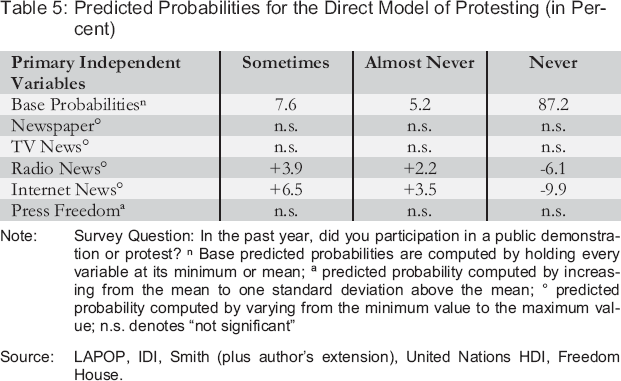
Note: Survey Question: In the past year, did you participation in a public demonstration or protest? n Base predicted probabilities are computed by holding every variable at its minimum or mean;
predicted probability computed by increasing from the mean to one standard deviation above the mean;
predicted probability computed by varying from the minimum value to the maximum value; n.s. denotes “not significant”
Source: LAPOP, IDI, Smith (plus author's extension), United Nations HDI, Freedom House.
The control variables perform as expected. Trust in the domestic news media has no effect on any of the participation variables. Political knowledge is positively related to discussing politics and voting but has no statistical correlation with attending meetings of local government or protesting. Latin Americans with more formal education report engaging in each form of participation more than individuals with less formal education. Wealth positively impacts discussing politics but fails to influence voting or protesting. Greater wealth is negatively related to attending meetings of local government. Women vote more than men but less often discuss politics, attend meetings, and protest than their male counterparts. Age is positively related to voting, discussing politics, and attending meetings but is not statistically related to protest participation. Finally, Latin Americans living in larger communities vote, discuss politics, and attend meetings less than individuals living in rural areas. This is perhaps because of the greater intimacy of personal or political networks in rural environments compared to those in large urban ones. Community size does not affect protest participation. These findings support the discussion of the model above, where the qualities of consumers were emphasized as being potentially more important than the media content itself.
Attention to cross-country differences is important. Until recently, cross-national studies similar to this one employed country dummy variables to illuminate those differences. Although they revealed that differences were present, they offered little explanation about what kind of differences were present across countries and how they variably affected the dependent variable of interest. Advances in statistical modeling allow this study to identify the country-specific characteristics (via hierarchical linear modeling) that may actually affect the relationship between news media consumption and political participation, thus potentially offering explanation along with the typical identification methods. In this study those country-level measures do not explain any cross-country differences. The contextual variable press freedom has no impact on any of the dependent variables. None of the other country-level control variables achieve a notable level of statistical significance with the exception of communication development, which is negatively related to attending meetings.
Discussion
This project considers all Latin Americans in a single group. Instead of separating them by country, they are identified by their individual-level attributes and the country-level characteristics believed to potentially affect their decisions to participate politically given varying levels of differing news media. Using a framework focused on the classic question of news media's mobilizing or demobilizing effect, this large group reveals much about media types and developing democracies (a distinction shared to some degree by all states in Latin America). So what can be learned?
First and foremost, the results regarding the relationship between four different types of news media consumption and four different kinds of political participation illuminate correlations that are statistically significant and consistently positive. In short, this indicates that media consumption in Latin America has a mobilizing effect on political participation. The lone piece of evidence of a demobilization effect is found in the relationship between Internet news consumption and voting. With regard to this finding, I suggest that the nature of the Internet news consumer is important for understanding that apparent malaise. But there are certainly other plausible explanations for the results of that test – some of which have to do with the nature of the measure employed.
The Latin American Public Opinion Project (LAPOP) asks respondents how often they use the Internet for the purpose of gathering news. Unlike for the other measures, the outlets producing and providing that information is unclear. Internet news sources could include email, social media, websites, or blogs, among other forms. Just as the Internet media are varied in their quality, the individual or organization producing that media can also greatly vary in terms of reliability. All it takes is a computer and Internet access to post “news” to the World Wide Web. Those who report using the Internet to gather news may be using the websites of renowned newspapers or an individual's blog. Yet both could provide the same response to the survey question. Despite this concern, the fact that Internet news consumption has statistically significant results indicates something systematic in the pattern of who uses the Internet to gather news and how that delivery method ultimately affects those consumers. It is also worth noting that the results are in line with expectations for the three forms of political participation other than voting. Taking everything into account, it would be erroneous to discount the impact of Internet news consumption on political participation.
A second important conclusion that comes from this research project pertains to the magnitude of the effects. As can be seen in the predicted probabilities tables, the statistically significant results are generally also substantively significant. This indicates that there is something about Latin America that heightens the mobilization potential of news media consumption relative to more developed democracies. But why?
In established democracies there is probably less potential for news media to socialize individuals to be more democratic than there is in newer democracies because democratic attitudes and political participation habits have become entrenched over time. In such democracies formal democratic political institutions such as elections are likely complemented by varying degrees of democratic structures and norms in work, church, and school environments (see Pateman 1970). In societies with deep-rooted democracy, there are many socialization sources that encourage democratic attitudes and behaviors, thus marginalizing the socialization effect of news media consumption. In regions where democratic regimes are still relatively young, like Latin America, democratic deepening remains secondary to promoting basic democratic norms and behaviors across the whole of society. In this context communications media may still serve an asymmetrical role in shaping the democratic attitudes and behaviors of individuals. As a result, the strong substantive effects of news media consumption in a region where democracy is yet to be entrenched should come as no surprise.
A third important finding is that news media should be examined independently of each other, as too should the various forms of political participation. Not only do the effect magnitudes greatly vary in each test, but the presence of statistical significance and even the direction of relationships change throughout this project. This is encouraging as it suggests there is good reason to expect similar results, but little reason to expect identical results. The increasing use of the Internet and the fact that Internet news consumption has the most inconsistent effects on the various modes of political participation should further caution researchers against combining news media into a single measure. In fact, the decision to use 2008 LAPOP data was based on this factor, as the 2010 and 2012 iterations combine traditional news media into a single measure – presumably to the detriment of these variable effects.
This project endeavors to assess the effect of news media consumption on individuals’ democratic behavior in a developing region. Latin America was selected as the focus of this research because its characteristics make it ideal for a comparative politics study. The 2008 LAPOP survey data meets the highest standards of quality. Taken in concert with a basic question (Mobilize or demobilize?) and a hypothesis about the socializing power of the mass media, this project provides a high-quality assessment of how various forms of news media consumption affect political behavior in a region comprised of developing democracies. Efforts to additionally identify the substantive effects of the relationships between news media consumption and political behavior uncover impact magnitudes that should raise eyebrows and heighten interest in similar research in developing contexts. This project employs traditional data in traditional analyses to set a baseline for understanding how news media consumption affects individuals in Latin America.
There are many key points to take away from this project, but there are still issues that need to be addressed in future research. The first important step is to establish a statistically verifiable causal relationship between news media consumption and political behavior in Latin America. The results of this project taken in concert with findings related to political interest in Latin America (see Salzman 2012) and tests that are causally reliable in other contexts (see Norris 2000) should enable future research to test that potentially mediated relationship with confidence. However, researchers seeking to prove this mediated relationship should avoid the temptation to make assumptions based on studies carried out in different locations over a decade ago. As this project establishes correlation, researchers would do well to test multiple potentially mediating factors. In Latin America (and likely elsewhere), civil society participation and social capital accumulation may be a worthy competitor to political interest. As such, researchers looking for broad findings related to political communication should do everything possible to begin with a blank slate.
The second important step involves the continued identification of contextual variables that may explain cross-country differences. The day of the country dummy variable has passed, whereas proper identification, sound measurement, and thorough analysis using contextual variables are in their infancy. Researchers should take care to move beyond country controls in order to try to really understand what it is about those countries that affects cross-national differences. Only when that happens will comparative political studies fully realize their potential.