



Abstract
Data for 17 Latin American countries collected by Latinobarómetro 2005 reveal that dissatisfaction with democracy is a sign of progress. Political stability and increased governmental effectiveness enable the better-educated leftish young to express their feelings without fear of repression and violence, which is particularly notable in countries least connected into the global economy, where inequality remains high. Dissatisfaction is thus an indicator of political modernization running ahead of progress in the economic sphere.
Introduction
Why is there a rising dissatisfaction with democracy in Latin America? If modernization theorists are correct, recent economic progress should have been accompanied by movement towards sustainable democracy. As originally proposed by Lipset (1959) and supported by a succession of subsequent authors 1 the causal progression of industrialization, urbanization, education, and rising incomes should now be finding expression in democratization. But progress in Latin American has been far from smooth. In the minds of some, inflationary pressures deflected democratization through the 1970s (O'Donnell 1973; Gasiorowski 1995) and the global crises of the 1990s weakened support for markets and democracy, fueling left-wing anti-globalization movements (Roett and Crandell 1999; Graham and Sukhtanker 2004). Dissatisfaction may be an inevitable accompaniment of early-state growth rather than its failures however – a sign of progress rather than an impediment. Kuznets (1955) theorized that inequality will increase in the early stages of development, to which later students add that rising inequality inhibits democratization (Dahl 1971; Huntington 1991; Muller 1995; Hiscox 2002; Boix 2003), helping stabilize dictatorships (Bollen and Jackman 1985, contested by Przeworski et al. 2000) until democracy becomes a necessity for further progress (Acemoglu and Robinson 2006). 2 In this abundance of literature there is little consensus.
E.g., Bollen (1983); Huntington (1991); Helliwell (1994); Londregan and Poole (1996); Barro (1999); Wu and Davis (1999); Przeworski et al. (2000); Li and Reuveny (2003).
Other institutional factors may also inhibit early-stage democratization. Mainwaring (1993) argues that multiparty presidentialism tends to obstruct the emergence of stable democracies. Li and Reuveny (2003) and Anderson and Guillory (1997) focus on institutional qualities of the regime and party fragmentation. Acemoglu and Robinson (2006) argue that political institutions may be essential for explaining why particular nations make the transition towards democracy but others do not, while North and Weingast (1998) support the idea that institutions are necessary for political freedom. The idea has been operationalized by Rigobon and Rodrik (2005), who tested the effect of the rule of law on democratization, openness of markets, and incomes.
The Research Question
There is thus both a need and opportunity to clarify the roots of dissatisfaction with democracy in Latin America. The opportunity comes from the availability of the Latinobarómetro surveys, which provide annual insights into public opinion in 17 Latin American countries; see Appendix A. 3 Question P18st in the surveys asks how satisfied each respondent is with “how democracy works.” Those surveyed were asked to state whether they were “very satisfied,” “fairly satisfied,” “not very satisfied” or “not at all satisfied.” The responses to this question are used as the dependent variable in our analysis. By combining individual-level Latinobarómetro data with country-level information provided by the World Bank, we attempt to determine whether higher levels of dissatisfaction with democracy are shaped by individual traits and/or characteristics of the polity in which the individuals reside.
The use of Latinobarómetro data to study attitudes to democracy is relatively new, and so we select a single year, 2005, for this preliminary investigation. This year was relatively free of major economic crises and came after free trade agreements had some time to take effect. In two previous studies Graham and Pettinato (2001) use the micro-level data to examine the effects of personal characteristics on attitudes and Graham and Sukhtankar (2004) formulate ordered logit models that show that happier people are on average more likely to be satisfied with democracy; those with more years of education, the unemployed, and the self-employed are less likely to be satisfied; and happier people are more likely to prefer democracy to any other system. However, as yet there has been little attempt to combine micro- and country-level data in a multilevel model.
Table 1 lists a set of individual-level variables drawn from Latinobarómetro 2005 and Table 2 a set of country-level variables provided by the World Bank. The individual-level variables were selected within the framework of modernization theory, including income per capita and education, as well as “perception of the current economic situation of the country,” “perception of the personal and household economic conditions,” and “subjective income.” A left-right scale is used as a control variable for political belief, as it has been in the previous literature, and the role of institutions is included in the form of individual perception variables of trust in institutions such as trust in Congress, the Judiciary, the President, and in political parties.
Individual-level Variables
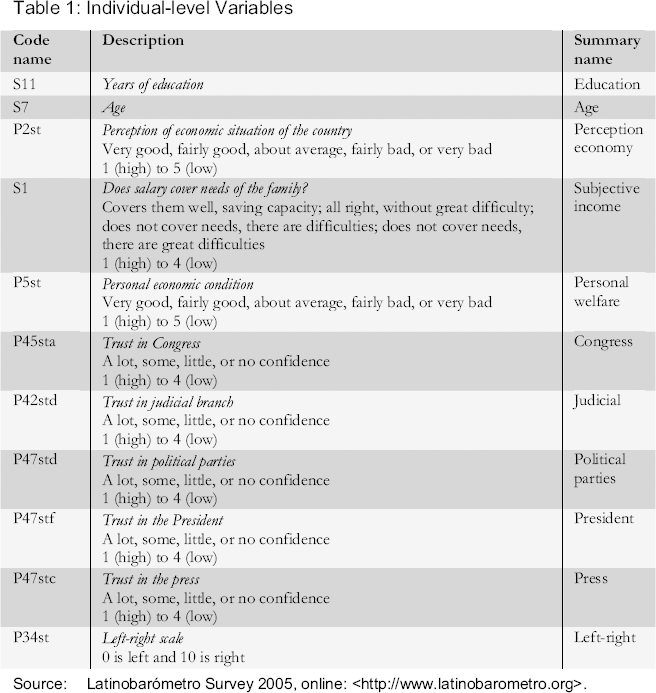
Source: Latinobarómetro Survey 2005, online: http://www.latinobarometro.org.
Country-level Variables
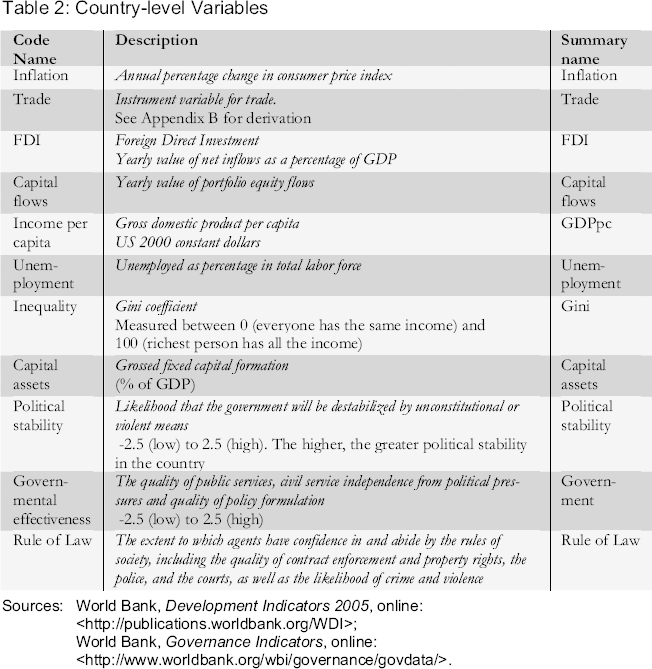
Sources: World Bank, Development Indicators 2005, online:
http://publications.worldbank.org/WDI
World Bank, Governance Indicators, online:
At the country-level, World Bank governance indicators are used to observe their effect on dissatisfaction with democracy, macroeconomic variables such as inflation and unemployment because the influence of these factors on attitudes toward democracy has not been explored at the micro level, and an income distribution variable (Gini) based on the hypothesis that income inequality retards democratic progress. An asset specificity variable (capital assets) is included in response to the argument that attitudes of landowners and physical and human capital owners toward democracy would not be the same – Boix (2003) and Acemoglu and Robinson (2006) theorize that democratization is more likely in a more industrialized society where the elites own physical and human capital than in a more agricultural society where the elites are mainly invested in land.
The included globalization variables deal with trade, foreign direct investment, and capital flows. They are included because they have been used with effect in earlier studies of the globalization-democracy relationship, but not in the presence of micro-level dependent variables. To address an endogeneity problem involving trade, an instrumental variable is constructed following the approach of Lopez-Cordova and Meissner (2005), based on work by Frankel and Romer (1999). The use of a proven instrumental variable of trade in which the geographic information used to predict openness is not correlated with the omitted variables should generate estimates in the equation that are unbiased. 4
We follow their example here, see Appendix B. Globalization has been most frequently operationalized as economic openness using measure of trade, foreign direct investment, and capital flows (Quinn 2000; Colaresi and Thompson 2003; Li and Reuveny 2003; Lopez-Cordova and Meissner 2005; Rigobon and Rodrik 2005; Rudra 2005; Milner and Kubota 2005; Papaioannou and Siourounis 2005; Giavezzi and Tabellini 2005; Yu 2007; and Eichengreen and Leblang 2006). Early empirical analyses looked either at the effect of globalization on democracy or vice versa without getting into a deeper question of a plausible two-way causality, the exceptions being Lopez-Cordova and Meissner (2005) and Bussmann (2001). Lopez-Cordova and Meissner used a gravity model à la Frankel and Romer (1999) to obtain an instrument variable for trade, regressing democracy on constructed trade share where trade is a function of population and the distance between trading partners. Their work revealed a positive effect of trade openness on democratization over the period 1870-2000, with different impacts by region.
Choice of Model
The initial inclination would be to make use of the four Latinobarómetro categories of dissatisfaction with democracy (not at all satisfied, not very satisfied, fairly satisfied, very satisfied) to create an ordinal dependent variable and to estimate a multilevel ordinal logit model by incorporating the variables described in Tables 1 and 2. However, the parallel regression assumption was found to be violated and the ordinal logit model therefore was discarded in favor of the multinomial logit form following a Hausman test for Independence of Irrelevant Alternatives (IIA) that confirmed that the odds that outcome-J vs. outcome-K are independent of other alternatives (i.e., that IIA holds) should not be rejected.
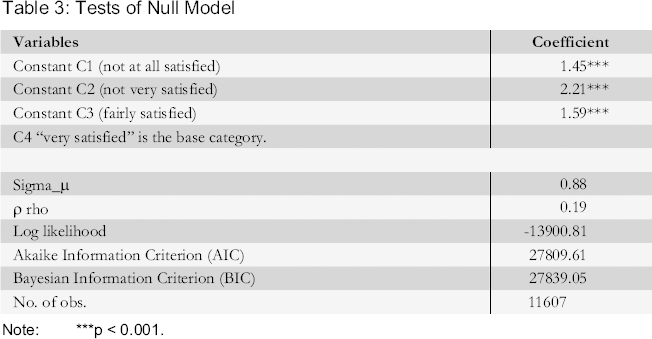
A second question was whether the multinomial logit model should be estimated in multilevel random intercept form. A null model was run, following the procedure outlined in Rabe-Hesketh and Skrondal (2008), with the results that appear in Table 3. The null hypothesis that the between-cluster variance is zero, H0 = Ψ = 0 against Ha = Ψ > 0, which is the same as the hypothesis that ζj = 0 (i.e., that there is no random intercept in the model) was evaluated using a likelihood ratio test with L = 2(l1 - l0) where l1 is the maximized log likelihood of the random intercept model which includes ζj and l0 is the maximized log likelihood for the model which does not include ζj. According to this test and the Akaike Information Criterion (AIC), we reject the null hypothesis that p (rho) = 0 at the 0.025 level of significance. The residual intraclass correlation p (Ψ/[Ψ+π 2 /3]) indicates the degree of dependence among the responses for the same cluster and is statistically significant at the 0.05 level (e.g., that the individuals’ responses are correlated within countries). Thus, there is significant statistical evidence to support a multilevel random intercept model that includes both individual-level variables and countries. The unobserved between-clusters heterogeneity in the null model (rho = 0.19 in Table 3) is reduced to 0.033 by the introduction of country-level variables.
Tests of Null Model
Note:
p < 0.001.
The Odds of Being Dissatisfied with Democracy
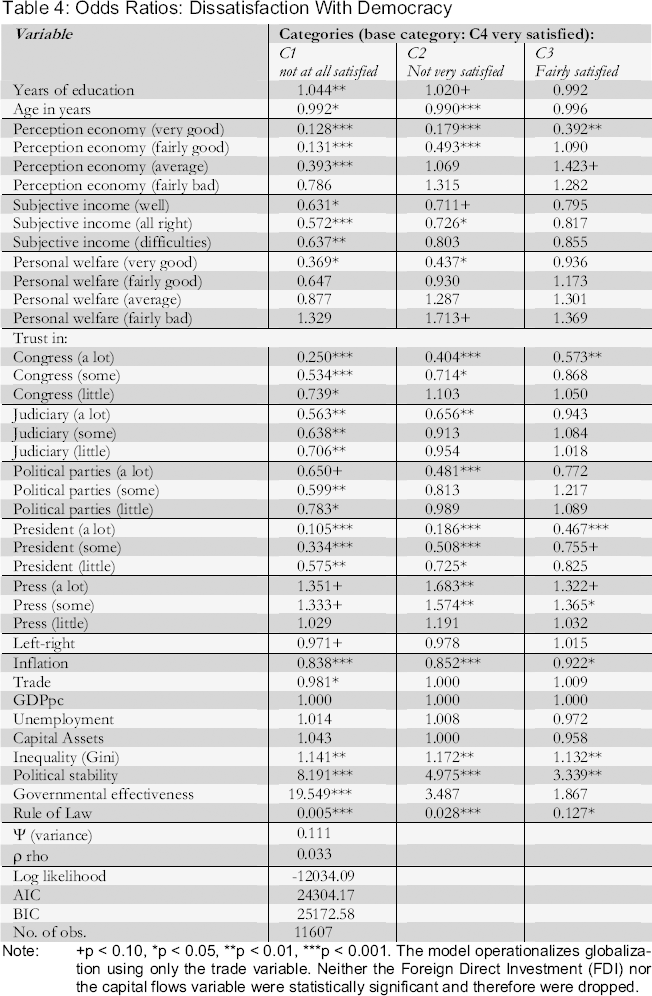
The results of fitting this model appear in Table 4. What are reported are odds ratios relative to the base case of a respondent being “very satisfied with democracy.” Thus, the first row of the table reveals that an extra year of education raises the odds of being “not at all satisfied” with democracy by 4 percent compared with the base (odds ratio 1.04). Further down the first column, the feeling that personal welfare is “very good” is associated with a 64 percent reduced likelihood that the respondent will be “not at all satisfied” with democracy compared with the base (odds ratio 0.36).
Odds Ratios: Dissatisfaction With Democracy
Note:
p < 0.10,
p < 0.05,
p < 0.01,
p < 0.001.
The model operationalizes globalization using only the trade variable. Neither the Foreign Direct Investment (FDI) nor the capital flows variable were statistically significant and therefore were dropped.
Scanning down the column, dissatisfaction with democracy therefore increases with years of education, with greater inequality, and especially when there are high levels of political stability and governmental effectiveness. Dissatisfaction decreases with respondents’ age, with right-wing beliefs, when respondents perceive that both they and the economy are doing well, when they trust Congress, the Judiciary, political parties, and the President, with greater globalization of trade, and especially with the rule of law.
Putting the two together, those who are most dissatisfied with democracy are the better-educated leftish young who feel that they and the economy are not doing well, especially in countries where the globalization of trade is weakest, and where there is substantial inequality. Despite living under conditions of political stability and governmental effectiveness they have little trust in government and politics. Perhaps it is the greater political stability that encourages such individuals to express their dissatisfaction in a more open way without fear of repression and violence against them due to their opinions. Likewise with governmental effectiveness, which includes the capacity of the civil service and its independence from political pressures, which can also provide an environment in which individuals can express their dissatisfaction without fear, knowing that the government will act according to the law. We thus are left with a picture of countries that have yet to be drawn into the global economy, where inequality is substantial, but where effective governments ensure the rule of law and political stability, providing the opportunity for the leftish young to focus on democratic institutions as the source of their perceived ills: perhaps the problem is one of political modernization in advance of the economic modernization that provides the young with outlets other than the street.
Footnotes
The Latinobarómetro Surveys
Latinobarómetro is an annual survey conducted since 1996 that provides individual-level public opinion data for 17 countries in Latin America.5 The same questionnaire is applied to all countries, providing a methodological and technical unity that allows it to represent opinions, attitudes, behaviors, and values across the entire region. Experts from the main comparative studies of public opinion such as the World Values Survey, Eurobarometer, and the National Election Study, were involved in the design of the questionnaire along with important political scientists interested in comparative politics and democratization such as Seymour Martin Lipset, Hans-Dieter Klingemann, Ronald Inglehart, and Juan Linz. The surveys were constructed to enable decision makers and scholars to analyze and better understand the process of social change. The surveys continue. The size of the sample for Latin America is approximately 19,000 adult population interviews which represent more than 400 million people, and the sample varies from 500 to 1,200 by country. The individual interviews are conducted by survey organizations based in each country and cover areas such as democracy, economy and international relations, integration and trade agreements, politics and institutions, social policies and wealth distribution, civic culture, social capital and participation, environment, gender and discrimination, and socioeconomic characteristics.
Latinobarómetro 2005 was selected for use in this study because it was taken at a time when the effects of free trade agreements, expansion of trade, foreign direct investment and capital flows in the region that started during the mid- and late 1990s were becoming apparent (most tariff agreements had phase-out periods of +/– ten years), the severe economic crises of Mexico in the 1990s and Argentina in 2000 had passed, but new sources of dissatisfaction with democracy were emerging.
Derivation of Trade Variable
The following variables are used to construct the instrument variable for trade:
A gravity model is used to predict the logarithm of bilateral trade for each country, viz:
Taking the exponential of the predictions and summing over all trading partners yields the predicted global trade for each country (Σ exp [T’ β∧t]).