




Abstract
High courts with abstract review powers to find laws unconstitutional may provide a strong check on other political actors and influence public policy if the judges in these courts are impartial decision makers. This paper tests existing judicial decision-making theories in relation to the behavior of judges on the Peruvian Constitutional Tribunal who are selected exclusively by Congress. Taking advantage of an original data set of judges’ votes on the Tribunal, we find that the origin of the law and whether the enacting governments at the national and subnational levels are still in power at the time of judicial review are important determinants of judicial behavior. Judges’ own political loyalties seem to have no perceived effect on decision making, which suggests that political affiliations are trumped by strategic concerns of judges due to the institutional design of the Tribunal as well as the political context in which it operates.
Introduction
Most scholars concede, as did Hamilton in Federalist 78, that high courts are extremely deferential to other political branches of government due to their failure to control the “purse” or “sword.” What is unclear is whether judges who work in high courts vary in their deference toward different political actors based on motivations arising from their political affiliations or due to their concerns about future careers or the legitimacy of the court in which they work. If patterns of deference are related to political bias or strategic concerns, then judges’ impartiality may be compromised. This is of particular concern for high courts, which decide important issues within a society, provide checks on other political actors, and influence policy. While most of the extant judicial politics literature shows that high court judges have some political and strategic motivations for their decision-making, these theories predominantly have been tested in countries with presidential systems in which judges are appointed by the country's president, usually with senate confirmation or by a mixed system of appointment where different judges are chosen by different political actors (including the executive) and sometimes non-political actors.
This study analyzes theories of judicial decision-making using the institutional and political context of the Peruvian Constitutional Tribunal, which differs substantially from other extant judicial behavior studies. Unlike other high courts studied in the judicial behavior literature, judges on the Tribunal have short terms and are all chosen by the Peruvian Congress within a weak party system. Further, the study not only reviews judges’ deference towards national political actors, who are in or out of office at the time of judicial review, but also towards subnational political actors.
An analysis of voting records reveals that judges are most deferential to Congress, which has the exclusive powers of appointment and removal, followed by deference to the executive and municipal as opposed to regional governments. The variability in judges’ deference among political actors appears to be related to both the role that these political actors play in judges’ careers and their ability to reward or punish judges and the courts in which they work. Independent of deference to the political actor that enacted the law reviewed, Tribunal judges are also more deferential to those holding power at the time of review rather than those who are no longer in power for all levels of government. Finally, judges’ individual political affiliations seem to play no role in judges’ voting behavior with regard to decisions of unconstitutionality; this is counter to most studies regarding high court judges. We suggest that this finding is due to the particular institutional rules of the Tribunal and the political context in which it operates.
Competing Theories of Judicial Deference
Judicial scholars suggest competing theories for judicial deference or its antithesis, judicial assertiveness (VonDoepp 2006). The majority of these studies are based on high courts in presidential systems whose judges are appointed by the country's president, usually with senate confirmation, or by a mixed system of appointment in which different judges are chosen by different political actors (including the executive) and sometimes non-political actors. We seek to discover whether these theories apply to judges chosen and removed by a different political actor – specifically the supermajority of Congress.
Under one group of decision-making theories, judges are thought to vote strategically, favoring certain political actors in order to avoid punishment in the form of removal or less funding for courts or judges (Scribner 2011; Iaryczower, Spiller, and Tommasi 2002; McCubbins, Noll, and Weingast 1995) or to receive benefits such as promotion to other positions (Magaloni 2003; Helmke 2002; Provine 1980; Epstein and Knight 1998; Murphy 1964), more power or additional funding.
While the threat of other branches punishing or awarding a high court or its judges has been widely discussed in the literature, more recent work implies that courts that are too deferential to political authorities risk being perceived as ineffectual and weak. In this regard, scholars suggest that there are some incentives for courts and their judges to oppose the other main branches of government under certain conditions (Carrubba 2009; Vanberg 2005; Staton 2010; Helmke and Staton 2010). It should be noted that strategic voting has been most often studied in regards to judges in high courts in presidential systems where the executive is involved in choosing and removing judges (for example, on the United States Supreme Court, the Argentine Supreme Court, the Chilean Supreme Court, and the Mexican Supreme Court). Most of these studies rely on assumptions tying judges decisions to their fears of retribution from the president due to his involvement in appointment and removal.
Despite evidence of strategic voting on the U.S. Supreme Court and a number of Latin American courts, some scholars suggest that judges may actually be motivated to make decisions based on their own unconstrained political preferences or affiliations (Segal and Spaeth 2002). Besides the United States Supreme Court, attitudinal voting has also been evidenced by judges’ decisions to find laws unconstitutional on the Canadian Supreme Court (Ostberg and Wetstein 1998, 2007; Wetstein and Ostberg 1999), the Malawi Supreme Court (VonDoepp 2006), the Italian Constitutional Court (Pellegrina and Garoupa 2013), the Portuguese Supreme Court (Amaral-García, Garoupa, and Grembi 2009), the Spanish Constitutional Court (Garoupa, Gomez-Pomar, Grembi 2013), and the Chilean Constitutional Court (Carroll and Tiede 2011). Even in cases where strategic behavior was shown, attitudinal variables were also found significant, such as on the Argentine Supreme Court (Iaryczower, Spiller, and Tommasi 2002) and the Chilean Supreme Court (Scribner 2011) (but see contra, VonDoepp 2006 on the Zambian Supreme Court). While these studies indicate the strength of the attitudinal explanation, none of the judges in the above-listed courts are appointed exclusively by the legislature as they are for the Peruvian Constitutional Tribunal.
While the above theories are used to describe how high courts deal with laws passed by the national branches of government, some constitutional courts are also responsible for reviewing the constitutionality of municipal and regional laws. When making decisions regarding the constitutionality of regional laws, high courts often ultimately decide the outcome of battles that pit regional governments against national governments. To date, only Pellegrina and Garoupa (2013) have dealt with the voting behavior of judges with regard to regional laws on the Italian Constitutional Court. They found that the central government tends to win such disputes when key members of the Constitutional Court are aligned with the prime minister's coalition.
Furthermore, few if any studies of high courts outside of the United States have distinguished between judges’ preferences for laws enacted by governments currently in power at the time of judicial review, as opposed to prior enacting governments. Dahl's influential article found that the U.S. Supreme Court was part of the “dominant national alliance” and thus predominantly followed the lead of the elected political actors in power. Dahl (1957) asserted that, during the time period of his study, the U.S. Supreme Court never found laws passed by a current legislative majority in Congress to be unconstitutional, as compared to laws passed by congressional majorities that are no longer in power. While Dahl's work is limited to a specific period in U.S. history, his argument has been re-examined in the American context (Abraham 1999; Flemming and Wood 1997; Landes and Posner 1975; Eskridge 1991; Ely 1980), but not in other polities.
The Peruvian Constitutional Tribunal in Context
Peru's current Constitutional Tribunal was created in 1994 under former President Alberto Fujimori, who fled the country in 2000 due to a corruption scandal revolving around his chief advisor Vladimiro Montesinos. Fujimori was replaced by Interim President Valentín Paniagua, and Alejandro Toledo assumed the presidency after subsequent democratic elections, serving as president from July 2001 to 2006. Alan García, a former populist president, won a subsequent democratic election and served as president from July 2006 to July 2011.
Since its creation in 1994, the Tribunal has consisted of seven judges who serve for five years without immediate re-appointment (Ley Orgánica del Tribunal Constitucional, Art. 9). The Tribunal hears cases of abstract review, amparo, and habeas corpus and data (see Tiede and Ponce 2011 for an analysis of the Tribunal's amparo decisions). Abstract review cases, which we focus on in this analysis, can be initiated by the president, 1 the national prosecutor, the Defensor del Pueblo or ombudsman, and at least 25 percent of legislators in Congress. Abstract review is a form of judicial review that allows judges to find laws unconstitutional, and such decisions have erga omnes or universal effects. In Peru, abstract review is limited to cases in which the law reviewed is not older than six years. Since 2001, decisions of unconstitutionality must be supported by votes from five of the seven judges. For the period of our analysis from 2001 to 2011, the Peruvian Constitutional Tribunal found 33 percent of the laws or decrees reviewed to be unconstitutional. 2
When the president requests the Tribunal to review a law for unconstitutionality, he or she must obtain approval by the Council of Ministers. Once the Council grants this request, one minister is designated to present the action before the Tribunal.
The Peruvian Tribunal's rate of finding laws unconstitutional does not appear to make it an outlier, as shown in our comparative analysis in the Appendix A-1. A breakdown of the Peruvian Constitutional Tribunal's decisions by type of law and period is found in Appendix A-2.
Judges on the Peruvian Constitutional Tribunal are chosen by only one political body – the unicameral national Congress. Other political bodies are not involved in either the selection or nomination of these judges. The Congress selects Tribunal judges under a supermajority rule requiring that two-thirds of the members of Congress agree on each Tribunal appointment. Dargent (2009) argued that under Peru's super-majority appointment rule, “political negotiation was required to reach an agreement, making it more likely that the candidates elected would be independent ones” (Dargent 2009: 266). As a result, all candidates are a compromise between the executive's party and the opposition parties.
Under Peru's institutional rules in the Constitution and organic laws, Tribunal judges’ terms were supposed to run concurrently with the five-year terms of the Congress that selected them, such that the judges and legislators would be completely replaced every five years. The concurrence of terms has implications for judicial independence. Nonconcurrent terms of judges and legislators are thought to make judges more independent from the elected branches (Moreno, Crisp, and Shugart 2003). Despite the intent of Peruvian Constitutional Tribunal designers, the Tribunal has not experienced completely concurrent terms of judges with the legislators who selected them for all judicial seats during the period of this study due to historical events. 3 The effect of these events has been accentuated by delays in the appointment of judges caused by long negotiations among the legislative parties necessary under the supermajority voting rule. 4
See Appendix A-3 for details of these historical events.
Authors’ interviews (January 2013, Lima).
The Tribunal has had seven separate court compositions between 2001 and 2011, which existed under the governments of former presidents Alejandro Toledo (2001–2006) and Alan García (2006–2011). Under Alejandro Toledo, the Tribunal should have consisted of judges who were all selected by the Congress under Toledo. However, due to Fujimori's flight from Peru, the reinstatement of judges he had removed, and delays in judges’ confirmations, many of Fujimori's judges were present on the Tribunal alongside selections from Toledo's Congress until 2004. For García's presidency, the Tribunal consists of judges who were selected both by distinct congresses under Toledo and García. As discussed later, this interesting Tribunal composition allows us to test whether judges chosen by different congresses behave differently. 5
See Appendix A-4 for a complete listing of all judges and their affiliations.
Judicial Deference and Predictions
Our main inquiry is to determine what, if any, factors drive judges’ propensity to act deferentially in their decisions regarding the constitutionality of laws. Based on the judicial decision-making literature and the Peruvian Tribunal's institutional rules, several predictions about the Tribunal and judges’ decision-making behavior are possible. Under abstract review, courts exercise their most political role (Sadurski 2008). Couso (2003), Hilbink (2007), Mera, Gonzalez and Vargas (1987), and Vaughn (1993) have suggested that judges are reluctant to find parts of laws unconstitutional in their abstract review function because political actors could punish the court, ultimately calling into question its legitimacy and institutional autonomy. Furthermore, we focus on abstract review cases because they involve high-profile political issues and decisions in these cases can potentially nullify portions of legislation enacted by elected officials at all levels of government. Unlike concrete cases, abstract cases can only be initiated by certain political actors and have broader implications.
Concerning judges’ individual incentives to vote deferentially, the Peruvian Congress selects, removes, and disciplines judges, while Congress and the executive control judges’ salaries and influence the Tribunal's budget (Organic Law of the Tribunal and Normative Regulations of the Tribunal 2010; Moreno, Crisp, and Shugart 2003: 121). Congress and the executive may influence judges’ future career prospects after their short terms on the Tribunal. While municipal and regional actors may be able to enhance judges’ career prospects after they leave the bench, they are less influential than national political actors. Considering these arguments, we predict that Tribunal judges are less likely to find laws of Congress and the executive unconstitutional as compared to laws of subnational governments (i.e. municipal and regional).
Despite the national government's influence over the Tribunal, a critical difference between regional and municipal governments may make the Tribunal more deferential to municipal governments than to regional governments. Specifically, regional laws are more likely to create a conflict of competence with branches of the central government than municipal laws (Pellegrina and Garoupa 2013). In Peru, regional governments have increasingly conflicted with the central government. The Toledo administration initiated a decentralization process in Peru in 2002 with the Fiscal Decentralization Law (Law 27783) and Legislative Decree 955. This process was disorganized, slowly implemented, and improvised (Tanaka 2002), which created conflicts between the central and the regional governments regarding the competencies of the regional governments vis-à-vis those of the central government (Lingán 2008; Ponce and McClintock 2014). 6 Furthermore, regional governments in almost all cases are ruled by regional rather than national parties, 7 which could trigger confrontations between regional governments and the central government. Based on the above, we predict that Tribunal judges are less likely to find municipal orders unconstitutional than regional laws.
For instance, some cases have involved the production of coca leaves by local communities (cases 6-08, 20-05, 21-05). Other cases include conflicts for rights of exploitation over natural resources such as fishing (cases 11-08, 24-07, 21-07, and 10-08) and mining (case 09-2010).
For instance, during most of the García administration, the party ruling the executive controlled only two regions (La Libertad and Piura). Toledo's party, Perú Posible, only governed one region – Cusco.
Judges may also be more deferential to enacting authorities at all levels of government who are in power at the time of the Tribunal's review (Dahl 1957). In this regard, the incentives of Peruvian Constitutional Tribunal judges are threefold. First, judges have incentives to behave deferentially to the current congress and the president because the current congress can remove judges and, along with the president can influence the Tribunal's budget and the salaries of judges. Second, judges also have incentives to defer to some current subnational governments because judges may seek careers at the regional and municipal level after serving on the Tribunal. Currying favor with any government authorities currently in power would help facilitate this. Third, as several scholars have indicated (Staton 2010; Staton and Helmke 2010), judges have incentives for the Tribunal to find some government laws unconstitutional because without such rulings, the legitimacy or stature of the court would suffer due to the public's classification of the Tribunal as weak and ineffectual. As shown by Staton (2010) and Helmke and Staton (2010), high court assertiveness is more likely in cases where it is uncertain how litigants or the government will react. The current government's reaction to decisions that oppose laws enacted by prior governments is more uncertain as current governments may have little if any concern about such decisions. As a result, we predict that Tribunal judges will be less likely to find laws enacted by authorities currently in power to be unconstitutional than laws enacted by prior authorities.
While the above predictions suggest that Tribunal judges have incentives to act strategically, we present a null hypothesis that Tribunal judges’ individual political affiliations or alliances will not influence their individual decisions of unconstitutionality. Incentives for attitudinal voting are curtailed by several unique features of the Peruvian Tribunal and its political context. First, some of the Tribunal judges’ political orientations might not be clearly defined due to the fact that they are selected by two-thirds of Congress and must therefore be compromise candidates among the parties with no strong political allegiances towards any one party (Dargent 2009). Second, Peru has a fragmented party system, meaning that appointees to the Tribunal not only are compromise candidates, but emerge from compromises among several parties rather than just two as in a strong party regime. Third, the Peruvian party system has been consistently characterized as non-programmatic and non-ideological (Rosas 2005; Coppedge 1998; Alemán, Ponce, and Sagarzazu 2011). Likewise, because parties’ ideological positions cannot be easily distinguished, judges might find that their own ideological positions are unclear. Finally, because the Tribunal requires that five out of seven judges vote to find a law unconstitutional, voting along party lines would appear ineffectual as it would be hard for judges to form majority coalitions of five judges with the same party affiliations. 8
At only one time, between 16 December 2004 and 23 July 2006, did the Tribunal ever have at least five judges chosen by the same legislative coalition.
Data and Methodology
The data for this analysis consist of all votes by judges on abstract review cases heard by the Peruvian Tribunal during the recent democratic period between 2001 and 2011 prior to the presidency of Ollanta Humala. The data consist of 311 abstract review cases. Abstract review cases involve the constitutional review of executive decrees and laws enacted by Congress and regional and municipal governments.
To test our predictions above regarding individual decision-making, our data was disaggregated to the individual judges’ vote, which allows an examination of 1,948 judge-level votes in abstract review decisions. Our dependent variable focuses on whether the judge found the law unconstitutional. In line with the scholarly literature, votes for unconstitutionality signal courts’ and judges’ independence and impartiality (Helmke 2002; Ramseyer and Rasmusen 2001), judicial activism or its antithesis deference (Hilbink 2008 referencing Cover 1975; Dyzenhaus 1991; Dubber 1993; Fuller 1958; Ott and Buob 1993), and legitimacy to overturn older precedent (Hanford and Spriggs 2006). Findings of unconstitutionality also reflect the extent to which judges are in fact policymakers (Segal and Spaeth 1993, 2002; Epstein and Knight 1998; Maltzman, Spriggs, and Wahlbeck 2000).
Our independent variables include:
Three variables for the law's origin, as follows: Congressional laws, Executive orders, and Municipal orders. The category Regional laws is omitted from the regression as a baseline in the model.
Law/order of government in power to determine whether judges are more or less likely to find unconstitutional laws that are enacted by a government in power at the time of judicial review or a government no longer in power. This variable takes a 1 if the judge was reviewing a law enacted by a political actor currently in power at the time of review and 0 if reviewing a law by a political actor from a prior period.
Political fragmentation is the effective number of parties (ENPP) for each congressional period, a standard measure of political fragmentation for a multi-party system (Laakso and Taagepera 1979).
Two alternative variables indicating judges’ political preferences include:
Judge party same as the sitting president at the time of review takes a 1 if the judge is affiliated with the president's (that is, the ruling) party at the time of review and a 0 if not. This reflects conventional criteria driving preferences in Peru; namely, whether an individual is for or against the government or the opposition (Alemán, Ponce, and Sagarzazu 2011).
Judge chosen by congress in power at time of review aims to capture whether judges who are aligned with a particular congress that chose them vote differently than judges chosen by other congresses. This variable takes a 1 if the judge deciding a case was selected by a congress in power at the time of review and 0 otherwise. 9
As an alternative, we could use judges’ party affiliations for attitudinal variables. Regrettably, there is little data on judges’ ideological positions or specific affiliations because several judges are non-ideological or apolitical, as our interviews and research revealed (Lima, Peru, January 2013). Summary statistics for all the variables are found in Appendix A-5.
We conducted a multivariate (multilevel) analysis with the following specification:
Pr (yi = 1) = logit-1 (αj[i] + B1Congressional lawi + B2Executive orderi + B3Municipal orderi + B4Law/order of government in poweri + B5Political fragmentationi + B6Judge attitudinal variablei), for i = 1, …, n, αj ~ N (μα, σ 2 congressional period)
where j[i] represents the congressional period in which each judge's vote i was cast.
Multilevel models provide valuable statistical tools with which to take into consideration the possible lack of statistical independence among observations across contextual units (Raudenbusch and Bryk 2002; Steenbergen and Jones 2002). In this case, a particular composition of Congress, determined by the share of seats of legislative parties, may create political dynamics that generate statistical dependence among judges’ votes cast during a particular legislative period. 10 Failure to cluster this type of data may result in underestimated standard errors and ultimately lead to mistakes in estimation or inference analysis (Barcikowski 1981; Blair et al. 1983; Steenbergen and Jones 2002). Given the dichotomous structure of the dependent variable, we employ a logistic multilevel model estimated through a maximum likelihood estimator. 11
In Peru, the composition of Congress and the executive changes every five years.
We use the arm package in R to estimate this model.
Results and Implications
The results, presented in Table 1, confirm our predictions that judges vote strategically rather than according to pure political preferences. Our findings establish that judges’ deference is highly dependent on which political actor enacted the law being reviewed and whether that actor was in power at the time of the review. The origin of the law seems to have the most impact on how judges vote out of all the other variables tested. The results show that judges are most deferential to Congress, followed by high degrees of deference for the executive and then municipal governments. Judges are least deferential to regional governments. Based on calculations of predicted probabilities, judges are 49 percent less likely to find laws promulgated by Congress to be unconstitutional, 37 percent less likely if the law is enacted by the executive, and 27 percent less likely if the law is a municipal order, as compared to a regional law. Not only are judges’ votes of unconstitutionality driven by the author of the law reviewed, but judges also are 13 percent less likely to find laws unconstitutional if promulgated by any level of government currently in power at the time of review. Finally, judges are 12 percent more likely to find laws unconstitutional when Congress becomes more fragmented. This finding is consistent with other judicial studies.
Explaining Judges’ Deferential Decisions (i.e. Votes of Unconstitutionality)
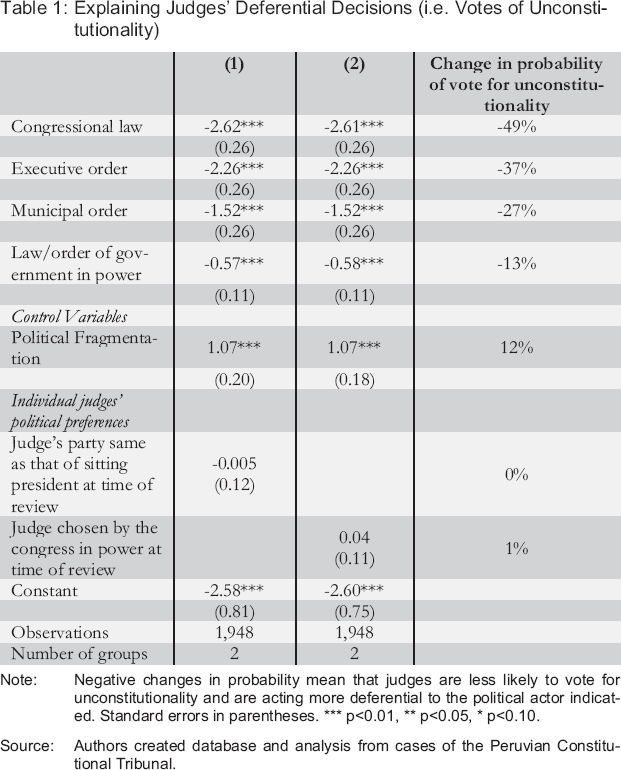
Note: Negative changes in probability mean that judges are less likely to vote for unconstitutionality and are acting more deferential to the political actor indicated. Standard errors in parentheses.
p<0.01,
p<0.05,
*p<0.10.
Source: Authors created database and analysis from cases of the Peruvian Constitutional Tribunal.
This analysis has shown that the role of judges’ political preferences has no impact on decisions of unconstitutionality; this is in contrast to the behavior of judges on many high courts. 12 As a result of the Tribunal's unique design and the political context in which it operates, Tribunal judges have little incentive to vote according to their political biases. This finding is in stark contrast to much of the work on high court judges’ behavior and suggests that institutional design can at least curtail political voting.
While the overall analysis does not seem to indicate attitudinal voting, further evaluation is provided in Appendix A-6.
As stated at the beginning of this paper, strategic or attitudinal voting may indicate that judges are not impartial decision makers. This study shows that Peruvian Constitutional Tribunal judges’ impartiality seems to be compromised not by individual political allegiances or affiliations, but by strategic concerns, making judges quite deferential to national actors as well as those currently in power at every level of government. Judges’ strategic behavior raises serious concerns about whether the Peruvian Tribunal, despite its expansive abstract review powers to find laws unconstitutional, provides a real check on other political actors or can effectuate policy. The Peruvian Tribunal is a relatively new Tribunal and may become less deferential over time as it becomes more institutionalized. However, policymakers may want to consider different appointment and removal mechanisms that would change judges’ incentives, causing them to vote more impartially.
Further research in the form of comparative analyses and more individual case studies would help clarify how particular institutions and political contexts affect judicial behavior of judges on high courts. While the present study has indicated that institutions may provide judges with incentives to vote strategically, further studies are needed to clarify the optimum configuration of institutions or combinations of institutions to encourage more impartial voting.