




Abstract
This article identifies the variables that explain the dissenting legal vote in courts that operate under conditions of extreme institutional instability. Drawing on three logistic regression models, this article proposes that judges’ ideological preferences constitute a good predictor of the dissenting vote. Contrary to the classic argument, which indicates that the instability of judges encourages strategic voting, this article argues that this relationship can be demonstrated only up to a certain point – that is, until an exponential increase in institutional instability leads the judges to vote sincerely, even when this means being part of a minority or “losing” coalition.
Introduction
Even though research on judicial politics in Latin America has grown in recent decades, there are still few studies that have attempted to identify the factors that determine the presence of dissenting votes within collegial courts. 1 This theoretical void is noteworthy because knowledge of these factors would allow for a deeper understanding of legal enforcement in Latin America from different perspectives. First, the presence of dissenting votes shows that jurisprudential-legalistic approaches only partially explain the behavior seen in courts presided over by more than one judge. Second, studying dissenting votes allows the judicial decisionmaking process to be examined within the context of cooperation and dispute, characteristics of judges on collegiate courts. Third, exploring the reasons for which some judges depart from the majority decision of their colleagues makes it possible to develop a theory of legal behavior that covers different levels of analysis (Gibson 1983).
Based on the pioneering work of Verner (1984), the literature in the region has captured the attention of many political scientists. A complete revision of the state of research on judicial politics in Latin America can be found in Kapiszewski and Taylor (2008).
I propose that the presence of dissenting votes is fundamentally explained by the differences in ideological preferences among the judges who make up collegiate courts. In other words, I suggest that when making collective decisions, judges vote sincerely, independent of the characteristics of the case under consideration, of the issue raised, and of the political environment. Considering that a large portion of the studies in Latin America argue that judges tend to vote strategically due to job insecurity, I present sufficient evidence to warrant refinement of this theory (Helmke 2002, 2005; Iaryczower 2000; Chávez 2003, 2004). To test the theory, I draw on three logistic regression models that analyze the dissenting opinions cast by judges on the Constitutional Court of Ecuador, one of the most unstable legal institutions in Latin America.
The first part of this article discusses the main theoretical findings related to judicial voting. Given the relative lack of empirical evidence specifically related to the dissenting vote in Latin America – in contrast to the abundant research on that topic in the case of the United States –I examine research that analyzes legal decision-making at the micro level. Even though this type of research does not include divided decisions as a unit of analysis, the variables used to explain the individual vote and the incorporation of institutional instability serve as a basis for the theoretical proposition developed in the next part. The second section discusses some of the variables that may explain the dissenting judicial vote and that take into account the argument presented in the literature review. The third section empirically tests the conjectures of this theoretical proposal, and the fourth part discusses the main empirical findings. This article concludes with some recommendations for future research not only in the field of judicial politics but also, more generally, in the study of the relationship between politics and justice within democratic regimes.
As mentioned above, there is little research in Latin America that includes divided judicial voting as a unit of analysis. 2 However, in American judicial politics there are more than four decades of research about the causal factors that explain judicial dissenting voting. The first explanation is that a dissenting vote is a function of the complexity of the cases. So, if the cases are more difficult to solve, the probabilities of dissenting voting increase (Pritchett 1941). A conclusion of these empirical findings is that judges vote sincerely, according to their preferences and the applicable legal norms. Contrary to this empirical evidence, Epstein, Segal, and Spaeth (2001) show that the intensity of the consensual norm in the U.S. Supreme Court is greater and the dissenting vote is less probable. Consensual norm is a practice by which justices who may privately disagree on the outcomes of cases mask their disagreements for the public by producing consensual opinions (Epstein, Segal, and Spaeth 2001: 362–363).
An exception is the research of Sánchez, Magaloni, and Magar (2010).
Epstein, Landes, and Posner (2010) show that the number of questions judges asked the parties during audiences is not a good predictor of non-unanimous decisions in the U.S. Supreme Court, and that judges used oral argument as a way to express their opinions and attempt to influence other judges. So, the above authors conclude that judges vote strategically. In the same vein, Narayan and Smyth (2007) point out that rate of dissent in the High Court of Australia decreases when the caseload and the real income increase. Other research has shown that the leadership of the Chief Justice predicts the degree of dissenting voting in the courts (Smyth and Narayan 2004, 2006). These authors offer empirical evidence for this hypothesis for the Supreme Courts of Australia and the U.S. In sum, the previous empirical findings position the discussion about judicial dissent between the attitudinal model and the separation of powers, or strategic, model. 3
Some of the main contributions about the attitudinal model are: Segal and Spaeth 2002; Segal et al. 1995; Rohde and Spaeth 1976; Shubert 1974; Danelski 1966; Nágel 1963; Schmidhauser 1961; Pritchett 1948, 1941. For the separation of powers (strategic) model, some of the more notable contributions are: Hammond, Bonneau, and Sheehan 2005; Maltzman, Spriggs, and Wahlbeck 2000; Epstein and Knight 1998; Spiller and Spitzer 1995, 1992; Brace and Hall 1993, 1990.
In Latin America the academic studies performed at a micro level have concentrated on the analysis of the degree to which the appointment terms of judges constitute a determining factor of sincere or strategic judicial decisions – though these studies have not focused on dissenting voting. Thus, the more stable that judges are on their benches, the greater the probability that their votes will correspond to their own ideological preferences. On the other hand, if job uncertainty is a fundamental characteristic of judicial activity, and if early and unconstitutional dismissal may take place at any moment, judges will be sufficiently motivated to vote as a function of the political actors who may dismiss them. Indeed, this perspective supposes that in order to avoid sanctions in the form of removal from office, judges will vote strategically.
Empirically, this argument has received the greatest amount of attention in Argentinean courts. In terms of both Argentina's Supreme Court and the sub-national courts of the provinces of Mendoza and San Luis, the logic behind this analysis of judicial decision-making is the same as mentioned above (Helmke 2002, 2005; Iaryczower 2000; Chávez 2003, 2004). At the regional level, the research of Pérez-Liñán and Castagnola (2009) has found that the situation described above is not exclusive to Argentina but rather corresponds to a large number of Latin American countries. Thus, in order to obtain judges whose vision is in line with that of the government, politicians alter the configuration of the highest courts, disrespecting the legal and constitutional terms of appointment. In sum, under conditions of job uncertainty judges vote strategically, while in unstable circumstances they resolve cases sincerely: according to their ideological preferences. Chile, Uruguay, Colombia, and Mexico, following the hegemony of Mexico's Institutional Revolutionary Party (Partido Revolucionario Institucional, PRI), constitute empirical references for this type of behavior. 4
In the case of Chile see the works of Hilbink (2007), Barros (2002), Prillaman (2000), and Correa Sutil (1993). For Uruguay the reference is Brinks (2007). For judicial politics in Colombia the key works are Cepeda (2005), Uprimny (2004), Rodríguez, Uprimny, and García-Villegas (2003). For the Mexican case see Sánchez, Magaloni, and Magar (2010) and Ríos-Figueroa and Taylor (2006).
To propose some possible explanations for dissenting judicial voting, I analyze the main variables discussed in the judicial decision-making models both in the U.S. and in Latin America. First, I consider the attitudinal model. This model is mainly concerned with observing how the ideological preferences of judges influence the direction of their votes (Segal and Spaeth 2002; Segal et al. 1995; Rohde and Spaeth 1976; Shubert 1974; Danelski 1966; Nágel 1963; Schmidhauser 1961; Pritchett 1941, 1948). Then, I analyze the contributions of the jurisprudentiallegalist model. This model focuses on the effects on judicial voting of both the provisions submitted for decision and the issues involved in the controversy (Markovits 1998; Greenawalt 1992; Ackerman 1991; Brigham 1978). Third, I incorporate the separation of powers, or strategic, model, along with the essential idea that the movements of political actors outside of the judicial arena may influence the direction of the judicial decisions (Hammond, Bonneau, and Sheehan 2005; Maltzman, Spriggs, and Wahlbeck 2000; Epstein and Knight 1998; Spiller and Spitzer 1995, 1992; Brace and Hall 1993, 1990).
Ideological Preferences
One of the theories with the most followers in the field of judicial politics indicates that judges vote sincerely – that is, based on their own ideological preferences. Therefore, a legal decision will be the result of a collation of the case under consideration and the judge's ideology (Segal and Spaeth 2002). From this perspective, a judge's vote on any given case will reflect her/his legal knowledge and judicial-political orientation with respect to the way s/he believes the world “should be” (Schubert 1965, 1974). The behavior of Chilean Constitutional Court judges in cases of human rights empirically demonstrates attitudinal voting in Latin America (Couso and Hilbink 2010: 181–182). According to the above theory, works that analyze the split voting in the United States Supreme Court have shown that the ideological distances between judges largely explain the presence of dissenting legal decisions (Brace and Hall 1990; Hall and Brace 1989).
The validity of the attitudinal model fundamentally lies with the idea that judges enjoy stability on their bench, meaning that when there is no pressure from the political environment, they can resolve cases sincerely.
The Cuarta Sala of the Supreme Court of Costa Rica or the Supreme Court of Brazil are good examples of this kind of judicial behavior in Latin America (Wilson 2010; Brinks 2010). In situations where judges work under conditions of job uncertainty, there are sufficient incentives for them to vote strategically. Thus, given that in Latin America the “price” that political actors must pay for dismissing courts of justice is low, judges will vote on cases based on the interests of the political actors who are able to sanction them. This behavior benefits not just the judges but also the political actors, as not only does it facilitate decisions that are aligned with the political actors’ own interests, but these actors also avoid paying the price implied by dismissing and subsequently nominating new judges. In analytical terms, this is the equilibrium mentioned by Helmke (2002, 2005) in his study on the Supreme Court of Argentina.
However, I argue that it is possible to find a different equilibrium when the cost for a political actor to dismiss judges is close to or equal to zero. In this case, the benefit for political actors lies with the restructuring of the courts, as this ensures that new judges are ideologically closer to the political actors. At the same time, in this scenario of extreme job instability the judges lack sufficient incentive to vote strategically because they know that they will inevitably be removed when political power shifts hands, independently of how they vote. The best decision that judges can make is to vote sincerely. Thus, voting according to ideological preferences even under conditions of extreme job instability constitutes a mechanism through which the judges benefit by maintaining and improving their prestige and reputation in the legal community and, above all, among their client base, which will continue to seek their services even after they are dismissed. Figure 1 shows the previous argument with specific paradigmatic country cases.
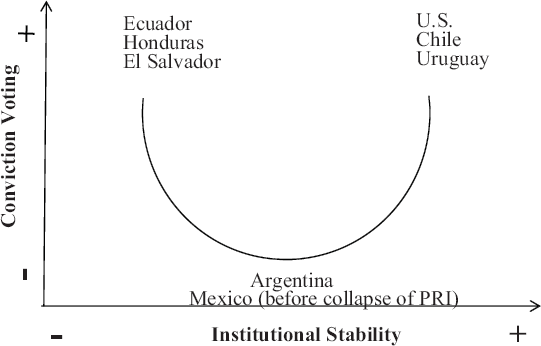
Relationship between Institutional Stability and Judicial Vote Variables
This equilibrium, which in previous works (Basabe-Serrano 2011, 2012) I have referred to as that of “judges without robes” is what this article intends to examine, analyzing dissenting votes for this purpose. Among the hypotheses, it is conjectured that if a judge is ideologically located to the left or to the right, his vote should be issued in the same direction, independent of whether this implies being part of a “winning” or “losing” coalition. Furthermore, if the dissenting vote can be explained by differences in the ideological position of the judges who make up the courts, it can be argued that judges resolve cases sincerely. As a corollary, the lack of dissenting votes within a collegiate court would indicate the ideological closeness of the court's members.
According to the literature related to the economic analysis of law, it can be argued that the importance of the legal norm under review influences judicial decisions. In the specific case of dissenting opinions, given that the judge is an actor who maximizes his benefits and minimizes his costs, using a dissenting vote is something that occurs only under specific circumstances (Posner 1993). In effect, given that disagreeing with the judge who presents the draft ruling implies an additional expenditure of time to study the case and subsequently cast the dissident vote, it is likely that judges will take this route only when it is merited by the norm under consideration. Therefore, given that judges are often overloaded with work and their salaries are set – which implies a negative incentive to work longer and more efficiently – in those cases in which the legal norm under question is of little significance the best strategy would be to adhere to the content of the draft ruling prepared by the colleague charged with this task.
In other words, judges cast dissenting votes as a function of the impact and scope of the legal norm under review. Regardless of whether the judges agree with the decision of the majority, they will vote in the same direction of the draft ruling if they think that the effect of the final decision is not sufficiently strong to justify them spending time to review the case in order to potentially cast a dissenting opinion. So, the informal rule in this dynamic appears to be that although the courts make decisions as a collective unit, really it is just the judge responsible for writing the draft ruling who proposes the main ideas to solve each case.
In order to differentiate between important legal norms and those that are less important, I take into account two criteria: The first has to do with the degree of negotiation previously involved in the approval of the norm. The second refers to the number of actors involved in the preparation of these legal devices. So, as there is a greater degree of exchange and negotiation in the political arena, and as more actors take part in the interactions, legal norms on the whole will tend to be considered more significant. On the other hand, with less intense negotiations and with few or only one single actor who must make decisions, the norm is less significant. In general, laws tend to fit within the first category while provisions from officials of the executive branch or of autonomous governments fit into the second category. As Pritchett (1941) conjectures, if the legal norm under review is considered to be of greater importance, the probability that dissenting votes are produced within the courts will increase. Conversely, when the provisions of the case in question are less significant, there will be a lower probability of dissenting votes.
The Issue under Review by the Judges
A third explanation of dissenting judicial votes has to do with the influence this behavior could have over the issue under review. In this regard, the literature on judicial decision-making has indicated that judges vote selectively based on the type of issues presented to them (Grijalva 2010; Taylor 2008; Brace and Hall 1995, 1993). Therefore, testing this variable for the case of dissenting votes could shed light on the logic behind this type of judicial decision. Grijalva (2010) points out that Ecuadorian Constitutional Court judges voted strategically only on issues that were reported by the media as being of national importance or that mobilized pressure groups. Taylor (2008) shows that Brazilian Supreme Court judges are important actors in the policy process, especially when it comes to issues related to energy policy reform. However, in both cases the above authors analyze how the issues influence judicial decisions but not how the issue could motivate a dissenting vote.
Brace and Hall (1993) focus on the variables that affect the rate of judicial dissent in death penalty cases in six U.S. state supreme courts (1980–1988). Accounting for each case's specific characteristics, the authors show that the presence of aggravating factors is positively and significantly associated with the tendency to cast liberal dissents. However, when this variable interacts with others related to the political context, the results change. The authors show that when judges are elected on partisan ballots in politically competitive environments, they are less likely to cast liberal dissents in cases that contain aggravating circumstances (Brace and Hall 1993: 928). Regardless of the empirical findings, the authors point out that the failure of this variable to have a greater impact on judicial voting could be the result of the manner in which the authors measured the variable.
Of the many issues that could be analyzed in this respect, I propose that among those issues that have been raised in the majority of Latin American countries and that are related to market-oriented reforms, some lead to greater debate and tension among the judges, resulting in dissenting votes in the final decisions.
Essentially, two types of issues subject to judicial decision are examined in the empirical analysis. First, there are those cases that consider the degree to which the state should intervene in the market. Second, there are those cases that analyze the degree of labor flexibility that should guide the relationship between employers and employees.
The first issue has a strictly economic connotation and involves a debate among the judges in the importance of the law of supply and demand in the progress of society. In this case, there could be major differences in criteria among the judges, which would lead to a greater possibility of dissenting votes. To a leftist judge the state should more strongly intervene in and regulate economic issues, while for a rightist judge the market is the better regulator and the state should play a less important role. This is not a categorical variable so it is not possible to identify a judge as simply “left” or “right.” Each judge is located on a scale of extreme left to extreme right.
In the second case what is under discussion is the value that judges place on the concepts of equality and social justice in labor relations and, specifically, on the positions of the actors involved in this interaction. This issue is less controversial given the unquestionable asymmetry in the employer–employee relationship. Consequently – as a hypothesis – in this type of case there would be less room for discrepancies, which makes the presence of dissenting votes less likely. However, my conjecture is that a leftist judge will generally be opposed to labor laws that diminish guarantees in favor of the workers, and a rightist judge will generally be in favor of labor laws that permit more varied economic relationships through less regulation of the labor market.
Changes in the Distribution of Political Power
The final, and perhaps most important, variable included in the analysis is an alternative explanation of judges’ ideological preferences, having to do with the influence that could be exerted over judicial votes by the changes in the distribution of political power among the actors who are able to dismiss the judges. Because most judges in Latin America do not benefit from job stability, one of the resulting conjectures is that variations in the makeup of the political powers could lead to either sincere or strategic judicial voting. Strategic voting occurs more often when judges fear being removed from their benches by the new coalition in power (Helmke 2002, 2005). However, this is not the only reason for judges to vote strategically in Latin America. Rodríguez Raga (2010) has shown that Colombia's Constitutional Court judges vote strategically despite their secure positions. Regardless of the variables that influence the judges’ decisions, the argument of the separation of powers model assumes that judges are ends-driven players who make decisions based on the moves of other political or social agents (Hammond, Bonneau, and Sheehan 2005).
If I consider the legislature, the political environment in which variations in the distribution of political power can best be seen, I can then conjecture that changes in the makeup of the political powers in this arena influence the frequency of dissenting judicial votes (Basabe-Serrano and Polga-Hecimovich 2013). Considering that judges in Latin America fear their early dismissal by political actors able to remove them, the ideological orientation of the legislative majority will motivate judges to decide cases in line with the ideologies of those political actors. It can be hypothesized that if the majority of the legislative coalition is ideologically oriented toward the right, then the probability that the dissenting votes will lean toward the left will increase. On the other hand, if the legislative majority leans left, the probability that the dissenting votes will lean right should likewise increase. In the end, verifying this hypothesis would reveal that under circumstances of job instability judges are more likely to vote strategically than they would if their jobs were more secure.
Methodology and Data
To test the aforementioned conjectures, this article draws upon the analysis of split decisions on cases of judicial review heard by the Constitutional Court of Ecuador (CC) between 1999 and 2007. The CC is not part of the judicial branch, and the nine judges are selected by the National Congress (Congreso Nacional) from among candidates representing the executive (2) and legislative (2) branches, the Supreme Court (2), workers’ unions (1), mayors and provincial prefects (1), and chambers of commerce (1). The CC was created in early 1996 and some of its powers were reformed with the 2008 Constitution; however, judicial review remains one of the most important political tools in Ecuador. Though the CC was comprised of three chambers of three judges each, the cases of judicial review mandated a chamber consisting of all nine judges – the Pleno. So, the minimum majority for a final decision was five votes. Until the 2008 Constitution was passed, the CC heard only cases dealing with constitutionality of various laws, so the decisions analyzed were dichotomous.
In methodological terms, this court is relevant for two reasons: first, because the CC is one of the most unstable courts in Latin America (Grijalva 2010). Between 1997 and 2009, none of the Constitutional Court's judges finished the four-year term to which they were elected. Although impeachment was the only mechanism available to dismiss them, all of the removals took place within the margins of this legal process (Basabe-Serrano 2012: 137). In addition, the average duration of each configuration of the CC was less than 21 months, so it is not hyperbolic to assert that the CC is a case of extreme instability. The picture of the CC is similar to that of Ecuador's Supreme Court. In the last democratic period, that court underwent five major reorganizations involving changes in personnel: in 1998, 2004, 2005, 2008, and 2011 (Conaghan 2012: 676).
The other reason the CC is relevant to this analysis is because it has a high rate of dissenting opinions. In fact, among the judicial review cases that took place during the period of analysis, just 14.29 percent were unanimously resolved, while 74.42 percent were resolved with dissenting decisions. 5 With regard to the selection of judicial review cases, this methodological decision is based on the fact that it is in performing this institutional function that judges are best observed as what some authors have called institutional veto players (Tsebelis 2002).
Basabe-Serrano 2009. A broader description with regard to the performance of the CC related to the level of negotiation among its members and its real capacity to act as a veto-wielding player in public policy is found in the cited study.
For its part, the identified time period covers the majority of the time in which the CC was part of the Ecuadorian constitutional arrangement. The few cases resolved between the end of 1997 and the beginning of 1999 remain beyond the analysis due to the lack of clear rules with respect to how the CC operated during that period, and because information available for this stretch of time was quite unsystematic. Finally, among the cases of judicial review, only those that relate to the tenuous process of structural adjustment experienced by the country –specifically, those cases that challenged the regulatory framework in relation to the degree of liberalization of both the economic system and labor relations – are considered. The database discussed in this article contains 576 individual votes in judicial review cases decided by the CC and was prepared based on data compiled by the present author (2011, 2012) on judicial decision-making in the context of institutional instability.
To analyze dissenting votes from different perspectives, I have constructed three dependent variables. The first groups the decisions together as a function of the coalition, including the individual votes. Thus, the collegial decisions were labeled votes with the majority coalition and were defined in opposition to the collegial decisions of the minority or dissenting group. For the second and third dependent variables the dissenting votes were grouped together as a function of their ideological orientation. Then, the decisions of the dissenting judges were categorized as dissenting votes to the left in relation to a majority decision to the right and as dissenting votes to the right in relation to a majority decision to the left. A vote to the left is conceptualized as a decision against market liberalization and/or labor relation liberalization, while a vote to the right refers to decisions in the opposite direction. The information used to measure these variables was extracted from the analysis of the content of the verdicts dictated by the CC in the selected cases.
To capture the values of the independent variables, the following strategies were employed. To obtain the ideological preferences of the judges, these actors were placed on a scale from 1 (extreme left) to 10 (extreme right) through surveys completed by 110 experts on constitutional matters (lawyers, academics, journalists, and politicians). 6 According to the conceptualization laid out in the previous section, the importance of the norm under judicial review is measured based on a dichotomous variable that categorizes organic and general laws as the most important ones; the less important ones are the rest of the legal provisions contested through judicial review. This differentiation is related to the greater number of actors and the greater amount of political negotiation implied by the first group, in terms of the interactions between the executive and legislative branches. The legal norms dictated by ministers of state and the legal provisions from sectional governments (municipal and provincial ordinances) are part of the second group.
The surveys were performed in 2007 and covered the cities of Quito, Guayaquil, Cuenca, and Loja.
To capture the variable related to the characteristics of the case under review, a nominal variable was designed, and divided into two categories: The first includes cases related to the degree of state intervention in economic matters. The second contains cases related to the degree of flexibility in labor relations. All observations included in the databases described at the beginning of this section are analyzed in this manner. The information used to measure this variable was obtained from the judicial review lawsuits presented to the CC. Finally, to capture the changes in the distribution of political power, the ideological location of the median party in the legislature during the period of analysis was used as a proxy. To identify legislative coalitions and the median political grouping in each one, the works of Mejía-Acosta and Polga-Hecimovich (2010) and Basabe-Serrano and Polga-Hecimovich (2013) were used. Table 1 summarizes the variables used in this article and the coding assigned to each one.
Description of the Variables that Explain Dissenting Judicial Voting in the CC of Ecuador (1999–2007)
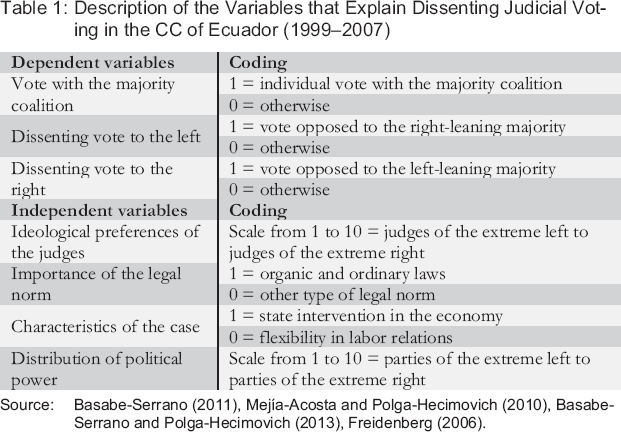
Source: Basabe-Serrano (2011), Mejía-Acosta and Polga-Hecimovich (2010), Basabe-Serrano and Polga-Hecimovich (2013), Freidenberg (2006).
Due to the dichotomous nature of the variables under consideration, employing linear regression models would lead to methodological problems with the estimators’ efficiency (Brace and Hall 1993: 922). In effect, given that these techniques do not establish restrictions on the values assigned to the dependent variables, the results would show probabilities greater than 1 or less than 0. 7
The inefficiency of the estimators generated by linear regression models also makes the tests of the coefficients of the hypotheses invalid. This methodological problem does not imply that the estimators produced by these techniques are biased.
Faced with this limitation, logistic regression models were chosen. This technique, which uses a value derived from the maximum likelihood method, produces estimated parameters based on the relationship between a group of independent variables and a dependent variable. 8 In other words, by integrating the three proposed models – one for each dependent variable – around a logistic option, it is possible to evaluate the probability that the dissenting vote coincides with the values assigned to the ideological preferences of the judges, the importance of the legal norm under consideration, the characteristics of the cases, and the distribution of political power in the legislature. Table 2 shows the distribution of the variables used in this article, including the ideological preferences of the judges.
Distribution of Variables Used to Explain Different Judicial Coalitions in the CC of Ecuador (1999–2007)
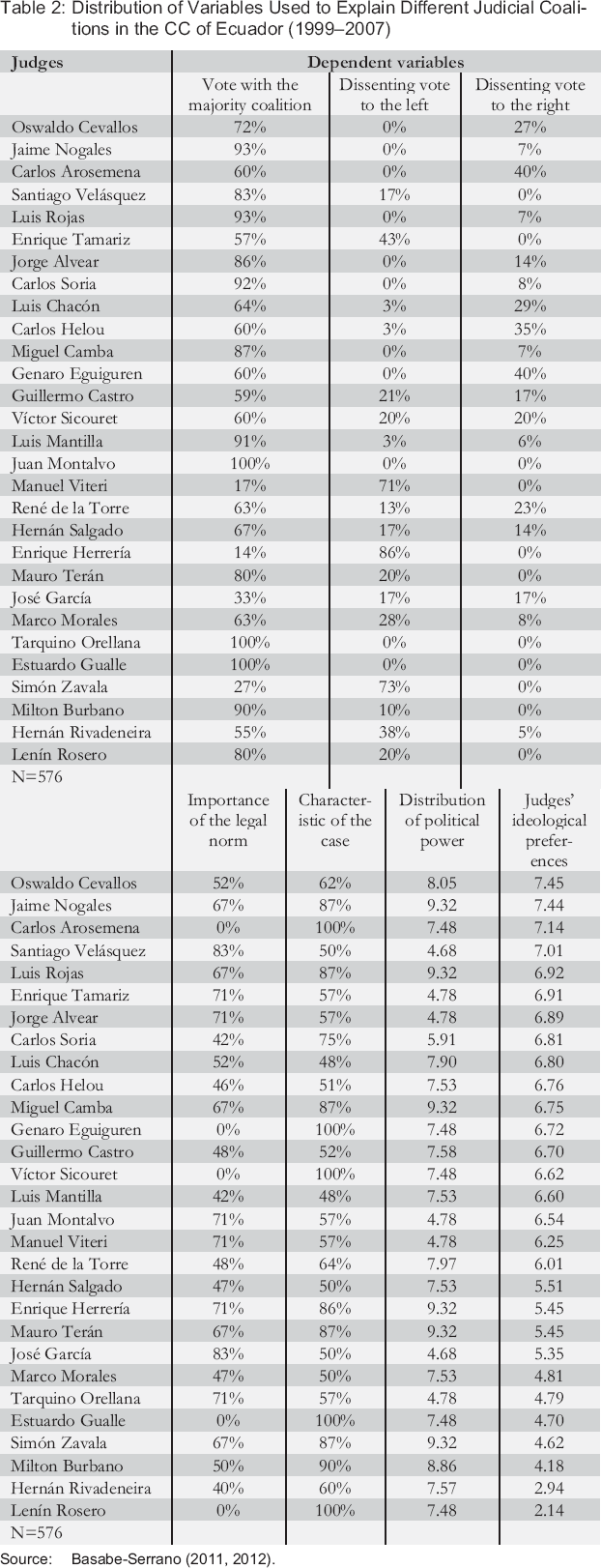
Source: Basabe-Serrano (2011, 2012).
While this method maximizes the probability of prediction from the observed sample, the least ordinary squares method used in linear regression models minimizes the sum of the squared residuals. Therefore, the latter method does not allow for observations of the smallest variances found in the sample.
According to the coefficients calculated by a chi-square test (p<0.05) it can be argued that within the set of independent variables selected for the three proposed models, the ideological position of the judges is the only one that remains highly significant. In other words, and according to Table 3, the distribution of political power, the importance of the legal norm, and the characteristics of the case are variables that do not decisively influence dissenting judicial votes. In this context, upon analyzing the factors that influence the aggregation of individual votes that compose the vote of the majority coalition (model 1), it is established that those judges identified as ideologically to the right are 1.2 times more likely to be located within the winning coalitions than their colleagues located to the left. Considering that the ideological judges’ preferences are primarily center-right (see the righthand column of Table 2), this result agrees with the theoretical proposal put forth by this article, which is that the judges vote sincerely. Thus, the more right-leaning judges there are in the CC, the greater the probability that they will form part of a winning coalition.
Three Logistic Models of Dissenting Voting on the Ecuadorian Constitutional Court (1999–2007)
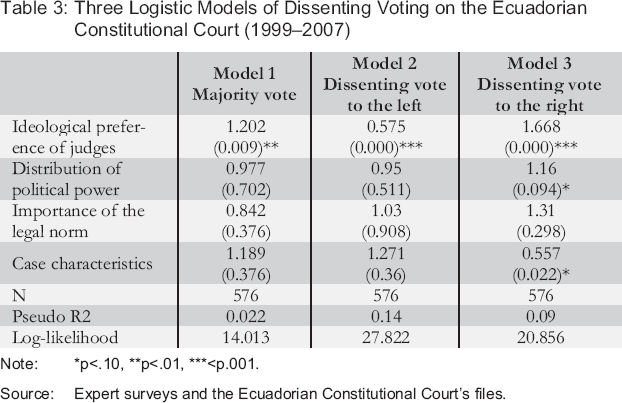
Three Logistic Models of Dissenting Voting on the Ecuadorian Constitutional Court (1999–2007)
Note:
p<.10,
p<.01,
<p.001.
Source: Expert surveys and the Ecuadorian Constitutional Court's files.
The results are even more relevant with regard to the formation of the dissenting vote to the left (model 2). In effect, the statistical coefficients show that if a judge is ideologically located to the left s/he is 1.57 times more likely to belong to a minority coalition in this direction than her/ his colleagues with a right-leaning political orientation. A case that exemplifies this quantitatively described behavior is the verdict pronounced on 29 April 2003 by the Pleno of the CC. This was a judicial review case proposed by different industrial and productive unions of the country against the legislative decision to increase the amount of one of the salary bonuses payable to workers in general. 9
Case no. 004-2003 is published in the Registro Oficial N° 78 from 9 May 2003. In this case, those behind the judicial review case were the presidents of the chambers of industry and commerce of the cities of Quito and Guayaquil. Their challenge was related to the “fourteenth pay” for workers in general, also known as the school bonus.
The plaintiffs’ argument to solicit a declaration of unconstitutionality claimed that the effect of the aforementioned policy led to an increase in public spending and that such decisions are to be made solely by the executive branch. After a lengthy judicial and political discussion that revealed the distinct viewpoints of the members of the CC, judges Zavala, Herrería, Burbano, and Terán finally decided to reject the plaintiffs’ claim. Given the ideological location of these judges, this behavior was nothing more than the validation of the statistical finding that shows that ideological preferences conclusively explain the formation of minority coalitions within the CC. 10 In other words, the aforementioned judges voted based on their own political orientation even though it was foreseeable that this decision would make them part of the “losing” coalition. As in model 1, the distribution of political power, the importance of the legal norm and the characteristics of the case were insignificant –that is, they do not explain the formation of the dissenting vote to the left.
In the end this judicial review case was rejected in a 5-to-4 split decision.
Finally, upon analyzing the variables that explain the formation of minority coalitions to the right (model 3), the pattern of behavior seen with the previous model tends to remain, although with a different degree of intensity. Thus, among judges identified as leaning toward the right, their decisions are 1.66 times more likely to form part of a dissenting vote in that direction than would be the case if their political orientation were located to the left. However, in this case the distribution of political power in the legislature does indeed influence the dissenting vote to the right. Therefore, when the distribution of political power in the legislature is more right-leaning, it is 1.16 times more likely that judges will decide to join the minority coalition of the right.
Certainly the results produced by these three logistic regression models show that the ideological preferences of the judges constitute a good predictor of a dissenting vote within the CC. In other words, in addition to considerations related to the political situation or the characteristics of the legal cases, when judges vote in opposition to the majority opinion they do so because their own ideological-political persuasions regarding the case under review differ from those of their colleagues. In summary, observing dissenting judicial votes confirms the idea that even under conditions of extreme judicial instability, such as those observed in the case of the Ecuadorian CC, judges vote sincerely (Basabe-Serrano 2011, 2012; Grijalva 2010).
As has been mentioned, this article provides evidence that judges on the CC vote according to their ideological preferences even when their individual decisions form part of a minority coalition. In other words, the sincere behavior of these actors is not substantially modified by the presence of factors related to the dynamics of collective action (Basabe-Serrano 2011, 2012). In the end, beyond their propensity to be part of the winning coalition, judges on the CC prefer to resolve cases in agreement with their own understanding of the various issues subjected to court decision.
From another point of view, the results of the empirical analysis remove the foundation of one of the key ideas developed by the economic analysis – namely, that which is related to the negative incentives for judges to put forth dissenting votes (Posner 1993, 1995). In effect, according to this theoretical focus these actors stick with the majority opinion not because they agree with the content of the adopted resolutions but, rather, due to the high transaction cost of studying the case and subsequently drafting a minority opinion.
Finally, the conclusions with respect to the factors that influence the dissenting votes of judges of the CC confirm, although only partially, the results of research performed in American courts of law (Brace and Hall 1990, 1995). In this sense, in the field of judicial politics in Latin America it is still unknown whether variables related to institutional design affect the formation of coalitions within the courts. Given that in the case of the Constitutional Court of Ecuador the institutional arrangements did not vary during the period of analysis, it is not possible to produce conclusions in this regard. The comparison of judicial choice in contexts of collective action and under different decision-making rules is an area ripe for future academic research.