



Abstract
In this paper, we systematically analyze decisions made by the Peruvian Constitutional Tribunal from 1996 to 2006 in amparo cases, which significantly impact individual rights. We ask the following question: in these types of cases, what conditions led the Tribunal to assert itself against the executive? Through an analysis of Tribunal decisions during the presidencies of Alberto Fujimori and Alejandro Toledo, we find that the Tribunal is more likely to rule against the executive, as the public's confidence in the executive decreases and as the share of congressional seats of the president's party declines. Further, the Tribunal is more willing to decide cases against the executive in areas that most pervade its docket, specifically in the areas of pensions and employment. These findings add to the comparative and American judicial politics literature by showing that high courts, even relatively weak ones, follow politics, but that case subject area and prevalence may temper this tendency.
Introduction
American and comparative judicial scholars have established that some supreme courts are strategic – acting deferential to the executive when the president is popular and strong and more independent when the executive's strength diminishes. In this paper, 1 we systematically analyze the strategic behavior of the Peruvian Constitutional Tribunal (Tribunal) by examining decisions made by this court from 1996 to 2006 in amparo cases, which have a significant and far-reaching impact on individual rights. Specifically, we ask whether the Tribunal favors the executive in these individual rights cases, and if so, under what conditions? Strategic deference or assertiveness has yet to be thoroughly tested in the context of constitutional tribunals, 2 which are often created to check the powers of other political actors (Barker 2008; Hammergren 2007) and because coexisting supreme courts are perceived as lacking independence (Ferejohn and Pasquino 2003). In other words, constitutional courts have been created in many countries to displace overly complicit supreme courts in important issue areas, such as human rights.
We would like to thank Ryan Kennedy, Mark Miller, and Jeff Staton as well as the editors and anonymous reviewers of the JPLA for their valuable comments on prior drafts of this article.
Constitutional courts are defined in this paper as those that exist concurrently with national supreme courts, but possess additional powers. In Latin America, higher courts are rarely studied empirically and those that have been are supreme courts rather than constitutional tribunals (see Helmke 2002; Iaryczower et al. 2002 on Argentina's Supreme Court; Scribner 2004 on the Supreme Courts of Argentina and Chile 2004, 2011; Staton 2010 on the Mexican Supreme Court). Further, most empirical studies have focused on cases in which the high court decides whether a law or its application is constitutional, rather than cases, such as amparo, involving government infringement of individual rights. There is, however, an emerging literature that analyzes rights adjudication in high courts (see Gargarella, Domingo, and Roux 2006; Gauri and Brinks 2008; Helmke and Ríos-Figueroa 2011; Staton 2010).
The Significance of Amparo Cases
In this study, we focus exclusively on amparo cases in the Peruvian Constitutional Tribunal because of their potential to affect the protection of individual rights. For some prominent legal scholars, such as Dworkin (1977), taking rights seriously signifies that governments also take law seriously. As described by Brewer-Carías, amparo is “a Latin American extraordinary judicial remedy specifically conceived for the protection of constitutional rights against harms or threats inflicted by authorities or individuals” (Brewer-Carías 2009: 1). Originally, derived from the Mexican amparo procedure, amparos in Peru also closely resemble an American injunction that allows individuals to file claims against government officials and private entities for violations of constitutional rights. In the Latin American setting, amparo decisions only affect the litigants to an action, not the larger population. Decisions in amparo cases do not invalidate laws, only their application in certain circumstances. The potential remedy for such a case is the court's demand that public authorities either perform or cease performing certain acts.
A critical mass of amparo cases dealing with certain subject areas may affect how the constitution is defined and redefined as it applies to individual rights. For example, Stone Sweet (2000) notes that due to the difficulty of amending constitutions, constitutional courts have more input into how minority rights are defined and protected than the legislature does. Stone Sweet (2000) also notes how constitutional courts’ decisions on individual rights have important policy implications:
Constitutional courts do not protect rights without becoming deeply involved in the facts, or social context, or legislative decision-making that underlies or has given rise to the constitutional question. In this mode of decision-making, it is the policy dimension that varies, not the law per se, and this variance heavily conditions constitutional development by dragging constitutional judges into the lives of citizens and the work of legislators and ordinary judges (Stone Sweet 2000: 99).
While there is a tendency to overemphasize the importance of other types of judicial review, such as abstract judicial review of legislation, the thousands of rights cases heard by constitutional courts may have broader impacts on society by defining how the written constitution is applied to pressing societal issues.
In Peru, petitioners may bring amparo actions against public officials for the violation of any rights that are enumerated in the Peruvian Constitution, which also specifically describes the amparo process. Bringing amparo cases to the Tribunal is at almost no cost to individual plaintiffs, as they are only required to pay for some copying costs. 3 These low costs ensure that more citizens have greater access to justice (see Wilson and Cordero 2006 commenting on the similar low costs of amparo petitions before the Costa Rican Supreme Court's constitutional chamber). Unlike the review of legislation abstractly, all courts in the country can decide amparo actions; however, the Tribunal has the final authority to review such claims after petitioners have exhausted their remedies in all other judicial proceedings. Although the rulings in these cases may typically affect only the litigants to the action, judges in lower courts may look to the Tribunal's decisions for guidance in similar cases before their own courts. To date, the Tribunal has heard thousands of amparo cases involving individual rights compared to a relatively small number of abstract review cases.
Author telephone interview with Tribunal personnel (3 May 2011). There are no filing fees associated with amparo cases. Obviously, litigants may choose to pay attorneys to represent them.
Here, we focus on whether or not Peru's Constitutional Tribunal acts assertively 4 by ruling against the executive in these amparo cases. Not only has deference to the executive rarely been studied empirically in the context of constitutional tribunals, but the degree of judicial assertiveness exerted in the context of amparo cases has rarely been a specific area of focus. Despite aspirations for constitutional courts to check the power of other branches of government and to provide a process for the adjudication of individual rights’ claims in new or emerging democracies, it is unrealistic to think that such courts would initially be willing to assert themselves against influential executives – especially in cases or subject areas that are extremely political in and of themselves or where the court is acting as a pseudo-legislator, as it does in abstract review cases. Therefore, the adjudication of individual rights’ claims in constitutional tribunals provides an ideal forum for determining under what conditions a reluctant or weak court might disfavor the government revealing its independence in certain subject areas. This is especially important in the context of the Peruvian Constitutional Tribunal, which has emerged from authoritarian governance to democracy.
As noted by Kapiszewski and Taylor (2008) and Ferejohn, Rosenbluth, and Shipan (2004), many scholars use the term “judicial independence” rather than “judicial assertiveness” to refer to the likelihood that courts will overturn government's actions. For example, both Helmke (2002, 2005) and Ramseyer and Rasmusen (2001) define judicial independence as the likelihood that the judiciary will rule against the government. Von Doepp (2006), however, prefers to use the term judicial assertiveness because it is a more specific term that “depends on the kinds of cases judges are asked to decide, the level of fragmentation in the political system, and the likelihood of political turnover in the near future” (Von Doepp (2006: 391). We follow Von Doepp in the use of the term “assertiveness.”
In our analysis, we find that the Tribunal is more likely to assert itself against the executive branch in amparo cases as public confidence in the president decreases and the strength of the president's party in Congress declines. The Tribunal is also more likely to vote against the executive under the competitive authoritarian regime of Fujimori than under the regime of democratically elected Toledo. Assertiveness also varies by case subject area and litigant type. The Tribunal is more likely to rule against the executive in the types of amparo cases that most pervade its docket. The paper proceeds first by discussing the reasons for and conditions under which high courts might vote against the executive. Second, we briefly describe the legal and political context of the Peruvian Constitutional Tribunal. Third, we use the literature as well as further information on the context of the Tribunal to provide testable predictions regarding the Tribunal's assertiveness against the executive. We then present our data, methodology, and results, concluding with broader implications of the results for the study of judicial politics.
Reasons and Conditions for High Court Assertiveness against the Executive
There are many reasons for courts wanting to, on occasion, appear independent or assertive. Here, we focus on two of the most prominent reasons given in the judicial politics literature. 5 The first significant argument for why courts reveal their willingness to vote against the government is that it is a matter of strategy. The strategic argument has been used to describe both American federal courts and non-U.S. courts. It is also the predominant argument used when studying the behavior of courts in Latin America (Helmke and Ríos-Figueroa 2011: 14). Generally, under a strategic interaction theory, judges generally vote their preferences; however, they will temper these preferences in anticipation and reaction to other political branches depending on the abilities of those branches to undermine the independence or autonomy of the court itself (Epstein and Knight 1998; Murphy 1964). McCubbins, Noll, and Weingast (2006) note that strategic interaction between the branches of government means that judicial independence “waxes and wanes with changes in the political composition of our three branches of government” (108). For these scholars, under a divided government, the branches of government have difficulty agreeing on legislation that would overturn a court's decision, while under a unified government judicial decisions are afforded less protection because the executive and legislature can coordinate to undermine them (Eskridge 1991; Gely and Spiller 1990; Bergara, Richman, and Spiller 2003; Iaryczower et al. 2002; Scribner 2004, 2011). Scholars supporting the strategic view of court decision-making emphasize that courts’ behavior follows politics or the political composition of government. 6
Although we focus on explanations revolving around courts’ and judges’ preferences and strategic interaction, we acknowledge that there are many other explanations in the literature that explain why courts may act assertively, especially in adjudicating individual rights cases. One such explanation is that individual litigants and the public as a whole demand not only that the court appear impartial, but also that it defend the rights of individuals and minorities. Through the use of special interest groups and social mobilization, scholars argue that citizens can effectively demand that the courts protect individual rights (Epp 1998; Wilson and Rodríguez Cordero 2006; Smulovitz 2010; McCann 1994).
Some authors interpret the strategic explanation more narrowly: for Helmke (2002, 2005) and Helmke and Sanders (2006), judges are more willing to vote against the executive in cases involving executive power only when they perceive that the executive is about to lose power. While most of the scholars espousing a strategic interpretation of court outcomes do so in the context of democracy, Helmke as well as Helmke and Sanders also describe how courts behave under authoritarian regimes. Other strategic accounts of high court assertiveness under authoritarianism focus on the executive's strategic considerations for empowering an independent court, rather than the court's own strategies (see Ginsburg 2003; Finkel 2008; Ginsburg and Moustafa 2008; Barros 2002). For example, Ginsburg (2003) and Finkel (2008) suggest that governments of all types ensure that high courts are independent so that these same courts will protect their interests once out of power. Ginsburg and Moustafa (2008) further argue that “authoritarian rulers may also attempt to make up for their questionable legitimacy by preserving judicial institutions that give the image, if not the full effect, of constraints on arbitrary rule” (5).
The second significant argument in the literature suggesting why courts and judges may show assertiveness against the executive is that judges’ individual preferences guide them to do so. A significant amount of the literature in political science supports this attitudinal argument; however, it is predominantly used to explain the behavior of judges on the U.S. Supreme Court or other high courts in the United States. Under the attitudinal model (Segal and Spaeth 1993, 2002), scholars argue that justices vote their political or ideological preferences. When these political preferences are against those of the executive it is expected that individual judges in turn will vote against the executive. By extension, if the majority of these judges in a collegial court have preferences opposed to the executive, then case outcomes as a whole would also be against the executive.
While political preferences may drive courts to make certain decisions, other judicial preferences may as well. Judges may prefer certain legal doctrines or interpretations of the constitution as the basis of their decisions (Hilbink 2007). Similarly, judges may have strong preferences about the role of the court in which they work. For some such judges, it is important that the court is perceived by the public and other political branches as an independent institution.
Provine (1980) argues that justices’ concerns about the proper role of the court constrain judges from always voting their pure political preferences when selecting cases to be heard by the U.S. Supreme Court. Judges’ desires for the court in which they work to appear independent may be especially significant for judges working in constitutional courts because often these courts exist outside the judicial branch, wield tremendous power, and are criticized as counter-majoritarian (see Bickel 1986). Additionally, the appearance of an assertive court is relevant for constitutional courts existing in developing nations and/or young democracies. It is thought that courts that are able to reveal assertiveness against the government are better regarded than those courts whose judges fear removal or the demise of the court itself if they confront the government.
While the above arguments suggest why judges and the court may act against the interests of the executive, this does not mean that they will always do so as the attitudinal model suggests. Rather, there are certain political, legal, and contextual conditions that may make high courts more willing to show assertiveness. In other words, the degree to which the courts reveal their preferences is constrained and conditional. First, high courts may be strategic about how they reveal their assertiveness. The two most prevalent conditions for strategic deference or assertiveness are related to executive strength as measured by the public's confidence in the presidency or his/her party's strength in the legislature. As to confidence in the presidency, several authors studying courts in the United States and abroad have found that courts’ decisions follow both public opinion and the electorate because such decisions signal that the court is neither obscure nor out of touch with the society it serves (Epstein, Knight, and Shvetsova 2001). Further, courts’ attentiveness to the preferences of the public bolsters institutional legitimacy (see, Ahdieh 1997; Attanasio 1994; Nikitinsky 1997; Vanberg 1999, 2005; Staton 2010).
Several studies have shown that the U.S. Supreme Court is cognizant of, and often influenced by, public opinion (Flemming and Wood 1997; Mishler and Sheehan 1994; also see Segal and Norpoth 1994). Dahl (1957), one of the first to counter arguments that the Supreme Court protected minority interests, asserted instead that the high court was part of a dominant national alliance and as such supported policies put forth by popularly elected officials. More recent studies have shown that the U.S. Supreme Court and even state high courts follow public opinion when deciding controversial issues (Marshall 1989; Kuklinski and Stanga 1979). As an extension of these studies, scholars assert that courts exhibit deference to the executive when the public has high confidence in the president (Randazzo 2010; Ducat and Dudley 1989; Yates and Whitford 1998). While in the American context, the relationship between public confidence in the president and high court deference is well established, this same relationship has not been established for the behavior of constitutional tribunals, especially those such as Peru's, which have experienced a democratic transition. Further, the effect of the public's confidence in the executive has not been tested in the context of amparo cases, which allow defendants relatively inexpensive access to the Tribunal. Further, the linkage between confidence in the president and judicial outcomes is less clear when judges are selected by the legislature, as they are in Peru, rather than by the president. The degree of assertiveness might be greater in a setting where judges are directly appointed by the president.
Second, high courts’ assertiveness against the executive is based not only on public opinion, but also on the de facto strength of the president as ascertained by his or her position in relationship to the legislature. Much of the literature is based on the underlying theory that high courts may be reticent to rule against presidents under unified as opposed to divided government because unified political actors are in a better position to undermine a high court's powers and strength (Ferejohn 1999; Epstein and Knight 1998; Murphy 1964; McCubbins, Noll, and Weingast 1995, 2006; Eskridge 1991; Gely and Spiller 1990; Bergara, Richman, and Spiller 2003). 7 In any event, presidential strength within the larger political environment is thought to affect high court decision-making.
Under the same logic as above, Ferejohn (2002) looks at political fragmentation more generally and notes that the more political fragmentation that exists among political actors, the less likely those actors will be able to control courts, and as a result courts will become more assertive (see also Chávez, Ferejohn, and Weingast 2011). Ferejohn, Rosenbluth, and Shipan (2004) insist that the logic surrounding the effect of political fragmentation in U.S. federal courts equally applies to courts in presidential systems in Latin America.
Scholars have found that high courts outside the United States are also more likely to check the executive under a divided rather than a unified government (Scribner 2004, 2011 for the Chilean and Argentine Supreme Courts and Iaryczower, Spiller, and Tommasi 2002 for the Argentine Supreme Court). Besides the effect of unified versus divided government, some scholars look at the role of party politics on judicial decision-making more specifically. For example, Chávez (2004), examining courts in Argentine provinces, finds that strict party discipline and unified government may prevent the judiciary from checking the power of governors. Amaral-Garcia et al. (2009) find that Portuguese judges, some of whom are chosen by legislatures (as they are in Peru), prefer voting for the party of legislators that appointed them.
While public confidence in the president and his/her party's share of seats in the legislature may influence a high court's willingness to rule against the executive, other factors also may influence outcomes, such as litigant type and case subject areas. As to litigant type, the identity of the litigants in the case may influence outcomes (Herron and Randazzo 2003; Von Doepp 2006). In a significant study, Galanter (1974) theorizes that litigants who frequently appear in court (“the haves”), such as government actors or private firms, tend to win more than those who appear only once or relatively infrequently (“the have-nots”). Frequent litigants, according to Galanter, have advantages over less litigious parties due to their expertise and informal relationships with legal institutions. However, in U.S. state supreme courts, Brace and Gann Hall (2001) find that infrequent litigants may win when lawyers are plentiful and the cost of hiring one is low.
Not only does litigant type affect outcomes, but certain subject areas may also influence decision-making (Scherer 2004; George and Epstein 1992; Segal 1986). The type of government powers being reviewed (Scribner 2004, 2011) as well as executive interest in the subject area (Iaryczower, Spiller, and Tommasi 2002; Von Doepp 2006) affect the likelihood that high courts will rule against the executive. Despite these specific case studies, there is no consensus, however, on what particular case subject areas may make high courts more or less likely to rule against the government in a wide range of countries. Instead, there has been more agreement on an approach for studying the influence of case types or facts. For most scholars, the decision of which subject areas to study is based on what types of cases are most frequently heard by the high court. For example, Segal and Spaeth (1993, 2002), Epstein and Mershon (1996), Pritchett (1948), and Baum (2006) focus their analysis of U.S. Supreme Court decision-making on the subjects that are heard most frequently.
The Peruvian Constitutional Tribunal in Context
While the literature provides expectations for conditions that might lead a court to oppose the executive in a specific country based on executive strength, such expectations depend on the political and historical context of the Peruvian Tribunal. In this section, we provide this context.
Constitutional tribunals are usually created to exist outside the judicial branch and are thought to provide legitimacy to the lawmaking process (Stone Sweet 1999, 2000; Landes and Posner 1975; Whittington 2005) and protect underrepresented minority interests (Ely 1980). In many countries, governments also create or reconstitute constitutional courts as part of broader constitutional reform packages. Such reforms provide an insurance policy for current government interests when the government anticipates losing power (Ginsburg 2003) or demonstrate to the public that the government is credibly committed to reforms that uphold individual rights and check the power of other political actors (North and Weingast 1989; Weingast 1997, 2003; Barros 2002). The establishment of the current Peruvian Tribunal was based on such concerns (Finkel 2008).
Peru has had two constitutional courts since 1982. The first, the Tribunal of Constitutional Guarantees (TGC), existed from 1982 to 1992 (Dargent 2009). The second was the current Constitutional Tribunal, created in 1994, which is the focus of this analysis. The Tribunal was created outside the judicial branch primarily because the supreme court was distrusted and failed to “act as an effective check upon other branches of government” (Dargent 2009: 252). For Peru's Tribunal, 8 policymakers steered away from an appointment method that allowed a variety of political actors to be involved in the selection process and would have enhanced independence, according to Moreno, Crisp, and Shugart (2003). 9 Instead, they chose a method that unilaterally allowed Congress to choose the Tribunal's members. Under this method, two-thirds of Congress is required to choose the judges who serve five-year terms without re-election. Although not specified in the Peruvian Constitution, certain political circumstances have led to the “partial renewal” of certain judges of the Tribunal for terms of five or more years that do not end at the same time as congressional terms.
Dargent (2009) asserts that Peru's current Constitutional Tribunal constituted two separate courts. The first existed under Fujimori from 1996 to 2000 and had a voting rule that required six of seven of the judges to agree in order to find a law unconstitutional. According to Dargent, a second court existed after 2001 and Fujimori's departure. This court had the same appointment rules and number of judges. However, the voting rule required that only five of seven judges voted to find a law unconstitutional.
Interestingly, Peruvian policymakers used the mixed selection method when constructing the TGC and the single appointment method when designing the Constitutional Tribunal. The judges for the TGC were appointed by a mixed appointment method in which the Executive, Congress and the Supreme Court each named three judges to the nine judge court. Despite an appointment method, which should have enhanced the TGC's legitimacy, this court was seen as largely ineffectual and was disbanded in 1992 (Dargent 2009: 254).
These circumstances have ensured that the seven judges of the Tribunal are appointed neither in a block every five years, nor concurrently with congressional terms (see Huerta Guerrero 2010). As to tenure, compared to that of constitutional court judges in other Latin American countries, Peruvian judges’ tenures are relatively short (Moreno et al. 2003). An online appendix lists the judges on the Tribunal for the period analyzed (see Online Appendix available as this article's supplementary material at <www.jpla.org>). Policymakers in Peru specifically provided the Tribunal with judicial review powers to review legislation abstractly as well as to review individual rights claims of amparo, habeas corpus, and habeas data.
During the period of this study, 1996–2006, the Tribunal heard amparo cases within a political context in which there were significant changes in the executive and legislative branches. The Tribunal came into existence after Fujimori's auto golpe of 1992 and the drafting of a new constitution (see Finkel 2008: 69). Soon after the Tribunal began deciding cases in 1996, however, it was required under its abstract review function to rule on the constitutionality of a law (Law 26657) passed by Congress in 1997 allowing Fujimori to seek a third term. In this decision, three judges (Guillermo Rey Terry, Manuel Aguirre Rocca, and Delia Revoredo Marsano de Mur) wrote that Fujimori was barred by the Constitution from seeking a third term, and two other judges did not vote. According to Dargent (2009), the Tribunal, “in a creative and controversial way,” claimed that the voting rule requiring six votes did not apply in this case, but rather a majority voting rule was applicable based on their assessment that the case be reclassified as a rights’ protection case (Dargent 2009: 269). This ruling, however, caused much public confusion, so the Tribunal issued a second decision claiming instead that the first decision was invalid because declaring a law unconstitutional in fact required that six of seven judges agree to the decision (see Dargent 2009: 269-270). Despite the Tribunal's attempt to invalidate their first decision, Fujimori requested that the three judges who opposed his re-election be fired. The Congress, by simple majority, then voted to remove them.
After being allowed to run for a third term, Fujimori ran for re-election in 2000 and faced a run-off against his opponent, Alejandro Toledo. This run-off election, much criticized by the international community, resulted in Fujimori's presidential victory. The victory, however, was short-lived due to corruption scandals revolving around Fujimori's chief advisor Vladimiro Montesinos, who was also accused of having links with drug trafficking. After Fujimori resigned by fax from Japan, Valentín Paniagua assumed the presidency on 22 November 2000. Paniagua then restored the three judges removed by Fujimori so they could serve out their five-year terms ending in 2004. Paniagua's government was followed by the democratic election of Alejandro Toledo on 28 July 2001.
Of the reasons provided by the literature regarding why courts may want to appear assertive or vote against the executive, we find some contextual support. As far as preferences of judges, we have some indication that judges on the Tribunal in any given period do not strictly have preferences aligned with the executive or the executive's party in Congress. Judicial appointments by Congress under a supermajority rule means that 66 percent of the members of Congress must agree on Tribunal appointment. Dargent (2009) argues that under the supermajority appointment rule, “political negotiation was required to reach an agreement, making it more likely that the candidates elected would be independent ones” (266). As indicated below, there was no time in which the executive's party had a supermajority in Congress. As a result, all candidates were compromises between the executive's party and opposition parties.
There is also indication that certain individual judges did not favor the appointing executive. Judges’ professional and political backgrounds did not necessarily lead to the alignment of their preferences with the executive or his party. 10 For example, two Tribunal judges appointed under Fujimori's presidency (Luis Díaz Valverde and Manuel Aguirre Roca) were also members of the Tribunal's precursor, the TGC that operated during presidencies with preferences distinct from those of Fujimori. Further, three judges were removed by President Fujimori in the first year of the Tribunal's operation because they opposed a third term of his presidency. Likewise, under President Toledo's tenure, three judges (Víctor García Toma, Magdiel González Ojeda, and Javier Alva Orlandini) belonged to parties in opposition to Toledo's. Finally, due to the later reinstatement of judges removed by Fujimori in 1997, not all judges’ five-year terms on the bench run concurrently with the five-year terms of legislators currently in office, making alignment with the president's party even more difficult.
See Online Appendix 1; Tables B.1 and B.2, indicating judges, dates of service, and professional and political background, available as this article's supplementary material at <www.jpla.org>.
Although the above evidence regarding judges’ preferences suggests that as individuals, not all judges’ political preferences were aligned with the executive, this is difficult to test quantitatively or systematically. In the cases analyzed, individual judges’ votes were not recorded, so we do not know how each judge voted. Finally, as to the strategic deference argument, which suggests that judges may act more assertively when executives are weak, this argument can only be tested empirically. Indeed, it would be rare to find, and we have not found judges that would admit to voting strategically based on executive strength. For this, we turn to our empirical analysis.
Testing Conditions for the Tribunal's Assertiveness against the Executive
Hypotheses on Strategic Behavior
In our assessment of the Peruvian Constitutional Tribunal's behavior, we primarily focus on how the political context influences the degree of assertiveness against the executive for amparo cases. The scholarly literature on high courts’ use of their powers provides testable predictions for ascertaining the conditions under which the Peruvian Tribunal would assert itself against the executive. First, for the period analyzed, the Tribunal operated in a context where presidential strength varied. A main determinant of this strength was generated from the public's confidence in the executive. On average, the public had more confidence in Fujimori (i.e. 36.6 percent average public confidence) than in Toledo (i.e. 27.1 percent public confidence). Within each of these two regimes, however, there was also variation in public confidence in the executive. Under Fujimori, public confidence on average ranged from 69.49 to 25.36 percent. Under Toledo, public confidence ranged from 42 to 15.03 percent.
Based on the literature provided in the previous section, the Tribunal's rulings should be sensitive to public confidence in the executive as follows:
Hypothesis 1: As public confidence in the executive deteriorates, the Peruvian Constitutional Tribunal will be more likely to rule against the executive in amparo cases
Not only did the Tribunal operate in an environment with changes in executive power, but congressional support for the executive's party also varied in the years analyzed here. During the first seven years of the Tribunal (1996 to 2000), Fujimori was supported by 55 to 56 percent of his party in Congress. However, during Fujimori's third term (from July 2000 to November 2000), the executive's party had a minority in Congress (43 percent). In contrast, Toledo was supported by 47 percent of his coalition of two parties in Congress – Perú Posible and its close ally Frente Independiente Moralizador. In addition, the Peruvian Constitutional Tribunal is nested in a political environment with a relatively weak institutionalized party system, making it more difficult for the ruling party to influence and win legislative votes compared to parties in more institutionalized settings (Alemán, Ponce, and Sagarzazu 2011). Under fragmented or divided governments, this should weaken the effect of the president's share of congressional votes, especially when the ruling party holds only a minority in Congress. Based on the literature dealing with judicial independence and divided government, the Tribunal's deference to the executive will vary with the political strength of the president's party in Congress as follows:
Hypothesis 2: As the executive's party loses seats in Congress, the Tribunal will be more likely to rule against the executive in amparo cases
The above two hypotheses together seek to test how Tribunal assertiveness varies with presidential popularity and influence in the legislature – variables that capture strategic behavior.
Other Determinants
The identity of litigants is an important control variable when assessing whether courts rule against the executive (Galanter 1974; Herron and Randazzo 2003; Von Doepp 2006; Brace and Gann Hall 2001). The litigants involved in amparo cases before the Tribunal are diverse. The cases involve individual rights claimants bringing actions against the executive, municipalities, regional governments, or other private actors. Of the litigants opposing the executive, approximately 94 percent are private individuals and 5 percent are private businesses. The other litigants, constituting 1 percent of the cases, are other political actors indirectly linked to the state (a mixture of municipalities, particular legislators, and other judicial entities). Based on arguments that litigant identity affects judicial decision-making (Galanter 1974), we expect that the degree of the Tribunal's assertiveness will vary across types of litigants filing suits against the executive, perhaps favoring other political actors and firms over individuals. The former may have more experience than individuals in front of the Tribunal.
We also take into consideration that the subject matter of the amparo cases will affect their outcomes. Based on the literature, the substantive areas of cases may affect decision-making. From 1996–2006, four subject areas predominated Peru's amparo docket: taxes, employment, pensions, and disputes over public property. Of these, pension cases constituted 63.3 percent and employment cases 30.8 percent of all amparo cases analyzed.
The proliferation of pension cases was due to the government's concerted efforts to limit pension benefits and the Tribunal's reaction to such efforts. During the 1990s, Law 25967 increased the minimum period of work required to obtain a pension to 20 years and created a maximum remuneration for pensioners under prior Law 19990. The Tribunal, in an acción de inconstitucionalidad (Decision 007-96-I/TC), responded, finding that Law 25967 was unconstitutional because it eliminated or modified pensioners’ prior rights and benefits. The Tribunal's anti-executive action produced a flood of amparo cases with plaintiffs seeking to restore previously acquired benefits. 11
An example of such an amparo case evolving from the acción de inconstitucionalidad is Tribunal Resolution N. 0465-2004-AA/TC filed by Gilberto Enrique Soriano Prochazka against a previous decision made by the Third Civil Court of the High Court of Justice of Lima. The Third Court argued that Mr. Soriano's pension should be calculated by the criteria established in Law 25967 (instead of Law 19990). The Third Court also claimed that Mr. Soriano's pension was calculated correctly. After analyzing the case, the Tribunal decided against Mr. Soriano and in favor of the executive. Despite the existence of a divided government in 2004 and the relatively low popularity of the president at that time, a significant number of cases similar to this were decided in favor of the executive during Toledo's government.
In response to a large number of such amparo cases after the acción de inconstitucionalidad, Congress responded with Law 27561 to resolve all cases in which Law 25967 had been incorrectly applied according to the Tribunal's prior decision. Tribunal resolutions in 2002 (N. 703-2002-AC/TC and N. 1816-2002-AA/TC) also resulted in an increase in amparo cases because this resolution required the Oficina de Normalización Previsional (ONP) to readjust minimum pensions under another prior law (Law 23908). 12 One of the reasons that pension cases in the form of amparo were so prevalent was due to the interactions between the Tribunal and Congress on legislation regarding the definition of these important benefits. Appendix 1 provides an additional overview of specific legislative action in the area of pensions and Tribunal responses.
Tribunal Resolution N. 4219-2004-AA/TC exemplifies this type of case well. Petitioner María Clara Milián Vda. de Pérez claimed that her pension had to be readjusted under prior Law 23908. In this case, the Tribunal decided to favor Ms. Milian. In line with our hypotheses, this case was decided in a period of relatively low public confidence in the presidency and relatively low strength of his party in Congress. Similar pension cases were resolved against the state.
Employment cases, constituting the second largest category of amparo cases, increased over the analyzed period (reaching their peak in 2005 and 2006). Employment cases generally refer to potential unfair dismissal of workers. As with pensions, the number of employment cases reaching the Tribunal increased during most of the period analyzed. Only in 2005 (TC decision 206-2005-PA/TC) did the Tribunal limit the number of these cases it heard to certain subject areas (work hostilities, (un)fair dismissals, and payment of remuneration).
For the remaining amparo cases analyzed here, the number of cases involving taxes and disputes over public property has remained constant. These groups constitute the third- and fourth-largest number of amparo cases, but involve only a small proportion of all amparo cases. Public property cases constitute approximately 6 percent of all amparo cases, and tax cases constitute 5 percent. Besides the four groups of cases described above, a fifth group of other cases is made up of disputes over private property between individuals, municipal affairs, and business affairs (without state intervention).
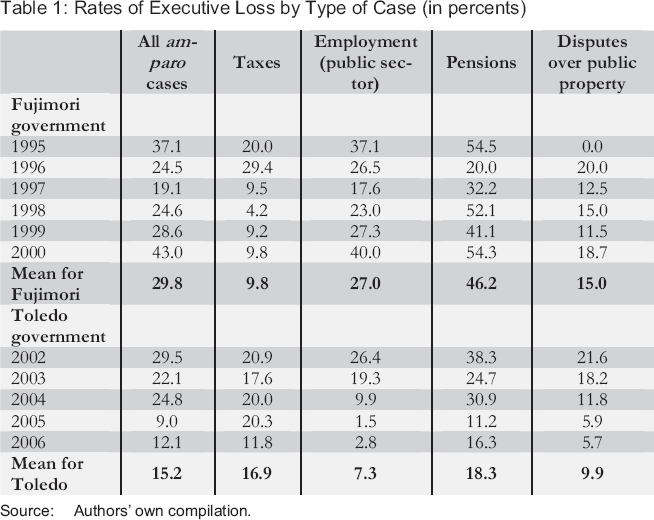
Because of the sheer number of amparo cases and their impact on individual rights, these cases are potentially the most visible to society. Of amparo cases themselves, those involving pensions and employment exceed other subject areas and as such may be more visible to the public. The court's decision to appear independent for any of the reasons suggested above would be more apparent in the subject area with the most cases. Indeed, Table 1 shows how the Tribunal's behavior varied by subject area and that in general it was more willing to oppose the executive in high-volume pension cases than in other subject areas.
Rates of Executive Loss by Type of Case (in percents)
Source: Authors’ own compilation.
Data and Methodology
The data for this project was obtained from the Peruvian Tribunal, which provides all case decisions since 1996. Of all the cases heard by the Tribunal, we analyzed all amparo claims from 1996 to mid-2000 and from mid-2001 to mid-2006, 13 which consisted of 19,289 separate case decisions in which the Peruvian executive was involved. Because amparo cases are so prevalent and directly implicate executive action, they provide a realistic sample to investigate Tribunal assertiveness or deference. A hierarchical logistic model is used to analyze the cases and to account for differences between congressional periods (Bryk and Raudenbush 1992; Gelman and Hill 2007). Our model incorporates variables to account for political and societal contexts as well as types of litigants participating in the amparo cases. In this model, information on the type of actors and the levels of confidence in the presidency are nested within contextual units (congressional periods).
Data from the August–November period (Fujimori's third mandate) is excluded from this study because it represents a period of catastrophic governmental collapse and one in which the government did not obtain a formal majority in the legislature through the April 2000 elections, but rather through the subsequent and often illicit actions of the intelligence services. It is considerably difficult to assess the number of legislators “bought” by Fujimori's advisor Vladimiro Montesinos. Likewise, data corresponding to Paniagua's transitional government are also excluded from the analysis since Paniagua did not belong to Fujimori's political party. Although Paniagua's party Acción Popular had only six legislators in Congress, Paniagua received the support of several parties to lead not only the legislative but also the executive branch. It is again difficult to determine what percentage of support he held in Congress.
Multilevel data provide valuable statistical tools for some particular challenges. Specifically, scholars must account for the possible lack of statistical independence among observations across contextual units (Raudenbush and Bryk 2002; Steenbergen and Jones 2002). Failure to cluster this type of data may result in biased (underestimated) standard errors and ultimately to mistakes in the estimation of inference analysis (Barcikowski 1981; Blair et al. 1983; Steenbergen and Jones 2002). To account for this, the use of multi-level modeling takes the hierarchical structure of the data into account by assuming random effects at each level of analysis. This provides a more conservative inference for the aggregate effect. Given our theoretical expectations of the key role of the strength of the president's party in Congress on judges’ decisions, we find it reasonable to assume a possible lack of statistical independence among decisions across congressional periods. In other words, we assume that the ruling party's share of seats and the needed two-thirds of legislators to appoint Tribunal judges create a political context in which the estimated coefficients of the variables might be different across congressional periods. More precisely, greater or lower participation of the ruling party across congressional periods may affect judges’ behavior with respect to other political and societal actors and their assertiveness given a certain level of confidence in the presidency.
The equations are estimated at two levels: an individual level, or level 1 equation within congressional periods, and a congressional level, or level-2 equation. Accordingly, we fit a multilevel varying intercept and slope logistic regression as follows:

where s[i] represents the congressional period in which the Tribunal makes a decision and xi is the case litigant's attributes (individual, firm, or another type for plaintiffs and defendants). The congressional period level's intercepts and slopes are themselves modeled given average congressional period attributes usi

with errors ∊sα,∊sβ having mean 0, standard deviations σα σβ, all estimated from the data.
Since we are interested in explaining under what conditions the Tribunal decides cases against the executive, the dependent variable is dichotomous, taking the value of 1 if the Peruvian Constitutional Tribunal makes a decision against the executive, and a 0 otherwise. In order to test the conditions for the Tribunal's willingness to oppose the executive based on the literature, we measure political strength by two independent variables: 1) public opinion or confidence 14 and 2) presidential party strength in the legislature. 15 For type of litigant, we have separate independent variables indicating whether the case involved a private person or a private firm (other political actors constitute the baseline group). We also include a binary variable to distinguish Fujimori's presidency from that of Toledo. This variable is then interacted with type of litigant (firms or private persons). Through these interactions, we test how assertiveness by litigant type varies across presidencies.
To measure the level of confidence in the executive, we rely on a question from the Latinobarómetro (from the Peruvian data): “Please look at this card and tell me how much confidence you have in the president: a lot, some, a little or no confidence?” When constructing this variable, we calculate the annual percentages by summing all “a lot” or “some” answers and dividing that number by the total number of answers.
We employ the percentage of seats held by either the ruling party or the ruling coalition.
To account for the potential variations across types of cases, we test our model in five separate specifications. The first specification includes all types of amparo cases. Specifications two through five analyze amparo cases by subject area including taxes, public sector employment, pensions and disputes over public property. Appendices 2 and 3 provide information on how all variables were constructed and the summary statistics for these variables.
Results
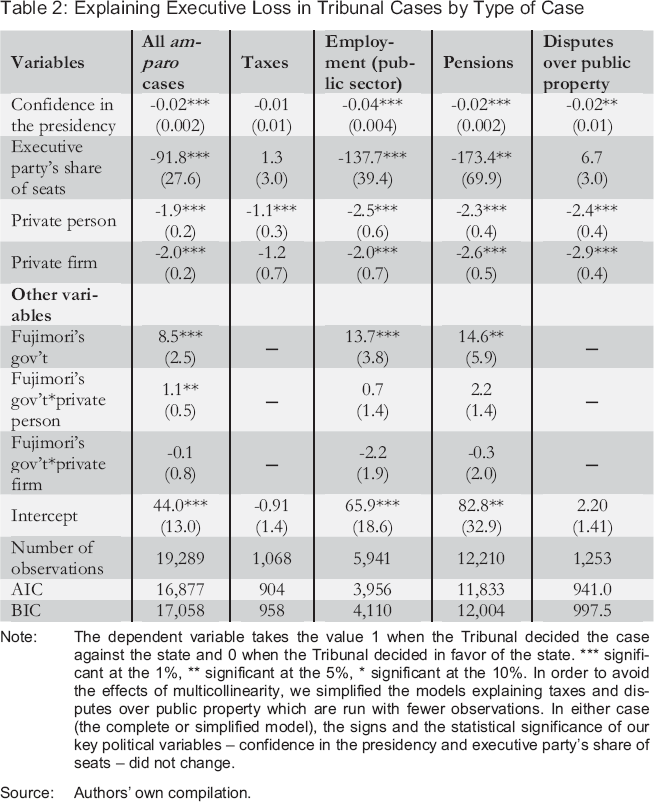
The results generally confirm our hypotheses and in doing so provide evidence that the Tribunal was acting strategically. Both the level of public confidence in the presidency and the share of congressional seats held by the president's party affect Tribunal decision-making. As shown in Table 2, the Tribunal behaves more assertively as the level of public confidence in the presidency deteriorates. Furthermore, lower executive party shares in Congress boost assertiveness against the state. The only two exceptions correspond to cases involving taxes and property. Tax cases involve no significant relationship between assertiveness and the political variables analyzed here. Tribunal assertiveness in property disputes is affected by public confidence in the executive, but not the executive's party share of seats in Congress. For the rest of the cases, our results remain substantially robust across different specifications. 16
Explaining Executive Loss in Tribunal Cases by Type of Case
Note:
The dependent variable takes the value 1 when the Tribunal decided the case against the state and 0 when the Tribunal decided in favor of the state.
significant at the 1%
significant at the 5%
significant at the 10%.
In order to avoid the effects of multicollinearity, we simplified the models explaining taxes and disputes over public property which are run with fewer observations. In either case (the complete or simplified model), the signs and the statistical significance of our key political variables – confidence in the presidency and executive party's share of seats – did not change.
Source: Authors’ own compilation.
In order to check the robustness of our multilevel model's results, we also ran two other types of regressions: a simple logistic regression and a generalized estimating method (GEE). In both cases, the results estimated are very similar to those reported in Table 2. GEE is used to analyze the influence of autocorrelation of observations in logistic regression models (Zeger and Liang 1986; Liang and Zeger 1986; Carl and Kuhn 2007). Through this model, we test whether autocorrelation within clusters might change our results. We assume that all correlations within clusters are equal such that only one parameter is to be iteratively estimated. This parameter is the same for all clusters.
Further, we test whether or not other potential political variables, which are part of the literature on high courts, matter when explaining assertiveness. Neither political fragmentation (measured by the number of effective legislative parties), nor a dummy reflecting the end of the presidency (several time frames were tested: 6 months, 12 months, and 24 months) can help explain the Tribunal's assertive behavior (Helmke 2002; 2005). These results are consistent across our model specifications.
The results in Table 2 also confirm in part that the Tribunal is more likely to rule against Fujimori than Toledo. As previously shown in Table 1, the losing rates of the executive in the Tribunal's decisions vary between and within presidencies, providing additional advantages for studying the Peruvian Tribunal. In general, the executive lost more in amparo cases under Fujimori than under Toledo. Further, Toledo lost more amparo cases in the first year of his term than in the last year. This greater degree of assertiveness during Fujimori's government is especially interesting because during this time period, the share of congressional seats of the executive's party was closer to the supermajority requirement for appointment, and Fujimori had in fact punished judges by removing them when they opposed his third term. Although purely conjecture at this point, the Tribunal may have had incentives to gain viability and legitimacy in its early years of operation, especially after Fujimori's removal and re-instatement of Tribunal judges during the period analyzed. By being more assertive using amparo cases in the first years of the Tribunal's existence and by defying Fujimori's government (linked to human rights violations and the removal of judges) in amparo cases, the Tribunal might have enhanced its stature in society. However, this speculation requires further evidence through interviews with judges during this period as well as an indication of how the Tribunal voted in cases not involving amparo or individual rights.
The results also indicate that the type of litigant matters. Again, not surprisingly, private firms and individuals are less likely to win a case against the state than are other litigants (i.e. political actors linked indirectly to the state – a mixture of municipalities, legislators, and other judicial entities). Under Galanter's theory, political actors are repeat players who have informational advantages when appearing before the Tribunal. Between private firms and individuals, however, the results indicate that individuals are more likely than firms are to win a case against the state, except in employment cases.
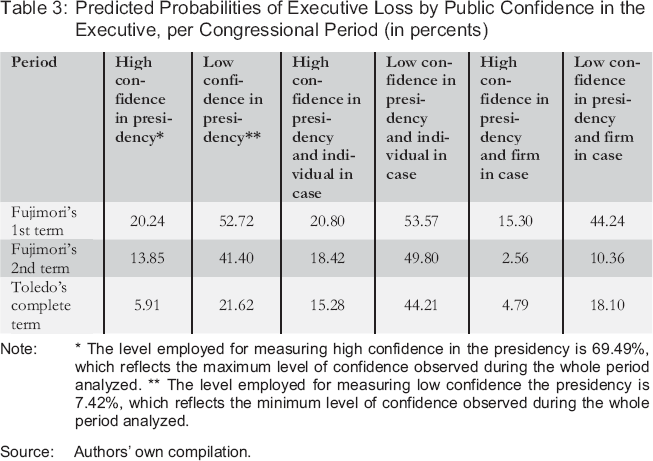
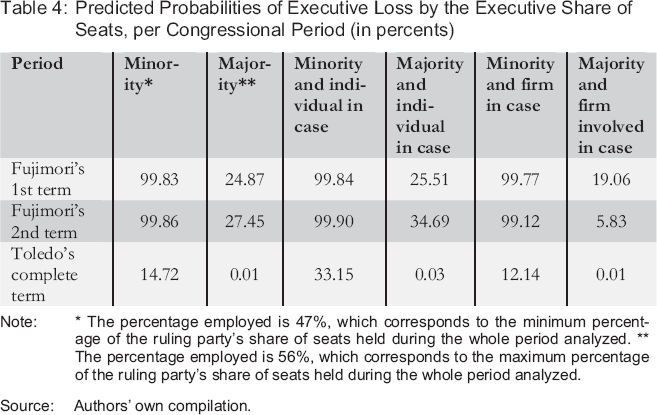
The above trends are further analyzed using predicted probabilities of the executive's rate of loss in percentages for each congressional period, holding the rest of the variables constant at their mean. Tables 3 and 4 show the predicted probabilities of executive losses when the ruling party has: 1) a minority in Congress (47 percent of the total number of seats) or a majority (56 percent of the total number of seats); and 2) high levels of confidence in the presidency (69.5 percent) and low levels of confidence in the presidency (7.4 percent). 17 These two political features (sharing of seats and confidence in the presidency) are combined with litigant type to provide additional predicted probabilities. These results not only support our hypotheses concerning the role of confidence in the presidency and the executive's share of seats in Congress, but also show the advantage that individuals tend to have over firms in cases against the state.
Predicted Probabilities of Executive Loss by Public Confidence in the Executive, per Congressional Period (in percents)
Note:
The level employed for measuring high confidence in the presidency is 69.49%, which reflects the maximum level of confidence observed during the whole period analyzed.
The level employed for measuring low confidence the presidency is 7.42%, which reflects the minimum level of confidence observed during the whole period analyzed.
Source: Authors’ own compilation.
Predicted Probabilities of Executive Loss by the Executive Share of Seats, per Congressional Period (in percents)
Note:
The percentage employed is 47%, which corresponds to the minimum percentage of the ruling party's share of seats held during the whole period analyzed.
The percentage employed is 56%, which corresponds to the maximum percentage of the ruling party's share of seats held during the whole period analyzed.
Source: Authors’ own compilation.
These percentages represent the lowest and the highest participation in terms of the number of seats of the ruling party and the levels of confidence in the presidency during the analyzed period.
Disaggregating court cases by type provides additional information about Tribunal behavior. First, these global results are substantially driven by pension cases. The relative importance of this type of case (approximately 63 percent of all amparo cases) makes this issue critical for explaining the results for all amparo cases shown in column 1 of Table 2. Second, losing rates vary across case type (see Table 1). Thus, the Tribunal may selectively discriminate among types of cases by exhibiting a greater degree of assertiveness for certain types of cases based on its political priorities or on societal demands. We verify that assertiveness was greater for public employment and pension cases, which may have greater effects on society given the high number of these types of cases and their visibility. Third, unsurprisingly, our key political variables – public confidence in the executive and the share of congressional seats held by the president's party – work much better when explaining these two types of cases (pensions and public employment). It seems that assertiveness for the other types of cases – taxes and disputes over public property – does not respond consistently to the political variables being evaluated in this project.
Implications and Conclusions
New constitutional courts face significant challenges in establishing their stature or importance with public and political actors. One way for a court to enhance its stature is to establish itself as an independent decision-making body that is willing to assert itself against the government through rulings in which the executive loses. While assertiveness against the government may enhance legitimacy, it also involves political risks, as those courts that are newly or weakly institutionalized may find their power undermined by the government, and judges can even be removed from judicial service. Even if judges in relatively new courts value the assertive role of the court, it would not be expected that a Tribunal would always vote against the executive. Instead, independence is conditional and “waxes and wanes” with politics (McCubbins, Noll, and Weingast 2006).
The Peruvian Tribunal, a relatively new and weak institution in a young democracy, has demonstrated signs of assertiveness under certain conditions. In amparo cases, the Tribunal is more likely to rule against the government when public confidence in the president decreases and as the president loses party seats in Congress. The Tribunal is also more likely to assert itself against the executive when litigants opposing the executive are also government agents. Among private individuals and private firms, the Tribunal tends to favor individuals in pension and property cases, but not in employment or tax cases. Finally, the Tribunal is more likely to rule against the executive in the most prevalent subject areas – pensions and public employment – suggesting that it is more assertive in cases involving the largest number of litigants and therefore most visible to the public.
As demonstrated by the judicial politics literature, executive strength and influence in the legislature generally drive the degree of Tribunal deference in both new and institutionalized courts. The Peruvian Tribunal is no exception in this regard. What has been surprising is the Tribunal's apparent strategy of ruling against the executive in certain types of amparo cases but not others. Specifically, the Tribunal is more likely to rule against the state when the subject itself constitutes the largest share of the Tribunal's docket and when the subject areas arguably affect the largest number of citizens. As a result, while the Tribunal is sensitive to the political landscape, it is willing to use its powers when decisions would impact a larger number of citizens. This willingness in turn should assist the Tribunal in establishing its reputation as an independent political actor as it becomes even more institutionalized. Further research across other types of cases – such as abstract review cases where the Tribunal reviews legislation and habeas corpus – is needed to determine whether the factors that appear to influence strategic assertiveness in amparo cases hold for other types of cases.
Footnotes
Appendix
Online Appendix 1, Tables B.1 and B.2, available as this article's supplementary material at <www.jpla.org>.