




Abstract
Information pollution poses a significant threat to democracy worldwide, and Mexico provides a critical case study of this growing problem. This study presents and applies a holistic analytical framework to detect the enabling and driving factors of information pollution, investigating its impact on democratic quality during the administration of Andrés Manuel López Obrador (2018–2024). Drawing on 20 expert interviews, findings reveal that structural socio-economic inequalities, weak institutional transparency, and media concentration indirectly enabled information pollution, while divisive populist rhetoric and a post-factual political style directly drove its rise. These dynamics contributed to affective polarisation, eroded trust in democratic institutions, and reduced press freedom. The study concludes that combating information pollution requires legal reforms, media literacy initiatives, and enhanced transparency. By focusing on a non-English speaking, deficient democracy, the study broadens the empirical base of understanding disinformation’s role in the global wave of autocratisation.
Introduction
Risks of Information Pollution for Democracy
Access to information (ATI) is considered a necessary condition for individuals’ ability to make informed decisions and to meaningfully engage in democratic processes (e.g. Yannoukakou and Araka, 2014). It is also essential for government transparency and accountability (e.g. Breuer and Leininger, 2021).
The advent of the internet in the 1990s, and subsequent emergence of social media, substantially changed the way information is created, distributed and consumed (Ardévol-Abreu et al., 2018). For citizens, these developments expanded opportunities to circumvent traditional information gatekeepers, discuss public affairs, monitor the behaviour of officials and engage in new forms of collective action (González-Bailón and Lelkes, 2022). For governments, digital technologies created additional opportunities to engage with their citizens, increase transparency, and improve the efficiency of public administration through e-government initiatives (Matheus and Janssen, 2019).
At the same time, however, digital media have created a distinctive set of problems for information integrity. Large volumes of information are disseminated without quality control and online content is mostly published on platforms whose economic model favours sensationalist content capturing users’ emotional attention over accurate and editorially curated content (Lischka and Garz, 2023). The exploitation of this model by diverse actors who spread disinformation for economic, political or ideological gains has led to substantial information pollution, that is, the circulation of false or manipulated information, which spreads faster and has greater outreach than information from reliable sources.
The potential negative effects of information pollution on the quality of democracy are substantial. Evidence indicates that disinformation, affective polarisation, and autocratisation are global trends that reinforce each other (Tucker et al., 2018; V-Dem, 2023a). Research presented in a recent special issue on “The New Polarization in Latin America” indicates that Latin America is part of this trend (Sarsfield et al., 2024).
Disinformation campaigns can also erode trust in institutions by delegitimising key democratic institutions or state actors. Post-COVID pandemic research from various countries, for example, found that disinformation regarding public health measures to contain the pandemic led to polarisation around health issues and a decline of trust in public health institutions well beyond the pandemic (e.g. Boulianne and Humprecht, 2023).
Digitalisation has vastly increased the amount and speed of information surrounding political events and processes such as elections, government changes, and salient policy debates. Information pollution makes it difficult for citizens to make informed choices regarding the political issues at stake. Where disinformation strategies are employed by government actors this may not only tarnish the public's perception of the government but also of state institutions in general. This is particularly problematic in contexts where baseline levels of citizen trust in state institutions are already low (Hunter, 2023). However, as illustrated by the storm on the Capitol in the US in 2021, even stable democratic societies with well-established institutions are not immune to the possibility of violent protests triggered by disinformation. Previous research on the US and European cases indicates that disinformation can amplify polarisation by exploiting identity-based divisions and fostering echo chambers in digital spaces. Social media algorithms often prioritise content that resonates emotionally, exacerbating pre-existing societal divides. This can lead to a deepening of societal rifts, as individuals increasingly align with ideologically homogeneous groups, further marginalising opposing perspectives. (e.g. Druckman et al., 2023)
Over the past two decades, a considerable body of literature that deals with the effects of digital media on democracy has emerged (see, e.g. Vaidhyanathan, 2018). However, several research gaps persist. First, the majority of research on this topic has been confined to studies in English-speaking, high-income states, many of which are digitally advanced and have stable democratic institutions (Valenzuela et al., 2022). Although some studies have ventured beyond these confines (e.g. Pan and Siegel, 2020; Sarsfield and Abuchanab, 2024), more research is needed on non-English speaking, poorer and digitally less advanced states as well as on conflict-affected settings and fragile states. Second, to a large extent, studies on the impacts of digital media on democracy are based on correlational data (for comprehensive reviews, see Lorenz-Spreen et al. (2023) and Boulianne (2018)) and thus unable to make strong claims about causality. Further, quantitative studies frequently focus on the impact of specific social media content on individual political attitudes and behaviour, paying less attention to the explications and implications of the wider media ecology.
Third, very little research has been dedicated to the political and sociological factors that explain what makes societies vulnerable or resilient to information pollution driven by digital media. Methods to systematically capture the causes of information pollution have been slow to emerge, and well-tested analytical frameworks do not yet exist (UNDP, 2022).
Against the background, this study focuses on two research questions:
What factors contribute to societal vulnerability to information pollution? How are these factors related to other factors in the political, media, social and legislative environments? How and through which causal mechanisms does information pollution impact democracy?
In doing so, the study seeks to address the analytical challenge of systematically capturing causes of information pollution and assessing its impacts on democracy. It presents a holistic analytical framework applied to the case of Mexico. By doing so, the study adds to the number of academic studies that investigate the relation between information pollution and democracy in states whose democratic institutions are under strain (BTI, 2022b), that are affected by conflict (HIIK, 2023), and that are non-English speaking. Given that the causal mechanisms at play have rarely been studied so far, the paper adopts an explorative, hypothesis-generating, rather than hypothesis-testing, approach.
While disinformation can originate from various agents – such as private corporations, grassroots movements, or organised crime – this paper focuses strongly on government-sponsored disinformation, given the capacity of government actors to leverage institutional resources, including public media, to manipulate public opinion. Combined with the ability of governments to restrict access to truthful public information, this has significant implications for the emergence of information pollution. As this study will show, this focus on elite behaviour is particularly relevant in the Mexican context, where government-sponsored disinformation and restrictions on access to public information have been instrumental in driving polarisation and undermining trust in democratic institutions. By situating government-driven information pollution within the broader information ecosystem, this study contributes to understanding the impact of elite control over public narratives on societal polarisation and the consequences of these dynamics for the survival of liberal democracy.
Conceptual Framework
To ensure clarity, this section will provide definitions of key concepts and terms and formulate expectations regarding the potential relationships between the phenomena described by these concepts based on existent literature.
Access to Information and Information Integrity
The right of information is derived from the human right to freedom of opinion and expression. The underlying notion is that individuals will only be capable of freely expressing opinions if they have the necessary information to form these opinions in the first place (Yannoukakou and Araka, 2014). The related concept of information integrity implies that citizens have access to trustworthy, balanced and complete information on issues that are important for their political perceptions and decisions (Club de Madrid, 2018).
The concept of ATI refers to the existence of a system that effectively satisfies the rights of citizens to request and receive government information, defined as the “information generated, collected, maintained and held by public organisations during the performance of their operational tasks” (Yannoukakou and Araka, 2014: 333). Transparency and ATI are key elements of government accountability, which involves the right of citizens to receive information about government action and the corresponding obligation of democratic governments to release all necessary details (Breuer and Leininger, 2021). Essentially, states can fulfil their obligation to ensure ATI in two ways: reactively, whereby government information is released upon request, and proactively, whereby government information is released voluntarily by government bodies (Yannoukakou and Araka, 2014). The latter, proactive dissemination of government information can be accomplished through the provision of open government data (OGD).
Disinformation and Information Pollution
A standardised terminology for false or low-quality information in media has yet to emerge. The popular term “fake news” is both too narrow and politically charged, as political actors have co-opted it to delegitimise critical media reporting. This paper instead uses information pollution, a broader, more neutral term for various low-quality content types circulating in the information ecosystem: misinformation – false or inaccurate content shared without intent to cause harm (Wardle and Derakhshan, 2017); malinformation – genuine information shared to inflict harm by distorting context or exposing private data that was meant to remain confidential (Wardle and Derakhshan, 2017); and disinformation – fabricated or manipulated content (sometimes blended with facts) disseminated through tactics beyond news reporting (e.g. automated accounts, targeted ads, organised trolling, internet memes) to harm individuals, groups, organisations, or nations (Horowitz, 2018).
Media Ecology
The term “media ecology” refers to how media – especially social media – shape an information ecosystem that influences social and political dynamics (Ruotsalainen and Heinonen, 2015). Decentralised digital communication increasingly blurs boundaries between public and private spheres. As the digital and analogue worlds become more interwoven, this ecosystem can foster democratic engagement through networked mobilisation (Casero-Ripollés and Micó-Sanz, 2022), but it can also drive polarisation and democratic erosion (Tucker et al., 2018). These effects are not one-way: the digital sphere is shaped in turn by analogue social, cultural, and economic structures. Pre-existing societal cleavages may be mirrored, intensified, or reshaped online, often amplified by algorithmic curation (Schrape, 2019).
Polarisation
Polarisation refers to a form of distance or distancing between actors. It is conceived of as a bimodal distribution of observations on a continuous scale, for example, ideological left-right, economic poor-to-rich scale, or demographic urban–rural. Polarisation can be conceptualised both as a state (i.e. the level of extremity in this distribution) and as a process (i.e. the growing distance between groups over time) (Bosilkov, 2021). Until the early 2000s, empirical research mostly focused on elite ideological polarisation on a single left–right dimension. However, starting from the 2010s, scholarly attention shifted towards mass polarisation, highlighting that new societal and political divides were increasingly crosscutting traditional economic and ideological cleavages. Scholars who have made efforts to structure societal divisions argue that they can essentially be grouped along a continuum with one end supporting traditional values and defending the existing social order, and the other end challenging existing social hierarchies and prioritising values of as self-expression (Inglehart and Welzel, 2023; Sarsfield et al., 2024).
More recently, the term affective polarisation has gained significant traction. Affective polarisation emphasises two features: (1) the increasing alignment of societal divisions increasingly along a single dimension, and (2) an emotional component, whereby group identities lead to strong positive feelings toward in-group members (e.g. liking, sympathy) and negative feelings toward out-groups (e.g. rejection, hostility). The ensuing division of society into two mutually distrustful “Us vs. Them” camps can fuel antagonism, and create a propensity to vilify the “other” group, thus providing the starting point for democratic erosion (McCoy & Somer, 2021).
Democracy
This paper adopts an encompassing concept of democracy following the proposition of the Varieties of Democracy (V-Dem) project, it conceives of democracy as an aggregate of multiple continuous dimensions. These dimensions include liberal, participatory, deliberative and egalitarian democracy, each of which can be measured by assessing the stronger or weaker presence of certain components. While this conceptualisation recognises different varieties of democracy, it considers electoral democracy, that is, the selection of government in free and fair elections, essential to any kind of democracy (Coppedge, 2023).
Figure 1 visualises the key elements of the conceptual framework. It is important to note that the framework does not assume the existence of an invariable sequential order or singular direction of effect (x → y) between the individual elements. Instead, relationships between the elements may be bi-directional or contributing to a mutually reinforcing cycle including positive and negative feedback loops. For instance, pre-existing societal cleavages – shaped by socio-economic or political structures – can lead to information pollution through the production and dissemination of emotionally charged and biased content. This, in turn, may amplify or reshape those cleavages through affective polarisation, fuelled by algorithmic curation within the broader media ecology. This process can ultimately impact multiple dimensions of democracy. While this is just one example, it illustrates how the concepts interact within the framework.
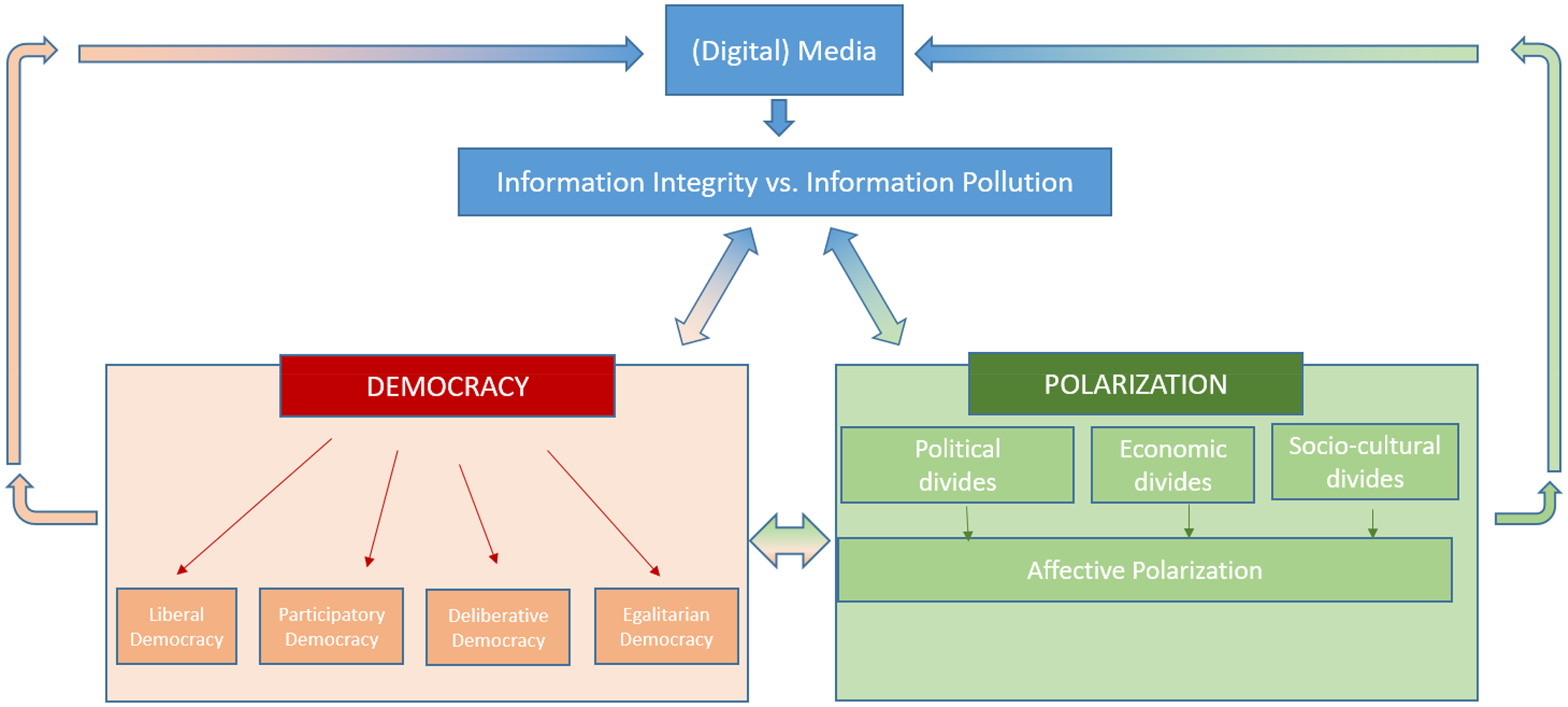
Visualisation of Conceptual Framework.
Mexico as a Case
Exhibiting decreasing levels of democratic quality and rising levels of digital disinformation, Mexico constitutes an appropriate case for exploring the interdependent relationships between information pollution and democracy.
Over the past two decades, autocratisation has become a concerning global trend (Carothers and Press, 2022; Leininger, 2022). Unlike previous waves of autocratisation characterised by fully fledged democratic breakdowns, autocratisation processes of the current “third wave” often manifest as “democratic erosion,” that is, gradual setbacks on key elements of democracy, such as the erosion of political participation beyond elections, shrinking spaces for civil society, restrictions on media freedom, and the undermining of accountability mechanisms (Carothers and Press, 2022; Lührmann and Lindberg, 2019).
Mexico is part of this trend, with democracy indices reporting a decline in the country's quality of democracy over the past decade. On the Freedom House global freedom index, Mexico declined from an index score of 65 in 2013 to 60 in 2023 (Freedom House, 2023). On the BTI's Political Transformation Index, Mexico's score fell by 0.89 points between 2012 and 2023, including a downgrade from “defective” to “highly defective” democracy in 2022 (BTI, 2022b).
An indicator for measuring disinformation, developed in the context of V-Dem's Digital Society Project, measures the frequency with which government and its agents use social media to disseminate misleading or false information via digital media. While the indicator only partially covers the phenomenon of disinformation, as it is limited to state agents as producers of disinformation, it provides an impression of the evolution of the problem. According to this indicator, in Mexico, starting from a medium level, the amount of disinformation disseminated by the government has risen to relatively high levels over the past decade.
Figure 2 puts the relation between government disinformation and autocratisation in Mexico into a global comparative perspective. The vertical axis displays the levels of disinformation disseminated by governments. The horizontal axis displays the disinformation scores before the onset of democratisation or autocratisation episodes, which started in different years for different countries. The data on autocratisation and democratisation episodes are drawn from the Episodes of Regime Transformation (ERT) dataset, using the “autocratisation episode” (aut_ep) and “democratisation episode” (dem_ep) variables as defined in the ERT codebook (V-Dem, 2023b). Only countries that experienced a regime transformation are included and marked either autocratising or democratising in 2023. Although only descriptive, the plot suggests that autocratising countries exhibit higher levels of government disinformation.
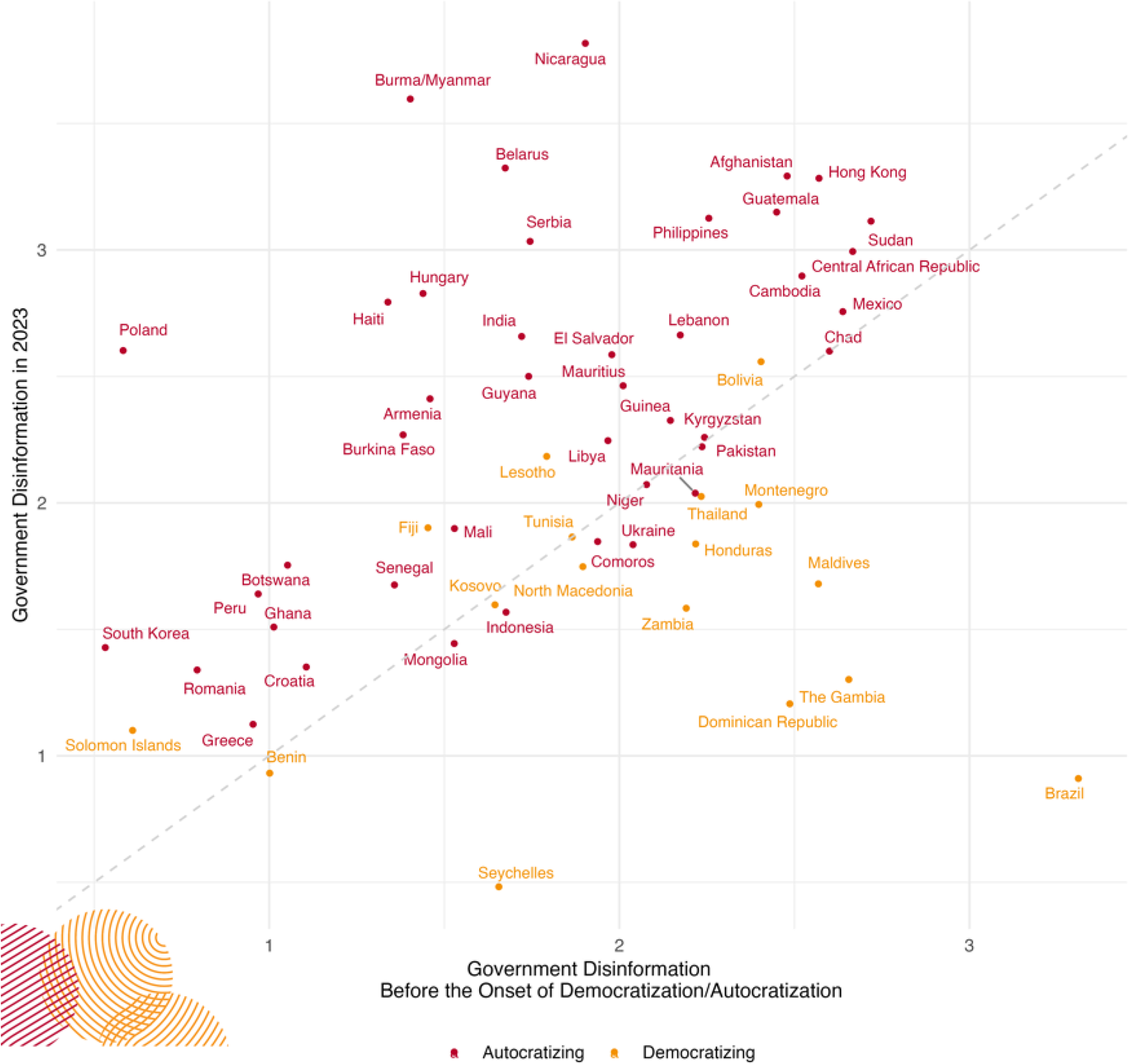
Government Dissemination of False Information and Autocratisation in Global Comparison.
Figure 3 illustrates the development of government-sponsored disinformation in Mexico over time (Note that lower values on this scale indicate higher levels of government-sponsored disinformation, with 0 meaning dissemination occurs extremely often and 4 indicating it is almost never observed).
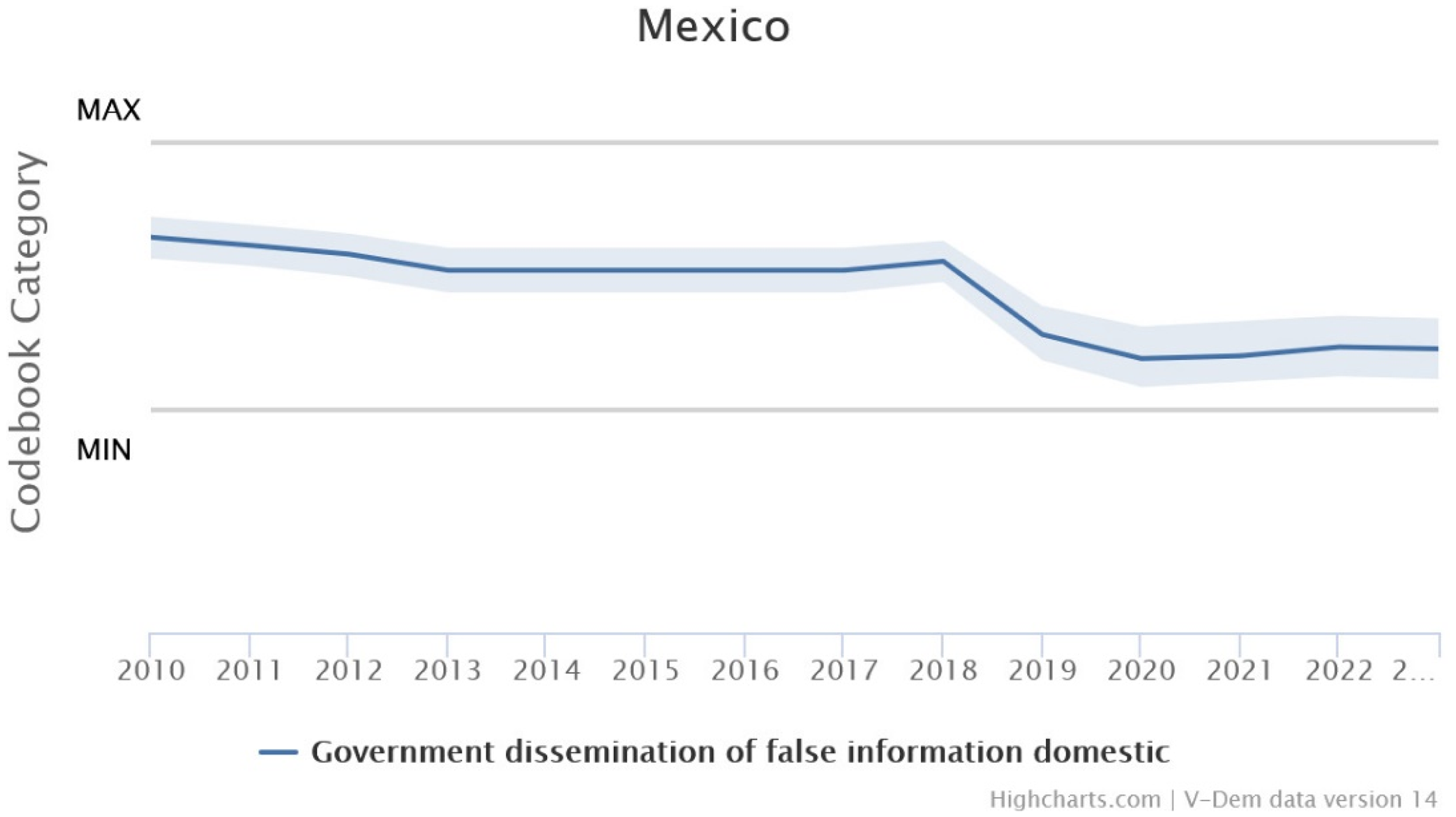
Government Dissemination of False Information, Domestic (2010–2023).
Although the organised dissemination of disinformation has been documented at least since 2012, when the so-called “E-activists” supported the candidacy of former Mexican President Enrique Peña Nieto (e.g. Echevarría, 2023), the graph shows a visible increase in government disinformation following the beginning of AMLO's term in 2018 (Figure 4).
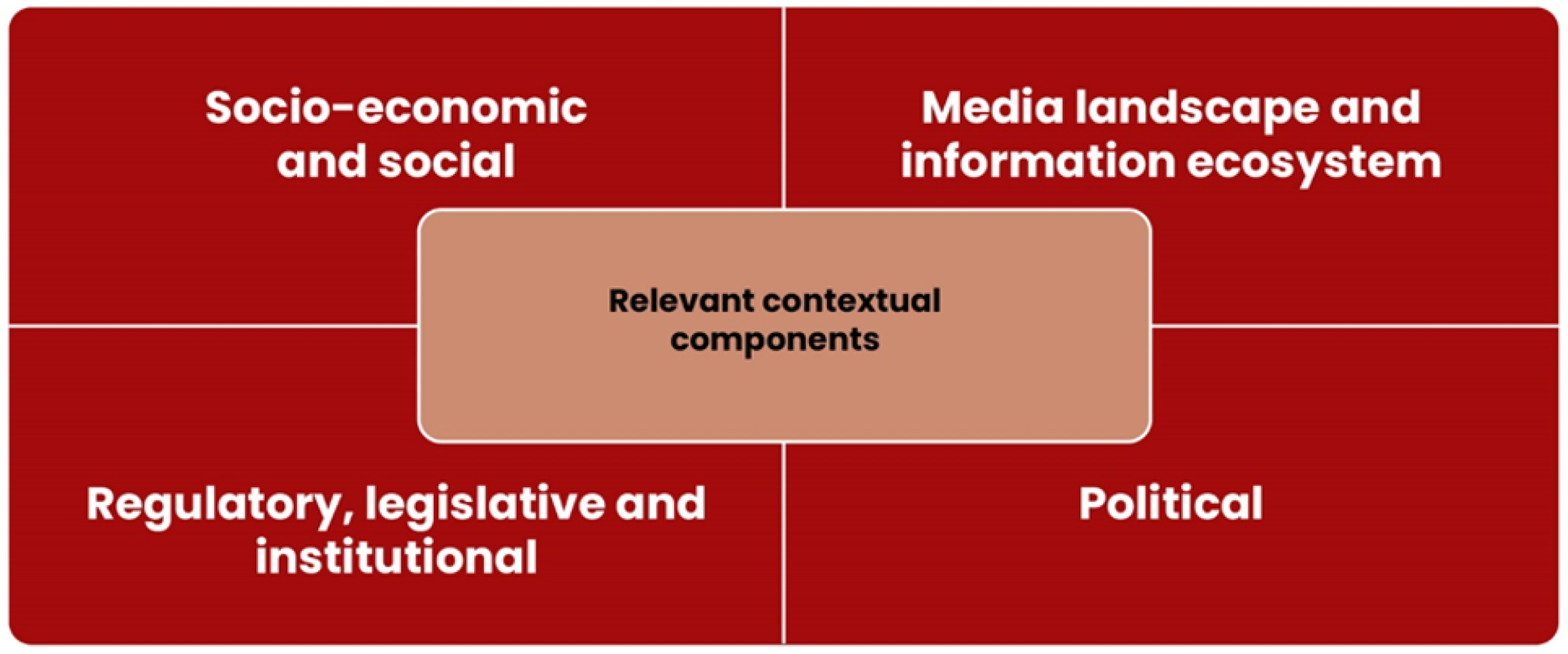
Analytical Framework: Identifying Enablers and Drivers of Information Pollution, and Assessing the Resulting Vulnerabilities and Impacts.
In sum, the indices discussed in this chapter indicate that Mexico constitutes a representative case of a widely observed global trend whereby increasing disinformation, and autocratisation appear to mutually reinforce each other (Tucker et al., 2018; International IDEA, 2023; V-Dem, 2023a). Against this background, the present in-depth study of the Mexican case aims to identify and understand the factors that drive these trends as well as the ways in which they interact.
Analytical Framework and Data-Collection Methods
To gain an understanding of the complex causes and consequences of information pollution, this paper adapts an analytical framework originally proposed by UNDP (2022). This framework assumes that the presence of certain enabling and driving factors increases societal vulnerability towards information pollution, which, in turn, can cause adverse impacts on democracy.
Enablers are understood here as structural conditions that indirectly facilitate information pollution, whereas drivers are actions that directly contribute to information pollution. Vulnerability, in turn, is understood as the presence of factors that increase a society's susceptibility to be adversely impacted by a phenomenon and the lack of ability to cope with this impact (see, e.g., UNISDR, 2009).
The framework posits that detecting the enablers and drivers of information pollution requires paying special attention to four contextual components: (1) the socio-economic and social context; (2) the context of the media landscape and information ecosystem; (3) the regulatory, legislative, and institutional context; and (4) the political context. This approach aligns with media ecology perspectives in academic research, which emphasise the interconnectedness of media, political, and citizen-level factors in shaping information ecosystems prone to disinformation (e.g. Echevarría, 2024).
Table 2 in the Annex provides the full list of potential enablers, drivers, vulnerabilities, and impacts contained in the framework, based on which different guidelines for semi-structured interviews were prepared for experts from or knowledgeable about each of the contexts. Interview questionnaires were designed to enquire about the presence of these factors and about concrete empirical examples of their consequences.
During a five-week field research stay in Mexico in early 2023, a total of 20 expert interviews were conducted. Interview partners included seven experts from academia, three media professionals, five members of civil society organisations (CSOs) engaged in rights to information and freedom of expression, three civil servants, and two development cooperation practitioners. To ensure anonymity, interviews were anonymised and numbered consecutively. Statements based on interviews are referenced with the corresponding interview number in brackets. A summary overview of the interviews by actor category is given in Table 1 in the Annex.
Empirical Findings: Causes and Consequences of Information Pollution in Mexico
This section presents empirical findings from Mexico structured according to four contextual components of the analytical framework.
Socio-Economic and Social Context
Enablers
While the World Bank classifies Mexico as an upper middle-income country, vast social disparities persist. In 2022, 36.3 per cent of the population was living in conditions of multi-dimensional poverty and 9.1 per cent in extreme poverty (CONEVAL, 2022). Development disparities run along geographical and ethnic lines: the five states with the lowest values are located in the country's centre and south where the largest part of the country's indigenous population is concentrated.
Development disparities have enabled multiple digital gaps. According to the National Census on Information Technologies (ENDUTIH), only 78.6 per cent of the population used the internet in 2022. There is also a large gap in internet use between different socio-economic groups, with 94.2 per cent of individuals from high-income households being internet users compared to only 57.8 per cent from low-income households, as well as clear differences in the number of internet users living in urban (83.3 per cent) and rural areas (62.3 per cent). Gaps also exist in terms of digital literacy. A 2018 OECD survey found that 39.3 per cent of Mexicans lack very basic computer skills (OECD, 2018). Interview partners confirmed that the ability of parts of the population to find, evaluate, and communicate information by utilising digital media is considerably limited due to language barriers or low levels of education (#3, #8).
In addition, Mexico has long been struggling with structural problems of violent conflict, crime, and corruption. The country's conflict structure is predominantly shaped by organised crime surrounding the drug economy and the state has lost its monopoly on the use of force in parts of the country. It is estimated that between 68 and 80 per cent of homicides are related to organised crime and the Mexican drug conflict is classified as “limited war” by the Heidelberg Conflict Barometer (HIIK, 2023).
Furthermore, the extent of violence against women in Mexico is alarming. In 2022, 3800 women were victims of homicide. Of these homicides, 947 were classified as femicides (SESNS, 2023). Women receive inadequate protection from authorities against gender-based violence. Complaints are often trivialised by male state officials, or the reporting women are discriminated against, especially if they are of indigenous origin.
This conflict matrix is completed by a complex migration dynamic. Mexico is a transit country for Central American migrants heading for the USA. Their transport across the border is organised by professional people-smuggling gangs under the control of organised crime. Some of the trafficking victims are forced to work for the drug cartels or engage in prostitution, others are subjected to forced farm labour. In order to protect themselves, since the mid-2010s, Central American migrants have joined together in so-called migrant caravans, which have involved up to 6000 people.
Drivers
The structural conditions of conflict and violence described above are also reflected in the digital space, where they directly drive information pollution and social polarisation.
The cartels have weaponised the digital space and platforms like Facebook, and Instagram are used to threaten rivals, sell drugs, and coordinate violent attacks. Social media also have become a key component of narcoculture, that is, the strategy whereby which the drug cartels seek to increase their social acceptance by creating a positive narrative that praises the rewards of the narco life – such as mansions, fancy cars, and beautiful women – while projecting power and highlighting the philanthropic deeds of cartels in areas where poverty is widespread.
Against the background of violence and discrimination against women, the feminist movement in Mexico has turned into one of the most important grassroots movements. However, in a country where the culture of machismo remains deeply rooted in parts of the population, feminism also faces resistance. Women's rights activists and journalists are frequently targeted in sexist defamation campaigns. Female protesters are also often accused of vandalism and are associated with fascism in social media, for example by the use of the hashtag #feminazis (Salas Siguenza, 2021).
Information pollution also plays multiple roles in the context of transmigration. On the one hand, migrants frequently fall victim to digital fraud. Online scammers range from human traffickers to individuals, who pose as legal advisors and trick migrants into paying for fake services regarding work visas, political asylum or alternative ways to cross the US–Mexico border. In a survey of migrants conducted by the Mexican CSO Conexión Migrante in 2023, two thirds of respondents reported having fallen victim to some sort of fraud or disinformation circulated on social media (Spinardi et al., 2023). On the other hand, disinformation about migrants abounds in digital media. Narratives on social media frequently contend that the caravans contain dangerous criminals. These narratives have fuelled anti-migrant sentiment in the Mexican population, which has occasionally escalated into physical violence against migrants, including lynchings (Ward and Beyer, 2019).
Vulnerabilities
In the perception of interviewees, the enabling structural conditions and their online ramifications result in a specific vulnerability of Mexican society toward information pollution. Since Mexico's democratic transition in 2000, no government has succeeded in significantly reducing poverty and inequality, violence and systemic corruption. According to interviewees this has contributed to an anti-elite sentiment that is widely shared across different social classes (#11, #12). Such grievances can easily be exploited politically. The chance that digital disinformation disseminated for such purposes will be taken at face value is greater in a situation where important parts of the population have low digital literacy and ability to verify information.
Further, findings from the Mexican case align with the concept of media ecology, which highlights how social media create an interconnected information ecosystem that influences social and political dynamics (Ruotsalainen and Heinonen, 2015). As the digital sphere becomes increasingly intertwined with the analogue world, it both reflects and shapes existing social, cultural, and economic structures. Pre-existing societal cleavages, such as those linked to violence, inequality, or migration, can be mirrored or exacerbated online, where algorithmic curation often amplifies divisions (Karatzogianni et al., 2016). This dual dynamic underscores how structural factors in the analogue world both drive and are reshaped by disinformation and digital vulnerabilities.
Media Landscape and Information Ecosystem Context
Enablers
Media pluralism is an essential pillar of the rights to information and freedom of expression and of paramount importance for informed democratic decisions. Since the democratic transition in 2000 and further spurred by the advent of the internet, the Mexican media landscape has become more diverse over the past two decades. Nevertheless, the media system continues to be highly concentrated. In the television sector, only two media organisations own almost all TV stations. Similarly, in the radio sector, many stations belong to a few companies that enjoy oligopoly status and follow similar editorial lines. Consequently, increased media plurality has not translated into an increased diversity of viewpoints within the information landscape (#10, #17). At the same time, the transparency of media ownership is low. According to interview partners, the regulatory authority in charge of issuing broadcasting licenses (Federal Institute of Telecommunications, IFT) intentionally creates opacity regarding ownership structures: By law we are obliged to have a public registry of concessions to make media ownership transparent. But the IFT provides this [information] in a way that makes it an impossible mission to understand who owns what and which economic interest group manages how many stations. (#10)
Opinion plurality, media neutrality and freedom of expression are further constrained by the entanglement between media and politics. Mexican media organisations are highly dependent on government advertising. In 2018, over 1,000 companies competed for these funds, yet half of the funding was allocated to only ten influential mainstream media groups, such as Grupo Televisa and TV Azteca. By contrast, online media outlets with a more government-critical stance, such as Aristegui Noticias and Animal Político, received only very small amounts of funding (GMR, 2018). It is also common for broadcast concessionaires to serve in the legislature. Known as the telebancada (television bench), prominent executives from leading television corporations participate in media-relevant parliamentary committees where they represent the interests of their employers.
As elsewhere in the world, the quality of journalism in Mexico has been negatively affected by the sensationalist logic of the business model of internet publishing (e.g. Echevarría, 2024). As one interviewee observes: We are dealing with a redesign of the information ecosystem […] Even the quality of prestigious newspapers has decayed. They still maintain a print version that is more informative than propagandistic, but their digital version is continuously deteriorating. (#8)
Furthermore, Mexico's indigenous peoples are marginalised in the information eco-system. Ethno-linguistic discrimination remains widespread (e.g. Olko et al., 2023) with mainstream media catering almost exclusively to the Spanish-speaking mestizo audience and government information being disseminated primarily in Spanish (#14).
Drivers
Structural violence poses a direct threat to press freedom in Mexico. In recent years, the situation of media professionals, particularly those reporting on drug-related crime and corruption, has deteriorated dramatically. In 2022, Mexico recorded 13 journalist killings, accounting for nearly 20 per cent of the 67 journalists killed worldwide in that year. This places Mexico among the top three most dangerous countries in the world for journalists along Ukraine and Haiti with 15 and 7 killings in 2022 (CPJ, 2023; Reuters, 2022). The same year, a total of 696 attacks against media professionals was recorded in Mexico, including physical attacks, harassment and stigmatisation (Article 19, 2023). Despite the alarming number of attacks, the federal government systematically failed to ensure effective protection for journalists, often downplaying the risks they faced and undermining existing institutional mechanisms designed to safeguard press freedom (Santillana & Davis, 2024).
A concern raised by all interviewees, was the strained relationship of former President Andrés Manuel López Obrador (2018–2024) with the press. During, his daily morning press conference, known as the mañanera, AMLO (as he commonly referred to in Mexico), frequently dismissed fact-based criticism by journalists as “fake news” and accused government-critical media outlets as corrupt or being paid to orchestrate disinformation campaigns against him (e.g. López Obrador, 2020). This recurring discourse formed part of a broader strategy of stigmatisation and labelling, aimed at undermining journalists’ professionalism by eroding their authority and credibility in the public sphere (Reyna, 2024).The President's verbal attacks on journalists were amplified through organised social media campaigns. Networks of bots, trolls and fake accounts used hashtags such as #PrensaSicaria (murderous press) or #PrensaProstituta (prostituted press) to discredit critical journalists. Scientific social network analyses demonstrate that the state news agency Notimex was involved in such campaigns, which on several occasions escalated into physical attacks on journalists in the streets (SignaLab, 2020; SignaLab, 2022). Despite international criticism, AMLO's government did not undertake efforts to reduce anti-press violence. On the contrary, “the President's aggressive discourse generate[d] an even more permissive environment” (#18).
Vulnerabilities
It is reasonable to assume that the combination of enabling factors and driving forces described above makes Mexican society particularly susceptible to information pollution. Attacks on journalists contribute to a climate of self-censorship that negatively affects the right to receive diverse and reliable information. Combined with a political discourse that discredits the remaining critical reporters, this has contributed to a reduced trust in traditional news media (#10, #17). Consequently, Mexicans increasingly rely on digital media for information. According to the latest Reuters Digital News Report, social media use slightly exceeds the use of television and more than doubles the use of print media for news consumption, and 34 per cent of Mexicans share news via messaging apps or email (Reuters, 2022). In the latest National Survey on Civic Culture (INEGI, 2020), the majority of respondents (44.7 per cent) indicated social media as their preferred sources to learn about issues of national relevance. This is highly problematic as previous research has shown that trust in in social media news has a strong relationship with willingness to spread disinformation (Humprecht, 2023). As misinformation and disinformation become more pervasive on social media platforms, this trend may reinforce Mexico's vulnerability to information pollution.
Regulatory, Legislative, and Institutional Context
Enablers
National information ecosystems are crucially shaped by legal and institutional settings that aim to facilitate the integrity of public information.
In Mexico, regulatory authority over the digital communication market remains disputed. Both the IFT and the Federal Economic Competition Commission (COFECE) claim jurisdiction in this area. This rivalry has created grey areas in the regulation of digital markets and to date, no specific laws exist to regulate content on digital platforms (Schneider, 2022).
In the absence of specific legislation and clear institutional responsibility to counter disinformation, the flipside, that is, efforts to secure access to public information and government transparency, is all the more important.
With regard to ensuring proactive transparency through the provision of OGD, there is significant room for improvement in Mexico. Political interest of AMLO in the topic was low. The national digital strategy (Estratégia Nacional Digital, EDN) adopted only three years into his administration is oriented toward the national development goal of reducing inequalities and therefore mainly focused on closing gaps in internet access (DOF, 2021). The topic of OGD, is treated only marginally in the EDN. Critics describe the document as an accumulation of good intentions that demonstrates a certain ignorance of the ICT sector and lacks the measurable indicators that would be necessary to develop a clear strategy towards addressing deficiencies (Covarrubias, 2021). Interviewees further criticised that the form in which OGD are published often does not correspond to good standards, such as completeness, timeliness and machine readability, and attributed these deficits to a general lack of data culture in the public sector (#2, #4, #5, #7).
In the area of reactive transparency, Mexico is a global forerunner as far as the legal basis is concerned. In 2016, Mexico's ATI law the “General Act of Transparency and Access to Public Information” (DOF, 2016) was ranked first out of 112 national ATI laws by the yearly Global Right to Information (RTI) rating. It is important to note, though, that the RTI rating is limited to assessing the strength of legal frameworks and does not evaluate the quality of their implementation. The law establishes the rules and procedures to guarantee the right of access to information in possession of public entities. The authority in charge of its implementation, the National Institute for Transparency, Access to Information and Personal Data Protection (INAI) is a constitutionally guaranteed collegiate body.
1
INAI's most important task is the operation of the National Transparency Platform. Theoretically, the platform enables any person with internet access to obtain basic government information that is made proactively available on the platform, or to request data that is not yet available free of cost. However, the INAI struggles with enforcement of the law in its day-to-day activities. One of the institute's biggest challenges is to interoperability of data-exchange formats of more than 8000 obligated parties (#4, #7). Another frequently expressed criticism refers to the platform's lack of user friendliness: There is a lot of disorganization of information and [the platform] is difficult to navigate. I’d say that specialized knowledge is required to navigate the large amount of data. (#12)
According to the user statistics published in INAI's annual reports the large majority of requests submitted through the platform come from citizens with a university degree (INAI, 2023). Yet another problem is that the information requests channelled through the platform generate an additional administrative workload that exceeds the capacities of many public entities. Officials have to handle the response to these requests in addition to their ordinary duties, often without receiving additional time, remuneration or specific training for this task (#7).
Overall, the Mexican ATI framework focuses more strongly on reactive than on proactive transparency. In the words of one interviewee: In Mexico, transparency is still understood as “if you ask for the information, I will give it to you.” So there has to be action on behalf of the citizen […] I am opposed to this understanding because if information is public, then it should be out there and accessible! (#5)
Drivers
A factor that directly jeopardised transparency and information integrity during the AMLO administration was the difficult relationship between the INAI and the President. According to AMLO, the existence of the INAI – as well as other autonomous bodies such as the National Electoral Institute (INE) – was putting an unnecessary strain on the national budget. In the mañanera, he repeatedly attacked the INAI as being ineffective and announced reforms to abolish the institute and transfer its functions to one of the federal government's own agencies (López Obrador, 2023). The critical attitude of AMLO contrasts starkly with the INAI's positive assessment by experts. The majority of interviewees assessed the creation of checks and balances on the executive through autonomous bodies as a major achievement of Mexico's democratisation. In their view, initiatives by the government to restrict the operational capacity of these bodies represented worrying attempts to concentrate power in the executive. They also pointed to the important role of the INAI in exposing various high profile corruption cases in the past (#2, #3, #6, #11, #15).
In addition, interview partners considered several legislative initiatives promoted by the government party Morena as direct attacks on the right to freedom of expression and net neutrality (#9, #16). One example was a 2023 attempt to create a Federal Cybersecurity Law that contained problematic provisions for content regulation, the criminalisation of online expression, and user privacy (Freedom House, 2023).
Vulnerabilities
The enablers and drivers in the regulatory, legislative, and institutional context described above can be understood as key factors contributing to Mexico's vulnerability to information pollution.
In the absence of legislation to regulate online content, the combat of information pollution in Mexico is mainly left to the operators of digital platforms, who self-regulate through community standards and terms of use (Schneider, 2022). In Mexico, Meta's Facebook, for example, is cooperating with local fact-checking such as the digital news magazine Animal Político (Meta, 2023). However, according to the assessment of interview partners, the extent of these voluntary self-regulatory activities is rather limited (#6, #10, #15, and #17). Given the lack of hard legal incentives for internet companies to curb information pollution, there is a high risk that ill-intentioned actors continue to spread malinformation and disinformation for economic, political or ideological gains. The described shortcomings in the provision of public information make it difficult for both journalists and ordinary citizens to identify and debunk such disinformation by contrasting it with high-quality official data. Furthermore, the observed attempts to curtail the right to information pose a potential risk. If successful, the legislation resulting from such attempts could restrict the civic space and limit information plurality through the repression of dissenting voices.
Political Context
While socio-economic, media and legislative-institutional factors played an important role, under the AMLO administration information pollution in Mexico was most critically enabled and driven by political factors.
Enablers
The trust of Mexican citizens in political institutions has traditionally been low. Persisting poverty, the precarious security situation, and corruption have severely damaged the reputation of political institutions (e.g. Latinobarómetro, 2023). By contrast, despite his administration's limited success in delivering on his core electoral promises of reducing poverty and corruption, AMLO experienced high and continually increasing popularity throughout his tenure as president. Research suggests that his strong popular support is attributable to AMLO's populist, personalistic leadership style (Castro Cornejo, 2022; Sarsfield and Abuchanab, 2024). Empirical studies show, for example, that his electoral victory in 2018 was largely driven by “affective polarisation,” which is not primarily rooted in political ideology but in identity and a feeling of belonging (Iyengar et al., 2012). During his tenure, affective polarisation was further driven by a simplistic populist narrative, in which the President pitched his supporters, to whom he referred as “el pueblo sabio” (the wise people), against his opponents, all of whom he assigned to a so-called “conservative bloc” (Sarsfield and Abuchanab, 2024; Villanueva Ulfgard, 2023). One interview partner summarises this charismatic populist leadership style as follows: People […] think of him as a good person, but they don’t link this to his government's performance. [He] is present everywhere, almost inescapable. […] He never accepts that he's wrong, he always criticizes, but he doesn’t use arguments, only disqualifications. And I think that's part of what explains his popularity: his omnipresence and his simplistic style.” (#12)
Drivers
Besides the enabling climate of affective polarisation described above, during AMLO's presidency information pollution was directly driven by his post-factual political style that relied on strategically crafted narratives rather than factual evidence. AMLO routinely rejected criticism of his administration's performance, even when backed by data from official sources. In doing so, he frequently pointed to alternative data allegedly available to him (interviews #1, #2, #3, #18, #19, #20) – a habit that was picked up by social media with the popular meme #YoTengoOtrosDatos (I have other data).
AMLO's government also actively engaged in the dissemination of malinformation and disinformation via digital platforms (CLIP, 2023). One example was a weekly segment of the mañanera entitled “Quien es quien en las mentiras” (who is who in lies), that was also present on X (formerly Twitter) with a dedicated account and attacked critical journalists by discrediting their reporting as “fake news.” Against the background of increasing violence against journalists in 2022, the Special Rapporteur for Freedom of Expression of the IACHR, urged AMLO to suspend this practice, which he criticised as “totally foreign to democratic standards of freedom of expression” (Barragán, 2022).
A further factor driving information pollution were restrictions imposed on ATI, particularly in the areas of national security, social transfer programs, and the government's mega-infrastructure projects. Regarding the latter, information requests were frequently declined on the grounds that they affected national security, since their implementation was partly transferred to the military (#1, #2, #3, #4, #5, #6, #11, #14). In 2022, 3,850 information requests to the National Transparency Platform were denied on the grounds that the information was classified (INAI, 2023).
To compensate for the lack of government transparency numerous Mexican CSOs engage in critical data journalism. Examples include the journalistic think tanks Data Crítica and México Evalua, and human rights organisations that advocate for the right to freedom of expression and ATI, such as Artículo 19, SocialTic, and R3D. Besides fact-checking and debunking disinformation, these organisations have in the past engaged in relaying reliable information to digitally lagging groups during national crises, such as the 2017 earthquake and the COVID-19 pandemic. However, the ability of CSOs to perform these tasks was considerably restricted by AMLO's strict austerity policy. In 2019, government funding to CSOs was discontinued, making them completely reliant on private donations and international aid (BTI, 2022b), a circumstance which AMLO then used to frame them as agents of elite or foreign interests. In 2023, AMLO called on US President Biden in an open letter to stop “interventionism” in the form of USAID support to CSOs such as Artículo 19.
Vulnerabilities
The combination of a growing affective polarisation of society, fostered by a populist-personalist and post-factual political style, and the deterioration of government relationships with the media and organised civil society may increase the vulnerability of Mexican society towards information pollution in several ways.
Previous research has shown that high levels of affective polarisation can lower trust in conventional knowledge-producing institutions and foster confirmation bias, with citizens being more likely to believe in in-group than outgroup disinformation (Druckmann, 2023; Jenke, 2023). Furthermore, the repression of media and civic watchdogs, whether through verbal attacks or the withdrawal of financial resources, poses the risk of shrinking civic spaces and the silencing of dissenting voices thus threatening opinion diversity. In addition, a post-factual political approach that strategically discredits government-critical reporting may not only negatively effect the reputation of the media but ability of citizens to trust in data and facts in general. For the Mexican case, one interviewee described this development as follows: People are so polarized that they have become somehow immune to data. [Their decision to] trust or distrust in data mainly depends on the messenger who is delivering the information (#2)
Discussion: Implications of Information Pollution for Democracy in Mexico
As set out in the introduction, this study adopts an encompassing concept of “liberal democracy” that conceives of democracy as a complex aggregate of multiple dimensions. This study has shown that in Mexico, contexts that are of particular relevance for equal access to integer public information – that is, the social and socio-economic, the media, the legislative-institutional and the political context – harbour enabling and driving factors that combine to make society vulnerable towards information pollution. Resulting vulnerabilities particularly jeopardise three dimensions of democracy.
First, the deliberative dimension of democracy critically depends on respect for opposition and the pluralism of opinions. Limited media neutrality, as well as structural violent conflict have long posed serious limitations on the freedom of press and expression in Mexico. Under the AMLO administration, this situation was aggravated by an increasingly media-hostile political environment, in which government-critical voices were routinely delegitimised and discredited. This strategy also contributed to the erosion of trust in news media in Mexico, with citizens turning increasingly to social media and messaging apps for news consumption. As previous research has shown, this development holds potential to indirectly promote affective polarisation. The information circulating among like-minded members of such echo chambers often appeals to identity-based grievances and has the potential to solidify negative viewpoints about out-groups (González-Bailón and Lelkes, 2022; Hobolt et al., 2024).
In addition, according to interviewees’ perception affective polarisation was actively driven by AMLOs strategy to exploit existing grievances and related anti-elite sentiments for his political project through a simplistic, divisive, populist discourse that pitted him and his supporters against an allegedly homogenous elite of corrupt conservatives. Interview partners in this study further expressed concern about an increasingly post-factual style of politics in which the government of López Obrador used digital media to spread disinformation about both its opponents and its own performance. In a situation, in which important segments of the population have inadequate means to identify digital disinformation, this poses a threat to truth as the necessary basis for informed democratic decisions
Second, the participatory dimension of democracy critically hinges on the existence of an enabling environment for CSOs. This study indicates a worrying development in this regard. On the one hand, due to the discontinuation of state funding of CSOs under the pretext of necessary austerity measures, the Mexican CSO participatory environment in general has deteriorated under the AMLO administration. On the other hand, particularly those CSOs that perform government watchdog functions by fact-checking official information suffered reputational damage from being framed as “agents of foreign interests” by the President.
Third, liberal democracy emphasises the importance of a system of checks on the executive power to ensure government accountability. The transparency of government action and the availability of data on government performance, in turn, are key prerequisites to hold governments accountable. Under AMLO's administration, access to important public areas, including national security, social policy and government infrastructure projects, has been increasingly restricted. In addition, experts interviewed in this study perceive the practical implementation of transparency laws in Mexico as being constrained by insufficient human and capacity resources in many public entities, as well as by a general lack of data culture in the public sector. The situation was further complicated by AMLO's persistent efforts to diminish the authority of the INAI, the agency responsible for implementing transparency legislation, during his tenure. In addition to publicly questioning its legitimacy and reducing its budget, he also initiated measures to abolish the agency entirely.
Survey data from Mexico suggest that the actions of the AMLO government outlined above have already had a significant detrimental effect on democracy. Trust in political institutions has been traditionally low in Mexico owing to the inability of all democratically elected governments so far to significantly alleviate socio-economic development deficits, as well as the persistence of corruption and the entanglement of political actors with organised crime. While in the past this also applied to the figure of the President, AMLO enjoyed approval ratings between 60 and up to 80 per cent throughout his tenure (see, e.g. Consulta Mitofsky). By contrast, support for democracy decreased alarmingly under his administration. Between 2018 and 2023, the share of Mexicans who considered democracy the best form of government dropped from 37.9 to 34.9 per cent (Latinobarómetro). Over the same period, the share of those who considered an authoritarian government as preferable rose from 10.9 to 33.2 per cent. A situation in which important segments of the population place higher trust in the transformational power of a strong leader than in the institution of democracy potentially implies a heightened risk of democratic backsliding.
Conclusions Avenues for Future Research and Policy Implications
This study set out to explore the relationship between disinformation, polarisation, and democratic backsliding in Mexico, in order to generate hypotheses on how these dynamics might interact in similar contexts. The findings suggest potential links between the growing prevalence of disinformation and both the increase in polarisation and the declining quality of democracy in Mexico. The Mexican case thus provides valuable additional insights into the observed global trend whereby increasing disinformation, polarisation, and autocratisation mutually reinforce each other (Tucker et al., 2018; International IDEA, 2023; V-Dem, 2023a). While existing research on this topic has thus far largely been conducted in high-income, English-speaking, technologically advanced countries with stable democratic institutions the present study adds valuable insights from outside this country grouping.
Furthermore, to date, research investigating the relationship between disinformation and autocratisation has largely focused on the digital realm. By contrast, the present study broadened the focus of the research by applying a holistic analytical framework that considers important contextual factors beyond the digital sphere. By doing so, it found that enabling and driving factors potentially increase societal vulnerability towards information pollution exist in the social, socio-economic, media, legislative-institutional and political contextual areas in Mexico.
Although social media plays a crucial role in the dissemination of disinformation, future research on the link between disinformation and autocratisation should be expanded to consider the wider media ecology, rather than adopting a social-media centric approach.
Three key hypotheses and related avenues for future research emerge from this study:
socio-economic inequalities, media concentration, and weak institutional frameworks exacerbate societal vulnerabilities to information pollution; disinformation and affective polarisation form a self-reinforcing cycle, particularly when political actors deploy divisive narratives; and the effects of disinformation on democratic backsliding are shaped by the interplay between digital platforms, traditional media, and informal communication networks.
Future research should explore these hypotheses through diverse methodologies, including quantitative user-level data analysis to assess exposure and susceptibility to disinformation, correlational studies linking socio-economic or institutional variables to vulnerability, and mixed-methods approaches combining case studies with media ecosystem mapping to capture context-specific dynamics. Such research would contribute to a deeper understanding of how disinformation interacts with structural and contextual factors to undermine democratic governance.
Concerning policy implications, a particularly important finding of this study is that information pollution can be elite driven to an important extent. Mexico represents a case of democratic backsliding, in which the deliberative, participatory and liberal dimensions of democracy have come under pressure from the political project of former president Andrés Manuel López Obrador that capitalised on persisting poverty and inequalities and corruption as widely shared grievances. His strategy combined a divisive populist and post-factual political discourse with the organised dissemination of manipulated information and restrictions on access to public information. Through this strategy the President positioned his supporters against his political opponents and fuelled affective polarisation, that is the progressive division of Mexican society into irreconcilable “Us versus Them” camps (McCoy & Somer, 2021). In the course of these efforts, he did not shy away from the creation of an increasingly media-hostile environment and undermining of democratic institutions tasked to ensure government accountability. In sum, as this study has shown, Mexico's democracy is moving towards a post-factual state, in which opportune political narratives replace facts and evidence as the basis for political debate, opinion formation and decision making.
Mexico's trajectory in this regard is not an isolated case. Rather, it reflects a broader global trend – and the related academic debate – whereby post-truth politics, as an outgrowth of national populism, drives increasing social fragmentation, thus posing fundamental challenges to the survival of liberal democracy.
To counter this trend, educational investments aimed at closing gaps in information literacy, improving media capacity to effectively manage information pollution, and strengthening the capacity of public institutions to promote access to information sources should be top concerns in the Mexican context.
Supplemental Material
sj-docx-1-pla-10.1177_1866802X251355963 - Supplemental material for Digital Drivers of Autocratisation: The Role of Information Pollution in Polarisation and Democratic Backsliding in Mexico
Supplemental material, sj-docx-1-pla-10.1177_1866802X251355963 for Digital Drivers of Autocratisation: The Role of Information Pollution in Polarisation and Democratic Backsliding in Mexico by Anita Breuer in Journal of Politics in Latin America
Footnotes
Acknowledgements
This project has received funding from the European Union’s Horizon 2020 research and innovation programme under the Marie Skłodowska-Curie grant agreement No 873119. The respective field research was conducted during a secondment of the author to the Instituto de Investigaciones Dr José María Luis Mora in Mexico City in the context of the project PRODIGEES – Promoting Research on Digitalisation in Emerging Powers and Europe towards Sustainable Development. I am deeply grateful for the indispensable support of the academic staff, particularly Dr Juan Carlos Domínguez and Dr Francisco Porras, as well as the administrative staff at Instituto Mora. Thanks also go to Julia Weidner and David Gepp who transcribed my interview recordings, as well as to Julia Waldman and Leidy Bedoya Giraldi who assisted with literature reference management and journal submission preparations of the manuscript. Finally, I would like to express my sincere gratitude to everyone who agreed to be interviewed for this research project and offered their time and expertise.
Data Availability
Due to the politically sensitive nature of this study, conducted in an autocratising context, the data cannot be made publicly available. Protecting the anonymity of interview participants is crucial, as releasing interview recordings or transcripts could reveal their identities and put them at risk. To ensure their safety and confidentiality, the data will remain securely stored and inaccessible to third parties.
Declaration of Conflicting Interests
The author declared no potential conflicts of interest with respect to the research, authorship, and/or publication of this article.
Ethical Approval and Informed Consent
This study was conducted in accordance with the ethical standards outlined in the guidelines of “Research Ethics at the German Institute of Development and Sustainability.” All procedures performed in this study were in full compliance with the guidelines for ethical research practices, including respect for the rights and dignity of participants. Written informed consent was obtained from all individual participants included in the study. Interview partners were provided with comprehensive information regarding the study’s objectives, procedures, potential risks, and their rights, including the right to withdraw from the study at any point without consequences. No minors or vulnerable populations were included in the study. No identifying information, such as names, interviewees’ institutions, or locations, was collected or retained. Any details that could potentially lead to the identification of interview partners have been removed, ensuring complete anonymity. All interview data have been anonymised, and confidentiality is strictly maintained. Only anonymised, non-identifiable data are presented in this publication.
Funding
The author disclosed receipt of the following financial support for the research, authorship, and/or publication of this article: This work was supported by the European Union’s Horizon 2020 research and innovation programme under the Marie Skłodowska-Curie grant agreement No 873119, as well as from the Federal Ministry for Economic Cooperation and Development (BMZ).

Supplemental Material
Supplemental material for this article is available online.
Notes
Author Biography
References
Supplementary Material
Please find the following supplemental material available below.
For Open Access articles published under a Creative Commons License, all supplemental material carries the same license as the article it is associated with.
For non-Open Access articles published, all supplemental material carries a non-exclusive license, and permission requests for re-use of supplemental material or any part of supplemental material shall be sent directly to the copyright owner as specified in the copyright notice associated with the article.
