



Abstract
Since the beginning of the past decade, the tolerance of corruption by citizens of most Latin American countries has become a concept in its own right within the broader study of corruption. This construct, however, lacks a systematic approach and is yet to account for specific types of corruption tolerance or identify appropriate indicators to measure them. The present study addresses these voids by analyzing data provided by LAPOP's AmericasBarometer 2006 for Peru (a typical case for the incidence of bribery in Latin America) and the Global Corruption Barometer against a carefully constructed framework for the understanding of the phenomenon of corruption tolerance. The results indicate that attitudes toward specific types of low-level corruption should not be equated to citizens’ decisions to engage in such behavior. They further suggest that the study of corruption tolerance has the potential to greatly improve our understanding of the determinants of corruption in developing countries.
Introduction
The study of corruption can be regarded as consisting of two periods. The first is characterized by theoretical debates between positive (or functional) (Huntington 1968) and negative (Klitgaard 1988) views of the corruption phenomenon and roughly spans from the 1960s until the early 1990s. The second stems from the change in position of the industrialized countries (led by the United States) and the subsequent emphasis placed on this topic by international organizations and think tanks around the mid-1990s, which has provided scholars with the opportunity to empirically test any number of relations and hypotheses directly or indirectly related to corruption (for a quick review of the new literature, see Morris and Blake 2009). The latter period saw a sudden availability of data, spearheaded by Transparency International and its Corruption Perception Index (CPI), which drastically changed the way corruption was scientifically approached.
Nevertheless, the scientific gains from this surge in survey data have been far from equally distributed across the field. While specific areas such as organizational (Pinto, Leana, and Pil 2008), bureaucratic, and political corruption have benefited from the new impetus and continued to progress from the pre-1990s era, the citizen – a key actor in any corruption scheme – has remained in the scholarly “back alley.” Although some research has examined the connection between citizens’ perceptions of corruption and their attitudes toward constructs such as democracy (Seligson 2002), government (Anderson and Tverdova 2003), and society in general (Uslaner 2008), there is a dearth of research on the role citizens play in the reproduction of corruption, the characteristics of citizens’ involvement in corruption, and the determinants of citizens’ reactions toward corruption. AsCharles H. Blake eloquently points out,
Despite interest in public attitudes toward corruption, to date there has been almost no systematic, cross-national research into the determinants of citizens’ tolerance of corruption (Blake 2009: 96).
This paper aims to systematically examine the role of the citizen in low-level corruption by employing the concept of ‘corruption tolerance’ – a term that has been repeatedly mentioned in the literature over the last 10 years, albeit without a clear definition. Furthermore, it presents a theoretical and empirical basis for the operationalization of the concept, which relies on the measurement of specific actions rather than purely of attitudes. Finally, it will show that a clear and significant operationalization of low-level corruption tolerance (LCT) can improve our understanding of the role that citizens have in the overall level of corruption.
The present paper is structured as follows: Section 2 reviews the literature on corruption tolerance, focusing on the case of LCT. Section 3 discusses the proposed impact of corruption tolerance on the overall level of corruption in society. Section 4 makes a case for the adoption of action-based indicators of LCT instead of relying on the usual attitudinal measures. Section 5 differentiates between need and greed cases of LCT. Sections 6, 7, 8, and 9 address the selection of a case study, the methodology to be used, the empirical analysis of our hypotheses, and the results, respectively, using data (on the country case of Peru) from the Latin American Public Opinion Project's (LAPOP) 2006 AmericasBarometer and Transparency International's Global Corruption Barometer (GCB). Section 10 presents the conclusions.
Literature Review
Before considering the phenomenon of citizens’ tolerance toward corruption, it is necessary to consider what exactly is meant by the term “corruption.” The most widely accepted definition describes it as the misuse of public office for private gains (among many others, Balán 2011: 4; McCann and Redlawsk 2006: 798; UNODC 2004: 11), while the basic typifications differentiate between “grand” and “petty” corruption (highlighting its monetary dimensions) (UNDP 2008: 8; Uslaner 2008: 10–11), or “political” and “bureaucratic” (highlighting the nature of the actors involved) (Amundsen 1999: 3; Khan 2003: 4; Andvig et al. 2000: 13). Uslaner (2008: 132) distinguishes between two main types of corruption – namely, high-level and low-level corruption – by highlighting not the profit size or the public office involved but rather the two possible scenarios that confront citizens as average members of unorganized society. In other words, the concept of high-level and low-level corruption brings to the discussion the accessibility of corrupt dealings to regular citizens. High-level corruption is understood as any corrupt activity involving senior administrative or political officials, on the one hand, and economic agents engaged in a sizable activity outside of the scope of single interactions, on the other. In this scenario, as explained by Morris (2008: 392; see also Németh, Körmendi, and Kiss 2011: 61; Uslaner 2008: 14; Tverdova 2007: 3), it would be futile to look for corrupt interactions involving the citizen as a direct actor – for example, in cases involving procurement or state capture. Conversely, low-level corruption involves the interaction between low-rank government officials and regular citizens driven (for the most part) by economic incentives – for instance, the paying of bribes to expedite a birth certificate at the municipal office, to avoid getting fined by the traffic police, to pass a driver's test, or to secure a doctor's appointment at a public hospital.
Following these two types of corruption, the literature on corruption tolerance can also be divided in two main groups: (a) tolerance as citizens’ support for corrupt politicians and (b) tolerance as citizens’ willingness to engage in corruption. An example of the first group is provided by Chang and Kerr's (2009: 4) definition 1 of corruption tolerance, which highlights “citizens’ proclivity to condone a political actor's engagement in corrupt transactions.” The second group, to which the present paper will try to theoretically and empirically contribute, focuses entirely on LCT, which it generally understands to signify citizens’ willingness to offer and/or justify bribes while being able to recognize such behavior as corrupt. Although not all authors subscribe to this description of citizens’ LCT, it does represent a general element that is either explicitly or implicitly present throughout the literature. A quick overview of some of the most obvious cases should provide a better grasp of the literary situation of LCT.
These two authors developed the first known conceptual definition of corruption tolerance.
As part of an effort to analyze the potential of both qualitative and quantitative methodologies to study corruption, Sautu (2002) developed a scale to classify middle-class citizens of Buenos Aires, Argentina, according to their level of “tolerance-resignation.” The scale was constructed from individual answers to a series of situational tests in which people were asked to express their level of willingness to take part in corrupt practices such as bribing a policeman or using a middleman to obtain a license. This same description of LCT as a “willingness to engage in bribery” can be detected in the analysis presented by Del Castillo and Guerrero (2003), although in a more subtle and implicit way.
The literature also reflects an understanding of LCT as the level of “justifiability of the corrupt act” expressed by citizens. To gauge attitudes toward receiving bribes, Moreno (2002: 4), Gatti, Paternostro, and Rigolini (2003: 7), and Blake (2009: 102) all ask whether people are justified in “accepting a bribe in the course of their duties.” The intention here, as Moreno's (2002: 6) “index of corruption permissiveness” clearly shows, is to assess the perceived legitimacy of bribery as a socio-political instrument; this is akin to the routinization of corruption theory that Salzman (2009) postulates to explain petty corruption in Latin America. This view is reinforced by Blake's explicit analysis of the determinants of LCT from an attitudinal perspective and Gatti, Paternostro, and Rigolini's (2003: 6) mentioning of “tolerant attitudes towards corruption,” which depict a conceptualization of corruption tolerance that is intimately related to the position of the citizen described in Spengler's “disadvantaged party” (2010: 8) – the societal third actor in a corrupt exchange who bears its external costs.
A final addition to our understanding of corruption tolerance for cases of petty (or low-level) corruption is provided by a study on corruption and good government conducted by the Mexican chapter of Transparency International (as cited in Del Castillo and Guerrero 2003), which found that as much as 18 percent of heads of household did not relate bribery to corruption. As the authors so correctly express, this is an important piece of information with which “to understand the tolerance that exists in Mexico towards so-called ‘petty’ corruption.”
The level of corruption in any particular society is said to depend to a big extent on the decisions that citizens take when confronted with corruption scenarios (or corruption opportunities). This seems to be a rather obvious statement for the case of low-level corruption, where a citizen's decision to refuse to pay a bribe effectively brings that specific instance of corruption to an end. The role of the citizen in fighting or embracing corruption, what I have identified as corruption tolerance, is also well emphasized by Manzetti (2000: 139), who explains that high levels of corruption take place when it “is so widespread at any social level as to be accepted and tolerated.” 2 This perspective draws on ideas found in the literature on tax evasion. In an enlightening analysis of the causes of the different levels of tax evasion in Chile and Argentina, Marcelo Bergman (2009) revisits the concept of equilibrium to explain why the same basic system of tax collection proves to be effective in Chile but fails in Argentina. He argues that the interaction between voluntary compliance, on the one hand, and the role of enforcement, on the other, can lead to a stable environment of compliance or noncompliance equilibrium, upon which citizens can make rational decisions based on the expected choices of others. In basic terms, Bergman presents a model where individual compliance is based on and reproduced by society itself; the final result depends as much on these society-based considerations as on the level and strength of governmental enforcement. This argument is similar to that raised by Manzetti (2000), who identifies three factors that create an environment of high corruption. The first two, checks and balances and the level of self-restraint, are none other than the set of formal and informal constraints that shape human interactions (North 1990) on the governmental side of the political system. The third factor, which is the focal point of my research, is citizens’ compliance with the corrupt set of formal and informal rules and their acceptance of and coexistence with low-level corruption. As advanced by the theory of tax compliance, it is possible to address the level of corruption in any country by referring to the characteristics of the formal institutions (understood only as the legal governmental structures and the bureaucratic and political culture of those who fill such structures) and the level of corruption tolerance among citizens.
Other factors are (a) a lack of checks and balances in government and (b) a lack of self-restraint in profiting from corruption.
An important point that can be derived from the previous discussion is that using LCT to account for corruption requires the researcher to translate LCT into actual behavior. To be clear, I am not saying that LCT as a measure of attitudes is only important when related to actual corrupt activities, but rather that a behavioral interpretation is a more suitable approach for understanding the significance that LCT has in the general level of corruption. The existing literature shows that most authors have understood LCT as a set of attitudes toward corruption and have subsequently tried to measure it through surveys. Evidently, they have sought to explain the tendencies for the occurrence of actual corruption based on attitudinal LCT. However, as social psychologist Icek Ajzen (2005) explains, we have to discard the belief that verbal responses (like those assessed in a standard questionnaire) reflect a person's attitude, whereas nonverbal actions measure behavior. In reality, both kinds of responses are equally valid indicators of a latent disposition (corruption tolerance). Based on this account, we could say that verbal expressions of corruption tolerance are in and of themselves specific actions that are of importance in the study of corruption; focusing on those actions, however, would clearly be different than addressing an actor's actual corrupt behavior, such as bribery.
At the same time, measuring attitudes is usually expected to help with predicting and understanding specific behaviors (Ajzen 1991). Therefore, attitudes have been “the focus of attention in explanations of human behavior offered by social psychologists” (Ajzen 2005: 1). Hence, the assessment of attitudes toward corruption can also be regarded as a valid indicator or predictor of a person's engagement in bribery – something authors seem to have implicitly accepted regarding their operationalization of LCT until now.
However, until Ajzen and Fishbein (1977) introduced the principle of compatibility, 3 the problem of attitude–behavior congruency (specifically its consistent lack of significant statistical validation) had long been regarded as the biggest impediment to accepting any theory based on attitudes and personal traits as determinants of human behavior (Schuman and Johnson 1976; Ajzen and Fishbein 1977). According to Ajzen (2005), the most important problem in the attitude–behavior literature is that measurements of general attitudes toward the object, institution, or person of interest were used to predict specific behaviors – a practice that was ultimately proven theoretically and empirically flawed by the above-mentioned principle of compatibility. The most fruitful way of understanding the relationship between attitudes and behavior came from Ajzen's theory of planned behavior (TPB). 4 It postulates that the intention to perform (or not to perform) a behavior is the most important immediate determinant of that action (alongside the actual control over performing it) and that this intention is a function of three main determinants: the attitudes toward the behavior, the subjective norm surrounding that behavior, and the perceived behavioral control behind it. 5 Ajzen (1985, 2005) also suspects that the process from dispositions (intentions) to actions may be hindered by the effects of time – specifically, due to possible changes in attitudes or other determinants or to the tendency to fall back into routinized responses. Applying the TPB to the discussion on LCT 6 will provide a more comprehensive basis from which to develop an operationalization of LCT that does not entail the inconsistencies and heterogeneity of the perspectives reviewed earlier. Figure 1 presents the case of low-level corruption in the TPB framework.
Essentially, the principle of compatibility postulates that at least the target and action elements of both attitudinal and behavioral measures must be the same. This idea allowed for the development of the theory of reasoned action and its successor, the theory of planned behavior (Ajzen 1985, 1991).
Since its introduction, the TPB has been applied to more than 600 studies across a variety of research fields, such as health behavior and environmental actions.
Intentions have been found to predict behavior with considerable accuracy, with meta-analyses reporting an overall correlation of 0.53. On the other hand, for a wide range of behaviors, attitudes, subjective norm and perceived behavioral control have been found to correlate with intentions in average up to 0.60, 0.42, and 0.46, respectively (Ajzen 2005).
For other instances where the TPB has been effectively used to study corruption, see Powpaka (2002) and Rabl and Kühlmann (2008).
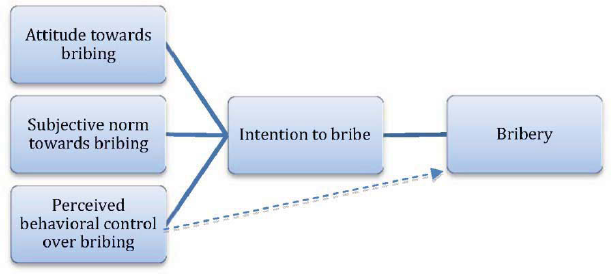
Low-level Corruption in the TPB
Figure 1 tells a clear story about the expected relationship between attitudes and behavior. Whereas bribery is the behavior of interest in most research regarding low-level corruption, the attitude towards bribery is clearly depicted here as one of three potentially important elements that ultimately determine behavior; therefore, it can only be regarded as a proxy for the actual behavior when considered in addition to the subjective norm, perceived behavioral control, and actual control over bribery. Without all other elements proposed by the TPB, the study of attitudes toward bribery (or toward corruption in general) may be of interest only for researchers examining citizens’ permissiveness of corruption in relation to other areas of interest (McCann and Redlawsk 2006). Nevertheless, if this study's interest is to assess the citizen's role on sustaining corruption (that which has been regarded as corruption tolerance) it will be necessary to focus on the behavioral side of LCT.
So far, the discussion here has centered on the usage and implications of LCT. However, defining and operationalizing LCT – a concept that comes under the disputed concept of corruption – requires taking a closer look at the different forms that it could adopt depending on the circumstances. This implies that in our account of LCT it is necessary to consider the different corruption scenarios that could evoke categorically different reactions from the citizen. As social psychologist Icek Ajzen (2005) explains, both attitudes and behaviors are evaluative responses to specific events. If this is indeed the case, then different categories of low-level corruption should produce different categories of LCT.
The most important distinction in the realm of low-level corruption is that between extortive and collusive corruption (Brunetti and Weder 2003), which describe the nature of the two possible relations between corruptor and corruptee. Extortive corruption, as Brunetti and Weder (2003: 1804) explain, “means that the government official has the discretionary power to refuse or delay a service […] in order to extract a rent from the private agent in the form of a bribe.” Collusive corruption is a situation where both directly implicated actors engage in a corrupt transaction in order to obtain a benefit to which neither is entitled. It is therefore entirely feasible that the incentives to engage in one form of low-level corruption or another differ. Probably the most transparent and citizen-driven conceptualization and description of collusive and extortive scenarios are offered by Bauhr and Nasiritousi (2011). They refer to collusion as a situation in which public actors or citizens pay a bribe in order to gain advantages they are not entitled to, whereas extortion is a situation in which citizens have to pay bribes to receive services that they are legally entitled to.
To turn the argument in the direction of the citizen, Bauhr and Nasiritousi decided to create the categories of “greed corruption” and “need corruption” – a distinction that tries to emphasize the two different sets of basic motivations behind the payment of a bribe and to call attention to their implications. Their approach is based on the idea that the difference between collusion and extortion can help to identify the corrupt interaction without giving particular importance to either one of the actors involved. Greed and need corruption, on the other hand, describe and emphasize the citizen's motivation to bribe either to obtain benefits by circumventing the law (greed) or to regain access to a service that is being unlawfully withheld by a public official (need); it reveals the role of the citizen in sustaining corruption.
In the proposed approach to LCT from a behavioral perspective, the differentiation between greed and need corruption can be found to exert an additional influence over the interpretation of tolerance under a TPB framework. In an extortion scenario the tolerant behavioral response from the citizen is the action of bribing – as has been suggested above. In a collusion scenario, however, the exchange is proposed by either a public actor or a citizen. In this respect, the citizen's tolerance of corruption is seen not only in the act of bribing but also in the citizen's behavioral attempt to bribe. The attempt to bribe, which can be seen as trying to perform a behavioral goal, was originally part of Ajzen's (1985) TPB, but it was later dropped when empirical testing revealed high correlations between both behavioral dimensions (Ajzen 1991). Hence, while it is theoretically appropriate to include the behavioral attempt to bribe in the analysis of greed LCT, it is essential to carefully weigh up the feasibility of obtaining such detailed data, on the one hand, and the actual empirical benefits such data would bring, on the other.
In the context of our discussion on LCT, greed and need can be defined as follows:
Greed LCT: Citizens behave deviantly by bribing (or attempting to bribe) a public official in order to gain a not legally entitled benefit.
Need LCT: Citizens behave compliantly by bribing a public official in order to gain access to a legally entitled service.
With these conceptual tools at hand, the next step is to test some of the statements I presented earlier regarding the nature and implications of LCT.
To test the implications of our previous discussion, this study focuses on Peru, which has a social and political environment generally characterized as being highly tolerant of corruption. Peru thus represents a particularly interesting case for testing the extent to which the attitudes supported by citizens translate into actions. Peru, however, is not a deviant case in the Latin American context, but rather a typical one.
To grasp the nature of the Peruvian context, we need to go back to the beginning of the century, when the Alberto Fujimori government (1990–2000) suffered a highly publicized collapse due to allegations of electoral fraud and, more importantly, the corruption scandal involving his main advisor, Vladimiro Montesinos. Following Fujimori's resignation, a comprehensive criminal investigation carried out during Valentín Paniagua's transitional government (2000–2001) uncovered a vast network of bribery, embezzlement, extortion, and fraud that involved Fujimori himself as well as senior members of his government.
In an interview published on April 2001, Diego García-Sayan, the transitional government's minister of justice, referred to the state of corruption in the country in the following terms:
How did this huge corruption machine appear in Peru? Without a doubt, the mafia took over Peruvian institutions with the tolerance and interference of a big part of Peruvian society. […] What to do so it doesn't happen again? It's about, then, identifying the objective conditions that existed in our institutionalization and the citizens’ behavior that tolerated this situation to get produced and progress. There are ethical and institutional matters that need to be identified to be able to face them and successfully fight the corruption phenomenon. 7
Translated from Spanish by the author. CARETAS, No. 1666, “Anticorrupción, Operación Tenaza,” 19 April 2001.
The corruption tolerance of Peruvian citizens referred to by García-Sayan does not only extend to their relationship with elected political figures, but is even more evident in their everyday experiences and perceptions. Peruvian citizens’ participation in low-level corruption such as bureaucratic bribery has scored consistently high in Transparency International's Global Corruption Barometer (GCB): for the period 2005–2010, an average of 17.8 percent of those surveyed claimed to have paid a bribe in the previous 12 months. 8 The result for Peru is only slightly higher than the Latin American average. When including Argentina, Bolivia, Chile, Colombia, Mexico, and Venezuela for the same period of time, the percentage of people reporting to have engaged in bribery is 16.3 percent. Moreover, according to the Fourth National Anticorruption Survey carried out by Proética (2007: 20), 57 percent of Peruvian citizens consider Peruvians to be either “corrupt” or “very corrupt.” Interestingly, although only 4 percent considered themselves as individuals to be corrupt (with 56 percent claiming to be “not corrupt at all”), up to 27.4 percent of interviewees admitted to having bribed a traffic officer in order to circumvent the law. Furthermore, only 6 percent said they had reported corrupt officials in relation to instances of bribery in which they were involved. It is thus no wonder that over 90 percent of surveyed Peruvians consider the problem of corruption to be either “serious” or “very serious,” and that half of the population consider it to be the single most important challenge facing the country on the road to development. This, however, does not sit well with the fact that 66.6 percent of the same population expresses “medium tolerance” to everyday acts that in one way or another break the law, such as paying a bribe to avoid a fine, public officials giving friends and relatives preferential treatment, and offering money or gifts to expedite municipal paperwork.
Statistical analysis performed by the author, based on raw data provided by Transparency International.
This state of affairs depicts a clash between reality, perception, and attitudes, where one could easily describe Peruvians as seeing corruption and understanding its evil but still engaging in it. Of course, what usually catches the attention of media and publications in such countries are the gaudy corruption scandals involving senior political figures. Nevertheless, one need not look too far to see that corruption is also engrained at the citizen level in the form of everyday bribery and favoritism.
If we use Transparency International's Corruption Perception Index (CPI) to compare Peru with the rest of Latin America, especially South America, we can logically infer that Peru is hardly an outlier, but rather a typical example of the state of corruption in the region. In 2006 9 the average score for the whole Latin American region, excluding the Caribbean, was 3.3 – exactly the same score received by Peru. This makes Peru a middle-ranked country in the region. By 2013 10 the regional average had slightly improved to a score of 3.6, while Peru remained a middle-ranked country in Latin America – though this time it fared a bit better with a score of 3.8. On this basis, the present study focuses purely on data for Peru, which is considered to be a typical case of how corruption is tolerated (or not) in the whole Latin American region.
See <www.transparency.org/research/cpi/cpi_2006#results> (28 July 2015).
See <www.transparency.org/cpi2013/results> (28 July 2015).
In the previous sections, the construction of the LCT concept resulted in two assumptions or hypotheses. First, there is no reason to equalize attitudes toward corruption to the actual engagement in corruption. In other words, an attitude-based indicator of LCT does not need to show a strong relationship to a purely action-based indicator of the same concept. Second, LCT should be related to the overall level of corruption in society. This means that a proper measurement of LCT should show a strong relationship to the general measurement of corruption in a country.
To test the first assumption, I use survey data on Peru from the 2006 AmericasBarometer provided by Vanderbilt University's Latin American Public Opinion Project (LAPOP). As LAPOP's questionnaire does not include any item that would allow for the measurement of specific behavior that would constitute a case of greed LCT, I rely entirely on the actual occurrence of bribery, treating this measure (for the case of greed LCT) as the minimum level of corruption tolerance in the given population. This strategy seems to provide fairly strong grounds for any further interpretation of the results, since it is possible to hypothesize that the high correlations between attempt and behavior – posited by Ajzen (1991) as reason to exclude the former – would also be found in the case of Peru's greed LCT. Supporting this idea is a 2007 report by the NGO Global Integrity, which regarded Peruvian law enforcement (48/100) and whistle-blowing measures (21/100) as very weak. 11 This suggests, in line with many accounts of low-level corruption in Latin America in general, that citizens who attempt to bribe will most likely succeed. LAPOP's data allows for the comparison between attitude-based and action-based measurements of citizens’ contact with low-level corruption. The following questions are available:
See <http://report.globalintegrity.org/Peru/2007/scorecard> (28 July 2015).
Action-based questions:
EXC11: During the last year to process any kind of document (like a license, for example), have you had to pay any money above that required by law?
EXC14: Have you had to give a bribe to the courts during the last year?
EXC15: In order to be attended to in a hospital or a clinic during the last year, have you had to give a bribe?
Attitude-based questions:
EXC18: Do you think that the way things are, sometimes giving a bribe is justified?
EXC19: Do you think that in our society giving bribes is justified because of the poor public services, or do you think it is not justified?
Additionally, the following questions measuring attitudes toward specific public services and corruption victimization (Orces 2009) are also used: (SGL2) “How have they treated you or your neighbors when you have had dealings with the municipality?”; (ST2) “Regarding the official dealings you or someone from your family has had with the courts or justice tribunals at some time, do you feel …?”; and (EXC6) “During the last year has any public official asked you for a bribe?” These variables are employed to test the relations of interest under specific conditions allowed by the use of subgroups. I also include commonly used control variables for the occurrence of bribery. First, income level (Q10) and economic satisfaction (Q10D), for instance, can have an impact – though of uncertain direction – on both the possibility and the necessity of paying bribes. For instance, more well-off citizens can afford to pay bribes to expedite a service, while poorer individuals tend to rely on bribery to gain access to otherwise unattainable benefits (Karklins 2005). Second, dissatisfaction with political objects (municipality [SGL1], government [M1], and democracy [PN4]) could explain the disregard for legal procedures and a preference for surreptitious solutions, notwithstanding the corrosive effect on the system (Della Porta 2000). Third, the perceived spread of corruption (EXC7) is usually suggested to produce self-justification that enables the engagement in corruption, as citizens tend to blame the system's current level of corruption for their own behavior (Del Castillo and Guerrero 2003; Karklins 2005). Fourth, interpersonal trust (IT1) instills a sense of social responsibility and common enterprise and has been argued to negatively impact on citizens’ propensity to engage in corruption (Uslaner 2008). Fifth, personal attributes such as educational attainment (ED), age (Q2), and gender (Q1) are commonly deemed to affect corruption tolerance, with those who have lower education levels, are young, and are male being considered to have a higher propensity to bribe (Ali and Isse 2003; Power and Clark 2001; Swamy and Knack 2001).
For the second assumption regarding the impact of LCT on the overall level of corruption, I expand the analysis beyond Peru and cover multiple Latin American countries, using data from Transparency International's GCB 12 and CPI. The analysis uses GCB data from the years 2005, 2007, 2009, and 2010 for Argentina, Bolivia, Chile (2007 not available), Colombia (2007 not considered 13 ), Mexico (2007 and 2009 not available), Peru, and Venezuela 14 ; only the 2010 CPI is considered for comparison as other authors have noted a high correlation between the results of the CPI of different years (Uslaner 2008; Canache and Allison 2003). The comparison between the GCB survey data and the CPI data provides a better understanding of the role that citizens have in sustaining the general levels of corruption. Although the CPI has been heavily criticized for its limitations regarding its reliance on elite perceptions (Seligson 2006), which is clearly not the same as the actual measurement of corruption (Olken 2006), it still offers by far the best international assessment of the corruption phenomenon and should be able to provide an adequate outline of average country-level corruption.
“The Global Corruption Barometer is a survey that assesses general public attitudes toward, and experience of, corruption in dozens of countries around the world.”, online: <www.transparency.org/policy_research/surveys_indices/gcb> (10 March 2012).
For unknown reasons, the tabulation only gives 66 observations for Colombia – a very small amount when compared to any other country in the sample.
Countries in Latin America were selected based on the availability of data from one more year other than 2010.
Actions versus Attitudes
To test the relationship between attitude-based and action-based indicators of LCT, I first create a composite ordinal variable from EXC11, EXC14, and EXC15 (all the questions regarding actual bribery and based only on data for those subjects that have indeed had interactions with public institutions in all three cases) and use ordered logistic regression analysis to regress it on the broadest attitudinal question (EXC18) and the relevant control variables. This analysis indicates whether the attitudes toward bribery are a good predictor of the actual engagement in bribery. It should be noted, however, that the composite variable does not differentiate between need and greed corruption. The results are shown in Table 1.
Impact of Attitudes over Behavior (Three Cases)
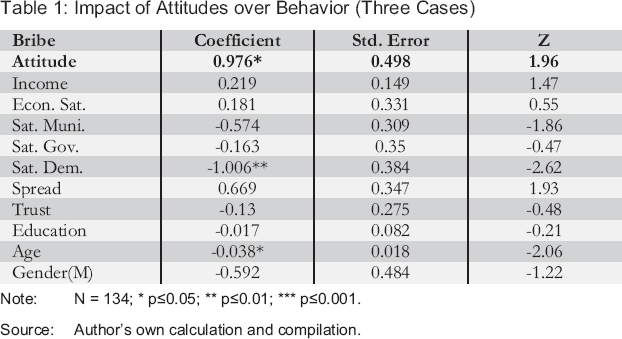
Impact of Attitudes over Behavior (Three Cases)
Note: N = 134;
p0.05;
p0.01;
p0.001.
Source: Author's own calculation and compilation.
As can be seen, the impact of attitudes over behavior results in a high coefficient of 0.97 and statistical significance at p 0.05. In terms of predictive probabilities, this means that a change of attitudes from “non-justifiable” to “justifiable” leads to an increased probability in engaging in corrupt behavior once (from 9 percent to 19 percent), twice (from 2 percent to 5 percent), and three times 15 (from 0.5 percent to 1.3 percent). Similarly, a more “tolerant” attitude toward corruption reduces the probability of not engaging in corrupt behavior from 88 percent to 74 percent. Finally, only two control variables were statistically significant: age and satisfaction with democracy. Citizens that are more satisfied with how democracy works in Peru engage significantly less in bribery; older people also participate less in such activities.
Although the results describe the engagement in at least one corrupt transaction in one, two, or three different contexts or scenarios (processing documents, dealing with courts of justice, and seeking medical attention), for ease of reading the simple counter of “times” is employed here to indicate the number of contexts where the citizen reports having paid a bribe.
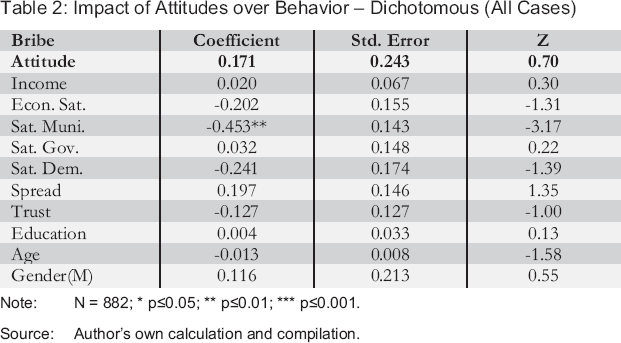
To further test the relationship between the two variables of interest, actions and attitudes toward low-level corruption, I dichotomize the values of the composite to represent “no incident” (zero times) and “incident” (one or more times) of bribery over the same period of time. I also include all the subjects that have had interactions with a public institution in at least one of the three cases. For this analysis, factorial logistic regression is employed. The results are presented in Table 2.
Impact of Attitudes over Behavior – Dichotomous (All Cases)
Note: N = 882;
p0.05;
p0.01;
p0.001.
Source: Author's own calculation and compilation.
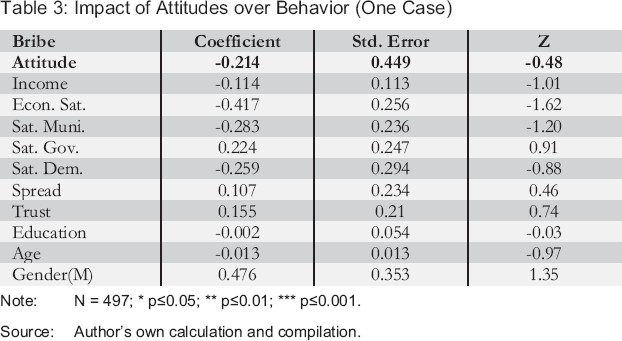
Table 2 provides no statistically significant findings (p > 0.05) regarding the relationship between attitudes and behavior, which suggests that the importance of attitudes in shaping actual behavior depends on the frequency of interactions between the individual and the public sphere. The only statistically significant control variable is “satisfaction with municipal services.” To lend support to (or withdraw support from) the assumption that attitudes only affect behavior when considering multiple interactions, I repeat the analysis for individuals that show the minimum frequency of interactions (the opposite population from the one used in Table 1); this means using the data for subjects that had interactions with a public institution in only one of the three action-based scenarios (EXC11, EXC14, and EXC15). The results are presented in Table 3.
Impact of Attitudes over Behavior (One Case)
Note: N = 497;
p0.05;
p0.01;
p0.001.
Source: Author's own calculation and compilation.
As assumed, the findings for the relationship between attitudes and behavior are not statistically significant and even result in an inverted coefficient, which lends support to the intervenient effect of the “frequency rate” of interactions between the private and public spheres.
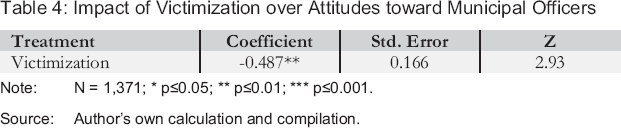
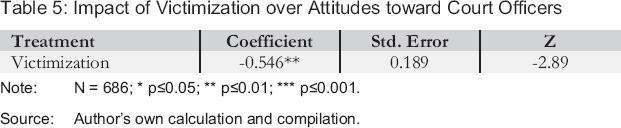
As stated in the theoretical framework, however, it is necessary to move beyond the general level of “corruption-tolerance behavior,” and to differentiate between greed and need corruption in order to analyze the relationship between attitudes toward corruption and corrupt behavior (LCT). This task is accomplished by controlling for occurrences of being asked for a bribe by a public official (victimization, EXC6), which directly identifies cases of extortive corruption (as suggested by Orces 2009). Using this step, victimization (EXC6) would be expected to have an important impact on citizens’ attitudes toward the way public servants treat them. To test it, I employ ordered logistic regression analysis to regress dealings with municipality (SGL2) and dealings with courts or justice tribunals (ST2), respectively, on victimization (EXC6). The results are shown in Tables 4 and 5.
Impact of Victimization over Attitudes toward Municipal Officers
Note: N = 1,371
p0.05;
p0.01;
p0.001.
Source: Author's own calculation and compilation.
Impact of Victimization over Attitudes toward Court Officers
Note: N = 686;
p0.05;
p0.01;
p0.001.
Source: Author's own calculation and compilation.
As expected, the coefficients in both cases are of important effect size (-0.48 and −0.54) and statistically significant (p ≤ 0.01), meaning that the requests for bribes by public officials diminish citizens’ levels of satisfaction with those services.
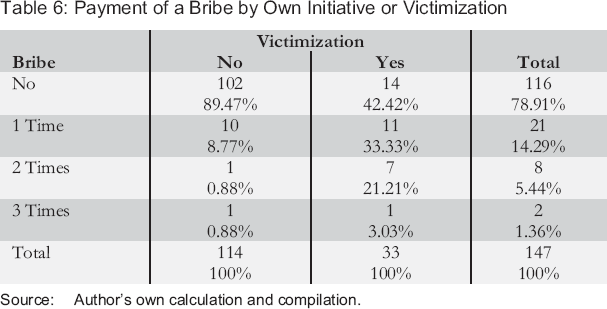
Now it is possible to disentangle the composite ordinal variable used in Table 1 16 (that which consider only the data for those subjects who interacted with public institutions in all three cases during the past year) by tabulating it with EXC6 (victimization). Table 6 presents the number of cases pertaining to the existence or not of victimization, thus effectively disaggregating them into collusive and extortive corruption.
For the sake of clarity, I chose to present here only one of the three composite models used previously – that which so far offers the most promising results with respect to the impact of attitudes on behavior. In the other two composite models, the regression results fail to achieve statistical significance (and a counter-logic negative coefficient in three out of the four analyses).
As can be seen, 57 percent of citizens that were confronted (victimized) with a request for a bribe decided to comply, showing what the literature has called a need behavior. On the other hand, 10 percent of those who were not asked for a bribe ended up giving one, suggesting a situation of greed corruption.
Payment of a Bribe by Own Initiative or Victimization
Source: Author's own calculation and compilation.
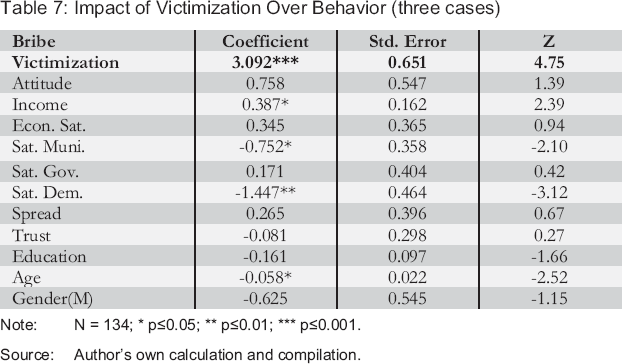
Although none of the survey questions employed here allow the possibility to state beyond a reasonable doubt that the occurrence of victimization corresponds to the payment of or refusal to pay a bribe (due to the exclusion of any measure of the frequency of such situations), it may still be possible to derive strong arguments if it can be proven that a bribe request (victimization) in fact influences the decision to pay it – as it would intuitively be expected. Table 7 presents the ordered logistic regression of the chosen composite ordinal variable on the occurrence of being asked for a bribe by a public official and the previously included control variables.
Impact of Victimization Over Behavior (three cases)
Note: N = 134
p0.05;
p0.01;
p0.001.
Source: Author's own calculation and compilation.
As expected, “victimization” has a large and statistically significant influence (3.09, p 0.001) on the decision to bribe or not. Hence, even though it is impossible from the survey questions to match both measures to the same event, the results of the regression analysis provide enough support to the assumption that they are in fact parts of the same incidents. The new control variables, “income” and “satisfaction with municipal services,” are also statistically significant.
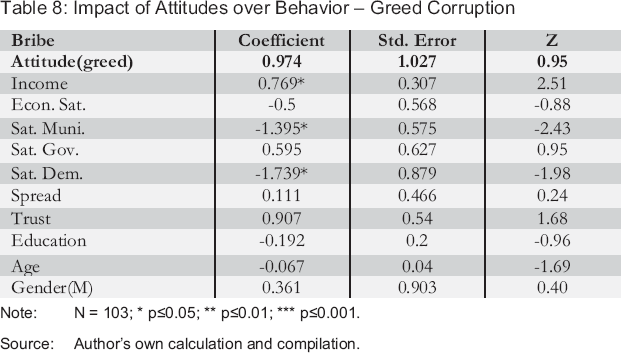
To further test the relationship between attitudes and behavior toward low-level corruption – now more readily delimited by the differentiated cases of greed and need – I use a more specific question regarding respondents’ justification of bribery due to poor public services (EXC19). Question EXC19 serves as an appropriate indicator for cases of apparent greed given that it clearly makes the distinction that the justification for paying bribes relies on a desire to circumvent deficient procedures and/or poor customer services, not because such payments are being actively imposed. Therefore, the ordered logistic regression of the action-based composite ordinal variable on the justification for bribery due to poor public services (for the subset of cases that were not asked for a bribe) should tell the collusive part of the story between attitudes and behavior. As before, I include my set of control variables. Table 8 presents the results.
Impact of Attitudes over Behavior – Greed Corruption
Note: N = 103
p0.05;
p0.01;
p0.001.
Source: Author's own calculation and compilation.
It is possible to see that the relationship between the two variables (i.e., tolerant attitudes toward bribery and actual engagement in corruption) is not statistically significant. However, the following control variables are statistically significant: income level, satisfaction with municipal services, and satisfaction with Peruvian democracy.
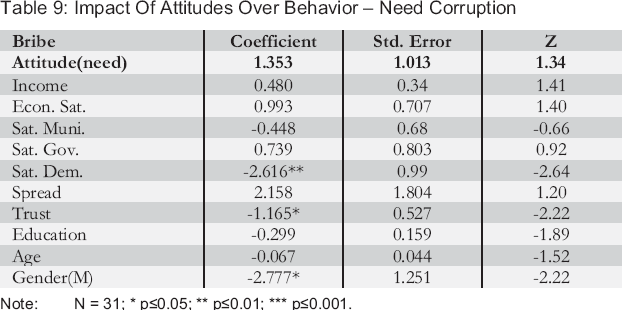
The final aspect to test is the relationship between need corruption and attitudes toward it – namely, cases of clear extortion. Unfortunately, the LAPOP survey does not ask people about their attitudes specifically toward being victimized by a public official. However, since the broadest attitudinal question in the survey (EXC18) is phrased in a manner that allows for the inclusion of both greed and need attitudes, it is likely that any important relationship between “need” attitudes and behavior can be identified through at least a weak impact of general attitudes on specific extortive behavior. To test this possibility, I once again employ ordered logistic regression analysis to regress the composite ordinal variable (actual bribery) on attitudes toward bribery and the control variables for the subset of cases that were asked for a bribe. The results are shown in Table 9.
Impact Of Attitudes Over Behavior – Need Corruption
Note: N = 31;
p0.05;
p0.01;
p0.001.
Source: Author's own calculation and compilation.
Once again the regression offers not statistically significant results for the relationship between attitudes and behavior regarding LCT. 17 Of the control variables included in this regression, “satisfaction with democracy” was statistically significant, as was “interpersonal trust” and “gender” – the latter revealing (contrary to the suggestions of previous literature) that when it comes to bribery as a result of extortion, men are less likely to engage in it than women. The gender finding clearly supports the importance of differentiating between greed and need corruption.
It is important to note that the lack of statistical significance in this particular regression may be the result of the exceptionally low number of cases included. Therefore, further data collection is necessary.
The second hypothesis of this paper proposes that LCT has an important impact on the overall level of corruption in a country. If this is the case, I should be able to find that the CPI results tend to follow those of the GCB, which measures self-reported cases of low-level corruption (the action-based indicator of LCT).
To make the results more readable, I have converted the CPI's 10-point index scores into percentages with inverted results, with the most corrupt countries scoring higher and the least corrupt countries scoring lower. For example, based on its 2010 CPI score of 2.0, Venezuela scores 80 percent; Chile, meanwhile, scores 28 percent (CPI score of 7.2). This method eases comparisons with the LCT measure, which is produced from the percentage of the surveyed population in each country that declared having paid some form of bribe during the 12 months prior to the survey. To continue using the examples of Venezuela and Chile, the data provided by the GCB reports a LCT level of 20 percent in Venezuela and 9 percent in Chile. The relationship between both measurements of corruption and corruption tolerance for all the countries included here is graphically presented in Figure 2.
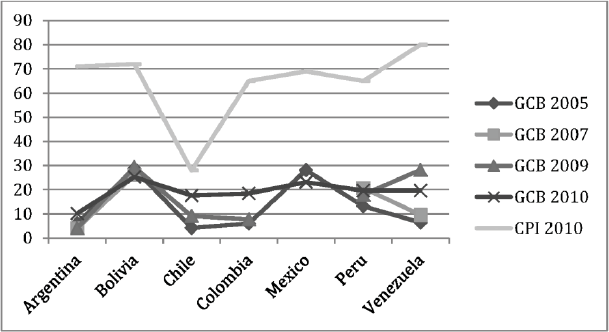
Tendencies of LCT and General Corruption
Figure 2 shows that, with the exception of the results from the GCB 2010 and the specific case of Venezuela, the levels of corruption accounted for by the CPI generally follow the international variations in citizens’ reports of bribery. In the GCB Bolivia, Mexico, and Venezuela (only in 2009) score a LCT level of around 30 percent; Peru, around 20 percent; and Argentina, Chile, and Colombia, under 10 percent (with the aforementioned exception of the 2010 values). Meanwhile, Venezuela scores 80 percent in the CPI; Argentina, Bolivia, and Mexico, around 70 percent; Peru and Colombia, 65 percent; and Chile, 28 percent.
The results of my empirical analysis reveal four major findings. First, attitudes toward bribery only serve as an important predictor of the decision to bribe. This is demonstrated by the strong coefficient and the presence of statistical significance when regressing the composite ordinal variable (which uses data for subjects that present values for all three action-based indicators of LCT) on general attitudes toward bribery. When repeating the analysis with dichotomized composite variables that include data for subjects that experienced at least one of the three scenarios, as well as for those that only experienced one of the three, the results lose statistical significance. Therefore, the potential of attitudes to predict behavior proves to be exclusively limited to “frequent-contact” subjects. In general terms, this finding can be said to demonstrate the possibility of making general inferences from the predictive capabilities of attitudes toward corruption, on the one hand, and the high probability that those same inferences may be entirely subordinated to the frequency with which the citizen encounters the public sphere (represented by public servants), on the other.
Second, identifying cases of extortion by public officials against the citizen (victimization) allows for the distinction between instances of greed and need corruption. Thus despite LAPOP's survey not including questions that explicitly ask about the nature of a bribe and/or the motivation to pay, it is still possible to deduce the differentiated contexts behind citizens’ decisions.
Third, a closer look at the relationship between attitudes and behavior regarding low-level corruption (be it of a greed or need nature) shows that in all analyses but the most generic one attitudes toward corruption fail to allow for the prediction of a citizen's decision to bribe or not to bribe based solely on his or her attitude. Such results corroborate the theoretical framework presented here, which points in the direction of other, and possibly more relevant, determinants of the role of citizens in sustaining low-level corruption – for instance, the control variables adopted here that actually are statistically significant.
Fourth, taking into account the notion of a probable impact of citizens’ LCT on corruption, I use a lined graph to identify whether there is a general pattern of association between the results of Transparency International's CPI and GCB. Overall, there is a common pattern for the Latin American countries included in the sample, which reflects a tendency for both types of measurements to run together. Clear exceptions, however, are the cases of Argentina and Colombia, which both report a much lower level of LCT in the GCB than would be expected given their scores in the CPI. These results may evidence the fact that the level of grand corruption tolerance is disproportionately higher than the level of LCT. For the rest of the countries, the pattern follows the expected tendency, meaning that the level of LCT is correlated with the overall level of corruption in those societies. This, however, does not come as a surprise, due to how the concept of corruption tolerance was operationalized: given that the LCT measurement employed here is action based in nature, it is expected that the level of general corruption will follow the general occurrence of bribery involving the lower levels of the bureaucratic apparatus.
Conclusions
When addressing a behavior so complex as that of a citizen's decision to bribe, attitudes cannot tell the whole story – as the case of Peru has demonstrated. People may pay bribes because (i) they are dissatisfied with the services provided by their municipal office or with the way democracy works, (ii) they are younger, (iii) they have higher incomes, (iv) they do not trust their peers, or (v) their gender makes them more vulnerable to giving in to extortion. These are all important factors that can drive citizens to exhibit bribery-supporting behavior even though they may at the same time express an intrinsic disagreement with the whole idea behind bribery. In other words, a citizen's evaluation of low-level corruption may be negative, but other factors beyond a citizen's sentiments also come into play when confronted with a real situation. The theory of planned behavior (TPB) suggests that this occurs because other elements influence individuals’ decisions besides their attitudes toward bribery. Theses elements could be the subjective norm (i.e., the opinion that others have about bribery) or the perceived behavioral control behind attempting to bribe. To test TPB's argument, surveys must include questions that identify the determinants of corruption from a citizen perspective.
As Bergman (2009) explains, the citizen has no incentive to behave in a righteous way if everyone else is not following the same cooperative strategy. In a society where public officials are highly corruptible and everyone around seems to be taking advantage of that situation, following one's moral convictions may prove to be the less efficient behavior. Nonetheless, as the data on Peru has statistically proven, such a context does not necessarily preclude anticorruption attitudes, even in its low-level form.
This study argues against the reliance on purely attitudinal indicators of corruption tolerance, specifically LCT, and supports the use of action-based indicators instead. The impact of this position is by no standards meager. Any study that focuses on citizens’ tolerance of corruption must necessarily employ theoretically and empirically sound indicators that measure the phenomenon of interest before attempting to explain its causes, its consequences, or how it interacts with other concepts of social scientific interest. Past approaches that implicitly conceptualize corruption tolerance as a matter of attitudes based their research efforts on the assumption that those attitudes would fundamentally explain or predict an individual's actual behavior and, therefore, have a specific impact on society. If not for the attitude–behavior correspondence, there would be no clear reason for choosing to explore a construct (corruption-tolerance attitudes) that has no effect whatsoever in reality. However, the assumption of the attitude–behavior congruence (as has been analyzed in this paper) has been proved both theoretically and empirically erroneous. In such a scenario, then, the logical course to follow is to conceptualize corruption tolerance as a specific behavior and to operationalize it accordingly in order to accurately assess the specific determinants of this phenomenon.
This conclusion (regarding the use of a behavioral approach to corruption tolerance) has been reached through the multivariate regression of behavior on attitudes, primarily, and relevant control variables. In the case of attitudes, which are the main focus of this paper, the results are for the most part not statistically significant. Therefore, the next step will have to take into account “attitudes” among other important variables (following the proposed theoretical model) in an effort to explain corruption-tolerance behavior.
The ability to explain and predict actual human behavior has the ultimate objective of providing policy makers with the appropriate tools to effectively fight the scourge of corruption, helping them to avoid the indiscriminate or uninformed employment of human and financial resources. Although it is not my intention here to criticize specific anticorruption policies derived from normative and positive studies, I argue that considerations regarding specific environmental causes identified by theoretically and empirically sound indicators should be a key element in any serious anticorruption policy. To this end, lucid and theoretically oriented surveys are crucial and will, among other things, allow the framework presented here to be fully implemented. Without clear data on the various characteristics of a corrupt transaction, the possibility of reliably assessing corruption tolerance in a particular society will always be limited.
Even though the data used here only cover Peruvian citizens, the above discussion applies to any study on the corrupt behavior of citizens in any region. The need for a sound operationalization of the studied behavior permeates geographical considerations. Moreover, Peru represents a typical case of a Latin American country whose citizens have frequent contact with all dimensions of corruption; therefore, it is entirely probable that similar results will be found if examining attitude– behavior congruency and LCT in Brazil or Mexico, for example. Such similarities would, of course, have to be empirically tested using appropriate data, but the potential for a regional examination of LCT is clearly present. This would require, however, improvement of the relevant survey tools, such as LAPOP and Latinobarómetro, among others.
As a final comment, I should clarify that although the proposed action-based indicator of corruption tolerance may represent the effective transposition of measures of the incidence of bribery (or the attempt to do so, as was effectively developed in theory) to the newly developed concept of low-level corruption tolerance, the important difference resides in what Bauhr and Nasiritousi (2011) have called “the basic motivations for paying a bribe.” This approach diverges from the classic interest in the corrupt action itself and the public-official side of the exchange by bringing attention to the role of the citizen as the fundamental actor in any corruption scenario. Therefore, to gain access to this newly emerging field of interest, we will need to address citizens’ actual behaviors and not just their opinions about the phenomenon of low-level corruption.