



Abstract
This article argues that the low levels of descriptive representation of women in local political office in Mexico and Latin America is much more than a problem of the purported patriarchal cultures of indigenous and rural communities. We claim, based on a comprehensive survey of 466 municipal governments in the indigenous state of Oaxaca, that the underrepresentation of women is a function of institutions limiting female candidates. We test this “candidate supply” hypothesis, adapted from US-based studies, against the hypothesis that culture – as measured by indigenous ethnicity – has an independent effect on women's representation. We disconfirm that patriarchal, traditionalist cultures of indigenous communities cause underrepresentation in the election of women and instead find that a particular set of local institutions, which are more prevalent in indigenous municipalities, blocks the supply of potential women candidates. We conclude by considering the normative implications for women's representation in local politics in Mexico and Latin America.
Introduction
Discrimination against women is the most glaring weakness in arguments that multicultural rights extend the defense of human rights to indigenous communities. Susan Okin's 1999 essay “Is Multiculturalism Bad for Women?” asks it most famously, but the question is on millions of lips. Hundreds of millions of women suffer discrimination routinely through traditional or customary law systems. Indeed, throughout Latin America, dramatic gender inequalities exist in land ownership and the holding of other resources (Deere and León 2003). Despite such severe indicators of discrimination, political analysts point to improvements in women's representation in elected office worldwide as solid achievements (Reynolds 1999; Inglehart and Norris 2003) – and they are. Great merit may exist in multicultural approaches to governance that protect, preserve, and recognize the customary practices of formerly colonized peoples, but caveats are in order. 1
The authors would like to thank Moisés Jaime Bailón Corres, Sarah Fulton, Magda Hinojosa, Víctor Leonel Juan Martínez, Jennifer Lawless, Gloria Zafra, and the participants in American University's 2011 Government Department Workshop and the “Ethnic Politics Workshop II” held at George Washington University in 2011 for their comments. We also thank Daniela Stevens León for her excellent research assistance.
Throughout indigenous Latin America, the rights to self-determination and autonomy of indigenous communities are being recognized through constitutional assemblies and by national and subnational legislatures. This trend has been spurred from the top by the 1989 creation of the International Labor Organization's Proposition 169, which binds countries to international standards for recognizing indigenous rights, and through the bottom-up demands of indigenous communities motivated in part by the 1992 quincentenary celebration of Columbus's voyage to the Western Hemisphere (see Burguete Cal y Mayor 2013). Indigenous rights movements have emerged across the continent – including Mexico's Zapatista Rebellion in 1994, the Pachakutik movement/party's success in Ecuador in 1999, and most recently, the 2005 victory of Evo Morales's Movement Toward Socialism (MAS) in Bolivia. These movements have expressed themselves across a range of institutions of representation, from comprehensive recognition of local autonomy in Bolivia to judicial support for indigenous groups in Colombia to partial recognition (at least of electoral practices) in parts of Mexico.
Customary law-observing communities – such as those where we collected data – in Oaxaca 2 , Mexico, use a mix of Western and traditional electoral means: citizens elect federal and state authorities according to standard liberal electoral processes of secret ballot and universal suffrage, and they elect municipal authorities via indigenous customs (Spanish: usos y costumbres, UC). The definition of UC practices is often debated. In Oaxaca, UC can refer to a range of practices for selecting leaders – from community-wide assemblies to appointing a council of elders to make decisions, from raising hands to support a candidate to drawing hash marks beneath a candidate's name. In general, voting under UC is done publicly and there is no guarantee of universal suffrage. Rather than rigidly define UC practices and establish a legal baseline for them at the moment of recognition, Mexican state authorities have allowed Oaxacan legislators to designate UC municipalities and grant local citizens the right to elect leaders via the system of their choice. The practices fit into a broader debate over such expressions of communal rights and the individual human rights of subgroups of these communities – including the individual rights of women – which are not always respected.
Oaxaca is Mexico's most indigenous state, where a slight majority of the 3.5 million people still identify themselves as indigenous, and where longstanding customary law elections have been legalized and recognized by the government since 1995.
Individual rights critics of multiculturalism such as Barry (2001), Zafra (2009), and Aguilar Rivera (2004) argue that the recognition of customary practices by governments unjustifiably permits gender-based exclusion from the political process, whereas multiculturalists such as Hernández Castillo (2006), Aguilar Ortiz, and Velásquez (2008) contend that the acknowledgment of group rights and identities supersedes individual rights. A visceral and emotional issue, this is also one that is rarely submitted to empirical testing, and prior tests of the relationship between ethnicity and female participation in the political process (Danielson and Eisenstadt 2009; Díaz-Cayeros, Magaloni, and Ruiz Euler 2011) have come up with somewhat divergent results. Danielson and Eisenstadt found female participation in selecting local authorities to be more prevalent where UC had been recognized, but with important intervening variables. Díaz-Cayeros, Magaloni, and Ruiz Euler found participation to be low but increasing, which they attribute to the impact of social spending programs where women are the gatekeepers. The two earlier studies used household survey data to assess perceptions and attitudes about women's participation in UC and non-UC municipalities and in accordance with indigenous and mestizo origin. Rather than focusing on women's participation, as did these previous studies, this article seeks to explain observed variation in women's descriptive representation in Oaxacan municipal governments.
This paper argues that grave deficiencies in women's descriptive representation belie formal improvements in women's rights, civic participation, and governance. Mexico offers a case in point as a new democracy where women are making steady, if insufficient, progress toward proportional representation at the level of national politics (Rodríguez 2003; Baldez 2007; Langston and Aparicio 2011). However, most work on political representation in Mexico does not consider the municipal level of government, which is often the first stepping-stone to political power at the state and national levels.
In this article we draw upon two distinct literatures. First, as discussed above, we seek to shed additional empirical light on the debates between advocates of multiculturalism and indigenous autonomy and those who answer Okin's famous question in the positive. Second, we address one of the central questions of the literature on women's representation in a very different context than is typical. To do this, we analyzed data from an original survey of 466 municipal governments 3 in the indigenous state of Oaxaca. Our analysis shows that the underrepresentation of women in municipal governments in rural Mexico is a function of institutions limiting female candidates, rather than the traditionalism of indigenous communities. We test this “candidate supply” hypothesis, which we have adapted from studies explaining women's descriptive representation in national political office in the United States (see notably, Lawless and Fox 2010), Latin America (Hinojosa 2012), and around the world (Matland 1998; Paxton, Hughes, and Green 2006). Specifically, we argue that traditional systems of community service – the cargo system – that exist in UC and non-UC municipalities in Oaxaca often serve to block the supply of women deemed eligible to hold higher positions of power. That is, we hypothesize that the low level of women's representation in municipal governments is explained by their lack of participation in low-level positions of community service. Thus, low representation may be most directly caused by this institutional bottleneck, rather than by active discrimination or patriarchal beliefs in the population that women are not fit to govern. 4
The 466 is 82 percent of Oaxaca's total number of municipalities (570). We surveyed 417 municipalities out of the 418 that observe customary law and a random sample of 49 out of the 152 that elect leaders via parties and elections.
We do not argue that discriminatory attitudes are insignificant. However, our data measure municipal-level outcomes rather than individual-level attitudes, making a direct test of a discriminatory attitudes hypothesis not possible here.
Against this institutionalist explanation, we also test explanations of whether culture – as measured by indigenous language – has an independent effect on women's representation. This hypothesis is derived from theories stating that increased gender equality is a defining characteristic of transitions from more traditional to more modern polities (Bartra 1997; Inglehart and Baker 2000; Inglehart and Norris 2003). In the Latin American context, arguments that indigenous culture is more traditional, and accordingly more patriarchal, are commonplace in public discourse. This is reflected, for example, in comments by Patricia Espinosa, former director of the Mexican government's National Women's Institute, who, when expressing support for the 2001 Indigenous Law, noted the virtue that the legislation explicitly protected women's rights and would “rescue them from traditions and customs” (cited in Forbis 2003: 237). However, we find that women are just as likely to hold positions of power in indigenous municipalities as in mestizo municipalities. This suggests, at least by this measure, that women's underrepresentation is not caused by indigenous culture.
In more contemporary research, scholars have moved away from arguments that indigenous culture explains women's underrepresentation and have instead focused on the customary political systems in southern Mexico as the source of the exclusion. Our analysis here offers a modification of the prevailing theories, which state that the recognition of indigenous political institutions like UC negatively impact women's probability of winning political office. While we do find that UC political systems have a negative effect on women's probability of holding political office, the negative impact of these systems is exacerbated considerably in municipalities that prohibit female inclusion in the local cargo system (which acts as a stepping-stone for any candidate wishing to enter a political post). 5 Thus, we posit that the principle barrier to female descriptive representation, particularly in UC municipalities, exists prior to the election and is a function of women's exclusion from participation in the cargos required to become an eligible candidate.
While it varies by municipality, candidates for mayor tend to have scaled the ladder of cargos through completion of lower-level positions (village errand runner, cemetery caretaker, night watchperson), mid-level posts (town manager, public project supervisor), and higher-level positions (overseer of religious ceremonies, mayor). This is an informal requirement rather than a formal one.
Oaxaca as Experimental Environment for Assessing Multicultural Policies
Mexico is not the only country where some citizens select their leaders through customary practices (see Relea 2008), but it may be the best case to examine the effects of multicultural recognition on women's representation. Specifically, the legalization of UC elections – which was in part driven by exogenous decisions at the level of the state legislature (Anaya Muñoz 2006) – in the majority of Oaxaca's 570 municipalities provides an opportunity for a natural experiment. The lessons of the Oaxaca experiment in indigenous rights recognition and the precedent it sets for Mexico and all of Latin America are of great importance (see Burguete Cal y Mayor 2013; Eisenstadt 2011, 2007; Lucero 2013; Mattiace 2013).
According to recent literature, such UC institutions exist in the communal assembly-based democracy and economic reciprocity arrangements of the Andes’ Aymaras (Ticona, Rojas, and Albó 1995) as well as in the self-regulating institutions of the Mixtecs and Zapotecs in Mexico (Carmagnani 1988; Bailón Corres 2002). In Oaxaca, UC municipalities follow a range of practices to elect their authorities. For instance, citizens elect government officials in public community assemblies by a show of hands (e.g., San Miguel Chimalapa), by drawing hash marks beneath their candidate's name on a chalk board (e.g., Coatecas Altas), by secret ballot (e.g., San Juan Mixtepec), or by lining up behind their candidate (e.g., San Pedro Yolóx).
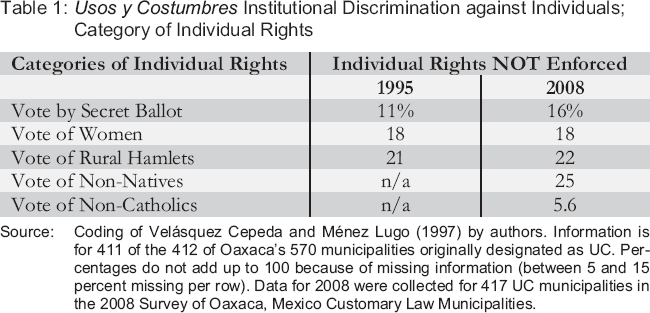
However, victims of unfavorable UC election outcomes often argue that customary law is so loosely defined that it empowers traditional-style chieftains to exercise their wills arbitrarily under the guise of communitarian decision making (see Eisenstadt and Ríos 2014 forthcoming). How discriminatory are UC practices in Oaxaca? Table 1 shows estimates from 1995 and 2008 documenting how different groups are excluded from participation in local elections, and how voting is not conducted by secret ballot in the vast majority of UC municipalities.
Usos y Costumbres Institutional Discrimination against Individuals; Category of Individual Rights
Source: Coding of Velásquez Cepeda and Ménez Lugo (1997) by authors. Information is for 411 of the 412 of Oaxaca's 570 municipalities originally designated as UC. Percentages do not add up to 100 because of missing information (between 5 and 15 percent missing per row). Data for 2008 were collected for 417 UC municipalities in the 2008 Survey of Oaxaca, Mexico Customary Law Municipalities.
Women are not the only group excluded from meaningful local participation, as municipalities exclude non-Catholics (5.6 percent), people not born in the community (25 percent), and people from outlying population hamlets (22 percent) rather than county or municipal seats.
As these data suggest, women in UC-designated municipalities seem to be particularly excluded from participation in elections. But does this exclusion from voting practices account for the small number of women who hold positions of local authority? We argue that low female descriptive representation is not solely attributable to the fact that women can be denied the right to vote under UC, but rather that underrepresentation is a direct result of exclusion from the cargo stepping-stone. Having served in lower-level cargos is considered to be a requirement for holding higher office in some non-UC municipalities and many UC municipalities. This makes it possible to empirically separate the effects of the cargo prerequisite from those of UC recognition. However, we also find evidence that the negative effect of the cargo requirement on women's representation is exacerbated by the flexibility of UC elections. In other words, while discrimination against women is pervasive, the lack of women in office is best explained by the obstruction of women's access to the positions that lead to power, rather than by the recognition of UC elections alone. Furthermore, underrepresentation is not related to indigenous ethnicity (as measured by language).
The first systematic study of female mayoral career paths in Oaxaca by Vázquez García (2011) studies only UC women mayors from 1999–2010. The author helpfully identified four pathways to becoming mayor (Vázquez García 2011: 32–33, 118, 127–145): (1) strong performance in traditional cargos (route taken by three mayors, including the only two indigenous-language speakers), (2) establishment of political credentials through the Party of the Institutional Revolution (PRI) (three mayors, despite the ostensibly nonpartisanship of UC municipalities), (3) service as a community teacher (six mayors), and (4) service to the municipality by channeling resources back from the urban areas to which they had migrated (six mayors). Only 4 female mayors of the 18 came from municipalities with cargo systems closed to women: a retired teacher who challenged the whole town with backing from women and PRI partisans with whom she had worked for 20 years (132), two teachers who did not hold cargos but argued that teaching was a form of cargo (135–138), and another woman who returned to her community and successfully advocated for important issues like water rights and thus created a platform of action upon which to campaign (141–142). Clearly, these four women were exceptions (representing only 15 percent of the few indigenous women who did succeed in becoming UC Oaxaca mayors).
Our statistical analysis shows that the real obstacle to the election of female candidates is the combination of the politicized rules of UC and the exclusion of women from the cargo system in these communities. As stated by Vázquez García (2011: 261), sexist caciques (political bosses) – often affiliated with parties – exploit existing rules to deny women access to power. Women participate in cargos through their husbands (Vázquez García 2011: 49–50), but only rarely as individuals (unless they are single, widowed, or their husbands have migrated permanently). Former UC mayor, López García (interview 2011), had the following to say:
Cargos are a school for leadership which women should also participate in […]. Our problem is that we [women] only want harmony between our spheres, the household and the community. We are often denied participation.
When allowed to participate, various women leaders told Vázquez García (2011: 90) that it is only to serve on domestically oriented cargo committees (health and education).
A systematic study of women's participation under UC did partially confirm the long-held view that UC institutions exclude women (Danielson and Eisenstadt 2009). However, it also revealed that in municipalities that do tolerate service by women in leadership roles, women actually participate in elections at higher rates. In other words, while UC autonomy allows for discriminatory practices that discourage female participation at many levels, women are highly participatory in those communities where women already hold leadership roles. Such open policies are not the norm, however, and women constitute a minority of Oaxaca electoral rolls overall.
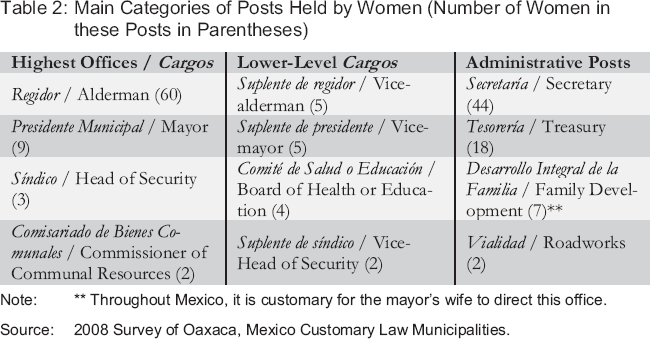
When women are permitted to hold office, they are more often than not assigned to school or health committees that address the needs of children and families (Velásquez Cepeda 2003: 27), as opposed to the budget committee or village security detail. Our study of the municipal offices held in 466 of Oaxaca's 570 municipalities – both UC and party based – between 2008 and 2010 reveals the following breakdown.
Main Categories of Posts Held by Women (Number of Women in these Posts in Parentheses)
Note:
Throughout Mexico, it is customary for the mayor's wife to direct this office.
Source: 2008 Survey of Oaxaca, Mexico Customary Law Municipalities.
The Mexican federal government has recognized the centrality of women to family life by delivering conditional cash transfers directly to women rather than men through the Oportunidades social welfare program. Díaz-Cayeros, Magaloni, and Ruiz Euler (2011) have concluded that such transfers may improve women's leadership roles in traditional communities. Nonetheless, women seeking to participate still face great obstacles. Echoing Zafra (2009), Velásquez Cepeda states that 80 percent of women who serve in official positions face hurdles, ranging from:
simply not being taken into account in any internal decision making, to personal conflicts in which they are delegitimized, criticized, and discriminated against by a member of the local government or the mayor, to fatigue caused by family tasks or work (Velásquez Cepeda 2003: 28).
Of course, women's rights have routinely been ignored in much of Oaxaca (Eisenstadt 2007; Danielson and Eisenstadt 2009; Eisenstadt 2011), Latin America (Deere 2006), and around the world (Inglehart and Norris 2003). For example, in Chiapas, Subcommandante Marcos famously acknowledged that female participation in the Clandestine Revolutionary Indigenous Committees in 2004 was between 33 and 40 percent, but that women constituted less than 1 percent of the membership of the Good Government Councils and autonomous governing councils (Marcos cited in Lewis 2008: 182).
In the following sections, we investigate the lack of women in positions of authority in Oaxaca and consider the cultural and historical explanation that UC status itself limits women's representation. We find that although places with UC political systems have more unequal representation, this effect is greatly magnified in places that ban female participation in cargos which in turn blocks their eligibility for higher political offices.
Specifying the Dependent Variable: “The Number of Women in Office”
Women held a total of 174 governmental posts, ranging from health administrator to mayor, in the 466 municipalities we surveyed. 6 But less than 18 percent of the municipalities surveyed reported having at least one woman in office. Only 21 municipalities elected two women to office, and 11 municipalities elected three women to office. Just three municipalities elected four women and only one municipality elected five. We tested for causes of this variation in women's representation using data from the 2008–2010 Survey of Oaxaca, Mexico Municipal Governments. 7 We sought to understand why some municipalities have limited female representation (zero to one) in office while others have higher levels.
These included elected and appointed posts, but appointments were by elected officials as part of administrations.
The survey was conducted between 2008 and 2010. The first part was funded by USAID-TIES Higher Education for Development Project, “Uniting Law and Society in Indigenous Mexico” and surveyed municipal authorities in 417 of the state's 418 UC municipalities. The second part surveyed the 152 Oaxaca municipalities governed by the party-based system, but was only able to capture 49 out of a random sample of 76 due to resource limitations. For both sets of municipalities, several questionnaires were administered by the same survey research team from the State Institute for Adult Education of Oaxaca. The first questionnaire was administered to three or four municipal authorities, typically the mayor, the sindico (head of security, the second post in most municipalities), the finance alderman, and the education alderman, among other elected positions. The second through fourth questionnaires were short biographical surveys of the mayor, the sindico, the commissioner of communal resources (the most important position of agrarian authority), and the mayordomo (the host of the community's patron saint festival).
We examined the independent and interactive role that institutional and cultural factors play in facilitating female representation in public office. First, we tested the claim that low women's representation is accounted for by the patriarchal cultural attitudes purported to be prevalent in indigenous municipalities. The proxy indicator we used for this – certainly not equivalent to patriarchal attitudes – is the percentage of the municipal population that speaks an indigenous language. Using this variable, we were not able to directly test whether patriarchal attitudes or cultures cause low women's representation, but rather whether the indigeneity of a polity accounts for lower levels of women's representation. While this is an imperfect and minimalist operationalization of ethnicity, it is the one used by the Mexican government and by scholars undertaking statistical work. Second, we tested the candidate supply hypothesis that the supply of potential female candidates for higher office in Oaxaca is blocked by the requirements of the cargo system. Finally, echoing Okin's provocative question, low women's representation in Oaxaca is often blamed on the recognition of UC, which allow communities (or dominant voices in communities) to exclude women from participation.
To test this thesis, we examined the interaction between UC institutions and the supply constraint of women candidates that results from the cargo system. To evaluate these hypotheses, we regressed the number of women in office on these independent variables along with several necessary control variables. The model shows that the interaction between a discriminatory cargo system and UC institutions is the best predictor of female non-participation in elected office. More specifically, this suggests that the informal institutional system of cargo requirements, rather than indigenous ethnicity, inhibits female participation in Oaxaca, particularly in UC municipalities. 8 Women do not complete the necessary prerequisites (often because they are precluded from doing so) and thus are not elected at the same rate as men. Importantly, however, the cargo system does not have an effect on women's representation in party-system municipalities, even in Oaxaca's dozens of “hybrid” municipalities where secret ballots and party-driven elections are employed alongside a cargo system.
To be clear, the dependent variable (number of women in office) does not measure the same thing as the cargo variable. The cargo variable measures whether cargo fulfillment is required for mayoral candidates and whether women are banned from participating in cargos.
Competing Explanations of Women's Representation
The Ethnic Identity Hypothesis
The claim that indigenous groups discriminate against women is often true. But is it related to deeply ingrained determinants of culture (e.g., language)? Or is it related to the historical development of customary practices and institutions (e.g., the cargo system) or the exogenously determined recognition of such practices (i.e., UC recognition)? This hypothesis anticipates that the traditional indigenous values (as defined by language) account for low levels of women's representation.
The idea that indigenous groups specifically discriminate against women is based on essentialist claims like Gossen's (1994) argument that identity is the result of ascriptive characteristics such as race and language. Primordialists claim (Geertz 1973; Escárzaga and Gutiérrez 2005; Gossen 1994) that ethnic identity is an inherent and a central determinant of core values. They argue that ethnicity is at the center of individuals’ decision-making behavior, particularly in indigenous cultures like those of southern Mexico. Although this type of theory has largely been rejected in modern scholarship, the notion that women are excluded from political processes in indigenous areas of Mexico because of ethnicity is still prevalent. In response to previous generations of primordialist scholars, who argued that ethnic identity is ascribed at birth and remains static, most social scientists have come to the conclusion that ethnic identities are actually flexible and ever changing. Representing the more primordialist position, López y Rivas (1995), for example, defines an ethnic group as a “stable group of people who have in common relatively enduring characteristics of culture (including language) and psychology, as well as a unity of conscience” (López y Rivas 1995, in part quoting Bromley). The 1994 Zapatista rebels also claimed that ethnic identity was fixed and that Mayan-descended communities of Chiapas were rising up against centuries of ethnic discrimination to demand that the Mexican government recognize indigenous peoples’ citizenship and grant them greater autonomy. The Zapatistas were part of a trend across the Americas in the early 1990s in which political leaders focused on ethnic identity, rather than class or sectoral cleavages as was typical in the past, and promoted indigenous rights with a new urgency (Brysk 2000; Eisenstadt 2011; Van Cott 2000).
The ethnic identity hypothesis, then (Hypothesis 1), posits that municipalities with a higher percentage of indigenous citizens should be less likely to elect women. As in other studies, indigenous identity is operationalized as the percentage of the municipal population that speaks an indigenous language. As the percentage indigenous is correlated (and often conflated) with both UC recognition and the cargo system, it tests for the independent effect of ethnicity.
The Independent Impact of UC Recognition
Although the legalization of UC-recognized indigenous rights, the traditional cargo system, and indigenous ethnicity are intimately related, it is important to note that the three factors are not equivalent. In point of fact, Oaxaca state legislators sorted and classified UC municipalities from party-system municipalities, rather than rigidly defining UC practices and establishing legal baselines for them. By delegating these decisions to legislators, the Oaxacan governor presumably granted local citizens, in the form of their representatives, the autonomy to choose whether to designate municipalities as UC or party based. For decades, Oaxacans had enjoyed de facto autonomy in the selection of their municipal leaders. However, as other work shows (Anaya Muñoz 2006; Eisenstadt 2011; Recondo 2007), after this self-determination was legalized in 1995, Oaxacans in some municipalities became easy prey for outsiders. In some instances, individual rights guarantees in the Mexican Constitution came into conflict with communal rights claims that the individual rights of citizens should be subsumed under group traditions, even in cases where this meant excluding women from voting or running as candidates. Thus, UC systems have been widely criticized as inhibiting female advancement in political offices because they permit the violation of women's rights in order to preserve group rights.
This hypothesis, then, expects that UC municipalities will have lower levels of women's representation than party-system municipalities, independently of indigenous ethnicity and other factors. We operationalize this hypothesis as a dichotomous variable with the value 1 if the municipality was designated as UC in 1995 or 1997 (417 municipalities qualify as UC in the sample) or 0 if not (49 municipalities qualify as non-UC in the sample).
The Candidate Supply Hypothesis
The candidate supply hypothesis argues that women occupy fewer elected posts because fewer women occupy the cargos that are required to be a candidate for these posts. In regard to candidate formation, Lawless and Fox (2010: 30) quite simply state that “women's historical exclusion from the professions that tend to lead to political careers also accounts for the gender disparities in office holding.”
The Oaxaca context is different, but the reasoning is similar. To be fair, Lawless and Fox are actually speaking to the gender gap in political ambition, rather than supply constraints, that accounts for women's underrepresentation. They found that women are less likely to think of themselves as qualified candidates, less likely to be encouraged to run for office, and more likely to rely on self-assessments of their qualifications when deciding. Other scholars, like Hinojosa (2012), have argued, as we do, that it is necessary to consider the institutional processes and norms through which women are recruited and become potential candidates. 9 Drawing on scholars like Hinojosa, we hypothesize that women are not being elected to office in Oaxaca municipalities in large part because they have not served in the lower level cargos often considered to be prerequisites for holding higher office. The prevailing authorities that manage the cargo system often serve as gatekeepers to exclude women from participating. Beyond this formal gatekeeping, informal norms create extra obstacles to women's participation in lower-level cargos.
Our data do not allow us to test for the explanatory importance of the gender gap in ambition, though we do not deny that this may be important.
Whatever the case, cargos are positions of public service that all citizens (or, in many communities, just men) are expected to fill. 10 Cargo service is vital as this form of “voluntary” public service at regular (usually three-year) intervals over the course of one's adult life leads – in 86 percent of municipalities – progressively up the rungs of a service ladder. Each family, typically represented by the father, is required to offer service on a rotating basis 11 (every several years) with increasing responsibilities over time. Roles include serving as a topil (low-level village police officer), an errand runner, a church caretaker, a mayordomo (sponsor of patron saint festival), and mayor. This system, which varies slightly by municipality, is said to familiarize communities with their mayors and ensure that mayors are well versed in village customs and institutions and the functions that must be served in lower-level cargos.
Some UC advocates (Flores Cruz 2005 and Méndez 2005 interviews) argue that women participate informally by handling family finances and relations while their husbands give cargo service in the municipal seat or cabecera.
In some communities, migrants must return to serve or be banished. Increasingly, however, migrants to the US are allowed to “buy” the services of someone local to fill their cargos. This trend allows women to offer cargos as “acting” heads of household (Alcántara Guzmán 2004 interview).
In many villages, cargos are prerequisites to elected office; they are the rural Mexico's equivalent to Lawless and Fox's “pipeline professions” (2010). We argue that the legal recognition of UC autonomy may have exacerbated tendencies in Oaxaca to exclude women from public roles, as UC legalization has legitimized practices (associated with the traditional system of cargos) which often justify excluding women because they have not offered non-remunerated labor and service for the community, as have men.
The candidate supply measures whether the cargo system is a stepping-stone from lower to higher offices and whether women can even take that first step. We use a dummy variable to measure whether cargo service is a prerequisite for holding higher office and whether these offices ban women from cargo participation. A cargo requirement is hypothesized to be a barrier to female representation at higher levels when these cargo systems are required for political advancement. This is because women are less likely to have gained the requisite experience in lower-level cargo, which would allow them to qualify for advancement to mayor and other higher-level positions of power. Hypothesis 3 then, is that where cargo systems exist, women are less likely to serve in elected positions. It is operationalized through a survey question that asks whether cargos are required for political advancement and whether women are barred from serving in cargos. The variable takes the value of 1 if there is a ban on female participation in cargos and these cargos are a prerequisite to obtaining higher office. It takes 0 otherwise.
The UC-Cargo Interaction Effect
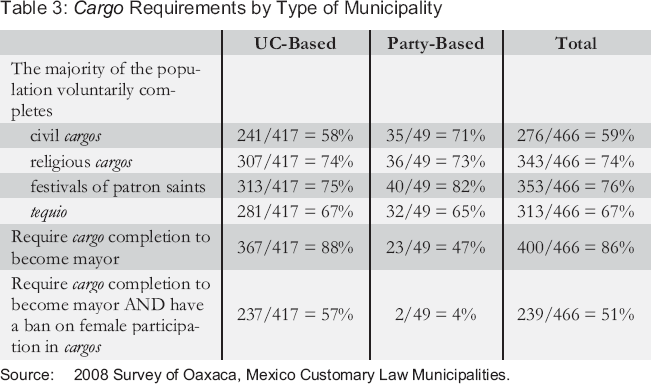
UC municipal systems are often associated with the cargo system, but they do not completely overlap. Yet, the presence of a cargo system is not exclusive to UC municipalities, and some UC municipalities do not require cargo service as a prerequisite for holding higher office. Cargo requirements exist in both UC and non-UC (party-based) municipalities. Table 3 shows the prevalence of cargo requirements in both UC and party-system municipalities. The rate of fulfillment of cargo-related activities is similar in both UC and party-based municipalities. This is true for such cargos as political volunteer positions, religious cargos, and tequio (voluntary labor on community service projects). Although both types of political system have a similar rate of cargo requirements for political advancement, there is a divergence when it comes to mandating whether fulfillment of cargos is a precondition for higher political office. Fewer than half of all party-based municipalities (47 percent) require cargo completion before citizens are eligible to run for mayor; in comparison, 88 percent of all UC municipalities require cargos as a prerequisite for higher office.
Cargo Requirements by Type of Municipality
Source: 2008 Survey of Oaxaca, Mexico Customary Law Municipalities.
When disaggregating this data further, we found a strong nexus between cargos and the exclusion of women from electoral politics. Of the 367 UC municipalities in our sample with a cargo requirement to be mayor, 237 also ban women from serving in cargos (57 percent of all UC municipalities). Of the 23 party-based municipalities that have a cargo requirement to be mayor, 2 also ban women from serving in cargos (4 percent of all party-based municipalities). The correlation between UC and the “pipeline” barrier thus becomes apparent. To account for this relation, we operationalized a variable with which to measure the interaction between the UC and the candidate pipeline dummy variables. This interaction variable is equal to 1 if the municipality has a UC-based system and it has a cargo requirement for obtaining office, and 0 otherwise.
Modeling Women's Representation in Oaxaca Municipalities
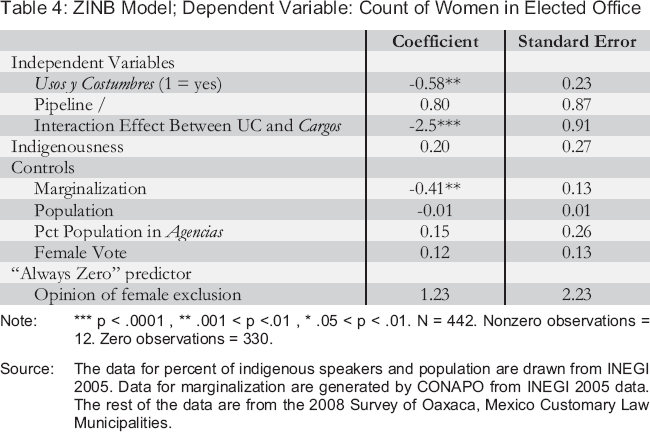
To test these hypotheses, we ran a zero-inflated negative binomial (ZINB) model. Women's representation was operationalized as the number of women in elected posts in each municipality. These data assume a Poisson distribution. However, Poisson models often fail to account for over or under dispersion in the dependent variable, and as a consequence, produce inefficient estimates. We used the ZINB model to account for this incorrect dispersion. To test whether this was necessary, we conducted a Vuong test, which suggested that a ZINB model was superior to a Poisson in this case.
We used a ZINB to account for the fact that two processes could account for a value of zero in the dependent variable. That is, an observation that no women held elected office can mean one of two things: (1) women ran unsuccessfully or (2) women did not run due to exclusion or other reasons. The ZINB model controls for the excess of zeros and alternative processes at work by separating the regression into positives, “sometimes zero” values, and “always zero” values. We ran a count model for the former and a binary logit predicting membership in the “always zero” for the latter. Table 4 shows the output of the ZINB regression. Note that the “always zero” group – those municipalities where women do not run for office – was separated and run independently.
ZINB Model; Dependent Variable: Count of Women in Elected Office
Note:
p < .0001,
.001 < p <.01,
.05 < p < .01. N = 442. Nonzero observations = 12. Zero observations = 330.
Source: The data for percent of indigenous speakers and population are drawn from INEGI 2005. Data for marginalization are generated by CONAPO from INEGI 2005 data. The rest of the data are from the 2008 Survey of Oaxaca, Mexico Customary Law Municipalities.
The second model is the “always zero” predictor. This is the factor that predicts zeros that occur due to a different process. This variable was measured by asking respondents whether a woman could become a mayor. With this effect isolated, we look at the first model without having excessive zeros bias the results. The results of the model are in Table 4.
This model also includes four control variables. The first is based on an index compiled by Mexico's National Council on Population (CONAPO, Consejo Nacional de Población) in 2005 and uses decennial census data and indicates the degree of economic marginalization in each municipality. Index values range from 3.14 (highest level of marginalization) to −1.87 (lowest level of marginalization). This variable was highly significant, suggesting that far fewer women took office in poorer municipalities; this is consistent with arguments that women are more likely to acquire politically relevant resources at higher levels of development (see Matland 1998).
The second control variable was population, which accounted for any effect that being from larger communities may have on women's representation. This variable was not significant in the model. The third control variable was percent of municipal population in outlying hamlets (agencias). This variable was included because municipalities that have a large population living in the outlying municipal hamlets, as opposed to the population center or “municipal seat,” are less likely to have female participation in political processes. However, this variable was not significant in the model.
The fourth control variable (binary) included in the model was whether women can vote in elections. This is presumed to affect female representation in local office in two possible ways: First, it can pose a mental barrier – a woman not allowed to vote, will be less likely to attempt to obtain that post. Second, it can create a practical barrier – women might tend to vote for women, and men for men. This variable was not significant in the model.
Overall, the ethnic identity hypothesis is not supported by our results. When holding UC, the cargo system, and other variables constant, municipalities with higher concentrations of indigenous-language speakers were no less likely to have female representation. Our analysis corroborates the second hypothesis, that UC municipalities are more discriminatory independent of ethnicity, the cargo system and other cultural factors – possibly due to the manipulation of elections and governance by strongmen that this system facilitates. This hypothesis suggests that the UC processes by which people are elected to office obstruct the election of women. Our model confirms the vast literature on UC systems and the barriers they pose to individual rights. However, the substantive impact of this relationship is small.
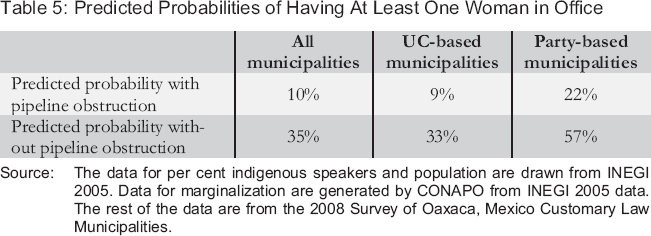
By contrast, the candidate supply hypothesis argues that cargo systems, which sometimes inhibit women's participation at lower levels, substantially block their pathways to higher political office. This hypothesis was significant and the coefficients were large. The interaction between UC and cargos is the single best predictor of female participation in political office in the model. This suggests, logically, that a UC system that bans women from serving in cargos is more of a deterrent to running for office than a UC system that allows women to serve in cargos. Indeed, the predicted probability of having at least one woman in office 12 is 10 percent for municipalities with gender barriers present in the cargo system and 35 percent for municipalities without this informal institution blocking the supply of potential women candidates. The predicted probabilities of having at least one woman in office change when we separate the data by UC or party-based municipalities. Table 5 below summarizes the results.
Predicted Probabilities of Having At Least One Woman in Office
Source: The data for per cent indigenous speakers and population are drawn from INEGI 2005. Data for marginalization are generated by CONAPO from INEGI 2005 data. The rest of the data are from the 2008 Survey of Oaxaca, Mexico Customary Law Municipalities.
This test was completed by running the exact same model as above except with the count data made into binary data equal to 1 if there is at least one woman in office, 0 otherwise.
The implication is that claims of inherent UC-system discrimination against women need to be tempered to account for these informal institutional factors (i.e., the exclusion of women from cargos), which are much more of an impediment to women seeking office.
The data show that the predicted probability of having at least one woman in office is greatly affected by mandating cargo prerequisites and excluding woman from that process. The predicted probability of one woman serving in political office increases by 24 percent (for UC municipalities) and 35 percent (for party-based municipalities) when cargo requirements are lifted or women are allowed to serve in these stepping-stone positions.
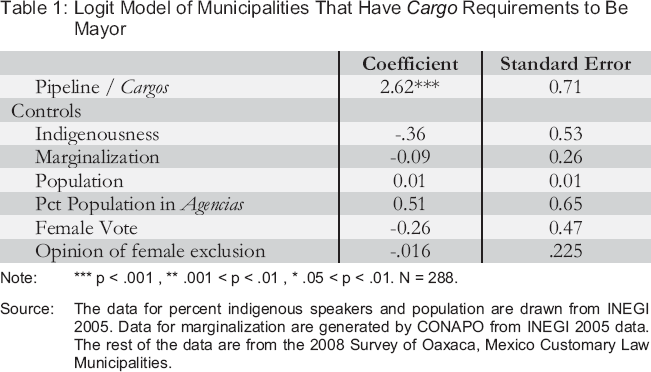
In order to sort out whether the cargo requirement or the female exclusion from cargos was more of a barrier, we narrowed the case set to only those that always had a cargo requirement. We ran an additional ZINB model for only these municipalities that had a cargo requirement (N=288). For these cases, we tested whether female inclusion in cargos impacted female participation in elected offices. Of these 288 municipalities that require cargo service to be mayor, 171 do not permit women to serve in cargos (59 percent) and 117 do permit women to serve in cargos (41 percent). Not surprisingly, we found that when women were permitted to serve in cargos, this system of service actually helps them obtain higher office (p≤0.01). The model is presented in Appendix A. Our findings were extremely robust. The model further shows that, with other variables held at their means, when municipalities transition from banning women from cargos to including women in cargos, the predicted probability of at least one woman occupying an additional elected office increases by 36 percent, meaning that when women are allowed to enter the candidate pipeline through cargo service, the probability of electing at least one woman increases by 36 percent.
Female Exclusion in Practice
Even though 68 percent of municipal authorities surveyed in our 2008 and 2010 Survey of Oaxaca, Mexico Municipal Governments said they would, in the abstract, be in favor of a woman governing in their community (56 percent in UC communities and 70 percent in non-UC communities), the reality is much different. 13 Women's participation in elected government in Oaxaca's municipalities is extremely low. According to Zafra (2009), 5 women were elected mayor from all 418 UC municipalities in the 2001 elections (10 women were elected mayor from all of Oaxaca's 570 municipalities statewide), and only 1 of the UC female mayors finished her term (Zafra 2009: 66–67). In 2004, only one woman was elected mayor via UC (eight female mayors were elected statewide) (Zafra 2009: 68). In 2007, 3 female mayors were elected via UC, and 14 were elected overall (Zafra 2009: 70). Zafra argues that UC elections are rife with interest-group politics, and that these groups can be even more tactically and personally aggressive toward women candidates:
This data comes from a 2002–2003 survey conducted by one of the authors.
The obstacles faced by women are legal, cultural, and relating to communal organization. […] The lack of normative figures [laws] to assure and defend women's participation causes electoral institutions to do very little […]. Furthermore, they [women candidates] face fierce opposition from interest groups, which, to avoid losing control, will use any means necessary to impede access by women to political competition and winning seats, especially local ones (2009: 63–64).
In other words, communal harmony tends not to exist, at least in municipalities where women are perceived to threaten the male-dominated status quo.
According to Vázquez García's (2011) study of the 18 UC female mayors from 1999–2010, cronyism to protect incumbent elites was commonplace, and UC justified local bosses’ authoritarian impositions of mayors (often with state government accomplices) through of the notion of “ancestral traditions.” Our statistical analysis suggests that the real obstacle to the election of women candidates is the combination of the malleable and politicized rules of UC with the immobile and longstanding rigidity of cargo system discrimination. As stated by Vázquez García (2011: 261), sexist caciques, who are often affiliated with parties, exploit existing rules to deny women access to power. Women participate in cargos through their husbands (Vázquez García 2011: 49–50), but only rarely as individuals themselves (unless they are single, widowed, or their husbands have migrated permanently and left them in charge). Former UC mayor, López García (interview 2011), had the following to say:
Cargos are a school for leadership which women should also participate in […]. Our problem is that we [women] only want harmony between our spheres, the household and the community. We are often denied participation.
Some women leaders told Vázquez García (2011: 90) that when they are allowed to participate, it is only to serve on domestically oriented cargo committees (health and education).
Empirical evidence shows that women are routinely excluded from obtaining office. Through cargo requirements in UC communities, women are denied roles in the higher echelons of local governance, which is perhaps the single best path into national politics. With no history of participation at the early stages and at the lower levels, women cannot be part of the candidate pool later on. While women constitute less than 1 percent of the mayors in UC communities and slightly more than 1 percent in non-UC communities, they face overt discrimination by incumbent mayors (measured as a negative response to the question of whether a woman could ever be mayor) in only 24 percent of Oaxaca's 466 municipalities surveyed.
Conclusions: Balancing Customs, Human Rights, and Autonomy
Women have enjoyed noteworthy, yet still insufficient, progress toward more equitable representation in national legislatures and governments throughout the developed and developing worlds (Paxton, Hughes, and Green 2006). A vast body of research has worked to tease out the relative importance of institutional, political, sociocultural and ideological factors that explain national-level variation in women's representation. Considerably less work has focused on the subnational level. Even less systematic research has considered the relative importance of culture and subnational institutions in indigenous communities in Latin America. Many studies grant much consideration to autonomy of groups as the ability to make their own governance decisions. However, as evidenced in Mexico's UC communities, little attention has been paid to how autonomy laws should be implemented operationally in order to reconcile and balance collective and individual rights and how these processes impact women's representation. 14 That is, what collective citizenship rights should a multinational state cede to regional groups when granting them autonomy? What price is unacceptable to pay for this redistribution of rights, especially in terms of the political rights of women?
In Bolivia, for example, none of the country's 300-plus municipalities had, in mid-2012, adopted the innovative local indigenous autonomy structures legalized in the 2008 Constitution with great fanfare.
Over the past two decades, scholars, activists and the public have paid a great deal of attention to multicultural reforms in Oaxaca and beyond (e.g., contemporary Bolivia, Colombia, and Ecuador). Texts on the impact of the 2001 constitutional reforms on indigenous rights in Mexico (Rabasa Gamboa 2002; Bailón Corres 2003) trace genealogies of the latest reforms, but do not mention any concrete cases whatsoever. Indeed, hundreds of cases of indigenous rights have reached Mexico's Federal Electoral Court, but none (at least not to the knowledge of a half dozen experts queried) 15 directly addresses the rights of women to participate in the political system free from discrimination – the denial of which, as this paper has conclusively shown, severely restricts their opportunities for election to higher office.
Author meeting on 5 June 2012 with officials from Electoral Court of the Judicial Power of the Federation (TEPJF), Mexico City.
Colombia's Constitutional Court is usually said to have compiled perhaps the most extensive corpus of rulings and doctrinal consistency in the Western Hemisphere on the rights of indigenous peoples. Straddling the line between individual and communitarian rights, this court “has developed a jurisprudence that seeks to maximize the autonomy of indigenous communities and to respect their ways of doing justice without embracing an unconditional cultural relativism” (Assies n.d.: 11).
Its decisions have often been controversial, such as the 1997 case T-523 in which it upheld an indigenous consultative verdict finding the political enemy of a murder victim guilty for instigating the murder at the hands of guerrillas (by denouncing the deceased to guerrillas as a paramilitary fighter shortly before he was slain). The perpetrator was sentenced to 60 lashes, expulsion from the Northern Cauca community where he resided and committed the offense, and the loss of all political rights there (Assies n.d.: 7). This decision was roundly condemned by human rights groups but consistent – after a finding that whipping and expulsion did not constitute torture – with the doctrine that judges should be guided by cultural relativism and, based on extensive anthropological research, take into account as much as possible the social context and meaning of the sanctions.
The Colombian Constitutional Court has elsewhere (perhaps most famously in its 1998 decision U-510) further specified (a) that conflicts are inevitable between the sphere of individual liberties and collective rights and (b) that indigenous communities are to be treated as unique and diverse multiethnic communities, though this said diversity is limited by the rights delineated in the Constitution (Sánchez Botero 2010a: 300–307). More broadly, Sánchez Botero (2010b) summarized the court's position as accepting three universally sacrosanct individual rights: (1) the right to life, (2) the right to preserve the integrity of one's body, and (3) the right to due process (however codified in a given cultural context).
The Colombian Constitutional Court standard, widely heralded among indigenous rights advocates, seems to allow violations such as the prohibition of the women's vote in Oaxaca. Furthermore, it seems to deny many external protections of minority groups and individuals, as per those mentioned in Kymlicka's (1995) effort to develop a theory of multicultural rights but which parts from the assumption of strong individual rights. Here too, it seems that gender rights and indigenous rights may clash, and that more attention should be paid to human rights issues, such as access to candidacies. In Ecuador and Peru, a recent analysis also found that even where customary laws are strong, indigenous women use them as petitioners less often than men and are “charged” with crimes more frequently than men (Brandt and Franco Valdivia 2008: 215).
Customary law in not only in Colombia and Mexico but also around the world is cast as a multicultural right by religious and ethnic minorities. However, the reality is far less simple than Oaxaca's de facto customary law practitioners or Colombia's de jure codifiers of cultural relativism have allowed. If access to the cargos is necessary in order to enhance one's public images and gain political exposure and professional experience, should women's access to such positions not be a guaranteed right? Perhaps, as even some staunch UC advocates have started to acknowledge, if discrimination against women is the “Achilles heel” of UC, then women's citizenship rights – including the right to run for office – should be enforced in municipalities with cargo systems.
However, a complication with such a proposal emerges when we consider that a common feature of UC elections is that there are no official candidates and no campaigns. Though the specific rules vary across the state, it is common for “candidates” to be nominated on the day of the election and voted on by a show of hands in the general community assembly. The apolitical purity of this process is often an illusion, as there are frequently shadow campaigns in which different political groups circulate names of candidates and sometimes even print out and circulate lists of a ticket. The fact that official, out-in-the-open campaigns are traditionally frowned upon in UC systems makes it quite tricky to require communities to allow women to run since it is often the case that nobody is supposed to run.
The apparently innocuous exclusion of women from serving in what some describe as quaint folkloric positions actually has a profound impact on their abilities to be heard, express citizenship, and lead their people. However, this too is not simple to address as it might seem. Women (and many men) often view lower-level, stepping-stone cargos as burdensome extra work that takes time away from raising families, taking care of homes and crops, and engaging in remunerated labor.
Whatever the case, our data have shown that the cargo system in Oaxaca is not incompatible with women's representation rights. In fact, the cargos can aid women's ascent to political office. However, when women are excluded from entering these cargos, it has a decisively negative impact on their political careers later in life. This fundamental problem was flagged by interviewees like Juanita López García (interview 2011), who stated that the “authorities often deny women participation in cargos.” Still, the fact that women – and men – have started to discuss this publicly 16 may be cause for optimism regarding the radical changes taking shape in gender relations and political participation in indigenous Mexico and beyond.
Author participant observation at the “First Statewide Encounter of Indigenous Women of Oaxaca,” 26 September 2011, Oaxaca City, Oaxaca (sponsored by the state government's Secretariat of Indigenous Affairs).
Footnotes
Appendix A
Logit Model of Municipalities That Have Cargo Requirements to Be Mayor
| Coefficient | Standard Error | |
|---|---|---|
| Pipeline / Cargos | 2.62 *** | 0.71 |
| Controls | ||
| Indigenousness | -.36 | 0.53 |
| Marginalization | -0.09 | 0.26 |
| Population | 0.01 | 0.01 |
| Pct Population in Agencias | 0.51 | 0.65 |
| Female Vote | -0.26 | 0.47 |
| Opinion of female exclusion | -.016 | .225 |
Note:
p < .001,
**.001 < p < .01,
* .05 < p < .01. N = 288.
Source: The data for percent indigenous speakers and population are drawn from INEGI 2005. Data for marginalization are generated by CONAPO from INEGI 2005 data. The rest of the data are from the 2008 Survey of Oaxaca, Mexico Customary Law Municipalities.