



Abstract
This paper examines committee behavior in Colombia to determine whether parties or coalitions exert agenda-setting powers despite the fact that the formal rules seemingly create little incentive for cooperation. Colombia's party system is extremely fragmented, electoral volatility is high, and there is a long history of candidate-centered electoral rules, all of which suggests that party and coalition leaders have few tools to control the legislative agenda. Additionally, chairs do not directly control committee reports as in other presidential cases. However, the naming of ponentes (rapporteurs) to write ponencias (bill reports) for the committee may give leaders the opportunity to set the agendas in committees. Hence, we test whether committee chairs strategically name ponentes to control the agenda and favor their partisan or coalition interests. We test these ideas using a unique dataset covering two complete legislative sessions and thousands of bills. Overall, we find that committee chairs use the ponente process to set the agenda and privilege legislation sponsored by allies, especially the executive.
Introduction
Colombia has a long list of political problems, including a long-running civil war, economic volatility, and drug violence. Many observers have blamed Colombia's problems on its weak party system, which historically makes it difficult to address national issues (Archer and Shugart 1997; Crisp and Ingall 2002; Pachón 2002). The collapse of the traditional two-party system in the 1990s, the extreme proliferation of parties in a new multiparty system, electoral reforms, and the election of a president without a party all seem likely to exacerbate the system's inability to “get stuff done” (Shugart, Fajardo, and Moreno 2006; Botero 2007; Posada-Carbó 2011). In short, Colombian parties lack the coherence and stability needed to effectively make policy (Eichorst and Polga-Hecimovich 2015).
The present paper argues that researchers should not ask if parties or coalitions matter in fragmented, decentralized systems like Colombia, but should ask when parties and coalitions affect policy-making, and how different rules may affect the delegation process within party and coalition ranks. Hundreds of bills are sent to committees every year. Given the workload, busy legislatures have developed rules to effectively allocate time in order to increase the legislature's chances of becoming relevant and represent the public interest (Cox and McCubbins 2011; Čopič and Katz 2014). As a result, committee chairs in some cases, and committee majorities in other cases, must decide how to prioritize certain bills over others. This iterated game provides opportunities for parties and coalition leaders to use their powers to influence the legislative agenda.
This paper augments traditional analysis of Latin American legislatures by examining the policymaking process in Colombia's legislative committees, rather than on the floor of the legislature. Similar to the cases of Perú and Costa Rica, committees in Colombia constitute the first stage of bill approval and can prevent bills from ever getting to the floor (Alcántara, Garcia, and Sánchez 2005). This contrasts with the situation of most legislatures in the region, in which committees only advise the floor with positive or negative reports (or can send multiple reports if there is no clear majority). 1
In the most extreme cases, the executive branch can even bypass the committee system completely (Pereira and Mueller 2004).
We argue that by examining the role of committees as agenda setters we can determine the circumstances in which parties and coalitions actively promote or inhibit bill passage, by looking at committee chairs and their decisions to delegate bill reports to different committee members. Unlike other cases, in which committee chairs are directly responsible for the bill report to the floor majority, committee chairs in Colombia can delegate the bill report to any member of the committee, regardless of that member's party/coalition affiliation. Given this rule and the characteristics of the party system, we argue that bill characteristics and the type of committee play a strong role in determining when parties and coalitions work to set the agenda as the traditional literature on legislatures posits (Aldrich and Rohde 1997, 2001; Cox and McCubbins 2002, 2005, 2011). In the same way, these characteristics also determine when parties and coalitions – and committee chairs as their delegates – allow their members to act as political free agents (Krehbiel 1993, 1998).
The remainder of this paper is structured as follows. First, we examine the role of parties as agenda setters. Drawing on the extant literature, we outline the supposed weaknesses of agenda-setting power in Latin American parties in general, and Colombian parties in particular. We also explore the factors that may counteract these supposed weaknesses and hypothesize that these factors will influence leaders’ agenda-setting powers within Colombia's legislative committees. We focus specifically on the naming of ponentes (bill presenters) and the writing of ponencias (bill reports) in shaping the legislative agenda. Second, we outline the unique dataset we have compiled, along with the variables and statistical tools we have used to analyze the assignment of ponentes and the writing of ponencias. The third section discusses the statistical results and their implications for the agenda-setting power of parties and coalitions in the Colombian legislature. The final section reiterates our main contribution to the Latin American literature on parties and coalitions, and discusses possible avenues for future research.
The Agenda-Setting Role of Committees
Parties-in-government are seen as procedural coalitions in which members delegate authority to party leaders in order to set the legislative agenda (Aldrich 1995). 2 In turn, leaders use their control over the legislative calendar and the internal rules of the legislature to determine which policies receive the legislature's most precious commodity – time (Al-drich and Rhode 1997, 2000, 2001; Finocchiaro and Rhode 2008). Leaders can use their power to actively promote legislation that improves the party's reputation, or to block legislation that threatens the party's reputation (Cox and McCubbins 1993, 2005, 2011; Kloha 2006; Young and Hetshusen 2003). The former is referred to as positive agenda control, while the latter is termed negative agenda control, or gatekeeping. For example, Chile's Concertacion majority coalition shaped important policy outcomes, using its power to set the legislative agenda (Londregan 2000, 2002). Similarly, presidents can use their agenda-setting powers to influence key policy outcomes (Pereira and Mueller 2004; Alemán 2006; Tsebelis and Alemán 2005). Thus, parties and coalitions help determine what legislation becomes law.
In this section we assume the logic of parties as procedural coalitions also applies to coalitions that include multiply parties, where the homogeneity or heterogeneity of the party or coalition influences the capacity of leaders to control the agenda (Krehbiel 1993, 1998).
While much of the literature on agenda setting has examined actions on the floor of the legislature, scholars are increasingly examining the role of committees in advancing or blocking legislation. Some recent examples are Calvo and Sagarzazu (2011) and Calvo and Chasquetti (2016), who demonstrated that the loss of majority control in Argentine and Uruguayan committees moves legislative outcomes away from the majority's median preferences. Similarly, Jones and Hwang (2005) showed that the majority party is never “rolled” in Argentina's powerful Budget Committee. However, research into the role of committees in agenda setting in Latin American committees is still in its infancy.
We believe that a major reason why the agenda-setting role of committees has been under-studied in Latin America is the prevailing wisdom regarding political parties and party systems. In the heavily researched US Congress, scholars have focused on intra- and inter-party ideological homogeneity/heterogeneity (Krehbeil 1993, 1998) because problems such as a highly fragmented party system and extreme electoral volatility simply do not exist. As noted above, these models work fairly well in Argentina or other settings in which the plenary has the final say, or where the polarized party system mirrors aspects of the US system (Saiegh 2009). However, parties in other parts of Latin America often demonstrate extreme ideological heterogeneity, with members’ ideologies overlapping considerably with those of other parties’ members (Wiesehomeier and Benoit 2008; Saiegh 2009). Similarly, party systems often suffer from high levels of fragmentation (Pereira and Mejia-Acosta 2010; Mainwaring 1993; Mainwaring and Pérez-Liñán 2005) and extreme volatility (Alcántara 2012; Roberts and Wibbels 1999). This wicked combination undermines incentives to build strong party reputations, since parties are ideologically indistinct and may cease to exist in the next one or two elections. Consequently, parties in many Latin American systems seemingly fail to meet the conditions necessary to be used to control the legislative agenda.
Perhaps no country better epitomizes this combination than Colombia. Colombia's history of candidate-centered electoral rules has undermined attempts to build parties focused on national goals, leading instead to ideologically heterogeneous parties and legislators prioritizing distributive pork-barrel projects (Archer and Shugart 1997; Crisp and Ingall 2002; Pachón 2002; Pachón and Shugart 2010; Saiegh 2009). Additionally, despite recent reforms, the party system remains fragmented, with an effective number of parties above 7 in both legislative chambers (Pachón and Hoskin 2011; Albarracín and Milanese 2012). Finally, Colombia's recent electoral volatility averaged 51.3 percent in legislative elections and 31.6 percent in presidential elections (Alcántara 2012). In such a system, the long-term benefits of building a party's reputation by delegating authority to party leaders in committees seem doubtful.
Nevertheless, recent research has shown that battles for membership and leadership positions on committees in Latin America are quite intense (Crisp et al. 2004; Heath, Schwindt-Bayer, and Taylor-Robinson 2005). 3 This is also true in Colombia, where members seeking seats on coveted “power committees” 4 must win elections held on the floor of the chamber on the first day of the legislative term, while each committee holds annual elections to select a Presidente de la Mesa Directiva, or committee chair (Cárdenas, Junguito, and Pachón 2007). 5 Both processes require significant coordination within parties and coalitions to balance out legislator's individual and collective interests (Pachón 2002). Party leaders seek the best deals to guarantee the entrance of their legislators into the committee leadership and to ensure that their share of committee power is commensurate with their party's seat share. Although parties were extremely fragmented during the period under scrutiny, the role of President Alvaro Uribe and the resulting division of the legislature into pro-Uribe and anti-Uribe factions facilitated this coordination. As a result, the pro-government coalition was consistently overrepresented on the powerful First and Third Committees (see Appendix Table A1), thus providing prima facie evidence of coalition effects. Hence, battles for committee membership and leadership roles empower even weak party structures and their leaders, which in turn enhance the prospects for agenda setting in committees.
At first glance, the internal rules of the chamber seem to offer little solace for advocates of party or coalition-centered politics. No formal party leadership positions exist, while chamber and committee leadership positions last only one year (Pachón 2002).
The First and Third Committees issue 51 percent of ponencias, or bill reports, while we would expect the committee average to be only about 28 percent if the work were distributed equally across the committees (see Appendix Table A2).
Committee chairs are called “presidents”, as is the speaker of the chamber and the leader of the Senate, but the terms committee president (Presidente de la Mesa Directiva), chamber president, and Senate president are awkward and lend themselves to confusion with the head of the executive branch. Consequently, we use the term chair to refer to the head of the committee. Chairs serve one-year terms and cannot be reelected.
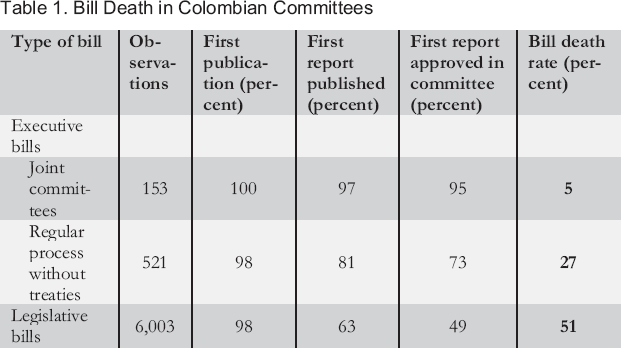
While battles for committee membership and leadership are key, three additional committee characteristics also encourage agenda setting in committee. First, Colombian committees have strong purview, meaning that the speaker cannot simply send a bill to a “friendly” committee controlled by a co-partisan (Finocchiaro and Johnson 2010). Furthermore, Colombia's rules do not allow for discharge petitions (Pachón 2002). Thus, while most other legislatures and parliaments around the world reserve the right to discharge legislation from committees, in Colombia the decision of the committee is final. 6 This combination of purview and gatekeeping has resulted in a large percentage of bills dying at the committee stage, with 27 percent of executive bills and 51 percent of legislator-initiated bills failing to make it through their committees (see Table 1). 7
Bill Death in Colombian Committees
Although there is a clause allowing the existence of an ad hoc committee to help the plenary decide whether to allow a rejected bill into another committee for its debate, this has not happened. Instead, authors of rejected bills usually introduce a new version of the bill, taking into consideration the issues raised in the first debate.
While the internal rules of the legislature are endogenous, the rules for committee membership are hard to change and have only changed marginally since 1992 (Ungar et al. 2008).
The third characteristic is perhaps the most important. After the speaker sends a bill to the appropriate committee, the committee chair assigns the bill to one or more ponentes, who act as the bill rapporteur(s). Committee chairs have complete discretion when assigning ponentes to write ponencias, or bill reports (Botero and Renno 2007; Pachón 2002). The chair may select only co-partisans, only coalition members, only members of the opposition, or any combination of these. Given that ponentes usually include one individual, or just a small subset of committee members, the chair has the power to over-represent allies and under-represent opponents, thereby controlling the agenda and helping shape the policy outcome (Londregan 2000, 2002; Pachón 2002).
Studies of the European Parliament (Kaeding 2015) and Brazil (Madereiros 2015) clearly demonstrate that rapporteurs/ponentes play a key role in determining policy outcomes since they draft the very reports that most legislators will use to inform their vote in committee. Furthermore, rapporteurs/ponentes have the first opportunity to propose amendments, which affects political negotiations. Hence, the naming of ponentes gives committee chairs the opportunity to influence policy-making.
Why might ponentes set the agenda in Colombia? First, ponentes are charged with writing a ponencia, or bill report, and each report suggests whether the committee should accept or reject the bill. Second, ponentes control the bill amendment process. There is an informal tradition that committee members do not vote on the original bill, but rather on the bill as amended by the ponente or ponentes. Third, if the bill reaches the conference committee stage, then ponentes are guaranteed representation when the two chambers attempt to hammer out differences in the legislation passed by each chamber (Alemán and Pachón 2008). Finally, ponentes can influence the timing of the debate and are present in most instances of negotiation. In extreme cases, ponentes simply fail to write a bill report and the committee never votes or reports the bill to the floor, even though ponentes are officially required to write a bill report (Alcántara, Garcia, and Sánchez 2005). In sum, a ponente has the power to act as a bill's champion, or as its gatekeeper, meaning committee leaders may use them to influence the agenda.
Why would legislators care about ponente assignments? The most obvious answer is that being assigned to serve as a ponente gives legislators leverage to shape executive and legislative proposals. Ponentes can add amendments that benefit key constituencies or protect constituents from harm. For example, Senator Ballesteros served as a ponente on a healthcare reform bill and received campaign contributions from a private healthcare provider (El Tiempo 2013). Similarly, ponentes can use their power to shape legislation in order to engage in both position-taking and credit-claiming (Mayhew 1974). Finally, legislators can use their ponente assignments to develop a reputation as a policy expert, or as a reformer. For example, Representative Juan Carlos Rivera Peña served as the ponente on a key tax reform bill and used his position to burnish his credentials as a defender of middle-class interests (La Tarde 2014).
For key legislation, ponentes should be especially careful to take the party's position into account, as well as the committee chair's perspective. Ponentes who routinely flout co-partisan or coalition committee chairs may lose ponente assignments in the future, be passed over for committee leadership positions, and be barred from “power committees” in future legislative sessions. In short, ponentes have the power to promote or retard the passage of legislation, legislators have incentives to use this power to enhance their careers, and chairs can exploit these incentives to set the agenda in committees.
Given the party system and electoral rules and the internal rules governing the legislature, we argue that the scope of the legislation influences the value of setting the agenda through the naming of ponentes and the writing of ponencias. Bills introduced by the executive branch tend to be relatively high-profile, which means that committee chairs have stronger incentives to assign a friendly ponente to these bills, and coalition party ponentes have strong incentives to write positive ponencias (see Finocchiaro and Johnson 2010). For example, President Uribe's government introduced a bill in February of 2005 to disarm and “reincorporate” members of the right-wing AUC (Autodefensas Unidas de Colombia), despite evidence that some members of the group had engaged in widespread human rights violations. The committee chair named a group of overwhelmingly pro-government ponentes and the bill earned a positive (and quick) ponencia. The bill went on to receive final congressional approval in June of the same year. Given the nature of executive legislation, the Uribe coalition, and the desire to control the agenda, we hypothesize that:
Committee chairs are more likely to name co-partisan and coalition ponentes to executive-initiated bills than to legislator-initiated bills.
Coalition ponentes are more likely to write positive ponencias for executive-initiated bills than for legislator-initiated bills.
While the executive seems to dominate the legislative process, legislators initiated the vast majority of the legislation introduced during Uribe's two terms (authors’ calculations). Furthermore, our most basic understanding of parties as procedural coalitions dictates that party and coalition leaders will use their powers to set the agenda in ways that benefit their members (Aldrich and Rohde 1997, 2000, 2001; Cox and McCubbins 2005; Finocchiaro and Rohde 2008). For example, Senator Fernando Eustacio Tamayo Tamayo of the Conservative Party introduced Bill 332/08 on 22 April 2008 and the bill was sent to the Third Committee. The senator sat on said committee and the committee's chair at the time was also a member of the Conservative Party. The chair appointed Senator Tamayo Tamayo to serve as the initial ponente. Not surprisingly, the senator issued a positive ponencia. Ultimately, the bill not only survived in committee, but went on to survive the entire legislative process and become law on 3 March 2009. Given the literature's expectations regarding parties and coalitions, we hypothesize that:
Committee chairs are more likely to name co-partisan and coalition ponentes to co-partisan or coalition-initiated bills than to opposition-initiated bills.
Coalition ponentes are more likely to write positive ponencias for coalition-initiated bills than for opposition-initiated bills.
The scope of the legislation includes not only the initiator, but also the content of the bill. As such, the content may also influence committee chairs’ incentives to strategically name ponentes in order to set the agenda (Cárdenas, Junguito, and Pachón 2007). Not all projects are created equal and constitutional amendments (Proyectos de Actos Legislativos) face a higher bar to passage than ordinary legislation (Archer and Shugart 1997). Consequently, committee chairs may assign ponentes from a range of parties in order to secure the votes necessary for amending the Colombian constitution. However, for these same reasons we are agnostic about whether parties and coalitions influence the likelihood of a positive ponencia. We hypothesize:
Committee chairs are less likely to name co-partisan and coalition ponentes to constitutional amendments than to regular legislation.
While constitutional amendments are often grand in scope, legislators also introduce a considerable number of bills each legislative session that direct government spending on particular locals (Cárdenas, Junguito, and Pachón 2007; Crisp and Ingall 2002). These pork-barrel bills offer opportunities for legislators to strengthen their connections with the constituents, or inside their electoral bailiwicks in the case of senators, and in some cases these bills are more likely to survive the committee process than more nationally oriented legislation (Finocchiaro and Johnson 2010). Given Colombia's electoral system, we expect that committee chairs will assign pork-barrel legislation to ponentes who will enhance the electoral prospects of co-partisan and coalition partners, while seeking to block any advantage their bills may offer opponents. The same logic holds for bill reports. Ponentes are more likely to write positive ponencias for co-partisan and coalition partners, while writing negative ponencias for members of the opposition. In short, we hypothesize that:
Committee chairs are more likely to name co-partisan and coalition ponentes to parochial or pork-barrel legislation.
Ponentes are more likely to write positive ponencias for coalition-initiated pork-barrel bills than for non-coalition-initiated pork-barrel bills.
While bill characteristics play a prominent role in our hypotheses, we also argue that committee type is likely to influence the naming of co-partisan and coalition members as ponentes, as well as the type of ponencias these ponentes write. Just as the parties and coalitions influence the composition of “power committees” (Cárdenas, Junguito, and Pachón 2007), chairs of these important committees have strong incentives to over-represent allies and under-represent opponents, giving their co-partisans an advantage over important legislation, the possibility of their bill getting presented by an “amicable” legislator. Similarly, these behaviors also suggest that coalition membership may matter given the polarization of the legislature into pro-Uribe and anti-Uribe camps. Furthermore, the importance of power committees suggests that ponentes on power committees are more likely to use negative ponencias to kill bills sponsored by the opposition. In short, parties and coalitions exercise agenda control when the stakes are high, and the stakes are higher on power committees. Consequently, we hypothesize that:
Committee chairs are more likely to name co-partisan and coalition ponentes when bills are assigned to power committees than when they are assigned to weaker committees.
Ponentes on power committees are more likely to write positive ponencias when coalition members sponsor bills.
In sum, our hypotheses focus on the potential effects of bill characteristics and committee characteristics in the naming of ponentes and the writing of ponencias. In the following section we will outline our original dataset, the variables we use, and the methods used to test our hypotheses.
Data and Methods
This analysis uses data from the Colombian Chamber of Representatives and Senate during two legislative sessions. The first session began 20 July 2002 and lasted until 20 June 2006, while the second began 20 July 2006 and lasted until 20 June 2010. The two legislative sessions coincide with President Uribe's first and second terms, and also with the change in the electoral system. Our data set contains all initiatives that were introduced in the Chamber of Representatives and the Senate for both sessions and was constructed using Congreso Visible (Visible Congress). 8 For the first part of our analysis, ponente assignment, the unit of observation is a committee chair-ponente dyad for each bill introduced and assigned to the committee. Thus, a bill may appear only once or could appear multiple times, depending on the number of ponentes assigned by the committee chair. Each observation has information about (1) the party and coalition membership 9 of the ponente, (2) the district where the ponente was elected, (3) a classification of the bill's targeting, (4) the bill's author(s) and his/her party and coalition affiliation, and (5) the committee to which the bill was sent. 10 Each observation includes the party and coalition information of the committee chair's party. For the second part of our analysis – type of ponencia – the unit of observation is the ponencia, or bill report, one per bill. Here, our interest was in testing whether the combination of certain characteristics – such as naming one or more ponentes from the same party or coalition – would result in a positive report.
Congreso Visible (www.congresovisible.org>) is a Colombian online congressional archive housed at the Universidad de los Andes that is designed to give Colombian citizens and scholars of Colombian politics (1) a comprehensive record of all members of congress and all political parties active in the legislature; (2) details of all bills initiated and all laws passed; and (3) electoral and legislative reports, among other information.
Pro-Uribe and endorsed parties included de la U, Cambio Radical, ALAS, Colombia Democrática, and the Conservatives. Pro-Uribe, but not official endorsed parties included Convergencia Ciudadana, Movimiento de Integración Regional, and Colombia Viva. The opposition was composed of the Liberal Party, the POLO, and indigenous parties. Shugart (2006) did not classify a number of one or two-seat parties such as Nacional Progresista, Movimiento Nacional, Salvación Nacional, and Huila Nuevo Liberalismo. We relied on the parties’ websites and news accounts to determine whether these parties were pro-Uribe or were members of the opposition.
We also include collected information on the following: (1) any actions taken on the bill, (2) any actions taken in the committee or on the floor, and (3) and the bill's final status (law, in committee, archived, or retired).
In order to test whether co-partisanship or coalition membership influence the assignment of ponentes by the committee chair, we created two simple dummy variables. The first dependent variable simply measures whether the ponente and the committee chair were from the same party. The second dependent variable measures whether the ponente and the committee chair were from the same coalition. 11 For example, Tarquino Pacheco Camargo of the Cambio Radical (Radical Change) chaired the First Committee and his party was also a member of the governing coalition. 12 Overall, approximately 17 percent of the bills had a majority of ponentes from the committee chair's party, while roughly two-thirds had a majority of ponentes from the same coalition as the committee chair.
Our measure includes parties that were members of the pre-electoral coalition.
In a separate analysis (not shown) we used a dependent variable for whether the ponente and the committee chair were from the same district. We did not find strong geographically oriented effects.
We created another simply dummy variable to test whether coalition membership influences the type of ponencia reported to the committee. At this stage, our unit of analysis is the bill and we measure whether the report was positive (scored a “one” in this case) or negative. Nearly 85 percent of bills had positive ponencias. 13 We limit our analysis of the reports to the ponencias del primer debate, or reports at the first stage of debate, as selection effects may play a role at subsequent stages of debate. Jointly, these dependent variables enable us to test whether committee chairs strategically assign ponentes and whether these ponentes influence the type of ponencias presented to the committee for debate.
Additional analysis (not presented) used a dependent variable that distinguished between ponencias that were “positive” versus ponencias that were “positive with modifications”, as 63 percent of the positive ponencias were issued with modifications. The model showed no substantive difference between the two types of ponencias and was therefore omitted. The model is available on request.
The independent variables focus on bill and committee characteristics. Bill characteristics include a series of dummy variables for bill sponsor and type of legislation. First, we include dummy variables for whether the bill was initiated by the Uribe administration, by a member of the committee chair's party, or by a member of the governing coalition. Recall that we expect committee chairs to guide these bills to friendly co-partisan or coalition ponentes. Second, we measure whether the bill was a constitutional amendment or whether it was parochially focused. The former includes all proyectos de acto legislativos, while latter draws on Taylor-Robinson and Diaz's (1999) widely used measure of the scope of legislation to classify pork-barrel legislation. We examined whether a bill was focused on providing a targeted benefit to a particular municipality or department. 14 Colombian legislators routinely introduce bills that build civic works or monuments, or issue a tax stamp (or bond). Both types of bills provide “pork” for a geographically defined area, hence our coding scheme.
Colombia's provinces are called departments, which are subdivided into municipalities.
We follow the same conventions regarding the bill reporting stage in our analysis. We again include a dummy variable for whether the bill was initiated by the Uribe administration. However, because our unit of analysis is the bill report, we cannot include dummies for each combination of ponente/author. Instead we constructed a series of dummies determining whether: (1) the majority of the ponentes were members of the coalition in a government authored bill; (2) the majority of the ponentes were not members of the coalition in a government authored bill; (3) the majority of the ponentes and the author were not members of coalition; (4) the majority of the ponentes were not members of the coalition, but the author was; and (5) the majority of the ponentes were members of the coalition, but the author was not. Therefore, the omitted category is when the majority of ponentes and the author were members of the coalition since this is the most common category. Remember, we expect coalition ponentes will be more likely to issue positive ponencias when the bill was authored by coalition party members or by the government, whereas they will be more likely to issue negative ponencias when the bill is authored by legislators outside the governing coalition. Constitutional amendments and pork-barrel legislation are scored as noted in the previous paragraph.
To address committee characteristics, we include a dummy variable for whether the committee was assigned to a power committee (the First or Third Committees). This variable is scored identically for both models. As noted previously, membership on these coveted committees require extra votes, and these two committees actually produce a majority of each chambers’ legislation. Recall we predict that both committee chairs and ponentes will emphasize agenda-setting powers when bills are sent to these committees.
In addition to bill and committee characteristics, we include several control variables. The first is a dichotomous variable for whether the bill was being considered in the Senate. Similarly, we also include a dummy variable for 2002–2006 Congress. The third variable accounts for the number of ponentes (logged) assigned to a given bill. The more ponentes assigned to a bill, the less likely it is that any given ponente will be a co-partisan or coalition partner. Finally, we include a series of dummy variables for the year in the president's term, with the final year being the excluded category. Jointly, these variables address the perceived political polarization of Uribe's terms.
Given the dichotomous nature of our dependent variables, we use logistic regression with robust standard errors in both sets of models. Our models are structured as follows:
To test whether presidents choose members of their own party or coalition,
Chair-Ponentes Match
i
= β0 + β
1
*Author_characteristics
i
+ β
2
*
To test whether ponentes give a positive or negative report on their first debate,
Ponencia i = β0 + β 1 *Author-ponentes combination dummies i + β 2 *Committee_dummies i +β 3 *Election_cycle i + β 4 *Legislature 2006–2010 i + β 5 *Pork + β6*Treaties + e i
We also ran models with a number of alternative specifications and additional control variables, but we omitted these as they did not alter our statistical or substantive conclusions. 15
The alternative models included: (1) models that dropped bills that were assigned ponentes, but were never reported out of committee, (2) controls for where a bill was in the legislative process, (3) models that used whether the chair was from the same district or region as the initiator, and (4) an alternative measure of coalition that included parties that were not formally in the government coalition, but allied with the Uribe administration during the legislative sessions.
Results
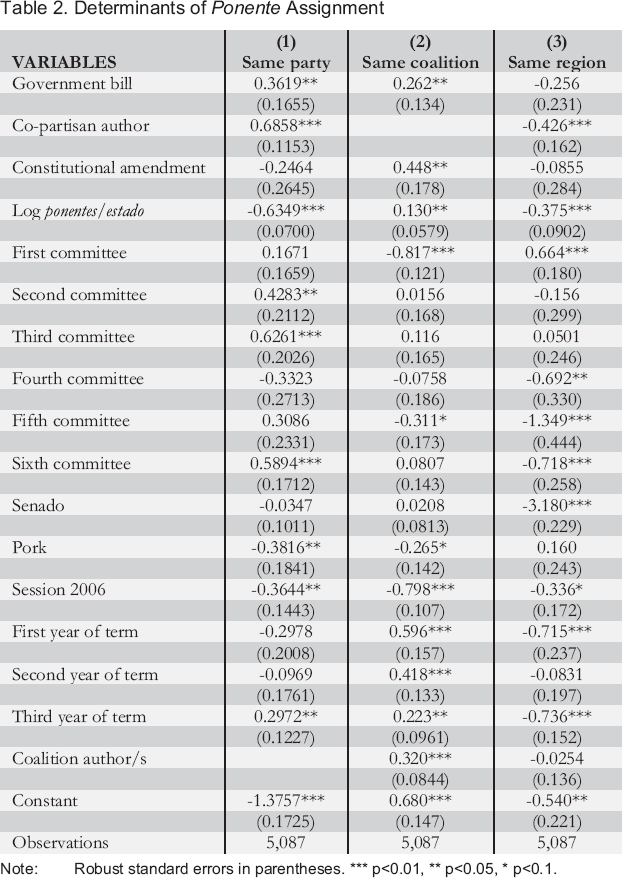
When, if ever, do committee chairs use party or coalition cues when assigning ponentes? We begin our analysis with an examination of the effects of bill characteristics by focusing on the author of the bill (see Table 2). Overall, we find that committee chairs are significantly more likely to assign bills authored by the executive to co-partisan and coalition ponentes. Similarly, our models indicate that when the bill's author is a co-partisan of the chair, the chair is more likely to send the bill to a co-partisan ponente. The example given in the theory section, regarding a Conservative Party chair assigning a Conservative Party senator to serve as the ponente of his own bill, is emblematic of a systematic relationship between committee chairs and their co-partisans. The same result holds in the case of coalition-authored legislation. Chairs are significantly more likely to assign these bills ponentes from the coalition. These results provide clear evidence that committee chairs use their agenda-setting powers when assigning ponentes to bills that originate from “one of their own”. This result provides clear support for H1a and H2a.
Determinants of Ponente Assignment
Note: Robust standard errors in parentheses.
p<0.01,
p<0.05,
p<0.1.
Turning from bill authorship to the type of bill, we find that constitutional amendments and pork-barrel legislation do influence how committee chairs assign ponentes, but not as we hypothesized. The negative coefficient for naming co-partisan ponentes matches our predictions, but the relationship is not statistically significant, whereas the positive and significant coefficient for naming coalition ponentes directly contradicts expectations. However, given the high bar needed for amending the constitution, this result may not be surprising to some observers of Colombian politics. Perhaps more surprisingly, given the literature's heavy emphasis on pork barreling in Colombian politics, we find that committee chairs are systematically less likely to name co-partisan or coalition ponentes to legislation designed to benefit a particular geographic local.
It may be that principles of universalism mean chairs do not assign pork-barrel legislation based on party or coalition cues, but allow all members to oversee their own pet projects.
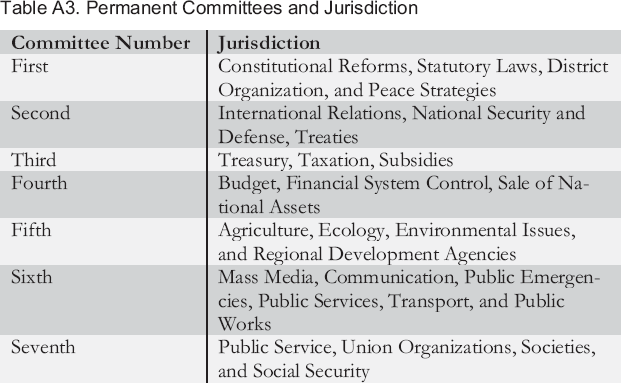
Our models regarding the effects of committee type on ponente assignment also provide mixed support for our hypotheses. On the one hand, the chairs of the Third Committee, which oversees finances, taxes, and subsidies, behave in a consistently partisan fashion. These chairs are far more likely to name a co-partisan to serve as a ponente than chairs on other committees. On the other hand, the chairs of the First Committee, which oversees constitutional reforms, statutory laws, district organization, and peace strategies, systematically under-represent coalition partners when assigning ponentes. It may be that while both committees are truly power committees, the nuts and bolts of governing that membership in the First Committee entails simply provides fewer incentives for committee chairs to behave in partisan or coalition ways – at least when compared to the Third Committee.
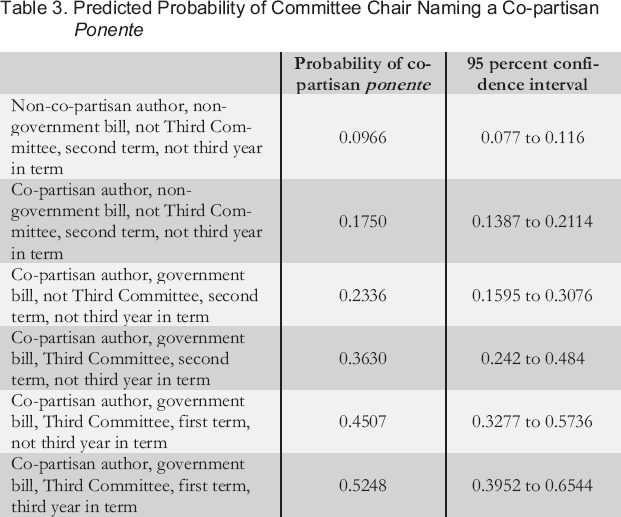
Overall, these models provide considerable evidence that committee chairs use partisan and coalition cues when assigning ponentes strategically, and that certain bill characteristics are fundamental when making this decision. This is largely consistent with the view that parties and coalitions are procedural coalitions. As such, they help set the agenda in an otherwise chaotic legislative process. To further illustrate these relationships, we calculated the change in predicted probability of naming a co-partisan ponente (see Table 3), or a coalition ponente (see Table 4), given distinct bill, committee, and control variable characteristics.
Predicted Probability of Committee Chair Naming a Co-partisan Ponente
Predicted Probability of Committee Chair Naming a Coalition Ponente
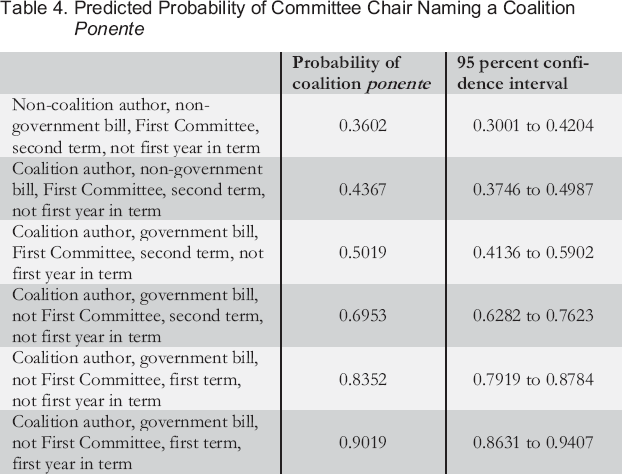
In both instances, party and coalition membership substantially increases the likelihood of serving as a ponente. In short, committee chairs systematically privilege members of their team.
Now we turn to the types of ponencias that ponentes write. Table 5 presents the marginal effects. The model shows the marginal effect comparing a positive and negative report. As expected, bills authored by the executive with a majority of ponentes by the coalition have the greatest positive marginal effect, which shows that these bills are “guarded” by the coalition members. It is also interesting to observe that bills authored by members of the coalition and that have non-coalition ponentes have a negative marginal effect, which suggests the intention to look for a negative report – contrary to the idea of protecting your co-partisans or coalition partners. Equally, bills authored by non-coalition members that are assigned coalition ponentes have a greater probability of getting a negative report. These results strongly support H1b and H2b and justify committee chairs’ naming coalition ponentes at the first stage in the agenda-setting process. In short, our analysis supports the notion that party and coalition membership shape the legislative process in ways that benefit their allies and hurt the opposition by controlling the agenda at the committee stage.
Determinants of the Type of Ponencia (Bill Report) (Average Marginal Effects)
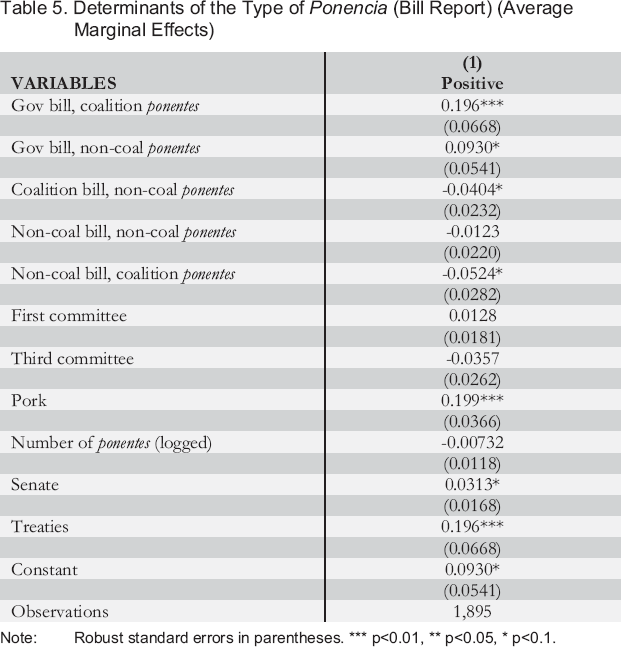
Note: Robust standard errors in parentheses.
p<0.01,
** p<0.05,
p<0.1.
As before, we used these results to calculate the predicted probability of a positive ponencia across a range of values on the key independent variables (see Table 6). After determining that almost all pork-barrel projects and international treaties receive positive ponencias, we divided the table with national legislation on the left and pork/treaties on the right. The congruence between the bill author's coalition and the composition of the ponentes plays absolutely no role for pork-barrel projects and treaties. Regardless of the coalition membership of author and ponente, these projects receive nearly universal support in the ponencia stage. However, we do find that the congruence between the bill's author and the ponentes greatly affects the probability of a positive ponencia for national legislation. When legislator-initiated bills are assigned unfriendly ponentes, these bills are far more likely to receive a negative ponencia.
Predicted Probability of a Positive Ponencia
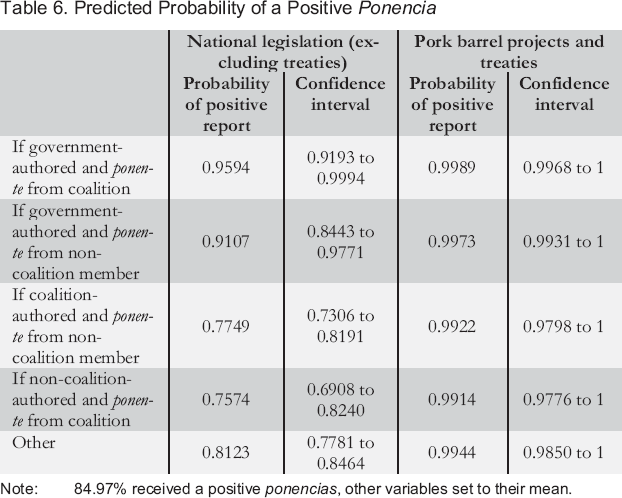
Note: 84.97% received a positive ponencias, other variables set to their mean.
Overall, our analysis indicates that committee leaders use their power to systematically favor co-partisans and coalition members when naming ponentes, or bill presenters. Furthermore, these ponentes are more likely to issue positive reports for bills written by their allies. In short, parties and coalitions can use the committee process to help set the agenda, despite Colombia's volatile, fragmented party system and electoral rules that discourage party-building.
Conclusions
The Latin American literature laments the weakness of the region's political parties. Party system fragmentation, electoral volatility, and ideological incoherence seem to exacerbate many of the region's problems. At the extreme, these problems are blamed for the poor quality of democracy in the region and even for democratic failure. In this paper we examine when, if ever, political leaders can overcome highly decentralized legislative processes and inherent weaknesses in a party system to help control the agenda. Our analysis focuses on Colombia, as its party system seems to suffer from all the frailties outlined in the extant literature.
Drawing on an original dataset we test whether committee chairs are able to counterbalance some of the limitations that party leaders face given the current internal rules of the Colombian committee system. We focus on the assignment of ponentes (bill presenters) by committee chairs, as well ponencias (bill reports), since both offer party and coalition leaders the opportunity to set the agenda before legislation can reach the plenary. We test when bill and committee characteristics influence these processes, and find that committee chairs use these processes to help control the agenda. Chairs assign friendly legislation to co-partisan or coalition partner ponentes, and these ponentes write positive ponencias for their friends. Chairs can use these same tools to block opposition legislation. In sum, the party begins when committee chairs strategically name ponentes and continues through the reporting stage.
Future work should aim to get at the “black box” of the amending process. Researchers should test whether ponentes use the process to substantially modify the original bill, or whether the amending process does not affect the initial intent of the authors. Further research is also need in order to understand (1) the role of parties and coalitions in the various stages of bill approval, (2) whether parties and coalitions influence negotiations within conference committees, and (3) the substantive result in the policy-making process at the committee stage.
Additionally, more work must be done to examine the potential agenda-setting powers of committees and their leaders across presidential systems. Distinct party systems and internal legislative rules offer wildly varied environments to test the agenda-setting powers of legislative committees. Our work simply represents an important step in a promising, yet understudied topic. In short, further exploration of these committee processes in Colombia and elsewhere allows us to determine whether reformers can achieve their goals of strengthening parties in order to facilitate policy-making.
Footnotes
Appendix
Permanent Committees and Jurisdiction
| Committee Number | Jurisdiction |
|---|---|
| First | Constitutional Reforms, Statutory Laws, District Organization, and Peace Strategies |
| Second | International Relations, National Security and Defense, Treaties |
| Third | Treasury, Taxation, Subsidies |
| Fourth | Budget, Financial System Control, Sale of National Assets |
| Fifth | Agriculture, Ecology, Environmental Issues, and Regional Development Agencies |
| Sixth | Mass Media, Communication, Public Emergencies, Public Services, Transport, and Public Works |
| Seventh | Public Service, Union Organizations, Societies, and Social Security |