




Abstract
We examine the distribution and consequences of postmaterialist value orientations among national legislators in Brazil. Using data collected in the Brazilian Legislative Survey in 2013, we undertake the first systematic study of postmaterialism within the National Congress and the party system and map the materialist/postmaterialist scale onto other salient divisions within the political class. We present five main findings. First, political elites evince vastly higher commitment to postmaterialism than the mass public. Second, Brazilian political elites drawn from constituencies with higher human development are more postmaterialist than their counterparts in other constituencies. Third, within the political class, the materialist/post-materialist cleavage overlaps in important ways with the left–right cleavage. Fourth, although postmaterialism successfully predicts elite attitudes on a number of “new politics” issues that are unrelated to the construction of the postmaterialist scale itself, postmaterialism is a poor predictor of voting behavior on the Congressional floor. Fifth, as others before us, we find institutional factors to be better predictors of legislative voting behavior in the Brazilian context.
Introduction
In the 2014 Brazilian national elections, parties and candidates were confronted with a growing demand to debate “new politics” issues. 1 This happened at both the legislative and executive levels, with political parties being pressured to explain their parliamentarians’ homophobic and sexist discourses, and presidential candidates being asked to present their views on abortion, legalization of marijuana, and gay rights (see Segalia 2014; Benites and Rossi 2014). As “culture wars” gained prime time attention in political media coverage and official campaigns, it became clear that electoral politics was no longer restricted to the traditional issues of the economy, health care, and public security. In debating new agendas, Brazil was consistent with some regional trends: Chile has taken up a long-postponed debate on abortion rights, Mexico has examined the possibility of legalizing marijuana, and Colombian courts have begun to recognize same-sex marriages performed abroad. Despite these developments, little is known about elite preferences on “new politics” issues, especially in emerging democracies such as Brazil.
The term “new politics” is generally associated with contemporary social issues, such as same-sex marriage, reproductive rights, gender identity assurances, and environmental protection.
The void of analyses on this topic stems from theoretical disjuncture and a lack of data. The theoretical disjuncture is a consequence of the fact that most theories of political culture have been developed to understand the collective priorities of the mass public, not of elites. The lack of data is a result of insufficient efforts to survey elites on emerging new politics issues – even while data on the value priorities of the mass public have systematically accompanied theoretical developments and have been gathered routinely since the early 1980s. Nonetheless, understanding the attitudes of political elites is relevant not only because there seems to have been a surge in the demand for politicians to express these attitudes, but especially because elites control policymaking. Given that politicians run on specific platforms and ideologies, it is also more likely that they have more defined and stable preferences than the average citizen (Converse 1964).
In this paper, 2 we assess the causes and consequences of postmaterialist value priorities among the Brazilian political class. Using elite-level data collected in the seventh wave of the Brazilian Legislative Survey in 2013, we start by comparing the value priorities of political elites (N=148 in 2013) to those of the Brazilian mass public as measured in the most recent World Values Survey conducted in that country (N=1486 in 2014). 3 We then provide the first systematic analysis of the distribution of postmaterialism within the National Congress and the party system, and map the materialist/postmaterialist scale onto other salient divisions within the political class, such as left–right ideology and territorial cleavages associated with socioeconomic modernization. We also explore the determinants of postmaterialism among the political class, before reversing the lens to test the explanatory power of postmaterialism in predicting the positioning and voting behavior of MPs on salient “new politics” issues.
The authors are grateful to Andréa Freitas for sharing roll-call data, and to Amy Erica Smith, Cesar Zucco, and the anonymous JPLA reviewers for comments on an earlier version of this paper. The usual disclaimer applies.
The Brazilian Legislative Surveys, conducted among members of both houses of Congress, began in 1990 and are available at <https://dataverse.harvard.edu/dataverse/bls>. The World Values Surveys, conducted among mass publics of over 80 societies, began in 1981 and are available at <www.worldvaluessurvey.org>.
We offer five key findings. First, Brazilian political elites evince vastly higher commitment to postmaterialist values than members of the mass public. Second, legislators drawn from constituencies with high human development are more postmaterialist than their counterparts from less-developed regions. Third, for the political class, the materialist/postmaterialist cleavage overlaps with the left–right cleavage, especially when data are aggregated to the level of political parties. Fourth, in accordance with value change theory, postmaterialism successfully predicts individual elite orientations on a number of “new politics” issues that are unrelated to the construction of the postmaterialist scale itself. Fifth, in keeping with a long tradition of literature on the Brazilian Congress, we find institutional factors to be better predictors of legislative voting behavior than ideology or values.
The remainder of this paper is divided into eight sections. The first revisits the core concepts and predictions of value change theory. The second section yields our main hypotheses concerning Brazil and introduces our data sources. The third section explores the degree of congruence between levels of postmaterialism in the mass public and among federal legislators. We then focus exclusively on politicians. In the fourth section, we map postmaterialism among Brazilian legislators. In the fifth section, we investigate the determinants of postmaterialism for the Brazilian political class. In the sixth section, we reverse the analytical lens and apply postmaterialism as an independent variable, asking whether it contributes to our understanding to elite attitudes on several emerging issues on the public agenda. In the seventh section, we analyze whether postmaterialism predicts legislative voting behavior related to environmental protection. The eighth and final section presents conclusions and goals for future research.
Revisiting Value Change Theory
The thesis of postmaterialism, first posed by Ronald Inglehart in the 1970s, launched a prominent research program in comparative political culture and later inspired the World Values Surveys (WVS). Postmaterialism is a theory of collective value change based on a Maslowian hierarchy of needs. According to this theory, rising levels of economic prosperity and physical security – in conjunction with the natural demographic process of intergenerational population replacement – generate a “culture shift” in which a given society's value priorities gradually change from “materialist” to “postmaterialist.” This shift impacts political life in myriad ways (Inglehart 1977, 1990, 1997; Inglehart and Welzel 2005).
Postmaterialist theory begins with the observation that, in traditional societies, individuals are generally preoccupied with fundamental needs such as economic and physical safety, housing, and food. However, as sustained economic development leads to more prosperous societies in which basic needs are more easily met, individuals begin to accord priority to newer, nonmaterial values (Inglehart 1971: 991). These values include personal emancipation, aesthetic satisfaction, and a wide range of issues connected to the quality of life. Postmaterialists give high importance to equal rights, personal freedoms, environmental sustainability, and female empowerment. Postmaterialists are responsible for many of the “green” and “new politics” movements that have transcended the traditional left–right cleavage in recent decades. Suspicious of bureaucratic authority and technocratic governance, postmaterialists tend to prefer grassroots, participatory forms of democracy. Libertarian in their instincts, they are tolerant of divorce, abortion, homosexuality, and immigration (Janmaat and Braun 2009). Although far better educated than their parents and grandparents, postmaterialists are often economic underachievers relative to their high levels of schooling, preferring to do work they find interesting rather than sell their labor for the highest remuneration. However, this in no way compromises their impact on society at large: postmaterialists often make their presence felt in educational institutions, the arts, and the media, meaning that their cultural influence is disproportionately high when compared to their raw numbers (De Graaf and Evans 1996: 609).
As population replacement causes the ratio between postmaterialists and materialists to shift in favor of the former, politics changes in palpable ways. Political divisions associated with the “modernization” phase of socioeconomic development begin to give way to the travails of “postmodernization.” Traditional left–right conflicts over state management of the economy do not disappear, but are instead joined by new cleavages focusing on quality-of-life issues, equal rights, and personal behavior, some of which give rise to “green politics” and “culture wars” (Inglehart and Abramson 1999). In more permissive electoral systems, these emerging issues may generate challenger parties along a “new politics” axis, pitting postmaterialists against forces of tradition. In more restrictive electoral systems, the traditional parties must somehow accommodate or adapt to postmodern agendas.
As they arrive on the political scene, postmaterialists work both inside and outside of traditional institutions to advance new goals of social tolerance and environmental sustainability. Rejecting the goal of “development at any cost,” postmaterialists are willing to trade away some economic growth in order to obtain a higher quality of life. The importance of value change becomes evident as postmaterialists begin to win significant space in the party system and legislature. Championed by postmaterialists and aided by population replacement, ideas that were once associated with a countercultural minority – such as environmental protection and same-sex marriage – become public policies that are binding upon everyone.
Given that postmaterialism is positively associated with socioeconomic modernization, it is not surprising that the World Values Surveys (which was initiated in 1981 and incorporated more than 80 societies in the first six waves) show immense variation in cross-national patterns of value priorities. While the vast majority of citizens in most societies cannot be classified as either postmaterialists or materialists (most exhibit “mixed” value priorities), one key macropolitical insight can be obtained by simply examining the relative sizes of these two groups. This is usually done by simply reporting the percentage of postmaterialists minus the percentage of materialists (see Appendix A for an explanation of these classifications). Figure 1 shows this figure for selected developed countries and for all Latin American societies included in the sixth wave (2010–2014) of the WVS. In Sweden, postmaterialists now vastly outnumber materialists, while the opposite is true for five of the eight Latin American societies (the regional outliers are Colombia, Uruguay, and Mexico).
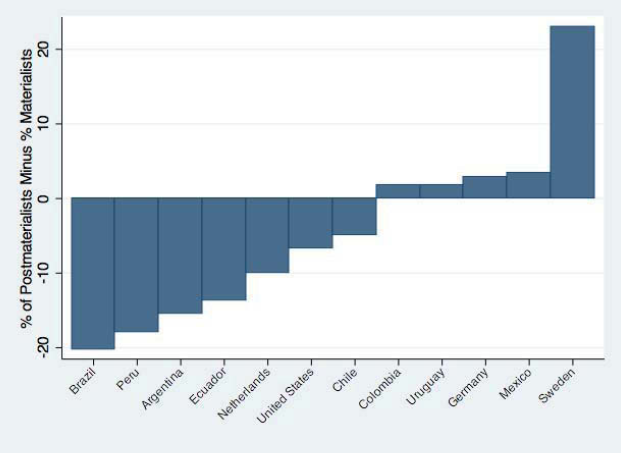
Percentage Postmaterialists minus Percentage Materialists, Selected Developed and Latin American Countries, WVS Wave 6, 2010–2014
Among the Latin American cases in the sixth wave of the WVS, Brazil ranks the lowest on the PM-M indicator, with roughly 32 percent of the public exhibiting materialist value priorities and only 12 percent being classified as postmaterialists in 2014.
While the early literature on postmaterialism focused heavily on prosperous Western European societies, the fact that a given society possesses low observed values of postmaterialism at a given point in time (for example, Brazil in 2014) is irrelevant to empirical testing of the theory. Postmaterialism is a theory of change in which the baseline condition is a society dominated by a materialist value syndrome. Cautiously recovering a central tenet of modernization theory, recent theoretical work by Inglehart and his collaborators has claimed that human societies change in more or less predictable ways. The original insights of post-materialism are being subsumed into broader and more ambitious frameworks, such as “postmodernization” (a multidimensional concept of which value change is only one aspect, see Inglehart 1997) or the “human development sequence” (a revised and universal theory of modernization that links economic development to a rising emphasis on self-expression values, which in turn are conducive to political democratization; see Inglehart and Welzel 2005; Welzel 2014). Although these variants of value change theory differ in subtle ways, they make virtually identical predictions about less developed societies. Specifically, while these societies may possess comparatively low levels of economic and physical security, postmaterialists will appear first among social strata that have access to these goods.
Therefore, although Latin America might observe a value syndrome that is heavily materialist at the aggregate level, we can still test for with-in-society variation, and we should expect postmaterialists to emerge from among the more socioeconomically privileged. Postmaterialism should vary positively with income and with education (especially tertiary education; see De Graaf and Evans 1996). As such, even though post-materialism may not be diffused among the general population, we should expect it to be predominant within a more homogenous set of the population, such as the political elite – a group that displays comparatively high levels of educational attainment and income.
Hypotheses and Data
The theory outlined in the previous section allows us to derive some basic hypotheses. These hypotheses have been built largely on cross-national work, but can easily be adapted to a single-country case study that explores intra-elite cleavages.
Political elites are relatively homogenous groups that are distinct from the mass public in significant ways. They are generally more educated and affluent than their constituents. Given their job responsibilities, politicians are also more directly exposed to and knowledgeable about political, economic, and social issues. As such, political elites are expected to display higher levels of postmaterialist tendencies, even in societies that are otherwise overwhelmingly materialist (Cámara Fuertes 2009).
Following value change theory, we contend that socioeconomic modernization fosters postmaterialism. Brazil has spectacular regional differences in terms of economic development. In a now-classic fable dating from the days of military dictatorship, the distinguished Brazilian economist Edmar Bacha (1976) renamed his country as “Belindia,” to signify a society in which a small upper-middle class with Belgian levels of prosperity was surrounded by a poor majority with Indian levels of deprivation. The Belindian hypothesis is directly relevant to our study: value change theory predicts that postmaterialism should appear first in “Belgium” before it arrives in “India.” Therefore, politicians representing more “modern” constituencies should be more postmaterialist than those representing poorer electoral bases.
Within the world of Brazilian political elites, we assume that both postmaterialists and left-wing parties should coincide in their opposition to “traditional politics” in Brazil – an exclusionary model that has combined oligarchy, authoritarianism, income concentration, and frequent physical repression. Thus, we should expect a correlation between value priorities and political ideology in Brazil: postmaterialists should be found disproportionately in leftist parties (for international comparisons, see Savage 1985; Kitschelt 1994).
The literature on postmaterialism suggests that Brazilian legislators with postmaterialist value priorities should adopt progressive positions on several controversial issues before Congress, such as reproductive rights, marriage equality, and climate change. At the same time, a large body of literature on executive–legislative relations in Brazil suggests that legislators may not be free to vote the way they think. Given party centralization, coalitional politics, and the presence of a legislative whip, politicians are constrained by discipline on the floor of Congress (see, among others, Figueiredo and Limongi 1999, 2000; Amorim Neto 2002; Power 2010). For empirical testing, we will adopt the intuitive directional hypothesis that attitudinal postmaterialism predicts legislative behavior. These ideas can be expressed more formally as follows:
H1. Federal legislators should be more postmaterialist than members of the mass public.
H2. Postmaterialism should vary positively with leftist political ideology (H2a) and with the level of socioeconomic modernization of electoral constituencies (H2b).
H3. Postmaterialist federal legislators should hold distinctive positions on “new politics” issues. Postmaterialism should predict greater attitudinal acceptance of (H3a) abortion rights, (H3b) gay rights, and (H3c) environmental protection.
H4. Attitudes should predict legislative behavior: members of Congress who score high on the PM index should be more likely to vote for identifiably postmaterialist positions on “new politics” issues, when controlling for institutional factors and party politics issues.
To test these hypotheses, we draw upon two datasets. The first is the Brazil 2014 module of the World Values Survey (WVS). The WVS was administered to a national probability sample of 1486 Brazilians in 2014 by researchers at the University of Brasília. The second data source is the seventh wave of the Brazilian Legislative Survey (BLS), an extensive questionnaire that was completed by 148 members of the Brazilian Congress between March and July 2013 (a response rate of 25 percent). Unlike previous waves of the BLS, the 2013 edition replicated a number of survey items from the global WVS questionnaire, including the four-item and 12-item postmaterialism batteries developed by Inglehart. To our knowledge, this is the first time that these indicators have been directly replicated within a sample of national legislators in Latin America. 4 We examine the BLS dataset separately, but we also artificially pool the respondents of both surveys for a preliminary inspection of the effect of political elite status on value priorities.
The PM battery was applied to a sample of 79 Puerto Rican assembly members in 2001 (Cámara Fuertes 2009). Treminio and Melián (2010) developed an alternative measure of “legislative postmaterialism” using a large number of substantive questions from the Parliamentary Elites of Latin America (PELA) dataset. Therefore, their results (which capture values, not value priorities) are not equivalent to the measures used by Inglehart or the WVS. Measures that capture “value priorities” are those that induce respondents to identify the ordering of their preferences on a set of issues, forcing them to rank materialist and postmaterialist goals directly against one another.
Elites and Masses: Testing for Congruence of Value Priorities
We started by assessing the level of elite-mass congruence with regard to value priorities. The low overall proportion of postmaterialists in the Brazilian mass public does not automatically imply that value change theory cannot be applied to Brazil. H1 anticipates that federal legislators will be more postmaterialist than the Brazilian mass public, following decades of comparative research showing that postmaterialism varies positively with both education and income. Relative to their constituents, members of the Brazilian Senate and Chamber of Deputies consistently exhibit extreme values on these two variables. While precise estimates are impossible, our reasoned guess is that, in terms of education, the median legislator is probably somewhere around the 97th percentile in the national distribution, and that all legislators would be in the top 1 percent of income earners based on their congressional salaries alone. 5 This is hardly unique to Brazil, as elected legislators rarely look like their constituents, and descriptive representation with regard to levels of education, personal wealth, and gender is traditionally low, especially in developing societies (Hughes 2013).
The salary of legislators in 2013 was BRL 26,723 per month, which is more than 39 multiples of the minimum wage. This wage is paid to them 14 times per year, for an annual salary of approximately USD 166,000 (using the average exchange rate for 2013). The vast majority of legislators also have other significant sources of income.
Figure 2 provides strong visual support for H1. Among members of the Brazilian mass public in WVS 2014, there were almost three times more materialists than postmaterialists in Brazil. Among members of Congress in BLS 2013, the ratio of postmaterialists to materialists was approximately 7:5.
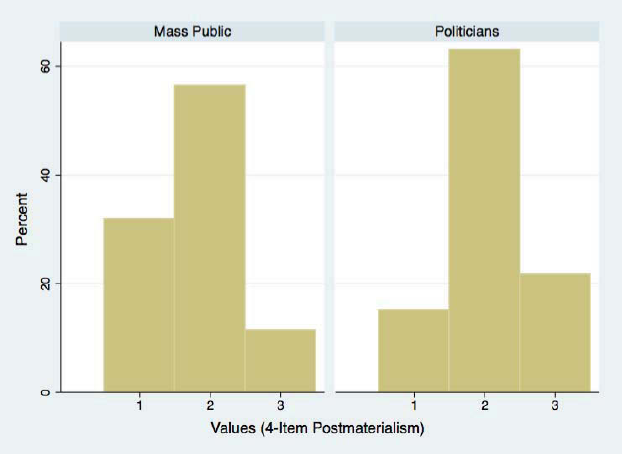
Comparing the Value Priorities of Brazilian Citizens (WVS 2014) and Federal Legislators (BLS 2013), Using the Four-Item Post-materialism Battery
A more precise test of H1 can be obtained by pooling the responses of elites and masses into a single model and also using the superior 12- item postmaterialism battery, which generates a continuous variable ranging from zero to five (Appendix A). Ideally, we would do this on survey data collected within both populations at the same point in time, but this is impossible. It would be equally unfeasible to field a national probability sample in which members of Congress were assigned their actual weight in the population (0.00003 percent). Therefore, and because of the fact that this is an exploratory analysis, we did the next best thing: we simply inserted the BLS 2013 respondents into the WVS 2014 dataset, assigned a dummy variable where the value of one identifies professional politicians, 6 and estimated a pooled model in which the dependent variable is the PM12 score. Members of Congress then made up just over 9 percent of this unconventionally pooled “sample.” This artificial merging of independent samples is wholly suboptimal and does not yield “real” statistical inferences, but it does provide an interesting first look at congruence on value priorities in Brazil in 2013–2014 by exploiting two very recent datasets. As a thought experiment, one could liken this exercise to a public forum in Brazil in which a national probability sample of 1500 ordinary Brazilians was invited to sit in an auditorium together with 150 randomly drawn members of Congress. If everyone in the room were asked to privately to disclose their value priorities (and bearing in mind that political elites are vastly overrepresented in the room), how would the politicians differ from the mass public?
Given that Brazil has approximately 65,000 elected subnational officeholders and thousands more appointed officials, it is possible that the WVS Brazil sample (N=1486) could have randomly included one or more “political elites” who are not coded as such here. The probability of this occurring is close to zero.
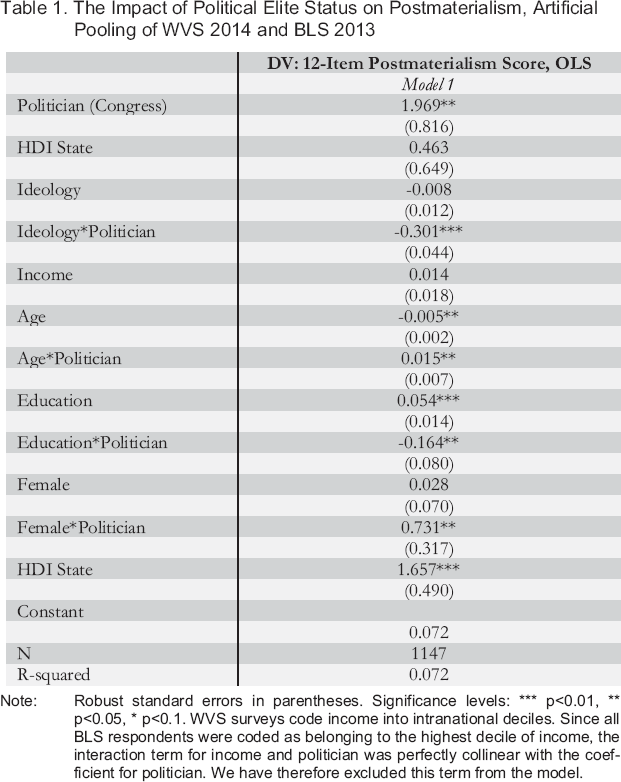
The model in Table 1 includes a binary variable for politicians. We then interacted the politician dummy with as many of the other independent variables as possible. Since all BLS respondents are coded here as belonging to the highest decile of income using WVS criteria, the interaction term (income*politician) was perfectly collinear with the coefficient for politician. The interaction term between politician and HDI State was also dropped, as variance inflation factor (VIF) tests showed that the inclusion of the variable led to severe multicollinearity that rendered estimations unstable. 7 Consequently, we had to exclude these two interaction terms from the model, but we retained interactions with our other control variables, which are (left–right) ideology, age, educational attainment, 8 and (female) gender.
The Impact of Political Elite Status on Postmaterialism, Artificial Pooling of WVS 2014 and BLS 2013
Note: Robust standard errors in parentheses. Significance levels:
p<0.01,
p<0.05,
p<0.1.
WVS surveys code income into intranational deciles. Since all BLS respondents were coded as belonging to the highest decile of income, the interaction term for income and politician was perfectly collinear with the coefficient for politician. We have therefore excluded this term from the model.
The inclusion of the variable almost tripled the total VIF for the model to 61.11 and, on its own, had a value of 238.97.
Differently from subsequent analyses restricted to politicians, in which we used an expanded 11-point scale of education, in the pooled model we used the original WVS nine-point scale so that all observations were coded in the same way.
To make the ideology scores for politicians comparable to those included in the WVS, we are forced to use the self-reported ideology scores from the BLS (and not the rescaled measure used in our subsequent analyses). This decision means that in the artificially pooled model in Table 1, all respondents (both elites and masses) have located themselves on an identical 1–10 scale, where one equals left and 10 equals right. Although there are many problems with using left–right self-placements for Brazilian politicians (Power and Zucco 2009, 2012), this is the only way to arrive at a single consistent metric.
The main finding of our artificial congruence model is that “elite” status – that is, membership of Congress – is a strong predictor of post-materialist values, as can be seen in the large magnitude of the “politician” coefficient. This effect is net of income and HDI (our measures of economic security in the model), which now cannot be interacted with the binary variable for professional legislator.
The most interesting finding of Table 1 relates to ideology. While the coefficient for ideology is negative, as expected (suggesting that postmaterialist values are associated with the political left), it is not statistically significant. However, the interaction term between ideology and politician is highly significant. This is likely an artifact of two familiar phenomena in survey research. First, ordinary Brazilian citizens have been shown to have difficulty in defining the terms of “left” and “right” and in locating themselves consistently on an ideological scale (González and Queirolo 2013; Zucco 2015). Second, even in societies that have much higher levels of literacy or educational attainment than Brazil, and presumably have fewer informational asymmetries between elites and masses, we should still expect elites to display higher levels of ideological constraint (Converse 1964).
The ideology measure used in Table 1 should be interpreted in the light of well-known biases in the left–right self-placements of Brazilian politicians. Conservative Brazilian politicians routinely place themselves to the left of where everyone else would place them; this phenomenon has been nicknamed the direita envergonhada (Power 2000; Power and Zucco 2009, 2012). Note that this bias is now embedded in Model 1 and should actually work against our hypotheses. If postmaterialism is linked to leftist ideology, and a large minority of Brazilian politicians then misrepresent their ideology by placing themselves further to the left than they really are (a bias almost certainly reflected in Model 1), this could potentially obscure the “real” relationship between ideology and post-materialism at the elite level, which is captured in Model 1 by an interaction term.
Age has no clear effect in the pooled model: as expected, it produces a negative and statistically significant coefficient; however, when it is interacted with politician, it becomes positive, which means that older politicians are more likely to hold postmaterialist values than their younger counterparts. The independent effect of education on postmaterialism is positive, as expected, but when interacted with Congressional membership the coefficient becomes negative. In other words, the artificial congruence model suggests that Brazilian legislators are actually less postmaterialist than their extremely high educational levels would lead us to expect. The interaction between female gender and politician is also statistically significant (we return to this issue later). Overall, the predicted relationship between elite status and postmaterialism is still clearly visible in Model 1, which suggests strong support for H1.
In this section, we have explored whether elite status is an important predictor of postmaterialist values. In other words, by pooling elite and mass public data we sought to investigate whether Brazilian federal legislators were significantly different from the mass public in regards to the PM-M scale. Although the sample is artificially composed and the findings are entirely irreproducible (no survey of the mass public would ever be large enough to draw valid inferences about federal legislators), the findings are still interesting and suggestive. Returning to our thought experiment of an auditorium containing both politicians and ordinary voters, we would probably find – even after controlling for the fact that professional politicians are vastly richer and more educated than the average Brazilian – that members of Congress are notably more postmaterialist than members of the mass public. In the next section, we present descriptive statistics to further probe the distribution of post-materialist values across Brazilian legislators. We then return to more conventional statistical analyses, using a representative sample of elites, to test our remaining hypotheses (H2, H3, and H4).
A Profile of Legislative Postmaterialism in Brazil
Of the 148 respondents in BLS7, 138 could be classified using the original four-item battery of postmaterialism, which was first used in the Eurobarometer survey in 1970 (see Appendix A). Of these 138 politicians, 63 percent exhibited mixed value priorities, while 21.7 percent were classified as postmaterialists and 15.2 percent as materialists. Thus, within Congress, the percentage of postmaterialists minus materialists is a positive number (5.5). By this simple measure, the profile of the Brazilian political class resembles that of the German or Mexican mass public (Figure 1).
BLS7 also asked respondents to complete the more comprehensive 12-item battery of postmaterialism, with a valid N of 137 on this variable. The 12-item battery generates a continuous variable that can range from zero (no postmaterialist values were accorded high priority) to five (all five postmaterialist values were accorded high priority). Taken as a whole, the Brazilian Congress sits exactly on the midpoint of the scale at 2.47, but this masks significant differences among the parties. The two most important ideological parties of the left, the PT and its satellite the PC do B, have the highest PM12 scores, while the lowest scores are held by the Democrats (DEM, ex-PFL) and the Republican Party (PR). While the PR is a small political arm of Pentecostal pastors and churches, the fading DEM is a more traditional party of the ideological right (in the “liberal” sense as its original name implied). Of our seven respondents from the PR, three are members of the “Evangelical Caucus” (Frente Parlamentar Evangélica, a cross-party group of Protestants, most of whom are Pentecostal) and hold sharply traditionalist positions on social issues, while none of our 11 DEM politicians identifies as a member of this caucus. Therefore, the reasons driving the low scores on these two right-of-center parties may well be different. What is most striking, however, is that the left and right “extremist” parties also exhibit the lowest standard deviations on the PM12 variable. Unsurprisingly, ideological extremism is associated with clearer value priorities.
A visual inspection of Figure 3 gives strong support to H2a, which posits that postmaterialism should be negatively correlated with rightist ideology in Brazil. At the individual level, the correlation between a re-scaled measure of ideology drawn from BLS data (on which higher values represent more rightist positions; see Zucco 2014) and the PM12 variable is −0.472 (N=134, p <0.01). At the party level, the relationship is much stronger, with a coefficient of −0.760 for the 10 parties displayed in Figure 3. The core left-of-center parties of Presidents Luiz Inácio Lula da Silva and Dilma Rousseff over the past 13 years (PT, PC do B, and PSB) 9 are located in the upper-left quadrant of Figure 3.
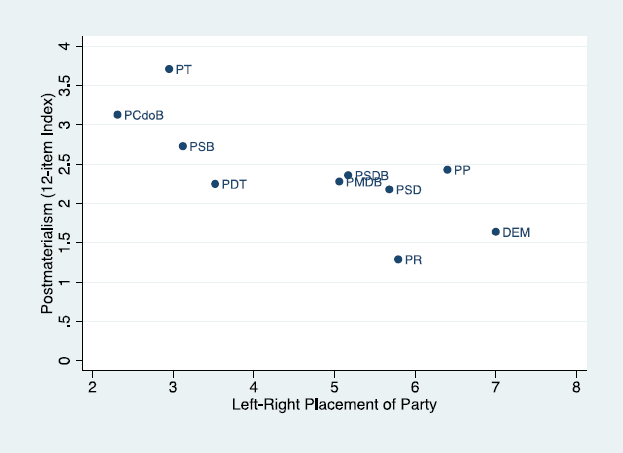
Postmaterialism and Left–right Ideology among Principal Political Parties in Congress, 2013
The Brazilian Socialist Party (PSB) left the PT-led coalition in 2013 and opposed Dilma's reelection in 2014.
Mean Postmaterialism Scores of Legislators by Human Development of State Electoral Constituency (Brazilian States by Terciles of HDI as of 2010)
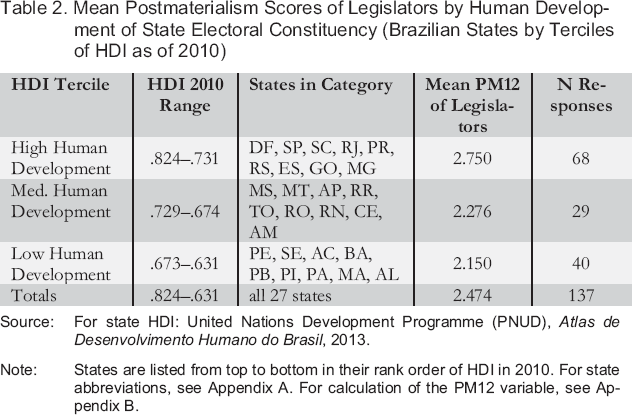
Source: For state HDI: United Nations Development Programme (PNUD), Atlas de Desenvolvimento Humano do Brasil, 2013.
Note: States are listed from top to bottom in their rank order of HDI in 2010. For state abbreviations, see Appendix A. For calculation of the PM12 variable, see Appendix B.
Overall, we found preliminary support for H2a, which is that postmaterialists and leftists – who should share an opposition to “traditional politics” and unfettered market capitalism, respectively – should jointly reject the Brazilian right, and therefore cluster together within the same political parties.
Descriptive analysis also gives some support to H2b, which proposes that politicians representing constituencies of relatively higher human development should be more postmaterialist than their colleagues from poorer regions. Historically, Brazil has had spectacularly uneven developments across its five major regions, with the South and Center-South being the most economically advanced. Following Bacha's metaphor of Brazil as “Belindia,” we suspect that the “Belgium” should be more postmaterialist than the “India,” and that legislative representation should imperfectly capture this cleavage. Dividing Brazil's 27 states into terciles of the Human Development Index, we find that legislators representing the nine most developed states are far more postmaterialist than their peers from the least developed tercile, in which eight of the nine states are located in the Northeast. However, we acknowledge that the Belindia metaphor is not exclusively a territorial cleavage. It also highlights the marble-cake pattern of Brazilian modernization, implying that “Belgium” already exists within the capital cities and cosmopolitan middle classes of even the poorest states – just as, overall, Mumbai is presumably more postmaterialist than rural India.
Determinants of Postmaterialism among Federal Legislators
Bivariate analyses suggest that postmaterialism among Brazilian federal legislators is associated with membership in leftist parties with electoral connections to more economically developed constituencies. In Table 3, we estimate three multivariate models predicting postmaterialism among legislators using the 12-item battery.
Assessing the Determinants of Postmaterialism among Federal Legislators, 2013
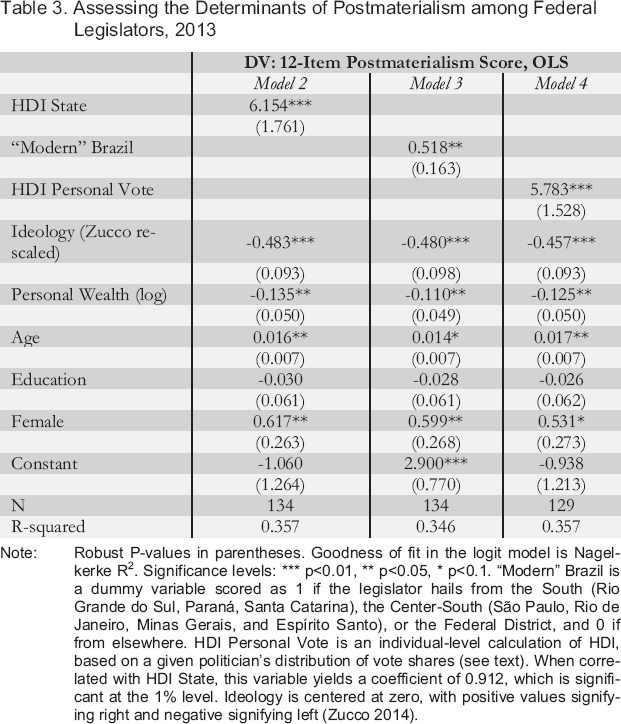
Note: Robust P-values in parentheses. Goodness of fit in the logit model is Nagelkerke R2. Significance levels:
p<0.01,
p<0.05,
p<0.1.
“Modern” Brazil is a dummy variable scored as 1 if the legislator hails from the South (Rio Grande do Sul, Paraná, Santa Catarina), the Center-South (São Paulo, Rio de Janeiro, Minas Gerais, and Espírito Santo), or the Federal District, and 0 if from elsewhere. HDI Personal Vote is an individual-level calculation of HDI, based on a given politician's distribution of vote shares (see text). When correlated with HDI State, this variable yields a coefficient of 0.912, which is significant at the 1% level. Ideology is centered at zero, with positive values signifying right and negative signifying left (Zucco 2014).
Here, we have included three alternative measures of district-level human development. In Model 1 we use the HDI of respondents’ federal units, as all our respondents are elected “statewide” in their districts (HDI State). In Model 2 we substituted a dummy variable for “modern” Brazil (this is scored as 1 if the legislator represents the South, Center-South, or the Federal District, and zero otherwise). Finally, in Model 3 we used an individual-level measure that was calculated by multiplying municipalities’ HDI values by the weight that each municipality contributes to the personal vote total of each elected legislator (HDI Personal Vote). This reflects the fact that legislative representation in Brazil takes diverse forms, including the targeting of non-contiguous constituencies within states (Cheibub 2009). 10
Each of the 26 Brazilian states is subdivided into a number of municipalities, ranging from 15 (Roraima) to 853 (Minas Gerais), with a mean of 214 and a median of 155 units. Congressional candidates run statewide and may receive votes in any municipality. We have HDI scores and candidate vote shares for all 5570 municipalities, which enables us to use ecological analysis to inspect how differing levels of human development contributed to each legislator's vote profile. Thus, the variable “HDI Personal Vote” represents the human development level of each legislator's effective electoral base, as if all the legislator's supporters were concentrated in a single imaginary municipality. (The 27th “state,” the Federal District, is not subdivided into municipalities, so the value of HDIPV is the same for the two BLS respondents from Brasília.)
To test H2a (postmaterialism and ideology), we included a more precise individual-level measure of left–right placement, using Zucco's Bayesian rescaling of the entire BLS time series to anchor the individual estimates for 2013 (Zucco 2014). The ideology variable was centered at zero, with −1 representing the leftmost position and +1 the rightmost.
We included several control variables. Postmaterialism should vary negatively with age and positively with education, economic security, and gender. Recall, however, that this is a sample of politicians, and these three factors vary far less among the political class than they do among the Brazilian mass public. Age is distributed closely around the mean of 57 for members of Congress, with only 10 percent of BLS respondents aged under 40. Our 11-point measure of education extends the nine-point scale used in the WVS with a view to capturing the far higher educational attainment of professional politicians. Most of the variation in the sample is at the tertiary level; some 47 percent of BLS 2013 respondents had completed an undergraduate degree and another 29 percent had completed some type of postgraduate degree – this means that a total of 76 percent of respondents have at least an undergraduate education. 11 To calculate personal wealth, we used official data from candidate affidavits filed with the Tribunal Superior Eleitoral (TSE). We then logged individual wealth, creating a variable that ranges from 2.950 to 19.783 and has a mean of 12.950. 12 We also included a binary variable for female gender. Some 12.8 percent of the sample is female, which is roughly the same proportion found within the Brazilian National Congress. 13 Some research on value change within European mass publics has found men to be slightly more postmaterialist than women, with a larger gender gap in predominantly Catholic societies. However, these findings have been contested recently (e.g., Hayes, McAllister and Studlar 2000) and in any case may be conditional on socioeconomic development (Inglehart and Norris 2003). 14 We are not aware of any direct test of the gender relationship on a sample of national politicians. 15
The BLS 2013 codebook is available at <http://hdl.handle.net/1902.1/14970>.
These data are available from <www.tse.gov.br> and are republished on numerous journalistic and NGO websites (for example, <http://noticias.uol.com.br/politica/politicos-brasil/>). The personal fortunes of the 148 BLS respondents at the moment at which they registered their candidacies (expressed in USD of 2012) ranged from USD 19.11 to nearly USD 400 million, which is why we log this variable.
In the 2011–2014 Brazilian legislature, women occupied 8.58 percent of seats in the Chamber of Deputies and 14.81 percent of seats in the Senate.
The relationships among gender, postmaterialism, and ideology at different levels of socioeconomic modernization are complex, as postulated in Inglehart and Norris’ (2003) “developmental theory of the gender gap.” In developing countries, a “traditional gender gap” finds women politically to the right of men, while in postindustrial societies the “modern gender gap” shows exactly the opposite pattern. Inglehart and Norris (2003: 94–97) claimed that the shift to the modern gender gap is predominantly a result of cultural change; that is, the growth of postmaterialism leads to more egalitarian positions regarding gender roles.
Vanderleeuw, Sandovici, and Jarman (2011) conducted a survey of 155 municipal politicians in Texas and found that females were more postmaterialist than males. Their survey asked politicians to rank 13 factors influencing community development priorities, and is therefore not directly comparable to WVS batteries.
Table 3 shows consistent support for H2a (ideology) and H2b (human development of constituencies). The three alternative measures of socioeconomic modernization have similar positive effects (if corrected for their respective scales), suggesting that postmaterialist politicians fare better electorally in the more developed regions of Brazil. The more precise individual-level measure of ideology is consistent with what we see in Figure 3; that is, postmaterialists in Congress tend to be left of center. Among the control variables, personal wealth, age and gender are statistically significant, but the signs produced by the coefficients of two of these variables (personal wealth and age) are the opposite of what was predicted by postmaterialist theory. This is likely due to sample homogeneity and severely truncated variance on these three predictors.
Again, we found that female gender is a positive and significant predictor of postmaterialism among Brazilian politicians in Congress. We see two possible explanations for this.
Firstly, although based on a very different analysis, this individual-level finding could be seen as broadly consistent with the aggregate cross-national results of Inglehart and Norris (2003), who showed that the relationship between (female) gender and postmaterialism becomes positive at the highest levels of physical and economic security. Put another way, the relationship should be positive in “Belgium” but not in “India” – and given that the model is restricted to elite women, this could be interpreted as “Belgian women.” Secondly, the 12-item postmaterialism battery includes several value priorities that tap into the debate over public security in Brazil, such as “strong defense forces,” “maintaining order in the nation,” and “the fight against crime.” Impressionistically at least, this debate appears heavily gendered insofar as male candidates and politicians typically seek “ownership” of law and order issues. If male legislators are more likely than female legislators to be policy seekers on public security, then biases in the PM12 battery would likely portray incumbent male politicians as significantly more materialist than their female colleagues. At the elite level, we could be observing differences between “Belgian women” and “security entrepreneurs.”
Does Postmaterialism Predict Positions on “New Politics” Issues?
We now reverse our analytical lens and emplace postmaterialism as an independent variable rather than a dependent variable. Theoretically speaking, if the value change thesis is to have any validity, postmaterialism should be able to accurately predict elite positioning on “new politics” issues associated with postmodernization. These debates are not exclusive to postindustrial societies, as can easily be seen by examining new policies on environmental protection in Mexico, on recognition of same-sex marriage in Argentina, or on decriminalization of drug use in Uruguay. Empirically speaking, a proper test is only possible if the policy issues to be studied are unrelated to the value priorities used in the construction of the postmaterialist scale. Here we ask whether postmaterialism predicts the orientations of Brazilian political elites in three policy areas: reproductive rights, same-sex marriage, and green politics.
In BLS 2013, the survey statement pertaining to reproductive rights was framed as “abortion should be prohibited under all circumstances.” The statement related to sexual orientation was that “homosexual couples should have the right to marry.” BLS respondents used a five-point scale ranging from strong disagreement (score of 1) to strong agreement (score of 5). We reversed the scoring for the abortion variable, so that both the reproductive and gay rights responses should correlate positively with the 12-item postmaterialism index.
On environmentalism, BLS 2013 reproduced a long-running survey item from the WVS in which respondents were asked: “Here are two statements people sometimes make when discussing the environment and economic growth. Which of them comes closer to your own point of view?” The two alternatives were (1) “protecting the environment should be given priority, even if it causes slower economic growth and some loss of jobs,” or (2) “economic growth and creating jobs should be the top priority, even if the environment suffers to some extent.” This is a clear (and difficult) binary choice.
Beyond the control variables included in Models 2–4 from Table 3, we also included variables capturing legislators’ membership in relevant issue caucuses in Congress. For the models predicting orientations on abortion rights and same-sex marriage, we included a dummy variable identifying membership in the cross-party Evangelical Caucus, which is a non-Catholic (mainly Pentecostal) religious faction that is reputationally associated with traditionalist positions on “new politics” issues. For the model predicting orientations on environmental issues, we included a dummy variable for membership in the cross-party Rural Caucus (bancada ruralista), which generally defends the interests of agricultural producers and large landowners. 16 Given the differing forms of our dependent variables, we employ OLS when testing for value priorities on abortion rights and same-sex marriage and estimate a logit model when assessing parliamentarians’ orientations toward environmental protection.
The heavily Pentecostal religious caucus calls itself the Frente Parlamentar Evangélica and publishes its membership roster at <www.fpebrasil.com.br/portal>. The Frente Parlamentar da Agropecuária (agriculture, livestock, and landowners’ faction) lists its members at <http://fpagropecuaria.org.br>.
For the models in Table 4, all of the dependent variables have been coded so that higher values represent greater support for reproductive freedoms, same-sex marriage, and environmental protection. After we controlled for legislators’ income, age, education, gender, membership in directly relevant floor caucuses, and for the human development levels of their electoral constituencies, we found that postmaterialism has a positive and statistically significant effect on attitudinal support for all three issues: reproductive rights (Model 5), same-sex marriage (Model 6), and (albeit more weakly) environmental protection (Model 7). The most likely explanation for the weaker predictive power of postmaterialism on our third dependent variable is the format of the question used. Unlike the other two survey questions employed, that question established a difficult binary choice: environment versus growth. Many legislators are likely to feel that promoting economic growth and creating jobs are part of the job description of any member of the Brazilian legislature – in fact, many candidates use electoral messages that resemble the survey item at hand. Given Brazil's uneven economic performance over the past 30 years, we should expect that incumbent legislators see economic stewardship as a grave responsibility of public life, and that the trade-off between “jobs or the environment” is more salient to them than it is to members of the mass public.
The Effect of Postmaterialist Value Priorities on Perceptions of Three ‘New Politics’ Issues
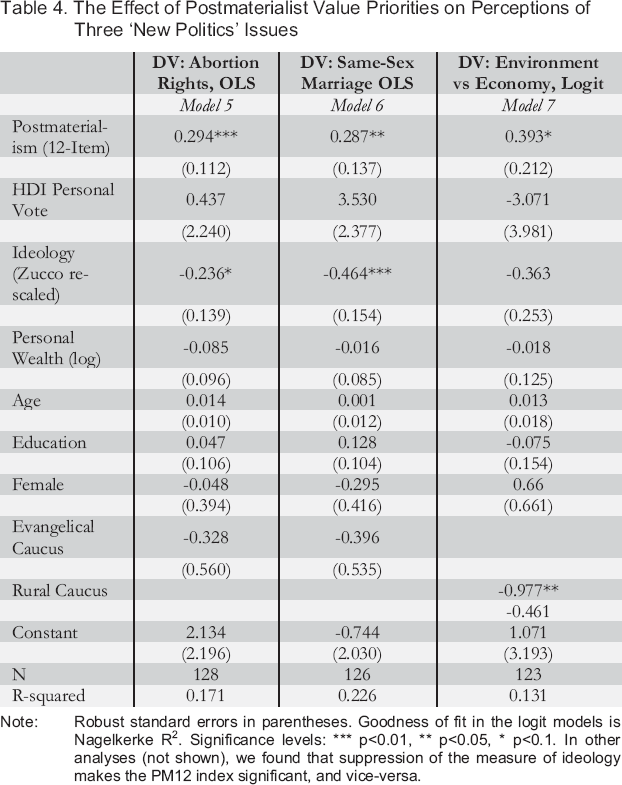
Note: Robust standard errors in parentheses. Goodness of fit in the logit models is Nagelkerke R2. Significance levels:
p<0.01,
p<0.05,
p<0.1.
In other analyses (not shown), we found that suppression of the measure of ideology makes the PM12 index significant, and vice-versa.
This means that the question framing might be responsible for underestimation, and that postmaterialism would have been a stronger predictor of environmental protection if the dependent variable had been measured with data from a question that did not invoke economic performance.
Similarly, our personalized measure of constituency-level socioeconomic modernization produces a positive, albeit not statistically significant, coefficient for our models predicting legislators’ attitudes towards abortion and same-sex marriage, but yields a negative coefficient when the dependent variable assesses views on environmental protection.
The rescaled measure of ideology produces a negative coefficient that is statistically significant in Models 5 (albeit weakly) and 6, which predict support for abortion rights and same-sex marriage, respectively. The magnitude and levels of statistical significance of coefficients suggest that left-leaning legislators are more distinguishable in their support for LGBT rights than in their positioning on abortion. Brazilian mass opinion is clearly moving at different speeds when it comes to these two issues. Abortion in Brazil remains illegal except for cases of rape, fetal anencephaly, or danger to the life of the mother, but same-sex civil unions were legalized in 2004 and full marriage equality was achieved in 2013.
Given the extreme homogeneity of the sample with regard to personal wealth, age, education, and gender, these variables yield no statistically significant coefficients. Nonetheless, the dummy for membership in the Rural Caucus expectedly produces a negative and significant coefficient in our Model 7. This binary variable goes a long way toward identifying those Brazilian legislators who personally exploit natural resources.
All in all, we conclude that the exploratory analyses summarized in Table 4 lend strong support to two of the three variants of H3. Post-materialism correctly predicts elite attitudes toward two major “new politics” issues. This is significant, given that the construction of the postmaterialism index is wholly unrelated to the three debates tested. 17 Nonetheless, it is still unclear whether postmaterialism remains relevant when parliamentarians are concerned with pressing issues, such as economic growth, industry, and potential job losses. The following section seeks to advance the debate by analyzing the voting behavior of Brazilian legislators when they are directly challenged to decide between economic and environmental gains/losses.
One of the 12 values in the postmaterialism battery – “making our cities and countryside more beautiful” – was originally included to tap into aesthetic considerations that might be linked to environmentalism in a general sense. However, this item did not load as expected onto the materialist/postmaterialism dimension. It remains in the 12-item battery, but has been abandoned in the construction of the 0–5 postmaterialism index used by Inglehart and collaborators and replicated here (see Appendix A).
Does Postmaterialism Predict Voting Behavior on “New Politics” Issues?
The question of whether postmaterialism predicts not only the policy preferences of legislators but also their policy behavior – that is, their position on roll-call votes on some of the “new politics” issues examined here – is interesting, but difficult to investigate. As Zucco (2009) and Zucco and Lauderdale (2011) have shown, roll-call votes in the Brazilian Congress are dominated by a coalitional logic in which the pro-presidential cartel defends the interests of the incumbent president on most key issues. Therefore, the majority of votes may be better explained by a government-versus-opposition logic than by ideology, or (we must assume) by postmaterialist value priorities as well.
It might be possible to gain some insight if a Brazilian president took a clear stand on a controversial “new politics” issue, such as legalization of abortion, or amendment of the Constitution to prohibit discrimination based on sexual orientation. Such a controversial stand would likely fracture the current governing alliance, which in part rests on an entente cordiale between the left-leaning executive and the traditionalist/moralist factions associated with Pentecostal churches (see Boas and Smith 2014), and could reveal the materialism/postmaterialism cleavage as a significant dimension of legislative voting. Although Brazilian presidents have very few incentives to stake out positions that would divide their interparty coalitions, this is precisely what happened during the 2012 voting of the new Brazilian Forest Code.
The Forest Code delimits conservation areas and provides guidelines for the proportion of land that should be preserved or reclaimed; these are, issues that directly impact the amount of available resources that rural producers can exploit. Given its controversial status among environmentalists and agricultural producers, the process of reforming the Code was long and laborious (1999–2012). Numerous versions were drafted and re-drafted by ministries and agencies of the federal government (Pereira 2014: 2–5).
The process came to a head in an historic session of the Chamber of Deputies on 25 April 2012. Parliamentarians were asked to vote for or against a new version of the Forest Code that included controversial amendments added by Deputy Paulo Piau. This was the most contentious vote of the process, given one of these amendments sought to take the power of defining conservation areas away from the federal government and give it to the states. This was a clear effort to empower large landowners and ranchers – many of whom double as provincial oligarchs and have strong influence over local law enforcement – against environmental regulators in Brasília. Both President Dilma Rousseff and her governing party, the leftist Partido dos Trabalhadores (PT), came out strongly against this amendment. The president gave explicit instructions to her supporters to make the bill less permissive to deforestation. Yet her heterogeneous governing coalition also included elements of the “Rural Caucus,” which hoped to dilute the new Forest Code with Paulo Piau's last-minute revisions. The discourse of the Rural Caucus was openly hostile toward environmentalists throughout the entire process of public debate (Pereira 2014).
The watered-down version of the Forest Code ended up splitting the government coalition, which defied President Rousseff by passing the bill with 274 votes in favor and 184 votes against. This was portrayed as the most important legislative rebellion in Brazil in nearly a decade. Despite losing the battle, the president won the war. Armed with her amendatory veto, Dilma Rousseff struck out 12 of the 84 articles of the bill and promulgated the remainder of the legislation a month later. Despite a reversionary outcome favorable to the president, the controversial roll-call vote on 25 April seems very appropriate for testing our H4. The bill concerns a “new politics” issue (environmental protection) that divided many parliamentarians and which, despite President Dilma's strongly stated position, led various legislators to ignore their party whips. In other words, the breakdown of the predictable government/opposition cleavage in the Chamber of Deputies was like a bolt of lightning that temporarily illuminated the “real” positions of legislators. Therefore, we use recorded voting on the Forest Code from 25 April, 2012 to assess the explanatory power of the postmaterialist scale in predicting voting behavior on a “new politics” issue.
Because we are not confident in our ability to interpret abstention or absence in this case, we have only considered those cases in which respondents took a clear yes or no position on the Forest Code. For this reason, and also because we are restricted here to federal deputies (not senators), the number of cases analyzed is reduced (N = 93). In Models 8–11, reported in Table 5, the dependent variable is scored as 1 if the federal deputy took the pro-environmentalist position (that is, voted “no” on the controversial version of the bill) and is scored as zero if the deputy opted for the diluted version of the Forest Code.
Predicting Roll-Call Voting on the Forest Code (DV=Support for Environmental Protection)
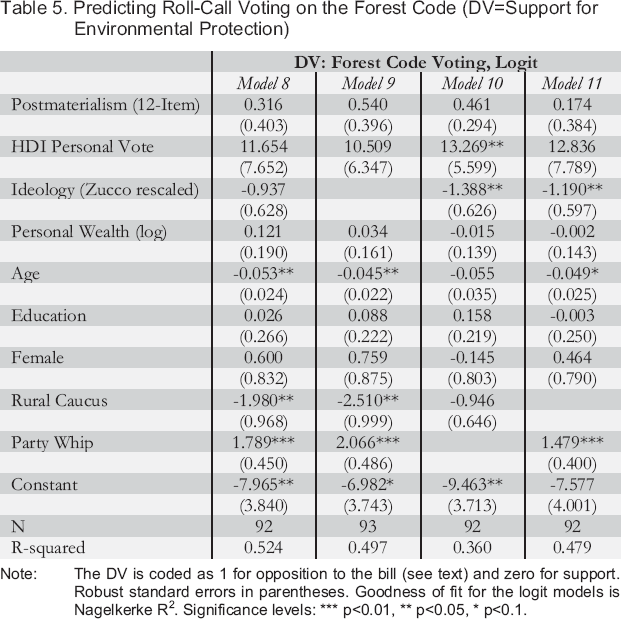
Note: The DV is coded as 1 for opposition to the bill (see text) and zero for support. Robust standard errors in parentheses. Goodness of fit for the logit models is Nagelkerke R2. Significance levels:
p<0.01,
p<0.05,
p<0.1.
In Brazil, as in many other democracies, the party whip is a strong predictor of voting behavior on the floor of the legislature (Figueiredo and Limongi 1999, 2000). For this reason, we controlled for the effect of party positioning on this controversial vote. We created a whip variable in which the value of −1 denoted a case in which the legislator received an explicit party recommendation to vote in favor of the bill (that is, tolerance of greater deforestation), a value of 0 means that the party floor leader remained silent (the party opted for a “free” or conscience vote), and a value of 1 refers to an order to vote against the bill (and for stronger environmental protection). Our scoring parallels the coding of the dependent variable detailed above. The declared positions of the party whips are documented in Appendix C.
Table 5 summarizes our results. The findings are strongly congruent with neoinstitutionalist analyses of the Brazilian Congress and are largely incompatible with an attitudinal model; they disconfirm our H5. The variables capturing the party whip and factional organization (here, the Rural Caucus) are the most significant predictors of voting behavior. When we included these factors in the model along with our conventional controls, postmaterialism had no effect on voting behavior on the floor of the Chamber of Deputies. (In other analyses not shown here, we found that postmaterialism had an effect only when left–right ideology and the party whip were excluded from our models.)
Importantly, the HDI of a deputy's personal vote base became statistically significant precisely when the control for party whip was excluded (Model 10). As we showed earlier, legislators elected by constituencies with higher levels of economic security are more likely to be postmaterialists. At the same time, we observe that anti-environmentalist legislators are more likely to be drawn from low-HDI constituencies, where their respective primary sectors of the economy (such as agriculture, ranching, mining, and lumbering) carry decisive weight in political life. 18 Thus, the performance of HDI in Table 5 is consistent with the story of uneven socioeconomic modernization in Brazil.
HDI Personal Vote and the binary control for membership in the Rural Caucus produce a correlation coefficient of −0.163 that is significant at p < .05.
Two other variables also generate statistically significant coefficients. The rescaled measure of left–right ideology produces statistically significant and negative coefficients for Models 10 and 11, which exclude the binary controls for Party Whip and Rural Caucus, respectively. This suggests that left-wing politicians are more likely to support environmental protection, but that their voting behavior will ultimately be influenced by partisan and factional alignments in Congress. Interestingly, our control for age also produced negative coefficients that are statistically significant for Models 8 and 9. This suggests that, other things being equal, older legislators are less likely to support environmental protection. Although more research is necessary here, it is very likely that the coefficient on age represents a cohort effect rather than a life cycle effect: older legislators are more likely to have personally experienced Brazil's spectacular economic expansion in the period from 1930–1980, during which environmental protection was accorded minimal priority. Nostalgia for growth should be higher within earlier birth cohorts.
Ultimately, our findings reinforce the idea that “institutions trump values” (that is, that party whips and factional organization are more important than the value priorities of deputies). This is in line with most scholars of Brazilian legislative behavior, as well as with qualitative investigation of the Forest Code reform. Amanda Pereira's work on the Forest Code (2014: 20–21) showed, through descriptive statistics and process tracing, that despite brief ideological disagreements, party discipline (as opposed to coalition discipline) remained high throughout the voting process. Her work, as well as ours, shows that party loyalties matter, even when the standard government-versus-opposition cleavage was strongly undermined by the Forest Code debate. Even with a last-minute rebellion within the government coalition, there was still order in chaos; the party whip remained a very strong predictor of the most controversial vote. This finding is entirely consistent with previous studies that have highlighted party discipline as the “norm” of legislative politics in Brazil (Figueiredo and Limongi 2000) and illustrated why attitudinal postmaterialism is unlikely to explain voting behavior even in “favorable” circumstances. In sum, Brazilian postmaterialists can be elected to Congress, but once inside the institution they are constrained by its organizational features and by the broader logic of executive–legislative relations under coalitional presidentialism.
Concluding Remarks
To our knowledge, this is the first analysis of postmaterialism among members of a national legislature in Latin America. In this paper, we have mapped the distribution of postmaterialist value priorities among the Brazilian political class as of 2013 and investigated how well these priorities predict elite orientations across several major issues of public policy. To the limited extent possible, we also compared the value syndromes of political elites to those of the Brazilian mass public as measured in the World Values Survey of 2014. Our efforts to probe elite-mass congruence were hampered by the fact that the artificial pooling of the two datasets creates an unbalanced population from which valid statistical inferences cannot be derived. Nonetheless, our “thought experiment” suggests that Brazilian political elites are disproportionately postmaterialist, even when we control for the fact that they are vastly wealthier and better educated than the mass public.
Overall, the descriptive and multivariate analyses conducted in this paper show strong and consistent support for some key predictions drawn from the theory of value change originated by Ronald Inglehart and his collaborators. The salient findings of the paper are as follows. As per H1, Brazilian political elites show much higher commitment to postmaterialist values than members of the mass public. Brazilian political elites drawn from constituencies with high human development are more postmaterialist than their counterparts from less developed regions (H2b, the Belindia hypothesis). Among members of Congress, the materialist/postmaterialist cleavage overlaps with the left–right cleavage, especially at the party level (H2ba). Furthermore, in accordance with Inglehart's original expectations, postmaterialism successfully predicts individual elite positioning on a number of “new politics” issues that are independent of the scale construction, such as abortion (H3a), same-sex marriage (H3b), and environmental protection (H3c). Finally, we found that postmaterialism is a better predictor of legislators’ attitudes than of their behavior (thus disconfirming H4). A case study of a key battle over environmental regulation suggested that party discipline and factional organization on the floor of Congress overcome the influence of value priorities among elites. However, survey research among legislators can continue to illuminate fault lines in the party system that are often invisible when it comes to legislative voting (Power and Zucco 2012). Post-materialism is one of those fault lines.
Footnotes
Appendix A
“People talk a lot about which goals Brazil should pursue over the next ten years. Which of the following goals do you personally think is the most important? And the second most important?”
“If you had to choose, which of the following things do you think is the most important right now? And the second most important?”
“Here is another list of objectives. In your opinion, which of these is the most important? And the second most important?”
The original 4-item battery is based on the second bloc of questions, and classifies respondents into one of three groups corresponding to their value priorities. They are “postmaterialists” if they select the two post-materialist goals in this bloc (in italics here), “materialists” if they select the two others, and “mixed” if they select one of each type. The 12-item battery yields a continuous variable based on all three blocs of questions. It measures how many of the five total postmaterialist goals were accorded high priority by the respondent, that is, were selected as the first or second choice from within each bloc. Thus the range of the PM12 variable is 0–5.
Appendix B
List of Brazilian States and Their Respective Abbreviations
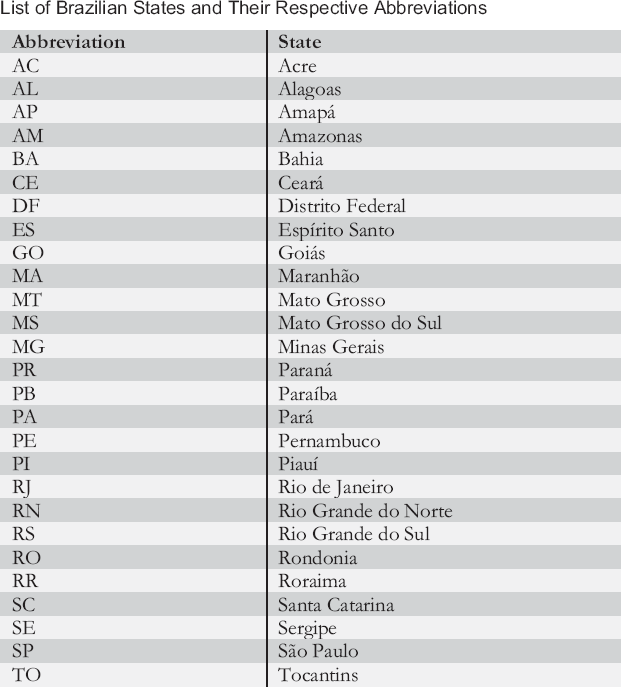
| Abbreviation | State |
|---|---|
| AC | Acre |
| AL | Alagoas |
| AP | Amapá |
| AM | Amazonas |
| BA | Bahia |
| CE | Ceará |
| DF | Distrito Federal |
| ES | Espírito Santo |
| GO | Goiás |
| MA | Maranhão |
| MT | Mato Grosso |
| MS | Mato Grosso do Sul |
| MG | Minas Gerais |
| PR | Paraná |
| PB | Paraíba |
| PA | Pará |
| PE | Pernambuco |
| PI | Piauí |
| RJ | Rio de Janeiro |
| RN | Rio Grande do Norte |
| RS | Rio Grande do Sul |
| RO | Rondonia |
| RR | Roraima |
| SC | Santa Catarina |
| SE | Sergipe |
| SP | São Paulo |
| TO | Tocantins |
Appendix C
Party Whip Positions on the Forest Code Vote, 25 April 2012
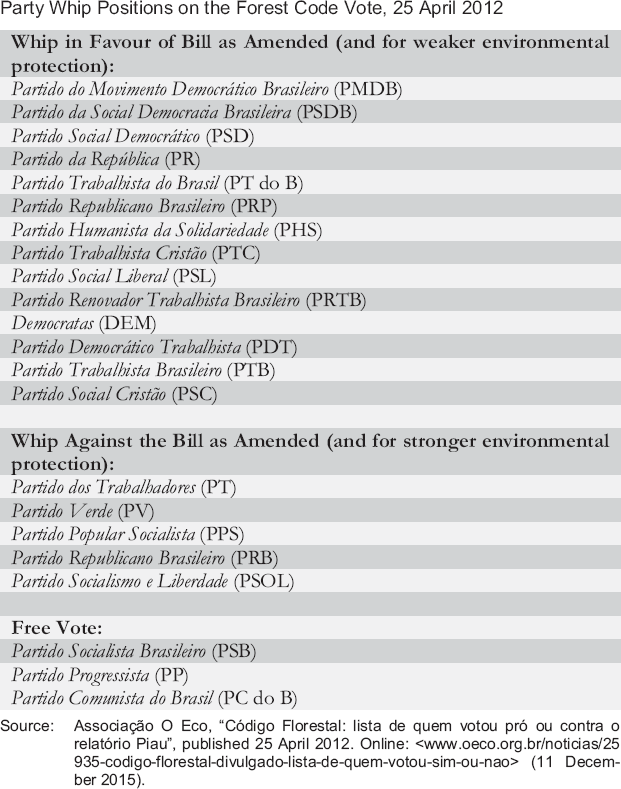
| Whip in Favour of Bill as Amended (and for weaker environmental protection): |
|---|
| Partido do Movimento Democrático Brasileiro (PMDB) |
| Partido da Social Democracia Brasileira (PSDB) |
| Partido Social Democrático (PSD) |
| Partido da República (PR) |
| Partido Trabalhista do Brasil (PT do B) |
| Partido Republicano Brasileiro (PRP) |
| Partido Humanista da Solidariedade (PHS) |
| Partido Trabalhista Cristão (PTC) |
| Partido Social Liberal (PSL) |
| Partido Renovador Trabalhista Brasileiro (PRTB) |
| Democratas (DEM) |
| Partido Democrático Trabalhista (PDT) |
| Partido Trabalhista Brasileiro (PTB) |
| Partido Social Cristão (PSC) |
|
|
| Partido dos Trabalhadores (PT) |
| Partido Verde (PV) |
| Partido Popular Socialista (PPS) |
| Partido Republicano Brasileiro (PRB) |
| Partido Socialismo e Liberdade (PSOL) |
|
|
| Partido Socialista Brasileiro (PSB) |
| Partido Progressista (PP) |
| Partido Comunista do Brasil (PC do B) |
Source: Associação O Eco, “Código Florestal: lista de quem votou pró ou contra o relatório Piau”, published 25 April 2012. Online: <www.oeco.org.br/noticias/25935-codigo-florestal-divulgado-lista-de-quem-votou-sim-ou-nao> (11 December 2015).