



Abstract
What role do Latin Americans expect legislatures to play vis-à-vis the executive? How do expectations shape political trust in a developing democracy like Peru? This article introduces new indicators gauging citizens’ current perceptions of, and idealized expectations for, the institutional independence of their elected assemblies. It uses 2007 data to test the hypothesis that the gap between the two indicators – the “legislative autonomy gap” – predicts trust in Congress. Most Peruvians claimed to prefer a more autonomous legislature. And citizens whose high expectations for institutional independence were adequately met were more likely to express confidence in Congress. However, having low expectations of congressional autonomy met also enhanced confidence in that institution. Trust in Congress proved to be pragmatic too, tied to perceptions of strong national economic performance, confidence in political parties, approval of congressional leadership, and approval of the same president from whom most Peruvians wished Congress would become more independent.
Introduction
Citizen distrust of political institutions, and of legislatures in particular, is prevalent in democracies rich and poor, old and new, presidential, semi-presidential and parliamentary (Catterberg and Moreno 2005). 1 But Latin Americans have generally polled at the very low end of political trust scales in cross-regional comparisons (Bratton et al. 2005; Boidi 2009). And within that region Peruvians have, in recent years, consistently expressed some of the lowest levels of confidence in democratic institutions (Carrión and Zárate 2007, 2009; Boidi 2009; CL 2009).
The author sincerely thanks: Rich Olson of FIU and Fernando Tuesta of IOP-PUCP for making this particular data a reality; Joseph Klesner, María Fernanda Boidi, Tatiana Kostadinova and Adrian Ang for their helpful feedback on earlier versions of this analysis; and Charles Kenney for sharing the data used in Figure 4.
In previous eras, a “folk hypothesis” for explaining low levels of trust in Latin American legislatures might have been that the public disdained them because these assemblies were weak or feckless. Now, however, we can observe some increasingly active legislatures with expanded institutional autonomy and capacity. Yet trust in legislatures across Latin America has remained flat or even declined.
What do Latin Americans want from their legislatures, and from legislative-executive relations in particular? In this article, I briefly survey the theoretical and empirical literatures on political trust. Next I compare aggregate-level data on trust in legislatures across the presidential systems of the Americas, and identify Peru as a case in which trust in Congress sharply declined even as that body markedly gained institutional autonomy in 2001–2007. I go on to introduce and operationalize a new way of thinking about how citizens view their elected assemblies, using individual-level data from a December 2007 national opinion survey in Peru. I examine expectations about the role of Peru's legislature and, more crucially, the gap between those expectations and perceptions of the legislature's actual role. I then analyze models for predicting Peruvians’ trust in Congress – gauging, in particular, the impact of the “legislative autonomy gap” – and discuss the results.
Democratization, Legislatures, and Political Trust: Theoretical and Empirical Works
Well after the “Third Wave” of democratization, some scholars continued to identify the weak institutional autonomies and capacities of legislatures as shortcomings of many Latin American systems (Linz 1990; O'Donnell 1994a; 1994b; 1996). Executive office-holders are relatively unconstrained by other branches of government, they argued, and horizontal accountability mechanisms – including the checks and balances essential to separation-of-powers systems – are ineffective. 2 In recent years, though, other scholars have instead pointed to shifts, however tentative, in the institutional balance of power. Though most Latin American legislatures continue to operate largely in a “reactive” mode, some have indeed improved their capabilities to effectively make laws, represent constituents and oversee government (Morgenstern and Nacif 2002; Crisp and Botero 2004; Crisp et al. 2004; Morgenstern 2004; Alcántara, García Montero, and Sánchez López 2005). Occasionally, an assembly will even exercise a power more closely associated with parliamentary rather than presidential systems: turfing out a president who becomes unpopular or runs afoul of Congress (Pérez-Liñán 2005, 2007; Hochstetler 2006).
On conceptualizing horizontal accountability see O'Donnell (1999), Kenney (2003) and Moreno, Crisp, and Shugart (2003).
These power shifts have not done much to improve overall levels of confidence in Latin America's national assemblies. One explanation is that people do not, in fact, want to see a more powerful legislature in their respective political systems, and do not feel confident about legislatures perceived as assertively checking the power of the executive. Another explanation, however, is that people would like legislatures to become even stronger and more autonomous from the executive branch than they currently are.
What shapes attitudes towards institutions in general, and towards legislatures in particular? Survey data research on political culture in Latin America and other new democracies builds on decades of scholarship on older democracies. Almond and Verba (1965, 1989), followed by Inglehart (1988; Inglehart et al. 2004), asserted that “civic culture” – attitudes of political efficacy, belief in the political system, and a tendency to trust other people – affects the viability of democratic political institutions. However, Jackman and Miller (1996, 2005) refute this claim, and for Latin America, Muller and Seligson (1994) likewise found evidence contrary to the civic culture thesis (see also Seligson 2001). Research on trust in specific institutions like legislative assemblies has similarly produced a raft of sometimes contradictory findings. What is more, trust in Congress, support for the institution of Congress, and approval of Congress's performance are sometimes blurred in the English language literature. And to complicate matters further, Spanish-language public opinion surveys use the term “confianza,” potentially understood as both “trust” and “confidence,” to probe this issue. (Here I use “trust,” “confidence,” and “diffuse support” (Easton 1975) interchangeably, though I reserve “job approval” for assessments of specific political figures.)
Scholarship on the US has unearthed numerous individual- and aggregate-level factors that affect feelings towards institutions such as Congress and state legislatures. For example, Patterson, Hedlund, and Boynton (1975) found that higher socioeconomic status (SES), educational attainment, and levels of political knowledge and participation all increase confidence in US legislatures, though other scholars disagreed (see Hibbing and Larimer 2005). For Latin America, Moreno (2001), Catterberg and Moreno (2005), and others suggested that democratic vs. authoritarian political attitudes shape confidence in legislatures and other institutions of government. On the other hand, Espinal, Hartlyn, and Kelley (2006) saw little evidence for the impact of democratic attitudes (or civic participation), though, echoing Catterberg and Moreno (2005), they did find that a higher level of interest in politics raises political trust. 3
Espinal, Hartlyn, and Kelley (2006) also found a curvilinear relationship between trust in institutions and variables like age and SES.
Scholars of US politics have also found that partisanship and ideology influence institutional trust and approval (on Latin America, see Mainwaring 2006; Boidi 2009). Cook and Gronke (2005) noted that conservatives have confidence in major national institutions but may distrust government in general. Kimball and Patterson (1997) found indirect evidence that conservatives disapprove of Congress in particular. Citizens who identify with a party – any party – may trust institutions such as Congress more than nonpartisans (Cook and Gronke 2005), though other scholars disagree (Kimball and Patterson 1997; Patterson, Ripley, and Quinlan 1992). And not surprisingly, party supporters of all stripes tend to withdraw their trust in, and approval of, Congress when their party is not in control of that branch (Hibbing and Theiss-Morse 1995; Keele 2005; Kimball and Patterson 1997; Patterson, Boynton, and Hedlund 1969).
The perceived performance of government institutions may affect public opinion too (Rothstein and Stolle 2008; Morris and Klesner 2010). Approval of the executive branch has been demonstrated to boost confidence in the legislative branch (Citrin 1974; Citrin and Green 1986). And how citizens perceive key organizational actors within legislatures – political parties and congressional leaders – is also thought to affect their perceptions of those legislatures. For Latin America, Boidi (2009) demonstrated that citizens’ assessments of political parties positively predict their confidence in Congress.
Finally, in addition to the political performance of presidents, parties and legislative leaders, the economic performance of the nation may also shape confidence in government and, by extension, in legislatures. Research by comparativists and Americanists alike has found that economic performance – and individuals’ perceptions thereof – positively affects democratic values, support for leaders, and, indeed, trust in institutions (Patterson and Caldeira 1990; MacKuen, Erickson, and Stimson 1992; Remmer 1993; Przeworski et al. 1996; Corral 2009).
So based on the extant literature we might expect the following variables to have an impact on how citizens feel about their legislatures:
demographic traits such as age, gender, SES, and education, as well as region;
attitudinal traits such as level of interest in politics, ideology, partisan leanings, and democratic/authoritarian values;
performance assessments of the president, political parties and congressional leadership, as well as perceptions about the health of the national economy.
However, the main contribution of this article is to introduce and assess the impact of an additional cluster of variables, one that stems from questions about the political process itself. How are citizens’ opinions about legislative institutions shaped by ideas about the proper roles of those institutions?
In trying to answer that question, one group of US-based political scientists moved the political culture debate in a novel direction. Hibbing and Theiss-Morse (1995, 2001, 2002) suggested that while most Americans strongly support the democratic political system, they dislike the untidy processes of democratic politics. Instead, they prefer “stealth democracy”: they want the mechanisms of democratic accountability to remain out of sight most of the time. Citizen confidence is thus lower for institutions – like legislatures – where conflict is more visible, and higher for more closed institutions such as courts or the executive branch (Durr, Gilmour, and Wolbrecht 1997). And if citizens have little tolerance for divisiveness and conflict in politics, then the legislative-executive balance of power can affect confidence in Congress too. Patterson and Caldeira (1990) indeed found that a legislative majority for the executive enhances US citizens’ trust in that legislature, while divided government breeds distrust. Overall,
Congress may be viewed unfavorably in part for performing the job assigned to it by the constitution […] People do not like disputes over policy issues, they do not like deliberative procedures, they do not like “special” interests, and they do not like ambitious decision-makers.
All of these elements are at the core of Congress (Hibbing and Larimer 2008: 11).
What did citizens disappointed by Congress expect it to be like? A few scholars of US politics have ventured to ask that question and to assess whether gaps between expectations and perceptions of legislatures affect political trust. Patterson, Boynton, and Hedlund (1969) found that higher levels of generalized support for the Iowa State Assembly resulted from a congruence between perceptions and expectations about that assembly and its members. Kimball and Patterson (1997) extended this research to national institutions, and similarly found that larger discrepancies between an individual's expectations and perceptions of members of the US Congress reduced that person's favorable feelings towards the legislature. They further suggest that Americans have actually been educated and socialized to expect quite a lot from Congress – so they disdain assemblies at least in part because of the high standards against which those assemblies are judged.
In operationalizing the concept of an “expectation-perception gap,” Kimball and Patterson (1997) borrowed from theories of social psychology that examine people's tendencies to harbor prototypical or idealized images of individuals and groups. When there are discrepancies between these images and perceived realities, they argue, the person or people in question are held in lower esteem – independently of how high or low the expectations and perceptions themselves might be. Appraisals are not based on absolute criteria; valuations of a person or group are made relative to existing expectations about that person or group. Prior expectations about “what should be” thus logically precede present judgments about “what is” (though they may evolve over time in an iterative process).
In politics too, expectations are the yardsticks by which individuals, groups and institutions are judged by citizens, not only in assessing specific policies or approving the job performance of a particular politician but also in proffering (or withholding) more affective feelings of trust and diffuse support. 4 As Miller (1974: 989) poignantly put it: “Political trust is the belief that the government is operating according to one's normative expectations of how government should function.”
On whether trust shapes performance evaluations or performance fosters trust, see Hetherington (1998).
In a separation-of-powers system, one of the most basic elements of “how government should function” would be relations between branches of government. And different people expect different things from these relations. The spectrum of public opinion vis-à-vis the proper role of national legislatures is very broad, especially among newer democracies. For example, while some Latin Americans wouldn't mind if their legislative branches more actively checked the power of executives, the percentage of citizens in 2008 who agreed with the notion that if the legislature “hinders the work of our government, our president […] should govern without the legislature” ranged from 21.8 percent in Argentina to 54.2 percent in Ecuador (AmericasBarometer). Disparate expectations about political processes and institutions might in turn lead to different levels of trust in, and diffuse support for, those processes and institutions.
Theories of expectations, perceptions and trust in Congress are nascent at best, even in the US politics literature from which they emerged. 5 The study of this question in newer democracies has been even more scant. 6 However, work on Latin America by Boidi (2009) stands out as a notable exception. Analyzing AmericasBarometer data from 2008, she concluded that citizen trust in legislatures is a linear function of the extent to which citizens feel that those assemblies “fulfill expectations.” Though the AmericasBarometer survey did not explicitly ask what those expectations might be, responses to other questions suggest that “making important laws” is one element. 7 Horizontal accountability may be another: trust in congresses is related to the degree to which they are viewed as “hindering” (estorba) the work of presidents. Higher perceptions of congressional checks on the executive led to higher levels of trust in Congress, though the relationship is slightly curvilinear: the 10 percent of respondents who felt that legislatures hinder executives “a lot” reported significantly lower levels of trust than those who perceived a moderate or low counterbalance.
More recent work on the “expectations-perceptions gap” in the US has tended to focus on the executive rather than on legislatures (Waterman, Jenkins-Smith, and Silva 1999; Jenkins-Smith, Silva, and Waterman 2005).
On Central and Eastern Europe see Hibbing and Patterson (1994) and Olson (1997). On broader expectations for democracy in Latin America, see Camp (2001) and Seligson (2001). On expectations about legislatures cross-nationally, see Mezey (1979).
Correlation between perceptions of fulfilling expectations and making important laws is 0.274 (Boidi 2009: 238).
Here I propose a linear hypothesis (though I will also check for nonlinear effects):
The larger the gap between a person's expectations about the legislature's independence from the executive branch and his/her perceptions of actual congressional independence, the lower that person's trust in the legislature.
Confidence in Legislatures: Exploring Aggregate Cross-National Data
Why do some countries’ citizens trust their legislature more than others? Eyeballing aggregate-level cross-national data from the Latinobarometer and AmericasBarometer offers few easy answers. Confidence in legislatures in 2008 does not seem directly related to factors like national wealth or the quality or stability of democracy, for example.
In Figure 1, relatively wealthy Latin American countries can be found at both the upper (Mexico, Chile) and lower (Argentina, Brazil) ends of the legislative trust scale. Some relatively poor countries (Dominican Republic, Bolivia) score high, others (Nicaragua, Haiti) score low. The correlation between 2008 GDP per capita and mean level of confidence in legislatures is insignificant (.04, P=.852). 8 Likewise, a long-standing, high-quality democracy like Costa Rica boasts high levels of confidence in parliament, but so does politically-troubled Venezuela; the US Congress is trusted less than legislatures in Honduras and Guatemala. Mean level of confidence in a country's legislature is not significantly correlated with its democratic quality or with the durability of its current democratic regime (.31, P=.177 and .06, P=.816, respectively). 9 So confidence in legislatures is not just epiphenomenal to macroeconomic indicators or political regime types.
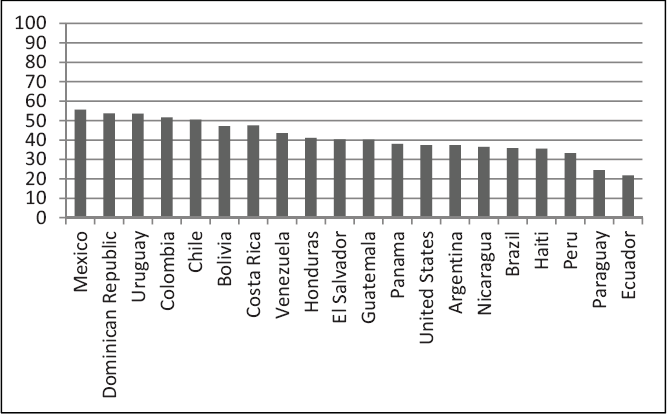
Citizen Confidence in Legislature, 2008
GDP per capita in 2000 constant USD (World Bank 2010).
Polity IV “POLITY” and “DURABLE” variables; Marshall and Jaggers 2006.
Nor, I would argue, does confidence in the legislature merely indicate overall levels of political trust. It is true that confidence in different national institutions often do track closely together (Hibbing and Patterson 1994; Hetherington 1998; Cook and Gronke 2005). And if we compare trust in Congress to trust in “national government” – implying the executive branch and its bureaucracy 10 – we do see a strong correlation in the 2008 data (0.745, P<.01). However, within-country differences between trust in legislatures and trust in government give us some valuable insights into how societies feel about the former. In all but two presidential systems in the hemisphere (the US and Paraguay), legislatures enjoyed markedly less confidence than “the government” in 2008. 11 (In Ecuador, the country with the least trusted legislature, the mean difference was a staggering 31.4 percentage points.) This disparity in institutional confidence is a persistent one: at the regional level, every year from 1996 to 2009 that the Latinobarometer asked about confidence in legislatures and also in government and/or the executive, legislatures lagged behind (CL 2009). In most separation-of-powers systems most of the time, legislatures inspire less confidence than the executive branch.
Most years from 1996-2008, Latinobarometer asked about confidence in national government, not the national president; AmericasBarometer only began systematically including confidence in the executive in 2008.
US data was compiled solely from an internet-based survey; more reliable Gallup polls done in the same period put approval of Congress much lower (Hibbing and Larimer 2008).
We might then ask whether and how this disparity is related to the perceptions and realities of the legislative-executive relationship itself. On perceptions, the 2008 AmericasBarometer (as noted above) asked respondents whether parliament “obstructs the power of the president” – and then asked whether, in such cases, “our president […] should govern without the legislature.” Aggregate-level correlations between each of these variables and legislative trust are not significant, and the correlation between the two variables themselves is negative (-.672, P<.01). Societies in which many people believe that legislatures obstruct presidents have fewer people who believe that, under such circumstances, the president should govern alone. Analyzing individual-level data, Orces (2009) found that the belief that parliament blocks the power of the president predicts greater support for presidents governing without legislatures. Yet as mentioned above, Boidi (2009) clarified that perceptions of legislatures counter-balancing presidents positively predicted trust in those legislatures – except at the very highest levels of perceived parliamentary obstructionism. So citizens might bestow their trust on parliaments that they perceive as providing a moderate (not extreme) check on executive power.
But perceptions and realities can diverge. On the realities of inter-branch conflict, we can see whether legislatures with greater opposition party representation inspire more confidence than those with greater representation for the president's party in Congress. Looking at the relationship between trust and partisan composition (Figure 2), it appears that the opposite is true: there is a positive correlation between the percentage of seats held by the president's party and the level of citizen confidence in the legislature (.445, P<.05). If we remove the outlier case of Venezuela, in which fully 100 percent of legislative seats were won in 2005 by parties affiliated with President Chávez, the correlation becomes even stronger (0.559, P<.05). So inter-branch harmony, not horizontal accountability, might be what earns citizens’ trust.
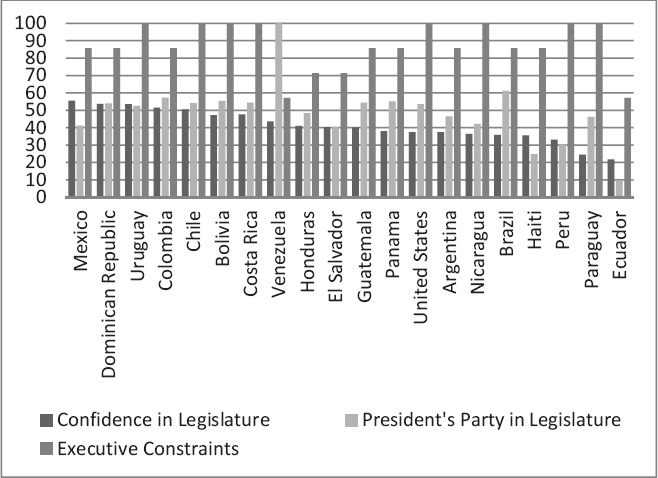
Citizen Confidence in Legislature, Legislative Seats Won by President's Party, and Effective Constraints on the Executive, 2008, in percent
Another way to analyze the role of the legislature vis-à-vis the executive would be to employ expert assessments of effective institutional counterweights, or “executive constraints.” 12 Here the relationship is less clear. Some systems with highly constrained executives, like Chile and Uruguay, also have legislatures that attract the trust of their citizens. On the other hand, Peru and Paraguay get high executive constraint scores yet their legislatures received very low levels of citizen confidence. Correlation between the two indicators is insignificant (.20, P=.40).
Polity IV's “EXECUTIVE CONSTRAINTS” variable gauges “institutionalized constraints on the decision-making powers of chief executives […] In Western democracies these are usually [provided by] legislatures” (Marshall and Jaggers 2006: 23).
Looking at change over time within systems is similarly puzzling. The most dynamic cases of change in inter-branch power relations (Figure 3) – those with the largest net differences in executive constraints from 1996 to 2008 – are Mexico, Ecuador, Venezuela and Peru.
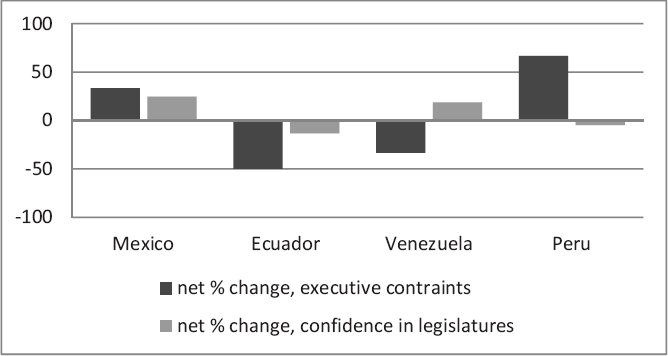
Net Change in Legislative-Executive Relations and Confidence in Legislatures, 1996 to 2008
In Mexico, constraints on the president increased as the ruling party shed its hegemonic role, losing control of the legislature in 1997 and giving up the presidency in 2000 – and there, confidence in the legislature increases too. From 1996 to 2008, executive constraints in Ecuador dropped, and confidence in the legislature moved in the same direction. But Venezuelans gained confidence in their legislature even as it was transformed from a fairly autonomous body controlled by an opposition majority during the second Rafael Caldera presidency (1994–99) to an increasingly compliant chamber controlled, since 2000, by the parties of President Hugo Chávez. And perhaps most strikingly, confidence in Peru's legislature fell even as constraints on the executive dramatically increased in the 2000s and Congress asserted its autonomy in ways not seen since the early 1990s.
Confidence in Legislatures: Citizen Perceptions of Congressional Autonomy in Peru
Indeed, Peru provides a fascinating case study of the relationship between institutional autonomy and citizen trust. From 1990 to 1992, the opposition-controlled legislative branch was, at times, in open conflict with newly-elected President Alberto Fujimori. In this period of severe economic crisis and mounting threats from armed insurgents, the public grew increasingly distrustful of the legislature. In April 1992, Fujimori launched a self-coup that shut down Congress, the courts, and other national and regional institutions – a move that was wildly popular at the time and stayed popular for several years thereafter. 13 Once reopened, Peru's legislature was hobbled; it enjoyed little institutional autonomy and was tightly controlled by Fujimori (and his advisor Vladimiro Montesinos). And yet the peak years for trust in Congress in Peru were 1993–1996. During that time, a Fujimori-dominated Constituent Assembly served as the national legislature from 1993 to 1995, and then the president was re-elected in 1995 along with a legislative majority.
On political trust and support for the coup, see Seligson and Carrión (2002).
The Fujimori presidency ended when he fled the country and resigned from office in late 2000, in the wake of a tainted re-election process and massive corruption scandals. Almost immediately, the role of the legislature in Peru underwent a dramatic transformation. From 2001 to 2006, lawmaking was increasingly done by congressional vote; presidential decrees decreased. Successful bills were more likely to originate in Congress than they had been in 1992–2000. Standing committees played more active roles in crafting legislation. Vetoes and veto overrides increased. Day to day oversight of government by Congress was enhanced. On virtually any measure, the legislature became more active in its own right and more independent from the executive (Levitt 2011).
But this newly-invigorated representative institution did not elicit durably higher levels of public trust. In fact, after a brief honeymoon following the 2000–2001 transition period (when the President of Congress, Valentín Paniagua, served as interim President of Peru), citizens became less confident in their legislature than they were during the Fujimori era. Elected in 2001, President Alejandro Toledo lacked the stable legislative majority that Fujimori had enjoyed from 1992 to 2000. What is more, Toledo actually adhered to the constitutional rules of the game and respected the role they set out for Peru's Congress. Yet in this era, public confidence in the legislature hit single digit lows.
Trust in Congress improved temporarily after Alan García won the presidency in 2006, defeating populist Ollanta Humala in a run-off election. García put together a legislative coalition that was anchored by his own well-organized APRA (American Popular Revolutionary Alliance) Party and also included part of the center-right UN (National Unity) Alliance led by third-place presidential candidate Lourdes Flores. But trust in Congress began to decline again in 2007 (APOYO S.A.). What is more, this decline cannot be attributed to any exogenous shock to the system. By late 2008, the legislature would indeed be affected by a major scandal: the alleged bribery of ministers – including Prime Minister Jorge Del Castillo, a sitting member of Congress – by foreign oil companies. But the 2007 data in Figure 4 (as well as the individual-level data analyzed below) were gathered well before that scandal broke. Confidence in Congress had simply reverted to its lackluster mean for the post-Fujimori period.
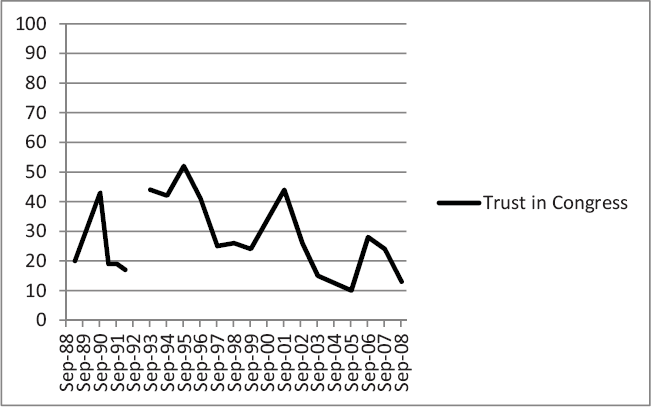
Peruvians’ Confidence in Congress, 1989–2008
Why might a more active Congress in a more robustly democratic Peru earn such paltry public confidence? As noted above, all matters of political trust necessarily involve people's normative expectations and whether or not those normative expectations are being met. So if we suspect that the public was disgruntled or disappointed with a more independent elected assembly, we should find out what Peruvians see – and would like to see – in the relationship between their Congress and their president.
Most national and cross-national surveys do not ask such a question explicitly. To help fill this gap, I was fortunate to be able to place two simple questions addressing this issue on a national survey conducted in Peru in December 2007 by the Institute for Public Opinion at the Pontifical Catholic University of Peru (IOP-PUCP 2007). The first asked how much independence or autonomy respondents believe Congress currently has vis-à-vis the executive branch or the president. The second asked how much independence or autonomy respondents believe Congress ideally should have (“idealmente … debería tener”) in this inter-branch relationship. 14
Legislature was elected by PR in multimember districts, and linkages between individual members and their constituents were weak (Levitt 2011). Thus, survey respondents were unlikely to be thinking of “their” congresista rather than Congress as a whole.
In their responses, most Peruvians expressed a clear preference for a more independent, autonomous legislature than they felt they had in late 2007. 15 On the question about perceived autonomy (a 1–5 scale), the mean response was 2.84, just below the mid-point. But on the question about ideal levels of legislative autonomy, the mean response was 3.96, well above the mid-point. 16 And nearly half (49 percent) of those polled wanted the legislature to have “a lot” of independence from the executive, the highest level of autonomy on the scale.
All analyses of this data employ survey weights.
Perceived and preferred levels of autonomy were not correlated; Kendall's tau b =-.01, P =.74.
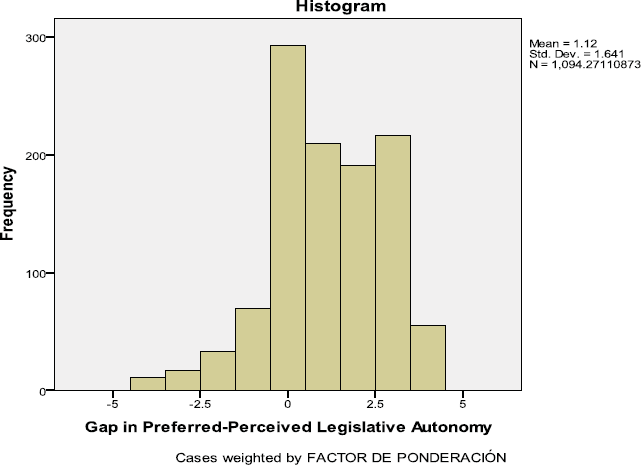
Relative “Legislative Autonomy Gap” in Peru, December 2007
If we put these observations together, we can measure the divergence of perceptions from expectations: a person's “legislative autonomy gap.” Subtracting perceived from preferred levels for each respondent yielded a relative indicator which ranged from −4 to 4 with a mean of 1.12. And removing the signs would measure the gap in absolute terms, though since 88 percent of relative gap observations were 0 or positive, this shifts the mean only modestly, to 1.56 out of 4.
Armed with this novel data, we can assess the impact that Peruvians’ perceptions and expectations about their legislature's independence might have on confidence in that legislature, controlling for other factors that have been hypothesized to affect it. Here I test a series of ordinal logit (“heterogeneous choice”) models predicting trust in Congress. All data was drawn from the December 2007 IOP survey (n=1700). The dependent variable is a three-category ordinal variable representing the degree of confidence respondents have in Peru's national legislature. 17 Other independent variables, derived from the literature on political trust, include demographic traits (age, gender, SES, 18 education, 19 and region 20 ); values and attitudes (interest in politics, 21 ideology, 22 partisanship, 23 and authoritarian values 24 ); and perceptions of performance (attitude towards parties, 25 job approval for the President and the congressional leader, 26 and perception of national economic performance 27 ).
Survey responses were “none,” “little,” “some,” or “a lot.” However, few respondents had “a lot” of confidence in Congress, so I collapsed the variable from four categories to three, reducing the number of empty cells and permitting use of the logit link.
Peruvian pollsters commonly use five composite SES categories represented by letters A through E; this survey collapsed SES into three categories: High (A/B), Middle (C); and Low (D/E).
Highest level of educational attainment; ten categories, from “none” to “Postgraduate.”
Categories are East, North, South, Center and Lima.
Self-described level of interest in politics; four response categories.
Self-placement on a left-to-right ideological scale; ten response categories, 0 = left, 10 = right.
First-round presidential vote in the last (2006) election, operationalized as dummy variables for each of three leading candidates: Ollanta Humala, Alan García and Lourdes Flores. These three account for 89 percent of valid survey responses.
Three-category ordinal variable gauging authoritarian values, ranging from “democracy is always preferable” to “systems of government are all the same to me” to “authoritarianism or dictatorship can sometimes be preferable.”
Confidence in political parties; four response categories. As the focus is on actors rather than institutions, this item assesses performance more than diffuse support.
Binary variables for approval/disapproval of the performances of President Alan García and of the President of Congress, Luis Gonzales Posada.
Following recent studies (Morris and Klesner 2010), economic performance was conceptualized as perceptions of sociotropic rather than “pocketbook” well-being, though the two were significantly correlated (Kendall's tau b =0.509, P<.01 for prospective, and 0.395, P<.01 for retrospective assessments). Since scholars disagree on the relative merits of each (Michelitch et al. 2010), I combined scores from prospective and retrospective sociotropic variables, each a five-point scale of perceived national economic decline/improvement during the past/next twelve months. (Modeled separately, prospective and retrospective variables had similar impacts on the dependent variable.)
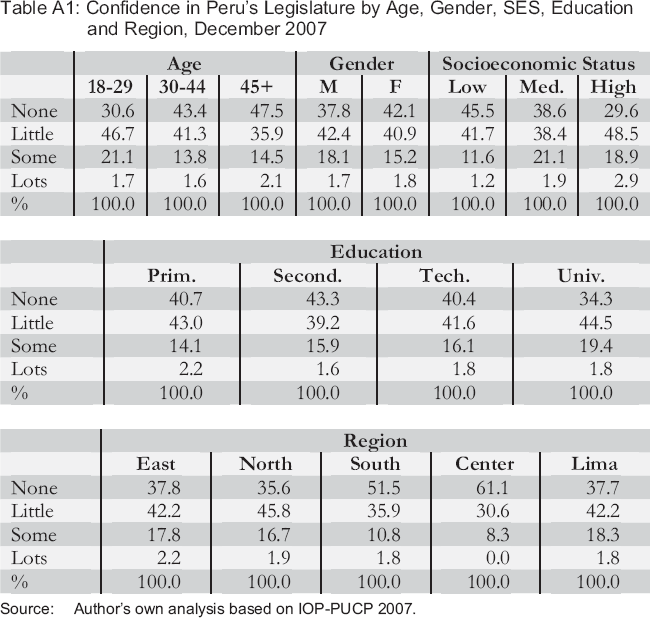
Purely descriptive statistics might insinuate that confidence in Congress is a function of demographic traits (see Appendix A). Trust in the legislature was, at a glance, lowest among women, older Peruvians, those of lower SES and with less education, and those who live in the Southern and Central highlands of Peru.
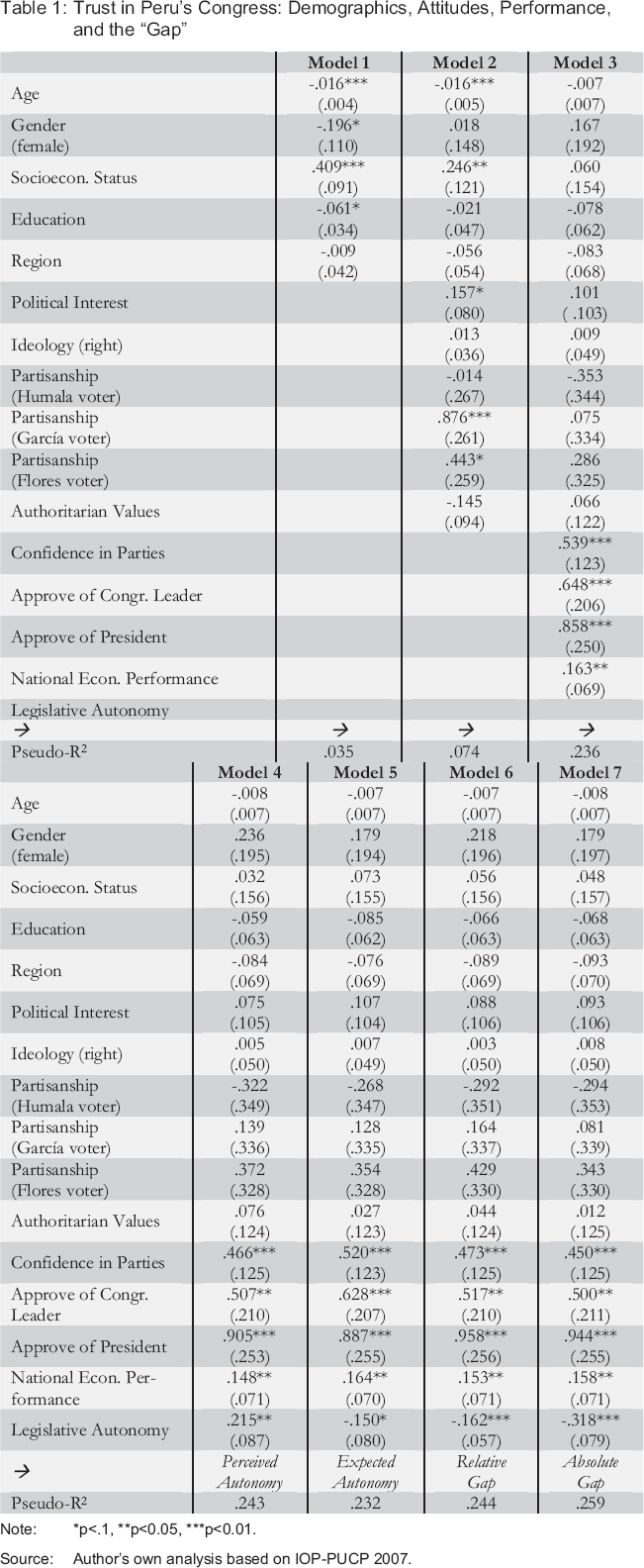
Multivariate analysis tells a different story. 28 In Table 1, we begin with a simple model including only those demographic traits. Age and SES appear significant; gender and education, weakly so (Model 1). If we add attitudinal variables, only age and SES remain significant in the model; among the attitudinal variables, interest in politics is significant, as is partisanship (Model 2).
Trust in Peru's Congress: Demographics, Attitudes, Performance, and the “Gap”
Note:
p<.1
p<0.05
p<0.01.
Source: Author's own analysis based on IOP-PUCP 2007.
There is no threat from multi-collinearity in any model in Table 1, as VIFS for all variables are <3, and all but the partisanship dummy variables – correlated by definition – are <2. As “heterogeneous choice” models, all are corrected for possible heteroskedasticity. Finally, all models pass parallel lines tests at the .01 level.
Being an electoral supporter of Alan García or of the other moderate runner-up in 2006, Lourdes Flores, increased the odds of a citizen having confidence in the legislature. Introducing performance variables (Model 3) washed out the impact of all of these demographic and attitudinal variables. Confidence in parties, approval of the president's and congressional leader's performances, and a positive assessment of the national economy all increased the odds of trusting Congress. But even when we control for all of these variables, citizens’ perceptions and expectations of legislative autonomy – and the gap between them – significantly predict trust in Congress.
In Model 4 we see that perceiving a higher degree of actual institutional independence in Peru's legislature increased citizens’ confidence in that body. By contrast, expecting a higher degree of congressional autonomy as an ideal (Model 5) corresponded with lower levels of trust in Congress. Most importantly, we can see that large discrepancies between the two indeed seem to dampen political trust: the gap between current perceptions and normative expectations is a significant predictor of lower confidence in Congress whether we operationalize the gap in relative terms (Model 6) or absolute terms (Model 7). Though we should be cautious about interpreting pseudo R-squares, the values generated when we include the relative gap (Model 6) and, especially, the absolute gap (Model 7) are markedly higher than when we exclude this information (Model 3). And bivariate test statistics indicate that the effect of the gap on political trust is probably linear, as differences between R-squared and Eta-squared values were small (=.025 for the relative gap and .011 for the absolute gap).
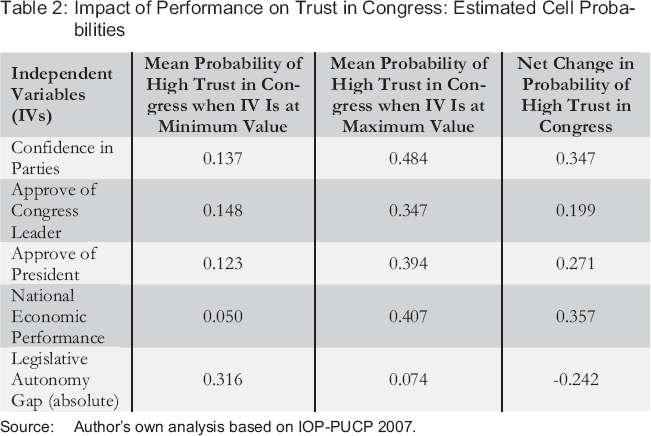
Thus it appears that an “expectations-perceptions gap” in citizen views on legislative autonomy has a discernible impact on trust in Congress in Peru. How much of an impact? Using the estimated probabilities generated by Model 7, we can assess the effects of the relevant control variables and of the “gap” variable on trust in Congress.
We can compare changes in the estimated probability of a respondent reporting a high level of trust in Congress as each independent variable moves from its minimum to its maximum value.
Table 2 shows that each variable that proved significant in Model 7 can, on its own, change the probability of having high confidence in the legislature by 20 to 35 percentage points. A shift from the lowest to the highest absolute value of the gap variable would lower the probability of having high trust in Congress by 24 points. While this does not negate the role of other performance variables in shaping political trust, the “legislative autonomy gap” has an impact that is larger than approval of congressional leadership and nearly as large as approval of the president.
Impact of Performance on Trust in Congress: Estimated Cell Probabilities
Source: Author's own analysis based on IOP-PUCP 2007.
Overall, the results presented in Tables 1 and 2 demonstrate that the extent to which a legislature fulfils citizens’ idealized expectations about its proper role vis-à-vis the executive markedly improves public confidence in that legislature. This relationship is robust even as we control for demographic traits, political attitudes, and a host of performance variables.
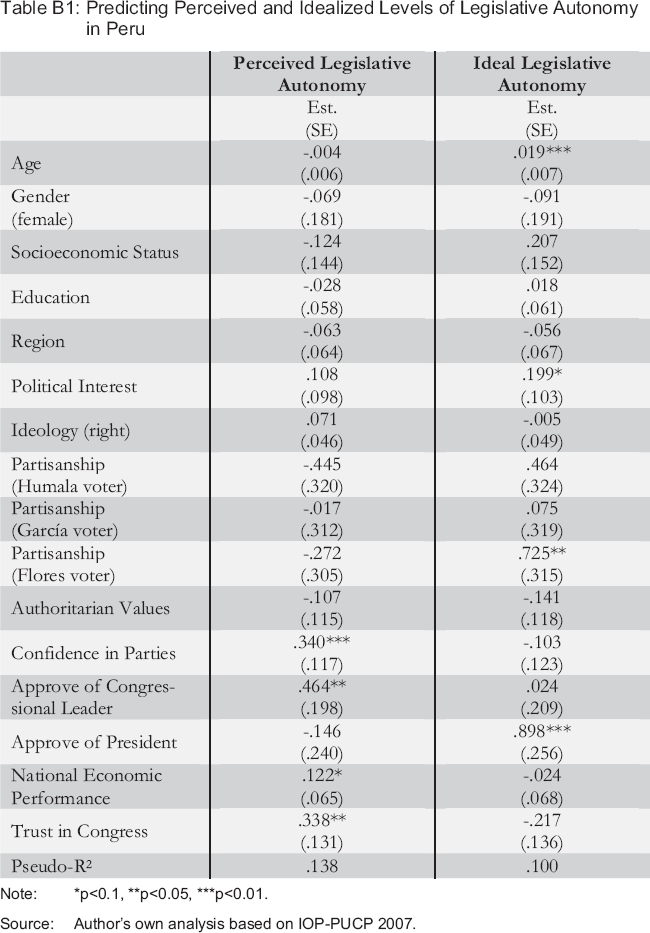
I end this section with three brief caveats about generalizability, endogeneity and reciprocal causation. First, it is true our analytical leverage would be vastly increased were cross-national and/or time-series data to become available. But as suggested above, data on feelings about legislative autonomy are only infrequently generated by cross-national or even national surveys. This was, to my knowledge, the first time that such a question had been asked in a national survey in Peru – and cross-national data-gathering on this issue within Latin America, while improving, has not been consistent. 29 Second, though demographic and attitudinal variables dropped out of more fully specified models, it is possible that these continue to indirectly affect trust in Congress through their effects on performance variables. Future analysis using structural equations models might be fruitful. Finally, the analysis presented here raises an additional question: if an expectations-perceptions gap affects political trust, might not political trust also affect expectations and/or perceptions? To assess this particular threat, I modeled trust in the legislature as a predictor of the two component parts of the “legislative autonomy gap”. The results (see Appendix B) indicated that trust may have an impact on perceived levels of autonomy but not on ideal levels of autonomy. (And it was the “ideal autonomy” side of the gap that contributed more variance.) Future analysis using reciprocal or recursive models could shed additional light on this dynamic, but in the meantime we might cautiously accept the findings presented here.
The 2008 AmericasBarometer included more detailed questions about the role of Congress than previous waves of that survey or of the Latinobarometer, though it did not include explicit questions about preferences for, and perceptions of, legislative autonomy (and the 2010 wave dropped even those questions that were included in 2008).
Discussion
Most Peruvians in late 2007 wanted their national assembly to stake out a more autonomous institutional role vis-à-vis the executive. If genuine, this sentiment could bode well for the country's democratic institutional development, especially after the low levels of public trust extended in 2001–2006 to a legislature that was, by the standards of previous years, remarkably active and independent.
Understanding the “legislative autonomy gap” gives us some additional analytical leverage over questions of diffuse support for the legislature. As hypothesized, the larger the gap between perceived and expected levels of congressional independence, the lower a citizen's confidence in Congress. If we take Peruvians at their word, then their distrust of Congress is due in part to Congress's doing too little rather than too much, falling short of the more independent role they would like it to have. But the absolute value of the gap was an even better predictor of trust in Congress than the relative gap: Peruvians who would have preferred their national assembly to be less autonomous than it was in 2007 were also more likely to distrust that assembly than those whose expectations, however high or low, were being met. Expectations matter.
How do other results presented above square with prior scholarship? Consistent with the more recent literature on US politics (Hibbing and Larimer 2005; Kimball and Patterson 1997), demographic traits were, overall, not very germane to the level of trust Peruvians showed for their legislature – at least not once we control for political and economic performance assessments. Unlike Carrión and Zárate (2009), Espinal, Hartlyn, and Kelley (2006), and several other recent works, I found only a weak or indirect linear relationship (and no curvilinear relationship 30 ) between age and trust in Congress. Likewise, the impact of SES on institutional trust was indirect at best.
Models testing age-squared not reported here; available upon request.
Nor were the effects of political attitudes and values very robust. In contrast with Boidi (2009), I did not find much evidence in support of the “civic culture” approach – though I was limited by the range of variables generated by this particular instrument. The IOP survey did not include questions about interpersonal trust, associational life, or political efficacy. However, democratic values, which I was able to test, made no difference to citizens’ political trust here, unlike in Moreno (2001) and Catterberg and Moreno (2005), among others. (Though it dropped out of the model, a greater interest in politics may increase trust in congress, consistent with Espinal, Hartlyn and Kelley 2006 and Carrión and Zárate 2009 but not Boidi 2009.)
Partisanship, too, played only a modest role in shaping trust in Peru's Congress. Voters who supported presidential candidate Alan García in 2006 were, by late 2007, more likely than other voters to express confidence in the legislature, but the effects of aprista partisanship disappear once we also factor in presidential job approval. Lourdes Flores’ voters were also somewhat more likely to trust Congress in late 2007, though by then some remnants of her UN Alliance had entered into an informal legislative coalition with President García's APRA Party while others had not, so it is difficult to assess whether Flores’ voters identified with the government or with the congressional opposition. In any case, this variable, too, drops out of more fully specified models. Finally, being a Humala supporter had no significant effect on trust in Congress. This was perhaps a product of the contradictions inherent in the roles that his electoral movement was playing in 2007. On the one hand, humalista legislators comprised the single largest opposition bloc in Congress; on the other hand, the ideology of their movement had, at the time, a rather anti-institutional bent.
The impact of government performance, broadly conceived, overshadowed most other influences on trust in the legislature. Echoing Espinal, Hartlyn, and Kelley (2006) and others, I found that positive assessments of government performance mattered more than demographic traits or democratic values. Sociotropic assessments of economic performance – perceptions of national economic well-being – had the hypothesized positive effect on trust in legislatures and, in fact, had the strongest impact of any variable included in the model. 31 Confidence in parties and approval of congressional leadership increased trust in the legislature too, consistent with Boidi's (2009) findings. Finally, a more positive assessment of the executive's performance increased trust in Congress, consistent with Citrin's analysis of US public opinion (1974; Citrin and Green 1986) but in contrast with Carrión and Zárate's results for Peru (2009). 32
Carrión and Zárate (2009) found that “pocketbook” perceptions shaped confidence in institutions but sociotropic perceptions shaped support for limiting the roles of parties or legislatures in Peru.
Note that results indicate more than a “government vs. opposition” effect. Bivariate correlation between presidential approval and trust in Congress are significant but modest (Kendall's tau b =.294, P<.01). And controlling for presidential and congressional leadership approval, expectations and perceptions of autonomy still have strong, significant effects.
My findings provide some indirect support for the theory of “stealth democracy” (Hibbing and Theiss-Morse 2002). Peruvians who approved of the president or voted for the candidate of some of his legislative partners may trust Congress more because they value inter-branch harmony. (Citizens were also apt to expect more independence for the legislature if they approved of the president and/or voted for the moderate opposition; see Appendix B.)
But the most original new finding presented here is this: Peruvians trust legislatures that live up to their expectations for institutional autonomy and distrust those that do not. 33 Most Peruvians hoped for an elected assembly more independent than what they saw in 2007. Those who held the most idealized images of congressional autonomy and/or made the lowest assessments of existing autonomy were indeed those who trusted Congress the least. Yet the absolute size of the gap between expectations and perceptions was a slightly better predictor of congressional distrust than the more information-rich relative gap variable. Citizens who rejected the idea of an autonomous legislature were still apt to trust Congress as long as they perceived a reassuringly low level of independence in its current incarnation. While these results do suggest some strong aspirations for greater horizontal accountability, they also tell a simpler but equally compelling story of met vs. unmet expectations. In doing so, my findings bolster the fledgling theory of an “expectations-perceptions gap” put forth by Patterson, Boynton, and Hedlund (1969), Kimball and Patterson (1997) and a few others.
The autonomy gap is not merely a proxy for trust in Congress; they are significantly but only modestly correlated (Kendall's tau b =.219, P<.01 between trust and perceived autonomy; =.055, P<.05 between trust and ideal autonomy).
Conclusions
Most Peruvians would apparently like to see a legislature with greater capacity to act on its own, independent from an executive branch that has, in the current wave of democratization, tended to overshadow it. However, there was a range of disparate empirical perceptions about what the legislature was doing in 2007, and an even wider range of normative expectations about what the legislature ought to have been doing. These normative and empirical considerations are mutually constitutive: dissatisfaction with the current role of the legislature cannot be understood without asking what sort of role would be considered more satisfactory.
In this article I tested a hypothesis that had previously gone largely unexplored in Latin America. I affirmed that, in Peru at least, the gap between a citizen's normative preferences and empirical assessments of the legislature's independence from the executive crucially shapes diffuse institutional support for that legislature. The larger the gap, the less likely one is to express confidence in Congress.
I also demonstrated that demographic traits and political attitudes had little impact on political trust. Instead, it was citizens’ assessments of government performance that were the key to understanding their confidence in Congress. How highly Peruvians thought of their national economy, their president, their parties, and their parliamentary leader were all crucial to predicting how much overall confidence they felt towards that parliament. But even once we controlled for the impact of all of these performance variables, the “expectations-perceptions gap” continued to affect trust in Congress.
Why does any of this matter? Because having a legislature worth its salt – able to make laws, represent citizens, oversee government and check the executive's power – is crucial to the quality of a democracy (Fish 2006). For Peru, where representative institutions have been disdained and even discarded in the recent past, it is heartening to hear that most citizens would prefer a more autonomous role for their elected assembly. And the fulfillment of citizens’ surprisingly high expectations for legislative autonomy was a very robust predictor of their confidence in that institution in late 2007.
This finding seems difficult to reconcile with the aggregate-level time-series data indicating Peruvians’ declining trust in Congress after the post-Fujimori democratic transition of 2000–2001. Trust in Congress was higher in the executive-dominated, post-coup Fujimori era (1992–2000) than during the muscular exercise of checks and balances that constrained the Toledo presidency (2001–2006). Even in 2007, Peruvians who approved of President García trusted the legislature (which he controlled through informal coalitions) more than those who disapproved of the president, perhaps indicating a proclivity for inter-branch harmony rather than the vigorous horizontal accountability that most Peruvians – like most Americans – claim to prefer. As Hibbing and Larimer (2008) note, Americans frequently hold self-contradictory attitudes about what they want from legislatures. Peruvians, too, may be unwittingly averse to the sorts of visible politicking that go on in an elected assembly that is actually doing its job well and living up to their stated expectations. 34
If so, then increased government transparency, roll-call voting in Congress, burgeoning press freedoms, and other democratic reforms in Peru may be a double-edged sword for earning citizens’ trust.
Performance factors other than legislative autonomy also powerfully shaped political trust. Peru's citizens seemed pragmatic in their trust in Congress; they especially rewarded performance on economic matters. If Peruvians think that their national economy is doing well, they will trust their representative institutions more. Of course, if the economy declines, or is even perceived to decline, then diffuse support for representative institutions could also decline. 35 And we know that in a moment of severe economic and social crisis in 1992, a president could destroy an opposition-controlled legislature and replace it with a more compliant chamber – all with the overwhelming assent of public opinion.
The data analyzed here also indicate a serious disjuncture between macroeconomic perceptions and realities. Just 28.5 percent of respondents felt that Peru's economy had improved at all over the previous 12 months, even though GDP growth in 2007 was a brisk 8.3 percent; see World Bank 2010.
A modicum of distrust of government is healthy – some would say fundamental (Hardin 2004) – for liberal democracy. But this crucially assumes that the persistence and functionality of key democratic institutions are not themselves in peril. If we could take that for granted, then conditioning trust on government performance might indeed enhance the quality of “new democracies” (see Cleary and Stokes 2006). Conditioning trust on government performance would be especially beneficial to new democracies if performance criteria included institutions fulfilling their constitutionally-delineated roles. In a presidential democracy, this requires an assembly meaningfully engaged in lawmaking, representation and oversight, notwithstanding the untidy legislative-executive conflicts that could ensue (Montinola 2004).
Increased congressional autonomy is what most Peruvians said they were looking for in late 2007. If this is so, then institutional practices that fulfill those high expectations of legislative autonomy will indeed improve political trust. Yet fulfilling low expectations of congressional autonomy improved political trust too. What is more, Peruvians’ attitudes towards their Congress are pragmatic: sensitive to perceived changes in national economic performance and, perhaps, tinged with “stealth democratic” values.
A cynic might conclude that citizens who claim to prefer higher levels of independence for their legislature are in fact unclear about what they really want, while citizens who claim to want less congressional autonomy are in danger of getting what they ask for. But perhaps such pessimism is unwarranted. The most straightforward interpretation of my findings would suggest better tidings for a fragile presidential democracy like Peru: virtuous cycles of increased horizontal accountability and growing public trust in Congress may be both possible and practicable.
Footnotes
Appendix A
Confidence in Peru's Legislature by Age, Gender, SES, Education and Region, December 2007
|
|
|
|
||||||
|---|---|---|---|---|---|---|---|---|
|
|
|
|
|
|
|
|
|
|
| None | 30.6 | 43.4 | 47.5 | 37.8 | 42.1 | 45.5 | 38.6 | 29.6 |
| Little | 46.7 | 41.3 | 35.9 | 42.4 | 40.9 | 41.7 | 38.4 | 48.5 |
| Some | 21.1 | 13.8 | 14.5 | 18.1 | 15.2 | 11.6 | 21.1 | 18.9 |
| Lots | 1.7 | 1.6 | 2.1 | 1.7 | 1.8 | 1.2 | 1.9 | 2.9 |
| % | 100.0 | 100.0 | 100.0 | 100.0 | 100.0 | 100.0 | 100.0 | 100.0 |
|
|
||||
|---|---|---|---|---|
|
|
|
|
|
|
| None | 40.7 | 43.3 | 40.4 | 34.3 |
| Little | 43.0 | 39.2 | 41.6 | 44.5 |
| Some | 14.1 | 15.9 | 16.1 | 19.4 |
| Lots | 2.2 | 1.6 | 1.8 | 1.8 |
| % | 100.0 | 100.0 | 100.0 | 100.0 |
|
|
|||||
|---|---|---|---|---|---|
|
|
|
|
|
|
|
| None | 37.8 | 35.6 | 51.5 | 61.1 | 37.7 |
| Little | 42.2 | 45.8 | 35.9 | 30.6 | 42.2 |
| Some | 17.8 | 16.7 | 10.8 | 8.3 | 18.3 |
| Lots | 2.2 | 1.9 | 1.8 | 0.0 | 1.8 |
| % | 100.0 | 100.0 | 100.0 | 100.0 | 100.0 |
Source: Author's own analysis based on IOP-PUCP 2007.
Appendix B
Predicting Perceived and Idealized Levels of Legislative Autonomy in Peru
| Perceived Legislative Autonomy | Ideal Legislative Autonomy | |
|---|---|---|
| Est. | Est. | |
| (SE) | (SE) | |
| Age | -.004 | .019 *** |
| (.006) | (.007) | |
| Gender (female) | -.069 | -.091 |
| (.181) | (.191) | |
| Socioeconomic Status | -.124 | .207 |
| (.144) | (.152) | |
| Education | -.028 | .018 |
| (.058) | (.061) | |
| Region | -.063 | -.056 |
| (.064) | (.067) | |
| Political Interest | .108 | .199 ** |
| (.098) | (.103) | |
| Ideology (right) | .071 | -.005 |
| (.046) | (.049) | |
| Partisanship (Humala voter) | -.445 | .464 |
| (.320) | (.324) | |
| Partisanship (García voter) | -.017 | .075 |
| (.312) | (.319) | |
| Partisanship (Flores voter) | -.272 | .725 ** |
| (.305) | (.315) | |
| Authoritarian Values | -.107 | -.141 |
| (.115) | (.118) | |
| Confidence in Parties | .340 *** | -.103 |
| (.117) | (.123) | |
| Approve of Congressional Leader | .464 ** | .024 |
| (.198) | (.209) | |
| Approve of President | -.146 | .898 *** |
| (.240) | (.256) | |
| National Economic Performance | .122 * | -.024 |
| (.065) | (.068) | |
| Trust in Congress | .338 ** | -.217 |
| (.131) | (.136) | |
| Pseudo-R2 | .138 | .100 |
Note:
p<0.1
p<0.05
p<0.01.
Source: Author's own analysis based on IOP-PUCP 2007.