



Abstract
Do Latin American citizens share a common conception of the ideological left–right distinction? And if so, is this conception linked to individuals’ ideological self-placement? Selecting questions from the 2006 Latinobarómetro survey based on a core definition of the left–right divide rooted in political theory and philosophy, this paper addresses these questions. We apply joint correspondence analysis to explore whether citizens who relate to the same ideological identification also share similar and coherent convictions and beliefs that reflect the ideological content of the left-right distinction. Our analysis indicates that theoretical conceptions about the roots of, and responsibility for, inequality in society, together with the translation of these beliefs into attitudes regarding the state versus market divide, distinguish those who self-identify with the left and those who self-identify with the right.
Introduction
The left–right distinction is one of the central categories in comparative politics to describe and analyze political behavior in its different facets. As the recent debate on the victories of left-leaning parties and candidates has markedly shown, this ideological dimension has also gained prominence in studies describing, analyzing and classifying contemporary Latin American politics. Using public opinion data, several scholars have, for instance, explored whether shifts in left–right self-placement of respondents can explain recent electoral outcomes (e.g. Arnold and Samuels 2011; Morales 2008; Seligson 2007; Remmer 2011). Lupu (2009) shows that respondents’ left-right self-placement and beliefs about the predominant role of the market indeed shaped support for the left, in addition to voters’ socio-economic characteristics such as class and ethnicity. On a more general note, Colomer (2005) demonstrates that Latin American electorates are consistently located on the left–right dimension, and Harbers, de Vries, and Steenbergen (forthcoming) illustrate that the variability in left–right preferences of voters can be attributed to individual and country-level characteristics. Yet, from a comparative perspective, we actually have little knowledge about whether voters in the region do form coherent groups along ideological lines and thus, whether citizens with the same ideological identification, in fact, share common and coherent convictions.
So far, exploration of the substantive meaning of left and right and its ideological content has been primarily confined to the elite level (see for instance Power and Zucco 2009; Puig and Cué 2008; Sáez and Valduvieco 2008). Studies using elite surveys have shown that legislators in Latin American countries have a clear and coherent understanding of the ideological meaning of left and right (Rosas 2005; Zoco 2006). Empirical analyses of the electorate, on the other hand, are rare to non-existent. However, whether voters consistently maintain a coherent ideological stance will have important implications for the nature of party-voter linkages. In the context of Latin American countries however, this linkage has been primarily described as one based on clientelism and personalism, amid repeated skepticism about the utility of the left–right distinction for the region.
The objective of this article 1 is thus to shed light on this question. We follow a recent appeal to base the measurement of political parties’ positions on the left–right dimension on a deductive approach rooted in political theory and philosophy and apply it to the electorate. Thus, in our definition, we follow Jahn (2011) who in line with Bobbio (1996) (see also Luna and Rovira Kaltwasser 2011) traces the core distinction of left and right to different attitudes towards equality and inequality as the constitutive element of this ideological divide. We use data from the 2006 Latinobarómetro survey wave, which, given the questions asked, offers us the possibility to explore whether behind the labels of left and right, we indeed observe individuals with like-minded perspectives on equality.
Nina Wiesehomeier thanks the Spanish Ministry of Science and Innovation for research support through the project ‘New Political Conflicts and Party Strategies: A Comparative Analysis of the Politicization of Identity, European Integration and Immigration’ (CSO2010-15143).
To do so, this paper employs joint correspondence analysis (in the following JCA), an explorative method especially useful for our purpose here, since it aims at uncovering associations among categorical data. It allows the inclusion of multiple questions, hence, in our case, the inclusion of multiple manifestations of equality, and computes weights to maximize the correlation among observed responses. This, in turn, enables us to relate those weights to the left–right self-placements of individuals to see whether they are meaningfully connected. In the remainder of this paper we will discuss the conceptualization of left and right, the questions chosen to represent attitudes towards (in)equality and present our results from the joint correspondence analyses and the ordered logit models. The final section concludes.
The Core Definition of Left and Right
It is important to note that we are not concerned with ‘ideologies’ as bodies of concepts and hence their substantive content and its variants, as may become manifest in different schools of thought, nor with the discussion of what constitutes an ideology. We are, though, interested in whether those concepts and values are manifest in such a way that they inform the electorate's ideological understanding of the labels ‘left’ and ‘right’; eventually, we do unite different ideologies under these labels, assuming that they share common characteristics that allow us to do so.
To determine what these shared beliefs are, we follow Jahn (2011), who, in a recent publication, has defended the measurement of party positions on the left–right dimension based on a definition rooted in political theory and philosophy. To this end, he draws on Norberto Bobbio's seminal work on the conceptualization of the left–right distinction, who argued that, at the core, the left and the right are divided by their different attitudes towards equality (Bobbio 1996). 2 Thus, whereas the left aims at greater equality in society through action, the conservative right conceives of inequality as a given, a natural social order, and the liberal right legitimizes inequality by emphasizing personal responsibility for an individual's place in society. In line with this interpretation, Luna and Rovira Kaltwasser (2011: 6) define the left as “a political position, which is characterized by the idea that the main inequalities between the people are artificial and thus seeks to overcome them by active state involvement.” The right, on the other hand, is defined “as a political position which is distinguished by the belief that the main inequalities between people are natural and outside the purview of the state.” Labeling political parties accordingly, even with varying degrees of left- or rightness, thus implies that we are able to do so because these political actors convey their convictions and tenets to the public. These are, for instance, reflected in public statements, in policy proposals political parties proclaim in their manifestos or campaigning, or in actual policy. Assuming that left and right do indeed function as shortcuts that help to structure the political realm, this then should be reflected in citizen's understanding of these terms.
Note that this is similar to Freeden's (1996) treatment of ideologies. For Freeden, ideologies contain nonnegotiable fixed core concepts, adjacent concepts specifying the core, and peripheral elements that might change or be abolished over time.
Since studies focusing on the electorate are rare however, the question, of course, remains whether that is the case. One notable exception which serves as a starting point is Zechmeister's (2006) insightful study on Argentina and Mexico. To explore whether voters attach common conceptions, if any, to left–right labels in the respective countries, she uses the Q-Method in experimental settings. Interestingly, her results demonstrate that on the mass level, citizens seem to be aware of the underlying differences of the left and the right concerning their perspective on equality. In Mexico, for instance, the political right is overwhelmingly associated with the Partido Acción Nacional (PAN), and voters also associate this party with the belief that the economy should be left in the hands of private enterprise. In Argentina, the right is linked to the conviction that an authoritarian regime is sometimes necessary. Despite those idiosyncratic differences, in both countries, the belief in income differentials as a societal incentive is associated with the political right. The associations with the ideological label of the left, on the other hand, are more divergent. Whereas in Mexico the belief in state responsibility for the provision of a decent living and greater income equality are among the most important features of the political left, state intervention in the economy, although mentioned, is less prominent in Argentina and superseded by the issue of social justice.
Thus, Zechmeister (2006) shows that voters do indeed attach coherent meanings to ideological labels even if that understanding varies systematically across both, contexts and individuals. This variation also depends on how the elite makes use of these terms in relation to substantive content. Zechmeister points out that Argentine politicians tend not to use these labels to either describe their own party, their policies or even their opponents, whereas the Mexican Partido de la Revolución Democrática (PRD) makes explicit mention of left ideology in its party manifesto, relating it to equality and the fight against poverty.
In addition, a fundamental difference seems to exist among both ideological camps when it comes to the use of ideological labels and in general, right parties seem to be more reluctant to do so (Zechmeister 2006). However, we believe that political elites provide the electorate with sufficient cues about their fundamental beliefs to enable voters to comprehend where they stand in ideological terms. Take for instance, the Chilean Unión Demócrata Independiente (UDI 2011). A look at its doctrine confirms the absence of any ideological label. Yet, this right leaning party is a good example of spelling out its tenet without making explicit use of ideological terms. Under the heading ‘Person, Family, Society, and State,’ where the cornerstone of the party's fundamental principles can be found, the document states:
[t]here is an objective moral order which is inscribed in human nature. In this moral order, the foundation of Western Christian civilization, must fit the organization of society and must subordinate all their cultural, institutional and economic development (UDI 2011, translation by the authors).
a statement that fits quite nicely with the established ideological definition of the right above. Moreover, although the party does not mention the terms left or right, further down it explicitly positions itself against Marxism, stating that
[…] [t]he weakening of marriage, the legalization of abortion and permissiveness against pornography and drugs are symptoms which, though they have various origins, are promoted or take advantage of this new expression of Gramscian Marxism, which now threatens even the most developed countries in the West. Facing the dangers of such aggression against the spirit and values of Western Christian culture is a prevailing obligation that the Independent Democratic Union is assuming and to which it alerts the Chileans (UDI 2011, translation by the authors).
Hence, although undeniable there are important idiosyncratic nuances among countries, as mentioned before we believe that the general political rhetoric, even if implicit, informs citizens substantive understanding of the ideological labels left and right sufficiently as to form a coherent belief system regarding core values underlying this distinction.
Data
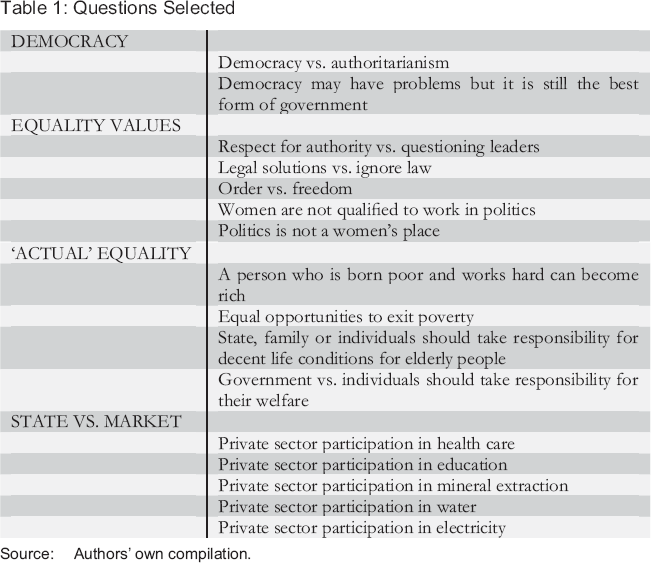
Based on the conceptualization discussed in the previous section, we select questions from the Latinobarómetro survey that reflect this core definition and represent its key aspects rooted in differing attitudes towards (inequality. Furthermore, we complement this definition with what has been found to be the primary substantive content of the left–right dimension in Latin America, the state versus market divide (see Kitschelt et al. 2010; Wiesehomeier and Benoit 2009; Wiesehomeier 2010). We thereby focus on policy preferences that characterize the state (or private enterprise) involvement in the economy, which reflects the underlying ideological definition based on equality. We expect to find a clear distinction among individuals self-identifying as left or right and their opinions and position-taking on the selected questions. We also consider attitudes towards democracy as a political system, yet our expectations in this regard differ. Bobbio notes that democracy, or authoritarianism, constitutes an issue which, rather than dividing the left from the right, unites their extremes, such that “a left-wing extremist and a right-wing extremist share a rejection of democracy” (Bobbio 1996: 21). Consequently, we expect the authoritarian-democratic cleavage to constitute a conflict that is orthogonal to the left–right axis. Table 1 summarizes the 16 questions selected, which we organize into the four groups denominated democracy, equality values, ‘actual’ equality and state vs. market. 3
See Appendix for detailed question wording.
Questions Selected
Source: Authors’ own compilation.
The first group consists of two questions aimed at gauging the attitude of the electorate towards democracy. We use a question that captures citizen's opinion regarding the contrast between democratic regimes and authoritarianism, together with the Churchillian question, in order to account for general support for democracy. 4 Although our ideological definition is in general based on differing perspectives on equality, for reasons of clarity and comprehensibility, at this point, we define separate groups which we believe capture different manifestations of this underlying principle. Therefore, the second group, equality values, is separated from the third group, ‘actual’ equality. Whereas the former includes questions about the role of women in society and respect for authority and order, the latter assembles attitudes reflecting the more practical side of the core definition in terms of state-versus-individual responsibility and equal opportunity. 5 The fourth group, the state vs. market divide, in turn, focuses on the practical translation of these underlying preferences into the realm of economic planning, and refers to differing beliefs regarding state intervention in the economy. We select questions to reflect perceptions of private sector provision of public utilities, public services and private sector participation in the extractive industry. 6
The codings are as follows; democracy vs. authoritarianism: 1 - democracy always preferable, 2 - sometimes an authoritarian regime is preferable, 3 - indifferent; Churchillian question: 1 - strongly agree, 2 - agree, 3 - disagree, 4 - strongly disagree.
The codings are as follows; respect for authorities: 1 - respect authority, 2 - question leaders; law: 1 - ignore laws, 2 - legal solutions; order vs. freedom: 1 - order, 2 -freedom; women are not qualified to work in politics and politics is not a women's place: 1 - mentioned, 0 - not mentioned. Hard worker: 1 - can become rich, 2 - can never get rich; exit poverty: 1 - equal opportunity, 2 - not equal; decent living conditions for elderly people: 1 - state, 2 - family, 3 - own responsibility; welfare responsibility: 1 - person to 10 - government, recoded into 3 categories.
The codings for all questions included in this group are the same: 1 - totally in charge, 2 - major participation, 3 - minor participation, 4 - none.
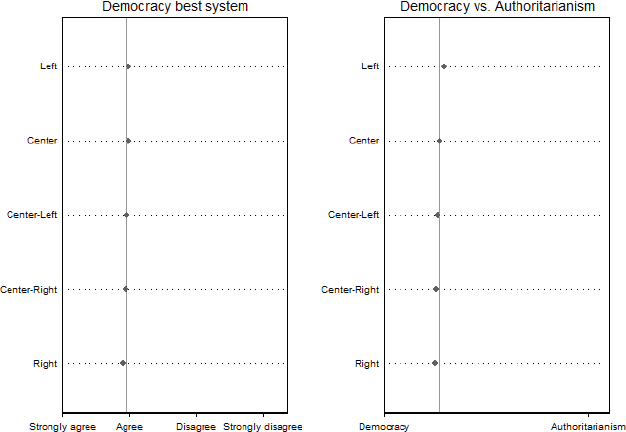
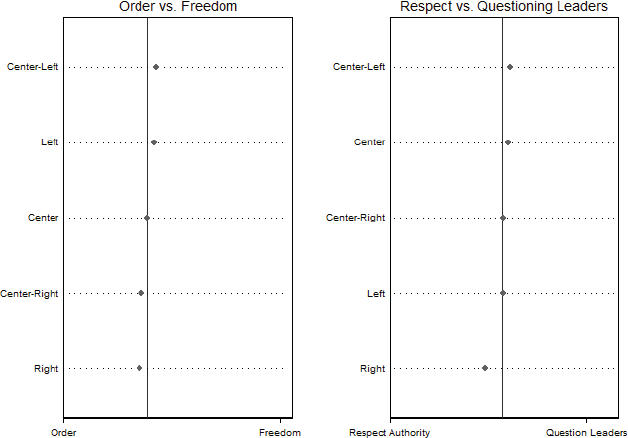
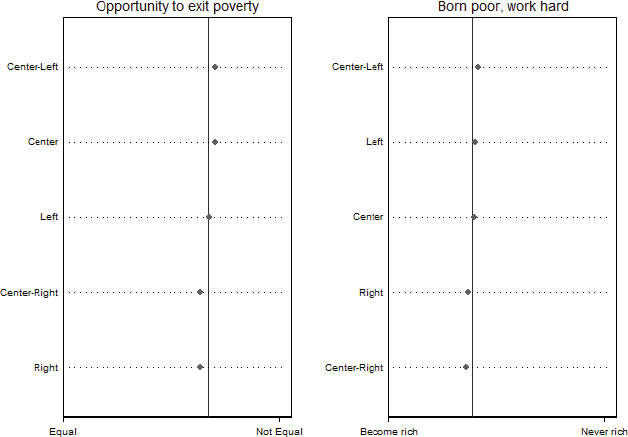
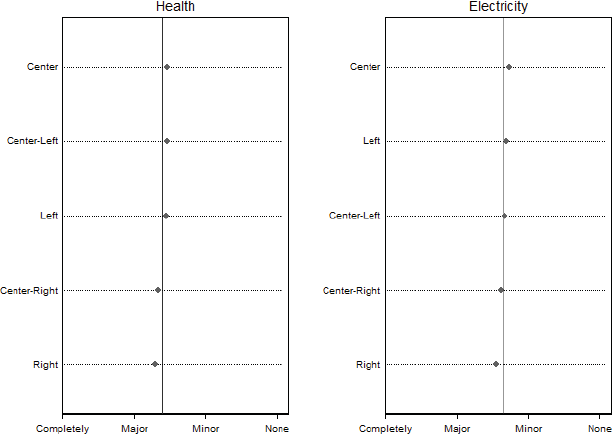
To maintain the idea of like-minded groupings among citizens, we convert the continuous left–right scale into a five-point categorical variable. Based on the individual responses to the selected questions, we can then generate a mean for each of the ideological camps of left, center–left, center, center–right and right and compare how the different categories are distributed on these questions. In the following, each figure contrasts two of the questions taken from each group defined in Table 1, displaying the regional mean as a vertical line and organizing the mean values of the ideological categories in descending order. Interestingly, when compared in this manner, there does not appear to be major variation among our ideological groups and moreover, we can observe some unexpected ordering among them.
Figure 1 shows how the five ideological groups differ in their attitudes towards democracy, as captured by our two questions. Overall, as indicated by the regional mean, Latin American citizens can be considered democrats. Interestingly, looking at the resulting ordering of the five categories, compared to all our questions, it is only regarding opinions on democracy that we find an array where both, the left and the right occupy the extremes. Individuals in the left camp have a tendency to disagree with the assessment that democracy is the best system and lean towards authoritarianism; for both questions their mean can be found to the right of the vertical line. Yet, in general, we do not find much difference among the ideological camps, suggesting that opinions regarding democracy no longer distinguish left and right in Latin America.
Attitudes towards Democracy
In Figure 2, in turn, clearer distinctions are discernible. This figure illustrates the variation across the ideological groups on two questions representing equality values. The left hand pane shows that the right and the center-right favor an orderly society, whereas the left and the center–left prefer living in a society in which all rights and liberties are respected, even at the cost of some disorder. In this case, the center lies directly on the regional mean. The right hand pane shows that those individuals who self-identify with the ideological right have a clear propensity to respect authority. Interestingly, in terms of ordering, the left groups follows those on the right, although its mean is to the right of the regional mean, thereby indicating an opposing position. Yet, it is those on the center–right, the center and the center–left, who have a stronger tendency to question leaders.
Attitudes towards Equality Values
Figure 3 represents attitudes towards the more practical side of equality. In relation to the opportunity to exit poverty, the mean value of respondents self-identifying with the right, and the center–right, clearly believe that there are equal opportunities to do so. Hence, what is reflected in this case is the belief in self-responsibility in determining one's rank in society. Surprisingly, the mean of the left falls onto the regional line, whereas the group of the center–left shows the most “leftist” attitude and, together with the center, believes that equal chances to exit poverty are not given. We find a similar distribution when we examine the statement: someone who has been born poor and works hard can become rich. As before, the center–right and the right believe that human activism decides an individual's fate, whereas the center, the left and the center–left do not, and fall on the opposite side of the line indicating the regional mean.
Attitudes towards ‘Actual’ Equality
Finally, diverging views over the involvement of private enterprise in health care and electricity are depicted in Figure 4. Again, although the five ideological camps are close to the regional mean, in both cases, this graphical representation displays divisions among the ideological categories as expected. In general, the right and the center–right are more inclined to concede a larger role for the private sector in health and utility provision, whereas those in the center and on the center–left and the left favor only minor market involvement in the provision of these goods.
Attitudes towards State vs. Market
On the whole, these figures have highlighted trends in attitudes towards equality and inequality and their connection with left–right self-placements of Latin American citizens that resonate with our core definition of the left-right divide. Yet, as these graphs rely on a summary measure such as the mean, they attenuate fluctuations in the responses and cannot show structures and patterns in the data, such as associations among categories. Therefore, in the next section we explore such associations more systematically.
Attitudes, Associations and Ideology
Once individuals display coherent patterns of answers across the questions tapping attitudes towards (inequality, we can confidently assume a coherent reasoning and understanding and match these patterns against the left–right self-placement of respondents. 7 To explore the relationship among our response groups, we use the method of joint correspondence analysis (JCA), an extension of multiple correspondence analysis (MCA). This is an exploratory technique, which has been adopted by many disciplines “as a highly informative and intuitive method for graphically depicting the association that exists between two or more categorical variables” (Lombardo and Beh 2010: 2101). Thus, JCA is particularly useful for our purpose here, given that we are dealing with survey data, the responses to which form categorical variables.
Here we understand coherence in the sense that respondents do not defend totally opposing ideas across the questions selected – inequality in one equality in the other. About the functional role of vagueness in ideology, see Freeden (1996).
Joint correspondence analysis can be understood as a generalization of principal component analysis for categorical variables (cf. Izenman 2008: 658). It seeks a linear combination of the data that accounts for a large part of the information and produces coordinates and weights, which are similar to factor loadings. This not only allows us to plot these scores and thus to visualize the relationships between the categories of the variables in a spatial map, but also to relate these weights to the left–right self-placements of individuals to see whether they are meaningfully connected (Greenacre and Pardo 2006: 193). For example, by performing JCA, we can visually determine whether agreeing strongly with private sector participation in the electricity sector is associated with agreeing strongly with private sector participation in health care and how, in turn, the obtained weights are linked to the ideological categories of left, center–left, center, center–right and right.
We estimate two different JCA models. The first one utilizes the nine questions measuring attitudes towards equality and the two questions relating to attitudes towards democracy. The second adds the five questions capturing the state versus market divide. In both models we also use the categorical variable for left–right self-placement as a supplementary variable. This means that this variable, and the associations of the individual categories, will be represented in the resulting graph, however, it does not affect the JCA solution. The figures plot the first dimension on the x-axis against the second dimension on the y-axis. The answer categories are labeled in grey font, while the supplemental variable is labeled in black font. For ease of inspection, we include horizontal and vertical reference lines at the zero points of each axis.
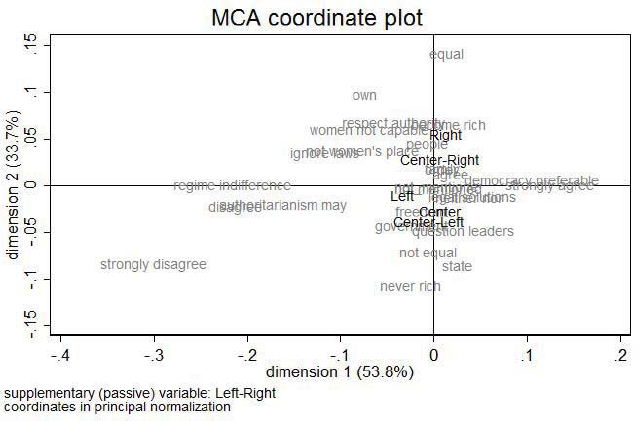
Figure 5 illustrates the results for the JCA model for equality and democracy. Together, the two dimensions explain 87.5 percent of the inertia in the data, which is best thought of as equivalent to explained variance in principal component analysis. Overall, dimension one separates respondents with positive attitudes towards democracy from those with negative attitudes, whereas the second dimension distinguishes those who consider inequalities as a state of nature from those who advocate state intervention to overcome inequality. As indicated by the supplemental variable, this latter dimension does indeed separate left from right, whereas the former dimension does not. Hence, the core definition of the left–right distinction rooted in (inequality is reflected in the answering patterns of Latin American citizens and their self-placement on the left–right dimension. As expected, the authoritarian-democratic cleavage constitutes an orthogonal dimension to this ideological distinction.
Joint Correspondence Analysis, without State vs. Market
Since categories that are close to each other have high associations, this graphical representation summarizes key features of the data in a low dimensional space, making associations among individual categories apparent. For instance, on the right side of the vertical line, those who believe that democracy is always preferable are close to those who strongly agree with the assertion that democracy is the best system, despite problems this regime type might entail. Yet, respondents who ‘only’ agree with this latter statement, are not very well presented by this first dimension, as we find this category close to the origin, i.e. the vertical zero line. On the opposite end however, all categories are well depicted by this dimension. Disagreement with the statement that democracy is the best system of governance is associated with the statement that sometimes an authoritarian regime is preferable, and in fact, both categories overlap. In their vicinity we can also observe those who say that the type of regime is irrelevant to them. The exposed position of ‘strongly disagree’ with democracy as the best system simply indicates that this category is different from all others, although this response has a tendency to be associated with leftist statements on equality.
Turning to the second dimension regarding equality we also find interesting associations. In general, the right and the center–right are associated with the conviction that there are equal opportunities to exit poverty, that a hard working poor person can become rich, and that individuals should be responsible for their own welfare. Furthermore, we can see that respect for authority; a negative mindset towards women in politics; the idea that sometimes it is better to ignore laws and find immediate solutions to a problem; and the belief that care for the elderly is an individual's responsibility, are associated with each other and with those on the right. Yet, as indicated by the position of the ideological label of the left, which we find slightly to the left of the horizontal zero line, compared with the center and the center-left, the left shows a minor tendency to be associated with those latter ‘rightist’ categories. From this graph, it seems then that the center and the center-left have a stronger association with leftist attitudes towards equality. Above all, they are associated with respect for rights and support for a free society; a preference for questioning leaders; the belief that there are not equal opportunities to exit poverty, and that there are barriers to social mobility; and support for state responsibility for the welfare of society.
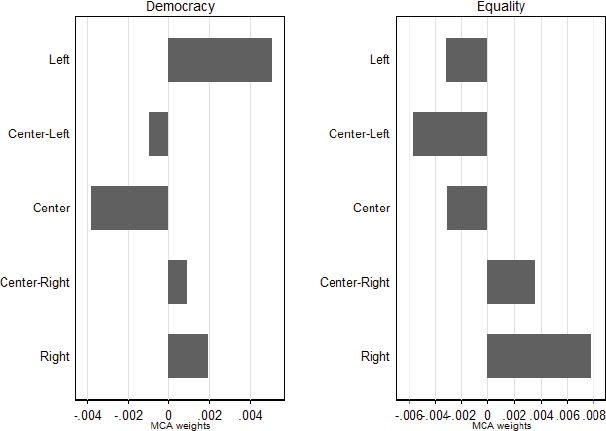
We can plot the predicted scores over our different ideological categories. As indicated in the left hand pane in Figure 6, the JCA weights again underline that the first dimension does not help us to distinguish between left and right in Latin America. On average, Latin American respondents in the extreme categories are more in favor of democratic principles than the center or the center–left. Conversely, the second dimension capturing the core definition of the left–right distinction rooted in differing attitudes towards equality, illustrates a clear separation between the left, and right, with those in the center expressing attitudes more akin to the left.
MCA Weights, Core Definition, Categorical Left–Right
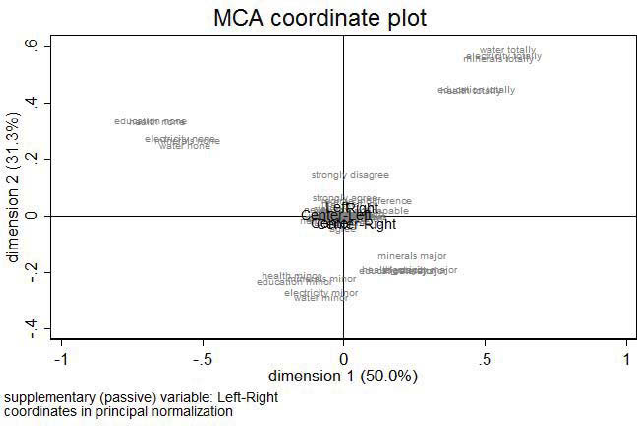
These overall distinctions are preserved when we add the questions concerning the state versus market divide to our analysis, albeit with a minor difference. Figure 7 shows the results of our second JCA model. In this case, combined, both dimensions explain 81.3 percent of inertia in the data. The first dimension can be identified as an explicit separation of the left from the right based on the state versus market divide. The second dimension, in turn, distinguishes radical positions from more moderate positions on the questions asked. This is also corroborated by a look at the supplemental variable, the five categories denoting ideological self-identification. On the left side of the vertical zero line on dimension one, we find leftist positions favoring little or no private sector involvement in the provision of public utilities, public services or private sector participation in the extractive industry. The left, the center–left and the center, fall onto this side of the graph. On the opposite side, the categories of the right and the center–right defend major or complete private sector participation in the economy. On dimension two, in the upper part of the graph, we observe respondents who reveal extreme stances on the attitudes captured. They would, for instance, prefer either complete private sector involvement in the economy or complete public sector involvement, or they would strongly agree with the Churchillian question, or strongly disagree with this question. Unsurprisingly, such positions are associated with the extreme categories of left or right, where we would find those who are most politicized in ideological terms. We find less politicized respondents in the center and center–right categories, who are associated with the more moderate responses on the lower side of the graph. They would, for instance, either favor minor or major private sector involvement or tend to ‘only’ agree or disagree with the Churchillian question. The center–left, on the other hand, does not seem to be well represented by the second dimension.
Joint Correspondence Analysis, with State vs. Market
A look at the weights obtained from this JCA model clarifies these associations further. As the left hand pane of Figure 8 clearly shows, the state versus market divide separates the left from the right, and again, on average, the center tends to side with leftist positions. The right hand pane, in turn, clearly illustrates the close connection between extreme attitudes and extreme ideological self-identification. The left and the right are both, on average, associated with more assertive responses, in comparison to those in the other three ideological groups.
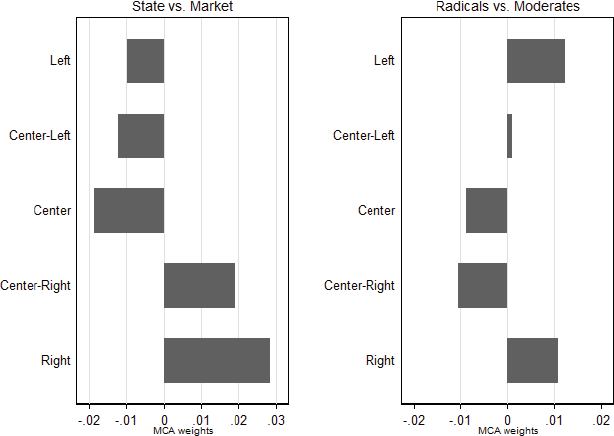
MCA Weights, Core Definition Plus State vs. Market, Categorical Left-Right
With the weights obtained from our JCA models, we can now move to our final question of interest, and test whether our dimensions are meaningfully related to the self-placement of respondents on the left–right divide. To do so, we estimate ordered logit models on the five-point categorical variable from left (1) to right (5), but we also replicate these results as logit models using a binary dependent variable. 8 Our primary explanatory variables are an individual's predicted scores (weights) for the two dimensions generated by each of the joint correspondence analyses. As we have seen, in the first model, dimension one separates attitudes towards democracy, and we therefore do not expect any relationship with our dependent variable. On the second dimension, negative values are related to leftist positions and positive values to rightist positions concerning equality. Hence, we expect to find a positive relationship between this dimension and the left–right self-placement of Latin American citizens. Regarding the second model, expectations are reversed. In that case, the first dimension showed a clear distinction between left and right on the state vs. market divide and again, negative values indicate left positions and positive values right positions. Therefore, we expect this dimension to have a positive effect on our dependent variable. Finally, the results for the second dimension of this model do not distinguish among ideological proclivities, but between the degree of radicalization of the respondents, which should be unrelated to preferences in left-right terms.
This variable is coded 0 - left, 1 - right.
We include important control variables in the models, all taken from the Latinobarómetro survey. Education represents the survey respondent's level of education and ranges from 1 (illiterate) to 7 (completed tertiary-level). 9 For income, we use the subjective economic ladder question, which asks respondents to place themselves on a 10-step ladder, where the poorest stand on the first step and the richest stand on the last. Marital status is a categorical variable with married respondents coded as 1, single respondents as 2 and divorced respondents as 3, while sex is a binary variable with 1 representing male and 2 female. Age is simply the stated age of the survey respondent. Indigenous controls for ethnic background, and is based on the question concerning the respondent's mother tongue. Those who state that their mother tongue is an indigenous language are coded as 1, and the rest as 0. Unemployed, homemaker, public worker and private worker are dummy variables coded from the answers given to the current employment situation question. 10 Finally, devout controls for the degree of piousness among citizens, from 1 (very devout) to 4 (not at all devout).
The full coding is as follows: 1 - illiterate, 2 - incomplete primary, 3 - complete primary, 4 - incomplete secondary, 5 - complete secondary, 6 - incomplete tertiary, and 7 - complete tertiary.
Retired, students and self-employed were omitted as reference categories.
Table 2 displays the results for our four models. Models (1) and (3) are the main models of interest, with the categorical measure of left–right self-placement as the dependent variable, while models (2) and (4) replicate the results with a dummy variable for left–right. In models (1) and (2), as anticipated, the dimension capturing the authoritarian-democratic cleavage is not related to respondents’ self-placement on the left–right dimension. On the contrary however, the dimension representing our core definition of the left–right distinction, equality, is significant at the ten percent level and shows a substantive positive effect on our categorical dependent variable, which is magnified when we use the dummy variable. Individuals with rightist leanings towards equality indeed tend to self-identify with right positions. As the results for models (3) and (4) show, the same is true for individuals who favor a larger private sector involvement in the economy and thus reveal a higher affinity towards market mechanisms. The coefficient for the state versus market divide is positive and highly significant at the one percent level. However, its substantive effect is much smaller. As expected, the dimension capturing the radicalization of Latin American respondents is not able to differentiate the ideological categories.
Results Ordered Logit and Logit Models
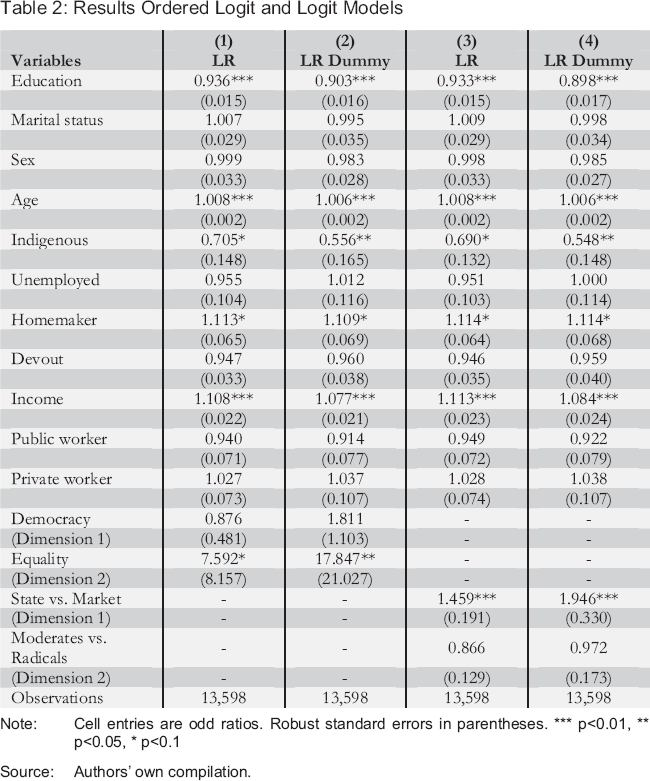
Note: Cell entries are odd ratios. Robust standard errors in parentheses.
p<0.01
p<0.05
p<0.1
Source: Authors’ own compilation.
Several of our control variables also are meaningfully related to the self-placement of respondents. Across all models, education has a weak negative, but highly significant effect on left–right placement, indicating that individuals with a higher education tend to identify with the left. The same relationship can be found for our variable measuring ethnic background, indigenous, albeit with a much bigger impact income, on the other hand, displays a highly significant and positive relationship with ideological preference. Respondents who consider themselves as materially well-off have a tendency to self-identify with the ideological right. The same is true for homemakers and older respondents, although in the latter case with a rather weak effect. The remaining variables never reach conventional levels of statistical significance. 11
To test the robustness of our results, we also estimated a number of alternative specifications. Firstly, in order to test the stability of the models, we performed a modified jackknife, a modification which did not alter the results presented here. Secondly, we ran collinearity diagnostics, the results of which indicated that this was not an issue in any of our models. These results are available upon request.
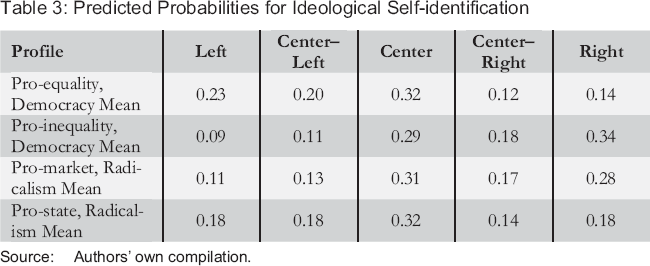
To get a more nuanced idea of the impact of the dimensions identified in our JCA analyses on respondents’ left–right placements, we generate predicted probabilities for each category of our dependent variable. We create four distinct respondent profiles which are based on their attitudes towards equality and the role of the market versus the state in the economic realm, whereas the dimensions constituting orthogonal divides towards the left–right divide are, together with our remaining explanatory variables, set at their respective mean values. Thus, we generate predicted probabilities for a defender of state involvement to overcome inequalities; a supporter for state involvement in the economy; a believer in self-responsibility; and a pro-market respondent, where each dimension is set at its minimum or maximum value according to the respondent's profile.
Table 3 displays the predicted probabilities for each of these profiles. The results are instructive and rather stark. The probability of an average democrat favoring state intervention to overcome inequalities identifying with the extreme left is 0.23 compared with just 0.14 for the right. Conversely, the probability of someone considering inequalities as a state of nature identifying with the right is 0.34 compared with just 0.09 to self-place on the ideological left. It is evident that differing attitudes towards equality impact on people's attachment to ideological labels and thus on the ideological self-identification of citizens across Latin America. Although we see similar patterns for the state versus market divide, interestingly they are not as pronounced. With 0.28, a pro-market supporter has indeed a higher probability to self-identify with the right compared to a probability of 0.11 to do so with the left. However, a defender of state involvement in the economy has the same probability of 0.18 of either identifying with the left or the right.
Predicted Probabilities for Ideological Self-identification
Source: Authors’ own compilation.
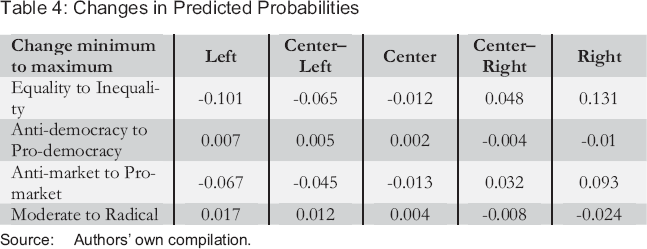
This gets even more evident when we turn to Table 4, which shows the changes in predicted probabilities when we switch the values of our four dimensions from their minimum to their maximum values. These results show that attitudes towards equality as captured by our core definition have by far the biggest impact on ideological self-identification. A change from the minimum to the maximum value for this dimension diminishes the probabilities of self-identifying with the left by 0.10 and increases the probabilities of doing so with the ideological right by 0.13. In comparison, the effect of switching from anti-market to pro-market stances is much weaker and decreases the probability of identifying with the left by just 0.06. Similarly, the increase of the probability to relate with the right for such a switch is just 0.09.
Changes in Predicted Probabilities
Source: Authors’ own compilation.
As expected, the two dimensions indicating divides that are orthogonal to the left–right distinction, taken on their own, do not exert a noteworthy influence on ideological self-placement. However, being pro-democratic and showing a more radical answering pattern seems to be more connected to leftism.
Combined, these results reflect that the conceptualization of the left– right distinction rooted in shared beliefs concerning attitudes towards (in)equality is indeed manifest on the mass level and that this core distinction is pre-eminent over a policy oriented definition when it comes to ideological self-placement. In other words, our findings for the state versus market divide reflect the heterogeneity of economic policy-making in the region. This is especially visible in the case of state involvement in the economy, where on average distinctions between the left and the right are muted, which might also reflect historical trajectories of economic planning in different countries. Given underlying core principles, there is room for the practical configuration of these into economic planning (or other policy issues for that matter) as is reflected in different schools of ideology defending differing degrees of state activism or personal responsibility.
Conclusion
As in other parts of the world, ideological labels are shortcuts to describe and analyze Latin American politics and to define expectations about political behavior and policy content. Nowhere has that become more evident than in relation with the recent ‘left turn’ across the region. The large body of scholarship this phenomenon has generated places emphasis on electoral demands and the content of the policies introduced by these left parties (see Stokes 2009; Lupu 2009; Baker and Greene 2011). However, while the substantive meaning of ideological labels has been explored at the elite level (Power and Zucco 2009; Puig and Cué 2008), empirical analyses of the meaning of left and right for the Latin American electorate more generally are non-existent. This paper has attempted to address this lacuna, and to determine whether voters, across the region, form coherent groups along ideological lines.
Utilizing a core distinction between left and right that is predicated upon differing attitudes towards equality, the analysis in this paper has demonstrated that, taken as a whole, the Latin American electorate does indeed form distinct ideological groups, which share common convictions regarding the responsibility of the state to level the playing field and its role in the national economy. Our results from the joint correspondence analyses show that theoretical conceptions about the roots of, and responsibility for, inequality in society, together with the practical translation of these beliefs into economic policy, clearly distinguish those on the right from those on the left. Furthermore, the central dimensions emerging from these analyses – differing attitudes towards equality and the state versus market divide – are pre-eminent predictors of the left–right placement of respondents.
While it is important to remember that this is an analysis for the Latin American electorate as a whole, which might mask important idiosyncratic differences between left and right at the country-level (see Zechmeister 2006; Harbers, de Vries, and Steenbergen forthcoming), nonetheless, our results here have important implications.
Firstly, it suggests that, just as legislators across the region, the Latin American electorate has a clear and coherent understanding of the ideological tenets of left and right. Given that politics across Latin America is frequently characterized as clientelistic and dominated by appeals to mass patronage (see Remmer 2002; Kitschelt 2000), if both the electorate and the political elite can be differentiated along ideological lines, then this could have important implications for the nature of party-voter linkages across the region. It indicates the possibility of a connection beyond clientelism that political parties might tap into in order to garner support. Exactly how these linkages are established, and the form they assume however, requires further investigation.
Secondly, if the electorate displays clear and coherent convictions, which attach them to different ideological camps, potential linkages between parties and voters could be established on the basis of these convictions. As a corollary to the point above, this implies that the left-turn might have a substantive policy content. Voters, dissatisfied with the policies of right-leaning incumbents, and with clear ideological beliefs about inequality and the role of the state in the productive economy, supported parties and candidates that reflected these beliefs. However, as our results indicate, whereas the core definition rooted in equality has a strong connection with left–right self-identification of Latin American voters, the market versus state dimension attenuates some of these strong distinctions. Put differently, across Latin American countries, there seem to exist a shared ideological core, yet depending on country contexts, the translation of these core beliefs about (in)equality into actual policy and proposals might differ. So, as we have been witnessing, the elected leftist governments have, to varying degrees, delivered increased social spending to address inequities within society and have strengthened the role of the state in the national economy (see Baker and Greene 2011; Stokes 2009), but there is no uniform “new left” model for the economy. Rather, we have a heterogeneous group of political leaders and parties that voice similar rhetoric about indigence, but who oversee the practical translation of this rhetoric into economic policy in a myriad different manners, and which often reflects varying national contexts. However, the divisions that exists across countries regarding the left–right divide and how this informs various attitudes towards economic policy, is a task for future research.