



Abstract
Drawing from well-known theories of democracy and democratic transition, this essay considers the transition to local democracy in Latin America. It raises a central question: Given the landmark decentralization of the past three decades, what constitutes local democracy in the region today and in which countries can we say it exists? Core considerations in comparing local democracy and national democracy are discussed. I present the concept of “minimum decentralization” and, using this framework, posit six procedural and institutional conditions for defining local democracy. Eighteen systems are evaluated against these conditions at the municipal and intermediate levels of government. Despite the real transfer of authority in many countries, and though several Latin American countries have established or nearly established local democracies, only a few of the local systems can be considered democratic. Though the conclusion is somewhat counterintuitive, explanations for the slow development of decentralization and local democracy are considered.
Introduction
Viewed against Latin America's centuries-old tradition of political and socioeconomic centralization (Veliz 1980), decentralization can be considered one of the region's watershed reform movements of the late 20th and early 21st centuries. Virtually all of the region's countries have experienced it to some degree, a trend well reflected in the considerable scholarly interest in the topic for the past 15 years at least (a small sampling includes: Fox 1994; Rodríguez 1997; Willis, Garman, and Haggard 1999; Montero and Samuels 2004; Eaton 2004a; Díaz-Cayeros 2006; Bland 2007). In some countries, change has resulted from a fairly quiet promulgation of new legal requirements, as with Costa Rica's 2001 constitutional reform (Ryan 2004), while in others, reform was initially dramatic and drew international attention, such as Bolivia's 1994 Popular Participation Law (Bland 2000; O'Neill 2005). Some countries have experienced multiple approaches to decentralization and recentralization, while others have enacted a series of new laws only to see little actual reform. Bolivia, Paraguay, and Peru, for their parts, have created new intermediate levels of elected government.
A major impetus for decentralization and local government reform in Latin America was a strong, politically oriented reaction beginning in the late 1970s to the authoritarian, centralized governments and practices of the past. The desires to restore elected local government, redistribute authority, and strengthen national democratic regimes through the development of more accountable, participatory, and effective institutions – both locally and nationally – were among the most compelling objectives (Montero and Samuels 2004; Angell, Lowden, and Thorp 2001; Oxhorn, Tulchin, and Selee 2004; Nickson 1995). The current re-emergence of personalistic, populist, and recentralizing governments and policies – as well as concerns about the democratic future of some countries and about fraudulent municipal elections in, most recently, Venezuela and Nicaragua – would appear to cast doubt on this assessment. Decentralization generally is, however, a highly political, conflict-ridden, non-linear process, and one should expect it to be subject to adjustment or reversal as priorities and governments change and lessons are internalized over time as the process matures. It remains to be seen to what extent current political and economic dynamics in Latin America produce with respect to intergovernmental reform. Though in some countries (Chile, Costa Rica, and Mexico, for example) political pressure for decentralization continues to be felt, decentralization generally is less in vogue in Latin America today than it was a few years ago. We have also seen some healthy questioning of the benefits to democratic systems of such reform (Sabatini 2003; Falleti 2005; Eaton 2006), suggesting that now is a good time to bring some perspective to the study of its effects on local democratic institutions in the region.
Recentralization may reflect temporary political realities, as in Brazil (Samuels and Mainwaring 2004), or confront countervailing political pressures that reflect the enduring impact of the intergovernmental reforms instituted earlier on. Factions in some of the new governing coalitions value the autonomy and authority that has come with decentralized government; the government's support may rest on the inclusion of new political forces that decentralization has strengthened. In Bolivia, in terms of the 2005 opening of all elections to indigenous and community groups and the direct election of departmental executives (prefectos), decentralization has deepened in important respects. Yet, on the other hand, the lengthy constitutional reform crisis that concluded in 2008 raised serious issues about the links between democracy, state fragmentation, and the value of departmental autonomy. Region-wide, barring a major reversal of democracy, which can be considered unlikely, decentralization in some form and the emergence of local democracy will likely continue to be central issues in Latin America's democratic consolidation.
These developments, both old and new, clearly point to the need for more rigorous understanding of the concept of local democracy, its relationship to the ebbs and flows of decentralization, and its development over time. In this vein, I suggest a definition of local democracy and propose a minimum threshold required for its establishment. Through an examination of the local systems in most of the countries in the region, I rely on a principal argument: we can extend widely accepted procedural conceptions of democracy to the local level, use them to develop a similar framework for local democracy, and then apply that framework to draw some conclusions about the state of local democracy in Latin America. Despite historic steps in the correct direction, I find, surprisingly, that a large majority of the countries in the group have yet to progress sufficiently to achieve local democracy – although several are close. An examination of the minimal institutional requirements or minimum conditions for the establishment of local democracy, as I as propose below, demonstrates that only three of seventeen Latin American municipal systems are democracies, while another six are nearly so. Nearly half of the region's nine intermediate-level systems of popularly elected government can be considered democratic. Weighed against these criteria, decentralization's progress has not – or at least not yet – been as impressive as one could rightly expect from the strong expressions of support and legislative reform seen so often over the past 30 years. In view of this conclusion, some may view the series of criteria for local democracy as too stringent. This point, a good one, is addressed in the final section.
Considerations in Defining Local Democracy
Given the increasing prominence of local government in countries seeking to develop democratic institutions, one question begs consideration: What constitutes a local democracy in Latin America today? The answer has two parts: First, local democracy can only emerge within the context of national democracy. Second, the local government system must meet certain minimum conditions necessary for any local democracy. Those conditions constitute a minimum level of decentralization to local government. When a minimum level of decentralization has been achieved, to put it another way, the local democratic transition has been completed: there is not only basic participation and contestation locally, but also a fundamental measure of autonomy. Elected local officials have the authority to act on significant issues primarily on behalf of their constituencies. Having reached that point, moreover, it is much more realistic to begin speaking about improving the overall quality of local democracy or effective democratic governance and about increasing public certainty that local democratic practice will continue improving indefinitely into the future (Linz and Stepan 1996: 5).
In theory and practice, national democracy differs from local democracy in three important ways. First, democratic local government is almost invariably viewed by modern democracy theorists, if they significantly mention it at all, as a facet of national democracy. Though country case studies are increasingly common, rarely is a theory of local democracy addressed as an end in itself (on this point, see Gibson 2005: 132; Gibson and Suarez-Cao 2007: 1-2; some exceptions, to varying degrees, include Sharpe 1970; Hill 1974; Pratchett and Wilson 1996; Smith 1996). Dahl, for example, is concerned only with national regimes (1971: 11-12). In the classic on democratic transitions, Transitions from Authoritarian Rule, local government receives essentially no mention (O'Donnell, Schmitter, and Whitehead 1986), and subsequent multi-country studies on democratic consolidation virtually ignore local government (Diamond et al. 1997; Linz and Stepan 1996; Mainwaring, O'Donnell and Valenzuela 1992). Few scholars of decentralization have failed to make some effort to measure it, either quantitatively or through assessment of political and economic institutions (Riker 1964: 125-136; Lijphart 1999: 185-199; Willis, Garman, and Haggard 1999). Again, however, degree of decentralization is not equated with local democracy in these or other recent decentralization studies (see Diamond et al. 1999; Diamond 1999).
Second, whereas national democracy accords a specific set of ideal political characteristics to a single entity – the nation-state – local democracy can entail any of the country's local politico-administrative units, which can number in the thousands. In theorizing about local democracy, what is the target of analysis? In this essay, I am referring to the local system of government as a whole. Viewing local government as a national system is helpful in that it allows for consideration of the local democratic regime as a single entity and facilitates cross-country comparative analysis.
In much of Latin America (like much of the developing world), local government is designed as a national system; unitary countries in particular apply a single national legal framework to their respective local levels of government. National laws may contain provisions reflecting local differences in size, degree of urbanization, demographics, or other features, but the general operation of local governments is the same. Even in the four federal countries of Latin America, which have recently experienced increased sub-national institutional diversity with decentralization, national constitutions, laws, and political tradition tend to limit the variation produced by local laws and regulations.
Taking a systemic approach, moreover, complements the important and growing body of work comparing the democratic trajectories of sub-national units within a single country. So far, virtually all of this work has focused on federal countries (Cornelius, Eisenstadt, and Hindley 1999; Snyder 2001; Gibson 2004, 2005; Gibson and Suarez-Cao 2007; Goldfrank 2007; Gervasoni 2008; and Chhatre 2008). As some of these and other works make clear, municipal and regional-level enclaves of authoritarianism exist throughout Latin America (Gibson 2004, 2005; Gervasoni 2008; Fox 1994). Any systemic examination of the democratization of local government must consider the broader impact of authoritarian enclaves on the local regime as a whole. Indeed, though not developed as such, the criteria presented below can also be applied to individual sub-national governments – municipalities, departments, states, etc. – in an effort to gauge their basic level of democracy.
The question of autonomy presents the third relevant distinction between national and local democracy. At the national level, democratically elected leaders must be able to govern independently of constraints imposed by unelected officials, especially the military (Schmitter and Karl 1991: 81-82; Collier and Levitsky 1997: 443). Local democracy likewise requires an important degree of autonomy, and in some cases constitutional and other norms accord substantial local freedom of action in local affairs (especially in federal systems). Sub-national autonomy cannot be predicated, however, on the ultimate independence or sovereignty of local government vis-à-vis the nation-state. The local agenda is always limited to some degree by the policies of higher levels of government, however they are locally manifested, and by the national government's duty to preserve the integrity of the nation-state.
The Minimum Conditions for Local Democracy
Current consensus posits eight minimum conditions that define national democracy. 1 Absent the emergence of these conditions, moreover, local democracy is unattainable. Though it is conceivable that elected and relatively responsive local officials can govern locally in the absence of democratic national institutions, 2 local government cannot be divorced from the national system within which it functions, and an authoritarian national regime thus denies the basic rights of citizenship, locally or otherwise.
The eight conditions comprise the “expanded procedural minimum” definition of democracy (Collier and Levitsky 1997: 443) developed by Dahl (1971, 1982) and others (see Schmitter and Karl 1991: 81-82). They include: government decision-making constitutionally vested in elected officials; free and fair elections; adult suffrage; freedom of adults to run for elective office; freedom of expression; free access to alternative information; freedom of association, including independent parties and interest groups; and effective power to govern.
A good example is authoritarian Brazil (1964-1985), where, especially after 1980, governors and most mayors continued to be elected during the gradual transition.
This essay posits another six minimum conditions that define local democracy: 3
Following on the conceptual approach to national democracy noted above, this is a minimalist definition of local democracy. It is deliberately focused on the fewest possible attributes that can still be viewed as establishing a viable standard for local democracy.
Control over local government decisions about policy is constitutionally vested in officials elected by the citizens of the local jurisdiction.
Locally elected officials are chosen in frequent and fairly conducted elections in which coercion is comparatively uncommon.
An effective number of locally elected officials is directly elected.
The arbitrary removal of locally elected officials is effectively precluded.
To achieve their various rights, including those listed here, citizens also have a right to form relatively independent local associations or organizations, including political parties.
Local governments are regularly able to carry out responsibilities of sufficient variety and significance to engage the interest of the public servant and citizen. 4
See Martin 1957: 50-51. For the purposes of establishing local democracy, the six conditions are considered to be equally important. Criteria 1, 2 and 5 are the national conditions revised to reflect the local context. Given the assumption that national democracy exists, the national criteria of adult suffrage, right to run for office, freedom of expression, and access to alternative information can be assumed to hold for the local system as well. However, where enclaves of authoritarian local governments are broad and deep-seated enough, this assumption may not hold.
A number of additional institutional features of a local government system would further promote democratic effectiveness, inclusion, and responsiveness. 5 They are not as fundamental and universally integral to the establishment of local democracy as these six conditions, however, and are therefore perhaps best viewed as part of a process of local democratic consolidation. The separation of national and local elections is a major issue in some Latin American countries, for example, because separation allows local concerns to predominate in local elections and local officials to act more independently of national authorities; when national and local elections coincide, local issues and leaders are submerged by national party priorities. Allowing the re-election of local officials would likely strengthen the accountability of local democratic government, yet its absence does not call into question the inherent representativeness of local government. Likewise, according local governments a significant option to raise their own revenue – or the authority to set and collect some taxes – allows for the establishment of a fundamental relationship of public accountability in any democratic system (Oates 1972 and 1994: 5-6; Bird and Vaillancourt 1998; Bahl 1999: 10-14). When local governments receive virtually all of their financing through central transfers, they tend to be dependent and responsive primarily to the central government and subject to its whims.
Key local institutions include the local elected official's term length, eligibility for re-election, and mechanisms for direct democracy, such as issue referenda, open meetings, etc. (Molina and Hernández 1998; Nickson 1995). Nickson advocates increasing the ratio of local councilors to local population. Relative power of the local executive and legislature/ council and the conduct of campaigns (financing, the media, etc.) are important considerations. Other potential party reforms are indicated by barriers to local inter-party competition; central control over nominations for local office; limited intra-party competition; control over list rank on ballot; and presence of vote-pooling (see Shugart and Carey 1992: 175-176, 239; Willis, Garman, and Haggard 1999). The literature detailing ideal expenditure and tax arrangements is extensive (see Bahl and Linn 1998; Bird and Vaillancourt 1998). Well-designed administrative and financial systems tend to increase institutional effectiveness and sustain a local democratic regime.
As a group, assuming that national democracy is in place, these six standards not only provide for local democracy, but also reflect a basic level of decentralization to local government. The criteria capture a fundamental premise: the establishment of a local democratic system is tantamount to the achievement of a definable, minimum level of decentralization – or a fundamental degree of local autonomy vis-à-vis a higher level(s) of government. The notion of minimum decentralization highlights the major distinction between political democracy at the national and local levels of government. Whereas the former is an independent sovereign, the latter is at least to a basic degree dependent on the center – and in some cases, particularly federal systems, the “center” is the intermediate-level government (i.e. the state or province) as well as the national government – to relinquish the authority required for local democracy to develop. To develop the idea further, we should consider what precisely is meant by “minimum decentralization.”
The Minimum Level of Decentralization
In the liberal tradition, decentralization is the transfer of power from the central government to popularly elected local governments (Lipset 1995: 335). 6 Decentralization may only entail the (re-)establishment of local elections, or it can involve a shift to the local level of a variety of new functions and financial resources in a country that has regularly convened local elections for decades. Decentralization thus involves three dimensions that represent, in essence, the components of power: political, administrative, and financial. A basic level of progress along each one of these dimensions – or what can be called minimum decentralization – provides local government with sufficient power for local democracy to emerge and then eventually consolidate. Assuming, again, that the national system is democratic, a local system becomes a democracy when elected local officials are expected to respond and be held accountable primarily to their constituents, carry out functions sufficient to engage the local public's interest, and exercise their legally established authority without being subjected to overriding financial or other constraints from unelected or non-local elected officials.
Here, again, “central government” could refer to the intermediate level or any other higher level of government.
Political Authority: Popular and Direct Elections, Arbitrary Removal, and Associative Freedom
The first five criteria for local democracy involve the development of a minimum level of political autonomy. Political autonomy is not simply a matter of according local officials increased freedom to act as they personally deem fit. Local officials must also face clear incentives to act on behalf of the residents of the community. The local constituency must be the lead actor in determining who local leaders will be within a local system that can develop a political identity of its own.
Constituent-oriented local representation requires not only regular free and fair local elections, but also an effective degree of direct election (which in practice typically means the direct election of the local executive or at least a majority of the local deliberative body). Direct election is a popular election in which 1) voters are entirely free to choose among individual candidates exclusively (i.e. an open party list) according to the particular office the candidate would assume if elected, and 2) the voters’ choice is not subject to intermediation by a third party (i.e. an electoral college, council vote). 7 Direct election thus accords the local elected official a fundamental measure of independent authority, not only vis-à-vis the local public, but also with respect to higher-level governmental authorities and his or her own political party. Local politicians have a stronger incentive to cultivate a personal reputation as opposed to a party reputation (Carey and Shugart 1995: 420-422). Likewise, the locality benefits from increased clarity of responsibility. Popular elections in the absence of a significant measure of direct election, on the other hand, accord primacy in selecting candidates for local office to the political party and thus place in the parties’ hands predominant influence over who represents the locality. Local elected officials who must rely on the party to get on the ballot thus are ultimately more responsive to the interests of their party leaders than to those of the community.
Direct election is found in both majoritarian and proportional representation systems. In the former, for example, mayors are directly elected on a separate ballot or town councilors can be chosen in single-member districts. In the latter, open-list voting for town councilors provides direct election, even if the council then selects the mayor.
Arbitrary removal of elected local officials violates the expressed will of the locality. By arbitrary, I mean procedures that are used or potentially used with some regularity, usually for a primarily political objective that does not in practice serve a clear local public purpose or the purpose for which they were intended. Yet, a surprising number of local government systems contain formal (i.e. a vote of the town council) or informal means for pressuring or legally removing local officials from office, without a public vote of any kind, for purely political reasons. National and intermediate-level authorities can also wield sufficient influence to remove politically inconvenient local elected officials. This is not to argue that legitimate processes for removing corrupt and incompetent officials (public referenda, mandated financial audits, etc.) cannot be developed and effectively implemented; indeed, these are fairly common and can be bulwarks of democratic governance. Because institutions are weak and the level of politicization is high, however, mechanisms for insuring democratic governance are often used as fronts for the manipulation of local administrations by party leaders or non-local interests.
In a national democratic regime, the general thrust of the fifth condition – local associational freedom – can generally be expected to hold. It is specifically the effective or outright prohibition on the creation of local parties or on the local presentation of independent candidacies that often poses an obstacle to the emergence of democratic local institutions. Allowing the participation of independents or the establishment of local political organizations 8 provides a strong inducement for competitive local elections, and such competition puts pressure on all political organizations, at the national level or otherwise, to respect local interests to win local office. Providing an opening for local parties and new political leaders – indeed, merely their potential emergence – softens central party control, engenders decentralization of the party system, and therefore encourages a more decentralized central government (Riker 1964: 129-131). 9
Here I am referring to electoral systems that provide locally based standards for the formation of local parties or independent candidacies. Or, if the system establishes standards based on national or other higher-level politico-administrative units, the practical barriers to entry are so minimal that the formation of local parties is common.
Some have argued that decentralization weakens already weak party systems (Ryan 2004; Sabatini 2003). This is not necessarily the case, as seen in Mexico and Uruguay (Ochoa-Reza 2004: 257; Eaton 2004a: 16). Decentralization was implemented in some cases in Latin America (i.e. Venezuela, Colombia), however, in part in an effort to halt the downward slide in legitimacy of decomposing party systems; that is, the traditional party system was already in severe and continuing decline. Countries like Costa Rica have used electoral design – tailoring rules to each level of government, for example, to provide for party aggregation at higher levels – as well as other reforms to help avoid party fragmentation. On decentralization and party aggregation, see Willis, Garman, and Haggard 1999 and Chhibber and Kollman 2004.
Administrative and Financial Authority: Sufficient Responsibility and Resources
The final condition is that local governments regularly carry out functions of considerable political significance. Or, to put it another way, local citizens must be able to feel that local officials address issues that significantly affect their lives and communities. Likewise, the prospective public servants – local citizens, bureaucrats, and politicians alike – need to be drawn to public service in local government. It bears emphasizing that this condition involves the political imperatives of administrative and financial decentralization. Local functions and finance are explicitly treated here as political resources; to the extent that they hold valued public responsibilities and command the resources to carry them out, local officials exercise an important level of political authority (Dahl 1971: 82).
What Latin American local governments actually do varies widely within countries and throughout Latin America (see Burki and Perry 2000). In the current context, reaching the threshold for local political democracy requires some movement beyond a limited group of responsibilities that have been in place for many decades. Most countries’ local governments have traditionally been engaged in areas such as, for example, garbage collection, maintenance of community infrastructure (parks, street signs, etc.), and markets. Over the past thirty years, the change has been considerable, albeit uneven. Today, it is common to see local officials providing services such as water and sanitation, basic health, education, or social assistance, more in accordance with the principle of subsidiarity. 10 Yet, often functions are formally assigned to local governments that, for reasons of traditional centralization, have never carried them out. Local responsibilities are often not well defined or have also been traditionally assigned to higher, more powerful levels of government, leaving local officials with little practical authority to assume new roles.
The principle of subsidiarity provides that public goods and services should be assigned to the level of government that can best account for the preferences of the beneficiaries and best internalize benefits and costs. See Oates 1972.
No local government system can be expected to perform its primary responsibilities without controlling, on a reliable basis, sufficient financial resources to carry out those functions. Although local governments are typically responsible for obtaining a portion of their own revenue, they cannot be unreasonably expected to fend for themselves to such an extent that such fiscal autonomy holds little effective meaning. The expenditure of revenue to which local officials do have access, moreover, is often conditioned by rules established at higher government levels. To the extent that this occurs, the scope of local decision-making authority is restricted, and the prospects for local democracy should be considered accordingly (for a discussion of fiscal authority in federal systems, see Díaz-Cayeros 2006).
It is important to note that this sixth condition, requiring that local governments actually carry out their responsibilities, emerges over a period of time as local governments develop. Unlike a new electoral provision, for example, it cannot be immediately instituted for the local system as a whole. Most local systems in the region exhibit great local variation (i.e., urban-rural) for a variety of reasons usually related to capacity and resource constraints. Therefore, for practical purposes, it is worth proposing that where the majority of a country's localities and most of its population are governed by local governments that engage a series of basic functions with some effectiveness, the system as a whole can be said to have achieved this final condition for local democracy.
Emerging Local Democracy in Latin America
As noted, deep public dissatisfaction with the performance of centralized authoritarianism was a prime impetus behind a historic wave of decentralization in Latin America. Have these reforms been strong enough to establish local democracies? What does the experience tell us about the status of the local democratic transition in Latin America today? The results presented below, which seek to demonstrate the applicability of the framework, are based on field research in certain countries; interviews with local officials, practitioners, and scholars; a review of laws, ballots, and other documentation, such as news reports and mission reports; and the publications cited.
Municipal Level
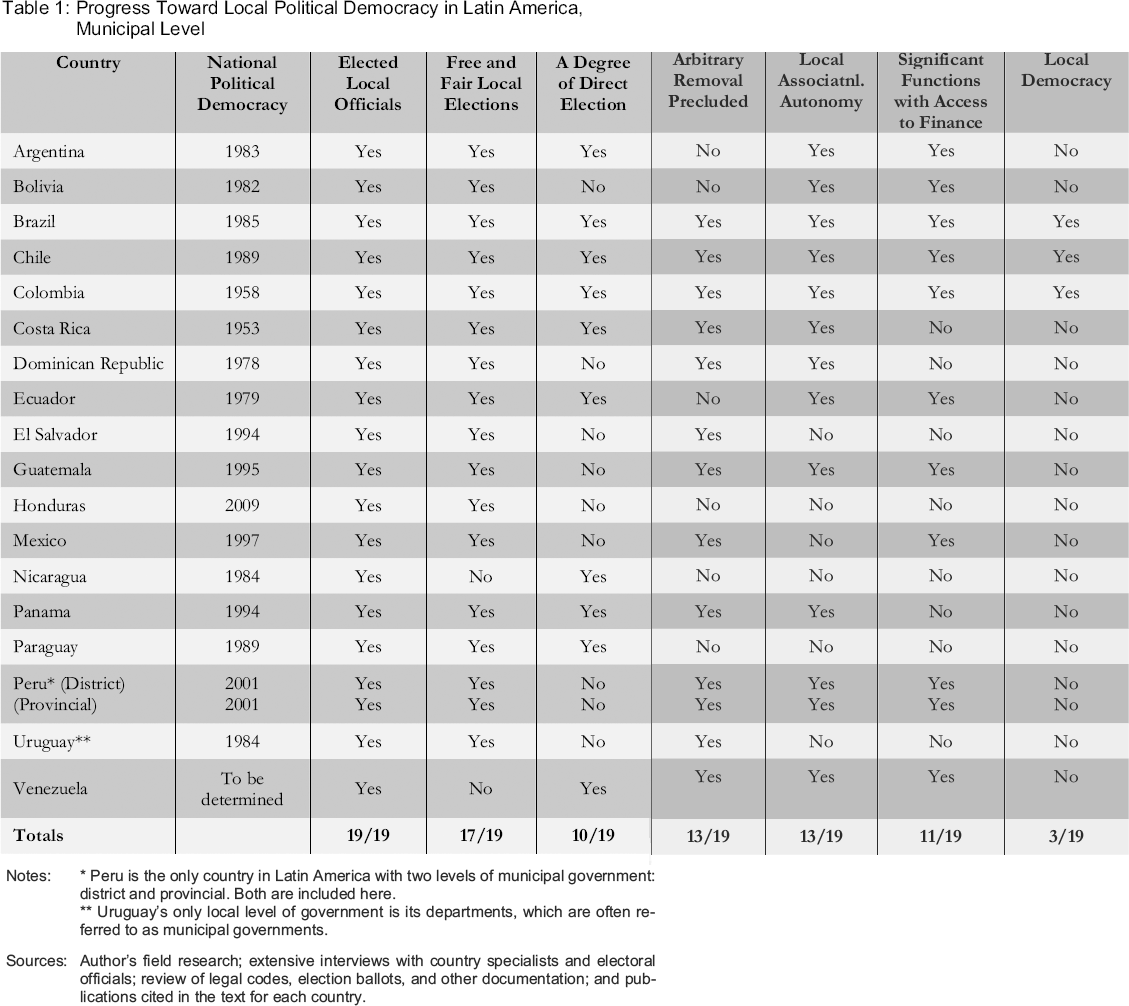
Table 1 provides a summary of the status of local democracy at the municipal level in 18 democratic Latin American countries as measured against the six criteria for minimum decentralization. The table demonstrates that with respect to municipalities, overall the countries of Latin America remain centralized. Only 3 of the region's 19 municipal systems – Brazil, Chile and Colombia – can be considered democracies. Argentina, Costa Rica, Ecuador, Guatemala, Panama and Peru are all one condition short of achieving it. The largest deficits appear in allowing direct election and according local officials significant functions and the revenue to carry them out; respectively, nine and eight of the Latin American systems do not meet these two standards. Latin American municipal systems do a little better with respect to precluding arbitrary removal of election officials and allowing local associational freedom.
Progress Toward Local Political Democracy in Latin America, Municipal Level
Notes:
Peru is the only country in Latin America with two levels of municipal government: district and provincial. Both are included here.
Uruguay's only local level of government is its departments, which are often referred to as municipal governments.
Sources: Author's field research; extensive interviews with country specialists and electoral officials; review of legal codes, election ballots, and other documentation; and publications cited in the text for each country.
Brazil's 1988 constitution, which embodies the country's long transition to democracy, defines municipal governments as autonomous units within the federation, allows them to take on any responsibility not constitutionally reserved to other governmental levels, and grants them the authority to enact their own laws (Nickson 1995: 119-120). The constitution assigns municipalities authority for three primary taxes and mandates municipal financial transfers through several revenue-sharing agreements with the states and federal governments. In practice, municipalities are involved in a wide variety of activities – including housing and urban services, primary education, and health – and their expenditures levels as a percentage of total government spending are the highest in Latin America (Ter-Minassian 1997: 442-443; de la Cruz 1998: 5). Furthermore, mayoral and council elections in Brazil are direct. Although mayors especially are removed for corruption, elected municipal officials are legally protected from being arbitrarily forced from office. In Brazil's famously fragmented party system, the constitution and national law allow for the creation of only national political parties (see Samuels 2000). In practice, however, any municipal (and state) leader can establish a provisional party or “rent” one that has achieved official status.
Beginning in 1983 and continuing to the present, Colombia has transformed itself from a highly centralized country into one of the most decentralized in Latin America. Under new legislation, previously appointed mayors were directly elected for the first time in 1988. Decentralization in Colombia provided new mechanisms for community participation that include a popular referendum on the mayor's continuance in office, but elected municipal officials are not subject to arbitrary removal from power. As the decentralization process was in part an effort to open up the political system to former guerrillas and other community actors, the 1991 constitution provides for the participation of social movements and citizen groups in politics, including municipal elections (Dávila and Bejarano 1998). During the 1990s, non-traditional parties and coalitions made considerable municipal electoral gains at the expense of the liberal and especially conservative parties (Hommes 1996; Querubín, Sánchez, and Kure 1998: 129-131; Angell, Lowden and Thorp 2001).
Through a series of laws, decrees, and constitutional reforms, Colombia has substantially increased financial transfers to the municipal level and mandated the transfer of primary health care, education, water, agricultural extension services, and other functions to municipal governments. Colombian municipal governments are now involved in administering health posts and have made some progress in education, though less than originally expected under the 1993 decentralization law (Law 60). Although many transfers and taxes accorded to municipal governments are earmarked – raising questions about the ability of local officials to use them with any flexibility – officials do sufficiently command the resources to carry out important functions (Bird and Fiszbein 1998: 186-190; Ahmad and Baer 1997: 458-460).
During the Pinochet dictatorship, with its hand-picked mayors, Chile's municipalities assumed an extraordinary set of new functions and a new fiscal regime to accord them important authority in these areas. At that point, however, they had little real political autonomy. In 1992, following the national democratic transition, Chilean mayors and councilors were elected for first time in 21 years. Since then, Chile has also gradually moved over successive elections to allow the participation of independent candidates in municipal elections, and mayors were directly elected for the first time in 2004. Chilean local authorities continue to complain about their lack of autonomy, however (Bland 2004).
Several countries are close to having local democratic systems as a result of important advances in the past two decades, including Argentina, Costa Rica, Ecuador, Guatemala, Panama and Peru, each of which meet five of the six criteria. Federalist Argentina's municipal executive, or intendentes, are directly elected, and the municipalities manage an important series of responsibilities; yet, their authority is also subject to the power of the provincial governors, and intendentes are removed from office for purely political reasons. They generally depend heavily on provincial transfers (López Murphy and Moskovits 1998). In Costa Rica in 2002, for the first time, mayors were directly elected in elections that permit local party candidates to run for municipal office (Ryan 2004). The 2001 constitutional reform requires substantial annual fiscal transfers to the municipal level. This provision has yet to be instituted, however, and the municipalities have not taken on significant responsibilities. In Ecuador, though decentralization policy has never been coherent, the country has a long tradition of direct election, municipalities have long exercised a significant local role, and the municipal tax system is relatively strong following the 2004 municipal reform (O'Neill 2005; Faust et al. 2008: 138-142). The country also has a tradition of removing elected local officials, however. Under the 2008 constitution and subsequent legislative reforms, the sub-national system will be changing. The impact of the reform remains to be seen.
Guatemala has been characterized by a lack of political consensus around decentralization, which emerged from the 1996 peace accords (Bland 2007). In 2002, a major municipal reform, an extremely weak decentralization law, and a local council law was enacted. Municipal-level civic committees can present candidates for municipal elections in Guatemala, but direct elections are not in effect. Panama's local regime is a plural one; the system is politically decentralized. Despite discussion of further decentralization in years past, however, Panama had not advanced significantly, and local governments’ financial and administrative authority continues to be quite weak (ICMA 2004). From 2002 to 2003, Peru enacted a series of decentralization-related laws, including a new municipal code that, unfortunately, leaves municipal functions rather unclear. The lack of clear definition in the division of intergovernmental responsibilities, a common problem in Latin America, and the absence of revenue-raising authority have not precluded a significant local role for municipal officials. Though Peru's local electoral system is localized, voters choose among the lists of national, regional, and local political parties or independent movements (Pajuelo Teves 2009: 189-193). 11
Peru is well known for the hundreds of municipal “political parties” that are created each cycle, most of which are really little more than electoral vehicles. National party labels do remain important in some municipalities, however.
Four countries – Bolivia, the Dominican Republic, Mexico and Venezuela – are two steps away from achieving a local democratic system. Despite the 1982 return to democratically elected government, Bolivia was for many years the only country in Latin America that did not have a nationwide municipal system. The landmark 1994 Popular Participation Law (PPL) established 311 municipalities across the nation, and the following year elections were held in all of them. The new law extended municipal jurisdiction to a wide variety of new service areas and accorded municipal governments the authority to set rates and collect property taxes. The PPL also increased from 10 to 20 percent the amount of national income transferred to municipal governments each year (Bland 2000; O'Neill 2005). Amid the political turmoil and broad demands for political inclusion that began in 2003, Bolivians enacted another major reform that allowed for the participation of indigenous organizations and citizens groups, as opposed to nationally registered parties only, in all elections (Mayorga 2004). Their participation for the first time in the 2004 municipal elections demonstrated a dramatic increase in local pluralism. Despite the advances, however, Bolivian municipal government faces limitations on political autonomy. Closed lists are used in municipal elections. A striking feature of the system is the degree of elected official turnover created by a constitutional provision allowing removal and replacement of mayors via a three-fifths council vote (Bland 2000: 75), though use of the provision has been somewhat restricted. This procedure allows strong manipulation of municipal authorities by higher-level party leaders.
The Dominican Republic's local electoral system is plural and open to independents, but dominated by the major national parties. Long a highly centralized system, the country enacted a 2007 municipal reform that provides local governments with a series of exclusive responsibilities, some responsibilities to be coordinated with national ministries, and a modified finance regime. Implementation is pending, and the limited financial resources actually provided to local authorities have not yet significantly increased local officials’ roles in service provision (UNDP 2008). In Mexico in the 1980s and 1990s, the wave of state and municipal victories by the opposition PAN (Partido Acción Nacional, National Action Party) and PRD (Partido de la Revolución Democrática, Party of the Democratic Revolution) cracked the PRI (Partido Revolucionario Institucional, Institutional Revolutionary Party) monopoly on political power in Mexico and demonstrated the value of pluralist local politics and municipal performance (Cornelius, Eisenstadt, and Hindley 1999). Municipal-level parties and independent candidates remain prohibited in Mexico, however. Although constitutional reform in 1983 and 1999 has significantly increased the formal autonomy and functions of Mexico's municipal governments, they remain burdened by the hierarchical control of their state governments, which, for example, must approve municipal budgets and set rates on property taxes collected by the municipality (Rodríguez 1997; Giugale and Webb 2000; Guillén 2006; Grindle 2007). In Venezuela, the concentration of power by an increasingly authoritarian regime has undermined what could otherwise be considered a decentralized local system. Venezuela's institution of direct election of mayors and councilors in 1989, its tradition of municipal administrative and tax autonomy, and the gradual doubling of financial transfers to municipal governments during the 1990s provide for considerable local autonomy (González and Mascareño 2004; Penfold-Becerra 2004; de la Cruz 1998). Following the November 2008 vote, however, when major candidates were prevented from competing, local elections can no longer be considered fair. Central control over the distribution of fiscal transfers (among other institutions) and threats of removal of opposition officials have further eroded local autonomy.
A final group of five more countries – El Salvador, Nicaragua, Paraguay, Uruguay and Honduras – have either experienced important spurts of reform or some reversal, or shown little movement in any area and thus remain among the most centralized in the region. El Salvador's municipal regime is characterized by extraordinarily weak finances – it is highly dependent on transfers and is the only country without a municipal property tax regime – and the absence of political opposition in municipal councils (the party winning the mayoralty gains all seats on the council, though as of September 2009 a reform measure was pending; Bland 2007). Though solid waste management is now entirely municipalized, the commitment to serious intergovernmental reform has consistently been lacking.
Meanwhile, Nicaragua's 1995 constitutional reform and 1997 municipal law provide a considerable measure of decentralization, including flexibility in setting property tax rates. Nicaragua then held separate municipal elections for the first time in November 2000. The legal reforms have not been implemented, however. Also in 2000, the liberal party and the now-governing Sandinistas pushed through a bi-partisan pact that intentionally limited political competition, reversed the practice of allowing the presentation of candidates in local elections by municipal-level political movements, and contributes to the divisions seen today (Dye, Spence, and Vickers 2000; Ortega Hegg and Sánchez 2000). Those divisions were witnessed in the December 2008 municipal elections, which were widely viewed internationally as fraudulent.
To the south, Paraguay's democratic transition began in the early 1990s and produced a new municipal law, the first direct elections ever in 1991, more space for the creation of new political parties, a new constitution, and a decentralization law – all to the benefit of a local democratic transition (Lambert and Nickson 1997). The reforms did not go far enough, however: the new functions have not generally been transferred to the municipalities, and the new political space was subsequently restricted. Decentralization reform remains under consideration. Meanwhile, Uruguay has experienced a modest measure of decentralization, which began with a 1996 constitutional reform that separated national and departmental elections and provided for a small fiscal transfer to the 19 departments through an annual budget allocation. Their functions and political stature have clearly increased. The departments remain politically restricted within a traditionally centralized system, however, and have not yet been able to assume a significant series of functions (Cason 2002; Eaton 2004a, 2004b).
In Honduras, the 1990 Municipalities Law was a major breakthrough for the Honduran system, establishing a series of public service responsibilities and tax authority and leading later to progress on electoral reform. That law, however, has since been amended to limit the responsibilities and authority (ICMA 2004). On a national scale, Honduras, a centralized, highly controlling two-party system, has seen little progress toward decentralization in any respect, though the new Lobo government promises to considerably increase fiscal transfers and the amount of public investment executed locally.
Intermediate Level
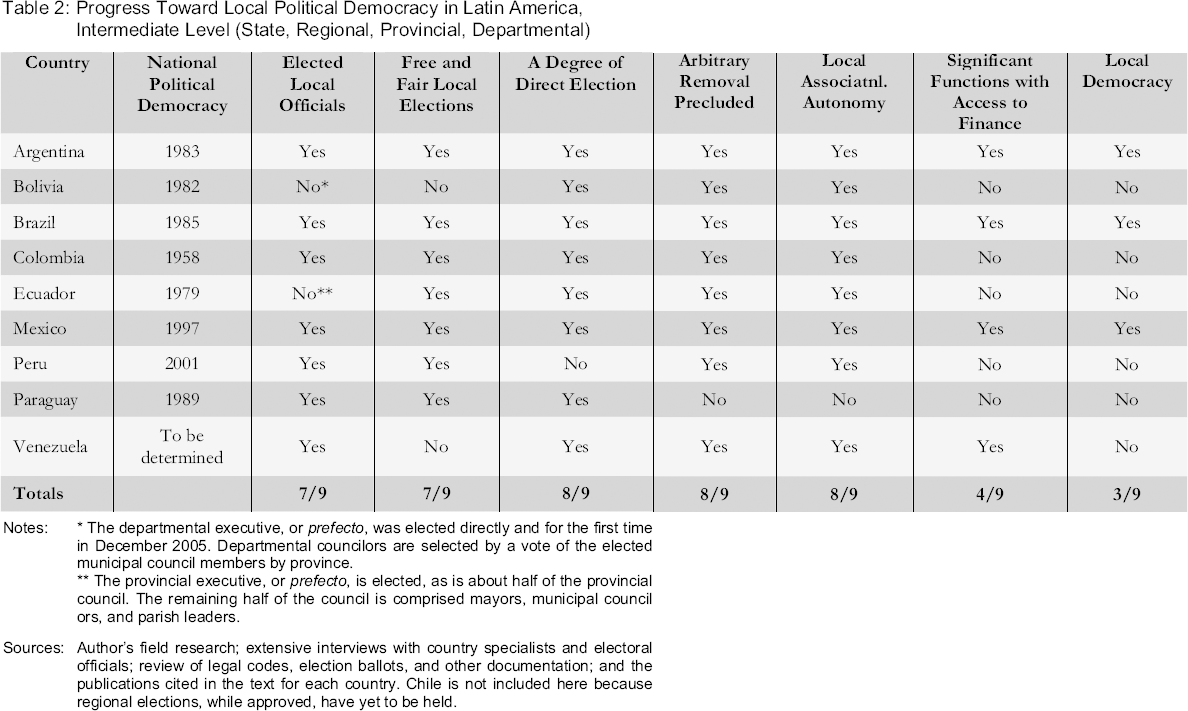
Table 2 allows for an examination of the intermediate level of government – the states, provinces, regions and departments – in the nine countries of Latin America that popularly elect intermediate authorities. 12 Overall, the transfer of authority to the intermediate level over the past three decades has been dramatic: three countries – Bolivia, Paraguay and Peru – have established elected authorities for the first time with varying degrees of responsibility. The remaining six cases have all experienced substantial decentralization and, in addition, some recent re-centralization. Three countries – Argentina, Brazil and Mexico, which are all federal systems – can be considered to have democratic intermediate-level systems by the proposed criteria. Of the remaining six systems – Colombia being closest – the major limitation is the lack of significant functions and the financing to carry them out.
Progress Toward Local Political Democracy in Latin America, Intermediate Level (State, Regional, Provincial, Departmental)
Notes:
The departmental executive, or prefecto, was elected directly and for the first time in December 2005. Departmental councilors are selected by a vote of the elected municipal council members by province.
The provincial executive, or prefecto, is elected, as is about half of the provincial council. The remaining half of the council is comprised mayors, municipal council ors, and parish leaders.
Sources: Author's field research; extensive interviews with country specialists and electoral officials; review of legal codes, election ballots, and other documentation; and the publications cited in the text for each country. Chile is not included here because regional elections, while approved, have yet to be held.
Chile has promulgated a constitutional reform to allow for the election of regional councilors (as opposed to the executive, or intendente). The elections have not been held yet.
Brazil's governors and state legislatures are directly elected through majoritarian and open party list systems, respectively. Reacting to decades of centralized military control, the drafters of the 1988 constitution created a specific tax base and revenue-sharing system that gives Brazilian states extraordinary autonomy. The state participation fund allocates more than one-fifth of the net revenue of three federal taxes to the states, for example. The states have some flexibility to set tax rates on interstate sales, a major source of revenue, and other taxes. Brazil's states hold exclusive and concurrent responsibilities in a range of public service areas, and they are currently most involved in education, social assistance and health care (see Ter-Minassian 1997: 443-449; Burki, Perry, and Dillinger 1999). President Cardoso's (1995-2002) ability to enact the Real Plan represents an interesting example of recentralization – a successful effort to control state fiscal profligacy – without altering fundamentally the features of the democratic federal system (Samuels and Mainwaring 2004: 121-125).
Although Mexico's states do not have the fiscal autonomy of Brazil's, intergovernmental reform and dramatic political change have turned a highly centralized system of state government into an infant democracy (Ochoa-Reza 2004). Directly elected for six years, Mexico's governors are powerful and have become much more politically independent since 1989, when the first PRI-opposition governor was elected. They also have regular access to resources through revenue-sharing, which has increased substantially since 1990 (Amieva-Huerta 1997: 577), and substantial responsibilities. The states are dependent on the transfers, but they can establish taxes on whatever is not already federally taxed. Though this residual authority is limited by the federal role and the state tradition of bargaining away its authority in exchange for fiscal transfers, it also has yet to be fully exploited (Díaz-Cayeros 2006: 133).
Argentina's federal government has a long tradition based on Article 6 of the Constitution of occasionally intervening in provincial affairs in times of crisis, including the removal of sitting governors (Gibson and Suarez-Cao 2007). This does not regularly occur, however, and the provinces have been otherwise accorded considerable political, administrative and financial autonomy. Indeed, provincial administrations generally dominate their lower-level municipal counterparts, an important consideration for municipal democracy in Argentina.
Colombia is the one unitary system with a nearly democratic intermediate level of government. The country directly elects governors and departmental legislators in a plural electoral system. Despite the promise of a 1993 law and a series of subsequent reforms aimed at certifying departments to take on new authority, they are relegated to administering national education and health policies under tight central government expenditure restrictions. In essence, they have no additional significant functions (Bird and Fiszbein 1998: 189-190; Acosta and Bird 2005).
The remaining five systems have not reached the democratic threshold, and all of them except Venezuela are unitary. In the major decentralization reform of late 1989, Venezuelan states assumed a series of exclusive responsibilities and a series of concurrent functions to be shared, following agreement on the terms, with the national government. That process stalled by the time Hugo Chávez was elected in 1998 and has since been reversed under the new laws and the political control of an increasingly authoritarian regime. States have long relied almost entirely on national fiscal transfers, moreover, and as yet they have no ability to institute a tax system. It is worth noting Bolivia's dramatic step toward regional autonomy, which has become a major source of political friction and concern about territorial fragmentation, by directly electing the departmental executives (prefectos) in 2005. However, the councils are not popularly elected.
Ecuador's provincial governments are weak institutions with limited functions in practice, in large part because they must compete for authority with appointed provincial governors and municipalities (though under the 2008 Constitution they can associate to form regions governed by elected officials). The provinces carry out public works projects and attempt to support education, public services, and social programs. The executive, or prefecto, and about half the council are elected; the rest of the council is comprised of designated municipal and parish officials. In Paraguay, departmental governments established in the wake of the 1989 transition have only a basic institutional coordination and planning role, and their budgets are extremely limited. The establishment of regional government in Peru following the November 2002 elections is an interesting development. Held for a third time in 2010, the elections allow for a wide variety of political participation, but only by party list; direct election has not been instituted. The regional law establishing the system provides for a four-phase decentralization process – a series of gradually increasing transfers of functions and fiscal resources. If carried out as planned, the law will go a long way toward the establishment of local democracy.
Explaining the Results
A series of interrelated factors is primarily responsible for the weakness of local democracy following the years of reform. First, in many cases decentralization has simply been too weak or poorly developed and instituted to allow for the emergence of local democracy. Here it should be emphasized that effective decentralization is a complex process of fiscal, administrative, and political change that affects myriad institutions and interests; it is simply difficult to achieve. Effective intergovernmental reform requires continual intergovernmental collaboration and evaluation and careful adjustment of objectives and means over a long period of time – error is to be expected under the best of circumstances – all of which allows plenty of time for opposition to the process to galvanize. Second, decentralization entails redistributing power to the local level, and no individual or institution relinquishes its authority without considerable incentive. In the large majority of Latin American countries, national legislators especially – the very officials who enact the reform legislation – see decentralization as a means of eroding their traditional power bases and generating political competition from the elected mayors or other local officials who benefit from the reform. Key ministries and public sector unions, opposed to any loss of authority or job security that could accompany local governments’ assumption of traditionally centralized policy and service functions, often prove to be significant obstacles as well. Political elites have become much less enamored with decentralization upon realizing the ramifications; or, they have enacted reforms in response to current political realities, yet have never seriously implemented them in a sustained fashion (Willis, Garman, and Haggard 1999).
Local democracy is just emerging in Latin America because, third, decentralization is a slow process that involves not only shifts in administration and resource allocation, but also a gradual change in political and socioeconomic culture that is best measured in decades (Montero and Samuels 2004). Local government development, like institutional reform of any kind, takes time, and democracy may not – or should not, in some cases – be the immediate goal, especially for the new intermediate levels of unitary systems. A centuries-long tradition of centralization and authoritarianism is not about to be eclipsed by 30 years of intergovernmental reform. Indeed, the failure of policy elites in the region to appreciate this reality and the limitations created by short-term political horizons has further fueled poorly developed or overly ambitious decentralization, which has, in turn, produced fiscal mismanagement, unmet high public expectations, and a consequent counter-reaction in a number of countries (Bird and Vaillencourt 1998; Prud'homme 1995). This disenchantment has been compounded by the mistaken belief that decentralization can rapidly address everything from corrupt political parties to poverty: decentralization has paid a price for being oversold. Fourth, Latin American governments have refused to decentralize because, they argue, local government capacity is too weak to effectively provide services or manage new resources. This point must in every case be given serious consideration, yet it also can be less than convincing. The “insufficient-capacity” argument is often simply an excuse utilized by national elites to avoid the loss of central authority that decentralization, by definition, entails. Central governments fail to recognize – or do not want to admit – that development of a local system requires according it a measure of autonomy to make reasonable mistakes and learn from experience.
Local democracy is weak in Latin America because, fifth, in many countries a centralized political party and institutional control, especially over the electoral system, remains strong. Decentralization consequently tends to be weak. The degree of centralization has long been linked to the degree of political party centralization (Riker 1964; Chhibber and Kollman 2004). Finally, decentralization is typically expensive, especially when poorly executed, and the desire to maintain macroeconomic stability has served as a brake on the process. The transfer of personnel, administrative reorganization, and income transfers, among other costs, can put strain on the national treasury. Central governments continue to provide public services that now, following decentralization, are also handled at the local level, producing costly redundancies. It is fairly common, moreover, to see local governments taking on highly burdensome debt levels, the payment of which effectively must be guaranteed by the central government. Here the experiences of Argentina's provinces and Brazil's states in the 1990s are the most prominent examples (Webb and Perry 1999; Samuels and Mainwaring 2004).
Conclusion
This article attempts to define the institutions of a local government regime that constitute the minimum conditions for local democracy. It also demonstrates that despite the historic progress of decentralization and democratic local government in Latin America over the past two decades – and irrespective of recent centralizing trends in some countries – local democracy remains scarce. The presentation above makes four assertions. First, building on the work of Dahl and others, it says that one can identify a fairly objective set of criteria that define local democracy. The six criteria are:
elected local officials,
free and fair local elections,
a degree of direct election of local officials,
local elected officials not removed arbitrarily,
local associational autonomy, and
control over financial resources to carry out significant local responsibilities.
Where these conditions hold within a democratic national regime, the local system can be classified as democratic. As such, local citizens have the unimpaired opportunity to present their preferences to local government, local officials have a fundamental incentive to weigh those preferences, and local government has sufficient independent authority to respond to them (see Dahl 1971: 1-3). As each country operates within its own complex institutions of intergovernmental interaction and control, local democracy is much more than a matter of scale. It requires according localities enough autonomy to allow local government and its citizens to move beyond the procedural and become habituated to the practice of democracy.
Second, this definitional model posits that the achievement of local democracy, or a process of local democratization, is tantamount to minimum decentralization, a concept that involves the transfer of at least a basic degree of political, administrative, and financial power to the local level. The first five conditions for local democracy provide for a fundamental level of political autonomy, which allows the plural expression of local citizen interests and works to ensure that local elected officials respond to those interests. The sixth criterion allows for the administrative and financial autonomy that is required for basic democratic political development. It helps ensure that local governments not only take on enough responsibilities to activate the interest of the local public servant and community in local affairs, but also have the financial resources that allow effective, accountable governance.
Third, the model allows a general assessment of the transition to local democracy in Latin America, and one would expect it to apply well in considering the progress of local democracy throughout the developing world. Eighteen countries in Latin America are specifically addressed here. At the municipal level, only three countries – Brazil, Chile and Colombia – can be considered to currently have local democratic systems of government, an assessment that demonstrates the long, continuing legacy of centralized government in the region despite the reforms seen today. Several countries are close to joining this group of local democracies, however. Most municipal systems require reform that is not easily achieved – especially the provision of direct elections and assumption of functions and finances – to reach the ranks of the democratic.
For the countries with elected intermediate-level government systems, the results are proportionally more positive, with three of nine – Argentina, Brazil and Mexico – classifiable as democratic. Among the remaining countries, the weak functions and financial resources are the major restrictions on democratic development. These new large sub-national government units can become politically powerful through decentralization. As witnessed for good and ill in Bolivia recently, for example, they have proven to be a considerable political counterweight to the dominance of national or capital-centric politics.
Finally, this article asserts that a number of factors are responsible for the weakness of local democracy in Latin America. Decentralization has often been poorly developed and instituted, and, because it involves a redistribution of power, it generates powerful political opposition. In addition, failing to understand that decentralization is a lengthy process of gradual institutional reform, Latin American policymakers have either oversold it, which has led to public disillusionment, or not moved to address concerns about insufficient local capacity. Decentralization also has been slowed by the continued existence of overly centralized political party systems, the expense of the process, and the potential macroeconomic fiscal difficulties it can create.
Are the criteria I propose for the establishment of local democracy too restrictive, thereby underestimating the status of Latin America's local systems? Three issues require mention in addressing this point. First, despite the general definitional consensus noted earlier, scholars continue to debate what constitutes a national democratic regime; one can hardly expect immediate agreement on the nature of local democracy. The six criteria presented above, based on a thorough investigation of the ongoing scholarly and policy debate over decentralization, are best treated as an attempt to bring institutional clarity to the question of local democracy and to generate needed discussion on the topic. Second, the elimination or weakening of, say, a couple of the criteria will not make much difference in the results presented here because of the country variation. (It could place about one-half of the countries in the democratic column, but not significantly alter the overall conclusion.) As noted, the results of this survey support the central notion that centuries of deep centralization and authoritarianism are not quickly reversed. Finally, it is worth adding that one's view of the degree of progress toward increased local autonomy is heavily influenced by where the viewer is situated within or vis-à-vis the intergovernmental hierarchy. On one hand, for example, national ministerial officials, who generally tend to be skeptical about decentralization, are more likely to consider these criteria for local democracy as too demanding. Local elected officials, on the other hand, are more likely to consider them insufficient. The inherent subjectivity of any evaluation of democratic institutions or decentralization prevails here, in this study, as well.
Local democracy is, again, a local political system that is almost completely responsive to all local citizens. It requires faith in the superiority of consensus-building over authoritarianism or open conflict as a means of resolving disagreement in local affairs. The local institutionalization of this process of compromise is achieved through agreement on the rules of the game, the application of those rules, and their continued operation over a long period of time (on democracy as consensus-building, see Rustow 1970: 362-363). In this sense, local democracy is no different from its national counterpart.
There is one strategic difference, however. The establishment of local democracy also requires the cession of real power to the local level by national decision-makers 13 – be they aging dictators or reformist democrats. Should decentralization occur, local democrats may not (as experience has shown, most probably will not) have much say in the definition of the rules by which they are required to play. It is nonetheless the argument of this essay that unless fairly specific local institutional features are put into operation, the local game that emerges will be less than democratic.
In the federal systems especially, the intermediate level policymakers also must relinquish authority.