



Abstract
During the 1990s, a large number of regulatory agencies were created or reformed in different sectors in Latin American countries. Almost all included political delegation mechanisms, intended as formal rules to enhance credible commitments to time-consistent policies. In this paper, using an original data set of agencies’ head tenure in the telecommunications and finance regulatory agencies, we discuss if these mechanisms worked as planned, and find a divergence between actual mandates and the formally established fixed terms, effected by means of systematic early resignations. Our findings reveal, however, some consistent patterns of behavior. Stronger legislative presidential power reduced effective delegation to some extent, and agencies’ organizational strengths protected them from patronage. We also confirmed the existence of some significant differences between the two sectors examined. Having slightly weaker delegation rules, delegation practices were also less effective in telecommunications than in financial services, contrary to expectations about credible commitments.
Introduction
Regulatory agencies in Latin America are not a new phenomenon. Regulation based on separate agencies dates back in many countries to the 1920s (Drake 1989). At the time, regulatory agencies were established in the region to supervise markets, with a special emphasis on economic stability, particularly in financial sectors such as banking, insurance, or stock markets (Jordana and Levi-Faur 2006). Because of the special tasks of control and supervision envisaged for such organizations, presidents and powerful ministers preferred them to be separate from the ministerial structure, and gave them their own organizational identity with distinctive employment conditions for their personnel. Since the mid-1980s, a new wave of regulatory agencification reaching multiple sectors has spread worldwide, including in Latin America countries, (Levi-Faur 2005; Gilardi, Jordana, and Levi-Faur 2007). This wave differed from the earlier one by asserting the independence of agencies vis-à-vis elected politicians, on the grounds that disconnecting regulatory decisions as much as possible from politicians would produce the best outcomes.
Apart from typical organizational measures granting autonomy (budget, personnel, and so on), nearly all the agencies created since the 1980s in Latin America as elsewhere have included in their original institutional design different mechanisms to effect political delegation (Epstein and O'Halloran 1999). These often include fixed-term mandates, provisions to prevent the dismissal of staff as a result of regulatory decisions, successive reappointment of board members, and so forth, in order to limit political influence on the decisions of the agency. Almost all of the early regulatory agencies were reformed after the late 1980s with the addition of these types of delegation mechanisms. The reasons for this reform are still very much debated. Explanations range from attempts to signal credible commitments to long-term investors, to normative behavior based on emulation patterns among countries, or to the growing power of professional networks within governments (Thatcher 2002; Gilardi 2002, 2004; Jordana and Levi-Faur 2005).
In this paper we enquire into the conditions under which the political delegation of agencies materializes in Latin America. 1 To this end, we consider whether the expectations of independence from politicians, created through the introduction of delegation mechanisms in regulatory agencies, have actually been realized in Latin America, for all that their formal institutional design gives them considerable de jure protection against political interference. A decade or more after most of these agencies were set up, agency interactions with their political principals certainly display some clear examples of autonomy. But we are interested in further examining whether formal rules regarding delegation were fully respected, and also whether different practices emerged, in order to draw some conclusions about the institutional dynamics in the region. We examine whether informal institutions for agency decision-making displaced the formal rules in different contexts, including patronage and rule adulteration, but also presidential abuse of authority (Helmke and Levitsky 2006: 6, quoting O'Donnell 1996). To this end we analyze regulatory agencies in two sectors that represent key areas of regulation in the governance of the economy – namely, telecommunications and financial services – with the aim of identifying possible divergences from their formal rules. We discuss the extent to which regulatory agencies’ de facto political delegation – our dependent variable – in Latin American countries has been related to greater formal independence or to any combination of factors other than de jure formal independence, including the broader institutional environment. With this end in mind, we examine whether mandated fixed terms of tenure for heads of regulatory agencies have been respected in the region since the extensive introduction of “independent” institutional designs, as a proxy for de facto political delegation.
This paper was presented at the XXVII LASA Conference held in Montreal in September 2007 and at the Symposium “New Frontiers on Institutional Research in Latin America”, 5-6 May 2008 and organized by the GIGA in Hamburg (Germany). We thank all the participants in these meetings for their comments, in particular Peter Kingstone and Laurence Whitehead, who acted as discussants for the presentations. Comments from Abel Escribà, Guillermo Rosas, and an anonymous reviewer are highly appreciated. We also thank Laura Ballarin for helpful research assistance. For financial support we are grateful to the Spanish Ministry of Education and Science (research grant SEJ2004-03358).
In Section 2, we review some literature on political delegation and regulatory agencies, and examine previous research on measuring the diffusion of independent regulatory agencies in Latin America. Section 3 concentrates on the research question and presents the interpretive framework and the methodology we have selected to deal with it. In Section 4, we present the data and the results obtained, and discuss our findings in the context of the comparative research on this issue. Section 5 concludes with a discussion of the theoretical implications of the empirical results presented.
Different explanations have been proffered of what induces politicians “to choose not to choose” (Voigt and Salzberger 2002). One line of reasoning about the introduction of delegation mechanisms into the institutional design of regulatory agencies has been to consider this innovation as a solution to the credible commitment problem (Kydland and Prescott 1977; Majone 1997; Elster 2000). This view argues that non-elected professionals with tenured mandates could transmit considerable confidence in the stability of markets, and also offer more security for long-run investments through the avoidance of short-term political shifts. In the Latin American context, this can also be interpreted as a way to increase the credibility of countries’ commitments in the eyes of foreign investors (Graham and Naim 1998). A rival interpretation, also based on the commitment hypothesis, maintains that politicians realize their long-term goals by introducing delegation, insofar as they design administrative institutions that are expected to survive their mandate, thus shaping future policy options (Moe 1990). Alternative explanations of delegation focus on more practical considerations, as for example when politicians want to reduce the decision-making costs involved in large hierarchies, or aim to extend public intervention into new areas without creating widespread fears of state expansion (Voigt and Salzberger 2002: 294-300).
During the 1990s, many international organizations and professional associations predisposed by normative considerations about the credible commitment problem, advocated political delegation, and in particular the introduction of mechanisms for protecting the tenure of the agency heads, such as fixed-term mandates. This mechanism was presented as the “correct” institutional design for new regulatory agencies (see, for example, OECD 2000, 2006; World Bank 1997), or as a required modernization for existing ones, and was diffused extensively in Latin America and worldwide (Jordana and Levi-Faur 2005; Jordana, Levi-Faur, and Fernandez 2009). Thus, regulatory institutions created or reformed during the 1990s tended to be relatively similar to each other, although there remain some variations in their institutional characteristics, which reflect historical legacies and many other factors differentiating nations and sectors (see Jordana and Sancho 2004; Gilardi 2008; and, in regards to Brazil, see also Mueller and Pereira 2002; Correa et al. 2006). In general, it was expected that agency heads appointed under specific professional conditions and protected by delegation rules from their political principals, could make regulatory decisions oriented to the long-term development of markets, regardless of political volatility.
The relevance of these institutional designs fostering political delegation in Latin American countries was based on the expectation that such designs could provide some areas of policy stability. However, this expectation also required an implicit commitment at the country level on the part of other political institutions not to challenge the autonomy of regulatory agencies. The creation of independent agencies can be also understood as a relocation of a basic commitment of governments to preserve policy stability and to avoid time inconsistency (Stern and Trillas 2003; Levy and Spiller 1994). Whatever the effective reasons that triggered the inclusion of delegation mechanisms in regulatory agencies, the fact is that these procedures were also broadly adopted and implemented in Latin America. This allows us to analyze how effective these institutional innovations were after they were implemented. It is important to assess the effectiveness of political delegation in the region, not only because of its possible impact on policy performance (not discussed here), but also because it represents an opportunity to discuss institutional performance itself. The adoption of external institutional models in the region requires careful scrutiny of its adaptability in dealing with public policy-making problems that are endogenous to the region's particular institutional characteristics (Weyland 2007). Discussing the limits of the applicability of such models could contribute substantially to our understanding of major institutional deadlocks in the region.
Specialized regulatory institutions in the financial sector were first introduced in Latin America in the 1920s. They were strongly influenced by North American designs, partly as a result of the missions of Edwin Walter Kemmerer, a Princeton University professor who acted as a consultant for many governments at that time (Drake 1989). In many cases they underwent a long history of subsequent institutional development (see Nogales 2000, for the Bolivian case; and López Garavito 2003, for the Colombian). Since the early twentieth century, better regulation in the financial area has been seen in the region as a basic requirement to control the impact of devastating financial crises, and special institutional efforts were made in this direction. Telecommunications regulatory agencies resulting from large changes in this sector expanded very fast across the region after the late 1980s, bringing privatization and the dismantling of monopolies. The introduction of new regulatory frameworks in telecommunications occurred in Latin American countries during the 1990s as part of a worldwide wave (Henisz, Zelner, and Guillén 2005). Their emergence was connected to the creation of competitive markets in this sector, which often had a positive impact on the development of telecommunications networks and on the performance of the sector more generally (Gutiérrez and Berg 2000; Ros 2003; Gutiérrez 2003a, 2003b; Jordana and Sancho 1999).
Figure 1 illustrates the process of regulatory agencification in Latin America for the two sectors considered in this article. Agencies in financial services emerged after the 1920s and expanded quite rapidly across the region in subsequent decades, while in the telecommunications sector, regulatory agencies appeared in the 1990s. As is clearly observable, telecommunications agencies were created with political delegation rules included, whereas financial agencies were massively reformed in the 1990s in order to incorporate such delegation rules (as previously stated, our proxy is the introduction of fixed-term mandates).
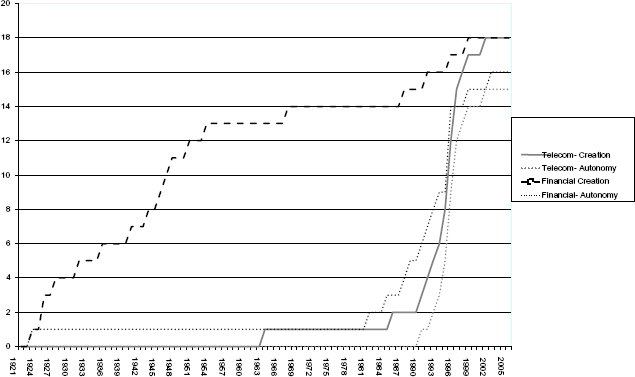
The Expansion of Telecommunications and Financial Regulatory Agencies in 18 Latin American Countries (1920-2005): Creation and Autonomy (Fixed-term Tenure)
Following their diffusion during the 1990s, independent regulatory agencies are now a tangible institutional reality in all Latin American countries. Because they were based on institutional models that were standard at the time, their traits are quite similar across countries and sectors. However, they are not identical; they differ in certain relevant characteristics, and significant formal variations exist among them. Rules granting independence are not the same in all countries, and some are stronger than others, insofar as they combine different political and organizational dimensions. Several independence indexes have been elaborated upon in order to better compare the formal characteristics of regulatory agencies. They have been applied to different sectors and countries in order to measure the extent of delegation in each case. 2 We rely here on several such indexes in order to gauge the existing diversity within Latin American countries. We also introduce a comparison with European countries in order to obtain a better view of the particularities of Latin American agencies with respect to both internal variations and aggregate regional differences. On the financial side, we consider the measure of supervisory independence, elaborated upon by Masciandaro, Quintyn, and Taylor (2008), with a sample of 55 countries, and also a classification based on a World Bank survey of a larger number of countries (Barth, Caprio, and Levine 2006). For telecommunications, we rely on the independence index elaborated by Gilardi (2002) for 17 European countries, which we merge with an extension to Latin American countries prepared by Sifontes (2005), using the same methodology. We also use another independence index prepared by Edwards and Waverman (2006) and extended to Latin American countries by Montoya and Trillas (2007).
The existing literature on central bank independence (Cukierman 2008) has been very influential in introducing this issue into the study of regulatory agencies and their institutional performance, and in a parallel way to the influence of independent central banks as a model for the establishment of those agencies (Gilardi 2002; Stern and Trillas 2003; Quintyn 2008). In fact, the first independence indexes were created to measure the degree of governments’ political delegation to central banks (Cukierman 1992).
Based on these indexes, we may conclude that the agencies’ level of independence is higher in European countries than in Latin American ones. Given that these indexes refer to the early years of this century, when major diffusion processes had already taken place in both regions, the institutional similarities among agencies – across both countries and regions – seem to be more significant than the differences. What is particular about Latin American countries – as noted by Sifontes (2005: 17) and confirmed by us as well when comparing the Masciandaro and Barth indexes for the financial sector – is that organizational autonomy and financial autonomy are the stronger dimensions on average, but the political dimensions of independence are not so strong. In particular, the dimension of agency head status and relations with regulated firms appears lower on the independence index. This suggests that independence characteristics are not identical among European and Latin American countries, although they are not very far apart. As we will argue later, we suspect that the observed differences make sense in light of the different logics of delegation existing in the two regions, and probably are not greater than they are because of the worldwide standardization of institutional traits in the creation of regulatory agencies, which was based on the spread of “best practice” doctrine during the 1990s (Brown 2004).
These formal independence indexes provide us with information about the intentions of governments and legislatures when they set up (or reformed) regulatory agencies. In most cases, we find that they established a certain level of de jure political delegation, and to some extent defined rules that kept them from intervening in the decision-making processes of agencies. As previously stated, our main concern is to enquire whether these delegation mechanisms introduced in Latin American countries really played a key role in their policy processes, altering forms of political decision-making that historically have dominated policy-making in these sectoral arenas (Murillo and Martínez-Gallardo 2007; Kaufman 1977). Thus, identifying how political delegation worked in practice after the creation of autonomous regulatory agencies, and discussing the conditions under which significant challenges were confronted, is very important for obtaining a better understanding of the dynamics of regulatory governance in the region.
Related to the study of central bank independence, a procedure to identify how political delegation works in practice was introduced years ago by Cukierman (1992). It is based on measuring the turnover of central bank governors, as opposed to observing their legal mandate, and on considering possible concerns about the implementation of laws establishing central bank independence, particularly in developing countries. The precise measure was the frequency of cases in which the governor is replaced within a short time period following a political transition. The aim of this de facto index of central bank independence was to indicate the degree of effective control exercised by politicians on the direction of the central bank, above and beyond the existing formal rules on appointing governors. A similar logic of analysis has only barely been extended to the debate of the effective independence of regulatory agencies, but some contributions have been made regarding Europe (Thatcher 2005; Maggetti 2007) and Latin America (Montoya and Trillas 2009). We draw on these studies to develop a broader discussion about the effective conditions under which political delegation works, and enquire into its actual relevance to the achievement of successful regulatory governance, which is, in the end, the main objective of such institutional innovations.
Thatcher's research (2005) examining the actual behavior of regulatory agencies in four European countries (Italy, France, Germany, and the United Kingdom) raises the issue of political delegation in practice. He looks into whether elected politicians have wanted to keep regulatory agencies after their creation
under tight control through application of their formal powers or whether they have allowed agencies to become a distinct set of actors, separated in practice, and hence representing a “third force” in regulation, in addition to governments and regulatees (Thatcher 2005: 348).
Thatcher's general conclusion about political interference in Europe is negative. He does not find clear evidence of interference by elected politicians in regulatory decision-making during the years following the creation of the agencies; the agency heads by and large completed their fixed-term mandates as formally established. He concludes that delegation has been working in practice as defined by formal rules. After obtaining these results, he elaborates upon an explanation of why governments (in many cases new ones) have maintained their commitment to agency independence, not only formally, but in practice. He offers two reasons: first, agencies actually followed politicians’ preferences, adapting their regulations to government policies; and second, the costs of interfering in agencies’ decisions exceeded the benefits of having autonomous agencies (in terms of their reputation among wider constituencies). In any case, Thatcher finds that, as a consequence, political delegation has converted regulatory agencies into a “third force”, constituting a separate policy actor from politicians in the sector, and thus making regulatory policy a more complex arena. Maggetti's (2007) analysis includes de facto independence indicators of employee autonomy, autonomy of resources, and political vulnerability for 16 European regulatory agencies, focusing on what explains discrepancies between de jure (formal rules) and de facto independence. His conclusion is clear: formal rules do not explain variations in de facto independence. He then considers other factors to make sense of actual agency independence, finding some relevance in the presence of veto players, but also in the age of the agency. On the Latin American side, Montoya and Trillas (2009) measure the independence of telecommunications regulatory agencies in practice, focusing also on the tenure of agency heads and the reasons for completing their mandates. For many countries, they find large variations in agency heads’ terms in office, irrespective of the legal mandates. All in all, it would appear that in Latin American countries variation in the realization of formal rules of agency independence is quite substantial, particularly in comparison with their general fulfillment in European countries, and this has certain relevant consequences.
The overall picture, however, can be fairly complex. Some Latin American governments might have limited their influence over regulatory agencies – either because regulators somehow adjusted their actions to politicians’ preferences or for reputational reasons – allowing agencies to emerge as a “third force” in the regulatory domain, thus moderating certain political boundaries. Other countries might have implemented political control of agencies by totally or partially challenging the formal structures of delegation introduced in the 1990s. Or they might have updated traditional hierarchical procedures insofar as they did not introduce political delegation in fact, or introduced only a very light version of it. For a couple of these countries, for example Chile, such strategies achieved significant success. These variations show that different institutional solutions might have been introduced to make regulatory policy commitments credible in the region. As Estache and Wren-Lewis (2009: 764) suggest, “the reduced accountability and commitment powers of governments in less developed countries imply that theory must understand better the way multiple principals interact in forming regulatory policy.” To this end, in the next section we introduce an interpretive framework to analyze in more detail the issue of effective political delegation of regulatory agencies in Latin American countries, with the aim of disentangling such puzzling results.
We substantiate our research question on delegation in the case of Latin American agencies by focusing on the specific influence that presidential institutions – as distinct from parliamentary ones – may have exerted on the behavior of regulatory agencies under democratic regimes. According to Moe and Caldwell (1994), presidential systems have a unique impact on the structure of the bureaucracy, in that legislatures in divided governments tend to prefer independent agencies that limit presidential power and are more accessible to parliamentarians and interest groups. Thus, we might expect that in presidential systems, legislatures will be more prone to set up independent regulatory agencies, accountable to the parliament; in parliamentary systems executives will be more favorable towards creating regulatory agencies accountable to the Executive (Voigt and Salzberger 2002); and political delegation will be granted only in decision-making domains where such commitment would not be vulnerable to cyclic fluctuations (for example, highly technical and non-controversial policy sectors). Conversely, parliamentary systems exert fewer pressures for the creation of agencies, and such agencies may suffer more habitually from problems of credible commitment. Executives in parliamentary systems often meet less resistance to attempted changes to agencies’ design, to the extent that they face fewer institutional veto players (Moe and Caldwell 1994). To avoid this threat of imposed change, regulators tend to adjust their preferences in the manner described by Thatcher (2005). Although in both cases regulatory agencies may exist as a “third force”, they do not evince identical behavior. Backed by legislatures, we might expect agencies in presidential regimes to be more open to conflict with the Executive, while in parliamentarian regimes agencies will prefer to avoid conflicts with governments.
In accordance with Moe and Caldwell's (1994) interpretive framework, we might expect legislatures in Latin American countries with presidential systems to exert pressure to create and defend independent agencies. However, most Latin American parliaments are considered quite reactive when compared with the United States’ legislative institutions, particularly in respect of their supervisory powers, thus making it difficult for them to hold to account particular public institutions such as regulatory agencies (Morgenstern and Nacif 2002). Yet their relevance to legislative proposals should not be underestimated; they may play a significant role when the presidential party does not exercise a majority (Alcántara Sáez, García Montero, and Sánchez López 2005; Shugart and Carey 1992). In this context, the legislative powers of the President are highly relevant to overcoming possible parliamentary blockages (Metcalf 2000; García Montero 2008).
Between the complete North American separation of powers and the complete European fusion of powers, Latin American executives have a “unique combination of institutional powers” (Cox and Morgenstern 2002: 467), which has to be taken into account. Considering such institutional conditions, we might expect agencies in the region not to behave identically to those in countries whose legislatures play a different role in the policy process. If Latin American parliaments do not impose and control agencies that are by and large independent, we may find in the region more institutional similarities with regulatory agencies in parliamentarian regimes in which executives allow them political delegation by reason of particular policy concerns. However, the conditions that allow credible commitments to remain stable in this case, such as reputational effects and preference adjustments, are not necessarily always effective in the strongly presidential regimes of Latin America, whose public administrations are accustomed to being more politicized and unstable in their tenure (Ramió and Salvador 2005; Portes and Smith 2008).
As we are interested in the consequences of such institutional designs in Latin America, we propose several hypotheses on how the relationship between executives and regulators evolved in this context following the creation of the regulatory agencies. As a point of departure, we consider that in presidential regimes strong legislatures protect delegation (this is not the case only when coincident majorities appear), while in parliamentary regimes coalition building also prevents the formal or informal demise of the mechanisms of delegation already introduced (this is not the case only when absolute majorities will). Presented more generally, one could say that the more veto players present in a political regime, the more anchorage possibilities there will be for regulatory agencies to realize their de jure independence. However, in presidential regimes with weak legislatures, institutional anchorages to protect delegation are almost non-existent. In addition, although many Latin America countries’ regulatory agencies tend to improve their management and recruitment systems (Graham and Naim 1998; Parrado and Salvador 2008), non-tenured public administration traditions also complicate the mutual adjustment of preferences that allow regulatory agencies to act as a “third force” in parliamentarian regimes, thus retaining some policy distance from the executive principals. In this respect, conditions are not very favorable for effective political delegation in Latin America. To better discuss such conditions, we entertain three hypotheses about the relationship between legislatures, executives and regulatory agencies in presidential regimes, with a particular focus on the effectiveness of political delegation.
H1. The stronger presidential legislative power is, the weaker the effective political delegation of agencies will be, to the extent that anchorage for independent institutions will be more limited.
H2. The risk of effective political delegation failure will be greatest after political transitions (such as presidential change), but the continuity of public bureaucracies, when they exist, may curb it.
H3. The stronger the requirements for time-consistent policies (such as investments in utility sectors versus other economic sectors) are, the more intense will be the pressure on presidents to maintain effective political delegation to agencies.
To aid in the discussion of the hypotheses introduced here, we identified political delegation mechanisms within the institutional settings of regulatory agencies in telecommunications and financial services, and established how they are followed in practice. We essentially concentrated on the rules governing the appointment and departure of agency heads, as well as examined whether legislatures were involved in the appointments. As fixed-term mandates are the most common delegation mechanism among regulatory agencies, this is an excellent way to observe effective political delegation. We collected information about formal rules as well as data about the actual mandates of agency heads of regulatory agencies in 18 Latin American countries for the period between 1990 and 2007. 3
Our data were mostly collected from legal documents found principally on agencies’ websites, but other repositories of legal documents were also consulted. In addition, a particular e-mail survey was used to identify the actual mandates of agency heads since agency creation. This was complemented with the interviewing of experts, and the consultation of national newspaper repositories and specialized information sources from sectoral international organizations.
In this section, we present the findings regarding our hypotheses on the actual operation of delegation mechanisms in presidential regimes, using the effective tenure of agency heads in regulatory agencies as a dependent variable indicator. In order to make sense of effective political delegation in the region, we discuss how the making of formal rules for delegation correlates with de facto independence, and also how these rules interact with presidential legislative powers and bureaucratic powers in different Latin American countries. We complement this discussion with some qualitative analysis on the option of countries to establish credible commitments without introducing or maintaining effective political delegation.
For Table 1 we collected formal regulations for the appointment and renewal of agency heads in telecommunications and financial regulatory agencies. We observe, with very few exceptions, that the introduction of rules for fixed-term mandates became generalized in Latin American countries during the 1990s. However, certain other characteristics related to agency heads show a reduced level of political delegation: appointment of agency head is in the exclusive hands of government for 25 out of 36 agencies considered here (for another five the agency board is responsible, and only six require ratification by the Legislative); renewal in most cases is at the discretion of the government, without any limitation of mandates (only eight cases have banned renewal or allow only one additional term); and finally, legal protection against removal (preventing dismissals for policy reasons) is formally established in only 14 out of 36 agencies. As for differences in formal rules between the two sectors, we should mention that they are not particularly big, despite the gulf between the average years of agency creation (the average year in financial services is 1954, while in telecommunications it is 1993). Delegation mechanisms were also introduced earlier in financial supervision, the average year for the introduction of fixed terms being 1988, while in telecommunications it was 1995. But the number of years for the formal fixed-term mandate is almost identical: 4.3 years (51 months) in telecommunications versus 4.7 years (55 months) in finance, on average. There are no relevant differences in the numbers of cases having protection from dismissal.
Formal Head Appointment Characteristics. Telecom and Finance Regulatory Agencies (circa 2005)
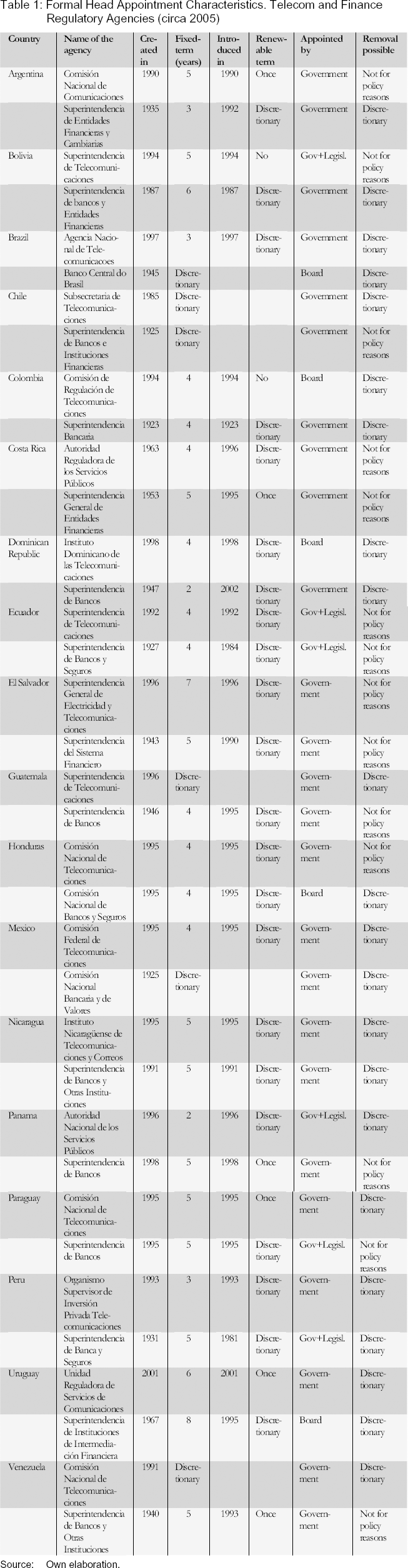
Formal Head Appointment Characteristics. Telecom and Finance Regulatory Agencies (circa 2005)
Source: Own elaboration.
From these observations on agency head rules, we can conclude in general that they do not represent a very strong protection for political delegation to agencies. There is no doubt some protection for agency heads, in particular the reputational and credibility costs for the government that early dismissals may incur, but in most cases other institutional anchorages are not present. This state of affairs coincides to some extent with previous considerations based on the examination in Section 2 of different independence indexes for Latin American countries. The political dimensions of delegation are weaker in the region – and agency head appointment is a key aspect in this area – while other dimensions of delegation, particularly organizational aspects, have a stronger record, thus providing significant protection in the turbulent public administration contexts that characterize many countries in the region. Such protections also involve a certain amount of public commitment to the purpose of regulatory agencies, which can contribute to the creation of an autonomous space for regulatory policy-making, but they are essentially not of a political nature.
Bearing in mind such weak regulations governing the appointment and removal of agency heads of regulatory agencies in Latin American countries, we proceed to the discussion of the previous hypothesis regarding the determinants of effective political delegation in the region. Our data on agency heads indicate that their tenure in the region is not very stable. Counting from the year that such fixed-term mandates were introduced in each country, we found some striking results: Completion of fixed terms in the region is rare. Of those agencies that introduced fixed-terms for agency heads (15 in the telecommunications sector; 15 in financial services), we found that only 21.3 percent of them completed terms formally established in legal statutes. There are important variations among countries. We also found that very short mandates – in some cases just a few months – could be linked to political and economic unrest. However, no country has a record of completing all terms for both sectors during the period examined. In addition, the average period of mandates is nearly one half the average tenure expected under the formal rules (see Tables 2 and 3).
Effective Mandate for Agency Heads of Regulatory Agencies (1990-2007). Financial Supervision
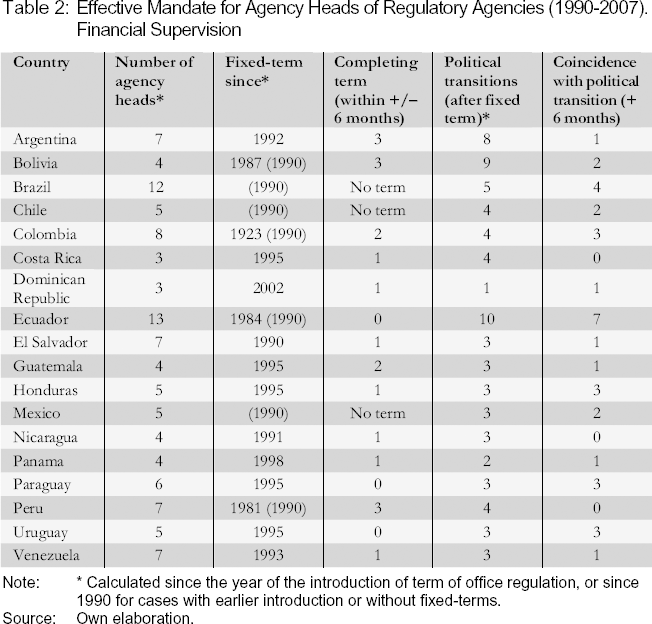
Calculated since the year of the introduction of term of office regulation, or since 1990 for cases with earlier introduction or without fixed-terms.
Source: Own elaboration.
Effective Mandate for Agency Heads of Regulatory Agencies (1990-2007). Telecommunications
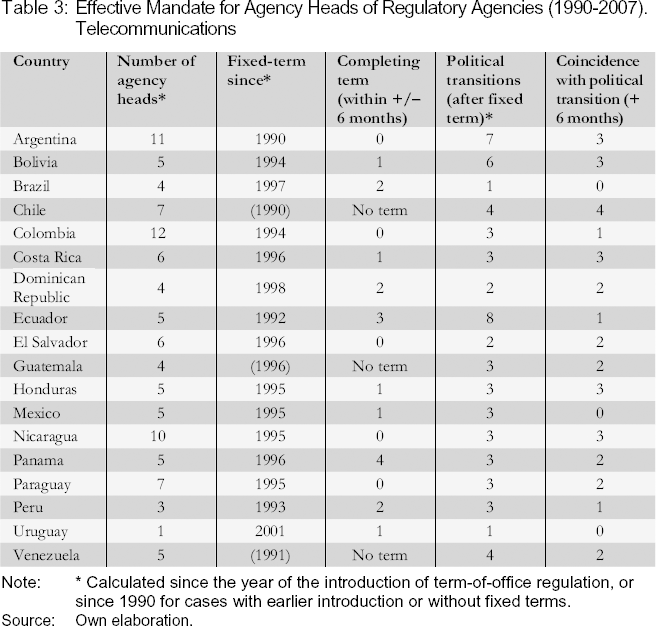
Calculated since the year of the introduction of term-of-office regulation, or since 1990 for cases with earlier introduction or without fixed terms.
Source: Own elaboration.
Among the reasons for the actual time period that agency heads remain in their offices, we may find contextual factors relating to a country's political and economic conditions, as well as personal reasons for early resignation (including the attraction of professional offers). However, we maintain that our first hypothesis, about presidential legislative power, also has an influence on the probability of agency heads retiring early. The countries with the most presidential legislative power in the region include Argentina, Colombia, Ecuador, Brazil, and Chile, 4 and according to our hypothesis this group of countries should have less political delegation to agencies because institutional commitment does not have any anchorage. The clearest example confirming the hypothesis is Chile, which has no delegation at all in its regulatory architecture, and at the same time is the strongest case of presidential legislative power. But we cannot consider cases of early retirement, since no fixed-term mandates existed in Chile for the two cases examined. Brazil has no fixed term for finance, which also reveals that formal political delegation is weaker for these countries.
We selected these countries because they have the highest rankings on different indexes of presidential legislative powers (see Stein et al. 2006; PNUD 2004; García Montero 2008).
Examining the remaining cases with formal fixed-term mandates, we find that only 17.2 percent of agency heads effectively complete their terms in these countries, less than the average for all Latin American countries. While the impact of political transitions in these countries on the removal of agency head is strong in the financial area (accounting for 54.8 percent of cases compared with 40.9 percent for other countries), it is less so in telecommunications, which means that these results confirm our hypothesis, at least for the more established area of financial regulation. As regulatory agencies in telecommunications are relatively new, a process of adjustment is probably still under way. In this sense, it is worth noting that policy disputes between agencies and presidents have been resolved several times by changes to delegation rules. Examples include the reshaping of the telecommunications regulatory agency in Argentina in 1996, when the inclusion of responsibilities for postal regulation necessitated a new law in which many delegation mechanisms were abolished; and the telecommunications law reform in Mexico during the last year of the Fox administration (2006), which resulted in the dismissal of the agency head and the Federal Telecommunications Commission's board.
As for our second hypothesis, on the risk of agency head replacement during political transitions (in practice, presidential changes), we found that for all the cases considered in our sample with fixed-term rules, 52 of 176 agency head replacements coincided with a presidential change in the country (we took as our reference period the six months after the appointment of a new president), representing 34.3 percent of total agency head changes.
Observing these results from the side of presidential change, we find a high risk for agency head discharge following a political transition. In 69 of 137 presidential changes in Latin American countries (50.4 percent), presidents decided to change agency heads immediately upon assuming office, irrespective of any existing fixed-term tenure. In addition, the large number of agency head resignations related to presidential change does not mean that the other agency heads continued in office after completing their fixed terms. In fact, 66 percent of agency head changes occurred also within a presidential mandate, most of them of shorter tenure than formally established. 5 These are quite striking results, given that only six out of 36 agencies have no fixed-term rules, so that in most cases these fixed terms were not realized. Comparing these results with the probability of completing terms for those 30 agencies with fixed-term rules, we found that only 38 out of 176 agency heads completed their terms (21.6 percent of the cases). Thus, from these results we can confirm our hypothesis: The risk of agency head replacement is much higher after a political transition than upon completion of a fixed term.
In this sense, it is worth noting that some countries, like Costa Rica, as a matter of pragmatism require by law that fixed-term tenures should coincide formally with the tenure of the presidential mandate, which also has a fixed term. In fact, these are the cases in which formal rules of agency head appointment tend to be more reliably realized.
The reasons can be varied for the high-risk removal of an agency head following a presidential transition. On one side is traditional political patronage, on the other a quest for more direct political control over the agency decisions. This is an issue for further research, but it can be argued that the presence in the regulatory agencies of highly specialized professionals who are selected on a competitive basis does not encourage patronage. In fact, as discussed above, agencies’ autonomy in Latin America is stronger on the organizational side than on the institutional side. Such a situation often provides resources to regulatory agencies that protect them against patronage, although clientelism may remain under certain conditions.
In fact, we observe the persistence of a strong organizational identity for regulatory agencies, facilitating their continuity beyond political cycles. Since the 1990s, regulatory agencies have been considered to be efficient bureaucracies within the Latin American public administration. In general, they work with high-quality procedures and have gained good reputations shortly after their creation. This has contributed to the “silent revolution” in state reforms in the region during this period (Lora 2007). They are generally well funded, and in many cases they have pursued merit-based systems of recruiting personnel. They have also designed more flexible organizational structures than those of traditional ministries, which had neither the technical capability nor the ability to instill confidence due to the predominance of political appointments and traditional corporatism (Parrado and Salvador 2008). Capable of implementing regulatory policies effectively, and of interacting with the business and professional communities (national and international), they can be considered islands of bureaucratic excellence in an environment that often has major shortcomings (Jordana and Ramió 2009).
In some cases executives have introduced major organizational changes to agencies (budget, personnel, infrastructure, and so on), or extended general public administration regulations to them. Many cases of this can be found: for example Peru's OSIPTEL managerial reforms after the accession of Alan Garcia to power (2006); or Brazil's ANATEL changes to human resources policies after Lula's victory in the 2002 presidential elections. This is a way of modifying the agency's power of self-organization and of adjusting the scope of policy-making discretion delegated to it within the regulatory regime. This can work as a functional equivalent of redefining the delegation framework to reduce effective political delegation with fewer reputational costs. These cases illustrate the presidents’ ambition to keep some political control over the agency by limiting its capability to act as a “third force”.
With regard to our third hypothesis on differences in the credible commitments of presidents depending on the regulatory area, we have found some intriguing results. The theory of credible commitments would lead us to expect political delegation in the telecommunications sector to be more respected than delegation in the finance sector, insofar as assuring long-term investment in utilities requires a more credible commitment to avoid time-inconsistent policies. However, our findings do not suggest a clear answer. Against expectations, regulatory agency heads in the financial sector appear to be more stable than those in the telecommunications sector. Only 20.2 percent of agency heads completed their terms in the telecommunications sector, as opposed to 23 percent in the financial sector. There are also more agency head changes during political transitions in telecommunications than in finance (54.8 percent versus 46.7 percent). This phenomenon is concentrated in Central American countries, but also present in Chile. Although the differences are not very large, the average of actual mandates by sector is nearly identical, with the financial arena being only slightly larger: 36 months in the financial services sector, and 29.5 months in the telecommunications sector. As could be expected, agency de jure delegation rules also had an impact on agency head stability, but again only for the finance sector. Having longer fixed terms appears to be related to a longer period of agency head tenure in the case of finance (Pearson coefficient of 0.28), but no such relation apparently exists in the telecommunications sector. A pattern clearly emerges favoring financial regulation. In addition, as the lengths of time considered for these two sub-samples are not identical (financial agencies are older), it is worth noting that greater political instability in the early 1990s affected only agency head replacement in financial agencies, making observed differences more substantial. In sum, most of these results show that agency heads in the financial sector were more stable in their tenure than those in the telecommunications sector, although the differences are not especially noteworthy.
When viewed in comparison to the more stable character of the financial sector, we might interpret these results, which refute our third hypothesis, in terms of the newer character of telecommunications policy following privatization in the sector. It could be that comparing two sectors in very different phases of their respective policy development could distort the assessment. The nascence of regulatory agencies in telecommunications in the 1990s, as well as the critical policy options that emerged after privatizations, probably made it more likely that agency heads would come into political conflict with presidents in regards to the direction of regulatory policy. Although some presidents could be more attentive to investment in the telecommunications sector by maintaining effective delegation in order to make their commitments more credible (Brazil and Mexico, for instance, did not change any agency head during their political transitions), turbulence in a nascent policy sector created pressures for more direct involvement on the part of the presidents in general. Such policy contexts likely had greater weight than considerations of signaling an institutionalized commitment to time-consistent policies. Nevertheless, one might expect that for such cases the commitment was transmitted directly from presidents to investing firms.
To conclude this section, it is important to note that we do not document any case of agency closure during the period examined, nor do we make any generalizations about patronage or organizational capture. Once created, regulatory agencies as public institutions have always been maintained after political transitions, to the extent that they represent a reservoir of strong professional capabilities that cannot be replaced in the short run, and which are required to manage sophisticated policy instruments. Findings clarifying variations in effective political delegation beyond legal regulations, however, confirm the sensitivity of delegation to the institutional characteristics of the country, but also to the differences among sectors. We confirmed our second hypothesis on the high risk posed by political transition for agency heads in Latin American countries, and partly in regards to our first hypothesis on presidential legislative power as well. As to the third hypothesis, our results were challenging. Although we clearly observed unexpected patterns of behavior in the two sectors, differences based on age, and between mature financial regulatory agencies and young telecommunications regulatory agencies, seem to be more relevant than investment constraints in explaining institutional differences in terms of effective political delegation.
Political delegation mechanisms intended as formal rules introduced in the design of the regulatory agencies to enhance credible commitments to time-consistent policies, did not generally work as planned in many Latin American countries after their creation. We found a divergence between actual mandates and the formally established fixed terms effected by means of systematic early resignations. We also observed a persistent turnover before the established term – often connected to presidential political cycles – that had a strong impact on agency head stability. Our findings, however, reveal some consistent patterns of behavior. Stronger presidential legislative power reduced effective delegation to some extent, and agencies’ organizational strengths protected them from patronage. This made their political supervision the key issue for presidents who did not confront many institutional obstacles to keeping most agency heads under their control (by renewing their appointments or expecting some policy readjustments). Furthermore, we confirmed the existence of some significant differences between the two sectors examined. Having slightly weaker delegation rules, delegation practices were also less effective in telecommunications than in financial services, contrary to expectations about credible commitments. This result can be related to differences in institutional novelty, a conclusion that agrees with Maggetti's findings on the stronger de facto independence of regulatory agencies when they are older (2007: 281).
Contrary to European practices, the logic of defining regulatory agencies as a new policy actor – a “third force” – has not clearly emerged in Latin American public policy-making. Although we cannot rule out its presence in some cases in the region, what we in fact observed was the emergence of multiple paths to cope with the time-consistency problem. Commitments have sometimes been made credible by means of political delegation, but the creation of strong public organizations with a level of autonomy and a very high professional profile has acted as a functional equivalent to some extent. Finally, locating commitments directly from the elected President and his or her policy instruments has become a common resource in recent years, particularly in cases of weak institutionalization. When strong policy reversals have occurred in the region, these have not necessarily occurred in those countries that have less effective (or formal) rules for political delegation.