



Abstract
What beliefs do citizens who perceive levels of corruption in their countries to be of significance hold? Do those beliefs arise from their exposure to corruption? Furthermore, do perceptual and experiential corruption decrease the reservoir of legitimacy of a democratic regime? We attempt to answer these questions using the 2012 Americas Barometer survey of 24 Latin American countries. We find that whereas “rational-choice corruptors,” males and, to a lesser extent, individuals with resources are particularly exposed to corruption, perceived corruption originates from a sense of impunity derived from a negative evaluation of the state's ability to curb corruption. In addition, we show that perceived corruption significantly decreases citizen satisfaction with democracy, but exposure to corruption does not. All in all, the policy implications of our study are straightforward: having an efficient and trusted judiciary is central to curbing both experiential and perceived corruption, even if it increases the latter in the short run.
Introduction
The deleterious effects of corruption are widely known. 1 Corruption is said to negatively affect economic agents, domestic public policymakers, international donors, and citizens in general, as it is thought to increase the costs of economic and financial transactions (Mauro 1995); to create severe inefficiencies in the implementation of public policy (Rose-Ackerman 1999; Tanzi and Davoodi 1998), including those funded with foreign aid (Maren 1997; Mauro 1997); and, most important, to decrease citizens’ trust in public institutions, politicians and political parties (Van der Meer 2010; Schwarz-Blum 2006), and ultimately their support for democracy (Seligson 2002; Moisés 2010).
I would like to thank the participants of the “Corruption, Clientelism, Cronyism and the Quality of Democracy” panel at the 2012 Madrid IPSA Conference for their comments. Special thanks go to José Álvaro Moisés and the anonymous reviewers of this journal for their detailed critique. I am also grateful for Hans-Joachim Lauth's questions and comments.
Yet despite these recognized effects, to the best of our knowledge there are few analyses (such as Olken 2006) that address the equally well-known gap between perception of corruption and actual exposure to it. In fact, how much corruption there actually is in any given country remains an enigma, as corruption is a multifaceted, complex phenomenon that is hard to measure and whose exact boundaries are difficult to define. Most proxy measures (or crude assessments) gauge perceptions of corruption, whether by experts – such as Transparency International's Corruption Perception Index (2007) – or by ordinary citizens from a political community. But most studies on corruption that go beyond perceptions underexplore the interconnections (or lack thereof) between individuals’ exposure to the phenomenon and their overall assessment of the country's degree of corruption (Seligson 2006).
The primary objective of this study is to begin to fill this difficult gap. We utilize the 2012 Americas Barometer individual-level survey data on corruption conducted in Latin America and the Caribbean (N=38,298) by the Latin American Public Opinion Project (LAPOP) to explore the factors that help explain this apparent disconnect between experiential and perceptual corruption. Who experiences corruption the most in the region and in which spheres of social interaction? What beliefs do those who perceive levels of corruption to be significant in their countries hold? The use of survey-based data enables us to analyze the socioeconomic, attitudinal and normative profile of the individuals most exposed to corruption and to gauge whether that exposure has any impact on the perception of corruption and on individuals’ satisfaction with democracy as it works in their country.
The next section details the complexity of studying corruption, especially when it comes to defining and measuring this phenomenon. Section 2 describes the data used and the hypotheses that this study examines. The determinants of both experiential and perceptual corruption are analyzed in Section 3, and their impact on satisfaction with the existing democracy is examined in Section 4. The last section discusses the public policy implications of the key findings of this analysis.
The Complexity of Studying Corruption
There are multiple challenges to the study of corruption; some are general difficulties, some pertain to the analysis of experiential corruption, and others relate to how one's perception of corruption is formed and how it changes over time. One difficulty is in how to define corruption, which sometimes entails delimiting the spheres of life where corrupt acts occur. There are maximalist definitions, which see corruption as “an infringement of rules – where a ‘rule’ is a criterion of behavior that indicates right and wrong ways of doing things” (Newell 2009: 2). Needless to say, this type of definition widens the scope of investigation of corrupt acts and their consequences, as the focus of analysis ceases to be only the dishonest behavior of public officials, and begins to encompass the actions of regular citizens in the privacy of their lives. In a study of corruption and democracy in Mexico, Bailey and Paras (2006: 72), for instance, show that Mexicans overwhelmingly consider actions such as “cheating on exams,” “[making a] long-distance call using someone else's phone,” and “[running] a red light when no cars are around” to be infringements of the rules. Similarly, Redlawsk and McCann (2005: 267) find that, in the United States, citizens’ perceptions of whether certain actions are corrupt are highly variable, such as when “voters supported a candidate for office in return for a promise to fix potholes in their street” or when an “official recommended an out-of-work friend for a government job.” Evidently, this (maximalist) way of approaching the subject creates serious measurement issues, as a multitude of behaviors can potentially fall into the category of corruption. Furthermore, such a definition of corruption has rather limited cross-national applicability, as it is highly context-dependent, given that, as Newell (2009: 2) himself indicates, it refers to a specific moral code from a particular country that an individual behavior has infringed upon.
Minimalist definitions, on the other hand, see corruption as the misuse of public authority for the obtainment of personal rewards (Canache and Allison 2005; Heywood 2007; Nye 1967; Transparency International 2007). This kind of definition is not devoid of shortcomings, either. First, it aggregates into a single category phenomena of different scales. For example, small bribes given to a public employee to have access to public services (for instance, to a nurse in a public hospital in order to be seen by a doctor faster) end up being grouped together with massive sleaze schemes (corruption rings) that can sometimes siphon off hundreds of millions of dollars from the public purse. Second, there is also a measurement issue. Public opinion surveys can estimate, albeit approximately, how often individuals resort to paying bribes by asking them directly about the subject – under the assumption that the anonymity of their answers will lead interviewees to feel safe enough to own up to some occasional “gray” conduct. Large-scale corrupt acts are more difficult to tap because, assuming that stratified samples reach the target individuals, the seriousness of some offenses precludes surveys from including in their questionnaires queries such as “Have you ever been involved in influence-peddling?” or “Do you, or does anyone that you know, run an extortion racket?” Moreover, the minimalist definition cannot be used to study corruption in the private sector. As a consequence, business transactions based on paid-for, privileged, confidential information, or on piracy or illegal spying on competitors – assuming that there is a consensus that these are corrupt acts – will remain understudied as long as public opinion surveys are used to attempt to understand the breadth and effects of corruption in a given society.
Despite the limitations of the minimalist definition, this study will utilize it to assess experiential corruption, as the minimalist definition is more focused and workable than the maximalist definition. We will thus focus primarily on corrupt acts stemming from the interaction between individuals and the state, while acknowledging that surveys are, almost by nature, ill prepared to capture cases of large-scale corruption.
When it comes to the study of experiential corruption, one of the key challenges pertains to the nature of the relationship between the parties who participate in corrupt acts. Seligson (2002, 2006), for instance, consistently refers to the notion of corruption “victimization,” which implies that corrupt acts have an active perpetrator who forces somebody else (a “victim”) to give him or her personal benefits in exchange for access to material or immaterial resources that the bribe's solicitor controls. Even though this might be the case in some circumstances, it might not hold true for all kinds of corrupt acts contained in the minimalist definition of corruption. Heradstveit (2001), for instance, shows how exploitative, rent-seeking elites in Azerbaijan actively engage in corruption to have access to the country's oil revenues. On a micro-level, some individuals vigorously resort to tax evasion, particularly in social contexts of lack of trust in the government (Scholz and Lubbell 1998).
This discussion is more than a matter of semantics; in fact, it has far-reaching consequences, as distinct levels of material wealth, particularly in highly unequal societies, are thought to lead to different individual experiences with corruption. You and Khagram (2005), for example, indicate that wealthier citizens have a greater ability to seek out corruption as a means to expedite transactions, whereas poorer individuals are the ones more likely to fall prey to extortion. Furthermore, Redlawsk and McCann (2005: 271) show that citizens of different socioeconomic strata define corruption rather differently. In light of these previous findings, we will work with the hypothesis that, among those exposed to corruption, there are individuals who, should opportunities to expedite transactions present themselves, will engage in corruption, alongside individuals who are simply forced to deal with it. In fact, in recognition of this important difference, Alatas (1990) developed an interesting typology, using the term “transactive corruption” to refer to the first type of cases, and “extortive corruption” in reference to the second.
Investigating perceived corruption (and its relationship to experiential corruption) can be equally complicated. First, there might be individual variation in what citizens consider to be corrupt acts (Lascoumes and Tomescu-Hatto 2008; Sousa 2008), which impacts individual-based assessments of corruption. Second, at the societal level, there are factors that can buffer or magnify perceived corruption that do not necessarily bear a relationship to actual corruption. Mazzoleni (2008), for instance, shows how partisanship and political trust influence how citizens react to politicians’ corrupt acts. Similarly, Davis, Camp and Coleman (2004) find that the ability of opposition parties to mobilize an anti-incumbent vote based on an anti-corruption platform depends on the nature (size and ideological competition) of the country's party system, heightening the levels of perceived corruption in some cases but not in others. Sharafutdinova (2007, 2010), in turn, shows how Russian elites’ aggressive electoral competition for control of state revenues gives rise to extremely negative political campaigns; as a consequence, perceived corruption seems to be a function more of unhindered political competition by crony elites than of the actual levels of existing corruption.
Another important factor of perceived corruption is the role of the media in transforming an episode of corruption into a major national scandal. Heywood (2007), for instance, describes how, in Spain, the Spanish Socialist Party's (PSOE) administration had levels of corruption similar to those of the Popular Party's (PP) governments; however, the media ferociously exposed the cases of PSOE-related corruption, and as a consequence, the perceived level of corruption in Spain was substantially higher under the socialist administration than during the PP's stints in power. Evidently, an active and investigative media presupposes the existence of freedom of the press (Canache and Allison 2005), which leads us to the similarly complex relationship between corruption (both perceived and experiential) and political regime type.
According to some authors, levels of corruption tend to decrease once the rights and freedoms associated with liberal, representative democracies are present (Chowdhury 2004). A more nuanced view indicates that cases of corruption tend to spike once democratic regimes are first installed and begin to function, and that such cases decline progressively as the institutional guarantees of accountability and transparency become more firmly entrenched (Rock 2007; Rose-Ackerman 2007). In the particular context of Latin America and the Caribbean, where there are several cases of somewhat recent transitions to democracy, political liberalization is thought not to have significantly reduced corruption. As Whitehead (2000) mentions, new types of corruption have sprung up. Furthermore, the process of economic liberalization (the privatization of public companies), which in some countries took place simultaneously with political liberalization, created fertile ground for the development of high levels of corruption (Weyland 1998).
In sum, there are myriad factors that shape perceived corruption, such as partisanship levels, institutional trust, the nature of the political elite's electoral competition, the role of the media, and the opportunity structure for corruption. Our goal here, however, is not to develop an all-encompassing or even mid-range theory of the causes of perceived corruption, but rather, using survey data, to understand both the beliefs that affect individuals’ perceptions of corruption and whether those beliefs arise from experiential corruption. The hypotheses described in the next section clarify these objectives; but before examining them, we will first discuss the data used in this study.
Data and Hypotheses
The Americas Barometer survey used here was administered in 24 countries of Latin America and the Caribbean in early 2012; it employs a questionnaire with core items that are identical in all countries, guaranteeing the cross-country comparability of results. Data were collected through face-to-face interviews; in 2012 (as in 2010) the surveys were based on a “multi-stage probabilistic design (with quotas at the household level)” and were “stratified by major region of the country and by rural and urban areas” (Seligson and Smith 2010: XXIX). The margin of error is ±2.5 or less; each country's sample has 1,500 or more interviews, and the overall sample for Latin America and the Caribbean comprised more than 38,000 interviews. 2
The sample size of the following countries was slightly different: El Salvador (N=1,499), Costa Rica (N=1,496) and Suriname (N=1,491). Bolivia's sample size was 3,029, so it was weighted in this study. Please note that the same questionnaire was also administered in Canada (N=1,500) and the United States (N=1,500), using a web survey; however, we do not include the data for these countries in this study, as the focus is on Latin America and the Caribbean.
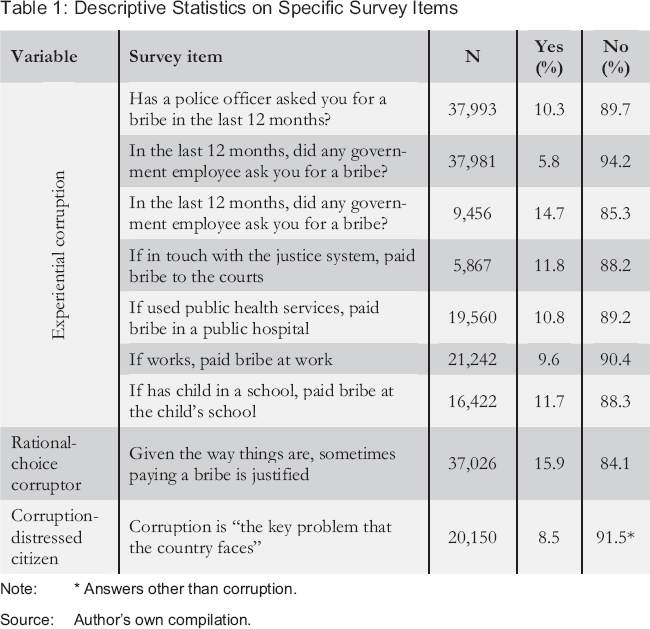
The 2012 Americas Barometer has a series of questions that enable us to examine both experiential and perceived corruption, and, more important, allow us to determine whether the first feeds into the second. As shown in Table 1, there are seven questions that investigate experiential corruption. 3 We will use these seven questions to create one of our dependent variables: “exposure to corruption” (Cronbach's Alpha, a measure of internal consistency of items being grouped, is 0.74 – an adequate level). It is important to emphasize that, whereas the first five items focus unequivocally on situations of citizen–state contact, this is less clear in the case of the last two questions (corruption at work and in schools), as one cannot know for sure whether the respondent works directly for, or indirectly with, the government, and whether his or her child studies in a public school. As a consequence, the inclusion of these last two questions represents a slight modification of the minimalist definition of corruption mentioned above.
Descriptive Statistics on Specific Survey Items
Note:
Answers other than corruption.
Source: Author's own compilation.
The actual wording of each question is as follows: “Has a police officer asked you for a bribe in the last 12 months?”; “In the last 12 months, did any government employee ask you for a bribe?”; “In the last 12 months, did you have any official dealings in the local government?” If yes, “In the last 12 months, to process any kind of document in your municipal government, like a permit, for example, did you have to pay any money above that required by law?”; “In the last 12 months, have you had any dealings with the courts? If yes, “Did you have to pay a bribe to the courts in the last 12 months?”; “Have you used any public health services in the last 12 months?” If yes, “In order to be seen in a hospital or a clinic in the last 12 months, did you have to pay a bribe?”; “Do you work?” If yes, “In your work, have you been asked to pay a bribe in the last 12 months?”; “Have you had a child in school in the last 12 months?” If yes, “Have you had to pay a bribe at school in the last 12 months?”
What are the key instances where corruption takes place in Latin America and the Caribbean? The descriptive statistics reveal that experiential corruption takes place primarily in the municipal government and the courts, an important piece of information, given that these are governmental entities that directly process demands from citizens. This observation leads to our first hypothesis: we expect that citizens who report making demands on governmental agencies are more likely to experience corruption than those who do not contact the public sector to have their claims processed. 4 Interestingly, interactions with the police officers and public hospital workers also provide, albeit to a lesser degree, an opportunity structure for corrupt acts to occur: approximately one in every ten interviewees has paid a bribe in a public hospital or has come across a police officer who has asked for a bribe.
Schools are also instances where experiential corruption takes place, but, given the way the survey item was phrased, we are uncertain about whether it refers to public schools (which would fit the minimalist definition) or not.
Lamentably, the seven questions about experiential corruption that compose the dependent variable do not enable us to contribute significantly to the aforementioned controversy in the literature surrounding corruption “victim” vs. active corruptor. Even though the first two items phrase the question about contact with corruption using a “victim” framework (“Has a police officer asked you for a bribe in the last 12 months?” and “In the last 12 months, did any government employee ask you for a bribe?”), the other five questions query the respondent as to whether he or she paid a bribe in different instances, which may include both sought-after and forced-upon corruption. However, the Americas Barometer does have a very straightforward question that can be used to gauge sought-after experiential corruption. The question is “Do you think, given the way things are, sometimes paying a bribe is justified?” As Table 1 indicates, 15.9 percent of our sample answered positively to this question, which suggests that these individuals (henceforth, “rational-choice corruptors”) view corruption as a justified means to expedite transactions and, as such, have a higher propensity toward taking part in corrupt acts. In fact, Huntington (1968), for instance, argues that engaging in corruption can be a rational behavior because it can improve efficiency, particularly when individuals have to deal with large, complicated, sluggish public bureaucracies. Similarly, describing the situation in Brazil, Taylor writes:
Corruption is often presented as a rational (if still unethical) response to local conditions. For example, the level of taxation is so high (comprising roughly 37 percent of gross domestic product, as compared to 19 percent in Chile, and 25 percent in Argentina), that tax evasion has become a survival strategy for some businesses. Further, in a corrupt environment, businesses may find it difficult to compete against bribe-paying competitors, thus increasing the likelihood of engaging in bribery themselves (Taylor 2010: 93).
Our hypothesis, thus, is that acceptance of corruption increases the chances of one being exposed to it: whenever an opportunity to expedite a transaction arises, rational-choice corruptors will willingly participate in corrupt acts (for instance, by offering a bribe).
The Americas Barometer survey also allows us to single out individuals who are highly concerned about corruption. One survey question asks individuals what they deem to be the “key problem that the country faces.” This particular survey item can be highly useful, as it tracks interviewees’ spontaneous answers: interviewers ask the respondents this question without suggesting possible answers. As Table 1 indicates, 8.5 percent of the Latin American and Caribbean sample seem to be what we will call “corruption-distressed citizens”: of their own volition, they indicate “corruption” as the gravest difficulty for their countries. It is hard to craft a clear hypothesis about what the impact of being a “corruption-distressed citizen” is on experiential corruption. Even though it is possible that these individuals never pay bribes because they morally object to them, and, as such, do not experience corruption (a significant, negative effect); it is also feasible to conceive that they are so adamantly against corruption because they have come across corrupt public officials, were led into paying bribes, and found that reprehensible (a significant, positive effect). However, we know that corruption-distressed citizens do not believe that “given the way things are, sometimes paying a bribe is justified”: they are not rational-choice corruptors. 5
Spearman's Rho, which measures the statistical correlation between two variables (in this case, anti-corruption crusaders and rational-choice corruptors), is 0.002, with N=19,475 and a non-significant p-value of .788.
When it comes to the variable “perception of corruption,” we used the following Americas Barometer survey item: “Taking into account your own experience or what you have heard, corruption among public officials is very common, common, uncommon, or very uncommon?” The pattern of distribution of the answers was: 4.6 percent, very uncommon; 15.7 percent, uncommon; 40.4 percent, common; and 39.3 percent, very common. Although most interviewees believe corruption is not infrequent, there is considerable cross-country variation in that regard. When we create a scale of perceived corruption (with the following values: 0=very uncommon, 33= uncommon, 66=common, 100=very common, which will be used throughout the analysis), we see that whereas in Suriname, for instance, the mean response to this question is 38.8, in Trinidad and Tobago, it is 80.5 percent, and in Colombia it is 81.7 percent.
What are our key hypotheses for the explanation of perceived corruption, particularly the gap between perception and exposure? Previously, we indicated that there is a plethora of factors shaping perceived corruption in any given country, ranging from partisanship levels, the features of the party system, the nature of electoral competition among elites, the role of the media (and the guarantees given regarding freedom of the press), and the opportunity structure for corruption, to name but a few. However, for the most part, these elements shape an individual's relationship with the political universe; they are not individual beliefs themselves. In terms of the latter, we expect perceived corruption to be related to a sense of impunity: a rudimentary and essentially negative assessment of the functioning of institutions, allowing for cases of corruption (however big or small) to be seen as going unpunished. As such, we hypothesize that individuals who lack trust in the justice system and who believe that the government is not doing much to combat corruption are the ones who will contribute the most to high levels of perceived corruption.
Experiential and Perceptual Corruption: Determinants and Their Inter-relationships
In order to understand the determinants of both experiential and perceptual corruption in Latin America and the Caribbean, and, more important, to determine whether, and to what degree, the latter reflects the former, we ran two multivariate regression analyses. When it comes to examining exposure to corruption, we utilize standard socioeconomic factors such as age, gender, educational level, income, urban vs. rural dwelling, size of municipality (number of inhabitants), along with a self-reported measure of perceived family economic situation. 6 In addition, we investigate the impact of three factors on exposure to corruption: the effect of being a rational-choice corruptor; the weight of being a corruption-distressed citizen; and the influence of making demands on the city government. 7 Finally, we include a measure of trust in the country's justice system (the latter varies between “0” for no trust to “7” for a lot of trust). Earlier in this study, we hypothesized 1) that individuals who rely on the municipal government to help solve their problems are more likely to encounter corruption, and 2) that rational-choice corruptors will likely be more often exposed to corruption as they see it as a legitimate means of expediting transactions.
Age has four categories: 18–25 years, 26–45 years, 46–65 years, and 66 and over. Gender is coded as female=1 or male=0. There are four educational groups (none, meaning, no formal education; primary; secondary; and higher education), and 17 income brackets, which capture total, before-tax annual family income. Self-reported perceived family income is divided into four categories: total household income is enough, allowing for savings; it is enough and the interviewee does “not have major problems”; it is not enough, and the interviewee is “stretched”; it is not enough and the interviewee is “having a hard time.” Place of dwelling is classified as urban (which takes the value of 1) vs. rural (value of 0). Finally, city size refers both to the number of inhabitants and the location of the city. It has five categories: capital city, large, medium, small cities, and rural areas.
The question here was whether the interviewee has “sought assistance from or presented a request to any office, official or councilperson of the municipality within the past 12 months,” which was codified as yes=1 or no=0.
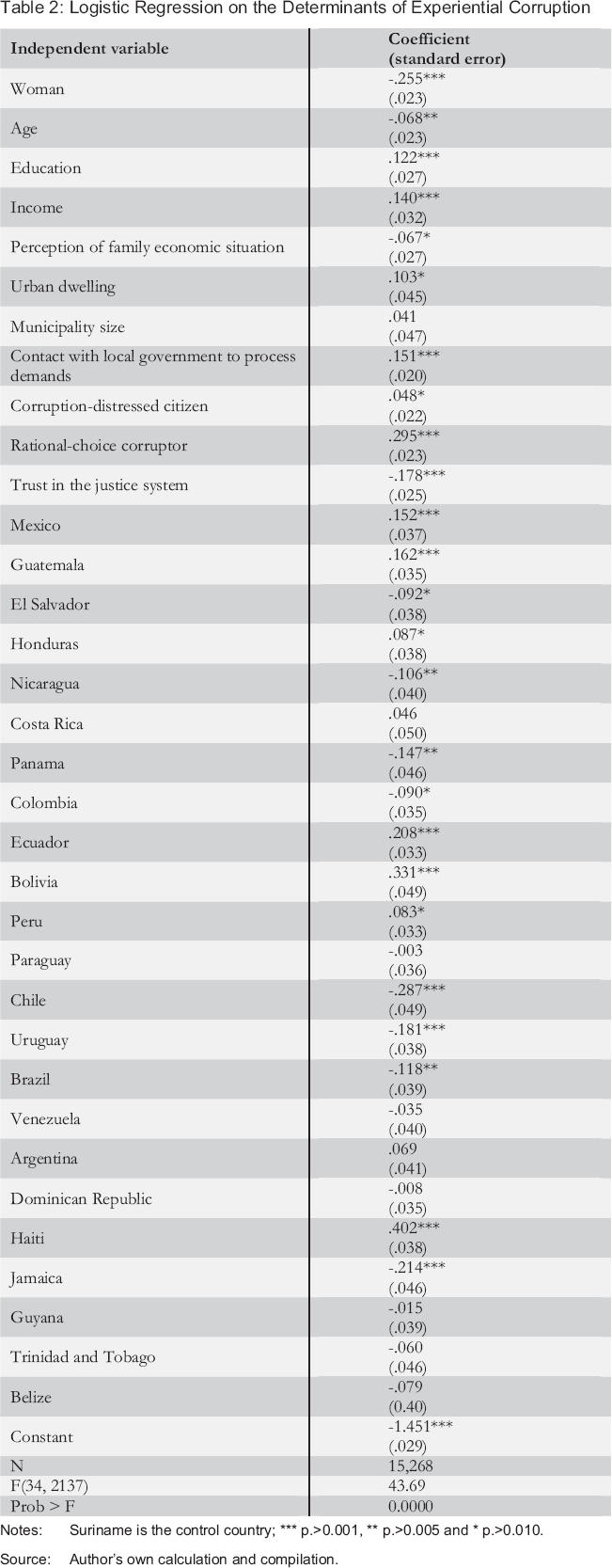
Table 2 displays the results of our analysis. The data show, first, that the most important determinant of experiential corruption is being a rational-choice corruptor. Needless to say, this is a major finding, as it calls for a review of academic and non-academic works that treat exposure to corruption using solely a corruption-victimization framework. At least in Latin America and the Caribbean, we can safely say that there are citizens who willingly engage in corrupt acts, mainly because they find it justifiable to resort to activities that others might find reprehensible. Corruption-distressed citizens, by contrast, experience corruption much less frequently than the former group. As mentioned before, our test indicated that those who deem corruption the country's key difficulty do not find it justifiable, which leads one to think that this particular category of individuals could be deemed “victims” of corruption (they do not seek out corruption). It is plausible to conceive that, in this case, “extortive corruption” (Alatas 1990) took place: corruption-distressed citizens came across corrupt public officials and bribes were forced upon them, which they condemned, thus heightening their sense of the danger that corruption poses to the country. However, it is important to keep in mind that, in this particular region of the world, as indicated in Table 1, rational-choice corruptors outnumber corruption-distressed citizens nearly 2:1.
Logistic Regression on the Determinants of Experiential Corruption
Notes: Suriname is the control country;
p.>0.001
p.>0.005
p.>0.010.
Source: Author's own calculation and compilation.
Interestingly, being male also ranks very high as a determinant of experiential corruption: in Latin America and the Caribbean, women are much less likely than men to be involved in corrupt acts. This finding corroborates work on the theme done in this region (Bailey and Paras 2006) and in others, such as in the United States (Swamy et al. 2001). It is also worth noting that, in the context of the 2012 Americas Barometer survey, men had a much higher chance of being rational-choice corruptors. Among those who believed that corruption is a justified means of getting things done, 56.3 percent were males, versus only 43.7 percent females – a statistically significant difference (Pearson χ2[chi2](1)=127.7736, Pr=0.000), which points to an important gender gap in the degree to which individuals accept corruption. 8
Please note that this correlation does not affect negatively the results presented in Table 2, as in this multivariate regression the correlation between being a woman and being a rational-choice corruptor is -.0587 (at the .001 level).
Lack of trust in the judicial system also plays a prominent role (after being a rational-choice corruptor and being male) in the explanation of experiential corruption, which comes as no surprise. As Rose-Ackerman (2007) pointed out, when the rule of law is not firmly upheld, especially due to the presence of ill-performing judicial bodies, citizens look for alternative ways of proceeding, and the latter are usually of questionable legality. Evidently, this finding has clear public policy implications, which corroborates Leitki (2006), according to whom citizens who trust public institutions are more likely to exhibit “civic morality” – meaning, to not engage in corrupt acts. Efficient institutions increase citizens’ trust in them, which creates incentives for law-abiding behavior.
As shown in Figure 1, which is based on Table 2's regression results (thus controlling for the impact of the other variables), higher levels of material wealth also correlate with more exposure to corruption, which confirms the literature that seeks to establish a link between a society's structure of class segmentation and the propensity to participate in corrupt acts (for example, della Porta and Vannucci 1999; You and Khagram 2005). As Nice (1986: 288) puts it, rather bluntly, “without adequate funds, no one can engage in bribery and its many cousins.” Our results clearly show that more affluent individuals, who have more opportunities and resources to resort to corruption, do make extensive use of those advantages in the context of Latin America and the Caribbean.
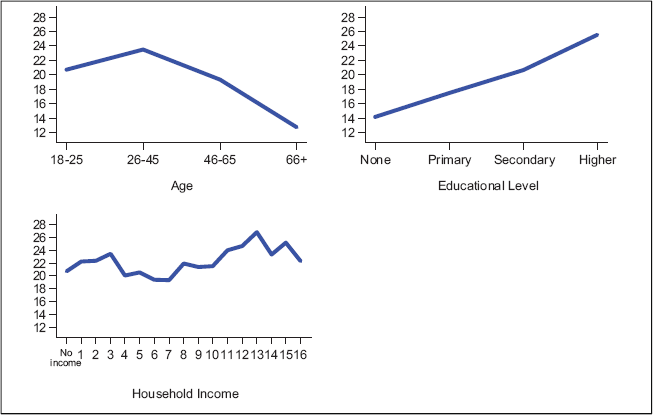
Age, Education, Income and Exposure to Corruption *
There are also other individual-level features that heighten the likelihood of an individual experiencing corruption, such as age and education. When it comes to age, as Seligson (2006) indicated, there is a life-cycle component: the oldest cohorts, and to a certain extent the youngest group, have a lower chance of being involved in corrupt acts than those between 26 and 45; the latter tend to be independent individuals (no longer living with their parents), at the beginning of their mature lives, and engaging in activities (such as buying houses, registering babies, and seeking licenses, for instance) that are instances of state–citizen contact where corruption can take place. The effect of education follows a different trajectory. Experiential corruption peaks among those with higher education levels, and it decreases almost linearly for the other educational groups, which suggests that higher levels of education make individuals more prone to engaging in behaviors of questionable legality.
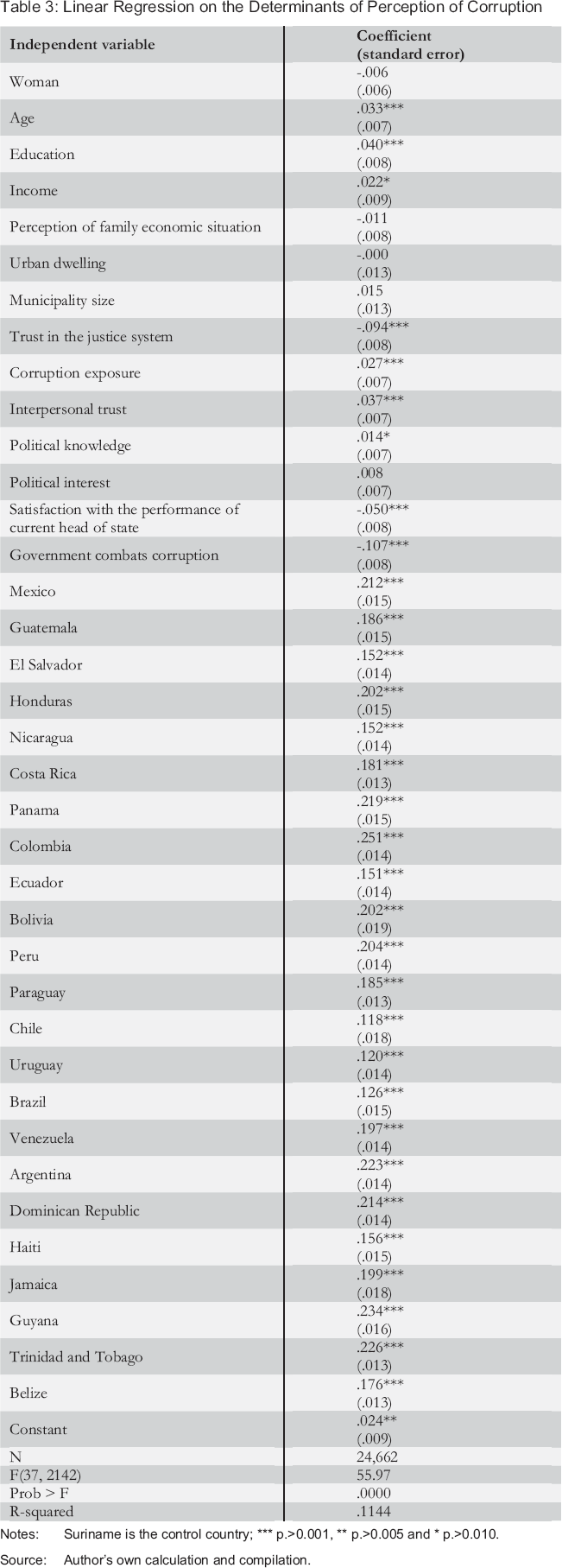
When it comes to perceived, rather than experiential, corruption, we tested the impact of the additional factors: political interest, political knowledge, interpersonal trust, an evaluation of whether the government is combating corruption, satisfaction with the performance of the sitting head of government, and most important, experiential corruption. 9 The results are presented in Table 3.
Linear Regression on the Determinants of Perception of Corruption
Notes: Suriname is the control country;
p.>0.001
p.>0.005
p.>0.010.
Source: Author's own calculation and compilation.
Political interest measures the self-reported level of the interviewee's interest in politics: none=0, little=33, some=66, a lot=100. We used the correct answer to the following question to gauge political knowledge (coded as correct=1; incorrect=0): “How long is the president's term in [country's name]?” Interpersonal trust varies from “people from around here” are untrustworthy=0, they are not very trustworthy=33, they are somewhat trustworthy=66, and they are very trustworthy=100. The interviewee's view as to the extent that the government is combating corruption varies from not at all=0 to a lot=100. Finally, satisfaction with the performance of the current head of government is coded as very bad=0, bad=25, neither good nor bad=50, good=75, and very good=100.
We find that the view that the government is not doing much to combat corruption in the country is a very powerful predictor of the perception of corruption. Tellingly, lack of trust in the justice system ranks as the second-highest. Undoubtedly, together these two determinants convey the idea that those displaying the highest levels of perceived corruption harbor a sense of impunity: the impression that petty and/or grand corruption is running rampant and being condoned by the very public authorities theoretically in charge of wiping them out. Disapproval of the performance of the sitting head of government contributes to the explanation of the phenomenon as well. Perception of corruption hits its highest levels among those displeased with the functioning of the current administration, which further corroborates the notion that perception of corruption correlates with the feeling of unmet expectations: for the people in this group, the status quo is substandard, and they believe that there is surely a better, more desirable alternative – regardless of how feasible it is.
When it comes to individual-level determinants of perceptual corruption, as Figure 1 makes evident, 10 the educational groups with the highest perception of corruption are also those who experience it the most. However, there are disparities. Corruption is widely noted by all age groups starting with the 26-to-45 age category, even though older adults (over 46 years old) do not experience it very often. Similarly, apart from those with no wealth, all income groups perceive corruption at rather similar levels, which further evinces the disconnection between income and respondents’ levels of exposure.
This figure is derived from the regression coefficients shown on Table 3.
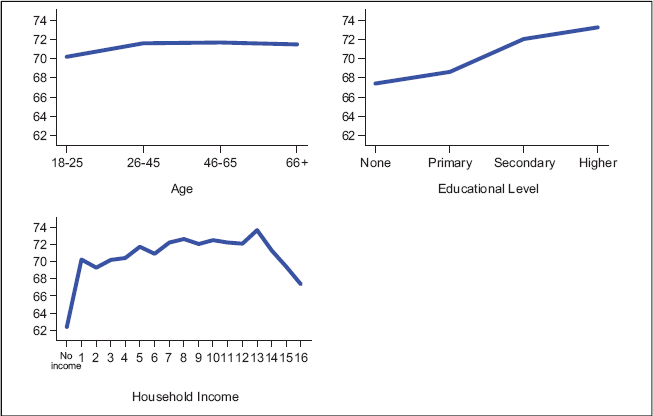
Age, Education, Income and Perception of Corruption *
More important, going back to Table 3, experiential corruption does have a positive, significant effect on perception of corruption. However, the effect is rather reduced; in fact, it is substantially smaller than the effect of lack of trust in judicial institutions or of the view that government is not as intent on tackling corruption as it should be. In other words, exposure to corruption associates strongly with the belief that corruption is justified, and with males in contact with governmental actors, particularly at the local level. Perception of corruption, on the other hand, stems from a rudimentary (and essentially negative) assessment of the functioning of institutions and governments, and from the view that impunity exists, that the latter is unwanted and that it could be dealt with by the public authorities.
This study thus confirms the conclusion of other works, such as that of Olken (2006), who found only a weak relationship between perceived corruption and actual corruption levels. In Latin America and the Caribbean, experiential corruption is a mainly function of motivations (individuals who seek out corruption because they find it justifiable), opportunities (citizen– state direct interactions), and, to a lesser extent, resources (individuals who have the means to engage in corruption). Perceived corruption, on the other hand, has strong evaluative and normative components: individuals believe that existing corruption goes unpunished, courts are untrustworthy, and governments are not putting a dent in impunity. These individual assessments, however, are not strongly determined by the actual individual exposure to corruption.
Corruption and Satisfaction with Democracy
Do experiential corruption and/or perceived corruption have any bearing on a country's democratic regime? Unlike autocracies, democratic regimes derive their legitimacy from mass support for the key components of their institutionalized political processes, such as free and fair elections, institutionally guaranteed liberties and freedoms, and transparency and accountability of the core state institutions. Corruption tarnishes the interactions between citizens and the state, and could potentially decrease individuals’ trust in political institutions and their satisfaction with the existing democratic regime.
This section analyzes whether corruption impacts satisfaction with the existing democracies in Latin America and the Caribbean. 11 Evidently, if we find that the perception of corruption and the exposure to corruption have no bearing on the levels of citizen satisfaction with the political regime as it currently works in their country, then these phenomena, though important for policymakers to analyze, are less relevant for democracy enthusiasts in general. However, if the opposite is true, then the study of corruption becomes more relevant than ever. Ultimately, dissatisfaction with the functioning of the existing political institutions could erode the “reservoir of legitimacy” (Easton 1979), which is essential for the long-term survival of a democratic regime.
Allow me to add that satisfaction with the current functioning of a democracy is just one of several ways of measuring political support. One could focus just as well on, among other things, the preference for democracy, political tolerance, and the spread of democratic attitudes among the electorate. I would like to thank one of the reviewers for suggesting that this point be clarified.
In order to investigate the potential impact of corruption on satisfaction with the existing democratic regime, we selected the following Americas Barometer survey item to be the dependent variable “satisfaction with democracy”: “In general, would you say that you are very satisfied, satisfied, dissatisfied, or very dissatisfied with the way democracy works in [your country]?” We coded the answers as very dissatisfied=0, dissatisfied=33, satisfied=66, and very satisfied=100. The mean for the Latin American and Caribbean region is 51.7, with a standard deviation of 22.5; the country-level mean range varies from 61.2 in Uruguay (standard deviation of 18.8) to 44.6 in Haiti (standard deviation of 25.6).
We ran a multivariate regression analysis on the determinants of satisfaction with democracy. The results are reported in Table 4. 12 First, as one can see, higher levels of interpersonal trust and political interest associate with increases in satisfaction with the current functioning of the democratic regime, whereas lower levels of education correlate with decreases in democratic satisfaction.
Linear Regression: The Impact of Corruption on Satisfaction with Democracy
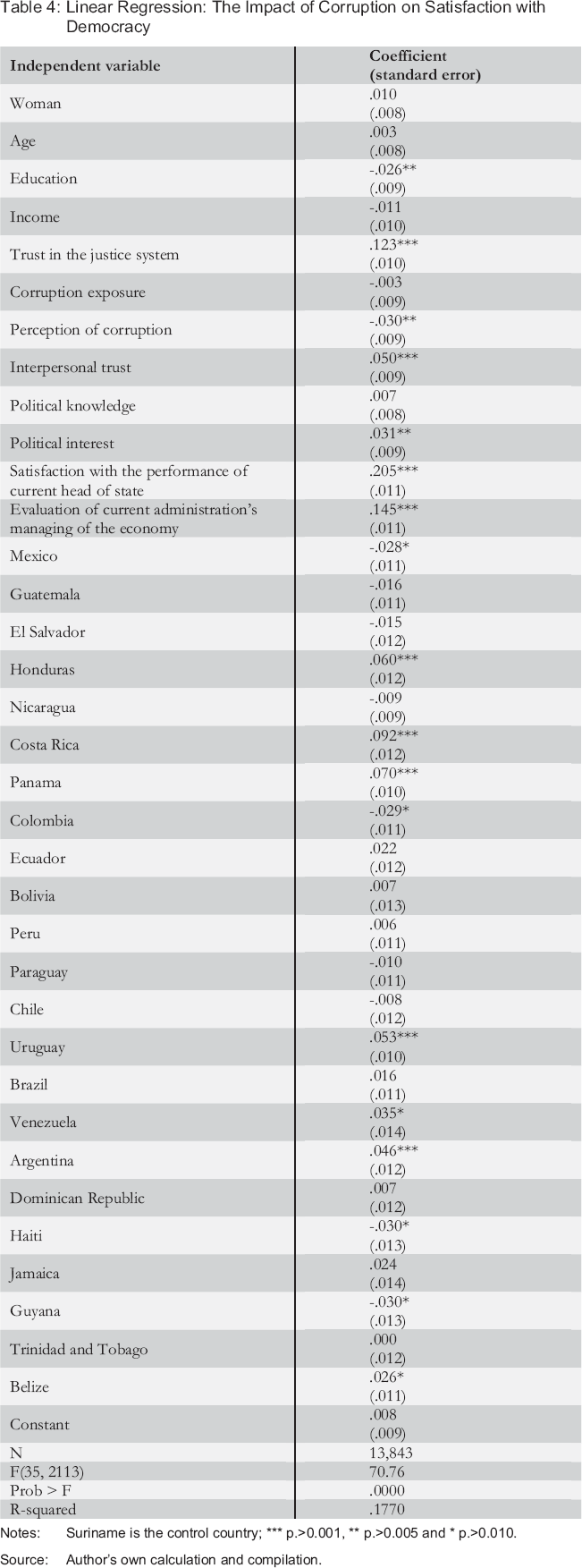
Notes: Suriname is the control country;
p.>0.001
p.>0.005
p.>0.010.
Source: Author's own calculation and compilation.
The only variable added to this regression that had not being used previously is the evaluation of the current government's economic performance. The question employed asks the interviewees about the extent to which they say “the current administration is managing the economy well,” which varies between not at all=1 to a lot=7.
Second, confirming other pieces on the theme, we find that an individual's level of satisfaction with existing democracy is highly dependent on the level of satisfaction with the performance of the sitting head of government and his or her administration's perceived economic performance. Przeworski et al. (2000), for instance, using country-level aggregate data, showed that economic performance, particularly declining levels of economic inequality, is of utmost importance to the survival of democratic regimes. This study provides survey evidence that there is also a link between sound economic performance and individual-level satisfaction with the democratic regime.
Trust in the justice system ranks next in terms of its impact on satisfaction with extant democracy: the higher the level of confidence in the institutions responsible for procedural justice, the higher the level of satisfaction with democracy. This result is not new – it corroborates the findings of other authors (Moisés and Carneiro 2008; Weitz-Shapiro 2008) – but it is extremely important in the context of this study, as we saw previously that lack of trust in the judiciary is a strong determinant of both experiential and perceptual corruption. A justice system that it is seen as failing and untrustworthy gives individuals both the motivation to partake in corruption and the justification for doing so, thus enhancing corruption exposure. Similarly, an ill-performing judiciary magnifies the sense that impunity runs rampant, which increases the level of perception of corruption. Consequently, trust in the justice system, which is a cornerstone of a healthy democracy, plays a key role in fostering “civic morality” (Leitki 2006) by creating the normative environment where both petty and grand corruption are considered unjustifiable, and where impunity, rather than being the rule, is seen as a rarity.
Interestingly, corruption exposure has a negative impact on satisfaction with democracy, but the effect is not statistically significant. 13 Perceptual corruption, on the other hand, clearly has a negative and statistically significant impact: those who perceive corruption to be rampant in their country are more likely to be dissatisfied with the functioning of the democratic regime in that country. These results should come as no surprise, as we saw previously that, unlike experiential corruption, perceived corruption is primarily, albeit not exclusively, the by-product of a negative assessment of the functioning of institutions that are the very foundation of a democratic regime.
Using Nicaragua as a case study, Seligson (2001) found that experience with corruption decreases a citizen's support for their political system, as measured by a variety of indicators, such as the belief that the country protects basic rights, the conviction that citizens have access to fair trial, and pride in the political system. However, even though the protection of basic rights and access to fair trials can be seen as important components of a democratic regime, this particular study did not analyze the impact of experiential corruption on satisfaction with democracy directly.
Conclusion
This study has shown that experiential corruption and perceived corruption are distinct phenomena, and are rather loosely related. “Corruption exposure” is a more accurate term and enables us to develop a more refined understanding of corruption than the “corruption victimization” framework does. Not everyone exposed to corruption is a victim. Quite to the contrary, in Latin America and the Caribbean there are “rational-choice corruptors,” who approve of corruption as a means to speed up transactions with the public bureaucracy, resort to it, and admit resorting to it when questioned about it in surveys. As mentioned before, being male and a corruption pragmatist are strong predictors of exposure to corruption. In addition, the data examined here suggest that citizen–state interactions are important loci where corruption takes place, but, as we cautioned, this could result from the fact that most surveys are ill equipped to tap corruption in the private sector.
Latin America and the Caribbean also have what we have called “corruption-distressed citizens.” These are individuals highly concerned about corruption, which they deem the most pressing problem of their countries. These distressed citizens, who are largely outnumbered by rational-choice corruptors, seem to be true “victims” of corruption. They also report engaging in corrupt acts, but as they find corruption unjustifiable, it is reasonable to think that instead of offering bribes to get things done, these citizens had bribes forced upon them.
Experiential corruption is thus strongly related to motivations and opportunities. Individuals with the mindset that corruption is acceptable have a higher propensity toward encountering corruption than those who take the opposite stance. Those dealing more frequently with the governmental bureaucracy are also more likely to be exposed to corruption. Evidently, one (a victim or a rational-choice corruptor) must have resources to participate in corruption acts; consequently, material wealth also partially explains experiential corruption.
Perception of corruption, on the other hand, is explained by totally different factors. It stems from a negative evaluation of the functioning of key democratic institutions, which gives rise to a sense of impunity: those engaged in corruption are believed to get off scot-free, which undermines the credibility of the state's institutions. Citizens’ actual experience with corruption contributes very little to explaining the levels of perceived corruption. In fact, we have shown that, even though this is not the case for all categories of individuals, there are some demographic groups with rather reduced levels of exposure to corruption who deem corruption to be rampant in their country, a fact that highlights the disconnection between experienced and perceived corruption. One could also hypothesize, as Ruhl (2011) suggests, that the reports about experiential corruption gauge petty corruption and that perception of corruption is a rough assessment of grand corruption, 14 which would help explain their weak relationship. Even though this is a possibility, this hypothesis cannot be tested within the limits of this study, as the survey items used here do not unequivocally distinguish between these two types of corruption.
I thank Cláudio Couto for alerting me to this possibility.
Interestingly, views about a country's justice system seem to comprise the thread that links experiential and perceived corruption. When the courts are seen as ill prepared to deal with cases of corruption, there is a hike in these two kinds of phenomena. There is no denying that an inefficient judiciary contributes immensely to engendering rational-choice corruptors: individuals who gather that, “given the way things are,” corruption makes sense, as it is a more expeditious and efficient method of moving about in society. Similarly, when the judicial institutions become the laughing stock of the country, the perception that corruption exists and goes unpunished increases.
If studying corruption is complex, examining its public policy consequences is no less difficult. Evidently, taking measures to enhance probity among governmental officials (higher pay for the police force, for instance) is an important step toward reducing the opportunities for corruption in state–citizen interactions. Creating a more efficient justice system is also central for the long-term enhancement of civic morality, and the reduction of the view that corruption is justifiable. In the short run, however, as noted by Bailey and Paras (2006: 62), a judiciary in a highly prosecutorial mode can actually enhance the levels of perceived corruption. Nevertheless, over time, an active and efficient justice system can give individuals the sense that the state is going to great lengths to both stifle corruption and prosecute those implicated in it.