




Abstract
Transitions from authoritarianism and breakdowns of democracy have long been central puzzles for scholars of Latin American politics. Because structural explanations have proved to be weak, recent work has emphasised political agency. This strand of research is promising, but major questions remain unanswered: Who are the key actors driving regime change? How do their individual preferences affect transitions and breakdowns? This article focuses on three central members of the political elite: presidents, opposition leaders, and military commanders. These actors develop unique preferences about regimes and unique degrees of radicalism regarding their preferred policies; in turn, these preferences and radicalism affect the probabilities of regime change. Testing the argument in 20 nations between 1945 and 2010, we find that an average measure of preferences masks crucial distinctions in the chain of regime change. Transitions to a competitive regime are more likely when autocrats have low intrinsic commitments to dictatorship. The survival of democracies hinges on whether top military officials develop pro-democratic preferences. The role of executive preferences, by contrast, is moderated by the attachments and radicalism of opposition leaders. Next, we examine how structural contexts shape both preferences and political outcomes, finding that economic development shapes both the emergence of preferences and radicalism and their impacts on regime change. Our findings improve the validity of political agency theories and reconcile the roles of actors with the environments in which regimes emerge and fall.
What factors move nations from authoritarianism to democracy or from democracy to authoritarianism? The usual suspects, in research terms, have been “structural” factors: levels of wealth, conflicts between social classes, civil violence, ethnic fragmentation, and political culture. Given that economically poorer democracies have survived while richer democracies have become dictatorships, it is no surprise that Latin Americanists, casting wary eyes on structural causes of regime changes, have instead emphasised the role of political processes. In Latin America, theories of regime change based on political agency have a long pedigree, a pedigree that begins with the seminal works of Valenzuela (1978) and O’Donnell and Schmitter (1986) on transitions and breakdowns to and from democracy. Some critics argue, however, that “theoretical denial, voluntarism, barefoot empiricism, and intellectual recycling” plague research on actors and processes (Remmer, 1991: 490). Until recently, moreover, cross-country time-series analyses were rarely implemented to test competing theories.
Mainwaring and Pérez-Liñán (2013 [hereafter, M&PL]) began to close this gap by emphasising the importance of intrinsic commitments to democracy as proximate causes of regime change. Their theoretical restart, and their accompanying empirical contribution, began the reconciliation of actors and structure. M&PL found that post-war Latin American societies with strong normative attachments to democracy were generally more successful in leaving an autocratic regime behind. Together with a supportive international environment, M&PL’s indicators of political agency outperformed long-term, distant factors. Still, major questions remain: Which players drive regime change? Do the preferences and radicalism of political elites interact to cripple the existing political regime, or are their effects independent? Where do regime preferences and radicalism originate? Does a single model of regime change apply to all countries and time periods?
This article both critiques and extends the work of M&PL. We agree that the commitment to democracy and the policy moderation of the political elite are central to understanding the establishment and the survival of democratic rule, but we argue for the careful identification of which members of the elite really matter. The governed – the masses, the media, or organised economic or social interests – shape political processes, but the success of their efforts rests on the gatekeepers. Three political actors play crucial roles in regime change and must be treated distinctly both from non-political elites and from each other. First, government executives – whether these executives are elected presidents or military despots – are always central actors. Executives are the most powerful office-holders and political leaders. They control the material and ideational resources necessary to preserve their regimes. Second, the leaders of political parties – prime players in the electoral arena and the main agents of political representation – are equally indispensable. If party leaders come to prefer outside options, threats to democracy may increase. Finally, military commanders – commanders controlling troops, weapons, and strategic state assets – constitute a pillar of regime survival. The behaviour of these three elites is the immediate determinant of regime change. Their normative commitments to democracy and their degrees of policy radicalism, in turn, are the intermediate political roots; they determine, in other words, the behaviour of the three elite actors.
Utilising (after a few minor improvements) the M&PL database of political regimes, a database that includes 20 Latin American nations between 1945 and 2010, we test these reformulations with a series of multi-level models of the likelihood of regime change. First, our measures of the normative preferences of incumbent executives prove to be central to explaining transitions from authoritarianism, because despotic rulers have the will and power to initiate such transitions. Second, the degree of radicalisation of opposition party leaders triggers both transitions from autocracy and breakdowns of democracy. Third, military leaders with strong pro-democratic values reduce the likelihood of democratic collapse, which may occur in contexts of polarisation, deadlock, or economic crisis. Fourth, the preferences of presidents are not enough to guarantee the survival of democracy. The consequences of their preferences, instead, are conditional on other elites: democracy is preserved when presidents and opposition party leaders are both committed to democracy and when pro-democratic incumbents rule in contexts of low radicalism. Finally, we find that international factors remain robust to the inclusion of these nuanced elite preferences.
Elite preferences are embedded in the economic contexts in which they arise. Modernisation theory predicts that individuals develop stronger attachments to democracy in richer societies (Lipset, 1959; Treisman, 2020a). Distributive conflict theories argue that elites recognise that social demands can be better addressed under democracy without threatening their own positions (Przeworski, 2005). Our test of these propositions confirms that rulers (executives) are less radicalised and that opposition party leaders hold higher attachments to democracy at higher levels of economic development. We also find that a longer experience of democratic rule pre-World War II has important effects. In democracies, executives and opposition parties have stronger preferences for democracy when their countries were more open in the past. In autocracies, despots are actually more attached to autocracy in places with greater experience with open politics pre-World War II. Military commanders are also less attached to democracy in such countries.
While elites in wealthier societies are more likely to hold democratic preferences and more likely to be less radicalised, such preferences themselves have heterogenous effects on regime change. Stronger commitments to democracy do not always lead to democratisation or democratic survival. Elite preferences can fall on deaf ears in societies with low levels of development and where social, economic, and political relations are more hierarchical. In theoretical terms, these conclusions suggest that a single regime-change model applied to all post-1945 Latin America may cede too much accuracy in its quest for greater generality.
Structural and Political Models of Regime Change
Structural accounts of political regime change work poorly for post-war Latin America. Modernisation theory expected economic development, with greater industrialisation, the education and mobilisation of workers, and the growth of middle classes, to bring about democratisation (Lipset, 1959). It failed to happen, at least in Latin America: higher income made authoritarian regimes no more likely to fall and democracies no more likely to rise (Przeworski and Limongi, 1997; Przeworski et al., 2000). Models of redistributive conflict – models expecting the lower classes to demand more redistribution and elites to impede democratic rule (Acemoglu and Robinson, 2006; Ansell and Samuels, 2014; Boix, 2003) – fit the evidence poorly as well. Models of post-World War II democratisation based on nineteenth-century Western European experiences travelled poorly to the political and socio-economic conditions of developing countries and former colonies (Haggard and Kaufman, 2016). As O’Donnell (1973) wrote, it was exactly in the countries where modernisation was most advanced that we observed the only successful attempts to implant “a new type of authoritarian political system (i.e.) bureaucratic-authoritarianism.” Likewise, colonial institutions, geography, and oil wealth all fail as explanations for variation in the paths to democracy in the New World (Acemoglu et al., 2002; Dunning, 2008; Treisman, 2020a). Equally against the odds, weak economic performance has not inevitably led to democratic collapse (Diamond, 1999; Haggard and Kaufman, 1995; M&PL, 2013).
Political regime dynamics are better understood by focusing on agency. On the one hand, external political pressures contribute to the survival and fall of regimes. The diplomatic and military support of the regional hegemon, the United States, as well as its proxy wars with the Soviet Union were crucial to encourage or destabilise democracy in Latin America during the Cold War (Huntington, 1991; Schenoni and Mainwaring, 2019). In the third wave of democratisation, the international diffusion of pro-democratic norms inspired and empowered local leaders and citizens to organise in the pursuit of democratic rule, a phenomenon especially relevant across neighbouring countries (Gleditsch and Ward, 2006; Starr, 1991). On the other hand, internal political dynamics remain central. The values, choices, and behaviour of key actors seal the fate of military coups and autocratic reversions as well as transitions to democracy and democratic consolidation. This is, of course, nothing new. Linz (1978) emphasised legitimacy and political moderation among contending parties and leaders. Classic studies, such as Valenzuela’s (1978) analysis of the collapse of Chilean democracy, highlighted the failure of politicians to solve problems by peaceful and political means. At the height of the third wave, O’Donnell and Schmitter (1986) famously portrayed transitions as deeply uncertain processes shaped by strategic interactions between distinct actors within each regime coalition.
The contributions above, however, relied on first-hand knowledge of a small number of cases; rarely were their hypotheses tested on large samples. Even when scholars made formal predictions (Przeworski, 1992), they put forth no quantitative tests verifying the interactions theorised.
Building on these challenges, M&PL developed and tested an important new political theory of the emergence and survival of political regimes in Latin America. Regime change, they contended, depends on the power of the political coalitions supporting change. The members of these coalitions share certain normative preferences directly affecting political events:
A regime type survives if the size and leverage of its coalition is greater than the coalition working for regime change. The regime changes when the opposition coalition is more powerful. Most actors […] change regime coalitions depending on how effectively the existing regime satisfies their instrumental policy preferences and, in some cases, their normative preferences about the regime itself. (p. 13)
Various case studies have emphasised the decisions and attitudes of specific leaders and organisations in the unfolding of democratisation and democratic collapse (Berman, 1998; Capoccia and Ziblatt, 2010; Levine, 1973; Linz, 1978; Valenzuela, 1978). These case studies, however, could not identify the crucial characteristics of those actors. M&PL, by contrast, argued that what matters most for regime survival and change are (1) the organised actors’ normative preferences for democracy and dictatorship and (2) the degree of radicalism of their policy commitments. Their first claim built on the idea that people value political procedures, not just policy outcomes. Normative regime preferences are based not simply on what democracy and dictatorship can deliver; rather, these preferences are rooted in the intrinsic utility of democracy and dictatorship as procedures for accessing and exercising power. A normative commitment to democracy among important actors reduces the probability of a breakdown to autocracy, while a normative commitment to dictatorship reduces the probability of a transition to democracy. M&PL’s second claim focused on policy radicalism, defined as having extreme and urgent preference for a particular policy. Radicalism increases the risk of democratic breakdown because it erodes the possibility of compromise and political solutions (cf. Tsebelis, 2002). M&PL were agnostic about the effects of radicalism in transitions from an authoritarian rule. Radical oppositions can foster despots’ intransigence and discourage liberalisation, but they can also delegitimise incumbents and breed further opposition. 1
Should Political Actors Be Averaged?
M&PL’s analysis is powerful, but it leaves pressing questions linking preferences to political regimes unanswered. Which actors should be examined? Is it useful to average the preferences of all types of (unweighted) actors while simultaneously separating pro- and anti-government actors to measure radicalisation? Do political elites play independent roles in regime coalitions, or does regime change depend on how actors relate to (i.e., interact with) each other?
Political Elites, Regime Preferences, and Regime Change
Taking regime preferences and policy demands seriously requires an explicit identification of the actors who form coalitions leading to regime change. M&PL built a comprehensive cross-national, time-series data set of actors’ regime preferences, but the types and numbers of the “important actors” they identify vary considerably from one period to another within and across countries. The inclusion of particular actors depended on the judgements of country experts and historians. Some experts included organisations of civil society, such as the Catholic church and media outlets; others did not. Moreover, M&PL created an unweighted average of the preferences of whichever actors the country experts included. As Colomer (2017: 508) pointed out, this unweighted average masked the agency of those players whose behaviour sustains or erodes political regimes. What should we make, for example, of a country in which the president and some party leaders declare a strong attachment to democracy, but the leaders of one opposition party and the directors of the national business association reject democracy? What should we expect, in that same hypothetical country, if the army and navy chiefs have a negative evaluation of democracy? Suppose an irregular militia seeking to redress rural grievances openly calls for regime overthrow, while the Catholic bishop of the capital city defends democracy? Simply averaging the preferences of this complex mix of actors might result in its classification as a case of moderate commitment to democracy. But what outcome is then more likely?
Breakdowns and transitions are not products of an average actor. They result, instead, from one coalition imposing its will over an opposing coalition. Some political actors within these coalitions hold preferences about the intrinsic value of political regimes. Crucially, however, some actors remain relevant players in either of the two coalitions (the pro-democracy and the pro-autocracy) while other actors come and go over time. These more ephemeral types may hold ideal policy positions but may not develop preferences for a particular political regime as an end in itself. Such actors will not be compelled to action by their own regime preferences. M&PL’s construct, the average level of preference for democracy across all possible holders of such values, thus masks the relative importance of different types of actors.
Which actors continuously occupy regime or anti-regime coalitions – that is, whose preferences and radicalism should we always measure? Scholarship on democratisation and breakdowns, both old and new, consistently notes the prime roles of certain actors in political regime dynamics. In autocracies, government leaders – the designated president, top military commanders, or the nomenklatura (in single-party regimes) – are fundamental to responding to pressures to democratise. They must choose to share or surrender power (O’Donnell and Schmitter, 1986; Przeworski, 1992; Treisman, 2020b). Opposition party leaders (even those surviving in secrecy) have primary roles as instigators of protests but also as the despots’ main interlocutors (Capoccia and Ziblatt, 2010; Weyland, 2014). In competitive regimes, government and opposition leaders have fundamental roles defending the regime by negotiating political compromises. These compromises solve issues that might otherwise result in change by force (Bermeo, 2003; Cohen, 1994; Levitsky and Ziblatt, 2017; Linz, 1978; Valenzuela, 1978; Weyland, 2014). Military officers inevitably play a major role in ensuring the survival or the fall of democratic regimes. In developing countries, where state capacity is weak, the top brass of the armed forces has the institutional and material means to force regime change (Stepan, 1971). The military may not obey investors or the landed elite; the military, in fact, is “an independent principal in its own right” (Slater et al., 2014: 354).
These political elites are also fundamental to avoiding democratic backsliding in the contemporary era. Presidents exercising political control over other state institutions may violate the rights of the opposition, which in turn may “ally with the military to overthrow the government” (Pérez-Liñán et al., 2019: 606). If political elites are crucial to explaining regime survival and change, what characteristics make them special? The answer is their preferences and radicalisation.
Our argument in no sense denies the importance of the citizenry. In democratic regimes, people vote to select their rulers. That vote, however, is a consequence, not a cause, of the existence of a democracy. Public opinion, without doubt, shapes the political environment. Politicians and other actors monitor opinions regarding current affairs held by average citizens as well as specific groups of citizens. But, as noted by M&PL, public opinion is not an actor – it cannot per se topple a political regime.
Citizens are also members of social classes, and the attitudes of social classes affect choices and actions that lead to political regime change. Landed elites, the bourgeoisie, workers, and peasants – all may hold discernible attitudes towards the sharing of political power and the extension of rights (Rueschemeyer et al., 1992). Social classes, nonetheless, are usually not “sufficiently organised and politically cohesive to form political actors” (M&PL: 11).
The organisations of civil society that represent religious, economic, or ethnic groups sometimes take part in events leading to the fall of a regime. These civil actors may or may not develop normative attitudes about political regimes, but crucially, they do not direct political movements and are not essential guardians of the political system. Labour unions from time to time have played important roles in political movements pursuing democratisation. But the significant actions of workers and union organisers that occurred in the early post-war era followed (rather than guided) government officials and party leaders. Indeed, such officials and leaders shaped, from the top, the incorporation of labour into modern politics (Collier, 1993). More recently, political entrepreneurs within and outside governments have mobilised pro-democracy street protests of unions and other social groups (Brancati, 2016).
Ultimately, organised social actors are no less important than political elites, but they are causally more distant. The former can pressure incumbent rulers to share power with those at the bottom, or they can call for the officer corps to end their troops to bring down the system. Given the right circumstances, civil actors may disrupt social order by taking to the streets and clashing with security forces. But such groups do not engage in continuous disruption. Even when they are disruptive, they do not negotiate and compromise as political elites do. Moreover, civil society actors lack the physical means to impose their regime goals unilaterally, and their objectives are often ignored when political actors challenge the current regime.
These three central political actors – executives, opposition party leaders, and military commanders – are ubiquitous in both autocracies and competitive regimes. As a result, it is crucial to estimate the independent effects of their separate regime preferences and degrees of radicalism as well as the possible reciprocal moderating effects between them. The next section explains why and how the values and choices of these actors matter in the study of democratisation and breakdown.
Executives
Executives are the most important actors in Latin American political systems. Presidents are “power brokers, party leaders, role models, the daily focus of public opinion” (Pérez-Liñán, 2007: 1). Presidentialism, by its institutional design, gives a prominent role to presidents in policy as well as leadership. Presidential systems unify the roles of head of state and head of government, facilitating the identification of the centre of executive power (Pérez-Liñán et al., 2019: 607). The political history of post-independence Latin America has been turbulent, and the presence of an activist military has led to a cumulative concentration of power in the executive (Cheibub et al., 2010; Colomer, 2013). The elevation of the head of government above all other institutional actors has not been limited to democratic periods or to autocratic civilian regimes (e.g., Mexico). The bloodiest military dictatorships selected presidents – military or civilian – to lead their governments even when that selection generated internal disputes within the armed forces. As a result, no study of regime survival and collapse can ignore the regime preferences of heads of government. Ultimately, autocratic presidents initiate transitions from authoritarianism and accept or reject its result. If the head of government in an autocracy continues to favour dictatorship, a transition rarely culminates in a competitive regime.
Incumbent autocrats are crucial actors who determine the fate of their closed regimes (Geddes et al., 2018; Treisman, 2020b). Moderate officers led the 1958 coup that overthrew Venezuelan dictator Marcos Pérez Jiménez and ensured the re-establishment of civil and political rights. Augusto Pinochet’s reluctant acceptance of the victory of the “No” in the plebiscite on his continued rule in Chile does not make him a democrat; rather, the willingness of Pinochet and his military commanders to respect the result was crucial for the transition. Similarly, while the normative adherence of presidents to democratic rule should be consequential for the survival of democracy, the preferences of presidents are only one factor facilitating regime survival: other actors may be more critical in the occurrence of breakdowns (a situation discussed below).
Opposition Party Leaders
Political parties are indispensable both to the defence and to the subversion of democratic rule. Parties are the primary intermediaries between society and the state. In democracies, parties aggregate, differentiate, and represent the plurality of a society’s interests and preferences. Parties, in Levitsky and Ziblatt’s terminology, are democracy’s “gatekeepers” (Levitsky and Ziblatt, 2017: 20). Democracies require the negotiations, compromises, and concessions that parties make. Whether parties tolerate each other as legitimate institutions or see each other as enemies has critical consequences for regime survival and change (Cohen, 1994). Gamboa (2017) argues that democracies can survive leaders with authoritarian tendencies if the political parties in the opposition behave strategically to preserve the regime. Radicalised opposition parties can undermine democratic regimes.
Parties are also central to transitions from authoritarianism. In semi-open regimes, parties may still function as limited channels of representation and participation (Magaloni and Kricheli, 2010). Madrid (2019) shows that at the beginning of the twentieth century, democracy emerged for the first time in some Latin American nations because splits within the elite materialised in political parties, even in regimes with limited competition. And in fully repressive regimes banning them, parties can recruit democratic sympathisers and prepare for the autocracy’s fall. In such scenarios, the opposition’s degree of policy radicalism is crucial: an embrace of radical policy change should severely undermine a dictatorship.
The Military
The stability of political institutions depends fundamentally on the military. In Latin America, politicised factions of the armed forces have been a constant source of conflict and instability (Linz, 1978; O’Donnell, 1973; Remmer, 1989; Stepan, 1971). Latin American military leaders, especially in weakly institutionalised polities, shape the evolution of central executive power (Colomer, 2013). During most of the twentieth century, presidential crises have often preceded military intervention (Pérez-Liñán and Polga-Hecimovich, 2017). 2 The military’s autonomy in developing and post-colonial societies explains these nations’ recurrent episodes of praetorianism and military intervention (Slater et al., 2014). Only the military has the experience and operational knowledge to stage coups d’état. Religious organisations and labour unions do not oust incumbent governments; they persuade others – guys with guns – to launch coups.
Scholars have long debated the roots of the generals’ attitudes: Are they motivated by class or corporate interests? Dreifuss (1964) and Nun (1967) argued that the military represents order-seeking middle classes during economic crises and disorder, crises in which politically activated labour forces and insurrectionary movements threaten the capitalist order. Most Latin American military commanders have been fiercely anti-Communist, especially after the Cuban Revolution. But clearly the military also pursues corporate interests, painting its involvement in regime struggles as preserving institutional unity and organisational resources (Fontana, 1987; Munck, 1998; Pion-Berlin, 1997).
Whether the military topples elected governments in defence of its ideological or corporate interests, the attitudes of the generals towards dictatorship and democracy must be included in any model of regime change. By contrast, the military’s degree of policy radicalism may be less meaningful, because commanders typically do not express policy preferences of their own. Many instances of revealed stances in reality refer to the military’s preferences on dimensions of the political regime (e.g. proscription of parties or civil rights).
In sum, our discussion of presidents, parties, and the military leads to four hypotheses.
The causal mechanism behind these hypotheses is based on the arguments of the seminal works on agency, summarised in the words of M&PL:
actors that believe in the intrinsic merits of democracy are willing to accept policy losses to preserve democracy. They do not turn against the political regime in hard times. Actors that do not have a normative preference about the political regime more readily turn against it in hard times. (p. 56)
We should add that pro-democratic actors accept not only policy losses but other defeats, such as adverse electoral results, as well. Similarly, we expect that actors that are not radicalised are willing to accept short-term policy defeats in order to preserve the political regime. This means, for example, that leaders of the opposition will be more active conspirators against the incumbent regime when they have weak value attachment to that regime. Military officers with a strong commitment to democracy will resist pressures to depose democratic governments that come from opposition parties, business owners, landowners, rebels, or other social groups. Ultimately, regime preferences and policy radicalism predispose political elites to act in ways that can preserve or overthrow the regime.
An Empirical Reanalysis of Political Agency Models
Our central empirical question asks how the preferences and radicalism of each elite actor has affected the probability of regime change in post-war Latin America. In the transition models, the dependent variable is the probability of changing from an autocracy to a competitive regime. In the breakdown models, the dependent variable is the probability of changing from a competitive regime to an autocracy. We rely on the M&PL data set, updated by Pérez-Liñán and Polga-Hecimovich (2017). 3
Dependent Variables
We adopt the trichotomous classification of political regimes proposed by Mainwaring et al. (2001). In democracies, citizens choose the executive and legislature through open and fair elections; the franchise includes almost all the adult population; political and civil rights are guaranteed and exercised; elected authorities wield real power. Semi-democratic regimes lack some of these four criteria; autocracies lack all four. We also incorporate a few adjustments to the regime-change data that make the analysis more robust. 4 In total, the (recoded) data include 9 breakdowns of full democracy to autocracy, 22 breakdowns of semi-democracy to autocracy, 16 transitions from autocracy to democracy, and 22 transitions from autocracy to semi-democracy.
Independent Variables
We construct indices of regime preferences and policy radicalism for three elite actors: executives, opposition party leaders, and military chiefs. Our measure builds directly on the secondary sources compiled by country experts and reported in M&PL. “Regime Preferences” is an ordinal variable with five categories from −1.0 (expressed commitment to dictatorship) to 1.0 (expressed commitment to democracy) in intervals of 0.5. Given that not all actors exhibit intrinsic attachments to either regime type, some have a 0. 5 The index of “Policy Radicalism” is an ordinal variable on a 0 to 1.0 scale, with higher values indicating more radicalised policy preferences. Because the secondary sources are inconsistent in terms of the number of opposition parties coded across cases, we construct a simple average of all parties not belonging to the government, an issue that affects 20 per cent of country-year data points. 6
M&PL do not always treat the military as a separate actor, so we complement their country reports with data published in Agüero and Fuentes (2009), Mares and Martínez (2014), and Pion-Berlin and Martínez (2017). 7 If military commanders were divided into two or more factions, we created an unweighted average. Almost every observation with military preferences corresponds to a competitive regime, given that in dictatorships the secondary sources do not clearly separate the president/government coalition from the military.
The literature on democratisation and democratic breakdown offers several alternative hypotheses to a focus on political agency. To assess the effects of national income, we follow M&PL and include (1) gross domestic product (GDP) per capita in thousands of constant US dollars, (2) the size of the manufacturing labour force, and (3) an indicator for countries dependent on oil and minerals. The effects of recent economic performance are measured with the average growth rate in per capita GDP over the past decade and the natural logarithm of inflation. Alternative arguments about domestic institutions and international factors are assessed, following M&PL, with indicators for the age of the current political regime, the Shugart and Carey (1992) index of presidential powers, a dummy for multi-party systems, an ordinal scale of US promotion of democracy in foreign policy, the regional share of democracies, and the average level of democracy outside the region.
Method
Because actors’ preferences and radicalism scores are grouped in clusters (countries), an ordinary least squares analysis would violate the assumption of independent units. We thus rely on a multi-level model taking into account that preferences and radicalism are measured at the actor level but nested at the country level. Transitions are coded trichotomously (“no transition,” “transition to semi-democracy,” and “transition to democracy”), so we implement ordered logistic regressions. The equation of the random-effects ordered logit model for transitions is


Results for Transition Models
Table 1 reports ordered logistic coefficients from the multi-level random-effects models of transitions from dictatorships to competitive regimes. For ease in exposition, the results are summarised by plotting, as in Figure 1, the marginal effects of changes in standard deviations of the independent variables together with the confidence intervals at the 95 per cent level. Model 1 serves as a benchmark, utilising M&PL’s average preference for democracy across many types of actors. The results fully replicate – as they should – M&PL’s finding that normative regime preferences drive transitions. A high average commitment to democracy among various players increases the likelihood of a transition to a competitive regime. A radicalised opposition, which in the original measure sometimes includes actors other than political parties, increases the probability of transitioning.
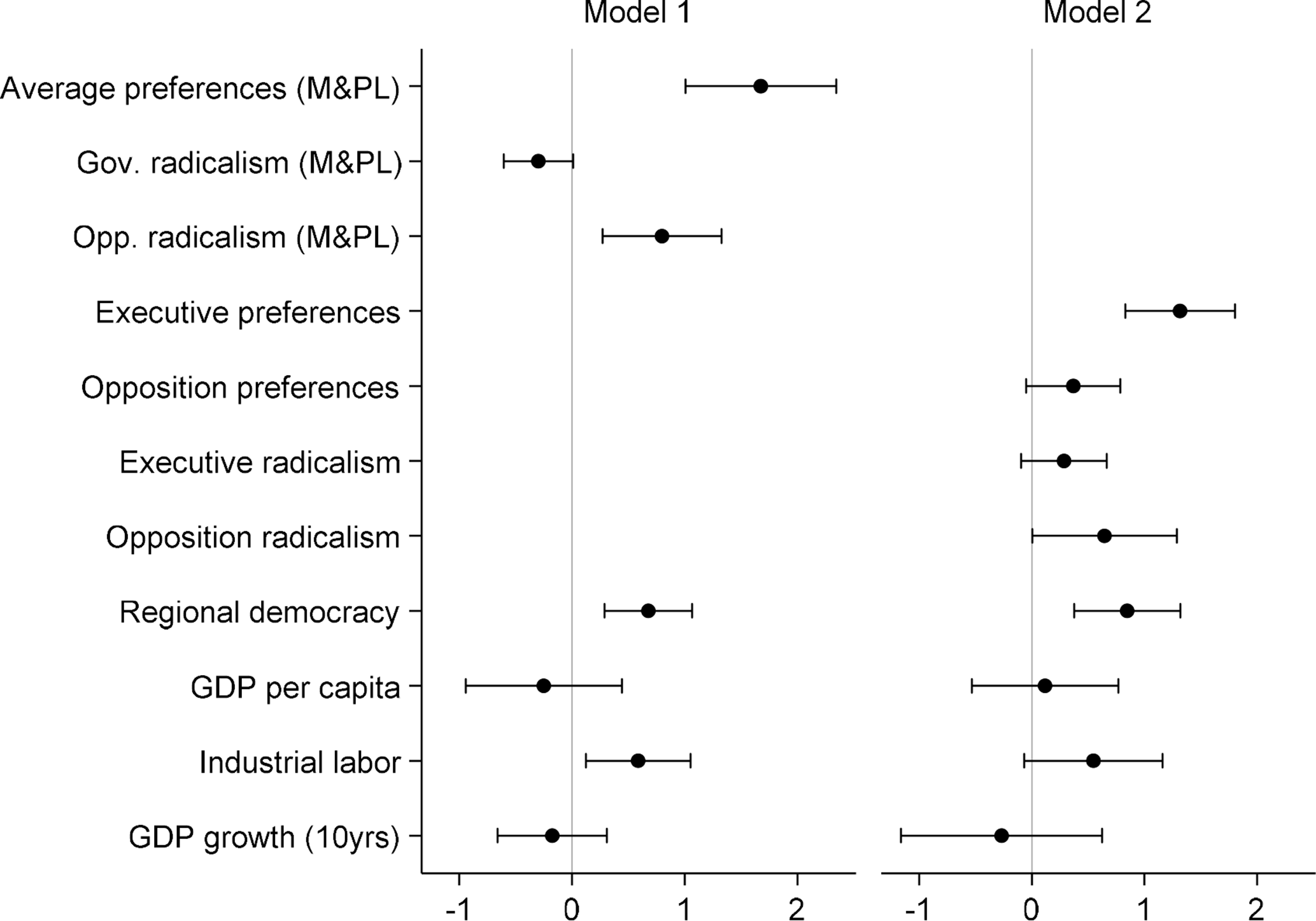
Marginal Effects of Political Agency on Probability of Transition.
Probability of Transition from Autocracy.
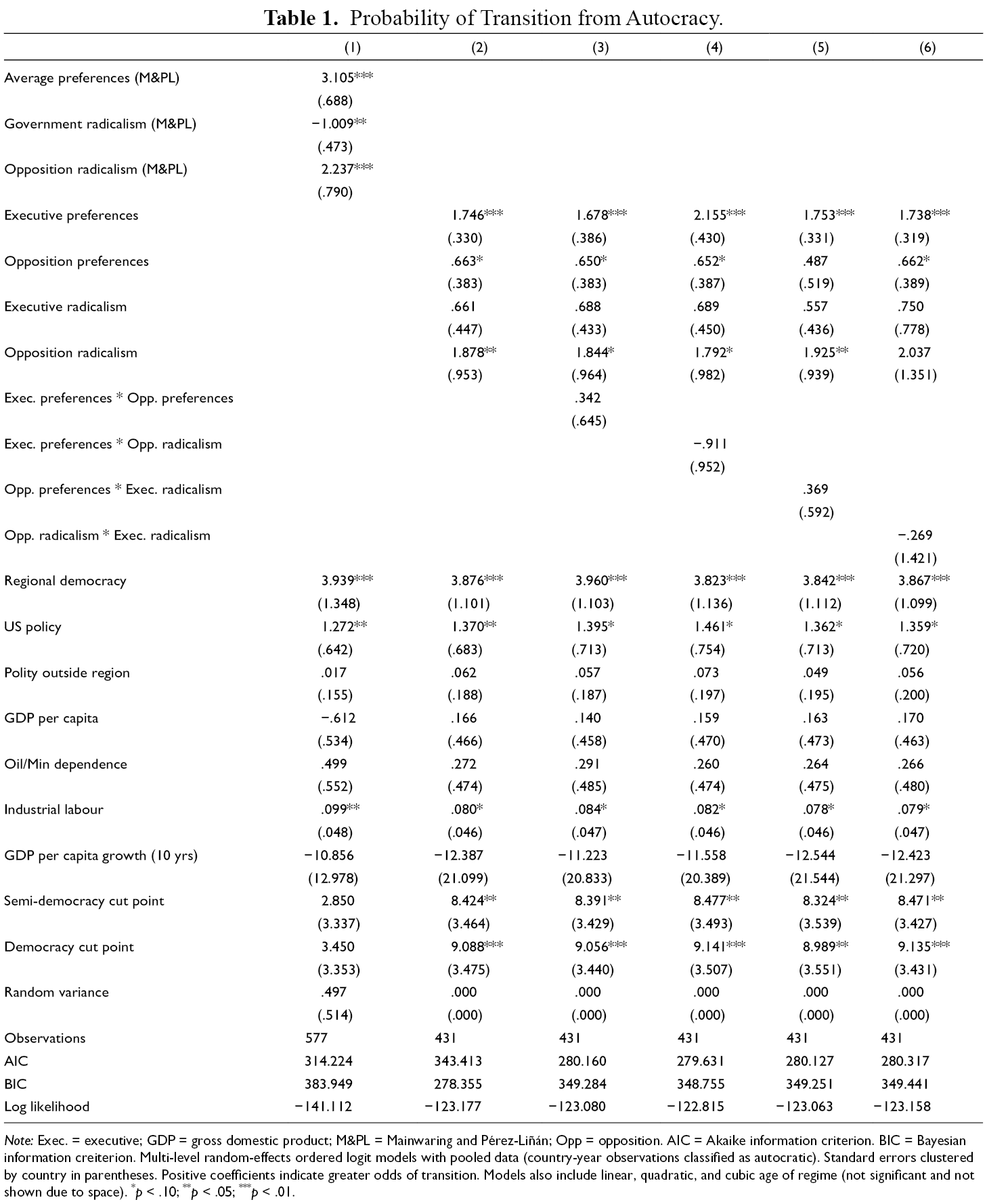
Note: Exec. = executive; GDP = gross domestic product; M&PL = Mainwaring and Pérez-Liñán; Opp = opposition. AIC = Akaike information criterion. BIC = Bayesian information creiterion. Multi-level random-effects ordered logit models with pooled data (country-year observations classified as autocratic). Standard errors clustered by country in parentheses. Positive coefficients indicate greater odds of transition. Models also include linear, quadratic, and cubic age of regime (not significant and not shown due to space). * p < .10; ** p < .05; *** p < .01.
Our nuanced measures in Models 2 – 6 illuminate the precise roles played by different actors and their attitudes towards the political system in transitions to democracy. As we can see in Figure 1, the disaggregation of political elites better explains the occurrence of transitions than an average, cross-actor value. When autocratic rulers reject dictatorship as an end in itself, transitions are more likely to culminate in competitive regimes. Liberalisation processes are top-down: autocrats relax repression, allow some civil liberties and political participation, and negotiate with opposition elites to (re)establish democracy. A key finding is that the effects of autocrats’ preferences are independent from other political actors’ opinions. Models 3 and 4 show that there are no significant interactive effects with opposition leaders’ feelings towards democracy or their radicalism.
The policy radicalism of the opposition turns out to be a consistently strong predictor of transition from dictatorship. When the opposition has beliefs radically contrary to the regime’s status quo policies, the probability of transitioning to a competitive regime is higher. While radicalism could reduce the opposition’s support for democracy, it directly weakens the authoritarian regime (M&PL: 106). Government radicalism, by contrast, has no effect, either independent or conditional, on other factors. 8 These results, together with the fact that our new models improve the fit of the estimation and explain more variation in the dependent variable, provide support for our first hypothesis. 9
Results for Breakdown Models
Table 2 presents logistic coefficients for models of the breakdown of competitive regimes. Model 1 replicates M&PL’s best model, a model suggesting that the stronger the normative preferences for democracy among the average actor, the lower the likelihood of a breakdown. Models 2 – 6 incorporate the disaggregated elites’ preferences and radicalism as well as their interactions. Figure 2 reports marginal effects of the effects of political actors’ preferences and radicalism on the probability of breakdown.
Probability Models of Breakdowns of Competitive Regimes.
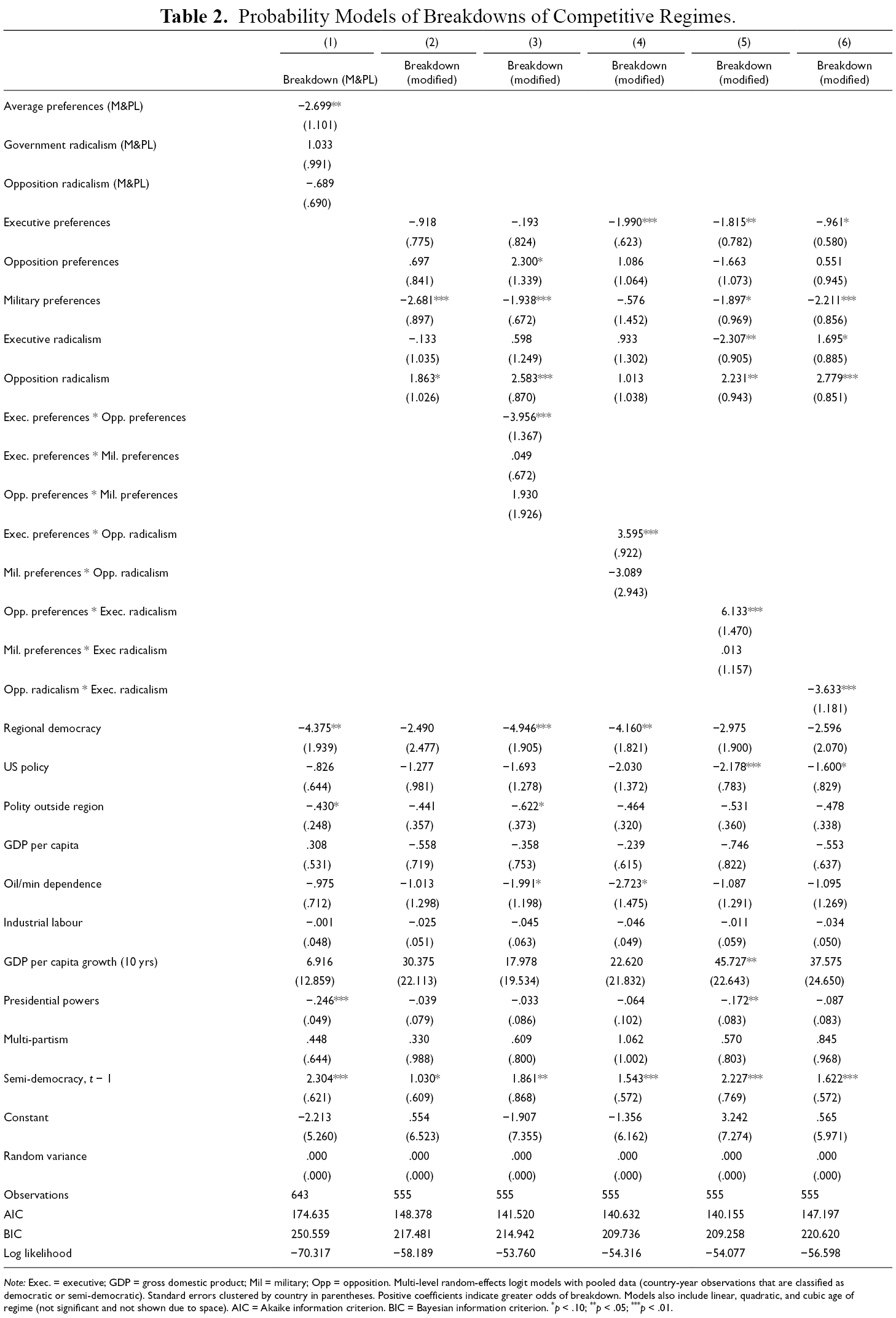
Note: Exec. = executive; GDP = gross domestic product; Mil = military; Opp = opposition. Multi-level random-effects logit models with pooled data (country-year observations that are classified as democratic or semi-democratic). Standard errors clustered by country in parentheses. Positive coefficients indicate greater odds of breakdown. Models also include linear, quadratic, and cubic age of regime (not significant and not shown due to space). AIC = Akaike information criterion. BIC = Bayesian information criterion. * p < .10; ** p < .05; *** p < .01.
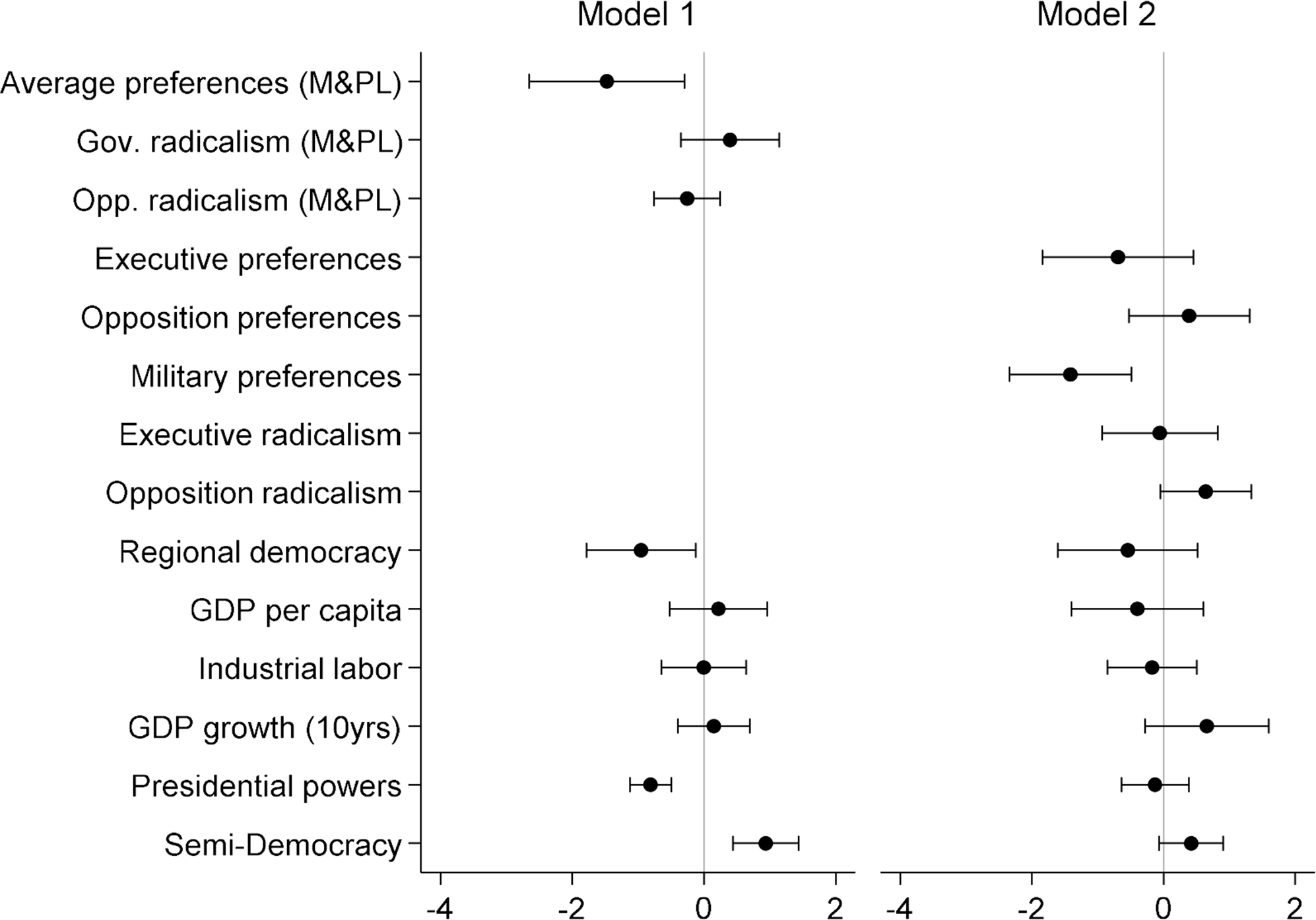
Marginal Effects of Political Agency on Probability of Breakdowns.
What happens when our preferences and radicalism measures are applied to the limited set of political actors? On the one hand, the results demonstrate that the intrinsic preferences for democracy of presidents and opposition leaders are not robust determinants of democracy’s survival. The commitment to democracy of those actors does not determine the fate of competitive regimes, as the point estimates are statistically insignificant. We do find, however, that military commanders with pro-democratic preferences significantly reduce the probability of a breakdown of the competitive regime. This is consistent with the observed data: in all 31 breakdowns, the military’s commitment to democracy was very low. On the other hand, the radicalisation of the opposition increases the likelihood of breakdown. Scrutiny of the actual evidence reveals that the opposition was very radicalised in 21 of the 31 episodes of breakdown. In 14 cases, opposition forces had a higher level of radicalism than the government.
The interactive models reveal an interesting pattern (Models 3 and 4 in Table 2). The value attachments of executives to democracy have no statistically significant independent effect on the survival of democracy, but these attachments do play a role conditional on the preferences and the radicalism of opposition party leaders. We illustrate this pattern by graphing the marginal effects of executive preferences on breakdowns conditional on the attitudes of the opposition. In Figure 3, the downward slope from left to right indicates that the effects of the incumbent’s preferences on the odds of a breakdown decrease as opposition party leaders become more pro-democratic. What presidents think about democracy thus matters much more for democratic survival when the opposition holds weak or no preferences for democracy. In addition, Figure 4 reports that incumbents’ pro-democratic preferences are associated with the fall of democracy when opposition leaders are more radicalised. The upward slope indicates that the effects of preferences on the odds of breakdown increase as the opposition displays higher degrees of policy radicalism.
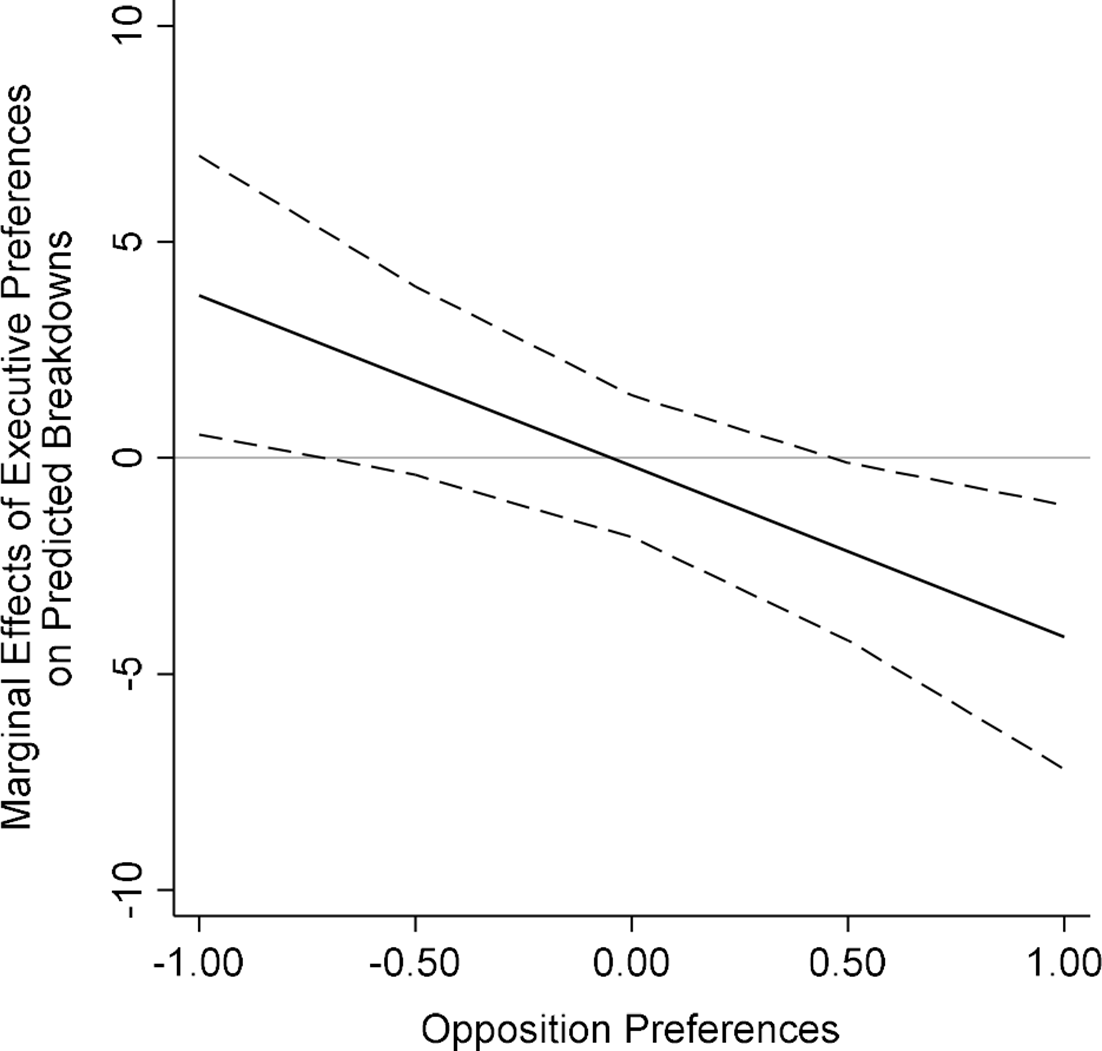
The Conditional Effect of Preferences on Democratic Breakdown (I).
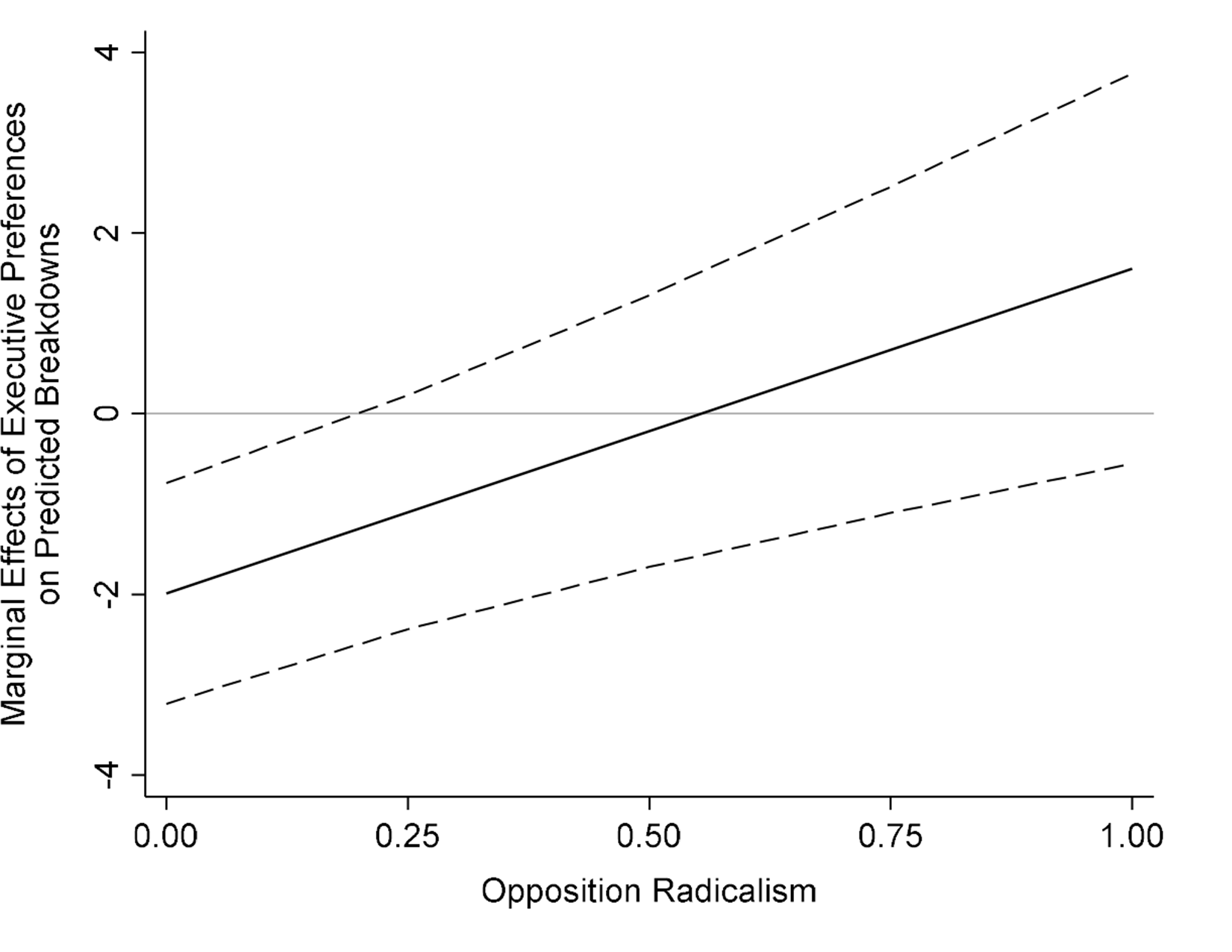
The Conditional Effect of Preferences on Democratic Breakdown (II).
Finally, the new evidence from both Tables 1 and 2 suggests that while political agency models nicely fit the historical evidence, other arguments stumble. The current level of income per capita has no direct effect on either transitions or breakdowns. Still, the absence of a direct effect does not fully invalidate the role of context. Our results suggest, for instance, that countries with larger industrial labour forces are more likely to transition from autocracy. In addition, regional patterns of regime diffusion and the foreign policy of the United States significantly contribute to democratisation and the survival of democracy.
The Origins of Preferences
If indeed the preferences of the political elite affect regime change, it is important, both normatively and theoretically, to track their origins. Why would a president or army chief of staff consider democracy as intrinsically desirable? M&PL offer hints but leave the matter mostly unexplained. While a comprehensive theory of preference formation is beyond our scope, we consider two long-standing hypotheses in comparative politics.
Modernisation theory argues that higher economic development creates a predisposition towards democracy (Lipset, 1959; Treisman, 2020a). Higher income per capita and its expected economic and social consequences – economic diversification, higher education, a vibrant middle class – encourage individuals to support democracy. Where the material survival of both the people and the elite is more assured, adherence to regular and free elections and to political and civil liberties should be higher. Distributive conflict theories claim, moreover, that the gatekeepers of democracy should recognise, even if they dislike the income redistribution an elected party may choose, that they have more to lose if democracy collapses (Przeworski, 2005). In fact, M&PL signalled but did not directly test the possibility that “in countries with widespread poverty or high inequalities, it is less likely that initially uncommitted actors will develop a normative preference for democracy” (Mainwaring and Pérez-Liñán, 2013, p. 59).
The second hypothesis, an argument about path dependence, emphasises the importance of past political development. Past experiences with political regimes shape political actors’ commitments to democracy. M&PL argue that “past experiences with democracy should increase present levels of support among political actors, which in turn may affect the likelihood of democratic transitions or breakdowns in the near future” (p. 92). Barely half of Latin American nations experienced some form of democracy prior to the end of World War II, and even fewer enjoyed continuous democratic rule. Political actors in nations with longer histories of democratic rule may develop stronger attachments to democracy. But actors who had once lived under democracy (especially in the interwar period) may fear disorder and anarchy in the very different post-war Cold War context (Przeworski, 2009). Facing demands for economic rights, order-seeking party leaders and military officers may distrust open political regimes.
These hypotheses can be assessed utilising the index of normative regime preferences and the degree of policy radicalism as our dependent variables. We split the sample between autocracies and competitive regimes because despots, democratic executives, and opposition party leaders may have different causes for their preferences and radicalism. To examine longer-term effects, we use the percentage of years a country maintained democratic rule between 1900 and 1944. Economic development, performance (growth and inflation), and international political indicators come from M&PL. We also address the effects of the distribution of wealth within society with an indicator of land tenure inequality compiled by Ansell and Samuels (2014).
Table 3 shows that the preferences for democracy on the part of incumbent executives in autocratic regimes are stronger when there is a low level of economic inequality and a low average of inflation in prior years (Model 1). The preferences for democracy of executives in competitive regimes are stronger when economies grow a lot (Model 2). Another divergence is that a longer experience of democracy before World War II is associated with lower democratic values for despots and higher democratic values for democratic executives. Interestingly, such a divergence is replicated for the regime preferences of opposition leaders: early democracy is associated with lower attachment to democracy under authoritarian regimes (Model 3), while such experience triggers the inverse under competitive regimes (Model 4). Finally, economic development predicts pro-democratic preferences for the opposition in both types of regime (as reported by the positive and statistically significant point estimate for income per capita in Models 3 and 4).
Determinants of Regime Preferences.
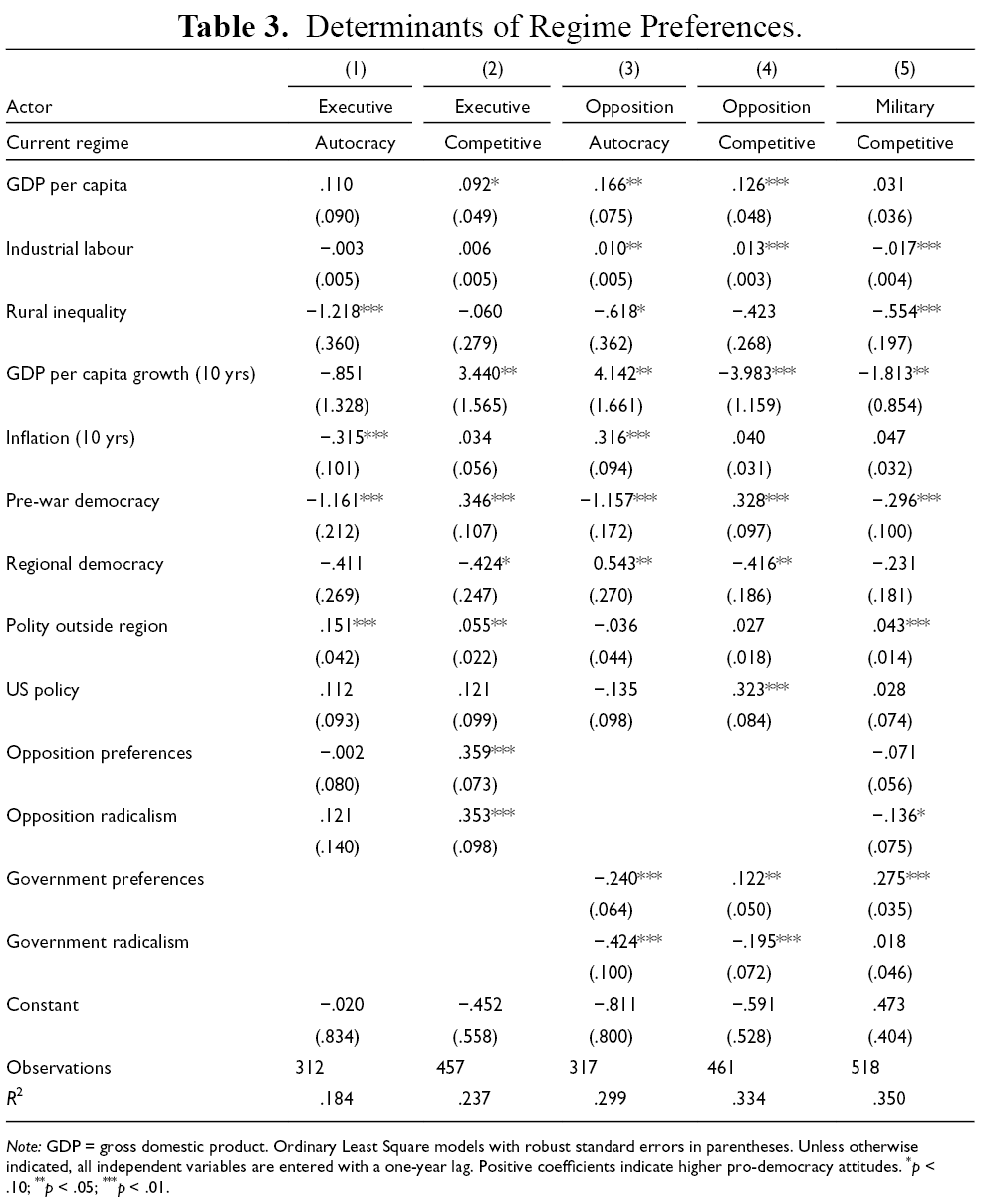
Note: GDP = gross domestic product. Ordinary Least Square models with robust standard errors in parentheses. Unless otherwise indicated, all independent variables are entered with a one-year lag. Positive coefficients indicate higher pro-democracy attitudes. * p < .10; ** p < .05; *** p < .01.
Table 3 also demonstrates that executives and opposition leaders react to each other’s preferences and radicalism. The commitment to democracy of heads of government is higher when the opposition is more pro-democratic. The commitment to democracy of opposition leaders is higher when executives are more pro-democratic and lower when they are more radicalised. Thus, our quantitative evidence supports M&PL’s case study of Argentina: “Actors responded to the apparent lack of democratic commitment and the intransigence of their adversaries with an escalation of antidemocratic practices and a radicalization of their own policy positions” (p. 169).
The evidence in Model 5 in Table 3 supports what might seem a counterintuitive long-term effect of past regime experience on the armed forces chain of command: their preferences for democracy are significantly lower in countries with many years of democracy prior to World War II. In these countries – Argentina, Chile, and Uruguay – the elite polarisation and endemic political instability that ensued after elections may have contributed to the rise of military officials with authoritarian values. 10 Further, economic structure shapes the views of military chiefs. Income per capita has no significant result, but societies with larger industrial workforces and poor economic growth have armed forces with lower attachments to democracy.
Table 4 brings us closer to the determinants of the radicalism of the political elite. Executives and opposition party leaders are consistently less radicalised in countries with higher levels of development. Greater economic growth makes democratic presidents less radicalised, but economic growth has no similar effect on the opposition. Finally, high inflation seems to increase the degree of policy radicalism of executives but seems to decrease it for opposition leaders.
Determinants of Policy Radicalism.
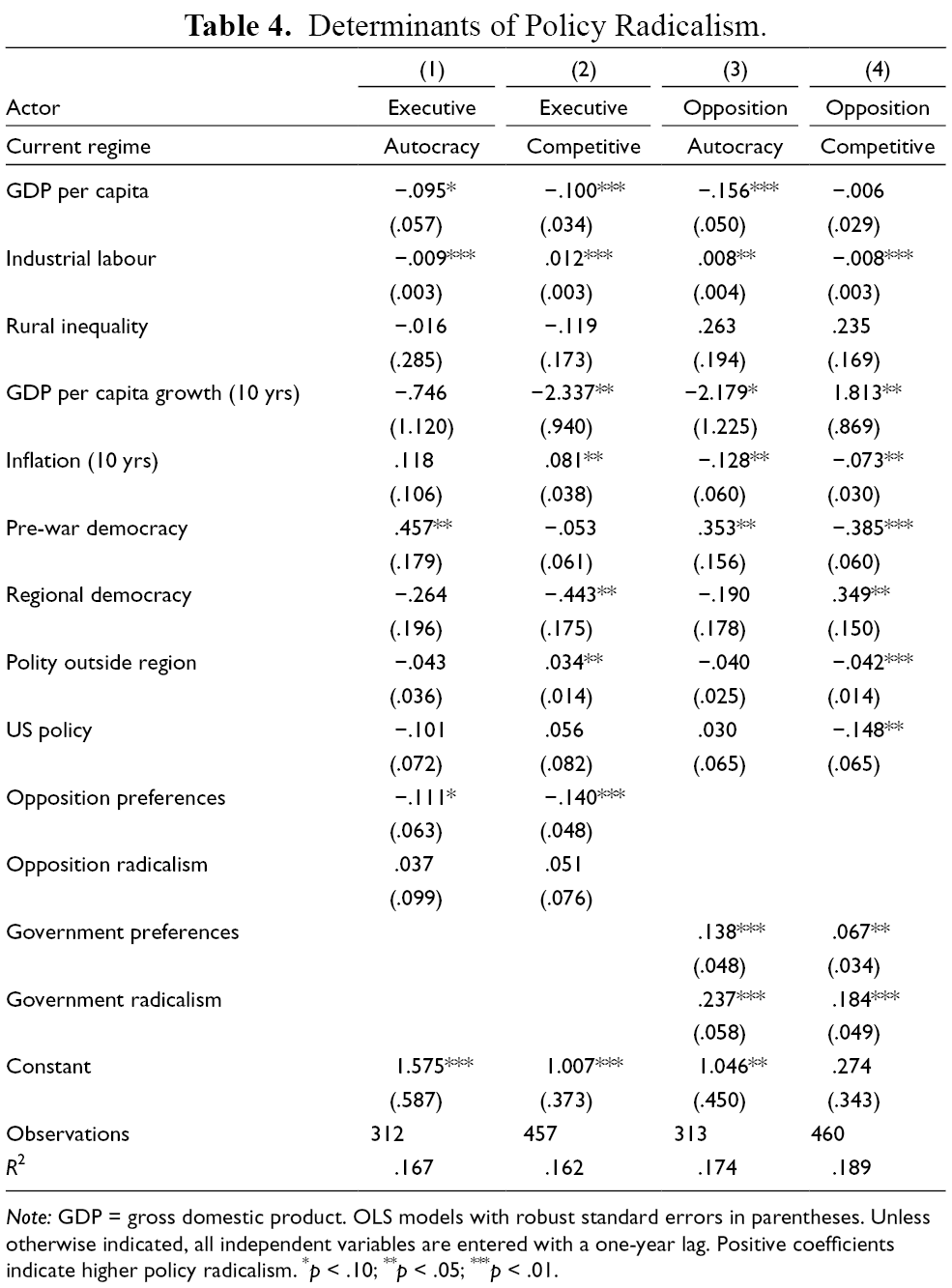
Note: GDP = gross domestic product. OLS models with robust standard errors in parentheses. Unless otherwise indicated, all independent variables are entered with a one-year lag. Positive coefficients indicate higher policy radicalism. * p < .10; ** p < .05; *** p < .01.
Accuracy versus Generality: Is the Most General Model the Best Model?
Does a single model of regime change apply to all places and situations? M&PL created a theory bound to Latin America. Such world regions group countries with distinctive features and dynamics. Without question, comparativists must be attentive to regional specificities when analysing democratic survival and democratisation (Bunce, 2000). Shared characteristics can affect political processes that lead to regime change and may explain the paucity of “truly universal findings” in large-N analyses. In a sense, focusing on a single region controls for unobserved traits that may be irrelevant elsewhere. Region-specific studies also facilitate the analysis of international influences. Geographic proximity, common colonial legacies, and shared religion and language make Latin American countries susceptible to imitation and contagion effects that do not affect nations in a region such as Eastern Europe. An assumption of “worldwide causal homogeneity” obscures such dynamics.
Still, sub-regional levels may present significant variation, a variation that cautions us against applying one model to all countries and periods, especially in the long and turbulent post-war era. Is this the classic trade-off between generality and accuracy, between breadth and depth, that Przeworski and Teune (1970) noted long ago? Modernisation theory, formulated as a universal statement, may well be conditional. For Treisman (2020a: 254), “income determines what political regimes could constitute equilibria in a given setting,” but which equilibrium occurs depends on political agency. Are the effects of elites’ preferences and radicalism on regime survival and fall identical across Latin America? Might they depend, instead, on the level of development? If national wealth contributes to modernising economic production, social relations, and civic life, it may predispose individuals to demand or protect democracy. Rueschemeyer et al. (1992) distinguished between sub-regional, income-defined blocs in analysing how rulers and social classes fought for a more liberal political order in Latin America. The structure of the plantation economy (and the recurrence of foreign intervention) in Central America influenced the behaviour of local actors in ways radically different from the course followed in the more developed South America.
Indeed, the incidence of autocracy and semi-democracy is somewhat greater in Latin American nations below the regional mean of income per capita. Breakdowns of competitive regimes have the same incidence across groups, but poor nations have experienced fewer transitions to democracy. Recall, however, that the econometric results in Tables 1 and 2 show no large independent effect of GDP per capita on the probability of regime change. Still, economic development may moderate the effect of political agency. To test this possibility, we incorporate into the logistic regressions the interactions of our political elite preferences and radicalism variables with income per capita. Figures 5 and 6 present the results graphically. (The full results are shown in Supplement tables A2 and A3.)
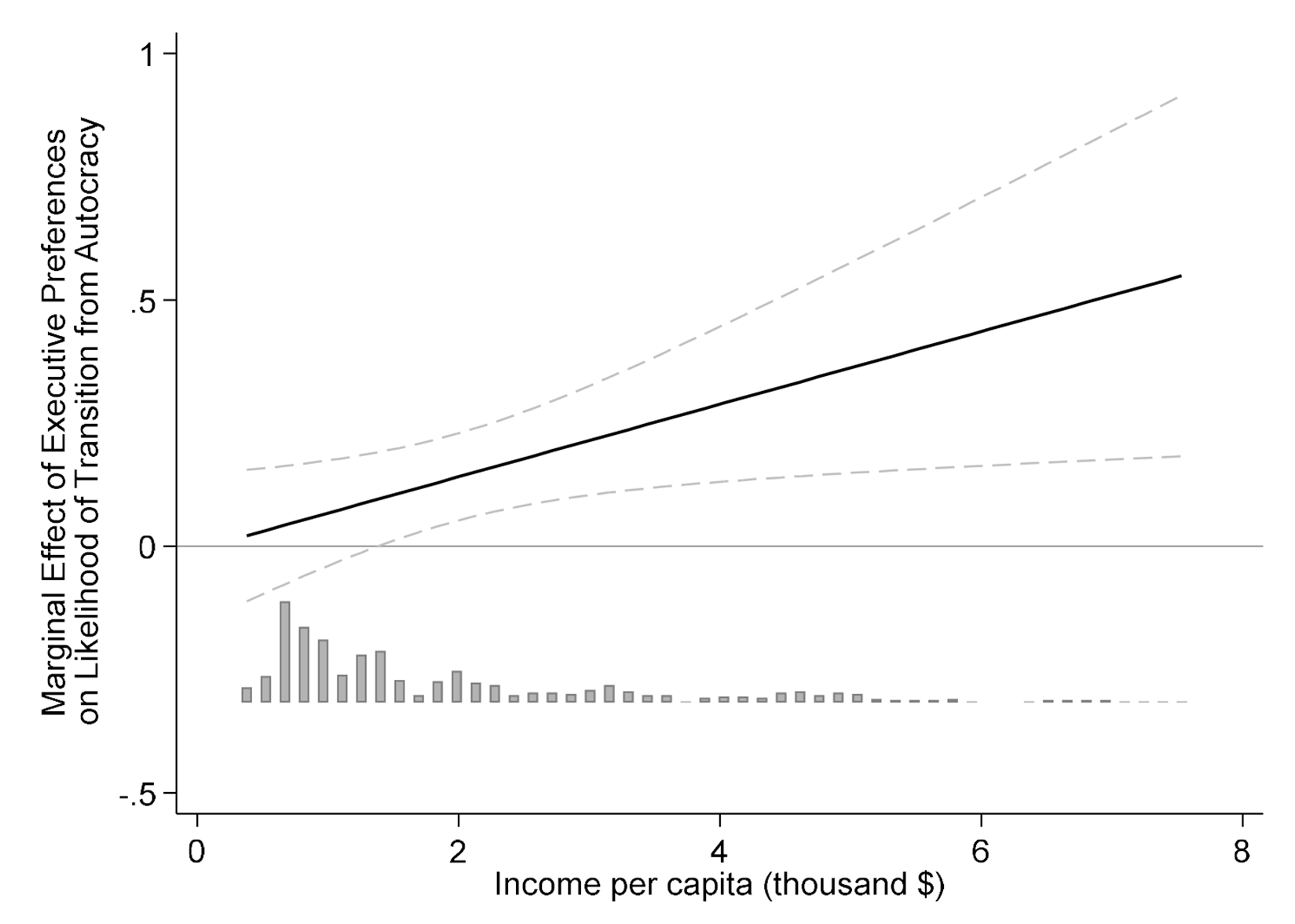
The Conditional Impact of Executive Preferences on Transitions.
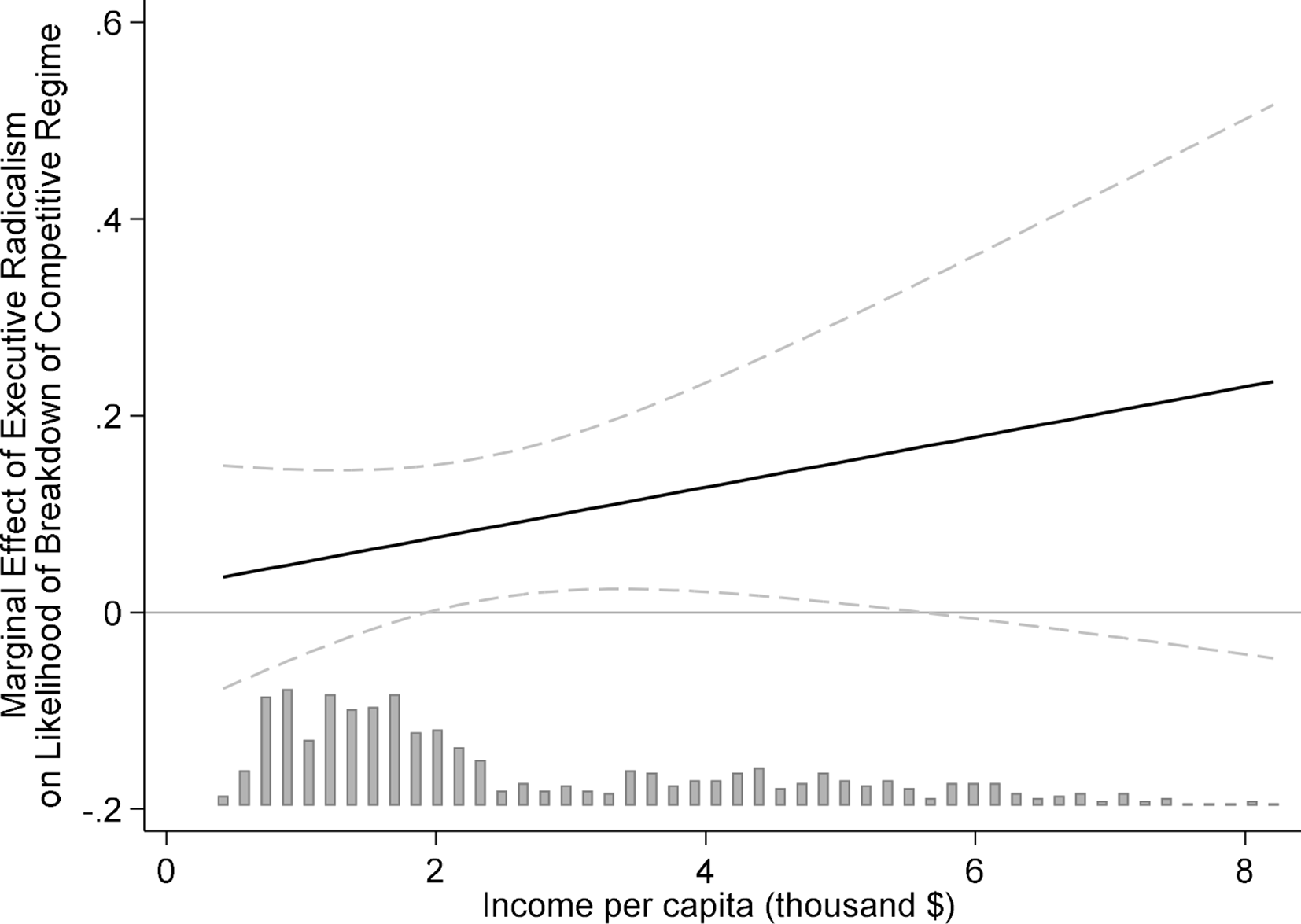
The Conditional Impact of Executive Policy Radicalism on Breakdowns.
The underlying economic structure clearly influences the role of despots in transitions (see supplement table A2). Figure 5 reports the average marginal effect of changes in incumbents’ normative regime preferences on the probability that a transition occurs, conditional on increases in income per capita. The effect of an incumbent autocrat with greater pro-democracy values (or at least no intrinsic preference for dictatorship) is significantly more consequential in triggering a transition in wealthier societies. In addition, the impact of the normative preferences of presidents and military chiefs on breakdowns is smaller at higher levels of development (Supplement table A3, Model 1). By contrast, the effects of policy radicalism on transitions from autocracy are independent of national wealth (Supplement table A2, Model 2). It appears, then, that the radicalisation of opposition parties is crucial in most settings. Finally, we find that the radicalism of the president is an important determinant of regime breakdowns in wealthier countries, as the coefficient for the interaction is statistically significant in Supplement table A3, Model 2. This result is illustrated in Figure 6.
Conclusion
For decades after the third wave of democratisation, scholarship on regime change in Latin America remained largely qualitative. Focused comparisons of small numbers of countries were the most common research strategy. Those who ventured into econometric analyses limited themselves to debates about modernisation theory. M&PL challenged that methodological approach by coding actors’ preferences and radicalism for all Latin American nations and evaluating a stylised model of regime change with advanced statistical techniques.
This article has sought to improve and extend their work along three fronts. First, we argued that aggregating the preferences of all sorts of actors into a single, unweighted average masks the dynamic political processes that lead to transitions and breakdowns. These political processes centre, perforce, on the preferences of the executive, the opposition, and the military. Other social forces act through these primary political actors. Autocratic rulers with low attachments to dictatorship are crucial facilitators of transitions to competitive regimes. Opposition parties with commitments to democracy facilitate transitions. Opposition radicalism increases the chances of transitions to democracy, but it also increases the chances of democratic breakdowns. Where military commanders have weak preferences for democracy, breakdowns are much more likely. In addition, pro-democracy preferences by executives help preserve competitive regimes but only conditional on the radicalism and beliefs of the opposition.
Our second front was an examination of the sources of political elites’ regime preferences and policy radicalism. Economic development and performance, long-term experiences with political regimes, and the positions and attitudes of other political actors define what political leaders think about democracy and their polarisation. Modernisation does seem to occur through the development of a pro-democratic and moderate political culture among the most important political actors, whose behaviours in turn shape regime patterns. Moreover, the evidence, uncomfortable as it may be, is that early political development in Latin America had a path-dependent, destabilising effect. Autocratic rulers and military chiefs have lower attachments to democracy in countries experiencing early electoral competition and political rights.
Our third argument contended that an assumption of regional homogeneity produces a more general but less accurate theory; that is, moderating the estimation of probabilities by income per capita yields worthwhile gains in explanatory power. Executive preferences have greater effects on democratisation in relatively wealthier countries such as Argentina, Chile, and Mexico. Transitions from autocracy in those places are deeply shaped by the authoritarian rulers’ beliefs in dictatorship versus democracy as the best game in town. We found as well that the radicalism of executives has stronger causal effects on the survival of competitive regimes at higher levels of development.
Though we do not report them here, we also implemented analyses incorporating variables measuring social unrest and inequality. These variables, especially measures of disorder, seem to matter more in countries at higher levels of development. The results are preliminary because the numbers of observations drop so much from the initial analyses that they are not comparable. A high-quality data set on social disorder over all Latin American countries since 1945 might well sharpen our sense that the political process in richer Latin American nations is qualitatively different from that of the poorer nations.
Finally, our analysis suggests a methodological reappraisal in the study of regime change. No single approach to the study of multi-causal and multi-level processes such as democratisation and regime collapse is universally superior. Country specialists focusing on agency and quantitative researchers focusing on the economy have lived in separate silos. We believe that the obvious, perhaps even trite, strategic advice is that each research approach should engage with the other. Scholars undertaking focused comparisons will benefit from grouping nations by macro-variables like GDP and by searching for links between, on the one hand, secondary actors such as bishops, labour unions, and social movements and, on the other, central political actors like parties and military factions. Large-N researchers should reconsider the trade-off between generality and accuracy. They should also seek to address the mismatch between theorised causal processes and the constraints of case coding (Haggard and Kaufman, 2016: 24). Future research, to the extent feasible, should code cases on an annual basis rather than assume, as in M&PL, that preferences are constant across each executive’s entire term in office. Lacking clear-cut historical evidence for setting exact dates for changes in regime preferences or policy radicalism on the part of each political actor over the course of an administration, researchers should consider creative ways of simulating the evolution of such values over time. Important questions are involved in this research on transitions and breakdowns, and we are far from definitive conclusions.
Supplemental Material
Supplementary Material 1 - Supplemental material for Agency and Structure in Latin American Regime Change
Supplemental material, Supplementary Material 1, for Agency and Structure in Latin American Regime Change by Barry Ames and Ignacio Mamone in Journal of Politics in Latin America
Supplemental Material
Supplementary Material 2 - Supplemental material for Agency and Structure in Latin American Regime Change
Supplemental material, Supplementary Material 2, for Agency and Structure in Latin American Regime Change by Barry Ames and Ignacio Mamone in Journal of Politics in Latin America
Footnotes
Acknowledgements
Thanks to Andy Baker, Josep Colomer, Aníbal Pérez-Liñán, John Polga-Hecimovich, David Samuels, workshop participants at the University of Pittsburgh, as well as to Jorge Gordin and two anonymous reviewers for their helpful comments. The usual disclaimer applies.
Declaration of Conflicting Interests
The author(s) declared no potential conflicts of interest with respect to the research, authorship, and/or publication of this article.
Funding
The author(s) received no financial support for the research, authorship, and/or publication of this article.

Supplemental Material
Supplemental material for this article is available online.
Notes
Author Biographies
E-mail:
E-mail:
References
Supplementary Material
Please find the following supplemental material available below.
For Open Access articles published under a Creative Commons License, all supplemental material carries the same license as the article it is associated with.
For non-Open Access articles published, all supplemental material carries a non-exclusive license, and permission requests for re-use of supplemental material or any part of supplemental material shall be sent directly to the copyright owner as specified in the copyright notice associated with the article.
