




Abstract
Pandemics, climate warming, growing inequality, and much more bring crises that change the patterns of daily life in human communities, directly impacting the provisioning systems that form in a community to meet the needs and wants of individuals, groups, and entities for goods, services, experiences, ideas. Provisioning systems sometimes begin as leadership initiated top-down, authoritarian prescriptive supply networks, public and private. Sometimes, they originate as bottom-up, self-organized, innovative, open choice, often informal, exchange based networks, and mostly, over time, they emerge as untidy self-organized multi-level diverse assemblages of both. The diversity of provisioning systems in a community enables crisis resilience, but limits efficiency and control. The provisioning systems that form in these ways are complex, multi-level, non-linear evolutionary systems, often unpredictable, and lacking direction. Balancing a desire for stability and an appetite for diversity, innovation, and change in shaping a provisioning system is like walking a narrow corridor on the edge of chaos. Achieving balance, avoiding slipping into chaos, rests on the management of a set of complex social mechanisms. These embrace delivery mechanisms where value is produced and consumed through complex infrastructures; stakeholder action fields where trust, collaboration, cooperation, compromise, competition, or conflict are in play; technology evolution mechanisms where innovation and the recombination of existing technologies occur at all levels; and value exchange fields where community and individual values shift in response to crisis and change. Recovery from crisis is not an event, it is a complex, continuing process, often unpredictable, often unequal in outcomes, but walking a narrow corridor is episodic, uncertain and in the end possible. This is the next normal for marketing.
Keywords
Introduction
A next normal for marketing is emerging as communities everywhere change their patterns of daily life in response to crises including a pandemic, a warming climate, an infinite desire for growth that cannot be satisfied sustainably (Cohen, 2018), the conflicts and mistrust created by ideology and inequality (Piketty, 2020), and the growing digitalization and challenges of big data, social media and privacy (Zuboff, 2019). As the patterns of daily life change, sometimes dramatically, so too do the needs and wants of individuals, groups, and entities for goods, services, experiences, and ideas, in turn transforming the provisioning systems that societies form and form again to meet their changing needs and wants. Sometimes provisioning processes begin as top-down, authoritarian prescriptive networks, both public and private. Sometimes they originate as self-organized, bottom-up, innovative, open choice, often informal, networks, and mostly, over time they emerge as untidy multi-level assemblages of both. In each of these formal and informal provisioning networks and blended systems is an embedded economic system in which individuals, small groups and entities interact, making choices in a search for meaningful outcomes such as survival, health, wellbeing, and improved quality of life (Bregman, 2020). These every day choices, almost infinite in number, then change and change again the nature of the transition challenges faced at all levels for households, communities, institutions and macro regions and states. In the process, these individual and small group choices create a complex cultural evolutionary dynamic of multi-level variation, selection, and reproduction generating provisioning systems (Johnson & Earle, 2000; Kauffman, 1995; Wilson, 2019). It is this evolutionary dynamic in communities, small and large, traditional or developed, remote or central, which provides the settings for a next normal for marketing. As each community responds to the challenges of pandemic lockdown, sustainability in the face of climate change, the problems of endemic inequality and the threats and opportunities offered by big data, social media and digital technology, the next normal for marketing theory, and practice will be transformed by the need to listen, learn, and reshape though leverage the needs, wants, institutions, and infrastructures of each community.
The impacts of the 2020 pandemic on the patterns of daily life are a profound example. To save lives and avoid overwhelming hospital and medical facilities, nations, cities, and local governments shut down industries such as tourism, hospitality, entertainment, and education in wide-ranging lockdowns, accompanied by strict social distancing, quarantine, and travel restrictions. As unemployment and poverty levels increased and funding was provided for troubled business sectors, fiscal deficits reached historically high levels. Streets in most cities emptied out as work shifted to home and education shifted to remote learning. Supermarkets experienced panic buying as households began to stockpile items such as toilet paper, pasta, and potatoes. Cash was replaced by tap and go and restaurants, hotels, pubs, clubs, and sporting events were closed or canceled. The flows of information, money, power, risk, possession, and ownership essential to the co-creation of value in a provisioning system and its embedded economies were significantly disrupted. Often, as a result, within a few days, the patterns of daily life changed, perhaps irrevocably, and the networks forming a provisioning system rapidly evolved as individuals, small groups, and entities sensing opportunity or threat acted appropriately, responding to self-interest, mutuality, and morality as their volatile, uncertain, complex world continued to change.
Most importantly, the pandemic demonstrates (1) how our systems and daily lives co-evolve with each other e.g., online shopping, remote working, zoom communication, travel and (2) how this evolution is creating continual and growing inefficiencies and inequalities e.g., nursing homes, elderly cocooning, or youth losing jobs, training and travel opportunities as they start out for economic independence.
These shifts threaten not just our public health, our social, economic, and political wellbeing but the planet itself that we all call home. They reflect the evolutionary dynamic, sketched in Figure 1. They constitute the next normal for marketing and for policy makers and management generally, cutting across how we live, work, shop, socialize, and interact generally with the community.
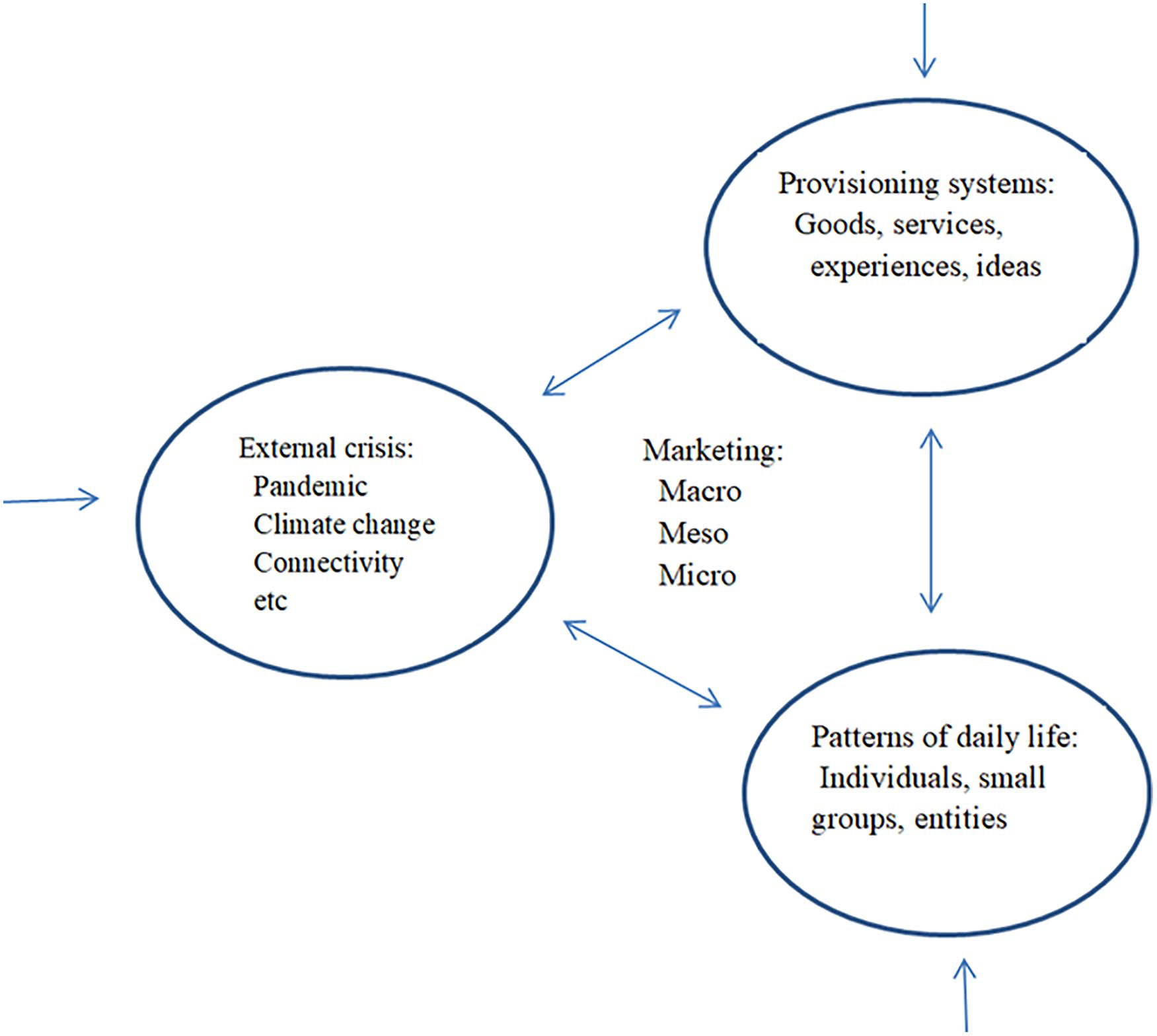
Looking beyond the immediate environment in an increasingly complex world.
We need to change marketing. Marketing can be reset by developing its theory base to cope with systemic collapse, sustainable resource consumption, economic and social inequality, and technology, both innovative and intrusive, by understanding not just consumption behaviors but the complex dynamics of a human collective (Wilson, 2019). The causal dynamics of provisioning systems are critical challenges for marketing scholars, for policy makers and managers and for external influencers, at a time when effective intervention in a response to crisis is a high priority in most communities across the world. Recognizing and managing these challenges holds open the possibility of realizing sustainable, ethical, and responsible societies in a not too distant future world. This paper is about exploring these challenges from a marketing perspective in theory and in practice.
We begin by defining provisioning systems and identifying four complex social mechanisms that together enable every provisioning system, both prescriptive supply systems and marketing exchange systems and blends, to form, grow and function effectively over time and space. The causal dynamics of provisioning systems and the networked diversity of provisioning systems found in most communities are then explored in more detail. We draw on these analyses to consider how marketers might shape the future of a focal provisioning system. In particular, the work of Acemoglu and Robinson (2019) suggests that “walking a narrow corridor,” seeking to balance the varying tensions between efficiency and innovation, might play a critical role in managing complex networks of provisioning systems. The paper concludes by proposing implications for marketing theory and practice.
Provisioning Systems—Networks and Assemblages of Economic and Social Exchanges
Provisioning systems form, grow, sometimes collapse and often regenerate, in every human community. Every community, shaped by geographic location, past history and often embedded in wider communities, in seeking to provide for the assortments of goods, services, experiences, and ideas essential to the changing patterns of daily life, instinctively draws on existing leadership and self-organization to form intricate social networks of interacting individuals, small groups and collective entities, public and private. These complex social networks are what we are calling provisioning systems, each endowed with the social and economic purpose of making available needed assortments to diverse community participants. All provisioning systems are social systems, based on trust, formed in and by human communities as individuals and entities search for ways of meeting their needs and wants for goods, services, experiences, and ideas. They are self-similar networks of individuals, small groups and collective entities, relating to each other through flows of information, money, power, risk, possession and ownership, operating in distinctive settings, with known and accepted roles, logics, language, and culture (Layton, 2015; West, 2017; Wilson, 2019).
Many provisioning systems co-exist in a community each seeking to meet the differing needs and wants of participants—individuals, households or small groups, collectives, and public and private entities—for access to widely varying assortments of goods, services, experiences and ideas, sometimes narrowly specified in content, space and time, sometimes wide ranging and general. A “community” in this context is more than simply a group or market segment defined by location, time, or psychographics. It is a collective, an interactive network of people (individuals, groups and entities) that together share some common interests, concerns, values or beliefs, often a shared geography, a set of technologies, and institutional/governance framework, in a local environment. It may, for example, be a marketplace, or shopping mall, a music festival, a social movement concerned with climate change or a religious commitment, all with a common or shared focus. It may be short-lived or long-lasting. In the contemporary highly interconnected world of social media, most people and organized entities are members of many such communities and participate in many quite different provisioning systems as part of their daily lives.
Each provisioning system, identified in this way—micro, meso, or macro—will have created associated networks of provisioning systems, complementary to or embedded in the primary supervening system, where production, distribution and societal or institutional needs for flows, including information, finance and capital, are met. In each system, primary, adjacent or embedded, complex multi-level evolutionary processes lead to delivery systems forming and forming again as local and macro environments change and change again. Infrastructures form and disappear, norms and customs emerge over time, history matters. Stakeholders seek a dynamic balance between stability and change and between production and transaction costs that brings individual, system, and societal benefits. Participants concerned with innovation and invention focus on shifting favorably boundaries, structures, and outcomes; all driven by individuals, small groups, and entities with differing blends of values such as self-interest (including survival and fitness), mutuality and morality, and of feelings such as sadness, awe, excitement, friendship, and hate (Garg & Lerner, 2013). Complementary and supporting provisioning systems provide the flows of information, money, risk, power, possession, and ownership that are essential to the efficient and effective operation of a supervening provisioning system, and in doing so meet community needs and wants for assortments providing innovation, width, depth, accessibility, relevance, fairness, and distributive justice.
Figure 2 suggests the rich diversity of the assemblages of complementary, adjacent, and embedded provisioning networks that form through leadership or self-organization over time in a community as participants sense opportunity (and threat) in their immediate environments (Canniford & Bajde, 2016). The degree of choice within a provisioning system appears in the horizontal axis and the emergence of structure is considered in the vertical axis.
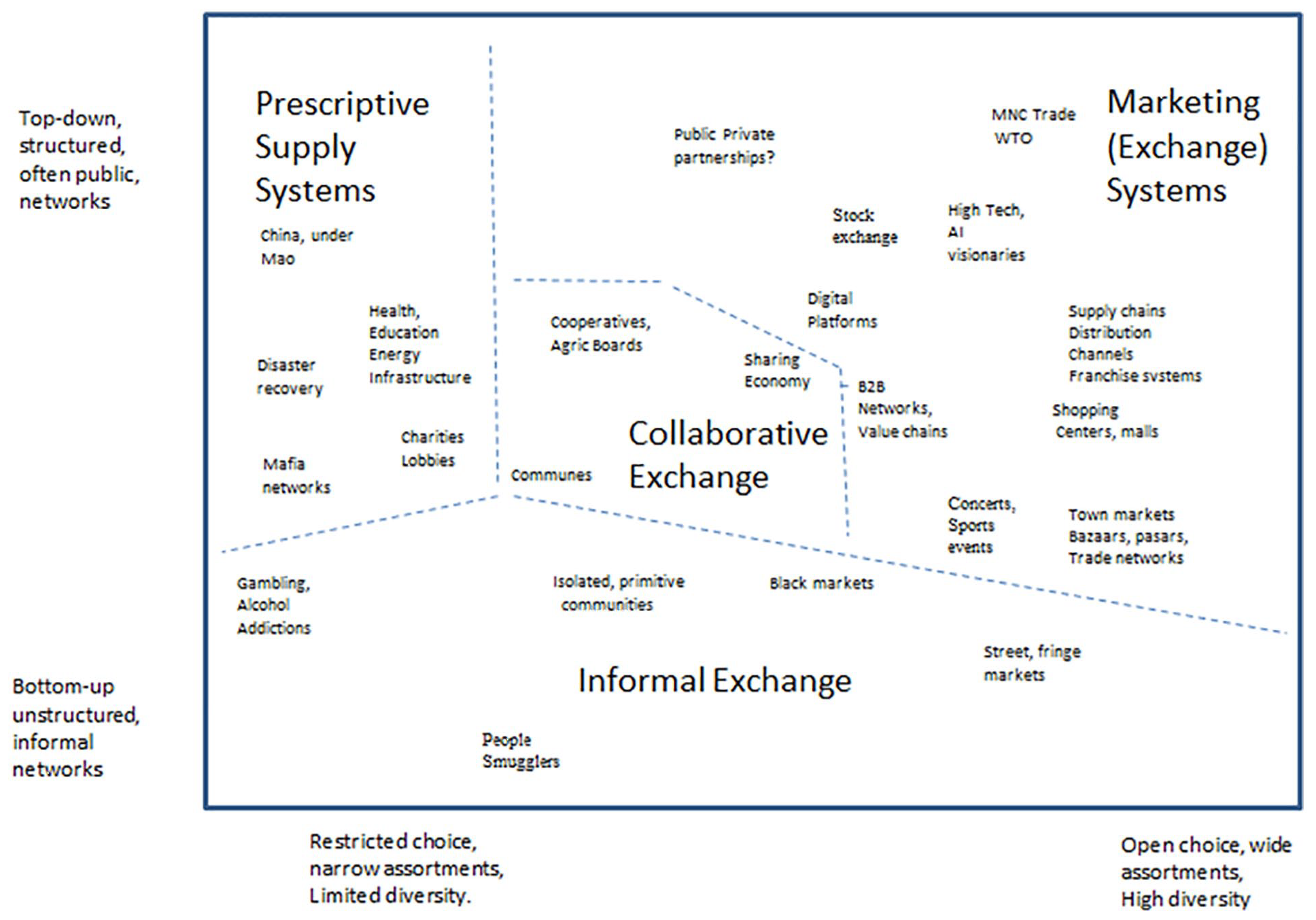
Mapping the diversity of possible provisioning system networks (adapted from Layton, 2019).
Each provisioning system identified in Figure 2 is a self-organized, patterned network of relationships among individuals, groups, entities, and institutions that forms a coherent whole. Most of the entries in Figure 2 refer to existing or emerging provisioning systems, each reflecting a distinctive positioning and pointing to an embedded or sub-network of provisioning systems. Using the mapping suggested in Figure 2 as a framework, a provisioning system in a community can be thought of as a shifting blend of four different assemblages of complex, multi-level, evolving, adaptive non-linear systems, and often unpredictable, with two dominant embedded systems standing out. The two dominant assemblages in many communities are the marketing exchange systems and prescriptive supply systems and the supporting or complementary assemblages embrace collaborative and informal exchange systems. Marketing exchange systems are the self-organized bottom-up networks that emerge as value-based voluntary exchange takes place in a community (Layton, 2015). They form as a result of individual, small group, or collective initiative. They vary from individuals trading with each other and with customers in street side stalls and informal marketplaces in the hope or expectation of an emergent enterprise, to shopping centers and formally regulated markets. They range from complex, multi-level high technology networks, to provisioning systems based on gambling and alcohol addictions, to franchise networks, supply chains and distribution channels forming global B2B networks. Sometimes, they form as a result of business enterprises hoping for corporate multi-level networked growth and profitability; often as informal, small, trust-based social networks; and sometimes as a consequence of innovation, invention, responding to internal, systemic changes and to external events such as a pandemic or other crisis.
Prescriptive supply systems emerge as leaders, secular or sacred, look to meet community needs for governance, law, religion, health, education, welfare, infrastructure, transport services, arts, culture, and more. Prescriptive supply systems are top-down, hierarchical, controlling, and prescriptive in what is made available, often bureaucratic and rigid, seeking operating efficiency more than customer satisfaction, often slow to change existing operating procedures, and may be public or private sector originated. Prescriptive supply systems may include tightly structured multi-level mafia networks providing a range of services including protection and smuggling, or high technology systems assuming a dominant positioning in a community. Prescriptive supply systems often interact with formal and informal marketing exchange systems creating increasingly complex provisioning networks. For example, shopping centers offering wide and deep assortments of goods, services, experiences, and sometimes ideas, often include welfare and other public services. Public transport services link with private market–based providers such as taxis and Uber services to provide wide, flexible or localized access to transport and public health provisioning systems, while primarily prescriptive, form close links to marketing exchange systems of doctors, clinics, private hospitals, and other commercial providers.
Complementing prescriptive supply systems and marketing exchange systems are two hybrid assemblages. One, collaborative exchange, embraces collaboration, cooperation, and compromise, avoiding the costs and uncertainties of competition and perhaps conflict, in an evolutionary search for survival and hoped for success. It includes platform technologies, the sharing economy, agricultural cooperatives working together in in retail and production, and historic and contemporary trade networks such as the Silk Road or the Chinese BRI. Other examples are the formation of closely integrated supply chains and distribution channels found in fast fashion and circular economies, or the alternative economies of food-sharing, time banks, and community gardening (Haase et al., 2018). It includes Israeli kibuttzim, Tibetan monasteries, self-isolated communities and a range of other social collaborations in market settings. In each case trust is an essential element. The other major hybrid assemblage is informal exchange, where provisioning is unregulated, immediate, open, often in settings where “information is poor, scarce, mal-distributed, inefficiently communicated, and intensely valued” (Geertz, 1978, p. 29); or a consequence of natural or economic disaster or collapse such as that which occurred in Haiti or Aceh (Davies, 2019).
It is in the hybrid middle ground of Figure 2 that many communities will find a continuing resolution of crisis conditions, such as those experienced in the pandemic, “learning by doing,” balancing state power with social openness, hierarchy with innovation, prescriptive choice with individual preferences. It is here that the seeds of new, perhaps unexpected provisioning systems can form, for example, from social movements, such as climate change activism, or as a consequence of social marketing intervention, or from intensifying religious commitments in the daily life of some communities, or from responses to natural, economic or political disasters where refugee flows had to be accommodated in makeshift crowded camps.
All four assemblages have differing but distinctive cultures—shared understandings and expectations (Cook et al., 2009), operating practices, customs, rules, norms, and values (Schlicht, 1998)—which are essential to understand in meeting community wide needs at all levels. Schlicht (1998) argues that custom is not an inertial force but is directly motivational, seeing “customary phenomena as partially autonomous, capable of shaping individual action, rather than merely reflecting social interaction and slowing down adaptation” (p. 272). He goes on to note “habits, attitudes, preferences and convictions are closely tied together. Each reconfirms the other” (p. 272) and observes that “customs differ widely across societies” noting that custom is dependent on history and circumstance. Each of the four broad assemblages creates and sustains its own set of customs, in the longer term stabilizing into something akin to an institution. When they intersect, for example, prescriptive supply systems such as education or welfare seeking additional revenues from a competitive entry to markets served by marketing exchange systems, or the latter seeking entry to a protected prescriptive supply system such as health or medicine—cultural tensions arise over control, power, flows, norms, settings, and logics. Efficiency tends to be uppermost in prescriptive supply systems while innovation, diversity, and customer choice are the hallmarks of marketing exchange systems.
The assemblages of provisioning systems that form and re-form in these ways co-exist in response to the diversity of daily needs and wants of individuals, small groups and entities, public and private. These needs and wants reflect wide-ranging differences and persistent inequality in behaviors, interests, capabilities, capital –economic and social—in values, status, roles and commitments, not only in individuals but also in the evolution of small groups such as cooperatives, collectives of all kinds and of entities, public and private (Wilson, 2019). These join together in increasingly complex social networks such as supply chains, distribution channels, and exchange links, often crossing community, region and international borders. These differences create essential network diversity; their impacts on demand and supply are ever-changing, often unpredictable but collectively provide the resilience needed for successful crisis resolution (Gunderson & Pritchard, 2002; Zolli & Healy, 2012). Critically, the end result then is most often a self-organized multi-level network of embedded systems, each with a distinctive, sometimes unique identity.
Over time each of these networks and assemblages of networks grow, change, and interact, some inspired by leadership and clearly defined purpose, some enthused by the opportunities offered from visionary technology change, others self-organizing to form community centers and marketplaces, and most simply responding to a local environment that usually, but not always, changes unequally, slowly, and unpredictably. Participants, stakeholders and entities, watch what is happening, using past experience and history to frame their insights; they learn from each other, competing with some, cooperating with others, collaborating, cooperating or compromising if needed for success. Conflict is possible. In this way, each provisioning system with its networks of networks lives with an uneasy balance between stability and innovation, between structure and diversity as it evolves over time and space, not always evident to individuals in their local environment. These and similar changes lead to the evolution of ever more complex self-organized multi-level emergent networks of trust-based exchange where value is co-created among individuals and entities within and between communities and their networks.
While policy making and management in the workings of a provisioning system is rarely simple, the global impact of the COVID-19 pandemic in 2020 highlights the importance of widening a traditional transactional approach to marketing, to policy and to strategic and operational management choice to explore the system wide causal dynamics of provisioning system networks. Two dimensions emerge from the Figure 2 discussions that are critical. The first is diversity, reflecting choice options and assortment width, depth, and innovation; the second is structure reflecting the tension between top-down purposeful hierarchy and an emerging bottom-up often self-organized anarchy inspired response to provisioning needs and wants. The locations of all networks in a provisioning system on both dimensions are uncertain and variable, changing over time, driven by factors including technology, social, political, and economic change, resources and governance, leadership, and self-organization in the wider system environment. Managing this interaction is often key to public-private partnerships in infrastructure projects or to the emergence of marketing functions in public enterprise or to the blends of informal and formal enterprise in disaster recovery situations. Mapping provisioning system networks and assemblages and identifying existing and potential connectivity’s are important first steps toward recognizing causal dynamics conflicts before they impact system outcomes.
Four Complex Social Mechanisms Underpinning the Evolutionary Causal Dynamics of Provisioning Systems
To identify the causal dynamics in a provisioning system network is to bring a set of social mechanisms into sight. There were four complex social mechanisms identified for marketing exchange systems by Layton and Duffy (2018). We suggest here that they are equally important is considering the working of prescriptive supply systems and supporting collaborative, informal assembles. The four social mechanisms derive from the work of Hedström and other analytical sociologists. Hedström (2005) defined a social mechanism as “a constellation of entities and activities that is organized in such a way that it regularly brings about a particular type of outcome” (p. 145). Linked to social mechanisms, Martin (2003) identifies field theory as the “explanation of regularities in individual action by recourse to position vis-à-vis others.” (p. 1) and goes on to note that “position in the field . . . is considered to indicate the potential for a force exerted on the person, but a force that impinges “from the inside” through motivation as opposed to external compulsion.” (p. 1). Fligstein and McAdam (2012) in their work “On a Theory of Fields” suggested strategic action fields, embedded meso level social orders, to be “the basic structural building block of modern political/organizational life in the economy, civil society, and the state” (p. 3), going on to show “how embedded social actors seek to fashion and maintain order in a given field” (p. 3). Each of the four complex social mechanisms are strategic action fields where social actors fashion and maintain order.
The four complex social mechanisms build on the highly evolved abilities of humans to communicate, trust, reciprocate, copy and learn, cooperate, exchange (with strangers), specialize, self-organize, form and manage emergent multi-level, often purposeful entities (Runciman, 2009). The four complex social mechanisms that together interact to drive the formation and growth of all provisioning systems are (1) delivery mechanisms, (2) stakeholder action fields, (3) technology evolution mechanisms and (4) value exchange fields. Each of these four mechanisms are found in every provisioning system network—macro, meso and micro, prescriptive and exchange based, formal and informal, top-down and bottom-up—sometimes well developed and sometimes embryonic, sometimes explicit and often implicit, but always essential in achieving successful provisioning system outcomes. The prospective emergence of a global provisioning system for a coronavirus vaccine might serve as a contemporary example.
Delivery mechanisms include the settings, roles, and behaviors where provisioning takes place; the logics, dialogues, and displays that convey meaning; the tangible and intangible infrastructures that have been created to make provisioning possible; the rules, written and unwritten that frame exchange; and the flows of information, money, power, risk, possession, and ownership that provisioning generates and which deeply influence the dynamics of the links connecting participants.
Stakeholder action fields are where the participants, small and large, in the workings of delivery platforms, including both sellers and buyers, customers and those impacted by the delivery system itself, push for attention, power and influence in shaping the future outcomes of a provisioning system. Stakeholders jostle for power and control of the prescriptive supply and marketing exchange provisioning system hierarchies, and of the choices being made that impact collaboration, cooperation, compromise, competition, and sometimes conflict. Where deception brings significant rewards or exploitation goes unpunished, both may be pursued. Trust in negotiation and exchange is always important, but group norms and sanctions and appropriate institutions may matter more (Cook et al., 2009). Amid these changes, stakeholders enter or depart action fields, often as a consequence of technology shifts, changing values and preferences, and political pressures, within an immediate provisioning system, a supervening system, or adjacent, perhaps distant, provisioning systems.
Shifting environments and stakeholder action fields generate opportunities for innovation and invention—small, every-day and large, system-wide change. This is met through the evolution of technology innovation mechanisms (Arthur, 2009; Kauffman, 2019), where individuals, groups, and entities sense opportunity to better survive or succeed, searching for and recombining existing technologies, innovations often with unexpected insights. Delivery mechanisms will change as technology is imported or invented, for example, in shop design or layout, perhaps in computing systems or artificial intelligence or the potential inherent in robotics, all in the hope of better meeting customer needs and wants. Technology evolution may respond to cost pressures and changing customer needs, but will often proceed independently as provisioning system participants seek advantage from insightful combinations of existing options.
In value exchange fields, all participants are faced with continually changing values as their immediate environments shift, responding to internal to external causes or crises; each participant has different priorities for self-interest, mutuality, and morality. All are responsive to immediate emotional commitments and concerns, sometimes seeking to change existing values and constructs, sometimes simply to resist change. All are in this sense malleable (Cohen, 2018) and persistent inequality in outcomes is inevitable.
Over time, each of these four social mechanisms increase (or perhaps fall) in size, complexity, intrusiveness, and unpredictability—a process that can take place rapidly in an emergency (such as a coronavirus vaccine) or slowly as a consequence of community or governance constraints. The four complex social mechanisms driving change in provisioning systems are set out in Figure 3 below.
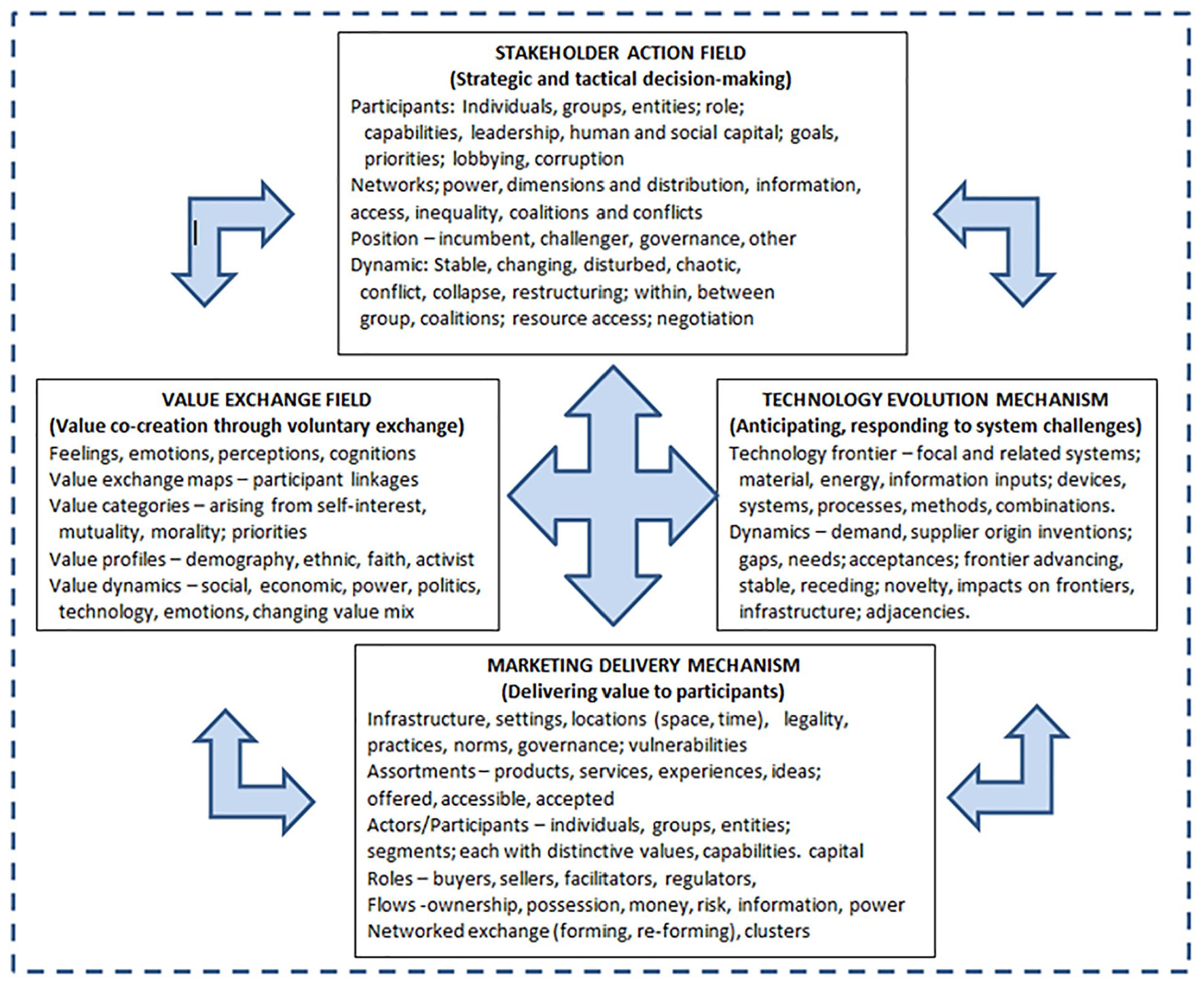
Complex social mechanisms driving formation and growth in provisioning systems (adapted from Layton & Duffy, 2018).
In the functioning of a provisioning system, each social mechanism interacts continually and simultaneously with the others, formed by individuals and entities each making decisions about value based exchange reflecting their assessment of an immediate or local environment (Kahneman, 2011). It is this simultaneous, continual, locally informed choice making that provides the basis for cooperation, specialization, self-organization and the emergence through multi-level group selection leading to the diverse mix of networked provisioning systems, a diversity that is crucial to the resilience and survival of each provisioning system (Padgett & Powell, 2012). It is this blend of simultaneous choice making that creates path dependence (Layton & Duffy, 2018) in the functioning of provisioning systems.
Each choice becomes part of the outcome sets of each provisioning system in which it takes place; each choice is noted by other participants, sometimes initiating change as they observe success or failure; each choice is part of the environment in which the social mechanisms, primary and complex, of the provisioning system function. Path dependence and inequality is integral to the interaction of prescriptive supply and marketing exchange systems in the workings of a provisioning system. While purposeful at the individual, small group or entity level, the search for survival and fitness at a collective level is often uncertain, with success or failure dependent on the immediate circumstances of each participant. A provisioning system is dynamic, evolutionary in nature and while sometimes external or internal forces can shape it, it is largely collectively direction-less.
The Underlying Causal Evolutionary Dynamics of Provisioning Systems and the Changing Patterns of Everyday Life
The evolutionary path taken by a provisioning system is set out in Figure 4 showing the complex feedback linkages between participant choice, the emergent social mechanisms of delivery, stakeholders, technology and value change, their consequences and the path dependent feedback to participant choice, and the workings of the social mechanisms. Each linkage will influence and be deeply influenced by the state, societal and local environments within which the provisioning system is located. Governance, formal or informal, state initiated or self-organized, is essential if trust-based exchange of value is to occur. Without effective and insightful governance, provisioning system formation and growth will be limited, choice will often be lacking, networks will be narrowly based on social connections, innovation will often be absent, corruption and power, particularly political power, will be evident in determining outcomes. For a provisioning system, caught up in a world of rapid economic, social, technological, and political change, the relationships between state and society are fraught with tension as each endeavor to gain an upper hand, resulting in shifting, often unpredictable, governance patterns, rules, customs, and cultures.
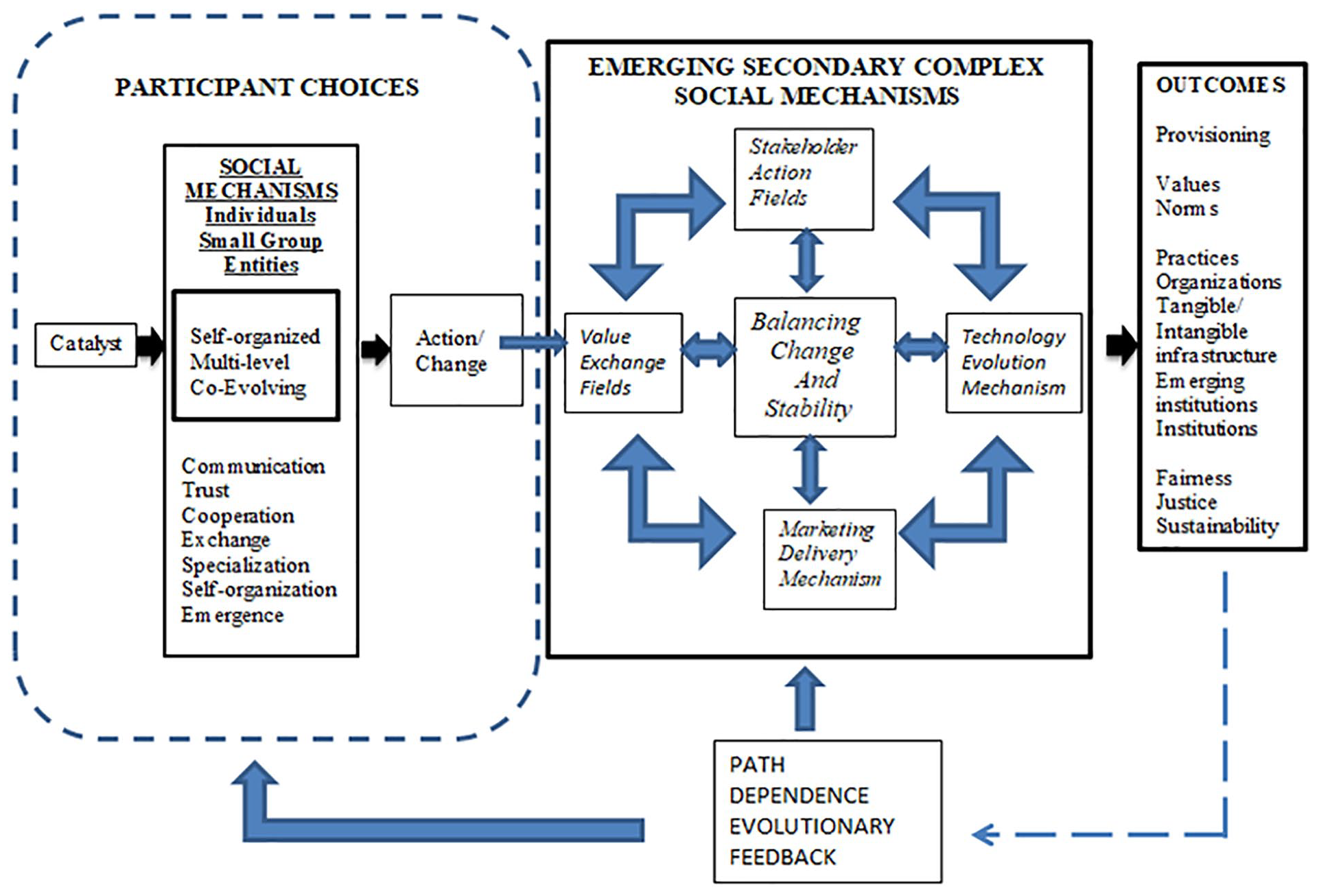
The dynamics of provisioning system evolution (adapted from Layton & Duffy, 2018).
As Acemoglu and Robinson (2019) point out in a discussion of nation-wide social system structures and outcomes,
for liberty to emerge and flourish, both state and society must be strong. A strong state is needed to control violence, enforce laws, and provide public services that are critical for a life in which people are empowered to make and pursue their choices. A strong, mobilized society is needed to control and shackle the strong state. (p. xv)
They go on to suggest that there is a narrow corridor in the continuing tension between state and social power where neither is over-powerful and an effective, but temporary, balance is reached. If state power at a national level is broadened to include top-down prescriptive authority and social power extended to include bottom-up marketing exchange-led innovation and diversity, then walking a path along the corridor, balancing the powers of state and society, stability and change, is a critical concern for the workings of provisioning systems, at all levels. Individuals, enterprises, and institutions watch one another, act, see what happens, and learn—an evolutionary process that repeats almost without limit in each provisioning system regardless of its scale. If, as a result, a significant shift occurs enhancing or reducing the equivalents of state or societal power, it risks initiating cascading change in all directions, creating complementary changes in the workings of provisioning systems, perhaps challenging the liberty needed for the effective and efficient operation of the system in a free and open society. As John Locke put it, people have liberty when they have “perfect freedom to order their actions and dispose of their possessions and persons, as they think fit . . . without asking leave, or depending upon the will of any other man.” (Acemoglu and Robinson, 2019, p. xi).
For provisioning systems, including both prescriptive supply and marketing exchange systems, from micro through to macro, the key to success in walking the narrow corridor at every level lies in balancing stability and innovation in relation to state and social/market forces. The difficulties encountered for provisioning systems in walking the corridor were highlighted by Acemoglu and Robinson (2019) in their discussion of the Red Queen phenomenon where, as Alice found, the pace of underlying change made it necessary to run as hard as possible to stay in the one spot. Problems are everywhere and demonstrate neither state nor market dominance is good for fully functioning provisioning systems and associated quality of life (Davies, 2019).
Complex adaptive or evolutionary provisioning systems, such as those discussed above, exist on the edge of chaos (Bak, 1997; Thurner et al., 2018) where a step too far can precipitate far-reaching non-linear, discontinuous change within and between adjacent systems that is often unpredictable. In the design, operation and evolution of the social systems caught up in provisioning system networks, achieving a balance in walking that narrow corridor at the edge of chaos is not just a macro issue. It is one that is potentially present at every level in every provisioning system. It will be critical in meeting community needs in a world recovering from the COVID-19 pandemic, or responding effectively to the crisis pressures of climate change, sustainable growth, or those of social inequality, and many more. This calls for new ways of thinking and acting that are multi-level, interactive, collective, system based, process rather than event oriented; not rejecting past scholarship and managerial insights but integrating them into a wider appreciation of the world as it exists.
It is especially relevant in considering the immediate concerns centering on the recovery from lock-down in communities across the world. As noted earlier, reconstructing complex social provisioning systems is not an overnight project of changing back to what once was. It is a continuing process where rethinking and reshaping social systems is essential, one where authoritarian action must be matched by self-organized diversity and innovation if changed patterns of life are to be sustained and provisioning system resilience is to be rebuilt in a changed world.
Environmental drivers are always important factors both in considering a provisioning system as a whole, and in assessing adjacent, embedded, supporting and complementary systems whether micro or macro. Nowhere is this more apparent in 2020 where the COVID-19 pandemic is playing havoc with provisioning systems in almost every global community. People, location, economics, technologies, institutions and history are obvious factors (Sachs, 2020). So too are societal issues such as the extent of conflict, corruption, and criminality; the strength of religious commitment; the impacts of inequality; culture and ethnicity also matter where contrasts between individual and collective cultures, or a distinction between loose and tight choice that is often culturally determined and important when provisioning systems cross geographic or cultural boundaries (Gelfand, 2018). The impacts of these and similar factors on micro and macro provisioning system performance often show up in considering the environmental challenges raised by adjacent, embedded and complementary systems.
Implications for Marketing Theory and Practice
This paper suggests that the next normal for marketing is to broaden its focus beyond the individual consumer and actors, exploring the ways that the formation, growth and evolution of provisioning system networks could be shaped in the interests of society and the possible consequences of failure. By shifting to this next normal the concerns noted above would become important perhaps central issues at all levels of marketing theory and practice, and marketing might then be seen as a social discipline drawing from and contributing insights to related social sciences such as economics, sociology, history, political science, geography, anthropology, and much more.
Working with multi-level provisioning system networks in this way highlights some important points of difference from a more conventional marketing analysis. First, it is more inclusive. It brings the state directly into the set of participants or stakeholders, instead of seeing it as an external source of governance and control. It brings the tensions between top-down efficiency and bottom-up self-organization directly into the analysis and opens the door to a wider assessment and mapping of participant identification, roles and interactions in the evolution of a provisioning system network. This, in turn, provides a basis for a dynamic causal mapping of the trust/mistrust characterizing linkages connecting participants and the flows of information, power, capital (economic, social and political), risk, money, ownership and possession connecting participants at each level.
Second, since a provisioning system network is an active, living social system, it focuses attention on process rather than events. Intervening in a provisioning system is a process, taken over time, changing and changing again as the process unfolds—it is not simply an event that can be left behind. Walking the narrow corridors between stability and innovation at each level in a complex provisioning system is an ongoing, episodic, evolutionary and hazardous process in which individuals, enterprises and institutions test possible futures, with fitness an achievable outcome.
Third, provisioning system networks never exist in isolation. Boundaries change, memberships fluctuate, structures form and re-form, secondary systems—adjacent, complementary, and embedded—come into being, supervening systems, challenged by environment may fail, and all must be considered in context.
Finally, provisioning systems thinking highlights collective choice at all levels, from small groups of individuals, perhaps family or often just with shared interests, to groups of entities drawn together perhaps by the benefits of collaboration and specialization, to macro groupings, perhaps searching for power or enhanced market presence. While individuals (and entities) make choices, they do so looking to each other in the many small groups in which they live, work and find trust and support.
These differences challenge the conventional analysis of rational exchange and presumption of market efficiency, allow much greater freedom in the design and operation of a provisioning system network, and generate important research questions.
How might a provisioning system approach work in a corporate setting, such as a national airline facing major external crises? Could it be used for example by Qantas or Virgin Australia, as each airline faces a national crisis driven by climate change and the COVID-19 pandemic, where markets are collapsing as National, State and sometimes local governments act prescriptively to force extensive lock-downs, border closures, quarantining and social distancing, closing shops, clubs, hotels, and much more?
Drawing on the four points of difference noted above, rather than seek to manage such events in isolation, a first step might be to identify and map the rich diversity of networks and stakeholders holding power in the macro provisioning system in which the airline is embedded. This mapping, at a macro level, would include National, State and some local governments, their health provisioning networks, the airlines and their provisioning networks, their staff, key customer groups, labor unions, lobby groups and more. At a meso level, the mapping would be more detailed including perhaps complementary provisioning networks such as airports, tourism providers, hotels and related service providers, together with customers of all kinds.
At a macro level, identifying and understanding flows of information, power and capital (economic, social and political) among stakeholders in an airline setting is critical in mapping the causal system dynamics at work, enabling managers confronting external crisis driven change to shape ongoing evolutionary change among key stakeholder networks, creating opportunities for collaboration, cooperation and compromise, perhaps lobbying for subsidy and regulatory reform, perhaps negotiating with other stakeholders with significant power, changing boundaries, forming and re-forming structures and networks.
This appraisal process is continuous, as the context is complex and unpredictable and as a result, management at each level is walking a narrow corridor every day in seeking a balance between stability and innovation.
While positioning, politics and power are important to establishing a viable future, the core business of an airline focuses directly on moving people and cargo efficiently and effectively. This is a meso level process-oriented perspective. The pandemic crisis has changed dramatically the patterns of daily life that underpin airline provisioning systems, collapsing demand for air travel, office space, tourism and hospitality. This may then be a time for re-thinking the post-crisis patterns of daily life that might emerge, re-working links among the complementary networks of airports, accommodation, taxi and airport travel services, storage, customs and re-thinking stakeholder networks and commitments. It will also be a time for fresh insights into delivery systems, looking for improvements in both tangible and intangible infrastructures; reconsidering commitments to technology evolution; and re-thinking understandings of the value evolution processes likely to be in play for air travel.
From a micro level point of view the changing patterns of daily life also suggest a wide-ranging re-engagement with staff and customers, not just as individuals but as small groups sharing common interests and concerns, looking perhaps for ways of stimulating innovation that lifts customer experience, improves staff satisfaction, and increases diversity in the corporate offer of goods, services, experiences and ideas. These in turn will generate fresh insights into what is possible in re-shaping delivery systems, challenging technology innovation in the everyday as well as strategic realms, inspiring new connections in stakeholder action fields, and opening new insights into long-standing value perceptions. And all this will link macro, meso and micro level thinking and ideas, empowering managers to walk the narrow corridor with confidence and success. Beginning with a provisioning system perspective could add significant insights, strengthening a conventional marketing assessment.
More generally then if marketing is to play the role that it could and should fulfill, then it will be found in the detail of each of the four complex social mechanisms and in the path dependency linkages, where new insights will be needed. Looking at societal provisioning through the lens of a delivery system, a number of challenges to more conventional marketing arise as emergent provisioning networks jostle for power and performance in changing environments—local and distant. These include the growing tensions in disaster recovery situations between top-down, administered external aid and bottom-up, self-organized provisioning systems. There are similar issues arising in public-private partnerships between public interest and private profitability in. For example, infrastructure projects, health and higher education; in the unregulated emergence of informal provisioning in many developing (and developed) economies; in the growing economic and social power of a few multi-level corporate structures in the open spaces left unfilled by the speed of new technology and in the prevalence of corruption in many provisioning systems. In many of these situations, action will initiate further embedded or complementary provisioning systems.
In stakeholder action fields the issues noted above play out in complex power based struggles where negotiation, information, trust and access become central skills in a search for collaboration, cooperation, compromise, competition and the avoidance of conflict, especially when stakeholder sets are dynamic, changing as a result of internal and external pressures. Research questions that might arise include how stakeholders should be identified (especially when disaster or discontinuity strikes); how they should be motivated to contribute; how to co-create deeper understandings of the complex dynamics driving most provisioning systems; how best to negotiate when confronted by widely disparate levels of economic, social and political power; what should be the role of single issue activists and lobby groups; how best to link with supervening, complementary and embedded stakeholder action fields; how might sustainability considerations be introduced into the workings of complex provisioning systems such as those encountered in fast fashion, transportation, food supply, energy or leisure and tourism; how best to cope with increasing levels of disconnect between trust and distrust in situations where social pressures are driving participants apart; land how best to cope with the distinctive cultures and customs that are often encountered in provisioning systems?
Turning to technology evolution systems, a central issue here is in the interaction of widely different technology frontiers in networks of provisioning systems which can range from the use of artificial intelligence in the conduct of a transaction to a set of weights and balances in the workings of a street-side stall. The same or similar transactions in an overarching provisioning system might be accomplished in very different technology settings. A related concern lies in the very different participant understandings of the technologies involved in prescriptive supply or value-based exchange transactions within and between provisioning networks, creating opportunities for exploitation of information asymmetry and power. The emergence of issue-based groups within communities, the interaction of wider and deeper social connectivity, the rise of social media and “big data,” the growing role of artificial intelligence and robotics, issues of privacy and “right to know,” all impact the potential ability of provisioning networks in an unequal society to meet the needs and wants of a wide range of people caught up in every day transactions. These are important and substantive issues for marketing theory and practice.
Finally shifting value exchange fields have long-term impacts on the outcomes achieved by provisioning networks. Small groups and communities will often have very different blends of self-interest, mutuality and morality, and individuals will differ considerably in the weight given to feelings, emotions and decision-making. Understanding the ways in which value exchange fields can change is basic to focusing or shaping the workings of a provisioning system network. Social movements, lobbying and activist causes are some of the ways that value blends can and do change; change can be slow or highly discontinuous, often unpredictable, often working in different ways depending on the nature of the specific provisioning networks involved.
Conclusion
As the coronavirus pandemic is showing us, to intervene in one part of a complex network of networks is to risk significant externalities in other sectors, sometimes discontinuity and failure, especially when the provisioning system as a whole is under significant pressure. The dynamics are elusive but often critical. Identifying critical environmental drivers, mapping the system as a whole and understanding the evolutionary dynamics that drive change, internal and external, are essential first steps to adaptive marketing.
Other crises will evoke much the same response pattern. Climate change bringing drought, bushfires and ever-warmer conditions demands profound shifts in daily life, at the same time reshaping the interactions that are at the core of provisioning systems, and by so doing, restructuring the nature of the crisis itself. A similar story awaits communities caught in a “commons” growth crisis, an inequality challenge, in a digital invasion of privacy, or in a crisis caused by social and political fragmentation.
Each of these crises challenge marketing theory and practice to broaden its focus beyond the individual consumer to understand the systemic settings in which the formation, growth, evolution and dynamics of provisioning system networks could be shaped to yield sustainable, ethical and responsible societies. It is showing the world how interconnected our daily lives are; how the systems that provide for our needs and wants are interdependent no matter how those systems differ from country to country.
Provisioning systems are rarely the simple, straightforward, unchanging networks of prescriptive and value-based exchange that designers, managers and administrators might hope for. While this hope might be fulfilled in the early stages of the formation of a provisioning system, or perhaps at a micro level where small groups of participants interact with each other, or sometimes in communities linked by strong common beliefs and values, it is unlikely to be realized as evolutionary processes continue. Over time and space, provisioning systems are self-organized, emergent, evolving, complex hybrids of networks of systems, forming and re-forming, driven by innovation and information asymmetries, framed by compromise, and responsive to the urges of stakeholders exercising economic, social and political power in changing environments, especially in the setting this paper is exploring, that of external crisis driven change. This is where critical governance frictions and failures often occur, undermining initial hopes for positive individual and social outcomes.
Bringing provisioning systems to play a central role in marketing thought, allows greater freedom for marketing to contribute to political, social, economic, managerial and consumer decision making, in a period where survival, efficiency, sustainability, equality, and social justice are all under challenge. Decision making is less often a local, rational, calculated act of self-interest; it is more often a sequence of increasingly complex, balanced, small group, community or national acts of choice, blending self-interest, mutuality, and morality with very human feelings, emotions and concerns. A focus on provisioning systems will help marketing theory and practice to find ways that will strengthen its standing as a social science with a central role to play in responding to emerging crises, shaping societal futures and enhancing distributive justice.
Footnotes
Declaration of Conflicting Interests
The author(s) declared no potential conflicts of interest with respect to the research, authorship, and/or publication of this article.
Funding
The author(s) received no financial support for the research, authorship, and/or publication of this article.