



Abstract
Using case-based thematic analysis, this paper explores Layton and Domegan’s description of change and adaptation within provisioning systems. A 2017 consultation project on the use of Distributed Electricity Resources (DER) within New Zealand’s electricity provisioning system is examined. The project sought industry input into the institutional context required for DER to become an aid to electrification pathways and assist the country to reach carbon zero by 2050. Findings highlight tensions arising from multiple co-existing logics, norms, values and power bases within the electricity provisioning system. Findings also suggest that tensions between supply and market actors combine to stall system-wide acceptance of DER, despite all actors acknowledging its future role in creating additional renewable electricity resources. The paper emphasises the necessity of recognising the political dimensions of power in decision making within transitioning provisioning systems.
Introduction
The pursuit of sustainability goals has prompted increased research interest into the adaptation of complex provisioning systems. Provisioning systems are regarded here as the way in which countries allocate, apportion and distribute the material resources required to satisfy wellbeing needs within society (Fanning et al., 2020; Kadirov & Varey, 2013; Köhler et al., 2019; O’Neill et al., 2018; Wooliscroft, 2021). Recent work by Layton et al. (2022) has introduced Fanning et al.’s (2020) concept of provisioning systems to marketing systems research, providing a lens through which to investigate the evolving role of marketing systems within provisioning contexts. Layton’s (2007) early definitions of marketing systems centre on exchange, the creation of assortments and the contribution of widening assortments to the quality of life within relevant communities. Both provisioning and marketing systems are centrally concerned with wellbeing outcomes, provisioning through a focus on sustainable resource use, and marketing through the development and exchange of assortments.
This paper contributes to this area of research by extending Layton and Domegan’s (2021) understanding of marketing systems that are rooted within provisioning system contexts. The first contribution is that it moves marketing systems research beyond the community and towards the socio-technical contexts that underpin the economic basis of society, in this case, the provisioning of electricity. It is essential to explore the role of marketing systems that are nested within electricity provisioning if we are to understand the changes required to achieve carbon zero economies and fully renewable electricity supply. The paper’s second contribution is a response to increasing calls for marketing systems researchers to engage with larger communities of scholars and contribute more fully to political, social and business system research (Benton, 2021; Layton & Domegan, 2021; Wooliscroft, 2021). This paper offers several examples of such engagement by exploring frameworks used in broader research to strengthen exploration of marketing systems in new socio-technical contexts. In doing so it deepens connections between Layton’s (2007, 2015) marketing systems, and emerging research in sustainability (Fanning et al., 2020; O’Neill et al., 2018, Thaichon et al., 2022). This paper supplements the Australasian Marketing Journal’s 2022 special issue on Re-imagining Marketing Scholarship in the era of the UN Sustainable Development Goals (Voola et al., 2022) by offering a meso-level regulatory examination of transition toward a renewable, clean energy system (UNSG7). Specifically, this paper adds a further case study to Lim’s (2022) work on the sustainability pyramid, Ashik et al.’s (2022) intersectional examination of food and water provisioning, and Wyllie et al.’s (2022) examination e-health and digital ecosystems. The final contribution is to add to the growing pool of research that addresses meso-level systems transitions. Offering an analysis of the roles of meso-level regulators and industry players within New Zealand’s electricity provisioning system contributes much needed research that bridges the micro/macro-marketing divide (Akaka et al., 2023; Davey & Krisjanous, 2023).
The context for this analysis is New Zealand’s electricity provisioning system, which is currently in transition from fossil fuel dependence to complete decarbonisation as the country moves toward carbon zero by 2050. The incorporation of Distributed Electricity Resources (DER) into the country’s electricity provisioning is one tool being considered for achieving carbon zero goals. DER include small scale generation resources, such as installed solar photo voltaic and wind powered systems, batteries, EVs connected to smart two-way chargers and smart technologies enabling consumers and industry to actively participate in electricity provisioning. Because of their distributed nature, these resources connect to distribution networks rather than to the national transmission grid. In this paper, we report on an initial consultation project undertaken by a meso-level regulator seeking to advance the institutional context required for including DER in electricity provisioning. Called Enabling Mass Participation, the consultation project began in 2017. In order to build connections between provisioning and marketing system contexts, we track the key social mechanisms of values, institutional logics and power (Layton, 2015) throughout the consultation. The case contributions include, firstly, opening marketing systems discussion beyond marketing exchange to provisioning system’s broader focus on social wellbeing at sustainable levels of resource use (Fanning et al., 2020). Secondly, the analysis deepens the theoretical contributions of Layton and Domegan’s (2021) prescriptive supply systems by reporting insights into the way in which social mechanisms interact and cause tension within provisioning contexts. Specifically, the focus is on the roles of multiple values, logics and power over as they manifest within interacting social networks of institutional elements, that is, the state, households, markets, community and technologies (Fanning et al., 2020; Köhler et al., 2019; Partzsch, 2017; Scott, 2007).
Electricity provisioning in New Zealand represents the legacy of public utility infrastructure constructed in the early and mid-twentieth century. The provisioning system manifests path dependency, whereby decisions made and actions taken during the system’s establishment and continuance influence current and future decision making (Layton & Duffy, 2018). In this case, large material stocks of public and privately owned infrastructure; supporting institutions including regulators, transmission and distribution operators, generation owners and retail providers; and the electricity markets created in the 1990s make up the current provisioning system. Given its pre-existing values and logics, transformation toward carbon zero using DER highlights the need for adaptation within the technological and institutional elements of the provisioning system.
Provisioning systems
The study of provisioning systems investigates societal variations in resource use, and is associated with sustainability and environmentalism. The aim is to improve understanding of resource allocation and utilisation through new systems thinking that is applied to create both sustainability and wellbeing outcomes through biophysical resource use (Fanning et al., 2020; O’Neill et al., 2018). Provisioning systems can be thought of as the means through which the material resources necessary to supply essentials such as food, transport and energy are distributed via institutional structures, including those of state, households, community, market systems and technologies (Fanning et al., 2020; Schaffartzik et al., 2021). Combining a focus on market exchange within provisioning systems therefore necessitates the nesting of markets and marketing systems within the larger scale, expensive and highly durable institutional structures utilised to apportion and allocate essential resources.
Layton and Domegan (2021) see provisioning as hierarchical, efficient, slow changing, top-down, prescriptive supply systems annexed to formal, informal and collaborative market exchange systems. In doing so, they highlight the importance of social networks and the politics and cultural impacts of power. Fanning et al. (2020) see provisioning systems as a combination of technologies, that is, material stocks and techniques, with networked exchanges between institutions, the state, community, household and market. These are the means through which resources are apportioned and allocated, embedding the role of market exchange and marketing systems within institutionally networked structures, and emphasising social networking between elements. While Layton and Domegan (2021) describe cultural tensions that exist at the nexus of prescriptive supply and market exchange, provisioning systems disaggregate prescriptive supply into institutional elements. These give insight into the networks of interactions among state, households, community, markets and technologies, as well as the effects of social mechanisms such as values, logics and power.
Multiple logics
Logics lead to individual and organisational action, and can be described as complex, pluralistic, nested and path dependent. Defined as the expression of material and symbolic practices, and underpinned by normative orientations and values, logics inform adaptation and change within organisations and institutional structures (Johanson & Waldorf, 2017; Ocasio et al., 2017). For example, state logics are underpinned by the normative orientation of public utility and the provision of national welfare. Market logics are based on norms of full competition, technological and economic efficiency as well as values of financial gain, entrepreneurial freedom and consumer choice. These values underpin logics relating to competitive differentiation, added value and commodification of product attributes. Community logics orient away from state provision toward collective community ties, action and social inclusion and are underpinned by values of independence and greater energy democracy (Whittmayer, 2021). Observing their relevance for provisioning system’s adaptation, Layton and Domegan (2021) view the co-existence of multiple codified logics within a single provisioning system as a potential source of tension between prescriptive supply and market.
New Zealand’s liberal market reforms from the 1980s and 1990’s led to the marketisation of the country’s electricity supply. At that time multiple logics were introduced into what had previously been a public utility, initiated for economic modernisation and the creation of universal equitable access to electricity (Martin, 1991). Market reforms ushered in an era of competition, innovation and economic efficiency, creating what is today an enhanced consumer choice of competitive retailer offerings packaged around pricing plans, loyalty programmes and bundles of electricity, gas, broadband and telecommunications. Large highly profitable incumbent gentailers and retailers exist alongside market traders, retail challengers and platform providers with their emerging new business models. Locally owned distribution services, historically underpinned by values of community ties, energy equality and social inclusion utilise a distinct hybridisation of community and market logics. Social inclusion and energy affordability are mixed with market efficiencies and technological innovations (Johanson & Waldorf, 2017; Thornton et al., 2012). Table 1 provides initial definitions of market and community logics, normative orientation, values and action from Whittmayer (2021) and gives examples of these from within New Zealand’s electricity provisioning system.
Logics, Their Normative Orientation and Values.
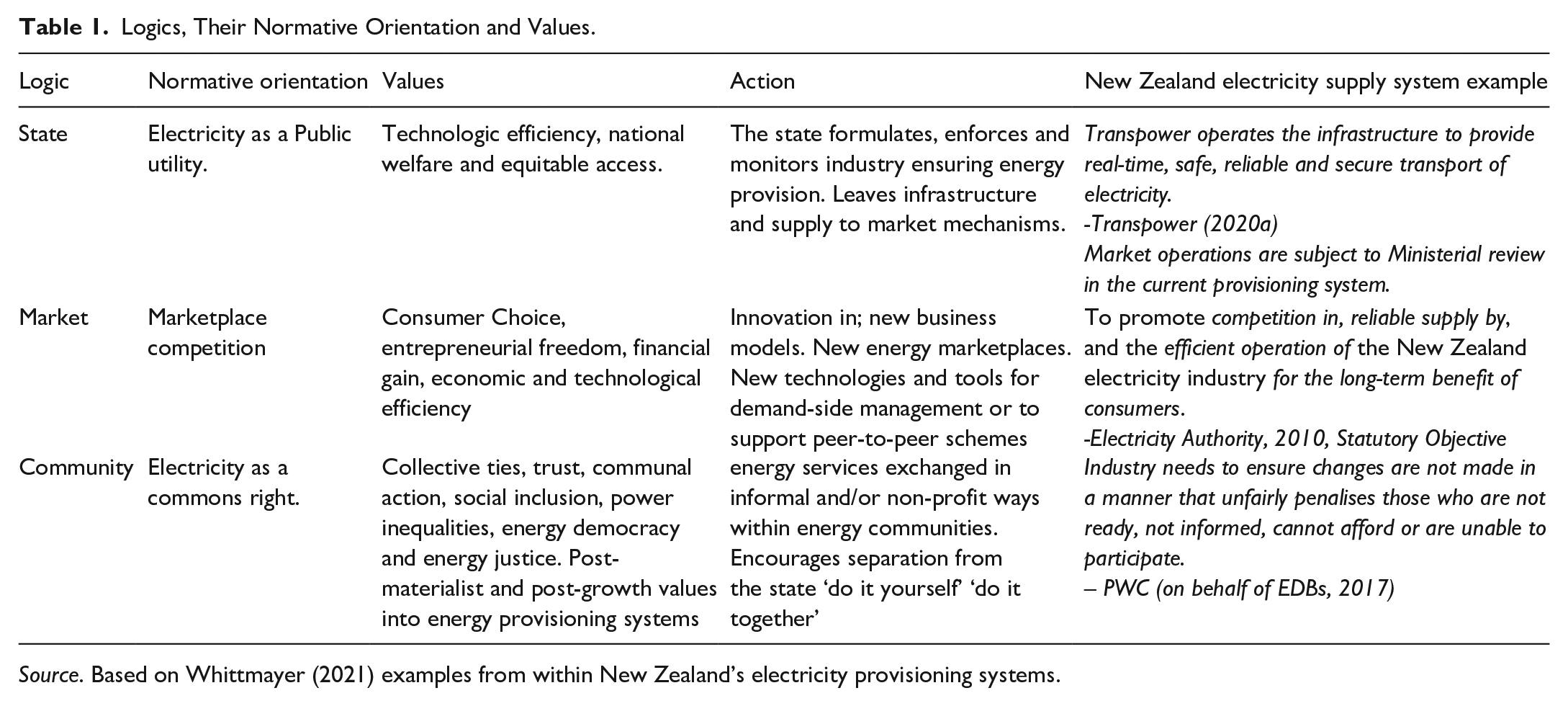
Source. Based on Whittmayer (2021) examples from within New Zealand’s electricity provisioning systems.
Power and power over in transitioning systems
Complex, relational and political, system transitions are inherently subject to manifestations of power, power relations between players and power over (Köhler et al., 2019; Partszch, 2017; Scott, 2007). Foundational work within socio-technical transitions research treats power as instrumental, residing within the incumbent regime and wielded to maintain stability (Geels, 2004; Geels & Shott, 2007). Critiqued as reductive, this instrumental approach contrasts with the expression of power as complex, structural and ideational, as well as visible, hidden and invisible (Lukes, 2005; Scott, 2007). For Lukes (2005) three dimensions of power exist: power as behavioural decision making; power as non-behaviour, exhibited by the exclusion of issues from decision making; and power embedded in institutional structures, not needing to be exercised to exist. In sum, institutional power emerges within a transitioning system to enable disproportionate influence by the powerful – those with the ability to include or exclude issues, define policy agendas, set rules, control information and use the media to shape public imagination (Avelino, 2017; Avelino & Whittmayer, 2016; Lukes, 2005). Taking a perspective of dispersal of power across multiple actor roles, Scott (2007) distinguishes between power as capacity (power to do something), power as relational (‘power [to act] with’) and dominant power (power over somebody or something). For Avelino (2017), distribution of power is both vertically – spread over meso and micro – and horizontally dispersed. Power becomes defined as the capacity of actors to mobilise resources and institutions to achieve goals, that is, ‘to do something’ . Power is therefore seen at once as relational, agentic and centred on structure (Grin, 2010). For Avelino (2017), power is agentic but constrained by its institutional context. In tracing its evolution from a transition’s perspective, power can be considered agentic but constrained and relational; it facilitates actors to ‘get things done’ within their institutional contexts (Avelino, 2017; Sovacool & Brisbois, 2019).
Partzsch’s (2017) conceptualisation of power with, power to and power over follows from this earlier analysis of instrumental, structural and discursive power (Partzch & Fuchs, 2012). Power to is defined by Partzsch (2017) as the ability to get things done. It depicts power as stratified within the structuralised institutions that directly or indirectly influence decision making. Where power to speaks of agents such as NGOs, and policy entrepreneur’s action on behalf of the interests of others, it contrasts with power with’s relational co-action.
Power with is described as ‘finding common ground among diverse interests, developing shared values and creating collective strength by organising with each other’ (Partzch & Fuchs, 2012, p. 363). It links to deliberative democracy and transformational action taken in concert, whereby individualised goals are subjugated to joint actions, undertaken in the name of the collective, with outcomes relating to the common good. Power with, as used in environmental stewardship, suggests that co-action and positive leadership in the interests of the greater good creates only winners and positive benefits for all in the long term, and therefore does not deal with structural issues such as disempowerment and unequal access. However, as Partzsch and Fuchs (2012) argue, in ignoring structural dimensions, power with cannot act independently from power over.
Power over is described as relational, visible or hidden, with influential actors exerting authority over other system participants, the institutional context, the narrative required to explain transition or system change, and, over the system structure itself. According to Sovacool and Brisbois (2019) power over provides a partial lens for understanding domination, resistance and empowerment in low carbon transitions. Power over in transitioning systems is therefore agentic, relational and constrained but also, hidden, visible and invisible and as such, useful for explaining the complexity of interactions between market and supply system with their multiple institutional logics, norms and values. Power over is manifested through four dimensions displayed below in Table 2 below.
Partzsch’s Four Dimensions of Power Over.
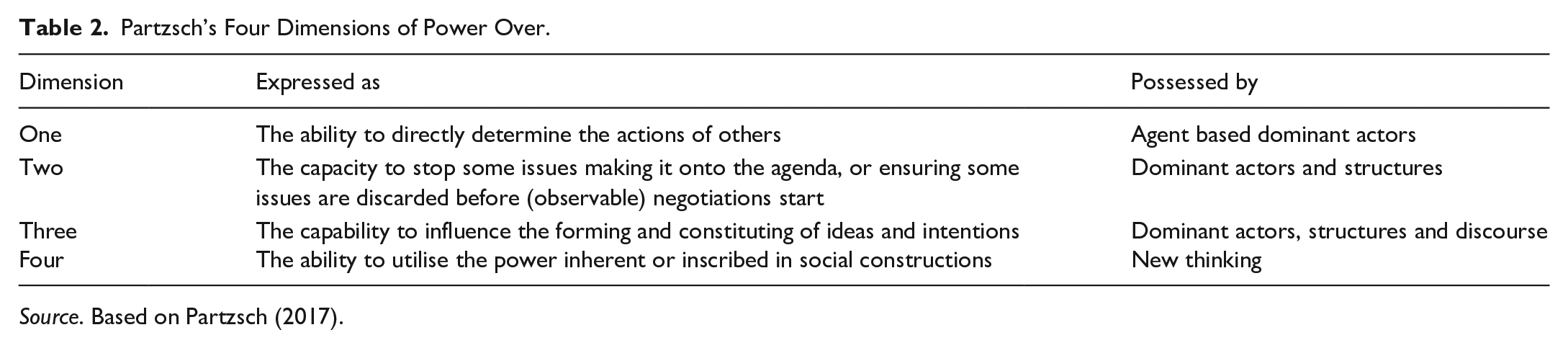
Source. Based on Partzsch (2017).
Aoteoroa New Zealand’s electricity provisioning system
New Zealand’s electricity supply is a long-term, infrastructure-based provisioning system, offering the potential for in-depth, nuanced research into long-term path dependency, stability and change (Layton & Duffy, 2018). Constructed as a public utility throughout the early and mid-20th century by the state, in 1996 state logics were replaced by market logics in a watershed change. The provisioning system was transformed from authoritarian state control into a competitive market system, and supply and market exchange were separated into discrete system functions. The current system offers an opportunity for observing the ‘in between’, the tensions arising at the nexus of prescriptive supply and market system (Miller & Page, 2007). This research project focuses attention on these tensions, at a time of advanced technological and environmental change when the appropriateness of the current structure and design of the electricity markets (and therefore the marketing systems in use) for transforming the country into a fully decarbonised economy is being questioned (Davis, 2023).
The current provisioning system is shown in a disaggregated form in Figure 1 below. The system is separated into the macro, meso and micro layers. On the vertical axis, power flows move one way only – from macro (Government agency) to meso (regulators, market and supply incumbents) and down to the micro level, with communities, households and industry having little to no means of actively influencing the provisioning system. Because the focus of the research is on provisioning rather than market exchange or the creation of assortments, Layton and Domegan’s (2021) focus on exchange assortments (horizontal axis) is replaced by logics – market and hybrid logics – in Figure 1. Community logics in Figure 2 and hybrid logics in Figure 3.
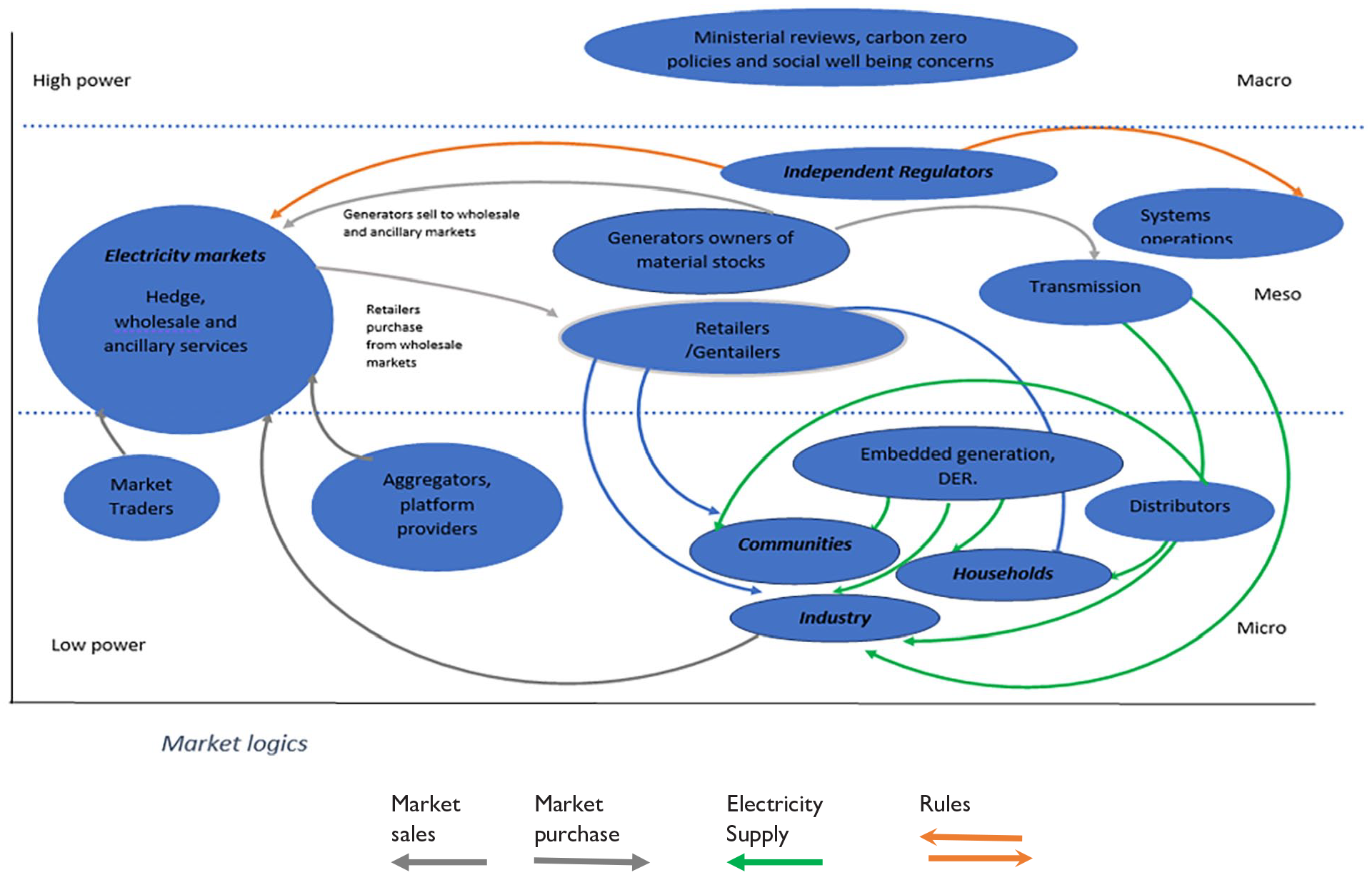
Electricity provisioning system in the current market era.
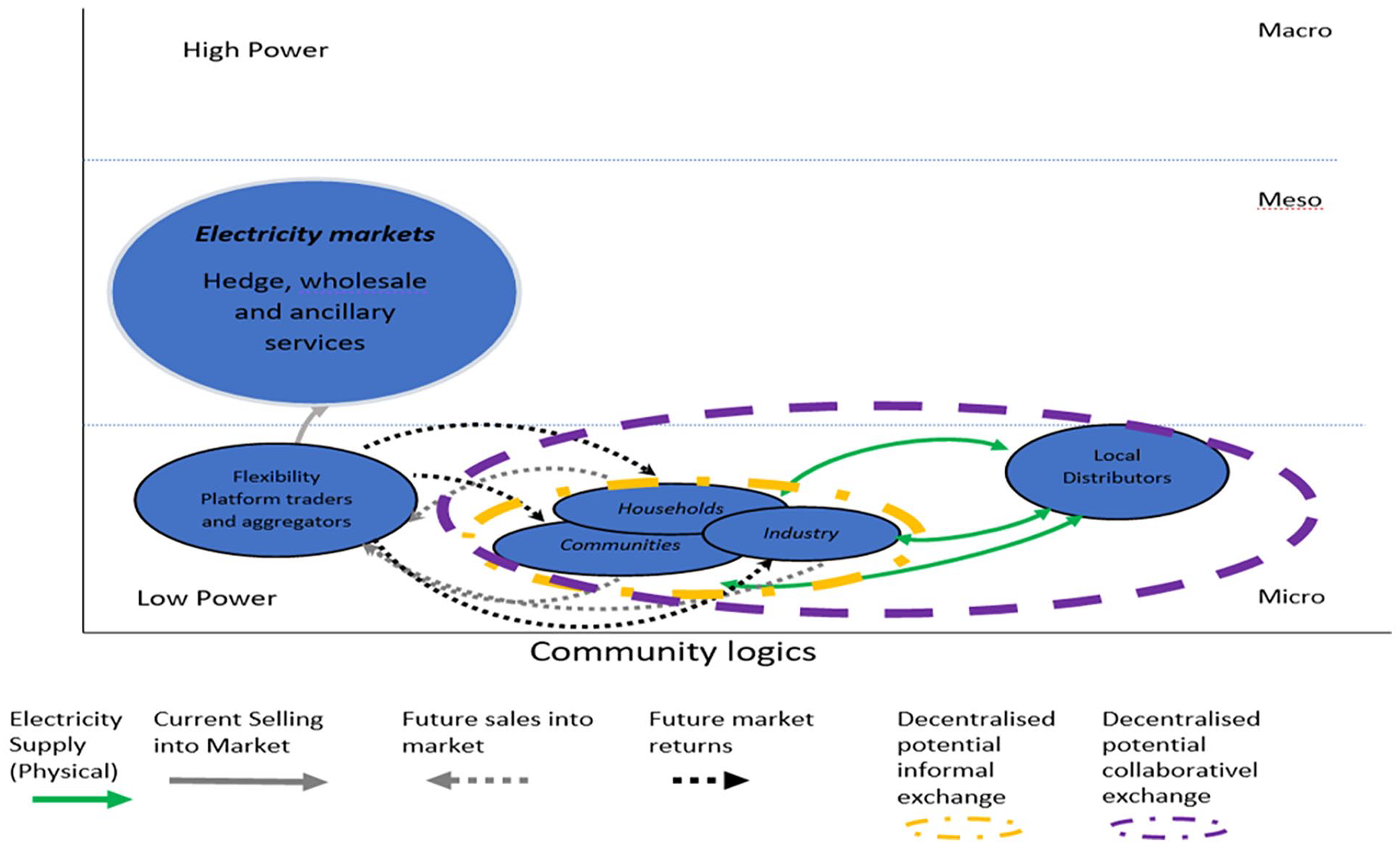
Adaptation to nascent distributed energy resources, potential future electricity generation and market participation.
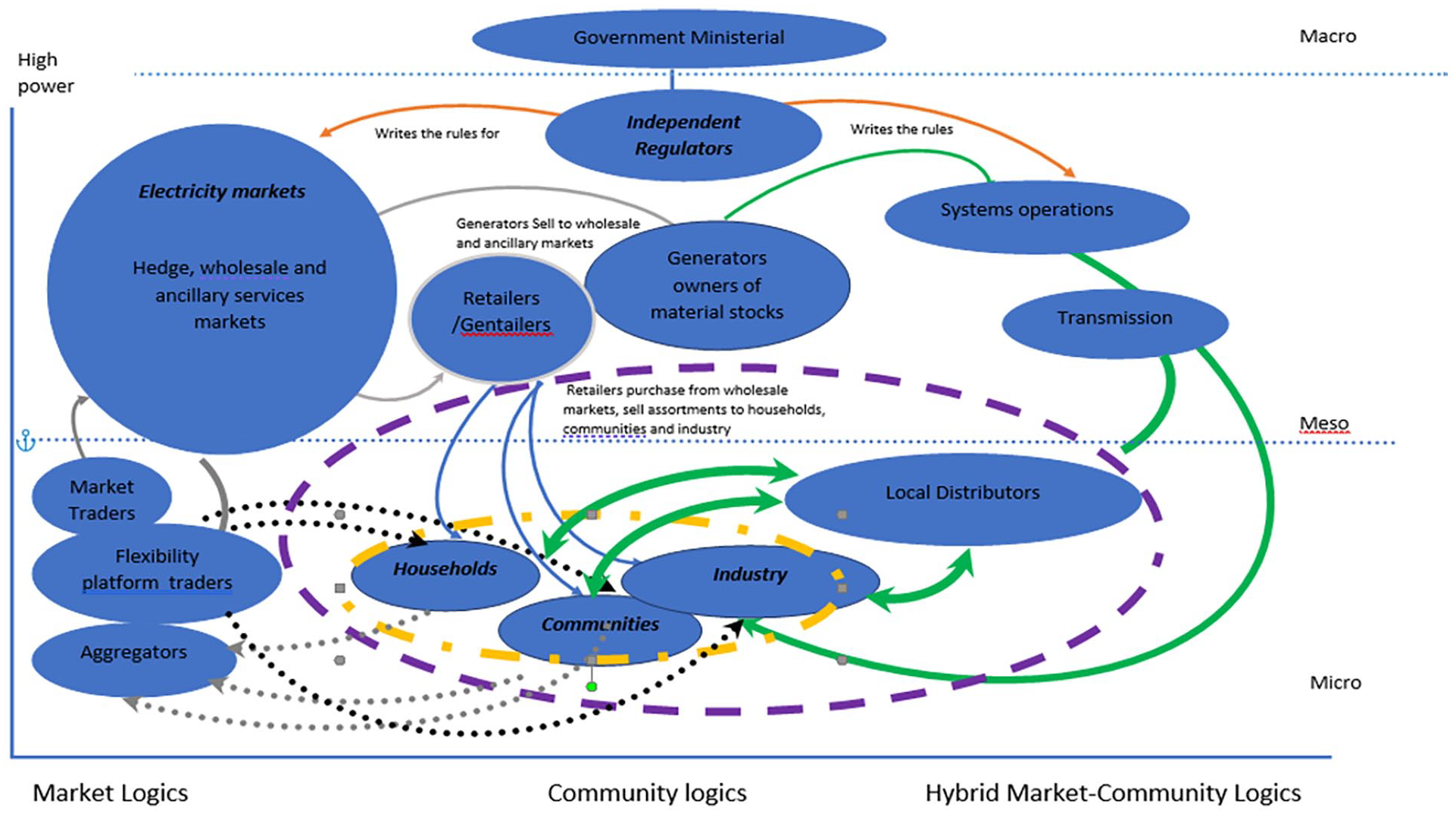
Current and future electricity provisioning system.
The additional elements incorporated into the system resulting from future participant access to DER are shown in Figure 2. These changes span both the micro and meso levels, including the potential for a scaled up collaborative supply, whereby communities, industry and households supply themselves and then feed excess generation into local redistribution. Householders, communities and industry are most likely to outsource the market exchange functions to new participants, flexibility traders. These aggregators combine the additional resources from micro level participants and on-sell through formal market exchange processes. The broken line in the model indicates that this aspect is still in the emergent phase with currently only limited numbers of commercially operating flexibility traders. The potential for informal market exchange is shown as a yellow broken line. This may occur in situations where neighbours choose to share resources, for example, one neighbour offering another the chance to ‘plug in’ and charge a battery, or in situations where access to surplus generation is made available from a central point by a community service. While it remains a possibility, informal market exchange offered at a scale that impacts the provisioning system beyond ad hoc arrangements remains unlikely due to tight industry regulations and obligations around participation in electricity supply.
Combining the existing electricity provisioning system with the additional elements made possible by the emergence of DER, leads to a highly complex system, one which incorporates new embedded generation technologies and more players at the micro level. Communities, households and industries who become prosumers, supply excess generated electricity to distributors and access the market through flexibility traders. Incorporating DER requires both supply and market to move from a single direction central supply and exchange to a two-way exchange and supply through prosumers, aggregators and those trading in flexibility services. To fully incorporate DER into the provisioning system is a major transition, and one that signals a need for significant system adaptation at the meso and micro levels. (Electricity Authority [EA], 2017a; Innovation and Participation Advisory Group [IPAG], 2019).
For the country’s electricity industry, DER represents an additional resource, one that potentially delays expensive infrastructure investment by creating alternative means for peak shaving and ancillary services such as frequency management (IPAG, 2019; Transpower, 2020b). For households, value creation opportunities from DER include decreasing electricity consumption costs and profitably selling low-cost generated electricity into wholesale and ancillary markets, while prosumer markets enable the trade of ‘locally’ produced renewable energy (IPAG, 2019; Mandow, 2020; Transpower, 2020b). The 2017 Enabling Mass Participation consultation project represents an early and significant attempt by one regulator, the EA, to canvas industry input into supportive regulatory environments for DER. It illustrates both the regulator’s attempt at developing a rigorous institutional context and an institutional context that influences the regulator’s attempts to develop the provisioning system.
Conceptualisation
By bringing the concept of provisioning systems, and the social mechanisms of values, logics and power over together, this paper discusses the incorporation of DER as an early step in the decarbonisation of New Zealand’s electricity provisioning systems. In examining the system from its provisioning system elements of the state, community, households, markets and technologies, Fanning et al. (2020) suggests that the provisioning of goods and services differs across each of these institutions in terms of their underlying values and principles, how provisioning is financed and regulated, and which institutions dominate provisioning (Powell, 2019 cited in Fanning et al., 2020). Marketing systems perspectives echo Fanning et al. (2020), with Layton and Domegan (2021) suggesting that power, differing values and multiple logics co-exist and create sources of tension. Using provisioning system’s institutional elements, a more detailed understanding of both the source of those tensions and their influence on the transitioning supply system is sought. RQ1 therefore seeks to provide an in-depth understanding of the tensions caused by multiple logics co-existing within the provisioning system as follows:
RQ1: What is the role of co-existing market and hybridised community-market logics in creating tensions within a provisioning system?
In addition to the existence of multiple logics, one needs to consider the influence of systemic power, in particular, power over as held by the regulator, the EA. The EA, with its overall responsibility for the electricity industry develops the regulatory context and, with its market logics aims to maximise competition, efficiency and technological innovation within the system. Regulator power over is therefore expected to moderate the influence of community and hybrid logics on the transitioning system. The second research question therefore aims to investigate both the influence of the regulator’s power over on the transition, and the influence of multiple logics on the regulator’s use of power over. It is specified as RQ2:
RQ2: What impact does the EA’s use of power over have on the provisioning system’s transition to incorporating DER?
Methodology
Adopting a case study methodology, this study uses thematic analysis to fully examine the EA’s 2017 consultation project, Enabling Mass Participation. The project considers three key aspects: reliability of electricity supply; the creation of fully competitive supply and market systems; and the efficiency of these systems. For the EA, Enabling Mass Participation represents a critical consultation project in analysing potential transition pathways for DER.
Case study methodologies are widely used in business research and rich, single cases are considered appropriate, if somewhat under-used, for exploratory studies such as this (Beverland & Lindgreen, 2010). Case studies are particularly useful for exploring relationships between streams of research, such as, work on logics and power over within institutions, or uncovering interactions between marketing and provisioning systems. (Ellinger et al., 2005; Renton & Simmonds, 2019; Simmonds et al., 2021). This study requires a case rich in information, one that surfaces tensions existing within the provisioning system, highlights these tensions in action, and enables in-depth exploration of these tensions during system adaptation. As such, a single case study approach was chosen to provide the richness of detail required (Beverland & Lindgreen, 2010). The case study includes the EA’s complete Enabling Mass Participation project documents and responses and has canvassed industry input relating to power and logics in a transitioning context. By allowing in-depth reporting of existing tensions, the case study is therefore appropriately rich, detailed and complete, yet bounded. As with all exploratory research this approach has limitations. However, its major advantage is to offer an in-depth exploration of the phenomena of interest in a delimited and discrete project setting. A case study is therefore an appropriate methodology to use to meet the paper’s goals. The research does not aim to produce generalisable findings, but rather to explore the emerging frameworks of provisioning systems and the role of nested marketing systems, logics and power in creating tensions within.
Analysis
The case data include the EA’s (2017) initial Enabling Mass Participation consultation paper, the complete set of 39 response submissions, the final decision paper issued by the regulator in November 2017, and subsequent advice given by the regulator to its Innovation Advisory Participants Group (IPAG, 2019). This rich single project offers 42 written texts of many hundreds of pages and canvases the views of all parts of the industry on the direction of a significant transition at a specific point in time. By allowing a snapshot in time analysis from within the transitioning provisioning system, the case study combines the project documents and responses with secondary research and the input of an industry expert, thereby creating both robust and valid case study data. The data were sourced, collected and categorised in late 2021 and thematically analysed using NVivo software in 2022. The initial textual analysis kept within the bounds of the project’s context, so that in the first stage, the submission responses were coded by the first author as they related to the EA’s aims, for example, themes were coded to reliability, competition and efficiency, peer to peer structures and so on. These broad themes were then disaggregated to those of the regulator, market system participants (gentailers, retailers, generators and innovators) and members of the supply system (distributors/network operators). Following disaggregation, data were coded again by the first author into second order themes, such as reliability as a tradeable product attribute, reliability as a statutory objective and reliability and customer service. Once second stage coding was complete, advice was sought from an industry expert who contributed their expertise to the coding process by discussing, and at times challenging, the second order themes. When complete agreement was reached, the third and final round of coding was undertaken in light of the relationships uncovered in the first and second stages. Third rounds of coding focused on the paper’s two research questions, uncovering interactions between provisioning and marketing systems, logics and power over. These final themes were discussed with the second author and the industry expert involved in the second stage of coding and it is these final themes that are reported here.
Findings
The EA’s purpose
The EA’s statutory objective, ‘to promote competition in, reliable supply by, and efficient operation of the electricity industry for the long-term benefit of consumers’ (EA, 2017a, p. ii) underpinned the Enabling Mass Participation consultation project. In canvassing input into transitioning ‘a decades-old electricity supply model with large-scale and specialised electricity businesses’ (EA, 2017a, p. i) into a two-way supply and market system incorporating DER, the EA declared its interest in market-based values. It sought to pursue greater competition, and the logics of economic and technical efficiency through harnessing DER for the national provisioning system. In positioning emerging DER with market logics as offering ‘mass’ participation in the electricity industry, promoting competition and delivering long-term consumer choices of supplier and type of service, the EA indicated DER’s significant benefits for personalising electricity supply in terms of reliability and security of supply. However, cognisant that these benefits would come at the greater cost of managing two-way supply in the transmission and distribution networks, the EA’s project prompted discussion of changes required within the generation, supply and market systems. Analysis of the consultation documents and participant feedback identifies multiple logics, values and actions that span both the supply and market systems. These findings suggest that varying logics and values embedded within the provisioning system, shape the ongoing transition to DER and dual supply and trading.
Hybrid market-community logics the distribution companies
While post-materialist and post-growth normative orientations were not evident in the submissions made by distribution network operators, community-based logics such as building collective ties and the social inclusion of all consumers, were clearly articulated within distribution operator submissions. Stressing the risk of being locked out from the benefits of DER, Unison (2017) commented on the very real possibility of excluding groups of customers from reliable, affordable electricity supply, including the very vulnerable; ‘those who have low incomes, low qualifications, are living in rented accommodation, or who are above 65’ with Vector (2017) asserting that these consumers were less likely to engage in domestic retail energy markets. Highlighting social inclusion in moving toward distributed energy resources, the joint submission made on behalf of the distribution networks argued for ‘changes not made in a manner that unfairly penalises those who are not ready, not informed, cannot afford or are unable to participate.’ (PWC Group, 2017).
The consultation project specifically invited comments regarding the effects of mass participation on competition, reliability and efficiency. The theme of reliability was repeatedly discussed, connecting closely to distributor logics of serving communities and customers; for example, ‘ENA members’ principle concern is reliability and security of supply for consumers (Electricity Networks Association, 2017) and “reliable electricity supply will remain in sharp focus”’. (Powerco, 2017). For Orion at least, the core purpose remained unchanged – ‘to serve our community by providing a reliable supply’ (Orion, 2017). Competition and efficiency did emerge as themes for the network operators, their hybridised logics married social inclusion and service to all members of the community with competition and efficiency gains. ‘Emerging technology will allow us to use our network more intensely, improve our operating efficiency and reliability and offer an expanded service range to customers. (PowerCo, 2017). For Orion, DER resources become “a platform for competition to meet customers’ needs”’ (Orion, 2017). Market logics of competition and efficiency, rather than being an end in themselves, became the means through which distributors could better meet community needs through ensuring greater reliability of supply. (PWC Group, 2017).
Market logics generation, gentail and retail submissions
The market driven generators, retail and gentail businesses, view emerging DER as creating customer choice, industry efficiency, technological progress and financial gain. Large incumbents, operating as generators, retailers and gentailers support the EA’s quest to create competition in the monopolised distribution network. For Meridian (2017) ‘As new technologies become increasingly pervasive, there should be opportunities for third parties to provide aspects of the network service’. Meanwhile Mercury (2017) agreed ‘with the Authority’s view that monopoly providers have a privileged position. Distributors in particular. . . .’ while for Contact Energy (2017), ‘There must be a level playing field for participants in network and wholesale markets where the dynamics of competition thrive.’ For the retail industry association, ERANZ, the distribution companies stymied the development of DER by ‘undercutting competitive dynamics, distorting and dominating the marketplace’ (Electricity Retailers Association of New Zealand [ERANZ], 2017). Full competition therefore requires, at a minimum, open and equal access to the network for service provision, if not the ‘structural breaking up of the monopoly services’ (Genesis, 2017).
For these incumbents, transitioning to DER creates an opportunity for expanded use of market logics within the provisioning system, full and open market access, greater competition in all parts of the business and better efficiency within the supply system. Regardless of the submission’s context and progress towards DER, creating full competition within the distribution network was the key change required in the provisioning system for many incumbents. Contact Energy (2017) explained this as the result of the; ‘ownership and control of assets no longer being necessary to support network reliability’, allowing for new actors, diverse sets of network solutions, rapid adoption and change out of new technologies, with ultimately, a material impact on the efficiency of network investment (Contact Energy, 2017; Mercury, 2017). For these participants, transitioning the supply system to incorporate DER becomes a secondary concern to the overall restructuring of the provisioning system.
Innovator submissions
A third group within the industry, the innovators, including new retailers, software service and data management providers. These newer participants oriented toward market logics, fully competitive markets, innovation in business models and energy marketplaces. New technologies and tools for demand-side management support the use of peer-to-peer schemes and redesigned business models.
In creating reliability, competition and efficiency, incorporating DER became for some, both necessary and relatively straightforward: ‘Clean data, and clear price signals, both in the forward markets and for network pricing are the only pieces of the puzzle that are missing’ (Emh Trade, 2017), required only the standardisation of services and contracts (Cortexo, 2017) and the need for transparency of information (Metrix, 2017). Most starkly though, reliability was viewed by a small number of innovators as no longer necessary, a false community logic, no longer needed in terms of the EA’s statutory objective, but rather a fully tradeable attribute of an open electricity market: ‘Reliability means different things to different people. Whereas an EDB considers security of supply as sacrosanct, innovation may mean end users accept lower grid reliability if combined with their own generation/storage, thus creating innovative pricing options (and more participation)’ (Cortexo, 2017) and ‘prosumers of the future may see reliability as a performance attribute that they are prepared to trade or rank lower than other attributes, such as price or cost of supply, or reliability ‘signals’ that they may choose to accommodate’ (Flick Energy, 2017). For Flick and Cortexo, reliability as an attribute of commodified electricity supply, should necessarily decouple from hybrid market-community logics, and be subject to fully competitive pressures and market efficiencies. Figure 4 below shows the contrasting logics existing within the provisioning system including those of future prosumers.
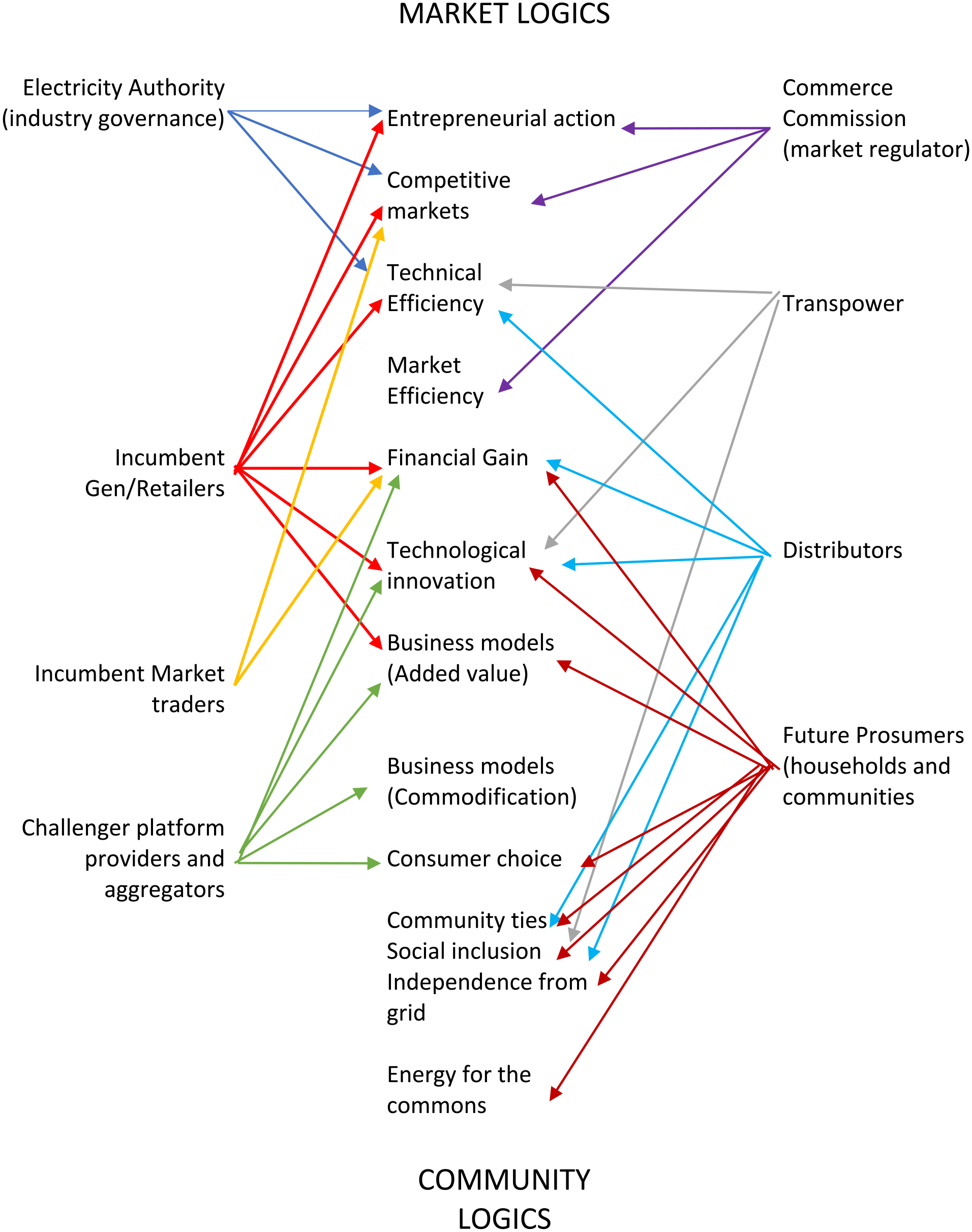
Institutional logics evident within the consultation project.
Contrasts exist between the logics and values of the network operators, large incumbents and innovators. For distribution network operators, tensions arose because of the competitive and efficiency driven values of the market, which left out social inclusion and community ties. These tensions were somewhat spurred on by the regulator’s language, in which distributors had a privileged position through which ‘they [potentially could] undertake activities to limit opportunities for others, or otherwise reduce efficiency’ (Unison, 2017). In response, distributors found ‘the discussion pejorative, unhelpful in facilitating a meaningful discussion and narrow in its scope (e.g. by not recognising the constraint provided by competition law on anti-competitive behaviour)’ (Orion, 2017) leading to calls for the adoption of a more ‘collaborative and co-operative approach between and across the industry in the early stages of the transition’ (PWC Group, 2017). Additionally, while incumbents called for a restructure of the monopoly network sector, network distributors resisted this pressure as outside the EA’s regulatory domain which required input from the dual regulator. Finally, tensions resulted from the innovator’s view of reliability as a completely tradeable attribute, a position misaligned with distributor’s values of social inclusion. Tensions within the provisioning system were therefore evident between the groups. How these went on to impact the transition to DER is best understood by considering the nature of regulator’s power over.
Power over and the impact of community and hybrid logics on its use
Dimension 1: The ability to directly determine the actions of others
For the EA, the consultation document was issued in the belief of its own authority to determine the regulatory context within which the electricity provisioning system evolved: ‘We want to make sure that the uptake of both technology and innovation in the electricity industry are not blocked’ (EA, 2017a). However, network operators outwardly questioned the EA’s role and focussed their efforts on examining the EA’s position; ‘we note that some of the topics raised in the consultation paper overlap with other regulatory jurisdictions and decisions’ (Powerco, 2017) and ‘Unison supports the ENA’s submission that structural regulation is appropriately the domain of MBIE and should be considered by policymakers, rather than the Authority’ (Unison, 2017). Seen as overreaching the bounds of its authority, the EA made what was perceived as misplaced criticism of other statutory bodies (Vector, 2017): ‘Parts of both the Electricity and Commerce Acts were written for the purpose of EDB restraint. If issues relating to whether these arrangements work, or that natural monopoly characteristics no longer hold, then that is a discussion to have at policy level’ (Aurora Energy, 2017).
General support for the EA’s position existed among the generator, retail and gentail incumbents as well as the innovators, with the EA having a mandate to resolve suboptimal system outcomes for the industry (Contact Energy, 2017). Questions arose regarding where the limits of the EA’s authority lay, such as, ‘The suggestion of ring fencing has been raised in the context of the recent Commerce Commission’s Input Methodology review. We would be interested to understand whether the Authority considers it may have powers to enact such arrangements’ (Mercury, 2017). Largely, these incumbents saw the EA’s power as constrained by the broader regulatory context of the provisioning system, ‘that the Authority on its own cannot fully address issues and needs to engage with “the [Commerce] Commission and MBIE on the sectors next steps necessary to truly level the competitive playing field”’ (Genesis, 2017; Meridian, 2017). For this group, the EA faced constraints in its ability to impact the industry. Like the distribution network operators, the group viewed provisioning system power as dispersed between the EA and the Commerce Commission, with ultimate oversight belonging to the Ministry of Business, Innovation and Employment (Ministry of Business Innovation and Employment [MBIE], 2021).
Dimension 2: The capacity to stop some issues making it onto the agenda, or ensuring some issues are discarded before (observable) negotiations start
The gaps in the EA’s agenda as evidenced by the structure of the consultation document were questioned by submitters from every part of the provisioning system. For the distributors, the limited conceptualisation surrounding the future of mass participation was of concern. The EA was seen to be ‘Jumping to options before firmly establishing the problem that may, or may not, need to be solved’ (Aurora Energy, 2017). Similarly concerning was the lack of potential consumer engagement in DER; ‘The majority of consumers are still ‘energy content’ and ‘unlikely to uptake new opportunities that they perceive will involve more active involvement in their energy management unless the benefits are clear and accessible’ (PWC Group, 2017). However, the absence of the dual regulator from the consultation process caused the greatest questioning of power over – ‘a considered and coherent approach to regulatory reform will be efficient if made in conjunction with other regulatory bodies’ (PowerCo, 2017).
For the generator, gentail and retail sector only one issue stood out as critical: structural separation of the monopoly businesses. However, with the absence of the dual regulator this issue remained off the table, limiting the consultation project’s overall usefulness: ‘We do emphasise, however, that in focusing on the minutiae of particular features of the electricity system, the Authority may miss an opportunity to meet its statutory objective through more fundamental structural changes’ (Contact Energy, 2017) and ‘while there may be many complex ways to tinker with existing frameworks, Genesis believes that the best outcome for consumers will only ever be truly served through the mandatory structural separation of electricity distribution businesses (EDBs)’ (Genesis, 2017). The creation of the consultation document by the EA, which left out both dual regulator and systems restructure, was seen, as an attempt by the EA to wield power over in shaping the discussion of DER to its own agenda. However, the industry response indicated that the EA’s power over is constrained.
Dimension 3: The capability to influence the forming and constituting of ideas and intentions
In terms of dimension three of power over, through the shaping of the discourse around incorporating DER, the EA’s market logics clearly articulated its position as at odds within the current system structure. Monopoly businesses constrained the full development of a competitive regulatory context for the transition to DER; ‘Monopoly infrastructure providers . . .privileged position means it is important that [they] avoid using their dominant position to discourage or distort competition in markets for electricity services’ (EA, 2017a). These structures led to what is, in the EA’s view, the major impediment to mass participation, the lack of fully competitive open access to the distribution network and its service provision. For the network providers, the shaping of the issue as a problem of their ‘privileged position’ drew ire, and resulted in questioning of other anti-competitive behaviour in the market system; ‘but we do note the “privileged position” of the large-scale, vertically integrated generator-retailers and their potential to impact competitive outcomes in the electricity spot market and market for financial products (e.g. hedges)’ (Unison, 2017). Many distributor submissions disputed the EAs position; ‘there should be no presumption that innovation is inherently less valuable because it originates from a distributor, or that distributors will prevent integration of innovation by others where it is in the long-term interests of consumers’ (Orion, 2017). On the other hand, incumbent retailers and generators agreed with the EA’s position ‘that monopoly providers have a privileged position. Distributors in particular. . . .’ (Mercury, 2017) and ‘choice is threatened by monopoly network owners who, as the consultation paper describes, are in a ‘privileged position’ of control over the network. They can dictate what technology can connect to their network – likely favouring self-provision. . .’ (Genesis, 2017). While the EA positioned the discourse as an industry-centric issue, problematised by the split between monopoly suppliers and competitive market players, for the distributors, the EA’s ‘simplistic views’ were not representative of the development of mass participation; ‘What is clear though is that the distribution network will play a significant role in facilitating increased participation’ (Wellington Electricity, 2017).
Dimension 4: The ability to utilise the power inherent or inscribed in social constructions
Evidence of Dimension four, the ability to utilise the power inherent or inscribed in social constructions, was evident most strongly in the EA’s formation of the Innovation Participation Advisory Group (IPAG) following the consultation project. The IPAG was tasked with ‘ensuring parties wanting to use electricity networks are treated equally and can compete on an equal playing field’. For the EA, ‘there is not confidence that all distributors provide open or equal access [to the network], and, that open or equal access and distribution pricing are the main barriers to promoting more competition’ (EA, 2017b). Having formed and appointed the IPAG members, the EA used this advisory group to set about developing an institutional context that mirrors their own market logics.
Discussion
The paper sets out to answer two questions: firstly, what is the role of co-existing market and hybridised community-market logics in creating tensions within a provisioning system? and secondly, what impact does the EA’s use of power over have on the provisioning system’s transition?
The case study focuses on differing logics and values to understand the tensions created at Layton and Domegan’s (2021) nexus between market and prescriptive supply. The paper’s first research contribution, therefore, is to explore co-existing values and logics as they appear in the project submissions, and thereby provide more depth to the depiction of tensions resulting from these. In answering RQ1, evidence of market and hybrid community-market logics and values were found and as seen throughout the consultation project’s discussions, formed the basis for further entrenching opposed positions (Johanson & Waldorf, 2017; Thornton et al., 2012; Whittmayer, 2021). Incumbent market players focused on restructuring the entire provisioning system, a position to which incumbent distributors took umbrage. The EA’s suggestion that distributors had unfair privilege is met with ire, and in response, distributors drew attention to the fact that the regulator was acting without an industry-wide mandate. Clearly, co-existing market and hybridised community-market logics became a source of tension between supply and market incumbents. This consultation project analysis confirms the existence of Layton and Domegan’s (2021) proposed tensions. System challengers – the innovators – go further than market incumbents. Intent on deepening market values by creating new business models, their logics threaten to overturn the basis of the provisioning system. These multiple values and logics entrench differences between market and supply incumbents and distract from transition aims. The real cost of these multiple values and logics is that the consultation discussion extends well beyond the EA’s purported objectives of introducing DER. In doing so, a single system-wide objective of transitioning to DER fails to emerge. As adaptation and change stall, opposing positions cement in, and system-wide movement towards DER halts even as transition benefits were acknowledged by both market and supply side participants.
In view of these tensions, the dominant industry actor, the regulator, using its power over (Partzsch, 2017; Scott, 2007; Sovacool & Brisbois, 2019) could be expected to set the transition’s direction. The second of our research questions examines the impacts of the EA’s use of power over on the provisioning system’s transition.
With its agenda positioning the current supply structures as constraining competition, the EA actively sought to align the incorporation of DER with market logics, aiming to facilitate greater competition on the supply side of the provisioning system. The EA’s beliefs in its own power over were visible as it manifested the four dimensions. However, pushback from distributors (the EA is overstepping its boundaries) and market led participants (pointing to the limits of the EA’s authority) ultimately undermine the EAs power over in its attempts to determine the transition’s direction. Calls made from market side for better collaboration and co-operation between industry participants suggest that for them, the EA’s adopted position of power over, would be better configured as mutually dependent co-operative power between the dual regulators or power with. However, as Partzsch and Fuchs (2012) argue, power with cannot act independently from power over because of the structural inequities existing within the provisioning system. That being the case, the institutional structure of the provisioning system and the EA’s role within it, more clearly evidenced a form of constrained power, a diffusion of power over dispersed between two regulators and a government agency (Avelino, 2017; Avelino & Whittmayer, 2016; Partzsch, 2017; Scott, 2007; Sovacool & Brisbois, 2019). In this case, the system-wide resistance to the dominant player’s manifestation of power over negates the EA’s ability ‘to do something’ (Scott, 2007) despite the EA’s certainty of its own position. However as neither the second regulator or the Government agency took part in the project, the direction of power flows remains unconfirmed.
The second contribution of this research, is to provide insight into the workings of power over within a specific, path dependent, complex provisioning system in which power is dispersed between two regulators and a crown agency. This dispersal of power combined with the complexity of varying logics and values within the system leads, to a state of stalemate and limited progress. No singular institutional element of regulator, market, household or community initiated any meaningful change without input from the broader provisioning system, a key difference from pre-market state-sanctioned power underpinned by public utility logics. The regulator’s market logics bought with it a focus on competition and efficiency, but dispersal of power over means change and adaptation within the system remains subject to political will and the broader state, community and hybrid logics in existence. The discussion of power highlights the important role of politics, logics and values within provisioning systems transitions (Köhler et al., 2019; Partzsch, 2017).
Practical implications
It is worth noting that in 2023, 6 years after the consultation project, consumers can and do trade DER generated electricity at the distribution level and the infrastructure required to physically distribute locally generated power remains owned and operated by distribution networks providers. However, the growth of a large market for trading DER resources and the presence of new system actors in the form of innovators, aggregators and flexibility traders remains nascent. The regulator’s approach to calculating the value of DER is predicated on sufficient uptake by consumers, highlighting network effects and requiring more than small levels of household, consumer and industry participation. Maximising the value of DER for the provisioning system remains a work in progress.
Limitations and future directions
The major limitation of this paper is that it centres on a single, rich case study in one country to explicate complex interactions between differing logics, values and power co-existing in a single transitioning provisioning system. The nature of case study research limits the contributions that can be made to adding depth to existing theory, and these results cannot be generalised more widely on marketing and provisioning systems instances. Future research should offer a broader picture of path dependency in provisioning systems and increase understanding of the interplay between politics and power. In this case, the dual regulation of Aotearoa New Zealand’s electricity provisioning system, while intentional, is unique in comparison to other marketised electricity systems. Comparisons between countries with similar industry structures, such as South and Western Australia, the United Kingdom and Ireland, can provide crucial comparisons to understand how power and politics combine to create change and stability in transitioning provisioning systems.
Footnotes
Declaration of conflicting interests
The author(s) declared no potential conflicts of interest with respect to the research, authorship, and/or publication of this article.
Funding
The author(s) received no financial support for the research, authorship, and/or publication of this article.
