



Abstract
The diagnosis and therapy of Helicobacter pylori infection have undergone major changes based on the use the principles of antimicrobial stewardship and increased availability of susceptibility profiling. H. pylori gastritis now recognized as an infectious disease, as such there is no placebo response allowing outcome to be assessed in relation to the theoretically obtainable cure rate of 100%. The recent recognition of H. pylori as an infectious disease has changed the focus to therapies optimized to reliably achieve high cure rates. Increasing antimicrobial resistance has also led to restriction of clarithromycin, levofloxacin, or metronidazole to susceptibility-based therapies. Covid-19 resulted in the almost universal availability of polymerase chain reaction testing in hospitals which can be repurposed to utilize readily available kits to provide rapid and inexpensive detection of clarithromycin resistance. In the United States, major diagnostic laboratories now offer H. pylori culture and susceptibility testing and American Molecular Laboratories offers next-generation sequencing susceptibility profiling of gastric biopsies or stools for the six commonly used antibiotics without need for endoscopy. Current treatment recommendations include (a) only use therapies that are reliably highly effective locally, (b) always perform a test-of-cure, and (c) use that data to confirm local effectiveness and share the results to inform the community regarding which therapies are effective and which are not. Empiric therapy should be restricted to those proven highly effective locally. The most common choices are 14-day bismuth quadruple therapy and rifabutin triple therapy. Prior guidelines and treatment recommendations should only be used if proven locally highly effective.
Keywords
Introduction
Initially, Helicobacter pylori gastritis was largely considered in relation to its role in peptic ulcer disease, which was then one of the major and most important gastrointestinal diseases. H. pylori treatment studies done for approval by the US Food and Drug Administration (FDA) required the presence of peptic ulcer and were assigned to the Gastroenterology section. As with other ulcer studies, the focus was on healing of ulcers rather than cure of the infection.1,2 A comparator was required because ulcers healed and recurred spontaneously (i.e. a definite placebo response was present). Only during the recent development of the rifabutin triple therapy, Talicia, did the FDA permit H. pylori therapy studies based only on the presence of the infection.3,4 Although a comparator was required, approval did not include the requirement of the optimized regimen. It appears that the FDA is slowly making the transition to dealing with H. pylori as an infectious disease of the gastrointestinal tract.
H. pylori infections are typically lifelong and rarely spontaneously disappear until the gastric mucosa replaced by intestinal metaplasia. There is no placebo response to therapy. With optimized current therapies and adherent patients with susceptible infections, one can reliably achieve ⩾95% cure rates.5–7 The ability to obtain cure rates of nearly 100% and lack of a placebo response obviates the need for a comparator other than the theoretically possible, 100% cured. This differs from the majority of gastrointestinal diseases where the etiology is unknown, cure is not possible, and there is a strong placebo effect that requires that therapies for typical gastroenterology diseases include a comparator and often a placebo as the outcome is often based on a change in symptoms or disease activity scored using a validated scoring instrument. Treatment success is determined by comparison with a poorly performing legacy therapy and often a placebo. Cures are not expected and techniques such as meta-analysis are needed to compare regimens. In contrast, with infectious diseases, cures are expected, there is no placebo response, and outcomes are scored in terms of comparison with the theoretical 100% cure rate. Comparisons are typically restricted to highly successful therapies using tests of noninferiority. We hope that soon both the FDA and Gastroenterology will embrace treatment of H. pylori as an infectious disease and focus on results with susceptible infection using therapies optimized to achieve cure rates near the theoretically possible cure rate of 100%.
Although H. pylori was formally declared an infectious disease in 2015, 8 this change in status has yet to be reflected in treatment recommendations or conduct and analyses of clinical studies. In infectious diseases, antibiotics are never administered to patients known to be resistance to them and additional antibiotics are not added to a therapy with the hope that the infection will be susceptible to at least one of them. 9 Current H. pylori treatment guidelines still deal with H. pylori gastritis as if it were a typical gastroenterology disease such as constipation (i.e. of largely unknown etiology, impossible to cure, treatable but with relative low expectations, and with a high placebo response). 10 This has resulted in a focus on randomized comparative trials where differences in cure rate rather than actual cure rates are considered the most important outcome measure. 9 In reality, most comparative studies compare therapies with the same name (e.g. bismuth quadruple therapy rather than on their actual components) and ignore the differences in details of drug administration that allows factors such as the prevalence of resistance, duration of therapy, and relative potency of the antisecretory drug to greatly influence outcome. An example, in a recent network meta-analysis, the cure rates with most of the clarithromycin triple therapy comparator ranged were clinically unacceptable, ranging from 32% to 92%, with 76% below 85%. 11 Comparative trials also typically do not take antimicrobial resistance or its effects on outcome into account. 9 As such, the results of most clinical trials and meta-analyses fail to provide useful information or to provide material from which to derive meaningful guidance for the management of specific infections in specific patients. As noted above, this problem is a residual of the history of attempting to force an infectious disease into a gastroenterology mold.
The recent rapid increase in the availability of susceptibility testing has taken us the cusp of integrating susceptibility-based H. pylori therapy into our daily practice. We anticipate that practice will rapid evolve to a combination of use of proven locally highly effective empiric therapies and susceptibility-based therapy (Figure 1). 12 The goal of this article is to review the issues involved in the choice of an effective therapy of patients with H. pylori infections and provide specific guidance that will reliably produce high cure rates. We begin with the problem of antimicrobial resistance.

Proposed algorithm for selection of Helicobacter pylori regimen based upon knowledge of the results of empiric first-line therapies, and the results of susceptibility testing.
Emergence of resistance during therapy
The earliest trials to find an effective therapy identified that emergence of antimicrobial resistance during H. pylori therapy as a significant problem (i.e. with ofloxacin 13 ). Emergence of resistance was soon a major problem preventing effective therapy with metronidazole14–16 and, subsequently, with clarithromycin.17,18 This early period was one of experimentation especially omeprazole with the antibiotics amoxicillin, metronidazole/tinidazole, and clarithromycin (reviewed in Axon 19 ). Amoxicillin was noted to enhance the effectiveness of clarithromycin and metronidazole, but the general lack of susceptibility testing before and after therapy prevented recognition that one of its major effects was prevention of emergence of resistance during therapy. The problem of emergence of clarithromycin resistance was evident in the trials of clarithromycin monotherapy.20,21 Clarithromycin plus omeprazole 22 was the subject of an FDA submission that failed largely because of emergency of clarithromycin resistance.2,6,23 A study of clarithromycin and amoxicillin (plus ranitidine for ulcer healing) showed that emergence of resistance was either prevented or greatly reduced by the addition of amoxicillin. 24 The benefit of the addition of amoxicillin was confirmed in clinical trials of clarithromycin plus amoxicillin and omeprazole or lansoprazole, both of which became FDA-approved regimens. 23 This experience eventually resulted in H. pylori triple therapies consisting of an antisecretory drug, amoxicillin, and the second antibiotic such as clarithromycin, metronidazole, levofloxacin, or rifabutin triple therapies.
The importance of understanding the mechanism of treatment failure
While clarithromycin-containing therapy was being developed for FDA approval, others were experimenting with it.19,25 This included an abstract using the triple combination of clarithromycin, amoxicillin, and omeprazole that tested antimicrobial susceptibility only before treatment and reported that the therapy was successful for susceptible infections. 25 In contrast, as shown above, the keys to understanding a therapy include testing susceptibility both before and in treatment failures as was done in the FDA submissions reported above. The general lack of susceptibility testing both before therapy and in the treatment failures has largely been responsible for failure of early development of highly effective regimens. The most common causes of treatment failure include the presence of antimicrobial-resistant organisms, emergence of resistance during treatment, ineffectiveness of antisecretory therapy, improper drug doses or dosing intervals, too short a duration of therapy, and poor patient adherence to therapy. Failure to attempt to identify the cause of treatment failures and to simply to score outcomes by comparison with another therapy has largely been responsible for long delay in identifying uniformly highly effective therapies or being able to improve poorly performing regimens. Low-dose amoxicillin largely eliminated the emergence of resistance during therapy with clarithromycin, metronidazole, and levofloxacin. Whether it also enhanced therapy by acting as an additional antibiotic is unclear, but if so, the contribution was small as shown by examination of outcome using the H. pylori nomogram.26,27 In the presence of clarithromycin resistance, the additional benefit of amoxicillin was shown to be primarily related to the degree of acid suppression that improves the effect on amoxicillin on both the proton pump inhibitor (PPI) or vonoprazan (VPZ) dual therapy component.28,29 As seen in the original VPZ trial, both PPI and VPZ triple therapies achieved 98% cure rates with susceptible infection.28–30
Although clarithromycin is still widely used to treat H. pylori, by 2000 (i.e. more than 20 years ago), increasing resistance resulted in clarithromycin triple therapy becoming generally ineffective.31,32 Despite its poor clinical effectiveness, however, it remains one of the most utilized combinations.33,34 Currently, the prevalence of resistance precludes the use of triple therapy with clarithromycin, fluoroquinolones, or metronidazole except as susceptibility-based therapies. 6
Choice of therapy
A basic rule in the treatment of infectious disease is to prescribe only therapies empirically in which high local effectiveness has been both proven and confirmed. The three approaches to identifying such therapies are antibiotic use history, susceptibility testing, and personal or local experience. Only the results obtained locally are important and national and society guidelines for H. pylori should be ignored unless their recommendations coincide with local experience.
Role of antibiotic use history in antimicrobial selection
Antimicrobial resistance is the main reason for failure of otherwise successful antimicrobial therapies. The present of antibiotic resistance within a population is reflected on the amount of its use within that population.35–44 Fluoroquinolone, macrolide, and metronidazole resistance are now almost universal, whereas resistance remains rare for amoxicillin, tetracycline, rifabutin, and furazolidone. The same principles used to identify resistance in populations are also applicable for individuals making review of each individual’s antimicrobial use history and pharmacy records especially useful for identifying which antibiotics to avoid.35,40,44
These recommendations were initially useful for ensuring successful empiric use of clarithromycin, metronidazole, or fluoroquinolones. The prevalence of resistance to these antibiotics, however, has increased to the point that it is now best to restrict their use to susceptibility-based therapy. Treatment success should be always be confirmed for each individual by a test-of-cure to confirm these drugs remain highly effective (e.g. cure rates of ⩾90%, locally).6,7,45–47
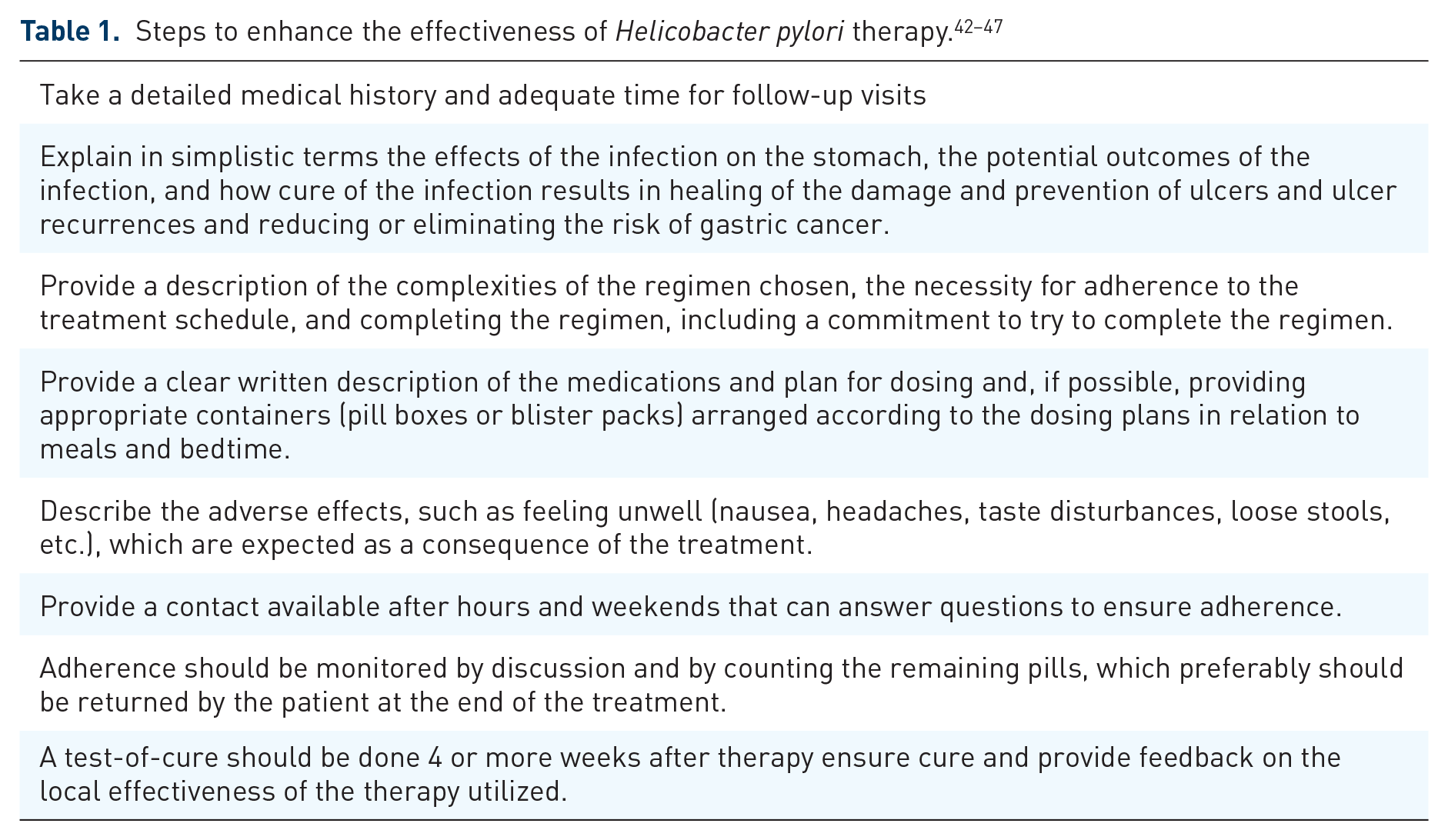
Therapy should also be preceded by a formal patient education/counseling regarding the therapy, potential side effects, and importance of completing the entire course.48–52 Written instructions are particularly helpful. Based in part on the successful program used by Wink de Boer for prescribing bismuth quadruple therapy, 53 we recommend establishing a trust-based doctor–patient relationship as outlined in Table 1.49,53
Test-of-cure
The classic three-step approach to H. pylori therapy is accurate diagnosis of an active infection, therapy, and confirmation of cure. It is critical that each course of therapy be followed by a test-of-cure, preferably using noninvasive testing such as the stool antigen or urea breath test (UBT). To prevent false negative results, care must be taken to follow the recommendations regarding stopping PPIs, antibiotics, and bismuth for an adequate time for testing. The test-of-cure provides direct and immediate feedback regarding outcome and informs clinicians regarding which therapies are successful and which are failing. 40 Ideally, test-of-cure data would also be shared with colleagues to expand the local and regional knowledge base. It retrospect, it is amazing that this simple approach was not immediately recognized as a critical element able to provide immediate and local feedback to clinicians. As such, decades of local treatment failures have been recorded and published as observations rather than as critical opportunities for providing better care.6,7,33,54
Susceptibility testing
With most other infectious diseases, the local susceptibility patterns are known, susceptibility testing is readily available at local laboratories and hospitals, and the data are collected and updated local/regional lists of antibiotic of choice are made available. Susceptibility testing for H. pylori has recently become increasingly available.
In Europe
As noted by Francis Megraud, the Covid-19 epidemic resulted in establishing polymerase chain reaction (PCR) testing in essentially all local hospitals and testing laboratories. In Europe, a variety of inexpensive kits are available for testing gastric biopsies or stools for clarithromycin resistance [e.g. Amplidiag H. pylori + ClariR (Mobidiag; Espoo, Finland), the RIDA GENE Helicobacter pylori assay (R-Biopharm AG, Darmstadt, Germany), H. pylori ClariRes (Ingenetix, Vienna, Austria), Allplex H. pylori, ClariR (Seegene, Seoul, Korea), the Lightmix H. pylori (TIB; Molbiol, Germany), and the H. pylori TaqMan real-time PCR assay (Meridian Bioscience, Cincinnati, Ohio, USA)].55–61 The Genotype HelicoDR assay (Hain Lifescience, Nehren, Germany) has been used for both clarithromycin and levofloxacin resistance of gastric biopsies but proved less effective for levofloxacin testing of stools.62–64 Clinicians should encourage the local hospital/laboratory to incorporate PCR-based susceptibility testing at least for clarithromycin. Culture and susceptibility is also available internationally from Microbiology Specialists Inc (Houston, Texas, USA). Next-generation sequencing (NGS) of stools for six antibiotics (amoxicillin, clarithromycin, metronidazole, tetracycline, rifabutin, and levofloxacin) is also available by post from American Molecular Laboratories (Vernon Hills, Illinois, USA).
The United States
Culture and susceptibility testing for H. pylori is now available in the Unites States from major diagnostic laboratories, including Mayo Clinic Laboratories (HELIS), ARUP laboratories (MC HPYL), Labcorp (180885), and Quest Diagnostics (36994) and from Microbiology Specialists Inc. Molecular susceptibility testing using NGS is available from American Molecular Laboratories that provides resistance testing for six commonly used antibiotics: clarithromycin, amoxicillin, tetracycline, metronidazole, rifabutin, and levofloxacin. Importantly, NGS susceptibility testing is available for gastric biopsies, formalin-fixed gastric biopsies, or stools. The turnaround time for culture and susceptibility testing is about 2 weeks, whereas it is up to 5 working days for NGS.
Recently, Mayo Clinic Laboratories has added molecular testing for clarithromycin resistance as part of its H. pylori stool testing service. With this service, if the stool test is positive, they will do automatic (reflexive) testing for clarithromycin resistance using PCR. It behooves clinicians to query their local laboratories about the possibility of offering reflexive stool susceptibility testing at least for clarithromycin. As noted above, reflexive stool testing using NGS is available from American Molecular Laboratories and is not limited to clarithromycin as it provides NGS results for amoxicillin, clarithromycin, metronidazole, tetracycline, rifabutin, and levofloxacin. Molecular testing of stools is theoretically ideal as it is noninvasive (i.e. endoscopy is not required) and the results are rapidly available. Susceptibility testing takes the guess work out of selection of a patient-specific regimen.
Overcoming barriers to successful therapy
Important barriers preventing effective therapy include the inoculum effect, the persister state, and intragastric acidity. The inoculum effect refers to the fact that the number of H. pylori in the stomach is truly immense such that statistically a small proportion of organisms are likely to be resistant to antimicrobial such as metronidazole, clarithromycin, and fluoroquinolones. 65 As noted above, this was observed clinically as emergence of resistance during therapy with monotherapies with these antibiotics and led to the addition of amoxicillin to reduce the overall population and thus the odds that the low prevalence populations of resistant organisms would survive to prevent effective therapy. Bismuth has a similar effect. Hybrid therapy uses a run-in of PPI plus amoxicillin dual therapy, followed by a 7-day concomitant therapy. In this instance, one can consider the run-in as aiming to reduce the low prevalence populations of clarithromycin- or metronidazole-resistant organisms and thus result in an improved outcome with shorter exposure to multiple antibiotics. The persister effect is largely related to the fact that H. pylori only replicates when the pH in its local environment is approximately 6.65,66 At lower pH, the organism becomes resistant to antibiotics that require replication to be effective such as penicillin. The traditional approach to the persister effect is to prolong the duration of therapy (an example is the treatment of tuberculosis). 67 A basic rule is that if the treatment failed and the organism is not resistant to the antibiotic used, the duration of therapy was insufficient. The ability to reliably control intragastric pH with the new potassium-competitive acid blockers (P-CABs) forms the basis for potential highly successful amoxicillin dual therapy. pH control is also important in preventing destruction of some antibiotics during passage through the stomach. 68
The current choices for effective empiric therapy are bismuth quadruple therapy, amoxicillin dual therapy, rifabutin triple therapy, and furazolidone triple or quadruple therapies. Furazolidone therapy will not be discussed here as furazolidone is no longer widely available. For details of furazolidone therapy, see Mohammad et al., 69 Song et al., 70 and Xie et al. 71
Recommendations for use of empiric therapy
All highly effective H. pylori therapies are susceptibility-based (Tables 2 and 3). The word ‘empirical’ is ‘to be based on, concerned with, or verifiable by observation or experience rather than theory or pure logic’. 72 By definition, empiric therapies should be restricted to those that reliably achieve high cure rates, which in practice implies utilization of only those antibiotics for which the prevalence of resistance is known to be low. With very few exceptions, worldwide this excludes empiric use of clarithromycin, metronidazole, and fluoroquinolones and restricts the choices to tetracycline, amoxicillin, rifabutin, and furazolidone. In addition, as discussed in detail below, metronidazole can be used empirically in bismuth quadruple therapy.
Currently available and effective Helicobacter pylori therapies in the United States.

Source: Table adapted from Lee et al. 73 with permission.
i.d., twice a day; FDA, US Food and Drug Administration; PPI, proton pump inhibitor; q.i.d., four times a day; t.i.d., three times a day.
The FDA recommends fluoroquinolones be used as a last choice because of the risk of serious side effects. 74
Combinations deemed unacceptable because each contains at least one antibiotic not required for effectiveness.

Use and optimization of bismuth quadruple therapy
Traditional bismuth quadruple therapy consists of a PPI, bismuth, metronidazole, and tetracycline. It is a complex but probably the most reliably effective therapy commonly used for H. pylori eradication. The regime is complex in terms of both medications and interpretation of the results of therapy. Treatment success in this era of increasing antimicrobial resistance requires attention to the details of therapy especially in relation to dosage and duration of therapy. Myths, misconceptions, and erroneous conclusions abound regarding bismuth quadruple therapy. 76 One of the issues relates to the effect of resistance on treatment success especially in relation to metronidazole. For example, it has often been suggested that metronidazole resistance as determined in the laboratory has limited or no ability to predict the results of therapy such that there is no reason to do susceptibility testing. This misconception is likely related to the fact that the effects of metronidazole resistance are not all or none and thus differ from what one typically expects with clarithromycin or levofloxacin. Metronidazole susceptible infections are consistently highly effective in optimized therapies.77–79 Although metronidazole resistance does not completely remove the drug for having an effect, metronidazole resistance has been conclusively shown to reduce the effectiveness of metronidazole-containing therapies, including both triple and quadruple formulations.76,78,80–82 To date, the only exception is that metronidazole resistance can be overcome using bismuth quadruple therapy but with the caveat that success is both dose- and duration-dependent (discussed below). 83
The extremely high population of H. pylori in the stomach typically results in the presence of small subpopulations of strains resistant to antibiotics such as clarithromycin, or levofloxacin called the inoculum effect. 65 With metronidazole, the odds of a resistant subpopulation are high as an analysis of multiple gastric samples from a single patient will often demonstrate the presence of both susceptible and resistant strains called hetero-resistance.84–86 Another problem is that the analysis of the claims of clinical studies in relation to resistance is often complicated by the method used to detect metronidazole resistance. For example, the Etest tends to overestimate prevalence of resistance and thus may result in erroneous conclusion regarding effectiveness in resistant infections.87,88 Possibly uniquely, the effects of metronidazole resistance can be partially or almost completely overcome by tailoring therapy in relation to the dosage of metronidazole and the duration of therapy.76,89,90 Increasing the dosage of metronidazole and/or duration of therapy is beneficial for both metronidazole triple and quadruple therapies. 78 Importantly, this benefit occurs with both resistant and susceptible infections.80,81,91,92
Metronidazole resistance is the primary impediment to successful therapy with bismuth quadruple therapy. Resistance to bismuth is vanishingly rare and tetracycline resistance is rare, but when present, resistance adversely affects outcome. 93 As such, and in contrast to metronidazole, it has been suggested that the dosage and frequency of administration of both bismuth and tetracycline may not be the keys to successful therapy. 81 Most often tetracycline is used four times daily (q.i.d.) and bismuth either twice daily (b.i.d.). Results with b.i.d. and q.i.d. administration of tetracycline and bismuth are approximately equivalent. 94 In contrast, experiments with primarily susceptible infections have reported improved outcome and adherence when the frequency of drug administration was increased allowing the individual and total doses to be decreased. 95
Unraveling the claims made in treatment studies with quadruple therapy
Bismuth quadruple therapy is highly effective in adherent patients with metronidazole-susceptible infections. High success rates have been reported with very short duration therapy (i.e. <7 days). 96 In contrast, in the presence of metronidazole resistance, high cure rates require full dosages, longer duration, and a PPI for acid suppression. For example, if the cure rate was 97% with susceptible infections and 65% with resistant infections, the overall cure rate would depend on the proportion with resistance.76,97
Until recently, the results from most studies have been based on data from studies using bismuth quadruple therapy for 14 days. Traditionally, therapy consisted of bismuth, tetracycline 500 mg, metronidazole 400 or 500 mg usually q.i.d., and a PPI given b.i.d. for 14 days. In most countries, including China, this regimen resulted in reliably high cure rates.76,79,90,97–99 Generally, however, this therapy has been less effective in Iran and Turkey. 90 It is unclear why. One possible explanation is related to the fact that in developing countries, it is more common to find drugs with reduced activity, outdated drugs, and even counterfeit drugs. 100 One of the main issues with bismuth quadruple therapy has been the relatively high frequency of side effects. It has been shown that it is possible to reduce the dosage and dosing interval (e.g. to b.i.d.) with the bismuth and tetracycline and thus reduce side effects. As noted previously, maintaining the dose of metronidazole to 1500 to 2000 mg and the duration to 14 days appears to be the critical determinants when dealing with metronidazole-resistant infections91,94,101
For susceptible infections, all drugs can be given b.i.d. It has been suggested that reducing the individual doses of metronidazole while increasing the frequency of administration may also reduce side effects.76,95,102 Studies are needed (i.e. using five administrations/day). The dosages of metronidazole available vary in different regions. For example, in the United States, metronidazole is only available as 250, 500, and 750 mg extended release version. In China, 200 mg tablets are available. It would be interesting to test 200 or 250 mg after meals and 750 or 800 mg at bedtime. There have been studies with 750 mg b.i.d. with good results but with an increase in adverse events. 103
Pylera
Pylera is the commercial name of a three-in-one bismuth, metronidazole, and tetracycline preparation. Pylera has no special properties or formulations. It consists of the same drugs used in generic bismuth quadruple therapy but they are put into capsules. The metronidazole is put in small capsules that are then included within a larger capsule. Pylera was marketed for 10 days to have a marketing advantage over Helicac, which was marketed for 14 days. This was done during the period when the FDA focused on H. pylori in peptic ulcer rather than as an infectious disease. Pylera is often the only form of bismuth quadruple therapy available in Europe and a head-to-head comparison of 10- and 14-day Pylera has not been attempted in patients with metronidazole-resistant infections. For metronidazole-susceptible infections, 5- to 7-day therapy is typically adequate although metronidazole triple therapy would be a better option as it is less complicated and has fewer side effects. 79 Although there have been a number of studies in unknown, but likely low, metronidazole-resistant populations with good results, studies in proven metronidazole-resistant populations suggest that 10-day therapy is insufficient as results with 14-day therapy are better. 98 In the United States, many pharmacies will fill the prescription for 14-day Pylera. In areas where metronidazole resistance is common and only Pylera is available and the local pharmacies will not provide the three-in-one therapy for 14 days, 10-day therapy is often the best available choice. Longer duration twice-a-day Pylera can also be obtained using the current dose pack by giving four caps b.i.d. plus 500 mg of metronidazole at bedtime for 15 days and achieve the full 1500 mg metronidazole dose with 500 mg of tetracycline and 560 mg of bismuth/day. Experiments are needed comparing 10- and 14-day Pylera in metronidazole-resistant strains and how to use it b.i.d. considering that no alternate formulations are available in Europe. The cost in Europe is approximately 100 Euro versus more than $1000 in the United States such that in the United States generic drugs are typically preferred. If the cure rate per protocol of less than 95% is obtained with 10-day therapy, one should consider 14-day therapy. As a general rule, a 90% cure rate is not the goal but is rather the minimally acceptable result. For example, a 6% decrease in cure rate (e.g. from 96% to 90% or from excellent to good results) results in administration of about 3000 kg of unneeded antibiotics/million treatments. The unneeded antibiotics only contribute to global resistance.
Optimization of VPZ-containing therapy
Vonoprazan is P-CAB that has advantages over traditional PPIs as it becomes fully active on day 1 and produces potent acid suppression. VPZ is stable under acidic condition and not affected by the CP2C19 genotype or meals. 104 VPZ was approved for treatment of H. pylori in 2015 in Japan. The pivotal phase III randomized controlled trial (RCT) compared a 7-day triple therapy with amoxicillin and clarithromycin plus the PPI, lansoprazole, or VPZ. In the presence of clarithromycin-susceptible infections, both the PPI and VPZ triple therapies were equivalent with a cure rate of approximately 98%. The cure rates with clarithromycin-resistant infections differ markedly in terms of cure rate: PPI triple therapy = 40% versus VPZ = 80%. In the presence of clarithromycin resistance, the patients effectively receive only a PPI or VPZ plus amoxicillin dual therapy. 30 The cure rates with clarithromycin-resistant infections are PPI triple therapy = 40% versus VPZ = 80%. Thus, the cure rate of 92% would consist of 80% from dual VPZ–amoxicillin therapy and only 12% from VPZ–amoxicillin + clarithromycin (i.e. at most 12% would benefit from receiving clarithromycin). 28 The Japanese H. pylori treatment guideline now recommends replacing PPIs with VPZ for first eradication regimens that results in more than 14,000 kg of unneeded clarithromycin/1 million treatments and contributes to the problem of increasing antimicrobial resistance. Over time, the overall cure rate of VPZ triple therapy has fallen in Japan coincident with increasing clarithromycin resistance and is now below 90% (range = 88–92%). The dictum of the Alliance to Save Our Antibiotics is that no individual, animal, or human should receive unnecessary antibiotics. 105
The overall cure rates with VPZ triple therapy in Japan currently vary between 88% and 92% with the combination of VPZ and amoxicillin dual therapy being responsible for the majority of the success. Currently, there are ongoing efforts to improve the cure rate of VPZ–amoxicillin dual therapy.
PPI–amoxicillin dual therapy
PPI–amoxicillin dual therapy was first introduced in 1998 and has a long history (reviewed in Dore et al. 90 and Graham et al. 106 ). PPI–amoxicillin dual therapy proved to be unreliable for achieving high cure rates in western populations. Recent studies in Asia where CYP2C19 rapid metabolizers are uncommon and gastric acid secretion is generally low due to corpus gastritis, have shown that the combination high dose PPI–amoxicillin can produce cure rates ⩾90%.107–109 The effectiveness of the regimen is sensitive to the total dose of amoxicillin, the frequency of amoxicillin and antisecretory drug administration, and the duration of therapy. Trials with PPI-dual therapy suggested that 3 g of amoxicillin per day, a high potency PPI b.i.d., and duration of 14 days are generally the most effective. In Asia, there have been studies using PPIs b.i.d. or q.i.d. based on Japanese studies of intragastric pH suggest it may be possible to reliably maintain the intragastric pH above 5.110–113 In Asia, PPIs are typically more effective than in the west in part related to low prevalence of CYP2C19 rapid metabolizes, an average lower body and parietal cell mass, and a higher prevalence of corpus gastritis in Asian populations.114,115
Sustaining high intragastric pH
The success achieved in maintaining a sustained high intragastric pH by increasing the frequency of PPI administration in Asia contrasts with the results of western studies where there was no advantage of increasing the frequency of administration above twice a day as increasing the dosage and/or frequency of administration has failed to reliably achieve a sustained intragastric pH ⩾6 as may be desired for the treatment of upper gastrointestinal bleeding. 116 Accurate assessment of intragastric pH is difficult and there are many technical issues such as use of antimony versus glass electrodes, the computer programs used to collect the data using Digitrapper pH-Z or similar collection devices, electrode calibration solutions with antimony electrodes, calibration pH (e.g. 1 and 4 versus 1, 4, and 7), calibration before and after testing, and so on (discussed in detail in the supplement to Graham and Tansel 116 ). Nonetheless, dual PPI–amoxicillin therapy has proven to be generally more effective in Asia than in Europe or the United States. Importantly, in the United States, dual high dose PPI–amoxicillin therapy using 40 mg of esomeprazole and 750 mg of amoxicillin every 8 h for 14 days resulted in unacceptably low cure rate (i.e. 72%)28,117,118 and reliable success independent of geography will likely require use of a more potent long-acting antisecretory agents with rapid onset and effective against nonactive proton pumps such as VPZ.27,68,119–121
VPZ–amoxicillin dual therapy
It is important to note that the Japanese government currently restricts the duration of H. pylori therapies to 7 days. Three recent trials of VPZ–amoxicillin dual therapy have been reported from Japan.122–124 One was a retrospective study using propensity score matching to improve comparability between the two regimen groups, which were dual group with VPZ 20 mg b.i.d. amoxicillin 500 mg three times daily (t.i.d.) (rather than 750 b.i.d. which is currently approved for amoxicillin therapy) for 1 week versus triple therapy with VPZ 20 mg, amoxicillin 750 mg, clarithromycin 200 mg, b.i.d. for 1 week. In the intention-to-treat analysis (ITT), the eradication rate with the dual therapy was 92.9% and not inferior to the triple therapy [92.9%; 95% confidence interval (CI) = 82.7–98.0%) versus (91.9%; 95% CI = 80.4–97.0%, p = 0.728). Importantly, that study showed conclusively that the addition of clarithromycin had no additional benefit. 122 A prospective observational study of junior high school students also indicated noninferiority of VPZ and lower dose amoxicillin dual therapy with VPZ 20 mg b.i.d. plus amoxicillin 750 mg b.i.d. for 7 days. 123 In that study the ITT, eradication rates were 85% (95% CI = 75.8–94.2%) with the dual therapy versus 82% (95% CI = 76.0–87.9%) with the triple therapy. Moreover, the same group performed a prospective, randomized clinical trial using the same regimens. 124 The dual therapy yielded the cure rate of 84.5% and 87.1% in the ITT and per protocol analysis, respectively. The VPZ dual therapy failed to achieve a 90% cure rate but was statistically noninferior to the triple therapy. 124 Together, these data confirm that the addition of clarithromycin to the triple therapy has minimal to no added benefit, which was also confirmed in the US/European trials. 125
Optimal amoxicillin dosage and frequency of administration for dual therapy
Since the introduction of penicillin, there have been disagreements about dosing and frequency of administration partially in response to the presence of microbial dormancy and the persister effect.67,126–128 H. pylori infection is associated with a marked enhancement of the gastric penetration of amoxicillin, as confirmed with a xenograft model of human H. pylori infection. 129 The fact that permeability of the large molecule, sucrose, is also enhanced during H. pylori infection and that enhancement is correlated with the density of the mucosal polymorphonuclear cell infiltration is consistent with the paracellular pathway being the site of increased permeability.130,131 Finally, Kimura et al. previously showed it was possible to cure H. pylori infections in humans with topical therapy consisting of a 1 h instillation of bismuth, amoxicillin, and metronidazole into balloon-occluded stomachs.132,133
The optimal dosage and frequency of administration of amoxicillin remain unclear. The major impediment to effective therapy is the ability to reliably obtain marked acid suppression. In Japan, dual therapy with either VPZ or PPIs has been able to achieve an approximately 93% cure with VPZ 20 mg b.i.d. and 750 mg amoxicillin t.i.d. for 7 days. 122 When 750 mg of amoxicillin was given b.i.d, the cure rate per protocol was 87.1%. 124 In contrast, in the United States and Europe when VPZ was given 20 mg b.i.d. and amoxicillin 1 g t.i.d., the cure rate was only 81.2%, per protocol. 125
The data suggest that the ability to maintain the intragastric pH at or near 6 for an extended time cannot be reliably be obtained with only 20 mg of VPZ given b.i.d. Likely, a higher dose of VPZ, such as 20 mg t.i.d., will be required. With VPZ, the frequency of administration of amoxicillin required for an effective dual therapy has been shown, at least in one study, to be similar whether 750 mg of amoxicillin was given either b.i.d. or t.i.d. 124 Based on the pharmacodynamics of amoxicillin, achieving a constant blood level above the minimal inhibitory concentration (MIC) requires 500 mg every 6 h or 750 mg every 8 h (discussed in detail in Furuta and Graham 134 ). The requirement that one maintain blood levels above the MIC, however, is not based on experimental data obtained while the intragastric pH is maintained at 6 or greater. Rather it is a largely untested hypothesis and, as noted above, the high cure rates with b.i.d. amoxicillin with VPZ antisecretory therapy suggest that more frequent administration may not be necessary. 128 Proof will only come when dual amoxicillin plus a P-CAB therapy is formally optimized, which will clarify the parameters required to reliably achieve high cure rates in particular populations.
The duration of therapy bias
One of the biggest problems to overcome when prescribing H. pylori therapy is the apparent physician–investigator preference for 7-day regimens. As a general rule, H. pylori therapies have proven most effective when given for 14 days compared with shorter durations. Whereas, interestingly, the eradication rates of the clarithromycin-resistant strain with the VPZ dual therapy was higher (92.3% versus 76.2%, p = 0.043) than those in the VPZ triple therapy. 124 The lower cure rate in the triple group might be because interaction of clarithromycin with VPZ and amoxicillin decreases the sensitivity to amoxicillin. The target of amoxicillin is the penicillin-binding protein (PBP), which is the enzyme involved in the biosynthesis of the bacterial cell wall. When H. pylori grows, the bactericidal effect of amoxicillin is enhanced due to the increase of PBP expression. Both VPZ and clarithromycin are metabolized by the same hepatic enzyme (cytochrome P450 3A4). Therefore, administering both drugs together increases the maximum plasma concentration of VPZ by 1.5-fold to 1.9-fold in comparison with the administration of VPZ alone. Penicillin is only effective in actively dividing H. pylori at a narrow external pH range between 6 and 7. VPZ–clarithromycin interaction might cause suboptimal gastric acid pH levels (i.e. >7), resulting in a decrease in the H. pylori sensitivity to amoxicillin in the VPZ triple therapy. Moreover, theoretically, the combination of amoxicillin and clarithromycin might be antagonistic. 135 Clarithromycin is known to affect as the inhibitor of ribosomal RNA (rRNA) and inhibit protein synthesis, including PBP, which is target to amoxicillin. 136 While this possibility is intriguing, the hypothesis remains to be tested.
Rifabutin triple therapy
The antibiotics used to treat H. pylori infections associated with a low prevalence of resistance are amoxicillin, tetracycline, furazolidone, and rifabutin. These antibiotics can thus be potentially used empirically. In western countries, this generally equates with bismuth quadruple therapy or a rifabutin-containing therapy. Rifabutin is typically administered in combination with a PPI along with amoxicillin or as a triple therapy (reviewed in Gisbert 137 ). The therapy is most often successful when combined with a high dose of PPI and amoxicillin. 137 Recently, a three-in-one combination (Talicia) has been introduced in the United States for firstline H. pylori eradication. The combination contains 150 mg rifabutin, 3 g of amoxicillin, and 120 mg of omeprazole administered as four capsules every 8 h for 14 days. 3 The cure rate was 84% (90% in those proven to have taken the drugs). It was well tolerated, and considering the short duration and low rifabutin dosage, significant side effects are unlikely to become a problem. Nietherrifabutin triple therapy nor bismuth quadruple therapy, has yet to be formally optimized and both regimens can likely be improved in terms of outcome. With bismuth quadruple therapy the reduction in side effects would likely improve often limits adherence.98,138 A generic equivalent of the Talicia formulation has not been tested. Rifabutin is packaged as 150 mg capsules. A compounding pharmacy could easily formulate fourteen 150 mg capsules into twenty-eight 75 mg or twenty-one 100 mg capsules and this along with a high potency PPI (e.g. 40 mg of rabeprazole or esomeprazole b.i.d.) and 1 g of amoxicillin every 8 h, or 750 mg every 6 h should prove effective at possibly reduced cost.
Rifabutin use and concerns about its effect on tuberculosis
In Europe, concern has been raised that the recent large influx of immigrants from countries with a high incidence of both H. pylori and tuberculosis might lead to a problem if rifabutin was widely used for H. pylori therapy. 139 This was addressed in a recent study of the effect of immigration on tuberculosis in Europe that reported that the overall incidence of tuberculosis had decreased by 25% despite the total number of immigrants increasing by 33%. 140 The finding of a strong negative correlation between the incidence of tuberculosis and the number of immigrants was considered ‘reassuring and indicated that there was not yet any cause for undue concern’. 140
A recent comprehensive review of rifabutin therapy also reported no correlation between the short-term use of rifabutin and emergence of rifabutin-resistance tuberculosis. 137 This finding was consistent with the data showing that with prolonged use of rifabutin for treatment of tuberculosis, the increase in rifabutin resistance has been negligible. 141 Studies have also reported that emergence of resistance among Mycobacterium avium and Mycobacterium tuberculosis was less likely to occur with rifabutin than with rifampicin. The emergence of resistance to rifabutin was studied by repeatedly subculturing M. tuberculosis in the presence of subinhibitory concentrations (0.05 or 0.1 MIC) of the drug and concluded that ‘these studies suggest that emergence of resistance among MAC and M. tuberculosis may be less likely to occur with rifabutin than with rifampicin’. 142 There was also a lack of acquired resistance among 36 isolates obtained from patients with rifampicin-resistant M. tuberculosis, M. xenopi, or M. avium infections treated for 12 months with rifabutin plus on other drug to which the pathogens were susceptible. 142
In summary, the European community has long been aware of the potential for tuberculosis to be reintroduced from the migrant population and most countries have instituted formal screening programs for active tuberculosis in immigrants from high tuberculosis incidence countries for tuberculosis. While it remains prudent to screen individuals from high tuberculosis incidence countries for tuberculosis before instituting therapy with rifabutin, the risk of developing resistance from short duration therapy for H. pylori is negligible and is not a reason to limit rifabutin for anti-H. pylori therapy generally.
Summary
The diagnosis and management of H. pylori continues to evolve. The recognition that H. pylori infections should be treated similarly to other infectious diseases had resulted in a reassessment how to approach therapy. The use of test-of-cure data to distinguish those therapies that are effective locally and those which are not and which should be avoided should markedly improve overall cure rates by rapid elimination of empiric use of locally ineffective therapies. Susceptibility testing is now widely available in the United States. There are now few barriers to inexpensive PCR-based clarithromycin susceptibility testing in Europe and clinicians should encourage their hospitals to offer it. We anticipate that treatment will continue to rapidly evolve and utilize a either the ‘proven highly effective empiric therapy first strategy’, followed by susceptibility-based therapy for initial treatment failures, If a proven highly effective empiric therapy is not available, initial therapy will be susceptibility-based (Figure 1). 12
Globally, resistance to clarithromycin, metronidazole, and fluoroquinolones has increased to the point that these antimicrobials should not be used empirically. The exception is metronidazole when used in bismuth quadruple therapy. Concomitant, sequential, hybrid, reverse hybrid, and VPZ triple therapy all contain at least one unneeded antibiotic and should no longer be used as they are responsible to tens of thousands of kilograms of unnecessary antibiotic use and likely contribute significantly to global antimicrobial resistance.
Footnotes
Author contributions
All authors have read and approved the final manuscript and each meets the criteria for authorship established by the International Committee of Medical Journal Editors and verifies the validity of the results reported.
Conflict of interest statement
The authors declared the following potential conflicts of interest with respect to the research, authorship, and/or publication of this article: DYG is a consultant for RedHill Biopharma and Phathom Pharmaceuticals regarding novel H. pylori therapies and has received research support for culture of Helicobacter pylori. He is also a consultant for DiaSorin regarding H. pylori diagnostics and with Otsuka Japan regarding novel breath tests. He has ongoing collaborative research projects with American Molecular regarding molecular diagnostics for H. pylori. He was the Principal Investigator (PI) of an international study of the use of antimycobacterial therapy for Crohn’s disease. AS received lecture fees from Takeda. HL is a paid consultant for AstraZeneca, Takeda, and China Medical System Holdings Limited (CMS) Pharmaceuticals regarding novel H. pylori therapies and has received research support from National Natural Science Foundation of China Pharmaceutical Company. PR has nothing to declare.
Funding
The authors disclosed receipt of the following financial support for the research, authorship, and/or publication of this article: DYG is supported in part by the Office of Research and Development Medical Research Service Department of Veterans Affairs, Public Health Service grant DK56338, which funds the Texas Medical Center Digestive Diseases Center.
