



Abstract
This article analyses the gendered differences in digital political communication of Ukrainian politicians and international figures on Twitter/X during Russia’s 2022 full-scale invasion. Narratives are captured using a structural topic model of 130,000 tweets by 74 Ukrainian politicians and the 223 international figures they targeted most to understand how men and women use different narratives during war. Men’s communications concentrated on military and diplomatic narratives while those of women focused on civilian trauma and Russian war crimes but contained no calls for compromise, disproving Western theories that women are more pacifist than men. A gender affinity effect was evident between men Ukrainian politicians and international figures, possibly due to men’s higher positions of power. These findings contribute knowledge to how gender impacts narrative use during armed conflict.
Keywords
Introduction
Social media has upended how wars are fought in the 21st century, making it an important virtual terrain in which to apply existing theories of gender, political communication and social networks during war (Aharoni, 2017; Manor, 2023; McNair, 2017; Patrikarakos, 2017; Ronzhyn, 2014). Russia’s full-scale invasion of Ukraine in 2022, and the following unprecedented international communicative response to the invasion by politicians, businesspeople, diplomats and concerned citizens, has inspired inquiry on how people facilitating support for a country are re-shaping societies through their use of digital communication technologies (Manor, 2023). This study aims to quantify how gender impacts narrative use in political communication of Ukrainian politicians and the international figures they targeted on Twitter (renamed X in July 2023) during the first year of Russia’s full-scale invasion. Political communication is defined as ‘all political discourse’, including communication by, to and about political actors or processes, including conflicts (McNair, 2017: 4). Strategic narratives are a tool in political communication, defined as the persuasion of a target audience to adopt a sender’s point of view (Coticchia and Catanzaro, 2022).
On 24 February 2022, Russia launched its full-scale invasion of Ukraine, eight years after Ukraine’s pro-European EuroMaidan uprisings and the subsequent annexation of the Crimean peninsula in southern Ukraine and parts of Eastern Ukraine through Russian armed groups and proxy forces (Mykhnenko, 2022). Ukrainian women politicians played a particular role in the first months of the invasion as they were exempt from martial law that barred men from leaving Ukraine during wartime and travelled to Europe and North America to facilitate support for Ukraine through both digital and physical diplomatic efforts. On Twitter/X Ukrainian politicians began to target European and US leaders and international bodies to appeal for global military and humanitarian aid, as well as to condemn Russian atrocities (Pavliuc, 2022). Women were found to produce more calls for support than men and to directly target international figures with messages. These digital communicative efforts by the main responders to the full-scale invasion – Ukrainian politicians and the international figures they targeted on Twitter/X – deserve deeper academic attention.
This study adds the voices of Ukrainian politicians into research on digital political communication of international figures during conflict, with an emphasis on the gendered differences of their communication strategies. By analysing tweets from both Ukrainian politicians and the international figures they targeted most during the first year of the full-scale invasion, this study therefore asks: How do men and women differ in their use of narratives during war?
Literature review
Gender and international relations
Scholars who adopt the lens of feminist international relations theory emphasize that men and women experience conflict differently in terms of physical violence, economic impacts and physical displacement (Enloe, 2014; O’Sullivan, 2019b; Sjoberg, 2016). The value of the gender-based approach to the study of war has long been questioned, with scholars claiming that it does not alter our understanding of war in significant ways beyond its impact on individuals (Elshtain, 2010). However, in its fourth decade, the feminist approach to international relations has contributed substantial work on the levels at which gender subordination in war generates imbalanced power relations and therefore the importance of continuing to study gender differences at individual, state and conflict levels (Cassidy, 2017; Monforte, 2021; Sjoberg, 2011). Strides have also been made to contribute knowledge and nuance on gender and international security in Central and Eastern Europe, including Ukraine, as the region’s feminist movements have developed distinctly amid Russian imperial aggression and active conflict (O’Sullivan, 2019a; O’Sullivan and Krulišová, 2023a, 2023b).
Gender and internet scholars have long studied the gendered differences of communication on social media, which has fed into studies of feminism and international relations. A landmark study by Sandra Herring (1994) analysed the differences in gendered communication patterns in online chat forums, finding that women were more personal and strived to avoid tension and conflict, and that men’s communication patterns were more authoritative. Similar research has continued to apply a gender lens to the study of online communities, from fandom to international relations (Cassidy, 2017; Morrissey, 2016). Van Doom and Van Zoonen (2009) provided a critique of such research on gender differences, stating that they arise from mutually shaping forces. They argued, first, that while gendered differences in communication have been found, the methodologies used to discover them do not challenge the gender binary dichotomy and do not allow space for gendered differences in communication to be sources of power for women. Second, they argued that external and mutually shaping forces are operating – users, regardless of gender, are at the mercy of corporate design choices of online platforms based on pre-formulated platform architectures. Both social norms of platforms and terms of service that restrict certain topics constrain potential discussion topics. Studying gendered differences remains important, as long as the constraints and architectures of social media platforms, along with the opportunities of social media for women’s voices and expression, are considered.
To help explain the role of gender in digital political communication in the contemporary wartime context that Ukrainian requires, this article examines the Women and Peace Hypothesis (WPH) and the gender affinity effect within the context of Ukrainian feminism and nationalism.
Feminism and nationalism in Ukraine
Ukraine has a rich history of feminist writings and political activities that have often been deeply intertwined with nationalist movements, making them valuable cases in which to study gendered nuances in conflict approaches (Channell-Justice, 2020; Kis, 2007; Martsenyuk, 2015; Phillips, 2014; Shevtsova, 2024; Zychowicz, 2020). This history has evolved alongside the persistent threat from neighbouring Russia, which sees itself in a state of ‘permanent war’ (Rumer, 2019). Feminist movements have had to accept their political context and adopt nationalistic framings to be taken seriously as fighters for statehood, alongside gender equality, given that the current territory of Ukraine was not unified for most of the 19th and 20th centuries (Kebalo, 2007). Social stigmas around feminism in the Ukrainian modern context have persisted, with Ukraine’s only former woman prime minister, Yulia Tymoshenko, publicly disavowing feminism and voting against gender equality legislation (Kis, 2007; Zychowicz, 2011).
This prioritization of statehood sparked the creation of innovative feminist movements despite backlash from those who claimed that feminist actions took away from the cause of nationalism (Channell-Justice, 2020). During EuroMaidan, women were discouraged from participating in more dangerous – and therefore visible – activities, so some of them formed ‘Women’s Squads’ in response, generating visibility and coverage for their contributions (Phillips, 2014: 414). The same discouragement persisted against women in the Ukrainian Armed Forces fighting in Donbas in Eastern Ukraine, where women in combat roles were often officially listed as medics and logistical supporters, leaving them without appropriate state support in case of injury (Martsenyuk et al., 2016). In explaining why they joined the EuroMaidan protests, Ukrainian women referenced both civic duty and motherhood, and that activism is a form of mothering and therefore part of their national duty (Nikolayenko and DeCasper, 2018). The Ukrainian myth of women being mothers of the nation originates from the story of the Berehynia, a character who combines traditional ideals of femininity with nationalistic sentiments. In modern day, the Berehynia is seen by some feminist scholars both as a symbol who gives visibility to women in national myths of Ukraine, but who also subjugates them to unrealistic feminine expectations of ideal mothers and citizens (Rubchak, 2001; Zlobina, 2015). These actions and histories show that Ukrainian women’s movements get the most traction when their goals align with independence movements, including when this requires support for combat against whose who wish to suppress Ukrainian statehood.
Women and Peace Hypothesis (WPH)
WPH posits that men are prone to combat while women are more pacifist and seek compromise and non-military solutions to international relations issues (Tessler et al., 1999). Despite women’s historical presence in combat, women are assumed to be ‘life-givers’, while men are ‘life-takers’, reinforcing the stereotypical roles of women as mothers and men as combatants (Elshtain, 1985; Fröhlich et al., 2013; Gizelis, 2018; Peterson and Runyan, 1999). Beyond this traditionalist explanation, women’s lack of access to institutionalized power may explain why they have historically adopted more compromising and tolerant positions than men (Tickner, 1988; Togeby, 1994). During the past few decades of inquiry into gendered approaches to international relations, the WPH has remained the common ideology, despite it being questioned for as long as it has been coined (Sjoberg and Gentry, 2007; Sylvester, 1987; Zur and Morrison, 1989). Its verity is particularly contested during highly salient conflicts that engulf entire nations or groups and make the need for conflict the only route toward peace (Aharoni, 2017; Conover and Sapiro, 1993). Immediately after Russia’s 2022 full-scale invasion, Ukrainian feminists published an op-ed stating that Russia’s war crimes had left them with no option but to demand the arming of Ukraine, as ‘pacifism will kill’ (Tsymbalyuk and Zamuruieva, 2022).
Studies of gendered attitudes toward peace are most valid in wartime populations with a direct stake in the conflict outcome, rather than in peacetime contexts where reactions to conflict are speculative. Many studies, such as those by Wilcox et al. (1996) and Jelen et al. (1994), focus on populations not directly impacted by conflict, often finding women more pacifist than men. For instance, Wilcox et al. (1996) found that women in 9 out of 11 major cities were less supportive of military action in the Gulf War than men, and Jelen et al. (1964) found that women in four out of six Central and Western European countries were more supportive of peaceful solutions. Togeby (1994) noted that Danish women were more likely to support cuts in military budgets than men, possibly due to their distance from foreign policy decision-making. Gizelis (2018) highlighted that these findings do not account for women’s active participation in military campaigns, questioning the validity of analysing non-conflict populations on the WPH.
In contrast, the concept of conflict salience helps explain why women in active conflict zones, such as in Ukraine, display fewer pacifist tendencies. Tessler et al. (1999) found that men and women in Middle Eastern populations had similar attitudes toward conflict during the Gulf War, likely due to their proximity to the threat. Studies of prolonged conflicts between Israel and Palestine and Ukraine and Russia have shown minimal gender differences in attitudes toward peace and conflict. For instance, Israeli students showed positive responses toward ‘peace encounters’ regardless of gender (Yablon, 2009) and Ben Shitrit et al. (2017) found little difference in attitudes toward direct and indirect political aggression among Israeli Jews. Similarly, Bukkvoll and Steder (2023) found minimal gender differences among Ukrainians in their willingness to fight after the 2022 full-scale invasion. These findings underscore the greater value of studying gendered conflict approaches in populations actively engaged in conflict rather than in peacetime populations who may not accurately predict their reactions in a real conflict scenario.
Gender affinity effect
The gender affinity effect posits that individuals tend to form connections and alliances with others who share their gender identity (Dolan, 2008). In the realm of politics – where this effect has mostly been tested on mass voting patterns toward politicians – women politicians may strategically appeal to female voters, leveraging shared gender identity to establish a sense of affinity and thus to garner support. Analyses of the effect have found mixed results. In a study of 50 parliamentary elections in 24 countries, Ortega et al. (2023) found a small effect of gender on voting patterns. Albaugh and Baisley (2023) found a positive affinity between women voters and a former woman premier of Ontario, Canada. Badas and Stauffer (2019) found mixed results, where there was a positive gender affinity effect in US non-partisan elections but found no effect in partisan elections.
Not enough research has been conducted on other forms of gender affinity in politics beyond voting, such as gender affinity through social media interactions. Samuel-Azran and Yarchi (2023) uncovered a positive gender affinity effect in social media posts by women politicians in Israel, indicating higher engagement when they discuss other women politicians compared to their posts about male politicians. On the other hand, no gender affinity effect was found when comparing engagement between Twitter/X users and Hilary Clinton and Donald Trump during their 2016 US Presidential election campaigns (Wang et al., 2016). Both studies that analysed social media engagement measured reactionary metrics between masses of constituents and the politicians who represent them. Beyond affinity between audiences and politicians measured by vote counts and post engagement, research has not yet tested how the gender affinity effect emerges on a smaller scale through convergence of narrative in international relations, as this present study aims to uncover.
Strategic narrative in digital political communication
A crucial component of digital political communication is the use of strategic narratives, designed to persuade a target audience to converge with the sender on their desired point of view (Coticchia and Catanzaro, 2022). Narratives contain three key elements: an actor, setting and action, but strategic narratives also contain a suggested further action or request (Coticchia and Catanzaro, 2022; Miskimmon et al., 2018; Roselle et al., 2014). The effective use strategic narratives can persuade an audience that does not have personal experience with an event, making them potent forces in situations such as wars where target audiences of potential supports are unlikely to ever have been in or near live combat (Wagnsson and Lundström, 2023). Narratives are also an important vessel through which to convey shared meaning and consensus – the key elements of soft power – through a group’s culture, values and policies (Roselle et al., 2014). The Ukrainian government sends strategic narratives not only via social media posts but also through political speeches, parliamentary addresses and website updates (Pham, 2023), although videos and summaries of such communications are often catalogued and shared digitally, including on Twitter/X (Official website of the President of Ukraine, nd; Volodymyr Zelenskyy / Володимир Зеленський [@ZelenskyyUa], 2022).
Diplomatic narratives in digital political communication
Diplomacy, a tool through which international relations are borne out, is increasingly conducted in the online realm where electorates and international publics can observe the actions and inactions of state officials through diplomatic communication (Bjola, 2015). Social media is just one tool that states utilize for digital diplomatic communication along with websites, video conferencing and email (Verrekia, 2017; Zhanaltay, 2024). Twitter/X has been found to be the top choice of world leaders and governments, though many are also active on Instagram, TikTok, YouTube, Facebook and Telegram (Manor and Segev, 2020; Zhanaltay, 2024). The gender balance of diplomats continues to be generally skewed toward men, and women tend to hold fewer high-profile ambassadorships (Azzahra and Latifah, 2021; Towns and Niklasson, 2016).
While the key actors of diplomacy tend to be seen as diplomats, ministries of foreign affairs and embassies, Russia’s full-scale invasion of Ukraine caused a paradigm shift in how and with whom Ukrainian politicians communicated on Twitter/X (Pavliuc, 2022). Politicians broadened from mainly communicating with their constituents to also targeting international politicians with diplomatic narratives. This turn built on an ongoing increase in the use of social media by Ukrainian diplomats, politicians and citizens during and after the EuroMaidan protests in 2014 (Lokot, 2021; Lyebyedyev and Makhortykh, 2018; MacDuffee Metzger et al., 2016; Onuch, 2015).
Hypotheses
The key actors analysed in this study are Ukrainian politicians and the international figures they frequently targeted on Twitter/X during the first year of the full-scale invasion. The tweets from these groups are combined and analysed along gender lines to explore how they differ in their use of narratives during war. This research aim is broken down into two hypotheses:
This hypothesis tests the WPH, which is operationalized as male discussion around combative and diplomatic narratives, as men are assumed to be more combative and utilize their higher access to political power. Women are expected to use more narratives about human trauma and suffering because, according to the WPH, they are ‘life-giving’ and wish to stop actions that could kill more Ukrainians. However, given the salience of Russia’s invasion, it is expected that women will discuss the human impact of the war in a way that supports further combat to achieve the Ukrainian goal of victory, rather than supporting any pacifism or compromise. This is particularly expected to be found with Ukrainian women politicians, who have historically had to intertwine feminist and nationalist movements.
This hypothesis tests whether the gender affinity effect holds during conflict and within international relations communication by measuring the overlap of narrative use by men and women Ukrainian politicians and the international figures they targeted most on Twitter/X. It is assumed, as during election periods between candidates and voters of the same gender, that Ukrainian politicians and international figures of the same gender will have more converging narratives than between these two groups with differing genders.
Methodology
Data collection
All tweets published by Ukrainian politicians and by the Twitter/X accounts they collectively mentioned over 10 times in the first year of Russia’s full-scale invasion (dubbed international figures based on the composition of these accounts) are analysed in this study. To facilitate collection of Ukrainian politician tweets, this author created a bespoke database of Ukrainian politicians serving in the current government, including their names (in Latin and Cyrillic alphabets), genders, political parties, positions in cabinet for ministers and Twitter/X usernames (see Supplementary Materials). Attributes were then collected from official Ukrainian government websites, gender was determined based on each politician’s first name and photo, and Twitter/X profiles were located by conducting searches using both Latin and Cyrillic on Twitter/X. This manual search enabled confirmation that each profile belonged to a politician, rather than an unrelated individual with the same name. Only 3 out of 111 Twitter/X handles did not reflect politicians’ names (@1971BY, @3TrAmvL026aJRar, and @AndrejS53143272) but, upon closer inspection, each profile contained their name and political position in their biography, or in recent tweets. Out of the 459 politicians currently serving in Ukraine, 19 percent of which are women, this search located 111 Twitter/X accounts in which 27 percent are women. The full database is available in Appendix 1.
The Twitter/X application programming interface (API) – a data access point most social media platforms use to make structured data available outside of their organizations – was used to collect up to 3,200 tweets from all Ukrainian politicians who have a Twitter/X account. Of those 111 politicians, 74 tweeted during the study period of 11 February 2022 and 8 March 2023. This date range was selected to capture the build-up to the full-scale invasion on 24 February 2022, the first year of the war, and the commemoration of the one-year anniversary. Data collection was conducted on 10 February 2023 (after Twitter/X’s announcement that it was cutting off free access to Twitter/X data) and again on 10 March 2023. These two datasets were merged and duplicate tweets were deleted. This repeated collection enabled more tweets to be captured from prolific tweeters for whom only 3,200 tweets could be collected at a time. In total, 38,418 tweets came from the 74 Ukrainian politicians who were active on Twitter/X between 11 February 2022 and 8 March 2023. The two accounts who hit the limit of 3,200 tweets while scraping had full datasets for the study period.
Ukrainian politicians mentioned 6,446 unique usernames 25,584 times in their 38,418 tweets. The most highly mentioned accounts were former UK prime minister Boris Johnson (536 mentions), US President Joe Biden (436 mentions), former UK prime minister and foreign minister Liz Truss (389 mentions), EU President Ursula Vonder Leyen (325 mentions), former UK defence minister Ben Wallace (316 mentions), the United Nations (271 mentions) and NATO (236 mentions). Of the 417 accounts that Ukrainian politicians mentioned on Twitter/X more than 10 times in the first year of the full-scale invasion, the 225 from individual accounts who did not identify as Ukrainian were selected for analysis in this study. Accounts representing organizations were excluded to only study communication between accounts representing individuals (171 accounts, such as @NATO and @UN). Accounts belonging to Ukrainians were also excluded to only study communication between Ukrainian politicians and international actors (63 accounts, including Ukrainian news outlets and Ukrainian government ministry and embassy accounts). The regions from which these 225 accounts originated were Europe (167 accounts, including Georgia and Turkey), North America (46 accounts), and Asia (four accounts from Israel, Japan, Taiwan and the United Arab Emirates). Eight individuals were labelled as international as they headed organizations such as the World Bank and the United Nations. According to job type, these account holders comprised 184 politicians, 15 individuals (including academics and business owners), 10 journalists, 10 diplomats and 6 people affiliated with international organizations. These 225 accounts had an average of 1.52 million followers on Twitter/X. These common recipients of Ukrainian politicians’ tweets are referred to as ‘international figures’ in this study, given that the group contains political actors, journalists, businesspeople and members of international organizations from Europe, North America and Asia.
Each international figure’s most recent 3,200 tweets were collected using the Twitter/X API, comprising a total of 278,234 tweets between 11 February 2022 and 8 March 2023. In the same way as for the Ukrainian politicians, collection was conducted twice, on 10 February 2023 and 10 March 2023, with duplicate tweets deleted. Of the 225 international figures whose tweets were collected for this study, 223 were found to have tweeted during the time period of interest. A full list of the database of international figures is available in Appendix 2.
Only tweets from international figures that pertained to Russia’s full-scale invasion of Ukraine were of interest to this study. The 278,234 tweets were filtered according to a list of 1,198 key terms about Ukraine and the full-scale invasion. These terms included all 461 city names in Ukraine (City Population, 2022), all Twitter/X handles (111) and last names (459) of Ukrainian politicians, and war-related terms (216). The latter included weapon names drawn from a random sample of tweets in the dataset and a Wikipedia page of weapons donated to Ukraine (Trebesch et al., 2023), and names of key Russian politicians, military commanders and oligarchs. The list was kept broad because the topic analysis would exclude anomalous unrelated tweets that may be picked up by the above search terms. For example, the word ‘leopard’ was added because it is the code name of a type of weapon that the Ukrainian government requested for months early in the war and its animal meaning is unlikely to be a major topic of interest in the Twitter/X accounts studied. This filtering process was not run on the tweets from Ukrainian politicians as it was assumed that all their tweets were relevant to studying their communications since Russia’s full-scale invasion in 2022. This data collection and filtering process yielded 91,838 tweets from international figures, contributing to a total dataset of 130,256 tweets, inclusive of all tweets from Ukrainian politicians.
Table 1 outlines the number of Twitter/X accounts in each group and how many tweets they published in the first year of Russia’s full-scale invasion. It also shows the percentage of international figure’s tweets that are about Ukraine.
Descriptive statistics of the four studied groups.
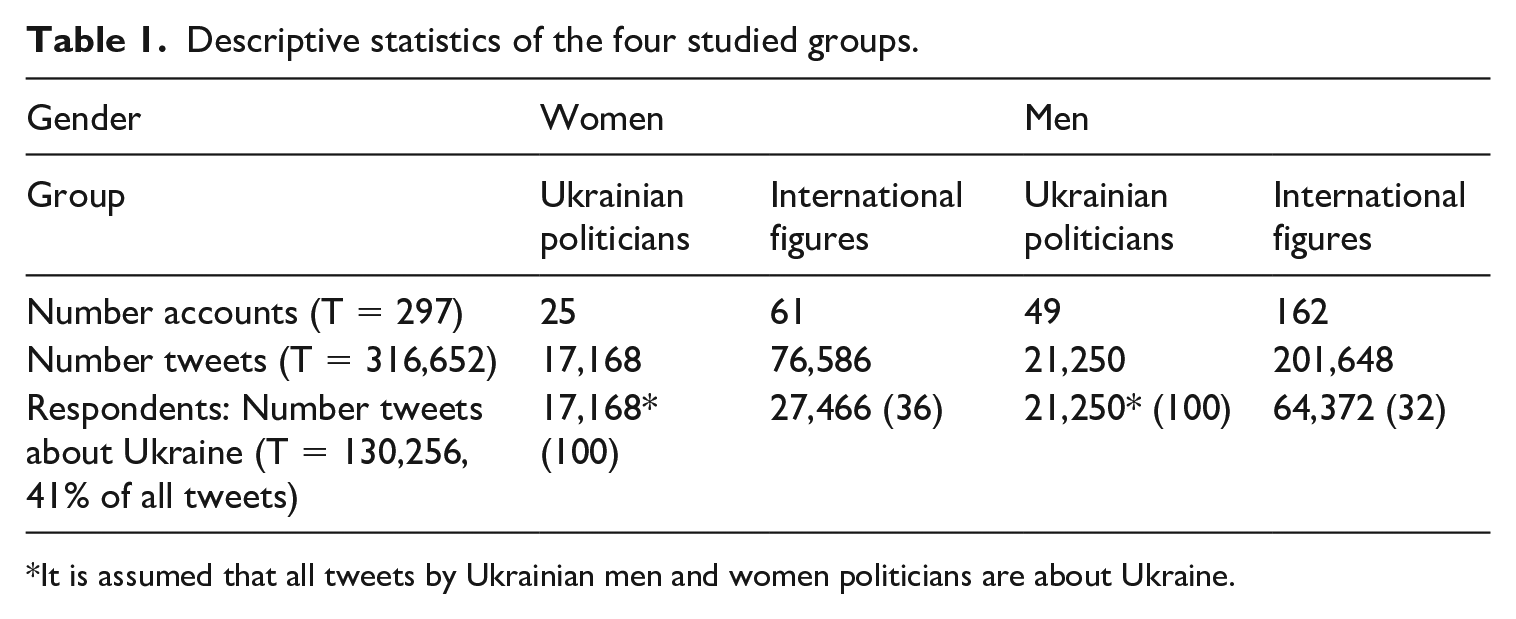
It is assumed that all tweets by Ukrainian men and women politicians are about Ukraine.
Methods
Structural topic modelling (STM) was used to provide empirical evidence for the research questions outlined above, using the STM package in R, a programming language. STMs calculate salient topics in input documents based on word co-occurrence (Roberts et al., 2013) and established the effect of metadata on topics (Blei, 2003). All hypotheses analyse communication patterns of four groups: female Ukrainian politicians, male Ukrainian politicians, female international figures and male international figures.
The STM was run on 130,256 tweets and their metadata for gender (man or woman), account group (Ukrainian politician or international figure) and date (11 February 2022 to 8 March 2023). The pre-selected number of topics was 100 and the statistical outputs of the STM for gender and account group are available in Appendix 3a and Appendix 3b. The 51 topics that had an estimate of more than 0.015 on at least one day in the 13-month study period were selected for further analysis. This threshold was selected to exclude topics that were persistently below this value, and to exclude 13 topics whose summaries contained mostly stop words and did not provide further value to the analysis. One of these 13 topics did pass the 0.015 threshold but was still excluded from the analysis on the basis that it did not provide further value.
The 50 topics that passed the thresholds for inclusion in the analysis were then condensed into one sentence that captured a summary of the topic. For example, a topic whose top words included ‘support’, ‘continue’, ‘partner’, ‘macron’, ‘swedishpm’, ‘financial’ and ‘assist’ was summarized as ‘continued financial support and partnership with Europe’. Next, each topic summary was further boiled down into the narrative it communicated, namely the setting and action of the topic summary as the actor was often the tweet sender group. For example, the narrative for the topic summary above was listed as ‘West providing support to Ukraine’. The narratives derived from the topic summaries are used to inform both hypotheses. The full list of topic summaries, narratives, genders and groups is available in Appendix 4.
Findings and analysis
Table 2 shows the 18 narratives used by men and women during the first year of the full-scale invasion, comprising the 50 topics that were selected for this study. The narratives most used by men discussed diplomatic efforts (7) and support for Ukraine from the West (5), as well as a narrative about the strength of the Ukrainian army (4). Topics within these narratives mainly highlighted diplomatic engagements between Ukrainian and international leaders, announcements of and gratitude for international support, and Ukrainian territory liberation (for more detail on these topics see Appendix 3a). Women tended to use narratives about Russia’s destruction of Ukrainian land and people (4) and its war crimes (3), which both focus on human trauma and suffering. Topics within these narratives included missile attacks on Kyiv, Ukrainian blood and homelessness, and Russian genocide and committed atrocities (Appendix 3a). Four narratives were used by both genders, including narratives of diplomacy and international support, as well as calls for support, which was also used by both women (1) and men (2).
Distribution of narratives used by women, men, or both genders.
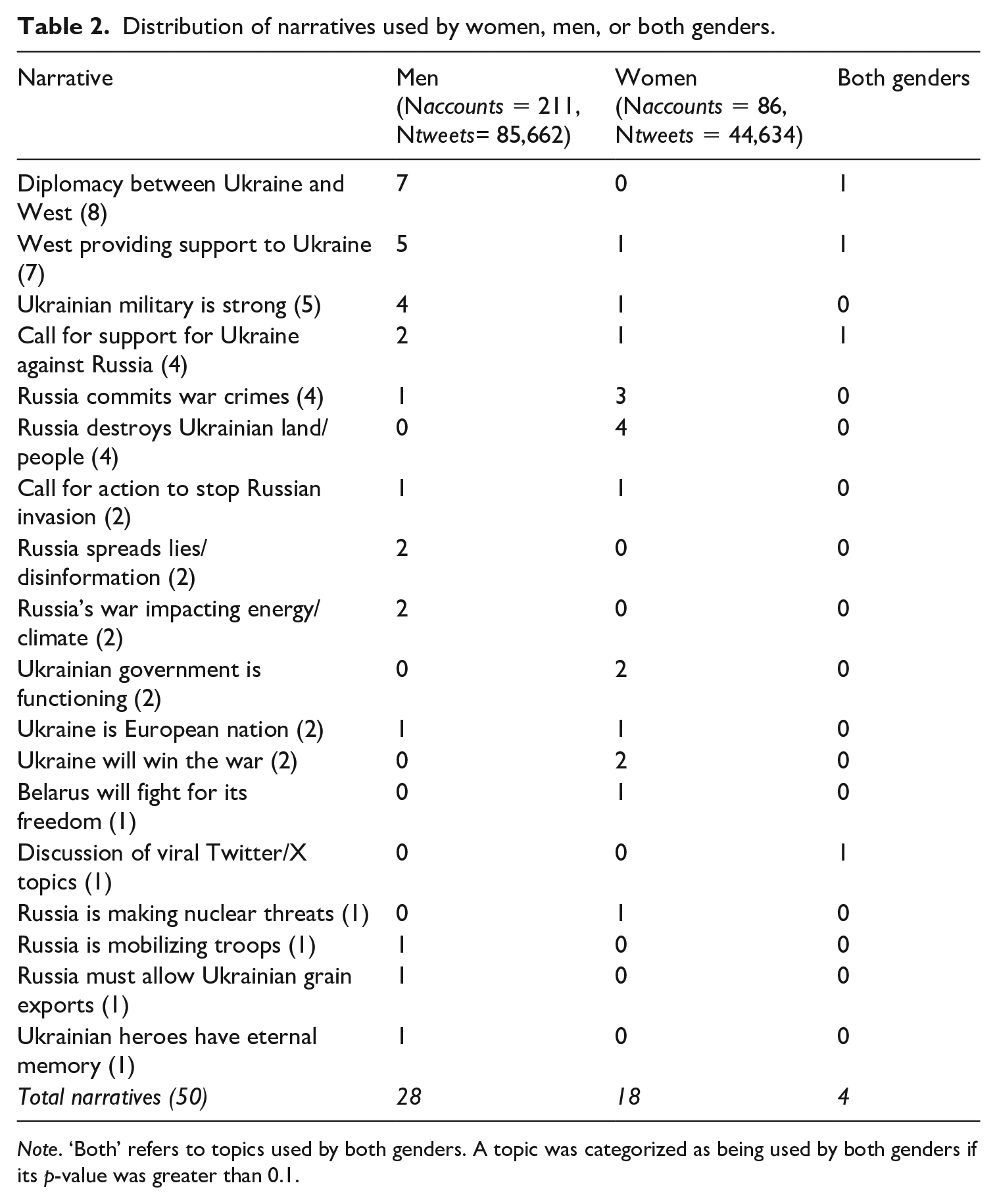
Note. ‘Both’ refers to topics used by both genders. A topic was categorized as being used by both genders if its p-value was greater than 0.1.
A deeper look into topics feeding specifically into Ukrainian women politician’s narratives found that their most used topics were attacks and murders of Ukrainian children and mothers, war crimes, the need for anti-missile systems and victory for Ukrainian statehood. Intertwining discussions of Russian atrocities against Ukrainian people with calls for anti-missile systems and victory may have been a strategy to use narratives about human traumas as emotionally driven appeals for more military support from international figures and publics. This would have allowed them to present themselves as Berehynia characters who act as mothers of the nation, while also promoting nationalism through calls for military support.
Table 3 shows the use of the 18 narratives by all possible combinations of men and women Ukrainian politicians and international figures. The columns under ‘Both’ indicate topics for which statistically significant differences toward any group were found, meaning that individual topics were used either by both men and women or by both Ukrainian politicians and international figures.
Distribution of narratives used by women or men or by both genders.
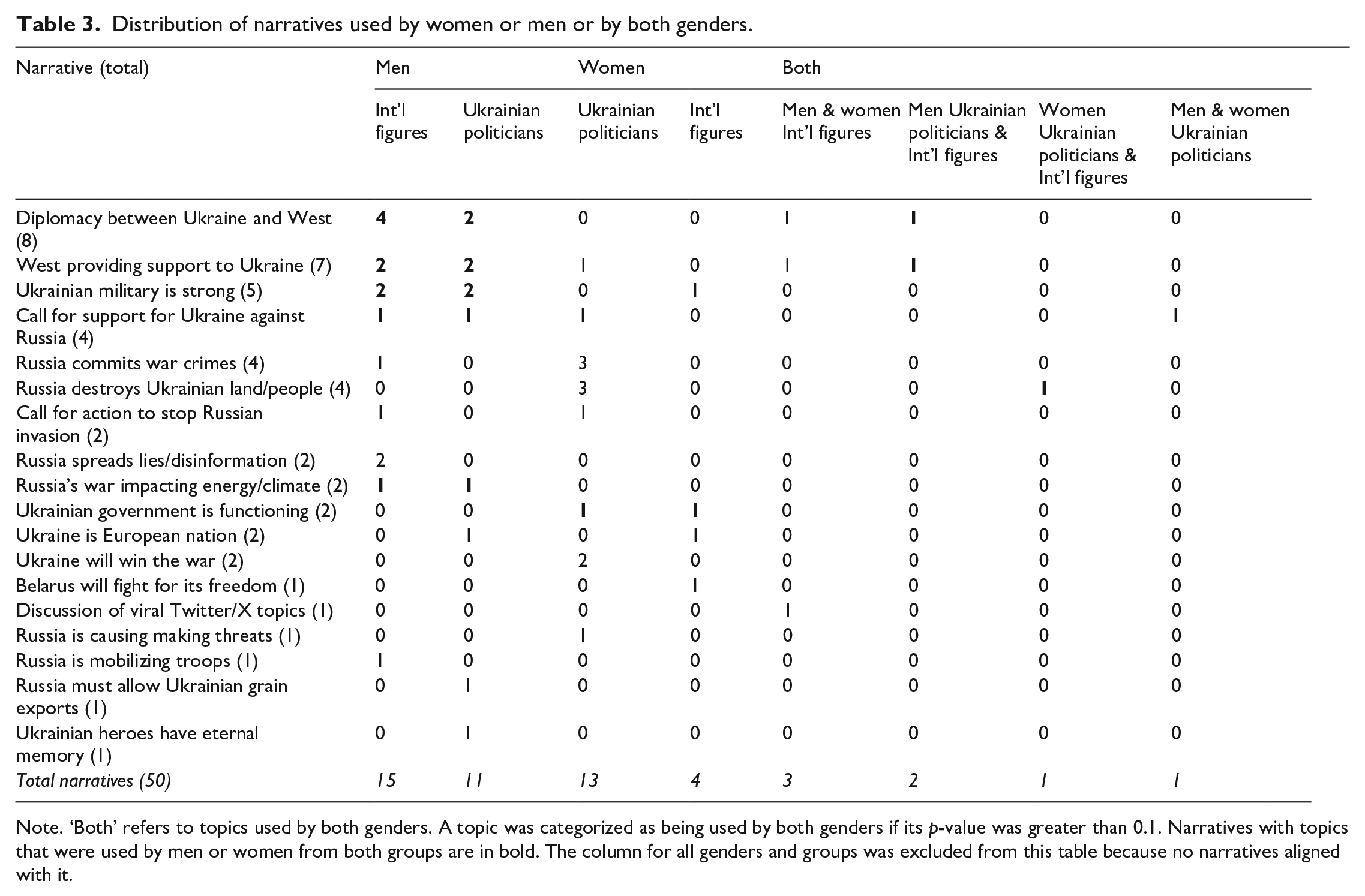
Note. ‘Both’ refers to topics used by both genders. A topic was categorized as being used by both genders if its p-value was greater than 0.1. Narratives with topics that were used by men or women from both groups are in bold. The column for all genders and groups was excluded from this table because no narratives aligned with it.
Men Ukrainian politicians and international figures appeared to have more convergence of narratives than women, having both discussed topics that fit into five narratives. Narratives revolving around diplomacy between Ukraine and the West were used in four topics by men international figures and two topics by men Ukrainian politicians, as well as one further topic that was used by both groups. Similarly, narratives about the West providing support to Ukraine, the Ukrainian military being strong, calling for support for Ukraine against Russia, and Russia’s war impacting energy and climate were used by both groups of men.
Only two narratives were discussed by women Ukrainian politicians and international figures. One topic under the narrative of Russia destroying Ukrainian land and people was used by both groups of women, and one narrative about the Ukrainian government continuing to function was engaged with by both groups of women. The delineation between diplomatic and militaristic narratives used by men and narratives about human trauma and suffering used by women in both hypotheses may be partially caused by men’s presence in higher positions of power that enables them to engage in more diplomatic engagements. Women may also be conforming to their expected duty as carers for human life and focusing on the human cost of war.
Discussion
Men international figures and Ukrainian politicians used more military-oriented and diplomatic narratives that communicate authority while women focused more on civilian harms and war crimes against Ukrainian people, confirming Hypothesis 1. It is more likely that men were able to engage in such diplomatic discussions because of their higher access to power. Women may have used more narratives about human trauma and suffering to align with their expected ‘life-giving’ perspective in the WPH. Ukrainian feminists’ historical need to merge gender equality movements with nationalist ones may also be reflected in Ukrainian women politicians’ use of narratives about human trauma and suffering, as injured and victimized Ukrainian civilians are often women and children. Using such narratives to imply the need for more military support may enable them to balance their dual roles as both mothers of the nation and nationalists who will support their country at all costs. These findings show that the gender differences that numerous studies have found can be sources of power, given that women may have used narratives that matched gendered expectations of them to call for more military support through emotional appeals. However, women’s lack of discussion about diplomatic efforts and state-to-state relationships, the ones most visible to international figures in the highest positions of power, may show how offline oppression (in this case women’s lack of access to institutionalized power) translates into online digital platforms.
The question arises: is it the salience or the persistent threat of conflict based on a country’s or group’s geopolitical situation that determines the applicability of the WPH? In Ukraine, where proximity to Russia has necessitated prioritizing nationalism over feminism, the permanent war mentality of Russia makes the threat perpetually salient for Ukrainians. This challenges the traditional understanding of salience, suggesting that constant threat perception may supersede gendered attitudes toward conflict. The notion of salience, often associated with an active conflict, becomes nuanced in this context. In countries frequently under the threat of attack, with populations harbouring higher threat perception, the likelihood of having pacifist women decreases as they comprehend the enduring consequences. Theories about women’s pacifism may therefore not be directly applicable to a country like Ukraine, which has confronted persistent external threats for centuries.
The gender affinity effect was observed between men more than between women, where men Ukrainian politicians and international figures often discussed narratives about diplomacy and military. This therefore partially confirmed Hypothesis 2 that the gender affinity effect would be observed between both men and women. Given that literature on the influence of gender on social media interactions is nascent, this finding begs for deeper inquiry into the gendered affinities between influential people on social media, growing on the current body of work on gender affinities between influential people and the masses who vote for them and engage with their social media content.
Conclusion
This article analysed the narrative use of men and women Ukrainian politicians and international figures on Twitter/X to understand how men and women used narratives differently during Russia’s full-scale invasion in 2022. By adopting a gender lens in the analysis of wartime digital political communication that is sensitive to Ukrainian historical tensions between nationalism and feminism, we gain a significant understanding of the varied and impactful contributions that women make in shaping narratives. Findings indicated that, while men and women did use different narratives they both, in their own ways, advocated for Ukrainian victory and for more military support. This is significant because women appear to be using all tools at their disposal to support Ukraine through emotional appeals about human suffering and war crimes to call for more military aid. This opens two future research areas. First, how do men and women use the interactive elements of social media to forge meaningful connections with their target audiences? This would uncover how dialogue, a key element of strategic and diplomatic communication, unfolds on social media and how women work to interact with people in high positions of power who are more often men. Second, further research on the impact of women’s nuanced communication strategies on target audiences could produce recommendations and best practices for both men and women in digital political and conflict communication.
This study faces challenges stemming from the contemporary constraints of limited data availability and restricted API access, marking a transition into an era of potential data scarcity in computational social science research. The evolving landscape poses concerns for this study’s generalizability amid increased barriers to accessing the Twitter/X API. The study’s focus on the 2022 Russian full-scale invasion captures a specific moment in the dynamic landscape of international relations, and hence requires caution when extrapolating findings to different temporal and geopolitical contexts. Finally, in terms of variables in this study, the prominence and job type of individuals studied was not included in the analysis, despite possibly being a factor in how individuals communicate on Twitter/X.
Supplemental Material
sj-docx-1-mwc-10.1177_17506352241309225 – Supplemental material for Gender and narrative in digital political communication during Russia’s full-scale invasion of Ukraine
Supplemental material, sj-docx-1-mwc-10.1177_17506352241309225 for Gender and narrative in digital political communication during Russia’s full-scale invasion of Ukraine by Alexandra Pavliuc in Media, War & Conflict
Footnotes
Funding
The author(s) disclosed receipt of the following financial support for the research, authorship, and/or publication of this article: The author aknowledges financial support from the Social Sciences and Humanities Research Council of Canada Doctoral Fellowship and the Oxford Internet Institute Shirley Scholarship: Global Merit Award. Any opinions, findings, and conclusions expressed in this material are those of the author and do not necessarily reflect the views of the funders.

Supplemental material
Supplemental material for this article is available online.
Author biography
References
Supplementary Material
Please find the following supplemental material available below.
For Open Access articles published under a Creative Commons License, all supplemental material carries the same license as the article it is associated with.
For non-Open Access articles published, all supplemental material carries a non-exclusive license, and permission requests for re-use of supplemental material or any part of supplemental material shall be sent directly to the copyright owner as specified in the copyright notice associated with the article.
