



Abstract
In February 2022, Russia began a full-scale invasion of Ukraine. The relevant narrative articulated by Vladimir Putin presented it as a short-term mission of military professionals. However, as the war continued, the situation at the front required complicated decisions that the initial narrative was not able to cover. This article analyses the core transformations of the Russian narrative on the war in Ukraine. Appealing to the strategic narrative concept, this article suggests a framework for assessing the narrative’s viability. The author reveals that, although the current modified narrative is not able to provide a clear and coherent explanation corresponding to people’s lived experiences, it is still effective due to the following reasons. First, it is built on and perceived within an intuitively familiar discursive landscape that has been promoted for decades. Second, the external prerequisites of the viability, such as the scale of its articulation through propaganda or existing opportunities to perceive alternative narratives, remain strong. Thus, it is likely that most of the rational argumentation in the narrative will be further replaced by its sacralization, and the information isolation will be continuously reinforced.
Keywords
In February 2022, Russian President Vladimir Putin announced a so-called ‘special military operation’ against Ukraine, which turned out to become a full-scale invasion. In his televised address, Putin tried to explain the aims and reasons for this operation. That speech was, in fact, the very first presentation of a holistic narrative directly legitimating a further offensive. At that time, the operation itself was generally understood as a short-term mission of military professionals, with no significant impact on ordinary citizens. In public perception, such an explanation could probably evoke associations with the Crimea scenario or the Russo-Georgian conflict. However, this war dragged on. As the war in Ukraine continued, the situation at the front required complicated decisions in war strategy and unexpected changes in the initial narrative. For example, following an attempt to assault the Ukrainian capital, Russia had to withdraw its military from Kyiv and Chernihiv directions in late March 2022. Then, the Kremlin’s narrative was similarly challenged by the declaration of partial mobilization in September 2022. The initially set narrative simply could not cover such developments at the front and rear, and had to be transformed. In fact, the narrative articulated by Putin was designed for a kind of shock and awe operation but faced the necessity to respond to arising essential issues.
This article analyses the core transformations of the Russian strategic narrative on the war in Ukraine and the results of such transformations for the narrative’s viability. Thus, the research questions of this article are: (1) How did the Russian strategic narrative change over the course of the war? and (2) How was the narrative’s viability affected by these changes? Responding to these questions, this article refers to the concept of strategic narratives – intentionally constructed stories that can ‘provide meaning to events related to the engagement in conflicts and wars’ (Coticchia and De Simone, 2016: 27). I considered statements made by Russian officials from 24 February 2022 to 30 September 2023 in order to analyse how and why the initially set ideas about the war in Ukraine have been transformed and what challenges the narrative faced during its modification.
This article aims to contribute to the literature on strategic narratives by considering viability as a complex property determining the potential of narratives to perform their core functions – persuade, justify, provide meanings and shape public attitudes. Based on a broad body of existing scholarship, the theoretical framework used in the present research suggests six qualities constituting and influencing narratives’ viability – fidelity, coherence, integrity, flexibility, clarity and ability to fit in the general narrative landscape. Assessing these interconnected qualities provides an understanding of a narrative’s potential to fill people’s cognitive domain and stay credible in public memory.
As such, this article has a clear empirical contribution to the literature on the Russia–Ukraine conflict and Russian strategic narration. It reveals which particular transformation of the Russian war narrative may be considered as forced and how this narrative succeeded in adapting to the events that caused such changes. The research clarifies what challenges the narrative perception today and tries to identify whether it became less viable but more fragile, and less strategic but more situational. During wartime, when it is difficult to measure public attitude towards the war by the usual sociological methods, the assessment of a narrative’s viability gives an idea of how effectively and for how long the articulated ‘version of truth’ will find public support.
At the same time, the research does not go into the mechanisms of narrative’s implementation and dissemination, e.g. deployment of a comprehensive infrastructure of war correspondents, information operations, the rise of Telegram, etc. Instead, it focuses on the official narrative itself, considering it the primary source and basis for further work with public attitudes and perceptions. Massive censorship in media narrowed the public deliberation area in Russia to the official narrative’s limits, not tolerating critics and minimizing the need to compete with alternative narratives.
The article is structured as follows. First, I explain the theoretical framework of the research. Second, I provide an overview of how previous scholarship has applied the narrative approach to Russia–Ukraine relations. After outlining the research strategy, sources and methodology, the next section considers the waves of transformation that the Russian narrative went through. These changes are presented within their correlation to events on the battleground (or on the home front). Finally, I analyse the narrative’s viability by assessing each of the suggested narrative’s qualities.
The article concludes that the Russian narrative on the war in Ukraine fits into the general narrative landscape developed since the 2000s. But the necessity to change this story of war in reaction to the occurrence of unexpected events brought contradictions and affected its coherence and integrity. In fact, the Russian narrative turned out to be not flexible enough to cover new events. Some developments of the conflict – such as leaving Kherson after the conducted referendum – challenged the narrative’s fidelity as what it promised did not correspond to people’s lived experience. Finally, public perception of the narrative probably became vulnerable because of the obscurity of the operation’s aims and the use of ambiguous discursive constructs such as ‘demilitarization’ or even ‘special military operation’.
Viability of strategic narratives: Theoretical framework
This article uses the strategic narrative concept, which has been applied to international relations since the 2000s. It followed the so-called ‘linguistic turn’ in social sciences and the first poststructuralist developments in international studies made in the late 1980s and early 1990s by Der Derian, Bartelson, Wæver and others (see Çalkıvik, 2017). The importance of narratives in military and strategic affairs was widely recognized after the Iraq War when it was critical to provide a convincing narrative that – as Lawrence Freedman (2006: 24) argues – could explain whether ‘the war had been worth the pain and cost’. Freedman identified strategic narratives as ‘compelling story lines which can explain events convincingly’ and which ‘are deliberately constructed or reinforced out of the ideas and thoughts that are already current’ (p. 22). Later, Antoniades et al. (2010: 5) defined strategic narratives as communicative tools used by political elites to achieve political goals by giving ‘determined meaning to past, present and future’.
But what makes a strategic narrative effective and persuasive? Based on the previous literature, this article suggests a theoretical framework that is useful for studying the war narrative in Russia but can also be applied to diverse narrative contexts. This framework focuses on the viability of the Russian strategic narrative on the war in Ukraine. Viability is considered here as a narrative’s potential to stay in public memory, to fill people’s cognitive domain and shape public attitude towards certain events. Viability makes a narrative remain credible and perform its functions (persuasion, justification, explanation, etc.) effectively and for a long time. Viability depends on different qualities of a narrative, both external (related to its delivery) and internal (related to its content).
The first group of properties includes scale and means of a narrative’s articulation, social trust of sources establishing it, rhetoric used to reveal its core ideas, the availability of alternative narratives, and so on. But the Russian powerful propaganda and censorship narrowed the focus of this article to the internal properties of the narrative because the mentioned external qualities seem obviously strong. Relying on existing literature on narratives, I suggest considering six internal characteristics of narratives.
Fidelity is the extent to which narratives correspond to people’s lived experience. It is about relevance towards personal knowledge and observations of reality that one is undergoing through. Fisher (1987: xiii) considered fidelity as one of the two basic principles of narrative logic (the other was coherence). Fisher understood fidelity as the truthfulness of a story. Fidelity responds to whether the stories that people experience ‘ring true with the stories they know to be true in their lives’ (p. 5).
Coherence. A coherent narrative is a story that is ‘not composed of contradictory elements and denotations articulated by the narrator should not be mixed up’ (Grzywacz, 2020: 254). A coherent narrative provides a cohesive and consistent interpretation of events. And its elements do not contradict or collide with each other.
Integrity. An effective war narrative forms an integral universal story by explaining the causes and aims of the conflict, and describing the image of the enemy. Ringsmose and Børgesen (2011: 506) state that effective strategic narratives clarify objectives and cause–effect chains. In the present research, I also add enemy presentation as a different component of narrative that is important to explore. I argue this is necessary because strategic narratives influence the formation and reception of identities in a ‘self–other’ dimension (Pate, 2018: 336). Constructing identity through narratives implies constructing the image of ‘them’, who we are not. Understanding self and others is critical for perceiving articulated aims and stated causes. Stories not only express ‘a sense of cause, purpose, and mission’ but also ‘a sense of identity and belonging’ responding to basic questions on who we are and what makes us different from others (Arquilla and Ronfeldt, 2001: 328).
Correlation with narrative landscape. Miskimmon et al. (2017: 2) suggested that strategic narratives operate at three different levels covering identity issues, particular policies and the international system. I assume that an effective narrative on war correlates with the other narratives and beliefs dominant in the cognitive domain of addressed audiences. Effective narrative not only resonates ‘with values, interests and prejudices of the intended audiences’ (Dimitriu, 2012: 197) but also contributes ‘to a community’s political myths’ (Schmitt, 2018: 490). That means that strategic narratives on war depend on a rooted common worldview and have to fit in the wider landscape of perceptions and beliefs within all the levels in which it works.
Flexibility allows an effective narrative to cover and explain arising issues that can potentially challenge the constructed story. So, a flexible narrative will be adapted and updated to suggest the explanation of new events that threaten a previously set understanding. By the same logic, flexible narratives resist new or updated counternarratives. Dimitriu and De Graaf (2016: 20) stated that public attitude is influenced by the formulated strategic narratives but only ‘in conjunction with the counternarratives produced by opposing parties’.
Clarity. In a long-term perspective, an effective strategic narrative has to be clear, straightforward and lucid. It must be easy to perceive and understand with unambiguous discursive constructs. ‘Strong strategic narratives articulate a clear and compelling mission purpose’ and hold the promise of wartime success (De Graaf et al., 2015: 9). Kvernbekk and Bøe-Hansen (2017: 232) note that, since the war is played out, narratives ‘switch from being prospective to being retrospective’ and rhetoric switches to argumentation. They write: ‘the initial appeal to national values, existential visions, and a sense of “who we are” is gradually replaced by truth, consistency, clarity, and relevance.’
These six presented characteristics are fundamental for ensuring a narrative’s viability. When losing these qualities, a strategic narrative becomes less viable and more fragile. Lacking credibility and persuasiveness, it is vulnerable to substitution by alternative narratives. The current theoretical framework suggests analysing the viability of the Russian strategic narrative by assessing these core properties.
The Russia–Ukraine conflict from a strategic narrative perspective
Arquilla and Ronfeldt (2001: 330) once noted that the results of military operations ‘depend on whose story wins’. They referred to the Chechen war, when Russia lost both the military battle and the battle of stories during the first campaign but succeeded in mobilizing society in 1999 by portraying the second campaign as a war against terrorism. Strategic narratives have been the focus of publications devoted to the Afghan war (De Graaf et al., 2015), as well as to conflicts and military operations in Iraq (Irvin-Erickson, 2017), Libya and Lebanon (Coticchia, 2015), and they still remain one of the core subjects for international studies.
A narrative approach has also been applied in studies of Russia–Ukraine relations. Since the dissolution of the Soviet Union led to ‘re-evaluations of historical narratives’ (Harris, 2020: 595), scholarship has focused on the ‘battle of narratives’ as part of a greater ‘war of memories’ between Ukraine and Russia. Maria Mälksoo (2021: 496) states that international actors seek mnemonical status through developing biographical narratives and ensuring their recognition. According to this approach, Russia being generally satisfied with memory order presents the case of mnemonical positionalism, and Ukraine, in turn, seeks mnemonical self-emancipation to become an independent actor.
In Ukrainian memory politics after Euromaidan, two approaches prevailed – an anticolonial and nationalist one and a hybrid one aimed to ‘transgress binary anticolonial national consciousness, bridge polarities and create new forms of identity’ (Törnquist-Plewa and Yurchuk, 2017: 713). At the same time, commemorative narratives in Russia promoted ideas on its unique path of development and messianic role and the existential necessity to remain powerful (McGlynn, 2023: 12). When analysing the causes of the Russia–Ukraine war, scholars generally follow two competing approaches, each of which reproduces Russia’s or Ukraine’s narratives to some extent. The pro-Russian approach represents Ukraine as a divided nation and the Russia–Ukraine conflict as having roots in the Donbas civil war. On the contrary, the pro-Ukrainian approach considers the war as Russia’s imperialist aggression and Ukraine’s anti-colonial resistance (Strakhov, 2023).
Constructing competing narratives, both countries ‘use and abuse history as a political weapon’ while interpreting the Great Patriotic War, the mass famine in 1932–1933, certain historical figures and the genesis of both modern nations and states (Kappeler, 2014). Historical narratives build nations’ identity through the shared understanding of the past. But identity construction also depends on particular practices of othering. Such practices were implemented in the strategic narratives of these two states as well. Russia’s portrayal of Ukraine as ‘little brother’, a fraternal but subordinate partner after the USSR collapse, changed with the implementation of the ‘narrative of betrayal’ after Euromaidan (Khaldarova, 2021: 16). The Ukrainian policy of othering appealed to specific perceptions of history. For example, after the 2014 Crimea crisis, the Ukrainian leadership developed a narrative that Ukrainian history was ‘similar to those of the EU countries and different from Russia’ (Klymenko, 2020: 985). Moreover, the conflict narratives of both countries were radicalized from 2014 to 2022. Russia tried to delegitimize Ukraine as a state and a nation. Ukraine, in turn, reframed the conflict as ‘the centuries-long intention of Russia to destroy Ukraine as a state and a nation’ (Myshlovska, 2022: 100).
The 2022 military operation in Ukraine brought the narrative dimension of conflict to the surface again. Different narratives describing Russia itself, the West and understanding a ‘world power’ constituted two strands in Russia’s strategic culture – ‘sense of vulnerability’ and ‘feeling of entitlement to great power status’. These strands, as Götz and Staun (2022: 492) argue, mean it is unlikely that the Russian government will give up military actions in Ukraine. According to Yuriy Savelyev (2023), Russia’s narrative on the current war is based on four core elements. First, Ukraine ‘has been formed as “anti-Russia” by western governments’ and brings a threat to Russia’s security. Second, Ukraine is governed by people following Nazi ideology. Third, Ukraine is ‘a constructed artificial entity’ referring to the questions of identity and genesis of the Ukrainian nation. And, finally, Moscow claims that Ukraine conducted genocide against the Donbas population, so Russia had no choice but to protect them. The last narrative is the crucial one. It, in fact, repeats the storyline used during the 2008 Russo–Georgian War. In both cases, Russia appealed to the Responsibility to Protect rhetoric while describing the situation as a ‘grave humanitarian crisis’. Such an approach aims to delegitimize the national governments ‘by outlining their alleged international law violations and atrocity crimes committed’. The justification core of these narratives is based on the new understanding of ‘legitimate military humanitarian intervention’ as defence of compatriots and native Russian speakers (Pupcenoks and Seltzer, 2021).
The strategic narrative landscape of the Russia–Ukraine crisis is complicated and includes narratives beyond those on the national level. In 2019, Valeria Lazarenko (2019) suggested looking beyond the logic of two competing stories. She also considered a third story – global strategic narrative on geopolitics – with its core elements such as ‘hybrid war’ or ‘continuation of the Cold War’. According to this narrative, Ukraine is just ‘a battlefront between the global West and Russia’. In this case, the epistemology itself (whether used with a pro-Western or pro-Russian stance) often denies or ignores Ukraine’s agency in the conflict (Hendl et al., 2023). Undoubtedly, this perspective impacts the perceptions of the conflict globally.
Although the scholarship has presented a number of insights on the role of narratives in Russia–Ukraine relations, there is a lack of research that analyses strategic narratives on war in their dynamics as constantly modifying stories that aim to cover developments of the Russia–Ukraine conflict. The present article not only describes the Russian leadership’s strategic narrative but reveals how and under what circumstances it was changed, and whether its viability has been affected. So, the focus of this article goes further than analysing justification as it also analyses the challenges that such justification may face when being perceived.
Research strategy and methods
The previously suggested qualities of strategic narratives substantiate the methodology of the present article. The research strategy was built to present Russia’s core narrative about the war in Ukraine, identify the adjustments it faced for more than a year and a half, and assess qualities which constitute its viability. Generally, there were five methodological phases.
First, collection of data. Since narratives are introduced through public statements, speeches, interviews and broadcast media ‘have been the favored media for reaching publics’ (Zaharna, 2016: 4409), I considered statements and speeches about the military operation made by Russian officials that match the following criteria. The analysed statements were made from 24 February 2022 to 30 September 2023 and were published in the RIA and TASS information agencies, as well as in the Russian Gazette. These sources were chosen as they are state-owned domestic media controlled by the Russian government and, at the same time, they are in the top list of most cited sources in Russia (Medialogy, 2022). This means the analysed statements were intentionally included in the public agenda and can be considered to be forms of interpretations of the strategic narrative.
Having applied these criteria, I collected 366 appearances in the press representing different public authority bodies, including the Russian president, the Foreign and Defence Ministry, two Chambers of Parliament and the Russian Security Council.
Second, from the abovementioned speeches and comments, I extracted 563 particularly relevant statements and blocks of statements. These materials were structured in chronological sequence, divided into three groups by general themes (preconceived due to the theoretical assumption regarding the narrative’s integrity) – causes/reasons, aims and enemy images. Each statement was provided with contextual information, such as author, addressee, place where a statement was made and source in which it was published.
Third, to present the narrative in its dynamics and understand the transformations it faced, all statements were checked for compliance with Putin’s initial speech in order to determine the updates to each of the thematic sections (aims, reasons, enemy). The general logic for making analytical choices was the following. Each new statement was compared to the initial narrative to identify whether (a) it repeats and reproduces the already articulated ideas, or (b) it provides new ideas, suggests new concepts, or describes new storylines. In the second case, this statement was coded. Then, if these new ideas and interpretations were repeated and formed a recurrent pattern articulated by representatives of different public bodies, they were analysed within the next phases.
Fourth, identifying the types of updates. During this phase, the key task was to identify whether an update was made to react to new events or to reinforce any of the previously articulated ideas. For this purpose, I provided the context for each wave of changes – particularly, the description of the situation on the battleground and intentions about negotiations – and observed correlations between changes made in the narrative and events that could have potentially forced the introduction of these changes. This was necessary for further assessment of the narrative’s flexibility.
Fifth, analysing the narrative’s viability. Every change in the narrative suggesting new interpretations of the war or a new storyline was checked for the extent to which it collided with what was already known. So, I tried to identify whether this change (a) updated the initial narrative and did not contradict it, or (b) presented something that damaged the narrative’s coherence. Thus, I analysed and described the contradictions that the second type of changes brought to the initial narrative’s content and tried to identify how critical they were, i.e. how many of the particular sub-narratives were affected and to what extent. This step aimed to determine whether the Russian strategic narrative was sufficiently flexible to cover new events without challenging its coherence and whether the potential contradictions (if any) made the narrative less integral. Then I referred to the academic literature on the Russian narratives to find out which particular narratives were operating in Russian official discourse for the last decade (reflecting the theoretical assumption on narrative landscape). This led me to correlate these narratives with the story about the current war in Ukraine. I focused on whether the current strategic narrative on war contradicts any of the previously articulated narratives, or if it utilizes the ideas of these narratives and is mostly based on them. Finally, I considered what could challenge the narrative’s clarity and fidelity. I observed a few developments of the conflict influencing people’s lived experience and compared them to what had been promised by the strategic narrative. I also suggested two discursive concepts that challenge the perception of the Russian representation of the war.
Transformations of the Russian strategic narrative 1
The Russian strategic narrative was initially set up by Vladimir Putin on 24 February 2022, 2 and later confirmed and specified by other officials. 3 It basically responds to three questions about the special military operation in Ukraine. The first part of this narrative reveals the conditions that forced Russia to start its military operation. Primarily, it tells a story about NATO expansion eastward, the Western policy of containing Russia, supporting the far-right nationalists and neo-nazis, and spreading Russophobia and genocide in Ukraine. The second subnarrative clarifies the aims Russia strives to achieve through conducting this operation. It is explained that, in order to protect people facing genocide, Russia was supposed to conduct demilitarization and denazification of Ukraine. Demilitarization has been defined as the neutralization of the military potential, and denazification as cleansing Ukraine of pro-nazi people and ideology. Finally, the third part describes the enemy(-ies) that Russia is combating. This story highlights that, located on Russia’s historical territories, Ukraine has come under complete external control of the West and become an ‘anti-Russia project’. At the same time, the Western bloc formed by the United States and their allies was presented as the ‘empire of lies’.
After the special military operation was announced, Russian troops attacked Ukraine from the south, south-east and north. Russia intended to install a new regime in Kyiv (Charap and Priebe, 2023: 12). But the executed offensive did not achieve its aims. Russia’s propaganda machine claimed that Kyiv could be captured in a few days, 4 but this did not happen. That meant the strategy had to be transformed, and the strategic narrative had to be changed. The more intensively the Russian population had been convinced that the military operation would be short and successful, the more complicated was the process of transforming the strategic narrative without losing its consistency and credibility.
Since 6 March 2022, Russian officials developed the idea about a military–biological program funded by the Pentagon and implemented in Ukraine. According to this storyline, 30 secret laboratories created biological weapons and worked on destabilizing the epidemiological situation in Russia. Another addition to the initial version of the narrative was made a week later. It relates that Kyiv, being unable to implement the Minsk agreements, had prepared a ‘plan B’ – the invasion of Russia and the Donbas in March 2022; and it is for that reason that NATO had supplied weapons in advance and sent military advisers to Ukraine. These two updates incorporated into the initial narrative tried to strengthen, develop and confirm Putin’s ideas and concerns. These adjustments aimed to persuade addressees that the decision to start the military operation was not a mistake but the only possible option. And, finally, they made the argument clearly that, if the special military operation had not been pursued, the consequences for Russia would be much worse.
Another change to the initial narrative was made on 9 March 2022. Since that moment, Russia’s official position emphasized that the military operation was not aimed at overthrowing the current Ukrainian government or destroying its statehood. In fact, it was a meaningful change in the war strategy that needed to be incorporated in the general storyline. The problem is that Putin previously defined the Ukrainian government as a junta directed against the people and robbing the state and called it a ‘gang of drug addicts and neo-Nazis’. 5 So, after all this has been said, why make controversial statements? I would argue that this change was intentionally made in preparation for a negotiation scenario. It was a signal to the Ukrainian side, but it was also an attempt to soften the perception of the current Ukrainian government in Russia. Otherwise, if negotiations resulted in an agreement, how could one explain the reasons why Russia signed it with the government it aimed to denazify. Such a scenario could have raised questions on the necessity of the military operation and its aims. Without being included in the updated narrative, negotiations could potentially have strengthened the ideas that the war was not existentially necessary and that people taking an anti-war stance were being persecuted unfairly. The spread of both these ideas could have decreased the level of public support for Putin.
In late March 2022, the Russian military had to withdraw from the Kyiv and Chernihiv regions. The reasons for cutting the military presence seemed to lie in the unexpected resistance, the uncertainty of further urban struggle, and in the strict necessity to reduce the front line and simplify the military logistics chain. But these fundamental changes in the course of the war needed relevant interpretations that could ensure the validity of the initial strategic narrative. For this purpose, two explanations were adopted and articulated during 29–30 March 2022. The first explanation described the emerging success in the Russia–Ukraine peace negotiations. From this perspective, Russian decisions on the battleground were made to stimulate mutual trust and create better conditions for further negotiations. The second explanation emphasized that Russia had forced Ukraine to concentrate its military forces on holding Kyiv and Chernihiv, which had created favourable conditions for the final stage of the military operation – the liberation of the Donbas. Another change in the initial strategic narrative consequently affected one of the main goals of the military operation. Denazification turned out to be limited in its meaning (April 2022) – it now required liberation from nationalist battalions rather than from the nationalist government. At the same time, denazification in June 2022 was limited to only the borders of the Donbas region. The modified idea of denazification fitted the two explanations of recent military withdrawal. Together these three adjustments tried to clarify a new understanding of the operation’s aim – ‘restore the statehood of two Donbas republics within the borders of 2014 that are fixed in their constitutions’. 6
On 21 September 2022, Putin announced partial mobilization and the Russian official narrative implemented a new understanding of the enemy. NATO was considered as a de facto part of the Ukrainian conflict and the special military operation itself was presented as an undeclared war against Russia that was started by the West. Although this turn in understanding the war was implemented first in April–May 2022, its active and consistent use started in September. Obviously, it was the way to explain why the special military operation required partial mobilization, even despite the previous assurances of the exclusion of such a scenario. Then, on 30 September 2022, Russia signed ‘agreements on the incorporation of the Donetsk, Luhansk, Kherson and Zaporizhzhya regions’, despite the Kremlin’s previous assurances that it had no plans to occupy Ukrainian territories. The narrative on the operation’s aim predictably turned to the protection of Russia and its new borders. It stressed the necessity to save the Russian state and its people, including those who had recently become new citizens. Now, the special military operation began to be considered as a de-occupation of Russian territories from Ukraine, and thus, the territorial integrity of Russia was included in the agenda.
Since autumn 2022, neither conflict parties had fundamentally changed the course of the war and it was arguably becoming a stalemate both for Ukraine and Russia. In 2023, the war seemed far from its end and the hope for peaceful negotiations seemed miniscule. After the central Russian territories (and the Kremlin in particular) were attacked by drones, the official discourse reidentified the Kyiv government as a terrorist regime emphasizing the impossibility of any negotiations. Also, since February 2023, the Russian narrative had focused on creating a buffer zone as one of the current purposes of the operation. Practically it was about moving the Ukrainian artillery to a safe distance from which it would not threaten Russian territories. This was a response to the ongoing discussion about Western weapon supplies to Ukraine.
All the narrative changes presented in this section are not exhaustive. For example, I did not include the developing sub-narratives on the demonization of the Ukrainian army, as it is unfortunately the usual practice during any war. And I tried not to emphasize changes in rhetoric but rather tried to focus on the themes and explanations of events by Russian officials. The conducted analysis identifies several noticeable changes in Russian strategic narration. Some of them just updated the strategic narrative, others led to reconsidering basic ideas that were articulated at the very beginning of the war.
Russian strategic narrative: From viability to fragility
During the time period covered by the present research, the initial narrative has been updated and/or changed in order to strengthen its core ideas or react to new events. Assessing the viability of a strategic narrative supposes analysing six properties described in the theoretical framework. I will start with narrative’s flexibility and coherence, two closely interconnected qualities. A flexible strategic narrative creates no contradictions when forcedly changed to explain new events. Otherwise, new explanations bring contradictions, which then affect narrative’s coherence. The conducted analysis identified the following contradictions that appeared while the Russian war narrative was transformed.
The first contradiction relates to the changing and controversial image of the enemy. The Kyiv regime was previously recognized as an illegitimate power responsible for crimes against Ukrainian citizens but was reframed as a regime that Russia had no plans to overthrow, and as a regime that could be an equal part of negotiations. Moreover, a previously demonized government received the Russian army’s withdrawal from its capital as a ‘goodwill gesture’ to build bases for further mutual trust. Another contradiction comes from the articulation of aims. Withdrawing from the Kyiv and Chernihiv regions was primarily explained as concentrating on the Donbas as a core aim of operation. But this came into collision with the initially argued necessity of liberating the Ukrainian people from neo-Nazi forces. It even came into conflict with the initial wide understanding of demilitarization and denazification of Ukraine because these two concepts were not limited to certain areas of Ukraine before. In addition, the idea to denazify and demilitarize Ukraine narrowed to build a buffer zone to protect Russian territories from the long-range weapons. Finally, the representation of causes has also been identified as contradictory. For instance, on 11 May 2023, Russian Presidential Press Secretary Dmitry Peskov stated that ‘it was hard to imagine that NATO members, the United States, European countries, first indirectly, and then directly would intervene in this conflict.’ 7 It does not correspond to the narrative’s lines on the vital necessity of a pre-emptive strike and Ukrainian neo-Nazis supported by NATO, who planned to invade Crimea and the Donbas republics.
The identification of these contradictions gives us three main insights. First, the narrative turned out to be insufficiently flexible as it could not reflect new events without consequences for other qualities of the narrative. Second, the narrative’s coherence was affected by contradictions. And third, these contradictions touched all the narrative’s dimensions – enemy image, causes and aims – meaning that they influenced the integrity of the narrative.
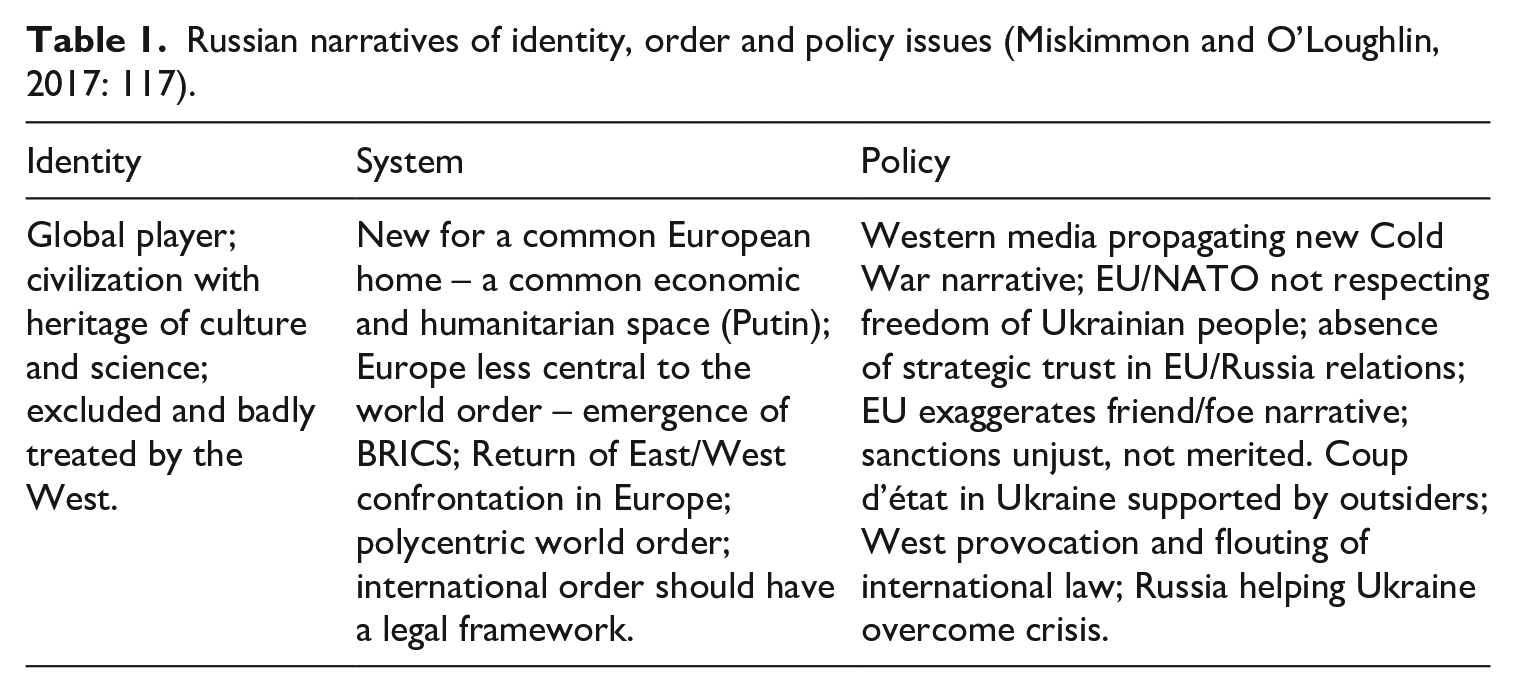
The theoretical framework also requires an assessment of how the Russian strategic narrative on the current war in Ukraine fits in the landscape of dominant narratives. Miskimmon and O’Loughlin (2017) analysed Russian official documents and speeches of key players since the 2000s to describe Russian narratives operating on different levels – identity, international system and policy (see Table 1). The modern war narrative does not contradict any of the stories utilized previously. Some of the ideas were exploited intensively and became basic for interpreting the causes and aims of the war or in depicting enemy images. For example, among the identity narratives, themes such as civilizational identification and global role are now widely used. At the same time, the representation of the war in Ukraine continues to appeal to system narratives on polycentric world order, the discourse of emerging powers and the return of East/West confrontation. And it continues to use narratives on a coup d’état in Ukraine, unjust sanctions and others.
Russian narratives of identity, order and policy issues (Miskimmon and O’Loughlin, 2017: 117).
Such an ideological landscape was further developed with Putin’s article ‘On the historical unity of Russians and Ukrainians’ in 2021. This idea of unity was also reflected in the current war narrative strengthening the responsibility to protect rhetoric. Similarly, the Russian narrative covered previous Russia–Ukraine relations, including the Normandy interaction and Minsk agreements, which were later presented as full of ongoing lies, misleading information and sabotage from Ukraine and the West. However, the current narrative obviously contradicted several pre-war statements of Russian officials regarding the disavowal of plans to invade Ukraine. Yet, in general, the strategic narrative on the war in Ukraine presented by Russian officials not only fails to fit, but is based on the narratives developed since the 2000s.
Continuing with the logic of the theoretical framework, two existential problems should be mentioned as damaging the clarity of the Russian narrative. First, the concept of special military operation could not describe the ongoing warfare. Indeed, it was important at the very beginning to establish the perception of warfare as a narrow short-term operation. And calling it a war could lead to persecution for many. But, since the war dragged on, in order to justify the length and losses of the warfare, as well as the later mobilization, some Russian officials (including Putin) 8 referred to the military operation as war. So the concept of special military operation became a trap. The Kremlin could not widely and formally determine the operation as a war and, at the same time, without naming it a war, it was difficult for the Kremlin to explain the necessities of partial mobilization and increasing losses. The second issue damaging the narrative’s clarity lies within the obscurity of the operation’s aims. From time to time, the meaning of denazification and demilitarization changed. I suppose that these concepts were intentionally set without providing clarity in order to manage their meanings depending on the further conditions and results of a short military operation. It has been designed for building the perception of victory via fast and simultaneous constructing and utilizing the meaning of the stated aims. That was a second trap of the initial narrative that has perplexed the Kremlin. Every supply of Western weapons questioned the demilitarization aim. Every statement on the readiness for negotiations, in turn, questioned the initial intention to denazify Ukraine.
To understand how the fidelity of the Russian strategic narrative has been affected since it was first introduced a year and a half ago, I suggest observing the following developments of the conflict. As NATO’s expansion to the East was presented as one of the main causes for starting the military operation, seeing it enlarged by Finland’s accession as the result of this operation meant that something went in the wrong direction. In addition, Sweden’s prospects to join NATO may again put this challenge on the public agenda. Another event affecting the narrative’s fidelity was Russian withdrawal from Kherson city. Since Russia incorporated the Kherson region in September 2022, it had to withdraw its troops from Kherson city in early November 2022. This happened after mobilization and the conducted referendum, after the decision to cut the frontline and concentrate on particular territories, and – what is essential – after the intensive propaganda and official statements that ‘Russia is here forever’. 9 The withdrawal from Kherson and the abandonment of the local population undermined the media and official propaganda. The trustworthiness of the official narrative was thus damaged.
Furthermore, the return of the Azov soldiers is also considered as an event that negatively affected the narrative’s fidelity. The appeals to the existence of Nazi forces in Ukraine and the construction of their cruel and inhuman image were constant whatever changes the narrative had undergone. In this sense, the Azov battalion was presented as an example of such a radical military unit. In August 2022, the Russian Supreme Court recognized the Azov group as a terrorist organization and they were considered by many officials to be war criminals, not subject to exchange. 10 But captives from Azov were among those participating in the war prisoners exchange in summer 2022. Moreover, in July 2023, Azov’s commanders were returned to Ukraine. That could raise questions as to how the Russian government allowed this to happen, after portraying Azov soldiers as monsters against whom the operation had originally been started.
Finally, when he started the military operation, Putin emphasized that conscripts would not participate and that there would be no mobilization of reservists. But this turned out to be false after the announcement of partial mobilization in autumn 2022. Moreover, the current recruitment reform in the Russian army raised the maximum age for men to be conscripted from 27 to 30 years. Such broken promises decrease the credibility of Russian authorities and, therefore, of their narrative. Moreover, such promises could be reminiscent of similar prewar statements that appeared to be false – such as those about not increasing the pension age or about not participating in elections for the third presidential term. These observations make it clear that what people experienced ran counter to the articulated storylines and – what is also essential – to the promise of success of military operation. So, the fidelity of the narrative appears to have been damaged by the described unexpected events.
What emerged from the results reported above? The Russian narrative on the war in Ukraine has faced several waves of changes. Some of them were made to reinforce the ideas articulated in the initial version of the narrative, while others were made to react to unexpected events. The narrative’s flexibility turned out to be weak, and this affected its coherence because forced changes have introduced contradictions to the narrative’s content. These contradictions touched on all the narrative’s dimensions – aims, causes and enemy images – and thereby threatened its integrity. The narrative itself fits into the discursive landscape of ideas articulated for more than the last two decades and remains intuitively familiar, but it lacks clarity in its core elements, and at the same time, it corresponds less to people’s lived experiences.
Conclusion
While analysing the modern Russia–Ukraine conflict, Freedman (2022: 12) notes that the compelling narratives ‘can rationalize setbacks as well as anticipate victories’ and that is why they are of increasing importance as the war wears on. In February 2022, Russia presented a deep and consistent strategic narrative explaining why the military operation had been started, against whom it was conducted, and what were its aims. The present study showed that the initial narrative has constantly undergone updates and changes from March 2022 until September 2023.
Among the main factors that forced the narrative’s transformation were the necessity of reducing the front line, preparations for negotiations, partial mobilization and attacks on Russia’s territory. The current narrative has had to respond to issues that it was not designed to cover, and it has failed in doing so. The current narrative loses its persuasiveness and credibility potential, becoming fragile and situational rather than strategic and viable. The findings confirm that today’s modified version of the Russian strategic narrative is neither flexible, coherent or integrative, nor is it clear or fidelitous. But it may still be easy to perceive and, in a certain sense, intuitively trust this narrative because it was constructed on ideas that have been articulated in Russia since the 2000s.
That means the Russian war narrative is still relevant due to two main reasons. First, it is built on an established familiar discursive landscape. Second, although it is weak and not able to provide a coherent explanation or react to challenges, the external prerequisites of the viability (such as the scale of its articulation through propaganda or existing opportunities to perceive alternative narratives) remain strong. This brings me to some suppositions. As this narrative is vulnerable to alternative ones, and because of its weak rational and logical justification, Moscow will increasingly replace rational argumentation with sacralization of the narrative. And it will continue to suppress any sources that can present alternative narratives.
The present research points to further areas for studying the viability of strategic narratives. I have not considered changes in public support of the war, and further research on this topic could look at interconnections between changes in narrative and in public attitudes towards war. However, today responses within a poll or survey do not seem as trustworthy to rely on in conditions of the ongoing war. Also, the idea that the creation of confusion may indeed be useful for Russian authorities is worthy of further study. Finally, future research on the role of semi-official media propaganda, opinion leaders of the radical nationalists and the so-called z-bloggers, in particular, might extend the understanding of how the war in Ukraine is being justified in Russian public discourse.
The results of this research enrich wartime narrative studies by providing a complex understanding of the nature of strategic narratives on war, defining viability as their key property and assessing the qualities that form it. The applied theoretical framework proved to be useful and can be applied to the study of diverse narratives in other contexts.
Footnotes
Acknowledgements
The author is indebted to Dr. Leonie Jackson for her continuous and invaluable support throughout the research process. Many thanks are also due to Professor Piotr Dutkiewicz and anonymous reviewers for their comments and generous feedback on an earlier version of this article.
Funding
The author received no financial support for the research, authorship and publication of this article.
