



Abstract
This article scrutinizes Russian state-run TV narratives over critical junctures – before the 2013 Euromaidan protests, the annexation of Crimea in 2014, and the periods leading up to and following the 2022 invasion – to illuminate how political agendas, historical narratives, and public perception intersect. The authors reveal the Russian political elite’s strategic shaping of narratives, influencing collective memory and swaying public opinion on the Ukraine crisis. The significance of the conflict narrative and Russia’s position is underscored, as reflected in the evolving structure of news broadcasts. The image of Russian leaders as capable and reliable is amplified during conflicts, while Ukrainian counterparts are persistently portrayed negatively. The media constructs an identity narrative that elevates Russian leaders and disparages Western counterparts post-crisis, mirroring geopolitical tensions. The framing of Ukraine’s narrative with WWII terminology is analyzed, highlighting attempts to deflect blame onto the West. This comprehensive study elucidates the subtle complexities of media narratives and their pivotal role in geopolitics and international relations.
Keywords
Introduction
In January 2015, following the Euromaidan – a protest movement in Ukraine calling for European integration and denouncing elite corruption, which culminated in the ousting of then-President Viktor Yanukovych and Russia’s annexation of Crimea – surveys conducted by the nongovernmental Russian thinktank Levada Center showed a remarkable rise in anti-Western and anti-Ukrainian sentiments in Russia. Notably, 48 percent of respondents viewed Russia’s relations with Ukraine as ‘hostile’, up from just 2 percent in January 2014, with 64 percent holding negative attitudes toward Ukraine. Furthermore, perceptions of Russia’s relations with Ukraine shifted drastically from a mere 10 percent considering them hostile in January 2013 to over 80 percent in January 2015. During this period, negative sentiments toward the European Union surged from 34 percent to 71 percent, while negative attitudes toward the US increased from 44 percent to 81 percent the prior year (Levada Center, 2015). Outside of occasional fluctuations, in subsequent years many Russians consistently perceived Russia’s relations with Ukraine, the US, and the EU as tense. Leading up to the full-scale invasion in February 2022, surveys indicated a substantial rise in anti-Western sentiments among Russians (Levada Center, 2022).
Russian public opinion shifts towards neighbors and the West may stem from a media strategy influencing conflict views. Increased pro-Kremlin and anti-Ukraine/West narratives in Russian outlets are noted (Lipman, 2015; Pomerantsev, 2015), with evident manipulation during events like Euromaidan and Crimea’s annexation (Hoskins and O’Loughlin, 2015), continuing through Vladimir Putin’s 2022 invasion order. While biased media institutions exist globally, even in established democracies like the US and the UK, these biases usually coexist within media ecosystems where the public enjoys a diverse range of information sources, allowing citizens to select from various narratives, including state-funded media and counter-narratives (Baum and Groeling, 2010). In stark contrast, Russia’s mainstream news media has transformed significantly since Putin’s presidency began in 2000, essentially becoming a government mouthpiece (Gaufman, 2015; Oates, 2006) and marginalizing alternative voices (Hoskins and Shchelin, 2018). The culmination of this trend occurred with Putin’s 2022 invasion of Ukraine, representing the peak of government-imposed information restrictions. Russia lacks independent public service broadcasters, and independent media outlets have been effectively stifled (Reporters Without Borders, 2022). State-controlled television channels in Russia play a prominent role in reinforcing narratives that align with the government’s agenda (Grigor and Pantti, 2021; Szostek, 2016). Television is both the most preferred and trusted information source for the Russian public. A Levada Center survey in March 2014, during the annexation of Crimea, found that 93 percent of respondents reported watching television news programs.
This study examines the evolution of strategic narratives of Russian state-owned television Pervyi Kanal’s (Channel 1) concerning war and conflict. We compare its coverage before, during, and after key events in Ukraine, including the Ukrainian Euromaidan uprising, the Crimean annexation, and Donbas conflict from 2013 to 2015, as well as its reporting before and during the full-scale Russian invasion of Ukraine from September 2021 to April 2022. During the period of this study (2013–2022), nearly half of Russia’s population relied on Channel 1 as their primary source for national and international news, making it the country’s most popular TV channel for current affairs (Public Opinion Foundation/ФОМ, 2023). As a national TV network, Channel 1 is predominantly government-owned, with the state holding a majority share of over 34 percent as of December 2020 (Interfax, 2020). Considering the unfolding events in Ukraine since the end of 2013, the stakes have significantly risen for the Russian leadership. Since the dissolution of the USSR, Russia has considered it advantageous to have a ‘gray zone’ around its borders to maintain its privileged political and economic status (Lucas and Pomeranzev, 2016). In their efforts to preserve Russia’s influence in Ukraine and prevent it from aligning with the West, Russian leadership has sought to ensure that their narratives dominate public discourse, including narratives concerning international affairs presented to domestic audiences through governmental ownership of the ‘golden share’ in Channel 1 (Oates, 2016). States seek to control media narratives to maintain their identity and credibility, making conflicts over narratives intense due to their identity-defining nature and their influence on the legitimacy of actions in the international arena (Faizullaev and Cornut, 2017).
Vladimir Putin’s rise to power in 2000 led to a gradual marginalization of independent media in Russia to prevent any challenge to his authority and his United Russia’s Party rule (Lipman, 2009). The broadcasting of sensitive topics is filtered, and the Kremlin controls the people that are invited or featured on national television (Gehlbach, 2010). Despite the already stringent censorship in place, the invasion of Ukraine led to a further escalation in state control over Russian media. Every day, the Kremlin issues a document called the temnik to key media organizations, detailing topics to be covered, positive or negative angles, approved viewpoints, and individuals to criticize or endorse (Mozur et al., 2022). Russian authorities imposed strict censorship, criminalizing any reporting misaligned with the government’s narrative. Laws were enacted, prohibiting state media from using terms like ‘war’ or ‘invasion’, replacing them with ‘military operation’ (Clark, 2022).
In this article, we define strategic narratives as the ‘stories’ that political leaders employ to provide significance to events from the past, present, and future. These narratives rationalize policies, boost popularity, and grant legitimacy, thereby extending state hold on power. These narratives also serve to mobilize and influence both domestic and international audiences (Miskimmon et al., 2013). The way narratives are projected and narrated to the public can significantly shape the world order, determining the perceived importance of actors internationally, and influencing whose policy preferences dominate globally (Miskimmon et al., 2017).
Since the onset of the Ukrainian crisis and conflict, numerous studies have analyzed Russian mainstream media coverage (Grigor and Pantti, 2021; Hinck et al., 2018; Khaldarova and Pantti, 2016;Koltsova and Pashakhin, 2020; Lankina and Watanabe, 2017; Oates, 2016; Ptaszek et al., 2024; Szostek, 2017). The present study builds on this previous work while departing from it in several ways. First, to the best of our knowledge, this is the first study to compare strategic narratives disseminated by Russian state-run TV across distinct periods: prior to the Ukrainian crisis in 2013 (a time of relative peace), during the Euromaidan and Crimean annexation in 2014 (amid active combat in Donbas, with Russia denying direct involvement in arming the militants), then shortly before and following the full-scale 2022 Russian invasion of Ukraine (involving direct conflict with Russia’s army). 1
Second, in contrast to many previous studies that primarily focus on verbal transcripts of the news, thus offering an incomplete perspective (although exceptions like Grigor and Pantti, 2021, exist), this article delves into both the visual imagery and the audio content of the news reports, providing a more comprehensive analysis of media narratives. Previous research in various media contexts has demonstrated that television viewers engage with both verbal and nonverbal content and that visual information plays a crucial role in shaping public opinion (Grabe and Bucy, 2009; Schill, 2012). Third, we not only identify the narratives projected by Russian political elites through TV news but also delve into the frames and lenses used in the ‘us versus them’ narrative (Sonwalkar, 2004). We examine how, in the period 2013–2022, Russian leadership portrayed key actors in the Ukraine conflict, including themselves as positive actors, and Ukrainian and (EU and US) Western leaders with skepticism and distrust. The findings in this article expand our understanding of how nightly news framed events in Ukraine, the messages conveyed, dominant voices in the discourse, positive and negative framing, and how to discern any patterns in these narratives. We see significant shifts in media narratives during different phases of the conflict in Ukraine. Furthermore, media narratives employed strategies such as assigning blame to Ukraine for civilian casualties and characterizing anti-Russian elements as ‘fascists’ or ‘Nazi’, demonstrating the fluidity of these narratives in molding perceptions and swaying public opinion.
Media and strategic narratives during times of conflict
Analyzing narratives helps us understand human experience, as the stories we tell intricately shape memory, identity, and community (Hinchman and Hinchman, 1997). Political actors use narratives strategically in international affairs to advance their interests and shape the international order, influencing perceptions and discourse, defining their identity, and expressing their vision for the world order (Miskimmon et al., 2017). Political elites employ narratives strategically to shape national security policies and convey a nation’s global objectives, often outlining allies and adversaries, and embedding the state within a cultural and historical context (Krebs, 2015; Miskimmon et al., 2013). These narratives incorporate a temporal dimension and offer insight into the nation’s future (Miskimmon et al., 2013). In times of trauma such as wars, strategic narratives become crucial in framing events as existential threats to the national way of life, assigning blame, and offering lessons to prevent a recurrence, thereby restoring order within a nation-state (Walldorf, 2022).
Political actors strategically design narratives around identities, issues, and the international system (Miskimmon et al., 2013, 2017). Identity narratives highlight a political actor’s values and objectives on the global stage while issue narratives justify the need for a policy, contextualizing government actions by defining problems, identifying key actors, and explaining how the approach will resolve core issues; finally, international system narratives concern political leaders’ perspective on the international structure and order (Roselle et al., 2014: 76). All three types of narratives are interconnected. Even though in this article we look mostly at identity and issue narratives, ‘strategic narratives employed at one level may affect narratives at other levels’ (Roselle et al., 2014: 76). Hence, the identity narratives crafted by Russian political elites and broadcast on the state’s primary television channel arguably significantly impact Russia’s position in the international system. These narratives shape Russia’s perception of the global arena and influence the image it seeks to portray to its public on the international stage (Miskimmon and O’Loughlin, 2017).
Scholarship on how the media plays a pivotal role in shaping the projection and reception of narratives among the public (Miskimmon et al., 2017) can be divided into two strands, the first asserting that the media, acting as the ‘fourth estate’ and a vigilant ‘watchdog’, hold governments accountable for events on the front lines. In the era of the 24-hour news cycle and global television networks, this view posits that media play a crucial role in shaping political leaders’ foreign policy decisions, especially during international crises (e.g. Jakobsen, 2000; Ranney, 1983; Robinson, 2002; Schorr, 1991; for a critical review of this perspective, see Gilboa, 2005; Griffin, 2010). The second strand posits that mainstream media coverage of war often aligns with official elite discourse and nationalist narratives (e.g.Bennett, 1990; Entman and Page, 1994; Hallin, 1986; Herman and Chomsky, 2008; Zaller and Chiu, 1996; for a critical review of this perspective see Baum and Groeling, 2010; Robinson, 2004).
Many studies analyzing Russian media’s role in conflict coverage post-1991 adhere to the second model in which mainstream media align with the Kremlin’s official lines, lacking critical and independent reporting (Dajani et al., 2021; Oates, 2006; Oates and Roselle, 2000; Simons, 2010; Simons and Strovsky, 2006). Since 1991, the Russian media landscape has transformed significantly and, given the experience and outcomes of the wars in Chechnya, Georgia, and more recently Ukraine, Russia has learned from mistakes and developed its military and communication policies in tandem (Rodgers and Lanoszka, 2023). Since the onset of the crisis in Ukraine in 2014, multiple studies show how mainstream media disseminates narratives favoring the Kremlin’s agenda with dissenting voices almost absent (e.g. Grigor and Pantti, 2021; Khaldarova, 2021; Khaldarova and Pantti, 2016; Oates, 2016) and how Russian media narratives win over public opinion despite the fact that the media environment does not create well-informed citizenry inside Russia (Hoskins and Shchelin, 2018; Szostek, 2016). 2
The narratives crafted by Russian political elites, imbued with historical myths, portraying Russia as a great power, and emphasizing the significance of strong leadership in preventing times of turmoil, especially during Vladimir Putin’s tenure, and disseminated through state-owned media, have influenced Russia’s foreign policy standing and its relations with the West (Baumann, 2020; Claessen, 2021; Miskimmon and O’Loughlin, 2017). Returning to Anderson’s (1998) concept of ‘imagined communities’ – the idea that individuals within a nation may share common ideals and opinions through shared narratives, despite lacking personal connections – narratives disseminated through various channels play a pivotal role in shaping Russian identity (Hinck et al., 2018; Szostek, 2017).
This article builds upon previous findings by analyzing narratives from distinct phases: the period of comparative calm before the 2013 Ukraine crisis, the intense conflict in the Donbas region during 2014–2015, and the lead-up to the widespread Russian offensive in Ukraine in 2022. ‘Active fighting’ is used here to indicate extensive military engagements in Eastern Ukraine, while ‘relative peace’ denotes times of localized conflict, without wider impact across Ukraine. The article utilizes the content aired on Russia’s nightly news as a representation of the strategic narratives intended for domestic viewers by the Russian elites. Who the creators of these strategic narratives are matters (Oates, 2016); therefore, the article delves into how the nightly news portrayed events in Ukraine, examining the pattern of messages disseminated, the dominant voices in the discourse, and the positive or negative framing received by various actors in the conflict.
The article proceeds thus: we outline Ukraine’s key events from late 2013 to Russia’s 2022 invasion, describe our analysis methods, present findings, and discuss their implications.
Political unrest, military conflict, and Russian activities in Ukraine
Political turmoil erupted in Kyiv in November 2013 when President Yanukovych rejected an EU deal (Piper, 2013), sparking Euromaidan protests for European integration. Violent crackdowns in early 2014 led to Yanukovych’s ousting and his flight to Russia. Amidst the chaos, Russia annexed Crimea in March 2014 after a disputed referendum and covert military intervention (Pifer, 2020). Concurrently, conflict broke out in Ukraine’s east, with allegations of Russian support for the local armed groups (Freedman, 2019). Despite peace attempts like the Minsk Accords, the conflict, with a toll of 15,000 deaths, persisted into the late 2010s (Reuters, 2022).
In October 2021, a briefing at the White House with American policymakers concluded that a full-scale Russian invasion of Ukraine was imminent (Harris et al., 2022). Satellite images in November and December 2021 revealed a significant Russian military buildup, with over 100,000 troops and heavy weaponry amassed at the Ukrainian border (Mcleary, 2021). By mid-December, Russia demanded NATO halt military activities in Eastern Europe and Central Asia and prevent Ukraine’s future NATO membership (Roth, 2021). NATO and the US rejected these demands, threatening sanctions in case of invasion. Despite international efforts by the US, France, and Germany to deter Russia, Putin announced the full-scale invasion on 24 February 2022. As of November 2023, the UN Human Rights Office documented nearly 10,000 civilian deaths and 16,000 injuries in Ukraine (Office of the High Commissioner for Human Rights [OHCHR], 2023). Western estimates suggest that about 500,000 Ukrainian and Russian troops have been killed or wounded since the full-scale war in Ukraine began in February 2022 (Cooper et al., 2023).
Methods
Employing a multimodal approach, as per Jones (2016) and Grigor and Pantti (2021), we analyze visual and audio content from Ukraine conflict news stories, using inductive framing methods (Gamson, 1992; Van Gorp, 2010) to evaluate depictions and interpretations. Framing, as Entman (1993) suggests, selectively emphasizes certain aspects to shape understanding, while strategic narratives, detailed by Miskimmon et al. (2013), assign meaning over time, integrating past and future contexts, distinguishing them from frames.
Media organizations shape the news content in various ways, including through agenda setting, providing priorities, and ordering news from most to least important, thereby guiding the public on what issues to prioritize and focus on (McCombs and Valenzuela, 2021). We assess the types of narratives that Russia’s Channel 1 conveys to Russian audiences by analyzing the prominence of specific news stories, including the timing, duration, angles, and frequency of coverage of specific stories and subjects. Additionally, as the media can influence public perception of an event through the tone of its coverage, in our coding of news stories, we considered factors like information sources, favored perspectives, dominance (i.e. when particular leaders, citizens, or perspectives were visually and audibly emphasized), sentiments expressed by anchors, language structure, and visual cues provided to help the audience understand and form an opinion of the situation.
Figures 1 and 2 present a timeline of Ukraine’s events and our analysis of Channel 1’s Vremya news (21:00 daily). We focused on four periods between 2013–2015: pre-crisis (7 October–14 November 2013), Crimea’s annexation (28 February–6 April 2014), post-annexation conflicts (6 October –13 November 2014), and post- ‘Minsk II’ ceasefire (28 February to 6 April 2015), which indicated a return to normality. 3
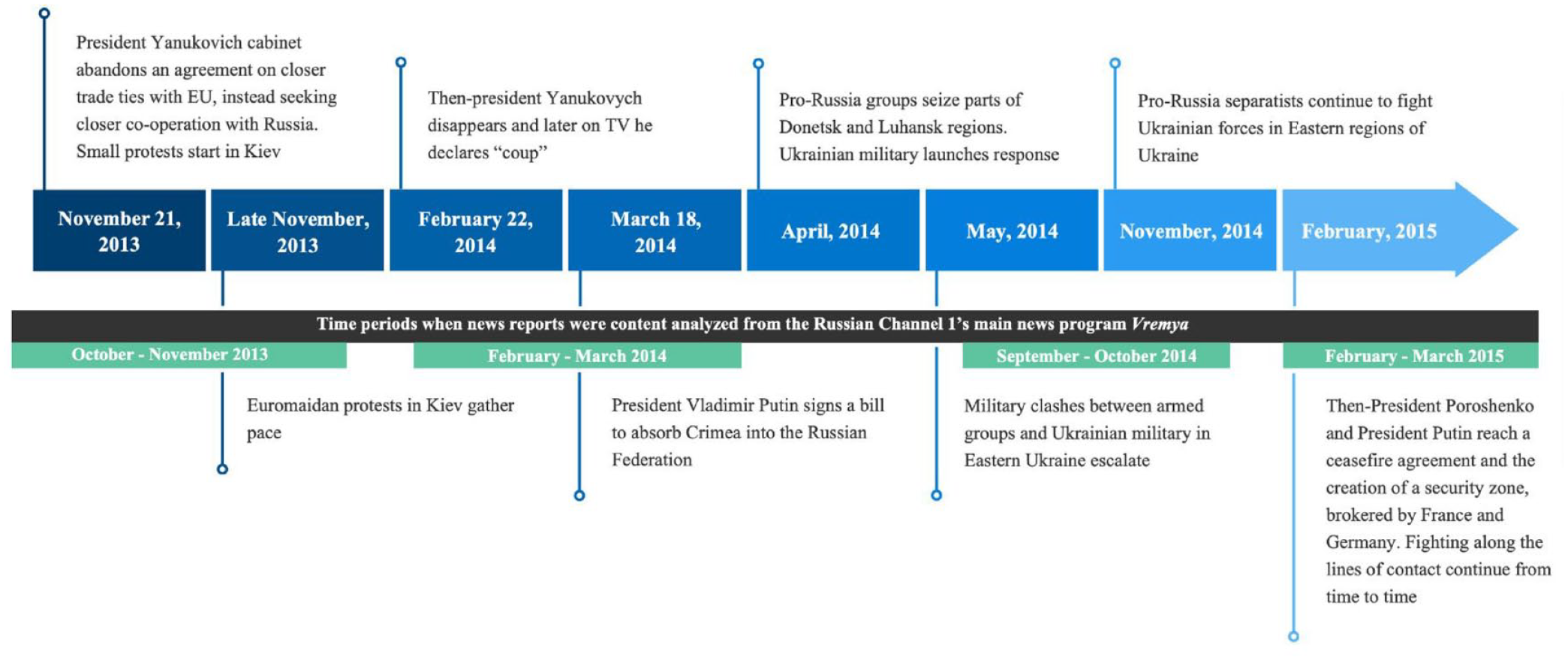
Event timeline in Ukraine (2013–2015 crisis) and content analysis of news reports.
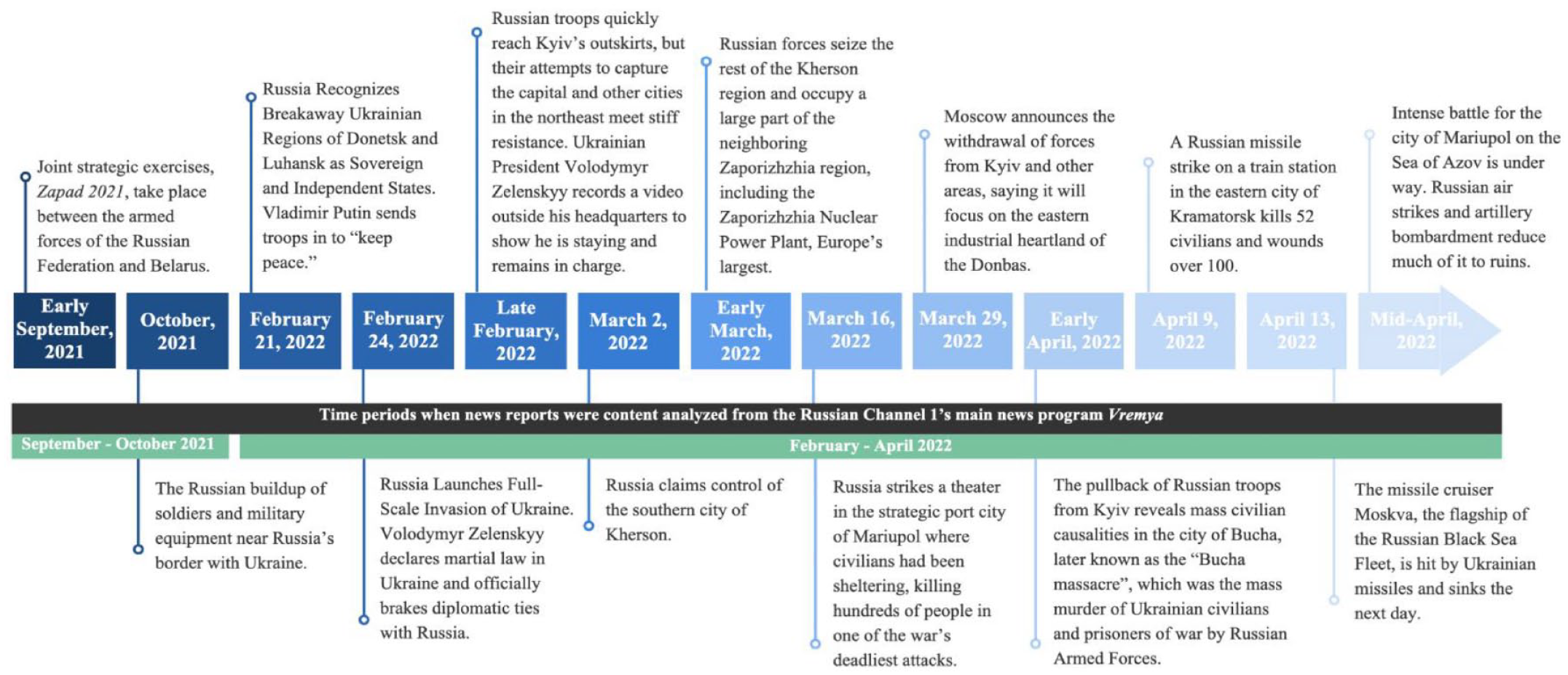
Event timeline in Ukraine (full-scale Russian invasion 2021–2022) and content analysis of news reports.
In 2021–2022, we studied the pre-invasion period (1 September–31 October 2021) and the invasion phase (1 February–30 April 2022). Each of the initial periods spans 38 days, while the latter two, covering 75 days, were coded bi-daily, resulting in 38 days of analysis for each.
We analyzed individual news stories aired on national broadcasts each day, focusing on their volume and content. 4 These televised stories, 3,410 over 228 days and six periods (15 per broadcast on average), were categorized on the website by title and sequence (e.g. 1/15). They are split into domestic policy (896), foreign policy (1,796 – covering a state’s external relations, including defense, economics, trade as per Wittkopf et al., 2007), and others such as entertainment (718).
We chose one to two stories from each broadcast for detailed analysis, emphasizing foreign policy and, for context, key domestic policy stories. 5 We coded the first domestic or foreign policy story from each broadcast, and if it was not about foreign policy, we also coded the next story that was. 6 Our coders, after viewing broadcasts from the initial periods, created a coding form and refined codes. They repeatedly viewed selected stories, analyzing video, audio, and text, to classify the sentiment towards Russian elites, Ukraine’s government, and Western actors as ‘positive’, ‘neutral’, or ‘negative’ (Grabe and Bucy, 2009). The valence frame scale includes such options as:
• Positive characteristics (e.g. resourceful, efficient, reliable, compassionate, fair, etc.)
• Neutral characteristics (e.g. balanced, cooperative, informative, etc.)
• Negative characteristics (e.g. incompetent, deceitful, cruel, biased, controversial, etc.)
We evaluated visual frames in the first news and foreign policy stories of each broadcast, creating categories and visual codes for each. Distinct frames were made for Russian, Ukrainian, EU, and US leaders and institutions, with fewer EU/US instances. The online Appendix details the visual frames, coding methods, and reliability.
Findings
To understand the narratives delivered to the Russian public via news media, we examine the content and structure of Channel 1’s premier news program, Vremya. Our analysis spans from before the onset of the Ukraine crisis through the escalation of the Euromaidan protests. Figure 3 highlights the evolution in Channel 1’s reporting, marking a distinct shift in narrative focus as the situation in Ukraine developed. Stories were categorized as domestic affairs, foreign policy, or miscellaneous – with a particular emphasis on coverage related to Ukraine. Contrary to previous impressions suggesting a prevalence of foreign policy stories on Russian news programs (Savin et al., 2018), Figure 3 reveals a different pattern. During periods of relative peace (fall 2013 and fall 2021), domestic issues were nearly twice as likely as foreign policy stories. Moreover, miscellaneous stories (entertainment/sports/other) were as prevalent as foreign policy stories during these two periods.
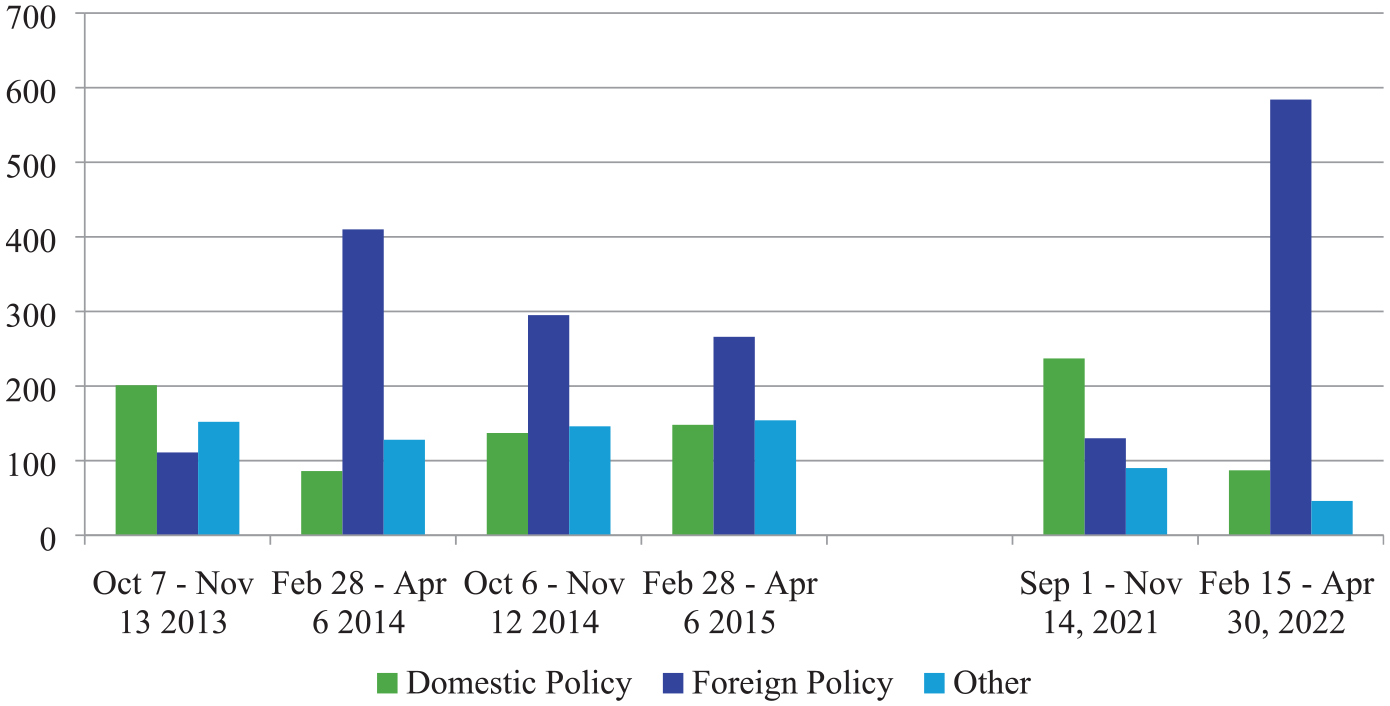
Relative coverage of story type by time period, Channel 1’s Vremya nightly broadcast.
Figure 3 reveals that, during times of intensified conflict in Ukraine, Channel 1’s coverage of foreign policy surged. In 2014, when the conflict was at its peak, 58.7 percent of stories focused on foreign policy, a significant increase from 36.5 percent in late 2013 and early 2015 when the conflict subsided: χ2(1) = 108.8, p < .001). Prior to the recent war, 28.4 percent of segments covered foreign policy, which nearly tripled to 81.5 percent with the onset of hostilities: χ2(1) = 329.1, p < .001. Combining both conflicts shows foreign policy stories constituted 67.2 percent during active fighting, as opposed to 34.0 percent in calmer times, χ2(1) = 369.0, p < .001, underscoring Ukraine’s prominence in Russian news and its importance to Russian leadership.
We assessed the emphasis on foreign policy in Vremya by analyzing the positioning of the first foreign policy story in the nightly lineup (Figure 4) and the overall airtime allotted to such stories (Figure 5). The program’s prioritization of the Ukrainian conflict was evident from the lead story’s placement; during active conflict, foreign policy stories opened the broadcast, a notable shift from their fourth or fifth position in quieter times, a statistically significant change (t(147) = 7.98, p < .001). Additionally, periods of conflict saw a significant increase in the total airtime for foreign policy, compared to periods of peace (t(3401) = 2.46, p < .02)
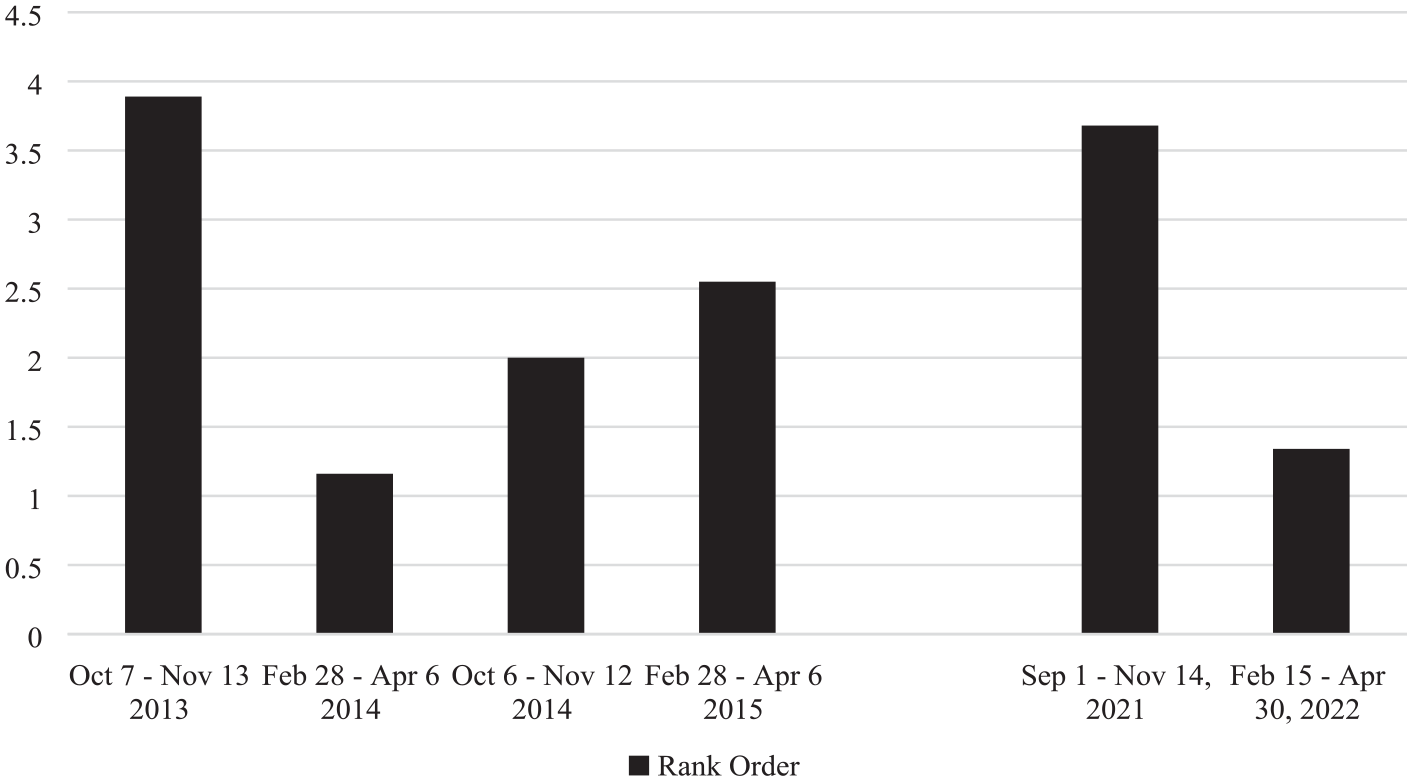
Occurrence of first foreign policy story during Vremya’s nightly broadcast, by time period.
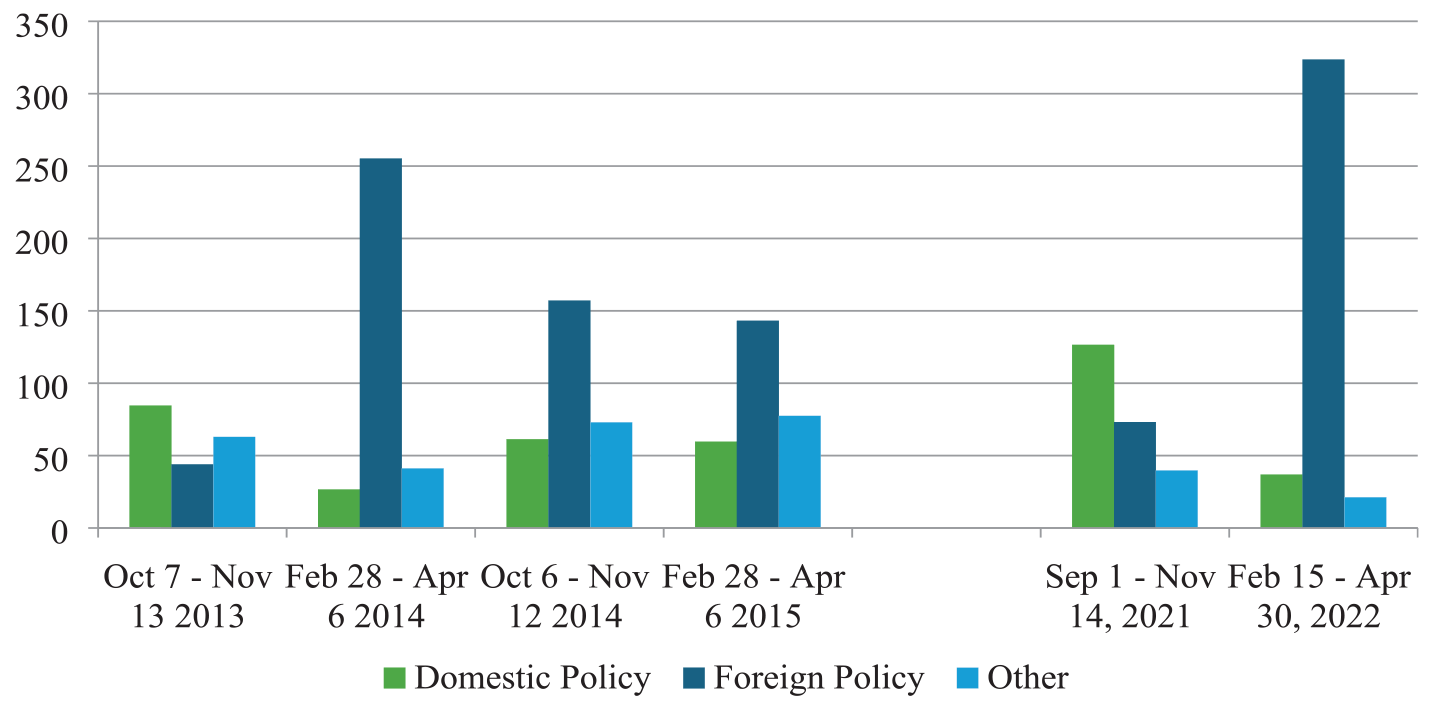
Total number of hours devoted to different types of stories during Vremya’s nightly broadcast, by time period.
We analyzed the sentiment of coverage using a 5-point scale from ‘Very Negative’ (1) to ‘Very Positive’ (5), coding the expressed attitudes toward Russia (including figures like Vladimir Putin and Russian institutions), Ukraine, and Western entities such as the EU, USA, and NATO. Figure 6 presents the sentiment trends for the initial foreign policy story in each broadcast. Consistently, coverage conveyed a very positive sentiment towards Putin and the Russian government, which intensified from an average of 4.1 in calmer times to 4.5 during active conflict (t(97) = 3.77, p < .001). 7
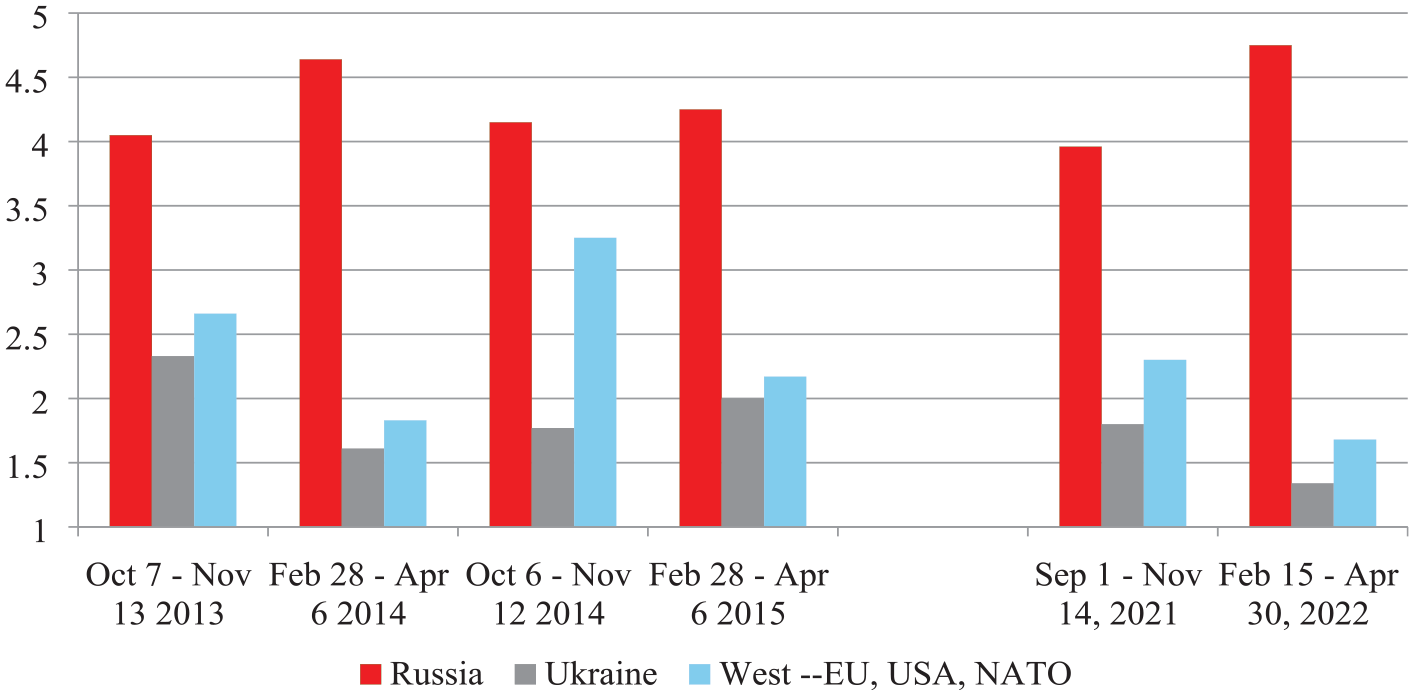
Average sentiment expressed toward different actors in the first foreign policy story from each broadcast, by time period.
On the contrary, average sentiment toward Ukraine and its leaders fell from a mean of 2.0 in peacetime to 1.6 during periods of active fighting (t(123) = 2.41, p < .02), showing a significantly more negative sentiment toward Ukraine and its leaders. Average sentiment in stories mentioning Western countries or their leaders or institutions was only slightly lower during periods of active fighting (2.3) compared to periods of relative peace (2.4). These numbers are skewed by the relatively high ratings received by leaders from France and Germany who were trying to negotiate peace during the fighting in the Eastern regions of Ukraine during September and October 2014. 8
Figure 7 reveals that Russian nightly news consistently portrays Putin and the government as key sources and figures in Ukraine’s crisis coverage, regardless of the conflict’s status. Our analysis focuses on the primary foreign policy story in each broadcast, categorizing sources into: (1) Putin and the Kremlin; (2) Russian officials; (3) pro-Russia Ukrainians; (4) Ukrainian leaders; and (5) the West, with an additional ‘other’ category for uncategorized sources. Vladimir Putin and the Kremlin remain the primary sources of information in our study, followed by Russian government officials from the Ministry of Foreign Affairs and Ministry of Defence during peacetime. During the times of active fighting, official Kremlin accounts are supplemented by accounts from pro-Russia actors in Ukraine, including rebels, Crimea leaders, Yanukovych, and civilians. This finding aligns with previous studies, such as Oates (2006), which demonstrated Russian authorities’ complete media control during the second Chechen War in 1999. A notable distinction between periods 2, 3, and 4 compared to periods 5 and 6 is the significant silence of Ukrainian political leaders on Russian TV news in late 2021 and 2022. This can be attributed to Vladimir Putin’s dismissal of Ukraine’s leadership in Kyiv before the invasion (Harris et al., 2022). Consequently, the views and positions of Ukrainian political leaders and institutions were disregarded as valid sources in Russian TV news. By predominantly framing foreign policy events through the Kremlin’s perspective, TV news consistently conveyed messages reinforcing political patterns where the Kremlin’s interests overshadowed discourse, serving the preferred political objectives of the Russian leadership.
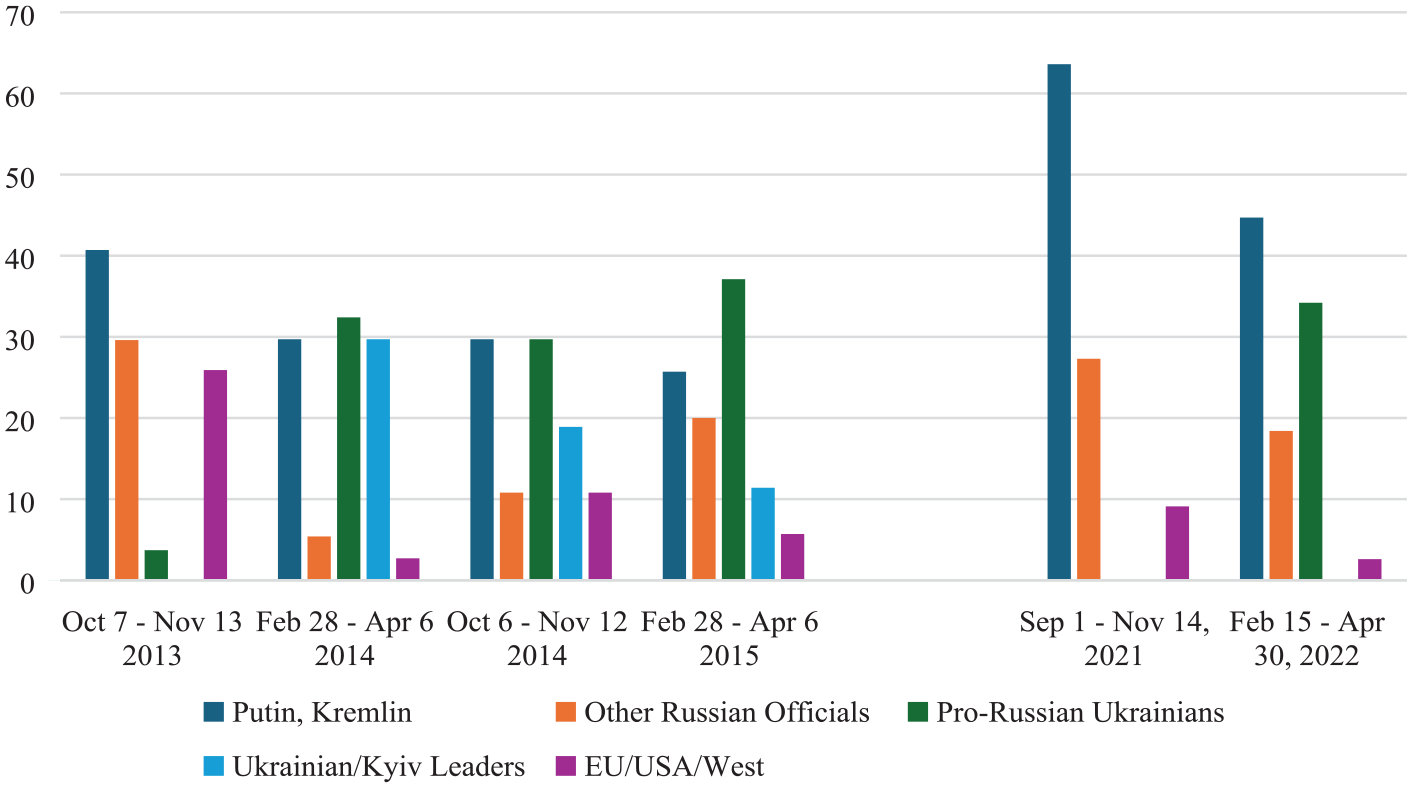
Primary source of first foreign policy stories by time period, Channel 1’s Vremya.
Figure 8 shows visual media frames during the peak of the Ukraine crisis (28 February – 6 April 2014), when Crimea was annexed, and in the period leading to the full-scale invasion in 2022 (1 September – 14 November 2021), depicting Russian leaders as powerful, visionary, and widely trusted. Across all six periods analyzed, a consistent visual frame highlighted the efficiency and innovation of Russian government institutions, especially those under Putin’s direct oversight. Agencies and officials appointed by Putin were depicted as competent problem-solvers, swiftly addressing economic and social challenges. This confirms previous studies indicating a noticeable bias toward the presidential administration in Russian state television (Oates, 2006; Rozenas and Stukal, 2019).
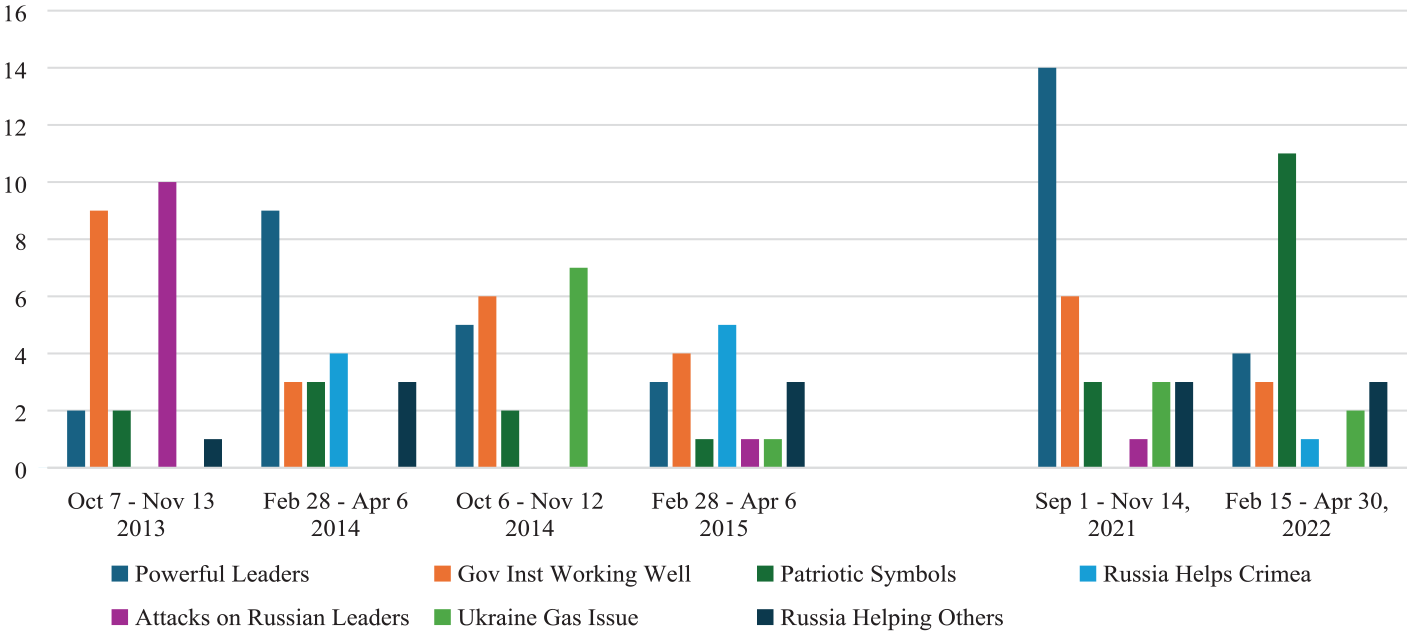
Media frames employed by Channel 1’s Vremya in foreign policy stories about the Russian government.
During our final period of data coding, coinciding with the onset of overt military actions in Ukraine in 2022, the use of patriotic symbols by Channel 1’s Vremya – soldiers in military attire, Russian military arsenal, the Russian flag, and Russian government buildings – increased significantly. This marked a departure from earlier periods when Russia’s support for armed groups in Eastern Ukraine was not officially recognized, and such patriotic displays were less prevalent.
Figure 9 illustrates visual frames concerning Ukraine, its leaders, and its institutions. Ukraine received minimal coverage during our initial study period in late 2013, with limited mentions continuing into the fifth period just before the full-scale invasion. A predominant frame post-crisis blamed the Ukrainian government and its army for casualties in the Euromaidan uprising and Donbas confrontations. Political and economic instability depicting Kyiv’s politicians in internal conflict was prevalent in the second, third, and fourth periods. Frames portraying Ukrainian citizens as pro-Russia and anti-Kyiv leaders peaked around the invasion, reflecting Russia’s anticipation of a smooth occupation without resistance (Miller and Belton, 2022).
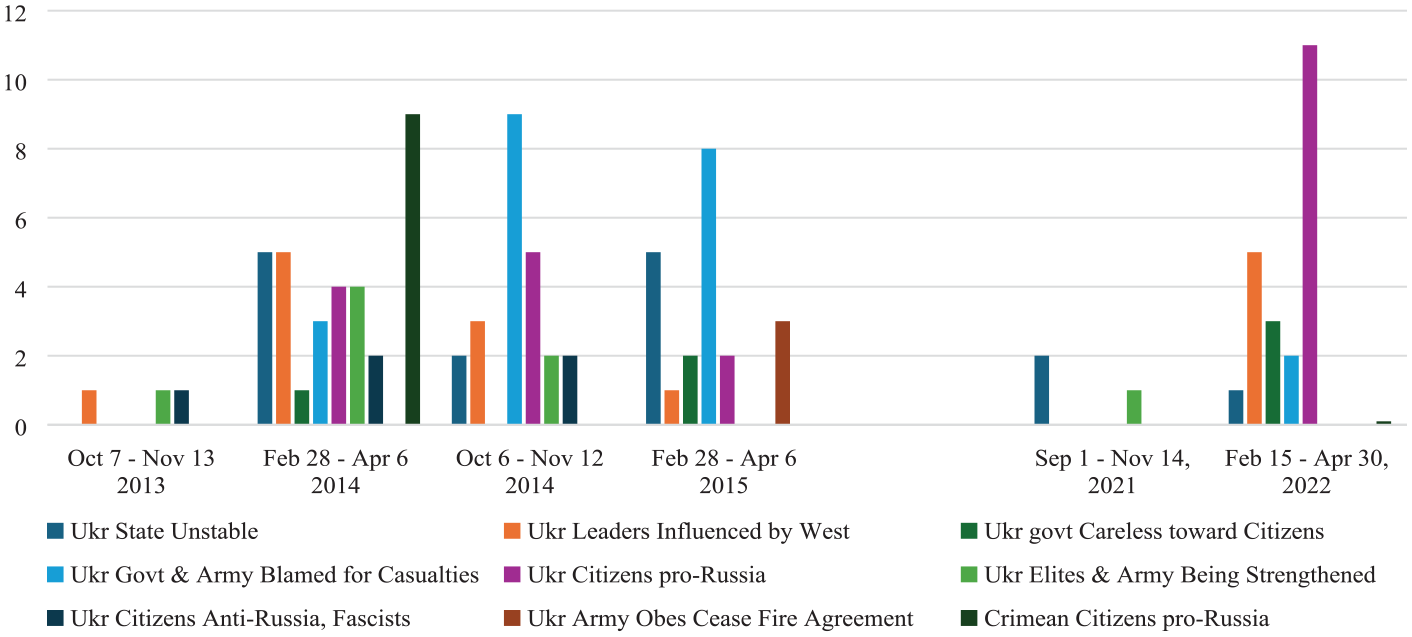
Frames employed by Channel 1’s Vremya in foreign policy stories about the Ukrainian government.
Figure 10 outlines key frames used by Vremya to depict the EU and the US during the study periods. Initially, the portrayal of EU and US leaders as reliable partners was common before hostilities with Ukraine. However, the negative frame of Western leaders being untrustworthy prevailed, even outweighing the positive frame. This positivity resurfaced when French and German diplomats aided ceasefire negotiations in Eastern Ukraine a year later. Notably, during the crisis in 2014 and early 2015, coverage of the West significantly diminished, only reappearing in the fall of 2021, another period of calm. A new frame emerged in fall 2021, highlighting perceived unfair treatment of Russian leaders by the Western press. Throughout the war, Western leaders were consistently depicted as opposing Russian interests.
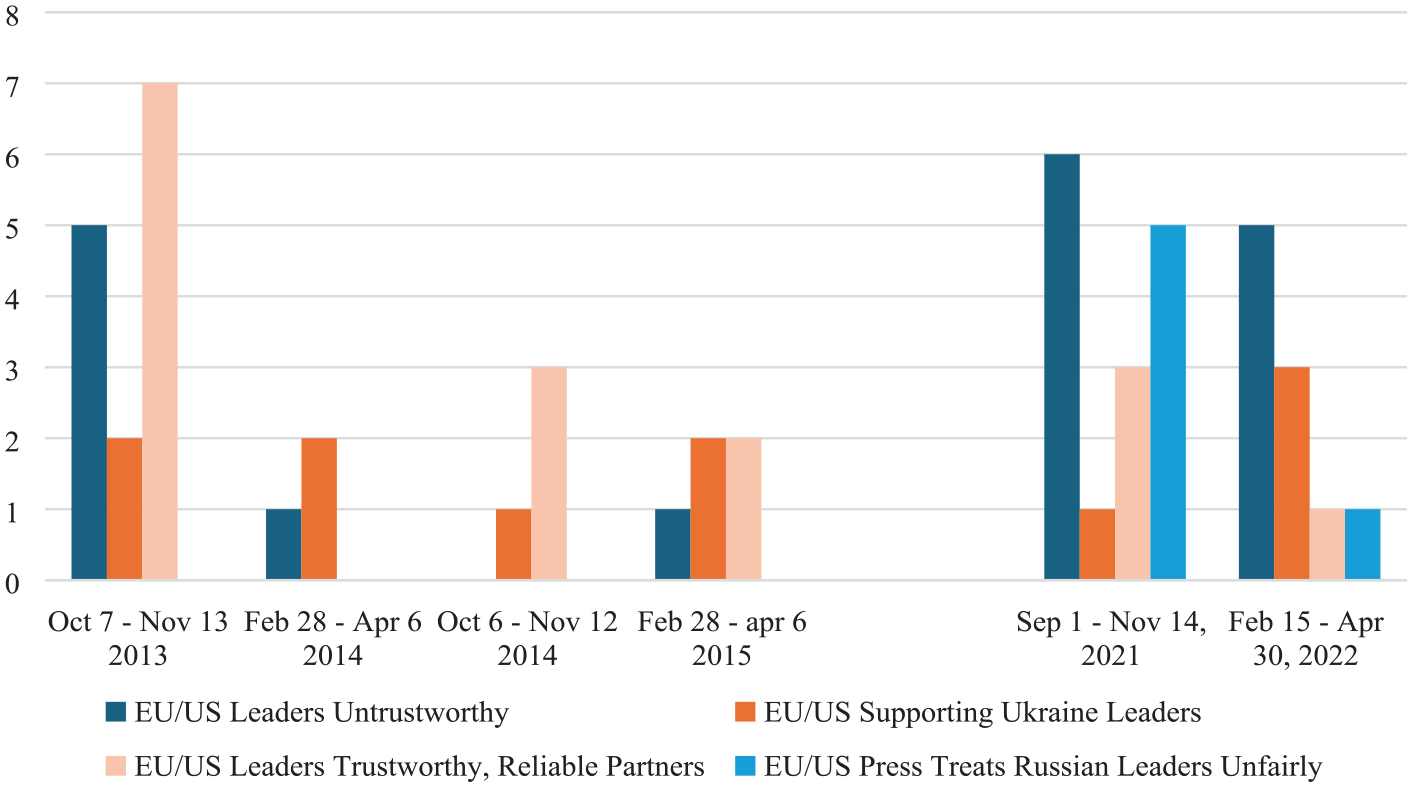
Media frames employed by Channel 1’s Vremya in foreign policy stories about the EU and US.
Finally, we confirm previous findings (Cottiero et al., 2015; Gaufman, 2015; Khaldarova, 2021) that Channel 1’s Vremya often framed foreign policy stories on Ukraine through a ‘fascism’ lens. As shown in Figure 11, although absent in the first periods of examination, the term emerged during the conflict with Ukraine in early 2014, labeling Euromaidan participants and post-Yanukovych leaders in Kyiv as fascists. During periods 2 and 3, over a third of examined stories referenced ‘fascism’, decreasing in period 5 before resurging during the actual Russian invasion in periods 5 and 6. Overall, 30.4 percent of the stories occurring during periods of active fighting mentioned fascism, with only 2.7 percent of the stories during relative peace doing so, a difference that is highly significant (χ2(1) = 40.23, p < .001). As previously shown (McGlynn, 2023), Russian media utilized WWII narratives ingrained in the public consciousness to frame the Ukraine conflict as a struggle for the Russian state’s existence, paralleling the portrayal of WWII to the Russian public.
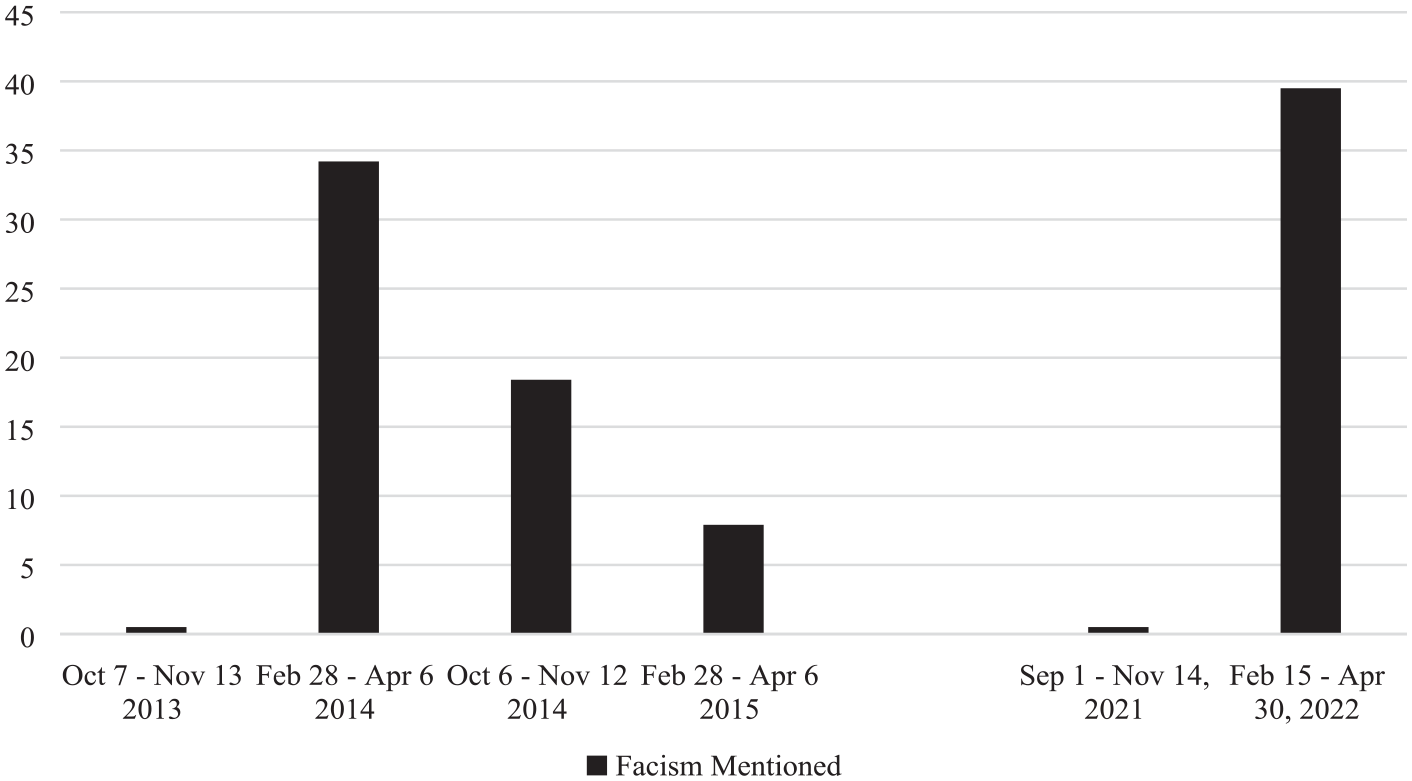
Occurrence of fascism frame in foreign policy stories, by time period.
Discussion and conclusion
This section investigates the evolution of Russian state TV’s narratives around the Ukraine crisis at key moments: before the 2013 tensions, the 2014 Euromaidan and Crimea’s annexation, and the 2022 invasion. It reveals how Russia’s political elite craft narratives to bolster domestic backing and further foreign policy aims. Through strategic historical and ideological framing, the media emerges as an instrument for shaping collective memory and swaying public opinion, with significant implications for regional and global affairs. The analysis highlights the critical role of media scrutiny in influencing geopolitical dynamics.
Our research reveals changes in the content and emphasis of Russia’s Channel 1 Vremya news during varying conflict levels. Peaceful times saw a focus on domestic politics, while escalating conflict in Ukraine shifted the spotlight to foreign policy, particularly stories about Ukraine, which began leading broadcasts and receiving more airtime. This suggests the Kremlin’s deliberate effort to highlight the Ukraine conflict’s importance to Russian viewers.
The nightly news promotes an identity narrative depicting Russian President Vladimir Putin and other Russian elites as competent and intelligent leaders. This positive portrayal remains consistent during peaceful times and intensifies further during periods of active conflict. Additionally, the news reinforces the narrative of trustworthiness of the Russian leaders, with Putin and other government representatives being the most prominently quoted or featured sources on the nightly broadcasts. In times of active conflict, official Kremlin accounts are supported by narratives from pro-Russia actors within Ukraine, including proxies for Russia in the Donbas region and local civilians with pro-Russia stances. Conversely, the news reinforces the identity narrative depicting Ukrainian leaders as untrustworthy and incompetent, both in peacetime and during active conflicts. This unfavorable portrayal intensifies, especially during periods of increased military activity. Notably, not only were Ukrainian leaders portrayed negatively, but official Ukrainian perspectives were almost absent as news sources in the period leading up to the full Russian invasion in late 2021 and early 2022. This can be attributed to Vladimir Putin’s dismissal of Ukraine’s leadership in Kyiv before the invasion. As a result, the opinions and positions of Ukrainian political leaders and institutions were disregarded as credible sources in Russian TV news. By predominantly presenting foreign policy events from the viewpoint of the Kremlin, TV news consistently conveyed messages reinforcing political trends that aligned with the preferred political goals of the Russian leadership.
Before the Euromaidan uprising, Ukrainian events had minimal coverage on Russian nightly news. However, post-crisis, Ukrainian leaders are portrayed as embroiled in internal conflicts and blamed for Eastern Ukraine’s war casualties and economic woes, while citizens are shown with pro-Russia stances. In contrast, Russian leaders are depicted as competent. The underlying message appears aimed at persuading Russian audiences of the benefits of Russian governance, implying that Ukrainian lives would markedly improve under the stewardship of skilled Russian authorities.
Before Ukraine’s crisis, the EU and US leaders were shown as reliable by Russian media. Post-crisis, they were negatively framed as antagonistic to Russian interests, particularly in 2022. The Russian elite reframe Russia’s role in conflict against Western policies to bolster national unity and inform foreign policy (Claessen, 2021; Miskimmon and O’Loughlin, 2017). Such media narratives exploit anti-Western sentiments, historically leveraged in Russia’s domestic politics (Shiraev and Zubok, 2000), and may exacerbate West–Russia tensions (Baumann, 2020). The elites could use this strategy to advance Russia’s regional and global ambitions.
Finally, the framing of Ukraine’s stories through the ‘fascism’ lens and WWII terminology taps into the emotional and historical significance of WWII for Russia. This lexicon holds deep collective memories for the Russian public. Connected to the above-mentioned narrative of hostility toward the West, one aim of this framing is to shift blame from Russia to the West for events in Ukraine (Pynnöniemi and Rácz, 2016).
Supplemental Material
sj-pdf-1-mwc-10.1177_17506352241257053 – Supplemental material for Narratives of conflict: Russian media’s evolving treatment of Ukraine (2013–2022)
Supplemental material, sj-pdf-1-mwc-10.1177_17506352241257053 for Narratives of conflict: Russian media’s evolving treatment of Ukraine (2013–2022) by Ecaterina Locoman and Richard R Lau in Media, War & Conflict
Footnotes
Acknowledgements
The authors extend their deepest appreciation to Barbie Zelizer, Timothy M. Frye, Julia Gray, Dariya Orlova, Alexandru Zanca, Ion Socolenco, the editor, and the two anonymous reviewers whose insightful comments and constructive feedback on earlier drafts have been invaluable to the development of this manuscript.
Funding
The authors received no financial support for the research, authorship, and publication of this article.

Supplemental material
Supplemental material for this article is available online at.
Notes
Author biographies
Address: Rutgers University, New Brunswick, NJ, USA. [ email:
References
Supplementary Material
Please find the following supplemental material available below.
For Open Access articles published under a Creative Commons License, all supplemental material carries the same license as the article it is associated with.
For non-Open Access articles published, all supplemental material carries a non-exclusive license, and permission requests for re-use of supplemental material or any part of supplemental material shall be sent directly to the copyright owner as specified in the copyright notice associated with the article.
