




Abstract
The Russian full-scale invasion of Ukraine on 24 February 2022 was a culmination of anti-Ukrainian rhetoric that Russian political elite and state-controlled media have been promoting at least since 2013. Apart from accusing Ukraine of being a Neo-Nazi state, pro-Kremlin commentators have espoused a heavily gendered rhetoric describing Ukraine as a loose woman in need of saving by its older brother. Gendered discourse was instrumentalized in Russian foreign policy not only through aggressive masculinity, but also through femininity. The latter, in contrast, sought to downplay the aggressive masculinity associated with fascism and consequently diminish Ukraine’s agency and status compared to Russia. This article offers a taxonomy of feminization rhetoric that shows how different types of gendered constructs influence the success of securitization process. Drawing on empirical material from Russian social networks during the first war in Ukraine in 2014–2016, this article argues against gender’s silencing role but, instead, its central role in influencing every stage of securitization process. Moreover, the author shows how feminization rhetoric paved the way to the legitimation of the current war.
Introduction
‘Like it or not, you have to take it, my beauty’, said Russian president Vladimir Putin to the astonished French president Emmanuel Macron across a very large table on the eve of Russia’s full-scale invasion of Ukraine in February 2022. This obscene rape joke was supposed to reference the fact that Ukraine had to accept the terms of the Minsk agreements whether it liked it or not, but it was not the first time that Ukraine and Russia were placed in a gendered hierarchy in Russian foreign policy discourse. While feminist scholarship has been quite vocal about gendered metaphors in international relations (e.g. Peterson, 1992; Shepherd, 2006; Sjoberg and Gentry, 2007; Tickner, 2002), the representation of referent objects in securitization discourses has been accorded less scrutiny 1 than the masculinity of securitizing actors who are supposed to save the damsels and their children in distress (O’Mochain, 2018; Wibben, 2016).
Politicians routinely employ gendered metaphors in foreign policy legitimation (Tickner, 2002). It is unclear, however, whether the population reinforces the gendered metaphors uttered by politicians on a mass scale, as securitization analysis often focuses on the elite and not grass roots securitization moves (Vaughan-Williams and Stevens, 2016) focusing on its performativity. However, turning to the audience of securitization in research is a vital step for assessing the success of securitization (Lupovici, 2019). Studying the grass roots discourses on conflicts can provide a useful insight into the way the audience perceives them. Given how engrained the digital sphere is in our everyday lives (Weber, 2013), this article aims to explore the kinds of gendered tropes that are employed in the online discussions of an ongoing Russian war against Ukraine. This way, following the epistemological lead of Vaughan-Williams and Stevens (2016), the article offers a study of the audience of securitization process as opposed to the usual emphasis on the securitizing agent or mass media pointed out in the meta-analysis by Côté (2016). Moreover, by applying a gendered approach to the securitization theory, this article intends to show how feminization plays out in foreign policy narratives, exposing the way that gendered rhetoric influences securitization process.
Specifically, this article shows how different constructs of femininity embeddedness can spur or derail the securitization process. It does so by utilizing multimodal discourse analysis to parse gendered metaphors in debates surrounding the first Russian–Ukrainian war on Vkontakte (VK), the Russian social network in 2014–2016. In the following sections, this article explores the role of gender in the securitization process, and subsequently offers an in-depth case study of the debates around Ukraine among Russian-speaking social media users as a response to the Russian government’s effort to frame the war against Ukraine.
Gender and audience in securitization process
Securitization theory has come a long way since the landmark publication in 1998 of Security: A New Framework for Analysis (Buzan et al., 1998) that argued for an intersubjective understanding of security. Not only has it moved beyond the five political sectors where securitization could potentially take place (economic, societal, military, political and environmental), but it also incorporated analysis of gender and race (Gomes and Marques, 2021), as well as moving beyond speech act (Guillaume, 2018) and to everyday practices and discourses (Balzacq et al., 2010; Bigo, 2002). In its original conceptualization, a mere uttering of ‘security’ was enough to place a matter outside the realm of ‘normal politics’ (MacDonald and Lake, 2008) but, in later versions, securitization’s success has been mostly associated with the adoption of extraordinary measures to deal with the existential threat to the referent object.
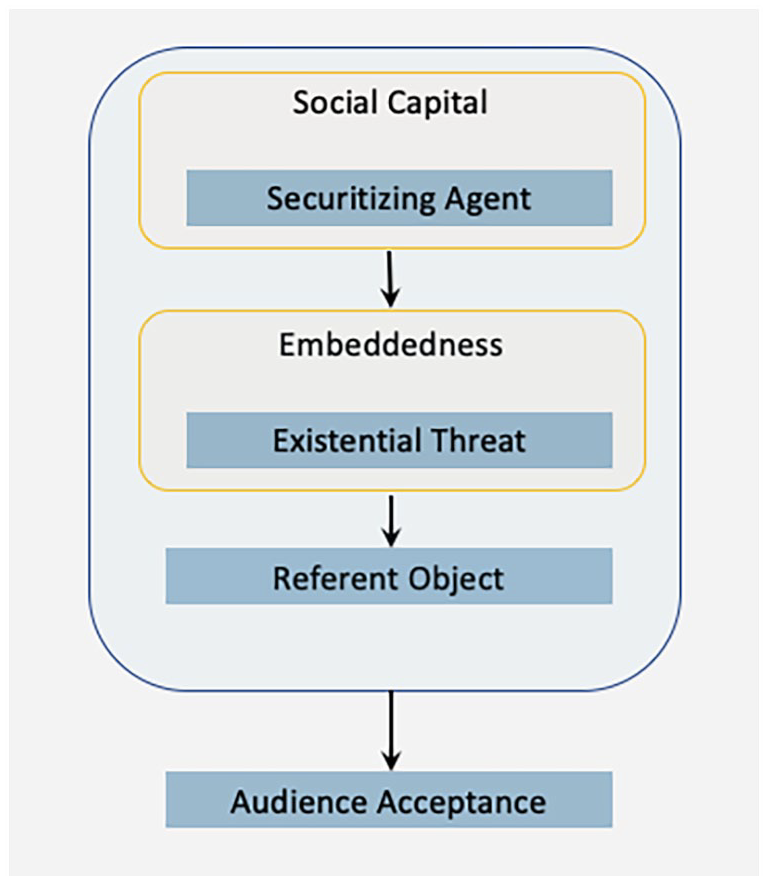
Balzacq (2016) suggests that an ideal type securitization theory is one that involves an audience as it completes a securitization process to a logical whole, while some scholars analytically marginalized the role of the audiences (Bourbeau, 2011; Hansen, 2011) or addressed it cursorily (Floyd, 2019, Ide et al., 2017). Representation of referent objects has been analysed by securitization scholars, most notably in Vuori (2010), Watson (2011) and Bagge Laustsen and Wæver (2000), but there has been little work done on the theorization of the successful framing of a referent object. Figure 1 outlines the securitization process and its facilitating conditions.
Securitization process.
Figure 1 provides an overview of a securitization process, in which a securitization agent with ‘the power to make generally accepted claims about security’ (Färber, 2018) is supposed to embed their existential threat narrative in contextually mobilized patterns of heuristic artefacts (Balzacq, 2011) and identify a clear referent object of the threat. If this process is successful, the audience accepts it and the securitization actor gains legitimacy to adopt (extraordinary) political measures.
Where does gender come into the securitization process above? Lene Hansen (2000) emphasized early on that there was an absence of gender in securitization framework and pointed out the importance of the role of silencing that maintains gendered insecurity. A number of feminist researchers identified the importance of a gendered lens on processes of securitization (Aradau, 2018; MacKenzie, 2009; Wilkinson, 2007). For instance, in cases of climate migration, gendered analysis of securitization can focus attention on human security issues (Detraz and Windzor, 2014) or moving against the state-centric and security professionals’ understanding (Bilgic, 2014). But, so far, gender has not been an intrinsic part of securitization theory per se. This article shows how gendered constructs serve as a facilitating condition on all levels of the securitizing process.
Scholars often underline that presenting a referent object as a woman or child is a particularly successful strategy (Cooper-Cunningham, 2019; Massari, 2021; Satjukow and Gries, 2004; Watson, 2011) that would emphasize the urgency of the threat from the ‘enemy’. In other words, an effective framing of a referent object is one that is feminized and constructed as an entity in need of saving, both in verbal and visual form – a stereotypical damsel in distress – that would warrant extraordinary political measures to protect her.
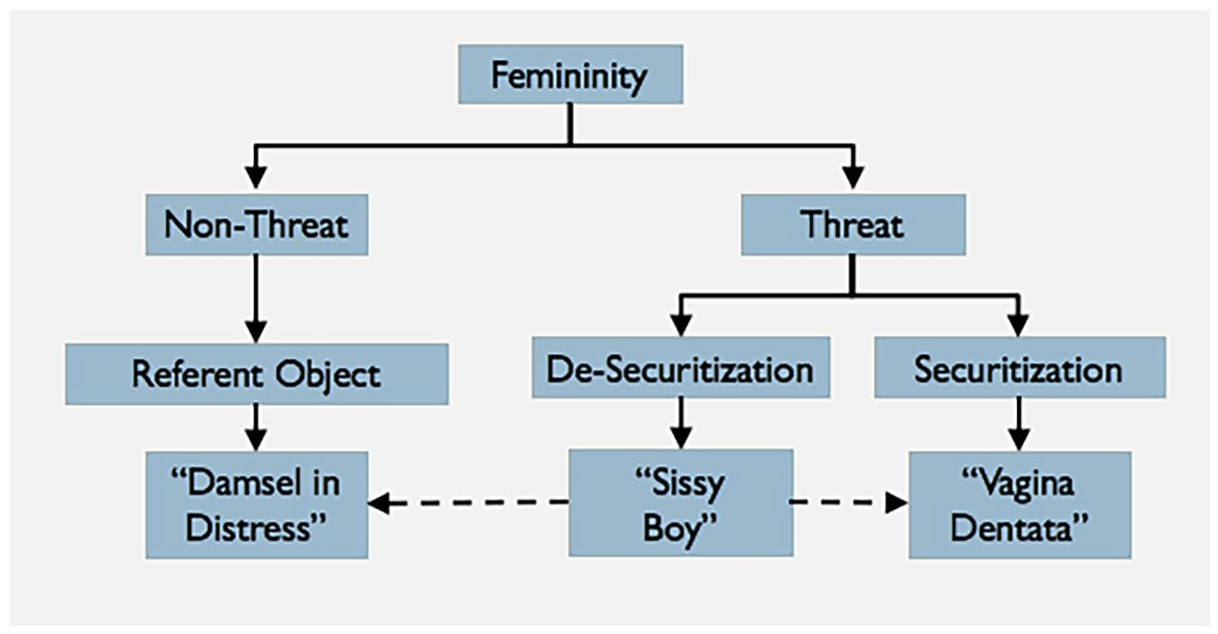
However, if femininity is categorized as a threat, it can either follow a de-securitization route or a securitization route. In the first case, femininity is usually conceived of as a ‘lesser’ male – a stereotypical wimp, a sissy boy. Megan MacKenzie (2009) pointed out this difference as well: female fighters in Sierra Leone were often described as somebody ‘associated with combat’ or ‘camp followers’, thus having no agency and being on a lower level in the hierarchy. MacKenzie described this phenomenon as de-securitization: in the context of a war, women could only be a victim, a damsel in distress, at the bottom of the gender hierarchy of a post conflict society. The de-securitization of femininity, however, usually evolves into a damsel in distress (i.e. a referent object) or becomes re-securitized as a deviant female and thus a threat to a heteronormal society (an existential threat).
Finally, if femininity is categorized as an existential threat, it often harks back to the ‘vagina dentata’ narrative, where femininity is deemed so dangerous that a woman can literally emasculate her mate. This kind of construct can be traced back to folkloric representations (Berezkin and Duvakin, 2021) of women in various societies from around the world. During the Middle Ages in Europe, this trope contributed to representation of women as witches and legitimized cases of violence against women or even femicide (De Blecourt, 2000). In contemporary discourse, it is associated mostly with the fear of politically active women or so-called ‘castrating first ladies’, as Ducat (2005) would put it. Even though there are multiple tropes that are used to construe femininity in a securitization discourse, most of them fall within the three archetypes summarized in Figure 2.
Constructing femininity.
Figure 2 shows that constructs of femininity can function either as referent objects or threats in a securitization process, which is a logical binary in a heteronormal paradigm. Turning a ‘regular’ male into a sissy boy is supposed to eliminate the existential nature of the threat – a smaller nuclear button is supposed to make Kim Jong-un’s North Korean regime inferior and ‘feminine’ compared to the US. At the same time, a femininity that is deemed as a non-existential threat can turn into a damsel in distress. Previously, this framing was used in colonizing discourses such as ‘the white man’s burden’ that represented indigenous population as lesser humans in need of education and salvation. In more contemporary policy legitimation, this type of rhetoric becomes more of an orientalist trope, often expressed through ‘rescuing’ veiled and oppressed women from backward political regimes, usually in the Global South (Hansen, 2020). Alternatively, femininity can be securitized through the trope of male deviancy, which is then portrayed as dangerous for the society, much like the overly (politically) active women who do not assume traditional roles in a (patriarchal) society. Given the overwhelming prevalence of heteronormativity across cultures (Bunzl, 2000; Fradenburg and Freccero, 2013,) it is little wonder that othering binaries were common, upholding the male as a norm and female as a deviation, not to mention any other gender identities that come in between.
Feminist scholars have noted multiple times that gender implies a hierarchy and priority in (security) discourse, favouring a male actor (Geeta and Nair, 2013; Hoogensen and Rottem, 2004; Peterson, 1992). This way, feminization constructs contribute to the inflation of the social capital of the securitizing agent. With a feminized referent object, a securitizing agent affirms their masculinity through the rescuing trope; a sissy boy narrative establishes a gendered hierarchy occupying a higher position for the securitizing agent; and a vagina dentata narrative polices the deviant femininity (Sjoberg and Gentry, 2007) that can threaten the established gender pyramid. Thus, gendered discourse can appear on all levels of the securitization process: on a securitizing agent level, on a threat construction level and on a referent object level. Each of the instances of the gendered rhetoric would have a profound effect on the securitization process success and failure: acceptance by the audience and adoption of extraordinary measures to combat the threat.
Once a phenomenon is gendered and embedded in existing discursive practices, it either becomes an existential threat or a referent object determining the acceptance by the public. Moreover, by asserting a gendered hierarchy, a securitizing agent increases its social capital in an heteronormative society. If, however, a phenomenon is gendered as a ‘sissy boy’, it can lead both to securitization and de-securitization. The empirical section of this article will first discuss the embeddedness of feminization discourses in collective memory and then the feminization tropes in the audience’s rhetoric in order to determine the acceptance, i.e. success, of securitization processes.
Embeddedness of femininity in securitization discourses
Balzacq (2005: 186) argues that, in order to be successful, a securitization narrative needs to fit within the ‘predominant social views, trends, ideological and political attitudes that pervade the context in which participants are nested’. The collective memory of feminizing discourses renders these types of narratives more embedded and therefore more effective, according to facilitating conditions in securitization theory. However, the feminizing discourse does not necessarily represent a female; it extends to other gender identities within a patriarchal society, where only a culturally appropriate (amount of) maleness lies at the top of the gender hierarchy (Connell and Connell, 2005; Sperling, 2014).
In securitization narratives, feminization is often used to represent a referent object through the ‘damsel in distress’ trope. In other words, in a context of an existential threat narrative, the most common way to frame it is to represent a referent object as a female or as a child in need of protection (Jeffords, 1991; Kumar, 2004): whether it is a Chinese war poster, a Spanish civil war poster, or a Soviet World War II poster (see supplementary material, available at: [TSQ]). Despite the fact that these posters might have other securitizing messages, all of them feature a damsel in distress, either in the guise of a female or a child, and are portrayed as being threatened by rape or other physical harm. On the whole, these posters can create a narrative continuity with contemporary social media posts that often literally re-use them to make a point about contemporary issues (Kalkina, 2020; Seiffert-Brockmann et al., 2018). In the context of Russia’s war against Ukraine, it can be best exemplified by the ‘Save Donbas Children’ (visual) narrative (Khaldarova and Pantti, 2016).
Many societies, from ancient Greece to the modern-day US, are concerned with the adequate amount of masculinity in their males, with giving the impression of being a wimp or too effeminate being a major violation of the perceived social equilibrium (Ducat, 2005). Moreover, cultures that equate penetration with domination (Halperin, 1989) reflect a similar hierarchy in politics, glorifying appropriately masculine ‘real men’ ‘with balls’ (Ducat, 2005) and undervaluing femininity and non-conventional gendered performances, both male and female. The wimp factor is especially pertinent for global politics that is built on perceptions of hierarchy (MacDonald and Lake, 2008; Peterson, 1992; Sjoberg, 2017), favouring the male, i.e. supposedly dominant position. At the same time, it is up to the securitizing agent, a masculine entity, to save the damsel in distress, which increases the enunciator’s social capital and fixes the fragile masculinity of the securitizing agent. In Russia, the concept of homosexuality is another vivid example of a gendered hierarchy. Homosexuality is considered an infraction of masculinity, a ‘feminine’ quality undesirable for men, which in terms of obscene language puts a man on a lower hierarchical level. At the same time, female homosexuality, even though listed in the same sexual perversion category, was never regarded as problematic (Kondakov, 2014) because it did not constitute an attack on the existing gendered hierarchy.
Feminization often serves as a tool to underline the ‘otherness’ of an enemy and herein lies its potential to become conceptualized as a threat. Most cultures around the world feature some kind of variation of the vagina dentata myth, which implies that femininity could be so dangerous that it might literally emasculate a male. Gilman (1991, 2000) argues that even the notion of ‘diseased’ was also associated with the ‘female’. The US National Library of Medicine offers a range of 1940s public health campaign posters that argued that women could be ‘bags of trouble’ or ‘may look clean – but . . . spread syphilis and gonorrhoea’ (National Library of Medicine, 1940), illustrating the thesis that ‘female’ equals ‘disease’. Within these narratives, ‘female’ was often portrayed as posing a threat to masculinity, notably but not uniquely, via the spread of diseases – a later reformulation of the vagina dentata myth.
The Pussy Riot trial in 2012 catalysed the discussion of Russia’s ‘spiritual bonds’ and the sexual performativity that is deemed (un)acceptable in Russian society as a cultural entity. The active, assertive woman became an existential threat given the sexualization and masculinization of Russian politics since the ascent of Putin to power (see Riabova and Riabov, 2011, 2013; Sperling, 2014; Wood, 2016). As the entire structure of political legitimacy is centred around a patriarchal understanding of Putin as a hypermasculine, ‘real man’ (Riabova and Riabov, 2013; Wood, 2016), there is no place for feminine qualities or effeminate men in the governance spaces.
This phenomenon is not unique to Russia. Fear of politically active women is illustrated at its best in anti-suffragette caricatures during the early 20th century in the UK and the US. Suffragettes were described as ‘plain things’ who were ‘old maids’ (i.e. too ugly to attract a man) and the only reason for them to demand voting rights was because ‘nobody loved them’ (History of Feminism, 2012). In the Post-Soviet context, the description of a feminist as someone whom nobody loves was quickly translated into the more literal ‘not fucked enough’ (Plakhotnik, 2008; Sperling, 2014). At the beginning of the 20th century, the main threat of female voting was associated with the fact that women would start wearing trousers and force men to take care of the children, but this threat is in fact a much more deep-seated fear of emasculation, ultimately related to castration (Ducat, 2005).
The discourse surrounding Ukraine in Russia was consistently dominated by the aggressive masculinity fascism narrative which has very strong existential threat embeddedness in Russia (Oushakine, 2009). Feminization tactics employed in relation to Ukraine nonetheless have links to the ambivalent threat narrative visible during the World War II media coverage in the USSR: while the gravity and urgency of the fascist threat was often exemplified with headlines such as ‘Kill the German’, Hitler was also often portrayed in Soviet magazines as a hapless, non-muscular nitwit who could easily be defeated (Golubev, 2008) – a de-securitization tactic designed to present the threat as ultimately ‘defeatable’ – as a sissy boy in the above-mentioned taxonomy.
Methodology
Even before the full-scale invasion in 2022, several researchers pointed out the importance of mass media in the dynamics of the war against Ukraine (Makhortykh and Gonzalez Aguilar, 2020; Makhortykh and Sydorova, 2017; Metzger and Tucker, 2017; Onuch, 2015; Szostek, 2014). Russian mass media were dominated by a discourse on fascism 2 and other collective memory references to existential threat narratives (Baysha, 2014; Snyder, 2014), evocative of massive casualties and atrocities associated with the Great Patriotic War. Several researchers pointed out that Euromaidan was securitized in the Russian media through collective memory of fascism (Makhortykh, 2018; Onuch, 2015). But gendered discourse was instrumentalized in Russian foreign policy not only through aggressive masculinity, but also through femininity. The latter, on the contrary, sought to downplay the aggressive masculinity associated with fascism and consequently diminish Ukraine’s agency and status compared to Russia.
The attitude towards Ukraine in Russia tends to be condescending, with pro-Kremlin actors usually putting forward the argument that Ukraine has never been an independent state and has always existed as an appendage of the Russian Empire and Poland (Paulsen, 2013). This discussion, however, can also be analysed in gender categories, as Ukraine’s supposedly subordinate role in geopolitical terms is often conveyed through feminization (Sperling, 2014). This framing is not unique to the 2014–2016 discourse and, as pointed out in the introduction, has been continuously used by pro-Kremlin actors and laid the groundwork for the acceptance of the aggression against Ukraine in 2022.
But, apart from the barrage of anti-Ukrainian propaganda on Russian state television, the primary source of information for the absolute majority of Russian citizens (Volkov and Goncharov, 2014), Russian social networks were an important discrusive space as well. Moreover, Russia’s internet audience in 2015 represented 70.4 percent of the Russian population, or 84 million people (Vedomosti, 2016). This is a majority of the Russian population and is a key demographic that constitutes the electorate for the coming generations. Hence, the Russian government has spent substantial sums of money to promote the pro-governmental point of view on social networks and beyond (Gunitsky, 2015).
VKontakte (VK), a Russian version of Facebook with over 410,000,000 million accounts is by far the most popular social network in Russia, with the biggest monthly audience and the largest number of posts per month (Brand Analytics, 2016). VK allows its users to create ‘communities’ (similar to Facebook pages or groups) where users can post statements, photographs, memes and music that relate to the theme of the group. This article will concentrate on analysing the discourse in one specific VK community – Antimaidan – at the time, the most popular public page associated with Ukraine and Russian foreign policy, in general, with more than 500,000 subscribers.
Antimaidan represents a consistently jingoistic and supposedly patriotic type of discourse that is often dismissed by scholars who are more interested in studying oppositional discourses on social networks (e.g. Enikopolov et al., 2016; Greene, 2013; Lonkila, 2012). This contribution seeks to analyse the discourse of the pro-Kremlin social network users, provide insights into the pro-governmental narrative and analyse visual memes from the group between 2014–2016. In the context of social networks, it is images or visual memes that are the main discursive tools due to their viral nature of circulation (see Shifman, 2013). Moreover, there is robust evidence for using memes in qualitative research (Iloh, 2021), as a successful meme can play on resonant symbolism that will affect the target audience (Makhortykh and Gonzalez Aguilar, 2020).
By using multimodal discourse analysis (Kress, 2013), I will focus on Antimaidan group posts that contain visual components in the time period between 2014–2016, i.e. the first military confrontation between Russia and Ukraine. The posts were manually selected during the monitoring period if they contained a meme and discussed the situation in Ukraine. 3 The memes about Ukraine usually generated between 30–70 ‘likes’ and 3–5 reposts, but it was par for the course for other content as well. Their frequency was also quite random and gendered tropes sometimes attracted more ‘likes’ (70–150), but their widespread use was already evidence for audience acceptance. The section below will show how the gendered tropes permeated the securitization process around the events in Ukraine.
Feminization in the war against Ukraine
‘Ukrainian whore’
The feminization of Ukraine worked along the above-mentioned avenues: Ukraine was represented as a female in need of Russian help (‘damsel in distress’), thus placing Russia in higher hoerarchical position and at the same time othering Ukraine as a non-male, i.e. inferior geopolitical actor. A most common hierarchical and dehumanization tactic involved representing Ukrainians as pigs (Antimaidan, 28 May 2015, 20 August 2015, 2 October 2015, 23 October 2015), drawing on the tradition of eating cured pork fat in Ukraine and Southern Russia. Moreover, as Gusejnov (2015) notes, mass media in 2014 resorted to the Tsarist discourse denying the existence of Ukrainian identity, language, or state, which is also a feminization strategy implying inferiority of Ukraine to Russia. This line of argumentation is related to phantom pains of Russia’s bygone great power status or its current attempt to become a subaltern empire (see Morozov, 2015).
In Antimaidan, the most common feminization strategy involved describing Ukraine as a sex worker. In a post-Soviet space, a term associated with a woman who has frequent intercourse is one of the most obscene taboo words in the Russian language, which refers to a woman who has ‘lost her way’ and can be dominated by any man who finds her (Mikhaylin, 2000). This patriarchal linguistic connotation has profound visual and discursive consequences. Several variations included the visual representation of scantily dressed women in Ukrainian flag colours (Antimaidan, 28 May 2015, 26 December 2015). Another common narrative that the Antimaidan users reposted was the tale of three sisters (Russia, Belarus and Ukraine) who lived in the same house, but Ukraine being the one with ‘loose morals’ that kept bringing different suitors to the apartment, the most objectionable one being ‘a n*****’ (Antimaidan, 7 April 2015). This framing constructs Ukraine’s alleged femininity in non-threatening terms, as a damsel in distress whose moral character needs to be straightened out – by another virtuous sister, Russia. Hence, a damsel in (moral) distress.
Other variations included visual depictions of Ukrainian male politicians being sodomized (Antimaidan, 13 December 2015) or Ukrainian men portrayed as homosexual (Antimaidan, 11 December 2015), while the breakaway republics of Donetsk and Luhansk were often depicted as heteronormal, non-sexualized females (Antimaidan, 30 May 2014). The former visual narratives were and still are relatively common in the Antimaidan group and can be grouped in the ‘sissy boy’ femininity constructs as they represent Ukrainian male politicians as no match for ‘real men’ of pro-Russian politics. In this regard, President Putin and Foreign Minister Lavrov have been consistently singled out as the masculine ideal compared to the seemingly deviant male (sissy boys) and female (damsels in distress with questionable sexual behavior) protagonists.
In order to further delegitimize the supporters of Euromaidan, Antimaidan users used different obscene modifications of the word ‘Maidan’. One of them can be literally translated as ‘fucked by Maidan’ (‘maidanutye’). In other words, the people who support Maidan are in an inferior, supposedly female sexual position – de-securitized sissy boys. Another supposed derogation referred to Euromaidan supporters as ‘Maidauny’ – a conflation of Maidan and Down’s Syndrome. Given that people with mental disorders are often stigmatized as undesirable and inferior (Postnikova, 2014), this conflation is considered to be an insult. In this system of coordinates, a ‘maidaun’ is yet again a feminization by referencing a medical condition that presupposes inferior intellectual capacity. This conflation is sometimes supplemented with visual aids: a ‘down’ is labelled as such if a person in a meme is wearing Ukrainian or American flag colours (Antimaidan, 22 March 2018). This is not unique to Russia linguistic technique. In the US, one of the very common insults in conservative and white nationalist milieu is ‘libtard’ – a liberal retard (Vultee, 2012; Zhang, 2018). Another insult included an alteration of the word ‘svidomye’ (a Soviet-era nickname for supporters of the Ukrainian nationalist movement), which in blogs often becomes ‘svidomity’, associating it with ‘sodomy’. These obscene neologisms are aimed at feminizing and de-securitizing the opponent in question, categorizing him as a sissy boy.
‘Obamka’
The majority of Russian mainstream and social media regarded the US as one of the sides in the Ukraine conflict (Gaufman, 2017), especially after US Assistant Secretary of State, Victoria Nuland, handed out sandwiches on Maidan Square to the Euromaidan supporters. Hence, American politicians became a ‘legitimate’ target for the pro-Kremlin social media crowd that was hardly Americanophile to begin with (Connor 2004). The ‘sissy boy’ type de-securitization rhetoric was parallel to the more typical anti-American rhetoric that represented the country as a fascist power yearning to expand its influence in Ukraine; in other words, as an existential threat to Russia’s great power status. This kind of narrative ambiguity is not unique. For instance, Gilman (1991) noted that, while Jews were often depicted in European culture as all-powerful, there were constant attempts to emasculate them through narratives of sexual impotence or disease (Menache 1985). Similarly, a negative perception of a racialized group can also range from feminization tropes common in any racist diatribe (Chen, 1996) to existential threats (physical harm, other forms of violence) (see Entman and Rojecki, 2001; Jackson, 2006). Thus, the anti-American narrative included seemingly opposite characteristics: a blood-thirsty fascist power and a stupid feminine entity that is no equal to Russia, headed by a racially inferior human (sissy boy) (Antimaidan, 2 August 2015). These competing frames indicate ambivalence of security narratives and show how securitization and de-securitization dynamics often collide in the context of one phenomenon. This finding is also relevant for other contexts: as Loken (2021) notes, armed groups often circulate visuals of armed mothers to reflect shifting dynamics of gender roles during conflict.
One of the common descriptions of the former US President is ‘Obamka’, i.e. the use of the ‘-ka’ suffix signifies either the harmless nature or the petite size of the subject described in this way (sissy boy). The ‘Obamka’ trick was probably one of the less offensive rhetorical strategies employed by Antimaidan subscribers, while the more sinister and racist was related to comparing the US President with apes (Antimaidan, 26 July 2015) and mocking him with photomontages that included bananas. The banana abuse was common not only on social media: even some Russian governmental officials engaged utilized the photoshopped photograph of Barack and Michelle Obama (Makarychev and Yatsyk, 2014). Another seemingly grassroots prank included a laser projection on the building of the US Embassy in Moscow featuring an image of Obama eating a banana while congratulating the US President on his birthday. Even though on the face of it, the banana/ape caricatures seem purely racist, they do include a feminization component as they create a gendered hierarchy with a supposedly intellectually inferior (male) being – a sissy boy.
In order to reinforce the de-securitization dynamics, the US was often identified with female representatives who were often seen as incompetent during press conferences (Antimaidan, 3 May 2015, 8 August 2015). The Soviet trope of stupid Americans is particularly pervasive in social networks. It was represented by Rzhaki nad Psaki (Laughs over Psaki, the State Department’s former press secretary), collages featuring photographs of Jennifer Psaki with fictional ignorant statements, especially on geography, for instance wondering whether Syria is a capital of Pakistan (Antimaidan, 18 November 2015, 18 December 2015).
State Department spokespeople were often juxtaposed with Foreign Minister Lavrov, and when Russia hired its first female foreign ministry spokesperson, Maria Zakharova, her physical attractiveness was often showcased as a sign of Russian superiority (Antimaidan, 26 November 2015). The supposedly shrill, unattractive female who is a threat to political stability was also the go-to description of Hillary Clinton, who was described during the presidential campaign as an emasculating unattractive power-hungry woman (Antimaidan, 5 September 2016) – the classic vagina dentata framing. Moreover, given that Secretary Clinton was perceived as the organizer of Russian anti-election fraud protests in 2011–2012, i.e. the time when Russia allegedly faced its own existential threat of Maidan, her candidacy was widely derided in favour of Donald Trump (Antimaidan, 10 November 2016). In contrast to President Obama, who was portrayed as ‘feminine’ and ‘racially inferior’, Donald Trump was seen as a normal man who could restore good relations with Russia and rule as a ‘real man’.
Mocking of physical qualities of the representatives of ‘the West’ was reminiscent of the anti-suffragette postcards mentioned above. On social media and in Antimaidan, in particular, users employed chauvinistic narratives of assumed sexual unattractiveness of Western female politicians that supposedly drove their professional careers (Antimaidan, 26 June 2015, 26 July 2015). In other words, it is implied that, because men are not attracted to these women, they sublimate their sexual frustration in politics. At the same time, the ‘love’ for Russia (or, to be more precise, for the pro-Kremlin position) was meant to be beneficial for a woman’s looks as exemplified by an Antimaidan photomontage where the supposedly unattractive politicians or bureaucrats who are against Russia, such as Angela Merkel and Samantha Power are juxtaposed with the ones who love Russia, i.e. the German Left Party (Die Linke) leader Sahra Wagenkencht and the head of the French right-wing party Le Front National – Marine Le Pen (Antimaidan, 11 November 2015).
Gayropa
Threatening femininity was present through securitization of homosexuality, as Euromaidan for many pro-Russian social media users became tantamount to other purportedly Western ‘evils’ and not just the aggressive masculinity associated with fascism. It was therefore predictable that social networks were riddled with references to ‘Gayropa’ – a term espoused for the ‘designation of European gender deviance and Europe as a whole and even to refer to European values and European democracy’ (Riabova and Riabov, 2013). This framing functioned both as a sissy boy de-securitization tactic that devolved into a vagina dentata securitization. In other words, as a gay actor, Europe was under the yoke of the US and deprived of agency, but at the same time Europe’s ‘false’ values are exemplary of the dangerous femininity that can devour Russian traditional values. Feminist scholarship has pointed out time and again that feminization often equals devaluation (Enloe, 1989, 2019), but in this case feminization equals homosexuality (Schulz, 2018; Sivakumaran, 2005) which in a heteronormative setting is considered an existential threat to the society.
Posts that associated homosexuality with drug abuse and paedophilia were common on Russian social networks even before the Euromaidan. This conceptualization is likely to be related to the audience’s acceptance of the government’s constant securitization of homosexuality by linking it with paedophilia and childhood development (Kondakov, 2014). According to Antimaidan subscribers, Europe has gone insane because men dress like women (Antimaidan, 2 December 2015), while the ‘decline of Europe’ can be understood as a linear progression from the degeneration of Hitler, to a gay man and then a dog (Antimaidan, 13 November 2015). From the visual memes associated with Europe, the message was clear: the EU is no rival (masculinity) to Russia as its effeminate practices stem from its culture. According to this logic, the EU has no chance of attracting Ukraine to its sphere of influence, but the spread of the ‘deviancy’ represents an existential threat as well, where the EU ‘requires Ukraine to employ gay men in kindergartens’ (Antimaidan, 12 November 2015). The difference between the ‘good’ and the ‘bad’ values was exemplified by a meme that showed a Ukrainian man choosing between the world of two men kissing under a rainbow flag, drugs and Hitler, and a picture of a nuclear family with a church and Russian fairy tale heroes in the background (Antimaidan, 15 August 2015).
The narrative of EU’s gayness (i.e. hierarchical inferiority in international relations) and sexual submission was also prominent in the sanction discourse. Antimaidan subscribers firmly believed that the sanctions imposed by the EU after the downing of flight MH17 over Eastern Ukraine were initiated by the US. Therefore, a lot of anti-sanction rhetoric was mostly concerned with banning Obama from entering certain establishments, while the EU came up in calls to ‘shove the sanctions up your Europe’ (Antimaidan, 24 October 2014), 4 playing on the similarity of the word Europe with the Russian word for ‘behind’.
Feminization of Europe showed how the heteronormal binary drives the ‘sissy boy’ de-securitized threat construct towards either the vagina dentata or damsel-in-distress direction. From a sissy geopolitical actor (the EU), it was transformed into a vagina dentata menace narrative that is threatening the heteronormal makeup of Russia and Ukraine (Edenborg, 2018; Peterson, 1999), where the EU is represented as a man in a red thong and high heel boots is getting closer (Antimaidan, 10 August 2015), and which Russia is supposed to be able to defeat.
Conclusion
This article contributed to the securitization and foreign policy analysis literature by providing empirical evidence for gendered rhetoric in all parts of securitization process that are employed in foreign policy narratives on the audience level. Not only does the article emphasize the role of the audience in the securitization process, which has been mostly ‘skirted’ in the literature (Balzacq et al., 2010; Vaughan-Williams and Stevens, 2016), but it also puts gender at the centre of the conceptualization beyond the silence argument (Gomes and Marques, 2021; Hansen, 2020).
Feminization rhetoric is hardly unique to Russia, as both damsel in distress and vagina dentata tropes pervade various cultures and eras, while some world leaders try to disparage others as sissy boys by engaging in nuclear button measuring contest (Payne, 2019). Hence, the case of Russia as analysed in this article in depth is generalizable and the suggested taxonomy of feminization rhetoric can be applied to the foreign policy discourse across cases in many countries. Feminization narratives expose the ambivalence of security: especially when it comes to personified existential threat narratives, both securitizing actors and the audience try to strike a balance between an actual existential threat narrative in order to legitimize extraordinary measures, while feminization serves as a tool to describe a referent object, thus de-securitizing the threat (see Loken, 2021). This way, three patterns of feminization emerge: a damsel in distress as a referent object, de-securitized femininity as a ‘sissy boy’ and a securitized femininity as a vagina with teeth.
While aggressive masculinity in the form of fascism is allotted more urgency and more attention on state media, feminization tropes are often used on social media in order to describe a referent object or in the de-securitization discourse. In other words, a fascist threat is an equal, a masculinity, while a feminized entity is a subordinate one that needs to be rescued by the securitizing agent in the first place. Hence the prominence of feminizing rhetoric in the context of Russia’s invasion of Ukraine in 2022, either referring to it as a Western colony or as ‘beauty’ that ‘has to take it’. By feminizing Ukraine in this way, Russian politicians deny it its agency and construct a hierarchical relationship, where Russia is superior to Ukraine.
While these findings precede the current invasion, they highlight how gendered rhetoric has contributed to legitimation of the war in Russia and how further research into audience of securitization is needed in order to understand its dynamic and potential. A limitation of this study is related to single-platform analysis. Further cross-platform and big data analysis are needed to explore how wide-spread these narratives are.
Supplemental Material
sj-jpg-1-mwc-10.1177_17506352221130271 – Supplemental material for Damsels in distress: Fragile masculinity in digital war
Supplemental material, sj-jpg-1-mwc-10.1177_17506352221130271 for Damsels in distress: Fragile masculinity in digital war by Elizaveta Gaufman in Media, War & Conflict
Supplemental Material
sj-jpg-2-mwc-10.1177_17506352221130271 – Supplemental material for Damsels in distress: Fragile masculinity in digital war
Supplemental material, sj-jpg-2-mwc-10.1177_17506352221130271 for Damsels in distress: Fragile masculinity in digital war by Elizaveta Gaufman in Media, War & Conflict
Supplemental Material
sj-jpg-3-mwc-10.1177_17506352221130271 – Supplemental material for Damsels in distress: Fragile masculinity in digital war
Supplemental material, sj-jpg-3-mwc-10.1177_17506352221130271 for Damsels in distress: Fragile masculinity in digital war by Elizaveta Gaufman in Media, War & Conflict
Supplemental Material
sj-png-4-mwc-10.1177_17506352221130271 – Supplemental material for Damsels in distress: Fragile masculinity in digital war
Supplemental material, sj-png-4-mwc-10.1177_17506352221130271 for Damsels in distress: Fragile masculinity in digital war by Elizaveta Gaufman in Media, War & Conflict
Supplemental Material
sj-png-5-mwc-10.1177_17506352221130271 – Supplemental material for Damsels in distress: Fragile masculinity in digital war
Supplemental material, sj-png-5-mwc-10.1177_17506352221130271 for Damsels in distress: Fragile masculinity in digital war by Elizaveta Gaufman in Media, War & Conflict
Supplemental Material
sj-png-6-mwc-10.1177_17506352221130271 – Supplemental material for Damsels in distress: Fragile masculinity in digital war
Supplemental material, sj-png-6-mwc-10.1177_17506352221130271 for Damsels in distress: Fragile masculinity in digital war by Elizaveta Gaufman in Media, War & Conflict
Footnotes
Funding
The author received no financial support for the research, authorship and publication of this article.

Notes
Supplemental material
Supplemental material for this article is available online at [TSQ].
Author biography
References
Supplementary Material
Please find the following supplemental material available below.
For Open Access articles published under a Creative Commons License, all supplemental material carries the same license as the article it is associated with.
For non-Open Access articles published, all supplemental material carries a non-exclusive license, and permission requests for re-use of supplemental material or any part of supplemental material shall be sent directly to the copyright owner as specified in the copyright notice associated with the article.


