




Abstract
This article presents the main findings of a content analysis of the coverage of the Russia-Ukraine war in the Brazilian TV news program, Jornal Nacional, undertaken as part of an international study of coverage of the Russia-Ukraine war on television news in nine countries. Jornal Nacional was selected as the first news program to be broadcast nationwide in Brazil, which is still the country's market leader for private TV. The content analysis included a 10-day sample of 66 news items from the invasion of Ukraine by Russia on 24 February 2022 and the following seven weeks, classified according to thematic categories. The results showed a coverage characterized by a panoramic view of the conflict and the presence of a diversity of angles and points of view. Most of the news focused on the civilian situation, sanctions applied to Russia by the United States and the European Union, and daily news about the battlefield.
Introduction
When the first news on the Russian invasion of Ukraine spread on 24 February, 2022, the most traditional Brazilian TV news program, Jornal Nacional, produced by Rede Globo, (the market leader of private TV and part of the Globo Group, the top Brazilian media conglomerate), produced an extended edition to explain the causes and consequences of the war to the audience. Immersed in a political and economic crisis, the political elite and the majority of people of the largest Latin American country had apparently not been following the growing political tensions in Eastern Europe, reflecting the traditional tendency of news journalism in Brazil to focus on domestic issues.
Over the past 30 years, Jornal Nacional has been the most relevant source of information for the population, contributing to the construction of an idea of the Brazilian nation and a national cultural identity (Becker, 2020; Coutinho and Musse, 2010). On air since the 1960s, Jornal Nacional was the first news program to be transmitted nationwide. Even after the recent rise of social media as a source of news in Brazil, it is still considered a model of journalism for other media groups and has the highest audience for TV news in Brazil, up to 300% higher than the second national newscast in the ranking (Jornal da Record/Record's Group) (Nascimento, 2023). The editions are aired during prime time (8:30 pm), from Monday to Saturday, and last around 51 min, not including the weather forecast.
Due to the political proximity between the Globo Group and the government during the military dictatorship (1964–1985), Jornal Nacional “worked as an instrument for the integration of the country characterized by the interest of the national order” (Becker, 2020: 208). The presence of Rede Globo in all Brazilian states and its large team of journalists is considered by the Globo Group owners a guarantee of a Brazilian perspective on the world (Guazina, 2011: 128). Globo's newscast producers are known for developing strategies of production focused on “approaching audiences through the informalization of their utterances, the incorporation of amateur content, and the use of images and techniques that seek to attribute greater ‘authenticity’ and transparency to how news broadcasts translate the real world” (Becker, 2020: 217).
However, the newscast dedicates fewer reports to international issues compared to the coverage of national issues, following the tendency of Brazilian journalism to focus on domestic issues. In a comparative study of newscasts from 17 countries, Wainberg (2012) found that coverage centered on domestic issues represented 68% of news coverage in the case of Brazilian newscasts (Jornal Nacional and Jornal da Cultura). On the other hand, international coverage usually privileges global North information flows, especially those from the United States (Tavares and Fernandes, 2019), which is a common characteristic of mainstream media in Brazil.
The Brazilian media system is characterized by a concentration of media ownership, a precarious or marginal Public Media Service and a low degree of deontological convergence between businesspeople and professionals, with a low level of media and accountability (Paulino et al., 2022). Historically, the Globo Group plays a key role in the Brazilian media system, which is known for its “high concentration of audience and ownership, high geographic concentration, lack of transparency, besides religious, political and economic interference” (Media Monitor Brazil, 2017, online). The Globo Group is one the largest media conglomerate in the world, having outlets and networks in all Brazilian media markets (Business Insider, 2016, online).
The alignment of Globo's Group with several federal government interests ended in 2016, as TV Globo was politically aligned with supporters of President Dilma Rousseff's impeachment process and the conservative government after she was overthrown (Paulino & Guazina, 2020). After the election of the far-right-wing politician Jair Bolsonaro in 2018, however, the Globo Group became one of the main targets of criticism among supporters of the Brazilian president. Bolsonaro's period as president (2018–2022) was marked by episodes of violence against journalists from various communication vehicles, a situation that, among other preventive measures, helped Globo reduce the number of journalists traveling with identified transport vehicles (Paulino et al., 2021).
As we explain below, the political context and singular characteristics of Brazilian television news constitute important factors in understanding the Jornal National's coverage of the Russia-Ukraine war. In the following pages, we will show how Jornal Nacional covered the beginning of the conflict and which aspects received more attention in the newscast editions from February to April 2022.
Sample and method
The study followed the content analysis guidelines of the international study, ‘Coverage of the Russia-Ukraine war by television news in nine countries’, edited by Nordenstreng (2023). 1 It analyzed the Jornal Nacional news bulletins of 24 and 28 February, 3, 7, 10, 17, 24, and 31 March, 7 and 14 April, constituting a ten-day sample. The content related to the war was divided into news items and classified thematically according to 13 different topics set out in Table 1.
Topics.
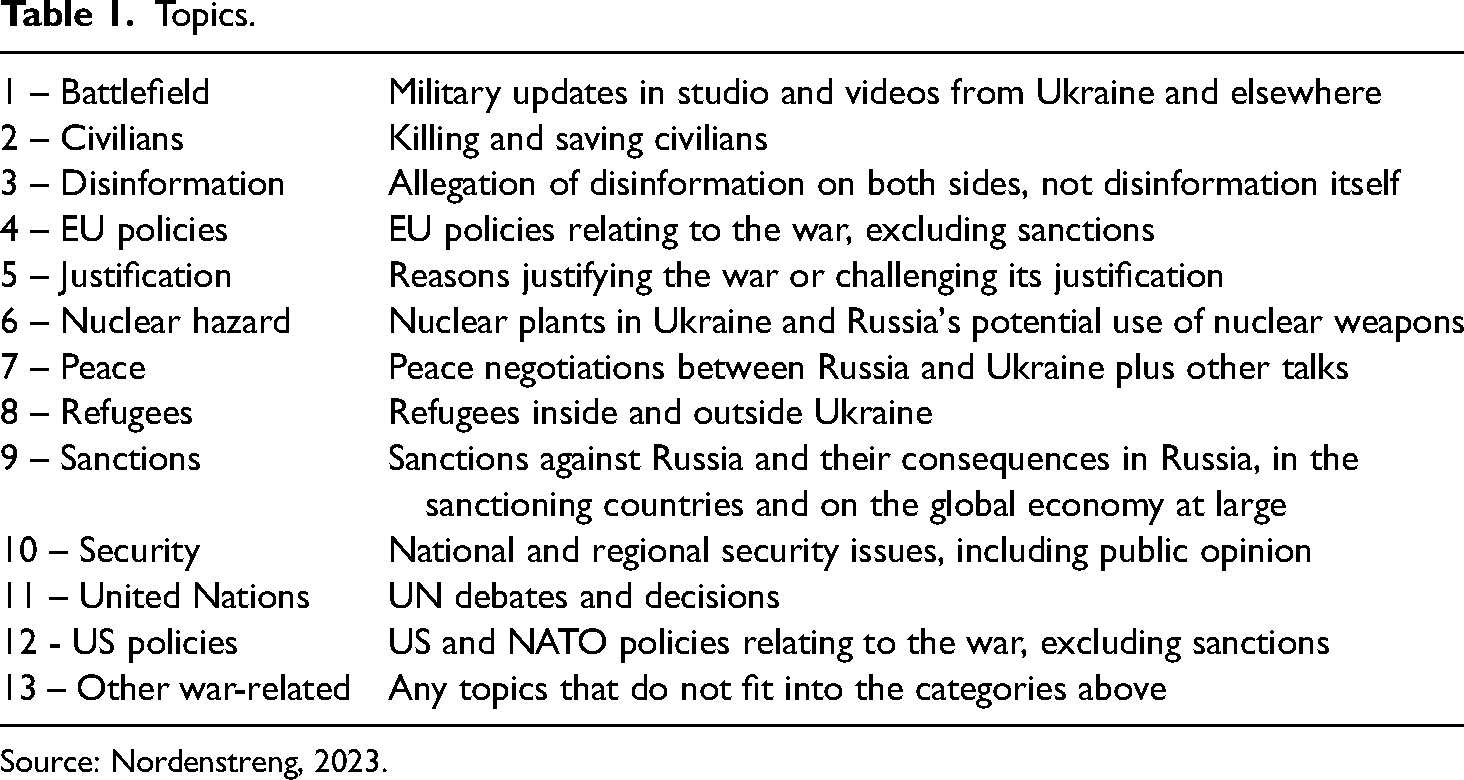
Source: Nordenstreng, 2023.
Furthermore, the news items were classified by five different angles corresponding to a predominant political perspective: Russia, Ukraine, Home Country, Other Country, and Non-government angle. All classification followed the pattern of measuring the time in minutes for each topic and angle. The complete content analyzed is available in the Globoplay platform for subscribers at the link https://globoplay.globo.com
In the next section, we describe the main findings of the analysis vis-a-vis some of the characteristics of international coverage of the Russian invasion of Ukraine by Jornal Nacional.
Main findings
As can be seen in Figure 1, Jornal Nacional paid special attention to the conflict only in the first days of the war in February. After March, the coverage of the conflict and its effects was significantly reduced, with other topics gaining more visibility in the daily schedule, strongly influenced by the general elections (Presidency of the Republic, governors, senators, federal deputies, and state deputies) scheduled for October 2022. The Figure 1 shows how the contents about the conflict falled from just under 80% to less than 20% of total aired content.
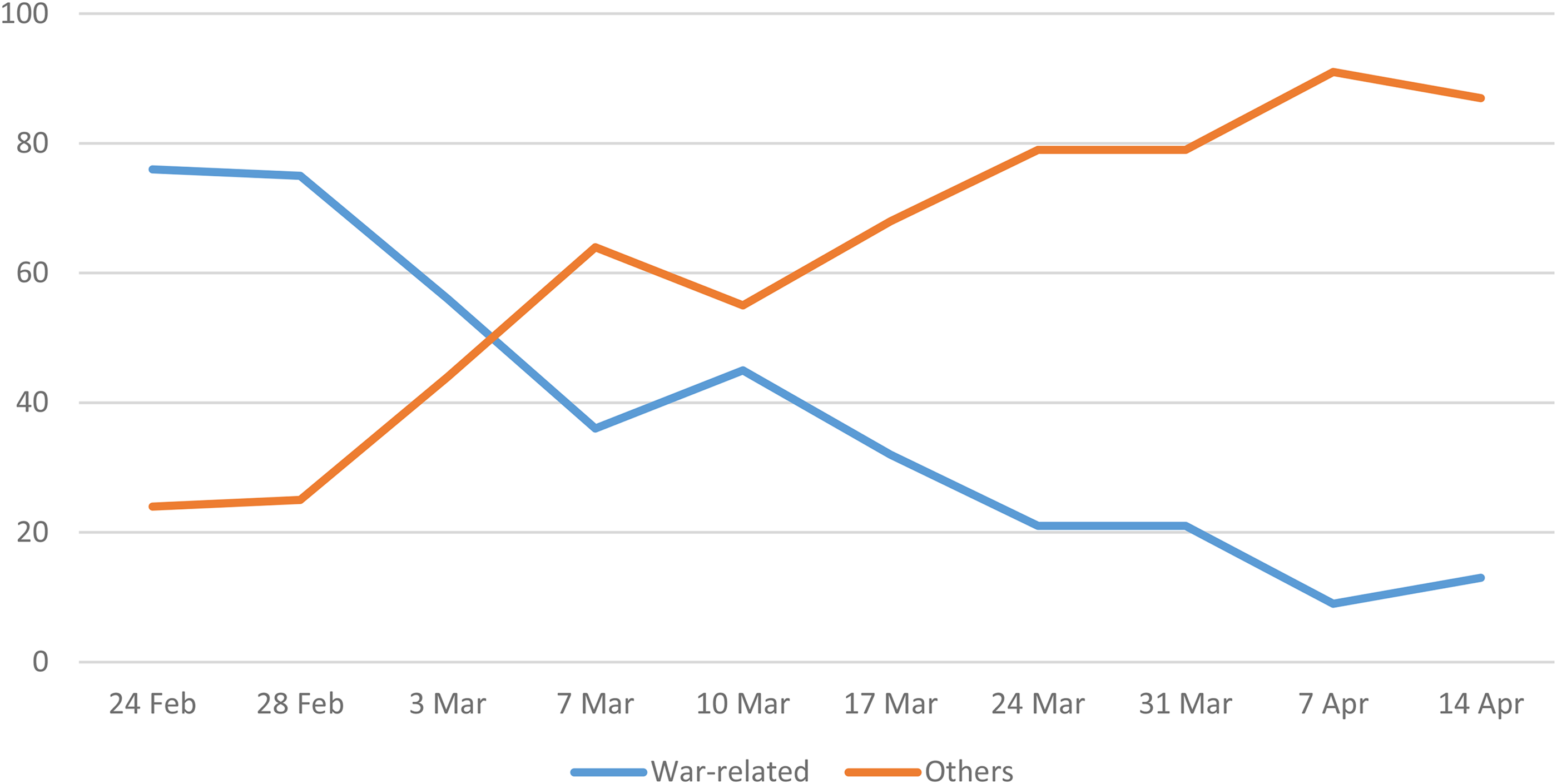
Percentage of war-related and other news in Jornal Nacional based on coverage duration on the sample days. Source: Authors.
After analyzing a 10-day sample, we identified 66 items dedicated to the conflict between Russia and Ukraine. More than half of the news was related to Civilians, Battlefield, and Sanctions (44). It called the research team's attention to the absence in the sample of the topics Disinformation (0), Nuclear hazard (0) and Justification (0).
The number of items was variable in each edition, with more stories at the beginning of the conflict (16 items on 24 February than in the later months of the sample (only two items on 14 April).
Table 2 shows the topics in the Jornal Nacional by number of news items and duration of coverage in minutes. The topic Civilians (32%), followed by Sanctions (18%) and Battlefield (15%) constituted more than 60% of total news items content. Also, these three first topics accounted for 66% of the total duration of war-related content. On the other hand, EU policies and Refugees accounted for the lowest number of news items (1 news item for each one) and had the lowest durations in minutes.
Topics by number of items and coverage duration in minutes in Jornal Nacional.
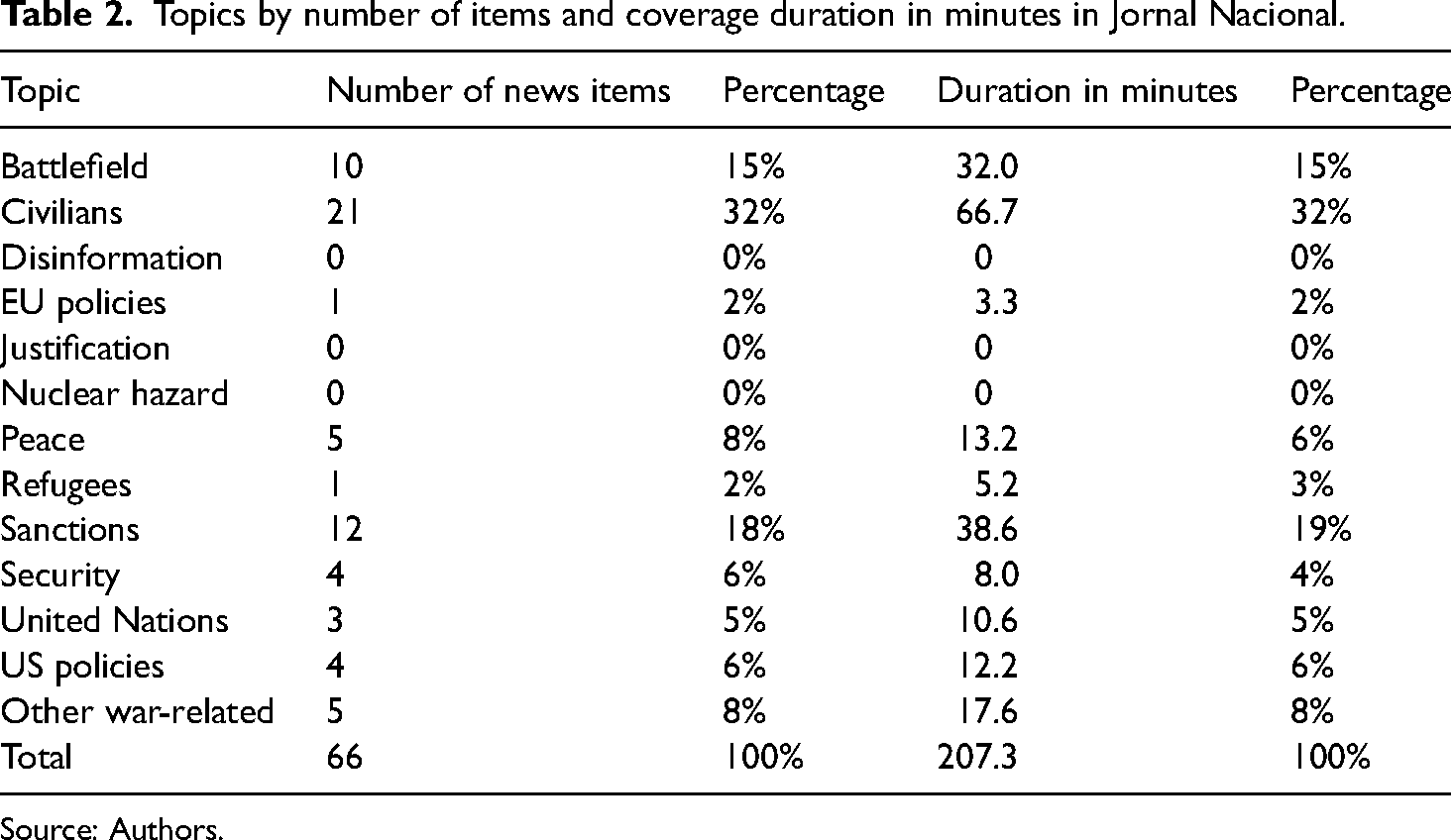
Source: Authors.
Table 3 shows the topics by duration of news items on the days sampled from 24 February to 14 April. It is interesting to note how the topic Civilians took up much time in the coverage from the beginning of the invasion until the end of the first month of the war (from 24 February to 31 March), but on the last two days of the sample (7 April and 14 April) this topic was totally absent.
Topics by percent of total program time on sample days in Jornal Nacional.
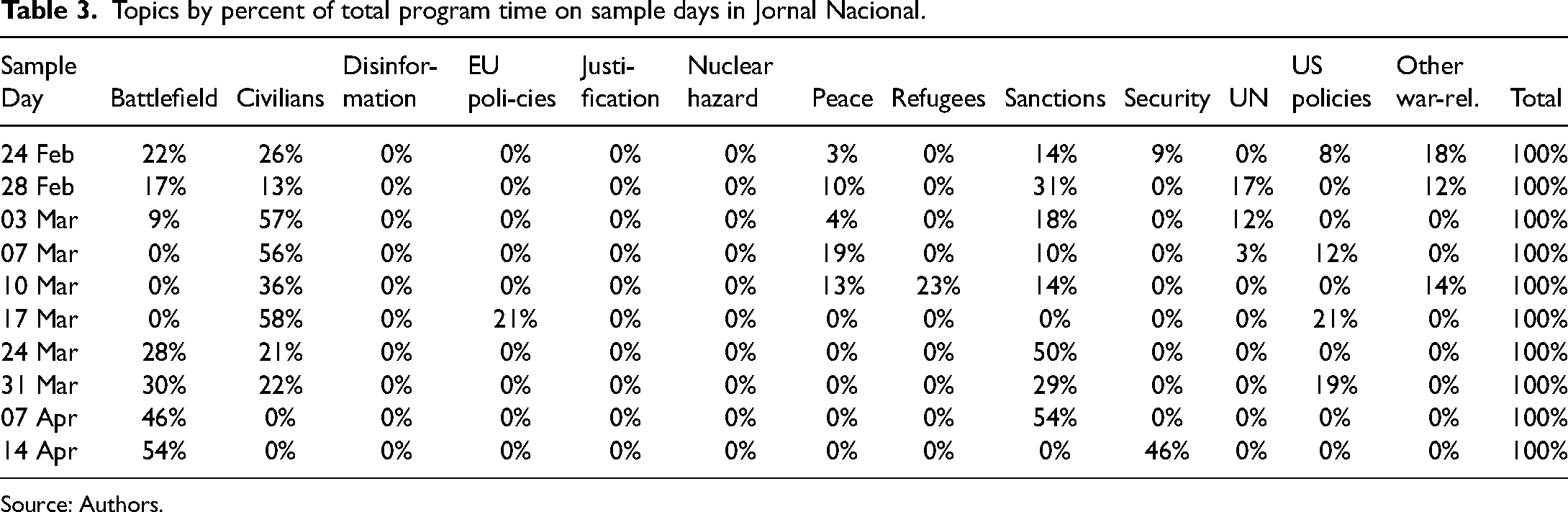
Source: Authors.
Sanctions were relevant topics of Jornal Nacional airtime most of the time, reaching, for example, 54% on April 7th. On the other hand, the topic Battlefield got 22% of the airtime at the beginning of the war (24 February). This decreased over the following days, being more than 20% of duration after 24 March. Further, the Refugees news topic was only featured on 10 March, during the crisis of the mass exodus from Ukraine.
Angles
Due to the historical characteristic of Brazilian TV journalism, using and adapting content, especially images, produced by global foreign television news agencies—notably Reuters TV and APTN (Associated Press Television News), the international news tends to include different positions based on secondary sources and present the material with a multi-perspectival view of the issues. The reporter contextualizes positions from more than one country in the same item; thus most news items on the conflict presented two or more angles on the days sampled.
Only one news item related to Sanctions presented one angle (the story was based on a US point of view). In general, the content, edit, and presentation of the facts allowed a coverage with a broader perspective, where the domestic point of view is represented but compared to other perspectives.
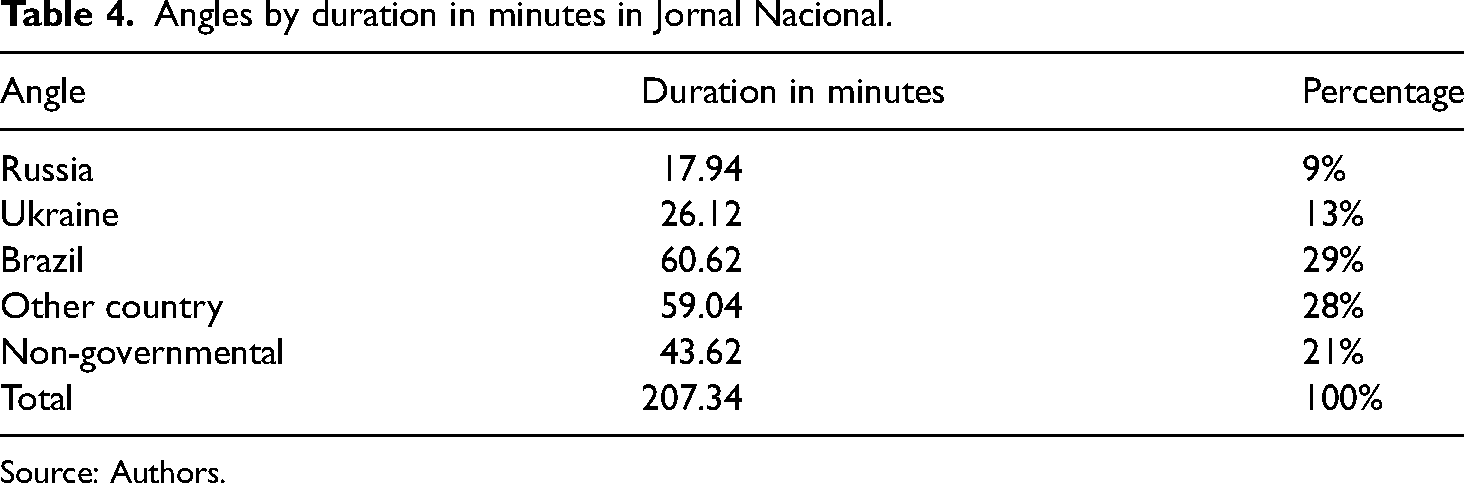
Table 4 shows the overall prominence of the Brazil and Other-country angles in terms of duration on Jornal Nacional. In fact, more than half of the duration was dedicated to these angles and to the Non-governmental angle. In addition, the Ukraine angle (13%) received more attention than was dedicated to the Russia angle (9%). This difference might be explained by the dependence of Brazilian news networks on the US-dominated international news media and their overwhelming support of the Ukrainian position.
Angles by duration in minutes in Jornal Nacional.
Source: Authors.
Battlefield
This topic was the third in terms of the number of news items, with 10 reports. Although the reports show, in general, the different positions of Russia and Ukraine regarding the facts, the reports on this topic emphasized the destruction of cities, the despair of civilians under attack and the dynamics of mutual recriminations between Russia and Ukraine. In this sense, the difference between Russian President Vladimir Putin's statements omitting the use of the word “war” (preferring to call it “special military operation”) and the Russian military's offensives in the invasion of Ukrainian territory, were highlighted in the news.
The coverage of this topic was presented 35% from the Ukraine angle, 23% from the Other Country angle and 20% from the Russia angle. In this case, the news coverage focused on the attacks and statements by Russian authorities.
Civilians
This topic had the highest number of news items (21). The reports on the topic emphasized the impact of the Russian attacks on the Ukrainians’ daily lives, the negotiations to create humanitarian corridors for civilians to exit and the increasing number of civilians leaving their homes. In this topic, it is important to mention the work of the Brazilian photojournalist Gabriel Chain in bringing emotional testimonies of civilians fleeing the country or taking the difficult decision to stay in risk areas. In addition, one report showed the protests of Russian civilians against the war. The Non-governmental angle, expressed in dramatic testimonies of common people in Ukraine and Russia, constituted the main part of the time devoted to Civilians (52%).
Sanctions
This topic was second in terms of the number of news items (12). Most of the reports showed an overview of the positions of different countries on the war, with a focus on the economic pressures from EU and US against Russia and the impact of the sanctions on the Russian economy. The reports highlighted statements by leaders in France, the UK, Italy, and the EU in the negotiations of the sanctions package and the reaction of China and Russia to the strategy of Western countries. The presence of different global leaders in the news was expressed in terms of time duration: 59% of this topic presented the Other Country angle. In addition, Brazil's abstention vote during the decision on the suspension of Russia from the UN Human Rights Council by the General Assembly was emphasized.
Refugees
Only one report on this topic was found in the ten-day sample. The report chronicled the journey of Brazilian and Ukrainian families (68 people in total) repatriated to Brazil from Poland. The report described the dramatic experiences of adults and children leaving Ukraine under bombardment to live in another country. The footage also showed the Brazilian president welcoming the families at the airport in Brasília. This report lasted more than five minutes and essentially offered two points of view: that of the Home country angle (60%) and that of the Non-governmental angle (40%).
Security
Security appeared in only four stories. In this topic, the stories described the disputed power relations between countries and the role of Russia in trying to change the geopolitical context dominated by the US and the EU. The reports pointed out the impacts of the beginning of the war in the UN Security Council meeting, the reaction of China to US advances in Taiwan and the threats of Russian officials against Finland and Sweden if they joined NATO, including mentions of “undesirable consequences.” For this topic, the angles were distributed according to four different points of view (Russia angle with 19%; Ukraine angle with 16% of the content; Home Country angle with 24% and Other Country angle with 41%).
United Nations
The three stories on this topic reported on the UN emergency meeting to pass a vote of condemnation of Russia, Russia's boycott of the hearing at the International Court of Justice in The Hague and the Investigation of the International Criminal Court in search of evidence of war crimes committed in the conflict. This story focused particularly on the decisive influence of EU/UK leaders (France, Germany, and the UK) on the UN's decisions. All three stories included the points of view of different countries. The percentage of the Other country angle was significant: 68%. In contrast, the Ukraine angle accounted for 18% and the Russia angle 9%.
EU policies
In the ten-day sample, only one item on this topic was identified. The focus of the report was the speech by the Ukrainian president Volodymyr Zelenskyy to the German parliament and his appeals to Chancellor Olaf Scholz to tear down the new “wall” in Europe. In addition, the story noted that Scholz expressed solidarity with Ukraine, but stated that NATO would not go to war with Russia. The report further mentioned Russia's demands for an end to the war and the Organization for Economic Cooperation and Development's perspectives for the global economy. The report lasted for a little more than three minutes and provided four different angles (Russia angle 19%; Ukraine angle 36%, Home Country angle 11% and Other Countries angle 34%).
US policies
Jornal Nacional closely monitored President Joe Biden's official statements as well as other official statements on the situation issued by the US government. The four stories with this topic reported on the meetings and discussions of the US, NATO, and other countries related to the role of the US and NATO in the conflict with an emphasis on statements like “the US is doing everything to end the war; US will defend every inch of NATO territory; China does not openly condemn the war.” In addition, the reports included the announcements of President Biden's administration to contain the increase in fuel prices in the US and Biden's criticism of Putin's actions. In terms of angles, Other countries predominated in 89% of the content, followed by the Russia angle (7%), the Ukraine angle (2%), and the Home country angle (3%).
Peace
The five news items related to the topic of Peace were connected to (a) international efforts to achieve an urgent ceasefire in Ukraine and the importance of global stability; (b) the plans of the Brazilian Air Force to rescue Brazilians leaving Ukraine; (c) a meeting involving senior Russian and Ukrainian diplomats in Türkiye; (d) Protests in front of the White House calling for Peace and (e) attempts by the Vatican to facilitate negotiations between Russia and Ukraine.
The Home Country angle was predominant (49%), followed by the Other Countries angle (31%), the Ukraine angle (9%) and the Russia angle (7%). The Non-governmental angle was present in only 3% of the topic content.
Other war-related topics
Like the topic, Peace, Other war-related topics also appeared in five news items. The Brazilian research team classified as “Other” a story about the increase in the price of petrol and diesel oil in Brazil after the war in Ukraine and the news focused on the impacts of rising fuel prices on Brazilian families’ budgets. The team also classified as “Other” a story that used infographics to show the role of Russia and Ukraine in the conflict and a report showing the Chinese government's position in relation to the war in Ukraine, noting that China did not condemn Russia's attack on Ukraine.
Two other items were classified as “Other,” both connected to President Jair Bolsonaro's modus operandi. A week after his controversial meeting with President Putin, the story showed that Brazil did not condemn the Russian invasion of Ukraine: Bolsonaro was on a motorcycle and spoke only in the middle of the afternoon about Brazilians who were in Ukraine. In other content, Bolsonaro insisted on neutrality in his speech about the Russian attack on Ukraine.
In terms of angles, the Brazil angle was present in most news items (79%), followed by the Ukraine angle (15%) and the Other country angle (6%).
The Brazilian research team did not find content on the topics “Justification,” “Nuclear Hazard,” and “Disinformation.”
Most of the news items offered at least two contrasting angles, except for one item. In addition, the focus on daily facts favored a neutral tone most of the time. On the other hand, the reproduction of leaders’ and official statements showed the high impact of the conflict on the global balance of power and appear to indicate the Russian and Chinese attempts to achieve a new multipolar world order.
Also, civilian testimonies described the war situation in a vivid and emotional way to the Brazilian audience. Beyond that, the Battlefield reports underlined the destructive impact of the Russian attacks and Putin's ‘real’ strategies against Ukraine. The images of the Ukrainian cities destroyed by the Russian army negatively emphasized Russia's position in the war.
Discussion and conclusions
The 66 news items analyzed by the Brazilian research team confirmed the historical characteristics of Brazilian journalism on international issues, using and adapting content, especially images, produced by US-UK dominated global news agencies and the insertion of content related to the conflict including positions based on secondary sources. These characteristics contributed to a multi-perspectival view of the conflict between Russia and Ukraine, including numerous angles and presence of many points of view in most of the news items.
Most of the topics received neutral coverage, with reproductions of statements and dramatic war images. Also, most of the news items had to do with a focus on Civilians (21 news items), on Sanctions applied to Russia by the US and the EU, and on the daily news on the battlefield. The impact of the reduced number of correspondents in Eastern European countries was offset by the work of special envoys, especially Gabriel Chaim, who managed to present important information based on contacts with people in Ukraine and go beyond the official positions, despite the absence of a regular correspondent in Ukraine.
As mentioned earlier, the main topics had a variety of angles. Most news items (79%) presented the perspective of the Brazil angle, but other angles were also found in the majority of the sample. The three main topics found (Civilians, Sanctions, and Battlefield) in terms of numbers and duration of news items also highlighted different angles. In the case of Civilians, more than half of the content presented the Non-governmental angle (52%). Sanctions were reported from the Other country angle in 59% of the content. The topic Battlefield was presented somewhat more from the Ukraine perspective.
The ten-day sample had a high number of news items dedicated to the Russia-Ukraine issue in the initial months of the conflict (February and March) and a decrease in Jornal Nacional's attention in the last month (April) of the sample. The coverage observed did not emphasize foreign affairs experts’ analysis or any more profound interpretation of the daily war reports. Finally, mention should be made of the position of the Bolsonaro government, which was reluctant to condemn the attacks largely due to exchanges with Russia and the need to continue buying essential fertilizers for the agribusiness in Brazil: The Brazilian president had also visited Putin days before the attack on Ukraine.
The conflict between Russia and Ukraine emerged in the Jornal Nacional coverage as an issue with economic and human implications. The unexpected Russian attack on Ukrainian cities and the destruction of citizens’ normal lives captured the news media's attention. Despite the global attention to the conflict between Russia and Ukraine, most Brazilians are more interested in domestic issues, especially the severe economic crisis and the political tensions in an election year. According to a follow-up survey YouGov for Digital Report of the Reuters Institute for the Study of Journalism in 2022 (Reuters, 2022, p. 34)., around 40% Brazilian respondents were not following it closely. The same survey pointed out that 10% of Brazilian respondents did not follow the conflict “at all,” the highest percentage among the five countries researched (Germany, Poland, UK, US, and Brazil). Further, more than 50% of respondents reported actively avoiding news on the conflict during the period of the sample (from 29 March to 7 April 2022).
In addition, a survey conducted in March 2022 showed that 75% of respondents reported that Bolsonaro was right not to take sides in the conflict. Even among the supporters of Luiz Inacio Lula da Silva, approval for Brazil's neutrality was 71%. Despite this, the majority (68%) expressed unfavorable opinions of Russia (Castro, 2022). It is worth mentioning that the scholarly public debate in Brazil tends to be critical of US positions due to the historically intrusive role of successive US governments in Latin American politics. Due to this, the multipolar narratives (including the Russian ones) also gain support from well-known analysts.
In contrast, the mainstream media in Brazil are historically often more focused on the countries of the global North and their information flows, minimizing Latin America's local approaches (Tavares and Fernandes, 2019). Several analysts have criticized Bolsonaro's position related to the war, pointing out the loss of opportunity to reposition the country in the global scenario and the negative impact of the controversial choice of “neutrality” (BBC News Brazil, 2022; Capomaccio, 2022; Milz, 2022).
The critics of his choice appeared twice on Jornal Nacional, but it was not a key point of the coverage. Also, this criticism of the United States was not evident, with a significant presence of US official positions in news reports. The variety of angles and actors in the news may be indicative of both the journalistic character of Jornal Nacional and a particular Brazilian mainstream media view of international issues. The ambiguous position of the Brazilian government and the lack of interest in the war on the part of the Brazilian population serve to express the distance between a European reality and Brazilian perceptions. After the coronavirus disease 2019 (COVID-19) pandemic, the Brazilian society seems to be engrossed in its own issues of high political polarization, disinformation, political violence, and economic crisis to pay too much attention to the wider world. Another important point to be observed in future studies is to verify whether Brazil's participation in the BRICS and other economic blocs can make a difference in international journalistic coverage carried out by the Brazilian media.
Footnotes
Declaration of conflicting interests
The authors declared no potential conflicts of interest with respect to the research, authorship, and/or publication of this article.
Funding
The authors received no financial support for the research, authorship, and/or publication of this article.