



Abstract
How closely does news coverage in independent media outlets in non-Western countries follow domestic political elites’ interpretations of Russia’s invasion of Ukraine? And how much attention do newsrooms pay to geopolitical aspects of the issue compared to domestic considerations? This study moves beyond a still prevailing Euro- and US-centric perspective by focusing on Brazil, India and South Africa, three democratic countries with close economic and political ties to Russia. The authors systematically compare the wording used by elite politicians to describe the events in Ukraine with that in mainstream news reports. They also analyse the salience of political leaders and geopolitical entities (countries and intergovernmental organizations) in news coverage. For the use of descriptive terminology, they find no evidence for news reporting to be indexed to government wording. Their analysis of references to geopolitical actors shows news media’s strong propensity for domesticating the war for their respective national audiences.
Keywords
Introduction
Mainstream news coverage of war often conforms to national – or larger geopolitical block-based – interests in international affairs, thereby emphasizing narratives that perpetuate ideological perspectives and fault lines (Bennett, 1990; Entman, 2003; Herman and Chomsky, 2002). Studies of media representations of the ongoing Russo–Ukrainian war since 2014 have largely confirmed this propensity for both authoritarian and liberal-democratic contexts. But research that focuses on non-Western and non-European countries – and especially those that have close economic and / or strategic-military ties with Russia – has only very recently taken off. While the Russian invasion of Ukraine in February 2022 has been widely condemned and met with severe economic sanctions by Western countries, governments from other world regions have been much more restrained in their responses, assumedly because of their geopolitical and economic interests (Lieberherr, 2022).
According to Lance Bennett’s (1990) indexing hypothesis, mainstream news media’s representation of contentious issues is indexed to the scope of debate within domestic political elites. In other words, clearly expressed dissent among political elites is a prerequisite for divergent viewpoints to find traction in mainstream media discourse. The mechanism behind this phenomenon was conceptualized by Robert Entman (2003) as the cascading activation model, in which Entman describes how issue interpretations, especially those concerning foreign affairs and national security, are most commonly activated at the top of a country’s political hierarchy (e.g. the White House in the US) and then spread from this highest level of a stratified system to other political elites, followed by the mass media and then the wider public. Only under certain conditions can interpretive frames also move upwards from lower to higher levels of this cascade. While developed and – so far – mostly evidenced empirically in Western contexts (e.g. Bennett et al. 2006; Handley, 2010), we assume that these models provide sufficiently accurate conceptualizations of media–government relations in non-Western democratic countries. Beyond Western journalism cultures, journalism’s role is often understood as a tool for a country’s development (Chattopadhyay, 2019). This, arguably, can create even more pressure on journalists to conform with their respective government’s political approach to international conflicts.
Our study contributes to the now burgeoning field of the study of international news – and war coverage in particular – in countries belonging to the BRICS intergovernmental organization (De Albuquerque and Lycarião, 2018; Pasti and Ramaprasad, 2018; Thussu, 2024; Thussu and Nordenstreng, 2020). Employing a comparative research design, we conduct quantitative manual and semi-automatic document and media content analyses of government announcements, parliamentary debate contributions and mainstream news coverage about the Russian invasion of Ukraine in Brazil, India and South Africa (i.e. the democratic member countries of the intergovernmental organization BRICS – Brazil, Russia, India and China) during the first year of the war. Our rationale for employing quantitative analysis is to identify macro-level patterns and to provide systematic observations in a larger corpus of texts (Krippendorff, 2018). This approach allows us to describe and compare the broad contours of country-specific news discourses about the war, within which insights from future qualitative analyses of arguments and discursive strategies can be contextualized. We compare issue wording in politicians’ statements and news articles for 2-week periods after key events that have occurred since the Russian invasion of Ukraine. We also examine the salience of domestic and foreign political leaders as well as references to geopolitical entities in news coverage. We use this data to describe and compare news discourse about the war in democratic BRICS countries in terms of its alignment with wording cues from political elites, as well as its tendency to either domesticate the issue or to provide a more global outlook on the war in Ukraine. For our media sample, we selected two widely circulated newspapers from each country: Folha de Sao Paulo and O Estado de S. Paulo from Brazil, The Hindu and The Times of India from India, and Business Day and The Star from South Africa.
News media and the geopolitics of the Russo–Ukrainian war since 2014
Media coverage of the Russo–Ukrainian war – which began on 27 February 2014 with the invasion of Crimea by Russian forces – has been a prominent research topic. Studies concerned with the period of the war prior to the invasion of Ukraine have identified a ‘Manichean discourse’ (Boyd-Barrett, 2017: 1030) propagated by Western news media in line with the geopolitical interests of the West. Several empirical studies (Fengler et al., 2020; Nygren et al., 2018; Norström, 2019; Roman et al., 2017; Springer et al., 2022) provide ample evidence that media coverage across combatant and non-combatant countries largely mirrors their respective countries’ stances towards the conflict, which was then still confined to Crimea and Eastern Ukraine. Ojala and Pantti (2017: 41) concluded that such news reporting in close alignment with the policies of countries and/or political blocks (e.g. the European Union) from which they emanate has helped to naturalize a geopolitical logic of a ‘new cold war’.
More recent studies have analysed media representations of the war after Russia invaded Ukraine in February 2022. Chernov (2023) analysed articles from CNN.com and the state-owned (via a subsidiary) Gazeta.Ru. He found that all articles about the war in Gazeta.Ru referred to the ‘special military operation’, in accordance with the official wording from the Kremlin. On the other hand, CNN reports spoke of an ‘invasion’ or ‘military aggression’. Media coverage in Gazeta.Ru also provided framing in line with the Russian government’s proclamations to protect Russian speakers in the Donbas region and to ‘demilitarize’ and ‘denazify’ Ukraine (Chernov, 2023). Hanley et al.’s (2023) study of coverage in the first three-and-a-half months of 2022 in US, UK, Russian and Chinese news websites revealed that Western news focused on military and humanitarian aspects, whereas Russian media tended to point to the alleged presence of ‘bio-weapons’ and ‘neo-Nazis’ in Ukraine to justify the ‘special military operation’ by the Russian army. Chinese media instead focused on diplomatic and economic repercussions of the war (Hanley et al., 2023). In their analysis of Chinese coverage by Xinhua News Agency, People’s Daily and China Daily, Ji et al. (2024) found that more than half of the news sources were of domestic origin.
Studying the structures and narratives of reporting the Russo–Ukraine war in countries of the Global South – and BRICS countries in particular – is a nascent field of inquiry.Wozniak and Liu (2023) analysed the first four weeks of coverage of the Russian invasion in The Times of India and The Telegraph (Calcutta) and found a strong propensity for domestication, mainly through the newspapers’ focus on the evacuation of Indian students from Ukraine as well as discussions of impacts on India’s economy. The Indian newspaper Business Today also focused mainly on economic issues and the pragmatic implications of the war on India (Sun, 2023). In an analysis of Indian TV newscasts, Roy and Paul (2022) found coverage to be more concerned with supporting India’s non-alignment foreign policy than reporting about the situation in the war zone. Kumar and Thussu (2024) analysed monologues on Republic TV, India’s most-watched English-language news channel and found their narratives to be strongly shaped by India’s national interests on the world stage. Coverage by Brazil’s Jornal Nacional, on the other hand, was found to be quite diverse topically, with the main focal points being on the fate of civilians, sanctions against Russia, and military updates from the battlefield (Guazina et al., 2024). Still, accounting for 29 percent of the total duration of news reports, Brazil was the most salient political–geographical angle through which the war was reported (Guazina et al., 2024). This was even more pronounced in news coverage by the South African Broadcasting Corporation (SABC), in which nearly half of the time of news stories in early 2022 was dedicated to telling stories through a South African perspective, with only 5 and 4 percent of the newscasts’ duration accounting for a Russian and Ukrainian angle, respectively (Ndlovu, 2024).
These studies employ a variety of methods, e.g. content analysis (Wozniak and Liu, 2023; Guazina et al., 2024; Ndlovu, 2024), generic framing analysis (Ji et al., 2024), issue-specific framing analysis (Chernov, 2023), a combination of computer-assisted textual analysis and thematic discourse analysis (Kumar and Thussu, 2024), a mix of corpus linguistics and discourse-historical analysis (Sun, 2023), a combination of computer-assisted topic and sentiment analysis (Hanley et al., 2023) and critical discourse analysis (Roy and Paul, 2022). Our study contributes to this growing body of research by providing a standardized comparative content analysis of news coverage about Russia’s invasion of Ukraine from three democratic BRICS countries during three phases of the conflict – the invasion of Ukraine by Russia, the opening of a new front in the south-east of Ukraine by the Russian army, and the start of the Ukrainian counter-offensive. Our approach complements research undertaken by Nordernstreng et al. (2023: 6871) who compared broadcast news in nine countries (including Brazil, India and South Africa) from early 2022 and identified ‘the concept of propaganda as a central element of the framework for digesting the empirical results’ (emphasis in original).
Case description: The democratic member states of BRICS
The term ‘BRIC’ was originally an informal designation, used in a Goldman Sachs publication (O’Neill, 2001) to summarize transnational investment opportunities. The loose association later became formally institutionalized, with the first official BRIC Summit taking place in 2009 (BBC News, 2009). South Africa joined one year later at the invitation of China (Reuters, 2010). On 1 January 2024, the intergovernmental organization was joined by Egypt, Ethiopia, Iran and the United Arab Emirates (Jutten, 2024).
Our study contributes to the still quite young subfield of international media studies that uses BRICS as a perspective (De Albuquerque and Lycarião, 2018). While our epistemological and methodological focus is firmly rooted in Western philosophical thought, we acknowledge and respond to the growing relevance of de-Westernizing international media studies. This is motivated by the moral imperatives of decolonizing research (Mutsvairo and Bukenya, 2023; Thussu, 2018), but also by observable changes to power dynamics in global politics, which has seen previously peripheral countries become more influential and assertive in international relations (Aouragh and Chakravartty, 2016; Delgado-Caicedo and Guzmán-Cárdenas, 2022; Käkönen, 2014; Zhao, 2014).
BRICS has been identified as one such ‘new’ power block in a changing geopolitical order (Käkönen, 2014; Pennaforte and Luigi, 2022). For our analysis of media coverage of Russia’s invasion of Ukraine, we have decided to focus on the democratic member countries of BRICS. This decision stems from our interest in better understanding the relationship between national interests and the work of journalists in (at least nominally) free media systems independent of direct state control. 1 This is not to say that examining media–state relations in authoritarian regimes such as the People’s Republic of China is not also of crucial importance, but they are beyond the chosen remit of this article (but see Hanley et al., 2023; Ji et al., 2024).
Beyond their shared connection through the BRICS organization, Brazil, India and South Africa also have close bilateral ties with Russia.
Brazil
Formal ties between the Federative Republic of Brazil (República Federativa do Brasil in Portuguese) and Russia go back to the early 19th century (Ministério das Relações Exteriores, 2018) but have only intensified after the collapse of the Soviet Union. Since establishing a Russian–Brazilian High Level Cooperation Commission in 1997 (Marcondes and De Almeida Silva, 2023), the two countries have continously strengthened their bilateral ties through high-level agreements and partnership arrangements, e.g. via the Brazil–Russia Military Technology and Transfer Pact in 2003 and the Brazil–Russia Strategic Alliance in 2005 (Council on Hemispheres Affairs [COHA], 2013). Amid domestic political changes between 2014 and 2022, Brazil’s foreign policy towards the Russo–Ukrainian war has remained relatively consistent with a focus on non-alignment and seeking a peaceful solution. This approach has been deemed as either counterproductive and naïve (Chivvis and Geaghan‑Breiner, 2023), or as favouring Russia (Secches, 2024). The relationship has remained cordial and pragmatic after Russia’s invasion of Ukraine (Secches, 2024), with Brazilian President Lula meeting Russian Foreign Minister Sergey Lavrov as recently as February 2024 (Presidência da República do Brasil, 2024). In 2023, the trade turnover between the two countries was $8.4 billion (TASS, 2024). The main export product from Brazil to Russia is soybeans, whereas fertilizers make up the largest portion of Russian exports to Brazil (Observatory of Economic Complexity [OEC], 2024).
India
The Republic of India (Bhārat Gan.arājya in Hindi) has had a close relationship with Russia – and the Soviet Union until 1991 – since it gained independence from the UK in 1947. The Soviet Union vetoed UN Security Council resolutions adverse to India numerous times, especially in respect to the dispute about Kashmir (Sen, 2022). Throughout the 1950s, the Soviet Union also assisted India with its industrialization efforts and the construction of power plants (Alipov, 2022). In October 2000, Vladimir Putin and then Prime Minister of India Atal Bihari Vajpayee agreed a Strategic Partnership between the two countries (Patney, 2017), which was upgraded to a Special and Privileged Strategic Partnership in December 2010 (Pandey and Yadav, 2018). India is currently the biggest market for the Russian defence industry (Ghoshal and Ahmed, 2022). Between 2019 and 2023, India accounted for 34 percent of total Russian arms exports (Stockholm International Peace Research Institute [SIPRI], 2024). Russia has been supporting India’s aim to attain a permanent seat in the UN Security Council (Menon and Rumer, 2022). In 2014, Russia and India agreed to set a target of $30 billion dollars in bilateral trade by 2025 (Financial Express, 2014) and to establish a joint study group to assess the feasibility of a free trade agreement (Lal, 2014).
South Africa
Moscow formed a close relationship with the African National Congress (ANC), the ruling party in the Republic of South Africa since 1994, during the Apartheid era (1948–1994) when the then Soviet Union assisted in military training, financial aid and diplomatic support for the country’s liberation movement (Filatova and Davidson, 2013; Shubin and Traikova, 2008). In 2013, South Africa and Russia signed a Comprehensive Strategic Partnership agreement covering a wide range of areas, in which the two countries declared not to challenge or condemn each other (Geldenhuys, 2015). It is seen by some as a type of alliance (Williams, 2023), built on the history of Soviet support for the anti-Apartheid movement. Cooperation over the following years included a nuclear deal (Torchia, 2014) and further military coordination. The two countries also collaborated with China in holding naval exercises in 2019 and 2023 (Buchuev et al., 2023). Despite its officially neutral stance on the war, South Africa has been accused of secretly providing weapons and ammunition to Russia in December 2022 (The Economist, 2023).
Methods
Following the approaches of Fengler et al. (2020) and Ojala and Pantti (2017), we analyse two weeks of media coverage following key events during the war: the invasion of Ukraine by Russia on 24 February 2022, the opening of the south-eastern front by the Russian military on 8 April 2022, and the start of Ukrainian counter-offensives on 6 September 2022. We also analyse official announcements by the governments of Brazil, India and South Africa, as well as parliamentary debates, to establish baseline evidence for the scope of elite political discourse about the war in Ukraine against which news coverage in these three countries might have been ‘indexed’ (Bennett, 1990).
Data collection
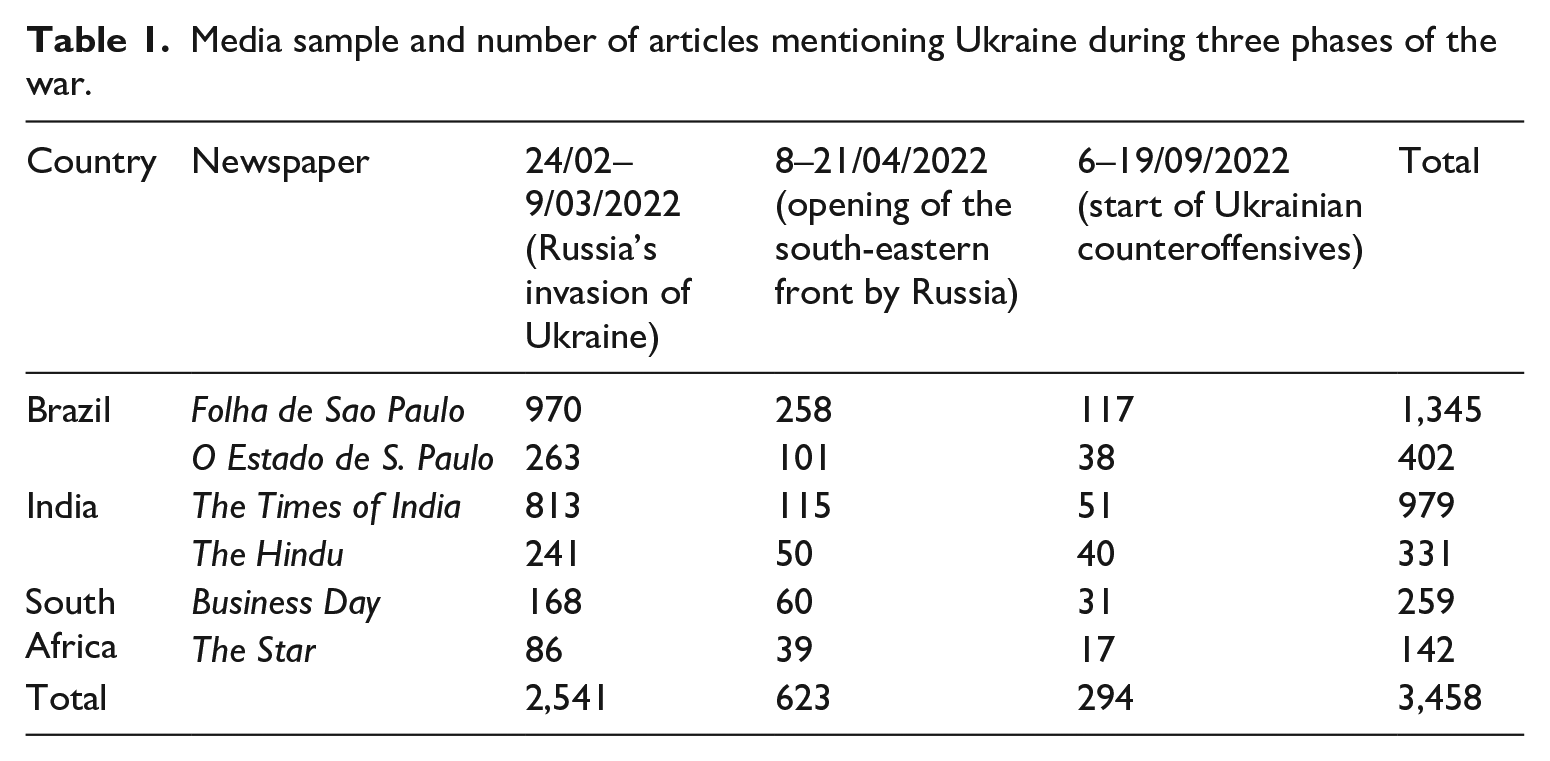
For our media sample, we selected two opinion-leading daily newspapers from each country (see Table 1). Within the previously mentioned periods, we searched the LexisNexis database for either ‘Ukraine’ (for the Indian and South African news outlets) or ‘Ucrânia’ (for the Brazilian newspapers) in the entire documents. During a previous study (Wozniak and Liu, 2023), we found that this generates a negligible number of false positives. We manually checked for duplicates in the results list by ordering all results alphabetically by headline. When we identified two identical headlines, we retained the article with the higher word count (when both article versions were published on the same day), or the one published on an earlier date. Our final corpus consisted of 3,458 news items. We downloaded all search results as individual MS Word documents and imported them into the analysis software NVIVO 14.0, with every file, i.e. every single news item, constituting one case.
Media sample and number of articles mentioning Ukraine during three phases of the war.
All Brazilian Portuguese news articles underwent machine translation into English for further processing alongside the original English language articles. To evaluate translation accuracy, we randomly selected a subset of 10 articles and translated them twice: once using the DeepL Pro API via the deeplr package (Zumbach and Bauer, 2021), and once utilizing the GPT API. A manual assessment conducted by a master’s level student assistant (and former journalist) from Brazil proficient in English revealed that the translation quality of GPT was on a par with that of DeepL. Considering its cost effectiveness and the positive evaluation by the native speaker, we decided to employ it for translating all Portuguese articles in our sample.
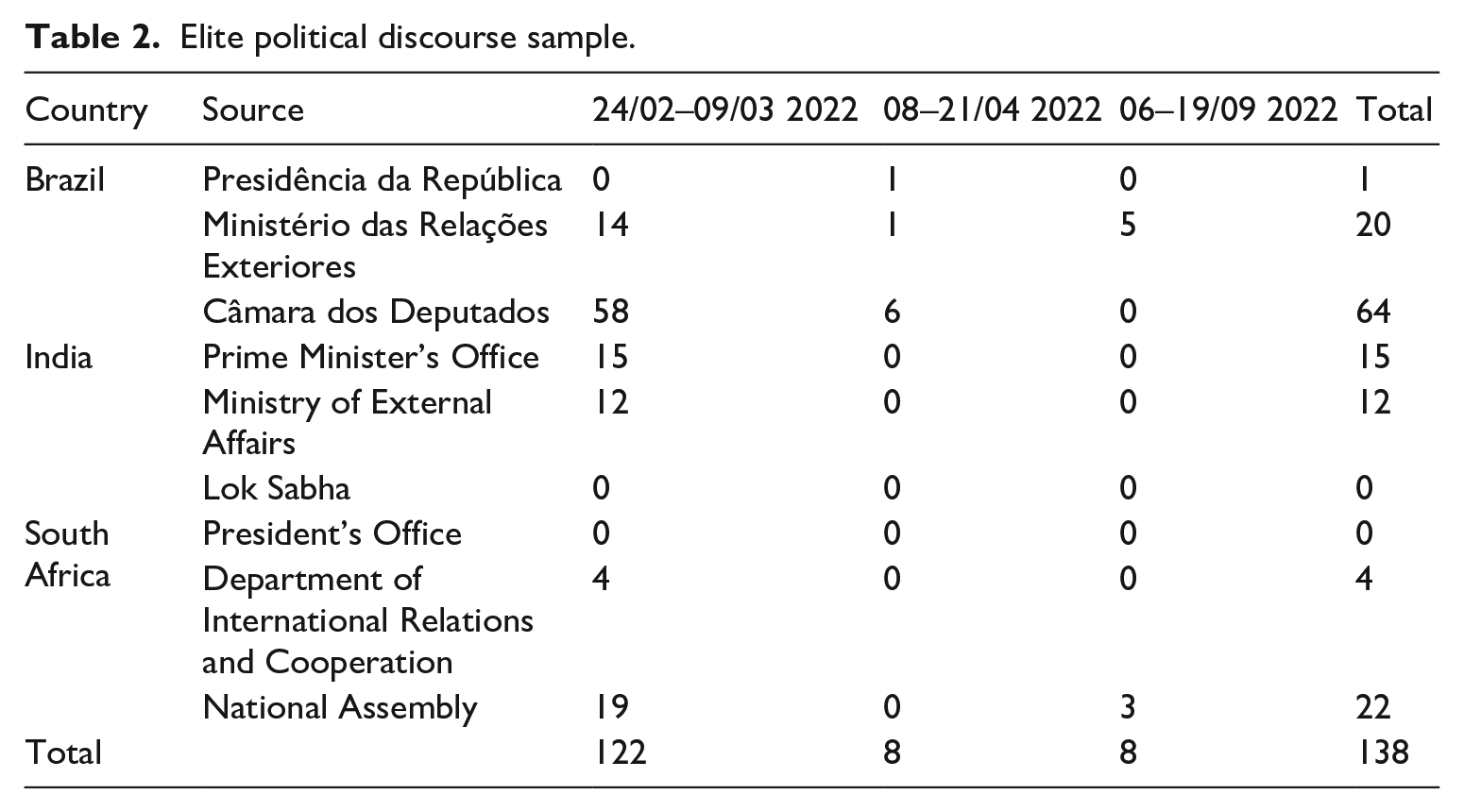
For elite political debate contributions, we collected the following types of documents: for Brazil, press releases by the Presidência da República (https://www.gov.br/planalto/pt-br), announcements by the Ministério das Relações Exteriores (https://www.gov.br/mre/pt-br) and plenary speeches by members of the Câmara dos Deputados (https://www.camara.leg.br); for India, press releases by the Prime Minister’s Office (www.pmindia.gov.in), announcements by the Ministry of External Affairs (https://www.mea.gov.in/index.htm) and plenary speeches – in both English and Hindi – from members of the Lok Sabha (http://loksabha.nic.in). And for South Africa, press releases by the President’s Office (https://www.thepresidency.gov.za), media statements by the Department of International Relations and Cooperation (http://www.dirco.gov.za) and plenary speeches by members of the National Assembly (https://www.parliament.gov.za). Thus, for each country we were able to ascertain wording choices by the head of government, the ministerial department of the federal government responsible for relations with other countries, and members of the lower house of the federal parliament, respectively. We identified a total of 138 debate contributions that mentioned the war in Ukraine, the majority of which (88%) were made during the first phase of the invasion (see Table 2).
Elite political discourse sample.
For our comparative analysis of news coverage in these six outlets over three phases of the conflict, we employed a mixture of manual and automated analysis techniques to assess: (a) the relative frequency of descriptors or labels used to describe the war in Ukraine; (b) the frequency of references to individual political actors; and (c) the frequency of references to geopolitical entities.
Measurements
Problem definition/issue wording
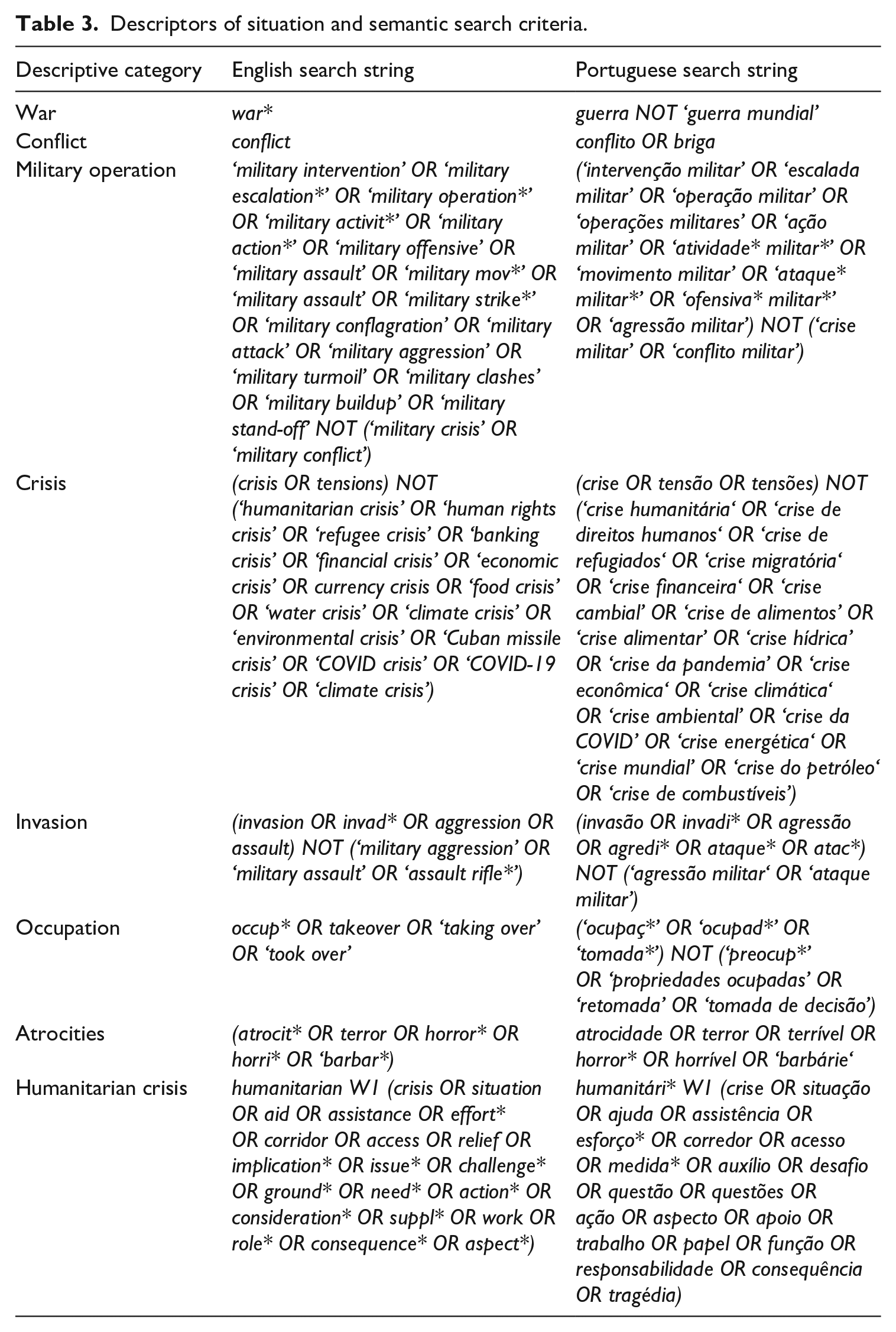
To assess how governments, members of parliament and newspapers chose to define the problem in their issue framing of the invasion (Entman, 1993), we analysed the use of conflict descriptors, replicating the approach used by (2023). For this, we employed the text query function in NVIVO 14.0 and assigned the pertinent codes to each case. Our Brazilian student assistant helped with the translation of our English-language search terms into Brazilian Portuguese (see Table 3). We decided to not use the automatically translated corpus for this part of the analysis because of the semantic sensitivity of the measurement. The level of analysis was the whole press release, announcement, plenary speech, or article, i.e. if at least one keyword pertaining to a descriptive category was found, the case was coded as featuring this descriptor (binary coding, 0 = not present, 1 = present).
Descriptors of situation and semantic search criteria.
Named entity identification
To determine the relative salience of specific political actors (e.g. Putin, Zelenskyy, or Modi) and geopolitical entities (e.g. NATO, EU) within news coverage, we employed the identification of named entities (NER, named entity recognition) in text as a proxy. We annotated news articles using the English-language en_core_web_sm model from the publicly available spaCy Python library (Honnibal et al., 2020). SpaCy has been evaluated and recognized as one of the premier off-the-shelf tools for extracting location-type named entities in English by Balluff et al. (2024). From the range of named entity categories provided by spaCy, we extracted names of people (PERSON), geopolitical entities (GPE), defined as countries, cities and states; locations (LOC), defined as non-GPE locations, which can include mountain ranges, bodies of water and other locales that are not political or administrative regions; and names of organizations (ORG). The extracted lists of unique English-language PERSON (N = 10,523), GPE and LOC combined (N = 3,405), and ORG entities (N = 9,792) underwent refinement, primarily involving the correction of obvious spelling errors and standardizing variant spellings by selecting a single representation for entities we deemed equivalent (e.g. ‘Zelenski‘ vs ‘Zelensky‘; ‘the United States‘ vs ‘USA’).
Named entity analysis
Subsequently, we categorized these GPE and LOC entities as being associated with specific countries (e.g. Brazil, India, South Africa, US) and other political entities (i.e. the European Union, ‘the West’). Regarding countries, our general procedure entailed reassigning GPE and LOC entities that relate to the capital, as well as subnational regions and their capitals, to their respective country names (e.g. we classified ‘New Delhi’, ‘Assam’ and ‘Dispur’ under the main category of ‘India’). Similarly, ‘European Union’, ‘EU’, ‘European Parliament’, ‘European Council’, ‘Council of Europe’, ‘European Commission’, ‘High Representative of the Union’, ‘European Central Bank’, as well as ‘Brussels’, were classified as ‘European Union’. Named entities such as ‘the West’ or ‘NATO’ were classified as ‘the West’. In technical terms, we created one dictionary for each of the six main categories and binarily classified if an article mentioned a category-relevant entity at least once or not. Reorganizing the data set, the new unit of analysis was now the tie between a news source and a mentioned named entity category. Given that we have six categories, each article can produce zero to six ties. This new dataset was the basis for the visualization in the Sankey diagram (see Figure 1 under Findings).
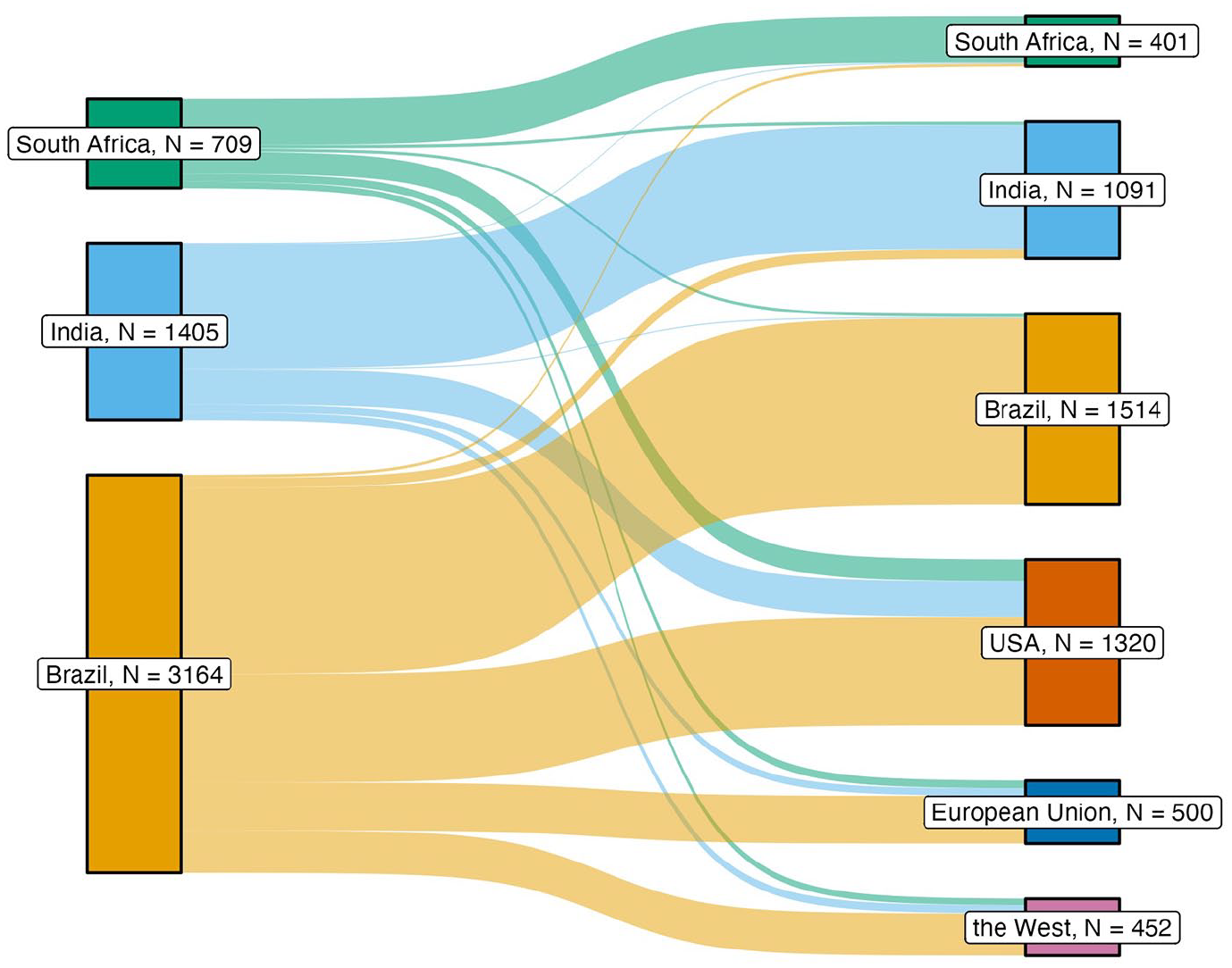
Sankey diagram: distribution of country mentions (right) in news coverage (left). Thickness of lines is linearly proportional to the number of times a country was mentioned at least once in the respective two newspapers from each country. Numbers are based on newspaper-entity dyads, e.g. 3,164 ties were found between a news article from Brazil and (at least one) reference to either of the 6 geopolitical entities on the right (each article could have between zero and six ties, the average number of ties in Brazilian news items was 1.8).
Findings
In the following sections, we present the findings from our manual and automated analyses of news content, government announcements and parliamentary speeches.
Describing the war
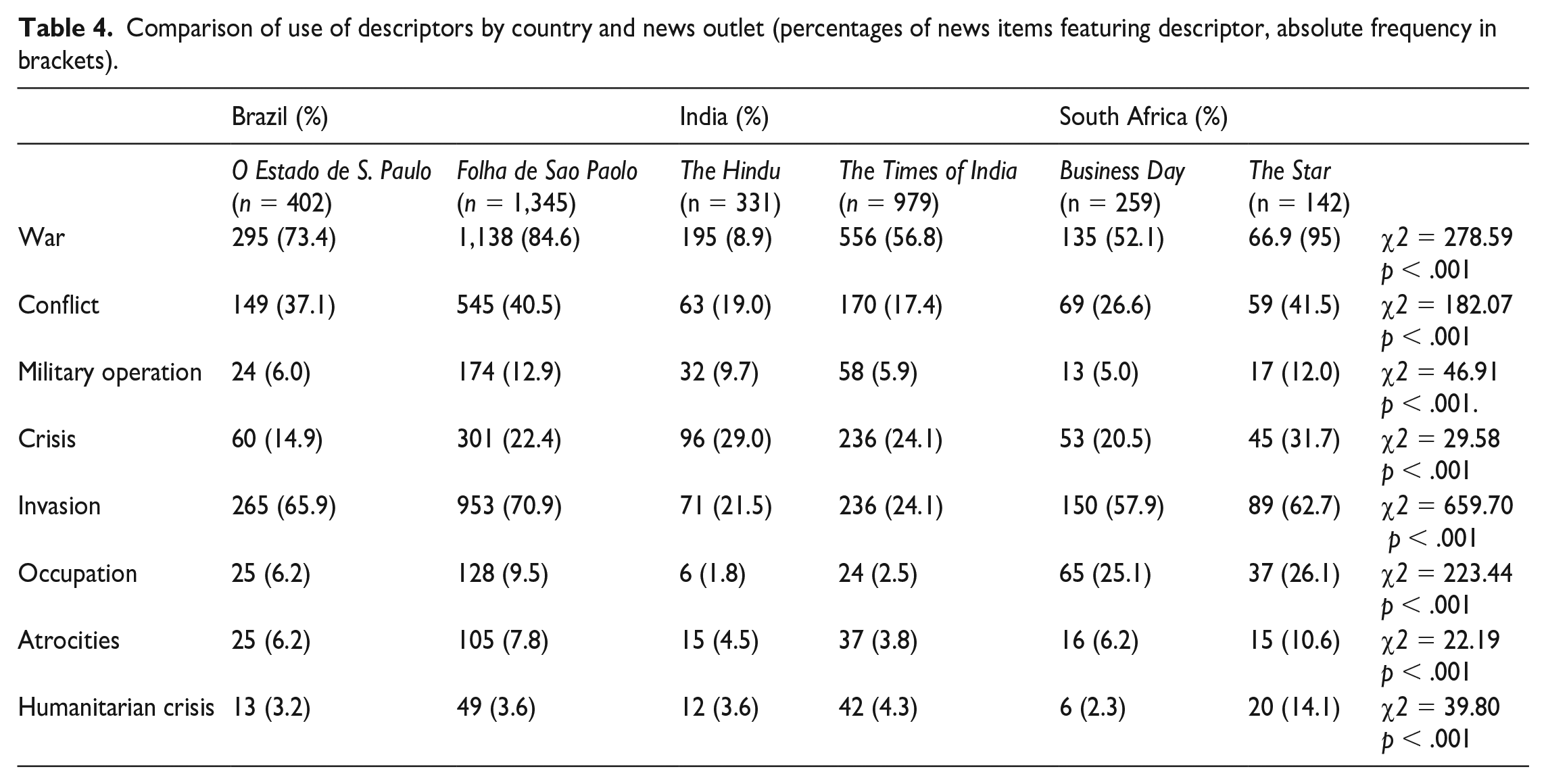
Our analysis of the use of descriptors for the events in Ukraine reveals substantial differences in word choices between media outlets and countries. Comparing coverage by country, we find significant differences for all descriptor categories except crisis (χ2(2, n = 3,458) = 9.92, p = .007) and humanitarian crisis (χ2(2, n = 3,458) = 7.14, p = .028). We observe the biggest difference in the use of words like ‘invasion’, ‘aggression’, or ‘assault’, which occurs in 70 percent of Brazilian and 60 percent of South African news reports, but in just over 23 percent of news reports in the two Indian newspapers (χ2(2, n = 3,458) = 655.16, p = .028). Cramér’s V is 0.435, which suggests a moderate relationship between country and use of descriptor. Use of ‘war’ in news coverage stands out in Brazil, with O Estado de S. Paulo and Folha de Sao Paulo featuring this term in 82 percent of their reports, whereas it appears in just over 57 percent of news articles in both India and South Africa.
Table 4 provides a more fine-grained analysis by newspaper. 2 At this level of analysis, crisis and humanitarian crisis also show significant differences; the former driven by significantly less use of this term in O Estado de S. Paulo versus roughly twice the relative frequency in the coverage of The Hindu and The Star; the latter largely driven by, again, The Star, which – in relative terms – featured up to six times more references to a ‘humanitarian crisis’ in Ukraine than the other newspapers in our sample.
Comparison of use of descriptors by country and news outlet (percentages of news items featuring descriptor, absolute frequency in brackets).
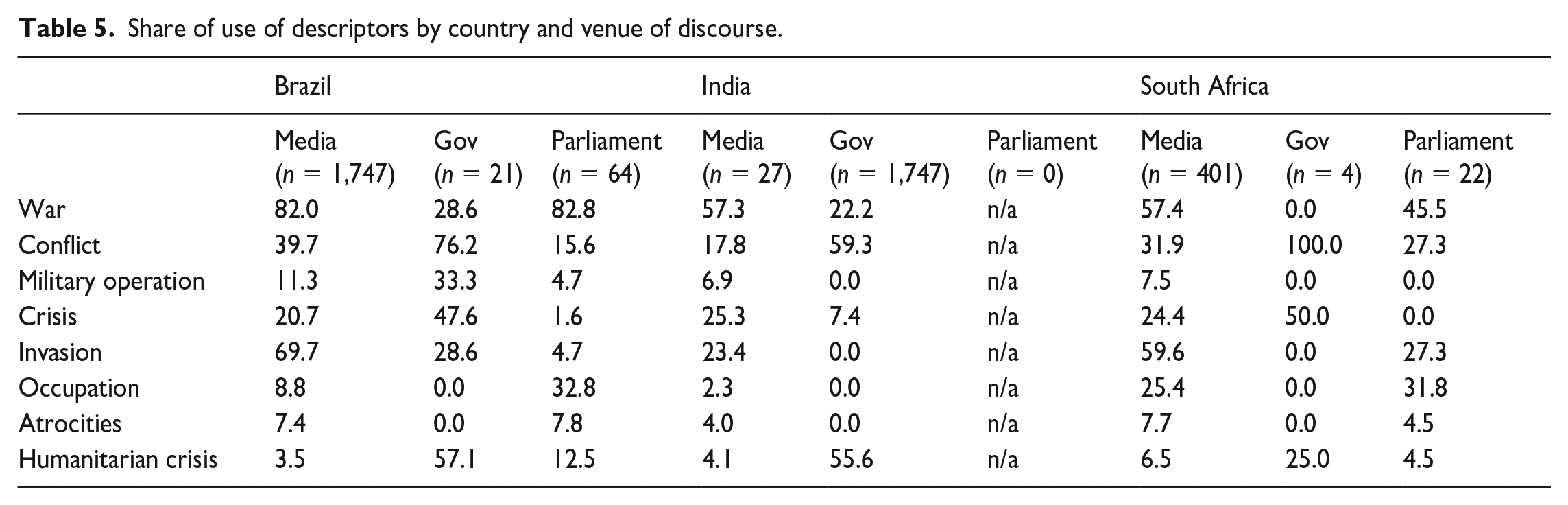
Using announcements from government sources and speeches by parliamentarians as benchmarks, we find that media coverage across all three countries differs substantially in its use of descriptive terminology for the events in Ukraine (see Table 5). While ‘war’, ‘invasion’ and ‘aggression’ were the most common descriptors in news coverage, heads of government and foreign ministries were much more reluctant to use such terms in their official communications. The South African government referred to the events as either ‘conflict’ or ‘crisis’ exclusively, while Brazilian and Indian government sources referred to ‘war’ in only 29 percent and 22 percent, respectively, of their press releases and announcements. On the contrary, references to ‘crisis’ or ‘tension’ were significantly more common in government communications than in news reports, and so were mentions of a ‘humanitarian crisis’. Parliamentary debates on the other hand showed greater similarity with the wording practices of news outlets. 3 While we cannot test the hypothesis with our data, it is reasonable to assume that this difference is due to parliamentary speeches being mainly directed at domestic audiences and MPs’ local constituencies, and do not have to be – like government pronouncements – informed by careful diplomatic considerations.
Share of use of descriptors by country and venue of discourse.
Salience of political actors and entities
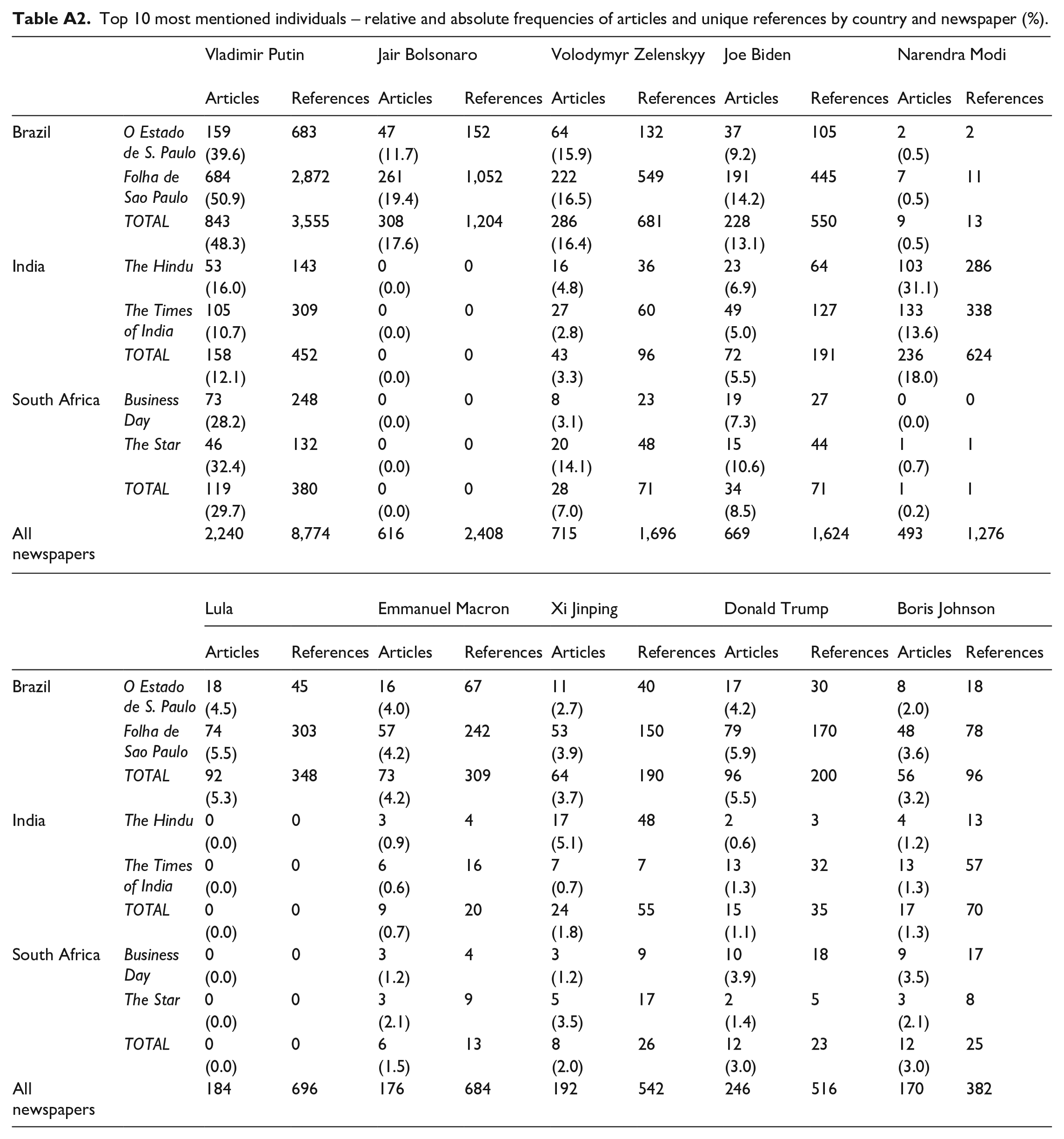
Our named entity recognition of people’s names revealed the most often mentioned individuals across our media sample. The top 10 – in order of the number of unique references – are Russian President Vladimir Putin (n = 4,387), then-Brazilian President Jair Bolsonaro (n = 1,204), Ukrainian President Volodymyr Zelenskyy (n = 848), US President Joe Biden (n = 812), Indian Prime Minister Narendra Modi (n = 638), then-former Brazilian President Luiz Inácio Lula da Silva (n = 348), French President Emmanuel Macron (n = 342), Chinese President Xi Jinping (n = 271), former US President Donald Trump (n = 258) and then-UK Prime Minister Boris Johnson (n = 191). 4 Again, we find significant differences between countries and newspapers when we compare the salience of these politicians in news coverage (see Table A2 in the Appendix for details). Putin is mentioned in 48 percent of Brazilian news reports but appears in only 30 percent of articles in South Africa, and a mere 12 percent of articles in India. Both Brazilian politicians in the top 10 – Bolsonaro and Lula – account for zero mentions across the four newspapers from India and South Africa. Inversely, Modi only appears in a total of nine articles in our Brazilian media sample and is just mentioned once – by The Star – in news reports from South Africa. Overall, Indian news coverage stands out – in both newspapers we observe significantly fewer references to foreign political leaders than in Brazilian and South African news discourse about the war. Putin being mentioned in 16 percent of articles in The Hindu is the highest share.
Finally, our analysis of references to geopolitical entities provides clear evidence for strong levels of domestication in news coverage in Brazil, India and South Africa. Almost all references to these three countries appear in their respective domestic newspapers (see Figure 1). In line with our findings of the analysis of named personalities, linkages between the democratic BRICS countries in reports about the Russo–Ukraine are negligible. The organization BRICS itself is mentioned in a mere 12 Brazilian, 3 Indian and 17 South African articles. Unsurprisingly, the US receives by far the most attention of countries that are neither combatants in the war nor part of our media sample, with more than 4,200 references. The North Atlantic Treaty Organization (NATO) – known as Organização do Tratado do Atlântico Norte (OTAN) in Portuguese – appears in 344 articles of our Brazilian sample (19.7%), in 58 articles of our Indian sample (4.4%) and 52 articles of our South African media sample (13.0%). References to the European Union (EU) – União Europeia (UE) in Portuguese – are made in 380 articles (21.8%) from Brazil, in 58 articles (4.4%) from India and in 62 articles (15.5%) from South Africa. Again, these findings indicate that, in their coverage of the Russo–Ukrainian war, Indian newspapers provide comparatively less coverage about international relations and global politics than their Brazilian and South African counterparts.
Discussion and conclusion
All the descriptor categories for the situation in Ukraine after Russia’s invasion showed significant differences in how salient they were in news coverage across our media sample. These significant differences also extended to the country-level of analysis, except for ‘crisis’ and ‘humanitarian crisis’. We found the starkest differences in the use of ‘war’, ‘invasion/aggression/assault’ and ‘occupation/takeover’, with the first being particularly prevalent in Brazilian news coverage, the second in both Brazilian and South African news coverage, and the third being much more salient in South African news discourse than in the other two countries. Of particular note is that this makes Indian mainstream news stand out as using more restrained language in their coverage. This finding is not evidence for a causal link between the Modi government’s cautious approach towards Russia’s military aggression and the language of news in India. But these substantive differences in labelling – and thereby defining, in both legal and moral terms – the Russo–Ukrainian war are indicative of a mediated public discourse in the Republic of India that comes closer to the discursive cues of government actors.
Overall, however, we do not find clear evidence for issue interpretations to ‘cascade down’ (Entman, 2003) from the government level to news coverage. As our comparison of the use of descriptors in government communications vs news articles shows, the mostly restrained and careful wording of the offices of the heads of government, as well as the respective foreign ministerial departments, was not reflected in the terminology of mainstream news discourse. If anything, news discourse rather conformed – or was ‘indexed’ (Bennett, 1990) – to interpretations voiced by members of parliament, of which almost two thirds came from members of opposition parties, a finding in line with the contingent attribute of political elite dissent by Bennett.
Indian news coverage also featured significantly fewer references to heads of governments than news reports from Brazil and South Africa. Only 12 percent of Indian news items mention Vladimir Putin while Ukrainian President Zelenskyy is referred to in just over 3 percent of them. Similarly, the Indian newspapers also contained by far the fewest references to intergovernmental organizations such as BRICS, NATO and the EU. We consider these findings to be indicative of a high level of issue domestication in Indian news coverage, which was somewhat more pronounced in The Times of India than in The Hindu (see results in Table A2 in the Appendix). As previously observed by (2023), the majority of coverage in The Times of India during the first weeks of the conflict (which accounts for 62% of our article count within the Indian news sample) focused on the plight of Indian students stuck in Ukraine. Most news reports – across the various regional editions of the newspaper – avoided providing accounts of military developments or the geopolitical implications of the escalation but instead zeroed in on human interest stories about students’ circumstances, their worried parents and the Indian government’s attempts to bring its citizens to safety.
Our analyses can only begin to tell the story of how mainstream news outlets in democratic BRICS countries have represented the Russian invasion of Ukraine to their respective domestic audiences. First, our results are limited to key events that occurred during or after the Russian invasion of Ukraine in February 2022. Since this does not mark the beginning of the wider conflict, and the patterns we observe also follow developments from earlier periods, we encourage future studies to cover longer timeframes. Furthermore, as would be the case for longer periods, the quantitative analysis employed here is useful for mapping certain patterns, particularly related to terminology and actor salience. However, to gain a more nuanced understanding of the contexts in which certain terms are used or actors are mentioned, more qualitative, in-depth analyses are necessary. In future studies, we aim to examine journalistic sourcing with a particular focus on the types of actors who get quoted directly. We will also analyse a subsample of our news corpus that consists of commentaries, editorials and letters to the editors – i.e. explicit expressions of opinions in news discourse – for the responsibilities they assign for the war and the solutions to the conflict they propose. These additional investigations will help to provide a more nuanced and detailed understanding of journalistic practices in covering the Russo–Ukrainian war in Brazil, India and South Africa. For now, we have provided a comparative description of larger patterns of news coverage in these Russia-aligned countries. We have found evidence for strong domestication of the issue overall, and in English-language coverage from India in particular. Our analysis of issue descriptors has revealed very similar patterns across all three countries in that news media was much more prone to use more alarming language (‘war’, ‘invasion’, ‘atrocities’) than their respective domestic government institutions.
These findings contribute to a better understanding of and theorization about the relationship between geopolitics, national ideologies and news content during a time of renewed antagonism between world powers. In ‘a paradoxical world where globalization appears to be moving forward and backward simultaneously’ (Hellmueller and Berglez, 2023: 2359), international comparative journalism research has a crucial role to play in helping us to understand the complex dynamics and interrelations between political power, ideology, information flows and mediated sense-making.
Footnotes
Appendix
Top 10 most mentioned individuals – relative and absolute frequencies of articles and unique references by country and newspaper (%).
| Vladimir Putin | Jair Bolsonaro | Volodymyr Zelenskyy | Joe Biden | Narendra Modi | |||||||
|---|---|---|---|---|---|---|---|---|---|---|---|
| Articles | References | Articles | References | Articles | References | Articles | References | Articles | References | ||
| Brazil | O Estado de S. Paulo | 159 | 683 | 47 | 152 | 64 | 132 | 37 | 105 | 2 | 2 |
| (39.6) | (11.7) | (15.9) | (9.2) | (0.5) | |||||||
| Folha de Sao Paulo | 684 | 2,872 | 261 | 1,052 | 222 | 549 | 191 | 445 | 7 | 11 | |
| (50.9) | (19.4) | (16.5) | (14.2) | (0.5) | |||||||
| TOTAL | 843 | 3,555 | 308 | 1,204 | 286 | 681 | 228 | 550 | 9 | 13 | |
| (48.3) | (17.6) | (16.4) | (13.1) | (0.5) | |||||||
| India | The Hindu | 53 | 143 | 0 | 0 | 16 | 36 | 23 | 64 | 103 | 286 |
| (16.0) | (0.0) | (4.8) | (6.9) | (31.1) | |||||||
| The Times of India | 105 | 309 | 0 | 0 | 27 | 60 | 49 | 127 | 133 | 338 | |
| (10.7) | (0.0) | (2.8) | (5.0) | (13.6) | |||||||
| TOTAL | 158 | 452 | 0 | 0 | 43 | 96 | 72 | 191 | 236 | 624 | |
| (12.1) | (0.0) | (3.3) | (5.5) | (18.0) | |||||||
| South Africa | Business Day | 73 | 248 | 0 | 0 | 8 | 23 | 19 | 27 | 0 | 0 |
| (28.2) | (0.0) | (3.1) | (7.3) | (0.0) | |||||||
| The Star | 46 | 132 | 0 | 0 | 20 | 48 | 15 | 44 | 1 | 1 | |
| (32.4) | (0.0) | (14.1) | (10.6) | (0.7) | |||||||
| TOTAL | 119 | 380 | 0 | 0 | 28 | 71 | 34 | 71 | 1 | 1 | |
| (29.7) | (0.0) | (7.0) | (8.5) | (0.2) | |||||||
| All newspapers | 2,240 | 8,774 | 616 | 2,408 | 715 | 1,696 | 669 | 1,624 | 493 | 1,276 | |
| Lula | Emmanuel Macron | Xi Jinping | Donald Trump | Boris Johnson | |||||||
| Articles | References | Articles | References | Articles | References | Articles | References | Articles | References | ||
| Brazil | O Estado de S. Paulo | 18 | 45 | 16 | 67 | 11 | 40 | 17 | 30 | 8 | 18 |
| (4.5) | (4.0) | (2.7) | (4.2) | (2.0) | |||||||
| Folha de Sao Paulo | 74 | 303 | 57 | 242 | 53 | 150 | 79 | 170 | 48 | 78 | |
| (5.5) | (4.2) | (3.9) | (5.9) | (3.6) | |||||||
| TOTAL | 92 | 348 | 73 | 309 | 64 | 190 | 96 | 200 | 56 | 96 | |
| (5.3) | (4.2) | (3.7) | (5.5) | (3.2) | |||||||
| India | The Hindu | 0 | 0 | 3 | 4 | 17 | 48 | 2 | 3 | 4 | 13 |
| (0.0) | (0.9) | (5.1) | (0.6) | (1.2) | |||||||
| The Times of India | 0 | 0 | 6 | 16 | 7 | 7 | 13 | 32 | 13 | 57 | |
| (0.0) | (0.6) | (0.7) | (1.3) | (1.3) | |||||||
| TOTAL | 0 | 0 | 9 | 20 | 24 | 55 | 15 | 35 | 17 | 70 | |
| (0.0) | (0.7) | (1.8) | (1.1) | (1.3) | |||||||
| South Africa | Business Day | 0 | 0 | 3 | 4 | 3 | 9 | 10 | 18 | 9 | 17 |
| (0.0) | (1.2) | (1.2) | (3.9) | (3.5) | |||||||
| The Star | 0 | 0 | 3 | 9 | 5 | 17 | 2 | 5 | 3 | 8 | |
| (0.0) | (2.1) | (3.5) | (1.4) | (2.1) | |||||||
| TOTAL | 0 | 0 | 6 | 13 | 8 | 26 | 12 | 23 | 12 | 25 | |
| (0.0) | (1.5) | (2.0) | (3.0) | (3.0) | |||||||
| All newspapers | 184 | 696 | 176 | 684 | 192 | 542 | 246 | 516 | 170 | 382 | |
Acknowledgements
The authors would like to extend their gratitude to their student research assistant Iara Gabriela Faleiro Diniz.
Declaration of conflicting interests
The authors declared no potential conflicts of interest with respect to the research, authorship and/or publication of this article.
Funding
The authors received financial support for their research through the School of the Arts’ Research and Development Initiative Fund at the University of Liverpool.

Supplemental material
Supplemental material for this article is available online.
Notes
Author biographies
Address: Xi'an Jiaotong-Liverpool University, Suzhou, China. [email:
Address: University of Vienna, Austria. [email: