




Abstract
The period since the full-scale Russian invasion is marked by the Russia-Ukraine conflict over interpreting historical periods/events/figures, which translated into wars over monuments in physical space and digital monument wars on media. Drawing on the analysis of 2708 posts reporting on monuments (24 February 2022–24 February 2023) and conceptualizing memory conflicts as online battles of spectacles, the article seeks to investigate digital representations of wars over monuments and mechanisms – multimodal, discursive and social media related – of online monument battles between pro-Ukrainian and pro-Russian Telegram channels. This article contributes to our understanding of how memory conflicts are waged online, and how they are incorporated in a broader international conflict. The study shows how memory contestations involving the same physical spectacles distinguished by regional patterns are used to construct reversed visions of past, current events and identity from a certain perspective on social media – pro-Ukrainian or pro-Russian – to undermine opponent’s position.
Introduction
‘Memory wars’ – struggles to define and narrate the past as a foundation for present and future (Fedor et al., 2017: 4) – and concomitant national identities discrepancies are an integral part of contemporary armed conflicts. Conflicting sides use history to legitimize and strengthen their positions (Wylegała and Głowacka-Grajper, 2020), (re)shape identities and construct the enemy (Fedor et al., 2017). Monuments as ‘material sites through which states create and distribute a sense of symbolic attachment and belonging’ (Koziura, 2020: 168) become ‘a hotspot of contestation’ between various forces (Klymenko, 2020: 821). Competing interpretations of countries’ past are an integral part of the ongoing Russia-Ukraine war. Almost immediately after the invasion, Ukraine got engulfed by another wave of decommunization – a political, social and cultural process of contesting and eliminating the cultural heritage of the communist/Soviet past from public spaces (Гриценко, 2019: 8).
The first Soviet monuments fell on the verge and after the USSR’s dissolution in 1991 mainly in West Ukraine (Portnov, 2013: 235). The second wave of decommunization is associated with national memory politics during Viktor Yushchenko’s presidency – rehabilitation of nationalist movement, condemnation of the Soviet regime, recognition of the 1932–33 massive famine (Holodomor) as a genocide of the Ukrainian people – and conflicts over monuments between supporters of Ukrainian nationalistic versus Russian imperial models of memory (Shevel, 2014, 2016). The third, more extensive wave of decommunization swept over Ukraine during the Maidan Uprising and the Revolution of Dignity in 2013–14, most known for Leninfall or massive dismantling of monuments to communist leader Lenin (Plokhy, 2015). Emerged as the oppositional public reaction to President Yanukovych’s rejection to sign the Association Agreement with the EU and to subsequent Russia’s occupation of Ukrainian Crimea and Ukraine’s eastern territories, it was institutionalized in 2015 by decommunization/‘memory laws’ mandating to remove monuments and rename places associated with communism and the USSR (Гриценко, 2019).
Since 24 February 2022 Ukraine has become a battlefield for another wave of monument wars. On the one hand, the process of decolonizing Ukraine’s public spaces broadened: the full-scale invasion re-accelerated decommunization and expanded it to de-Russification – activists’ movement and Ukraine’s national memory politics aiming at eliminating monuments associated with Russia and Russian imperial policy, including those related to the Russian Empire, the Soviet Union, or the Russian Federation (Fomenko, 2023). Moreover, the war strengthened removing the remaining monuments of the Soviet past in Eastern Europe as an anti-war/-totalitarian/-occupational protest and excited memory activism internationally to voice support for Ukraine (Pshenychnykh et al., 2024). On the other hand, having taken control over some part of Ukraine’s territory, the aggressor/their collaborators destroy monuments to Ukrainian prominent figures and (re)instal Soviet monuments (Gabowitsch and Homanyuk, 2025).
Modern wars are also distinguished by hybrid nature, and media may become another space for memory conflicts (Rutten and Zvereva, 2013: 1). The Russia-Ukraine wars over monuments unfolding in physical space since 2022 have also translated into digital monument wars on media. Since February 2022 these conflicts have been extensively visualized and engaged the public on online Russian and Ukrainian state TV channels, news issues and social media. According to the author’s monitoring of social networking platform Telegram, this topic has become the focus of daily attention over the period of 2022–23 reaching up to 161 posts on monuments a month on a channel broadcasting from the Ukrainian position (December 2022) and up to 65 – on a channel circulating pro-Russian narratives (May 2022).
Telegram is a relatively new messenger, having been around since 2013. It enables individual or group users to create channels for others to follow. Similar to other networking platforms, Telegram channels are decentralized, so that control is partly distributed to users who have relatively equal opportunities to contribute content – subscribers can message their content to administrators, yet the latter select, edit and distribute it. The most specific feature of Telegram channels is their high degree of anonymity: 77% of the most popular Telegram channels in Ukraine in 2022 were anonymous (Рябоштан et al., 2022) – their administrators and/or their location were not indicated. Nevertheless, channels’ ideological position can be traced in their language, and in 2022 10% of most popular Telegram channels in Ukraine used pro-Russian rhetoric. In 2022, such features of Telegram as its accessibility, instant news posting, anonymity made Telegram ‘a pivotal platform for searching for the news’ in Ukraine (Рябоштан et al., 2022). Telegram popularity, the coexistence of pro-Ukrainian and pro-Russian channels there and high visibility of posts on monuments, make this platform a pertinent source for understanding online memory conflicts in wartime.
The study aims to unravel the specific form the current Russian-Ukrainian memory wars over monuments take on social media. In this article, memory wars between pro-Ukrainian and pro-Russian Telegram channels are conceptualized as online battles of spectacles – competitive strategies of channels’ administrators to make contestations of memory and monuments hypervisible and engaging and to construct their representations from the position that conflicts and undermines interpretations circulated by the other side. The central argument of this article is that while offline Russia-Ukraine wars over monuments are distinguished by distinct regional patterns, digital affordances enable both sides to cross digital and physical borders and report on the same monuments’ contestations in the same regions yet communicate them from antagonistic perspectives. It results in constructing reversed, polarized, mirroring, mutually exclusive interpretations of the same historical periods/events/figures, as well as of current events and national identity creating dividedness of the two camps.
Conflicts over monuments as physical and digital spectacles
In most general terms, a spectacle is an event which is purposefully created and intended to awe or amaze audience (Penner, 2019: 20). Public spaces are among sites where physical spectacles are staged – participants gather and engage in performative acts to hold spectators’ gaze (Thejaswini and Haneef, 2020). Besides being visually striking, shocking, entertaining, non-trivial (Reyes, 2020), physical spectacles interrupt people’s daily routine (Briziarelli and Armano, 2017) to articulate, draw attention to, spread, reaffirm or express dissent with political, social, ideological views (Asenas and Hubble, 2018; D’Arcus, 2006; Thejaswini and Haneef, 2020). Rooted in tensions among proponents of different ideologies, political, social movements, such acts as de-commemoration, erecting new objects, protesting against them, damaging, modifying monuments are instances of battles of physical spectacles – an integral part of monument wars or conflicts over monumental heritage in political, public, online, offline spaces (Kazharski and Makarychev, 2021; Portnov, 2013; Pshenychnykh et al., 2024).
Wars over monuments have been extensively studied from historical and political perspectives, showing how these conflicts develop in physical space and how the past is revisioned to shape the present identity. The geographical focus of these explorations is broad, including comprehensive studies of monument wars in post-socialist countries (Adams and Lavrenova, 2023; Bitušíková, 2018; Kazharski and Makarychev, 2021; Letko, 2016; Williams, 2008; Young and Kaczmarek, 2008). Such events as USSR’s dissolution, the Revolution of Dignity in Ukraine, the Russia-Ukraine war since 2014 involved reinterpreting the past and, consequently, changing country’s monumentscape. Elaborated research on monument wars within Ukraine has been undertaken on the period till 2022, for instance, on revising Ukrainian history and monuments (Portnov, 2013); researching on wars over Soviet monuments in the context of the Revolution of Dignity and decommunization laws (Cherviatsova, 2020; Kovalov, 2022); on regional identity and disputes over memory and monuments in Ukraine (Klymenko, 2020; Koziura, 2020; Mahony, 2021; Plokhy, 2017; Sukovata, 2022; Yekelchyk, 2021; Zhurzhenko, 2020; Гайдай et al., 2018). These investigations show that while in Russia such historical themes as the Great Patriotic War, the Soviet victory in WWII and the USSR’s greatness were integrated into official narratives (Fedor et al., 2017), in Ukraine the period of 1991–2022 was characterized by a ‘lack of a uniform national public consensus’ on the past and internal tensions over Ukraine’s history and identity, mainly between pro-EU and pro-Russian supporters (Kasianov, 2022; Portnov, 2013: 233). Since 24 February 2022 the internal conflict over memory and identity within Ukraine has grown to the international one, and most recent works identify its regional and ideological patterns: decolonization in Ukraine versus (re)installing Soviet monuments on Russia-occupied Ukrainian territories and damaging/destroying monuments representing Ukrainian historical figures by the aggressor (Betlii, 2022; Gabowitsch and Homanyuk, 2025). However, in the contemporary context of history weaponization on media, these studies do not uncover either the form this dispute takes online or the role of digital media in it.
Scholarship on media studies provides insights into how memory wars are waged through a range of media forms with the recent focus on digital memory wars (Dounaevsky, 2013; Rutten and Zvereva, 2013; Sporer-Wagner, 2013). Before 2022, digital media had already been a space for disputes over common periods in the history of Ukraine and Russia – such as the Soviet era, WWII, the Holodomor, the occupation of Ukrainian territories in 2014. Compared to traditional media, new media allowed for more diverse representations of events and memory contestations, more controversial public opinions, which, on the one hand, coexisted with distinct political and social movements’ history interpretations and identity imaginings and, on the other, undermined the national framework for memory and identity production (Kukulin, 2013; Kulyk, 2013; Makhortykh, 2020; Nikiporets-Takigawa, 2013; Pasholok, 2013; Rutten and Zvereva, 2013). Ukrainian traditional and new media were characterized by heterogeneity of views on Ukrainian past and national identity. They provided a space for nuanced individuals’ opinions and a battlespace for pro-EU, nationalistic and pro-Russian views (Kulyk, 2013; Makhortykh, 2020; Paulsen, 2013; Pshenychnykh, 2019; Rutten, 2013). Russian social networking platforms represented an alternative public space and displayed much more diverse narratives on history compared to state-driven mass and online media (Dounaevsky, 2013; Kulyk, 2013; Makhortykh et al., 2022; Rutten, 2013). Contrary to the previous findings, the most recent studies in the context of the full-scale war (Bekus, 2022; Pshenychnykh et al., 2024; Tolz and Hutchings, 2023) indicate that the invasion significantly reduced the diversity of history interpretations on digital media and aggravated pro-Ukrainian and pro-Russian polarized views online. As this overview shows, the research on digital conflicts over Ukrainian and Russian pasts to date has mainly focused on controversial historical episodes but not on online debates over objects commemorating them. This article aims at bridging the gap between memory and media studies by exploring how the contemporary Russia-Ukraine memory conflict over monuments is translated online on pro-Ukrainian and pro-Russian Telegram channels.
Due to such characteristics of social media as instantaneity and simultaneity, accessibility and low-cost production, disintermediation or bypassing traditional gatekeepers, deterritorialized, networking and participatory environment, a physical spectacle can evolve into a digital one – viral popular stories gaining, shocking or exciting much bigger audiences ahead of mainstream media (Kellner, 2017; Nanabhay and Farmanfarmaian, 2011; Stratton, 2020). Spectacles on traditional media are not limited to mass produced images of advertising and entertainment. Their manifestations also include other media genres such as news and propaganda (Debord, 2014 [1967]). In recent papers on digital spectacles, they are characterized by seizing people’s attention (or distracting it) with the help of amusement (Reyes, 2020: 51) or dramatism (Kellner, 2017: 2), as well as by dominance on media (Kellner, 2017: 2). Their digital manifestations range in genre – advertisements, films, cinema, music videos, computer games (Darley, 2000), shows and news (Kellner, 2017; Kraidy, 2018) – and theme – entertainment, politics, disasters, terror attacks, protests, riots and revolutions (Kellner, 2017; Nanabhay and Farmanfarmaian, 2011), war and death (Morelock and Narita, 2022; Stratton, 2020). They are widely circulated online and become ‘signature events’ of a historical period (Kellner, 2017: 3) – both are characteristics of the monument wars under study.
However, spectacle is not reduced to image amplification and visual perception aimed at provoking strong emotional response. The dialectic of unity and separation, introduced by Debord (2014 [1967]), remains a fundamental characteristic of digital spectacles (Briziarelli and Armano, 2017). On the one hand, media spectacles become a means of unification by seizing people’s attention and cultivating certain relations mediated by images (Debord, 2014 [1967]; Kellner, 2017), which has been further reinforced since the introduction of hyperconnective social media (Stratton, 2020). On the other, spectacles are representations which stand for the real world (Debord, 2014 [1967]). News stories online are not always objective or accurate, comprehensive or full accounts of events – information might be mis-/dis-interpreted, falsified, manipulated, presented fragmentary, and so on, and Telegram is not an exception. By this, the detachment from reality might be achieved in a hyperconnected digital environment. Discrepancies between events in physical space and their mediated versions might lie in perspectives these reality fragments are represented from – positions from which a person/group view something and communicate their views (Ensink and Sauer, 2003; Graumann and Kallmeyer, 2002). In contemporary re-readings of Debord’s work, scholars disagree with the totalizing effect of the media spectacle (Asenas and Hubble, 2018), arguing that the digital spectacle cannot be understood as an overwhelming hegemonic regime but rather as a space of contestations in which competing forces and their perspectives meet and confront each other (Kellner, 2005). With media democratization, social networks are potentially open for a more active involvement of spectators to voice their diverse viewpoints (Briziarelli and Armano, 2017). Along with that, recent studies show the divisive nature of media spectacles rooted in conflicting perspectives of framing a situation (Kraidy, 2018), when digital media develop into spaces for opinion popularization and polarization (McCrow-Young and Mortensen, 2021), social conflicts (Couldry and Curran, 2003), online hate, incivility, violence and harassment facilitation (Asenas and Hubble, 2018).
The subject for the qualitative investigation of this article is digital spectacles – Telegram posts covering news, stories, opinions, and so on, on monuments from two ideological perspectives – pro-Ukrainian and pro-Russian. The data collection process included the following stages. To identify relevant Telegram channels, the word ‘Ukraine’ (Ukr. Україна) along with the names of Ukrainian administrative centres and major cities were used to search the platform and join 10 open-access nationwide Ukrainian channels and 30 Ukrainian cities’ channels with the highest number of subscribers, including those of occupied Ukrainian territories since 2014 (Luhansk, Donetsk) and 2022. The latter are represented on Telegram by channels broadcasting from both pro-Ukrainian and pro-Russian stance. Following a three-month monitoring period, 32 channels – six identifying themselves as nationwide and 26 as regional – were selected for further analysis based on their frequency of posts related to monuments. The search words ‘Crimea’ (Rus. Крым) and the names of major Crimean cities were also used to join one all-Crimean and ten Crimean cities’ most popular open-access channels – all translating Russian agenda.
The final dataset comprised 43 channels. Given that most of the selected Telegram channels do not disclose their administrators’ identity and location, and we can only establish their subject of interest and position traced in rhetoric, narratives and titles/descriptions, I refer to the channels under analysis as pro-Ukrainian or pro-Russian. Among them, nine identify themselves as channels of Ukrainian media, city/regional/military administrations, though their administrators’ identity remains undisclosed. 20 pro-Ukrainian channels indicate only their geographical focus in titles/descriptions (for example, ‘Ukraine’ or city/region). 14 pro-Russian channels provide only regionality in their titles/descriptions (city names, ‘Crimea’, ‘Russia’), and nine of these are registered at Roskomnadzor – the Russian federal executive agency of media monitoring, controlling and censoring.
The selected channels were monitored from 24 February 2022 to 24 February 2023, and 2708 posts involving monuments and consisting of texts and visuals (photos, videos) were analysed to register regionality, types of practices on/next to monuments and historical periods/events/figures these objects commemorate. However, this approach proved insufficient as very often both pro-Ukrainian and pro-Russian channels made visible the same events, the same monuments commemorating the same historical periods/events/figures, and the same regions. The main historical periods represented on both pro-Ukrainian and pro-Russian channels are the Ukrainian Cossacks era, the imperial period of Russia and Ukraine under the reign of the Russian Empire (XV century–1917), the October Revolution in Russia (1917) and the Civil War (1917–1922), the Soviet Union and WWII, and the events of 1991–2023. The regions covered by both pro-Ukrainian and pro-Russian channels are also the same – mainly Ukraine and the EU countries. Most visible practices involving monuments on pro-Ukrainian and pro-Russian channels include those connected with decolonization, conservation of monuments and installing new monuments in Ukraine; monumental re-Sovietization and de-Ukrainization of occupied Ukrainian territories; destroying monuments in Ukraine by shelling; installing new objects on occupied Ukrainian territories, as well as removing Soviet monuments, protests and memory activism in the EU countries. Overall, this stage of the research demonstrated that physical spectacles reported on the selected channels are predominantly the same.
However, digital spectacles regarding the same historical periods/events/figures and monuments constructed from pro-Russian and pro-Ukrainian perspectives showed considerable divergencies. Thus, at the next stage, the posts were analysed applying multimodal critical discourse analysis (Jewitt et al., 2016; Machin and Mayr, 2012) to inspect the interplay of verbal and visual constituents, understand discursive meanings constructed from either pro-Ukrainian or pro-Russian perspective along with social media related mechanisms of the online conflict, that I am presenting below.
Online battles of spectacles over monuments on pro-Ukrainian and pro-Russian Telegram channels
Despite Telegram hosting both pro-Ukrainian and pro-Russian channels, followers are separated by being usually subscribed only to channels reflecting their position. However, from channels’ monitoring it becomes evident that there is still a dialogue of a specific character in the form of online battles of spectacles waged between the two sides – on regular basis administrators appropriate visuals from opponent’s channels, presumably anonymously following them, reframe these visuals verbally or digitally modify them to fit their position, circulate certain representations of current and past events to discard rival’s interpretations of them. The selected channels promote one of the perspectives – pro-Ukrainian, anti-Russian/-imperial or anti-Ukrainian, pro-Russian/-imperial. To understand mechanisms aimed at defeating opponent’s viewpoint, the empirical discussion is structured to compare online representations of physical spectacles involving monuments which commemorate the same historical periods/events/figures and are most visible on pro-Ukrainian and pro-Russian channels.
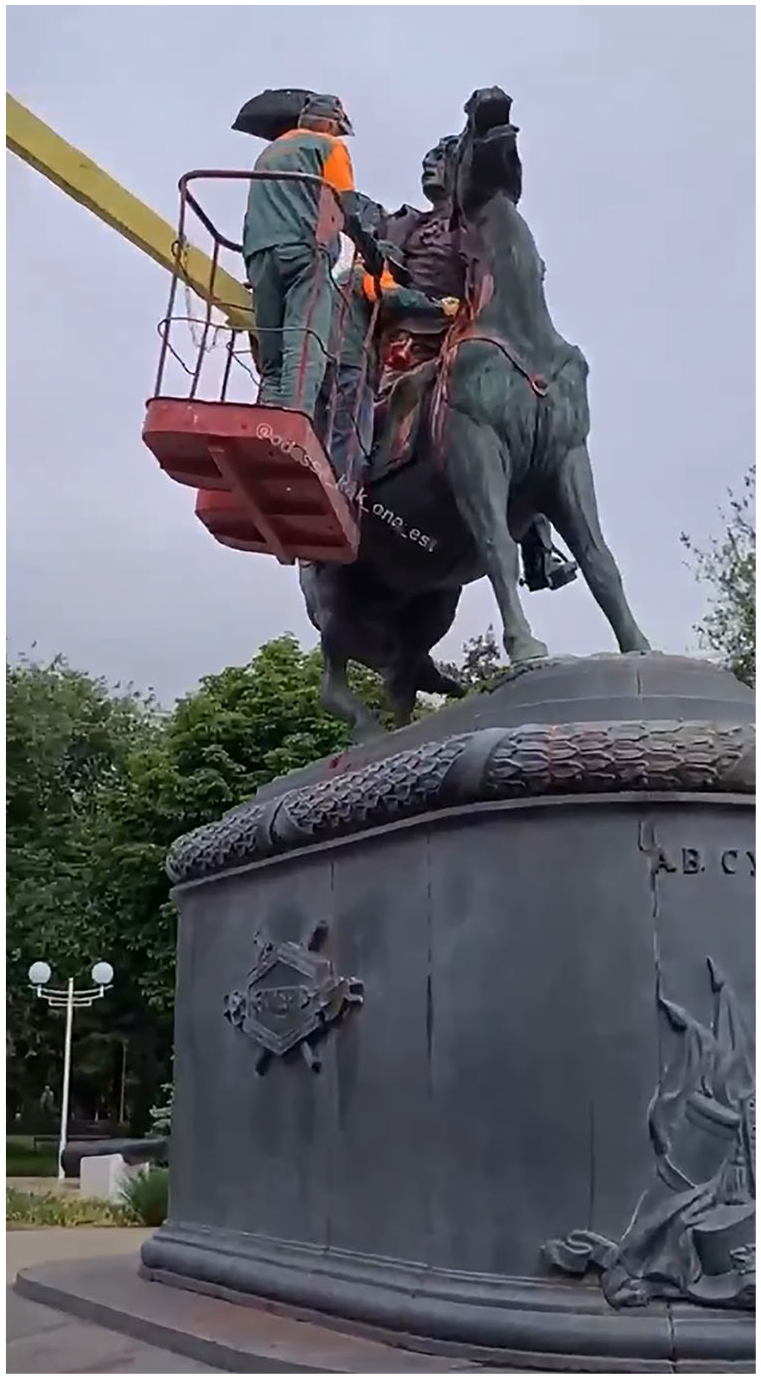
For example, Image 1 features an anti-war performance in Ukrainian Izmail next to Alexander Suvorov monument: people have brought household appliances stained in red with the inscription ‘Russian soldier, take it and go away’, referring to the Russian Army’s maraudings and killings. In the contemporary context, as an activist explains in the post, the figure of the Russian Empire general identifies the aggressor: we expressed our position to monuments to torturers of Ukrainian people. We want this monument to be taken away (Суспільне Одеса, 07.05.22: 22:55). In Kyiv, while dismantling the Soviet statue representing a Russian and a Ukrainian worker under People’s Friendship Arch (renamed to the Arch of Freedom of the Ukrainian People in 2022), Russian figure’s head accidentally fell off (Image 2). A pro-Ukrainian channel framed the event in the context of the ongoing conflict accentuating its symbolism: A symbolic video. While dismantling the monument under the Peoples’ Friendship Arch in Kyiv, the schweinehund’s head fell off (Хуёвый Харьков, 26.05.22: 17:02). Russian worker’s statue represents the aggressor dehumanized by the exonym and the Internet meme schweinehund (Ukr. свинособака), widely used on pro-Ukrainian Telegram channels. Image 3 is a digital modification of the toppled sculpture: the Russian worker metonymically stands for the invader digitally defeated by beheading the monument.
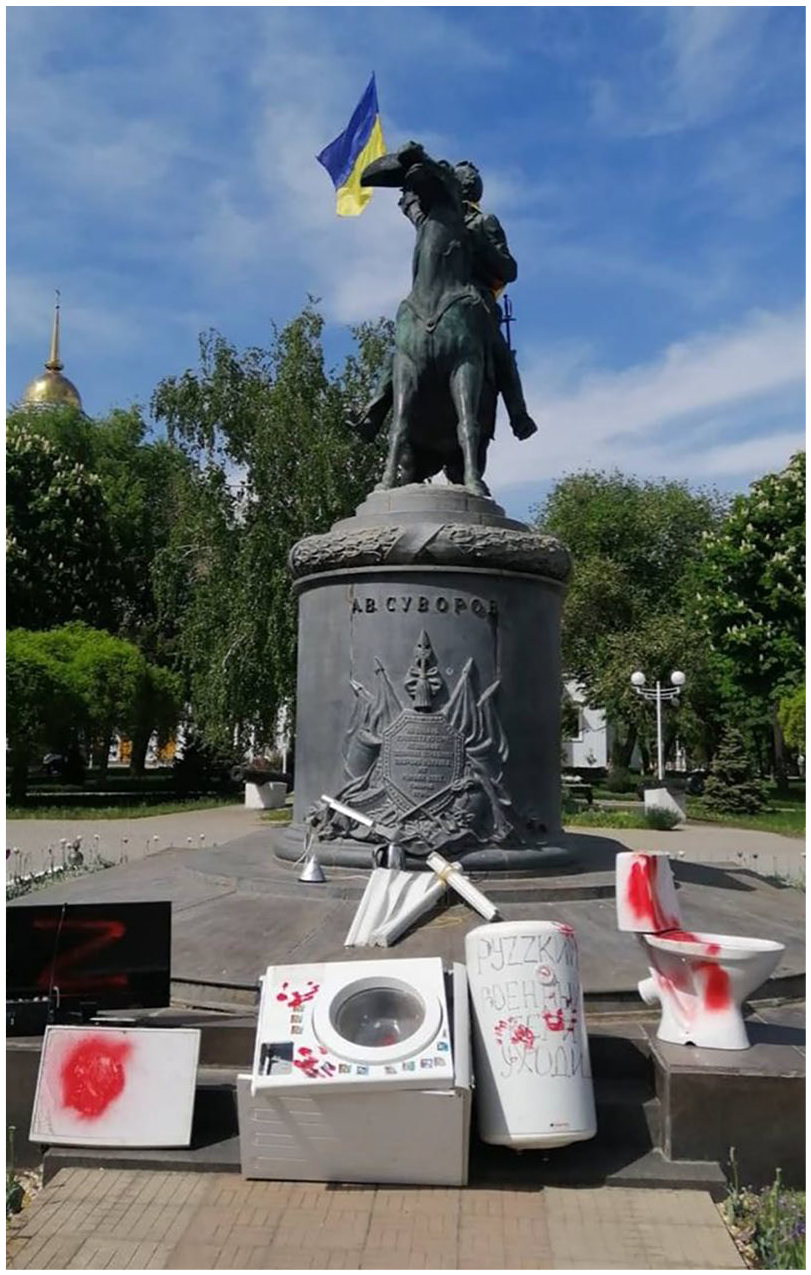
Source: Суспільне Одеса, 07.05.22: 22:55.
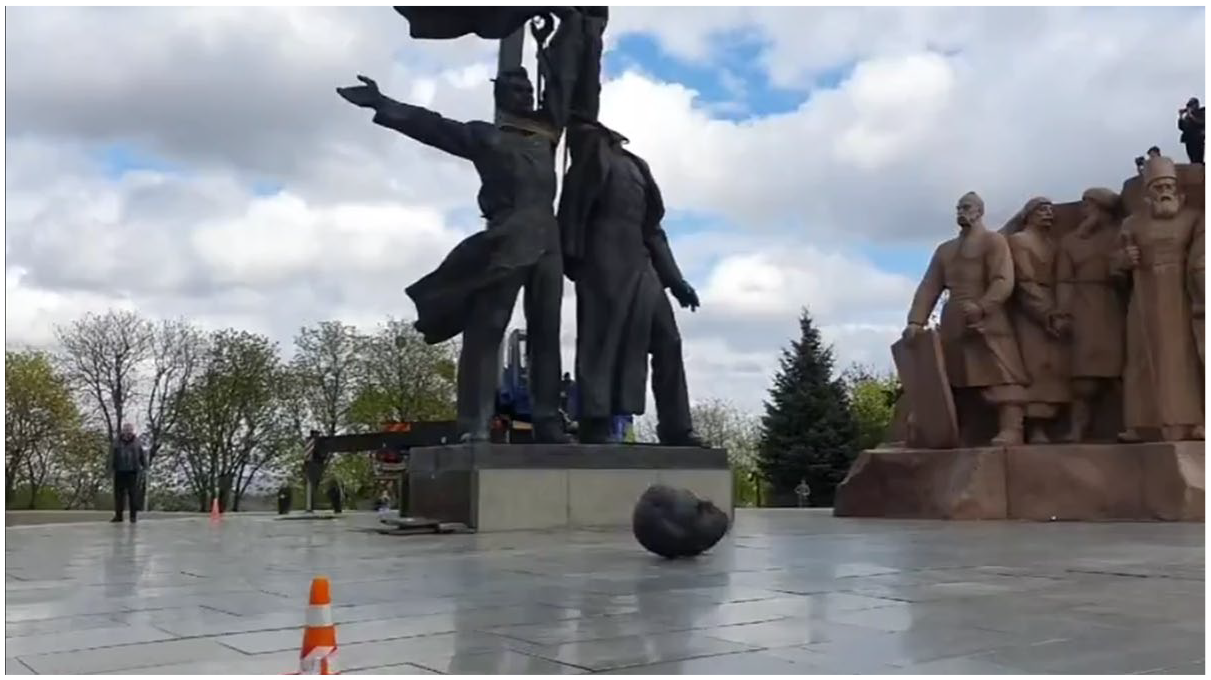
Source: Хуёвый Харьков, 26.05.22: 17:02.
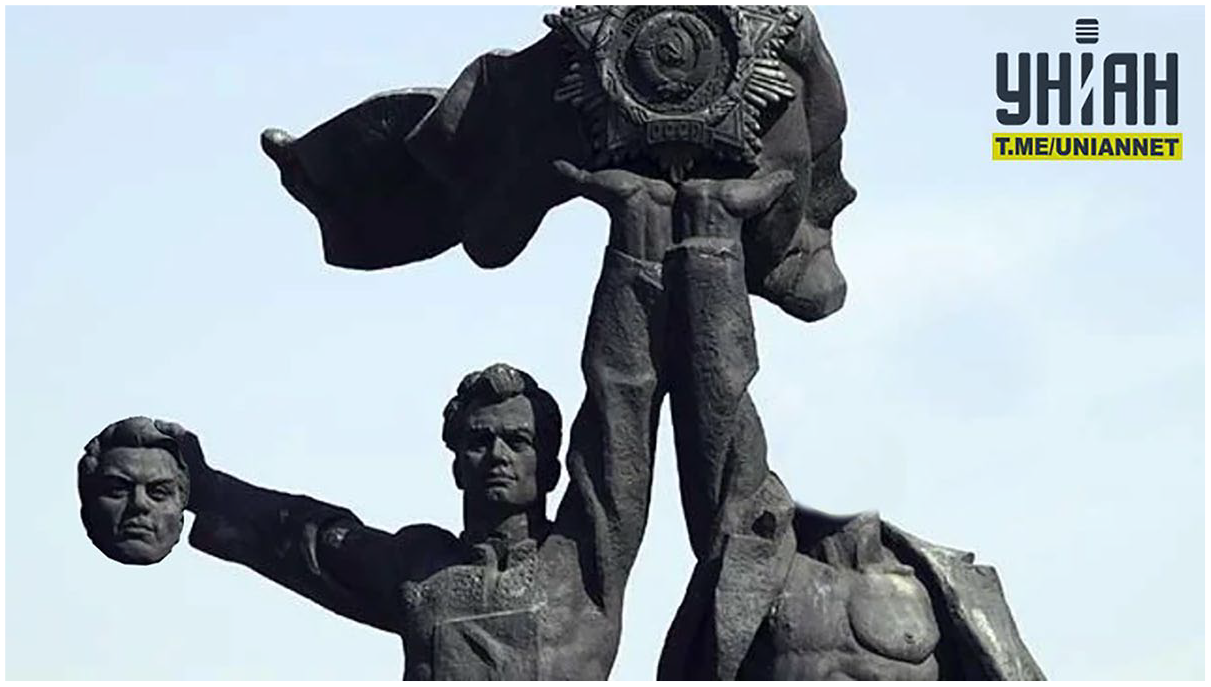
Source: УНИАН, 26.04.22: 15:13.
Another example is an online representation of dismantling the monument to Georgy Zhukov (USSR Marshal) in Kharkiv. Having been the subject of long-lasting memory wars between pro-Ukrainian/-EU and pro-Russian supporters, nationalist organizations and local authorities, it was toppled after the invasion by Kraken regiment. The posted video features activists tearing the bust down with a rope and a truck, throwing it out onto a rubbish dump (Image 4), and inscribing the pedestal with Glory to Ukraine as a symbolic Ukraine’s victory. The video is commented by Kraken’s leader drawing parallels between Zhukov and the aggressor downgraded by decapitalizing in the text (a common practice in Ukraine since 2022): . . . Zhukov is a monster guilty of the deaths of 400 thousand of Ukrainians, repressions, marauding, mass shootings. All these crimes are as true about the russian army as ever. . . . he[Putin], like his idol[Zhukov], will end up on the dump of history (Хуёвый Харьков, 17.02.22: 11:52).
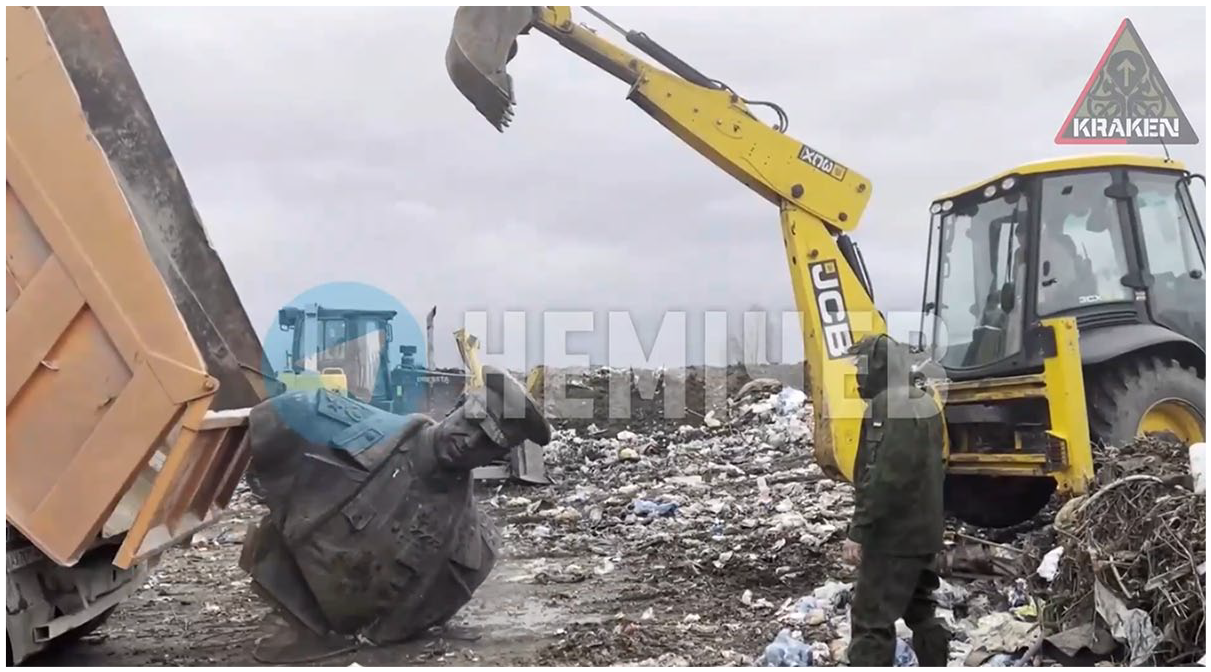
Source: Хуёвый Харьков, 17.02.22: 11:52.
Pro-Ukrainian channels also make visible the removal of remaining Soviet traces in EU countries. These acts are framed similar to those of decolonization in Ukraine and characterized as manifestations of ‘standing with Ukraine’. One video from Finland shows tearing a Lenin’s bust (F[*cking]lenin in the text) off its pedestal, hanging it up with a rope and driving away. Another video records the fall of Monument to the Liberators of Soviet Latvia and Riga from the German Fascist Invaders, furnished with Riga gives a lead of what must be done with dirty-ass occupants’ monuments.
Along with digital spectacles of decolonization, pro-Ukrainian channels post on aggressor’s de-Ukrainization – shelling Ukrainian monuments, destroying, damaging or marking them with Soviet Banners – USSR’s symbol of victory over the Nazis – on occupied Ukrainian territories. These acts are interpreted as a strategy to erase Ukrainian history and identity, and the aggressor is sarcastically characterized as ‘liberators’ whose actions are aimed at ruining, murdering, and so on. It resonates with the message massively promoted by pro-Russian channels to reason the invasion – to ‘denazify’ Ukraine – which gets the meaning of de-nationalization on pro-Ukrainian channels. Visually and verbally, monuments are personified as peaceful Ukrainian civilians, victims, survivors of military attacks and occupation or as inspiring symbols of resilience. Texts are often built on contrasting Ukrainian people who are civilized and victorious with uncivilized Russians who are to suffer defeat. For example, a video (Image 5) from Russian media posted by a pro-Ukrainian channel features dismantling the monument to Petro Konashevych-Sahaidachny (a Ukrainian military Cossacks’ leader, known for supporting a Polish Prince to usurp the Russian throne in 1618) in occupied Manhush: Occupants are dismantling the monument to Hetman Sahaidachny . . . the Ukrainian who headed a march on moscow, arises inferiority complex in rusaks[pejorative for Russians]. They want very much to forget the history of their defeats and our victories. But they will fail. Because we have history, and we are descendants of great ancestors, and they are a herd of stupid sheep, which has neither pride nor dignity (Труха Украина, 09.05.22: 19:00).
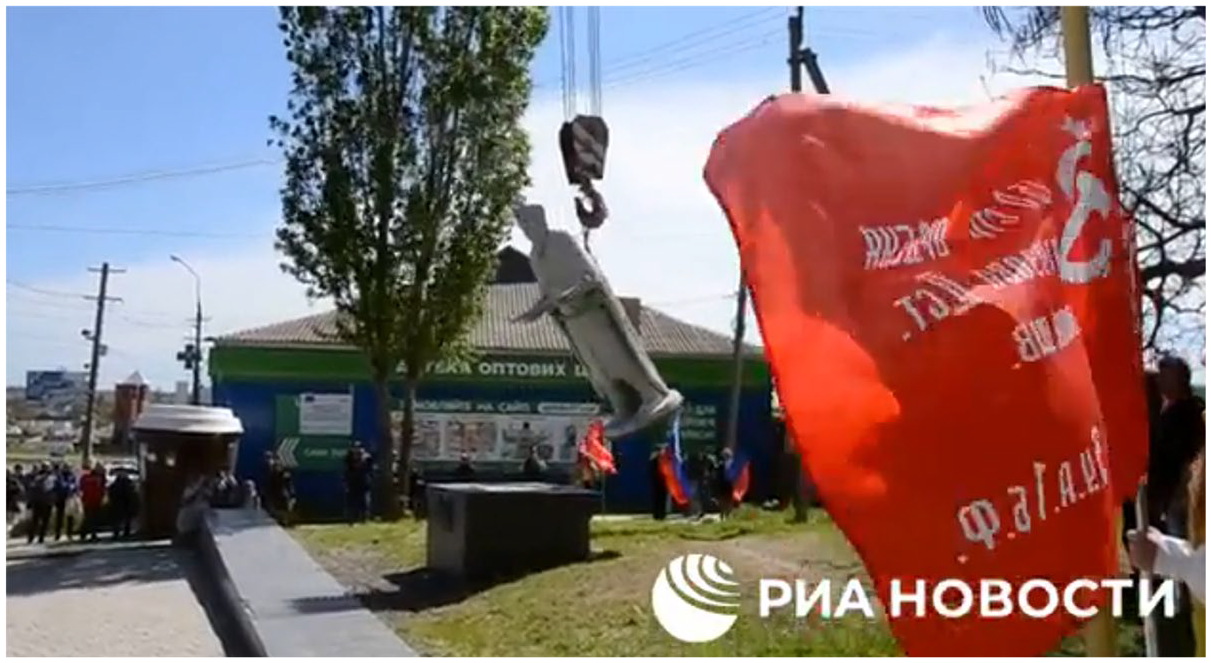
Source: Труха Украина, 09.05.22: 19:00.
Except destructive acts on monuments representing Ukrainian history and identity, pro-Ukrainian channels widely report on the occupier’s ‘re-Sovietization’ of occupied Ukrainian territories such as rehabilitation of Lenin’s figure. Visuals document (re-)erection of Lenin’s monuments dismantled during the Leninfall of 2013–14: driving them back, assembling from parts on empty plinths. However, pro-Ukrainian channels frame this process from a prospective position, verbally dismantling the monuments: Lenin is the dead man and his statues will be crushed, toppled down again. Scenes of ‘Leninrise’ are also scanned in the retrospective temporal direction by describing them as returning back in time and by characterizing Russians as backward people of the ancient past: While Ukraine is the first one to launch electronic passports, orcs are restoring a monument to Lenin in the temporarily occupied Nova Kakhovka. Hold tight, our dearest[Ukrainians], when these tribesmen[occupants] get away from the territory of our country – there will be leninfall 2.0 (Хуёвый Харьков, 30.04.22: 14:17). To reduce the significance of installing Lenin in occupied Melitopol, a pro-Ukrainian channel contrasts its photo from a pro-Russian channel (Image 6), taken from a close low angle against the background of Victory Banners, with a photo (Image 7) from a distant point exposing its actual size: . . . a monument to f[*cking]lenin . . . has turned out to be a dwarf (Хуёвый Харьков, 24.04.22: 07:31).
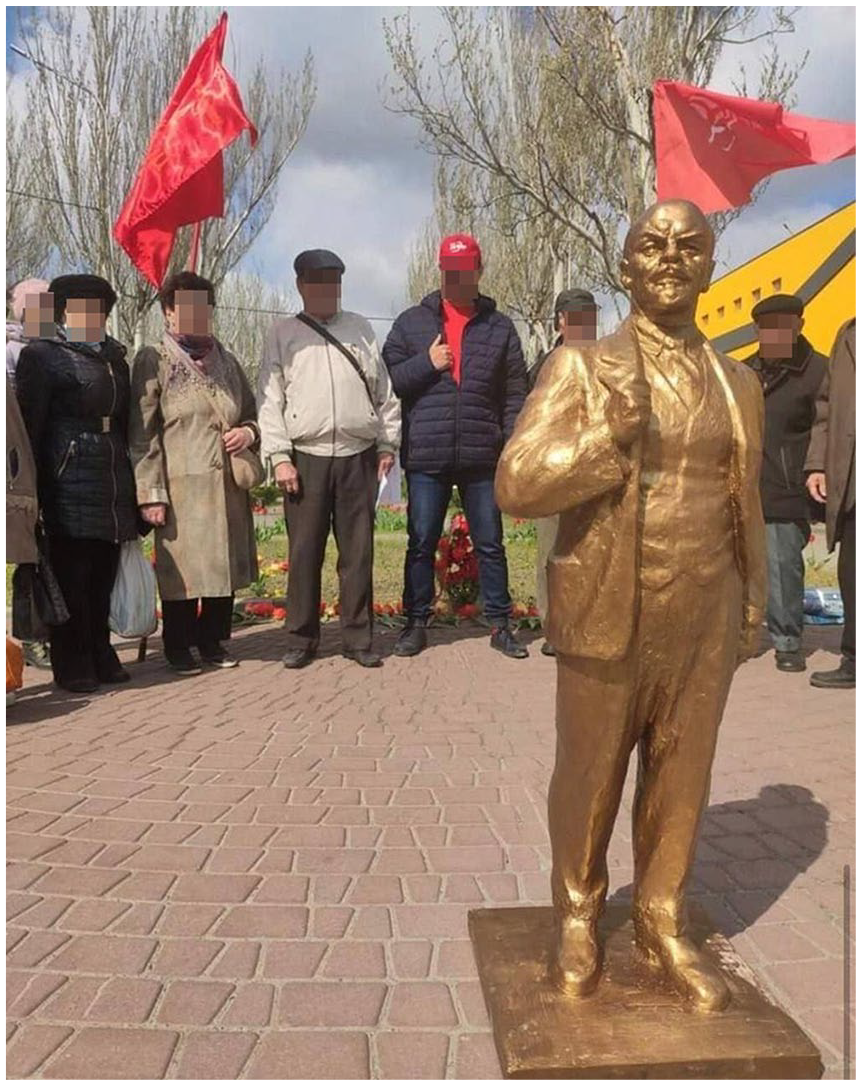
Source: Хуёвый Харьков, 24.04.22: 07:31.
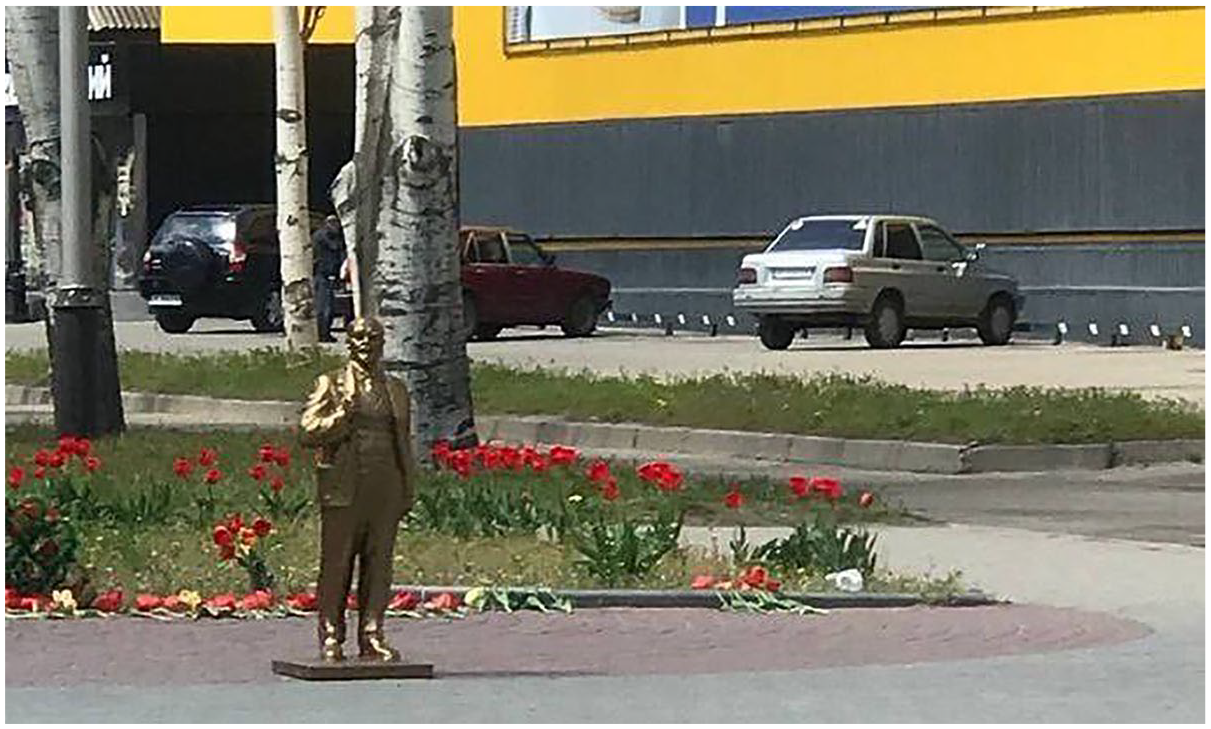
Source: Хуёвый Харьков, 24.04.22: 07:31.
To oppose de-Ukrainization, Ukrainians launch heritage conservation to preserve monuments valuable for Ukrainian identity. On Telegram, these projects are represented by photos of monuments protected with structures looking like shelters, fortifications or military defence constructions. Such images are described with military vocabulary comparing objects either to Ukrainian innocent civilians or warriors: monuments are in protection carcasses, covered with protection constructions, in a shelter, put on bulletproof vests. In Kharkiv (Image 8), the monument to Taras Shevchenko (a renowned Ukrainian poet) has received solid protection (Хуёвый Харьков, 29.03.22: 18:30) and embodies a war leader with a line from his poem in another post – Keep fighting – you are sure to win (Новини України 24/7, 27.03.22: 23:15).
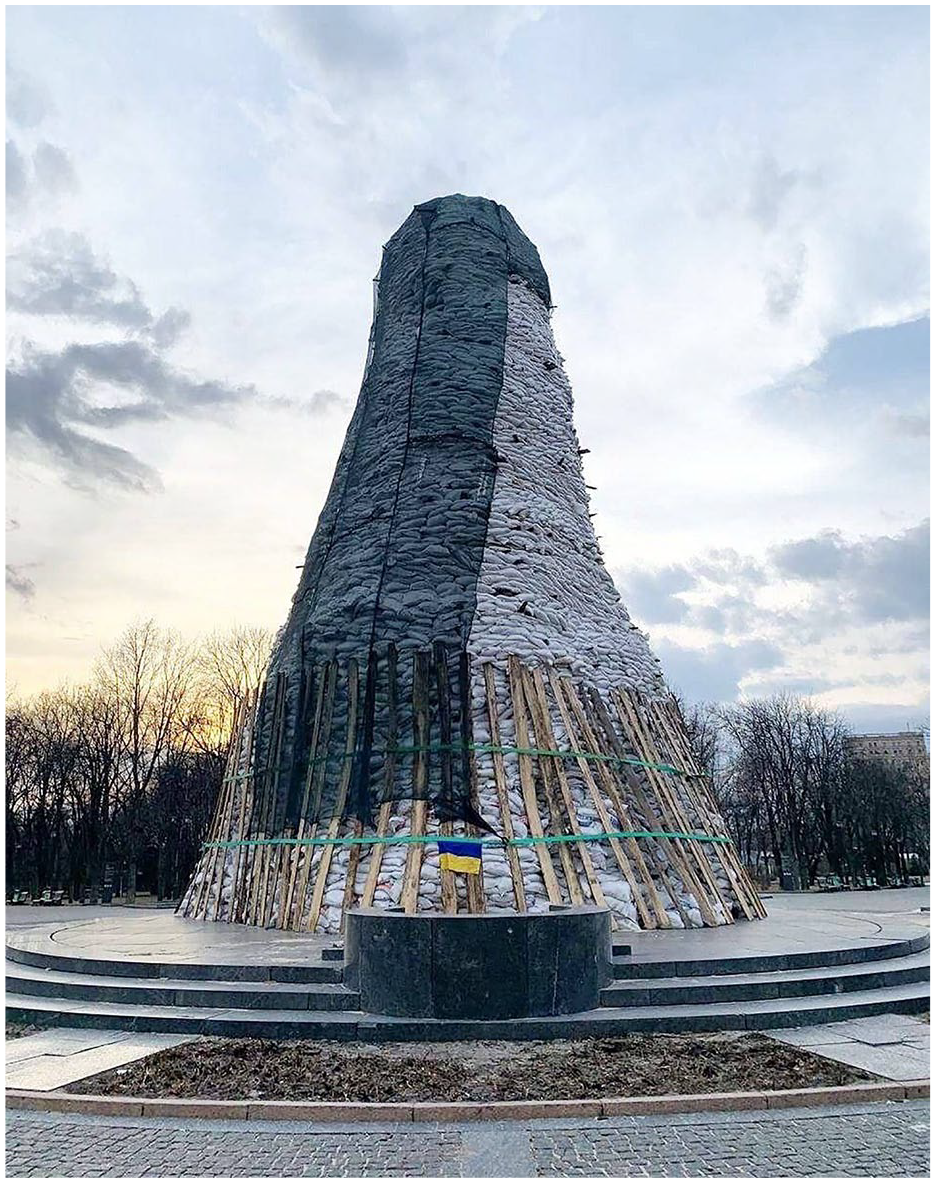
Source: Хуёвый Харьков, 29.03.22: 18:30.
Pro-Ukrainian channels also have multiple posts reporting on putting up new monuments to commemorate contemporary events. For example, one post informs about installing a monument to the Territorial Defence Forces of Ukraine in de-occupied Irpin (the military reserve of the Armed Forces of Ukraine, significantly activated in 2022 with a considerable number of civilians volunteering to join it). The photo (Image 9) represents the monument inscribed with ready for resistance and imprinted with the map of Ukraine including Crimea and other Russia-occupied Ukrainian territories. By that it sends the messages of what Ukraine’s state borders are and what the aim of Ukrainian resistance is.
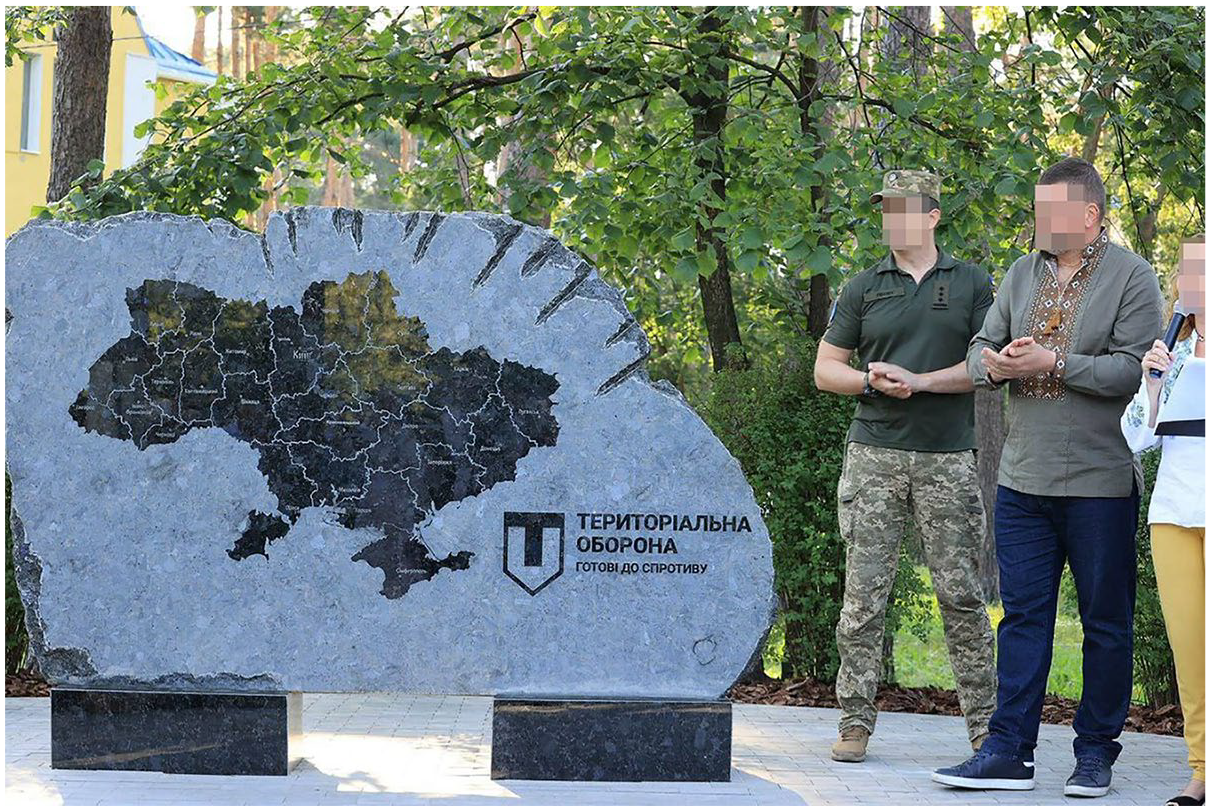
Source: Хуёвый Харьков, 25.08.22: 09:00.
The same processes of decolonization, de-Ukrainization, ‘re-Sovietization’, conservation, new monuments’ installation are visible on pro-Russian channels yet interpreted from a reversed perspective which is analysed below.
Source: НОВОСТИ КРЫМ, 29.05.22: 22:18.
Contrary to pro-Ukrainian Telegram channels, where Soviet monuments metonymically represent the aggressor and are metaphorically constructed as ‘trash’, pro-Russian channels attach high value to monuments of the Soviet epoch. Along with that, monuments representing Ukrainian identity are to be de-commemorated and destroyed. For example, Image 5 was posted on a pro-Russian channel with the text linking the object to Ukrainian nationalistic movement – the monument was created at the initiative of the far-right political party National Corps and the Azov Regiment. From the pro-Russian perspective, its presence would qualify as desecration of the heroes fallen in WWII: . . . a Celtic cross and the monument to Sahaidachny, installed by neo-Nazi ‘Azov’, were dismantled. The Celtic cross was next to the monument of the soldiers died in battles of the Great Patriotic War (НОВОСТИ КРЫМ, 08.05.22: 08:01).
While decolonization movement in Ukraine is often profiled against the current events, ousting any past connections with Russia to the background, pro-Russian channels voice the necessity to (re)instal and restore monuments symbolizing the Russian Empire and the USSR, foregrounding these historical periods and constructing the metaphor ‘memory of them is a fragile object which needs fixing, protecting’. For example, it has been reported that in Crimean Simferopol, students started the restoration of pioneer heroes’ busts (members of a Soviet youth organization commemorated for their feats during WWII): they have . . . removed the old facing . . . and . . . will start restoring damaged parts and painting them . . . (Симферополь|Политика|Новости, 07.04.22: 21:06). Framing is also reversed on an occupational Nova Kakhovka channel as to the restoration of Lenin’s monument in the city: . . . [Lenin] returned to his place, and our city became part of Russia. . . . no matter how much they would like to upset our life, they will not succeed. Justice will always triumph! The shot of Lenin’s statue in Image 6, posted on a pro-Ukrainian channel, initially had the following text on an occupational Melitopol channel, commemorating the Soviet leader: Today is birthday of great Vladimir Ilyich Lenin . . . residents held a peaceful meeting and laid flowers to a new bronze statue of Lenin. . . . earlier upon command of Kiev terrorist regime, a monument to the Leader of the proletariat had been toppled in the same place (Новый Мелитополь, 22.04.22: 12:59). Image 8, posted by a pro-Ukrainian channel, appears on a pro-Russian channel which jokingly alludes to ‘re-Sovietization’ of occupied Ukrainian territories: The monument to Taras Shevchenko in Kharkov has been completely covered. Imagine, they uncover it later and see there Lenin instead (НОВОСТИ КРЫМ, 04.04.22: 07:35).
From the reversed pro-Russian perspective, decolonizing monumental heritage in Ukraine is described as ‘desecration’ and ‘vandalism’ acts by Ukrainian nationalists, neo-Nazis. Moreover, in contrast to pro-Ukrainian channels which promote disruption with anything Russian and personify monuments as war criminals, pro-Russian posts verbally emphasize Ukraine’s and Russia’s interconnections, creating the metaphor of ‘family relations’, and identify monuments with victims who need protection: Ukrainian puppet rulers . . . have been dismantling monuments of our common history and hope to erase people’s memories . . . when our peoples lived like one close-knit family. One can crush stone, smash granite, but it is impossible to cross out our past, to shatter the dream that peoples’ friendship is still possible (НОВОСТИ КРЫМ, 27.04.22: 22:47).
Pro-Russian channels also report and comment on monuments symbolizing the Russian Empire and the USSR in the EU countries. In contrast to pro-Ukrainian channels which identify such monuments with the invader, describe their removal/modification as positive and anti-war acts, pro-Russian channels reverse these views, labelling such events as desecration and vandalism. For instance, a post on a pro-Russian channel features the Soviet War Memorial in Berlin. It is in red stains and inscribed with messages against Russia’s war in Ukraine including Putin = Stalin, Ukrainian blood on Russian hands. However, the channel verbally frames it as an illegal act: Ukrainian nationalists . . . have desecrated the Monument to the Soldier Liberator in Berlin (ПОДСЛУШАНО КЕРЧЬ, 08.04.22: 05:54).
As illustrated by Image 3, Telegram channels do not only verbally reframe visuals from other channels, they also digitally modify them to circulate certain perspectives on history and current events. For instance, Image 9 was digitally changed to Image 11 and appeared on a pro-Russian channel with the description: . . . they opened a truthful monument to the remnants of Ukraine (НОВОСТИ КРЫМ, 26.08.22: 18:41). This falsified visualization of the monument – its name and a part of Ukraine are erased – contributes to the reversed narrative circulated on pro-Russian channels: Ukraine (or part of it) is Russia.
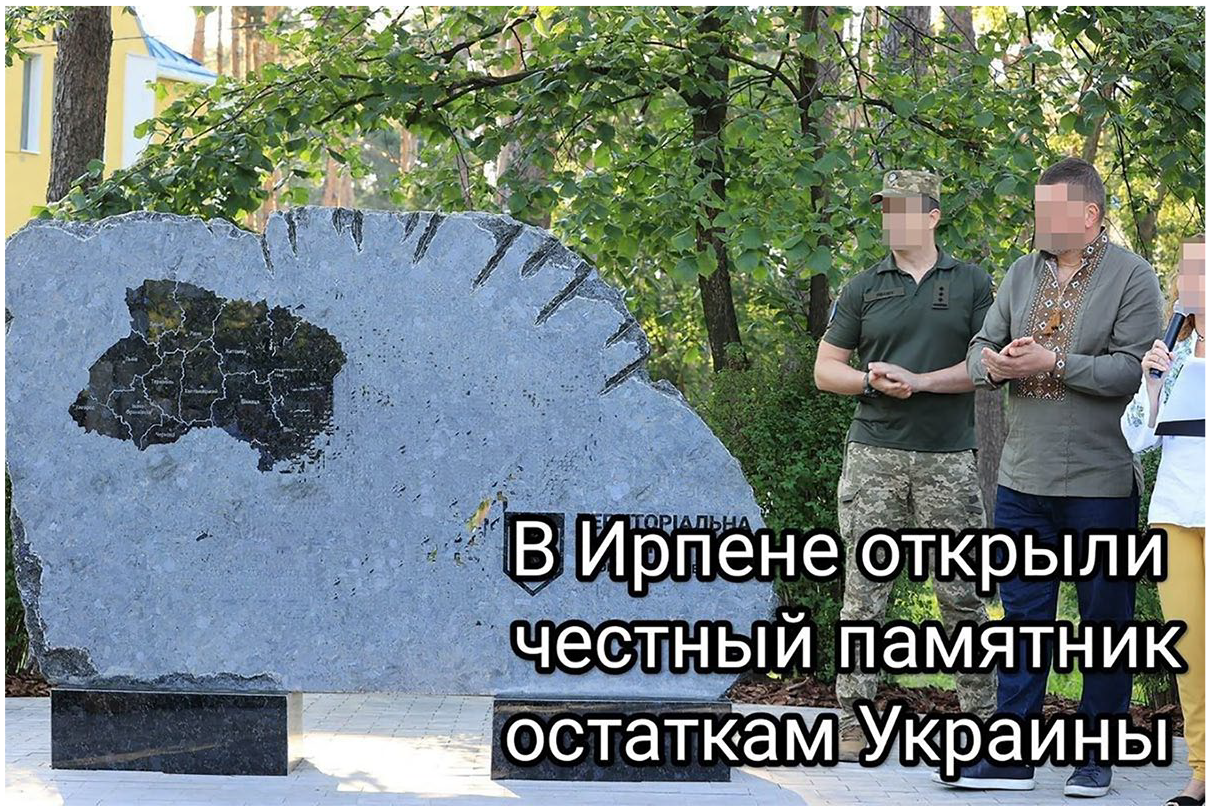
Source: НОВОСТИ КРЫМ, 26.08.22: 18:41.
Conclusion
This study set out to fill in the gap in research on wars over monuments and digital memory wars by examining digital spectacles – hypervisible and engaging online representations of practices on monuments – and understanding the mechanisms of online battles of spectacles – ways of constructing reversed, conflicting interpretations on social media – in the context of war. Drawing on the literature of memory wars and spectacles, and conceptualizing practices on monuments as physical and digital spectacles, I show how online battles of spectacles over monuments are waged between pro-Ukrainian and pro-Russian Telegram channels.
In the physical space, patterns of monumental heritage contestations are bound to certain regions. Connectivity, accessibility, anonymity of social media, administrators’ role as gate-keepers, meaning-makers and perspective-promoters allow for developing online strategies of monument battles. Although we can’t often precisely trace information flows on Telegram – the online conflict is rather a form of ‘spying’ than an open confrontation – the dataset provides evidence that Telegram administrators monitor their opponent’s channels, select, extract, accumulate news beyond/across borders (physical, digital, delineated by the war) intermedially, transmedially, from offline sources (information received from witnesses on occupied, annexed territories, from abroad) and amplify them online. Mechanisms of constructing digital spectacles involving monuments include video and photographic means, selecting certain photos and videos, digital modifications (from memes to fake news), framing and reframing visuals verbally to construct mutually exclusive, reversed visions on past and present from antipodal perspectives. As a result, the same concepts are filled with conflicting content on pro-Ukrainian and pro-Russian channels – for example, ‘vandalism’ is destroying Ukrainian monuments on occupied territories versus ‘vandalism’ is destroying Soviet monuments in Ukraine.
This article contributes to our understanding of memory as a dynamic concept and monuments as unstable signifiers (Cole, 2023). They gain new meanings and invite for contestations under extraordinary circumstances such as the war (Mihelj and Jiménez-Martínez, 2021). The research also shows that monuments become a part of broader information war – they are an object and means for constructing highly polarized, reversed and competing worldviews coexisting on one networking platform. This leads to the detachment of physical spectacles from their online representations, as well as to the separation of audiences – technically interconnected on Telegram, they are polarized in terms of unified meanings they are exposed to. The situation is aggravated by the fact that the audience’s engagement in online debates and questioning the dominant perspective are restricted on pro-Russian and pro-Ukrainian Telegram channels due to disabling users’ comments function on channels, self-censorship, attacking and banning users with unpopular views.
The case study is also an example of how monuments, being in the repertoire of imagining and embodying a nation (Mylonas and Tudor, 2023), are utilized for constructing and promoting national identity online – an instantiation of digital nationalism (Mihelj and Jiménez-Martínez, 2021). Although the past is very often profiled against the background of currents events, the sides of the conflict spectacularize monuments to state what they see as their national memory and identity – for example, celebrating versus distancing from the imperial past. Although borders are crossed, it is to create more rigid ones. The exposure to reversed digital spectacles may allegedly alienate the publics on the territory of Ukraine, following only either pro-Ukrainian or pro-Russian channels. This is an issue to be considered in the realm of memory and reintegration policy, especially taking into account that occupied territories experience the launch of pro-Russian media and personal devices undergo examination there. However, we do not know whether the same reversed views are constructed on other digital platforms, what mechanisms are involved or whether audiences hold the same polarized opinions, which present a direction for future investigations.
Footnotes
Funding
The author(s) disclosed receipt of the following financial support for the research, authorship, and/or publication of this article: This research was funded by COHERE (the Securitization of Heritage and its Challenges for EU and UN Actorness) project (KU Leuven), Cara/Loughborough University Visiting Fellowship and the British Academy/Cara/Leverhulme Researchers at Risk Support grant LTRSF/100162 (Loughborough University).
