




Abstract
On 24 February 2022, Russia launched a large-scale invasion of Ukraine, which since then has been consistently referred to by the Russian authorities as a special operation and not war. The purpose of this specific framing of the Russian aggression can be attributed to multiple reasons, but among the main advantages it provides to the Kremlin is the emphasis on power inequality between Russia and Ukraine as well as minimizing the concerns of the Russian population about the impact of the war on their lives. However, despite all the Kremlin’s propaganda and censorship efforts, it is still unclear what the dominant framing of the war is among Russian internet users and how they engage with different frames used in relation to it. To address this gap, the authors conducted an automated analysis of over 6 million public posts from VK, the biggest Russian social media platform, published between 14 February 2022 and 24 June 2022, and related to different ways of framing the war as well as the ways users engage with these frames. Their analysis reveals that the invasion was predominantly discussed in connection with the losses in the Russian army, and allusions to WW2 were also common. The users who posted about the war were older than average VK users and tuned in to pro-regime and pro-war content more frequently. Notably, after the enactment of the law criminalizing the usage of the term ‘war’, most users either remained consistent in their terminology or exited the discourse, with very few transitioning to using ‘special operation’ instead.
Introduction
On 24 February 2022, Russia started a large-scale invasion of Ukraine following eight years of the hybrid war. In his televised address on the same day, Russian President Vladimir Putin (2022) announced the beginning of the ‘special military operation’ to ‘demilitarize and denazify’ Ukraine. Since then, the Kremlin has avoided calling the attack on Ukraine a war and referred to it as a special military operation; it also passed a law under which ‘fake’ information about the military operation (including calling it a ‘war’; RFE, 2022) is punishable by up to 15 years in prison. This law was enacted on 4 March 2022, followed by numerous administrative and criminal cases.
The decision of the Kremlin to frame its aggression as a special operation is attributed to several reasons. Besides the legal (i.e. the declaration of the war implying adherence to Geneva Conventions; Otis, 2022) and the geopolitical reasons (i.e. the desire to avoid being treated as a side openly declaring war), it can be related to the way the Kremlin prefers the Russian population to interpret the war. The special operation implies a lesser scale of involvement and Russian superiority (Gorobets, 2022) and avoids triggering unresolved traumas associated with the 20th-century wars (Otis, 2022). The human toll of these conflicts, in particular WWII, together with the limited possibilities for trauma processing due to the instrumentalization of these conflicts’ memories (Gaufman, 2017), resulted in a strong emotional load of war-related references in Russia.
In this context, the Kremlin likely views the special operation framing as a less risky option. While it does not necessarily enable the large-scale mobilization as it would be in the case of all-out liberation war framing, it also impedes the counter-framing that could undermine the public support for the Kremlin’s aggression (e.g. as in the case of the Russian invasion in Syria; Makhortykh, 2020). However, whether the Russian population shares the framing of the war desired by the Kremlin remains an open question. Answering it is a rather non-trivial task, particularly considering the unreliability of traditional ways of measuring public opinion (e.g. surveys) in the authoritarian context (Chapkovski and Schaub, 2022).
An alternative approach is to rely on social media data. Despite the increasing efforts of the Kremlin to control digital platforms in Russia (e.g. Makhortykh et al., 2022; Sivetc, 2021), the censorship mechanisms are still arguably far from being fully effective, particularly when dealing with individuals with a small audience. Using the large sample of data from the largest social media platform in Russia, VK, we employ natural language processing and descriptive statistics to examine the composition of the pro- and anti-regime frames of the invasion and the audience engaging with them. We also evaluate the effectiveness of the censorship mechanisms for individual users. Specifically, we aim to answer the following questions:
RQ1: How was the Russian invasion represented in VK content, and how was it associated with the special operation and the war frames over time?
RQ2: What were the patterns of engagement with the content related to the special operation and the war frames on VK?
RQ3: What were the main characteristics of users who engaged with the war or the special operation frames regarding demographics and selective information consumption?
RQ4: Did the enactment of the law that criminalized references to the Russian invasion as a ‘war’ trigger users’ self-censorship?
Theoretical background
Framing of armed conflicts
Defined by Entman (1993) as a process of selecting some aspects of perceived reality and making them more salient, framing plays an essential role in how social reality is structured. By providing meaning to specific issues, frames determine individual and collective attitudes towards them and thus shape what is viewed as a beneficial course of action (Reese, 2001). Different typologies, ranging from issue-specific frames (De Vreese and Lecheler, 2012) to generic frames (e.g. Semetko and Valkenburg, 2000), were introduced to facilitate analysis of framing and its impacts.
Framing is important when dealing with crises such as healthcare emergencies (Wicke and Bolognesi, 2020) or wars (Makhortykh and Sydorova, 2017). By prioritizing specific interpretations of the crises, frames program the reactions of the involved parties and shape their expectations of the crises’ outcomes. In the case of wars, it can result in a broad range of effects, varying from promoting reconciliation and diminishing hostilities (Bratic, 2008) to encouraging violence and impeding de-escalating behaviour (Hamelink, 2008).
Traditionally, research on armed conflict framing focused on journalistic media, which were treated as major framing actors (e.g. Griffin, 2004; Nygren et al., 2018). However, the emergence of social media turned regular users from members of the audience to ‘active contributors, creators, commentators, sorters, and archivers of digital news content’ (Nisbet, 2009: 75). It transformed framing into a two-way process, where the users can not only be influenced by the prevalent frames (Banks et al., 2020) but also exert influence on them and adapt their content (Aslett et al., 2022).
These changes lead to the acceleration of frame production and dissemination, which increases the impact of framing but also makes it less top-down and consistent (Manor and Crilley, 2018). The decrease in consistency is an ambiguous phenomenon; potentially, it can increase societal polarization, particularly considering the potential for spreading disinformation that can demonize internal and external opponents. However, it can also counter state propaganda and promote anti-war messages. Arguably, the latter scenario is especially relevant in authoritarian regimes, where online platforms may expose users to alternative framing that is otherwise not available due to censorship (Tang and Huhe, 2014).
Framing of the war in Ukraine
Since the beginning of the hybrid war in 2014, the framing of the Russian aggression against Ukraine has attracted substantial scholarly interest. It turned out to be the largest armed conflict in Europe in the last two decades and also a prominent example of the new phase of war mediatization labelled as the ‘arrested war’ (Hoskins and O’Loughlin, 2015). The shift to the arrested war is attributed to the rise of online platforms and the increasing appropriation of the changes in reporting dynamics by mainstream media and political actors. It has profound implications for how the war in Ukraine was framed and how audiences worldwide engaged with its framing.
Most studies (e.g. Nygren et al., 2018; Ojala et al., 2017) have so far focused on the journalistic framing of the war in Ukraine. Ojala et al. (2017) examined the visual framing of the war in a selection of major Western European newspapers and found their tendency to focus on the humanitarian aspects as well as putting a strong emphasis on the responsibility of the Russian political leaders for the war. Nygren et al. (2018) compared the framing of the war in Ukrainian, Russian, Polish and Swedish TV shows and newspapers, and found major country-based differences in the tendency to prioritize neutrality over partisanship in relation to the war.
In contrast, the framing of the war in Ukraine on social media remains under-investigated. Makhortykh and Sydorova (2017) used issue-specific frames to compare the visual framing of the war on VK. They found profound differences between Ukrainian and Russian communities, with the former promoting the good war discourse and the latter emphasizing the humanitarian aspects of violence. Gaufman (2015) looked at textual and visual framing of the war in Russian VK communities and observed the tendency to utilize references to earlier armed conflicts (e.g. WWII) to increase the emotional impact of the frames together with the tendency for dehumanization of Ukraine and the West.
Besides the generally low number of studies looking at the framing of Russian aggression against Ukraine on social media, additional gaps need to be addressed. The first of them is (as far as we know) the absence of systematic examination of framing of the war in the context of the new stage of aggression starting in February 2022. Another gap deals with the tendency of the existing studies to focus on the (predominantly qualitative) frame analysis but not engagement with frames. However, understanding engagement is essential for evaluating the impact of specific frames, particularly when different frames compete with each other.
Methodology
Platform selection: VK
The study of Makhortykh and Sydorova (2017) is one of the few empirical analyses of VK in the context of political communication. A few other studies look at VK pro- and anti-Maidan groups in 2013–2014 (Gruzd and Tsyganova, 2015), online news consumption patterns on VK in Russia (Urman, 2019) and Ukraine (Urman and Makhortykh, 2021), and effects of the VK ban in Ukraine (Golovchenko, 2022). Yet, the platform remains understudied despite its prominence in the post-Soviet space: VK was one of Ukraine’s most popular social media platforms until its ban in 2017 and remains the most popular social media platform in Russia (Yuzbekova, 2022). Already before the invasion, VK offered a more representative snapshot of social media-based discourse in Russia than other platforms (Urman, 2019).
Data collection
The data were collected in July 2022 through VK’s API using vkr R package (Sorokin, 2020). VK API allows searching for public posts based on specific keywords. We collected all the posts for the keywords ‘война’ (‘war’) and ‘спецоперация’ (‘special operation’, as commonly shortened in Russian) in all their declensions published from 14 February 2022 (10 days before the invasion to serve as a baseline) and 24 June 2022 (4 months since the invasion). The API returns only 200 of the most recent posts, so we extracted the date for the earliest post in each batch and repeated the procedure until we reached 14 February 2022.
We collected 5,262,383 posts with the word ‘war’ and 1,153,119 posts with ‘special operation’. The dataset includes publicly available posts from individual users and public pages (i.e. the pages users can subscribe to). In the ‘war’ sample, 49.45 percent of posts came from the public pages and 50.55 percent from individual users. There were 1,261,914 unique posters: 31.41 percent were public pages, and 68.59 percent were individual users. In the ‘special operation’ sample, 61.31 percent of posts were from public pages, and 38.69 percent were from individual users, with 203,757 unique posters (37.08% were public pages, and 62.92% were individual users).
A total of 142,442 posts (2.7% of the ‘war’ sample; 12.35% of the ‘special operation’ sample) contained both words. Manual reading of a random selection of posts reveals that around 80 percent of them exhibited support for the ‘special operation’ and used the term ‘war’ to reiterate Russian propaganda (e.g. about the war that Ukraine conducted against the people of Donbas). The remaining posts were against the invasion and criticized the term ‘special operation’, explaining why the invasion shall be called ‘war’. We did not exclude the posts that mentioned both words from the analysis since they contain meaningful information and are few, so we expect them not to distort the results.
Data analysis
To understand the framing of the invasion (RQ1), we first analysed the dynamics of publishing VK content containing the words ‘war’ and ‘special operation’. Then, we analysed the thematic composition of this content via BERTopic (Grootendorst, 2022), which enables tracing emerging frames from a body of texts rather than imposing pre-determined classification categories and is thus especially useful in investigating previously unexplored contexts (Groshek and Engelbert, 2013). The resulting topic classification was validated by qualitatively examining randomly selected documents from each of the top 20 topics. This examination showed that the topics corresponded to the theoretical concept of interest – that is, frames – as we expected since our corpora were thematically focused from the beginning (Dehler-Holland et al., 2021; Maier et al., 2018). We also examined the evolution of topic frequency over time for the ‘special operation’ and ‘war’ samples, facilitating it by examining the most representative posts and the top keywords associated with each topic.
To investigate the patterns of engagement with the content (RQ2), we analysed the daily changes in the average number of views for the VK posts that mentioned ‘war’ and ‘special operation’. To understand the content of the popular posts, we extracted the 20 most viewed posts for each sample and manually examined them. We acknowledge that our analysis relies on the number of views at the time of data collection (July 2022), and the respective numbers can change later for each post. Despite some post-hoc variation, these data allow us to make generalized judgements.
We examined user demographics and their preferences for content consumption to analyse the characteristics of users engaging with frames (RQ3). The preferences were analysed based on the data about the users’ subscriptions to VK public pages. Since downloading profile and subscription data through VK API is time-consuming and our user samples are rather large, it was neither feasible nor necessary to collect this for the whole sets of users who posted about war or ‘special operation’. Thus, we randomly selected 10,000 user IDs from each sample and collected the data only for those. Additionally, to be able to establish the baseline and evaluate how the information consumption of users who posted with the words ‘war’ or ‘special operation’ compares to that of average VK users, we also collected the data for a random sample of 10000 VK users.
Following previous studies (e.g. Urman, 2019), we generated a set of random user IDs and collected the data for them. Hence, we collected the data for three randomly selected samples of users based on IDs: a sample of posters with the term ‘war’, a sample of posters with the term ‘special operation’ and a sample of random VK users. However, we initially generated samples of exactly 10,000 IDs since some user accounts were deleted or set to private. Some public profile data was available for 9,992 users in the ‘special operation’ sample, 9,948 in the ‘war’ sample and 9,179 in the random sample. As we note in the corresponding Results section, there was a drastic variation in the share of users who had specific profile information available (e.g. information on gender was publicly available more often than birth year).
After collecting the data, we first compared the user samples in terms of the gender- and age-related composition to establish whether demographic differences distinguish the samples of posters who mentioned ‘war’ or ‘special operation’ from each other and from the random sample of VK users. After this, to evaluate the differences in the patterns of selective information consumption, we first established which pages are the most popular in each sample (by the share of users who subscribed to specific pages). Finally, we established which pages are comparatively more popular in each sample compared to the others, i.e. the pages with the biggest differences in the shares of subscribers across samples pairwise: ‘war’ vs ‘special operation’ sample; ‘special operation’ vs random sample; and ‘war’ vs random sample.
To examine the effect of censorship on user behaviour (RQ4), we looked at whether the enactment of the repressive legislation in Russia made users switch from using the term ‘war’ to the term ‘special operation’. To do this, we first collected the user IDs of the users who published posts mentioning ‘war’ but not ‘special operation’ between 24 February and 3 March 2022 (both dates included). Then, we compared this list of IDs with the users who, following 4 March, either (a) continued posting about ‘war’ but not ‘special operation’; (b) stopped posting using either of the two terms; (c) started posting only about ‘special operation’; and (d) continued posting mentioning both terms.
Results
RQ1: Representation of the war in Ukraine through the special operation and the war frames
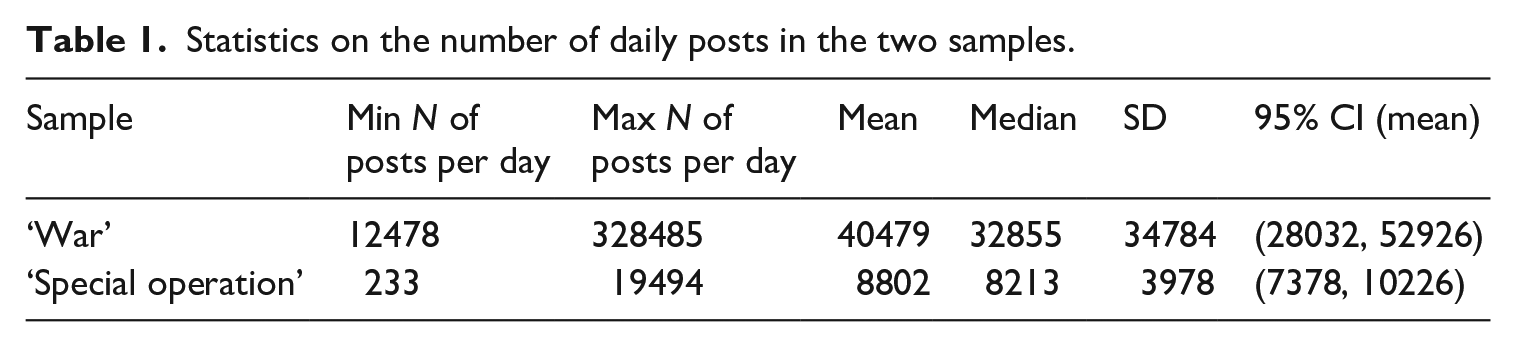
Figure 1 shows the daily numbers of VK posts, including the words ‘special operation’ and ‘war’ (note the difference in the y-axis scale). There were consistently more posts mentioning ‘war’, as summary statistics on the N of posts shows in Table 1.
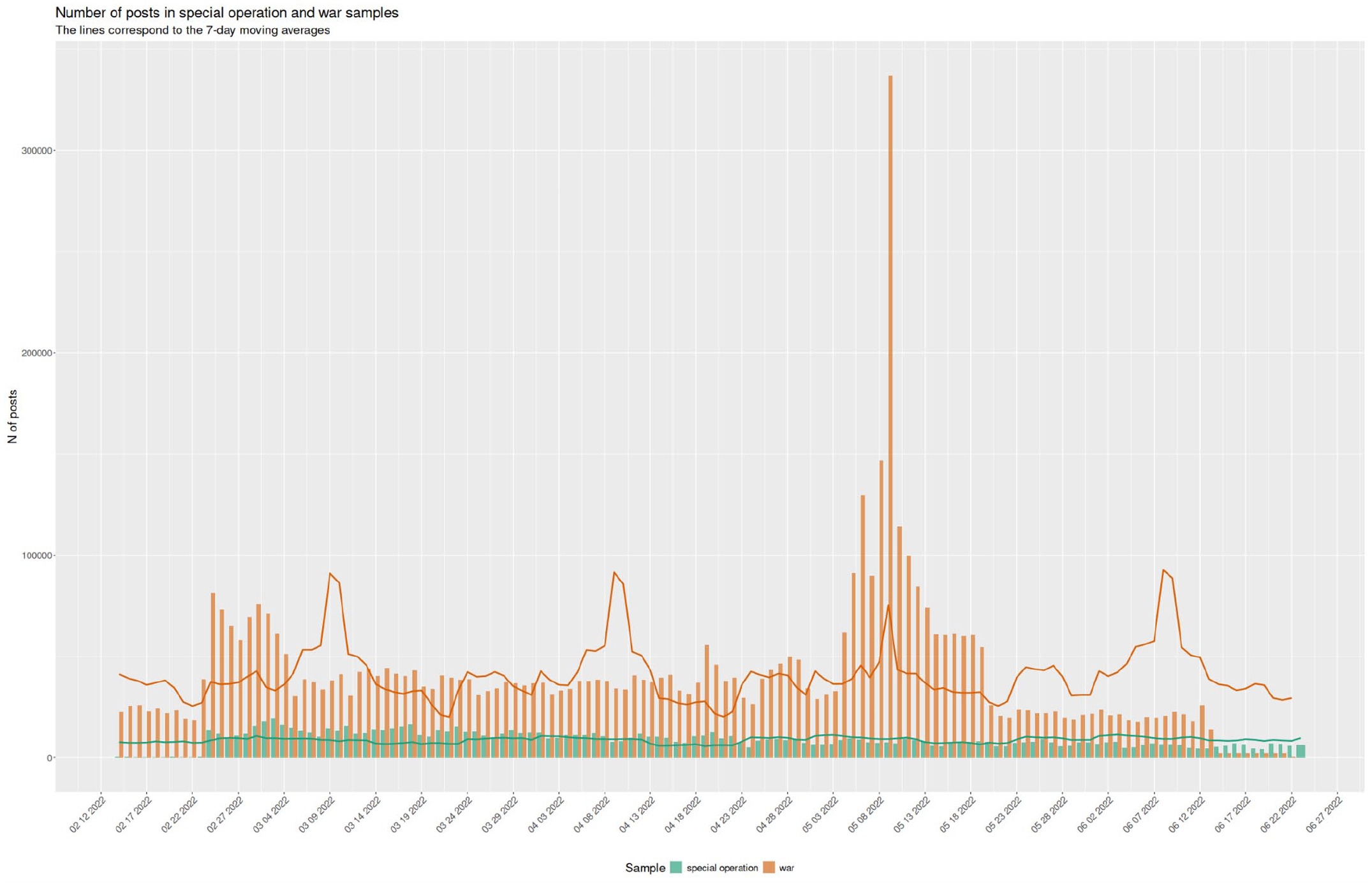
The number of posts mentioning ‘special operation’ and ‘war’ over time.
Statistics on the number of daily posts in the two samples.
The peaks in ‘war’ posts correspond to 8 and 9 May, and 22 June, and include content dealing with WWII. Despite the tendency of the Kremlin to instrumentalize WWII references, we did not observe the corresponding increase in the ‘special operation’ posts around the same date. One reason for this can be attributed to the selective instrumentalization of WWII by the pro-regime propaganda: instead of referring to WWII itself, it usually relies on the selective use of a few negative tropes (e.g. Nazi, see Makhortykh, 2018) to stigmatize the opponents. Furthermore, because both ‘war’ and ‘special operation’ can refer to different military conflicts (e.g. ‘war’ is often used in relation to WWII, whereas ‘special operation’ can refer to the Chechen wars), it is difficult to establish whether the higher volume of ‘war’ posts can be attributed to the term being more ambiguous or the endorsement of an anti-regime frame. Topic modelling-based analysis, however, helps shed light on this issue.
Figures A1 and A2 in the Appendix show the dynamic evolution of the top 10 topics in the ‘war’ and ‘special operation’ samples. For readability reasons, in Figures 2 and 3, we display only the first three most relevant topics for the ‘special operation’ sample and the Russian invasion of Ukraine-relevant topics for the ‘war’ sample. The topics are denoted using descriptive labels created based on the keywords associated with each topic and manual analysis of the top 15 most representative posts per topic. Figure A1 in the Appendix demonstrates that the ‘war’ sample was dominated by WWII-related posts, not posts about the invasion. Since we focus on the latter, we have zoomed into topics related to the war against Ukraine (see Figure 3) to trace their dynamics better and compare them with the ‘special operation’ sample (Figures 2, A2 in Appendix).
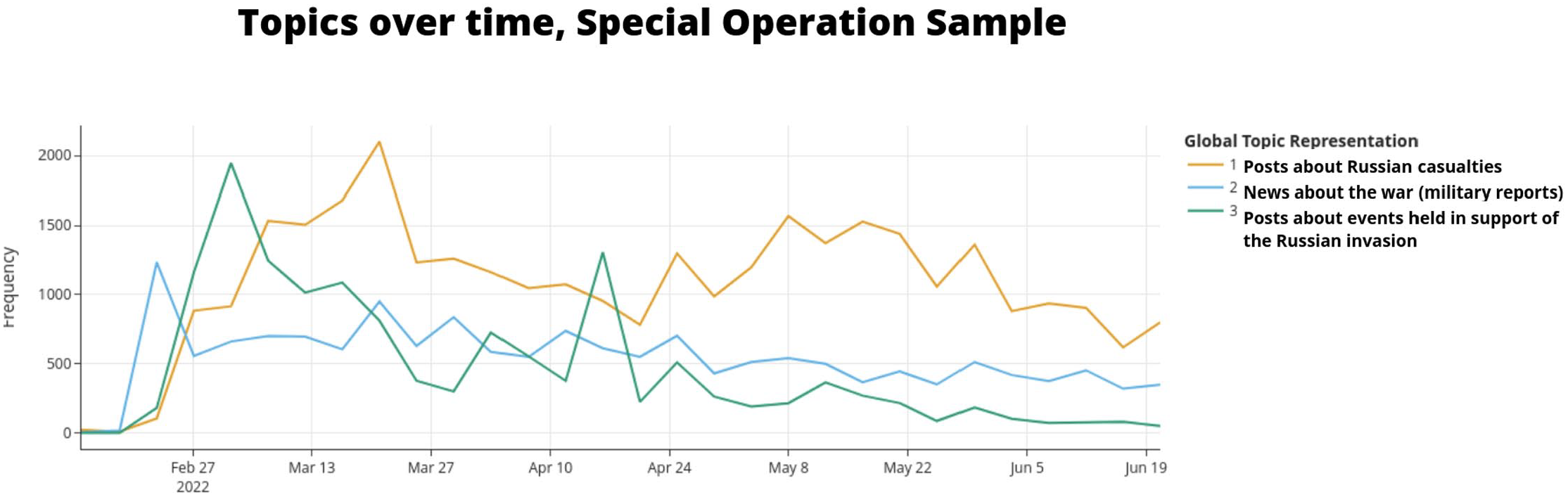
The dynamics of the top three topics in the ‘special operation’ sample.
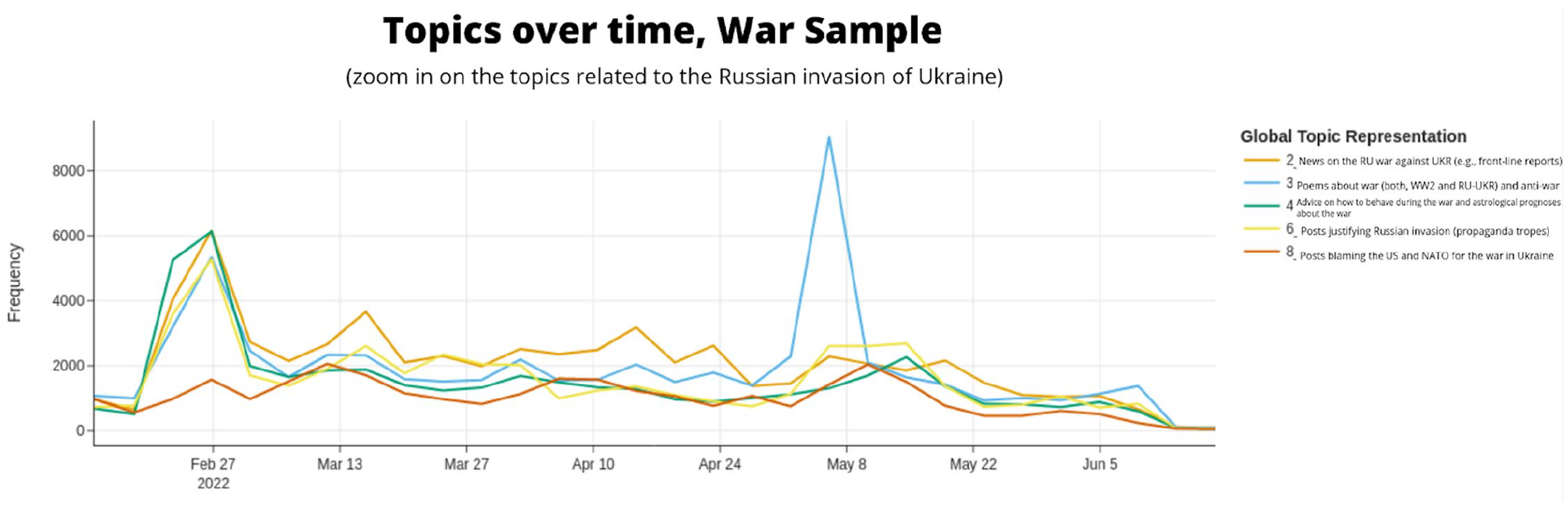
The dynamics of top topics in the ‘war’ sample focused on the Russian invasion. The less relevant topics are in shades of grey, and the more relevant ones are in colours for readability.
Three main observations emerge from the comparison. First, even the subsample of ‘war’ posts related to the war in Ukraine is larger than the ‘special operation’ sample, thus suggesting that the ‘war’ frame was more common. Second, the ‘special operation’ sample had more fluctuations per topic, whereas the ‘war’ subsample showed higher consistency (except topic three, which was a mix of posts related to the Russo–Ukrainian war and WWII). Here, the number of posts peaked right after the beginning of the invasion, decreased at the beginning of March, and stayed stable after that. We suggest this can be attributed to the Russian law against ‘fake news’ passed in March and outlawed referring to the invasion as ‘war’. Finally, the ‘special operation’ sample was heavily dominated by news rather than regular posts, which can be due to the above-mentioned law forcing the media to use the term ‘special operation’.
There are several important observations concerning the content of the posts. In the ‘special operation’ sample, the most prominent topic in terms of post frequency was the Russian casualties. Typically, these were posts written by the relatives of deceased soldiers or by local authorities that contained brief biographies and described how soldiers ‘heroically’ died during the ‘special operation’. The prominence of this topic goes against our expectations. Since the Kremlin has been trying to downplay the scale of the Russian casualties, we expected that VK would remove such posts or that the relatives would engage in self-censorship.
We also found that news about criminal and administrative cases was among the top 10 topics in the ‘special operation’ sample, suggesting that information about state repression is widely circulating on VK. Despite the widespread repression, a topic related to anti-war posts was also among the top 10 in the ‘special operation’ sample. In terms of post frequency, it peaked at the beginning of April, around the time when the news about the Bucha massacre appeared. In the anti-war posts, the ‘special operation’ term was mostly used ironically (e.g. ‘special operation aimed at the destruction of civilians’). The fact that there was a distinct anti-war topic in the ‘special operation’ sample but not in the ‘war’ sample also goes against our expectations as we anticipated that anti-war users would more often refer to the war instead of using the term employed by Russian propaganda.
RQ2: Engagement with the content related to the special operation and the war frames
Figure 4 shows the average number of views received by posts mentioning ‘war’ and ‘special operation’ and published on a given day. The view averages were higher for the ‘special operation’ posts; however, that is likely attributed to the fewer posts in this sample with the high disparity in the number of views between popular and unpopular posts, as shown by the lower median number of views in the ‘special operation’ sample together with the higher standard deviation (see Table 2: as in both samples the numbers are highly skewed, we also report the 5th and 95th percentiles for both samples). Another possible explanation relates to the posts referring to the ‘special operation’ being often published by pro-regime media communities, which are likely to have many subscribers on VK.
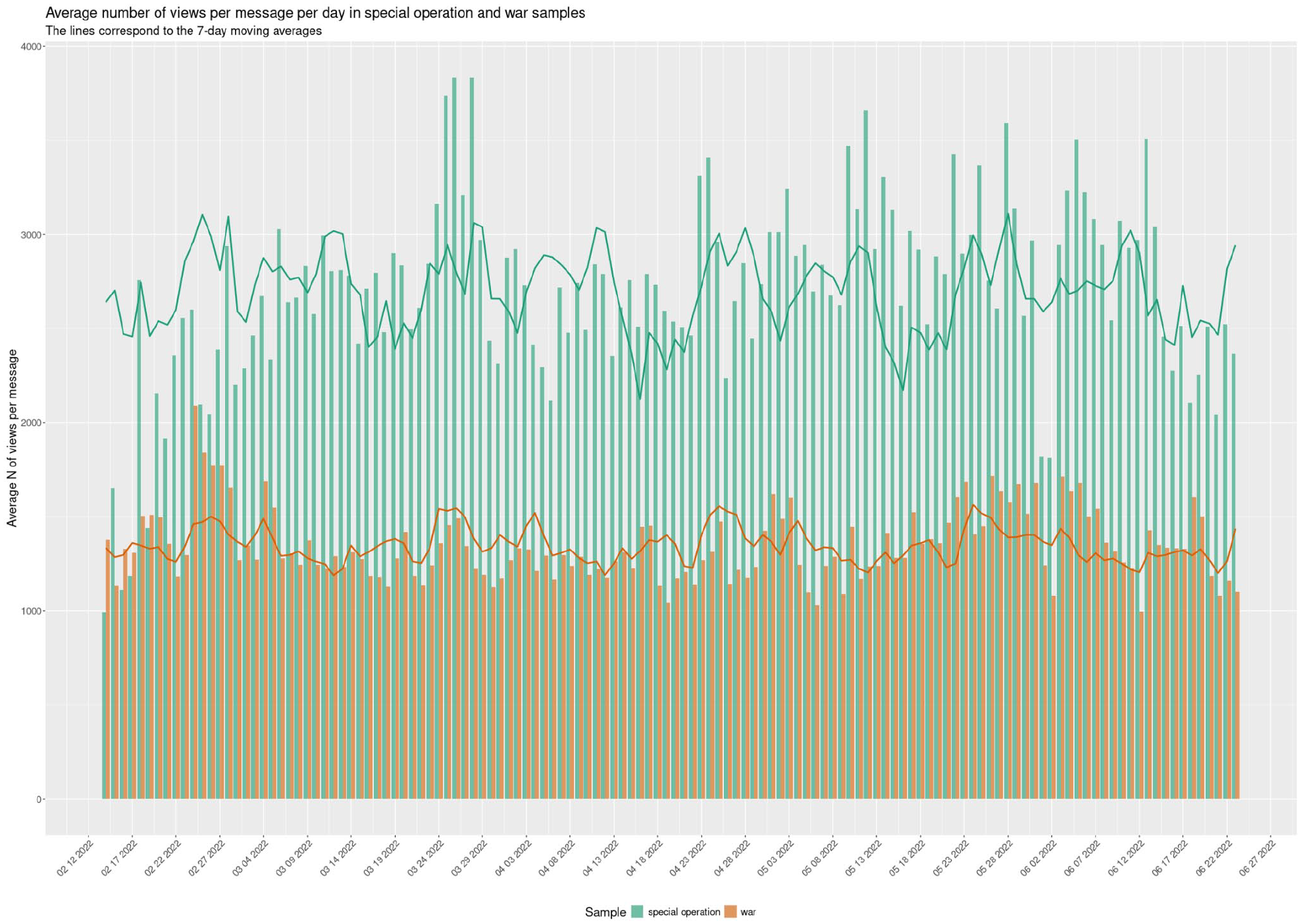
Average number of views for the posts published on a given day in the two samples.
Statistics on the number of views received by the posts per day in each of the two samples.
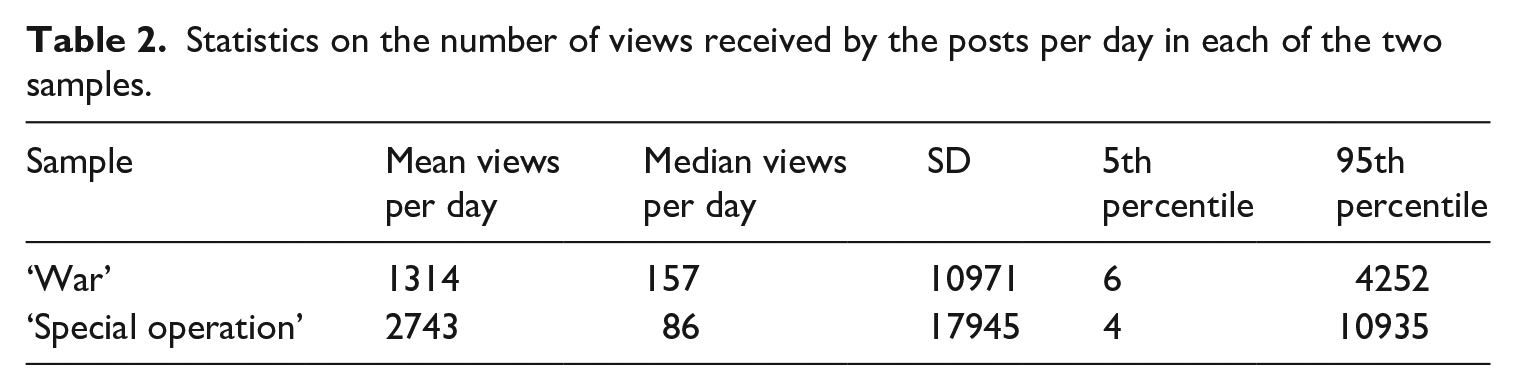
Overall temporal dynamics in the average N of views per post is stable, with the observed peaks in each sample predominantly corresponding to the most popular posts (see Tables A1 and A2 in the Appendix). The only exception seems to be the peak in the N of views per post for the ‘war’ sample right after 24 February, which cannot be accounted for by a small number of popular posts published around the same date and likely signals initially high engagement with war-related content right after the beginning of the Russian invasion of Ukraine.
Tables A1 and A2 in the Appendix contain the summaries of the top 20 most popular posts by the number of views in each sample. We do not present the full text of posts out of ethical concerns (many of them contain misleading or unverified information, offensive content or personal details of deceased soldiers) and for the sake of brevity. Instead, we present short summaries that give the reader a general overview of the content.
One important observation, in line with the findings related to RQ1, is that the most popular posts in the ‘special operation’ sample often deal with the stories of deceased Russian soldiers. Those are mostly written from relatives’ point of view, e.g. referring to ‘my son’ or ‘my brother’, though published and distributed by large public pages – often thematically related to Russian Orthodoxy rather than individual users. Such posts mostly glorify the deceased soldiers, calling them ‘heroes’ or stating that they ‘gave up their lives to protect us and our motherland’. While glorifying the soldiers and expressing grief or condolences to their families, these posts (at least based on a qualitative check of a small subset of posts) did not resort to calls for revenge for the deceased. Partially, it can be attributed to the gradual evolution of the Russian Orthodox Church’s stance towards the war: while in the later stages of invasion, it became rather strongly aligned with the Kremlin discourse (as evidenced, for instance, by the proclamation of the invasion being a holy war in 2024; Negron, 2024), in the early days of the invasion there were many instances of dissent within the Church regarding support for the invasion (Stoyanov, 2024).
In the ‘war’ sample, in contrast, there is no single most dominant topic. Many of the most popular posts there do not directly relate to the Russian invasion of Ukraine and deal either with WW2 or with ‘information wars’. Notably, most of the most popular posts in this sample related to the invasion were published by the same public page that we refer to as ‘Writer’ in Table A1 out of ethical concerns (see note 2). While we cannot provide detailed information on the page, its follower count is large but much lower than the other pages with the most popular posts. Further, the number of likes, reposts and comments, as evident from Table A1, is much lower than that of other popular posts. This suggests that the view counts might, in fact, be artificially inflated in this case, though we do not have a reliable way of confirming or disconfirming this hypothesis.
One common characteristic of the most popular posts in both samples is that, apart from one post by Ramzan Kadyrov, the Head of the Chechen Republic, they were all posted by public pages rather than regular users. This aligns with our expectations, given that such pages typically have a much broader audience than ordinary users.
RQ3: Characteristics of users engaging with the war and the special operation frames
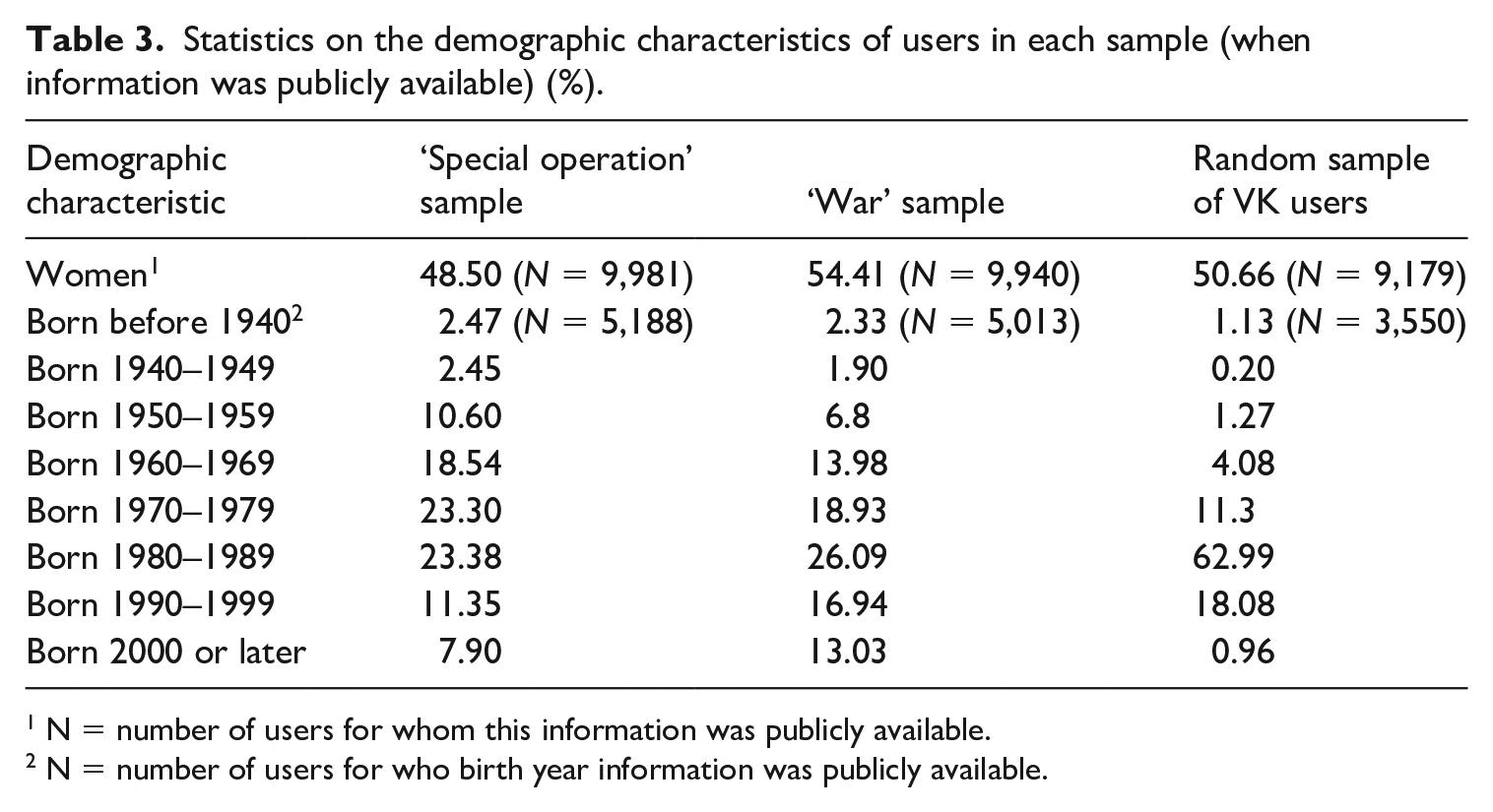
Table 3 summarizes the demographic characteristics in the two random samples (N = 10,000) of users who published posts mentioning the ‘war’ or ‘special operation’ words. Additionally, it shows the characteristics of a random sample of VK users (N = 10,000), which serves as a baseline for the comparison. The comparison shows that women are slightly over-represented in the ‘war’ sample and under-represented in the ‘special operation’ sample; the pairwise differences are statistically significant (p < 0.01) based on the Z-test for proportions. Additionally, it appears that the users in the random sample are more privacy-conscious because birth year information is available for only 33.5 percent of users (compared to 51.88% and 50.13% for the ‘special operation’ and ‘war’ samples); here as well, the pairwise differences are statistically significant (p < 0.01), based on the Z-test for proportions. Despite the lesser availability of birth year data, it still allows for a comparison between the samples, which suggests that older users are over-represented in the ‘special operation’ and ‘war’ samples.
Statistics on the demographic characteristics of users in each sample (when information was publicly available) (%).
N = number of users for whom this information was publicly available.
N = number of users for who birth year information was publicly available.
To a lesser extent, the same is true for the youngest users (i.e. those born after 2000), whereas those born between 1980 and 1999 are under-represented in the ‘war’ and ‘special operation’ samples compared to the random sample. To examine more fine-grained differences in the demographics and age-related skews (e.g. that the largest difference between samples is observed for the users born in the 1980s) in Table 2, we report percentages instead of the median age per sample. Through the pairwise Z-test for proportions, we find statistically significant differences for most age groups except users born before 1960 (between ‘special operation’ and ‘war’ samples) and in the 1990s (between the ‘war’ sample and the random sample). The lack of significant differences for the first group suggests that older users are similarly represented in both samples, possibly indicating comparably low levels of engagement with the invasion-related narratives. For the users born in the 1990s, we find that individuals in this cohort are not disproportionately less drawn to the ‘war’ framing than the general VK population, albeit they are significantly less represented in the ‘special operation’ framing. These findings highlight the value of using age-grouped proportions rather than a single median age metric, as they reveal nuanced demographic skews that can be linked to generational differences in media consumption, political engagement, or targeting strategies.
Tables 4 and 5 present the data on the content consumption preferences for the three user samples: Table 4 shows the public pages most popular with users in each sample in absolute percentages, whereas Table 5 highlights the public pages that are more popular in each sample than the two others. We present corresponding descriptions of each page in Tables A3 and A4 in the Appendix. To enhance readers’ understanding of the differences, we have used colour-coding: pages related to political, pro-government, news and blogs are highlighted in red; religious pages in yellow; non-political and non-religious pages (e.g. those about music, movies or cooking) are in blue. The data shows that the ‘special operation’ sample is the most consistent regarding content preferences, with the highest number of subscriptions shared between the users. These subscriptions are mostly related to politics-related and/or pro-Kremlin news pages, with the top three pages being Tsargrad (i.e. a pro-war far-right Russian news media), RT (i.e. the Russian edition of Russia Today, a state-sponsored news outlet) and the page of Nikita Mikhalkov, a Russian film director currently known for his conspiratorial and pro-war YouTube vlog. The top subscriptions for the random sample do not contain any politics- or news-related pages, whereas for the ‘war’, there is only one such page (i.e. Tsargrad). Thus, there is a major contrast in the prevalence of politically relevant pages in the ‘special operation’ sample compared to the other two. There are two possible explanations for this: either this sample is characterized by extremely highly political (pro-Kremlin) news interest and/or a high share of this sample consists of bots that are deployed to both promote the ‘special operation’ framing through posting and artificially inflating the subscription numbers of pro-Kremlin news pages. As we note when discussing the limitations in the Discussion, we have no reliable way of testing the bot prevalence in the sample. However, this potential explanation is still worth noting.
The most popular public pages per three user samples (%). 1
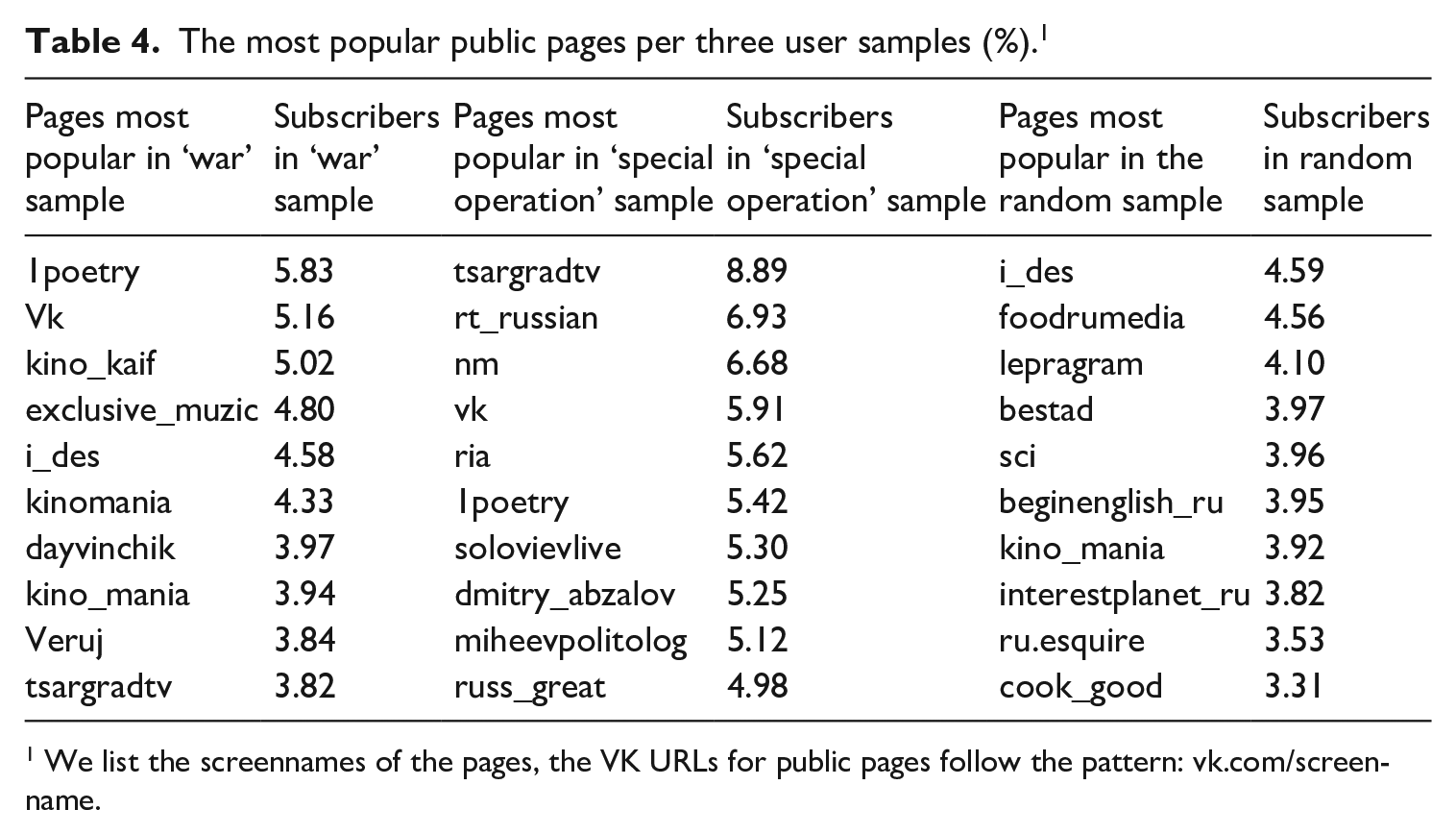
We list the screennames of the pages, the VK URLs for public pages follow the pattern: vk.com/screenname.
Public pages that are relatively more popular in each sample compared to the others (%).
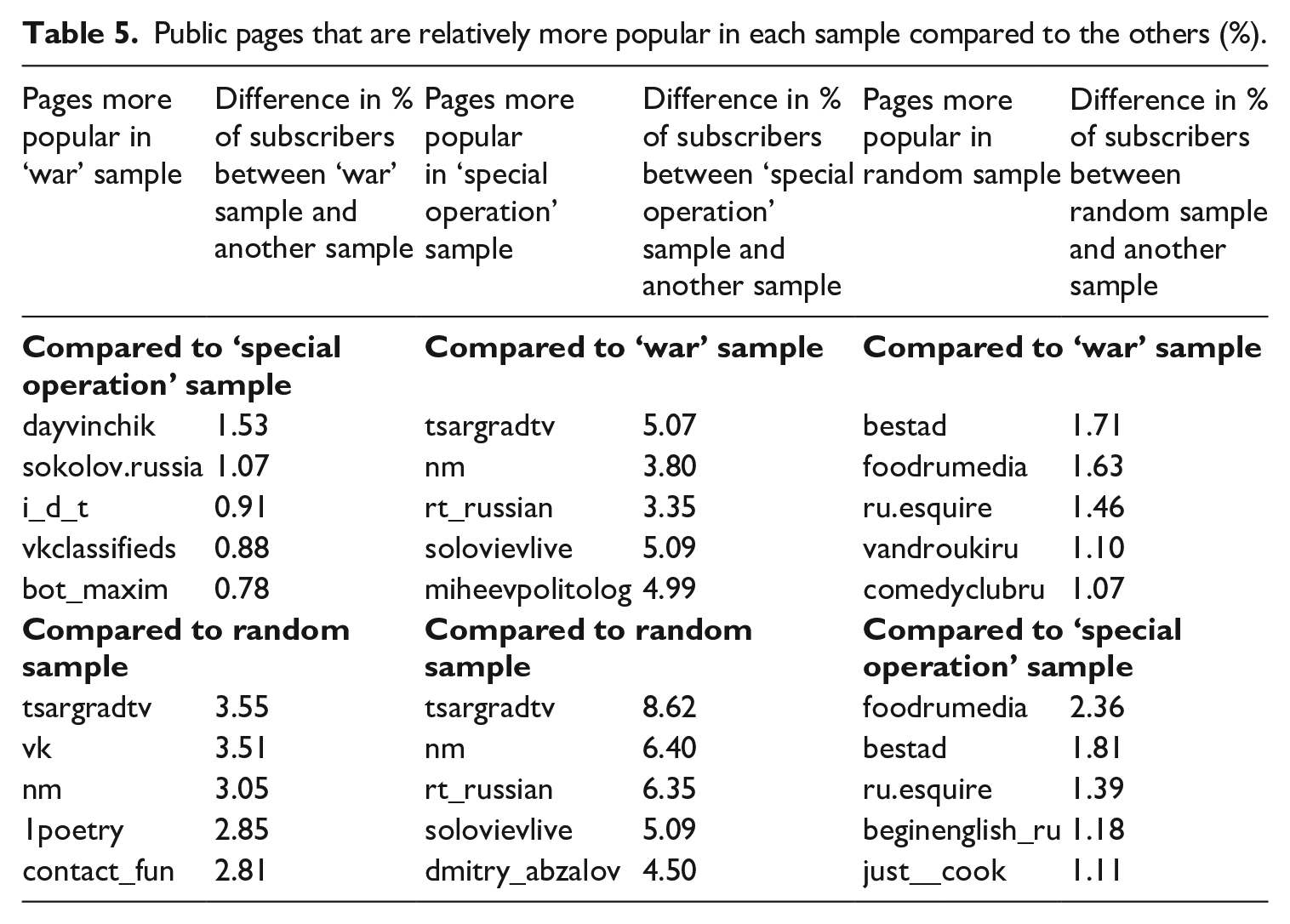
The preference towards pro-war and pro-Kremlin content among the users from the ‘special operation’ sample is corroborated by Table 5, which shows that pro-war pages are particularly visible in this sample compared with the other two. Two pages emerge as particularly relevant in this context – those of Tsargrad and Nikita Mikhalkov – by having a higher share of subscribers in the ‘war’ sample than the random one and an even higher percentage of subscribers in the ‘special operation’ sample. Furthermore, the ‘special operation’ sample shows a higher share of subscriptions to pages of Vladimir Soloviev and Sergei Miheev, two pro-Kremlin public personalities known for their hawkish (and, at times, extremist) stances on the war in Ukraine. These findings indicate a clear difference in the content preferences between the users who posted about ‘special operation’ and the random sample, with the former giving preference to more radical pro-Kremlin stances on the war.
RQ4: Changes in user behaviour after the criminalization of the usage of the term ‘war’ in connection to the Russian full-scale invasion of Ukraine
We evaluated the posting behaviour of users who initially (right after the beginning of the Russian full-scale invasion of Ukraine) mentioned the term ‘war’ in their posts but did not reference the term ‘special operation’ after 4 March 2022, when the references to the full-scale invasion as ‘war’ got criminalized. This sample included 216,427 unique accounts, out of which 72.25 percent were individual users, not public pages. Our analysis yielded the following insights:
These findings provide insights into user behaviour and language shifts in the context of discussions surrounding ‘war’ and ‘special operation’. Notably, after the enactment of the law that criminalized the usage of the term ‘war’ in the context of the full-scale invasion of Ukraine, most users either remained consistent in their terminology or exited the discourse altogether, with relatively few transitioning between the terms. Individual users were more likely than public pages to cease posting activity altogether. These findings suggest that the enactment of the law criminalizing references to the ‘war’ was, if at all, effective only in triggering users to engage in self-censorship – it needs to be noted that the users could have stopped posting about the war for reasons not related to this legislation. To reliably identify the reasons for the change of behaviour, we would ideally have the possibility of approaching individual posters and inquiring about the reasons for the changes in posting behaviour (that would be difficult even without the current repressive conditions in Russian) or conduct a more in-depth qualitative analysis of changes in the content of user posts that is beyond the focus of the current study. However, it was not associated with the transition to the ‘special operation’ terminology among the users who initially posted using the term ‘war’ as only 1.29 percent of the accounts completely switched from one term to another and a slightly bigger group – but still a minority – of 13.64 percent of accounts adopted both terms simultaneously in their posts.
Discussion
Our analysis has revealed that the framing of the Russian war against Ukraine on Russian social media in the initial months after the beginning of the full-scale invasion did not fully align with the framing actively pushed by the Kremlin, in particular among users who initially referred to the invasion as ‘war’. Despite the introduction of the repressive laws that made references to war punishable by up to 15 years in prison, many users still discussed it as ‘war’, and only a minority switched to the ‘special operation’. Thus, disengagement from the discourse was the most common reaction to the repressive laws. This suggests that the primary impact of the legislation was encouraging self-censorship rather than shifting public narratives towards the Kremlin’s framing. Importantly, while disengagement could stem from other reasons, such as fatigue or fear, our findings show limited effectiveness of top-down discursive attempts to persuade users to adopt the ‘special operation’ terminology. This underscores the limitations of legal coercion as a tool for shaping online discourse, particularly in an environment where alternative frames remain accessible.
In the ‘special operation’ corpus, the most prevalent topic was related to the deceased Russian soldiers. Notably, the most engagement with such posts came not from state- or media-related pages but from more general ones (e.g. public pages related to Russian Orthodoxy). It is another evidence that the Kremlin’s efforts to downplay the scale of the invasion and its death toll were countered by an alternative framing, thus highlighting the importance of online platforms even under strict censorship (Tang and Huhe, 2014). That being said, the most popular pages that posted about the deceased soldiers endorsed the war. Hence, although the information about the human toll might go against the Kremlin’s framing strategy, the dominance of the war frame seems to have emerged not out of opposition to the invasion but rather out of sympathy with the soldiers participating in it. In this way, a counter-official framing could still contribute to the Kremlin’s public mobilization effort by propagating hate towards Ukrainians (albeit we observed few explicit calls for revenge). We also observe that the ‘war’ content was largely associated with WWII rather than the Russian war against Ukraine. Even the posts associated with the current conflict in the ‘war’ sample were often related to WWII, aligning with the Kremlin’s strategy to instrumentalize WWII memory for its political aims (e.g. Gaufman, 2015; Makhortykh et al., 2021). It can also suggest that, in the long-term, the Kremlin might find it more effective to shift from the current framing of ‘special operation’ to the more WWII-like framing that will be more in line with this tradition of memory instrumentalization.
At the same time, it needs to be highlighted that, despite the efforts by the Kremlin to establish a strong association between the current war and World War II, our data suggests that the general public did not embrace this narrative at the beginning of the invasion. While the Kremlin has a long-standing strategy of instrumentalizing WWII memory to consolidate support for its military actions, our data does not indicate widespread engagement with this framing in the context of the war against Ukraine. As shown in Figures 2 and 3, activity around posts referencing the current war remained largely flat, except for a handful of poems that explicitly referenced WWII. This suggests that, rather than actively drawing parallels between the two conflicts, users engaged with WWII-related content in a more compartmentalized manner, treating it as a separate historical event rather than a lens through which to interpret the ongoing war. The lack of engagement with Kremlin-endorsed historical analogies is further supported by the view counts presented in Figure 4. These findings indicate that, while WWII references continue to play a role in Russian political discourse, they do not automatically translate into public buy-in for the Kremlin’s specific framing of the current war.
We have also found several differences in the demographics and content consumption preferences of the random sample of VK users and the users who published posts with the terms ‘war’ or ‘special operation’. One major difference is related to the age distributions within the samples. The random sample contained more users born between 1980 and 1999 than the two other samples, whereas the latter samples contained more older users, particularly the ‘special operation’ one. Such a difference can be explained by several complementary factors: first, older people in Russia tend to be more supportive of the regime and of the war against Ukraine in particular and pay more attention to the war, according to surveys (e.g. Levada-Center, 2022). While these survey results should be taken with a grain of salt, considering the tendency for preference falsification out of fear of repression (Chapkovski and Schaub, 2022), it is possible that younger Russian VK users posted less about the invasion because of being less interested in it than the older users. Additionally, younger users, even in liberal democracies, are more likely to be concerned about their privacy on social media and the potential repercussions of their online activities (e.g. in the context of job search; Blank et al., 2014). In contemporary Russia, this general tendency is aggravated by the fear of repression for anti-war opinions and can explain why users born between 1980–1999 (i.e. those most active on the job market) are less likely to post about the war or, alternatively, keep their posts about the war hidden from the public (and thus not part of our data collection).
We also found the prevalence of interest in political content in the ‘war’ and ‘special operation’ samples compared to the random sample. In the latter, there were no politics-related pages in the top 10 or the top 20 public pages based on the share of subscribers (Table 5). This is generally in line with the previous observations that only a minority of Russian VK users follow political news pages (Urman, 2019). At the same time, there were several politics-relevant pro-regime pages in the top subscriptions of the ‘war’ sample, whereas the ‘special operation’ sample’s top subscriptions were dominated by such pages. Our findings highlight that the users who produced content about the war were more politicized in the pro-regime direction than average VK users. Tsargrad TV – a nationalistic and pro-war media founded by Russian billionaire Konstantin Malofeev following the Russian annexation of Crimea and the beginning of the Russian hybrid war against Ukraine – emerges as the most influential (in terms of the shares of subscribers as compared to the random sample) political page. The second most influential page is that of Nikita Mikhalkov, a Russian film director known for his pro-regime views and promotion of conspiracy theories. This highlights the importance of non-state actors in spreading pro-war narratives on VK: neither Tsargrad nor Mikhalkov’s channels are directly backed by the Kremlin (unlike RT or state-owned TV channels). We suggest this observation warrants further research into such actors and their potential influence, and the differences and similarities in the narratives pushed by such actors and those directly affiliated with the Russian state.
Finally, it is important to note some limitations of our study. First, our results should not be interpreted as an objective representation of the perception of war framing among the Russian population. Discussions on social media are not representative of general societal opinions in most contexts, but their representativeness is even lower in the case of Russia since users might be hesitant to post anti-war content, and Russian platforms can remove such content. Before the invasion, VK maintained some anti-regime public groups and pages (Urman, 2019), and the Russian opposition strategically utilized the platform to spread its messages (Dollbaum, 2021). However, since 2022, VK accelerated the process of blocking anti-regime communities (Meaker, 2022).
Second, we used only ‘war’ and ‘special operation’ terms to collect data, whereas other terms (e.g. ‘invasion’) might also be relevant. We also did not check whether users in our sample are authentic or part of bot or troll networks as it is difficult due to the lack of ground truth VK data against which we could benchmark any evaluations. Unlike X/Meta, VK never published any datasets of coordinated inauthentic behaviour, and there are no accessible tools for detecting it. Hence, we would need to develop such tools ourselves but, in the absence of ground truth data, assessing these tools’ reliability would be close to impossible. Besides, many parameters which are used to detect non-authentic behaviour on other platforms, such as the account’s registration date (De Nicola et al., 2021), are unavailable through VK’s API. For these reasons, we did not attempt to detect bots since unreliable bot detection could introduce more errors into our findings than taking the data ‘at face value’.
Supplemental Material
sj-docx-1-mwc-10.1177_17506352251371864 – Supplemental material for My war is your special operation: Engagement with pro- and anti-regime framing of the war in Ukraine on Russian social media
Supplemental material, sj-docx-1-mwc-10.1177_17506352251371864 for My war is your special operation: Engagement with pro- and anti-regime framing of the war in Ukraine on Russian social media by Aleksandra Urman and Mykola Makhortykh in Media, War & Conflict
Footnotes
Funding
The authors received no financial support for the research, authorship and publication of this article.

Supplemental material
Supplemental material for this article is available online.
Author biographies
Address: University of Bern, Spuistraat 210, Bern, Switzerland. [email:
References
Supplementary Material
Please find the following supplemental material available below.
For Open Access articles published under a Creative Commons License, all supplemental material carries the same license as the article it is associated with.
For non-Open Access articles published, all supplemental material carries a non-exclusive license, and permission requests for re-use of supplemental material or any part of supplemental material shall be sent directly to the copyright owner as specified in the copyright notice associated with the article.
