




Abstract
This article examines how Second World War memory is circulated, reproduced, and challenged in the transnational space of digital media by Ukrainian and Russian Internet users. Using as a case study one episode of the war on the Eastern Front—the capture of the Ukrainian capital, Kyiv, by the Red Army in 1943—it investigates how this event is commemorated through YouTube, which is a popular online platform for uploading, viewing, and commenting on audiovisual materials. This article employs content analysis to assess audiovisual tributes to the Battle of Kyiv from two perspectives: that of representation (how the event is presented on YouTube) and that of interaction (how YouTube users interact with memory of the event). This article concludes that although YouTube is frequently used for the propagation of nationalistic interpretations of the past in Ukraine and Russia, it still has the potential to democratize collective remembrance of the Second World War.
Contemporary scholarship has demonstrated how the recent advent of digital technology brings fundamental changes in the way we remember the past and, in particular, how we deal with memories of war and conflict. 1 The connectivity of digital media makes them “the key modulator of security and insecurity today” (Hoskins and O’Loughlin, 2010: 2) by increasing our awareness of remote conflicts and articulating the presence of immediate threats through a variety of formats varying from video clips to blog posts. However, digital technology also enables a real-time memorialization that differs in its immediate and decentralized nature from earlier practices of war commemoration. Yet, when we think of the impact of digital media on the framing and remembering of warfare, we tend to think first and foremost of contemporary conflicts without asking how the advent of technology impacts memories of older wars, which over the past decade have increasingly been affected by processes of digitization. Or, to put the question more concretely, what opportunities does this “mediatization of memory” (Hoskins, 2009: 28) offer for the production of new narratives of past conflicts? And whether or not it can lead to the actualization of past injustices that can ignite new conflicts?
In order to investigate how digital media interact with a contentious European past, this article examines how one episode of the Second World War—the capture of Kyiv by the Red Army in November 1943—is remembered through YouTube. Not only is this episode an important milestone of the war on the Eastern Front, it is also a “historical wound” (Chakrabarty, 2007), a traumatic mix of history and memory that divides collective experiences of the Second World War in Ukraine and Russia. By exploring how it is represented through the world’s largest video-hosting platform, this article investigates the opportunities that digital media provide for remembering past conflicts and how these opportunities are used in Ukraine and Russia. This article also questions how Russophone and Ukrainophone users of YouTube interact with contentious war memories and asks if the study of these interactions can deepen our understanding of how the past is viewed in Ukraine and Russia and how Second World War memory is appropriated in the context of ongoing conflict.
Historical background
In September 1943, the Red Army approached the former capital of Soviet Ukraine, Kyiv, which had been seized by the Germans 2 years earlier. The battle that followed—known as the Battle of Kyiv—was an integral part of a Soviet offensive that resulted in more than four million soldiers from both sides fighting along a 750-km-long frontline. Over the following 2 months, Soviet troops made several attempts to cross the River Dnieper and recapture the city, although these were unsuccessful because of the heavy losses sustained while crossing the river and the difficult terrain on the German-controlled west bank. Finally, after weeks of bloodshed, the Red Army organized a simultaneous attack on Kyiv from two bridgeheads—Lyutezh and Bukrin—and captured the city on 6 November, just before the anniversary of the October Revolution, the most important state holiday in the Soviet Union. This victory, however, was achieved at the expense of heavy losses which were seemingly a result of haste linked to the desire to capture the city in time for the anniversary (Korol, 2005: 22) as well as of the massive mobilization of Ukrainians, who were often sent to battle unprepared and according to some testimonies practically unarmed (Koval, 1999: 95–96).
The successful actions of the Red Army during the Battle of Kyiv had a profound impact on the course of the war on the Eastern Front. The capture of Kyiv led to the destabilization of the German front and a rapid Soviet advance in 1944, followed by the retreat of German troops from Ukraine. The liberation of the Ukrainian capital also had significant symbolic and ideological meaning that was extensively used in Soviet propaganda (Korol, 2003). Not only was the capture of Kyiv presented as a decisive victory of Soviet people over their enemy, but the liberation of the “immortal heart of Ukraine” (Shulzhenko and Tykhonenko, 2013: 4) was also interpreted as a key condition for the restoration of the Soviet rule in Ukraine. The propaganda, however, omitted the heavy losses suffered by the Red Army in the course of battle and, instead, focused on praising the heroism of Soviet soldiers and describing German losses (Shulzhenko and Tykhonenko, 2013: 3).
After the end of the war, the Battle of Kyiv quickly became an integral part of the Great Patriotic War myth that defined practices of public Second World War commemoration in the Soviet Union. During the Khrushchev period, the day of liberation, 6 November, became an official holiday—the Day of the Liberation of Kyiv from the Nazi invaders—and the actions of the Red Army during the Battle of Kyiv were unequivocally praised in Soviet historiography, which avoided any mention of the battle’s less glorious aspects (Hrynevych, 2005). Similarly, while numerous monuments commemorating the Second World War appeared in Kyiv during the Soviet period, 2 the majority of them were dedicated to the Soviet High Command, while the suffering of rank-and-file soldiers remained largely ignored. Only in the late 1970s did a few monuments dedicated to ordinary participants of the Battle of Kyiv appear in the Ukrainian capital, and yet, these monuments commemorated soldiers who liberated the city from the victorious Lyutezh bridgehead. In contrast, the Bukrin bridgehead, which distracted the majority of German forces and where the bloodiest clashes took place, remained forgotten (Makhortykh, 2014).
The dissolution of the Soviet Union had a dramatic impact on the collective memory of the Second World War in the countries of the former Soviet bloc. The collapse of the Soviet system was accompanied by the revision of the Soviet past, which included fierce criticism of the Great Patriotic War narrative that in the beginning of the 1990s was contrasted by “a rich amalgam of passion, regret, nostalgia, rage and remembrance” (Tumarkin, 2003: 602). While in Ukraine the annual Soviet-style celebration of the liberation of Kyiv continued after 1991, a number of Ukrainian scholars (Ginda, 2010; Korol, 2003; Koval, 1999; Smoliy, 1996: 320–321) started questioning traditional views of the event. The revision of the Soviet narrative about the Battle of Kyiv made it possible to integrate those traumatic memories that were left out by the glorious story about the liberation into the public discourse of the Second World War; yet, a number of scholars (Jilge, 2008; Portnov and Portnova, 2010; Zaitsev, 2010) note that the rewriting of history in Ukraine led not to the demythologization of the Second World War, but to the formation of new myths, which emphasized the martyrdom and heroism of the Ukrainian people. In the case of the Battle of Kyiv, this shift toward “competing victimhood” (Jilge, 2008) in the Ukrainian historiography of the Second World War resulted in the deglorification of the event and the propagation of a view of the battle as a Soviet crime against the Ukrainian people (Korol, 2005) or even an instance of genocide (Ginda, 2010).
These radical revisions of the traditional narrative of Soviet heroism and glorious liberation turned the Battle of Kyiv into one of the problematic issues in Ukrainian–Russian memory relations, which diverged sharply during the Perestroika and, in particular, in the first half of the 1990s. Despite significant challenges to the Great Patriotic War narrative in the late 1980s and early 1990s, the cultural memory of Second World War in Russia experienced significantly fewer changes when compared with the Soviet period than in Ukraine. The revival of the Soviet war narrative—together with Soviet traditions of Second World War commemoration—in Russia in the second half of the 1990s and especially in the beginning of the 2000s further contributed to the rise of “memory wars” (Kurilla, 2009) between the two countries, especially concerning the question of Soviet war crimes. This memory warfare was not limited to academic historiographies and, instead, became increasingly present in political debates in Ukraine and Russia; an illustrative example of such increased politicization in the case of the Battle of Kyiv is the fierce dismissal of criticism of the Soviet High Command’s actions by the Russian Minister of Culture, Vladimir Medinsky (2011: 401–402) who argued in his recent book that all claims about the “liberation for the anniversary” and subsequent heavy Soviet losses (Korol, 2005) were no more than anti-Russian fantasies.
These complexities demonstrate why memory of the Battle of Kyiv remains a source of controversy both inside and outside Ukraine. Similar to other historical wounds, which haunt collective memories of war in different countries, the traumatic legacy of the Battle of Kyiv can hardly be comprehended through the lens of national memory practices only. While the de-territorialized space of digital media can provide new opportunities for dialogue about a contentious past and eventually lead to the overcoming of historical trauma (Levy and Sznaider, 2002: 91), the degree to which these opportunities are used by Ukrainian and Russian internet users is currently unclear. By examining how YouTube is employed for remembering the Battle of Kyiv and interacting with memories about it, the study questions the impact of digital technology on traumatic memories of the Second World War in Ukraine and Russia.
Literature review
Today, both war and memory are “narrated, experienced and performed” (Kuntsman, 2010a: 1) in digital media, bringing a fundamental shift in how conflicts are remembered. Not only does this shift have profound implications for how old and new conflicts alike are perceived by general public, but it also opens new venues for appropriating their memory both for provoking and preventing future conflicts. The reach and speed of digital media produce increased connectivity between the forms, agents, and discourses of memory, leading to unprecedented opportunities for the archiving and retrieving of the past (Hoskins, 2009). The consequences of this oversupply of evidence for war commemoration are many and vary from the increased ability to document war atrocities to the burgeoning use of digital representations of conflict for information warfare; together these result in the transformation of “modes of witnessing, feeling and remembering violent and traumatic events” (Kuntsman, 2010a: 2).
While a number of studies (Berengrer, 2006; Hoskins and O’Loughlin, 2010; Matheson and Stuart, 2010) examine how this transformation affects remembrance of contemporary conflicts, significantly less research has been done on the remediation of old wars in “new” media. In recent years, a number of works on the use of digital media for the commemoration of past conflicts have appeared (Benzaquen, 2014; Drinot, 2011; Jensen, 2012); yet, as Rutten and Zvereva (2013: 4) note, the majority of these studies paid only marginal attention to developments outside the West and, in particular, the post-Soviet countries. 3 Consequently, the level of academic assessment of interactions between digital media and contentious memories in Eastern Europe remains low, even while the extensive presence of the past constitutes one of the essential features of this region’s digital landscape (Rutten and Zvereva, 2013: 5).
This article attempts to contribute to the closure of this gap in digital memory scholarship by looking at how the Battle of Kyiv is remembered through YouTube, one of the online platforms whose impact on remembrance of past and present conflicts is increasingly recognized. Not only is YouTube the world’s largest video-sharing platform, used by millions of users to publish and watch videos, it also allows individuals to comment on what they watched. Such a combination turns the platform into a “portal of cultural memory” (Hilderbrand, 2007: 54) that provides users with an opportunity to share their view on the past by making audiovisual memorabilia and commenting on others’ creations. According to Jones and Gibson (2012), the heightened level of interaction with memories that is enabled through YouTube not only enhances the remembrance experience but also democratizes collective remembrance of the traumatic past. Similar views are expressed by Knudsen and Stage, who argue that YouTube can facilitate “the creation of a democratized memory practice” (2013: 432) by allowing ordinary citizens to share their views on war commemoration and manifest their disagreement with dominant discourses of the past.
At the same time, Danilova (2014) in her study of digital commemoration of British fatalities in Iraq and Afghanistan notes that digital media and, in particular, YouTube, can not only provide space for alternative narratives of war and suffering but also sustain the mainstream framing of the contentious past and foreclose public discussion of ethical dilemmas. Instead of questioning the ambivalent context of British involvement in Iraq and Afghanistan, digital memorials to British soldiers strengthen the official framing of both conflicts by focusing on “military professionalism and individual qualities of service personnel” (Danilova, 2014: 278) and encouraging support for the armed forces as well as military operations themselves. Drinot (2011) in his study of digital remembrance of the War of the Pacific provides an even more pessimistic assessment of the interactions between YouTube and war memories by arguing that, instead of facilitating production of new global narratives of the past, the platform serves as an outlet for “ultra-nationalism inflected by virulent racism” (p. 381). Similarly, Benzaquen (2014) argues that comment culture on YouTube turns it into an “aggressive and entertainment-oriented environment” (p. 805) that complicates the platform’s use as an outlet for historical interpretations.
These diverging evaluations prompt critical assessment of YouTube’s impact on the contentious memory of old conflicts—especially in Eastern Europe, where “digital media form a pivotal discursive territory” (Rutten and Zvereva, 2013: 2) for narrating and experiencing the past. By examining how Ukrainophone and Russophone users interact with memory of the Battle of Kyiv on YouTube, this article tests both optimistic and pessimistic assumptions by questioning the purpose behind these interactions. While it is hardly debatable that YouTube can, in theory, enhance commemorative experiences and expand the limits of war remembrance, it is less clear whether the platform is actually used for this purpose and whether or not it can at the same time promote intolerant and biased views on the past.
Methodology
In order to collect data for the study, I used YouTube’s own search engine to work my way through the platform’s huge collection of audiovisual materials. On 12 March 2015, two queries—“битва за Київ 1943” and “битва за Киев 1943” (in Ukrainian and Russian; both are translated here as “the Battle of Kyiv 1943”)—were used to search for videos that could be relevant for the study; none of YouTube’s filters were applied during the search, in order to avoid any possible limits on data collection. The language of queries was chosen based on the official status of the Russian and the Ukrainian languages in Russia and Ukraine, respectively; however, it is worth noting that the Russian language is also commonly used in Ukraine, especially in eastern regions, where it is a preferred language, and central regions, where both Ukrainian and Russian are equally common (Khmelko, 2004). One of the consequences of this complex linguistic situation is that it is hard to determine the nationality of users who produce YouTube clips and/or comments in Russian: these can be either Russian-speaking Russians or Russian-speaking Ukrainians.
Based on search results, I selected 50 YouTube clips that were related to the Battle of Kyiv. For this purpose, I examined the descriptions of videos that were provided on YouTube; in those cases where such a description was absent, I examined the clip’s content in order to decide whether or not it should be included in the study. The final decision was based on whether or not content of a given video included explicit references to the Battle of Kyiv of 1943 and/or commemorative practices associated with it.
Similar to earlier studies of YouTube and conflict memories (Benzaquen, 2014; Harju, 2014; Knudsen and Stage, 2013), I used content analysis to examine how the platform was used for commemoration on two levels: the level of representation (i.e. how the event was presented on YouTube) and the level of interaction (i.e. how YouTube users interacted with memory of the event). In the first case, I explored the content of clips—as well as their descriptions on YouTube—in order to investigate how the Battle of Kyiv is framed online and what audiovisual genres are used to encode Second World War memory in the Web 2.0 environment.
In the latter case, I looked at how YouTube users interact with audiovisual memories about the Battle of Kyiv by examining different forms of feedback that are facilitated by the platform. While the majority of studies on YouTube and memory (Drinot, 2011; Jones and Gibson, 2012; Knudsen and Stage, 2013) explore how users interact with each other and audiovisual materials verbally (i.e. through YouTube comments), the platform also enables nonverbal interactions through the systems of view counts and likes/dislikes. In this study, I considered both verbal and nonverbal forms of interactions in order to investigate how Russophone and Ukrainophone users experience memory of the Battle of Kyiv online. Furthermore, I explored the significance of audiovisual genres used on YouTube for representing memory of the Battle of Kyiv and how clips of different genres were received by YouTube users.
Findings
Representation
In this section, I examine video clips associated with the Battle of Kyiv that were found on YouTube. Using content analysis, I identified four major audiovisual genres that were used by Ukrainophone and Russophone users to commemorate this event: tributes, documentaries, journalistic reports, and amateur records. 4 The majority of these genres (i.e. documentaries) are not unique to YouTube or digital media in general; however, their use for the remediation of Second World War memory through online platforms such as YouTube remains underexplored. Below I examine exactly how each of these genres was used to commemorate the battle.
Tributes constituted one of the most interesting genres of war remembrance on YouTube, as they employed digital technology for producing amateur accolades to those who fell in the Battle of Kyiv. As their name suggests, tributes were amateur clips that focused on praising the heroism and self-sacrifice of Soviet soldiers in a highly sentimental way; such a specific purpose together with the use of amateurish video-making techniques differentiated tributes from other audiovisual genres found in my study. Unlike other genres, which were characterized by relative uniformity in the way they structured the representation of the battle, tributes tended to be more diverse and personalized. While the choice of content varied significantly among videos in this genre, the majority of them featured historical photos and/or footage as well as fragments of contemporary documentaries, together with several lines of explanatory text that provided brief historical background about the event. Often, tributes were accompanied with music, which varied from Soviet military marches to Russian heavy metal.
The focus on the glorious aspects of the Battle of Kyiv is one feature that was common to almost all tributes. The majority of visuals 5 that were used for clips in this genre showed Soviet soldiers in action, irrepressibly moving forward, whereas Germans were usually shown either retreating or dead. Similarly, explanatory texts described the battle as a brilliant operation that was perfectly executed by Soviet troops and led to significant gains on the Eastern Front. The subject of Soviet losses, 6 however, was almost completely excluded from tributes, which avoided referring to it either visually or textually. Neither photos, nor footage showed dead Soviet soldiers, and the only exact figure that was cited in tributes in relation to the Red Army was the number of soldiers who were awarded the title of Hero of the Soviet Union. In contrast, the only reference to Soviet losses among all the tributes analyzed suggested that less than 1% of the Red Army soldiers who fought in the battle were killed; by contrast, some contemporary evaluations suggest that Soviet fatalities varied from 240,000 (37%; Korol, 2003) to 380,000 (56%; Ginda, 2010). These patterns were so consistent that it is possible to speak about strongly established conventions for representing the Battle of Kyiv in this genre; the origins of these conventions seem to be rooted in the Soviet myth of the war as well as taboos associated with it.
While the majority of tributes in Ukrainian and Russian alike articulated a sense of triumph and joy, a few clips attempted to problematize this Soviet-style interpretation of the Battle of Kyiv. A video titled “Битва за Київ у 1943 році” (“The Battle for Kyiv in 1943”) departed from the established practices of tribute-making by focusing not on active but on static images. Instead of framing the event through historical photos or footage, which showed Soviet soldiers on the move and instilled in the viewer a sense of action and excitement, the video deliberately chose contemporary images that originated from the museum of the Battle of Kyiv at the Novy-Petrivtsi village near Kyiv as well as the neighboring monument to Soviet soldiers who fell during the battle. By focusing on postbattle images (e.g. museum stands and memorials) instead of battle images (e.g. photos and footage of combat action), the video shifted the emphasis from the past to the present. While doing so, it attracted the viewer’s attention to subjects that were omitted in other tributes, including the importance of remembering not only the victory but also the sacrifices made to attain it; however, it still fell short of openly discussing Soviet fatalities during the battle.
The extensive use of historical photos and footage was also common among the second genre of audiovisual representations of the battle, which is the documentary. As the term suggests, this genre comprised nonfictional films that embodied “a simulacrum of the perceptual experience of human existence” (Aitken, 2013: 2). Many of these films were produced for educational purposes and then uploaded to YouTube—either as complete videos or fragments. While both tributes and documentaries used historical materials to illustrate the statements they make, documentaries usually included larger amount of contemporary content, such as commentaries from scholars and interviews with eyewitnesses. Furthermore, unlike digital-origin tributes, documentaries were usually made for traditional media rather than digital media and relied less on the use of amateurish digital video-making techniques.
In contrast to tributes, which demonstrated significant commonality between Ukrainophone and Russophone clips in predominantly promoting the glorious view of the Battle of Kyiv articulated by Soviet historiography, documentaries propagated different views on the event depending on their country of origin. 7 These differences reflected significant distinctions between the Ukrainian and Russian historiographies of the battle, which were discussed earlier. Russian documentaries tended to reproduce the traditional Soviet view of the battle, which emphasized the successful implementation of the High Command’s sophisticated strategy and the heroism of Soviet soldiers. While some of them referred to the heavy Soviet losses, such references were limited to abstract statements (e.g. “the waters of Dnieper were red with blood”) and avoided citing exact numbers. 8 Similarly, while some Russian documentaries did mention the widespread perception that the battle of Kyiv was seemingly timed in order to mark the anniversary of the October Revolution, all of them dismissed this as fantasy.
In contrast, Ukrainian documentaries unanimously emphasized the significant losses sustained by the Red Army, ranging from 417,000 to 1 million killed in the battle. Many of them also accused the Soviet High Command of deliberately destroying the Ukrainian population through criminal field mobilizations designed to ensure the city was taken in time for the anniversary. The focus on suffering—both of mobilized Ukrainians and Soviet soldiers in general—was a common feature of Ukrainian documentaries, which often included visceral descriptions of the hardships experienced by Soviet soldiers during the battle. Many of these descriptions, however, relied on controversial images (e.g. the story about German machine-gunners who shot too many Soviet soldiers and went mad 9 ) that originated from the individual war memoirs or works by adherents of revisionist views, such as Victor Suvorov (2014) or Mark Solonin (2008). By employing these controversial images, Ukrainian documentaries evoked the tendency toward myth-making that was common for Russian documentaries; however, unlike the latter ones which relied on memory tropes from the Soviet war myths, Ukrainian documentaries tended to refer to opposite tropes that originated from revisionist works on the Second World War. Some of the claims made in Ukrainian documentaries sounded almost absurd—for instance, about Stalin’s order to arm mobilized Ukrainian males only with halves of bricks 10 —even though they were presented by documentaries’ narrators as statements of the same credibility as the ones produced by established scholars whose comments on the Battle of Kyiv were also included in documentaries.
Yet, Russian and Ukrainian documentaries from YouTube differed not only in the factual sense but also in the way these facts were represented. The majority of Russian documentaries relied on historical footage produced by Germans and Soviets in the course of the battle or contemporary animation, stylized to resemble historical footage. Similar to tributes, these documentaries were action focused and brought the viewer into the thick of the Soviet offensive; at the same time, they usually omitted showing scenes of Red Army deaths or dead bodies. In contrast, Ukrainian documentaries demonstrated limited use of historical footage; instead, the main focus was on historical reenactment, together with interviews with witnesses that made their approach more personal and focused on the present—instead of the past. The subject of death was also much more present in Ukrainian documentaries than in Russian ones: the former not only discussed death frequently but also included gory images that communicated the pain and suffering to the viewer. Such a difference again can be explained by reliance on different memory frameworks: the Soviet myth of the Great Patriotic War with its taboo on the discussion of Soviet fatalities in the case of Russian documentaries and the revisionist narrative of the Second World War together with nationalistic discourses of victimhood of Ukrainian people in the case of Ukrainian ones.
Unlike tributes and documentaries, which were mostly focused on the battle itself, the final two genres—journalistic reports and amateur records—dealt exclusively with the present-day context. The former genre consisted of reports made by professional journalists for Ukrainian and Russian TV channels, whereas the latter included videos made by ordinary people. In both cases, the majority of clips were dedicated to annual celebrations of the liberation of Kyiv in Ukraine in November 2010–2013; however, the journalistic reports tended to provide a more complex view of the event, often including brief interviews with Soviet veterans and/or a brief explanation of the historical background of the battle, whereas the amateur records simply showed footage from celebration without any additional commentary.
One significant difference between journalistic reports and other genres concerned the political instrumentalization of Second World War memory for present-day purposes. Such political instrumentalization and appropriation was a defining feature of a number of journalistic reports produced in 2012 and especially in 2013. This sort of instrumental use of memory of the Battle of Kyiv in the context of contemporary politics was typical of both Ukrainian and Russian mass media. One report produced in 2012 for the Ukrainian TV channel, for instance, compared what at the time was Ukraine’s ruling party—the Party of Regions—to the Nazis who occupied Kyiv, suggesting the party would have to be expelled during the new battle for the Ukrainian capital. 11 In a similar manner, a Russian channel complained about nationalistic distortions of history in Ukraine, citing as evidence the absence of red flags and greetings for the Red Army on the streets of Kyiv. 12
This obtrusive appropriation of memory of the Battle of Kyiv in journalistic reports contrasted with the absence of commentaries in amateur records. While this feature limits their interpretative value, the large number of such records, which were the most common genre of audiovisual representation of the Battle of Kyiv on YouTube, points to the importance of the celebration of the city’s liberation for Ukrainian and Russian users, who considered it significant enough to be filmed, uploaded, and shared online. The analysis of amateur records also indicated which aspects of offline commemoration attracted the most interest from the audience: in the case of the Battle of Kyiv, the majority of records focused on the historical reenactment of the Soviet offensive on the Lyutezh bridgehead and demonstrated the producers’ particular fascination with the use of authentic aircraft from the Soviet and German sides.
The findings of this section suggest that YouTube hosts different narratives about the Battle of Kyiv, which vary significantly in their framing and interpretation of the event. The platform’s ability to accommodate divergent views on the past and articulate the variety of emotions, ranging from grief to pride, supports earlier suggestions (Jones and Gibson, 2012; Knudsen and Stage, 2013) about YouTube’s potential for the democratization of collective remembrance. The co-existence of contradictory narratives on the same platform, however, does not necessarily lead to the formation of a new cosmopolitan and pluralist view on the contentious past. In contrast, my findings suggest that, as in the case of other historical wounds (Drinot, 2011), digital clips dedicated to the Battle of Kyiv tend to promote national as well as nationalistic interpretations of this episode of the Second World War. Consequently, instead of viewing YouTube as the source of new digital forms of transnational remembrance, it seems more reasonable to consider it as a prism, which facilitates comparison of how the past is viewed in Ukraine and Russia.
Interaction
Next, I examined how YouTube users interacted with audiovisual memories of the Battle of Kyiv in verbal and nonverbal ways. I started with nonverbal forms of interaction, which include viewing, liking, or disliking of YouTube videos; while these forms of feedback have lesser interpretative value than comments, they can exhibit general patterns of interaction as well as point to genre-related variation in the way users interact with the past.
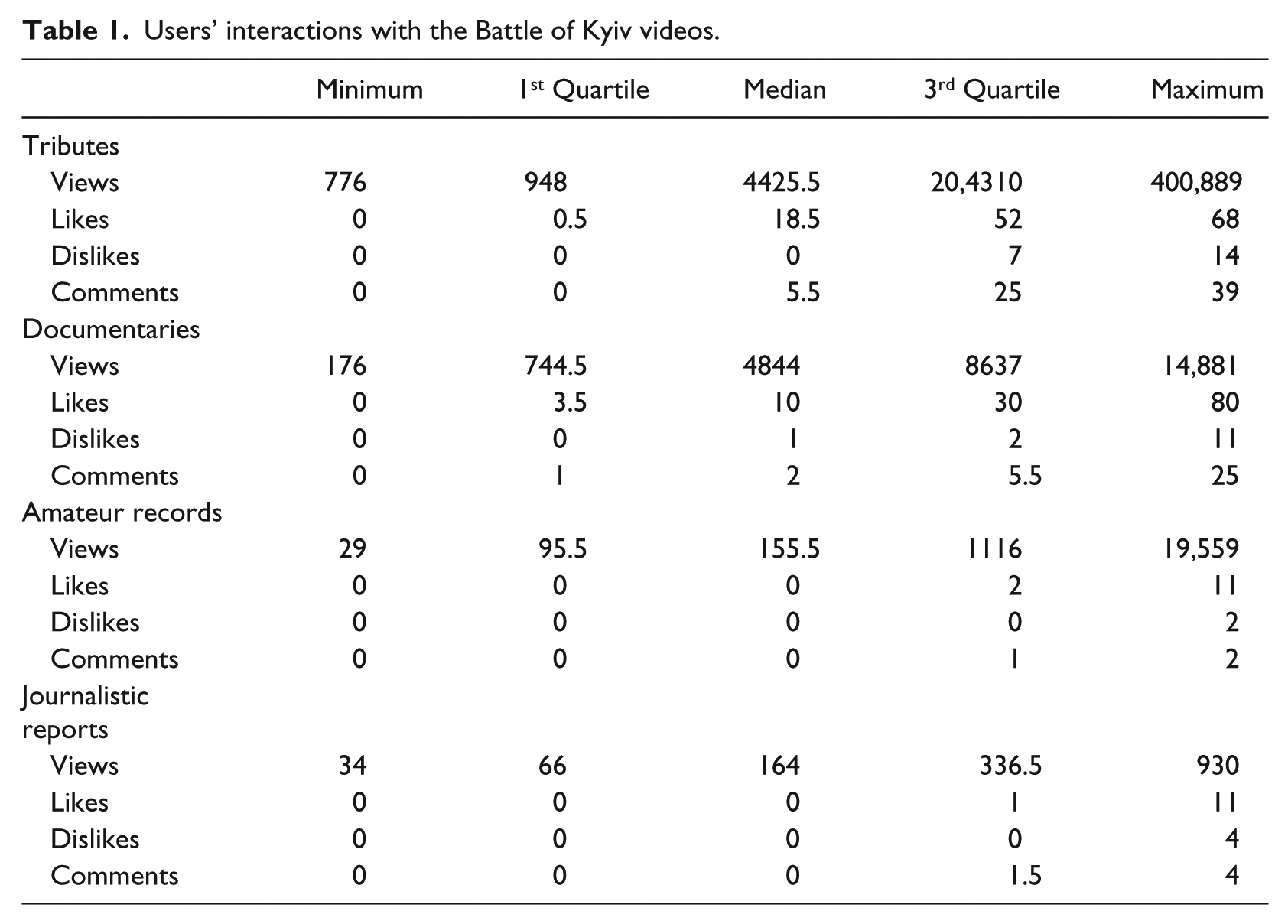
Table 1 indicates that users’ attention was distributed extremely unequally among individual videos used to represent the Battle of Kyiv on YouTube. While the view count for some YouTube clips went into the hundreds of thousands, other clips were viewed only a few dozen times. The same inequality—albeit on a lesser scale—was found in the distribution of likes and dislikes: while the majority of videos were not (dis)liked at all or received one or two likes, some of them provoked much stronger emotional reactions. While no statistical tests were done, all nonverbal forms of feedback seem related to each other—i.e. videos with larger view counts tended to receive more likes/dislikes as well as comments. That said, another study is needed to prove or disprove this suggestion empirically.
Users’ interactions with the Battle of Kyiv videos.
While the highly unequal reception of different representations of the Battle of Kyiv is not surprising and, thus, cannot be viewed as a finding by itself, it is worth considering why some of clips attracted considerably larger attention than others. While it is hard to explain, based on YouTube data, why some videos provoked significant interest, whereas others did not, I considered several factors that might influence users’ preferences. My observations suggest that duration of a given video’s presence on YouTube was not an influential factor: even while some of the most viewed videos were uploaded to YouTube in 2011/2012, many others appeared around the same time but were not viewed that often. In contrast, the choice of language seemed to be more relevant: the majority of the most frequently viewed videos were made in Russian—or at least used Russian titles. This strategy allowed videos’ creators to target the more numerous Russophone audience, which included both Russian-speaking Ukrainians and Russians, whereas Ukrainian-only representations were reliant on a smaller target audience.
The most important factor linked to the popularity of a given clip, however, would appear to be genre. Table 1 suggests that tributes and documentaries attracted significantly more attention—both in terms of views and emotional responses—than amateur records and journalistic reports. While there are many possible reasons for this sort of distribution of interest in genres, I suggest that one of these could be the fact that tributes and documentaries provided the viewer with a more emotional and authentic commemorative experience that resulted in reverberation of affective states in and out of YouTube. 13 Unlike reports and records that focused on content related to contemporary commemoration practices and that tended to provide brief—and often dry—commentary on the Battle of Kyiv, both tributes and documentaries were often affectively charged and shared with the viewer a wide range of memorabilia, varying from historical photos to interviews with eyewitnesses. The use of sound, such as the Soviet war marches in tributes or sad instrumental motifs in Ukrainian documentaries, is another factor that contributed to mobilization of interest among viewers of clips of these two genres who experienced what Thompson and Biddle (2013) call “affective transmissions” (p. 5). Yet, the deeper examination of the reasons behind the attractiveness of a particular genre for nonverbal interactions remains beyond the scope of current research and is a subject for a separate study.
Unlike nonverbal forms of interaction, which pointed to significant distinctions in the reception of different genres of YouTube remembrance, the analysis of verbal interaction indicated much lesser inter-genre variety. Instead, the majority of verbal responses independent of the video’s genre expressed negative feelings varying from anxiety to rage, whereas positive emotions were expressed rather rarely. Based on content analysis of comments, I suggest that users’ reactions to representations of the Battle of Kyiv mainly revolved around three highly contentious and emotionally charged subjects: the current situation in Ukraine, the struggle for historical truth, and commemoration of Soviet victory in the Second World War.
The majority of responses to digital clips dedicated to the Battle of Kyiv involved appropriating Second World War memory in connection to the current crisis in Ukraine. Often this was done by drawing parallels between the war years and the current conflict in Eastern Ukraine in general (“многие кадры горящих хат, сняты как сегодня—летом 2014?” (“Many images of burning houses look completely like today—in summer 2014”); xtyjlx) or by directly framing the post-Euromaidan Ukrainian government as successors to Nazi Germany (“С праздником Киевляне! Свободу Киеву и русскому и украинскому народу от майдано-гей-фашистов!” (“Greetings, Kievites! Freedom to Kiev and the Russian and Ukrainian peoples from Maidan’s homosexuals-fascists!”); EVGENIY 61RUS). Many comments compared the Euromaidan revolution in Ukraine to a military defeat, contrasting it to the Battle of Kyiv of 1943 (“Как же так в 1943 году победили а в 2014 году сдали без боя и кому?” (“How is it we won in 1943, but surrendered everything without a fight in 2014, and to whom?”); Рамиля Пещур) and expressed a desire to reclaim Ukraine which was seemingly lost for Russia after the overthrow of President Yanukovych in 2014 (“как бы не пришлось по новой освобождать” (“Seems like we should liberate it again”); Nikolay Bukert).
The second most common type of reaction revolved around the question of historical truth and the (in)adequacy of current commemorative practices related to the Battle of Kyiv. Unlike comments related to the Ukraine crisis, which were produced mainly by Russophone users, comments on historical truth were distributed equally between Ukrainophone and Russophone viewers. Both types of users were particularly active in commenting on the interpretations provided in Ukrainian documentaries. While a number of users praised the revision of the traditional Soviet narrative on the Battle of Kyiv (“ОСЬ ЦЕ потрібно показувати по ТВ на ‘9 мая’, а не московську хрєнь” (“THIS should be shown on TV on ‘9 May’, not this Muscovite shit”); OmyLeg), others were more critical (“ну сука, пидор, с первой же фразы—пиздеж! давно же доказано, что Киев брали не специально к 7-му ноября, так совпало … хуесосы авторы, гандоны либерастические, рот ваш ебал в порядке очереди!” (“Wow, what a whore, a fag, he lied from the very beginning! It was proven that Kyiv was not captured for 7 November, it was a coincidence … Authors, you are cock-suckers, liberal condoms, I would like to fuck your mouths one by one!”); osjabender). The majority of comments of this type promoted a particular interpretation of the Battle of Kyiv—either from the Ukrainian or the Russian historiography—even while a few reactions criticized the nationalistic view of the past in general (“Вброс для очередного разжигания национальной проблемы Россиян и Украинцев” (“Another provocation for igniting national strife between Russians and Ukrainians”); Игорь В.).
While I also found comments that expressed admiration for the heroism of Soviet soldiers (“Вечная память героем освободителям!” (“Eternal memory for liberators!”); AntiK AntiK) or emphasized the importance of remembering their sacrifices (“эти фильмы надо показывать по тв чтобы никогда не забывали” (“These films have to be shown on TV, so people will never forget”); MrMid1night), such reactions were not numerous. Consequently, they remained barely noticeable against the backdrop of aggressive statements, many of which were of a nationalistic (“Ссыклявая нация, да и фамилия у них на ‘ко’, идите к лесу, пидарасы, не братья вы нам, предатели !!!!” (“A nation of cowards, their surnames end with ‘ko’, go to the forests, fags, you are not our brothers, but betrayers!!!!”); Михаил Дие) or homophobic nature (“на хуя ты, пидарасня фашистская на этот канал залез. дрочи на свои бандеровсие подвиги на своих каналах. мне по хуй на вашу говнораду, хоть на киевскую, хоть на верхнюю и на тебя тоже по хуй. ты понял, салоед мой расклад?” (“Why, for fuck’s sake, did you, a fascist homosexual, crawled onto this YouTube channel? Continue masturbating over your Banderites’ exploits on your own channels. I do not give a fuck about your shitty Council, both in Kyiv and the upper one, and fuck you too. Understand, you, fat-eater?”; cc c). Even though the resulting environment could be identified as an “interactive commemorative space” (Knudsen and Stage, 2013: 420), the metaphor of Drinot, who likened comments on YouTube as “a nasty shouting match between anonymous posters” (2011: 371), seems to be more appropriate.
My findings suggest that nonverbal interactions with audiovisual representations of the Battle of Kyiv varied depending on the genre of the given video: tributes and documentaries provoked more emotional reactions and attracted more attention than journalistic reports and amateur records. In contrast, verbal interactions showed little variety between genres as the majority of comments expressed negative emotions, which often appeared as aggressive statements addressed to other YouTube users. The predominance of such reactions—as well as the tendency for them to be framed in nationalistic or homophobic terms—problematizes the idea of using social media as a commemorative space. While some users employed YouTube for what can be viewed as overcoming historical controversies and debating over a contentious past, others used the platform for appropriating memory of the Battle of Kyiv in order to frame the current Ukrainian crisis and dehumanize their both real and virtual opponents. Consequently, while it is hardly debatable that YouTube provides a variety of opportunities for interacting with different visions of the past, it is worth noting that these interactions are often hostile and aggressive. However, despite the aggressiveness of its environment, YouTube remains a space where Ukrainian and Russian Internet users can discuss their contentious past and its relation with the present, which is particularly valuable in the context of ongoing crisis between two countries.
Conclusion
The findings of this study suggest that YouTube facilitates remembrance of the traumatic past by opening up a new space for commemoration, a space that is less limited by national borders than offline commemorative spaces. The de-territorialized environment of digital media accommodates different views of the past and allows for representation and sharing of distinct historical narratives online. In the case of the Battle of Kyiv, it leads to the co-existence of Soviet, Russian, and Ukrainian interpretations of this event on the same digital platform. Even while these interpretations are not necessarily represented equally, the variety of digital clips dedicated to the Battle of Kyiv contrasts positively with offline commemorative practices, which tend to promote one-sided views of the event and ignore alternative interpretations. Consequently, my observations comply with the ones made by Jones and Gibson (2012) who argue that YouTube has the potential to enrich the remembrance experience by enabling “a cultural exchange of shared experience that more traditional forms of remembrance are unable to provide” (p. 127).
At the same time, my findings suggest that mediatization of war memories does not necessarily lead to the formation of new cosmopolitan narratives of the past that transcend “ethnic and national boundaries” (Levy and Sznaider, 2002: 88). Instead, even in the transnational space of digital media, memory of the Battle of Kyiv is predominantly represented in terms of national—and often nationalistic—interpretations of the Second World War. Similar to the Latin American context, where digital representations of historical traumas are largely determined by local historiographies that portray these traumas in highly contradictory ways (Drinot, 2011), Ukrainophone and Russophone users tend to use YouTube not to challenge national narratives of the past but to disseminate and propagate these narratives online. While these users do interact with each other through the platform, these interactions are often limited to offensive comments that challenge opponents’ views in an obnoxious way and impede discussions about the past instead of stimulating them. Consequently, instead of constructing new narratives about the contentious past, YouTube tends to recreate established practices of war commemoration in Ukraine and Russia and, thus, contributes to their conservation.
At the same time, even while YouTube discussions are permeated by “user flaming and crassness” (Hess, 2009: 431), it does not necessarily invalidate the platform’s potential for democratizing war remembrance. Despite the aggressive comment culture on YouTube, which turns it into a “battlefield in transnational politics” (Benzaquen, 2014: 805) and often takes the form of hate speech, the platform serves as space where preeminent discourses of the past can be disputed and scrutinized. This opportunity for expressing public commemorative disagreement with dominant memory narratives is particularly important for postsocialist countries, where war memories are often disproportionately politicized and regularly instrumentalized for collective mobilization. Under these circumstances, social media such as YouTube can serve as a platform for political and cultural self-expression, thus facilitating comprehensive assessment of the contentious past and the establishment of more pluralist narratives about the Battle of Kyiv.
Footnotes
Declaration of Conflicting Interests
The author(s) declared no potential conflicts of interest with respect to the research, authorship, and/or publication of this article.
Funding
The author(s) received no financial support for the research, authorship, and/or publication of this article.