



Abstract
Background:
Ethiopia’s population is currently estimated to be 117,814,659 people and continues to have countries with the highest maternal mortality rates. Family planning is one of the most effective techniques for lowering mother and child mortality, in addition to limiting rapid population expansion.
Objective:
The aim of this study was to assess level and determinants of long-acting family planning method among reproductive age women in Harar, Eastern Ethiopia, 2021
Method:
Community-based cross-sectional study was conducted among 845 randomly selected reproductive age women. Data were collected by trained data collector using pretested structured questionnaire. Data were coded and entered into Epidata v.3 and analyzed using SPSS v.26 software. Descriptive statistics, bivariate and multivariate logistic regression analysis was used. Variable with p-value less than 0.05 was declared as statistically significant.
Result:
The prevalence of long-acting family planning method was 74.7%, while 53.6% and 46.4% was from rural and urban, respectively. The mean age of participants was 28.5 (± 5.6) years. Married women four times (AOR: 4.1; 95% CI: 1.6, 10.4) more likely to use long-acting family planning method than single women. Women with educated husband four times (AOR: 4.4; 95% CI: 1.8, 10.6) more likely to use long-acting family planning method than women with illiterate husband.
Conclusion:
There is high level of utilization of long-acting family planning. The women’s marital status, increased education level of husbands, increasing in age of women, intention to spacing birth, and having less than five children were found to significantly increase the utilization of long-acting family planning.
Introduction
Family planning is one of the most effective techniques for lowering mother and child mortality, in addition to limiting rapid population expansion. 1 It prevents unintended pregnancies that could lead to unsafe abortions, increasing the risk of death and illness for the mother. 2 Evidence suggests that providing contraceptives can prevent 44% of maternal mortality. 1 Beyond reducing maternal mortality, family planning helps to give couples the opportunity to invest more in the welfare of each child and promote the economic benefits; by reducing unintended pregnancies, it can benefit education of girls and create opportunities to participate more fully in society, including paid employement.3,4
World Health Organization has classified contraceptives according to their efficacy; long-acting contraceptive methods (LACMs), such as intrauterine contraceptive device (IUCDs), implants, vasectomy, and tubal ligation, are in the top tier; combined hormonal and progesterone-only treatments are in the second tier, and barrier methods and fertility awareness are in the third tier. 5
LACMs can prevent unintended pregnancy and pregnancies that are closely spaced. 5 Despite its effectiveness in improving maternal health, LACMs approaches have had a low level of acceptance and use by the general public. 6
Long-term reversible contraception can be protective against some forms of cancer and significantly lower rates of unintended pregnancies owing to less user error compared to other methods.7,8
In Sub-Saharan Africa, the utilization of LACMs was influenced by several factors, including sociodemographic characteristics (age, education, number of children), sociocultural (family pressure, social stigma, myths), and behavior of specific groups of women and health facilities factors (provider attitude, access, quality of service).9–13
Ethiopia’s population is currently estimated to be 117,814,659 people, based on the Worldometer 14 interpretation of the most recent United Nations data, and it is one of the countries with the highest total fertility rate. 15
Ethiopia continues to rank among the countries with the highest maternal mortality rates. In Ethiopia, the maternal mortality rate was 412/100,000 live births. 15 The country has made progress in lowering maternal death but still has a high rate of maternal mortality. 16
There is low utilization of LACMs in Sub-Saharan Africa. 17 Moreover, in Ethiopia, the prevalence of LACMs usage was low. 18 Low usage of long-acting family planning (LAFP) related to decrease in weight, feeling of lack of sensation on the arm, and bleeding. 19
The majority of previous research has attempted to assess LACMs usage among women who visit a healthcare facility. No study has been undertaken in the study area to examine LAFP utilization at the community level; the objective of this study was to assess the level of utilization of LAFP methods and determinant factors among reproductive age women in Harar Region, Eastern Ethiopia.
Method and material
Study area
Harari region is one of the 10 regions in Ethiopia which is located 526 km away from the capital city of Ethiopia, with an estimated area of 334 km2, and the estimated total population of the Harar town is 246,000. Approximately, 60% of the population is living in urban areas. There are nine numbered woredas in the Harari region. Under the woreda, there are 19 cities kebeles and 17 rural kebeles. This study was conducted in Harar, Eastern Ethiopia from 12 January to 22 January 2021. A community-based cross-sectional study design was used to assess the level and determinants of LAFP among reproductive age women in Harar, Eastern Ethiopia.
Sample size determination sampling technique
We use 423 samples which are calculated using single proportion formula with 95% of confidence interval and 5% margin of error, 10% non-response rate, and assumption of 50% proportion. Then multiplying by two design effects

The study participants were classified into two strata based on their residence area (urban and rural). Finally, this study was conducted among randomly selected 845 reproductive age women in each stratum. All 15–49 years aged women in Harar were our source population. Whereas, all 15–49 years aged women randomly selected from each stratum are our study unit.
Eligibility criteria
Study participants who are volunteered to participate in the study during data collection period were included in the study. Those who do not have the willingness to participate in the study were excluded from the study.
Data collection tool and procedure
Data were collected by face-to-face interview method using the pretested structured questionnaire. The questionnaire was prepared in the English language which is adapted after reviewing relevant literature. The questionnaire was consisting of three parts, which consist all necessary sociodemographic variables (age, educational status, occupation, marital status, educational level, etc.), variables regarding reproductive factors (age at first marriage, parity, and gravidity) as exposure variables, and the current utilization of the LAFP method was our outcome variable. Data were collected by four students from second year health informatics students.
Data quality control
To assure the quality of data, 3-day training was given for data collectors on how to collect data and interviewing techniques. However, 5% of the questionnaire was pretested on Hakim Woreda, checked for consistency, and necessary revisions were made. Close supervision of the data collector was made by the authors. Collected data were checked both in the field at the end of each day after data collection and before data entry for completeness and missing value. Double data entry was performed by two authors (A.D. and A.A.).
Data processing and analysis
After data were collected, checked for consistency, clarity, and completeness, data were entered into Epidata version 3.0 and transported to statistical package for social science (SPSS) v.26 for analysis. Descriptive statistics were computed to summarize the result in the form of percentage, mean, and standard deviation. Bivariate and multivariate analysis was computed to assess the association between the dependent and independent variables and to control possible confounding variables, respectively. Finally, those variables in the second model with a p-value less than 0.05 were declared as statistically significant. We have used STROBE checklist for cross-sectional study design for writing the finding of the study.
Ethical consideration
The official letter was obtained from Rift Valley University, Institutional Health Research Ethical Committee (IHREC; IHREC/006/2021). After telling the participants the importance of the study and that there was no risk to participating in this study, including maintenance of confidentiality, oral informed consent was taken from each study participant. This is because written consent was not feasible as some of the participants may be illiterate. Then, the data collector asks the interviewee whether they are willing to participate in a study before each interview. If the participant agrees to participate, the data collector marks [Yes] in the informed consent form and signs his signature. The data collector can also mark [No] if the person refuses to participate.
Result
Sociodemographic characteristics of the study participant
A total of 845 study participants were included in the study, which is a 100% response rate. The mean age of participants was 28.5 (± 5.6) years. Out of 845, a majority (92.7%) were married. Regarding their occupational status, most of them, 398 (47.1%), were housewives (Table 1).
Sociodemographic characteristics of reproductive age group women in Harar, Eastern Ethiopia, 2021.

ETB: Ethiopian birr; n: frequency number in each stratum; N: total number.
Reproductive characteristics of women
Out of 845 reproductive age women, the majority, 635 (75.1%), of them married at an age of ⩾ 18 years with a mean age of 19.3 (± 2.7) years. Most of them, 673 (79.6%), have less than five children, 147 (17.4%) have no children (Table 2).
Reproductive characteristics of study participant women in Harar, Eastern Ethiopia, 2021.

n: frequency; %: percentage.
Awareness about LACM
Out of 845 women majority, 740 (87.6%) knew about LACM, among this, 542 (73.3%) and 198 (26.7%) of them knew about implant and IUCD, respectively (Figure 1). Among 738, women who know about the LAFP method, 420 (56.9%) were in the 25–34 years age group, 177 (23.9%) in < 25 years, and the rest is in 35–49 years of age.
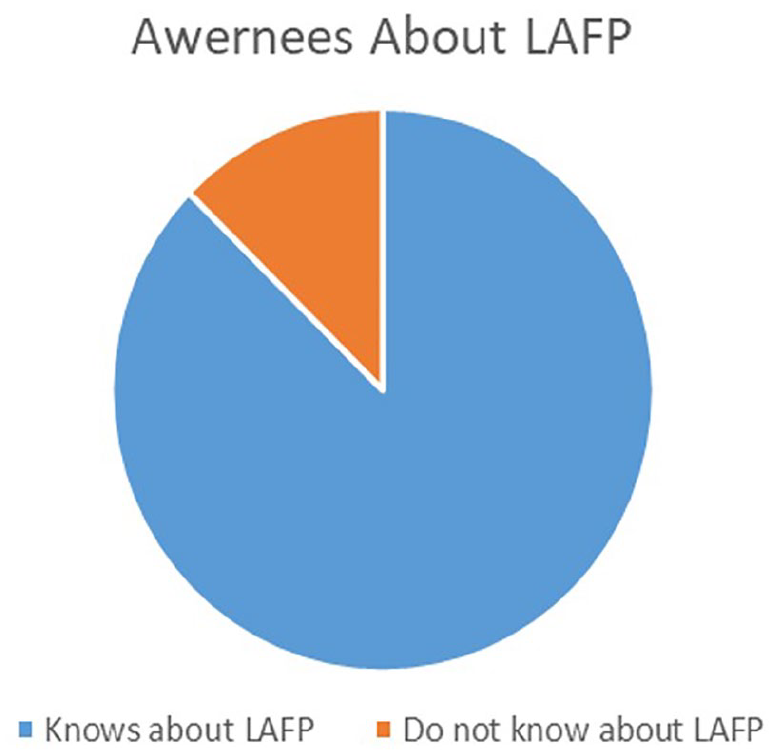
Awareness about LAFP among reproductive age women in Harar, Eastern Ethiopia, 2021.
Source of information about LACM
Out of 740 women, who knew about LACM, the majority 370 (50%) sources of information were from television, 227 (31%) from health professionals, 81 (11%) from radio, 53 (7%) from their friends, and only 9 (1%) from a newspaper (Figure 2).

Source of information about LAFP among reproductive age women in Harar, Eastern Ethiopia, 2021.
Utilization of LACMs
Out of 845 women, 631 (74.7%) utilize long-acting methods, among this, 489 (77.5%) utilized implants, and 142 (22.5%) utilized IUCD. The majority 483 (76.5%) were from government institutions, 147 (23.3%) from non-governmental organizations (NGOs), and only 1 (0.16%) from private institutions (Table 3).
Utilization of LAFP methods among women in Harar, Eastern Ethiopia, 2021.

LAFP: long-acting family planning; IUCD: intrauterine contraceptive device; NGOs: non-governmental organizations; n: frequency number in each stratum; N: total number.
Factors associated with utilization of LACMs
Almost all sociodemographic variables show associations with the use of LAFP methods in a bivariate analysis model. However, multivariate analysis model for sociodemographic factor shows women in the 35–49 years age group two times (AOR: 2.2; 95% CI: 1.3, 3.8) more likely to use LAFP than women < 24 years age group. Married women four times (AOR: 4.1; 95% CI: 1.6, 10.4) more likely to use the LAFP method than single women. Women with educated husbands four times (AOR: 4.4; 95% CI: 1.8, 10.6) more likely to use LAFP methods than women with illiterate husbands. Women with 5–9 family size 36% less (AOR: 0.64; 95% CI: 0.4, 0.9) likely to use LAFP than women with < 5 family sizes (Table 4). Multivariate analysis model for reproductive factors shows women who have 1–4 children 18 times (AOR: 18; 95% CI: 1.03, 315) more likely to use LAFP than women who have no children. Women who planned to space birth three times (AOR: 3.1; 95% CI: 1.4, 6.8) more likely to use LAFP method than women planned to stop birth (Table 5).
Sociodemographic factors associated with the utilization of LAFP method among reproductive age women in Harar, Eastern Ethiopia, 2021.

LAFP: long-acting family planning; ETB: Ethiopian birr; COR: crude odds ratio; 95% CI: 95% confidence interval; Bold*: p-value < 0.05 significant; AOR: adjusted odds ratio; bold: p-value < 0.25.
Reproductive factor associated with LAFP utilization among reproductive age women in Harar, Eastern Ethiopia, 2021.

LAFP: long-acting family planning; COR: crude odds ratio; 95% CI: 95% confidence interval; Bold*: p-value < 0.05 significant; AOR: adjusted odds ratio; Bold: p-value < 0.25.
Discussion
In this study, the mean age of study participants was 28.5 (± 5.6) years, this finding was consistent with a study conducted in South Ethiopia’s mean age of 28 years, 20 but less than from a similar study conducted in northwest Ethiopia with a mean age of 29.6 (± 7.6) years. 21 This slight difference could be due to sample size and geographical variation.
In our study, the prevalence of LAFP utilization was higher (74.7%), than other similar studies conducted in different parts of Ethiopia, 65.4% in Lay Armachiho, North Gondar, 5 20.9% in Adama, 22 20.4% in Gondar town, 23 and 19.5% in Gojjam. 21 Similarly, studies from Eastern and Southern Ethiopia indicate a prevalence of 38% in Harar, 24 22% in Hawassa, 25 and 7.3% in Jinka, 20 respectively. This difference could be due to the difference in sample size, sample population, and the fact, that our study was conducted at the community level. In addition to this, currently in Harari region, the number of urban and rural health extension workers who are trained to provide LAFP method was highly increased.
Our study also indicated that 92.7% of the married women utilize long-acting reversible contraceptive which is higher than the finding reported in 2005 and 2016 Ethiopia Demographic and Health Survey analysis which is only 12.3% of married women utilizing long-acting reversible contraceptive methods. 26 This difference could be the difference in the timing of the studies, population, and sampling differences.
In our study, 77.5% of women utilized implants; this is higher than the studies conducted in different parts of Ethiopia, which reported 26% in Hawassa, 25 20.4% in Gojjam, 27 17.5% in Arsi Negele, 28 and 16.1% in Adama, 22 but our finding is lower than the study from Gondar which reported 96.5%. 23 This difference could be due to the difference in sample size and population.
IUCD utilization in our study was 22.5%, which is higher than other similar studies conducted in different parts of Ethiopia, which reported 7.5% in Arsi Negele, 28 4.6% in Adama, 22 4.5% in Hawassa, 25 3.5% in Gondar, 23 and 2.3% in Gojjam. 27 This difference could be due to the difference in sample size, population, and high health coverage of the Harari region.
In our study, increasing in age was found to be significantly associated with the utilization of LAFP. This finding was consistent with the studies conducted in Debre Markos and Wondo Genet, Sidama.21,29 The reason for this could be explained by the fact that with increased age the women had already attained their fertility plan and use long-acting contraceptives till menopause.
In our study, having an educated husband was found to significantly increase utilization of LAFP methods, which is consistent with the finding in Arsi Negele and Chencha, Gamo Gofa, Zone.28,30 Other contradicted findings reported from, however, different studies indicated that educated women were found to significantly utilize LAFP.31,32 This could be due to the fact that the more educated the husbands are the more knowledge they could have on the benefits of LAFP. Thus, they can influence their wives to utilize LAFP methods.
In our finding, married women are more likely to utilize LAFP than unmarried women, which is consistent with the findings from Gondar and Tigray.23,33 This could be due to, married women more likely to have an adequate number of children which compel them to utilize LAFP method.
Limitation of the study
Since the study used cross-sectional study design, it is difficult to establish a temporal relationship, which means, the temporal link between the outcome and the exposure cannot be determined because both are examined at the same time. Even if this study is conducted at community level, it does not incorporate qualitative method. If the study had used qualitative methods, it could provide more detailed in-depth information to explain complex issues, such as behavior, and attitudinal factors which may not be adequately addressed by quantitative method.
Conclusion
There is a high level of utilization of LAFP among reproductive age women in Harar. The women’s marital status, increased education level of husbands, increasing in age of women, intention to spacing birth, having less than five children were found to significantly increase the utilization of LAFP. To increase LACMs utilization, continuous targeted and tailored information should be provided by Ministry of Health and Regional Health Bureau through different media to the community at large and specifically to women regarding LACMs. Health institutions should regularly provide behavioral change communication about the benefits of LACM to all reproductive age women who came for routine services and on community outreach programs. Improving women’s access to formal education and economical participation would empower women to exercise the rights to make reproductive health decisions, including utilization of LACM. In addition, improving male involvement in family planning matters through tailored program outreach and education is essential to increase the utilization of LACM.
Supplemental Material
sj-docx-1-whe-10.1177_17455065211063279 – Supplemental material for Level and determinants of long-acting family planning utilization among reproductive age women in Harar, Eastern Ethiopia
Supplemental material, sj-docx-1-whe-10.1177_17455065211063279 for Level and determinants of long-acting family planning utilization among reproductive age women in Harar, Eastern Ethiopia by Astawus Alemayehu, Abebaw Demissee, Dereje Feleke and Maruf Abdella in Women’s Health
Supplemental Material
sj-docx-2-whe-10.1177_17455065211063279 – Supplemental material for Level and determinants of long-acting family planning utilization among reproductive age women in Harar, Eastern Ethiopia
Supplemental material, sj-docx-2-whe-10.1177_17455065211063279 for Level and determinants of long-acting family planning utilization among reproductive age women in Harar, Eastern Ethiopia by Astawus Alemayehu, Abebaw Demissee, Dereje Feleke and Maruf Abdella in Women’s Health
Footnotes
Acknowledgements
First, the authors thank almighty God. They also thank Mr. Merga Hirko for language editing of the article. Finally, they thank the Woreda Offices that allowed us to conduct the study and the study participants for their participation.
Author contributions
AA, AD, DF, and MA, participate in the study from the inception to design, acquisition of data, analysis, interpretation, and drafting of the article.
Consent to participate
After all study participants were informed of the aim of the study, Oral informed consent was obtained. They were also informed that they have the right to participate and withdraw from participation at any time, without any harmful events.
Data availability
Any time the corresponding author provides an additional resource on request.
Declaration of conflicting interests
The author(s) declared no potential conflicts of interest with respect to the research, authorship, and/or publication of this article.
Ethical approval
Ethical approval letters were obtained from the Rift Valley University, Institutional Health Research Ethics Review Committee, with Ref.no. IHREC/006/2021.
Funding
The author(s) received no financial support for the research, authorship, and/or publication of this article.

Supplemental material
Supplemental material for this article is available online.
References
Supplementary Material
Please find the following supplemental material available below.
For Open Access articles published under a Creative Commons License, all supplemental material carries the same license as the article it is associated with.
For non-Open Access articles published, all supplemental material carries a non-exclusive license, and permission requests for re-use of supplemental material or any part of supplemental material shall be sent directly to the copyright owner as specified in the copyright notice associated with the article.
