Analytical formulae were obtained to quickly determine the temperature level in a single disk of the multi-disk brake. They take into account the time of contact pressure increase, convective cooling on lateral surfaces of the disk, and different thermal conductivity of material in the axial and radial directions. Calculations were performed for a disk made of carbon composite material Termar-ADF. The influence of the aforementioned input parameters on the temperature of the disk during single braking was studied. It is established that the obtained theoretical results are in good agreement with the corresponding experimental data.
High-load multi-disk brake systems are commonly used in trucks, construction machines, and above all in aviation.1–3 Friction elements in such brakes are made of materials belonging to one of three groups: polymers, sintered powders, and carbon composites.4 Each of the mentioned groups of materials corresponds to the characteristic optimum operating conditions such as superficial and volumetric thermo-mechanical loads, relative sliding speeds, and wear rate. Generalized information indicator of the friction pair load is the intensity of heat absorption , where is the total energy absorbed by braking system, and is the total weight of absorbing elements (disks).
Polymeric friction materials are used in brake systems operating in relatively light conditions, when the temperature on the contact surface does not exceed 400 °C and the volumetric temperature of the heat absorbing element is lower than 300 °C. A typical representative of this material class is Retinax A, which was previously widely used for the production of pads in drum and disk brake systems. Retinax is usually used in combination with gray cast iron or various types of steels.5
Sintered powder materials are used at medium operating conditions of the braking system, when the temperature of the friction surface does not exceed 1200 °C and the volumetric temperature of the element is not higher than 600 °C. The most known materials of this class are metal-ceramics working in combination with cast iron or steels. In braking systems with such friction pairs, the intensity of heat absorption should not be greater than 350 kJ/kg. Otherwise, the temperature generated on the friction surface can cause local melting of the metal components of the material and, as a result, junctions the friction pair at reducing the speed and stopping of the vehicle or aircraft.6 The use of metal-ceramic disks is limited by their relatively high wear, the significant shrinking of the casing, the destruction of fastening elements, and the friction material.
Carbon–carbon (C/C) composites are used in the braking systems subjected to severe conditions, when the superficial and volumetric temperatures may exceed respectively 1500 °C and 800 °C. The intensity of heat absorption of some friction materials from this class (e.g. Carbenix-4000, Termar) can reach even 2000 kJ/kg.7,8 These materials have a significant advantage over polymeric materials and metal-ceramics. They are characterized by a less-pronounced tendency to increase wear with increasing temperature and less sensitivity to changes in contact pressure and sliding speed.
Experimental investigations and full-scale tests of multi-disk brake systems equipped with carbon composites showed that as in the case of metal-ceramics, the main factor determining resistance to wear of disk material, and thus the service life of the brake as a whole is its temperature mode.9,10 Therefore, the development of mathematical models to determine temperature distributions in multi-disk brakes is an actual scientific problem. Overviews of analytical, numerical, and experimental studies of frictional heating during braking are included in the articles.11–14 It follows from them that the exact analytical solutions of the thermal problems of friction are mainly obtained for semi-bounded bodies (semi-spaces) and do not take into account cooling of the free surfaces. Corresponding solutions for bodies with finite dimensions (stripes) that take into account the change in contact pressure with time of braking and non-homogeneity of thermophysical properties of the material are absent. Therefore, the objective of this article is to obtain the exact solution to the boundary-value problem of heat conduction for an orthotropic strip, which is heated on the front side by time-dependent heat flux and convectively cooled on the lateral surfaces. Based on the obtained solution, the influence of the rate of contact pressure increase, cooling intensity, and strip thickness on the distribution of the temperature in the carbon composite disk was studied.
Statement to the problem
Disks are brake components that are the most exposed to high mechanical and thermal load. When the coefficient of mutual overlap of the friction pair made of two single disks (rotor-stator) equals 1, the nominal contact area remains unchanged during braking and eliminates the appearance of unwanted fluctuations of braking torque. Example photo of the aircraft multi-disk brake is shown in Figure 1(a).15 Due to the symmetry of the multi-disk brake friction components, we consider only a single disk separated from the system. Diagram of selected disk with internal radius , external radius , and thickness is presented in the Figure 1(b). It is assumed, that
The disk is made of an orthotropic material with thermal conductivities and in radial and axial directions, respectively;
The initial values of the angular speed of the disk and kinetic energy are and , accordingly.
The coefficient of friction is constant.
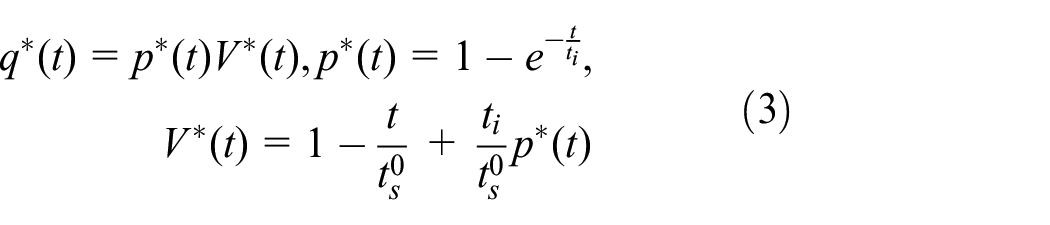
The contact pressure during braking increases exponentially from zero to the nominal value .
On the lateral surfaces of the disk, the convective cooling with constant coefficient of heat transfer takes place.
The initial temperature of the entire disk equals .
Scheme of the consider system: (a) example photo of a multi-disk assembly15 and (b) a single, separated brake disk.
On the front surfaces and disk is heated by the heat fluxes with intensity16
where
Due to load and geometrical symmetry relative to the plane and the rotation axis of disk , the transient temperature field is homogeneous in the circumferential direction, so its value at any instant depends only on radial and axial spatial coordinates. Therefore, to find temperature distribution, we consider the two-dimensional (2D) boundary-value problem of heat conduction for a strip , referred to the Cartesian coordinate system (Figure 2).
Scheme heating of the strip.
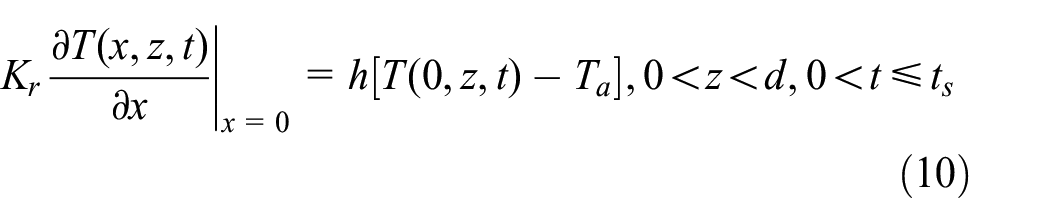
The upper edge of the strip is heated by the heat flux with intensity (1)–(6), the lower edge is thermally insulated, on the lateral edges and , , the heat exchange with environment according to the Newton’s law with constant heat transfer coefficient takes place. Transient temperature field in the strip will be found from solution to the following boundary-value problem of heat conduction
The transient 2D equation of heat conduction (7) with taking into account the boundary conditions (10) and (11) can be reduced to the one-dimensional (1D) form17
where
Introducing the dimensionless variables and parameters
the equation (13), the boundary (8) and (9), and initial (12) conditions with account of relation (1)–(6) are written in the following form
where
Solution to the boundary-value problem (17)–(22) is presented in the following form18
where is the new sought function. Taking into account substitution (23), the boundary-value problem (17)–(20) is presented in the following form
where the dimensionless specific power of friction and braking time are determined from the formulae (21) and (22), respectively.
Solution to the problem
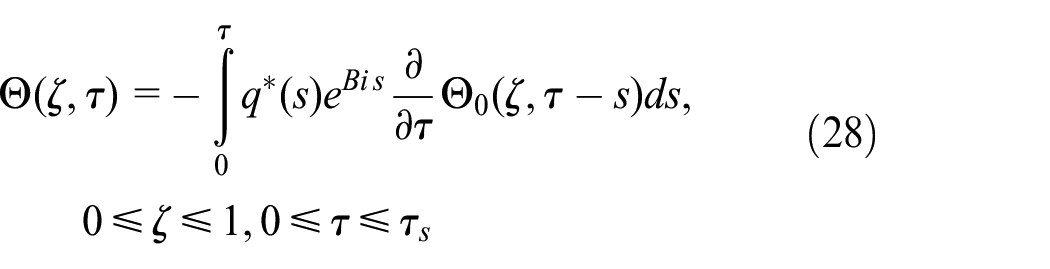
Based on Duhamel’s theorem,19 solution to the boundary-value problem of heat conduction (24)–(27) is presented in the following form
is the solution of the same problem at . Differentiating function (29) with respect to the variable and substituting the result to the right side of the equation (28), we obtain
where
The eigenvalues is determined from formula (30), and the sign here and further means that the first element of the series (for ) has to be multiplied by 0.5.
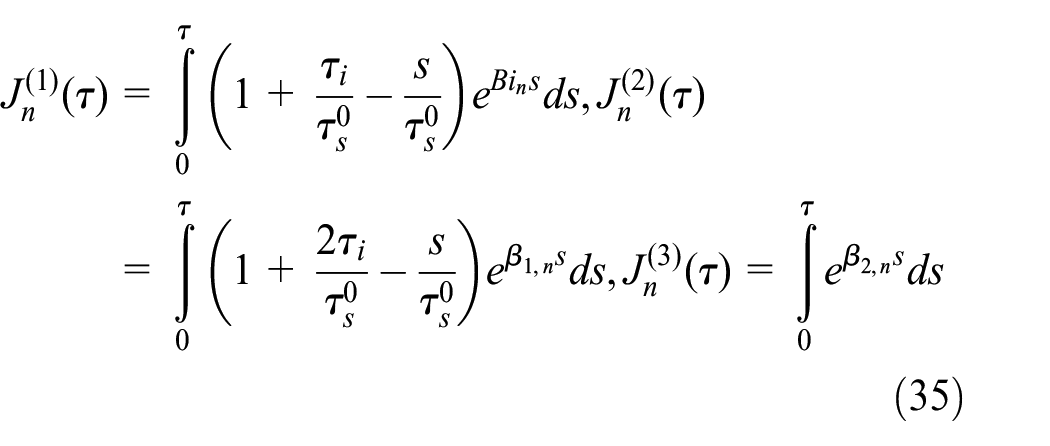
Substituting the function (21) to the integral (32), we have
where
Form of integrals (35) testifies about that the solution (31) significantly depends on the values of parameters , (36). If , then after calculation of the integrals (35) and substitution of results to the right side of the equation (34), we have
By substituting functions (37) to the solution (31), we obtain
Based on function (38), from the relation (23), we find the dimensionless temperature in the strip in the following form
where
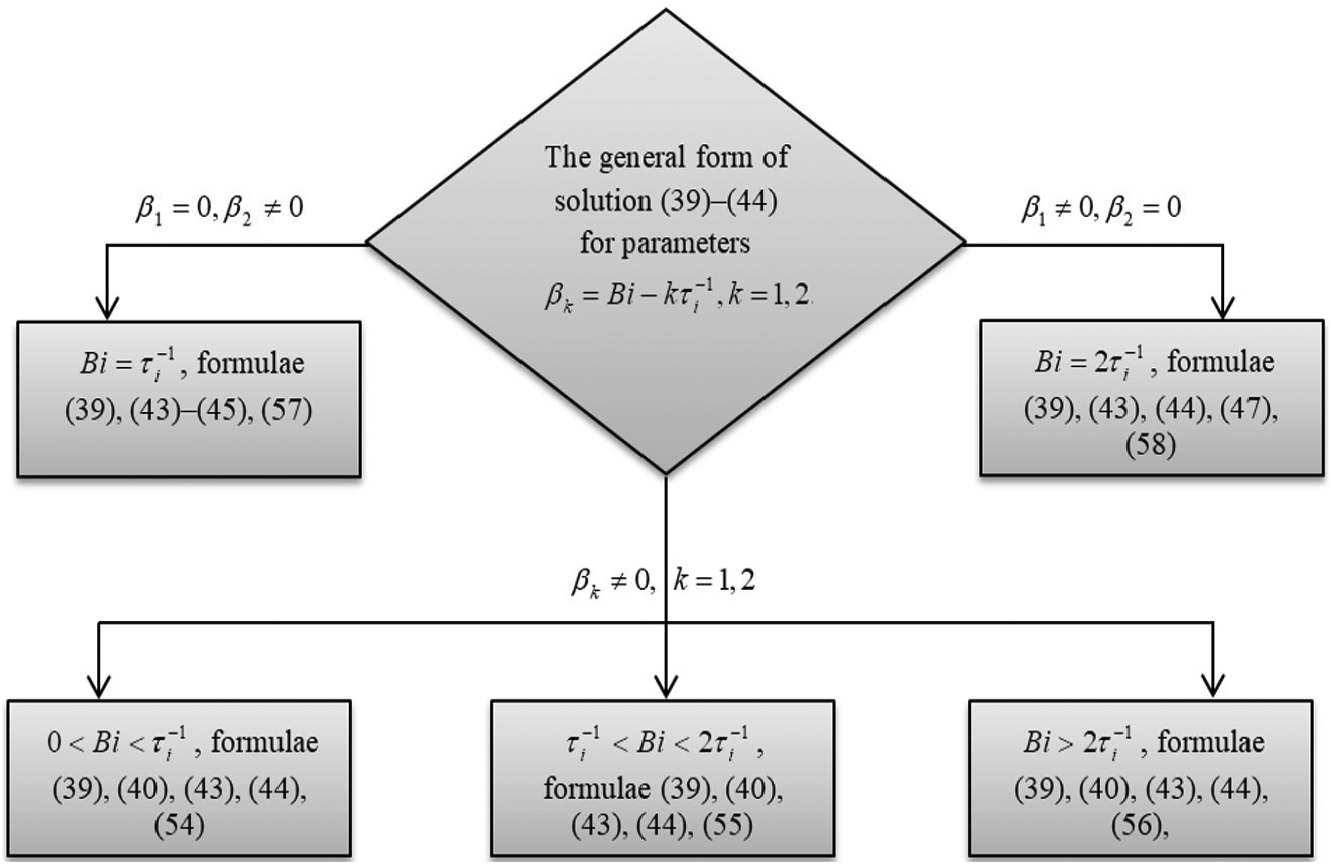
and parameters , , , , , are calculated from formulae (33) and (36). Below steps of calculations in the section “Solution to the problem” are presented on the flowchart in Figure 3.
A flowchart presenting the calculation steps of solution to the problem.
If , , then solution (39) should take into account the function
and functions (42) and (44), which are calculated for parameters
In the case , the dimensionless temperature in the strip is determined from equation (39) with account of the function
and functions (42) and (44) with parameters
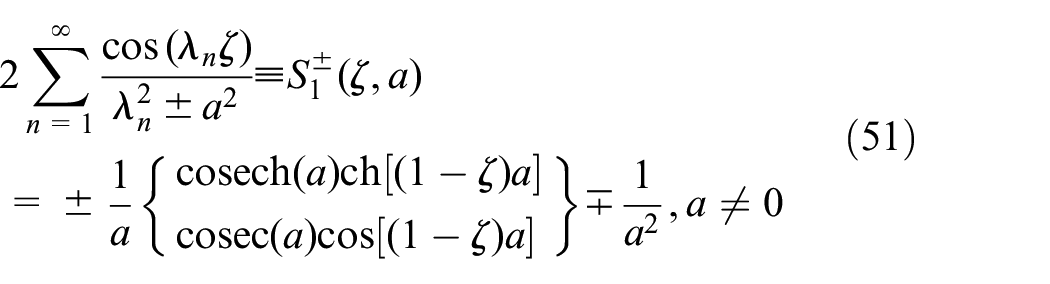
The series (41) and (42) can be summed. For this purpose, we use the following relations21
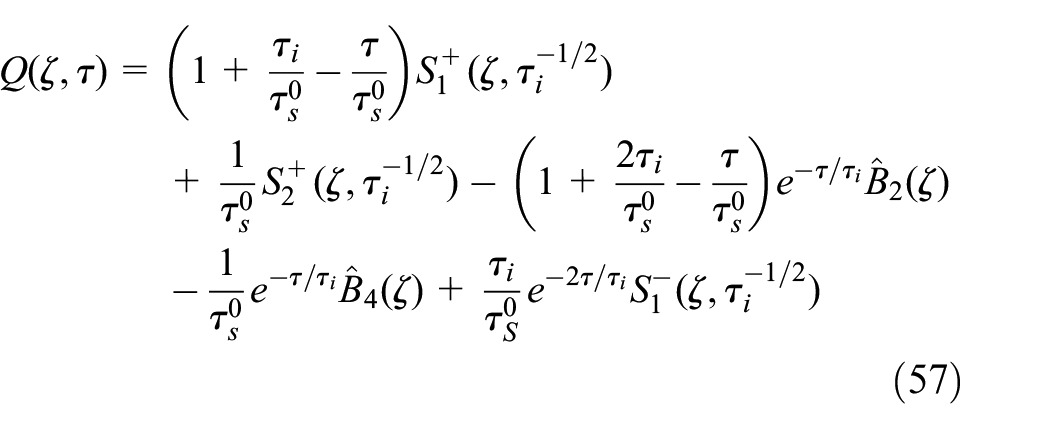
If the Biot number , then , , , and function (41) and (42) with account of the sums (49)–(53) takes the following form
If , then , , , and , and we obtain
If , then , , and , and we find
For , parameters take values , , , and , and we establish that
Finally, if , then , , , and , and we obtain
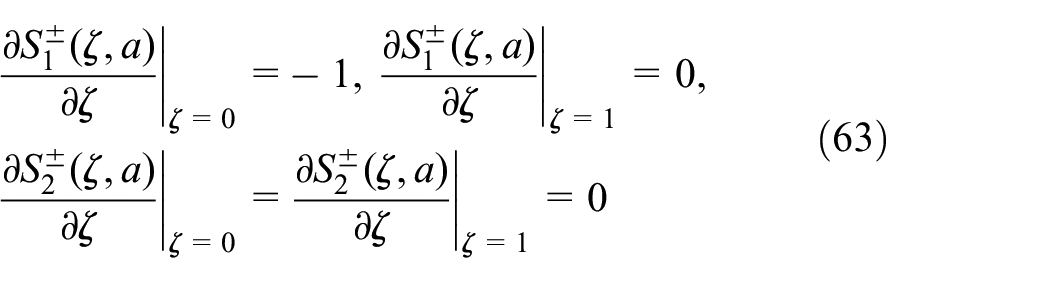
We show that the obtained solution satisfies the boundary conditions (18) and (19) and the initial condition. After differentiating the relations (49)–(53), we find
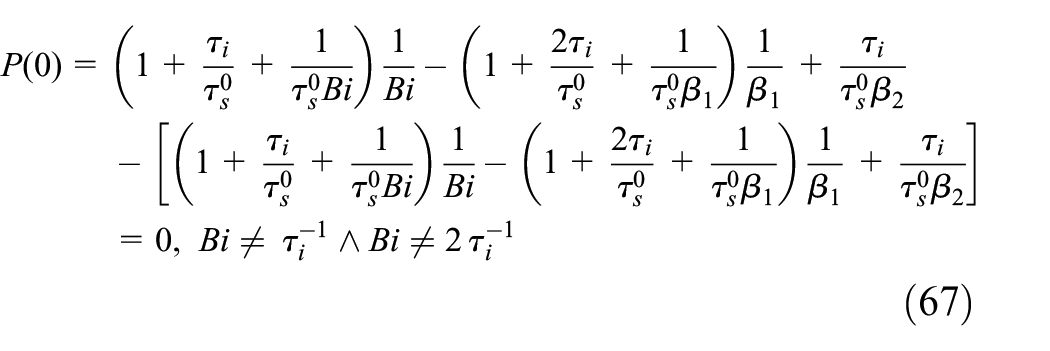
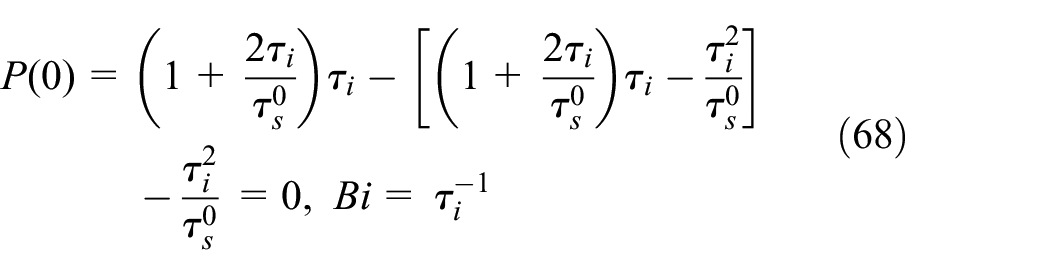
From the formulae (68)–(70) follows that
Differentiating solution (39)–(44) and (54)–(58) with respect to variable and taking into account the values of derivatives (62) and (63), we obtain
where the specific power of friction is given by formula (21). Relations (64) and (65) testify that the boundary conditions (18) and (19) are satisfied.
At the initial moment of time , the dimensionless temperature (39)–(44) has the form
and from formulae (40), (45), and (47), we get
which confirms the fulfillment of initial condition (18).
Some special cases of solution
Temperature of the surface of friction
For from relations (49)–(53) follows that
and solutions (39)–(48) and (54)–(58) allow to present the dimensionless temperature of the friction surface of the strip in the following form
where
with parameters , , , , given by formulae (33) and (36).
Braking with constant deceleration
In limiting case , the contact pressure attains nominal value instantly, the speed reduces linearly, and the temporal profile of specific power of friction (21) has the following form
and solutions (39)–(44) were written as
where the parameters are calculated from formulae (30) and (33). On the surface of friction from formula (80) follows known result23
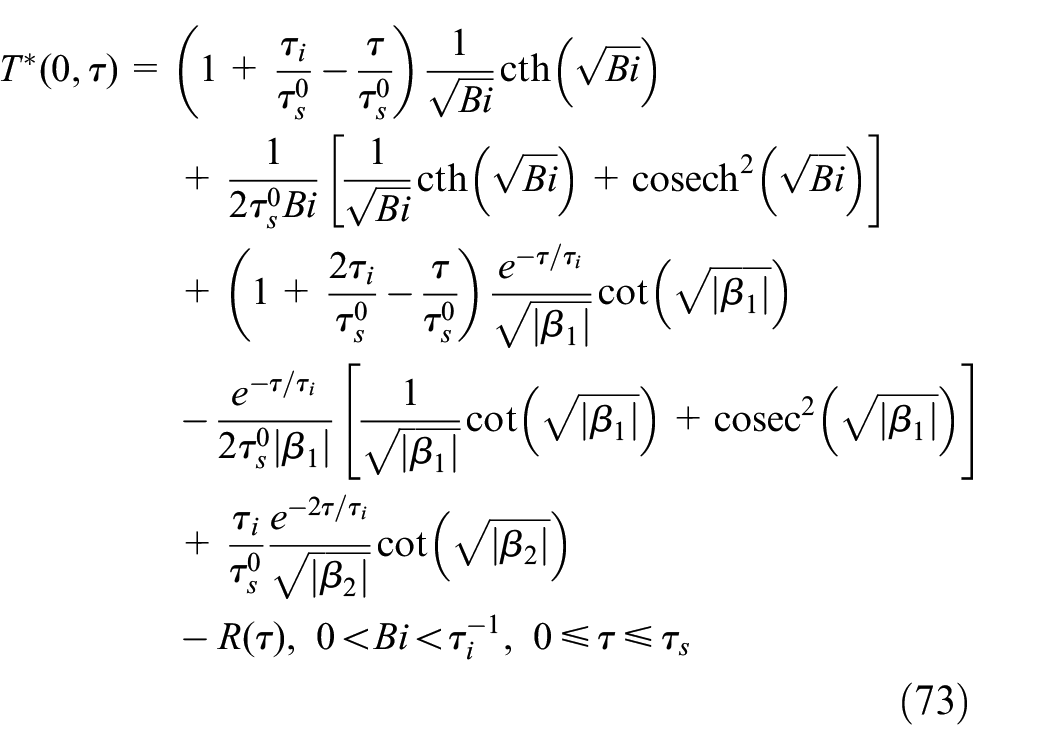
The same result we obtain from solution (73) at . In addition, in the limit case from formulae (80) and (81), we obtain the solution to the boundary-value problem (17)–(20) with constant capacity power of friction
Thermal insulation of the lateral surfaces of the disk
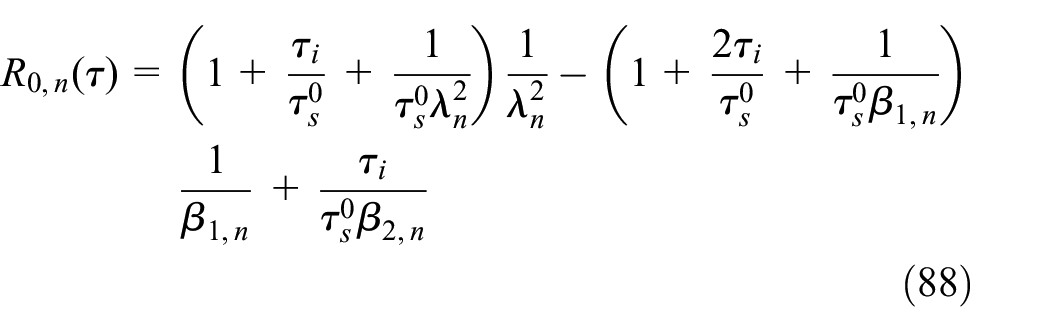
Similarly, as when getting solutions (39)–(44), the dimensionless temperature of the disk at , we write as
where, with account of the sums (49)–(53), we have
and the eigenvalues , we calculated by formula (30).
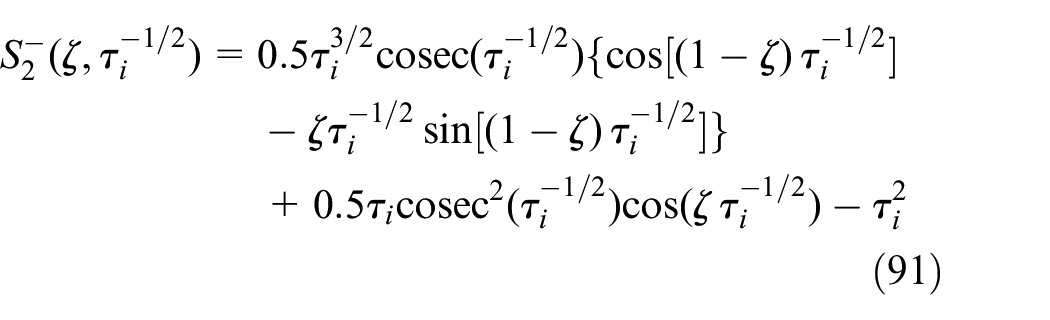
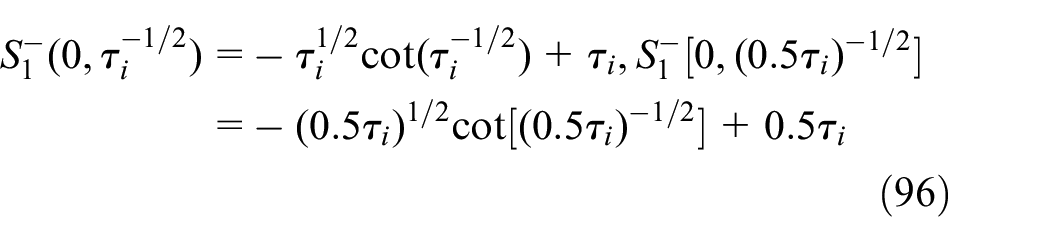
The dimensionless temperature of the heated surface of the strip we obtain from solution (84)–(92) at with account of relations (70)–(72) in the form
where
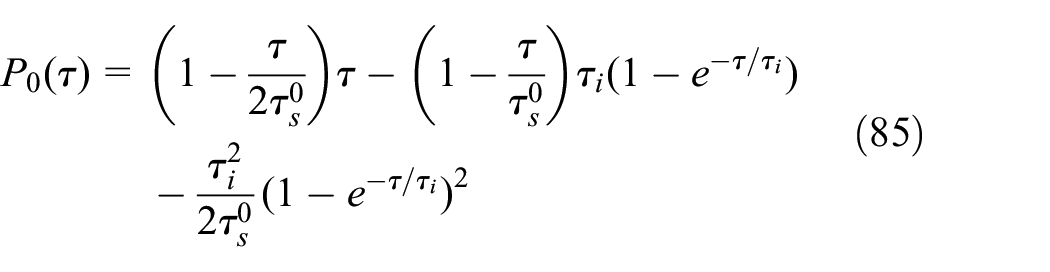
and is the same function (85).
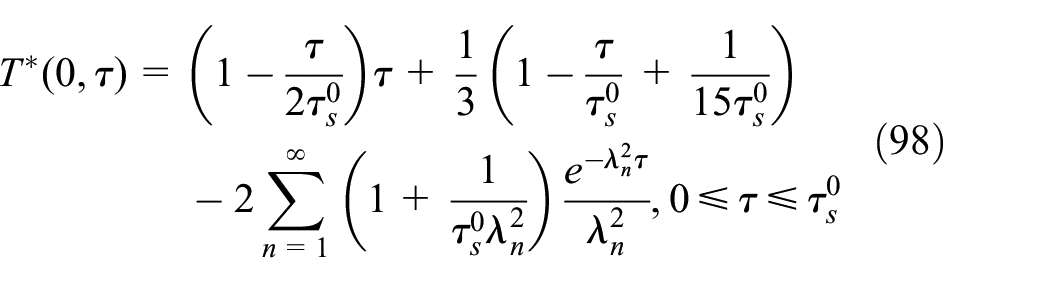
In the limiting case from solutions (84)–(96), we obtain the dimensionless temperature of the adiabatic strip at braking with constant deceleration in the following form
and on the surface of friction as
where is the time of braking (5). We note, that the solution (98) was obtained earlier in the article.23
Approximate solution
In the scientific literature regarding the problem of estimating the temperature of the brake disk, often the approximate solution of the boundary-value problem (17)–(22) at is used in the following form24,25
where
is the temporal profile of the density work of friction, the function is determined by formulae (49) and (53), and the dimensionless time of braking is found from formula (22).
Numerical analysis
Taking into account the notation (16), the temperature field of the disk is determined by the following equation
where , is the dimensionless temperature (39)–(48) and (54)–(58). Calculations were performed for a disk with dimensions and , which is made of carbon fibrous composite material Termar-ADF (, , and at initial temperature ).23
First, to validate the proposed theoretical model, the temperature values obtained from this model are compared with appropriate experimental data from a previous article.23 The mentioned experiment applies the heat generation process in the multi-disk aircraft brake with linear reduction of the sliding speed and constant pressure on the contact surfaces. Measuring system comprise three thermocouples mounted over the circumference with the mean radius on distance from the surface of friction. Final values of temperature were established by averaging data obtained from individual thermocouples. Experiment was performed on the reduced test rig using the friction machine IM-58-T2 for three braking modes with input parameters included in Table 1.
The change of temperature on the friction surface of the disk during braking with constant retardation, calculated by formula (102) with taking of exact solutions (81) for (solid lines) and (98) for (dashed lines) into account, are presented in the Figure 4. Dotted lines represent the corresponding experimental data.23 Evolutions of the temperature, found from theoretical solutions and also experimental measurements, have temporal profiles characteristic for a single braking: rapid growth of temperature at the beginning, achievement of maximum value close to the half of the braking time, and gentle cooling before standstill. In braking mode (a), the contact pressure and coefficient of friction are the greatest and the time of braking is the shortest, while maximum values of temperature are equal and and obtained from exact solutions for and , respectively (Figure 4(a)). Corresponding values of temperature are and for braking mode (b) (Figure 4(b)) and and for mode (c) (Figure 4(c)). Similarity of temperature profiles with and without account of convective heat exchange on the side surfaces of the disk proves that in working conditions of multi-disk brake system in accordance with mode (a), that is, during short, heavy-loaded, single braking, the influence of convection on the temperature can be omitted. Elongation of braking time and reduction of the pressure and coefficient of friction at modes (b) and (c) results that temperature at overestimate corresponding values found and experimental data. The highest differences between theoretical and experimental values of temperature occur at the stop time moment (Figure 4(b) and (c)).
Evolutions of temperature on the surface for three (a, b, c) braking modes for operational parameters presented in the table.
The effect of convective cooling on the maximum temperature on the heated surface is shown in Figure 5. The highest values of the maximum temperature , , and for modes (a), (b), and (c), respectively, are attaining for thermally insulated lateral surfaces of the disk . Drop of maximum temperature due to increase of heat transfer coefficient during braking in accordance with modes (a) and (b) has linear and insignificant reduction: for values are in mode (a) and in mode (b). The highest decrease of maximum temperature to value occurs during the longest braking in mode (c). Little influence of convective cooling on the maximum temperature of the disk during short-term processes of braking with intensive heat generation at mode (a) has been observed also in the Figure 4(a).
Dependences of maximum temperature achieved during the process on the coefficient of heat transfer for three modes of braking.
Presented in the Figures 4 and 5, results were obtained at braking with constant deceleration, when nominal value of constant pressure is attained instantly at the beginning of the process . Next part of numerical analysis concerns, obtained above, theoretical solutions with taking of the time of contact pressure increase into account. Calculations are executed for the brake disk with the same thermo-mechanical properties, dimensions, and initial temperature as above. The remaining input parameters: and were adapted from a previous article.26 Then from the relations (2), (5), (6), (15), and (16), we find , , and .
Evolutions of temperature on the heated surface of the disk for three values of time are shown in the Figure 6. Results are obtained based on formula (102) at with taking of the solution (73)–(78) for (solid lines) and solution (93)–(96) for (dashed lines) into account. For these values, time of an increase of contact pressure from formula (4) to the time of stop were calculated. The corresponding values of maximum temperature at are slightly higher, and they attain a bit later at the moments in comparison to the results and , obtained at convective cooling of the lateral surfaces of the disk . At the fixed moment of time, growth of the time of pressure increase causes drop of maximum temperature and elongation of its time of achieving. In the final stage of braking , influence of the parameter on temperature is inconsiderable. Temperature at the stop time moment determined for different values are the same and equals for and for .
Evolutions of temperature on the heated surface of the disk for three values of time of contact pressure increase .
Change of temperature on the friction surface during single braking with fixed value of time are presented in the Figure 7. Calculations were made by means of equation (102), taking into account the dimensionless temperature , found by means of exact solutions (73)–(78) at (solid line), (93)–(96) at (dashed line) and approximate solution (100) and (101) at (dot-dash line). In addition (dotted line), we presented results obtained based on solution to the boundary-value problem of heat conduction for a semi-space , heated on its surface by heat flux with the same intensity (1)–(6).27 The temporal profiles of the temperature in all considered cases are qualitatively similar, but obtained values of temperature differ quantitatively. Temperature on the heated surface of the disk, found with account of convective heat transfer on the free surfaces, achieve maximum value at the time and the value in the stop time moment . Corresponding values for adiabatic lateral surfaces of the disk are for and at . Evolution of temperature, calculated by means of approximate solution (100) and (101), is close to the temporal profile of temperature found from exact solution (93)–(96). The greatest difference of these temperatures occurs in the initial stage of braking. Maximum value of temperature obtained from solution for semi-space is , and its time of achieving is the shortest. At the stop time moment, this temperature decreases to the lowest value .
Evolution of temperature on the heated surface for .
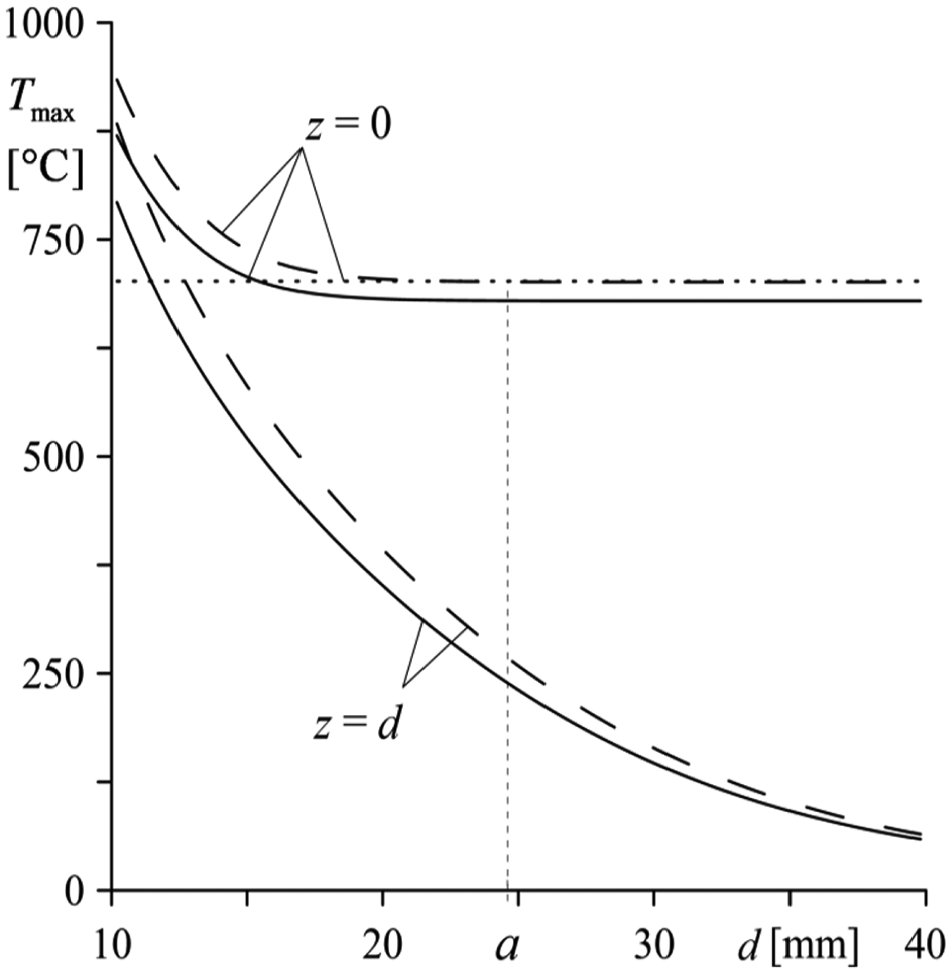
Variations of maximum temperature of front surfaces and with increasing the thickness of the disk are presented in the Figure 8. We see that increase of disk thickness causes reduction of maximum temperature on both surfaces. Temperature drop on the free surface is much faster than on the heated surface . Decrease of temperature on the surface is noticeable to the thickness both—without and with account of convective heat exchange on the lateral surfaces. For and adiabatic side surfaces of the disk, maximum temperature of the heated surface remains unchanged at (dashed line). The same value of the maximum temperature for these input parameters were obtained also from solution to the 1D thermal problem of friction for a semi-space heated by the heat flux with intensity (1)–(6) (dotted line).27 This leads to the conclusion that for estimating maximum temperature of the disk with thickness above the , we can use the exact solutions of thermal problems of friction for the semi-infinity bodies. It should be noted that usage of these solutions to investigate temperature during short-term braking is acceptable when the characteristic dimension of a heated element (at us this dimension is the half of disk thickness ) is larger than effective depth of heat penetration .10 In the presented case, maximum temperature of heated surface of the strip for is steady, and for is equal to the value , obtained from 1D solution of the thermal problem of friction for a semi-space.
Dependence of maximum temperature of heated and adiabatic front surfaces on the disk thickness .
Convective heat transfer on the lateral disk surfaces causes decreases in temperature of both front surfaces, and steady level of maximum temperature of heated surface is reached at (solid line). However, the maximum temperature on the thermally insulated surface monotonically reduces with increasing in disk thickness in the whole analyzed range For , the values of the maximum temperature on the surface equal for and for , respectively. However, if , then these values equal for and for .
Conclusion
The theoretical model for determining the temperature field of a multi-disk brake is proposed. For this purpose, the boundary-value problem of heat conduction for a separated disk is formulated. This model takes into account the variation of specific power of friction in the process of braking, the heterogeneity of the material of the disk, as well as convective cooling of its lateral surfaces. The exact solution of this problem is found. Verification of this solution is made by obtaining from it, in particular cases of parameters, well-known formulae. In addition, the temperature values established on the basis of the received solution were compared with the corresponding experimental data and confirmed their good convergence. Numerical calculations are executed for a disk made of a carbon composite material Termar-ADF. As a result, it is established that,
Influence of convective cooling on the lateral surfaces on the maximum temperature is inconsiderable at short-term heavy-loaded braking processes.
Time of contact pressure increase significantly affects the temperature of surface of friction in the initial stage of braking until reaching the maximum temperature value. At the stop time moment, this effect becomes insignificant.
An approximate Chichinadze’s solution can be used to estimate the maximum temperature of the friction surface only in the case of thermally insulated lateral surfaces of the disk. However, taking into account the convective heat exchange on these surfaces, the exact solutions obtained in this article should be used.
Taking into account, the actual thickness of the brake disk is important when determining the temperature of relatively thin disks . If the thickness of the disk is comparable or higher than the effective depth of heat penetration, then to estimate the maximum temperature of heavy-loaded multi-disk brakes working in a short-term single braking mode, it is reasonable to use analytical models of frictional heating of semi-limited bodies.
The presented calculation scheme is linear, as the solution is obtained with constant thermophysical properties of materials and constant value of the coefficient of friction. Last, as it is known, can change under the influence of high temperature, so the corresponding thermal problems of friction become nonlinear. These problems can be solved by means of numerical methods.28–30 It should be noted that in experimental tests on the friction machine IM-58-T2, the coefficient of friction varied within the limits and the value used in the calculations is an averaged value.10 Two- and three-parameter dependences of the coefficient of friction on temperature, pressure, and speed are also known.31 The construction of computational models using such dependencies is still an actual problem.
Surface roughness also influences temperature during braking, in particular on the flash temperature. One of the methods to consider this factor is the construction of equations system of the thermal dynamics of friction and wear.32 The main hypothesis of such approach is to represent the maximum temperature as the sum of the mean temperature of the nominal contact area and the temperature of the flash. The solution obtained in this article can be used to calculate the first of these two components, only. The questions connected with determination of the flash temperature, are considered in the article.33
Our solution also does not take into account the structure of the composite. We intend to solve this problem in the near future.
Footnotes
Appendix 1
Handling Editor: James Baldwin
Declaration of conflicting interests
The author(s) declared no potential conflicts of interest with respect to the research, authorship, and/or publication of this article.
Funding
The author(s) disclosed receipt of the following financial support for the research, authorship, and/or publication of this article: This study was funded by the National Science Center of Poland (grant no. 2017/27/B/ST8/01249).
KokoninSSKramarenkoEIMatveenkoAM.Fundamentals of design of aviation wheels and brake systems. Moscow: MAI Publ. House, 2007 (in Russian).
3.
DayAJ.Braking of road vehicles. Oxford: Butterworth-Heinemann, 2014.
4.
ChichinadzeAVKozhemjakinaVDSuvorovAV, et al. Application of theories of thermal dynamics and modeling of a friction and wear process of solid bodies at designing of the hard loaded brakes of transport cars. Friction Lubricat Mach Mech2009; 5: 31–37.
5.
ChichinadzeAV (eds). Polymers in friction assembles of machines and devices: a handbook. New York: Allerton Press Inc., 1984.
6.
ChanDStachowiakGW.Review of automotive brake friction materials. Proc IMechE, Part D: J Automobile Eng2004; 218: 953–966.
7.
ChichinadzeAVBraunEDSinaiskiiVM, et al. Interrelation of friction-wear and temperature characteristics of loaded opposite and similar friction couples under stationary and non-stationary regimes of friction. J Friction Wear2000; 21: 158–166.
8.
KokoninSSObizhaevGAOkulovBS, et al. Highly loaded multi-disc brakes and factors that determine the efficiency and smoothness of their operation. Heavy Mech Eng2001; 4: 19–26 (in Russian).
9.
ChichinadzeAVKozhemjakinaVDSuvorovAV.Definition of a temperature field in brake carbon frictional composite material (UFKM) disks for planes. Friction Lubricat Mach Mech2010; 5: 27–32.
10.
ChichinadzeAVKozhemjakinaVDSuvorovAV.Method of temperature-field calculation in model ring specimens during bilateral friction in multidisk aircraft brakes with IM-58-T2 new multipurpose friction machine. J Friction Wear2010; 31: 23–32.
11.
YevtushenkoAAKuciejM.One-dimensional problem of friction during braking: the history of development and actual state. Int J Heat Mass Trans2012; 55: 414–4153.
12.
AfzalAMujeebuMA.Thermo-mechanical and structural performances of automobile disc brakes: a review of numerical and experimental studies. Arch Comput Method E2019; 26: 1489–1513.
13.
YevtushenkoAAGrzesP.The FEM-modeling of the frictional heating phenomenon in the pad/disc tribosystem (a review). Numer Heat Tr A: Appl2010; 58: 207–226.
14.
WasilewskiP.Frictional heating in railway brakes: a review of numerical models. Arch Comput Method E2019; 27: 45–58.
15.
GrygorcewiczPSkorupkaZ.Wybrane zagadnienia projektowania hamulców (Selected issues of brake design). Autobusy: Technika Eksploatacja Systemy Transportowe2013; 3: 565–573 (in Polish).
16.
KuciejM.Accounting changes of pressure in time in one-dimensional modeling the process of friction heating of disc brake. Int J Heat Mass Trans2011; 54: 468–474.
17.
LuikovAV.Analytical heat diffusion theory. New York: Academic Press, 1968.
OzisikNM.Heat conduction. New York: John Wiley & Sons, 1993.
20.
HetnarskiRBEslamiRM. Thermal stresses—advanced theory and applications. New York: Springer, 2009.
21.
PrudnikovAPBrychkov YuAMarichevOI.Integrals and series. Vol. 1. Elementary functions. New York: Gordon and Breach Science Publishers, 1986.
22.
AbramowitzMStegunIA.Handbook of mathematical functions with formulas, graphs and mathematical tables. New York: National Bureau of Standards, 1979.
23.
NoskoALMozalevVVNoskoAP, et al. Calculation of temperature of carbon disks of aircraft brakes with account of heat exchange with the environment. J Frict Wear2012; 33: 233–238.
24.
ChichinadzeAV.Estimation and investigation of external friction during braking. Moscow: Nauka, 1967 (in Russian).
25.
YevtushenkoAKuciejMTopczewskaK.Analytical model for investigation of the effect of friction power on temperature in the disk brake. Adv Mech Eng2017; 9: 1–12.
26.
YevtushenkoAGrzesP.Maximum temperature in a three-disc thermally nonlinear braking system. Int Commun Heat Mass2015; 68: 291–298.
27.
TopczewskaK.Influence of the time of increase in contact pressure in the course of braking on the temperature of a pad-disc tribosystem. Mater Sci2018; 54: 250–259.
28.
YevtushenkoAAGrzesP.Axisymmetric FEA of temperature in a pad/disc brake system at temperature-dependent coefficient of friction and wear. Int Commun Heat Mass2012; 39: 1045–1053.
29.
YevtushenkoAAAdamowiczAGrzesP.Three-dimensional FE model for calculation of temperature of a disc brake at temperature-dependent coefficient of friction. Int Com Heat Mass Trans2013; 42: 18–24.
30.
YevtushenkoAKuciejMOchE, et al. Effect of the thermal sensitivity in modeling of the frictional heating during braking. Adv Mech Eng2016; 8: 1–10.
31.
ChichinadzeAVBraunEDSynaiskyVM, et al. Interrelation of friction-wear and temperature characteristics of loaded opposite and similar friction couples under stationary and non-stationary regimes of friction. J Frict Wear2000; 21: 158–166.
32.
GrzesP.Determination of the maximum temperature at single braking from the FE solution of heat dynamics of friction and wear system of equations. Numer Heat Tr A: Appl2017; 71: 737–753.
33.
GrzesP.Finite-element solution of the three-dimensional system of equations of heat dynamics of friction and wear during single braking. Adv Mech Eng2018; 10: 1–15.