




Abstract
The influence of the thermal sensitivity of a coefficient of friction and thermophysical properties of the pad and disk materials on the temperature distribution during single braking has been studied. For this purpose, the corresponding one-dimensional thermal problem of friction at braking has been formulated. The solution to such nonlinear problem has been made in two stages. First, the partial linearization was carried out using Kirchhoff’s substitution, and then, the initial problem for a system of nonlinear ordinary differential equations was obtained by method of lines. Numerical solution to problem was received by Adams’ method realized in the DIFSUB package. For a friction pair, disk (steel)–pad (retinax), an analysis of the evolution of sliding speed and temperature was carried out. The results obtained within the model that took into account the mutual influence between the speed and temperature were compared with those obtained without taking into account such effects.
Keywords
Introduction
Calculation of the working characteristics of the brake systems is usually performed on the assumption that a friction coefficient is constant.
1
Such an approach is fully justified if the designed system is similar both structurally and in terms of working regime to a brake which is already exploited. To outline the working regime, an average effective value of the friction coefficient is determined, under the condition that in the designed and working brake systems are used the same friction materials. However, when a working analog does not exist, the calculations mentioned above often give results that significantly differ from real data and turn out to be entirely useless. In particular, such situations take place during the design of heavily loaded braking systems, when on the friction surfaces, the large amounts of heat are generated, which cause heating elements to high temperatures
To determine the reason of differences between experimental data and the results of theoretical calculations, it should be taken into account that in fact all the characteristics of friction during braking processes are interrelated and interdependent. Changes in pressure and velocity cause a change of the friction power, and thus, a change in the intensity of heat generation on the friction surface. As a result, the temperature of the subsurface layers increases, and the mechanical, thermophysical, and frictional characteristics of the materials change, which influence the friction power. 3
Experimental study on dependence of the coefficient of friction on sliding speed, load, and temperature was made for different types of braking systems and by many kinds of friction materials. The study showed that temperature has the greatest influence on the value and character of changes of the friction coefficient in the braking process.4,5 Actually, the temperature reflects the influence of power density of the frictional forces which depends on the coefficient of friction, pressure, and speed. Besides, the temperature has a large influence on the mechanical and thermophysical properties of materials of a friction pair, and the intensity of processes of physico-chemical mechanics that occur on the friction surface, which in turn have an impact on coefficient of friction. Thus, it is an integral parameter, joining interaction of many factors.
To describe the frictional heating of braking systems, with taking into account changes of the friction coefficient and the interdependence of all the characteristics of the process, the systems of equations of heat dynamics of friction and wear (HDFW) are used. 6 These equations make the changes of the friction coefficient, braking speed, mechanical, and thermophysical properties of friction pair materials dependent on temperature. The basic components of such systems are two problems: an initial one, for the equations of motion, and a boundary-value heat conduction problem. Common elements for both problems are contact pressure and friction coefficient. The spatial distribution and change of the contact pressure with time are usually known a priori, and a friction coefficient in the braking process may be constant or dependent on temperature.
On the assumption that a coefficient of friction is constant in the braking process, first the equation of motion is solved at a given initial value of speed. This allows to determine the course of speed reduction in time and outlines the braking time. When we know the change of time pressure and the velocity, it is possible to determine a time profile of the power of friction. Then, we move on to solve the nonstationary heat conduction problem with two boundary conditions on the contact surface pad–disk. One of the conditions determines the type of thermal contact (perfect or imperfect). The second one assumes equality between power of friction (that was found earlier) and sum of intensity of the heat fluxes directed along the normal from the friction surface to inside of the elements. 7 Thus, at a constant coefficient of friction, relation between the velocity and the temperature does not include the effect of temperature on the speed.
Another situation takes place, with taking into account the changes of the coefficient of friction under the influence of temperature, when the sliding velocity and temperature of friction pair elements are interdependent. Then, the solutions to the equations of motion and heat conduction with the relevant initial-boundary conditions should be sought at the same time. In the case of axisymmetric (two-dimensional (2D)) or spatial (three-dimensional (3D)) nonlinear heat problems of friction during braking for thermally sensitive materials, their solutions are most often obtained numerically, using the finite element method (FEM).8,9 To determine the temperature of brake systems which operate under conditions when most of the heat generated in the contact area of the friction elements is directed along the normal to the friction surface, and the convection cooling of the free surfaces of these elements has little effect on temperature, it is useful to use nonstationary one-dimensional thermal problems.10–13 Solutions to one-dimensional boundary-value heat conduction problems, describing the process of heating the friction disk and the brake pad, which are made of materials with constant thermophysical properties and temperature-dependent friction coefficient, were obtained in papers.14–16 Analytical–numerical methods for solving one-dimensional thermal problems of friction for thermally sensitive materials with constant coefficient of friction were proposed in papers.17–21
The aim of this work is to obtain a solution to the thermal problem of friction during braking, with temperature-dependent coefficient of friction for the two half-infinity bodies (the semi-spaces), which are made from thermally sensitive materials.
Statement of the problem
Let us consider two different semi-spaces (pad and disk), based on the Cartesian coordinate system Oxyz (Figure 1). In the initial time moment

where

where f is a coefficient of friction,

Scheme of the problem.
Reduction in speed is accompanied with generation of heat on the friction surface

where
A similar form of temperature dependences is assumed for the coefficient of friction

where
We consider an imperfect thermal contact of friction between bodies, where the sum of the intensities of the heat fluxes directed from the friction surface to the inside of each element is equal to the specific power of friction

and their difference is proportional to a gap of temperature on the friction surface. The coefficient of proportionality is a coefficient of thermal conductivity of contact
In accordance with such assumptions, the one-dimensional transient temperature field



where a change with time-specific power of friction
The initial problem of the equation of motion (equation (2)) and boundary-value heat conduction problem (equations (5)–(11)) are connected via coefficient of friction f, which is dependent on the average temperature on the friction surface
Equations (1)–(11) represent a major part of the system of equations HDFW. To write the entire system, it must be supplemented with two elements—a problem to determine the flash temperature and an equation to find the thermo-mechanical wear. It will be the main subject of our studies in the future.
Let us introduce the following dimensionless variables and parameters

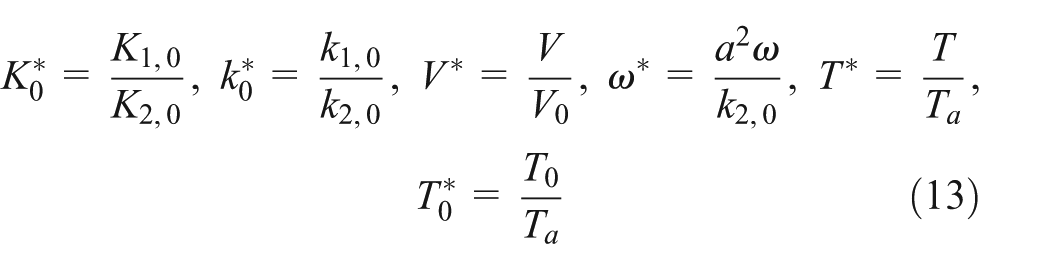
where


We note that the parameter a (equation (15)) is the effective depth of heat penetration at braking with constant retardation during time
Taking into account the designations (equations (12)–(15)), problems (equations (2) and (6)–(11)), and the relationships (equations (1) and (5)), we write in the dimensionless form as follows


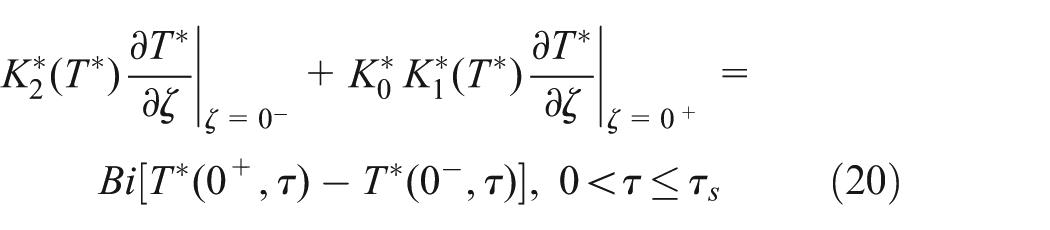


where


Solution to the problem
Taking into account the technique from the article, 23 we use Kirchhoff’s transformation

and the finite-difference method with central differences to solve the boundary-value problems (equations (16)–(24)). As a result, we obtain the following initial problem for the system of ordinary differential equations of the first order



where

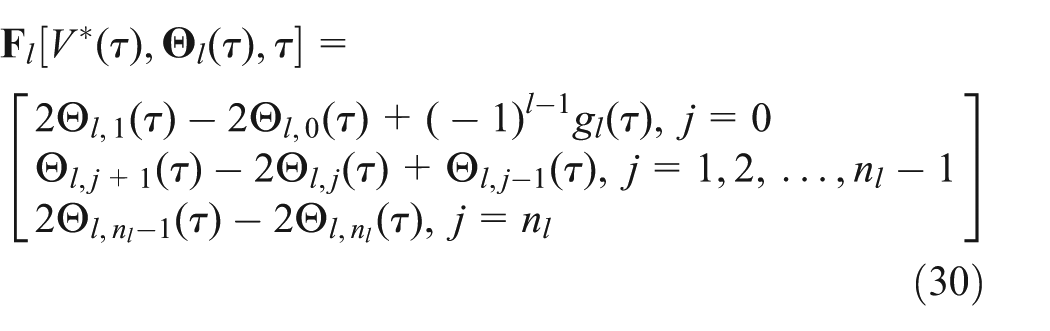


and the values of the parameters

Numerical solution to the Cauchy problem for the nonlinear system
We assume that the functions

where

where
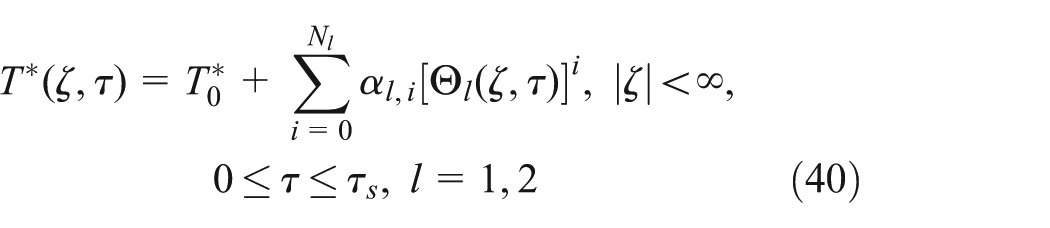
where

Taking the notation (equation (35)) into account, the relationship (equation (40)) in the nodes of the mesh

The computational scheme consists of consecutive implementation of the following steps
Setting of the input parameters

Calculation of the values
Solution of the initial problem (equations (26)–(36)) with respect to functions
Calculation of the dimensionless temperature
Numerical analysis
The calculations were performed for the disk–pad frictional system at a single braking process for the following values of input parameters

Dimensionless functions
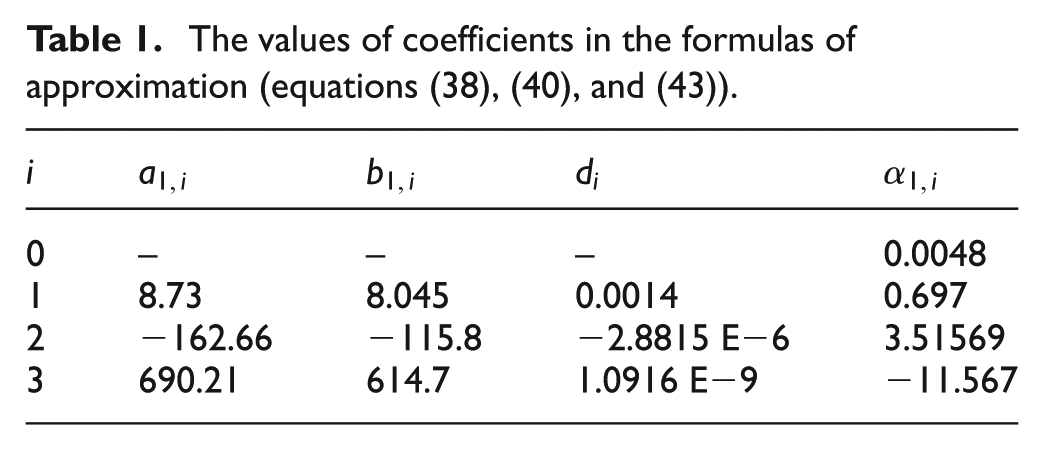
The values of coefficients in the formulas of approximation (equations (38), (40), and (43)).
Tests on friction stability have shown that the coefficient of friction pairs 30HGSA-FC-16L varies with temperature
28
(Figure 2). Dimensionless function

where the values of coefficients
Two variants of pressure changes (equation (1)) with braking time have been considered: a rapid increase from zero to the nominal value
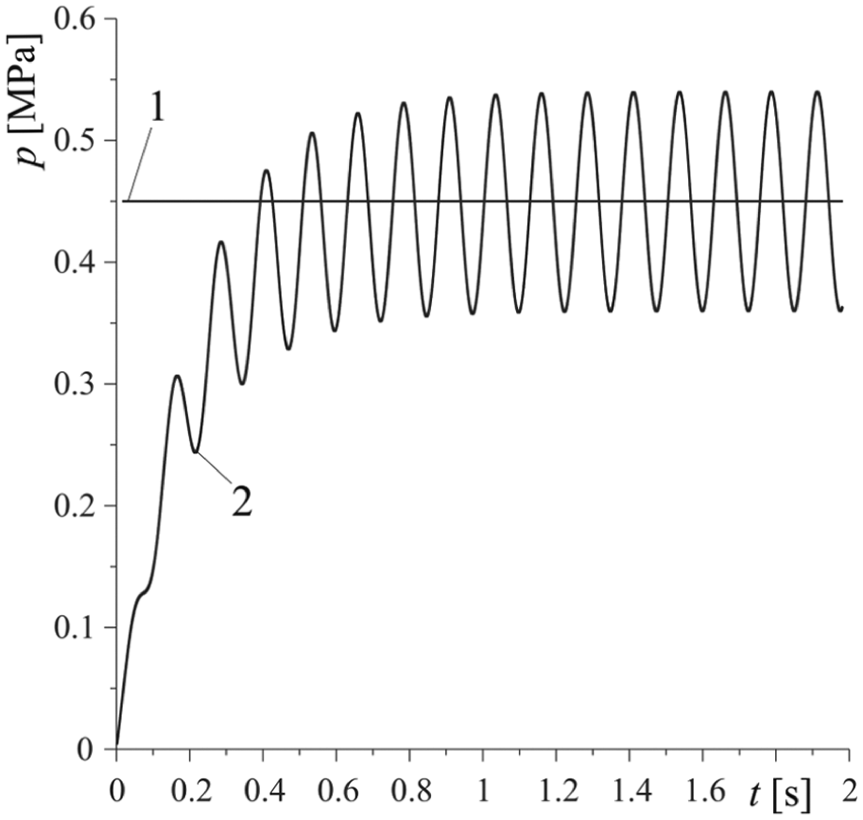
Change the contact pressure p during braking: 1:
In each element, grids
The change in speed during braking is shown in Figure 4. In case of a sudden increase in pressure to the nominal value, the speed is reduced linearly from the initial value to zero at the moment of stop (braking with uniform delay). If the pressure increases with oscillation during braking, then, in the initial moments of time, change of the speed with time is nonlinear. In both cases, taking into account the coefficient of friction depending on the temperature, it reduces the braking time (reduces braking distance) by about 10% compared with the case of braking with a constant friction coefficient. The braking time when the pressure increases rapidly is always shorter than the braking time with oscillating increase in pressure.

Change the sliding speed during braking with taking into account (solid lines) or without (dotted lines) the mutual influence of speed and temperature: 1:
Evolutions of temperature on working surfaces of disk and pad during braking with constant delay are presented in Figure 5. Both in the case of imperfect (Figure 5(a) and (b)) and perfect (Figure 5(c) and (d)) frictional thermal contacts, the maximum temperature calculated, with taking into account the thermosensitivity of coefficient of friction (solid lines), is higher than the temperature found at the constant value of this coefficient (dashed lines). Taking into account the thermal resistance of the friction surfaces results in a significant difference of temperature between the surfaces (Figure 5(a) and (b)). Due to the higher thermal conductivity of steel compared with retinax (Table 1), the temperature of the friction surface of the disk (Figure 5(a)) is significantly (approximately 3.5 times) lower than the temperature of the pad (Figure 5(b)). At the perfect frictional thermal contact, temperature of the working surfaces of disk and the pad

Evolutions of temperature T on different depth z from friction surfaces of the disk (a, c) and the pad (b, d) with taking into account (solid lines) and without (dashed lines) the mutual influence of speed and temperature at
On the contact surface
The treatment accuracy of disk and pad working surface has a significant impact on the achieved maximum temperatures. With perfectly smooth surfaces, when there is the perfect frictional thermal contact of the pad and the disk, the maximum temperatures of both elements are equal and, as mentioned above, they are
Corresponding evolutions of the temperature with the oscillating increase in contact pressure are shown in Figure 6. Temperature fluctuations that are noticeable on the friction surfaces of both components quickly “smooth out” with the growing distance from the contact surface, and they completely disappear at distances greater than 1 mm. The amplitudes of the temperature fluctuations on disk and pad friction surfaces do not exceed 10% of the size of the amplitude of fluctuations of the contact pressure presented in Figure 3.

Evolutions of temperature T on different depth z from friction surfaces of the disk (a, c) and the pad (b, d) with taking into account (solid lines) and without (dashed lines) the mutual influence of speed and temperature at
The results of the theoretical modeling show that such studies should be carried out in the future in parallel with experimental studies. A more extensive discussion of the theoretical models and computational methods can be found, for example, in a review article. 7
Conclusion
The nonlinear mathematical model has been developed to describe the mutual influence of the speed and temperature of the heating process of friction during single braking. The model takes into account the thermosensitivity of materials and the thermal resistance of working surfaces of the friction elements of the braking system. During establishing the model, the assumption of changing the coefficient of friction under the influence of temperature was essential. It allowed to simultaneously solve the analytical and numerical equations of motion and boundary-value heat conduction problem with a known time profile of the contact pressure. The effectiveness of the proposed mathematical model was shown in the numerical analysis of selected materials of disk (steel 30HGSA) and pad (retinax FC-16L). The achieved results of calculation were compared with the data obtained with a constant friction coefficient. It has been established that when in the calculation model the temperature-dependent friction coefficient is taken into account, then the braking time is reduced by about 10%, while the maximum temperature is increased by 10%, compared with the results obtained with the constant coefficient of friction. It was shown that for the case of full thermal contact between the disk and the pad, the calculated results were similar to the data from the literature.
This mathematical model is a basic element to determine the average temperature of the contact surface in such operating conditions of the braking system when the generated frictional heat is absorbed to the inside of the pad and the disk mainly in direction normal to their friction surface.
Footnotes
Appendix 1
Academic Editor: Bo Yu
Declaration of conflicting interests
The author(s) declared no potential conflicts of interest with respect to the research, authorship, and/or publication of this article.
Funding
The author(s) disclosed receipt of the following financial support for the research, authorship, and/or publication of this article: This paper is supported by the National Science Centre of Poland (research project no. 2015/19/N/ST8/03923).