The friction power is a key parameter that largely determines the value and distribution of temperature and corresponding thermal stresses in friction elements of a braking system. In this article, the influence of this parameter on the thermal stresses is under consideration. For this purpose, the exact formula was obtained to determine the normal thermal stresses, arisen due to frictional heating during relative sliding of the pad on the surface of a brake disk, for 10 selected temporal profiles of the specific friction power. Numerical analysis was carried out for a frictional couple consisting of a cast iron disk and a pad made of retinax. It is established that some temporal profiles of the specific friction power can cause the generation of the tensile stresses on the friction surface of a brake disk in a radial direction. The change of compressive stresses into tensile may indicate the initiation of the microcracks on this surface.
Phenomenon which determines friction, wear and reliability of frictional elements of the machines working in the braking mode occurs due to high temperature and also significant thermal stresses. Thermal stresses are caused by simultaneous effects of the temperature gradients and their maximum values1,2 which depend on factors such as a braking mode, microgeometry, and macrogeometry of the contact surfaces and physicochemical properties of the materials.3
In practice, there are known cases, where only the gradients of temperature cause so high level of stresses in the subsurface layers of a pad and a disk, that the friction process takes place in the plasticity contact conditions, even if the volumetric temperature of the friction elements and the contact pressure is so low, that in normal conditions, it could result in the elastic deformations only.4,5 High values of the thermal stresses are conducive to the cracking initiation that gradually leads to disruption of the friction node work.6–8 Thus, the estimation of the stresses distribution in the frictional couple elements of a braking system is important. The knowledge about the state of stresses allows to point the manner of stress value reduction and thus decrease the abrasive wear of friction surface and increase the expected exploitation time of the friction node.
Based on analysis of the results presented in the literature,9–11 the topic of mathematical modeling and experimental investigations of the distributions of temperature and thermal stresses in the friction elements of a braking system is an intensively developing scientific problem. Theoretical works related to this problem can be divided into two main groups depending on applied methods of solution to the thermal problems of friction—the boundary-value problems of heat conduction taking into account the heat generation due to friction on the contact surface of the friction couple elements and the corresponding boundary problems of thermoelasticity. The analytical and analytical–numerical methods belong to the first group, and numerical methods belong to the second one.12,13
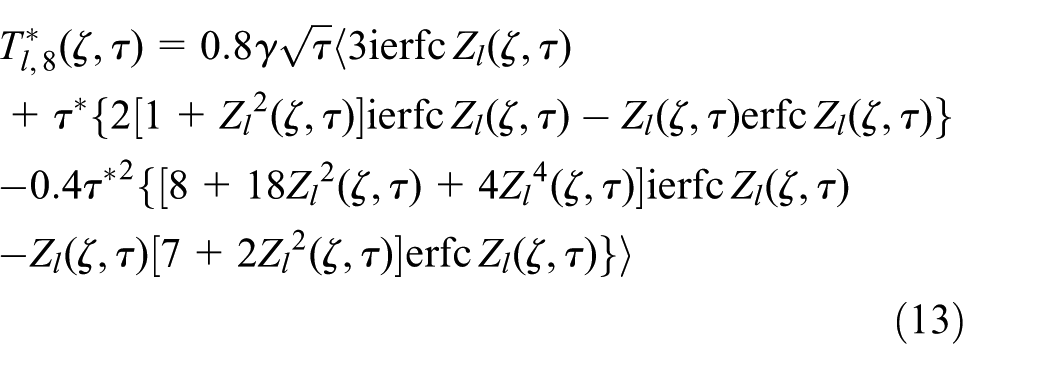
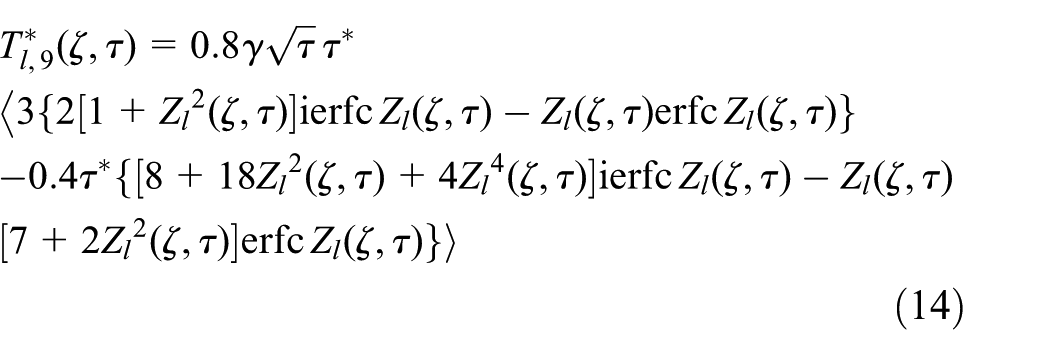
Issues related to determination of the quasi-static thermal stresses in the friction elements of a braking system, based on exact solutions to the one-dimensional thermal problems of friction, were considered in the literature.14–18 Calculation schemes devised in those works concern modeling of the frictional heating of the pad–disk system by means of appropriate solutions for two replacement systems: (1) two-element (strip–semi-space) and (2) three-element (consisting of a homogeneous half-space and a protective strip deposited on a semi-infinite homogeneous foundation). In both schemes, the case of a single braking process with a constant retardation was considered when the specific friction power linearly decreases with time from maximum value at the initial moment to zero at the moment of standstill. As experimental researches show, the temporal profile of specific friction power during braking can significantly differ from the linear one. Functions that describe the evolution of the specific friction power during braking were classified in the monograph19 containing 10 different functions. Taking account of the profiles, at first, the influence of the specific friction power on the temperature during separate heating of one element of the friction couple was investigated.20 Next, the thermal problems of friction were considered. Temperature fields, obtained from the solution of the heat conduction problem for disk and pad (two semi-spaces), taking into account 3 of the 10 above-mentioned temporal profiles of specific friction power, were analyzed in Topczewska,21 and the corresponding distributions of the thermal stresses were studied in Topczewska.22 Exact equations to carry out the analysis of the temperature distributions in the pad and disk for all 10 time profiles of specific friction power were designated in Yevtushenko et al.23 Based on the obtained results, corresponding formulas to analyze the quasi-static thermal stresses were established in this article.
Temperature
Based on the tests on the thermal stability of the friction couples with simultaneous registration of time-varying braking torque, the following temporal profiles of the specific friction power were determined20
where t is the time, is the braking time, is the total friction work of the system at the stop time moment , which is equal for all 10 time profiles (1)
and forms of dimensionless functions with the maximum values , and the time of its achieving were presented in Table 1, where and .
Temporal profiles of specific friction power , and their maximum values achieved at the moments of time .
i
1
2
0
2
2
1
3
1.5
0
4
1.5
1
5
3
0
6
3
1
7
1.5
0.5
8
1.35
0.25
9
1.35
0.75
10
1.5
0.25
To describe the frictional heating process in the pad–disk tribosystem during single braking, we choose the one-dimensional thermal problem of friction by taking into account the heat generation due to friction process on the contact surface of two different semi-spaces and (Figure 1). We assume that the initial temperature of both elements is the same and equal to the ambient temperature , and thermal contact on the sliding surface is perfect
where the functions of specific friction power , have forms (1) and (2); are the coefficients of thermal conductivity of the pad and disk materials; and is the transient temperature fields which disappear when the distance from the contact surface increases.
Scheme of the problem.
Solutions to such formulated problem have the form21,23
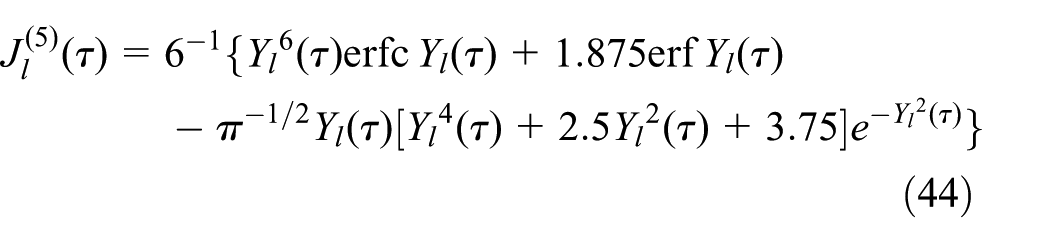
where
, are the effective depths of the friction couple elements heating;4, , where is the Gauss error function.24
Thermal stresses
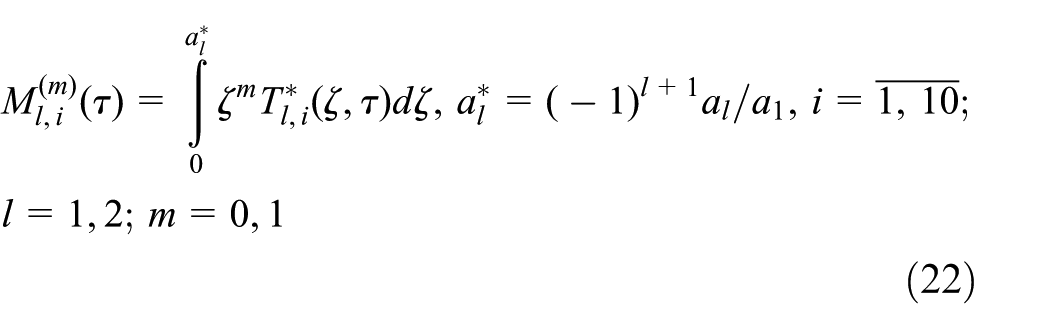
Spatio-temporal distributions of the quasi-static thermal stresses in the friction elements due to heterogeneous temperature fields (equations (5)–(17)) will be found based on the theory of thermal bending of a thick plate with free edges.25,26 In accordance with this theory, in every point of the strips —in a pad—and —in a disk—in the directions Ox and Oy, the same normal thermal stresses act
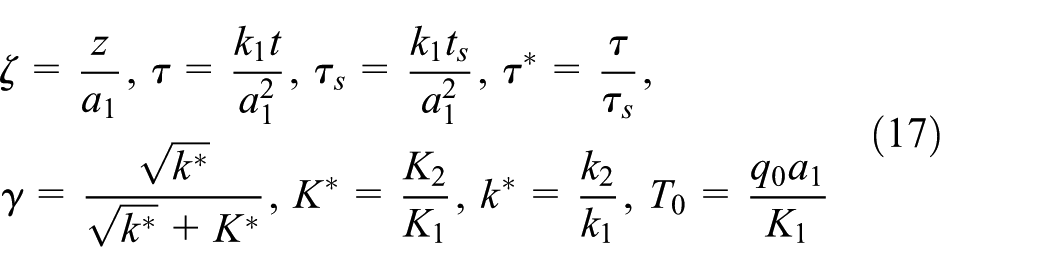
Detailed numerical analysis of the evolutions and spatial distributions of the dimensionless temperatures , ; (equations (7)–(17)) were conducted in the literature.20,21 Calculations were carried out for a cast iron disk (K1 = 51 W m−1 K−1, k1 = 14 × 10−6 m2s−1) and a pad made of retinax FM–16L (K2 = 0.65 W m−1 K−1, k2 = 4 × 10⁻⁷ m2s−1).29 In this study, the spatio-temporal distributions of the corresponding dimensionless thermal stresses (equations (21)–(23)) will be investigated, for the same set of materials. Taking into account the thermal properties of the selected materials, from equations (17) and (22), the following values of the dimensionless parameters , , and were obtained, which are necessary for numerical calculations.
Changes of the dimensionless thermal stresses on the friction surfaces of the disk (, solid lines) and the pad (, dashed lines) with time for temporal profiles of the specific friction power , are illustrated in Figure 2. Considered functions can be divided into three characteristic groups.20 The first one consists of the profiles , monotonically decreasing from maximum value at the start moment to zero that is reached at the stop moment. Corresponding dimensionless temperatures on the friction surfaces , , rapidly increase with time at the initial stage of braking, then reach maximum values, and after that the intensive cooling of the contact zone takes place until the moment of the vehicle standstill. Such a character of temperature evolution has immediate influence on the change of the thermal stresses with time on the friction surfaces of the disk and the pad. Due to thermal expansion of the materials and associated lifting of the sliding surfaces, stresses are compressive in the initial and the middle stages of braking process. At the beginning of the braking process, the absolute values of these stresses rapidly increase and achieve maximum values , , and on the friction surface of the disk , at the time moments , , and , respectively (Figure 2(a)). On the friction surface of the pad , the highest absolute values of the thermal stresses , , and are achieved at the moments, respectively, , , and . The above-mentioned cooling of the contact surface, which follows after reaching maximum temperature, causes decrease in the absolute values of the thermal stresses with time of braking. In the pad for , and in the disk for , superficial stresses remain compressive until the moment of standstill. Whereas in other two cases, thermal stresses change sign and become tensile before the standstill, at the time moments and . These tensile stresses achieve the highest values and at the moment of stop .
Change of the dimensionless normal thermal stresses with braking time on the friction surfaces of the disk and the pad , for different temporal profiles of dimensionless specific friction power : (a) , (b) , and (c) .
The functions , belong to the second group, which monotonically increase from zero at the initial moment to the maximum value at the standstill. In the same manner, evolutions of the temperature proceed on the contact surface of the friction couple elements.21 Absolute values of compressive stresses on the friction surface of the disk , initiated by those temporal profiles of temperature, also increase from zero at the beginning of the process to the maximum values , , and reached at the stop moment (Figure 2(b)). On the friction surface of the pad , these values are 0.670, 0.574, and 0.838, respectively.
The third group comprises functions , which have a local maximum within a duration of an optimal braking process.20 Corresponding evolutions of dimensionless temperature on the contact surface also achieve maximum value within the time interval .21 Change of the thermal stresses with time is qualitatively similar to their evolutions in the first group. At the beginning of the braking, stresses are compressive for both frictional elements, and their absolute values increase with time until the moment of achieving the local maximum (Figure 2(c)). On the friction surface of the disk, the highest values of the dimensionless stresses , the time moments of reaching them are 0.143, ; 0.137, ; 0.121, ; and 0.151, . Corresponding values on the friction surface of the pad are 0.514, ; 0.463, ; 0.536, ; and 0.631, . Then, the reduction of the values with time begins, wherein stresses on the friction surface of the pad remain compressive until the standstill. However, on the disk surface at the moments , , and , stresses change the sign. Monotonic increase in the tensile stresses lasts until the stop moment, and their values at this moment for are equal 0.026, 0.029, and 0.031, respectively.
Isolines of the dimensionless thermal stresses , for time profiles of specific friction power , (Table 1) are illustrated in Figure 3. It can be seen that stress states in considered zones of the disk and the pad are different. On, and adjacent to, the friction surface of the pad, during the whole braking process, normal compressive stresses are present, which values are significantly higher than in the disk. It is caused by lower thermo-physical properties of the retinax material than the cast iron properties. The absolute values of compressive stresses decrease to zero with increasing distance from the contact surface to the center of the pad, where the zone of tensile stresses to the surface occurs.
Isolines of dimensionless normal thermal stresses , , inside the disk and the pad, for different temporal profiles of dimensionless specific friction power : (a) i=1; (b) i=2; (c) i=3; (d) i=4; (e) i=5; (f) i=6; (g) i=7; (h) i=8; (i) i=9; (j) i=10.
At the beginning of the braking process, the compressive stresses appear also in the subsurface zone of the disk . On its friction surface, when , their absolute values decrease to zero with time, after achieving maximum. Next, the zone of tensile stresses appears, which values increase to the end of the process. The sooner the maximum value of friction power is reached, the sooner zero isoline appears, and the values of tensile stresses on the surface of the disk are higher at the stop moment. However, when , stresses in the subsurface zone remain compressive during the whole braking process. Inside the disk, on the levels and , isolines of zero stresses occur. The region of tensile stresses is located between these isolines. Their maximum value is achieved at the similar time to the moment of reaching the highest value of stresses on the friction surface. Above the range , the second region of tensile stresses occurs, and their absolute values are much lower than corresponding values in the subsurface zone.
Conclusion
The mathematical model was proposed to investigate the influence of temporal profile of friction power on the stress state in the pad and the disk during a single braking. For this purpose, for 10 selected (based on experimental data) functions, which describe temporal profile of specific friction power during braking, the one-dimensional thermal problem of friction for a two semi-infinite bodies was formulated and solved accurately.21 Knowing the spatio-temporal fields of temperature in both elements of friction pair, in this study, the analytical equations to designate normal thermal stresses were found, based on the model of thermal bending of a thick plate with free edges. Numerical analysis was carried out for a friction pair consisting of cast iron disk and pad made of retinax. It was established that values and distribution of the thermal stresses are closely correlated with time profile of specific friction power. When the friction power monotonically increases during braking, reaching maximum value at the moment of standstill , the tensile thermal stresses occur on the contact surfaces of elements and attain the highest absolute values at the stop moment. Whereas in cases , in which major part of the friction work is made at the initial stage of braking, absolute values of the tensile stresses on the contact surface rapidly reach maximum, then decrease with time to zero, and change their sign. Values of normal tensile stresses increase to the moment of standstill. Time of stress transformation, from compressive to tensile, and the values that the tensile stresses reach at the stop moment are closely correlated with time of reaching the highest value of the specific friction power. It should be noted that the change of stress sign occurs only in the subsurface zone of the disk. This result is compatible with known experimental data, which show that the normal tensile stresses in the circumferential direction are responsible for initiation of the thermal microcracks in radial direction on the friction surface of the brake disk.5,6
Footnotes
Appendix 1
Handling Editor: Jose Ramon Serrano
Declaration of conflicting interests
The author(s) declared no potential conflicts of interest with respect to the research, authorship, and/or publication of this article.
Funding
The author(s) disclosed receipt of the following financial support for the research, authorship, and/or publication of this article: This article was supported by the National Science Centre of Poland (research project no. 2017/27/B/ST8/01249).
ORCID iD
Michal Kuciej
References
1.
ŚcieszkaSF.Hamulce cierne. Zagadnienia materiałowe, konstrukcyjne i tribologiczne. Radom: ITEE, 1998.
2.
DayAJ.Braking of road vehicles. Oxford: Butterworth-Heinemann, 2014.
3.
KimDJLeeYMParkJSet al. Thermal stress analysis for a disc brake of railway vehicles with consideration of the pressure distribution on a frictional surface. Mater Sci Eng A2008; 483–484: 456–459.
4.
ChichinadzeAVBraunEDGinsburgAGet al. Calculation, test and selection of frictional couples. Moscow: Nauka, 1979 (in Russian).
5.
RashidA.Overview of disc brakes and related phenomena—a review. Int J Vehicle Noise Vibrat2014; 10: 257–301.
6.
MackinTJNoeSCBallKJet al. Thermal cracking in disc brakes. Eng Failure Anal2002; 9: 63–76.
7.
DufrènoyPWeichertD.A thermomechanical model for the analysis of disc brake fracture mechanisms. J Thermal Stress2003; 26: 815–828.
8.
GaoCHuangJMLinXZet al. Stress analysis of thermal fatigue fracture of brake disks based on thermomechanical coupling. Trans ASME J Tribology2007; 129: 536–543.
9.
YevtushenkoAAGrzesP.The FEM-modeling of the frictional heating phenomenon in the pad/disc tribosystem (a review). Numer Heat Transfer Part A2010; 58: 207–226.
10.
YevtushenkoAAKuciejM. One-dimensional thermal problem of friction during braking: the history of development and actual state. Int J Heat Mass Transf55: 4148–4153.
11.
YevtushenkoAAGrzesPAdamowiczA.Numerical analysis of thermal stresses in disk brakes and clutches (a review). Numer Heat Transfer Part A2015; 67: 170–188.
12.
KuciejM.Analytical models of transient frictional heating. Białystok: Publishing House of the Białystok University of Technology, 2012 (in Polish).
13.
YevtushenkoAKuciejMOchE.Some methods for calculating temperature during the friction of thermosensitive materials. Numer Heat Transfer Part A2015; 67: 696–718.
14.
AdamowiczA.Axisymmetric FE model to analysis of thermal stresses in a brake disk. J Theoret Appl Mech2015; 53: 357–370.
15.
AdamowiczA.Finite element analysis of the 3D thermal stress state in a brake disk. J Theoret Appl Mech2016; 54: 205–218.
16.
YevtushenkoAAKuciejM.Influence of the pad’s material properties on the thermal stresses during braking. Numer Heat Transfer Part A2009; 56: 931–945.
17.
YevtushenkoAKuciejM.Temperature and thermal stresses in a pad/disc during braking. Appl Therm Eng2010; 30: 354–359.
18.
YevtushenkoAKuciejMOchE.Modeling of the temperature regime and stress state in the thermal sensitive pad-disk brake system. Adv Mech Eng. Epub ahead of print 6 June 2018. DOI: 10.1177/1687814018781285.
19.
ChichinadzeAV.Calculation and study of external friction during braking. Moscow: Nauka, 1967 (in Russian).
20.
YevtushenkoAKuciejMTopczewskaK. Analytical model for investigation of the effect of friction power on temperature in the disk brake. Adv Mech Eng. Epub ahead of print 11 December 2017. DOI: 10.1177/1687814017744095.
21.
TopczewskaK.Influence of the friction power on temperature in the process of braking. Mater Sci2017; 53: 235–242.
22.
TopczewskaK.Influence of the friction power on temperature stresses in the course of one-time braking. Mater Sci2018; 53: 651–659.
23.
YevtushenkoAKuciejMTopczewskaK. Effect of the temporal profile of the friction power on temperature during single braking. J Theoret Appl Mech, in press.
24.
AbramowitzMStegunIA.Handbook of mathematical functions with formulas, graphs and mathematical tables (Appl Math, series 55). Gaithersburg, MD: National Bureau of Standards, 1979.
25.
TimoshenkoSPGoodierJN.Theory of elasticity. New York: McGraw-Hill, 1970.