An analytical–numerical nonlinear model to investigate temperature fields and thermal stresses in a pad and a disk for a single braking with a constant deceleration has been proposed. For this purpose, the boundary-value heat conduction problem for a tribosystem strip–semi-space has been formulated, which takes into account the temperature dependence of the thermophysical properties of materials. The solution to this problem has been obtained by a partial linearization through the Kirchhoff substitution, and next with a subsequent use of the method of linearizing parameters. Knowing the distribution of temperature fields in the elements of a friction pair, the thermal stresses have been established within the theory of thermal bending of plates. In this case, the temperature dependence of the Young’s modulus, Poisson’s ratio, and linear thermal expansion of the pad and disk materials have been additionally taken into account. The numerical analysis has been performed for a friction pair consisting of a titanium alloy pad and a steel disk.
One-dimensional (1D) linear analytical models of friction heating in brake systems of the pad-disk or multidisk types, are based on the following simplifying assumptions:
During braking, most of the heat generated at the contact surface is propagated inside the friction elements along the normal to this surface.1–3 It allows to neglect the change in the temperature gradients in the direction of the pad sliding (circumferential) and perpendicular to the pad (radial).
The frictional thermal contact of the bodies is perfect, that is, temperature of both the elements (pad-disk, disk–disk) on the contact surface is equal, and the sum of the intensities of the heat fluxes directed to them, along the normal to the friction surface, is equal to the specific power of friction.4,5
During a single short braking, the influence of convective cooling of the free surfaces of the pad and the disk on the temperature of the tribosystem is negligible.6,7
The mechanical and thermophysical properties of the pad and the disk materials in the process of frictional heating during braking are constant.
A review of the formulations and methods of solving 1D linear thermal problems of friction is given in Yevtushenko and Kuciej,8 where it was shown that one of the most frequently used geometric forms in the modeling of frictional heating in the pad-disk brake system is a strip–semi-space connection. The article concerns only the review of 1D thermal problems of friction during braking. Extensive information on the analytical and numerical methods of solving two-dimensional (2D) and three-dimensional (3D) thermoelasticity contact problems, including the generation of heat due to friction in brake systems, may be found in Evtushenko et al.,9 Talati and Jalalifar,10 Yevtushenko and Grzes,11 Yevtushenko et al.,12 and Qiu et al.13
The distribution of nonstationary temperature and thermal stresses in the pad and the disk on the basis of the solution of the linear boundary-value heat conduction problem and the corresponding quasi-static boundary problem of thermoelasticity for strip–semi-space tribosystem has been studied in Yevtushenko and Kuciej.14,15
Due to greater sliding speed and pressure on the nominal contact region between the pad and the disk, and consequently high temperature of the friction surfaces, it is important to take account of the thermal sensitivity of frictional materials in the mathematical modeling of frictional heating at braking. In such conditions, the solutions of linear problems can be a source of significant quantitative inaccuracies, which may often lead to incorrect conclusions. On the other hand, the continuous striving of engineers to the value of the safety factor equal to one, results in increasing requirements for accuracy of the temperature regime in the braking systems, which, in most cases, is not possible without creating appropriate nonlinear models.16,17
1D analytical models of frictional heating during single braking with taking into account the temperature dependence of the thermophysical properties of the materials have been proposed in Yevtushenko et al.18–20. The corresponding numerical models based on the method of lines have been presented in Yevtushenko et al.21,22 In these studies the tribosystem consisting of two semi-infinite bodies (semi-spaces) has been chosen as the geometric model. Moreover, the authors limited their study to the temperature fields. In addition, in Yevtushenko et al.,23 the temperature and thermal stresses distributions have been analyzed in the thermosensitive thermal barrier coating (TBC) applied to the brake disk.
The main goal of this article is to develop an analytical nonlinear model for a strip–semi-space system that allows calculations of the temperature and thermal stresses distributions of the pad and the disk by taking into account the temperature dependence of the mechanical and thermal properties of their materials.
Statement of the heat conduction problem
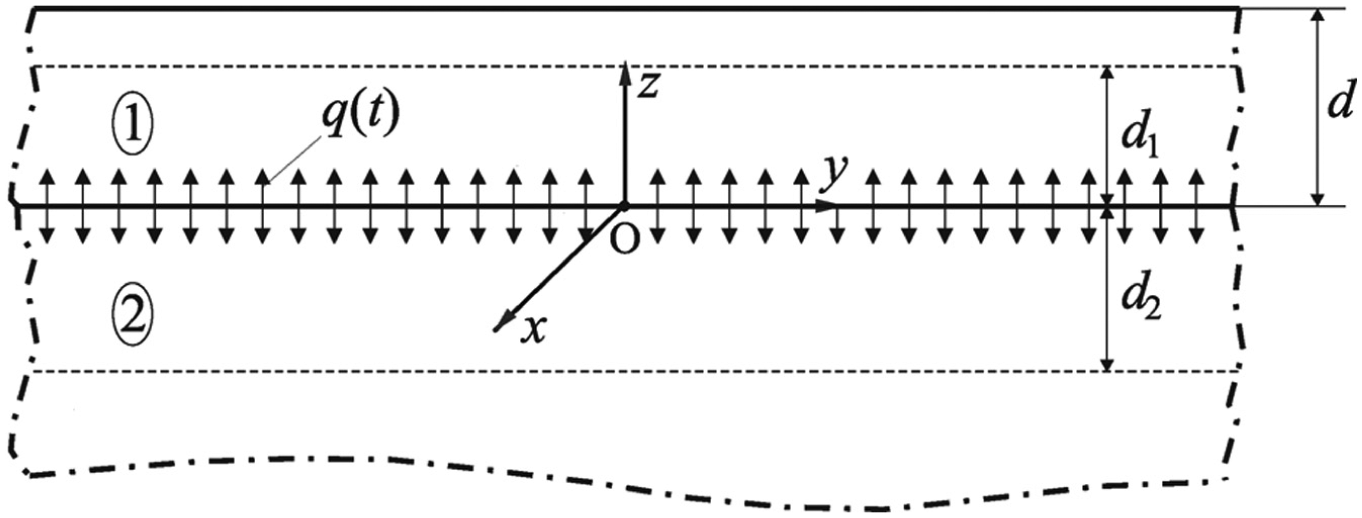
Let us consider a 1D model of frictional heating of the pad-disk tribosystem in the form of the strip of thickness (pad) and the semi-space (disk; Figure 1). At the initial time moment , the strip is pressed by constant pressure to the surface of the semi-space and begins to slide in the positive direction of the x-axis of the Cartesian coordinate system . Due to friction, the heat is generated at the contact surface and both elements of the friction pair are heated. Heating is accompanied by a linear decrease in the sliding velocity of the strip, from the maximum value at to 0 at the moment of stop , that is, . Taking into account the above assumptions, and the constant value of the coefficient of friction , the sum of the intensities of heat fluxes directed along the normal to the surface of contact inside the strip and the semi-space is equal to the specific power of friction
Scheme of the problem.
We assume that the initial temperature of the tribosystem is , the outer surface of the strip in the heating process is adiabatic, and the thermal contact on the friction surface is perfect. Hereafter, all values and parameters relating to the strip will be denoted by subscript , and to the semi-space as .
We assume that the thermosensitive materials, of which the pad and the disk are made, belong to the class of materials with a simple nonlinearity—their coefficients of thermal conductivity and specific heat depend linearly on the temperature as
and the coefficients of thermal diffusivity are constant.24 In this case, we have
where , is the specific material density. If the dependences of the thermophysical properties of the pad and the disk materials on temperature are nonlinear, they can be approximated by piecewise linear functions.25
The distribution of the nonstationary temperature fields , , in the strip and in the semi-space, will be found from the solution of the following thermal problem of friction
where the temporal profile of the specific power of friction has the form (1), and the temperature dependences of the thermophysical properties are given by formulas (2) and (3).
Denoting
we write the boundary-value heat conduction problem (4)–(10) in the dimensionless form
where, taking into account the dependences (1)–(3), we have
It is known that the boundary problems with nonlinearity in a differential operator are called problems with internal nonlinearity. The problems with nonlinear boundary conditions are known as problems with external nonlinearity.26 The boundary-value problem (12)–(18) belongs to the class of problems with both types of nonlinearities, and its solution will be obtained by the method of linearizing parameters.27
Linearization of the problem
Taking notation (11) into consideration, the Kirchhoff substitution can be written as28
From the relation (21) it follows that
Using dependences (20) as integrands in formula (21), we find the relation between the dimensionless temperatures of friction elements and the corresponding Kirchhoff functions of the form
Taking into account relations (22) and (23), the boundary-value problem (12)–(18) takes the form
where
The boundary-value problem (24)–(30), obtained as a result of applying the Kirchhoff substitution (21), belongs to the problems with an external nonlinearity, since it contains the nonlinear boundary condition (26). For its final linearization we assume that
where , are the unknown linearizing parameters.25,27 When taking into account equation (32), from formula (31) it follows that
As a result, boundary condition (26) takes the form
where
We note that, if the thermal properties of the materials do not depend on temperature, then , , and the relation between the temperatures and the Kirchhoff functions is linear as
Kirchhoff functions
We write the solution of the linear heat conduction problem (24), (25), (27)–(30), and (34) by means of Duhamel formula29
where the functions , are the solutions of the same problem at a constant specific power of friction , in the boundary condition (27). The solution of this problem at a constant thermal properties of materials (, ) was obtained in Yevtushenko et al.14 Using the methodology from this article, we find a solution for arbitrary values of the linearizing parameters
where
–error function24 and parameter is determined by formula (35).
On the contact surface from formulas (38)–(41) we obtain
where
Then, solution (37) for the function (19) can be written as
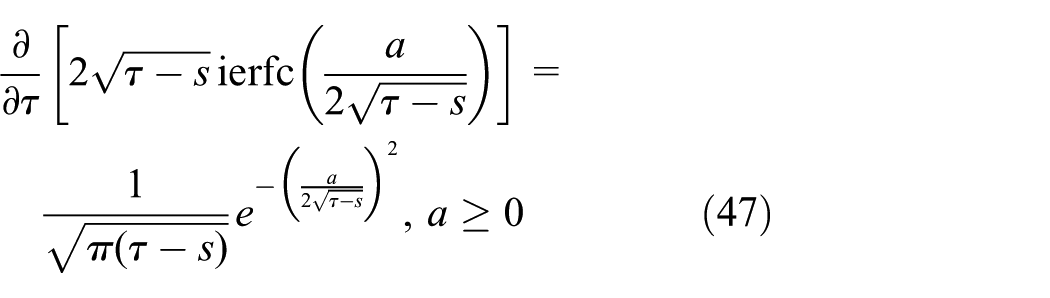
The method of calculating the integrals (52)–(55) was proposed in Yevtushenko et al.19 By means of it we find
Substituting the functions (56), (57) and (58), (59) into formula (51), we obtain
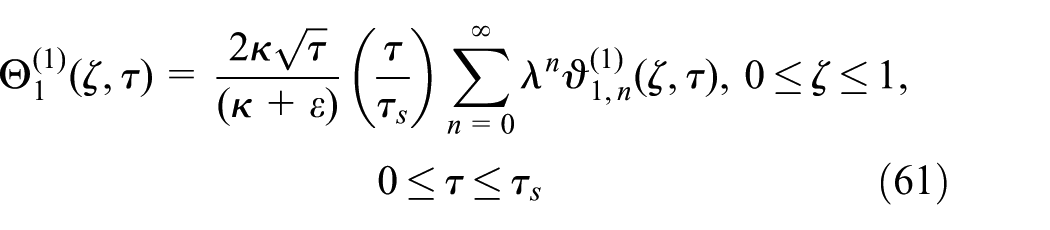
where . Taking into account the relation (50) and formula (60), we write the functions , (48), (49) in the form
where
At from formulas (61)–(64) it follows that
where
Having the functions (38)–(42) and (61)–(64), and using formula (45), we determine the desired Kirchhoff functions , .
Temperature fields
Solving equation (32) with respect to functions , we obtain
Taking into account the form of functions , (43), (44), (65), and (66), from formulas (45) at and (67), we find the relation between the linearizing parameters and as
For a fixed value of dimensionless time , the calculation is performed according to the following scheme:
We set the initial value and determine the corresponding value by formula (68). It is usually assumed that , , that is, as a “zero” approximation in solving a nonlinear problem, we choose the solution of the corresponding linear problem.
For these values , using formulas (43)–(45), (65), and (66), we find the functions , .
By formula (31), we determine the dimensionless temperatures , on the friction surfaces of the strip and the semi-space.
We verify the satisfaction of the boundary condition (26) as
If condition (69) is not satisfied, then we define a new value and repeat the calculation, starting from the point 2. We must take into account that for and for , .
For the new values , found in this way, for which condition (69) is satisfied, by the formulas (38)–(42), (45), and (61)–(64) we find the Kirchhoff functions , .
According to formula (23), we determine the dimensionless temperature fields , .
We proceed to the next value of the dimensionless time and repeat the calculation, starting from point 1. The process continues until parameter reaches the value of the dimensionless time of braking .
Thermal stresses
The thermal stresses in the pad and the disk, initiated by the temperature fields , , we determine using the model of the thermal bending of plates.31 For this purpose, in each element of the friction pair we select a layer (plate) of thickness , , where (Figure 1). The state of thermal stresses in each such plate is characterized by two nonzero components , that satisfy the equilibrium equations in the stresses. In addition, they must satisfy the compatibility equations32
where
, , are the temperature-dependent Young’s modulus, Poisson’s ratio, and the coefficient of linear thermal expansion, respectively, , , , .
The solution of the differential equation (70) must satisfy the equilibrium conditions
Taking notation (11) into account, we write equations (70) and conditions (74) in the dimensionless form
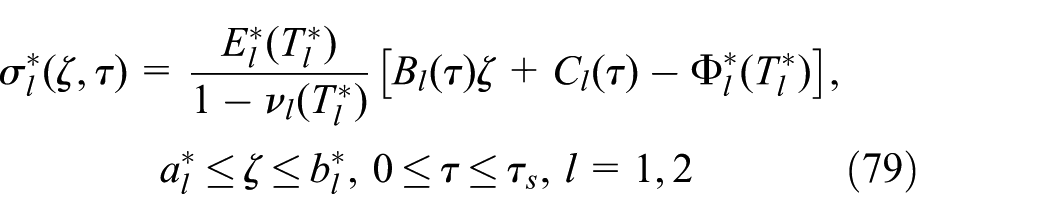
where
The solution of equations (75), which satisfy the equilibrium conditions (76), is of the form
where
If properties of the materials of the pad and the disk are constant (), then from formulas (79)–(82) we obtain the known solution33
where , , , .
Numerical analysis
Based on the above found solutions, the numerical analysis of dimensionless temperature and thermal stresses for a friction couple consisting of a titanium alloy pad (Ti-6Al-2Sn-4Zr-2Mo) and a 304 steel disk (UNS S30400) has been performed. Both these materials belong to the class of materials with a simple nonlinearity.34 According to formulas (20), (71), and (72), the changes in their properties depending on temperature have the form:
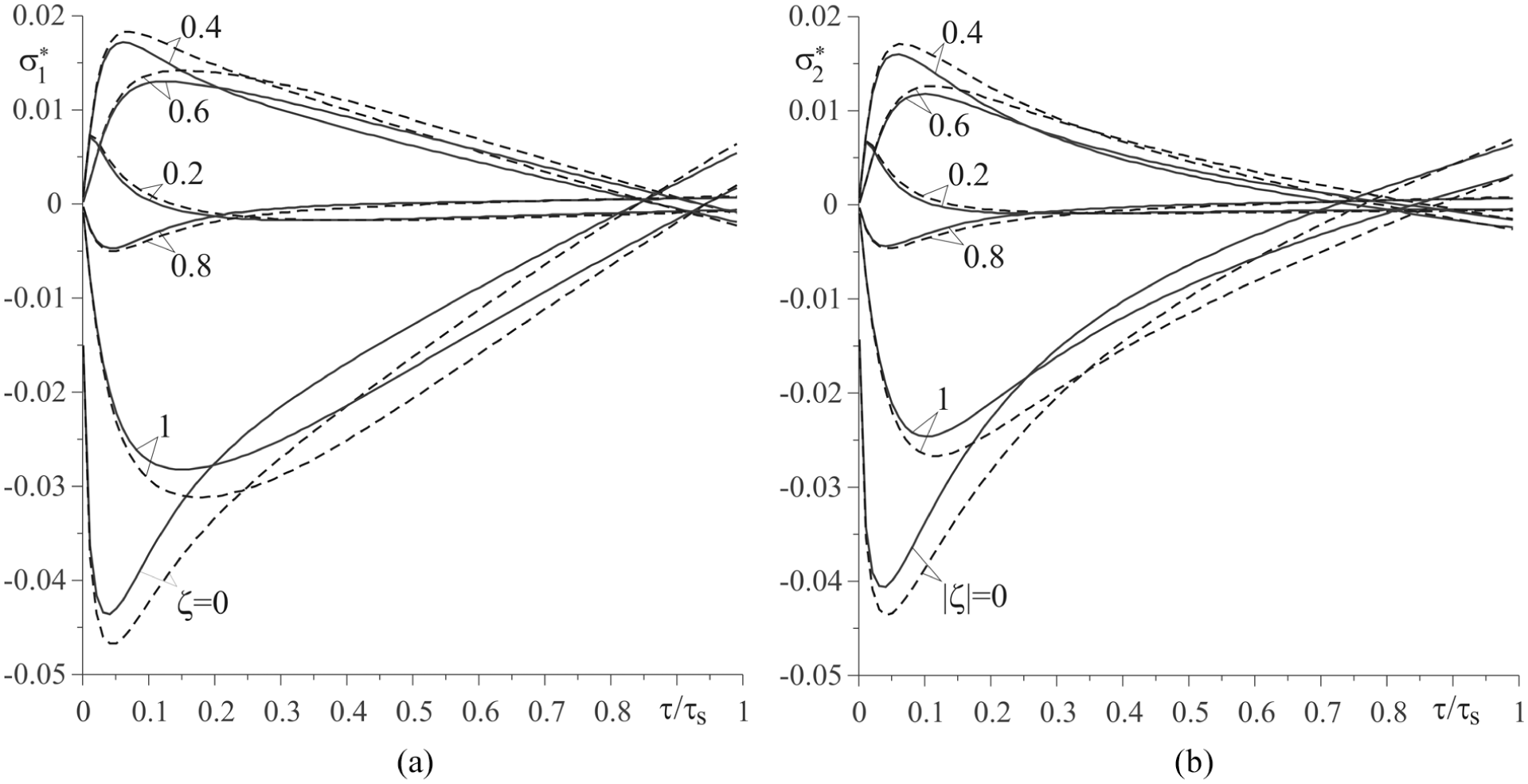
The values of the properties of these materials at the initial temperature are given in Table 1. To calculate the distributions of temperature and thermal stresses during single braking with a constant retardation, the following input parameters have been used: , , , , (). The results of calculations with (solid lines) or without (dashed lines) taking into account the thermal sensitivity of materials are presented in Figures 2–6.
Properties of materials at initial temperature.
Properties
Materials
Titanium alloy ()
Steel 304 ()
()
()
(GPa)
Evolutions of dimensionless temperature , on various distances from surface of friction. (a) The pad (strip). (b) Disk (semi-space).
Evolutions of temperature , on surface of friction , during braking.
Isolines of the dimensionless temperature , in the pad and the disk during braking.
Evolutions of dimensionless thermal stresses on various distances from surface of friction. (a) The pad (strip). (b) The disk (semi-space).
Isolines of the dimensionless thermal stresses in the pad and the disk during braking.
The evolutions of the dimensionless temperature , on the contact surface and at selected depths within the friction elements are presented in Figure 2. In the pad (strip), whose free surface is adiabatic, at the end of the braking process the temperature evens out and has a significant value throughout its cross-section (Figure 2(a)). However, in the disk (semi-space), in the whole process of braking the highest temperature occurs on the working surface, and it is lower at selected distances from it (Figure 2(b)). By increasing the distance from the surface of friction, the time to reach the maximum value of temperature moves in the direction of the stop time. The values of temperature obtained by taking into account the thermal sensitivity of materials are smaller than the corresponding values at the constant properties of these materials. The maximum difference between these temperatures does not exceed 10%.
The evolutions of temperature at the contact surface of the pad and disk () calculated with and without taking into account the thermosensitivity of the materials is presented in Figure 3. For both variants of calculations, according to the boundary condition (6), the temperatures of the sliding surfaces of the pad and the disk at any moment of time are the same. Evolution of temperature on the contact surface is specific for the case of braking with a constant retardation, that is, the temperature increases rapidly with the start of braking, it reaches a maximum value in approximately half the time of braking, and then it falls down till the end of the process. At the initial moment of braking time (up to ), the temperature values calculated with and without taking into account the thermosensitivity are the same, next the difference begins to increase up to the maximum value (), and then, with the temperature drop, it starts to decrease until the end of braking (). The maximum temperature value calculated by taking into account the change in temperature properties of the materials is lower than the maximum temperature calculated with constant thermal properties, which confirms the results obtained previously in a dimensionless form (Figure 2).
The isolines of dimensionless temperature , in the pad and the disk are shown in Figure 4. Due to thermal insulation of the free surface () of the pad, the temperature change occurs throughout its cross-section. The temperature on this surface of the pad is significantly higher than the temperature of the disk at the same distance from the surface of contact. We also see that isotherms are continuous at transition through a surface of contact, which confirms the satisfaction of the boundary conditions (14) or (26). The more heated the friction elements, the sharper the difference becomes between the temperatures calculated with (solid lines) and without (dotted lines) the account of thermal sensitivity of materials.
The evolutions of dimensionless thermal stresses , in the pad and the disk at a few distances from the surface of friction are presented in Figure 5. The greatest compressive stresses appear on the contact surface in the initial braking stage, both in the pad (Figure 5(a)) and in the disk (Figure 5(b)). These compressive stresses become the tensile ones at the end of the process of braking. If the value of these stresses exceeds the permissible tensile strength of the material, cracks may be generated and the friction element may be destroyed. The initiation of surface cracking at this time is accompanied by a monotonic increase in transverse tensile stresses.38 The nature of the course of thermal stresses in the pad and the disk at the same fixed distance from the surface of contact is similar.
The isolines of dimensionless thermal stresses in the pad and the disk are shown in Figure 6. From the beginning of the braking in the region below the contact surface, in both the elements the compressive stresses appear. They decrease along with the deceleration time, and at the end of braking time they become the tensile stresses of significantly lower values, in comparison to the compressive stresses. The regions of the compression stresses are also generated just under the free surface of the pad () and inside the disk (). In the pad, the compressive stresses in this region occur throughout the braking time, and they fade out just before the time of stop. However, in the disk the compressive stresses decrease, and they become the tensile stresses, as in the region below the heating surface. In the middle of both the components, from the start of the braking process the tensile stresses zones are generated, which reach significant values at the beginning of the process, and decrease over time. In both the pad and the disk, in the final stage of braking (), the area gets narrow and it moves in the direction. The regions of compressive and tensile stresses are separated by zero isolines, which enable to clearly indicate the place and time of the change in the stress sign.
Finally, we note that the above described spatial-temporal distributions of the thermal stresses in the pad and the disk are typical for a single braking, and are consistent with the corresponding data presented at constant properties of materials in Yevtushenko and Kuciej.14,15
Conclusion
The analytical 1D transient model to determine distributions of temperature and thermal stresses in the thermally sensitive pad and disk during a single braking has been proposed. For this purpose, the nonlinear boundary-value problem of heat conduction with frictional heat generation on the contact surface of the strip and the semi-space was formulated and then solved by method of linearizing parameters. It was assumed that the pad and the disk are made of materials having a simple nonlinearity—their thermal conductivity depends on temperature, and the thermal diffusivities are constant. The numerical analysis was made for a titanium alloy pad and a steel disk. As a result, for such friction couple it was found as follows:
The thermal sensitivity of materials should be taken into account for calculating the temperature regimes in the pad and the disk. The temperature of both the elements, obtained with account of the temperature dependence of the properties of their materials, is less than when these properties are constant. The maximum difference between these dimensionless temperatures is about 10% and takes place in a contact region of the pad with the disk. A noticeable difference between the temperatures calculated with and without taking into account the thermal sensitivity of the titanium alloy is also observed inside the pad and on its free surface. At the same time, in the steel disk, this difference decreases with the increasing distance from the surface of friction.
Within each element, during braking three characteristic regions of the sign of the normal temperature stresses are formed. The first region of compressive stresses is located just under the contact surface. Below it, there is a region of tensile stresses located, and still below it—another region of compressive stresses. Unfortunately, the change in the sign of the temperature stresses occurs not only inside the pad and the disk, but also on their working surfaces shortly before the stop. Under certain conditions, the appearance of tensile stresses on the surface of the disk can lead to the initiating of radial microcracks on it.14
The proposed model allows to perform a rapid assessment of temperature fields and thermal stress state of the friction elements of the braking systems operating under high pressures at significant initial speeds. High values of the average temperature of the working surfaces of these elements require the development of computational models that take into account the change in the thermophysical properties of the materials from which they are made.
Footnotes
Appendix 1
Handling Editor: Ismet Baran
Declaration of conflicting interests
The author(s) declared no potential conflicts of interest with respect to the research, authorship, and/or publication of this article.
Funding
The author(s) disclosed receipt of the following financial support for the research, authorship, and/or publication of this article: This article is supported by the National Science Centre of Poland (Research Project No. 2015/19/N/ST8/03923).
ORCID iD
Michal Kuciej
References
1.
NewcombTPSpurrRT.Braking of road vehicles. London: Chapman & Hall, 1967.
ChichinadzeAVBraunEDGinsburgAGet al. Calculation, test and selection of frictional couples. Moscow: Nauka, 1979 (in Russian).
7.
AdamowiczAGrzesP.Influence of convective cooling on a disc brake temperature distribution during repetitive braking. Appl Therm Eng2011; 31: 2177–2185.
8.
YevtushenkoAAKuciejM.One-dimensional thermal problem of friction during braking: the history of development and actual state. Int J Heat Mass Tran2012; 55: 4118–4153.
9.
EvtushenkoOOIvanykEHHorbachovaNV.Analytic methods for thermal calculation of brakes (review). Mater Sci2000; 36(6): 857–862.
10.
TalatiFJalalifarS.Analysis of heat conduction in a disk brake system. Heat Mass Transfer2009; 45: 1047–1059.
11.
YevtushenkoAAGrzesP.The FEM-modeling of the frictional heating phenomenon in the pad/disc tribosystem (a review). Numer Heat Tr A: Appl2010; 58: 207–226.
12.
YevtushenkoAAGrzesPAdamowiczA.Numerical analysis of thermal stresses in disk brakes and clutches (a review). Numer Heat Tr A: Appl2015; 67: 170–188.
13.
QiuLQiH-SWoodA.Two-dimensional finite element analysis investigation of the heat partition ratio of a friction brake. Proc IMechE, Part J: J Engineering Tribology. Epub ahead of print 7 February 2018. DOI: 10.1177/1350650118757245.
14.
YevtushenkoAKuciejM.Temperature and thermal stresses in a pad/disc during braking. Appl Therm Eng2010; 30: 354–359.
15.
YevtushenkoAKuciejM.Two calculation schemes for determination of thermal stresses due to frictional heating during braking. J Theor Appl Mech2010; 48: 605–621.
16.
EvansDINewcombTP.Temperatures reached in braking when thermal properties of drum or disk vary with temperatures. J Mech Eng Sci1961; 3: 315–317.
17.
LingFFRiceJS.Surface temperature with temperature-dependent thermal properties. ASLE Trans1966; 9: 195–201.
18.
YevtushenkoAKuciejMOchE.Effect of thermal sensitivity of materials of tribojoint on friction temperature. J Friction Wear2014; 35: 84–92.
19.
YevtushenkoAKuciejMOchE.Influence of thermal sensitivity of the pad and disk materials on the temperature during braking. Int Comm Heat Mass2014; 55: 84–92.
20.
YevtushenkoAKuciejMOchE.Temperature in thermally nonlinear pad-disk brake system. Int Comm Heat Mass2014; 57: 274–281.
21.
YevtushenkoAKuciejMOchE.Method of lines in nonlinear frictional heating during braking. Int Comm Heat Mass2015; 65: 1–7.
22.
YevtushenkoAKuciejMOchE.Effect of the thermal sensitivity in modeling of the frictional heating during braking. Adv Mech Eng2016; 8: 1–10.
23.
YevtushenkoAKuciejMOchE.Influence of thermal sensitivity of the materials on temperature and thermal stresses of the brake disc with thermal barrier coatin. Int Comm Heat Mass2017; 87: 288–294.
24.
LuikovAV.Analytical heat diffusion theory. New York: Academic Press, 1968.
25.
YevtushenkoAAKuciejMOchE.Some methods for calculating the temperature during the friction of thermosensitive materials. Numer Heat Tr A: Appl2015; 67: 696–718.
26.
TsoyPV.Methods of calculation of heat and mass transfer. 2nd ed.Moskow: Energoatomizdat, 1984 (in Russian).
KirchhoffGR.Vorlesungen über die Theorie Der Wärme. Leipzig: BG Teubner, 1894.
29.
OzisikMN.Heat conduction. New York: John Wiley & Sons, 1980.
30.
AbramowitzMStegunIA.Handbook of mathematical functions, with formulas, graphs and mathematical tables. New York: Dover Publications, 1979.
31.
TimoshenkoSPGoodierJN.Theory of elasticity. New York: McGraw-Hill, 1970.
32.
PopovychVS.Construction of solutions of the thermoelasticity problems for thermosensitive bodies at convective-radiant heat exchange. Rep Natl Acad Sci Ukraine1997; 11: 69–73 (in Ukrainian).