




Abstract
This study aims to evaluate the fatigue durability of a cowcatcher and optimize its structure. The cowcatcher, which serves as the crucial component of electric multiple units, generally influences the electric multiple units operating security and stability. A finite element model considering material properties and geometry sizes of the cowcatcher is established for structural strength analysis. Based on the P-S-N curve, the nominal stress method is introduced to analyze the fatigue durability of the cowcatcher. Considering influences of input variables such as elastic modulus, Poisson ratio, loads, and plate thickness on the fatigue durability, the parametric model of cowcatcher is built. In addition, three-level fractional factorial design is chosen to ascertain the location of sampling points in the above variables’ sampling space. The response surface of the cowcatcher is fitted using Kriging model. Then, a non-linear programming by quadratic Lagrangian algorithm is proposed for optimizing the cowcatcher structure. With a comparison of fatigue durability pre-optimization and post-optimization, conclusions on cowcatcher design and application are made. The proposed method not only prolongs the fatigue life of the cowcatcher but also improves its structure reliability.
Keywords
Introduction
The cowcatcher mounted at the underframe of electric multiple units (EMU) is capable of cleaning up obstacles from the track and easing impacts in crashing. During its long term of operation, fatigue failure subjected to alternating loads is the main failure mode of EMU component failure. 1 Thus, cyclic operation of the cowcatcher is actually a fatigue damage accumulation process. When the accumulation damage reaches a critical value, the cowcatcher fatigue occurs. Therefore, it is of importance to evaluate and assess the reliability and fatigue durability of the cowcatcher.
Cowcatcher is a vital component to sweep away the obstacles and absorb kinetic energy. Some researches on cowcatcher have been conducted. Ding and Zhao 2 adopted a new energy absorbing structure and filling material with the application of collision-resistant system design based on LS-DYNA simulation. They indicated that the new type of cowcatcher optimization scheme is available for absorbing energy and easing collision. Also, when designing the cowcatcher, it is essential to pay attention not only to the basic condition parameters, including its structure, height and static strength, but also to its energy absorption performance to meet the security requirements for relieving the impacts.
To improve the service life and ensure the safety while vehicles are in motion, it is essential to take the fatigue durability into further consideration. 3 Shen et al. 4 offered a proposal to assess fatigue durability of automotive exhaust system using finite element (FE) simulations. In general, FE analysis has been commonly used to locate the most dangerous region for fatigue analysis and design.5–7 Zhang et al. 8 estimated the strength status and fatigue life of the front axle for heavy-duty truck using fatigue module of ANSYS platform, found the dangerous position of beam, and carried out a combined fatigue simulation of multi-working conditions. Dietz et al. 9 presented a simulation-based method to predict fatigue life of a railway bogie under dynamic loads on the combination of frequency domain and time domain calculations, FE simulation, and a multi-body system (MBS) program.
The previous studies on fatigue durability of vehicles had a conjunct characteristic. Namely, most of them focused on deterministic analysis which regarded design variables as specific values. 10 However, uncertainties are ineluctable in many aspects of machining dimensions, material properties, load variations, non-linear degradations,11–13 and other uncontrolled variations.14–17 Probabilistic analysis is required to quantify these uncertainties, especially its effects on the fatigue behavior of components. 17 Accordingly, it is important to predict the service life of the EMU cowcatcher based on nominal stress approach and fatigue damage accumulation rule by means of ISIGHT 5.6 and FE-SAFE 6.4 platforms.
The rest of this study is organized as follows. The response surface fitted by three-level fractional factorial design is introduced in section “Basic theories for fitting response surface.” Section “Fatigue durability of the EMU cowcatcher” investigates fatigue durability of the cowcatcher based on nominal stress method and fatigue damage accumulation theory. Section “Optimal design of the EMU cowcatcher” applies the non-linear programming by quadratic Lagrangian (NLPQL) algorithm to optimize the cowcatcher structure. Then, results of pre-optimization and post-optimization are compared. Finally, conclusions are given in section “Conclusion.”
Basic theories for fitting response surface
Geometry of the cowcatcher
The EMU cowcatcher is used to remove obstacles from the rail to avoid the possibility of derailment and other running accidents, so as to ensure its safe operation. The cowcatcher is composed of welding structural steeled baffle, aluminum alloy clamping support, and buffer board, and all these components are connected by 14 M16 bolts and 6 M12 bolts. The draft of whole geometry of a cowcatcher is given as shown in Figure 1.

Geometry of the cowcatcher.
FE analysis
In order to improve the calculation accuracy and analysis efficiency, a series of FE sub-models with increasingly tinier mesh densities are constructed and solved sequentially until the FE meshing size of the model is consistent with the geometric surface. 18 SHELL181 element is chosen for FE meshing, with results of 76,947 units and 89,253 nodes. The cowcatcher serves as an axisymmetric geometry. 19 Besides, material used for the EMU cowcatcher is predominantly 5083 aluminum alloy, with a yield limit of 125 MPa and Young’s modulus (E) of 70 GPa. Meanwhile, considering the real working status of the cowcatcher, its boundary conditions are applied on the corresponding positions. 20 Longitudinal load of 100 kN is applied on the front end of the cowcatcher and constraints are applied on the head car, as shown in Figure 2.

FE mesh of the cowcatcher.
The determination of random variables
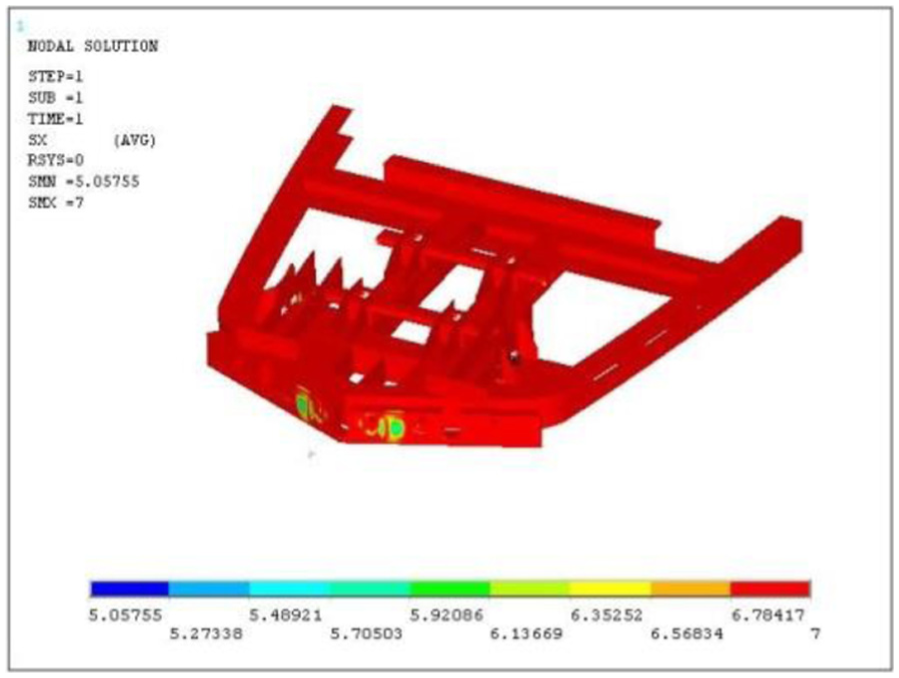
The input design variables, including the plate thicknesses, loads, and material properties, are given as random variables. Accordingly, a parametric model is established using ANSYS parametric design language (APDL). Figure 3 shows the stress nephogram under requested conditions, while the maximum von Mises stress is taken as the output response.

Stress nephogram of the cowcatcher.
In Figure 3, the maximum von Mises stress is centralized on the baffle for the reason that this region inherits the collisions on the track. Simultaneously, the value 107 MPa is evidently below its yield limit. Thus, the cowcatcher will not be damaged owing to the lack of static strength. Considering that the potential fatigue failure given rise to long-term effects of alternating loads, 21 according to fatigue design concept, thicknesses with larger stress are chosen as input parameters. Design variables and their respective distributions are listed in Table 1.
Properties of design variables.

Limit state equation of the cowcatcher
A limit state equation of the EMU cowcatcher is built in accordance with the stress–strength interference theory. On the assumptions of design parameters x1, x2, …, xn, the limit state can be formulated as

where [σ] is the fatigue strength of the material and σmax is the von Mises stress obtained from FE simulation.
In equation (1), Z > 0 signifies that the structure is in the reliable state and Z = 0 represents the limit state, and likewise, Z < 0 means structural failure. In order to conduct fatigue reliability analysis of the cowcatcher, one needs to obtain the probability distribution of Z ≥ 0 and then proceed to evaluate the effects of material properties, load, thickness, and other random variables on the maximum von Mises stress and the randomness of design variables on the EMU fatigue durability.
Response surface methodology
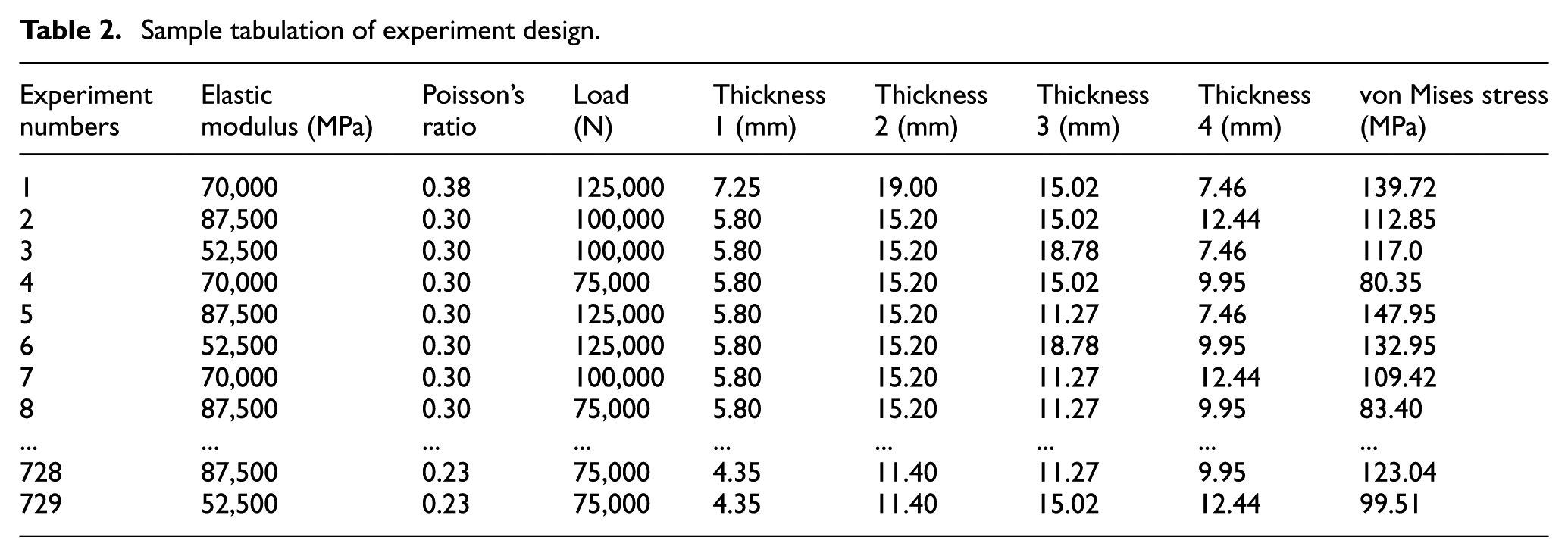
In general, the precision of a mathematical model determines the design quality, design, and optimization results. Once the real model deviates too much from the ideal, the optimization will be unacceptable. As an alternative mathematical model to FE models for complicated mechanical structures, response surface methodology (RSM) is developed for solving a complicated and low-efficient design problem, holding the strengths of cushy implementation and superior computational efficiency. 22 First, through setting up simFlow by ISIGHT 5.6 software, three-level fractional factorial design is carried out. This method incorporates the factors of various levels combined into distinct experimental conditions and three independent repeated trials done under each condition, to ascertain the locations of sampling points in the input variable sampling space and fit the response surface, so as to investigate the possible effects of a subset of all factor levels on the response. Through making a comparison with full factorial design, this approach distinctly enhances computation efficiency. Samples of the experiment obtained by 729 simulation cycles are given in Table 2.
Sample tabulation of experiment design.
Generally, it takes a considerable time to proceed with reliability analysis directly using computer-aided engineering (CAE). In contrast, RSM is a combination of mathematics and statistics that can be efficiently used to model and solve problems in which a response of interest is influenced by several parameters and the objective is to optimize this response.23–26 On the basis of three-level fractional factorial design, RSM of the cowcatcher is substantially generated by 729 iterations and histograms are obtained by variables and response. The response function tensile strength (TS) is a function of elastic modulus (E), Poisson ratio (P), load (F) and thickness (T), which is formulated as given in equation (2)

Approximate RSM is fitted by quadratic polynomial models, which is described as follows

where Y represents the predicted response, x is the design variable, bi (i = 0, 1, 2, …, k) is the linear regression coefficient, bii signifies the quadratic regression coefficients, and λ is the neglected model error.
The coefficients calculated by simulation are expressed as
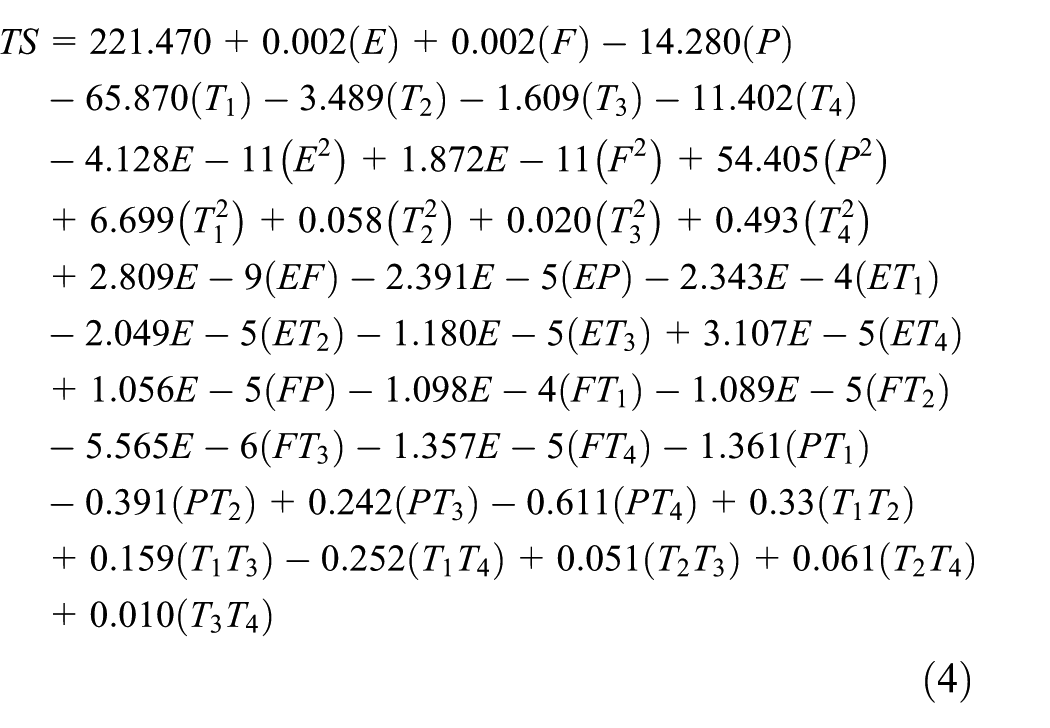
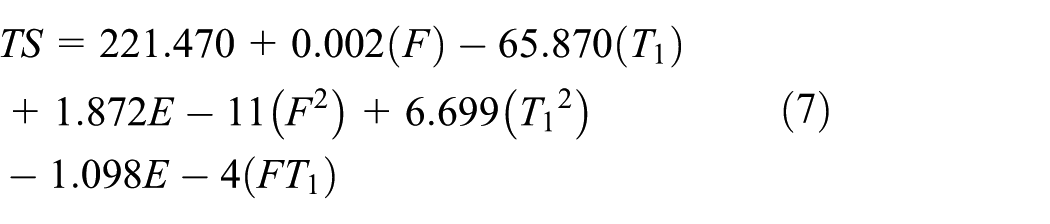
After determining the significant coefficients, three-dimensional response surface which clearly illustrates the relationship between design variables and the response is shown in Figure 4. The corresponding expressions are as follows




Stress response diagrams: (a) influence of thickness T1 and T4 on stress, (b) influence of thickness T1 and elastic modulus E on stress, (c) influence of thickness T1 and load F on stress, and (d) influence of Poisson ratio P and load F on stress.
With the changing of design variables, the response value has shown a corresponding change. Figure 4(a) illustrates the response which is sensitive to both T1 and T4. With the increasing thicknesses, stress tends to be declined. Figure 4(b) shows that T1 makes great contributions to the response. Meanwhile, elastic modulus is positively correlated with stress. It can be seen from Figure 4(c) that F and T1 are key factors that influence the stress. Figure 4(d) shows that when F keeps constant, Poisson’s ratio almost has no change, while stress changes obviously with the increase in F.
Fatigue durability of the EMU cowcatcher
Basic probabilistic curves
Basic probabilistic curves refer to the P-S-N curves in the mid-long life-cycle regime. 27 To estimate the fatigue durability on the scatter of material properties and structure dimensions, that is, the capability of a cowcatcher to perform the intended functional capacity within prescribed application and maintenance requirements, the nominal stress method is utilized. Until now, methods of estimating fatigue life are mainly using nominal stress method, local stress–strain approach, and stress field intensity approach. Among them, nominal stress method is easy to use for engineering applications. As one of commonly used fatigue prediction methods, it obtains the location and nominal stress of the most dangerous positions on the cowcatcher based on S-N curves of 5083 aluminum alloy. In general, a power law function of S-N curve can be expressed as follows

Taking a logarithm to both sides of equation (9), its corresponding linear equation can be derived as 28

where S is the fatigue stress amplitude, Np is the fatigue life under a certain probability of p, and C and m are the material constants.
According to nominal stress approach and fatigue damage accumulation theory, Figure 5 shows P-S-N curves constructed for structural fatigue analysis by executing fatigue experiments. In practice, engineering components are subjected to variable amplitude loadings with non-zero mean stresses, and nominal stress should be corrected for mean stress effects.29–31

P-S-N curves of 5083 aluminum alloy.
Figure 5 shows that after N = 107 cycles, the curves tend to be horizontal under constant amplitude loading. When stress amplitude is lower than the horizontal level, the cowcatcher can be subjected to an infinite number of loading cycles without damage.
Linear damage accumulation rule
Linear damage accumulation rule, also named as Miner’s rule, states that fatigue damage under each isolated stress is linearly accumulated under cyclic loadings.
According to Miner’s rule, when n loading cycles are performed, fatigue damage caused by the stress Si can be calculated by damage D

When the number of cyclic loading n is equal to fatigue life N, namely, the accumulation damage reaches the critical fatigue damage, fatigue failure occurs, which generally leads to the following equation

Fatigue durability analysis of the EMU cowcatcher
Based on damage accumulation rule, fatigue durability evaluation is carried out using FE-SAFE 6.4 module, which determines the location of initial cracks and provides a theoretical basis for structural optimization design.
According to FE-SAFE 6.4, fatigue life of the cowcatcher can be expressed as 32

where Sx is the logarithmic result and N denotes the fatigue life. The logarithmic life of the cowcatcher under reliability of 50% is shown in Figure 6.

Logarithmic life of the cowcatcher under reliability of 50%.
Figure 6 gives the fatigue life calculated using equation (13) under reliability of 50%, which is 106 cycles. The result validates the most dangerous location appearing in the baffle, which agrees well with that of static strength analysis, as shown in Figure 3.
To verify the requirements of high reliability and safe operation, this section also calculates the service life under reliability of 99%, which is 114,169 cycles, as shown in Figure 7.
Logarithmic life of the cowcatcher under reliability of 99%.
Optimal design of the EMU cowcatcher
The objective of optimization is to seek the optimal design of the cowcatcher structure, so as to satisfy the demands of operational safety and prolongate service life as long as possible. As a stable gradient optimization, the NLPQL algorithm expands the objective function by two-order Taylor series and linearizes the constraints based on RSM to obtain the next design point via disposing the quadratic programming, for the ultimate objective of acquiring an improved design on each iteration, until the result converges to the optimal design. This approach is well suited for highly non-linear design spaces and long running simulations.33,34 In addition, it has characteristics of exploiting the local area around initial design points, rapidly locating a local optimum design, and handling inequality and equality constraints directly.
Linear Pareto graph shows the effects of a set of factors on the response by plotting the relationship determined by regression analysis of the data. Percentage effects correspond with the length of bar chart, as shown in Figure 8.

Pareto plot for response.
In Figure 8, F, E, and P are positively correlated with the response, which means the larger the load, the larger the stress. By contrast, T1, T2, T4, and T3 are negatively correlated. F and T1 have the strongest correlation with the von Mises stress.
On the basis of this analysis, independent and isolated parameters which have shown a significant effect on the reliability and fatigue durability are chosen as design variables, and then, the objective function, which is expected to get a minimum stress to guarantee good strength, can be achieved effectively by adjusting seven design parameters. The objective also conveys the relationship among them, with the limitation of boundary constraints. The structural optimization problem can be briefly described as


where [σ] is the fatigue strength of the adopted material.
According to the given ranges of the input and output parameters, equation (14) is solved to reach the desired goal. The lower bounds for the parameters are implemented to guarantee compliance, while the upper bounds of the geometric dimensions are set to achieve a compact structure.
Prior to computation, the input parameters should be configured. Default maximum number of iterations is 40, termination accuracy is set as 1.E−6, relative step size is 0.001, and minimum absolute step size is 1.E−4. There are two phases for each iteration. First, the search direction is determined at the current design point. Then, the step-length along the selected direction is searched. In practice, the number of iterations is executed nine times. At the same time, the number of potential candidates is generated automatically. The comparisons of design variables are listed in Table 3.
Comparison of design variables before and after optimization.

Note that the structural optimization performed on the established response surface can achieve a minimum stress concentration of 99.50 MPa and the lowest weight of 0.32 t, comparing to the initial weight of 0.35 t. The decrease in weight is available to actualize saving cost and to improve its dynamics performance.
With the objective of making a comparison between initial reliability and optimization results, central composite design (CCD) of RSM is adopted for reliability analysis of the cowcatcher. Response surface model is established based on a polynomial fit via the least squares regression of output parameters to input variables. Along with the finish of locating sampling points in the input variable space, the approximate function is formulated to deal with finite element method (FEM). Comparing with Monte Carlo method, RSM requires fewer simulation loops. This procedure makes the computation simplified and the degree of accuracy sufficiently obtained. The number of experiments required by the CCD is determined by

where k is the number of design variables and
Based on equation (15), a total of 79 experimental design points are chosen by means of CCD. As aforementioned in section “Limit state equation of the cowcatcher,” the probability that
In order to better evaluate the post-optimization structural performance of the cowcatcher, the post-optimization fatigue life nephogram of the cowcatcher under the P-S-N curve with P = 50% and 99% is shown in Figure 9.
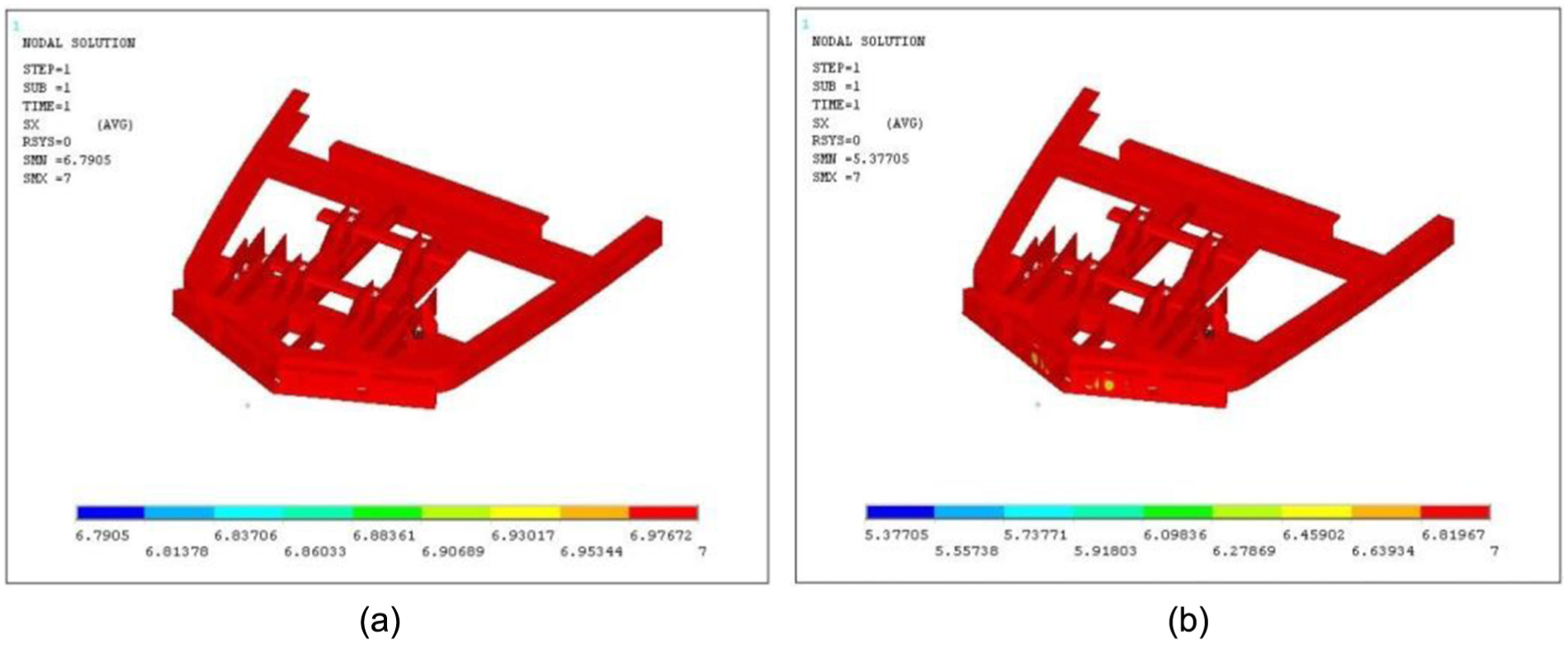
Optimal logarithmic life of the cowcatcher: (a) logarithmic life of the cowcatcher under reliability of 50% post-optimization and (b) logarithmic life of the cowcatcher under reliability of 99% post-optimization.
Note from Figure 9 that the lowest life position of both conditions appears in the baffle. It illustrates that the baffle is the weak part of the cowcatcher structure. In addition, the service life under reliability of 50% is 6,165,950 cycles, and 238,231 cycles for reliability of 99%.
It is worth noting from Table 4 that comparing with the pre-optimization fatigue life, the post-optimization results show that fatigue durability under reliability of 50% and 99% has been improved with the percentage of 5.17 and 1.09, respectively.
Comparison of fatigue life of the cowcatcher optimization.

Therefore, the values of weight, reliability, and fatigue durability of post-optimization are improved, which provides a reference for engineering practice.
Conclusion
Combining with FEM and RSM, methodologies to evaluate fatigue durability and optimize the structure of a cowcatcher have been studied in this analysis. Some conclusions are drawn as follows:
Quadratic polynomial response surface based on three-level fractional factorial design is fitted for analysis and optimization under design variables, including elastic modulus E, Poisson ratio P, load F, and thickness T. The effects of these variables on the maximum von Mises have been drawn from Pareto graph. F, E, and P are positively correlated with the response. T1, T2, T4, and T3 are negatively correlated. F and T1 have shown the strongest correlation with the von Mises stress.
Fatigue durability of the EMU cowcatcher is evaluated under alternating loads using nominal stress approach and fatigue damage accumulation rule by FE-SAFE 6.4. Results show that the fatigue life of the cowcatcher under working conditions with the reliability of 50% is 407,380 cycles for fatigue crack initiation life. This process can be used as a reference for estimating the service life of EMU cowcatchers.
Structural optimization is conducted using the NLPQL algorithm to seek the optimal design of the cowcatcher and simultaneously to satisfy the requirements of fatigue durability and operational safety. The comparison of structural parameters between initial values and optimal results can be adopted as a reference for future design of EMU cowcatchers.
Footnotes
Academic Editor: Dong Wang
Declaration of conflicting interests
The author(s) declared no potential conflicts of interest with respect to the research, authorship, and/or publication of this article.
Funding
The author(s) disclosed receipt of the following financial support for the research, authorship, and/or publication of this article: This study received partial supports provided by the program of Educational Commission of Liaoning Province under contract number JDL2016001, the program of National Natural Science Foundation of Liaoning Province under contract number 2014028020, the program of the Dalian Science and Technology Project under contract number 2015A11GX026.