



Abstract
In this paper, the 3 degrees of freedom (3-DOF) parallel robot (3-RRC) is taken as the research object. The Lagrange method is used to establish the reduced order dynamic equations of three branch chains. On the basis of the U-K (Udwadia-Kalaba) equation, the analytical expressions of ideal and non-ideal constrained forces are obtained. Then the complete dynamic model of 3-RRC parallel robot is established. In order to achieve high precision control of 3-RRC parallel robot, and fully considering the uncertainty of non-ideal constrained force and chattering problem in terminal sliding mode control algorithm, the neural network is used to adaptively adjust the gain of switching function and achieve universal approximation of the unknown non-ideal constrained force. The neural network terminal sliding mode control algorithm is proposed for the complete dynamic model of 3-RRC parallel robot, and the stability of the control system is proved by Lyapunov theorem. Finally, the simulation research is conducted on the 3-RRC parallel robot. Simulation results show that the tracking precision of angle positions and non-ideal constrained forces are all reached 10−2 order, which realize the high precision control of the 3-RRC parallel robot, weaken the chattering phenomenon, and verify the correctness and effectiveness of the proposed dynamic model and control algorithm.
Keywords
Introduction
Parallel robot is a closed-loop kinematic chain mechanism, which is composed of fixed platform, moving platform and some links connecting them. These links are usually composed of drivable prismatic joints and passive spherical joints or general joints connecting the platform. In view of these structural characteristics, the parallel robot has four main advantages compared with the serial robot: firstly, since the cumulative error of the parallel robot is less, its motion accuracy is higher. Secondly, because the actuator of the parallel robot is fixed on or close to the fixed platform, its motion inertia is smaller. Thirdly, the components of the parallel robot system move in parallel, so its structural stiffness is larger, and there is no cantilever load in the system. Fourthly, the inverse kinematics of the parallel robot is relatively simple, which is beneficial to achieve real-time control. Therefore, parallel robot has a wide application prospect in the occasions that need high stiffness, precision, running speed, and perfect dynamic characteristics, such as aerospace, manufacturing equipment, medical, and other fields.1,2
At present, most parallel robots are designed with6-DOF structure, but in many applications (such as welding, medical, cutting, handling, etc.) parallel robots only need lower-mobility to meet the requirement. 3 Many scholars have successively carried out research on lower-mobility parallel robots (generally 2–5 degrees of freedom), especially 3-DOF parallel robots, such as the famous Delta, 3-RRR, 3-RPS, Tricept, and so on. The main advantages of the lower-mobility parallel robot compared with the 6-DOF parallel robot are that it can meet the needs of most industrial operations, and the complexity and cost of the mechanism are lower.
Different from the serial robot with perfect dynamic modeling method, the dynamics of parallel robot is more complex due to the closure of kinematic chain. In addition, lower-mobility parallel robots usually have parasitic motion and over-constraints, which make the dynamic modeling more complex. 4 The research on the dynamic modeling of parallel mechanism is mainly divided into four categories: Newton Euler method, Lagrange equation, Kane equation, and virtual power principle. Chen et al. 5 established a closed dynamic model of 3PRRU parallel robot by using Newton Euler method and carried out dynamic analysis, but the model was not accompanied by over-constraints. Xin et al. 6 combined Lagrange equation with virtual working principle to establish the dynamics of 3-DOF parallel mechanism. Dong 7 established the dynamic model of planar parallel mechanism with redundant driving force by Lagrange equation, which could eliminate the Lagrange operator through the zero space expression of velocity constraint matrix. Chen et al. 8 deduced the rigid flexible coupling dynamic model of3-RRR planar parallel mechanism based on the Kane equation. Hu et al. 9 deduced the velocity mapping matrix of (3 UPU) + (3UPS + S) serial parallel robot, established the dynamic model based on the virtual work principle, which achieved the calculation formula of the driving force.
The accurate dynamic modeling of parallel robot plays an important role in the design of control algorithm. According to the above-mentioned work, many researches only consider the ideal constrained force, and lack the modeling and solving of non-ideal constrained force for the parallel robot. Udwadia-Kalaba equation is a new method for dynamic modeling of constrained complex mechanical systems.10–13 When solving the dynamic problems of constrained systems, it does not need to introduce auxiliary variables, and the dynamic equation in analytical form and the acceleration expression in display form can be obtained, which is applicable to both ideal and non-ideal constrained force. In this paper, the 3-RRC parallel robot is taken as the research object, where exists the constrained force between the moving platform and each branch chain. Actually, the constrained force in the 3-RRC parallel robot can be divided into two parts. One is the normal force, which is regarded as the ideal constrained force. The other is the tangential force that can be seen as the non-ideal constrained force. Firstly, the reduced order dynamic equations of three branch chains are established by Lagrange method. Then the analytical expressions of ideal and non-ideal constrained forces are constructed and obtained by using the U-K equation. Finally the complete dynamic equation of 3-RRC parallel robot is established.
3-RRC parallel robot is a highly coupled and strongly nonlinear system. The sliding mode control is the preferred method for uncertain parallel robot control because of its strong robustness, no need for accurate modeling, special decoupling, and fast response speed. 14 Compared with the ordinary sliding mode control, terminal sliding mode control introduces nonlinear function in the design of sliding hyperactive plane, which can make the control system converge to the equilibrium point in limited time. At the same time, it also has the advantages of small control gain, fast dynamic response speed, and high steady-state accuracy. 15 Feng et al. 16 proposed a nonsingular terminal sliding mode control method for the singular problem of general terminal sliding mode controller, and discussed the design of nonsingular terminal sliding mode controller. This method has been successfully applied to the trajectory tracking control of n-DOF rigid robot. Zhang et al. 17 proposed nonsingular terminal sliding mode control, which realizes high-precision trajectory tracking control of redundant parallel robot system and eliminates the singularity of traditional terminal sliding mode control method. Doan et al. 18 constructed a synchronous full order terminal sliding mode surface in the state space of cross coupling error for the 3-DOF planar parallel robot with uncertain dynamics. The position error and synchronization error variables converge at the minimum value at the same time, which can ensure the effectiveness of position tracking control of the 3-DOF planar parallel robot.
Although the terminal sliding mode control has many advantages, the discontinuous switching characteristics of the sliding mode control will cause system chattering and affect the control accuracy of the system. In order to reduce the chattering effect of the sliding mode control, there are many methods such as filtering, observer, switching gain, fuzzy rules, neural network, and genetic algorithm optimization. Fei et al. 19 proposed a new low-pass filter sliding mode control method, which realized the tracking control performance of 3-DOF space robot and weakened the chattering phenomenon to a certain extent. Wang et al. 20 applied Hamilton Jacobi inequality theory and the designed disturbance observer to the designed sliding mode robust control to verify the anti-interference ability of WDPR. The disturbance observer can effectively reduce the chattering and improve the control accuracy of the system. Gao et al. 21 proposed a variable structure controller with integral operation switching surface, which makes the parallel robot system insensitive to uncertainty and external interference. The adaptive law is designed to realize the on-line identification and estimation for the uncertainty of the parallel robot system and reduce the chattering of the traditional sliding mode control. Wu et al. 22 established the dynamic characteristics of the robot based on the virtual work principle. The control scheme adopts fuzzy sliding mode variable structure control to suppress the chattering of the driving joint and reduce the pose error of the robot end-effector. Nguyen et al. 23 combined adaptive neural network, adaptive robust sliding mode control, and nonlinear compensation term to realize high-precision trajectory tracking control of redundant parallel robot. Zhou and Liang 24 proposed the sliding mode control based on genetic algorithm, adjusted the parameters of switching function and exponential approximation law through genetic algorithm, improved the control performance of robot joint position trajectory tracking, and significantly reduced the chattering of controller output.
In order to effectively reduce the chattering phenomenon of the terminal sliding mode control and considering the uncertainty of non-ideal constrained force, this paper combines the neural network control with the terminal sliding mode control to realize adaptive adjustment of switching function gain. The universal approximation of unknown constrained force is realized by using the universal approximation characteristic of the neural network. The neural network terminal sliding mode control algorithm for the complete dynamic model of 3-RRC parallel robot is proposed, and the stability of the control system is proved by Lyapunov theorem to realize the high-precision control of 3-RRC parallel robot.
The structure of this paper is as follows: firstly, the dynamic model of the reduced order 3-RRC parallel robot is derived according to the Lagrange equation, and then the analytical expressions of the ideal constrained force and non-ideal constrained force between the moving platform and each branch chain are obtained based on the U-K equation. The complete dynamic equation of the 3-RRC parallel robot is obtained. Then, according to the constrained dynamic equation, the neural network terminal sliding mode controller is designed, and the stability of the control system is proved by Lyapunov theorem. Finally, the simulation of 3-RRC parallel robot is carried out to verify the correctness and effectiveness of the proposed dynamic model and control algorithm.
The reduced order dynamic modelof 3-RRC parallel robot
In order to realize the high-precision control of lower-mobility parallel robot, it is necessary to establish its accurate dynamic model. This paper takes the spatial 3-RRC parallel robot as the research object, and its mechanism diagram is shown in Figure 1. The moving platform

3-RRC parallel robot model.
A fixed coordinate system
3-RRC is a lower-mobility parallel robot, in which three links

In the above equation, since the end of each branch chain is connected with the moving platform in the form of cylindrical pair, which can translate and rotate along the axis of the moving platform, and the end of each branch chain is subject to constrained force. In the 3-RRC parallel robot, the link corresponding to angle variable

For the convenience of subsequent calculation, take the derivative of variable

Where,
Without considering the constrained force of the moving platform on each branch chain and according to the equation (2), the angle variable

Where,
The reduced order dynamic equations of three branched chains are established by Lagrange method. The fixed platform


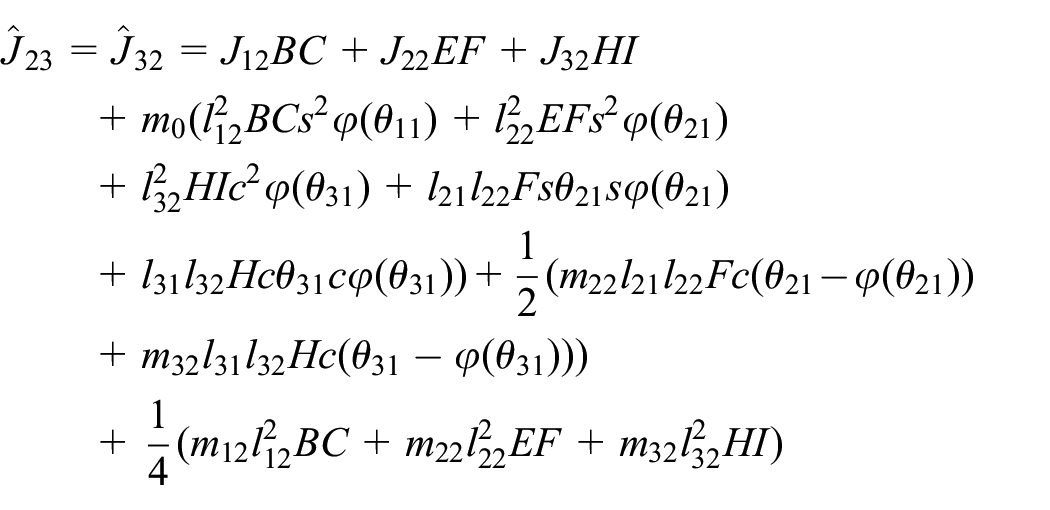
When the equivalent rotational inertia of the system is obtained, the parameters in the Coriolis force and centrifugal force matrix can be obtained according to the Lagrange equation:

By calculating the gravity potential energy of each link and moving platform, the gravity matrix can be expressed as follows:
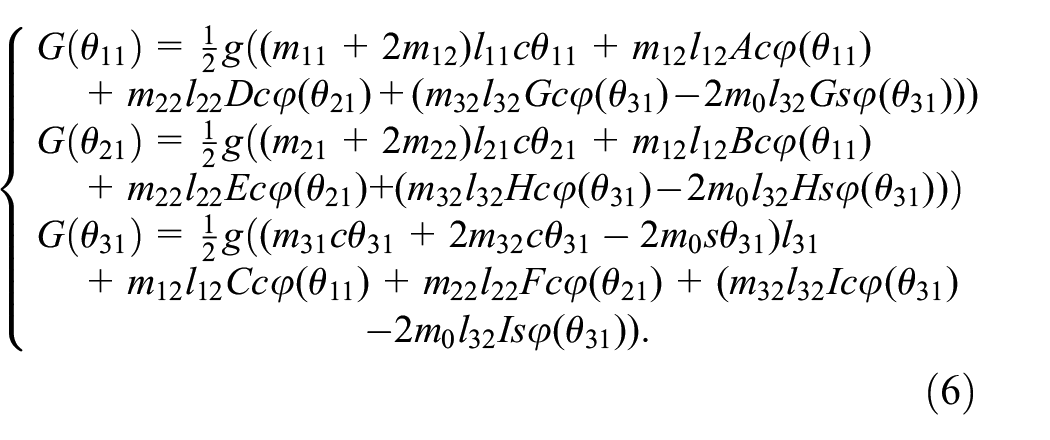
So far, according to the above matrix parameters, the dynamic equation of 3-RRC parallel robot without considering constraint can be established.
The complete dynamic equation of the constrained 3-RRC parallel robot
In the actual motion, the constrained force exists in the moving platform and each branch chain. Assume the system has

The equation (7) include all the usual varieties of ideal and non-ideal constraints. Differentiating equation (7) with respect to time, the following matrix form can be obtained:

Where,
Due to the existence of constrained force, the system is not only affected by the active force, but also by the constrained force. Under the combined action, the motion of the system will be changed. The dynamic equation of equation (4) can be written as:

Where,
According to D’Alembert’s principle, the constrained force between the end of each branched chain and the moving platform can be expressed in two forms: ideal constrained force and non-ideal constrained force. The virtual work done by the ideal constrained force is zero, and the virtual work of the non-ideal constrained force is not zero. In this article, the non-ideal constrained force is the friction acted in the manipulator.

As shown in Figure 1,
The U-K method gives the expressions of ideal generalized constrained force and non-ideal generalized constrained force in analytical form:

And

Where,
In totally, the complete dynamic equation of the constrained 3-RRC parallel robot can be written as:

Design of the neural network terminal sliding mode controller
Although the conventional sliding mode control is suitable for 3-RRC parallel robot, the system still has obvious chattering, large adjustment time, and low control accuracy. In order to reduce the adjustment time of the control system and solve the singular problem of the controller by switching the corresponding linear sliding mode surface, the terminal sliding mode control system is designed for the 3-RRC parallel robot.
Considering that the angle variable of each drived link is a function of the driving link, the aim of position tracking control of parallel robot is to require the angle variable
The tracking error is defined as:

Where,
The terminal sliding mode control surface can be designed as:

Where,
Because the terminal sliding mode control has obvious chattering phenomenon, and considering the uncertainty of non-ideal constrained force, the universal approximation characteristic of neural network is used to approach the non-ideal constrained force
The output function

According to the approximation theorem of RBF neural network, the desired neural network output is:
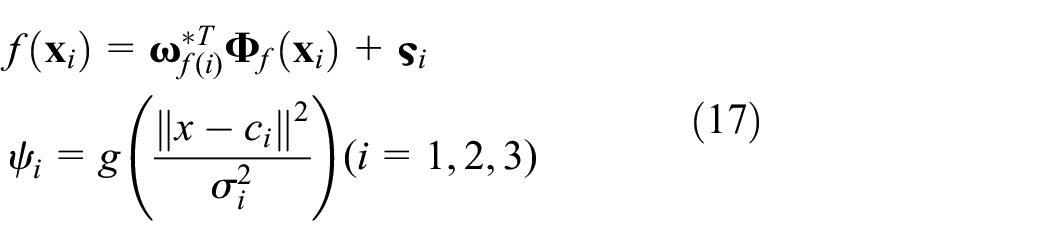
Where, ‖·‖ represents the Euclidean norm,
The actual output of the RBF neural network is written as:

The design of the neural network terminal sliding mode controller is obtained as follows:

Where,
The stability of the neural network terminal sliding mode controller shown in equation (19) is analyzed below, and the Lyapunov function is selected as:

Since

When

From equations (15), (20) and (22), it can be obtained:

When
In order to simplify equation (23),

From equation (24), it can be obtained:

Make

The adaptive law is designed as:

Then equation (23) can be expressed as:

Substituting equation (27) into equation (28), one can get:

According to the universal approximation theorem of neural network, it is existed that

There exists a small positive real number

From equations (29)–(31), it can be obtained:

In the control system, take

Based on the above analysis,
Simulation experiment
In order to verify the correctness and effectiveness of the proposed control algorithm, taking the 3-RRC parallel robot in Figure 1 as the research object, the control algorithm designed in this paper is verified by simulation experiments with MATLAB.
It can be seen from Figure 1 that the end of three branch chains are connected with the moving platform, and the driving link and drived link are subject to motion constraints. According to equation (2), the angle variables

Take the second derivative of equation (34) to get the following equation:

Equation (35) can be written in the matrix form of equation (8):

By substituting each matrix in equation (36) and each matrix parameter in equation (4) into equation (11), a complete analytical expression of ideal constrained force can be obtained. Considering the uncertainty of non-ideal constrained force, the proposed neural network terminal sliding mode control algorithm is used to approximate the non-ideal constrained force
Each link and moving platform of the 3-RRC parallel robot is regarded as a rigid body, and physical parameters and control parameters are shown in the Table 1:
Physical parameters and control parameters.

According to the complete dynamic model of 3-RRC parallel robot, the terminal sliding mode surface is constructed by introducing nonlinear function. This method not only improves the response speed of the control system, but also avoids the singularity of the controller. Considering the uncertainty of non-ideal constrained force and the chattering problem of terminal sliding mode control algorithm, the neural network method is used to adaptively adjust the gain of switching function and realize the universal approximation to unknown constrained force. The structure of neural network terminal sliding mode control system of 3-RRC parallel robot is shown in the Figure 2:

The block diagram of control system structure for 3-RRC parallel robot.
The simulation results of Figures 3 to 5 shows the position tracking and tracking error of driving link

The angle position tracking and tracking error of the link

The angle position tracking and tracking error of the link

The angle position tracking and tracking error of the link
The simulation result of Figure 6 represents the control driving torque of link

The control driving torque of link
The simulation result of Figure 7 shows the tracking of non-ideal constrained force. The red solid line represents the desired non-ideal constrained force, and the blue solid line is the actual non-ideal constrained force approximation and tracking.

The non-ideal constrained force approximation and tracking.
The Table 2 lists the maximum value of the control driving torque and the maximum error of the Figures 3 to 7 in the stable stage.
The maximum value and the maximum error.

From the above simulation results, the control algorithm proposed in this paper meets the control requirements, and the following three conclusions can be drawn:
In the stable stage of the angle position and non-ideal constrained force tracking of each link, the tracking accuracy of the angle position and non-ideal constrained force reaches the order of 10−2, and the angle position relationship between link
From each simulation curve, there is no chattering phenomenon in each simulation result, which proves that the control algorithm proposed in this paper overcomes the chattering phenomenon when using sliding mode control alone.
Combining the neural network with the terminal sliding mode control, this paper effectively realizes the high-precision approximation and tracking control of non-ideal constrained force in 3-RRC parallel robot, and makes the dynamic model of parallel robot more complete in practical application.
Conclusion
In order to realize the high-precision control of 3-RRC parallel robot, the complete dynamic model of 3-RRC parallel robot is established by combining Lagrange method and U-K equation. Considering the uncertainty of non-ideal constrained force and the chattering problem of terminal sliding mode control algorithm, the neural network method is used to adaptively adjust the gain of switching function and realize the universal approximation to unknown constrained force. Then the neural network terminal sliding mode control algorithm is proposed, and the stability of the control system is proved by Lyapunov theorem. Finally, the 3-RRC parallel robot is simulated and verified. The simulation results show that the tracking errors of each link and non-ideal constrained force reach the order of 10−2, which effectively realizes the high-precision approximation and tracking control of angle position and non-ideal constrained force in the 3-RRC parallel robot, and weakens the chattering phenomenon when using sliding mode control alone, so the correctness and effectiveness of the proposed dynamic model and control algorithm are verified. The dynamic modeling method that combining Lagrange and U-K equation is suitable for most multi-DOF mechanical systems, which has great popularization and application value.
Footnotes
Handling Editor: Chenhui Liang
Declaration of conflicting interests
The author(s) declared no potential conflicts of interest with respect to the research, authorship, and/or publication of this article.
Funding
The author(s) received no financial support for the research, authorship, and/or publication of this article.
