



Abstract
In order to achieve high precision control of the dexterous hand, an adaptive neural network sliding mode control algorithm based on the U-K (Udwadia-Kalaba) equation is proposed. Firstly, based on the U-K equation and considering the ideal and non-ideal constrained force at each link of the dexterous hand, the detailed dynamic equation is derived. Secondly, considering the uncertainty of the non-ideal constrained force (mainly the friction force on each link of the dexterous hand) and the chattering phenomenon when using sliding mode control alone, the adaptive neural network and the sliding mode control algorithm are combined to realize the high-precision tracking and estimation of each link angle trajectory and the non-ideal constrained force. Finally, in order to verify the correctness and rationality of the proposed algorithm, the 3-DOF spatial dexterous hand is taken as the simulated object. The simulation results show that the tracking and estimation errors of each link angle and the non-ideal constrained force are 10−2 order of magnitude.
Keywords
Introduction
Dexterous hand is the last contact of the interaction between robot and environment, which directly affects the robot’s maneuverability and intelligent level. The single-DOF end effector, which is widely used in the industrial field, has simple structure and convenient control, but its versatility is poor, and it is difficult to arbitrarily grasp objects with complex shapes. Therefore, in order to adapt to various grasping tasks, multi-DOF dexterous hand has become one of the research hotspots in the robot field in recent years.
The most important function of dexterous hand is to achieve the task of operation and grasping. The accuracy of constraint solution directly affects the accuracy of dexterous manual mechanical modeling, 1 and the accuracy of dynamic equation is very important for the high-precision control of grasping and positioning. The dexterous hand has three to five fingers, which can be regarded as a multi-DOF rigid body system. For the dexterous hand, the interference of the restraint and the external environment is uncertain, and the conventional modeling and control methods are no longer applicable, so new theories and methods must be explored.
A lot of academic researches solved the constrained force of the dexterous hand. Lippiello et al. 2 transformed the constrained force optimization problem of dexterous hand into a convex optimization problem, and proposed a solution suitable for online implementation. By dynamically reducing the number of active torque constraints, the computational load was greatly reduced. Nguyen and Véronique 3 solved the constrained force of the tendon driven dexterous hand, and then realized the strong grasping and operating potential of the dexterous hand by controlling the maximum torque and constrained force. However, the performance of the force control algorithm is still poor when the recoil force of dexterous hand is high. Kaya et al. 4 proposed a force compensation method based on model to complete the estimation calculation of the environmental constrained force of multi-joint dexterous hand. The method considered a variety of constrained reaction forces at the end of the dexterous hand, but lacked the decomposition solution of the viscous friction force, making its dynamic model incomplete. Mavrogiannis et al. 5 proposed an optimal solution to solve the forced closure constraint of a dexterous hand, taking into account the mechanical and geometric constraints imposed by the shape design of the hand and object. Ji and Peng 6 put forward a method to acquire constrained force for three-fingered dexterous hands in operational tasks.
Liu et al. 7 and Lin et al. 8 both approximate the size and direction of the constrained force by covering dense tactile sensors at the fingertips of the dexterous hand. Ma et al. 9 aiming at the uncertainty of the constrained force of dexterous hand, established the environmental attraction region by using the model in the configuration space, and then configured and generated the offline grasping plan, and then eliminated the uncertainty of the constrained force through online dynamic adjustment. All of the above constrained force solutions only consider the constraint of perpendicular constraint reaction force on the surface of the object, while the influence of the tangential friction is not taken into account. Therefore, the problem of constrained force solving has not been completely solved.
The dexterous hand can be regarded as the general mechanical rigid body system.10,11 So far, there are many researches on the dynamic modeling of the constrained mechanical system. Lagrange was the first to use Lagrange multiplier method for the motion analysis of the constrained mechanical system, which is difficult to get the Lagrange multiplier. Gibbs and Appell solve the dynamic equation by adding auxiliary variables and using Appell equation, but it is difficult to be used in the research of multi-DOF dexterous hand. Udwadia and Kalaba proposed the constraint equation of multi degree of freedom mechanical system, which is called U-K equation.12–17 According to the D’Alembert’s principle, 18 the virtual work done by the ideal constrained force is zero, while the virtual work done by the non-ideal constrained force is not zero. The U-K equation is suitable for ideal and non-ideal constrained force.
At present, some scholars use U-K equation to model and solve different mechanical systems. Liu and Liu 19 and Huang et al. 20 used this equation to obtain the dynamic models of the series and parallel robots respectively. Zhao et al. 21 successfully established the dynamic equation of mechanical fish through the equation. By now, the above researches only consider the ideal constrained force, and lack the modeling and solving of non-ideal constrained force. In addition, the U-K equation has not been used to solve the constrained force of dexterous hand.
Dexterous hand is a typical mechatronics system. In addition to friction, saturation and other nonlinear factors, there is a strong coupling relationship between the links. The characteristics of sliding mode control22–24 are suitable for the control of dexterous hand. On the one hand, when designing the sliding mode control system, there is no need to do special decoupling for the internal coupling of the system. It can be designed according to the own independent systems, and the selection of parameters is not strict. On the other hand, the sliding mode control has strong robustness to parameter perturbation and external disturbances, and has fast response speed, small amount of calculation and simple physical implementation.
Although the sliding mode control has the advantage of invariance, the discontinuous switching characteristics of the sliding mode control will cause chattering. A lot of researches have been done on anti-chattering problem of the sliding mode control. Xu et al. 25 divided the control law into three parts: equivalent control, switching control, and continuous control. Eun et al. 26 designed a discrete sliding mode control. By designing an observer to observe the interference at the input end of the control, the interference was effectively compensated and chattering was effectively eliminated. By designing an adaptive integral term to replace the switching term, Wong et al. 27 realized the adaptive adjustment of the gain of the switching term, effectively reduced the gain of the switching term, and thus weakened chattering. Lakhekar et al. 28 combined fuzzy control with sliding mode control to reduce the influence of state switching through the empirical characteristics of fuzzy rules, thus reducing chattering of sliding mode control. Ren et al. 29 developed an adaptive fault-tolerant BC by utilizing strict formula derivations to compensate for unknown composite disturbance, dead zone, and actuator fault in the FS system. Huang et al. 30 proposed a method based on the combination of RBF neural network and sliding mode control, and used the approximation ability of neural network function to load the switching state quantity into the neural network function in the form of input quantity, thus achieving the purpose of eliminating chattering. Li et al. 31 proposed a novel neural network and sliding mode control architecture for the intuitive and unmarked visual remote operation of dexterous hands, and realized the high-precision control of dexterous hands. Liu et al. 32 designed a new neural-network-based sliding-mode control of an uncertain robot is presented, which is handled by using the neural-network strategy to adapt the unknown dynamics and disturbances. Ren et al. 33 developed an adaptive neural-network (NN) boundary control scheme for a flexible manipulator subject to input constraints, model uncertainties, and external disturbances. In this article, based on the U-K equation and considering the chattering phenomenon of the sliding mode control, an adaptive neural network sliding mode control algorithm is proposed. Compared with the above control algorithm, the main contributions in this article are highlighted as follows.
Based on the U-K equation and considering the uncertainty of the non-ideal constrained force, the high-precision approximation is realized to solve the non-ideal constrained force through the universal approximation property of the neural network. Meanwhile, the dexterous hand system control is realized without the precise mathematical model of the controlled object.
In the multi-DOF dexterous hand system, the neural network control, sliding mode control, and adaptive algorithm complement each other. The neural network overcomes the chattering phenomenon of the sliding mode control, the sliding mode control avoids the disadvantage that neural network is easy to fall into local minimum when learning, and adaptive algorithm ensures the stability of the whole system.
This paper is organized as follows. Based on theU-K equation, the complete dynamic equations of dexterous hand under ideal and non-ideal constrained forces are obtained. Aiming at the uncertainty of non-ideal constrained force of each link and chattering phenomenon of the sliding mode control, the adaptive neural network and sliding mode control method are combined to achieve high-precision control of dexterous hand. The stability of the system is proved by Lyapunov theorem. In order to verify the effectiveness of the control algorithm, a 3-DOF spatial dexterous hand is studied.
The Udwadia-Kalaba equation
The dexterous hand can be regarded as the multi-body system. To the multi-body system without constraint, the dynamic equation 24 of n-DOF system can be established as:

where
When the system has

The

Equations (2) and (3) are derived for time respectively, and the constrained equation 20 of the system is as follows:

Where
Considering the ideal and non-ideal constrained force, the equation (1) can be expressed as:

Where
According to the D’Alembert’s principle, the

where
On the basis of the U-K equation, the detailed analytic expressions of the ideal and non-ideal constrained forces are as follows:

and

where
Dexterous hand model
The dexterous hand with multi-sensor and multi-DOF is a highly integrated mechanical system, which integrates the mechanical, driving, sensing, and microprocessor systems. Each finger of the dexterous hand can be regarded as an independent multi-body.
In order to verify the effectiveness and correctness of the dynamic model and control algorithm, a 3-DOF spatial dexterous hand is taken as the research and simulation object, and the model is shown in Figure 1.

3-DOF dexterous hand model.
Figure 1 shows a simplified model of a three link dexterous hand. The first link rotates, and the second and third links pitch. The length of link 2 and link 3 respectively are

where,
The variables of the mass matrix

The variables of the coriol and centrifugal torques matrix

The variables of the gravitational torque vector
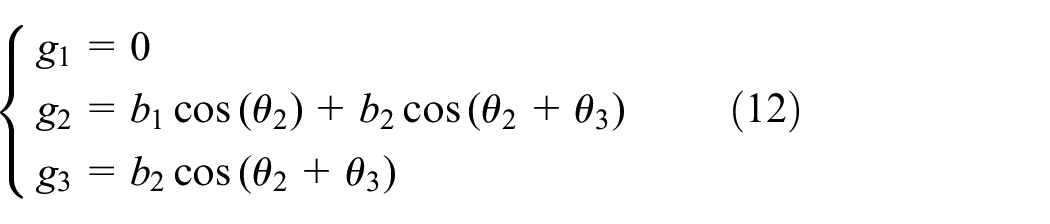
where,
Adaptive neural network sliding mode control for dexterous hand
According to the dynamic model, define the tracking error:

The sliding mode surface is designed as follows:

From the above equation, it can be obtained:

The equation (15) are multiplied by the matrix

where
The sliding mode controller is designed as follows:

where
According to the expression of

According to the learning process of the RBF neural network, the ideal output of the RBF neural network is as follows:

where,
The actual output of RBF neural network is set as follows:

Make
Then equation (20) is substituted into equation (17), and the neural network sliding mode controller is obtained as follows:

Substituting equations (19) and (21) into equation (16), the following results can be obtained:
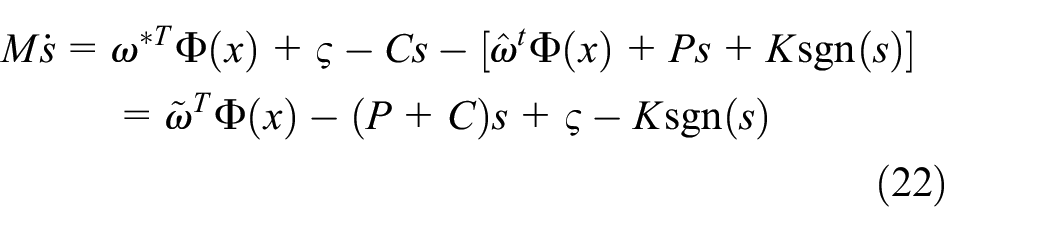
In order to verify the stability of the control system, the Lyapunov function is taken as:

where,
The matrix characteristics of the dexterous hand is

Substituting equation (22) into equation (24):

Because of the following formula:

From equations (25) and (26), it can be obtained that:

Since

In order to get a stable control system, the adaptive law of RBF neural network weight adjustment is designed:

Substituting equation (29) into equation (27):

When

When
Simulated example
In order to verify a set of constraints given for the 3-DOF dexterous hand in Figure 1, the constraint is the angle trajectory constraint of each link, and the constraint condition is:

Take the second derivative of the equation (32) with respect to time, and the second-order constraint form can be obtained as follows:

According to the constraint equation form of the equation (4), one can get:
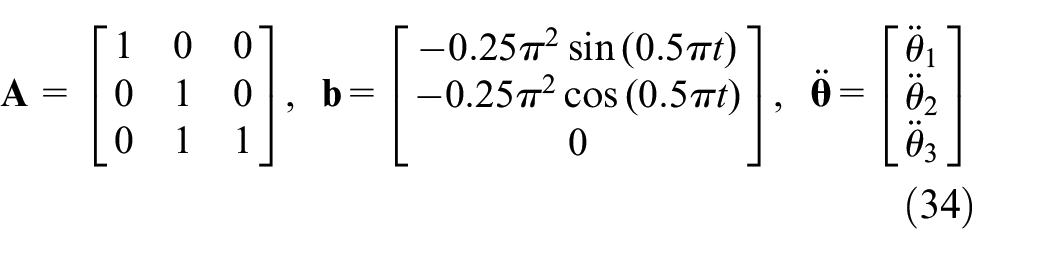
In addition, the ideal constrained force at each link of the dexterous hand can be obtained according to equation (4), but the vector
The physical parameters of the three-link dexterous hand are set as:

The control parameters of the control algorithm are set to:

Structure diagram of control system for three-link dexterous hand.
The simulation results are shown in Figures 3 to 7. Figures 3 to 5 shows the angle trajectory tracking and tracking error of each link, in which the red solid line represents the angle trajectory given in theory and the tracking error, and the blue dotted line represents the actual angle tracking trajectory. Figure 6 shows the control torque of each link. Figure 7 shows the input and estimated approximation of the non-ideal constrained force of each link, in which the red solid line represents the input value and the blue dotted line represents the estimated approximation value.

The angle tracking and tracking error of the link 1.

The angle tracking and tracking error of the link 2.

The angle tracking and tracking error of the link 3.

The control torques of the dexterous hand.

The input and estimation of the non-ideal constrained force.
The maximum error values of the angle trajectory tracking and non-ideal constrained force approximation estimation errors of each link in the above figures in the stable stage are shown in the following table:

From the above simulation results, it can be seen that the adaptive neural network sliding mode control algorithm can realize the high-precision approximation and tracking of the angle trajectory and non-ideal constrained force of the dexterous hand. Three conclusions can be drawn as follows:
In the aspect of angle trajectory tracking, the tracking error of each link in the stable stage is close to 0, and the angle relationship between link 2 and 3 satisfy the constraint conditions, which proves that the dynamic model and control algorithm are effective and meet the control performance requirements.
In terms of control torque, the simulation result shows that the torque curve of each link has no chattering phenomenon, which proves that the universal approximation characteristic of the adaptive neural network algorithm overcomes the chattering hidden trouble of the sliding mode control.
In the non-ideal constrained force approximation estimation, the adaptive neural network algorithm used in this paper achieves the approximation and estimation of the uncertainty of non-ideal constrained force, which makes the dynamic model of dexterous hand more complete in practical application.
Conclusion
This paper presents an adaptive neural network sliding mode control method for dexterous hand. Based on the U-K equation, the complete dynamic equations of dexterous hand under ideal and non-ideal constrained forces are obtained. Aiming at the uncertainty of non-ideal constrained force of each link and chattering phenomenon of the sliding mode control, the adaptive neural network and the sliding mode control method are combined to achieve high-precision control of dexterous hand. The stability of the system is proved by Lyapunov theorem. In order to verify the effectiveness of the control algorithm, a 3-DOF spatial dexterous hand is studied. The simulation results show that the tracking errors of each link angle and the non-ideal constrained force are 10−2 order of magnitude. The high-precision control for the angle/force control of the dexterous hand is realized, and the chattering phenomenon caused by single sliding mode control is suppressed. In the future, the dynamic modeling method and adaptive neural network sliding mode control algorithm proposed in this paper will be extended to other multi-DOF mechanical systems, and will also be applied to practical engineering applications.
Footnotes
Handling Editor: Chenhui Liang
Declaration of conflicting interests
The author(s) declared no potential conflicts of interest with respect to the research, authorship, and/or publication of this article.
Funding
The author(s) received no financial support for the research, authorship, and/or publication of this article.
