




Abstract
This study examines an extended view of both actors and roles of Action Research studies in the field of management. More specifically, we study the new actors and roles considering three specific support infrastructures: long-term funded projects; collaborative agreements; and educational programs. We carry out three stages based on a systematic literature review with Prisma methodology. Our findings permit identifying new actors and roles along the four factors of the complete theory of Action Research: context, relationships, process and outcomes. In this way, new actors such as the head of educational program, project researcher network, head of communication, lawyers, academic supervisor or senior management incorporate roles such as supervisor, facilitator, advisor, visualizer, or follower appear in these scenarios. The implications of these AR network of both roles and actors imply an increasing complexity to manage AR studies but, at the same time, the fact that these new actors may increase the visibility of AR projects and to enrich the process. This new map of actors and roles permits us to develop the “Action Research network”. We demonstrate the influence and challenges of this network in the four elements of complete action research theory. Furthermore, we highlight how support infrastructures are important in building formalized bridges that promote university-firm relationships in practice and increase their social impact.
Introduction
Action research (AR) is a research methodology that carries a significant weight in the field of management. From the 1980s, and with papers such as those by Susman and Evered (1978) and Evered and Louis (1981), this methodology has appeared in management literature as a tool to render empirical research more practical and bring it closer to the real problems facing firms. During the 90s and 00s, AR was considered to be a relevant qualitative research methodology in areas such as operations management, information systems, marketing and human resources.
However, AR has evolved and nowadays is defined not so much as a methodology or approach but as a research approach (Coughlan & Coghlan, 2024). Shani and Coughlan (2021a) develop a reflective study of AR in the field of business and refer to different challenges that may guide further research and action as well as assisting future reflection.
Analysing the roles that influence the integral performance of AR is essential for fostering effective relationships between the diverse agents in a collaborative project. In support of this view, Coghlan and Shani (2005) emphasize that the interplay of roles, politics, and ethics is central to the design and implementation of any AR project. They argue that for novice researchers, managing these issues is crucial, as the willingness of participants to engage in the process is directly related to the clarity established among all actors involved.
Gummesson (2000) shows that AR can be conceived as an approach that responds to a series of rules, such as: (1) being collaborative, providing an activity that takes into account the interests of the interlocutor; (2) having a dual objective, insofar as the same activity has a practitioner interest as well as a research interest; (3) providing a research activity that takes into account the practitioner’s participation, as well as an operational activity that takes into account the researcher’s participation. These, along with other norms, foster a process of interdependence between research and business activity that lends content to the approach and provides, among other things, a superior interaction and process of communication and integration between practitioner and researcher (Guercini, 2004). However, at the same time, it involves new actors that incorporate new roles that may help to face those challenges defined in Shani & Coghlan (2021a).
In this study, we introduce the concept of a ‘support infrastructure,’ which we link to Susman and Evered’s (1978) original notion of the ‘infrastructure of the system.’ They defined this as the key instrument used for the dual purpose of alleviating an immediate problem while also generating new knowledge about system processes. This powerful concept has been largely overlooked in subsequent AR literature, and we consider its rediscovery and application to be a main contribution of this research.
The underlying hypothesis of this study is that AR in management has evolved, and that it is necessary to reframe the roles and actors that define the interactions in AR studies. The aim of this study is to focus on answering the following research question:
In order to answer this question, we combine a conceptual essay with a systematic review. This permits to highlight those aspects of the paper more relevant to both researchers and managers/practitioners and also to carry out a rigorous review of the AR literature related to roles and actors. In this way, this paper is directed at both researchers and managers/practitioners. With regard to the former, our intention is to encourage them to develop research studies based on AR within the scope of business networks. In the case of the latter, this paper shows the need to implement open innovation practices as a way of creating an infrastructure that enables different agents (firms, public organization, business associations, NGOs, etc.) and research groups to interact and develop win-win relationships.
This paper is structured in the following sections. Firstly, as a conceptual essay, we describe the evolution of AR in the fields of business and management. This enables us to show how our study fits in with new AR issues and trends in these specific areas. Then, we explain our findings using an AR methodological approach based on three stages, whereby we show the main findings related to the RQ we take into consideration in the Introduction. In the following section, we carry out a systematic literature review based on Prisma methodology, and we show how our findings engage with previous literature that analyses the evolution of AR in business and management. Lastly, we briefly summarise the conclusions, limitations and further research.
Action Research in the Fields of Business and Management
There are several factors that explain the evolution of AR in the field of management from the 2010s onwards. The first is that AR is considered to be an approach methodology when incorporated in management journals, although it is true that most papers also use the feature of “approach” (Westbrook, 1995). Some years earlier, Coghlan (2010) had highlighted the fact that AR had come to be understood as a family of practices expressed through modalities focusing on different assumptions, contexts and starting points.
A second aspect that determines the evolution of AR is that even today AR, along with other collaborative research methods (De Wit-de Vries et al., 2019), is considered to be a critical bridge to fill the gap between theory and practice: This is worthy of mention, as collaborative projects may be considered an open innovation tool to improve university-firm relationships (Ollila & Yström, 2017). While AR and Open Innovation (OI) have traditionally developed as distinct fields, recent scholarship has increasingly recognized their synergistic potential. For instance, Doppio et al. (2020) demonstrate how AR can be utilized to design innovation contests that facilitate OI within SMEs by breaking down collaborative barriers. Similarly, Katzy et al. (2013) highlight the role of innovation intermediaries in managing collaborative processes through an AR lens, emphasizing the co-creation of knowledge across organizational boundaries. Furthermore, in specialized sectors such as healthcare, Núñez-Merino et al. (2025) employ AR to identify and implement innovative solutions within the Industry 4.0 context, showing that the iterative nature of AR is particularly suited for managing the complexity of open, multi-actor innovation ecosystems. In this vein, we consider the connection between AR and OI to be one of the dimensions requiring further analysis, and it is worth pointing out that AR is especially useful when analysing the social impact of innovation.
Thirdly, it is worth emphasising that in the first stage most AR studies focused on firms. Nevertheless, it is more common to find practitioners with specific features such as universities (Paes et al., 2017), public administrations (García-Navarro et al., 2019), hospitals (Marín-García et al., 2020) or innovation intermediaries (Franzó et al., 2023). This implies that the relationship between researcher and practitioner may be different in these cases than with firms. Thus, we can find papers that analyse the specific features of doing AR studies in non-traditional firms. It is also worth highlighting the increasing importance of AR for both the service research community and the subfield of organisational change and development (Shani and Coghlan, 2021b).
Figure 1 summarises, from our viewpoint, the main changes associated with the use of AR in the field of management, and we have included a third column to highlight how new roles may emerge because of these changes. Thus, we consider our paper to be in line with conclusions drawn by Shani and Coghlan (2021a) and Ollila and Yström (2020). Evolution of AR in the fields of business and management and implications in roles and actors. Source: Authors’ own elaboration
Methodology
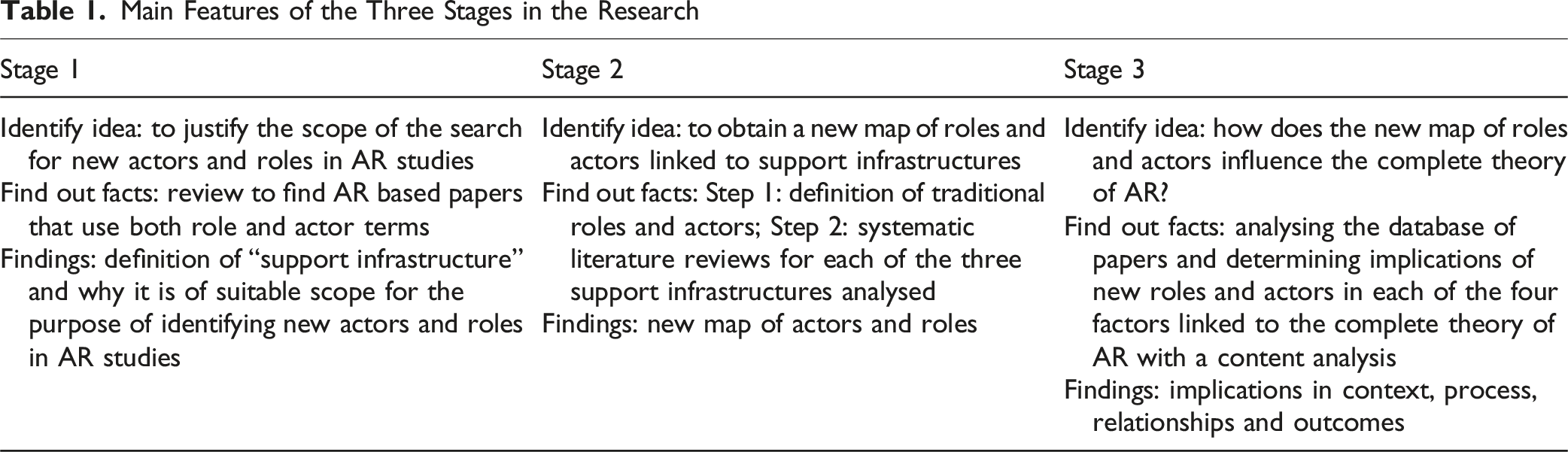
In order to answer our research question, we carry out three sequential stages, as in Figure 2. More specifically, in Table 1, we summarise how we have acted in each of the three stages. We then carefully describe how we have obtained the information in order to conclude the findings in each of the three stages. Description of three methodological stages. Source: Authors’ own elaboration Main Features of the Three Stages in the Research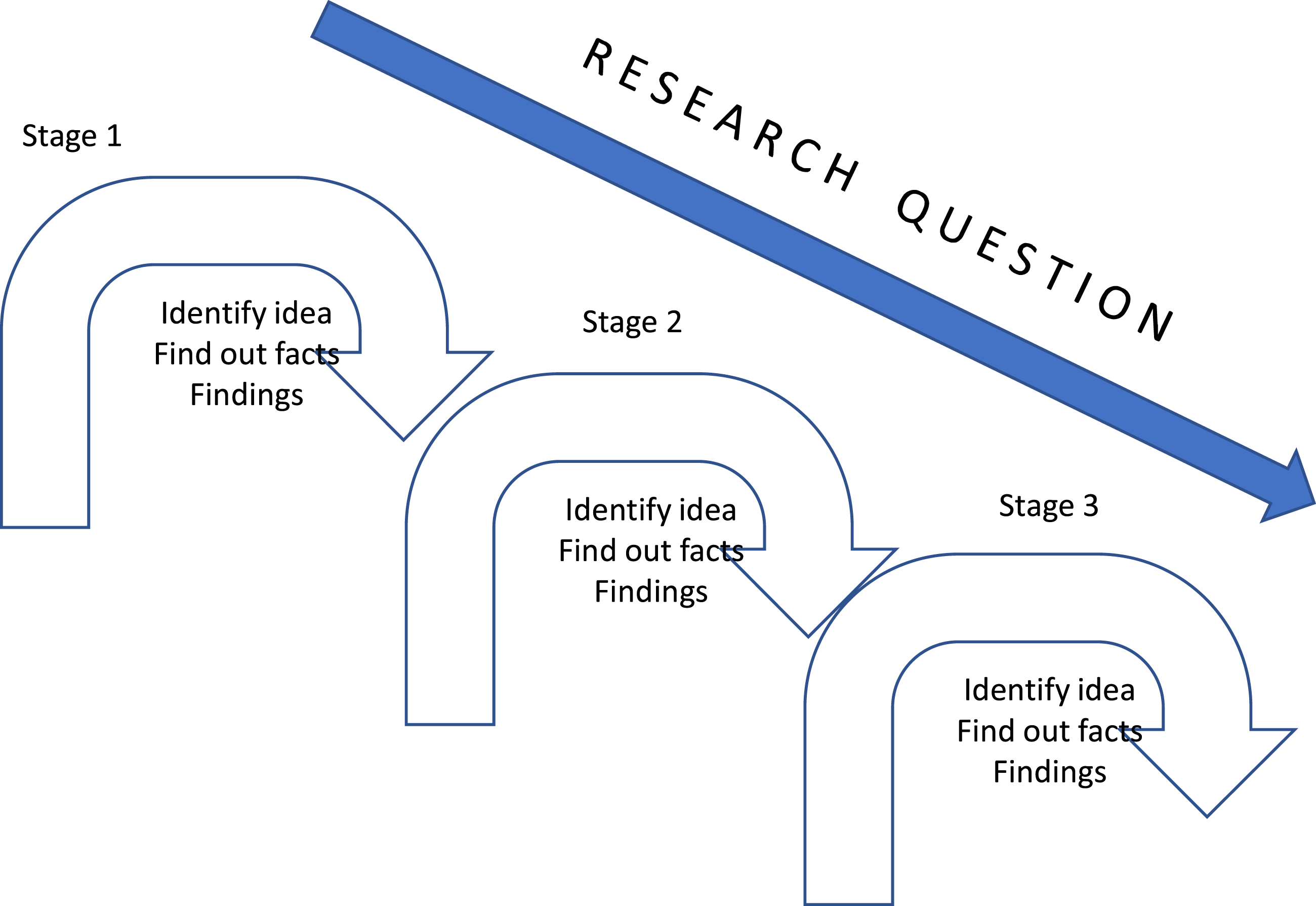
Stage 1: Support Infrastructure: Concept and Types
As pointed out in the Introduction, the concept of “support infrastructure” is linked to that of “infrastructure of the system”, which can be characterised as a tool that alleviates the immediate problematic situation, and generates new knowledge about system processes. Susman (1981) highlights the fact that within a client system, a network of both informal and established face-to-face groups typically forms to address problems using AR. The client system itself can be a single face-to-face group, an organization, or a broader network of organizations. This dynamic shows how AR facilitates the formation of collaborative groups to tackle specific issues, whether at a small or large scale. (p. 146). A similar concept to the “support infrastructure” could be the “buffer zone”, which is defined by Bennett and Brunner (2022) as “a dynamic, contextual space and set of practices necessary to undertake participatory research within complex and changeable settings. This has implications for research management, design, funding and training” (p. 74). In this case, they present the case of What Works Scotland - a research centre committed to collaborative AR. In terms of roles, by taking the support infrastructures into consideration and according to Coghlan and Shani (2005), “the greater the variety of structures and processes in the AR inquiry mechanisms, the greater the challenge of developing role clarity within and outside the AR inquiry mechanism” (p. 543).
In line with Alfaro-Tanco et al. (2021), we have considered three options: collaborative agreements between a university and an organisation; competitive research projects funded by local/national/international and public/private organisations; and educational programmes.
With respect to the first option, collaborative agreements can be a useful infrastructure for developing AR research projects in the field of management. The aim of this infrastructure is to design, monitor and assess research projects with dual contributions, which is the right scope for developing the AR methodology. Secondly, many AR studies will most likely be carried out under the umbrella of competitive research projects. One example is the study described in Coghlan and Coughlan (2006), which forms part of the results obtained from CO-IMPROVE, a European Union (EU) funded project. Thirdly, there is a field of AR that analyses the most influencing factors regarding the benefits of using AR methodology within educational programmes. For instance, Zuber-Skerritt and Fletcher (2007) emphasised the quality points for a PhD thesis based on AR, while Coghlan (2007) showed the features of a PhD thesis using AR, in whose case the PhD student is a manager who acts jointly as researcher and practitioner: an -insider action researcher.
In this sense, we are aware that this work does not attempt to make an in-depth analysis of all the types of support infrastructures that may exist, but rather, just to focus on three of them to show how they give rise to the emergence of both new roles and actors, and this may have a relevant influence on the complete theory of AR.
Stage 2: New AR Network Maps of Both Actors and Roles
As pointed out in the Introduction, we define actors as the individuals or organisations that participate in the AR process, while we assume that roles represent the functions that the actors play in the different stages of AR studies.
Traditional Actors and Roles
First of all, it is important to define both actors and roles. In the case of the second concept, we cite the definition provided by Coghlan and Shani (2005, p. 535): “…role in the context of AR as patterns of behaviour which individuals expect of others performing specific functions or tasks”. However, for actors, we define them as referring to” the individuals that participate in the AR process, while we assume that roles represent the functions that the actors play in the different stages of AR studies”.
Thus, the boundaries between the roles of academic and non-academic actors may become blurred (Lindhult & Axelsson, 2021). Katz and Kahn (1978, p. 206) refer to role ambiguity as uncertainty about what the occupant of a particular office is supposed to do.
An AR project will always have two main actors: researcher or ARer and practitioner. For the former, we can distinguish between external and insider action researchers. The second type refers to when managers or workers undertake AR projects within their own organisation. Consequently, insider AR has its own peculiarities, which distinguish it from an external AR approach (Coghlan, 2001).
External/Outsider Action Researcher
Greenwood and Levin (1998) point out that the foundation of AR was that the researcher’s role changed from observer to agent (participant in specific problem-solving and real-life issues). Notwithstanding this, we think the first role remains relevant in their capacity as external action researcher. Eden and Huxham (1996) highlighted the necessity for management action researchers to extend their consultancy role by being reflective and self-aware, and this is related to the role of the expert: Kates and Robertson (2004) point out that the AR researcher must have the ability to interpret and understand the company’s empirical observations, develop concepts and theory, plan and implement interventions, collect, analyse and interpret data in the wake of interventions, construct theoretical explanations, and build joint collaboration within the team and organisation. The researcher also helps the client understand how he or she fits into a system (Perry & Gummesson, 2004). For their part, Westbrook (1995) refers to the following role of the expert by achieving the appropriate rigor involved creating a consistent approach and using tools that could accommodate and acknowledge the commonalities and differences across various sites. This ensured that research maintained a high standard of quality while remaining flexible enough to handle the unique characteristics of each site. Along these lines, Coughlan and Coghlan (2002) and Cassell and Johnson (2006) name this role as agent of change and architect of change, respectively. Eden and Huxham (1996) include the role of expert and adviser: “the action researcher retains a pivotal expert role in providing advice about it, and offering encouragement through processual interventions” (p. 794). Cassell and Johnson (2006) also highlight the pivotal role of the expert in providing advice and such encouragement. The AR process required that researchers in general took an active role and even acted as advisors (Ollila & Yström, 2020).
Lindhult and Axelsson (2021) point out that to better integrate AR in the scientific community, it is crucial to acknowledge the researcher’s valuable role as a co-learner, collaborator, and participant in human and business improvements. This recognition of the collaborative, active, and participative dimensions of science is essential for a more effective and dynamic scientific inquiry process. Susman and Evered (1978) also state that the “action researcher also increases skills at developing organisational infrastructures and networks for enabling members of organisations to plan, organise, learn, and help themselves” (p. 601). Yström et al. (2019) outline a model for learning in interorganisational networks and discuss related challenges that can affect the role as co-learner in AR studies.
In the academic sphere, the researcher takes the role as a scholar theorising the data gained through joint learning and thorough understanding with a view to generating theory, thereby enforcing a separation from practitioners (Ollila & Yström, 2020). The same study highlights the fact that the researcher uses mechanisms in an integrative way in the AR sphere, as the researcher engages the practitioners in shared thinking and acting. In doing so, the researcher takes on a facilitator/enabler role to support joint learning and enable a deeper understanding of all aspects encompassed by the AR project (Ollila & Yström, 2020, p. 405). Cassell and Johnson (2006) also cite this role: “the researcher’s role begins to move away from one of expert to that of enabler” (p. 796). Coughlan and Coghlan (2002) also emphasise that “action researchers are outside agents who act as facilitators of the action and reflection within an organisation” (p. 227).
Insider Action Researcher
Their specific roles are linked to the three main challenges they have to face (Coghlan, 2019): pre-understanding, role duality and managing organisational politics. These imply that the IAR should be an intermediary between academia and the company (McKenzie & Bartunek, 2023; Williander & Styhre, 2006). Coghlan and Holian (2007) also emphasise the relational role as a colleague, researcher and school leader. The role as provider is also shared with the practitioner because this is the agent that gives more or less continuous access to empirical data, to managers and to other actors. The role of observer is also crucial for an IAR: even if he/she works in the organisation, it does not mean that he/she has a holistic view of the problem. Accordingly, the role of observer is very important to ensure that the preunderstanding does not imply a bias. The researcher operates in the role of observer (Brannick & Coghlan, 2007) by understanding, informing others and surviving in organisations other than the one subject to study (Evered & Louis, 1981). We can add the role of politician in facing the third challenge, which implies being politically astute, seeking the right support, and being alert. The IAR has to be effective in favouring change and developing his/her career in the company, and co-generating knowledge (Coghlan, 2019). An additional role is to be that of agent of change, in whose case this is the only credible role for conducting such a fundamental change project within the organisation. The company-driven design of the initial research question ensures the high level of interest by the firm which is required in order to build up corporate motivation to bring about change.
Practitioner
Coughlan et al. (2016) highlighted the importance for both academics and practitioners, each from their own starting point, in engaging with both theory and practice, and also to the role of collaborative research in bridging the gap between theory and practice.
The role of practitioner has not been analysed at all in AR studies to date. Rather, the focus has always been on the action researcher. Swepson (2014) develops the concept of “practitioner inquiry”, and even though the roles of practitioner are not explicitly defined, the roles of analyst and expert can be inferred. It is very important to discern between a problem and a solution, and the role of problem-solver or agent of change is also indicated as follows: “Practitioners are problem-solvers. The systematic logic of AR fits naturally with practitioners’ instincts and can enhance these instincts with practical ways of collecting good information” (p. 643-644).
Ollila and Yström (2020) is a recent study that analyses the roles of practitioner, in which they point to advisors and owner of change. As advisor, practitioners frequently prioritized swift action and implementation of suggestions, advocating for rapid progression and change. They often sought immediate conclusions to guide their actions or act as advisors, even when more time was needed for thorough data analysis and theorizing. This study also unveils a second role that the practitioner assumes: owner of the change, i.e., having the responsibility for implementing new practices which are initiated by the practitioners. One of the findings of this study is that, to the best of our knowledge, we have not found any other papers that analyse the roles of practitioners - a gap which we think should be filled in further research. Figure 3 represents a new conceptual contribution named as “basic network” derived from the review based on papers that explain roles and actors in AR studies. There, we show summarises the two roles identified for the three traditional actors: that of action researcher, insider action researcher and practitioner. “Basic network” traditional actors and roles. Source: Authors’ own elaboration
New Actors and Roles
In order to determine whether the evolution of AR in management has implied the emergence of new actors and roles, we have classified the context in terms of the “umbrella” under which the AR study has developed.
WoS and Scopus Search Queries

Description of Inclusion and Exclusion Criteria

The search strategy did not impose a chronological limit, ensuring a comprehensive capture of the evolution of the field. The resulting selection of 16 articles represents a longitudinal cross-section of the literature spanning from 1992 (e.g., Perry & Zuber-Skerritt, 1992) to 2025. The high degree of selectivity in the final sample is due to our restrictive inclusion criteria, which required papers to move beyond general AR results to provide explicit evidence of roles and the influence of support infrastructures.
In the second step, a manual screening of references from candidate literature, known as snowballing, was conducted. The purpose of this manual search was to enhance the representativeness of the literature in question, and to ensure that all important studies were noted. The full text of these articles was evaluated according to the criteria provided in Table 3. Eventually, 2 additional articles were selected for inclusion in this study. In accordance with this PRISMA method as shown in Figure 4, the final number of articles selected for inclusion in this study was 21. Prisma flowchart. Source: Our adaptation from Ref. Moher et al. (2009)
We then show those non-traditional roles and actors we have identified in the reviews associated with each support infrastructure.
Literature Review 1: Collaborative Agreements
Collaborative Agreement Supervisor
This actor is represented by two people - one in the firm and the other in the university - and they have key roles in ensuring the success of the AR studies pursued within this support infrastructure. More specifically, we have identified three: facilitator, mediator and monitor.
Most interestingly, we have identified two specific cases that illustrate this. Firstly, Larrea (2019) describes the specific case of Orkestra, a research institute in the Basque Country (Spain) that focuses on researching competitiveness and promoting AR studies. This study emphasises the role as monitor and facilitator of the coordinator as follows: “I characterise the role of researchers in developing AR, but my commitment to organisational change … has led me to also experience role duality. My role combines the coordination of AR processes with stakeholders with the facilitation of insider AR processes to develop AR” (p. 407). Secondly, there is the case of Business Chair Volkswagen Navarra – University of Navarra, also in Spain, which was first presented in Avella and Alfaro (2014). In this case, authors emphasise the role of supervisor in solving conflicts and acquiring a global overview of the project and to manage it from the beginning to the end; it contains an overview of all the actors. Additionally, in this specific support infrastructure, it is highlighted the role of the supervisor in dealing with problems caused by the cognitive distance between researchers and practitioners. As for the role of mediator, it is crucial that the supervisor has a close relationship with both researchers and practitioners.
Senior Management
This actor works in the firm and plays the role of project sponsor in both university and the firm/organisation. Coghlan et al. (2012) cited this actor as follows: “…sanctions the effort but is not necessarily involved in the framing of the research focus nor its design.” (p. 56). Ollila and Yström (2017) defined senior management as those managers who are active within a large collaboration or network and do not have their organisational base with any of the collaborating partners. Even though the authors analyse this actor in the context of open innovation practices, we consider there to be AR contexts in which this actor is commonplace. Ollila and Yström (2017) defined two additional roles for this actor: facilitator and sense giver. Senior managers devote a lot of time and effort to facilitating the process of knowledge and technology transfer across people and organisations, and sometimes even among industries - activities that are close to those of intermediating brokers. Avella and Alfaro (2014) explained how top managers from both universities and firms play a crucial role in the success of AR projects. They are involved in the control mechanisms, such as committees that oversee the research activities, and ensure that projects align with the strategic goals of both entities. Their support is essential in order to facilitate funding and credibility, which is aligned with the role of sense giver.
This role may refer to different people in terms of the type of organisation - in the case of Cozzolino et al. (2023) the CEO and the sales director, although Dias et al. (2024) cited municipal authorities and local community members because the collaboration was between a public administration and a university. Another example is Kroeger et al. (2015), where the practitioner is an educational establishment, and the School Administration played the role of sponsor.
Cozzolino et al. (2023) show that this actor is involved in strategic decision-making and overseeing the implementation of the AR project, by participating in meetings, providing leadership, and ensuring that the project is aligned with the companies’ strategic goals. This is the role of aligner. In the case of Dias et al. (2024) these actors facilitate local knowledge and insights, participating as tactician in participatory mapping and helping to implement solutions.
Head of Communication
Ollila and Yström (2017) highlighted the role of Communication, which implies the actor as “head of communication” in both the firm and the university. This actor plays a major role in collaborative agreements as visualizer, with this role being linked to outcomes. One of the main findings obtained from this study is that AR projects represent a tool that visualizes the social impact of both universities and firms/organisations.
Literature Review 2: Competitive Long-Term Research Projects
By ‘competitive long-term research projects,’ we refer to those initiatives that secure resources through a competitive bidding or grant-application process. These funds can stem from either public institutional calls or private research foundations, and may operate within national or international programs (e.g., European Union framework programs or national R&D agencies). The ‘competitive’ nature here describes the selection process for the grant—where researchers must compete against other proposals for limited resources—rather than market competition between firms. This process necessitates a specific formalized structure and a defined set of actors to manage the project’s administrative, legal, and scientific requirements. Most likely, many AR based papers have been presented under this support infrastructure, although there are very few papers that analyse both specific roles and actors when this happens.
Project Champion/Manager
In long-term research projects funded by public/private, national/international organisations, the project champion may have different roles: Coghlan et al. (2004) and Coghlan and Coughlan (2006) explain the experience of CO-IMPROVE, a European Union (EU) funded project which ran from 2001 to 2004, the objectives of which were to develop a business model to support the design, implementation and ongoing development of collaborative improvement between partners in extended manufacturing enterprises. Coghlan and Coughlan (2006) emphasise the role of facilitator, who embraces the tasks of co-ordinator, catalyst, observer, climate setter, communication enabler and learning coach, among others. The facilitator role was played by the project champion, who had a promotional and influential role with a view to gaining support from the decision makers and the participants involved. The project facilitator acted as a learning coach, assisting with the discussions and providing a structured approach towards reflection and progress evaluations. Coghlan et al. (2004) unveil the concepts of “Action Researcher Networks” and describe three levels within the network: local researcher, work package and project researcher. In the AR network (Figure 5) we have included the project champion/manager and assume that it includes the other two levels defined for the specific case of CO-IMPROVE. It should also be emphasised that we have not found any other AR-based papers that describe similar experiences. “Extended network” of actors with influencing roles in AR. Source: Authors’ own elaboration
Project Partners: Academic and Professional
Pereira et al. (2013) explained that project partners are organisations from different countries with complementary areas of specialisation. They have a role involving expertise as they bring diverse perspectives, contributing to the development of shared conceptualizations. Yström et al. (2019) defined their roles in terms of sharing knowledge and engaging in the workshops organised by the researchers. For their part, Dick et al. (2015) pointed out that the project partner could be academic or a practitioner. In the funded research project that is described in this paper, there were three universities involved and two firms, both of which featured the role of expertise.
Literature Review 3: Educational Programmes
Academic Supervisor/Dissertation Advisor/Tutors
These actors share the common role of supervising both the action researcher and the practitioner. The academic supervisor typically appears in educational contexts, such as master’s degrees and, especially, PhD theses. Extensive literature exists on developing AR projects within these programmes. Morales-Contreras et al. (2024) explain that the dissertation advisor plays a crucial role as mentor and monitor, guiding candidates in framing research questions relevant to both practice and academia, counselling them on ethical and practical challenges, and ensuring rigorous reflection in order to minimise biases and manage role duality effectively. Muff (2023) describes how the supervisory team provides training in AR for PhD candidates, while Kelliher and Byrne (2018) argue that tutors in AR play a crucial role by facilitating reflective practice, providing ongoing support and feedback, and fostering a collegial environment.
Stakeholders
In AR, stakeholders are typically individuals or groups with a vested interest in the research outcomes, such as end-users or members of affected communities. They play a crucial role as experts and sense givers by actively participating in the research process, offering external perspectives, feedback and expertise with a view to identifying and solving problems (Kuran, 2024). Their involvement ensures the research is grounded in real-world contexts and addresses practical challenges. Stakeholders collaborate with researchers to co-create knowledge, fostering experiential learning and reflective thinking. This participatory approach enhances the relevance and applicability of research findings, leading to actionable solutions and continuous organisational improvement (Muff, 2023). As experts, stakeholders possess in-depth, practical knowledge of the specific organisational or community context. Their insights into day-to-day operations, challenges and opportunities are invaluable in identifying relevant problems and co-creating solutions.
Updated Map of Actors and Roles
Figure 5 shows the actors identified from the review analysis we presented in the previous section. Most importantly is the fact that we define three concepts that may help action researchers to best define the context of an AR study. We group the actors into three levels. The first refers to “basic teamwork” and is made up of the practitioner and action researcher (external or insider). Basic teamwork has to be defined in any AR study and how the roles listed in Figure 3 will be put into practice will be deemed necessary. Secondly, in those AR projects where the support infrastructure takes the form of an educational programme, the “extended teamwork” will have to be defined, including the roles of both the academic supervisor and senior management. We think there is a trend in developing AR studies under this specific context and, therefore, it should be included in the AR process. Thirdly, the aggregated concept is the “extended network”, which includes all the actors identified, with Figure 5 showing the entity where each of them can be located in terms of AR position (basic teamwork, extended teamwork or just AR network). There are two actors that appear twice because they may be employees of the university or the organisation. These refer to the Collaborative Agreement Supervisor, Senior Manager and Head of Communication. The concept of AR can be useful to use as a reference that includes other actors and roles that have not been identified in this study. For example, there are possibly agents outside the university’s or practitioner’s organisation, but who surely have an influential role in the quality of relationships, process or outcomes.
By way of a summary, Figure 6 lists the roles that we have identified in each actor from Figure 5. This enables us to show the complexity of AR studies when considering support infrastructures. As a result, it is very important to determine the influence of these new roles and actors in the complete theory of AR. New roles associated with each “new actor”. Source: Authors’ own elaboration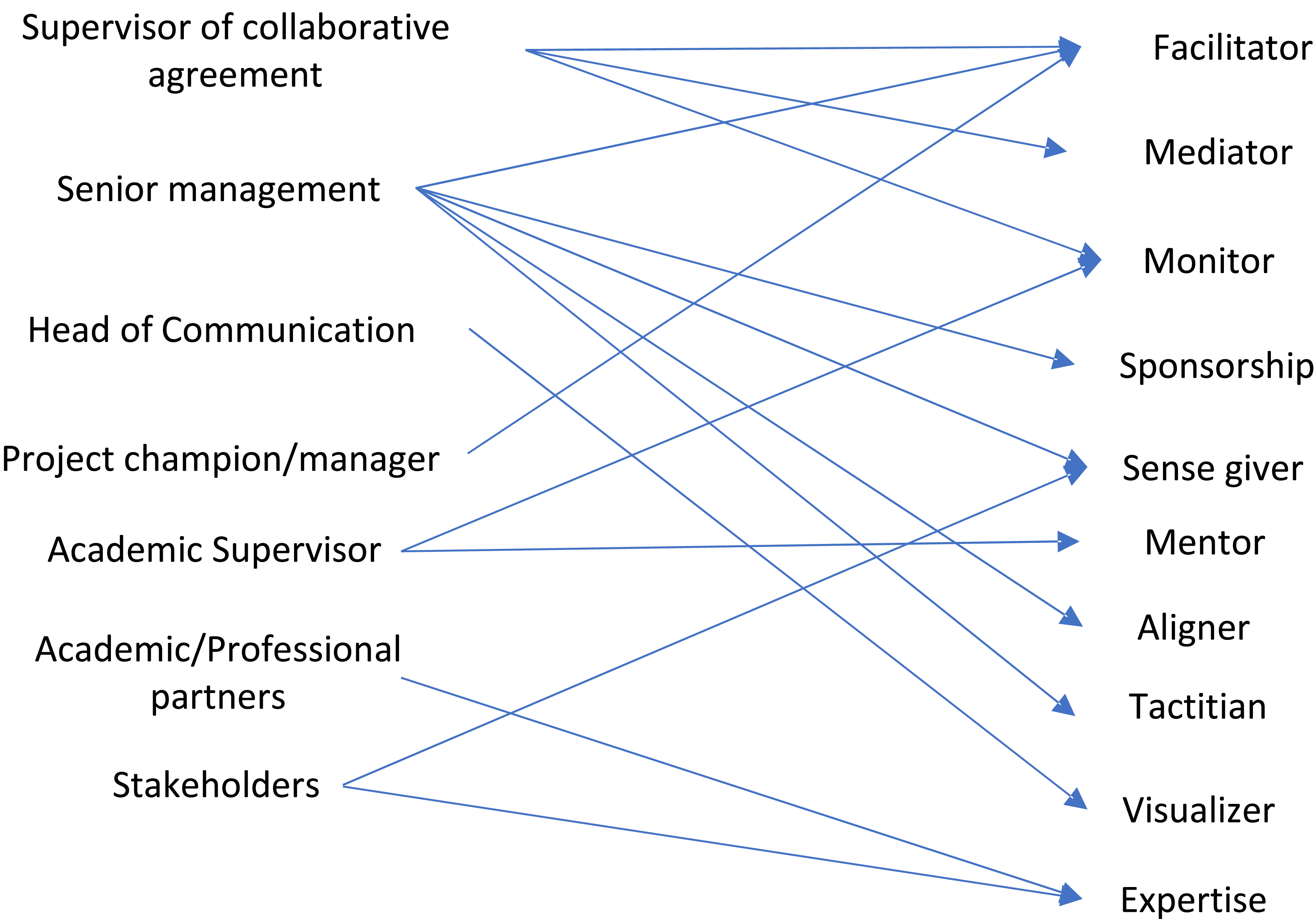
Stage 3: Implications of New Map in Complete Theory of AR
Following on from what Shani and Pasmore (2016) defined as “Complete theory of AR”, four aspects can be analysed in an AR study as follows: context, quality of relationships, quality of process and outcomes.
Context
This factor includes environmental factors in the global and local economy as well as organisational characteristics. The fact that the AR study is under the “umbrella” of a support infrastructure brings into consideration a further element in the context. The three types of support we have analysed (competitive research project, educational programme and collaborative agreements) lead to the following topics being clearly specified: deadlines, scheduling, intermediate and final reports; data confidentiality; ethical issues. These implications can be considered positive for both the action researcher and practitioners because they imply the incorporation of new actors and lend both credibility and visibility to the project.
Quality of Partnership
The quality of partnership in AR projects between researcher and practitioners is paramount and evolves during the course of the projects. The involvement of new actors increases the complexity of interactions, although at the same time, their contributions can greatly enhance the quality of the relationship between researchers and practitioners.
The collaborative management supervisor from both universities and firms work together to ensure effective communication and alignment between researchers and practitioners. Their combined leadership, support and strategic direction are crucial in maintaining focus on project goals and fostering trust and commitment among participants (Avella & Alfaro, 2014; Cozzolino et al., 2023; Pereira et al., 2013; Yström et al., 2019). For their part, project champions and change agents play a crucial role in fostering a participatory and inclusive approach – by ensuring that all stakeholders feel involved and valued, they strengthen trust and communication, creating a cohesive and collaborative environment (Kelliher & Byrne, 2018; Kuran, 2024). Stakeholders contribute local knowledge and insights, fostering a sense of ownership and engagement in the project. Their involvement, along with continuous support from advisors, ensures effective communication and collaboration, generating trust and mutual respect among all parties involved (Dias et al., 2024; Kuran, 2024; Morales-Contreras et al., 2024; Muff, 2023).
Quality of Process
The quality of the AR process benefits from the synergistic efforts of various new actors. The Collaborative Agreement Supervisor oversees the project’s progress, providing strategic direction and resolving conflicts, while top managers participate in control mechanisms that oversee research activities and address any issues that may arise. This combined oversight ensures that the project stays on track and maintains high standards (Avella & Alfaro, 2014; Cozzolino et al., 2023; Pereira et al., 2013; Ystrom et al., 2019).
Academic supervisors provide formal training and guidance in AR to PhD candidates, ensuring that the research process is well-structured and adheres to academic standards. They also provide ethical guidance, helping researchers navigate complex ethical issues and maintaining the integrity of the research process. This support, combined with the feedback from stakeholders, ensures the accuracy and relevance of the research process (Kelliher & Byrne, 2018; Morales-Contreras et al., 2024; Muff, 2023).
Project champions guide organisations in reflecting on their processes and adapting AR methodologies to their unique context. Their involvement ensures that the research process is inclusive and considers the perspectives of all stakeholders, making it more comprehensive and effective (Kuran, 2024). Stakeholders ensure the research is grounded in local realities and needs, and this contributes to the overall quality and credibility of the research process (Dias et al., 2024).
Outcomes
The outcomes of AR projects are significantly influenced by the collaborative efforts of various of these new actors. The Collaborative Agreement Supervisor ensures that the research achieves its intended goals and delivers valuable results, while Senior Managers ensure that the research aligns with the strategic goals of both institutions and facilitates the implementation of research findings. This combined effort ensures that the research has a meaningful impact (Avella & Alfaro, 2014; Cozzolino et al., 2023; Pereira et al., 2013; Yström et al., 2019). For their part, the Academic Supervisor ensures dual impact and significance of the research outcomes, addressing practical problems for the company while also contributing to academic knowledge. Their guidance, combined with the efforts of project champions and change agents, ensures that the research findings are implemented and sustained over time, leading to long-term improvements in organisations (Kuran, 2024; Morales-Contreras et al., 2024). Lastly, stakeholders ensure that the research outcomes are relevant and address community needs, and this contributes to the overall significance of the research (Dias et al., 2024; Kuran, 2024).
Discussion: Related Topics and Research GAPS
The findings obtained in this paper help to complement the literature that analyses how AR should fit into the scope of business and management in the 21st century. As reflected in Shani and Coghlan (2021a), we show how the analysis of both new actors and roles influence those factors to which closer attention should be paid in AR studies in the fields of business management: context, process, relationships and outcome. Besides, our study emphasises the increasing complexity of context as being crucial to promoting AR. In this sense, we recall the concept of “support infrastructure” as defined by Susman and Evered (1978). Our study can be linked to the use of AR in contemporary contexts (Bennett & Brunner, 2022), such as sustainability (Wittmayer & Schäpke (2014).
In terms of specific findings, this paper can be linked to those studies that analyse both the roles and actors in AR studies, which have tended to focus on the roles of traditional actors: researcher (outsider and insider) and practitioner. The most relevant ones are Coghlan and Shani (2005), Coughlan et al. (2016) and, with more specific scope, Guercini and Rufola (2015).
We consider that Figure 5 is descriptive as it is based on a review of papers, but, of course, it represents a tool to design better AR projects. This is in line with the paper that focuses on the identification of roles – in some cases, the paper related to specific infrastructures refers to some of them.
The definition of an “extended network” and the roles associated with new actors have implications for the four factors of AR methodology as explained in the text, and so this study complements the challenges defined in Shani and Coghlan (2021a). Accordingly, context plays a more relevant role as the new roles and actors focus on this factor. A more exhaustive explanation of context should be incorporated in AR-focused papers, by defining the roles of actors involved in the corresponding infrastructure. Additionally, the quality of relationships and quality of process are affected. The extended view or new roles make the relationships between actors more complex and, therefore, they will have a more relevant influence on the success of the AR study. In terms of the process, it would also be useful to determine the role of the actors at each stage of the AR study. Lastly, we highlight a new type of outcome: those related to visibility-the role of heads of communication as a visualizer are crucial in promoting the development of AR studies and in keeping one step ahead in this aspect.
Finally, this study is also related to open innovation literature as newly-incorporated actors emphasise how AR studies can be considered crucial for innovation (Ollila & Yström, 2017, 2020). We go one step ahead, and define AR as an open innovation tool where the impact of support infrastructures is crucial in promoting university-firm relationships through the use of AR studies.
The knowledge transfer involved in collaborative research projects should be promoted and the best way of doing so is to “sell” this as an open innovation practice and as a way to promote new forms of science-industry relations and knowledge transfer (Perkmann et al., 2021).
Further Research and Limitations
This paper finds that organising AR requires defining all the roles and actors that have an influence on the context, process and relationships of outcomes. Although the concepts of infrastructures (Susman & Evered, 1978) and the AR network are not novel (Coghlan et al., 2004), they must be given more weight when defining an AR study. In this way, further studies could define a reference framework to identify and classify the typology of support infrastructures. This would permit to generalize our findings and going one step ahead. Also, in terms of further research, we wish to highlight the fact that there is a lack of studies that analyse the roles of different actors based on methodologies such as interviews, focus groups, Delphi or surveys. In this sense, we encourage researchers to describe the roles of the practitioners as most of the studies concerning roles focus on action researchers. Lastly, we hope a major research line will be developed based on AR studies such as an open innovation practice, with all the implications this would have in terms of opening up a new dimension of AR. Clearly, there is a need of reframing how AR and OI could be integrated. We have highlighted this point in Further Research.
As for limitations, there are studies that analyse how organisational actors may influence the success of AR studies, although we think the scope of this study should focus on individuals. Of course, having incorporated the authors’ experience in our findings implies a certain degree of subjectivism, even though we think this really enriches the study. Besides, the analysis of how the roles can be associated with the different steps of the AR process has not developed, as we consider we do not have enough evidence to do so.
Supplemental Material
Supplemental Material - Identifying New Roles and Actors in Action Research Management Studies in Specific Support Infrastructures
Supplemental Material for Identifying New Roles and Actors in Action Research Management Studies in Specific Support Infrastructures by José A. Alfaro-Tanco, Simone Guercini, María Isabel Rodríguez-Ferradas in International Journal of Qualitative Methods.
Footnotes

Ethical Considerations
This article does not contain any studies with human or animal participants.
Author Contributions
José A. Alfaro-Tanco: Conceptualization, Methodology, Formal Analysis; Discussion of results and conclusions, Writing - Original Draft Preparation, Writing - Review & Editing.
Simone Guercini: Conceptualization, Discussion of results and conclusions, Writing - Review & Editing.
María Isabel Rodríguez-Ferradas: Methodology, Data Curation, Formal Analysis; Discussion of results and conclusions Writing - Original Draft Preparation, Writing - Review & Editing.
Funding
This work was supported by the “Cátedra de Empresa Volkswagen Navarra –Universidad de Navarra”.
Declaration of Conflicting Interests
The authors declared no potential conflicts of interest with respect to the research, authorship, and/or publication of this article.
Data Availability Statement
In accordance with this journal’s Shared Data policy, the Excel file named PRISMA_results.xls has been included in this submission as additional material. This file contains the list of the articles obtained using the PRISMA methodology and analyzed in our work to identify the new profiles and actors associated with each of the three supporting infrastructures: collaborative agreements, competitive long-term research projects, and educational programmes.
Supplemental Material
Supplemental material for this article is available online.
References
Supplementary Material
Please find the following supplemental material available below.
For Open Access articles published under a Creative Commons License, all supplemental material carries the same license as the article it is associated with.
For non-Open Access articles published, all supplemental material carries a non-exclusive license, and permission requests for re-use of supplemental material or any part of supplemental material shall be sent directly to the copyright owner as specified in the copyright notice associated with the article.
