




Abstract
Research in management needs to contribute to practical relevance and applicability of research results. An approach that acknowledges the needs that emerge from practice and still offers guidance for proper research, is action research. The purpose of this paper is to expand the action research methodology, focusing the researcher’s role. Two consecutive action research projects were reviewed and reflected upon from a literature-based model. The projects were analysed iteratively by two participating researchers with different experiences and backgrounds. The main finding is the outline of the mixed role in action research projects, which allows for performing high quality research in parallel with interventions in the study object organisations. Development of the mixed role concept allows practically oriented research and interventions in research projects to be developed alongside traditional research, which at large can encourage researchers to take part in practical managerial development. The action research methods were successful in the projects, as they provided a fast-track to deep insights in the companies and the ability to act and evaluate results. With the mixed role approach, we could quickly come down to details, expose assumptions, discuss new solutions and come up with more profound research questions. The mixed consultant/researcher role has been a means to keep the research schedule within acceptable limits. Hence, a consciously managed project with in-depth considerations of the mixed role of the researcher can in itself remove one of the main obstacles of action research. The mixed role is a novel concept, pragmatic but still well aligned with prior research. The establishment of the concept can inspire more researchers performing action research.
Introduction
The business context has changed over the past decades, and the pace of change is increasing, requiring a more dynamic approach to address challenges. Hence, new tasks and capabilities are necessary to coordinate an action research project. So, it is crucial to redefine the role of action researchers, and to look for references that justify this objective. Greening logistics services is an example of such a business context.
While many studies on action research are literature studies, in this paper we revisit and develop the action research methodology, based on empirical experiences from two research projects on greening logistics services.
The focus of the paper is – based on experiences gained from using action research methodology – to develop the role of the action researcher.
Business is under constant pressure to change, while management researchers struggle to follow, understand, and contribute to this development. The action research approach can address practitioners’ and researchers’ needs simultaneously: it grounds research in practical relevance. According to action researchers Paul Coughlan and David Coghlan, managers plan to improve operations, but there are internal obstacles (Coughlan & Coghlan, 2002). They suggest action research to avoid these. They argue that action research is relevant to operations management as it addresses the realities experienced by managers while contributing to knowledge (Coughlan & Coghlan, 2002). Thus, action research can be a way to conduct research in a dynamic setting, allowing unplanned events to become part of the research process.
Action research is a methodology where the researcher actively participates in organisational development, aiming for improved performance. Unlike traditional research, action research can quickly uncover hidden problems and test solutions in context. However, results may not be generalisable and could be biased. Checkland and Holwell (1998) stress the notion of recoverability in action research processes as opposed to repeatability in science. It is crucial for an action researcher to reflect on these issues.
We have noticed in research projects the need for the researcher to navigate between being an observer and an active change agent. We found this to be seldomly addressed in literature, but a long time ago, Friedlander and Brown (1974) suggested the integration of consultant and researcher to be desirable and even necessary. It is still relevant to analyse the role of action researcher (Shani & Coghlan, 2021).
The researcher is implicitly addressed when theory versus practical development is discussed in the interactive research process (Ellström, 2008; Glaser & Strauss, 1967; Starrin et al., 1991), but the researcher’s role is often overlooked, and we identify a gap in literature regarding the role of the action researcher.
The purpose of this paper is to explore and bring increased understanding about the role of the action researcher.
Action research often involves two parallel projects (Coghlan & Brannick, 2001): a core project involving the researcher working with the organisation to improve performance; and a research project involving the researcher inquiring into the core project. Coughlan and Coghlan (2002) note that even if the core project fails to reach its goal, the research project can still gain valuable insights. This paper focuses on the action research approach rather than the specific results of the core projects the paper builds on.
The structure of the paper, following this introduction, is Theoretical frame of action research; Methodology for this paper; The collaborative projects for more sustainable freight transports; Mapping of the action research projects; Analysis and learning from the implementation; Conclusions.
Theoretical Frame of Action Research
This section outlines the action research methodology. It offers a detailed description of action research for a deeper understanding of the approach. It begins with the basic assumptions of action research, followed by its origins, research procedures, and roles. It also discusses the benefits and criticisms of action research, with a focus on the researcher’s role.
Action Research
Action research is rooted in the relationship between reality and theory. Starrin et al. (1991) highlighted the important connection between data collection and theory founding (see Figure 1). The path from reality to theory, known as the grounded method (Glaser & Strauss, 1967), involves multiple laps to reveal patterns and deep structures, a characteristic of action research. Glaser (1978) emphasised the importance of developing theories that work in reality through collaborative research methods. Grounded theory and theory founding, based on Glaser and Strauss (1967), Starrin et al. (1991), and Alvesson and Sköldberg (2000).
To conduct collaborative research between ‘outsiders’, that is academics and ‘insiders’, and practitioners, a setup is needed that simultaneously ensures quality research and solves practitioners’ problems. Näslund (2002) discusses the benefits of collaborative/action research in logistics, where close collaboration reveals unexpected findings and generates new ideas. Ellström (2008) describes collaborative research as ‘the interactive research process’, featuring two parallel paths, one for research and one for practical learning.
Svensson and Aagaard-Nielsen (2006) categorise traditional academic research as MODE 1 and action research as MODE 2, see Figure 2. Different types of management research methods are compiled in the figure, with more passive observation-oriented methods as MODE 1 and more active action-oriented methods as MODE 2. Comments in Figure 2 on insider and outsider roles are based on Gummesson (2000), Westlander (2006), Cronemyr (2007), Salminen-Karlsson and Wallgren (2008), and Carr et al. (2010). It should be noted that action research projects often use a combination of traditional and action-oriented methods. Methods in management research. The model is our own; however, ‘MODE 1’ and ‘MODE 2’ are defined by Svensson and Aagaard-Nielsen (2006).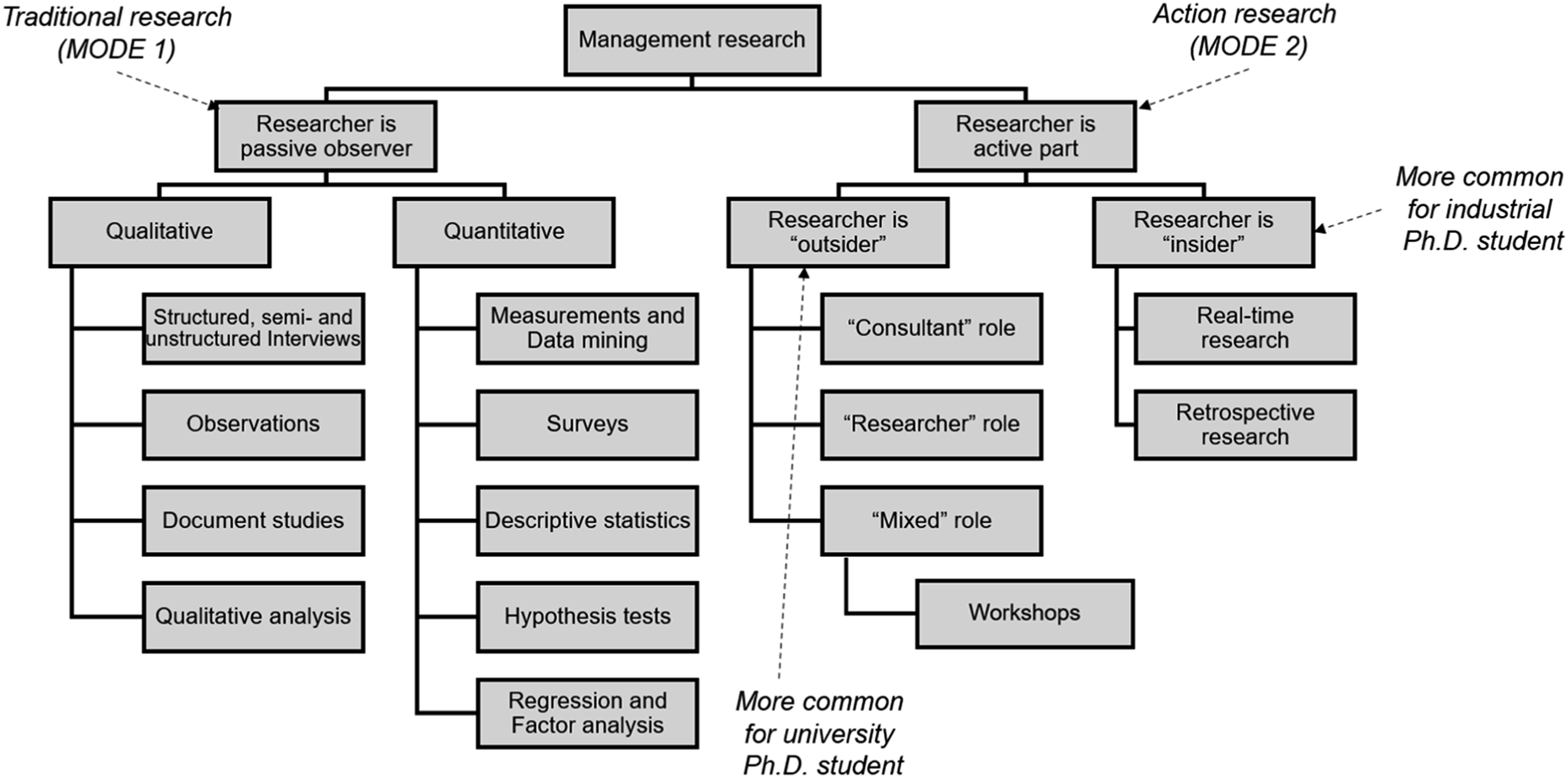
Kurt Lewin, by many considered to be the father of action research, argued for a research discipline with the main purpose ‘to help the practitioner in an action of planned change’ (Lewin, 1946). According to Lewin, action research is a parallel action and a creation of a knowledge base for the researcher when he/she participates in an action of planned change in cooperation with the client/practitioner: ‘[Lewin’s] theory for turning research into action and vice versa enabled a merger of Taylor’s vision of labour-management cooperation with systematic social experiments. […] He taught that to understand a system you must seek to change it. […] He also pointed the way toward collaborative consultation’ (Weisbord, 1991, pp. 71–72).
As Coughlan and Coghlan (2002) stated: ‘For many types of research question, detached observation or archival study are indeed appropriate. However, the range of these questions does not define the range of research issues relevant to OM’ (Coughlan & Coghlan, 2002, p. 221). To conclude, MODE 1 traditional research is very useful and could be used in many situations, but to solve complex problems and develop practices in operations management, however, MODE 2 action research is also needed.
In their literature study, Coughlan and Coghlan (2002) asked ‘What is action research?’ Based on thirteen referenced papers, they characterised action research as: • Research in action, rather than research about action • Participative • Concurrent with action • A sequence of events and an approach to problem solving.
How then, should the researcher carry out action research? Lewin (1947) outlined the steps of research in ‘action of planned change’ as planning, factfinding, and execution. It begins with an idea, transformed into a plan through cooperation with the client. Blake and Mouton (1984) emphasised the researcher’s acceptance of the client’s needs. The action involves planning, fact finding, and execution in steps, each corresponding to a lap in Starrin’s model (see Figure 1). The researcher’s role varies between active and passive during a cycle. The process continues until major performance targets are met. Plans with goals and actions along the way may change at any step based on new knowledge, see Figure 3. Describing action research results involves detailing the evolving process. Action research: planning, fact-finding, and execution. Re-drawn from Lewin (1947) and indicating the iterative application of theory founding as shown in Figure 1.
In each of Lewin’s iteration steps (Figure 3), there is planning, fact finding, and execution. Coughlan and Coghlan (2002) developed this further into the action research cycle, where the first input ‘Context and purpose’ is the same as Lewin’s ‘Reconnaissance of goals and means’. Then the rest of the cycle is repeated in each iteration step.
Action research includes both actions and research. It may be self-evident, but some papers claim to conduct ‘action research’ but only describe actions, that is interventions where researchers help practitioners solve problems using known techniques. This is more of a consultant role. To also take on the researcher role, the problem and goal should be reformulated as new insights are found (Lewin, 1947). Elg et al. (2020) present an analytical framework for action research based on practice versus research systems, and problem versus solution. The research part involves identifying, redefining, and theorising problems. A case study of an intervention may provide useful information, but if the problem is not developed further, it is not action research as defined by Lewin (1947), Gummesson (2000), and Coughlan and Coghlan (2002).
In his book ‘Qualitative Methods in Management Research’, Evert Gummesson (2000) emphasises the following advantages of action research: (a) First-hand experiences; (b) Access to data; (c) Inductive method.
In the scientific community, (especially outside the Nordic countries), there has been criticism about qualitative research in general, and action research in particular, suggesting it is ‘not scientific’, see for example, Westlander (2006). In quantitative research, a mathematical or a logical proof is deduced from established theory, or a hypothesis induced from empirical data and tested with a statistical method. That is considered ‘scientific’.
Common objections to qualitative research are, for example, that it is too subjective and biased, person-dependent, not generalisable, and only explorative. In addition to the ‘problems’ of qualitative research, action research also has the disadvantage of being time consuming. The problems can be summarised: • Subjectivity and bias. There is a tendency for the researcher to be over-involved to the extent that personal biases come into play in the analysis of the findings (Coughlan & Coghlan, 2002; Gummesson, 2000). • Vulnerability to pressure. Insider action researchers may often be subordinates in an organisational setting. Power relations and differentials may complicate the conduct and influence the research results (Cronemyr, 2007; Gummesson, 2000; Westlander, 2006). • Time consuming and ‘fuzzy’ methodology. Critics question the ‘fuzzy’ methodology in action research and the ‘fuzzy answers’ that it gets (Walter, 2009). The redefinition of the research question and the refining of methodology take time, making the entire research process time-exhaustive and complex. However, that can be dealt with by conducting retrospective action research in addition to that performed in real-time (Gummesson, 2000).
These issues may be ‘problematic’ if not considered and presented; hence, it is very important for action researchers to consider them by not being too active (or too passive), as described in Figure 2 and by Elg et al. (2020).
Traditional academic research aims at achieving generalisable knowledge that can be applied in other settings, whereas action research aims at gaining knowledge while achieving a change with a performance target in a specific process or setting. Eden and Huxham (1996) present several guides to how action research contributes to theory: • Action research generates emergent theory, developed from a synthesis of that which emerges from data and practise. • Theory building will be incremental, moving from the particular to the general in small steps. • Action research theory must be conceptualised in ways that are intended to be meaningful to others. • It is not enough to generalise the design of tools, techniques, and models; their design must be explicit and shown to be related to the theory.
Traditional Research versus Action Research.

The ‘final’ results from action research are the learning from the change process, unlike traditional research, which aims for generalisable knowledge. Cronemyr (2007) describes an action research project where Process Management and Six Sigma were implemented in a company. Initial results were disappointing, but after modifying the order of activities based on learning, goals were achieved. This learning progression is typical for action research. Based on these results, a more general method for implementing Process Management and Six Sigma was developed and tested in other organisations (Cronemyr & Danielsson, 2013). A version of this model has been used in the logistics research project that forms the basis of this paper.
As the project evolves, the goal often changes, and many results are achieved that do not relate directly to the original problem statement expressed from the overall performance target. As progress is made, more interesting problems are revealed and can be addressed and theorised. The results and learning need to be detailed for other academics to understand and use in future research. They also need to be communicated to other practitioners, for example, in seminars and articles. This spreads the knowledge and allows others to benefit from the action research outcomes. New theories and models gained from action research can be presented in academic papers, like the authors’ previous papers (Cronemyr and Huge-Brodin, 2019, 2021; Navarro, 2023; Navarro et al., 2018).
Some, not acquainted with action research, argue it has the character of ‘anything goes’ and a ‘fishing trip’. On the contrary, data and methods need to be valid and reliable for action research, as well as for traditional research. In this respect, there is no difference between the two, and ‘normal’ methods for assuring quality of research results apply. Traditional criteria, see for example Firestone (1993) and Merriam (1988), may be used, as presented below. • Ensuring internal validity: Member checks, Long-term observations, Peer examination, Clarifying researchers’ biases. • Ensuring external validity: Reader or user generalisability, Case-to-case translation, Analytical generalisation. • Ensuring reliability: Clarifying investigators’ positions, Triangulation.
Classification of Action Research Approaches
A Framework for Action Research Approaches by Alfaro-Tanco et al. (2021). The Numbers Indicate the Number of Papers Found by the Authors in Their Literature Review.

As can be seen, there are 3 × 3 = 9 different approaches. In their literature review they found that implementation (practice) combined with theory building (research) was the most common approach of action research projects. The least common approach was proposal (practice) combined with theory elaboration (research). So, what could be labelled ‘study of implementation projects’ was the most common approach, while what could be labelled ‘propose solutions and see if the theories hold’ was the least common approach.
This is also in line with types of inquiry and action, based on level of intervention, as described by Schein (1999): (1) Pure inquiry. Question to ask: ‘What happened?’ (2) Exploratory diagnostic inquiry. Question to ask: ‘Why do you think this happened?’ (3) Confrontative inquiry. Question to ask: ‘Have you thought about doing this…?’
The least common approach in the framework of Alfaro-Tanco et al. (2021) is similar to what Schein (1999) called Exploratory diagnostic inquiry.
Alfaro-Tanco et al. (2021) did not discuss researchers’ roles, but the different approaches clearly relate to the researchers’ roles, as discussed above.
The Mixed Role of the Action Researcher
Ng and Vargo (2018) state: “The role of the [action] researchers was to support, mentor, educate, empower, and organise – to provide structure around [the clients’] process, and provide them resources and tools. The outcome was different in each community, as required to meet their unique needs.” This comprises many tasks and many different roles.
As a researcher you are traditionally not supposed to influence the outcome of the inquiry. The researcher should be a passive observer. An action researcher, on the other hand, is actively influencing the progress of the research project. Action research must have some advantages to justify this activity.
The phrases ‘consultant role’ and ‘researcher role’ in Figure 2 deal with the dilemma of ‘action research’ versus ‘consulting’, often (but not always) classified as ‘passive’ versus ‘active’ roles. To clarify, in this paper ‘passive’ and ‘active’ are used in relation to potential interaction between the researcher and its object. A fully passive researcher strictly observes, while the active researcher extensively interacts with the research object. This is a core notion to describe the role of the researcher in action research.
Hence, there is a need to establish the mixed role of the researcher, which comprises a balanced and dynamic, as well as thoroughly thought-out blend of ‘the traditional researcher’ (passive) and ‘the consultant’ (active), rather than trying to find the middle-way, or a ‘mean’ degree of interaction. Elg et al. (2020) identified three approaches to action research in service research: (1) Practice-enhancing, (2) Concept developing, and (3) Theory-enhancing. Their classification of approaches is well aligned with what we classify as (1) Consultant role, (2) Mixed role, and (3) Researcher role.
According to Gummesson (2000) the action researcher should be aware of the following requirements, not required of consultants: • An action researcher needs to be more rigorous in inquiry and documentation of actions taken and results along the way. • An action researcher requires theoretical justifications. • An action researcher does not have the same time and budget constraints as a consultant. • Action research is cyclical (as described in procedures below), while consultation is often linear (start, act, stop).
However, there is often a need for a mixed role (see Figure 2); not only active consulting or traditional researching, but a well-considered balancing of the two roles. A common way of working in the mixed role is to conduct workshops with researchers and practitioners. Planning the workshop is more passive; the workshop itself is most active (‘where it happens’). Analysis and evaluation is more passive, while the researchers are more active again when suggesting changed practices to the practitioners. It is important for the action researcher to understand, and document, when they are active or passive in order to not only consult.
Using Schein’s (1999) levels of intervention and based on our experience from action research, only working with (1) Pure inquiry can be ‘too passive’, while only working with (3) Confrontative inquiry can be ‘too active’. An action researcher in a mixed role would work with all three types of inquiry and action, that is (1) Pure inquiry and (2) Exploratory diagnostic inquiry in planning and analysis, and (3) Confrontative inquiry in workshops and when suggesting changed practices.
So, while the role of the researcher in AR can be characterised as ‘insider’ versus ‘outsider’, and as ‘passive’ versus ‘active’, what roles did the researchers take on in the conducted AR projects?
Methodology for This Paper
First, to put this study in perspective, we conducted two action research projects during several years. The descriptions and results of these two projects have been published in previous papers (Cronemyr and Huge-Brodin, 2019, 2021; Navarro, 2023; Navarro et al., 2018). During these projects several methodological issues were considered, for example how to get data, how to analyse data, and ethical aspects of action research. These have been thoroughly described in previous papers.
To address the current paper’s purpose, the two researchers developed a plan and method to capture the essence of the action research approach. This study was in fact not an AR project, but a retrospective case study, with the purpose to analyse the work methods used in the previous projects, especially the mixed role of the action researcher.
Due to the large amount of data, the researchers first designed an empty process flowchart (see Figure 4 below), based on Langley (1999), to position the data. The chart consisted of a timeline and grids based on the different contexts active in the project. The centre is the research work performed by the researchers, surrounded by fields indicating work at the respective companies. These fields are split in two: one for joint development and one for internal company development. Major exogenous factors that influenced the project, as suggested by Langley (1999), are also indicated. The template used for the mapping of the action research projects. Based on the ideas of Langley (1999).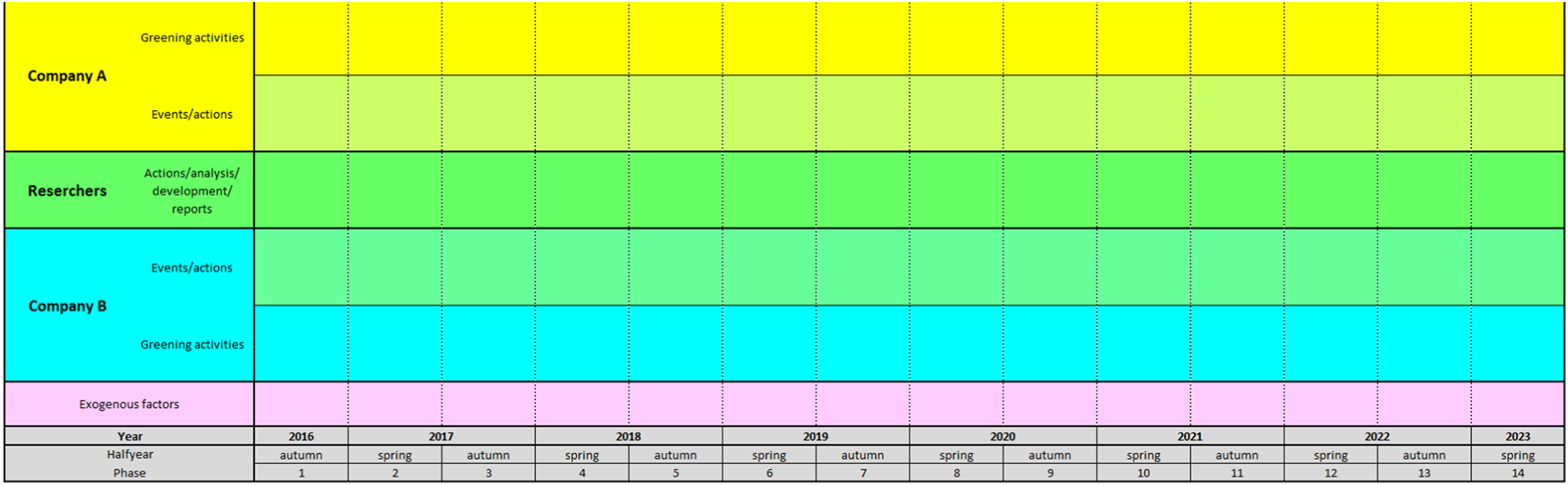
The two consecutive action research projects, performed from 2016 to 2023, were retrospectively mapped on the process flowchart by the two authors in 2023, according to the ideas and method used by Langley (1999). The project documentation included meeting notes, presentations from research meetings, and transcribed interview protocols. The documentation contains the researchers’ actions and observations and the practitioners’ reflections. The researchers compared notes, and the findings were characterised and sorted into main streams of actions, learning, and results.
After the mapping, an analysis was conducted. The researchers asked themselves: “What happened?”, “When and why?”, “What did it lead to?”, “Where did new ideas come from?”, “Where/when were project goals and direction changed?”, “What were the final results?” Based on the researchers’ responses to these questions, some development paths were selected. These are representative of the projects and illustrate the researchers’ roles.
The Collaborative Projects for More Sustainable Freight Transports
Business is under constant pressure to change, while management researchers struggle to follow, understand, and contribute to this development. Logistics management is no exception to this, and in particular, the challenges stemming from demands on increased environmental sustainability result in a volatile business landscape as well as an urgency to drive the development in the desired direction (McKinnon, 2018).
This section introduces two consecutive projects conducted with an action research approach in the freight transport industry. The goal of the first project was to introduce Process Management to facilitate greening the industry. The overarching research question was roughly, Can, and if so how, Process Management support the greening of freight transport and logistics services? The goal of the second project was to jointly develop tools that could support greening the freight transport industry.
The projects began in response to business and societal needs, identifying opportunities in Green Logistics and Process Management. At the time, freight transport companies wanting to develop Green Logistics activities largely lacked customer support and tools (Evangelista et al., 2013). Despite many ideas and technologies for greening transports, progress is slow (Evangelista et al., 2017), highlighting the need for knowledge and tools to put environmental intentions into action.
Researchers suggested Process Management as a potential tool to greening transport and logistics services. Two freight transport companies participated as ‘living labs’ to test this idea. Process Management supports higher quality and improved societal satisfaction (Bergman and Klefsjö, 2010; Deleryd & Fundin, 2015). An important basis for Process Management is process maps (Cronemyr & Danielsson, 2013).
The first project started in 2016 with university researchers and CEOs of two Swedish freight transport companies. The project involved close collaboration between researchers and practitioners. Project plans were jointly elaborated. The research process included traditional case methodologies and more action-oriented activities.
Results from the Green Logistics and Process Management research project have been previously presented (Cronemyr and Huge-Brodin, 2019, 2021; Navarro, 2023; Navarro et al., 2018). Recurrent project meetings provided insights and learning. Practitioners shared their progress and challenges, and researchers offered guidance and suggestions. Both companies gained understanding of Process Management and its role in environmental sustainability. However, its application varied in the two companies, in line with the previously mentioned statement by Ng and Vargo (2018). Internal factors, like limited resources, slowed development. Top management’s mindset played a crucial role. In our cases, top management strongly supported greening efforts, with varying ambitions to introduce Process Management.
Mapping of the Action Research Projects
The actual results from the process mapping of the two action research projects are shown in the photography in Figure 5. The two action research projects, mapped on the template based on the ideas of Langley (1999). All notes are based on a retrospective analysis of the researchers’ own notebooks and documents. The texts on the notes are blurred due to detailed information from the companies (LSP = Logistics Service Providers) that should not be disclosed. The black and red text in the top and the bottom of the figure are the base for the analysis described in the following paragraphs.
After the mapping, an analysis was conducted. Some of the analysis results are given at the top or bottom of the figure. They are further shortly described next. More thorough descriptions of the project results are given in previous papers (Cronemyr & Huge-Brodin, 2021; Navarro, 2023; Navarro et al., 2018).
The Two Projects
Analysing the characteristics of the two projects leads to classifying the first project as ‘Searching and learning’, and the second as ‘Development and testing’, where both still contained all those ingredients but with different foci.
The first project started out with the idea (by the researchers) that Process Management (PM) may be useful in freight transport companies to get a more managerial approach to implementing Green Logistics (GL), in addition to just implementing new technology. The needs of the practitioners’ business had previously been identified in research within Green Logistics. PM was not commonly used in SME freight transport companies, but was commonly used in other business sectors, mainly by large companies.
Analysis of Planned and Unplanned Events in the First Project
The implementation of PM in the participating companies followed the roadmap PM123 (Cronemyr & Danielsson, 2013) with the three phases: (1) Process mapping and development, (2) Process analysis and improvement, (3) Strategic process control. Before Phase 1 started there was an initial project phase: Scanning of practices and needs and PM introduction to the companies.
The first project was characterised as ‘Searching and learning’. The searching part was “Can PM be implemented in freight companies?” and the learning part was “What did work/not work, and did it improve the management of GL?”
Put very briefly, the results of the original plan based on the PM123 phases were: (1) Process mapping and development worked as planned in the larger of the two companies, while not at all in the smaller company. (2) Process analysis and improvement did not work as planned in any of the companies. (3) Strategic process control was not implemented based on the original plan.
From the list above, it may look rather like a failed project. On the contrary, by trying, testing, analysing, and continually adjusting the plan accordingly, based on the action research methodology, it was successful. The deep knowledge about the context, given through the AR methodology, enabled new knowledge to be developed, thus expanding knowledge of the usefulness of the PM tool to SMEs in the transport and logistics sector.
The following adjustments were carried out: (1) Based on the poor acceptance of PM1 in the smaller company, an extension to the PM123 theory was developed, called PM0123 (Cronemyr & Huge-Brodin, 2019). Several process maturity levels below ‘1’ (i.e. PM without maps) were defined and a tool for Process Management and a development was designed and launched in both companies. This extended existing PM models and brought additional knowledge about organising activities in SMEs in the transport and logistics sector. In this development, the researchers’ roles went from ‘educators’ introducing PM123 to ‘coaches’, supporting the companies in their mapping process. One of the researchers, in addition, engaged an external consultant to support all through. The researchers then became ‘researchers’ and studied the first phases of PM123. The analysis showed that little had been done, in particular at the smaller company, and that one reason was that they did not want to be as formal as the method prescribed. This finding prompted the researchers’ idea to further detail the method’s first stage, and acknowledging that processes existed albeit in different forms (e.g. ad-hoc, tacit knowledge, policies). When introducing this updated method (as ‘consultants’), the researchers realised that it was notably more accepted than the original method. (2) Process improvements were already, to some extent, carried out in both companies, but improvements were not connected to analysis of root causes to problems in the existing processes. Based on the researchers’ suggestions, several initiatives for the first steps of improvement work, namely collecting ideas and suggestions from the employees, were launched by the companies. However, none of the initiatives worked, even though the researchers supported management with different practical solutions. The ex-post analysis revealed that the companies did not have Process Management practices that were mature enough for improvement processes, according to PM2, to actually work. This could possibly have been anticipated by scrutinising the original plan, but it was not, so it was a surprise when it happened. (3) Strategic process control, with statistical process control, was not implemented since neither of the companies had carried out PM2 and hence did not have statistical process control charts to follow up. However, new tools based on established quality management tools for management and control were developed and were later successfully used in the companies, especially in the larger of the two. In Figure 5, MK means ‘Miljökontot’, which is Swedish for ‘the Environmental Account’. It was suggested by the authors as a possible solution to a problem expressed by the CEO of the smaller company. It was later renamed ‘Green Karma’ (GK in the figure). The tool was based on the established quality tool of QFD for managing customer requirements but was transformed into a proactive tool for initiating and managing environmental initiatives (Cronemyr & Huge-Brodin, 2021). SIQ MM in the figure means ‘the SIQ Management Model’ (SIQ, 2019). It was introduced by the authors and quickly became a foundation for strategic management of the larger company.
Analysis of Planned and Unplanned Events in the Second Project
The research in the second project was carried out on two parallel tracks, conducted by the researchers concurrently with the two companies, but with different research questions (both tracks with both companies). Both tracks focused on the strategic management of Green Logistics in the companies and were conducted more like ‘Development and testing’ than the first project, which was more of a classical action research project. However, the second project also consisted of both planned and unplanned events, and the planned events were very much based on the unplanned findings of the first project.
The first track focused on further developing the tools ‘PM0123’ and ‘Miljökontot’, for which prototypes had been developed during the first project. ‘Miljökontot’ was renamed ‘Green Karma’ (GK) and was further developed together with the companies, first within each company, then with lessons learned between the companies, together with customers and external organisations, and finally spread to other organisations at conferences and in both popular and scientific papers.
The second track focused on why PM1, that is process mapping and development – also labelled ‘traditional Process Management’ (Cronemyr et al., 2024) – did not work as planned in neither of the companies, especially in the smaller company. Based on the analysis of results from the first project, which indicated a lack of resources and a focus on fast customer feedback in SMEs, it was suggested to develop and to increase the understanding and applicability of PM in SMEs by applying a theoretical lens based on Dynamic Capabilities (DC) (Navarro, 2023).
Roughly, as the projects proceeded, the roles of the researchers changed from educators to coaches, and then to observers; the first two mostly as ‘consultants’, the last mostly as ‘researchers’. So, all-in-all, researchers took on a mixed role.
Final Results from the Projects
The final results from an action research project are ‘what has been found and learned along the way’, which have been presented in other papers, as mentioned above. Yet, in the closure meeting of the second project, the CEOs of the participating companies were asked: “What have you gained from these projects?” Their reflections (seen to the far right in Figure 5), were that process thinking had inspired them to more active development which had supported business growth, and that both companies had shared knowledge and know-how between them, especially about Green Logistics. The first reflection is about Process Management and the second is about Green Logistics, that is the two concepts that were used to initiate the projects.
Analysis and Learning from the Implementation
In this section, the methodology described above is applied to the research project, managed with an action research approach.
Classification of Action Research Approaches
In the framework developed by Alfaro-Tanco et al. (2021), they found that ‘study of implementation projects’ was the most common approach, while ‘propose solutions and see if the theories hold’ was the least common (see Table 2). Using the framework to classify the two projects in this paper, the first project was exactly the least common one, that is ‘propose solutions and see if the theories hold’, while the second was more of a traditional implementation project, albeit it with an action research approach. Using Schein’s (1999) classifications of inquiry and action, the first was Exploratory diagnostic inquiry and Confrontative inquiry, while the second was Pure inquiry.
Alfaro-Tanco et al. (2021) describe that “theory elaboration is based on the researcher’s ability to analyse both the general theory and the context in a balanced manner” (ibid, p. 5). We interpret ‘a balanced manner’ as another way of saying ‘a mixed role’. Problems and pitfalls discovered in the implementation initiatives lead to new and improved theories. Here, the researchers needed to keep both the practical and theoretical development in mind simultaneously.
Sometimes solutions to problems were based on theoretical knowledge which led to new practices, for example methods for Process Management. On the other hand, sometimes solutions for practical problems led to new theoretical knowledge, for example how to work more proactively by using quality tools in new applications. Both examples were facilitated by taking on the mixed role.
Procedures for Doing Action Research
The phases, that is steps, of the projects were set up by the researchers and the practitioners in the beginning of the projects and were followed for eight years in total. That general plan was not altered in any major way, even though the last phase was somewhat different to the original design. However, the activities within the steps were not set from the beginning. In each step the procedure as seen in Figure 3 was applied, and the researchers conducted more passive as well as more active activities, hence taking on a mixed role. The general plan expressed as overall performance targets was mainly kept but goals with corresponding activities and interactions were set up along the road jointly by the practitioners and the researchers.
In addition to the plan with managers, employees began to question the projects and researchers’ assumptions. This led to new learning and project redirection. During the second research cycle, managers presented a new idea for strategic support. As the third cycle started, this idea became the focus. The researchers and practitioners continued to develop the model together over the second project, and the companies use it internally as well as for communication with customers.
The researchers took active roles, in lectures and workshops, bringing new general knowledge to the companies, and also developed the models in collaboration with the managers. More passive roles were taken through documentation of the workshops, documentation of interviews with managers and other employees, and document studies.
Advantages with Action Research
According to Gummesson (2000) the advantages of action research is first-hand experiences, access to data, and inductive method. We analyse our experiences in these three dimensions. Based on previous research and from interaction with practitioners, the basic idea of the research project was that there is a need for ‘some method’ to manage initiatives in the freight transport companies going green. Process Management may be a feasible method, since it has been applied successfully in many other business sectors. The researchers’ preunderstanding of the interaction of Green Logistics and Process Management was limited. Even though one researcher was very experienced in logistics and the other was very experienced in Process Management, none of them knew much of if (and if so, how) Process Management had been applied in the freight transport business, or if there were any specific constraints or possibilities related to Process Management in that sector.
By working closely with practitioners and jointly adapting plans and questions, the researchers got first-hand personal experience that enabled a more profound understanding of the processes and conditions, which in itself facilitated co-creation of knowledge and solutions on a much more profound level, compared to what should have been possible by traditional observation methods. Such close collaboration may, as described above, reduce the researchers’ objectivity.
By applying a mixed role – a balanced and deliberate mix of passive and active research – we got quick, comprehensive, and extensive access to data, by means of discussions, workshops, and interactions with the companies, as well as by access to documents and systems. This access to data could not have been acquired by traditional forms of data collection, which provide only superficial access to processes of change. We agree with Gummesson (2000) that “the role of change agent provide better access” and since “business administration is an applied science that has to be connected to real world data”, we developed our understanding, knowledge, and questions “based on inductive data, and not by means of logical deductions from established theory” (Gummesson, 2000, p. 209).
This experience illustrates the mixed role the researchers need to take. In order to support the practitioners in reaching their respective sustainability goals, the researchers took on more of a consultancy role and developed tools that have served its purpose well – contributing to solve the practical challenges. Meanwhile, the trust built, resulting in deep access to data, has been crucial for the conceptual development. In their more traditional researcher role, the researchers benefitted from the different experiences of the practitioners, as well as from joint meetings between the different practitioners and the researchers.
Criticism of Action Research
Subjectivity and bias can complicate the conduct of an action research process (Coughlan & Coghlan, 2002; Gummesson, 2000). In our projects, the researchers neither belong, nor have formal relationships with, any of the two companies. The pressure that still resides on the projects relates rather to the personal relationships prior to the projects that have developed over time in the project context. From the researchers’ perspective, this is slightly evident in the conflict between being objective and really wanting – and urging – beneficial development. We balanced this potential conflict of roles through conscious planning, discussions, and reflections in the research group before and after project meetings. At the same time, the researchers must be, and are, aware, that fast development – introducing fast changes according to a plan – may not benefit the companies, considering their perspective, and understanding of why development takes time is a crucial part of the research results. This underlines the duality of the mixed role, taking action but at the same time being able to take a step back and observe the results of various initiatives. Thus, the mixed role can contribute to reduce bias and subjectivity. At the same time, as the projects progressed over a long time, personal relationships developed between researchers and practitioners, which could have reduced subjectivity.
Due to the time-consuming character of action research, it is often conducted with one or only a few cases. Two cases may sound too few; how could we generalise? However, while the two-case companies were ‘similar’ in size and business, they were also ‘different’ in organisation, practices, and processes. Hence, we can learn from comparing the two cases. We had quick and comprehensive access to the companies, as both CEOs were very engaged. Learning from one company were often transferred to the other, either through the researchers, or sometimes directly between the companies. Some actions worked out well in one company, some did in both companies, and sometimes in neither company. We could investigate the reasons and root causes, do some ‘theory founding’, try predictions, and continuously learn and create new knowledge. This an example of analytical generalisation (Firestone, 1993): predication based on previous results. The results from using a mixed role approach were very similar to concept developing as described by Elg et al. (2020).
Fulfilling the quality criteria in an AR project is difficult, but the action researcher should save no effort in doing so because of the ever-present critique of action research. Taking on a mixed role of the action researcher in the project described here helped us in working towards fulfilling these quality criteria.
Probably the most difficult criterion to fulfil is ensuring reliability, since ‘the investigators’ positions’ should be both independent and active. The challenge lies in finding a balance between the two sides of this mixed role.
Conclusions
In this paper we describe how action research was applied in two projects, with particular attention to the mixed role of the researchers. Below we present our conclusions in general on action research and in particular on the mixed role, and the section ends with some further reflections and suggestions and advice for further research.
Revisiting the Purpose
As stated in the introduction, the purpose of this paper is to expand the action research methodology, with a particular focus on the researcher’s role. The paper draws on a range of experiences from collaborative research projects that were managed with an action research approach, including both traditional research methods and action research methods. These are compiled and presented as a conceptual model (Figure 2) of methods in management research.
The action research methods were successful in the projects, as they provided a fast-track to deep insights in the companies and the ability to take action and evaluate results. Good access was based in trust and confidence building over time, and increased confidence brought richer descriptions. The confidence built over time has encouraged the companies to express and elaborate on ideas for new actions.
By intervening in the system and studying the results, the researchers’ learning becomes faster than by passively observing a certain contemporary or historical state. We developed the specific project methodology upon established criteria (e.g. Coughlan & Coghlan, 2002; Gummesson, 2000; Westlander, 2006) for how to conduct action research and how to avoid the pitfalls. One way for the researcher to avoid the pitfalls while benefitting from the advantages of action research is to take on a mixed role.
The mixed role means to maintain the traditional and objective researcher role, while simultaneously contribute to action within the study object. This is in line with the original ideas about action research, as expressed by Lewin (1946). It also relates directly to the researchers’ approach to the project described in the paper. We have actively strived to fulfil the quality criteria for research – both qualitative research in general and action research in particular. This entails the planned action as well as the structured reflection around the interaction in the project at hand. In retrospect, the reflective phases surface as critical for the researchers to maintain objectivity while being involved in action. Planned reflection brings everybody’s attention to possible flaws in the knowledge creation process. This helps to build mutual trust and confidence between the partners, as described above, which has proved to be a good ground for creativity and innovation.
With the mixed role approach, we could quickly come down to details, expose assumptions, discuss new solutions and come up with more profound research questions. Although action research is time consuming (as described by Gummesson, 2000), the mixed consultant/researcher role has been a means to keep the research schedule within acceptable limits. Hence, a consciously managed project with in-depth considerations of the mixed role of the researcher can in itself removeone of the main obstacles of action research.
The projects behind the paper are within the logistics context. Our research brings experiences of mixing academic disciplines – Quality and Process Management with Green Logistics. Both disciplines were required to address the research problem, where the need for development was identified by the practitioners while the initial idea of how to address these needs was proposed by the researchers. Both disciplines belong to the wider field of Industrial Engineering and Management, which means the respective disciplines rely on similar assumptions about reality and they also share many theoretical roots. This, we believe, has eased the process of mutual learning between the researchers in the project. As Coughlan and Coghlan (2002) state, using multiple knowledge bases ensures quality in action research; however, we conclude that keeping the research within similar frames can even further improve the action research process. Also noteworthy from the researcher’s perspective is that learning new disciplines requires a certain level of researcher curiosity as well as the propensity to look outside one’s disciplinary boundaries.
In the logistics context, this research is one response to the need for more practice-oriented research, as stated by Lambert (2019). Although recommended for decades (Näslund, 2002), action research has been poorly utilised in logistics research. The findings on the researcher’s role are indeed relevant for researching logistics development and include aspects of technical as well as organisational natures – which suggests it can be equally useful in similar business research contexts. It is noteworthy that this paper, as well as the article by Näslund (2002) refer to a mix of knowledge between the research fields Logistics and Quality Management.
Contribution
The main contribution of this paper is the establishment of the mixed role for the action researcher, which has been defined and discussed above. The concept of the mixed role is not novel per se; however, there has been a lack of definition of the role, as well as a problematised discussion, which this paper provides. The mixed role is not a static position, instead it is a strategy for how to consciously move between roles in different situations and during multiple cycles in an AR project. This paper illustrates how such a strategy can be applied.
This paper highlights the need for clear communication, planning of the research process, mutual interests among researchers and practitioners, and also the crucial role of building trust through applying those strategies. The mixed role, as well as other typical roles in action research, is aligned with the typical action research approaches identified by Elg et al. (2020). The descriptions of the mixed role for the action researcher, as provided in this paper, can inspire, and encourage other researchers to perform action research.
Building on the concept of the mixed role, the schematic illustration of research approaches in management research, presented here as Figure 2, contributes to expanding the scope of available research approaches, and lays out various approaches to action-oriented, as well as traditional management, research.
Finally, our research, as described in this paper, is clearly a type of interactive research approach. This term is generally broadly used when indicating interaction between the researcher(s) and the research object. In this paper, we have addressed the specific case of interactive research which is known under the label action research. We have defined action research as a type of interactive research that involves not only following, but also taking action as a joint effort of the researchers – here outsiders – and the practitioners – the insiders. In this, we, the authors, wish to strengthen the distinction between as well as the interconnectedness of interactive research and action research (Ellström, 2008; Svensson & Aagaard-Nielsen, 2006; Westlander, 2006).
Future Research
This paper reflects the experiences from action research projects. While there exist some comprehensive frameworks for how to perform action research, there is a lack of reporting experiences from actual projects. The methodological development would benefit from such reports.
Although this paper only briefly touches upon theory development in the actual projects, the action research approach was instrumental in achieving theoretical development. The process of developing theories in the borderland between established research disciplines – in particular in the context of action research – deserves more attention.
In any action research project, we believe that personal bonds between the participants inevitably develop over time. Although highly interesting from a sociological point of view, we have not analysed that aspect of action research relating to this project; hence, it would be subject to further research into the mixed role in action research projects.
In their research, Alfaro-Tanco et al. (2021) found that ‘study of implementation projects’ was the most common approach, while ‘propose solutions and see if the theories hold’ was the least common (see Table 2). The first of the two projects of the current study was conducted with the least common approach, that is ‘propose solutions and see if the theories hold’, while the second was more of a traditional implementation project, albeit it with an action research approach. We suggest taking on a mixed role would enable more action research projects conducted with the least common approach to perform theory elaboration and abduction.
In a Nutshell
We are confident that action research methodology, used in a planned and serious manner, brings value for both scientific and practice development. We recommend others to use action research in order to study, learn, and develop new knowledge in cooperation, and to pursue actions and observations in balance by taking a mixed role.
We conclude that the mixed role is not a static position. Rather, the mixed role as a concept offers a way of approaching the project at hand. To manage an action research project requires flexibility in relation to applying degrees of researchers’ and consultants’ roles at different times according to the needs of the project.
The mixed role approach enabled us to arrive at the goal set up from the beginning of the projects, although the road to the goals was not planned in detail from the beginning. Pragmatically, step-by-step, the mixed role enabled us to keep the goal in sight while continuously developing practice and research. We argue that researchers consciously taking on mixed roles would be beneficial in academic–industry partnerships.
Footnotes
Declaration of Conflicting Interests
The author(s) declared no potential conflicts of interest with respect to the research, authorship, and/or publication of this article.
Funding
The author(s) disclosed receipt of the following financial support for the research, authorship, and/or publication of this article: This work was supported by the Familjen Kamprads Stiftelse.
