




Abstract
Partnership research projects between academic researchers, service providers, policy makers, and persons from vulnerable populations are increasingly promoted as a means to inform and improve research and practice. Key elements in partnership research are the participation of multiple stakeholders and a shared responsibility and control over ideas, processes, and outcomes. This sounds clear, yet it is susceptible to various interpretations and coloring, creating the risk of unbalanced power between stakeholders and researcher. In this article, we present a case study in which partnership research is applied in the form of multistakeholder participation. In combination with theoretical concepts, we provide insight into how a partnership based on a nonhierarchical relationship between stakeholders and researcher is developed. We highlight three issues, being the reach, the depth of participation, and the power dynamics between stakeholders and researcher. The findings presented here focus on the partnership research process and the participation of multiple stakeholders as partners. Further research is needed to gain insight in the effectiveness of partnership research, that is, in how a partnership succeeds or fails to reach research goals, for example, improvement of practice, impact, and empowerment of stakeholders.
Keywords
Introduction
Participation in research is increasingly popular in academic, policy, and practice environments (Banks, Herrington, & Carter, 2017; Garretsen, van de Goor, & van de Meehn, 2018; G. Jacobs, 2010; Natland & Hansen, 2017; Van Regenmortel, Hermans, & Steens, 2013; Van de Meehn, 2019). In partnership research, participation is characterized by an emphasis on shared responsibility and control of ideas, processes, and outcomes between academic researchers and stakeholders (Frankham, 2009).
Despite the ongoing interest in participation, it has not yet become standard practice in research to elaborate on an actual shared responsibility and control between academic researchers and stakeholders in the research process (Abma, Nierse, & Widdershoven, 2009; Frankham, 2009; G. Jacobs, 2010; Natland & Hansen, 2017). This may be caused by the difficulty of maintaining an unambiguous definition and interpretation of relevant concepts among all stakeholders during the whole research process (Abma, Bos, & Meininger, 2011; G. Jacobs, 2010; Van Regenmortel, Steenssens, & Steens, 2016). What is participation in a partnership? And which stakeholders are to be considered partners? This relates to the issue of the reach of participation (Huntjens, Termeer, Eshuis, & van Buuren, 2011). It is typical that in research practices partnerships usually are formed by involving stakeholders from the so-called supply side (professionals as policy makers, policy implementers, and/or social professionals) in the research process, but that the involvement of stakeholders from the “demand side” (“silenced voices,” vulnerable populations) is not yet evident (Siesling & Garretsen, 2014; Van Regenmortel et al., 2013).
There is also the issue of the depth of the partnership: What exactly is the content of the partnership? What is the role and function of stakeholders in the research project? (Huntjens et al., 2011). And a third issue related to this: How are power dynamics addressed? Who is really in control? (Abma et al., 2009; Nierse, Schipper, Zadelhoff, van de Griendt, & Abma, 2011).
This article presents suggestions for the application of partnership research and the participation of multiple stakeholders as research partners. Specific attention is being paid to the issues mentioned above: reach, depth, and power dynamics in partnership research. We start with a brief review of literature on participatory action-oriented research (PAR), resulting in a focus on partnership research and the meaning of participation in this type of research. This is followed by a reflection framework for participation, using the participation ladders of Arnstein (1969), Abma and Broerse (2007), and Pretty, Guijt, Thompson, and Scoones (1995). Insights of Ray (2007), who distinguishes various participatory approaches, are included here. Subsequently, we focus on the research practice itself and discuss the issues stated above. We describe how we applied partnership research in a concrete social work research practice, how we translated the theoretical concepts and insights in our approach and the further insights we gained. The final section reflects on the findings from practice to theory, providing a practical pathway for the implementation of multistakeholder participation in partnership research practices.
Partnership Research
Partnership research is a research approach within participatory action–oriented research (PAR). PAR has been defined as “a philosophical approach to research that recognizes the need for persons being studied to participate in the design and conduct of all phases (e.g., design, execution, and dissemination) of any research that affects them” (Vollman, Anderson, & McFarlane, 2004, p. 129).
Typical for all PAR is the double objective: “to prove” and “to improve.” The research aims not only to develop both practically relevant and academically founded knowledge, but it also aims to contribute to real improvement of a concrete practice or living situation of a specific population in a specific context (Abma & Widdershoven, 2006; Fals-Borda & Rahmann, 1991; Huntjens et al., 2011; Migchelbrink, 2016; Reason & Bradbury, 2001; VanderPlaat, 1999; Van Regenmortel et al., 2016, 2013). Cooperation between researcher and participants—the so-called stakeholders, meaning the people whose interests are at stake and whose contribution is important for the research (Abma et al., 2011)—is necessary in order to realize this 2-fold ambition (Bergold & Thomas, 2012; Heron & Reason, 2001; S. Jacobs, 2016).
In partnership research, cooperation takes on a specific form. Here, the participants are considered as partners in research (Abma & Broerse, 2007). The emphasis is on shared responsibility and control over ideas, processes, and outcomes (Frankham, 2009). With this emphasis, a nonhierarchical relationship between academic researcher and stakeholders takes central position.
The key issue in partnership research is striving toward more social equality and justice (Abma et al., 2011, 2009; Abma & Widdershoven, 2006; Siesling & Garretsen, 2014; Van Regenmortel et al., 2013, 2016). In order to realize more social equality and justice, all those whose interests are touched upon by the research should actively be given a voice, multiple stakeholders (Abma et al., 2011).
Usually, this concerns a plurality of voices that may even be in conflict with each other. Instead of assuming consensus, partnership research acknowledges the plurality of interests, values, and perspectives in order to avoid the exclusion of a particular issue (Brown, Bammer, Baltiwala, & Kunreuther, 2003). This concerns in particular the issues of the so-called silenced voices; vulnerable and marginalized populations whose participation in research are not yet evident (Abma et al., 2011, 2009; Van Regenmortel et al., 2013). Dialogue between stakeholders is then used to reach a consensus or a shared understanding of a phenomenon between various stakeholder groups (Abma et al., 2009; Snoeren, Niessen, & Abma, 2011; Van Regenmortel et al., 2013). In partnership research, stakeholders ideally are involved in all phases of the research process and work together on a basis of equality with academic researchers in a continuing process of dialogue and interaction (Abma et al., 2009; Nierse et al., 2011).
From a methodological perspective, this type of research cannot be a linear process. The striving for partnership inevitably requires continuous inclusion of a plurality of voices and adjustments in the research process in response to these voices. The research design and the research process are not predetermined but develop gradually in dialogue with stakeholders. Abma et al. (2011, 2006) call this an “emergent design.”
With respect to power dynamics, the dialogical perspective distinguishes partnership research from other approaches within PAR, that is, participatory research and user-controlled research, which build on a monological perspective (Abma et al., 2009). Partnership research is not typified by the one-way traffic of either the researcher taking control or the researcher handing over control. All involved, both stakeholders and researcher, are seen as partners: Stakeholders share the decision-making power with the researcher.
Participation in Partnership Research
Characteristic for partnership research is the participation of multiple stakeholders. However, participation is a foggy concept. G. Jacobs (2010) speaks of a buzzword that is frequently used in varying contexts, but without an interpretation. This threatens to turn it into a hollow concept. The concept of participation demands clarification, especially when it concerns the participation of multiple stakeholders who cooperate as partners in a partnership. This must be clear for managing the expectations of all partners involved.
In order to clear away the fog around the concept of participation, use can be made of insights and tools that have been developed to distinguish between the various levels and forms of participation. Examples are Arnstein’s (1969) ladder of participation, which has been elaborated on and tailored toward research practices by Abma and Broerse (2007).
While Arnstein’s ladder of participation focuses on the level of involvement and control, it does not relate to the quality of the interaction and the relationships. The limitation of Arnstein’s ladder lies in the one-way traffic of the participant in relation to others. The relation is presented as monological instead of as dialogical. This limitation led Abma and Broerse to further develop the ladder of participation (Abma et al., 2009). Other examples are the ladder of Pretty et al. (1995) and the classification of three participatory approaches by Ray (2007).
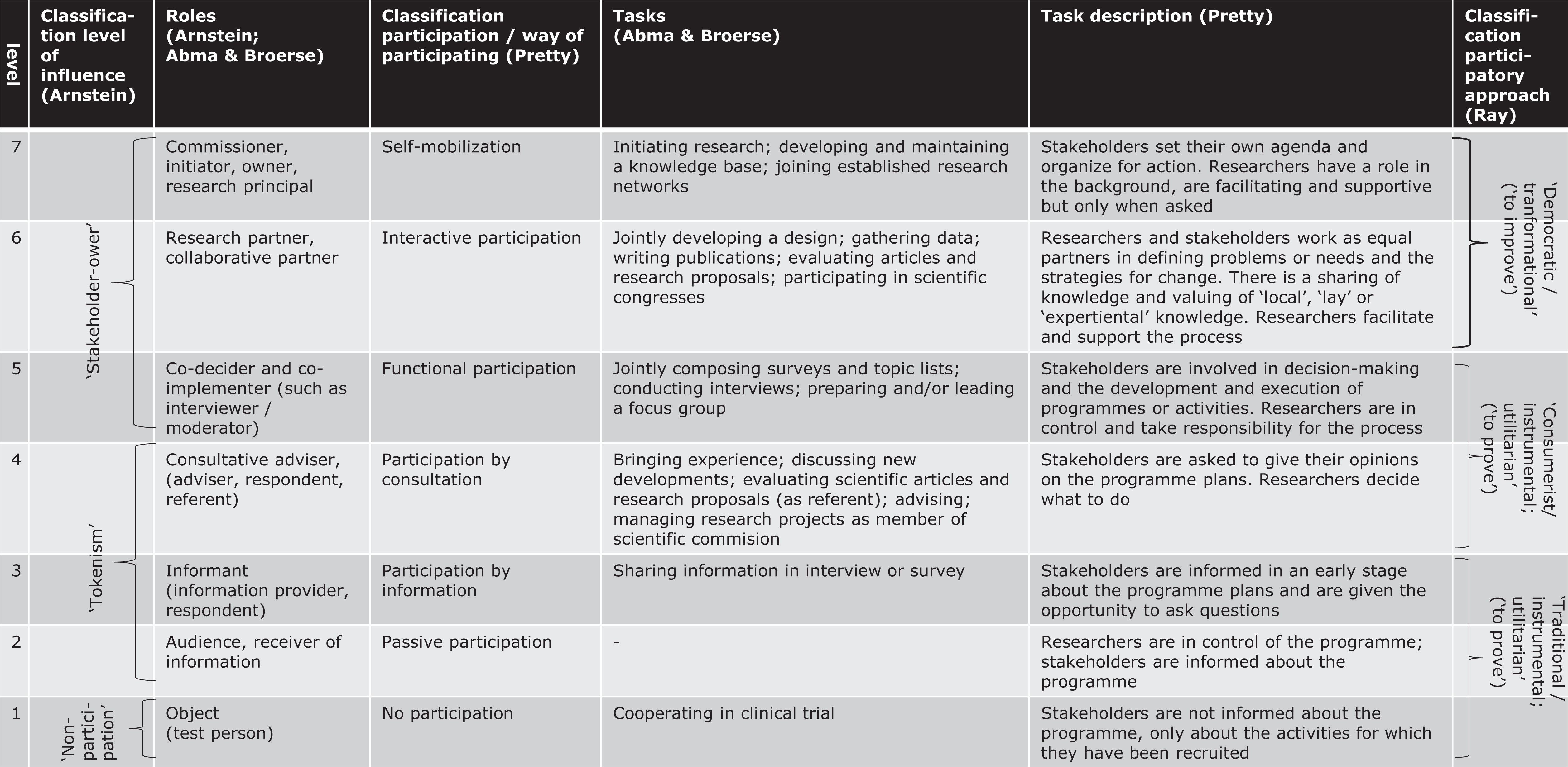
Considering these insights as complementary to each other provides a broader insight in the concept of participation and offers a framework for reflection to screen research projects on participatory characteristics (see Table 1). Moreover, by applying Pretty’s ladder to the role of research partner as outlined in the ladders of Arnstein and Abma & Broerse, it becomes possible to look at the interpretation of the role of research partners in a more nuanced way. Pretty does not classify clearly defined roles as Arnstein and Abma & Broerse do but distinguishes various forms of participation. This allows for attribution of various ways of participation to one and the same role. In this way, pluriform grades of participation can be distinguished in the same role. It may, for instance, be conceivable that the role of research partner, derived from the ladders of Arnstein and Abma & Broerse, which presupposes a high level of participation, can be taken up in more ways than suggested by Arnstein and Abma & Broerse. For depending on the process in which the research is situated, research partners may participate in different ways and thereby take up different and/or changing roles, without derogating from the concept of “partner” and the nonhierarchical relationship between stakeholders and researcher. The key is the existence of an experienced partnership that may be taken up in different ways (over time). This could also take away the existing criticism of the ladders, that is, their linear or hierarchic and static character, and their valuation of the lower levels of participation as inferior, even though these may be very reinforcing for the stakeholders involved and may contribute to the research objectives (Shier, 2001).
Reflection Framework Participation, Based on Participation Ladders Arnstein (1969), Abma and Broerse (2007), Pretty, Guijt, Thompson, and Scoones (1995), and Ray (2007).

Multistakeholder Participation in Practice: A Concrete Case
The following paragraphs present a concrete case in which the partnership approach is applied with multistakeholder participation at its core. It concerns a review of the perspective of the researcher on the basis of her journal notes and reports (thick descriptions) with regard to the initial stage of the research process, during which a multistakeholder defined research agenda and design were developed together with stakeholders, that is, the research partners. We use the insights described here and the framework for reflection presented above to take up the issues described earlier in the partnership approach, being (1) the reach of participation, (2) the depth of the participation, and (3) power dynamics.
Project Background
Recently, the Dutch government made significant changes in the social welfare system. Nowadays, in Dutch society, self-management and participation of citizens are the main goals of social policy (Bredewold, Duyvendak, Kampen, Tonkens, & Verplanke, 2018; Duyvendak & van der Veer, 2014; Oude Vrielink, 2015; Tonkens, 2014; Vereniging van Nederlandse Gemeenten, 2013). This also applies to vulnerable populations, for whom self-management and participation are not so obvious. As a result of reducing social security and professional care, the number of vulnerable populations is growing (Coalitie Erbij, 2015; Sociaal & Cultureel Planbureau/Centraal Bureau voor de Statistiek, 2014).
These findings led to a PhD research project with societal vulnerability as its central theme. The purpose of the study is to obtain a better understanding of the concept of societal vulnerability and its underlying mechanisms—“to prove” (scientific knowledge building)—and especially to contribute to more social inclusion of vulnerable people—“to improve.” The research project started in 2015 as part of the multi-annual research program of Tranzo/Academic Collaborative Center Social Work of Tilburg University, commissioned by a social work organization in the city of Tilburg in the Netherlands.
Issue 1: Who Are Participating? The Reach of Participation
Interaction, multi-actor, and multilevel perspectives
Within this research project, multistakeholder participation is characterized by two key elements: the use of a multi-actor perspective and a multilevel perspective. In this way, a more specific interpretation of the concept of “stakeholders” is provided. It concerns (groups of) selected stakeholders that represent the perspectives at micro (individual), meso (organization), and macro (policy) levels. The respective stakeholders are persons with experience regarding vulnerability (vulnerable populations), social professionals, policy implementers, and policy makers. This also means that both the so-called demand side and the supply side are involved in the research project. Moreover, the distinct perspectives of (groups of) stakeholders are related to one another. This does not only concern the micro-, meso-, and macroperspectives but also the perspectives of various forms of knowledge such as experiential knowledge, practice knowledge, policy knowledge, and scientific knowledge. The inclusion and mixing of these perspectives allows a third element of this interpretation of multistakeholder participation to emerge: interaction.
This specific interpretation of “multistakeholder participation” is chosen based on the ideological (democratic) argument of empowerment (at individual and organizational levels) and the aim to achieve improved practice (“to improve”). It assumes that in order to achieve real improved practice (impact) the commitment of several stakeholders is needed from the start. In particular, those stakeholders who are able and willing to contribute to improved practice, the so-called supply side (social professionals, policy implementers, and policy makers). But involving the “supply side” does not suffice. The so-called demand side (vulnerable populations) also has to be involved in research in order to decide whether the improved practice that is aimed for is also relevant: Does it really help them? Participation is aimed primarily at hearing and bringing out the voices of vulnerable populations (“silenced voices”). Interaction between “demand and supply sides” has to be encouraged in order to cross the various perspectives and gain a wider and more in-depth understanding of the issues at play and how they might be addressed.
It is also assumed that commitment is created by starting with the stakeholders themselves by taking what matters to them as a starting point. This interpretation of “multistakeholder participation” is closely related to the transformational participatory approach (see Table 1), that emphasizes the empowering potential of collaboration and collective action, in order to change or improve the practice and/or policy in favor of those at whom it is directed (vulnerable populations). Connecting to G. Jacobs (2010, with reference to Ray [2007]; Holstein and Minkler [2007]), this approach may also be qualified as a form of democratic participatory action research, the difference being that the research theme is not solely derived from stakeholders themselves, but that the theme is decided by means of a dialogic and iterative process between researcher and stakeholders, that the theme is relevant for all, and that stakeholders are involved in the research process.
Vehicle for the reach of participation: The project structure
Key elements of the partnership approach led to the development of a project structure in which stakeholder groups are involved in the research process on a basis of equality and shared responsibility and that allows for participation of stakeholder groups. The project structure ensures that interaction between various groups of stakeholders and their perspectives is initiated and continued. Marsh (2007) uses the term “partnership practice.” In this “partnership practice,” findings (related to content, methodology, and process) are verified from multiple stakeholders’ perspectives through dialogues (Westhues et al., 2008). In the research project, the project structure has been designed as follows (Figure 1).

Project structure research project and participation reach of participation.
The selection of these groups is also grounded in the premises that relate to the selected reach of participation. Premise 1: in the research project, priority attention is given to the voice of vulnerable populations and to achieving relevant improvements for vulnerable populations. The mixed research team is established to bring out this voice, for which often “deafness” exists. To bring out is one thing. Once it is brought out, this voice also needs to be listened to. In order to be listened to, an advisory board group is established, consisting of stakeholders who themselves are able to contribute to relevant improvements, who are in a position to implement changes and/or to mediate the voice of vulnerable populations toward other relevant parties that are able to realize improvements. Premise 2: the perspective of the researcher is colored and limited. In order to broaden this perspective, firstly, supervisors are involved. These supervisors are professors working at the university. In addition to the involvement of supervisors, there is collaboration with coresearchers in a mixed research team, consisting of persons from vulnerable populations with experiential knowledge and social workers with practice knowledge; all of them with a perspective on vulnerability. This allows for the weighing in of relevant perspectives and allows the research to become more valuable. An additional group acts as a sounding board and allows for additional focus and enrichment. This group consists of selected persons for whom the research theme is relevant, with knowledge of and/or experiences regarding the research theme and/or experiences in conducting scientific research.
A total number of 47 unique persons are actively involved in the research project. They are all considered as research partners because they are committed to the research project and are involved in the research process in some way. This project structure aims to contribute to providing both coresearchers and other stakeholders with shared authority and control of the entire research process.
Realizing reach: How to achieve multistakeholder participation?
The project structure and the separate stakeholder groups were designed at the drawing board. But how to eventually find 47 participants? Figure 2 presents in a schematic way the activities that have been undertaken during the initial stage of the research project in order to concretely flesh out multistakeholder participation and a multistakeholder defined research agenda and design.

Time line activities initial phase research project on behalf of realization multistakeholder participation and research agenda and design.
Issue 2: How Does Participation Take Place? The Depth of Participation
The people who are participating—the reach—are no indication for the depth of participation. The depth of participation concerns the question: In which way do stakeholders participate, to which extent, in which shape and role?
Depth has not proven to be a fixed phenomenon in the research project. Although the nature of the separate stakeholder groups remained unchanged (the composition of members per group however did change over time, for instance, due to change of job or illness), the depth of participation has proved to be less static. The depth shows a more fluid character as Figure 3 and Table 2 illustrate.
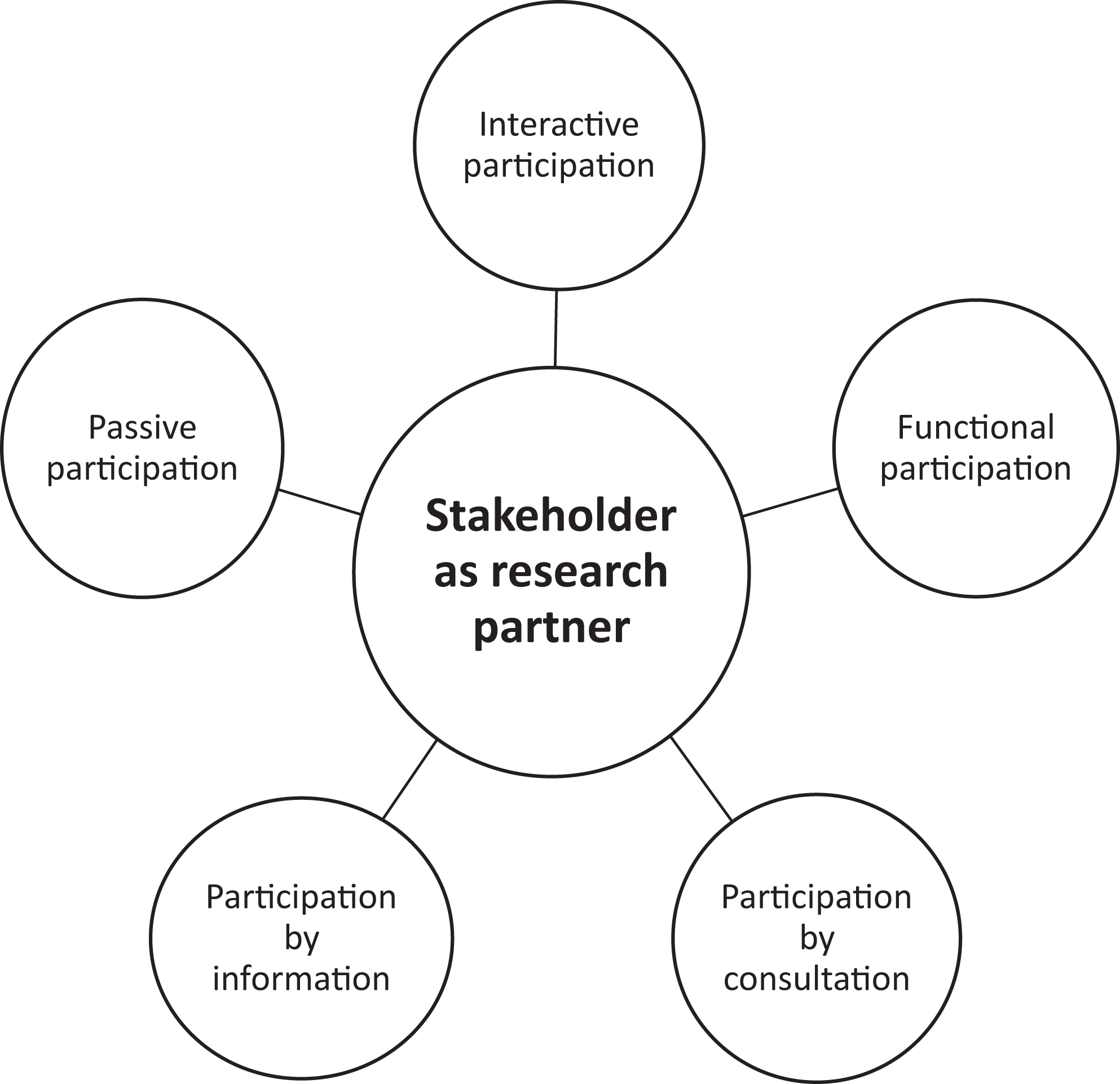
Research partner in different modes of participation.
Depth of Participation Using the Participation Reflection Framework (see Table 1).
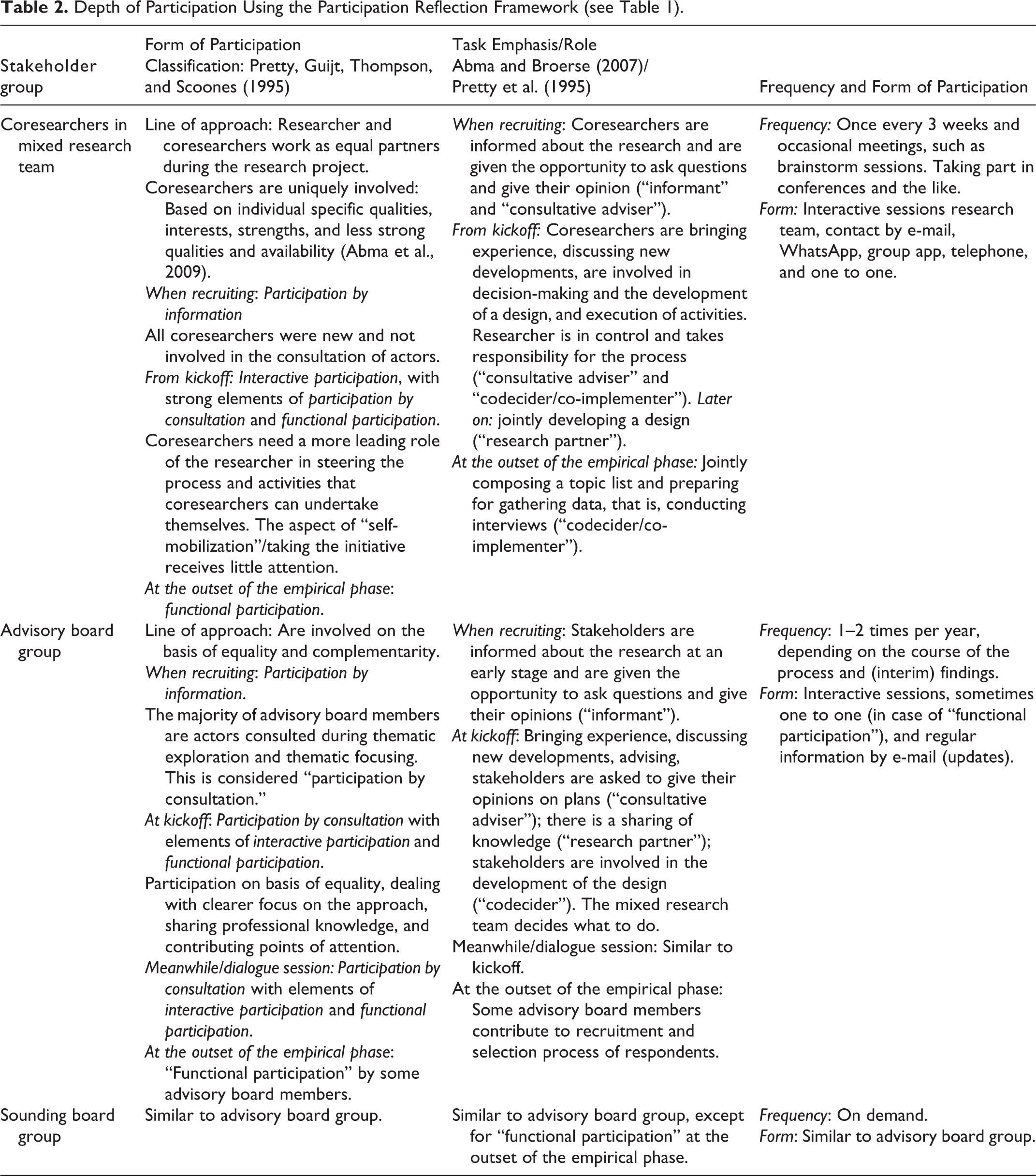
Although all stakeholders in the research project are considered as research partners, the character of the partnership differs per stakeholder group. In other words, all stakeholders have shared authority and control over the complete research process, but the level of authority and control differs per stakeholder group. The level of authority and control depends on the manner of participating per stakeholder group. Moreover, the level of participation depends on the phase of the research and the consequent activities taking place (see Table 2). As the whole research is emergent—a consequence of the choice in favor of a partnership approach—so the depth of participation is also emergent. The research process shows openness and flexibility: different ways, levels, and shapes of participation of the stakeholders are possible in the various phases of the research. This also means that stakeholders may carry different (shared) responsibilities.
When making use of the participation reflection framework presented earlier (Table 1), the depth of participation during the initial stage of the research project can be found in Table 2.
The way in which advisory board group and sounding board group participate may seem identical. However, they each contribute not only different forms of knowledge and different perspectives (see Figure 1), but their functions as partner in the research project also differ. It is exactly because of those differences that both stakeholder groups are considered important.
The advisory board group is “in a position” to actually implement changes, which is needed to eventually achieve change and/or improvement (“to improve”). The sounding board group is not. It primarily contributes to thinking about the content. In other words, the prime function of the advisory board group is to create as much impact as possible.
Banks, Herrington, and Carter (2017) discuss “co-impact,” an umbrella concept referring to realizing changes as a result of the collaboration of individuals, groups, and organizations. Banks et al. (2017) distinguish three types of co-impact, namely, “participatory impact,” “collaborative impact,” and “collective impact.” When those three types are matched with the functions of the various stakeholder groups in the research project, it leads to the following Table 3.
Impact Function of Participation Stakeholder Groups.

Issue 3: Power Dynamics. Who Is in Control?
Different (impact) functions and depth of participation of stakeholder groups may suggest the existence of a hierarchy of power between the various stakeholder groups and researcher. Yet this is not the case. A nonhierarchical relationship between stakeholder groups and researcher takes central position in the research project. All—stakeholders and researcher—share decision-making power.
In the research project, power is continuously balanced by dialogue. From the outset, ground rules in participating were discussed with and agreed upon by the different stakeholder groups. This led to common ground for the involvement and engagement of the various stakeholder groups and the way in which they participate in the research project and interact with each other. These ground rules are (1) all stakeholders, including the researcher, participate on an equal basis in all phases of the research project; (2) all bring in a unique perspective and all perspectives are respected and considered valuable; (3) each stakeholder group serves a certain goal (see Figure 1) and thereby fulfills a different task(s) and role(s) (see Tables 1 and 2). All goals, tasks, and roles are considered valuable; and (4) all share authority and control, and dialogue is used to reach a shared understanding or a consensus over ideas, processes, and outcomes.
However, this does not mean that “anything goes.” The leading principle in this kind of collaboration with stakeholder groups is the double research objective, which is realized by answering the research question in a systematic way, that is, “to prove” and subsequently “to improve.” In other words, with respect to the power balance, it is the research question with its underlying double research objective which dictates the research process. By consequence, the contributions of the partners are always weighed against the relevance of it in answering the research question. Decisive in this assessment is the researcher. However, not without substantiating, the decisions made to the partners in stakeholder group dialogue sessions. A last ground rule (5) about the decision-making power which is also agreed upon. In this respect, the researcher fulfills the role of gatekeeper and guide in guarding the research process and outcomes, aiming at realizing the 2-fold objective of the research project. Decisions about whether or not contributions of partners are integrated in the research project are justified by the researcher to the partners in stakeholder group dialogue sessions. This continuous transparency is an instrument to harmonize the power dynamics.
To demonstrate, how authority and control are shared in the research project two examples of research decisions are presented here. Both examples show how the various stakeholder groups contribute to the decision-making. An example of a research decision that was made in this research project that shows how the different boards contributed to the decision-making is when an initial research design was presented to both the advisory board group and the sounding board group. In a dialogue session, both groups raised the following question: Whose perspective actually has priority? We agreed that the perspective of vulnerable populations is the starting point of research. However, according to the partners, this starting point was not visible in the initial research design. Due to the initial research question, the research tended to focus on vulnerable populations instead of with vulnerable populations. From the outset, we all agreed to avoid this pitfall and therefore the research team (coesearchers and researcher) was strongly advised to revise the research question in order to ensure that the voices of vulnerable people themselves are heard. After intensive but constructive deliberation within the research team, consensus was reached on a revised research question and subsequently a revised design. This was presented to discus with and finally agreed upon by both groups. The original research question was formulated as follows: Which factors and actors influence the development, continuation, and reduction of societal vulnerability? The revised and final version of the (double objective) research question is: What is the perception of people from vulnerable populations of the concept of societal vulnerability (“to prove”), of the factors and actors influencing it (“to prove”), and what are their suggestions for reducing perceived vulnerability (“to improve”)? Hence, the perspective of people from vulnerable populations became the starting point of research instead of the perspective of theory and policy.
An example of a research decision that was made that shows how the coresearchers contributed to the decision-making is when the research team was preparing for the phase of data collection. All coresearchers wanted to conduct interviews with persons from vulnerable populations. In preparing the interview questions, some of the coresearchers found the term “vulnerability” stigmatizing and refused to use this term during the interviews with the participants. The researcher however found it very important to use the term since it is the central theme of the research. In this case, friction was embraced and a great deal of time has been spent discussing whether or not to include the term “vulnerability.” Discussing proved to be fruitful. All coresearchers, including the researcher, gained a sharper and more nuanced understanding. We concluded that vulnerability is a sociopolitical construct in Dutch society and not our subjective judgment. With this in mind, the coresearchers felt more confident in avoiding the potential risk of stigmatizing participants during the interviews. They also felt confident to use the term “vulnerability” during the interviews with the participants because they were well prepared in how to explain this concept to the participants, for example,. by extensive discussing and role-playing. In addition, it created more profound awareness of the complexity of the concept of vulnerability. From a methodological point of view, this contributed to the quality of the research.
Conclusion and Discussion
This article elaborates on the concept of “partnership research” as a form of participatory action–oriented research and with a focus on multistakeholder participation. It is based on both existing theoretical insights from scientific literature and the description of a practical case in which partnership research is being implemented. In the case description, three issues are being discussed: the reach, the depth of participation, and power dynamics. In this way, we try to lift the fog surrounding “participation,” the key concept in partnership research. In this article, this concept is elucidated and has proved helpful in the description of the practical case to reach a more nuanced understanding of the umbrella concept of “multistakeholder participation.” This is particularly so in the case of the participation reflection framework developed on the basis of insights of Abma, Nierse, and Widdershoven (2009), Pretty, Guijt, Thompson, and Scoones (1995), Ray (2007), and Shier (2001) supplemented with earlier experiences from the practice case. This reflection framework allows us to further interpret the way of participating and the roles of various stakeholders/groups—the depth of participation. It also allows for more conscious choices regarding the desired and/or suitable way of participating of various stakeholders/groups, depending on the research phase, the chosen reach of participation, and with a view to impact realization. All this without derogating the role of the research partner.
If equality is the point of departure and a characteristic of partnership research, it should allow for differences in the ways of participation. In order to do justice to participation, stakeholders ought to be able to fulfill various roles over time and pluriform roles at the same time. In this way, the issue of depth of participation also encompasses the issue of width of participation.
Reach, depth, and width of participation should all be considered elements that affect the realization of impact. The reach, depth, and width of participation selected in the practice case seem to increase its opportunity to create impact. The practice case currently shows “participatory impact.” This is illustrated by the adjustments in the original research design as a result of the exchange of perceptions between stakeholder groups. The follow-up will demonstrate whether “participatory impact” remains the case or that other forms of co-impact as distinguished by Banks et al. (2017)—“collaborative impact” and “collective impact”—will also become prevalent. An interesting question in this respect is which type of impact still allows one to relate to partnership research and what the supposedly “higher” forms of impact (collaborative and collective impact) would signify for the way in which the role of research partner is interpreted.
Another element of participation seems essential for the type of impact, namely dialogue. The choice of dialogue, and correspondingly a nonhierarchical relationship between stakeholders and researcher, as point of departure for the research project has created commitment among stakeholders. This commitment seems to continue to exist whether the dialogue with and between stakeholders are continued. This dovetails with what Brouwer, Woodwill, Hemmati, Verhoosel, and Vugt (2016) classify as one of the most important characteristics of effective multistakeholder partnerships, namely that everyone who affects the situation that led to the process or is being affected by it, should be involved from the very beginning. In the practice case, therefore, commitment is not considered a one-off thing but something that needs to be carefully maintained throughout the process. Dialogue is the vehicle to use. In the current research process, this seems to bear fruit so far: Stakeholder groups are still actively involved.
With the elements of participation—reach, depth, width, and dialogue—participation can be considered a process. Participation is a process that contains value in itself, regardless of the outcomes of the research. By continuously exchanging and crossing various perspectives and intermediate findings, it is as if a “learning partnership” is created, aiming at improving practice. This takes place gradually during the process. Participation enriches, deepens, inspires, and teaches. The vehicle for the research project’s “learning partnership” is the set of ground rules to which all partners agreed from the outset, and the designed project structure in which the collaboration with stakeholder groups was embedded from the start.
Until now, this way of working has been successful in the research project: the contribution of stakeholder perspectives, and reflection and dialogue around these, has deepened and enriched. It has led to what Kunneman (2017) calls “instructive friction,” which is caused by the confrontation of different perspectives and creates turning points. The presented cases regarding power dynamics are examples of this instructive friction. Moreover, the multistakeholder defined research agenda and design in the research project have gradually developed on this basis.
The most essential turning point in the initial stage was the question stakeholders raised: whose perspective actually has priority? And thereby reminding the research team of a possible pitfall: that of conducting research “on” vulnerable populations instead of “with” vulnerable populations, although the research is fully aimed at this. Therefore, the research design was adapted to accommodate this toward the end of the initial stage of the research process. It is also the reason that this article, which describes the initial stage, does not discuss the stakeholder group of vulnerable populations in detail. Starting from the data-gathering phase, the perspective of vulnerable populations is the point of departure and dialogue will be used to make the connection between stakeholder groups, including the stakeholder group of vulnerable populations.
This all sounds positive, but there are some drawbacks to be mentioned. First of all continuous attention is needed to keep the commitment of stakeholder groups in the researcher’s thinking and in the researcher’s actions. Thinking ahead and timing activities are essential. This is all the more complicated when dealing with a variety and diversity of stakeholders/groups, in acknowledging the pluriform roles of research partners (stakeholders), and in uniquely involving those research partners.
Also according to Brouwer et al. (2016), multistakeholder participation can be regarded as a form of governance (a way of governing). This calls for a different interpretation of the role of the academic researcher than that of a “classical” academic researcher. Brouwer et al. (2016) state that the success of a multistakeholder partnership depends to a large extent on the “facilitator” who embodies three important roles: (1) convenor brings relevant actors together and promotes interaction; (2) moderator facilitates so that stakeholders collaborate through dialogue and support for mutual learning processes; and (3) catalyst stimulates stakeholders to think out of the box and to develop and implement new and daring solutions. This means that academic researchers need to have strong facilitation skills in order to fulfill these roles.
The three roles are recognizable in the research project. The academic researcher is not just a partner—not “the” expert, but “an” expert or a “critical friend”—who is actively involved in the dialogical process (Abma et al., 2009; Van Regenmortel et al., 2013, 2016) but also a facilitator along the lines described by Brouwer et al. (2016). Experiences so far also show the possibility of a fourth role for the researcher as “facilitator,” namely that of process manager. This concerns organizing the conditions, providing and guarding direction (gatekeeper and guide), and coaching and being accountable (financially and contentwise). The researcher needs to manage the playing field with its multiple players. Managing multistakeholder participation in research has in this way proved to be a time-consuming affair.
Although the “facilitating” role of the researcher thus far turns out to be conducive and effective for the participative process, this role does not always compare easily to the role of “classical researcher” and the scientific standards that need to be met. These two roles need to be continually balanced while also taking into account the time frame of the research project. This balancing is continually challenged by the characteristics of the partnership approach. Where the more classical research approaches are characterized by conforming to models, linearity, sequentiality, control, and rationality, partnership research as implemented in the research project demonstrates different characteristics: relational, cyclic, iterative, coinciding, reflexive, and emergent. In her lectures, Abma relates to “messiness”: Participation causes the research process to be untidy, frayed, and chaotic, but at the same time, this participation provides educational moments of friction that enrich the research process.
“Messiness” also does not make it easier to manage the role of “classical researcher” and to comply with scientific standards and output criteria that often are founded on the characteristics of more classical scientific research approaches. Issues related to this are safeguarding the scientific quality, maintaining the purity of the critical aspect of the research position and the way in which the complexity of the process can be expressed in outputs.
Finally, partnership automatically includes participation, but not the other way around. A shared responsibility to reach practice improvements is characteristic for partnership research. The responsibility differs depending on the way in which participation of research partners takes place or changes during the research process.
Any form of partnership research is unique and follows its own path and logic. There is no blueprint for the design of multistakeholder participation in research (Brouwer, Woodwill, Hemmati, Verhoosel, & Vugt, 2016). Such a blueprint would be impossible. For emergence is inherent in this form of participation. It is precisely in the dialogue with stakeholders that the research process takes shape and a research design gradually emerges that will eventually lead to outcomes. There is a significant saying by the Chinese philosopher and sage Lao Tse: “a path is created by walking on it.” As Bindels, Baur, Cox, Heijings, and Abma (2013) also state, there is not just a single perfect method that may be applied everywhere and on everyone. The criterion of suitability is important: is it suitable in this context, given these circumstances. The form of participation should always start from the context and the conditions and assignments that are incorporated in it and should relate closely to the people who are involved. This article describes a path that others may find useful to learn from in order to follow their own path in their own research context.
The case study presented here focuses on the research process. Further research is needed to gain insight in the effectiveness of multistakeholder participation and how this partnership succeeds or fails in achieving its goals, namely, improvement of practice, impact, and empowerment of stakeholders.
Footnotes
Declaration of Conflicting Interests
The author(s) declared no potential conflicts of interest with respect to the research, authorship, and/or publication of this article.
Funding
The author(s) received no financial support for the research, authorship, and/or publication of this article.
