




Abstract
Body-map storytelling (BMST) is a qualitative visual research methodology and has been used to access embodied subjective experiences in different areas of knowledge, with few studies in the field of nutrition. The consciousness of body experiences can decrease vulnerability to environmental stimuli for food consumption, which can be advantageous in contemporary changes with a significant appeal to food overconsumption. This study aimed to present the application of the BMST as an integral part of the Food and Nutrition Education Program with Sensory and Cognitive Exercises (PESC), an intervention designed to promote consciousness of eating experiences, highlighting its potential as a tool for the expression and assessment of perceptions triggered by the intervention. To this end, a theoretical framework, the Triple-Aspect Monism theory of consciousness, and a methodological framework, the manual for the use of BMST in health research, were considered. The adapted BMST application protocol was designed so that BMST could promote the synthesis of intervention activities and their integration with previous eating experiences and fit the intervention structure. 19 adult Brazilian women created individual BMSTs in collaboration with us and recorded narratives. These were analyzed using Braun and Clarke’s Reflexive Thematic Analysis, considering messages generated at the end of BMST production. The findings present an overarching theme: Insights about embodied eating experiences and four thematic categories related to eating experiences: Holistic approach, learning, self-evaluation, and applied eating experiences. The application of BMST has been demonstrated as a visual and qualitative research methodology with promising relevance in nutrition studies. This methodology acted as a catalyst for the embodied expression of women’s consciousness of eating experiences related to contemporary food consumption appeals.
Keywords
Introduction
The perception and recognition of body sensations triggered by physiological processes and environmental stimuli are increasingly recognized as important in modulating eating behavior (Weltens et al., 2014). Sensations triggered by physiological processes inform us about energy levels and nutritional needs, which are interpreted as hunger or satiety, and result in homeostatic control of eating (Morton et al., 2006). Sensations from environmental stimuli associated with memory, emotion, and the reward system, represented by interactions with food or situations related to food consumption, may lead to cravings and be a possible trigger for food consumption (Rolls, 2006; Shepherd, 2012).
Contemporary food consumption changes are marked by advertising appeals, the diffusion of facilities for food consumption (McCrickerd & Forde, 2016; Recio-Román et al., 2020; Shepherd, 2006), and increased availability and accessibility to ultra-processed foods (Moodie et al., 2013). This scenario constitutes what is known as an obesogenic environment (Lake & Townshend, 2006) and has contributed to the weakening of signaling and perception of body physiological processes (UK Government’s Foresight Programme, 2007, Section 3 “Causes of obesity”; Finlayson & Dalton, 2012). Therefore, there is maintenance and creation of space for the various environmental stimuli to act in urban contexts, which may contribute to the increase in obesity and chronic non-communicable diseases (Cordain et al., 2005; Swinburn et al., 2019).
Given this scenario, consciousness is defined as experiences that people can report after interacting with the environment (Pereira & Ricke, 2009). Furthermore, the perception and attribution of meanings to sensations are considered essential components of conscious experiences (Pereira, 2013). Interventions capable of promoting these aspects related to eating experiences have been suggested as possible ways to reduce individuals’ vulnerability to environmental stimuli for overconsumption (Herbert, 2021; Simmons & DeVille, 2017). Lehman (2013) assumed that behaviors devoid of consciousness tend to be fast and rigid. By contrast, those provided with consciousness operate in slow and flexible ways (Lehmann, 2013). Considering that environmental stimuli for food consumption encourage immediate and thoughtless behaviors (Chandon & Wansink, 2012), it has been proposed that the promotion of consciousness of eating experiences may offer less vulnerability within this context.
Thus, the Food and Nutrition Education Program with Sensory and Cognitive Exercises (PESC), an intervention designed to promote the consciousness of eating experiences in response to stimuli imposed in the contemporary food scenario, emphasizing the excess of environmental and circumstantial stimuli for food consumption. This food consciousness intervention, named PESC, consists of four workshops in which exercises are applied to stimulate perception, body location, meaning, and reflection on sensations aroused during eating, which are considered essential for the promotion of consciousness (Pereira, 2013). A detailed description of the PESC food consciousness intervention activities was published in the study protocol (Palazzo et al., 2021).
Body-map storytelling (BMST) is a qualitative visual research methodology based on artistic processes (Harries et al., 2019; Leavy, 2018). The BMST is centered on the creation of a life-size human body silhouette composed of visual, textual, and reflexive elements, which illustrates individuals' experiences based on the narration of a story (Gastaldo et al., 2018). This methodology was adapted to health research in 2012 with studies in the occupational and migration fields (Gastaldo et al., 2012). Through adaptation, BMST has been applied in several contexts and fields of knowledge (Skop, 2016; Wallace et al., 2018; Willis et al., 2018). One of the distinguishing qualities of this methodology is that it allows awareness of perceptions and bodily sensations (Tarr & Thomas, 2011), as the individual materializes their experience from the body silhouette. This allows us to access symbols and personal meanings (Hammelman et al., 2020).
In the last PESC food consciousness intervention workshop, the creation of a BMST was proposed to synthesize all the activities developed in the previous workshops. The BMST also acts as a tool to promote and record the conscious perception of eating experiences through embodied experiences (Swinburn et al., 2019; Townshend & Lake, 2009; Turner et al., 2018). The choice of this methodology was motivated by its reflexive, multisensory, creative, adaptable, and highly sensitive interpretive nature (Harries et al., 2019). It is also capable of accessing and communicating the experiences of individuals (Lys et al., 2019). Its potential to promote reflection on food consciousness was considered, as it allows mapping of the embodied experience (Sweet & Escalante, 2015; Lys et al., 2018).
Although there is extensive literature on how environmental stimuli affect individuals, there is a lack of methods capable of accessing one’s experiential perceptions. In particular, they perceive that they are affected and behave in the face of environmental stimuli for food consumption (Turner et al., 2018). Thus, the present study focused on the application of BMST as an integral part of an intervention for promoting consciousness of eating experiences, highlighting its potential as a tool for the expression and assessment of the perceptions elicited by the intervention.
Methods
Researchers’ characteristics and reflexivity
We are four female researchers. We are affiliated with a research laboratory with extensive experience in studies focusing on women’s eating behaviors. Our group also has experience in clinical care. In the context of approaches to obesity treatment, the present project seeks to fight stigmatization and encourage empowerment. This focus includes a political commitment to broader therapeutic strategies by integrating a transdisciplinary team of researchers.
Study setting
The application of BMST was an integral part of the fourth food consciousness intervention workshop. The PESC is an experiential intervention that takes place weekly, in groups of up to six people, and consists of four 2-hour workshops and two evaluation sessions. In the three initial workshops, sensory perceptions were exercised in everyday situations that can offer stimuli to food consumption based on the interaction between food characteristics and the perceptions of the body. The fourth workshop was described in this study. The application of the food consciousness intervention was described before (Palazzo et al., 2021). Figure 1 describes the PESC food consciousness intervention workshops used to contextualize the BMST’s role. Timeline and description of the four workshops (W1, W2, W3 and W4) conducted during the PESC food consciousness intervention, including respective themes and goals. Adapted from “Educational intervention for food consciousness: A randomized study protocol” by Palazzo et al., 2021, Nutrition and Health, 28 (1), p. 127 (https://doi.org/10.1177/02601060211011801). Copyright 2022 by SAGE Publications.
This qualitative study encompasses an intervention piece; as such, it can be classified as a cross-sectional study as it refers to one session of a six-session intervention (Palazzo et al., 2021). This study was approved by the Research Ethics Committee of the Clinic Hospital of Ribeirão Preto (HCRP-USP), number 09850919.6.0000.5440. All participants signed an informed consent form. Ethical components and confidentiality of information were also considered (Gastaldo et al., 2012; Guillemin & Drew, 2010).
Adaptation of the Body-Map Storytelling as a component of the PESC, a food consciousness intervention
Theoretical and methodological frameworks
Traditionally, body maps have been applied in groups (Solomon, 2008), but they have also been used in individual sessions to tell stories about remarkable and profound experiences (Harries & Solomon, 2018; Krueger-Henney, 2019; Lys, 2018). Adaptations in the method of applying the BMST to suit research themes have been observed in the literature. The use of open-ended questions (Lys et al., 2018), the form of application (Chenhall et al., 2013), the number of sessions and time length (Dew et al., 2018), association with other research methods (Skop, 2016), and the use of different paper sizes (Dennis, 2020; Larrea-killinger et al., 2020; Wallace et al., 2018), are examples of such adaptations. Strategies for strictly individual processes within an intervention context, to access and promote the reflexivity of individual eating experiences, were the challenges of this study. McCorquodale and De Luca (2020) reinforce the opportunity for knowledge production by using the body and its perceptions but emphasize that access to these experiences is still scarce in the literature.
For the adaptation of the BMST, we considered the following: (i) the Triple-Aspect Monism (TAM) theory of consciousness (Pereira, 2013), which served as the theoretical framework for the development of all PESC food consciousness intervention activities; and (ii) the manual of methodological considerations for the use of the BMST in health research, by Gastaldo et al. (2012). These references were chosen so that the BMST could perform two functions in the food consciousness intervention: a means to access food and embodied consciousness and a tool for synthesizing in-depth eating experiences.
According to the TAM, the rise of conscious experience goes through physical and sensory aspects (interaction with the environment), cognitive content associated with these interactions, and the attribution of feelings. Feelings are considered when there is a meaning associated with an event and it is recognized as a lived experience by the individual (Pereira, 2013). It is known that an essential way of interacting with the environment is the body (Solomon, 2020), which occupies a central position in the formation and rise of conscious processes. For TAM, reproduction of conscious content requires reproducibility. We used the BMST as a means of recognizing experiences - representation and access to the conscious processes described - because of its centrality and sensitivity to the embodied experience.
The manual of methodological considerations for the use of the BMST in health research (Gastaldo et al., 2012), was the first systematized document and the reference in this area and is widely used in studies (Davy et al., 2014; Dew et al., 2018; Gelatti & De Angeli, 2019; Lys, 2018; Murasaki & Galheigo, 2016). This manual was chosen for its guiding potential in the application of the BMST in various health research contexts, particularly, for being used as a tool for synthesizing workshop experiences in addition to individual eating experiences.
According to this facilitator manual, the creation of the BMST should be guided by trigger questions that are applied in an exercise format. These questions are based on reflections on how an individual experiences an explored topic (Gastaldo et al., 2012).
Adaptation process and proposal
The adaptation process was conducted over a 1-year period. The BMST was adapted to (i) promote the synthesis of PESC food consciousness activities and the integration of these activities with participants' eating experiences and (ii) fit within the intervention structure.
The first condition signaled the necessity to elaborate on triggering questions that were consistent with the theoretical framework adopted in this study (TAM), according to the perception of physical aspects and sensory forms, cognitive content, and attribution of meaning to the themes exercised in the workshops. This framework generated open-ended questions examining specific patterns of embodied records, as described below. I. Body location where the sensations of food desire and pleasure are perceived, as well as the body’s hunger and satiety signals. II. The expressions of these sensations as a consequence of the interaction with the environment. III. The thoughts aroused as of represented expressions, based on workshops themes (food desire, food pleasure, and body signs of hunger and satiety), as well as the importance of these thoughts.
Since this is an individual experience (condition ii), despite being applied in groups, we tried to ensure that the creation of the BMST was carried out in a limited space so as not to promote influence among group members. For this reason, it was proposed to create body maps on smaller paper sheets (A3 size, 297 × 420 mm) and use individual kits of art materials.
Comparison of the elements tested in the present study with the application manual by Gastaldo et al. (2012).

The application protocol was developed based on the points considered for adaptation of the BMST. The BMST application exercises are shown in Figure 2. Descriptive representation of the guided process to create body-map storytelling with the participants. Irresistible foods and tasty foods were nominated as markers for food desire and food pleasure, respectively. BMST: body-map storytelling.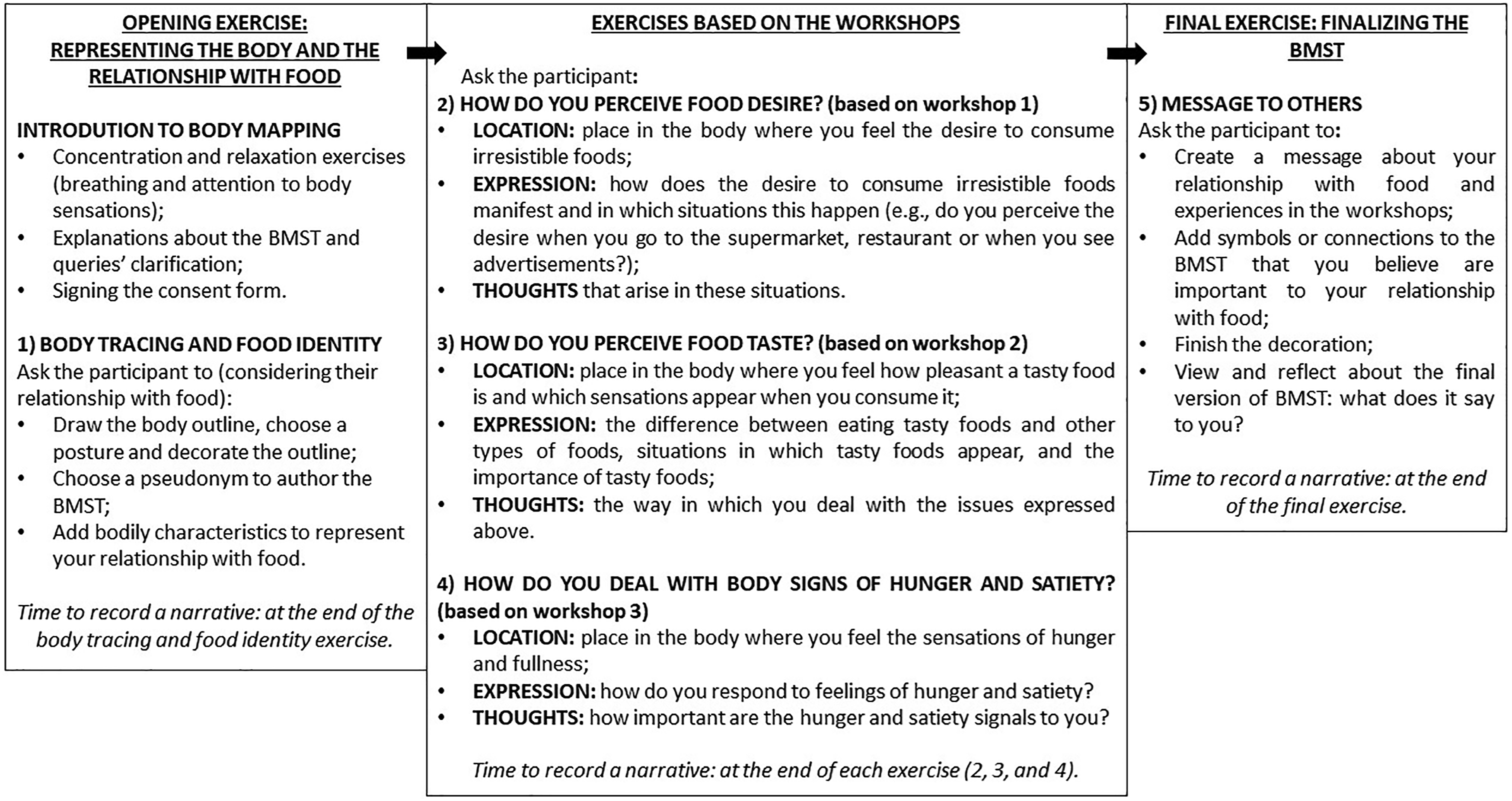
This study presents the findings of the final stage (Item 5 “Final exercise: finalizing the BMST”) of BMST creation.
Participants
The recruitment and selection of participants were performed as described in the PESC food consciousness intervention protocol (Palazzo et al., 2021). Adult women from 20 to 59 years of age were included (World Health Organization, 2009, Chapter 1 “Women around the World” section), with a Body Mass Index (BMI) of between 18.5 and 34.9 kg/m2, corresponding to classifications between eutrophic and obesity grade I (WHO, 2000, Part I “Use of other cut-off points” section). Participants were required to present a minimum variation of 5% of body weight in the previous year, report difficulties with weight management, and express the desire to improve their relationship with food. Individuals with the following conditions were excluded from the study: smoking habits; pregnancy; diabetes; celiac disease; dietary restrictions; psychotropic medications; nutritionists; and nutrition students.
The BMST adaptation for application in the food consciousness intervention was tested in a pilot group (4 participants) and later applied in the intervention group (19 participants).
Data collection, organization, and processing
The workshops were held in person from 2019 to 2020 per WHO determinations of the Coronavirus-19 pandemic (https://www.who.int/emergencies/diseases/novel-coronavirus- 2019/advice-for-public). Four trained researchers participated in the data collection. The BMST was applied in one session, with an average of 2 hours.
The creation of the BMST was based on three processes (Gastaldo et al., 2012), conducted through reflexive exercises according to the themes of the workshops: (i) the draft of a smaller-sized human body map, representative of the participant’s body; (ii) the creation of visual representations in images and texts based on the individual experience; and (iii) individual narratives recorded in audio, to signify the context and visual representations created. The recordings were made by the participants on personal cell phones and sent by a multiplatform messaging application (WhatsApp) for a private conversation with the main researcher. The recordings were prepared after the completion of each exercise to ensure access to as much information as possible.
The BMST generated two data formats: verbal data (recorded narratives) and visual data (image and text representations). The organization and processing of the data were carried out after the completion of each intervention group. It consisted of transcribing the recorded audio, photographing the BMST on a white wall, and a lit place to facilitate data storage and analysis. To produce systematized documents containing the relations of meanings of the visual representations based on verbal data, transcriptions and the BMST were used. A systematized document was produced for each participant with no interference from the researcher in the data created by the participants (Guillemin & Drew, 2010). The generated data were then confidentially stored.
The fifth exercise, the finalization of the BMST, was used to explore the perceptions of the participants about the food consciousness intervention experience. In this exercise, participants elaborated and recorded a final message about their relationship with food, considering the experience promoted by the workshops and resumed during the production of BMST. This process characterized their eating experiences at the individual level and in association with the food consciousness intervention experiences.
Data analysis
The photographic records of the BMST and narrative transcripts of the 19 participants were included in the software for qualitative data analysis (Atlas.ti, version 9.0; Scientific Software Development GmbH, Berlin, Germany). Messages referring to the fifth exercise of the final part of BMST creation were selected from the transcripts. Although the visual data were not analyzed, they were considered in this study. This was because they were produced in an integrated way and consisted mostly of text, adding to the content of the narratives. The visual data were considered from the systematized documents created to contain the meanings of each visual representation in association with the recorded narratives shared by the participants.
The initial process described was considered the first level of analysis because of the researcher’s interaction with the production and generation of data. This interaction was characterized by familiarity with the data, understanding, and making connections between visual and verbal data. Therefore, the initial immersion was made possible.
After this process, content analysis, reflexive thematic modality (Braun & Clark, 2006; 2019), was applied. Other studies have also applied this type of analysis to the data produced in BMST (Boydell et al., 2020; Dew et al., 2019; Ellem et al., 2020), including the evaluation of the BMST experience as a data collection method in a sex education intervention (Lys et al., 2018), which seems very similar to the present investigation. Reflexive Thematic Analysis was chosen because it is a creative and reflexive method that seeks to identify meanings and their patterns (Braun & Clarke, 2006; 2019), considering the depth and sensitivity of BMST in communicating phenomena. As proposed by the Reflexive Thematic Analysis, the analysis actively produces data (Braun & Clarke, 2019), just as the data are produced in the BMST. Seeking the identification of thematic categories that captured the perceptions of the process experienced in the food consciousness intervention, especially related to how the participants interact with the contemporary food environment, two questions were applied to the selected data: 1. How was the food consciousness intervention experience? 2. How were the food consciousness intervention experiences processed and interpreted considering the prior individual eating experiences?
After floating reading, the data were coded and refined until representative themes were obtained (Braun & Clarke, 2006; 2019). Throughout the process, we searched for meanings communicated by the participants within the data generated. A second researcher performed the same procedures to ensure the quality and consistency of the data. Discussions among the researchers established a consensus on data analysis. The confidentiality of the stored data is ensured by the security of the software Atlas.ti version 9.0.
One overarching theme and four thematic categories were identified. The overarching theme, insights about embodied eating experiences, illustrated the possibility of new ways of thinking and/or connections about previous knowledge in relation to perceptions about the food consciousness intervention experience. The thematic categories were derived from the overarching theme because they further describe how these changes were experienced: first, the holistic approach to the integration of eating experiences refers to the central meaning, highlighting what made the most sense as an integration of what was experienced from food consciousness intervention; second, learning about eating experiences, reflecting on how the participants captured these new connections and expressed the knowledge formation; third, self-evaluation of eating experiences, indicating the assessments as what lessons were learned and how the experiences (intervention and personal) were summarized; fourth, applied eating experiences, unpacking how they applied the food consciousness intervention experiences to their personal eating experiences. A discussion of these findings is presented in the following section.
Findings and Discussion
The findings and discussion are divided into two sections. The first section presents and discusses BMST’s creation after the adaptations; the second section unfolds the overarching theme and thematic categories generated. This division is per the objective of this study, which is to reflect on the application of BMST as an integral part of an intervention for consciousness of eating experiences promotion, highlighting its potential as a tool for expression and assessment of the perceptions elicited by the intervention. The pseudonym chosen by each participant illustrated in the BMST was used and is shown in italics.
Body-Map Storytelling: Reflecting on eating experiences and their determinants
Figure 3 shows an example of the final product of BMST creation after the described adaptations and applied protocol. Example of body-map storytelling, named Mirror of Mine.
The message representing the fifth exercise is below the representation of Mirror of Mine and represents a major representation form of the visual elements (in text): “First of all, stop and evaluate, and then act and perform the task of eating.” The presence of visual data (drawings and shapes), as well as texts, should be noted. The visual data were consistent with the proposed questions and represented the phenomena exercised in the workshops (food desire, food pleasure, and signs of hunger and satiety).
From the narrative elaborated after visual creation, we realize the connection between what is inside the body and the background space of the BMST. This is visually represented by arrows and shapes in lines that signal movement and dynamics (fluidity and sequence) of the interaction between the data. We can observe the integration of some visual elements expressed in the BMST of Mirror of Mine. The connection between what is represented inside the body as a stomach (oval shape, in the center of the trunk, with brownish filling and a colored outline) and the representation of a clock (in the background space of the BMST, connected to the stomach by a greenish trace), which also makes a connection with the mind, is verbally illustrated by the participant:
"One thing that is very connected for me is the time to eat. I'm kind of connected to time, like a clock. And it's not only the time I'm hungry; what guides me the most are the schedules. So, I wrote here that satiety and the need to eat are important because they help to regulate and control the timing of eating, which time influences a lot. I see that it's getting close to lunchtime and I'm already feeling hungry. It is linked to the psychological component.” (Mirror of Mine)
A similar visually represented movement was also found in a study by Larrea-Killinger et al. (2020). In everyday life, bodies are dynamic and constantly in motion in response to the environments to which they relate (Boydell et al., 2020; Dennis, 2020; Larrea-killinger et al., 2020). This was represented by Mirror of Mine when describing the relationship between how a bodily sensation, hunger (internal expression), is followed by an external command, which establishes the time for eating as a social norm. Using the body as the central element of representation (Bruckner, 2018), BMST positions itself with the ability to access and reproduce the interaction between individuals and the environment. It was considered that the elaboration of visual representations from the body outline acts as a generator of meanings (Dennis, 2020), which was translated through the narration shared by the participant. This seems to characterize embodied human experience, as described by Solomon (2020).
Overarching theme and thematic categories
Visual representations of the overarching theme and thematic categories from the data created in the BMST, presenting participants' perceptions after participation in the food consciousness intervention.

Overarching theme: Insights about embodied eating experiences
When producing the final message during the creation of the BMST, narratives that represented the integration of the experiences proposed by the PESC food consciousness intervention with individual eating experiences were common. These perceptions were intended to give new meaning to the previously existing understanding of the participant’s relationship with food. The narratives assumed, therefore, a tone of discovery, changing the perspective when looking at the way they usually eat, as illustrated by the following narrative and visual data (see Table 2, Figure 4):
"It opened my mind to some points. I realized that I am careful with my nutrition. And this was something that I had always charged myself with. I had always charged myself a lot. I am very, very grateful, for this period and for this discovery and these sensations that we never stop to think about. And it was a very good experience.” (Sun)
Sun drew the representation of a smiling person with yellow stripes coming out of her head and wrote: “Period of discoveries and gratitude,” referring to the expression “opened my mind,” which represents the period of discovery for issues that she normally did not think about.
BMST, as an art-based research methodology, can directly perceive phenomena in new ways (Lys et al., 2018) and enables insights/learning processes to occur (Dew et al., 2019; Harries & Solomon, 2018). This is because of the ability of this methodology to broaden the understanding of the phenomenon by engaging the participant to create a narrative endowed with multiple forms of representation, meaning the same phenomenon in different ways (Lys et al., 2018). This mapping process allows for the representation of relationships between space, objects, and time (Futch & Fine, 2014).
The change in perspective in the face of an experience accompanied by the reorganization of self-perception is consistent with what is defined as insight (Levitt et al., 2004). Insight is considered a subjective experience (Webb et al., 2018), which can occur in diverse contexts (Shen et al., 2018), and refers to the formation of new connections between previously existing conceptions or skills (Bowden et al., 2005), or even the reorganization of individuals’ perceptions (Levitt et al., 2004). In this way, there is the possibility of experiencing a phenomenon differently than what would normally be experienced with a general level of self-awareness (Levitt et al., 2004).
The finalizing moment of the BMST also allowed the participants to revisit a phenomenon previously represented in the BMST. Thus, they broaden their understanding of how the addressed phenomenon is embodied and experienced in the realms of perceiving and feeling (see Table 2, Figure 5):
"In the drawing [body-map storytelling] I added more veins because I had put them only in the arm [when previously representing how you feel the food pleasure in the body]. Yeah, I didn't put it on the whole body, but I put it all the way down to the feet because it's a feeling of complete body satisfaction [perception about food pleasure phenomenon], not just on the top, so I thought it was necessary to put it all the way down." (Eth, body and health)
Eth, body and health drew red lines from the representation of a heart on her torso and down to her lower limbs to represent veins. These veins refer to the feeling of body satisfaction, which represents what she feels in her body as food pleasure.
Based on these findings, it was possible to identify two perspectives of insight about embodied eating experiences: one endowed with a more “reasoned” process (Sun) and another more spontaneous, influenced by the present moment of creation of the BMST that stimulated the expansion of embodied knowledge about food pleasure (Eth, body and health). From the overarching theme, which describes a new perspective on the perception of eating experiences, four thematic categories were identified. They provided a deeper look at the processes triggered by participation in the food consciousness intervention.
Thematic category: Holistic approach to the integration of eating experiences
This category illustrates the prominent perception of the integration process among the experiences in the PESC food consciousness intervention with personal eating experiences. It also demonstrates the already existing expressions of knowledge expanded by new connections (Levitt et al., 2004).
For Marisa, salient insight was directed toward the embodied experience. She identified the need for positive appreciation and valuing of the body as central to her experiences (see Table 2 and Figure 6):
"My sacred, wise, sensitive temple. Because I need to look at my body and see it more as...a sacred thing, my home. And it is very wise, I wrote, because it tells me what I need [...] sensitive because it is...sensitive, it gives me the sensation of pleasure. When I am happy, it is my body that gives me this feeling as a gift [...] so my body, it is my gift, it is everything for me, and I didn't have this notion. I think it's the first time that I'm thinking like that." (Marisa)
Marisa wrote over the representation of her lower limbs the following phrase: “My sacred, wise, and sensitive temple,” to represent the appreciation of her embodied experience.
Sweet and Escalante (2015) describe that body experiences are based on cultural and social practices, which allow body feelings (sensations, moods, and states of being) to be a means of detecting and incorporating these experiences. By exploring the experiences directing them to the embodied representation, the BMST confers the possibility of reinforcing embodied knowledge and communicating the meanings that this knowledge acquires in the face of an individual repertoire (Klein & Milner, 2019).
Expanded perceptions about eating were also narrated, as the participants proposed the use of sensory and bodily apparatus for a more attentive relationship with food.
"Stop, think, perceive the food, feel it in all its forms, in relation to taste, texture, noise, smell." (Perseverance)
"First of all, stop and evaluate, and then act and perform the task of eating." (Mirror of Mine)
The active participation of the body in the production of eating behaviors (Hayes-Conroy, 2010) is provided by the sensory apparatus (Longhurst et al., 2009). Thus, eating experiences occur as a product of the interaction between body structures and external structures to the body (environment, as food), which modulates the relationship with food (Longhurst et al., 2009). The intervention proposes a constant exercise in food consciousness by encouraging participants' perception of their intrinsic resources as an alternative to empowering them in the face of environmental appeals for food consumption. The narratives of these participants turned to the recognition and appreciation of the perception of individual factors experienced by the body for more conscious eating in the face of the environment.
Therefore, the findings exemplify body sensations, thoughts, and emotions in an integrated and holistic way. As discussed by Boydell (2021), the BMST stimulates the embodied sensory and psychological experience and, thus, can be positioned as a holistic research methodology.
Thematic category: Learning about eating experiences
This category highlights the process of knowledge acquisition prompted by participation in the food consciousness intervention, which occurs in an integrated manner with personal eating experiences. This learning process is anchored in the present and the themes rescued throughout the creation of the BMST but also signals the intention of change and the search for more learning in the future.
Me for Me (Tica) signaled that she was encouraged to learn by understanding the importance and extent that the senses and body have in the face of eating experiences (see Table 2, Figure 7):
"The final message that I would like to put, is that from these encounters I think I learned and understand the need to learn. Earlier, I did not see the need to learn, and now I see how necessary it is. How much I am learning and need to learn more and more about the relationship between the senses and the body. They speak about everything we feel." (Me for Me (Tica))
Maturity described the learning process she experienced from the workshops as follows: “I learned to relate better to food and the signals the body gives, things I didn’t notice before."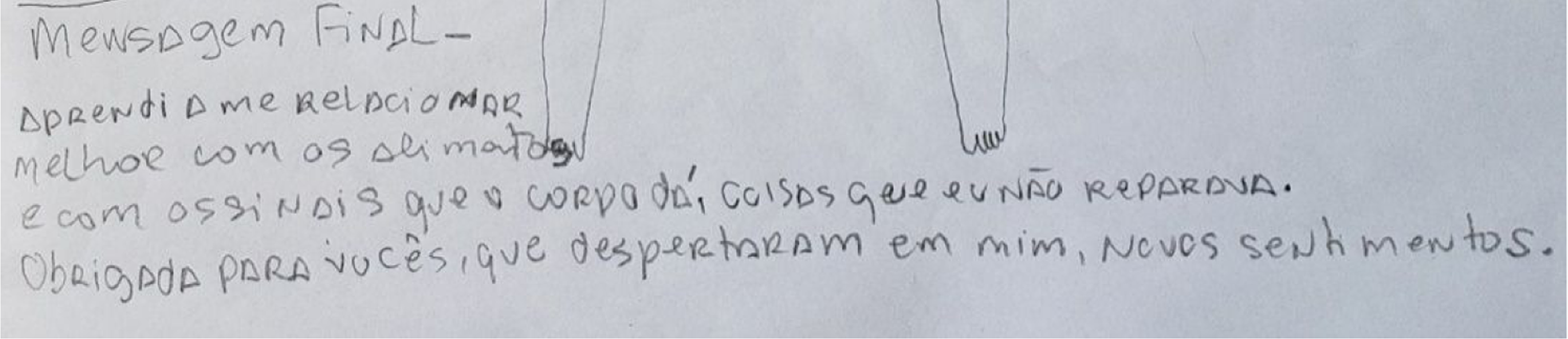
Cristal described her individual eating experience as integrated with the knowledge gained from the PESC’s food consciousness intervention experiences, focusing on the relevance of attention and respect for the body in the face of well-being:
"Learning to listen to my body, not to just keep ignoring the signs and symptoms. When something is not good for me or when I simply think that it's not going to be good for me, I don't go beyond that limit." (Cristal)
The BMST enabled the valuing of personal knowledge (Klein & Milner, 2019); engaged consciousness about experiential experiences by turning to experience with the body (Lys, 2018); and contemplated cognitive aspects, as it integrates somatic experience with mental processes (McCorquodale & De Luca, 2020). Thus, the representations expressed the body as a means of knowledge acquisition owing to its centrality in everyday experiences, as assumed by Collings & Smith (2020). The narratives signal the occurrence of insights based on thoughts and enhancement of learning (Webb et al., 2018).
Thematic category: Self-evaluation of eating experiences
The self-evaluation of eating experiences illustrates the interaction between environmental conditions and individual factors, signaling the strength with which these scopes operate on eating experiences. Mirror of Mine brings a conclusion about mindless eating and the intensity with which external stimulations to the body can lead to food consumption beyond bodily needs:
"The message that I have after all the workshops, and this last exercise, which is to make the map, is that we see that we often don't think to feed ourselves. And sometimes, you don't just fill your need, you let your desire exceed your need." (Mirror of Mine)
Heloisa contextualizes the work environment as a hindrance to the consciousness of hunger signals, acting as a stronger stimulus than her bodily needs (see Table 2, Figure 8):
"There are responsibilities at work that don't let us sometimes take a break to feed ourselves when we feel hungry. So, we get conditioned to all this, besides the stressful life, right? Anyway, in relation to the rush that ends up making us want to eat certain foods, right? Foods that bring us more comfort." (Heloisa)
Heloisa wrote a message to represent the stimuli in her context that act as barriers to an eating relationship in tune with what her body needs. “Today’s society has conditioned us to increasingly ignore our relationship with food, either because of the industry that adds various chemical substances or because of the busy and often stressful daily life we face.”
The manner and strength with which the participants' perceptions occurred were demonstrated by the BMST. Mirror of Mine interacted with the conditions external to her body, while Heloisa noted the idea of conditioning as conformity to a reality that does not favor the valorization of bodily needs. Both add new connections to previous experiences (Bowden et al., 2005), but with different perspectives.
Thus, the BMST allowed the assessment of reflections (Lys et al., 2019) that characterize eating experiences from an individual perspective (how participants see themselves affected by this context), contemplating extracorporeal conditions (Morton et al., 2021). Dennis (2020) highlighted the potential of BMST to point to the ways in which bodies are not segregated from the environment in which they operate, and this dynamic was identified in this study.
Thematic category: Applied eating experiences
The applied eating experiences demonstrated how the participants applied the perceptions acquired in the food consciousness intervention to their eating experiences. It was possible to observe an expansion of the repertoire of the relationship between the body and eating behaviors (see Table 2, Figure 9):
"Today, I have another vision, another perception of how to feed myself, of how to perceive hunger, of how to perceive satiety, thanks to the workshops.” (Alice)
"With the workshops, I even uninstalled the ifood notifications [food delivery application]. I have it there for when I need it, but this visual part [situation she describes when she feels stimulated to consume food by seeing a food brand], which I know can hinder my relationship with food, is what I have already learned from this experience [food consciousness intervention]. I started to understand the body signals better, what my real needs are, and which signals they represent.” (Eth, body and health)
Violet wrote a message to represent the application of the experiences acquired during the workshops: “If I plan my eating and eat mindfully, I realize my satiety better."
Considering the PESC’s food consciousness intervention experiences, through embodied knowledge (Boydell et al., 2020), the BMST showed sensitivity in communicating the participants’ relationship with environmental factors that stimulate food consumption, which influences health and well-being. It was evident that participants were able to experience food practices in different ways (Levitt et al., 2004), integrating the occurrence of insights.
Strengths and Limitations
The BMST proved to be a promising tool for accessing and expressing perceptions promoted by participation in the food consciousness intervention. By using the body silhouette, even in a smaller dimension, the BMST has maintained its ability to be a means of embodied expression. Furthermore, by using a smaller-sized body map, it became easier to apply, including the transportation of materials, use by participants within small rooms, organization, digitalization, and storage, and analysis of data, which can be advantageous for unorthodox research contexts. The BMST proposal can bring about positive effects regarding the change in perspective on eating experiences. Thus, it can promote health and well-being by considering the deleterious effects of obesogenic environments that have affected public health worldwide. Proposing the use of a creative qualitative research methodology to stimulate and communicate eating experiences can be considered the innovation enacted by this project by adding new possibilities to the current literature.
We considered as limitations of this study: 1. Contrary to standard practice, we used smaller body maps (A3 paper size: 297 × 420 mm) for logistical reasons, which might have affected the findings, such as attenuating the richness of the artistic elements employed in the BMST compared to other studies (Gastaldo et al., 2012). Furthermore, there may be differences in the way the data were produced and generated, which requires a comparative study between different paper sizes to assess this issue; 2. The sample was limited to women from the same area of the country and were culturally similar, which may reflect analogous food habits according to the typology of food, pattern of meals, and access to food, making it impossible to generalize to other sociocultural realities; 3. This study presents an application proposal for the BMST in the specific context of food consciousness intervention. This makes BMST reproducible, but there may be dissimilar findings when applied to other contexts, especially because there is no known systematization of the BMST adaptation process.
Implications for Future Research
The versatility of the proposal of this study occurs in the use of the BMST as a research methodology, acting both as an instrument of intervention and as a tool for the assessment and expression of perceptions triggered by the food consciousness intervention. We emphasize the need for qualitative studies that adopt BMST in the nutrition field, considering that eating experiences occur through embodied experiences. We suggest that the proposed scripts and structures be executed in different research contexts and populations to infer the scope of their applicability. Future studies can be carried out to validate the BMST proposal applied to the nutrition field, especially to assess its impacts on production and data generation compared to other research approaches.
Conclusion
The BMST showed promising applicability when applied as a catalyst for the expression and assessment of embodied experiences integrated with contemporary appeals that facilitate food consumption, within an educational intervention for food consciousness. The proposed application of the BMST, drawing from a theoretical framework for food consciousness (TAM), shows the potential for investigating this phenomenon through the recognition of experiential processes. The use of the body as the main platform in a creative way was shown to be effective in accessing the embodied sensations involved in interactions with the environment that stimulate obesity. This study provides new ways to explore and discuss eating experiences that impact the health of the population.
Footnotes
Acknowledgments
We would like to acknowledge and thank Dr Alfredo Pereira Júnior for his theoretical and methodological contributions to the adapted protocol of BMST, all participants of this study, and Gabriela Batista Ribeiro Mendonça and Homero Munaretti for their contributions to this study. BEL thank the National Council of Scientific and Technological Development - Brazil (CNPq) for the scholarship [grant number 168801/2018-3]. RWDG and LM thank the National Council of Scientific and Technological Development - Brazil (CNPq) for the Productivity Scholarships [grant number 303194/2018-9 and number 303037/2018-0].
Declaration of Conflicting Interests
The authors declared no potential conflicts of interest with respect to the research, authorship, and/or publication of this article.
Funding
The authors disclosed receipt of the following financial support for the research, authorship, and/or publication of this article: This work was financed in part by the Coordination for the Improvement of Higher Education Personal - Brazil (CAPES) [finance code 001]; and the Foundation of Support to Teaching, Research and Assistance of Clinic Hospital of Ribeirão Preto, University of São Paulo - Brazil (FAEPA) [grant number 1069/2020], which are not involved in any procedures of development in this study.
