




Abstract
This article describes an improvisatory or ‘no method’ research approach in socio-ecological sustainability in two rural Ugandan communities. A team of multidisciplinary researchers purposed to understand how rural community members make sense of their role in, and relationship with, the environment. In addition, they sought to unsettle pre-existing assumptions, categories of knowledge, and methods of knowledge generation, through a practical and conceptual exploration of community-academy collaboration in research. The authors present an account of the research process as an experiment towards a decolonial, context-specific, and post-qualitative practice of inquiry and collaboration. The paper describes the context of the Ugandan communities involved and the socio-ecological issues that impact their lives. Related methodological practices are discussed to support the description and discussion of the improvised methods employed in this study. The methodological findings that conclude this paper have implications for global sustainability research, partnership, and action.
Keywords
Introduction
This paper describes the first phases of an exploratory project that redefined the roles, responsibilities, and practices within interdisciplinary sustainability research 1 in rural Uganda. We present an improvisatory approach to research that eschews many normative assumptions within natural and social science research models but reflects a genuine commitment to the context-specific nature of accountability, impact and sustainability. Through the use of images, quotes, and commentary, this paper offers contextual detail of the locations of the research, examples of the data that was generated, and discussion of the emergent outcomes. Supported by this context, the focus of this article rests on the theoretical foundations and research practices that form a methodological framework.
The study began as a collaboration with partners in the Global North (UK) and the Global South (Uganda); from the natural sciences, social sciences, and the arts; and from civil society organisations. Prior to engagement with rural communities, the study was motivated by the objective to understand how rural community members make sense of their relationship with sustainability issues such as food security, energy, water, and socio-economic wellbeing (Riley & Chilanga, 2018). Additionally, the team shared a commitment to research and engagement that resisted neo-colonialism. In other words: challenging inherited power and economic dynamics to implicitly, or even explicitly, impose external value systems, practices or currencies; challenging uni-directional approaches to research – assuming that only the perceived vulnerable need development or intervention; and refusing narrow or single-disciplinary conceptions of complex socio-ecological issues. To this end, the research objectives were held contingent, ready to shift or evolve as communities took up collaborative roles in the project. The team purposed to step ‘outside the box’ of traditional Eurocentric research methods (Khupe & Keane, 2017).
The ‘box’ in our collective work has come to be a metaphor for all manner of normative and established practices in international development related research; in the case of this inquiry, the box stood for pre-determined methods. Exploring the notion of ‘outside’ existing research structures, and drawing on Deleuze’s critique of the dogmatic image, Jackson (2017) writes, ‘thinking without method relieves qualitative inquiry from the twin forms of epistemological imperatives of knowledge production and a conventional dependency on procedural method. Freedom from this reliance gives us a new starting place: the outside of method’ (p. 666). In this project, thinking outside of traditional methods not only allowed us to use a responsive approach to data generation and knowledge production, but also enabled us to navigate the different types of ‘procedural methods’ that become entangled -- with varying degrees of harmony -- when working across multiple disciplines and cultural contexts. Working in the ambiguous borderlands between disciplines, continents, cultures, and languages, the three authors of this paper can attest to the implications of the plurality of ways of knowing the world. From three different cultures and backgrounds, we experience the world differently from one another and we rely on more than one ‘real’ science in understanding it. Methods are designed and justified from epistemological positions that also determine valid ways of knowing and understanding a particular phenomenon. There are limitations to the application of natural and social science methods that are largely defined by the Global North, given that people engage with the world with very different epistemological lenses (Arndt & Tesar, 2019; Sajnani, 2012; St. Pierre, 2019; Singh, 2017).
Mahmood Mamdani argues that Western knowledge production tends ‘to relegate Africa to providing raw materials (“data”) to outside academics who process it and then re-export their theories back to Africa’ (Bob-Milliar, 2020, p. 56). We set out to do something entirely different from this. Not only did our team seek to engage local knowledges on the subject matter, but in a negotiated approach that would bridge the gap between academia and rural people. To pursue these aims, established qualitative research frameworks, or as coined by Brinkmann, ‘good old-fashioned qualitative inquiry (GOFQI)’ (2015, p. 620) held too many conflicts; based as they are upon premises that fell far from the epistemologies of the communities invited to participate in this study. We acknowledge the multidisciplinary scholarship in sustainability research that interacts with indigenous knowledge systems, with community engagement, and with multiple disciplines (e.g., Moyo & Moyo, 2013; Odora-Hoppers, 2002; Pullanikkatil et al., 2016). We bring previous experience in frameworks such as Participatory Action Research (e.g., McIntyre, 2007), Participatory Rural Appraisal (e.g., Chambers, 1994), and Community-Based Research (e.g., Boyd, 2014) to support and contextualise our exploratory departure from pre-existing research frameworks. The accumulated knowledge and experience in this field is in part what brought these authors together within the wider community of practice of the Sustainable Futures Global (SFG) Network (www.sustainablefuturesglobal.com). However, the focus herein lies in our departure from established methods (Arndt & Tesar, 2019; Bridges-Rhoads, 2015; St Pierre, 2019; Sajnani, 2012). An intention to think ‘outside the box’ provided the impulse that began and directed the journey of this project.
In the next section we highlight existing work in community-based and context-specific research methods. We then introduce socio-ecological sustainability in the context of Uganda. From here the article focuses on the study contexts, followed by the research methods that emerged in response to them. We go on to discuss the lessons learnt and challenges encountered. We intend this article to contribute knowledge to the work of decolonising and localising research methods, and the Africanisation of socio-ecological research.
Responding to Context through Research Methods
In the search of context-based approaches to research, an ever-increasing range of research methods have been developed (Bob-Milliar, 2020). These draw on cultural frameworks including improvisation (Lees, 2019; Medina, 2021), indigeneity (Drawson et al., 2017; Themane, 2021), creativity (Lees, 2019; Schoon et al., 2020), and African ubuntu (Muwanga-Zake, 2009). References to culturally specific (Drawson et al., 2017), flexible and innovative (Drawson et al., 2017; Kramer et al., 2019; Bob-Milliar, 2020), and post qualitative research (Kramer et al., 2019) are now commonplace. What emerges as central across this range of approaches is the endeavour to make research meaningful to the research participants. Methodological improvisation informs ‘creatively-driven enquiry, and involves risk and open experimentation (Lees, 2019, p. 11). Relatedly, Bob-Milliar, 2020; Reiter, 2018 speaks of decolonising methods as those that address the asymmetrical power relations between Principal investigators from the Western World and Research Assistants from the global South. In doing so, the work creates space for participants as well as researchers to equally engage in and benefit from knowledge creation. To this end, Muwanga-Zake adds that ‘decolonising research decentres the focus from the aims of the researcher to the agenda of the people, and advocates a research relationship that engages the subjects’ (Muwanga-Zake, 2009, p. 418).
Scholars have advocated specifically for Indigenous Local Research (ILR), that ‘recognises and acknowledges social contexts in which research takes place by being sensitive to it and using it’ (Themane, 2021, p. 63). In the African context, ILR speaks of the Africanisation of research methods as a trade-off between Western research methods that allow generalisation of findings, and contextual rich data that addresses local needs. Africanist researchers, states Bob-Milliar, 2020, ‘can best address the issue of quantification through innovative interdisciplinary research approaches’ (p.65). Khupe and Keane (2017) describe African research methods as being transformational and participatory, and able to recognise cultural identities and diversity through language and cultural norms. One such approach is described by Muwanga-Zake (2009) as the Ubuntu research philosophy. ‘Essentially, Ubuntu as a research philosophy gives the research process a human face, as opposed to some top-down imposed research processes, and advocates collaboration with the participants and community humanely, with respect to their spirituality, values, needs, norms, and mores.’ (Muwanga-Zake, 2009, p. 418).
Muwanga-Zake (2018) later coined the Ugandan concept of obuntubulamu that relates to the Southern African Ubuntu concept in that they both refer to ‘humane and collective actions and relationships’ (Muwanga-Zake, 2018, p. 208). He differentiates Obuntubulamu from ethnography, whereby ‘while ethnography seeks to investigate cultural processes, Obuntubulamu provides already known procedures of conducting research in Bantu communities’ (Muwanga-Zake, 2018, p. 217). In general terms, the noted concepts speak of context-specificity and relevance to indigenous communities (Drawson et al. (2017). However, Drawson et al. (2017) stress that context-specific methods are not necessarily mutually exclusive with Western methods but can also enhance each other.
Improvisatory methods and post qualitative methods join broader community-participation approaches aimed at prioritising the needs of the community (Drawson et al., 2017). Ibanga lists conceptual frameworks with potential to ‘illuminate Africannes in community-based research, including ‘(i) Ethnophilosophy, (ii) Sage Philosophy, (iii) Conversational Philosophy, (iv) Conceptual Mandelanization, (v) Eco-Afrocentricism, (vi) Indigenous Language Analysis, (vii) Eco-Afro-feminism (viii) Conceptual Decolonization (ix) Storytelling Philosophy, and (x) Cultural Adaptionism’ (2018, p. 126). These are examples of how ‘African worldviews of knowledge, as embedded in the collective of oral and literary traditions, [can] be used to conduct research in science and humanities?’ (Themane, 2021, p. 62). Nonetheless, these conceptual propositions remain to be contingent upon authentic and ethical practices.
Researching with(in) communities has always been a contentious issue in academic research. The contention has been on the level of community voice or how research represents the communities’ views and beliefs (Back, 2009; Janes, 2016; Marker, 2003). Communities, especially in the rural global South, are often characterised by low print literacy levels, low socio-economic status, powerlessness, marginalisation and vulnerability (Monyake, 2018). As a result, researchers coming from outside the local communities are considered powerful, resourceful, and often seen as potential donors or aid givers (Bananuka & John, 2020). Being an outsider has scales: for example, researchers from an urban context but sharing the same nationality (as with Bananuka and Kadoma) are outsiders to the community but considered related through sharing heritage, politics, and culture, and better understood by rural community members. Researchers from the global North (Perry) are positioned by the community not only as different, but also as unrelated, as resource rich, and authoritative in matters relating to progress and development. These dynamics may be based on lived experience of receiving outsiders’ interventions in communities, but also on collective imaginaries fuelled by the endless narratives of outsiders bringing aid in the form of agricultural supplies, water, or infrastructure into the communities. These interventions are predominantly based on national policy or Northern science that assumes particular preconceived needs and proposes solutions based on outsider knowledge and external resources. Notably, there are many cases in which Development Assisted Countries (DAC) like Uganda have partnered with outsider interventions with unintended and detrimental consequences. Buildings, wells, and technologies that are left unused, un-serviced, and unrepaired for example, have become irrelevant or a reminder of imbalanced partnerships (Ndou, 2012; Rwakakamba, 2009). In addition, non-indigenous crops or animals provided from external initiatives have disrupted agricultural production, eco-systems, and livelihoods due to their impact on existing practices and conditions (Moyo & Moyo, 2013). Finally, an increased provision of English and Swahili education is resulting in the disappearance of local languages, and along with them, ways of knowing and interacting with the world (Defourny & Šopova, 2019). The outsider then, has an inherited status, he or she inspires a certain amount of expectation, but not always trust or shared objectives. Consequently, it is not surprising that outsider researchers face a substantial challenge in building trust or establishing common ground with communities and a genuinely participatory approach to research. Without a common ground, the research endeavour is limited, and unlikely to reveal anything more than superficial impressions and enactments of expected assumed roles. This dynamic is not unique to rural communities in the Global South but is heightened in this context due to the often-extreme extent of perceived power and resource divide between the researchers and the community members (Back, 2009). A general consequence of this dynamic is a tendency for community participants to act and respond in a manner intended to please researchers or to satisfy their expectations, in order to economically benefit from the interaction (Bananuka & John, 2020).
Extensive theoretical and practical work has been done over the past 50 years to counteract extractive and exploitative research, and as discussed earlier, there are models, tools, and discourses to support participatory, decolonial, and reflective research practices (see for example, Caretta & Riaño, 2016; Zarowsky, 2011; Ziai, 2007). This work often revolves around foregrounding participants’ opinions and perceptions. However, coincident with important developments in research methodologies, academia recognises definite processes, practices, and procedures for what counts as credible research. The Academy, globally, is disproportionately influenced by Northern institutions, funding systems, colonial language and normative discourses. This imbalance of influence has implications for what research receives funding; for the requirements of institutional ethical approval processes; and for peer review and publication processes. Thus, the issue of epistemic privilege and violence (De Lissovoy, 2010; Spivak, 1994) looms heavily within international research. The extent of the relevance of knowledge generated through conventional international research collaborations, and the benefit of that research to participant communities, cannot be taken for granted.
The next section introduces the socio-ecological context of the project, followed by the community contexts that hosted our collaborations. We then outline key theoretical and discursive tools that we have used to develop our no method 2 approach.
The Socio-Ecological Challenge in Uganda
Human interaction with nature is purposeful and intentional (Howard, 2018). Even where human actions towards the environment appear destructive, there is a gain or profit motive. This implies that humans do weigh the losses against benefit in their relations with nature to the extent that we understand them. Within human made systems (social, economic, industrial) these decisions multiply in impact. ‘The system in its narrow pursuit of profit—and on ever-greater scales—increasingly disrupts the fundamental ecological processes governing all life, as well as social reproduction’ (Foster, 2021, Foster & Clark, 2016, p. 2). What remains key to every society is how to regulate individual and societal actions against the common good (Yurchenko, 2021). ‘For Marx, man’s relationship to nature is twofold (subjective, objective)’ (Fuchs, 2006, p. 11). In other words, whereas human existence is dependent on nature, humans also have capacity to sustain and co-exist with nature in sustainable ways.
Africans have had a deep sense of consciousness of their mutual and symbiotic relationship with nature or their environment. ‘Much as the continent is famously known to be having the widest biodiversity (biological diversity) and eco-diversity, it has been and is still losing this natural heritage at a high rate due to anthropogenic interference precipitated by the global economic order’ (Kamugisha, 2018, p. 290). As a result, African societies have long improvised ways to preserve the environment. Africans for example, used taboos, totems, folktales and proverbs to strengthen understandings of the connectivity between human and environmental behaviours. Strauch et al. (2008) reports on the example of the Sonjo people of Tanzania who use a combination of traditional knowledge and scientific knowledge to ensure harmonious relations with ecosystems such as forests, swamps and water resources. Unfortunately, recent efforts in sustainable development particularly in the global South have rarely tapped into local indigenous knowledge. The challenge for our research team as outsider academics was to create a methodological approach that could be adapted to engage genuinely with indigenous knowledge. Any debate about environmental sustainability in African societies ought to raise consciousness but not by means of didactic messages from elsewhere of what ought to be done.
The research contexts and methods described below focus entirely on a community level engagement. It is important to note that this is not due to an assumption that sustainability challenges begin or end at a community or local level of practice. To the contrary, the interconnectedness of local and global actors, individual and societal systems, geopolitical and biodynamic forces are central to a broader agenda to interrogate how knowledge is constructed and by whom. That being said, the research approach is described and applied herein with a focus on the community and local level relationships with the immediate environment. As previously stated, the study was motivated by the objective to understand how rural community members make sense of their relationship with sustainability issues such as food security, energy, water, and socio-economic wellbeing.
The Study Context
The agrarian communities invited to this study are located in Apala and Abia Sub-counties in Alebtong district and Kibanjwa, Kitoba Sub-county in Hoima District. The Apala and Abia communities are healing communities recovering from 20years of internal conflict, primarily instigated by the Lord’s Resistance Army (LRA), a rebel military outfit. By the time peace began to return in 2006, approximately 90 percent of the population had either been internally displaced and living in camps, or moved out of the country, with hundreds of thousands tortured, raped, or killed (Dolan, 2009). This healing community is the home of the Apala Widows and Orphanage Centre (AWOC), established to assist widows and orphans in coping with and recovering from the effects of the LRA that saw many of the men in the community either killed or forced to join the rebels.
In contrast, the community of Kibanjwa has been affected by the recent discovery of oil in the area, which has resulted in intense investment in the area due to research and the increase in opportunistic settlements. Consequently, the majority of local people have not only been forcibly evicted from their lands, but forced to sell at very low prices, and exposed to exploitation and harsh treatment (Tumusiime, 2014; Tumusiime et al., 2018). Nevertheless, Kibanjwa community has enjoyed relative peace and stability for more than 30 years and is representative of an agrarian community in Western Uganda. Significantly, both participating communities were homes to at least one member of the academic research team. These pre-existing relationships provided an important bridge to the partnerships and relationships that formed the foundations and motivations of the research.
Research, Enquiry, and Engagement with “No-Method”
The remainder of this paper describes our process of research despite the heavy history, culture, and constraints that we carry as academic outsiders in two rural Ugandan communities. This research tackles the compromises and negotiations made with pre-determined regulations including for example, institutional financial processes, funder requirements, and project timelines. Suspicious of the ethical and practical implications of normative research practices in complex community contexts, we join many research innovators in striving for flexible approaches, relevant and responsive discourses, and opportunities to unsettle status quo, to see what else might emerge (Pierre, 2014; Wiles et al., 2013). The growing field of post-qualitative research rejects the inevitability of traditional humanist and empirical frameworks of reference such as the authority of coding, the legitimacy of member-checking, the logic of triangulation, and so on (Strauch et al., 2008; St Pierre, 2019). In this study, we put these ideas to work in conjunction with decolonial theories that challenge extractive approaches to research (Strauch et al., 2008) that take data from one context (for example a rural community) to benefit another (for example an academic conference presentation). We resist the epistemic violence (Spivak, 1994) that underpins the subtle and blatant ways in which colonial frameworks and discourses silence or obscure other ways of knowing and being (for example interpreting and describing cultural practice in a community through academic discourses that translate and transform one reality into something else). This approach foregrounds the ethical and ontological dimensions of research, that emerge through less familiar and often surprising avenues of practice and engagement. In this paper we commit not to interpreting the reality of others, not to extracting the data from communities to present to you; but rather, to demonstrate the methodological outcomes of putting decolonial and post-qualitative approaches to work and to indicate the plural outcomes that this enabled.
Theoretical Tools
In addition to the commitment to a participatory and decolonial approach to social research, the concepts of intra-action and improvisation support an understanding of the practices that emerged from this project. The concept of intra-action is taken from the new materialist theory of Karen Barad (2007). Barad draws on foundational physics to understand the ways in which forces of influence (individuals, materials, ecologies, belief systems, and so on) not only interact with one another to create a particular reality; but impact and therefore substantively change in relation to one another in their interaction. To this end, the relationship between the “social” and the “physical” sciences needs to be carefully considered. Posthuman theory, applied in sustainability and educational studies has taken up and expanded this relationality to de-centre the human or reconsider the agency of non-human things in our ongoing struggle to navigate the increasingly precarious relationship between humans and our environments (Kruger, 2016; Verlie, 2019; Walsh et al., 2021). The concept of intra-action indicates the entanglement of all proximal entities, and with that, the shared agency across multiple forces (social and physical, as well as spiritual and cosmological) in what comes to be in the world or comes to be the world (Bennett, 2010). In our work, this concept helps to explicate how histories and actions work to co-create research sites together with community participants, lands, wetlands and socio-ecological systems. In acknowledging intra-action, we cannot speak of “the community” as an independent entity separate from the roles that we play at those sites. The research site, then, emerges as a site of engagement and emergence across individuals, practices, ecologies, non-human beings and materials.
The research project can be seen as an intervention into a place. From the moment the project began, the research site began to emerge with our engagement, intra-acting with our assumptions, expectations, actions, and re-actions and in this process both the place and the researchers were changing. In this way, even as we began initial introductions in the community locations, our research was about us in intra-action with the communities. Working as a multidisciplinary team, we were not equipped with the skills to predict this emerging research space, nor were we ready with methods that would effectively respond to it. Posthuman discourse was not something that was discussed during the long car rides to the rural locations; instead, we shared our own individual expertise and limitations in relation to the team and the community context. On this footing, we entered the field, not only with open and curious minds, but also with a readiness to improvise (St Pierre, 2019). Supported, but at the same time challenged, by each other’s expertise as well as those of the community, we quickly became fast footed, acutely aware, and playful academic improvisers.
We take up the concept of improvisation (Medina & Wohlwend, 2014; Sajnani, 2012) to help us to understand the practices that emerged from this study. In contrast to the performance arts genre of “improv,” the practice of improvisation is a socio-cultural perspective of the intra-active dynamics of engagement between an academic research team, a rural community, its spaces and structures. Medina (2021) explains this practice as “doing, remaking, and changing … to enact, re-create, and theorize with hidden and marginalised knowledges” (p.137). Improvisation can happen at the intersection of unexpected and purposeful interactions across networks of people, their environments, materials, and the social conditions that surround us. Medina relates this directly to decolonial research, “…relocalizing and reinterpreting homogeneous dominant discourses in relation to players’ immediate social conditions opens the possibility of unpacking and mapping the complex ideological power structures of coloniality that have different consequences for different worlds, communities, and people” (Medina, 2021). From all involved in this research project, expectations (imagined) met with practices and structures of engagement (the conversation, the hosting, the exposition), and with the flexibility we were committed to. As a result, our prevailing research practice was a moment-to-moment improvisation with the shifting dynamics, understandings, energies, and material contexts of the space.
Practical Tactics
The no method research approach emerged out of a desire to genuinely engage the communities to share their perspectives and perceptions of the socio-ecological conditions, challenges, and solutions as co-researchers. The term community researcher is used to refer to the collaborators participating from the communities of this study. We do not differentiate community researchers from ‘informants’ or ‘participants’ due to the recognition that knowledge, propositions and claims are always collective, relational, negotiated and indebted to the intellectual inputs, and innovations of many more. The individual and the plural are in tension here, as we pen and claim authorship for this article, but this is an important tension to hold transparently, and to remind us of the contingency of our work. Due to the inclusive and emergent approach to participation, the data that was generated and the participants that were engaged could not have been pre-determined; but rather resulted from a responsive and improvisatory engagement with the moment-to-moment interactions in the field. We endeavoured to shake up, if not equalize, the power relations between the research team and the community members. This implied breaking some ‘rules' in traditional research methods, without compromising the ethics of best practice. Research norms and rules can become so entrenched – through training, teaching, and the echo chambers of academic silos – that to work differently, to improvise in response to a dynamic community context, can seem daunting, risky, or playful, depending on your knowledge and experience. What follows are some of the norms we put aside.
Participation: Pre-Determined to Undetermined Selection Criteria for Participation
As mentioned earlier, the academic research team included a colleague who originates from each of the partner communities. This enabled the full team to become more easily familiar with the community members, gain easy access to the research spaces and build good relationships that were integral to the research process. With direct connection already made, the community partners were informed and guided in their participation by community leaders, local government council officials, and Civil Society Organisation employees. In addition, participants joined spontaneously as groups traversed community paths to observe ecological assets such as swamps, gardens, forests, and wildlife. Community members became co-researchers by taking part in various ways. Some were prompted to participate when they noticed their chairperson or familiar faces in the company of strangers (the academic researchers); others had strong perspectives or objectives that they wanted to pursue. Participation ranged from momentary (with brief encounters) to substantive (leading decisions, sustaining regular contributions) and continues to this day as community researchers move in and out of direct participation in this study.
Research Questions: Pre-Defined to Undefined
As earlier stated, engagement with the communities was guided by specific areas of interest rather than pre-conceived questions. However, we were mindful to not create a new form of distinction whereby community knowledge silenced academic or scientific perspectives. We were also acutely aware of factors that impede community agency, including gender, power relations, illiteracy and other vulnerabilities that are often left unrecognised (Bananuka & John, 2020). Thus, during research interactions, we adopted a two-way approach to problem analysis where everyone could ask questions. In this way, we co-constructed the inquiry based on the issues and problems shared by the community members, in relation to the questions that we as researchers brought from our disciplinary and cultural backgrounds. This approach raised the confidence of the community researchers and in so doing, allowed a more open dialogue.
Questions emerged through shared experiences, conversations, and points of interests between the academic and community researchers. Each academic researcher was able to initiate discussion in their respective areas of research; likewise, community researchers were encouraged to share their own areas of priority, concern, interest, or specialised knowledge. The academic team was conscious of power relations: rural people often look to academics and ‘privileged outsiders’ for guidance and direction. It therefore took skill and patience to create a collaborative practice because the work was frequently interrupted and diverted by myriad and meandering stories and discussions on issues of politics, culture, religion, education, amongst other areas of interest. As environmental sustainability was related across these diverse issues, it was notable that participants regularly apportioned blame among various stakeholders, whilst also acknowledging their own involvement in the deteriorating state of the environment.
Pre-Defined to Undetermined Data Generation Methods
The no method approach implied that the team went to the field without a pre-set of methods or design (St Pierre, 2019). However, the approach did not imply that there were no methodological foundations. The team’s approach was to use existing models as starting points from which to improvise data generation practice in response to community contexts. What emerged can be understood as a series of methods, within a design, but as it was co-constructed in time and place, it could not be repeated or transferred, and the approach would materialise differently in every subsequent study. Important to the success of this approach was that the team entered the communities as learners as well as well as experts (Perry, 2020; Singh, 2017). Finally, critical to the no method approach was openness. As we entered each other’s spaces, we had to remain open to observe, to listen and to interact with people, in flexible, informal, and every-day settings; whilst giving attention to the beliefs and practices that may be taken for granted or considered common sense in that setting.
Encountering the People and the Place: The Roaming Group Discussion
In part, due to the combined interests in the social and ecological aspects of community and sustainability, and in part due to the activities of the community revolving around outdoor gathering spaces, it is not surprising that group discussions took place outdoors during the first days of the fieldwork. Due to the topics that emerged during the discussions – for example relating to water sources, crop health, and housing -- community researchers were keen to show the academic visitors what they were speaking about. And thus, we began to move as a group, through the various spaces and places that related to the expressed concerns and conditions. One of the academic researchers summarised “... as we walked, we listened, and talked; we posed questions, and answered questions; we took photographs, video clips, audio recordings, and copious notes; we tracked our paths with GPS; and after the session concluded, we wrote reflective journals to fill in any additional information, ideas, and reflections that we had not otherwise been able to document”. (academic researcher)
The nomenclature of Roaming Group Discussions (RGD) emerged as an adaptation of the traditional focus group discussion (Dilshad & Latif, 2013) and borrows from the model of a transact walk (familiar in geographical research) (Lorenzo & Motau, 2014). Initially, a group of approximately 15 assembled and divided into small groups – each group including an academic researcher, a community researcher and a language interpreter (for cases where not everyone could speak the local language and English language had to be used). Whereas FGDs follow guidance of the researcher, the reverse was true with roaming group discussions. Since we had no guiding questions for community members, it was the community members that continuously invited us to various community assets [water points, swamps, tree species, development activities and so on] to show and explain to us how climatic changes had affected them. In turn, we also probed for more explanation to their accounts. (Figure 1) Community and academic researchers exploring crops during a Roaming Group Discussion.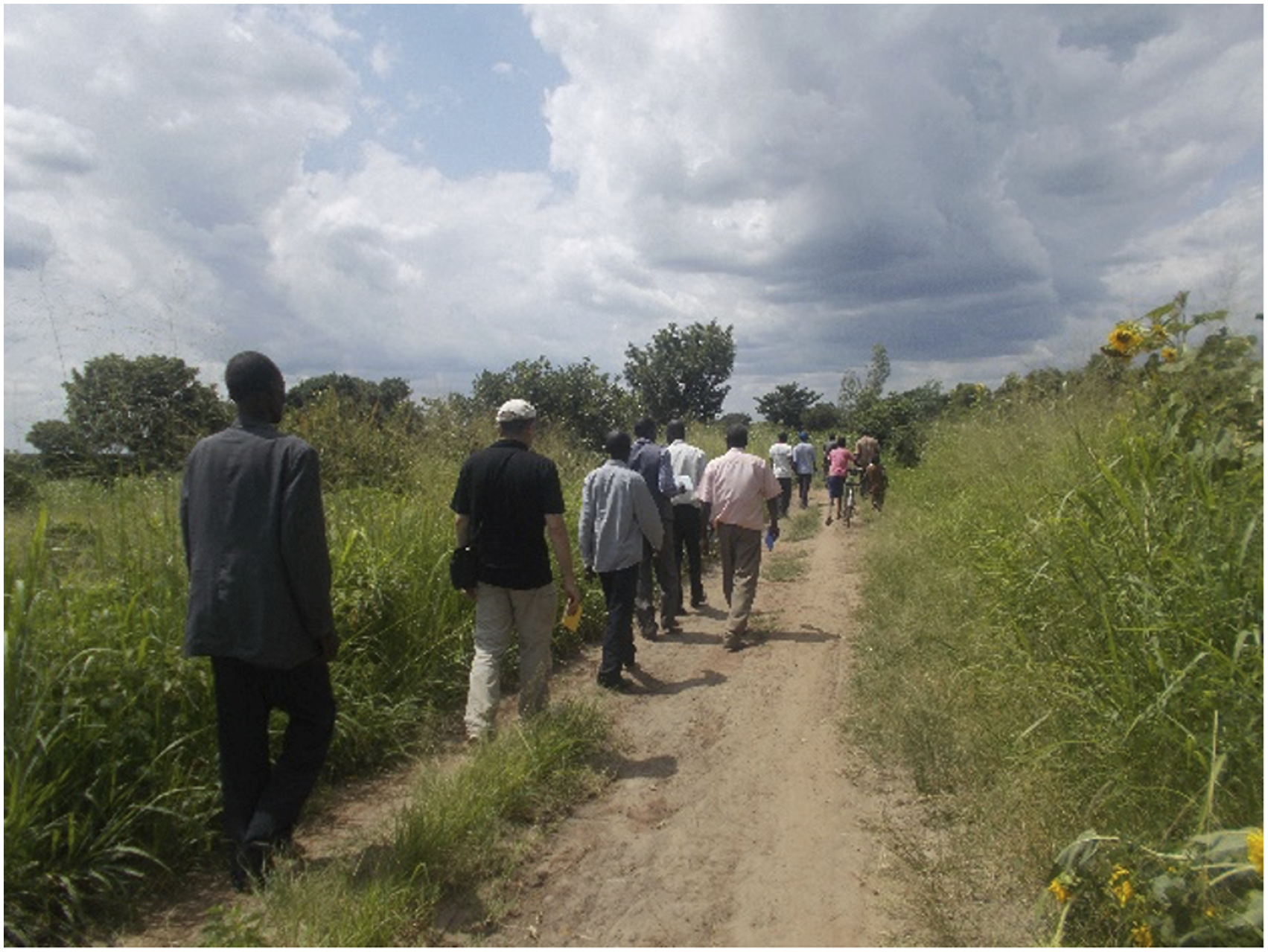
During the RGDs, the many people who came along and voluntarily joined the groups added layers of perspectives to the study. The discussion usually revolved around topics such as environmental changes that were clearly seen and felt, community and cultural practices, past and present interventions. In all cases, the groups were welcoming and inquisitive. After the exchanges of pleasantries, academic researchers were offered fruits and other gifts, a very important gesture that conveyed respect and adherence to the cultural norms of the communities. For ethical purposes the academic researchers were introduced with every new encounter, and a senior member of the group, usually the local council chairperson, would explain the group’s purpose of visiting the area. As is typical of many rural communities, people were generally disinterested in lengthy descriptions and tedious ethics procedures that characterise conventional academic research (Nuwagaba & Rule, 2015). Nevertheless, we continued to find opportunities to reiterate our project objectives and the reasons for our invitations for collaboration.
Building Relationships, Building Understanding: Home Visits
In addition to the ecological sites, economic developments and agricultural spaces explored through the RGDs, community leaders and researchers were keen to share another important element of community life: the family and home. Socio-ecological issues impact home-life in different ways than they do elsewhere, and so perspectives and priorities can also shift when sustainability issues are discussed in relation to home and family. In order to generate understanding and dialogue on this aspect of the research, the community leaders proposed home visits as a very important strategy.
The homes visited included nuclear families, extended families, female-headed families, child-headed families, and families headed by people with physical disabilities. In each home, researchers were shown around the living spaces of the family. Each visit followed a slightly different format, depending on the available spaces, seating arrangements, food and drinks shared, and the categories of participants involved in the discussions (for example elders, children, heads of house). Accordingly, for each home visit, experiences were documented differently, using methods such as audio recording, photography, diary notes, or whatever was deemed most appropriate. Methodologically this practice relates to anthropological observation, although in this case, the practice extended beyond observation. In addition to observation of the family capabilities and surroundings, the team engaged family members in discussion on topics ranging from socio-ecological sustainability to how livelihoods are linked to their environments and relationships.
The home visits afforded a more private context for people to share their opinions and concerns, away from the visibility of the wider community, and its politics. It allowed a different type of data and information to be generated that provided an important contrast to that resulting from the RGDs. For example, gendered views on issues of environmental sustainability (Ndidde et al., 2019) became clear as husbands and wives freely agreed or disagreed on particular issues. As it later emerged through iterative analysis, the home proved to be a basic unit of interaction between the community and the environment. Therefore, aspects such as sources of energy, income and family size were observed and analysed in relation to socio-ecological sustainability.
Community Engagement: Forums and Photo Elicitation
To respond to the cultural expectations and etiquettes of the study communities, the research team hosted a public event in each location in the form of a community forum. The events were attended by 153 people in Apala and 48 people in Kibanjwa. To effectively design the structure of these fora throughout the fieldwork, decisions and plans responsive to the contexts were made right up to the beginning of each event. In each community, the event began with an introductory activity in small groups, whereby community researchers discussed amongst themselves what they considered to be the community’s main challenges, as well as their proposals for solutions. Each group nominated a leader based on leadership and literacy skills. The issues and ideas raised in these small groups were noted on paper and brought forward for presentation and discussion in the plenary. (Figure 2) An academic researcher presenting at a community forum where various scenes taken from the Roaming Group Discussion were shared for collective analysis.
In parallel form, an academic researcher (Bananuka) presented the outcomes of the discussions emerging from the academic research group, including images and videos collected in the RGDs and home visits to support and deepen discussions across the groups. In contrast to the traditional method of photo elicitation – the use of images to prompt participant responses (Bananuka & John, 2015; Mitchell, 2008; Noland, 2006) – this use of visuals occurred in a collective environment, where the visuals served as immediate feedback to the community, an opportunity that did not only lend transparency and clarity to the data generated together, but also prompted new discussion in this forum context. Sharing the visual data in this way also enhanced community ownership of the initial findings and allowed community censorship and commentary where necessary. One noted aspect was how, in this context, local people interacted with each other across gender, socioeconomic status, age and leadership levels. Various stakeholders, that included government and development agencies, families and individuals, were given opportunities to account for the harm being meted on the environment.
Outcomes: The Strengths and Limitations of the No Method Approach
“At the beginning, when [community researchers] were asked whether they know what they were going to do about the environment, it looked like they were looking more for external solutions. However, by the end of the day, people started talking to each other” (Academic researcher)
It would be an exaggeration to say that the research team shared a methodological common ground from the outset. On the contrary, we had far more questions than conclusions, and far more uncertainties than expectations. However, as a team we shared a willingness to work outside of our comfort zones of expertise and outside of familiar research practices – this willingness was critical. The methodological findings are explored in the following section in relation to: research accountability; impact; and sustainability.
Research Accountability
The publication of this article will serve to benefit the authors of this paper, and through dissemination to other researchers, it will serve to benefit future community-engaged research interactions. What is less tangible in this work, as with many academic research projects, is how, in what ways, and for how long, the communities that participated will benefit. In other words, how is this work accountable to the communities it relates to? It is this question that must motivate and guide our work, from research conception to reporting (Patel, 2015). There are institutional systems in place to ensure that we are accountable to funders, employers and research participants. However, accountability to participants remains minimal, and is usually materialised in the form of reports and summaries.
The no method research approach addresses this issue and ensures accountability to the communities that participated in this study in the following ways: Firstly, the foundation of strong and trusted relationships in the research project. Placing a high value on the relationships that mediate this work obliges the researchers to nurture and maintain those relationships. In the case of this study, the relationships pre-date and out-live the duration of the project, but those relationships are also transformed and developed by the project. For example, the organisation, Apala Widows and Orphanage Centre (AWOC), introduced the academic research team into their community, but now continues to work there with an enhanced understanding of the community challenges and their capacities to address those challenges. The community in turn now has an enhanced and expanded understanding of AWOC and its connection to wider systems of resource and research.
Secondly, the co-construction of questions and pathways of inquiry ensures accountability. Just as the methods were developed through improvisatory responses in the communities, the questions also emerged through those approaches. As the community researchers actively co-constructed questions and methods (including the words, issues, and locations of inquiry) co-ownership becomes apparent. An important outcome of the research is the identification of questions and challenges specific to that place, time, and population. In this development, the community shares the representation which in the case of this project emerged through presentations, debate, reports, collective decisions and commitments.
Thirdly, the proposition of pathways of action and needs directly feeds into future practices. The forum and photo elicitation method revolves around community participation and action. In this process, through facilitated dialogues and recording, the community and academic researchers together identify potential pathways of action for the issues uncovered in the research. This is where accountability becomes explicitly shared. In this process internal factors as well as external factors are identified. For example, community learning and cohesion is recognised as the missing link in some areas, whilst external obstacles and potential resources have also been identified. Examples of external solutions include an agricultural education package to better inform small-scale farmers of the implications of seed choice in relation to soil type. Another example of this interconnectedness is the issue of accurate communication between policy makers and communities, often considered absent due to linguistic, cultural, and political differences. It is around this final point that the research team is now mobilising since leaving that community. Currently, we are undertaking the critical work of translating the findings of the research and building networks between community researchers and external partners and funders that can help address the issues that require external resource.
Each step that has been carefully taken in this process works against the tendency to extract information from communities for the purposes of academic communities and careers and towards recognition, collaboration and capacity strengthening. Each step interweaves the processes of design, data generation, and analysis – not as distinct and separable components that can occur in separate times, locations, and carried out by different people; but as iterative and entangled processes that inform, challenge, and push each other to accountability, impact, and engagement.
Research Impact
Although it is not the intention of this paper to discuss the specific findings or the impacts of this study on socio-ecological issues, we briefly highlight a few areas to illustrate what emerged from the no methods approach. When research is co-constructed it is inherently relevant to all the participant categories because all of them are needed to sustain the practice, and so all sets of knowledges are integrated. Relevance leads to impact, albeit materialising in very diverse ways. The research engagement is positioned amongst other local and national encounters that continue to influence developments in these communities. It is still too early to claim that there are ecological impacts arising directly from the study; however, we draw on testimonies from follow up community interactions that took place after the initial fieldwork. Guided by the insights and relationships developed, the follow up engagements were extended to political leadership at local and regional levels. Some of these interactions provided indications of the more immediate and perceived impacts of this work, as well as further clarity on the tasks ahead for external collaboration. Based on the interactive, multi-directional mode of data collection, participants were able to reflect and reconstruct their practices for a more engaged relationship with their environment. Three key topical issues emerged, and these were: individual actions in response to environmental degradation; collective actions towards improvement; and finally, external sources and collaboration needed to address the challenges identified in this research.
By the end of this first phase of the study, perspectives and positions had revealed the complexity of the context and both community and academic researchers framed their discussions in the form of substantial future focused commitments. At an individual level, commitment was expressed to avoid cutting down trees and plant more; to stop cultivating in wetlands; to be conscious of the disposal of plastic materials; to avoid burning bushes; and to protect community water sources. Importantly commitments on a collective, community level were equally stated, and echoed individual commitments. The role of district and national governance and community leadership was taken up, and the community researchers expressed their commitment to lobby their leaders to develop by-laws and practices that protect the environment. Finally, community researchers expressed their willingness to create external partnerships that can promote farming. Investments in ox-ploughs, improved animal and crop breeds, tree seedlings, start-up capital and support towards education of their children were identified as the relevant areas for intervention. Environmental issues were consistently interwoven with family and community livelihoods, entangled with the socioeconomic wellbeing of the communities. The fast rate of forest destruction for example, is associated with the lack of alternative energy sources but also the inaccessibility of energy-saving stoves.
Research Sustainability
This project has not been neatly contained within a funding cycle. It has exposed the academic and rural communities that participated in this study to learning, including an awareness of the potential in creating and engaging with external actors. The project is ongoing and now interconnected with other initiatives of the SFG network and international collaborations. The affects and impacts move in different ways and in multiple directions. By the end of 2018 community members had formed community policing clubs to caution those engaged in environmentally destructive activities and embrace more tree planting. The academic researchers have created and submitted funding applications for specific follow-on activities including funding ox-ploughs and educational resources.
Overall, a level of enthusiasm and engagement has continued at different levels, from the family, community and local government levels. This project was conceived as a pilot initiative in the beginning of 2017; the fieldwork took place in 2017 and 2018. In February 2019 the project continued with a facilitated cross-sector forum that included community members, international and Ugandan academics, and local policy makers. In August 2019, the research team followed up the study with a strategic development meeting that included community and district officials. Just as the rural communities are tasked with a new level of engagement with environmental issues, the academics are tasked with taking forward initiatives to secure the external resources needed to build on the study. Ultimately, the sustainability of this project is assured by the commitment of all participants involved by cultivating a sense of shared ownership and accountability.
Conclusion
We conclude by highlighting the transformative learning process that this project has enabled (Merriam & Ntseane, 2008; Robinson & Levac, 2018), and continues to reveal. It has been a process of new insights and self-discovery, not least through the new levels of awareness of the insights and innovations that have been possible through genuine engagement across different knowledges. This approach to research is a dynamic process that recognises and responds to the changing and unpredictable times and situations in which research takes place.
The no method approach achieved its objectives of unsettling the traditional categories, hierarchies, and design practices of qualitative research design, through pursuing active collaboration with community members as co-researchers. Institutional disciplinary knowledge divisions were tempered, in favour of community-led constructions of topics, contexts, and questions. The involvement of community researchers which allowed the research to begin from shared topical issues rather than pre-determined research objectives and questions, increased the level of trust between the academic and community researchers. The research problem was co-created as a community problem, and not the researchers’ perception of a problem. We take cognisance of the fact that unequal power relations still persisted through the collaborative process, whilst the team worked to renegotiate power whenever possible through valuing lived experience and local knowledge systems.
This paper has demonstrated that there is a growing movement against extractivism and the imposition of academic research disciplines in community-based research. We articulate a clearly responsive and ethical practice in the context of community research in sustainability without necessarily erasing methodology; but rather altering the rules to accommodate the unexpected, the unknown, and the other.
Ethical Considerations
Our entrance to the communities was based on prior working relations with a local CSO and the communities. We obtained expressed permissions from local government structures, at district, Sub-County and Local Council 1 (Village) level. Due diligence was ensured in line with standing national research rules and standards. Principles of confidentiality and anonymity were strictly followed, and where photographs and videos were taken and recorded, those concerned were asked for permission and consulted on whether their images could be shared.
Footnotes
Acknowledgement
The primarily acknowledgment of this paper goes to the communities of Kibanjwa in Hoima district and Apala in Alebtong district with whom the authors and their team worked with over the course of this project. We are grateful for their trust, support, participation, expertise and their interests and priorities motivate and inform this academic paper. We are grateful to Dr Alex Okot, and Dr Kellen Aganyira for their generous collaborations and introductions, as well as our other team members.In addition, we acknowledge the local governments of Hoima District and Alebtong District. Finally, we acknowledge with gratitude the Sustainable Futures Global Network  , and the Ugandan and Scottish hubs in particular for their support and contribution to this work.
Declaration of Conflicting Interests
The author(s) declared no potential conflicts of interest with respect to the research, authorship, and/or publication of this article.
Funding
The author(s) disclosed receipt of the following financial support for the research, authorship, and/or publication of this article: The work was funded in part by the ESRC (Economic and Social Research Council) (ES/P006701/1), UKRI. The funded project was entitled: Communities of Science and Practice Engage: Mitigating the Implementation Gap in Environmental Initiatives through Community Engagement and Public Pedagogies .