




Abstract
Codesign is increasingly used for health research and service improvement. Codesign combines generative and exploratory methods, enabling collaboration between service end users and researchers as equal partners. The aim of this study was to evaluate a codesign method used to design an online education package about inclusive education for children with disability in mainstream schools. The study design was a multiple methods evaluation informed by participatory and transformative research paradigms, incorporating design sciences and public service approaches. A governance committee supported the process. The codesigners (n = 12) included teachers, teacher assistants, parents, and allied health professionals. Process and outcome evaluation data were used; data collected were from verbatim transcripts of codesign workshop discussions (n = 11), documents, Self-Report Level of Participation Surveys, and individual interviews (n = 11). Thematic and descriptive analysis methods were used to describe the codesign processes, experiences, and outcomes. The key processes were identifying the issues through storytelling, voicing frustrations, being vulnerable, sharing insider knowledge, challenging other people’s roles, and deliberation and decision-making. Codesigners’ experiences and outcomes identified strengths and challenges in the method. A conceptual model is presented demonstrating interrelationships between processes, subprocesses, and codesigners’ experiences and outcomes. Codesign involves multiple, interrelated processes that support deliberation and creative design. Skills and resources are required to effectively facilitate what can be a meaningful, creative, and social process.
Keywords
Introduction
This article reports on a multiple method evaluation of a codesign process used with parents, educators, and allied health professionals to design an online education package. Codesign is an increasingly popular method of health systems research and service improvement. There are, however, key issues relating to use of this method that remains unresolved (Greenhalgh et al., 2016; Palmer et al., 2018). In the current study, codesign was used to emulate collaborative consultation, a collaborative team process considered best practice in inclusive education (Friend & Cook, 2017). This research is needed to improve knowledge of processes involved in codesign and the experiences and outcomes of codesign participants (identified as codesigners).
The use of multiple methods aims to increase understanding of codesign processes, which researchers have identified is lacking in existing literature (Bowen et al., 2013; Mulvale et al., 2019; Palmer et al., 2018; Voorberg et al., 2015). This multiple method research included the use of qualitative and quantitative process and outcome data to achieve in-depth description and analysis required for building understandings of codesign. This article provides background to codesign research and discusses challenges and knowledge gaps identified in the literature. An overview of the study context, design, and methods is provided, followed by in-depth description of the research findings.
Background
Codesign is a research method that combines generative and exploratory research with developmental design (Sanders & Stappers, 2016). This method requires a collaborative process in which end users of the research outcomes are involved in research as equal partners. The codesign mindset described by Palmer and colleagues (2018) requires researchers to shift from thinking that “‘experts know and decide everything’ to ‘we need to decide things together’” (p. 1). By applying multiple sources of knowledge toward a research or service development outcome, codesign can foster positive change with and for end users of the research, resulting in increased service acceptability and accessibility (Farmer et al., 2018; Greenhalgh et al., 2016; Palmer et al., 2018).
In public services research, codesign is identified as a type of coproduction (Batalden et al., 2016; Bovaird, 2007), originally an economic concept denoting the value of everyday inputs provided by citizens and the public in the delivery of public services (Alford, 2014; Bovaird, 2007). Coproduction is purported to enable public cooperation and shared decision making across a range of public service functions, including co-commissioning, co-prioritization, co-evaluation, and codesign (Loeffler & Bovaird, 2016).
Collaboration and creativity are critical features of codesign. Methods of codesign rely on assumptions that all people can be creative, and people are “experts on their own experiences,” which contribute varied knowledge, viewpoints, and experience that strengthen design processes (Visser et al., 2005, p. 129). The codesign method described in the current study was informed by design sciences and public service approaches. The key cross-discipline principles that formed the theoretical basis for this study were (a) systems perspective (intersecting health, education, and public policy), (b) positioning research as a creative process of knowledge production centered in human experience, and (c) an emphasis on process, relationships, governance, and effective facilitation that prioritized power sharing and group dynamics (Greenhalgh et al., 2016).
Specific strategies are embedded in codesign processes to reduce the influence of power hierarchies. Codesign facilitators, for example, utilize task-focused conflict that promotes creativity and group dynamics while ensuring interpersonal conflict is managed through effective group facilitation (Greenhalgh et al., 2016). The codesign process involves various stages: from identifying the problem, to understanding it, addressing it, and modeling solutions to create, implement, and evaluate a working solution (Kimbell, 2016; Sanders & Stappers, 2016). Design activities are used to elicit people’s experiences and perspectives and embed these experiences in outputs (Kimbell, 2016; Sanders & Stappers, 2016). While the stages of codesign are established (Kimbell, 2016; Sanders & Stappers, 2016), there is limited research on what is involved in enacting codesign processes or on codesigners’ experiences (Palmer et al., 2018).
A range of issues are identified in the existing codesign methodological literature. The methodological underpinnings and rationale for codesign are often not justified (Voorberg et al., 2015). Researchers often provide only limited description or analysis of codesign processes, and few outcomes or impacts are reported (Bowen et al., 2013; Palmer et al., 2018; Voorberg et al., 2015), which are critical for participatory and transformative research (Mertens, 2008; Wallerstein & Duran, 2008). These omissions might occur because of page-length restrictions in peer-reviewed journals, thereby limiting complex and multifaceted descriptions of completed studies. However, the gaps in reporting of codesign research lead to questions about methodological rigor and value of research outcomes. Voorberg et al. (2015) stated that lack of detail “contributes to the idea that co-creation/co-production is primarily considered as a virtue in itself, which does not need to be legitimized by reference to external goals” (p. 1349). Research on codesign processes is critical to understand whether and how the range of challenges that present during codesign can be addressed and whether the outputs and outcomes of codesign are effective in addressing research questions. Evaluation is particularly important to justify costs relating to this resource-intensive method (Bowen et al., 2013; Mulvale et al., 2019). The findings provide an in-depth description of the processes, experiences, and outcomes of a codesign method to address these issues and knowledge gaps.
Study Aim
The study aim was to evaluate a codesign method used with parents, teachers, education assistants, and allied health professionals to design an online education package about inclusive education for children with disability in mainstream schools.
Study Context
The aim in developing an online education package was to improve intersectoral collaboration in the context of major public policy change in Australia: the rollout of the National Disability Insurance Scheme (NDIS). The NDIS provides funding support to people with significant disability to increase their choice and control in decisions that impact their independence and overall quality of life (McDonald & O’Callaghan, 2015). Although an aim of the NDIS is to increase access to and participation in mainstream communities through capacity-building activities, individual funding cannot be used for goals that relate directly to the services of mainstream systems, such as educational goals, which are the responsibility of the education system (McDonald & O’Callaghan, 2015).
Successful rollout of the NDIS, therefore, requires cooperation across public services, private providers, and people with disability to codesign strategies that promote streamlined, rather than disrupted supports across funding boundaries. Within a mainstream school setting, the successful inclusion of students with disability relies on parents, teachers and teacher assistants, and allied health professionals (McDonald & O’Callaghan, 2015). Friend and Cook (2017) argue that a team approach is needed to support students with disability, which utilizes a collaborative process of problem identification and brainstorming of potential solutions. They define this collaboration as “a style for direct interaction between at least two co-equal parties voluntarily engaged in shared decision-making as they work toward a common goal” (Friend & Cook, 2017, p. 5).
Codesign was selected for the current study because of the close alignment with this recommended best practice approach. The codesign process emulated a typical student support team. The codesigners were asked to design an accessible and engaging online resource that could be used to educate those who have roles in supporting children with disability in mainstream school.
Method
Study Design
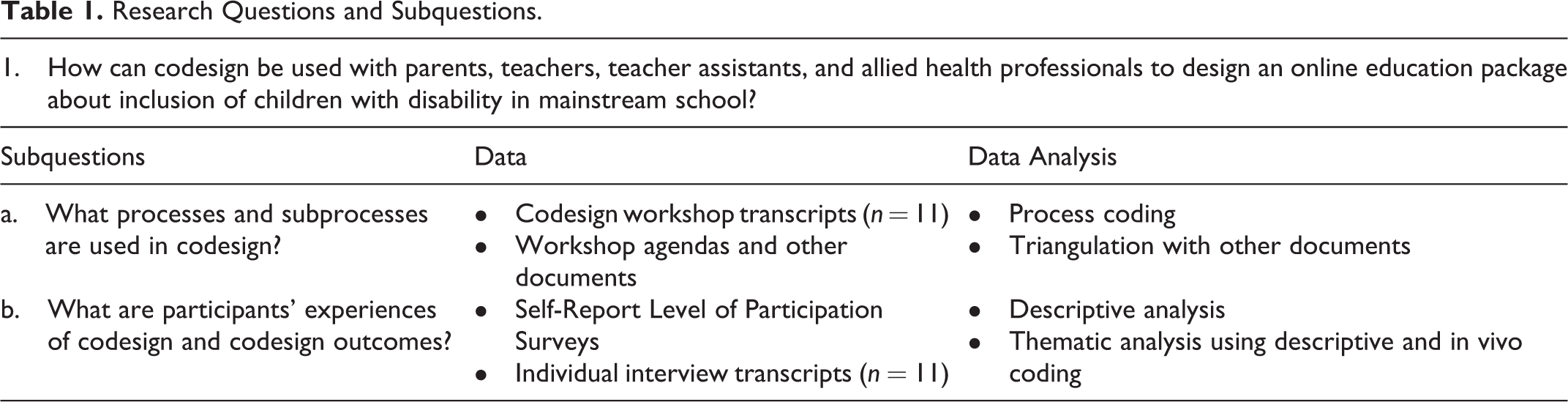
The study design was informed by participatory and transformative paradigms and ways of doing research (Mertens, 2008). Paradigmatic positions that enable power sharing for knowledge creation with people whose lives are directly impacted by the research issue (Bradbury & Reason, 2008; Gaventa & Cornwall, 2001; Mertens, 2008). Codesign ensures that the creative design of a research output is accessible and acceptable by end users (Palmer et al., 2018). Existing codesign methods were adapted to create a process for a multidisciplinary and intersectoral group that was tailored to local context (Greenhalgh et al., 2016). This multiple methods study incorporated qualitative (dominant) and quantitative process and outcome data that were most effective for evaluating the codesign method and addressing the research question and subquestions (Morse & Maddox, 2013; see Table 1).
Research Questions and Subquestions.
Approval to conduct this research was obtained from the Human Research Ethics Committee at La Trobe University (approval number S17–174) and the Victorian Government Department of Education and Training (Project ID: 2017_003515). Voluntary and informed written consent was obtained from all codesigners before commencing the research. Guidelines on rigorous reporting of research with user involvement were followed to increase rigor and transparency (Wright et al., 2010).
Governance Committee
A governance committee was formed to oversee the project and monitor project progress, risks, and outcomes against the expected objectives and time lines. The committee (n = 9) comprised two teaching staff, an allied health employer, two research team members, and four disability consultants (two parents of a person with disability and two people with disability).
Quarterly meetings were held over the project duration (total of six meetings). The committee was provided with project reports and presentations of the codesign outputs and the online education package prototype. The committee provided feedback to the codesigners to inform deliberations and decision making.
Codesign Group Selection and Recruitment
Purposive and convenience sampling strategies were used to recruit people who would typically be involved in a collaborative teamwork process for supporting inclusion of a child with disability in a mainstream primary school. Recruitment to the codesign group was facilitated through the governance committee, who distributed the research recruitment advertisement to staff and parents associated with their school or practice. People interested in participating in the study then contacted researchers directly to express their interest. Recruitment was completed when targets were met for all roles: four parents of school-age children with a disability attending a mainstream and/or specialist schools, two teachers, two teacher assistants, two occupational therapists, and two speech pathologists.
The codesign group did not include children with lived experience of disability because they were not intended to be the end users of the product. However, the importance of receiving insight from those with people with disability who could reflect on their school experiences was recognized and obtained through the governance committee.
Codesign Resources
The codesign workshops required 16.5 hr of direct facilitation and participation. Codesigners were reimbursed at a cost of $80 (AUD) per hour per person, resulting in project costs of $960 per hour of codesign ($15,840 in total for 16.5 hr). Catering was provided for each workshop ($763 total). Therefore, the average cost per 3-hr workshop was $3,018 excluding in-kind resources (e.g., facilitator time, stationery, project management, and expenses incurred by the governance committee and researchers).
Data Collection
Process data were collected via audio recording and verbatim transcription of codesign workshop discussions (n = 11) and by collating other documents including transcriptions of written notes and copies of facilitators’ records (agendas, presentation slides, and postworkshop reflections on group dynamics).
Codesigners completed an anonymous, individual written Self-Report Level of Participation Survey at the end of each codesign workshop, adapted from an existing participation measurement tool (spidergram tool: Draper et al., 2010). Ratings were 1 = passive (low-level participation), 2 = information sharing, 3 = engagement and mobilization, 4 = collaboration, and 5 = empowerment (high-level participation). The objective was to achieve a median of 4 (collaboration) across 5 codesign activities: planning and organization, creative design process, priority-setting, negotiation, and reflection and evaluation (Draper et al., 2010). This objective aligned with the model of collaborative consultation that codesign was selected to emulate (Friend & Cook, 2017) and acknowledged that certain parameters were determined prior to the commencement of the project, which would limit full codesigners’ autonomous control.
After the final codesign workshop, semistructured individual interviews were conducted with codesigners (n = 11) by researchers who were not directly involved with codesign facilitation. The interviews were completed either in-person or by phone and were audio-recorded and transcribed verbatim. One codesigner (parent) declined to participate due to scheduling difficulties. Questions were designed to collect data on the codesigners’ experiences of the process and outcomes.
Data Analysis
Process coding
A process-coding method adapted from Saldaña (2016) was used to analyze codesign workshop transcripts, conducted using NVivo Version 11™ computer-assisted qualitative data management software. This process coding enabled the identification of processes and subprocesses and in-depth description. The coding was guided by the questions adapted from Saldaña (2016): What were the processes? What are the codesigners doing? What was the experience of processes? What emotions are described (or implied)? How is language used to describe the experience of processes (are any metaphors used)? and What practical tasks and actions are used to facilitate the process? Researchers were cognizant that the aim of the codesign method was to facilitate decision making and promote collaborative participation in design activities (Palmer et al., 2018). Therefore, process coding also considered questions of, Is there evidence of participation in decision-making? and Is there evidence of collaboration in design activities?
Process coding included open, broad-brush coding of one transcript completed by four researchers (two codesign facilitators and two researchers not directly involved with codesign) to identify possible codes and draft a codebook. Each of the 11 transcripts was coded by two researchers using the codebook. All four researchers met regularly to discuss and further refine codes and develop categories and themes using the process-coding method and questions to guide reflexive discussions. Inclusion of researchers in coding who were not directly involved with codesign facilitation supported reflexivity and critical questioning required for study rigor. Additional data sources (e.g., documents) were reviewed by one researcher for triangulation to assist coding decisions.
Descriptive analysis of Self-Report Level of Participation Survey
For each workshop, a group median was calculated and the range was identified for each key task/activity (planning and organization, creative design process, priority-setting, negotiation, and reflection and evaluation).
Thematic analysis of individual interviews
Individual interview transcripts were thematically analyzed using descriptive and in vivo coding methods to describe the codesigners’ perspectives in-depth (Saldaña, 2016). The same coding process was used by two researchers, beginning with independent open coding and the development of a codebook, followed by coding comparisons and consensus-based discussion to develop categories and themes. Reflexivity was supported by coding discussions with a third researcher.
Overview of the Codesign Group
The sociodemographics and general background of each codesigner were collected during Workshop 1 (see Table 2 for key demographics). The codesigners resided in rural and regional locations in Victoria, Australia. Some had experiences of living and working in remote and international locations, which provided them with insights into challenges of supporting children with disabilities in areas where services and support are limited. All codesigners had experience working in teams to support a child with disability in a school context. They reported expertise with negotiating relationships, communication, policy implementation, advocacy, and teamwork. Five had a good understanding of the NDIS. All had experience supporting children of varying sociocultural backgrounds and disabilities. Existing relationships were identified by educators (all four worked at the same school) and allied health professionals (all four worked for the same organization across two regional locations). No existing relationships were identified by the parent codesigners.
Demographic Characteristics of the Codesigners.

Note. N = 12.
a One missing value, denominator = 11.
Overview of the Codesign Process
The codesign process occurred over six workshops (from November 2017 to July 2018), totaling 16.5 hr. Approximately 3 hr of preparation and reflection activities were completed outside of workshop time. Codesign facilitators met with codesigners individually to orientate them to the project and gather information that would assist with their participation. Codesigners were asked to review an online education module (Module 1) prior to attending the first workshop and to provide feedback via an online survey. Module 1 included relevant background and definitions of key concepts and had been prepared by the researchers. This task also created an opportunity to share an example online education package.
The parameters set for the codesign group by the research team in consultation with stakeholders during the grant application stage were objectives, number of codesigners, group mix and ratios, facilitators, number of meetings and meeting duration, design activities, resources available for design activities, and evaluation methods. The codesign group had power over design decision-making, including design of fictional cases, teamwork processes, support strategies, and key features of the online education package.
A summary of the codesign process is presented in Table 3. The codesigners agreed to key principles to inform the codesign process (see Supplemental Material). Members of the codesign group self-allocated themselves to one of two subgroups, each tasked with designing a fictional character for the education package. One subgroup designed a fictional character with NDIS funding (Luke, Group 1, n = 6), and the other group designed a fictional character with no NDIS funding (Milly, Group 2, n = 6). Both subgroups had equal representation of all team roles and were guided by the same codesign facilitator over the duration of the research. Icebreaker activities were used to enable codesigners to develop rapport. Activities were designed to encourage a creative mindset. Codesigners were sent preparatory information prior to workshops by email. When a codesigner was not able to attend a workshop, their input was sought by facilitators through email or phone.
Summary of Codesign Process.

Findings
The findings include processes and subprocesses identified in codesign, codesigners’ experiences and outcomes, and a conceptual model illustrating the interrelationships between findings.
Processes and Subprocess of Codesign
The key processes identified through thematic analysis of codesign workshop discussions were identifying the issues through storytelling, voicing frustrations, being vulnerable, sharing insider knowledge, polite challenging, and deliberation and decision-making. In the quotations, P is used to represent a codesigner, and I is used to represent the facilitator.
Identifying the issues through storytelling
Identifying the issues through storytelling occurred in both groups and all workshops. This process involved sharing examples, stories, and personal examples and was dominant in Workshop 1 for both groups. The codesigners engaged in this process to share and understand experiential knowledge, which led to identifying and understanding key issues or priorities and tasks. A parent in Group 1 illustrates how storytelling was used to identify and prioritize the issue of safety: The safety issues, whether there’s fencing (P: Near a main road?) Which is a big one for my girl…because my daughter is a runner, she’s not as bad now, but [she was] one of those children that when she was little would just bolt, just be running all the time, not really wanting to go anywhere, but just a runner. So when we sent her to school two years ago, we met them halfway, they were willing to fund it all, but because they had just been so great, we said “Look we’ve got a local builder that we use to do a lot of things at home, if you buy the materials, he’ll do the fencing.” So we helped them fence where it wasn’t fenced. (Group 1) She was diagnosed at two and a half, so she was diagnosed really early…And it was a small town [which] only had a few schools…We had expected to put her in a mainstream school and when the principal from that kindergarten said, “There’s no point in her doing a second year” because I had anticipated two years of kinder, and she said “There’s no point at putting her through another year of kinder, because she’s not going to learn anything. She’s not going to learn anything in a normal school, you really need to look at specialist school, because that’s really her only option”…I hadn’t even thought about putting her in a specialist school at that stage, so that’s why I wondered whether they could actually refuse? (Group 2)
Voicing frustrations
This process was identified in both groups and was more dominant in Workshops 1 and 2 compared with other workshops. The codesigners shared their frustrations with the group through emotional self-disclosure, which was verbally and nonverbally validated by others. Examples were “It’s kind of you know sink or swim, you’ve got to just work it out yourself” (Group 1), and “As you say you feel like you’re visitors, we feel like…we just get all this stuff and I read through and go ‘How the hell am I going to do this in my classroom?’” (Group 1). A Group 2 parent expressed her frustrations about year-to-year transitions: It’s hard…at the start of every year you’ve got a new teacher, so it takes you a good term to figure out what’s going on and meet all the members of the team again and start over…every time I go into the school at the end of the year I’m like “who’s the teacher for next year?” and they’re like “Oh we don’t know, because we don’t choose that till blah, blah, blah.” [P: Yeh and they probably can’t tell you either, because we’re not allowed to tell parents until next week.] But see, but why is that the case? Like I don’t understand. [P: There should be exceptions as well. P: Yeh, because sometimes you need to have that end of year planning.]…Like it’s a real barrier to getting things off to a good start. (Group 2)
Being vulnerable
The process of being vulnerable was an emotive moment that occurred once or twice in most workshop discussions. Being vulnerable was defined as self-disclosure of limitations in knowledge or experience, usually followed by others showing empathy. An example from a teacher was “Sometimes it’s just a lack of knowledge and ongoing training…when I was in a Year 12 class, he had cerebral palsy, I knew nothing.” A parent stated, “I must admit I go to some meetings at school and I’m like ‘I don’t even know why I’m here, because I know that they’re not even going to try a thing’” (Group 1).
Emotional moments of vulnerability were observed in discussions about what the codesigners “struggle” with in supporting children with disability in schools. A teacher revealed how she found it difficult to engage some parents at her school, I don’t know how you improve that, because a couple that we’ve got, they do have heaps of support, but…they still don’t come in…so I don’t know how you deal with that? [P: Yeh, its hard isn’t it?]. (Group 2)
Sharing insider knowledge
The process of sharing insider knowledge was dominant across Workshops 1–5 and involved codesigners educating others through sharing facts and online and community resources and explaining concepts and systems. This process enabled codesigners to learn from each other, develop shared understandings, and gain inside perspectives into their different contexts and roles.
Codesigners shared information on realities, expectations, and norms as well as practical information on school policies and procedures, government funding, and services. For example, one allied health professional shared information on NDIS audit processes and how they impact their practice, stating I know if I work on handwriting and I put it into my notes, we could get audited back and they could say “No, that’s actually the role of the education system, not the NDIS” so…we’ve got to navigate that. (Group 1) I think I would as a speech pathologist, I would provide alternate ways of asking questions…Rather than, “You need to go and do this now, sit down.” I might create a chart saying like “Avoid this language, instead use this.”
Challenging other people’s roles
This process occurred infrequently and was identified in Workshops 1–4 for Group 1 but only in Workshop 2 for Group 2. Described as polite challenging, this was when codesigners openly shared personal opinion or criticism. The codesigners appeared to respectfully challenge the roles of other team members. For example, in Group 1, a parent suggested that teachers did not have appropriate knowledge to support students with disability, stating “Sorry teachers, Education Support Staff [Teacher Assistant], sometimes lack of knowledge…Like sometimes the lack of knowledge of teaching. No offence, that’s true. [P: None taken, none taken.]” (Group 1). Another example was, “Unfortunately, teachers are no longer teachers anymore, they are expected to be so much more and I know that’s a lot of pressure on you guys…Sorry but that’s fact” (Group 1). A teacher also said to an allied health professional, “Nothing against you guys here, but you’ve got to be in the classroom, you’ve got to be, because I read through those recommendations and I go ‘Ah right, how am I going to do this?’” (Group 1). In addition, a parent said, “I would hope with the Behaviour Support Plan that the first alternative isn’t to call mum and dad. [P: Yeh.] But knowing that these things don’t work, we need another avenue. This is the absolute last resort” (Group 1), and “It would be nice if someone else could take on that role [booking team meetings]” (Group 1). One of the few examples of comments from Group 2 was, I have a nephew who is clearly ADHD [Attention Deficit Hyperactivity Disorder], he’s not diagnosed and they have so much trouble with him in class, he’s failing everything, because he’s not getting the right support. [P: ADHD is not a disability, it’s just a learning difficulty]…Well I heard that they were trying to put it under the same umbrella. (Group 2)
Deliberation and decision making
Deliberation and decision making occurred across both groups and all workshops. Subprocesses used by facilitators to enable deliberation and decision making were identified as providing instructions, clarifying parameters and asking questions, summing up and checking in, and confirming. Facilitators generally provided instructions at the beginning of an activity. During an activity, codesigners asked questions to clarify the parameters of the task. The facilitators asked questions of the codesigners to prompt deliberation, for example, “What else can we add to that?” “Is there anything in particular you really want to add there?” “Any other issues that you want to highlight from your perspective?” “Is that something you think we could address through this case?” and “Do you think that’s important?” The facilitators also summarized group discussions and checked with the codesigners that what had been heard and recorded was an accurate reflection of their discussion. They provided confirmation when decisions were made.
Codesigners engaged in deliberation through collaborative problem solving, considering different views on the issue or viewpoints and sometimes changing their mind, considering different approaches to a problem, and finding consensus. The subprocesses observed in the codesigners’ deliberation and decision making were clarifying parameters and asking questions (for scenario/task), imagining hypotheticals (verbalizing how the situation might unfold), and confirming and validating decisions. In Workshop 5, codesigners shared outcomes across groups using oral presentations and role plays. The final workshop involved recognition and celebration of achievements, which was the end point to this process.
Codesign Experiences and Outcomes
Findings relating to the codesigners’ experiences of the process and outcomes were identified through descriptive analysis of the Self-Report Level of Participation Survey and thematic analysis of individual interviews.
Self-Report Level of Participation Survey
Median (range) scores are presented for the key activities measured by the Self-Report Level of Participation Survey for each codesign workshop (see Table 4). The target rating of collaboration was reached for all activities for Workshops 2 and 3. The process of creative design received the highest self-reported level of participation ratings overall. The range demonstrates there was some variability in ratings between individual codesigners.
Self-Report Level of Participation Survey.

Note. WS = workshop; n = number of participants attending the workshop. 1 = passive (low-level participation), 2 = information sharing, 3 = engagement and mobilization, 4 = collaboration, and 5 = empowerment (high-level participation).
Individual interviews
Two overarching themes from the individual interviews were experiences of codesign and outcomes of participating in codesign; subthemes are identified in italics. Individual codesigners are identified by a pseudonym (role and number, e.g., T1 for Teacher 1).
Experiences of codesign
The codesigners described their experience of participating in the codesign process and identified several key features that were important to them. They appreciated the codesign facilitation and creation of a safe environment. One stated, “I take my hat off to them [the facilitators], to be able to bring all these people together from all different places to get something really awesome out of it” (AH1). The codesigners recognized the importance of sharing power, roles, and contributions, for example, “…you know we all got to speak up and have our ideas” (TA2) and “I really felt like the process made everyone more equal” (AH4). One parent noted specific situations in the process in which she felt she could contribute, in contrast to when she felt she had little to contribute, So they wanted to know what would Milly’s parents do in this situation, what would Milly’s parents think about, so I was able to contribute in those areas, because as a parent I know what I would want and what I would be looking for…but definitely like when it came to anything school related, I felt a little out of my depth. (P3) I think the biggest positive for me was actually working with a range of people…[and] different professionals. I think it was so great to have a couple of parents on the group…that was probably biggest eye opener, but also the biggest asset to the team. Because they’re the ones that are spending all the time with their children. (AH3) The thing was sitting down and being able to talk to the parents and hearing how it happened and how they found out about it and what they’ve done about it. Their whole journey and how they feel from the parent’s perspective to getting a child into school. What were the challenges, what were the difficulties, what were the successes? (T2)
This enjoyment occurred despite frustrations in relation to gaps between workshops, feeling that the work was unfinished, and logistical problems that had to be overcome to accommodate the time required, stating “I never felt we had enough time” (P1), and “I would have loved a bit more time to flesh out things a little bit more, especially with that particular child” (P1). One codesigner identified that more time would have been helpful to further refine their design outcomes, “But in our group, I just felt like it was a bit more clunky and wordy and not as refined” (AH2).
There was concern about the time-lapse between workshops, with one codesigner stating “…I know you guys struggled with getting everyone able to come at particular times…I think the last time we met was term one and now its term three, so I’ve forgotten all about Milly” (T1). Frustrations were also expressed about taking time away from their usual work roles, “That it was hard, with the timetable, to be able to release me to come here, because it was a bit disjointed for my children [students]” (T2).
Outcomes of participating in codesign
This theme reflected what codesigners felt about both the tangible product and personal outcomes. The codesigners identified that developing insights was an important outcome, they said “I did learn about the parents’ perspective” (AH2), “Maybe they [parents and teachers] are more interested in it than I thought they would be” (AH4), and “just getting a bit more knowledge from seeing what the challenges other people have from trying to access [the] NDIS” (TA2). The codesigners reported learning new information and ways of doing things. For example, “I’ve learnt about the co-design process, because previously I’d never really heard of it that much” (AH2), and another stated, “And the skills I have taken away from it is listening better” (P1). A teacher assistant commented, “I got to learn more about NDIS, what they do” (TA1), and a parent said, “I learnt about the dual enrolment, there’s a lot of stuff I didn’t know about” (P3).
New ways of doing things included working as a collaborative, cross-discipline team, one allied health professional said, “I really liked having teachers, EAs [Teacher Assistants], parents, therapists, all there together, because that usually doesn’t happen” (AH4). A parent commented on how things were usually done differently at her child’s school, so that only she, her husband, and the teacher were involved in meetings, leading her to comment “Oh gosh, wish we could be doing this” (P1).
The codesigners expressed pride in their work and the product achieved, stating “I’m pretty happy that it’s come to fruition and something will actually…come of it…I’m satisfied it’s happened and that it’s going to be accessible for people” (AH2), and “As a tool, it’s going to be fantastic to, to be out there helping people of all different areas to get some information out of it” (P3). Another stated, “Like it will be pretty cool to be able to say to people ‘Hey, I helped to sort of make this’” (T1).
Conceptual Model of Codesign
The conceptual model presented in Figure 1 illustrates the interrelationships of the processes and subprocesses, underpinned by the codesigners’ experiences and outcomes.

Conceptual model of codesign.
Discussion
The findings provide in-depth descriptions of processes and outcomes of a codesign method. These descriptive findings contribute new, critical insights into how codesigners engage in this creative and deliberative knowledge production process. The findings illustrate the benefits and limitations from the codesigners’ perspectives. Few existing studies provide in-depth analysis into the codesign process, which is needed to understand its inherent complexity. The findings provide support for the argument by Palmer et al. (2018) that codesign is a “socially deliberative process,” which is “inevitably relational and emotional” (p. 9). The conceptual model illustrates this complexity, demonstrating how social engagement is an important precursor for deliberations required for making design decisions. The findings provide insights into how codesign was a meaningful, creative, and social experience.
The description of processes, subprocesses, and codesigner’s experiences and outcomes provide insight into the facilitation skills and resources needed to ensure codesign is collaborative and not tokenistic. Facilitators need to be skilled in building relationships, managing conflict and emotional disclosure, and designing activities that enable equal participation in design deliberations. The level of collaboration achieved through this codesign process is also evidenced by the Self-Report Level of Participation Survey results. In comparing the findings with previous research, key processes and features that appear to be critical for achieving a collaborative level of participation include opportunities for storytelling and sharing experiences (insider knowledge), establishing connections (through sharing frustrations and being vulnerable), and expertly facilitated deliberation and shared decision-making (Bowen et al., 2013; Mulvale et al., 2019; Palmer et al., 2018).
The evaluation demonstrates the personal impact of codesign processes that include people from different disciplines and with varied lived experiences. This finding supports the argument of Greenhalgh et al. (2016) that codesign research can have “strong and enduring impact on health and wider outcomes” (pp. 393–394) in the setting in which it is conducted. The conflict observed through challenging other people’s roles might reflect changing group dynamics and increasing group cohesion as per Tuckman’s storming group developmental stage (Bonebright, 2010). Greenhalgh and colleagues (2016) describe this as task-oriented conflict, which is a power diffusion strategy embedded in codesign that is critical for creativity and productivity. Additionally, issues raised by codesigners relating to the challenge of balancing costs versus benefits and logistics of scheduling have been raised previously (Bowen et al., 2013). Researchers must be cognizant of these challenges and requirements prior to selecting this method (Mulvale et al., 2019), which were not overcome in the current study.
The current study demonstrates how codesign can be used in the nexus of private health, education, and public policy, which enabled codesigners to share critical insights, knowledge, and resources across sectors. Existing codesign research largely has focused on service improvements within public institutions (Greenhalgh et al., 2016). A common method, for example, Experience-Based Co-Design, originated in the National Health Service (The Kings Fund, 2013), and research has largely occurred in health systems (Donella et al., 2012; Locock et al., 2014; Tollyfield, 2014; Tsianakas et al., 2012). The current study demonstrates how the codesign method is feasible for bridging sectors and addressing intersectoral public policy and practice problems.
The findings provide insight into the reasons why people can enjoy the codesign process, which can elicit feelings and experiences of altruism and personal and professional growth. Learning to communicate and negotiate with a team in codesign creates social learning that codesigners can take with them into future encounters with similar situations in their real-world context (Farmer et al., 2018; Palmer et al., 2018). The in-depth descriptions and the conceptual model reveal how the stages of codesign are enacted (Kimbell, 2016; Sanders & Stappers, 2016), which can be used by researchers to guide planning, facilitation, and evaluation of codesign research and can inform research training for novice researchers.
Limitations
There were limitations in this research that should be considered when interpreting study findings. The codesign process was not fully participant driven, and several parameters were decided by the researchers in consultation with stakeholders when preparing the grant funding submission and budget. However, codesigners had full control over design decisions, which is key to codesign research. Strategies used to address power dynamics during this project were equal compensation, governance committee structure, group facilitation techniques, a self-report measure, and activities designed to promote equal participant contributions. Future studies could add a qualitative question to the Self-Report Level of Participation Survey to seek feedback on individual score variability. Findings could have been impacted by the research time frame, which the codesigners identified as a study limitation.
Conclusion
The findings of this study provide in-depth description of codesign processes and subprocesses, which increases understanding of how codesign can be utilized to address real-world issues. The multiple methods evaluation contributes insights into people’s experiences of codesign processes and outcomes, highlighting strengths and challenges that should be considered in future research. Codesign was effective in meeting the study aim, which was to design an online learning package by emulating a teamwork process that is best practice in inclusive education. The facilitation skills and resources needed for codesign require careful consideration by researchers to ensure that it is the most effective method to address the research question and objectives and is not used for symbolic reasons. Further research and rigorous evaluation are needed to build an evidence base for this increasingly popular and potentially transformative research method.
Supplemental Material
Supplemental Material, Supp_Material_CoDesign_Principles_(1) - Evaluation of a Codesign Method Used to Support the Inclusion of Children With Disability in Mainstream Schools
Supplemental Material, Supp_Material_CoDesign_Principles_(1) for Evaluation of a Codesign Method Used to Support the Inclusion of Children With Disability in Mainstream Schools by Nerida Hyett, Kerryn Bagley, Teresa Iacono, Carol McKinstry, Jo Spong and Oriane Landry in International Journal of Qualitative Methods
Footnotes
Acknowledgment
We would like to acknowledge Associate Professor Mary Keeffe who has involved in the initial planning of this study and provided considerable expertise relating to inclusive education. We would also like to acknowledge Clare Bear Creative for their assistance with the graphic design technical work.
Declaration of Conflicting Interests
The author(s) declared no potential conflicts of interest with respect to the research, authorship, and/or publication of this article.
Funding
The author(s) disclosed receipt of the following financial support for the research, authorship, and/or publication of this article: Funding was received from the National Disability Insurance Scheme through the Information, Linkages, and Capacity Building (ILC)—National Readiness Grant.

Supplemental Material
Supplemental material for this article is available online.
References
Supplementary Material
Please find the following supplemental material available below.
For Open Access articles published under a Creative Commons License, all supplemental material carries the same license as the article it is associated with.
For non-Open Access articles published, all supplemental material carries a non-exclusive license, and permission requests for re-use of supplemental material or any part of supplemental material shall be sent directly to the copyright owner as specified in the copyright notice associated with the article.
