




Abstract
In this three-part narrative paper, I put forward “collecting sensorial litter” as an innovative method for helping ethnographers reflexively grapple with complicated corporeality during fieldwork. First, I highlight the continued need for experimentation with body-based reflexive methods that can help capture the messiness of ethnographers’ experiences, especially for sensuous, embodied forms of ethnography. Second, I use theories of intensity and embodiment to conceptualize the “too intense experiences” that are refuse/d by ethnographers’ bodies (e.g., fleeting, whirling emotions; spatial disorientations). Third, I draw upon my fieldwork to illustrate that such experiences are not lost when refuse/d, but manifest symbolically and materially as “sensorial litter.” I detail my methodological process for: A) identifying B) re-claiming and C) reflexively considering three pieces of sensorial litter. I argue the value of collecting sensorial litter includes enhancing self-communication, attending to uncomfortable power relations, and rendering visible critical data (perhaps) inadvertently thrown away in research.
This narrative paper emerges from my text message exchange detailed above in Figure 1, which occurred during the fieldwork of a sensory ethnography (Pink, 2015b; Vannini et al., 2012). At the time, I was documenting my own and other participants’ embodied experiences of a community-based sexual health educator training program. I was focused on exploring “the messy process through which discourse [about sexuality, education, and mind/bodies] coalesces and takes root in the experiential” (Green, 2016, p. 424). Attending to our senses, feelings and experiences about learning and teaching sexual health, I employed a range of qualitative and arts-informed methods as sensuous enactments that can provide insight into ways of knowing.
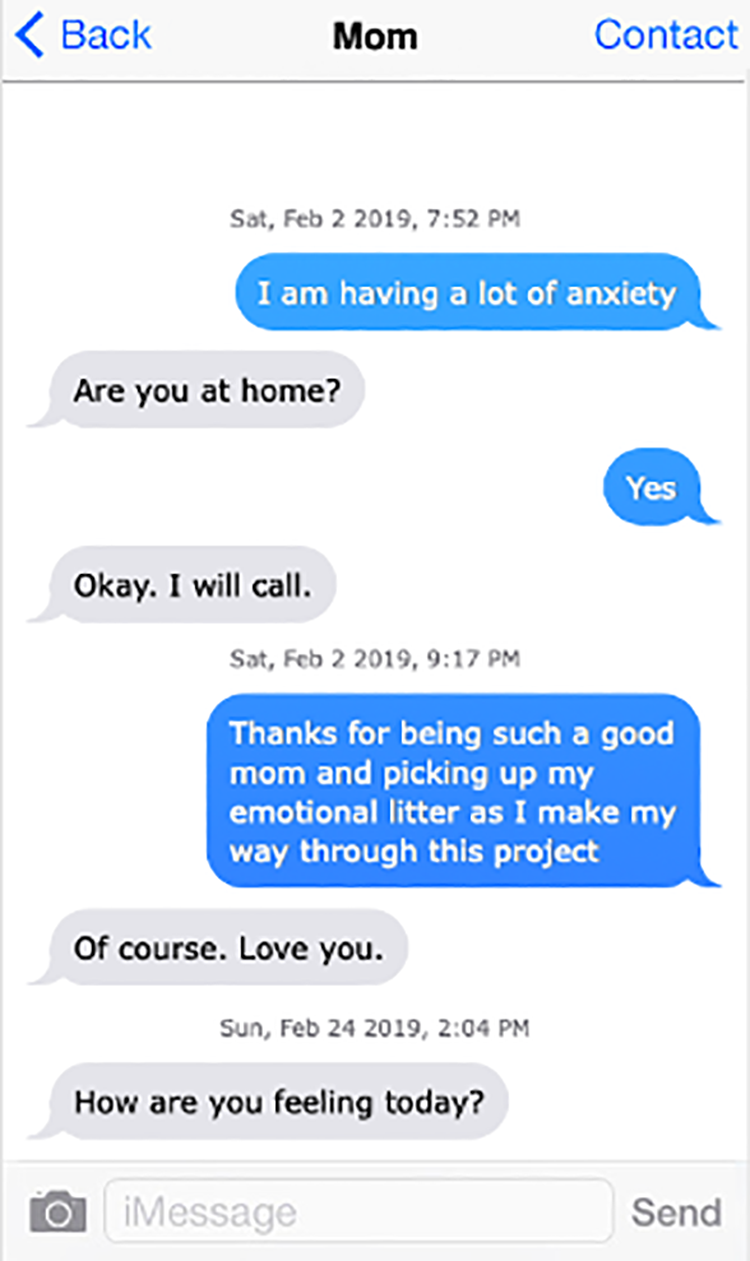
Text Message Exchange with my Mother.
The text exchange came at an emotional peak of a period marked by many personal and professional challenges. The demands of being a participant-observer in the educator training program were much more taxing than anticipated, requiring significant amounts of time, effort and group work to complete quizzes, assignments, practicum presentations, lesson plans, a marketing plan, and a final exam. My data collection had also expanded from a monthly group session held at in the training program classroom, to ongoing individual sessions held throughout a mid-sized city with bad traffic and limited parking. I was overcommitted more generally with many academic commitments. And perhaps most challenging, I had recently gone through a difficult romantic break-up that took a toll emotionally, financially, and materially.
I was further concerned that my corporeal overwhelmed-ness was impacting my engagement in effective reflexive practices (Pink, 2015b; Saldaña, 2018; Sparkes & Smith, 2011). Viewing reflexivity as an interconnecting component of sensory ethnographic research (Pink, 2015a), and feelings and emotions as a central component of reflexivity (Burkitt, 2012), I deemed it crucial to be able to critically engage with my embodied experiences during fieldwork. However, my bodily sense was often one of retreat from self. It was difficult to have Burkitt’s suggested “internal conversation” about research-based beliefs, desires, ideas, or happenings.
Increasing my apprehension was that to advance my work’s anti-oppressive orientation, I had planned to engage in rich, multi-sited, intertextual reflexivity that “reject[ed] that which leads too easily and too closely to the familiar” (Pillow, 2003, p. 192) and bring my whole self into the research process (Hordge-Freeman, 2018). However, I found that my planned documentation methods, narrative journaling and poetry (Redman-MacLaren, 2015), were resulting in simplistic and shallow reflections. My deep, meaningful feelings about the project’s progression would often surface as haphazard, emotional swirls, during times not conducive for academic documentation, like night walks or chats with loved ones.
It was one such chat that prompted the text exchange above. After my mother had supported me through an anxiety attack stemming from the demands of data collection, I sent her a thank-you text that included the pivotal line—“thanks for picking up my emotional litter.” It was a visceral, raw response that I originally texted without much thought. But, as can happen in academia, the phrasing and implications that I had produced “litter” that could be “picked up” provoked significant thought about my embodied reflexivity. I posited: How might I conceptualize and capture so-coined emotional/sensorial litter, for the purposes of re-claiming complex corporeal experiences expelled by my body during fieldwork? Can attention to sensorial litter augment reflexive consideration of how embodied experiences shape my ethnographic knowledge production?
In keeping with these questions, in this three-section paper I pose a novel method for embodied reflexive inquiry—“collecting sensorial litter.” In section one, I review the “messiness” of carrying out ethnographic reflexivity, including and especially for research that focuses on embodied and sensory experiences (Pink, 2015b; Rhys-Taylor, 2010). In doing so, I highlight the continued need for the development of reflexive methods that are embodied or “body-led.” In section two, I draw from theories of phenomenological embodiment (Allen-Collinson & Owton, 2015; Leder, 1990) to conceptualize certain experiences of fieldwork as “too intense” and refuse/d by the body (e.g., fleeting, whirling anxious thoughts; spatial disorientations and dissonances; emotional voids), which require specific reflexive consideration. In section three, I draw upon my fieldwork to illustrate that such experiences are not lost when refuse/d, but manifest symbolically and materially as “sensorial litter” that can be particularly visible in digital media use. I detail my methodological process for: identifying, re-claiming, and reflexively considering three pieces of sensorial litter. I argue the value of collecting sensorial litter includes enhancing self-communication, attending to uncomfortable power relations, and rendering visible critical data (perhaps) inadvertently thrown away in research.
This paper contributes a form of body-led reflexive inquiry that centers on experiences involving exceptionally dense and complex feelings, moments and impressions—experiences that, I argue, may be particularly difficult to query, but can have great reflexive value if re-incorporated into research. Given the centrality of reflexivity as a methodological tool within not only ethnography, but within qualitative research more broadly, such a method can help answer calls for innovative, experimental methods for engaging in embodied inquiry (Pink, 2015b). Specifically, sensorial litter can provide entry points into the ways in which researchers’ sensing, feeling bodies are perpetually in flux, shaping and re-shaping during fieldwork. In doing so, I also offer an account in which my feeling, sensing body could not be cordoned off from fieldwork, which troubled any false sense of preciousness of what can constitute ethnographic data.
Part #1: Messy Reflexivity in Embodied Ethnography
Debates about reflexivity have long been embedded within ethnographic scholarship. Historical discussions concentrated on practices of writing, including the acknowledging the constructed nature of ethnographic texts, attending to how ethnographic knowledge is produced, and bringing participant voices into academic accounts (Pink, 2015b). A popular conception that emerged from such dialogical debates was that ethnographers write themselves into the lives of their subjects (Mazanderani, 2017).
As scholarly attention expanded to embodied approaches to ethnography (i.e. sensory, visual, and digital), the “verbocentric”-ness of dialogical reflexivity correspondingly came under increased scrutiny (Pink, 2015b). Howes (1991) suggested that dialogical anthropology failed to account for the scope and nature of human senses in fieldwork. Bendix (Pink, 2015b) similarly criticized writing-exclusive approaches as being too focused on “the authorial self” instead of striving to understand the role of senses, emotions and affects “within as well as outside of the researcher-and-researched dynamic” (p. 34). Likewise, Stoller’s (1997) seminal Sensuous Scholarship was “an attempt to reawaken profoundly the scholar’s body by demonstrating how the fusion of the intelligible and the sensible can be applied to scholarly practices and representations” (p. xv).
Central to these perspectives is the notion that reflexivity itself needs to be conducted through an embodied lens. Ellingson (2006) explains: My sense of embodiment keeps me deeply rooted in the awareness that knowledge is produced not by the disembodied voices that speak in official accounts of research in professional journals and books but by researchers, whose bodies unavoidably influence all aspects of the research process. (p. 298)
For embodiment-focused ethnographers, how we arrive at ways of knowing, imagining and understanding are based on bodily experiences in relation to persons, places and things (Binte Abdullah Sani, 2015). An embodied approach reminds us ethnographic research reaches beyond the intensity and immediacy of local contexts, entangling with multiple spatial trajectories. Fulsome reflexive engagements thereby need to take up the varied and often messy forms of knowledge production, including acknowledgment of the centrality of bodies within the web of human experiences constituting fieldwork.
Embodied Reflexivity: Methods and Challenges
The requirements of embodied reflexivity have prompted methodological inquiry into the emotional and affective elements of fieldwork, especially for sensory ethnographers. While conducted from a first-person, experiential perspective, sensory ethnography has different reflexive demands than auto-ethnography (Spry, 2001). Sensory ethnographers position experience in ways that are not centered on the self, despite knowledge being derived from their own sensing, feeling bodies. Ethnographers seek to “meaningfully reflect upon their subjective role in the research without speaking only of themselves and risking a form of solipsism” (Mazanderani, 2017, p. 83).
A central task for sensory ethnographers is weaving descriptions of the world with deeply personal, emotive responses to that world, while reflexively maintaining an awareness of those distinctions (Rhys-Taylor, 2010). In carrying out this task, well-established dialogic methods (e.g., field notes, reflexivity journals/dairies) remain useful. They can assist sensory ethnographers document observations, responses, thoughts and questions. Diarizing, likewise, can partially represent the inner dialogue and drama of ethnography via “its intuitive base, its halting time-line, and its extensive recycling of concepts and perspectives” (Marshall & Rossman, 1995, p. 15). Indeed, language and metaphor are “vehicles for making sense of bodily sensations and actions” as language can be needed to “turn sensation into…meaning” (Hughes & Paterson, 1997, p. 332).
Implementing such methods in sensory ethnography is not without challenges, however. Explained by Rhys-Taylor (2010), language has limitations for capturing and conveying body-based experiences. There are restricted conventions for capturing the difficult-to-articulate, and available word choices tend to be emotive and clumsy adjectives. It is often necessary to cue the rawness of experience by using additional information: e.g. paralinguistic features, silence/pauses, vocal tones, body language and facial expressions. Mazanderani (2017)’s “voice notes to self” elaborates this line of thinking.
The co-constituting nature of language and corporeality also introduces rich complexity into experience, as a central matter of reflexive consideration. Experience is recursive in that each language event (re)creates meaning, contributing to the continuation of those meanings, while also recasting meaning in somewhat new ways (Cameron & Kulick, 2003). The perception and understanding of sensory experiences, including material entanglements, provides fodder for engaging with “the messy, complex and contradictory factors at play in human experience, as well as the essentially emotive, corporeal and intersubjective, visceral, sentient nature of our being” (Inckle, 2010, p. 35).
This analytic messiness is especially pronounced when trying to capture elusive, unintelligible and/or ineffable bodily experiences during fieldwork—the focus of section two. Sparkes & Smith (2011) for example, vividly detail attempting to reflexively document feelings after a particularly taxing data collection session and only being able to draw a scribble. As such experiences often stem from complicated and challenging elements of fieldwork, they can hold a significant bodily information that can provide reflexive insights into the researcher’s subjectivities and intersubjectivities.
Methodological Advances for Embodied Reflexivity
The premise that bounds of language are not the bounds of messy, unruly felt-sense experiences and knowing is central to innovative reflexive methods (Vannini et al., 2012). From an experiential perspective, scholars have aimed to develop novel embodied methods that encapsulate undulations of language and embodiment, with particular focus being on arts-based methods. Past decades showcase use of song-writing (Carless, 2018), poetic representations (Brady, 2004), drama-based approaches (Pässilä et al., 2015), and mixed genre representations (Sparkes, 2009; Yi’En, 2013). Such methods add corporeal depth by helping the ethnographer access complex embodied experience, explore embodiment in novel ways and engage bodies as tools of reflexivity.
Nonetheless, arts-based reflexive methods require a level of expertise (Leggo, 2008). The ethnographer needs be comfortable and proficient engaging in creative expression, as well as knowledgeable in employing arts-based genres in ways that can yield reflexive insights. Accordingly, I suggest it can be useful for ethnographers engage in forms of inquiry that provide embodied reflection that build on familiar practices of fieldwork, like observation, spatial connections and thick description. Likewise, more knowledge is needed on the occasionally fraught conversion of sensory and multi-genre reflexive data into academic texts, helping illuminate possible configurations of bodies, discourse and materiality (e.g., see Merit Müller, 2016). Further experimentation with experiential, embodied reflexive methods is warranted (Mazanderani, 2017; Sparkes & Smith, 2011).
To respond to these challenges, I put forward here a novel method—collecting sensorial litter—that can facilitate using bodily sensations and feelings to seek out visible, temporal, messy material and symbolic evidence of raw reactions, meaning-making processes and behavioral outcomes in fieldwork. I highlight the types of deep insights that can be gained through embodied examination of entangled fragments of complex corporeal experiences, as well as the moments where complicated feelings find language, to strengthen reflexive engagements.
Part #2: Conceptualizing Too Intense Embodiment—Sensorial Litter
To conceptualize the method of “collecting sensorial litter,” I follow Pink (2015b) and Saldaña (2018) in building upon theories of phenomenological embodiment to grapple with complicated corporeality. I start from the premise that the dynamism of the senses is “multisensoral.” I recognize the strength in multisensorality for conveying how the senses are interconnected and enmeshed with feelings and emotions. As one of our “primary languages,” the sensory realm is “both a reaching out to the world as a source of information and an understanding of that world so gathered” (Rodaway, 1994, p. 5).
Leder (1990) asserts that the dynamism of sense comes from understanding how one’s body is constituted by a diverse system of interconnected organs and body parts, each of which is characterized by “different ways of withdrawing and surfacing to consciousness” (p. 37). These corporeal depths are often spatially ambiguous: “they are part of the body we do not use to perceive or act upon the world in a direct sense”—and have spatiotemporal discontinuity, which includes moments of appearance and disappearance (p. 53). Sensations can come to the foreground of bodily awareness through various bodily functions, types of engagement with the world, or concentrated corporeal focus.
Leder (1990) further discusses that different parts of the body can shift into focus via triggered sensory intensification: “a region of the body that may have previously given forth little in the way of sensory stimuli suddenly speaks up” (p. 71) For instance, thinking about a specific topic might result in one’s heart pounding or skin perspiring. Applying this thinking, it is possible to see how researchers’ bodies and corresponding knowledge can appear during moments of confusion, fear, connection, realization and so on during fieldwork, as the always/experiencing body moves in and out of active perception.
Leder’s (1990) theorization of intensification in embodiment also provides a useful foundation for how the Cartesian mind/body divide, wherein the body and mind are falsely treated as separate entities, can manifest and be addressed in reflexive examination. While the mind-body divide is constructed, the impacts of this divide can still shape researchers’ empirical experiences of self. When absorbed in our “mental” perseverations, we can feel as though we slip in and out of our embodied selves, both becoming disembodied and “returning to our senses.” Likewise, there can also be multiple, ongoing, and fractured senses of self/body that can further contribute to an embodied sense of duality and divides. In this reflexive examination, I handle this complexity by acknowledging embodiment exists via an integrated body and mind, while also honoring my empirical sense of moments where elements of my being come into particular intensive focus (e.g., body-led)
Intense Embodiment, Too Intense Embodiment and Bodily Refuse
Leder’s (1990) notion of sensory intensification is expanded upon by Allen-Collinson & Owton (2015). Allen-Collinson and Owton put forward the concept of “intense embodiment” to describe moments in which a concentrated experience of corporeality is triggered. For this concept, Allen-Collinson and Owton demonstrate that dys/appearance can also occur through otherwise intense experiences such as physical activities. As conducting sensory/embodied ethnography asks for fulsome engagements of bodily felt-sense, intense experiences exist as an important component of conducting research. For instance, the whole-body thrill of seeing/smelling/tasting/feeling a new place or a chest-filling empathy hum based on a participant’s life circumstance.
Returning to my experience of fieldwork, not only was I having intense moments of embodiment, but I was also having “too intense” experiences. I had fleeting, whirling anxious thoughts that did not settle; emotional voids from pushing away difficult feelings; and spatial suspensions of disorientation where I struggled to make meaning of experiences. These experiences extended beyond the bounds of my immediate fieldwork contexts to surface during my life overall. I had escalated emotional responses to small events ranging from receiving an odd comment during fieldwork to misplacing a jacket to being asked to address false “sexual wellness” claims by a celebrity.
As articulated in the text message, I felt as though these too intense feelings could not be embodied or contained within my skin. Messy feelings would overflow and push through my bodily bounds and externalize during conversations like the one that prompted the text exchange. It was often something that felt out of my control; it was as though the bodily-experiences were viscerally rejected or “refuse/d” by my body. Expelling these overly intense sensory experiences, I seemingly shed or threw away that which felt deeply unpleasant or difficult to process. Emotions, feelings and sensations left my bodily bounds as shards, bits and pieces, and flowed into the material environments in which I am entangled. As I noted in the text message, this can be understood as sensorial litter. 1
The Materialization of Sensorial Litter
My text exchange was not just serendipitous due to the conceptualization of sensorial litter, but because it contained the accompanying notion that litter is not lost when refuse/d by the body. As highlighted, litter can be “picked up”; or in academic terms, because sensorial litter manifests materially and symbolically, it can be reclaimed and reincorporated into the research process, rather than going to waste.
Connecting as such to Strasser’s (1999) work on waste, there exists a “categorizing process that defines trash” (p. 5). Refuse is established through the sorting of what we deem valuable from what we deem not. We must similarly distinguish that which could be valuable from that which will be valuable. Something not valuable in its current refuse/d state might be repurposed or recycled into something novel or useful. We also may not realize the potential value of something until someone else points it out to us. What is wasted, or left as litter, in research is neither concrete nor definitive.
Categorizing refuse also functions as process of marginalization (Strasser, 1999). That which we refuse can entail the most subjective and difficult parts of research—those sensations, emotions and feelings with which we are uncomfortable and relegate to the margins of our pages, bodies, and sometimes, consciousness. But in line with Manalansan (2014), I consider that which happens on research’s margins as providing key contextual information that can reveal relevant processes of power and institutional structures. Such data can enable reparative work by helping us to take critical account of the conditions that shape our research projects (Pillow, 2003).
The creation of litter can thus be understood as a human process (Strasser, 1999). I conceptualize this process as one of embodied reflection upon that we have personally shed—one that requires us to be critical, inventive and creative as no two pieces of litter are likely to be the same. Thinking about what is required for effective reflexive inquiry, the essential quality of valuable sensorial litter is its ability to prompt reflexive examination of what we refuse/d, why we refuse/d it, and what are the implications of that refusal for our research projects.
Part #3: The Method for Picking Up Sensorial Litter
Considering the processes of refuse raises questions about not only what becomes litter, but where litter goes after it has left our bodies. If we “throw away” litter—where is away? (Strasser, 1999). To find my litter, I utilize Manalansan’s (2014) approach to studying mess and focus attention on the material environments with which I am entangled. I find it particularly methodologically beneficial to query digital environments. As per Couldry (2012), I adopt the perspective of “de-centered media” in my research and overall twenty-first century existence. I recognize that media are fully enmeshed with activities, technologies, materialities and bodies, and that corporeal realities are often augmented through virtual connections. Further, I note that digital media technologies help render visible the circulation of ideas, emotions and power dynamics, including “what can and cannot be said” (McIntosh & Cuklanz, 2014, p. 245). In this way, throwing “away” is not separate from my research, but diffused throughout/across many research environments.
The Research Project
I carried out a sensory ethnography (Pink, 2015b) documenting my own and five focal participants’ embodied experiences of a community-based sexual health educator training program in Vancouver, Canada. The program took place from October 2018 to April 2019. Program enrollees were required to complete a prerequisite workshop and attend five weekend modules (Friday morning through Sunday late afternoon), with homework conducted between modules. The program was highly interactive with a variety of lessons, practical activities and presentations. Enrollees could also complete a formal practicum. I aligned my research to run in-tandem with the program, with my focal participants and I meeting 5 times throughout. My study methods included ethnographic content analysis (Howes & Classan, 2014), digital microanalysis (Markham, 2016); erasure poetry (James, 2009); commonplace books (Miller, 1998); body maps (Sweet & Escalante, 2015); and sensorial interviews (Pink, 2015b).
Capturing Sensorial Litter
To search for litter, I adopted an approach similar to that of a rag-picker (Strasser, 1999), foraging for data through my media environments to locate and claim interesting pieces for thoughtful study. However, this was not a random search. I quickly realized the overwhelming volume of my digital interactions and implemented several parameters to help concentrate and structure my search. 1) I assessed existing field notes and self-reflexive data collection activities for topics that lacked reflection, especially ones I knew were emotional or difficult (e.g., changes in personal circumstances). This helped to identify what topics might have been expelled from my bodily bounds in partial, fleeting and raw states of corporeal expression. 2) I selected key focal professional and personal relationships where litter was likely to linger (e.g., the family members and academic friends with whom I was most likely to engage in vulnerable communication about my research). 3) I identified new or “out-of-character” behavior that I had started doing during the period of my data collection. I asked myself “what has changed about me” and “do I know why?”. And 4) I provided temporal boundaries for the search to focus on periods that were particularly research intensive (e.g., specific days around classroom training). While it is likely litter may have manifested out of these bounds, these parameters created a manageable scope for my search.
Once the parameters were in place, I sought to identify key pieces of sensorial litter. I searched for indicators/evidence that I was processing information (i.e., asking questions, seeking information, expressing layered emotions like confusion or apprehensiveness). I retraced digital steps using search histories; I examined purchase histories and smartphone usage for consumption patterns; I re-read emails and texts messages. This embodied reflective examination was guided by Ringrose & Renold’s (2014) methodological process for demystifying analytic inquiry around intense data. Building off of MacClure’s (2013) notion of “hot spots”, Ringrose and Renold describe the importance of sitting with data for a period of time in order to use bodily intensities to identify data that “glow” (p. 776). Of particular importance to locating the “hot spots” is identifying specific instances of boundary rupture that disrupts the resonances of what is being studied.
For my purposes, I took up these palpable “hot spots” that “glow” and “rupture” (Ringrose & Renold, 2014, pp. 775–776) as deeply evocative moments for my embodiment. As I initially searched, I scanned my sensing, feeling body for twinges, instincts or other ruptures to my normal being that evoked a sense of wonder, as they might signal notable or unusual data. I then reflectively examined the sensorial litter to determine if entailed emotional shards might lead to larger connections, noting what bodily intensities were running through my body and the project. And finally, as I moved into developing the litter into a reflexive format for communication with others, I thought carefully about what litter made me feel hot and sweaty, what litter made me feel intensely uncomfortable or vulnerable, and what litter would “travel through” (p. 778) to prompt me to ask a colleague “could I ever include this in an academic paper?” and “should I ever include this in an academic paper?”. In other words, my body re-intensifications identified “what” I needed to re-claim in my research process.
Re-Claimed Litter
My body-led searching identified three key pieces of sensorial litter. To help make this process more tangible and to convey my embodied processes more fulsomely, I first show the material expression of sensorial litter. These mark the sites where bits and pieces of my “too intense” experiences flowed into the material environments in which I am entangled. I next narrate the sensorial bits and shards of my refuse/d experiences contained within the litter. I then overview my examination of the litter’s significance to my overall project, including detailing the reflexive prompts generated for deeper consideration. Of note, not everything I identified during my searching was useful—some pieces of litter, while evocative, remain unconnected. I focus here on the three pieces of litter that produced the richest reflections.
Sensorial Litter #1: Mapping my Research Route
The training course was held in a classroom of a hospital. I had originally planned to conduct five group data collection sessions in this classroom, held after the Saturday session of each module of the training course. It quickly became apparent that I would, instead, be conducting mainly individual sessions for the study to proceed. While I still held the classroom group session, it only had two participants. The other three participants needed individual sessions due to scheduling difficulties. All three participants asked that we meet in their own homes, which was something I had not prepared for in advance. I soon found myself driving, supplies and cinnamon buns in tow, throughout the city.
Each of these trips was something that I experienced as being immensely stressful and unpredictable. Even though I had very limited time during this period, I would allot an extra 45 minutes beyond the estimated travel time to commute to a location. Similarly, although I have never felt the urge to use GPS in my two decades of driving, I suddenly found myself using a GPS app to help me navigate already familiar city streets. Each trip, I would start my car, plug-in my phone, and pull up the map to the participant’s location. Before starting, I would intently try to memorize the route. I would then monitor the map while driving, reassuring myself that I would reach the right place. This continued even after I had visited each location multiple times. I felt this sensation of not wanting to get lost so acutely, that even now while writing, my fingers have mimicked scrolling through the app and a familiar prickling has started below my navel. My memory also has reproduced the sound of my voice repeating: “This is okay. You are okay”, while my eyes see fuzzy, gray car ceiling fabric and fourth Avenue in front of me.
As the sessions all took place during the day, issues inevitably did not materialize—as shown by the clear, blue route in Figure 2: Sensorial Litter 1. I found myself arriving nearly an hour in advance of multiple sessions. I thus spent a significant amount of time during those months parked out of sight at my participants’ houses, hoping to avoid the awkwardness of being caught arriving so early. I also was careful not to share with anyone that I was repeatedly doing this (albeit harmless) behavior, in fear that they might convey a lack of support. I preferred to sit quietly in my car, watch the winter rain, and feel intensely relieved to have arrived.

Sensorial Litter 1 - GPS Mapping.
I have come to reflexively realize that this intensity was me responding to the disorientation of unexpectedly spanning a public/private research boundary. I had originally conceived the project as occurring in a neutral, public location. Instead, I became tasked with managing my bodily knowledge of intimate details of participants’ lives within my project. I experienced varying socio/economic status realities; listened to my participants’ private conversations with kin; engaged with the sensescapes of their homes—drinking coffee and tea, offering opinions on incense, petting animals—all while discussing sexuality and highly personal thoughts and emotions. It was something I did not ever find completely comfortable, as I was always aware that I was a guest in someone’s home. These sessions went very well and have produced lasting relationships and rich data, but the mix of personal-yet-distant feeling of those sessions was a notable difference from my group data collection that requires navigation.
From this litter, I generated two reflexive prompts. How does the spanning of private/public boundaries impact my perceptions of participants? How do I account for the different dynamics of the group setting versus the personal setting in my data analysis?
Sensorial Litter #2: Washroom Dynamics
During data collection, I went through a difficult break-up with my romantic partner. I had wanted to keep this information temporarily private. I knew this would be challenging because each new module of the training course began with an “actual check-in” activity, in which we were asked to discuss our lives in a genuine way for 3 to 4 minutes. I had planned to share a general statement, before discussing lighter matters in my life.
On that first morning, I arrived in a heightened emotional state. Driving myself for the first time, I missed one of turns to the hospital and was nearly late. I was further upset because I had a limited view of the classroom from the one remaining back-row seat.
My back-row seat also meant I was second to check-in. Opening my mouth, I promptly burst into tears with accompanying loud, shuddering breaths. I remember fourteen empathetic faces staring at me, my leg being patted, and someone’s purse tissue being passed through the room. I was then even more dismayed because I felt I had acted unprofessionally. I did not complete the check-in. That day, I repeatedly left the classroom to sob in the hospital washroom—crunched over in a stall for a few minutes—before returning to the classroom with an increasingly puffy face and wrung-out demeanor. It was the most difficult day of my research study and also the hardest day of my break-up.
After class, I found myself again teary in the washroom, when three people happened to enter the space. One person was someone who I had forged a friendship with outside the course; the other two were the group participants. There was some fussing about who should stay and who should go, if anyone. The situation settled with the two participants staying, while the friend hesitantly left. We later had a follow-up text exchange (Figure 3: Sensorial Litter 2).

Sensorial Litter 2 - The Washroom Text Message.
During our talk in the washroom, the highly complex ways that the participants and I negotiated our different layers of identity evolved, and the bounds of our relationships changed. The power relations were reconfigured between us, as our base sense of personhood superseded our respective research roles. I also gave up the false pretense that I could keep any part of my self out of the study. I accepted that, although perhaps one of the last things I want to academically discuss, sobbing in a bathroom during data collection was not something that I could or should wash away as refuse.
This incident further evidenced the deep, unique bonds researchers and participants can form doing body-based work. The follow-up text I received from my friend—kind but removed—provided stark evidence of an alternative relationship to the one forged with my participants. Although less close as “friends,” the participants felt comfortable entering a moment of extreme emotional vulnerability with me, and we resultingly became quite bonded. My new friend chose not to stay, perhaps feeling like an intruder in a group dynamic where members possessed deep connections that were not articulated but were still perceptible to the various bodies in the room.
From this litter, I generated two reflexive prompts. In what ways do the unique bonds my participants and I formed shape my research findings? How does my body’s refusal to not enter the research space impact what I am willing to share about my self in academic writings?
Sensorial Litter #3: Supervisory Segues
About halfway through the data collection period, I suddenly became extremely focused on my academic future. For about 10 days, I stayed up late into the night researching my possible career. I sought out post-doctoral programs/opportunities; I created reference lists of journals I wanted to publish in and conferences that I should attend; and I searched for summer teaching opportunities. My search history showed a marked shift from motivational YouTube videos and tips for getting through heartbreak to all academia, all the time. This search felt compelled, as though I immediately needed to gain control of my academic future.
I emailed one of my very supportive supervisors to set up a Skype meeting to discuss my findings. I was taken aback during the meeting, however, when she responded by reminding me to focus on data collection, instead of being concerned about things quite far in the future. I remember being shocked by this supervisory re-direct. I had thought I might have given off a bit of a frenzied energy while describing my so-called informational gems, but I genuinely believed these were the exact tasks that I should be doing at that time. It was a very startling to receive the opposite feedback. I hung up from the call, feeling reassured from her direction, but confused. I wondered why there was such an atypical divide between what my supervisor and I thought were appropriate courses of action.
Upon closer examination (and doing a full body cringe when I read the above email—Figure 4: Sensorial Litter 3)), I have realized my dissonance stemmed partially from my academic processing of the project. Through my searching, I was trying to determine how to actualize the wide range of interdisciplinary ideas emerging out of my work. I was revisiting past ideas to make sure I was engaging with the most fruitful questions across disciplinary contexts. I was also trying to determine how to most effectively position the analysis and relevance of my work. Accordingly, I did re-focus on finishing data collection, but the orienting information gained from this period has remained an important part of my project’s framing.
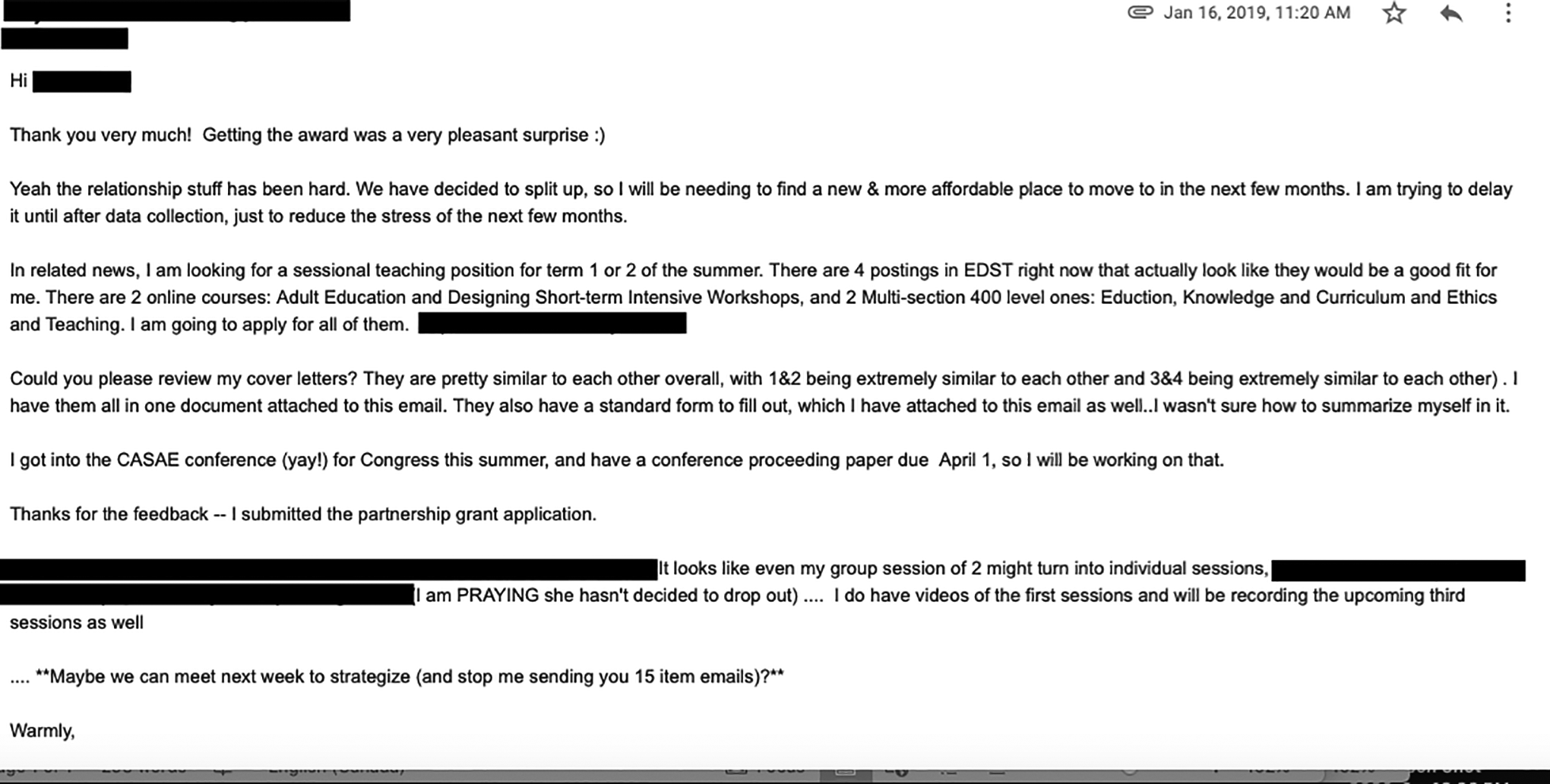
Sensorial Litter 3 - Supervisor Email.
I have further realized that my supervisor was responding to the “too intense” emotions I was shedding. There was a dramatic, rapid increase in fervor with which I was approaching my studies; I was barely acknowledging massive life changes before discussing my productivity; and I was quickly making decisions that could impact my life and career—all before “warmly” signing off on email and continuing on my way. Knowing her level of emotional perceptiveness and care, I can understand now that she was also saying “slow down and focus on what you can control here” to try to bring me back to my more typical, calmer state of being.
From this litter, I generated two reflexive prompts. How does working to fit within disciplinary bounds shape the knowledge I am producing from this study? In what ways, if any, has the study’s research purpose shifted, as I considered different possible personal and career futures?
The Value of Reclaiming Sensorial Litter
By focusing on often-ineffable, embodied aspects of fieldwork, collecting sensorial litter provides a valuable opportunity to enhance reflexive engagements. As illustrated in the narrations, my corporeal focus shifted during overly intense experiences, introducing and re-configuring the bodily information I used in my meaning-making processes (Poyntz & Hoechsmann, 2011). Collecting sensorial litter enabled me to capture the raw data of overly intense experiences that I had bodily refuse/d and threw “away” during fieldwork, re-introducing them as reflexive data. Importantly, not only was I able to capture these elusive experiences, but collecting sensorial litter helped me to use bodily knowledge to reflexively articulate their “glowing” potential to inform my study (Ringrose & Renold, 2014, p. 776). I was able to generate prompts for more deeply analyzing my in-flux body. Collectively, the three reclaimed litter pieces showed how my self became enmeshed with data—creating and recreating the ways in which I made sense of my experiences during fieldwork.
Uncluttering Self-Communication
Working from the premise that what becomes classified as refuse varies from person to person, differs across locations, and changes over time (Strasser, 1999), a key reflexive value of sensorial litter is its ability to foster a productive channel of embodied self-communication. As I struggled to overcome my sense of a Cartesian mind/body divide in order to connect with my body through notes and diarizing, I had use for a method of reaching more deeply within my self for hard-to-access knowledge (Sparkes & Smith, 2011). I needed some way, though, to shift into a form of embodied exploration that could result in these expressions of self.
Sensorial litter enabled me to identify embodied memories—often manifesting as shreds and fragments embedded in my actions and behaviors—and to bodily experience them in old and new ways. As I “rag-picked” through months of digital media data, I was not reviewing words and actions “only with the benefit of hindsight that [makes] the scribbling in my diary…something of real use” (Woodthrope, 2009, p. 82); I was carrying out a body-led reflexive process, in which I visually and temporally emplaced my body in fieldwork. For instance, it was my feeling, sensing body that noticed feelings of routine, calm and security as I engaged with my map app, which had transcended fieldwork to become part of my traveling routine more broadly. While I only had a basic observation of this behavioral change during my study, given the “hot spot” (Ringrose & Renold, 2014, p. 776) focus of collecting sensorial litter, I engaged with these previously unarticulated and shed anxieties to gain new insights into my motivations.
Refracting Fragments of Self and Selves
The nature of self-communication enabled by sensorial litter supports Picker’s (2014) contention that ethnographers can be configured “as a constellation of partial selves, in communication with different networks, none of which constitute a whole” (p. 266). In conceptualizing this notion, Picker invokes Haraway’s human/machine “cyborg,” with multiplicitous selves that capture different stimuli and functions, while constituting a singular entity. My sensorial litter highlighted how my different selves shifted in and out of intensity-driven focus, in ways that were not always categorizable in relation to a fixed central self. For instance, not only did my litter reflect contradictory emotions about professionalism and vulnerability, but I also had unexplained reactions that remain unintegrated with the rest of the project. The insights from sensorial litter helped expand my understanding of my ethnographic self from coherent and integrated—thinking that I would be able to observe and compare my different reactions, emotions across contexts—to a much more tentative, fractional understanding of a feeling, sensing body shaped and re-shaped during fieldwork (Aoki & Yoshimizu, 2015).
Viewing my ethnographic selves in constellation also challenged my understandings of a bounded, coherent, and organic ethnographer who works emplaced in external phenomena and realities “out there.” Through my litter, I could bodily discern how pieces of my selves become embedded in my environments. I was able to track the development of single threads of body-based expressions over multiple digital platforms, with various temporal and spatial dimensions. For instance, finding my third piece of sensorial litter involved following my progression from searching webpages to compiling Google documents to sending email to having a Skype record of use. My anxieties about the framing of my work, concerns about meeting the demands of academia, and my shifting sense of scholarly and personal self, blurred the boundaries of body, materiality and discourse.
The way in which ethnographers are enmeshed in their environments also ties into Sparkes & Smith’s (2011) suggestion to utilize the “assistance of others,” such as colleagues and loved ones, to deepen critical reflection (p. 13). In this case, my process suggests that the material and interpersonal connections we forge in and across digital environments can also fulfill this role of “others”, as well as preserve the response of “others” for future reflection. In this way, digital environments provided helpful exteriorization that allowed me to engage with my bodily experiences from different perspectives.
Diving Into Discomfort
The physical experience of returning to that which my body had refuse/d occasionally resulted in discomfort surfacing; for example, when revisiting the washroom event. Some discomfort was simply feeling difficult emotions that my body had previously cast away. The larger discomfort stemmed from me acknowledging that despite holding deeply held values around the co-constructed research process and the legitimacy of “non-expert” knowledge, I still was quite tied to a more traditional conceptualization of what it meant to be a researcher. I needed to challenge my own lack of willingness to be vulnerable, desire to present a specific form of professionalism, and uphold a strict sense of personal/professional boundaries, including the entailed power relations. In this way, sensorial litter manifested was when my feeling, sensing body interrupted the protocols and power of research. Attention to embodiment thus prevented me from cordoning off specific notions of research that I did not want to acknowledge academically…but needed to (Aoki & Yoshimizu, 2015).
Notably, the refuse/d experiences I reclaimed did not feel unfamiliar. This was surprising because I was actively seeking out that which was unfamiliar (Pillow, 2003). Once reincorporated into my research, it was not challenging to identify associated feelings or make broader connections with the litter. I had simply granted myself permission to access existing, but estranged, bodily knowledge. As scholars, we have an enhanced awareness of the powerful ways that bodies are acted upon, even as our own bodies are subject to those forces. In exploring what I shed, I directly confronted the privileges and powers I knowingly hold, but uncomfortably occupy due to my critical scholarly orientation. I realized that my sensorial litter did not lead me away from the familiar but asked me to re-embody a too familiar acknowledged power, in order to ask new questions of myself and my research.
Wrapping Up Sensorial Litter
When ethnographers manage research information, there can be a tendency to demarcate whatever has the highest academic value as data. What is included in ethnographic research is not typically what we have refuse/d, but the so-classified data that conforms to the narrative we are attempting to convey. Collecting sensorial litter can help disrupt this process by accounting for the untidiness and humanness of ethnographic research, focusing on the emotional, embodied dynamics of analyses, as well as identifying the ways we might use corporeality to feel our way through complex analyses. The processes involved in reclaiming sensorial litter ask ethnographers to reflexively consider: a) what influences in the overall research environment lead to the identification of data and b) what uncomfortable, unarticulated bodily experiences of data collection, are nonetheless familiar and important parts of our meaning-making? Sensorial litter enables us to use our embodied selves to look inwards on research.
Sensorial litter is rude and abrupt in its interruption of the valuable data ethnographers often rather highlight in their research. Sensorial litter is that which we attempt to throw away in spaces outside of our research projects: it is feelings of disorientation; it is anxieties spurring late night Google searches; it is personal crises that we cannot quite contain. It can happen in the margins of our research space, such as during travel to a research site or in a washroom where one tries to wash away that which one refuse/s. But despite marginalization, our bodily experiences are not thrown away easily. Sensorial litter is the information that refuses to conform to the research process, that insists on being present and not wasted. In this way, sensorial litter is our crumpled embodiment of research that requires ethnographers to be reflexive in deep, corporeal ways.
Footnotes
Acknowledgments
Kathleen gratefully acknowledges the funding of the Joseph-Armand Bombardier Canadian Graduate Scholarship, The University of British Columbia’s Four-Year Doctoral Fellowship and The University of British Columbia’s Public Scholar Initiative for this project. The comments of Dr. Theresa Rogers, Dr. Kedrick James and reviewers have greatly improved this manuscript.
Author's Note
Kathleen A Hare is also affiliated with University Canada West, Vancouver, British Columbia, Canada.
Declaration of Conflicting Interests
The author(s) declared no potential conflicts of interest with respect to the research, authorship, and/or publication of this article.
Funding
The author(s) disclosed receipt of the following financial support for the research, authorship, and/or publication of this article: Social Sciences and Humanities Research Council of Canada (752-2017-2366).
