




Abstract
When using video and visual methods in qualitative and post-qualitative research, the size and scale of the data set can be overwhelming, particularly for new researchers. Collaborative research teams often work with a code book to systematize and unify their analyses. Interpretive researchers pursuing multi-layered and multi-voiced visual analysis often find it difficult to move away from desires for a single ‘best’ interpretation of what happened. This paper illustrates and interrogates an open and flexible method for ‘thinning’ (screenshotting) video data that we call the ‘Five Images Method’. We offer one unfolding of interpretive processes and tensions and examine how four researchers worked across positionalities to analyse video data. We start with our positionalities in relation to a research study of children creating photographic and written stories of cultural artifacts, carried out over one year. The primary data from the study was generated through online video-conference sessions connecting a university researcher with an elementary class. A second level of data was created through a process of screenshotting, followed by recursive cycles of conversation about the choices of each researcher, and how they were guided by background, geography, roles in relation to child participants, technologies, personal experiences, and so on. Two key incidents that illustrate the potential of the method and the interpretations produced are described. We argue that reducing video data in this way can be both generative and limiting, while also serving as a catalyst for enhanced analysis. The collaborations and relationships built in research teams through slow processes of analysis (and writing!) working across difference also promote evocative and layered learning. Looking at interpretations as multiple can be hampered by longstanding histories of research as intended to produce authentic and singular truths.
Keywords
Introduction
This paper grew out of our frustrations, insights, and excitement when managing video data and creating summaries and analyses that evoked the data’s complexity and visuality. We document our collaborative attempts at thinning substantial amounts of video data collected using a process we affectionately and loosely call the Five Images Method, whereby screenshots frame our interpretation of what was important.
Data was generated in a visual arts-based research project with a Grade 2/3 class within a public-school board in eastern Canada, where teacher and students explored the question, “Why should we respect the diverse cultures and traditions within our community?” Building from an already in place pedagogical process that involved design thinking (Watson, 2015) and critical empathy as action (Mirra, 2019) as its goal, the research examined how children could be viewed as collaborators and provided experiences where they could learn to conduct research. Another goal was to examine how engagement in critical photographic inquiries, with a range of audiences, might build understandings of how images might be used to create understanding across difference. Children took and modified (their own and each other’s) photographs and wrote about and shared their photographic images with others—peers, other people in the school community, and online through a regional art gallery. Permission to share images was obtained from parents/guardians, and assent was given by children.
For 6 months during the COVID-19 pandemic, data was generated in-person and through online sessions with students in Melissa’s classroom. These sessions were joined virtually by a university researcher, Diane, and sometimes by doctoral research assistants, Simran and Zach. During our data analysis, we 1 realized we had collected massive amounts of multimodal (i.e., images, video, drawings, photographs, audio-recordings) data, and that condensing this data in a way that was useful was difficult. Challenges posed by our subjectivities, personal histories, and positionalities vis-à-vis our research participants and each other intensified these tensions. We engaged in various transcription and summary activities, trying to find a way to represent our interpretations.
This paper, collaboratively written by four researchers, provides rarely offered insights into tensions and processes involved in collaborative video analysis and is organized into four sections. We begin with an overview of research using video methods in classrooms, and both theories and studies related to research positionalities and subjectivities. We briefly present our subjectivities and positionalities in relation to the research study and describe how our method of analysis evolved as we worked together over 6 months. We illustrate how our histories and perspectives were highlighted by describing our analysis of two “key incidents.” We describe what we learned as a method to open up analytical discussions and contend that collaborative data analysis that does not seek consensus can allow for rich analytical insights about data, and about difference. We end with provocations for other researchers to build on and vary methods in their own journeys toward generative video data analysis.
Collaborating Across Difference with Video/Visual Methods: Concepts and Context
Visual and video methods of conducting research are pervasive and often daunting to employ in economical and generative ways. When researchers work collaboratively with qualitative data, including video data, they often try to find common ground. Those operating in interpretive, post-positivist paradigms often acknowledge the ways that their subjectivities (that they bring to research, and to analysis) and their positionalities (that they bring to research relationships with participants and with other researchers) influence and enrich analysis and insights gained. Visual/video methods often offer one way to connect across difference. In this section, we provide an overview of video methods and the role of subjectivity in qualitative research. We propose that collaborative video analysis that embraces subjectivities also enriches interpretation.
Building Video Methods
It is tempting to capture enormous quantities of video/visual research data, at a time when digital tools and storage are within reach, for researchers in the Global North (Knoblauch & Tuma, 2020). Video research in classrooms is a long-established tradition (Derry et al., 2010; Klette, n.d.; Stigler et al., 2000) and has contributed to the study of pedagogies as well as social relationships in educational settings. Video data has been used to understand better effective science instruction in primary schools (Fitzgerald, 2012), and also very particular elements of classroom experience, such as the practices for handling living things in biology classes (Petr, 2014). Video data has been used to research teachers’ metacognitive instructional strategies (Hoe et al., 2018), their gestural practices when delivering curriculum (Mortimer et al., 2018), and as a tool for reflexive pedagogical practice (Hubber et al., 2018). The longevity and varied use of this tradition speaks to how video captures complex and busy classroom social interaction well (Smythe et al., 2016). Classroom video research allows for documentation of complex events and dynamic nuances that might otherwise go unnoticed (Blikstad-Balas & Sørvik, 2014). Generating a large amount of video data may suggest it is possible to capture what really happened ‘as if reality can be possessed or seized’’ (Plowman & Stephen, 2008, p. 547). Massively intensified and sophisticated technological developments in audio-visual recording technology over the last decade provide many ways (i.e., traditional video cameras, iPhones/iPads, GoPros) to record video in social sciences research.
Embracing videography as a method requires a plan for analyzing large volumes of data (Baroutsis, 2020; Luttrell & Clark, 2018). The dominant approach for interpretive analysis of video data is founded upon phenomenological and methodological assumptions that actions viewed within the video data are “guided by meanings” that can be interpreted and understood (Knoblauch & Tuma, 2020, p. 3). At the same time, most interpretive researchers expect that visible actions alone are not sufficient to illuminate activities, relations, and events. Data, and interpretations of data, generated in qualitative research is always fragmentary, and video data is no exception (Blikstad-Balas & Sørvik, 2014). Video methods make no promise of “authenticity” (Harwood & Collier, 2019, p. 54) because “each angle, each event, each perspective is always partial and through a particular framing” (p. 54). For researchers interested in working with video data, the question of how to reduce (or ‘thin’) data generated from them into a more manageable and focused set is imperative.
The use of static images (i.e., photos) in arts-informed qualitative research studies is well documented (e.g., Collier & Rowsell, 2020; Cappello & Hollingsworth, 2008; Doucet, 2018). Methods of data creation/collection through photo-elicitation (Prosser, 1998; Roger & Blomgren, 2019) and photo-documentation (de los Ríos, 2017; Gerodimos, 2018) have demonstrated the importance of using photographs in research. Photographs as data are especially useful for researchers intending to focus on “the embodied and material manifestations of social phenomena” (Rose, 2016, p. 328). Time-lapse photography has sometimes been used to document learning events over time (Baroutsis, 2020; Persohn, 2015) and various researchers have developed methods of multimodal video analysis (Cowan, 2014; Davidsen & Vanderlinde, 2014). The use of screenshots, taken from longer video sequences, and examined in the context of viewing the longer video sequence, has not been extensively examined (Reimer, 2018), although some researchers of popular culture and digital literacies have examined the use of screenshots by video game, laptop, tablet, and smartphone users in formal and informal learning contexts (e.g., Mandau, 2021; Svelch, 2021). Photographs (static images) often fail to capture everything that might be of interest to an educational researcher (Rose, 2016). Embracing the complementary strengths of video and photo methods presents opportunities for both reducing and illuminating data, and another fulfills Flewitt’s (2006) call for multi-method research practises that reveal visual relationships that exist between social phenomena and literacy practices.
Positionalities/Subjectivities in Data Analysis: Working Collaboratively
Collaborative analysis can question the singular expertise of the individual academic researcher, and usual hierarchies of knowledge are flattened to some degree when analyses are built through team contributions. Graduate students and community collaborators, research participants, and colleagues can be viewed as collaborators. Differing positionalities and theoretical framings can be emphasized in collaborative analyses (Collier et al., 2014; Honan et al., 2000) to highlight how the same data can be interpreted differently. Also, the subjectivities and positionalities of researchers can be seen as complementary (Johnston et al., 2021) and cumulatively lend expertise and experience to interpretation. Collaborative data analyses can lead to generative processes and feelings of solidarity (Ritchie & Rigano, 2007). These instances of complementarity differ from a process whereby a code book is developed, refined, and verified over time (i.e., Saldana, 2021) and consensus or a single interpretation is the goal. Within collaborative research, each researcher comes with their own perspectives, histories, and agendas that inevitably influence every step of research processes (Pillow, 2003). Their investments, histories, and interpretations are entangled in qualitative research design and insights that are built and disseminated. As part of a commitment to reflexive practice, novice, and experienced qualitative researchers, must consider positionalities–power relations and roles within research generation and analysis–as well as from everyday contexts (Roulston & Shelton, 2015) and subjectivities–related to personal histories, epistemologies, identity memberships, and other research experiences (Henriksen & Schliehe, 2020).
Being reflexive during data analysis can build connections between researchers, method, and data (Mauthner & Doucet, 2003). Engaging in reflexivity can address tensions and ethically important moments during data generation (Lustick, 2021) and when researching visually, with children, is essential (Chawla-Duggan et al., 2018). By documenting these affects or responses, researchers can think more deeply and explicitly about research complexities, interpretations, and relations with their participants and audiences (Shaw, 2010). Interpretive qualitative research can build new understandings, unsettle deeply held assumptions, and does not aim to represent one truth or reality (Lather, 2006).
In the analytic journeys represented here, we wondered how our process of collaborative analysis could contribute to methodologies and pedagogies that push the field forward while honouring individual positionalities, voices, personal histories, and, even, agendas. Through our research process, we built and solidified connections not only between our data but also between each other. As a team, we were both tempted and determined to collect vast quantities of video and visual data. We employed recording devices such as laptops and an iPad in addition to smartphones and audio recorders to build our data collection. It was as if all these tools together might capture what was really happening between and amongst students. We were quickly overwhelmed with this mass of data, realizing we seemed to be seeking some complete or authentic representation that was not possible, nor perhaps desirable. We needed a way to manage our approach. Each of us was viewing the project from a different lens, not only regarding positionalities, but physical locations as well. Looking at video data, and focusing on visual prompts (such as video clips) would allow us each to vocalize our experiences of re-viewing and to hear what and how each other were affected.
Researcher Positionalities and Subjectivities
In collaborative data analysis, it is helpful to think about histories, investments, and agendas of, and relations between researchers. As previously mentioned, we came together in our common interest in critical and urgent literacies. Diane is an associate professor and previous elementary classroom teacher. Her research is focused on everyday culture (family, digital, popular culture literacies), ethical engagement with children and communities, and digital, multimodal, and visual methods. She was both an insider and an outsider in this research study as she was a streaming video presence in Melissa’s class but limited in how she could act and interact. Simran is a doctoral student and former early educator. Her research documents everyday literacy experiences of children living in a migrant slum with smartphones (Kellner & Share, 2007; 2019). Raised in New Delhi, she had no experience working with children in Western contexts before this research. Simran joined into only a few live sessions with the children, viewing most data as recordings. Zach is also a doctoral student and high school English teacher. His PhD research focuses on comics pedagogy and the implications of comics as sponsors for literacy in the 21st century (Jacobs, 2013; Kirtley et al., 2020). As a research assistant, Zach primarily assisted with collection and organization of data. He was also an occasional virtual visitor to the classroom, where he participated in research activities with students. Melissa is an elementary school teacher and a researcher. Her research considers specific pedagogies such as critical media literacies (Kellner & Share, 2019), and the role they might play in creating an environment that nurtures competencies like critical empathy (Mirra, 2019). This research was the focus of Melissa’s MEd thesis. Her role within the project was one of both teacher-learner and teacher-researcher, reflectively planning as a teacher while also observing and collecting data as a researcher. Relationships within our team created a dynamic with potential challenges of democratizing our inputs although all members hoped for a collaborative process. Diane was the graduate supervisor to Zach, Simran and Melissa, during this period, and we talked about tensions between collaboration, mentorship, and academic gatekeeping.
Building Our Method
Process
Video data was from Diane’s ongoing research project about children’s photography and literacies and Melissa’s thesis work and classroom practice. Our data collection took place over a 6-month period of classroom inquiry into photography/images, empathy, and collaboration processes of taking and modifying images and writing about them. Diane recorded video data of Melissa and her students on MS Teams. Data were split-screen video clips with Diane (connecting from home because of COVID-19 measures) in one half and classroom/classroom activities (connected via iPad) in the other. These sessions were conducted, on average, two to five times per week for 1 hour.
By the time we began analysis, the classroom research had already generated a great deal of data, including video, photographs, drawings, audio recordings, and written texts (i.e., poems, descriptions). We began our data analysis with written transcription and summaries of each session. Still, we all felt as though we were losing something meaningful in translation from multimodal (video, image, and text) data to a monomodal (written) analysis. Diane said: “We’re just playing to see what tells a better story” and so we experimented over researcher meetings to see the most helpful way to document what had happened. One of the first approaches was screenshotting all moments we felt were most important to each of us, from the larger video segment.
Taking “importance” as a point of departure (a tactic that mirrored the children’s focus on importance in their photo-editing, but that we did not realize we were doing until later), we decided to constrain our selections to only five screenshots. We hoped this would force us to make analytical decisions and would offer the potential to hone in on what mattered to each of us. Once each researcher had compiled their five images, these were emailed to Zach, who would organize them into a word document for sharing in our meetings 2 . We followed this process with three different videos from different phases of the ongoing research corpus. Only two are discussed in this paper. During our meetings, we would discuss our five images and share our reasoning for our selections. We started to call our approach the Five Images Method.
Each team member viewed and selected screenshots prior to our meetings. Although our individual strategies evolved over time, during one of our meetings we began to think with Maggie MacLure’s notion of “data that glows”: [S]ome detail – a fieldnote fragment or video image – starts to glimmer, gathering our attention. Things both slow down and speed up at this point. On the one hand, the detail arrests the listless traverse of our attention across the surface of the screen or page that holds the data, intensifying our gaze and making us pause to burrow inside it, mining it for meaning. On the other hand, connections start to fire up: the conversation gets faster and more animated as we begin to recall other incidents and details in the project classrooms, our own childhood experiences, films or artwork that we have seen, articles that we have read. (MacLure, 2010, p. 282)
Although not every screenshot was this evocative, there were quite a few that operated in this way, and we referred to them as moments that were “interesting, weird, strange, or whatever” (Diane). Screenshots themselves become provocations for richer, improvised, and unpredictable conversation.
We extended discussions that came from these meetings in the second phase of analysis, where we spent time reviewing each person’s analysis across the three video sessions. Each person’s responses were then the focus of an analysis session where we would reflect on, probe, and discuss that person’s choices and interpretations, their positionalities and subjectivities that inevitably came to the surface. Through this extra layer of analysis, we found points of commonality and difference, as well as deeper understandings of the photo-making of the children and their collaborative processes. Upon reflection of her selected images, Simran, for example, noted that “my lived experiences and subjectivity influenced my selection criteria for five images.” Diane also spoke about how her position as a past participant (in the recording) played a role in how she viewed the data at this stage: “How many times my memory/feeling of what happens differs from my interpretation when I revisit.” Each of us began to see connections and make new interpretations not initially apparent or visible.
Ethics
Although not centrally the focus of this paper, the research study and our actions as researchers are guided by an ethical commitment to the children (Warin, 2011; Phelan & Kinsella, 2013). Institutional ethics required us to request consent for video recording and images, and we were also committed to explaining research processes to children and how we would be guided by their concerns about sharing images. The research and classroom data include images produced by children, of family artifacts, and then photographs of events (taken by Melissa and by children) and screenshots from video as data. Our consent forms were transparent about the lack of confidentiality and anonymity in the research, and participants did have the option to have images blurred, although no one requested this modification.
The focus on faces when talking about ethics in research with children, particularly research that uses photographs or video, can suggest that faces represent children (or any research participant) in some authentic way, and Spencer (2022), building and elaborating on Nutbrown’s (2011) discussion of pixelation as potentially problematic, suggests that any decisions about what photographic representations of children to include and share need to be considered in relation to the “cultural politics of childhood” (p. 247) and the “relation [of the image and of the face] to assemblages of power that require social production” (p. 243). That is, images live on beyond the present, but also, a judicious and specifically designed approach to sharing images, with intentions to create new understandings, needs to underpin processes. For us, in this collaborative research process, we used screenshots of video data as part of our analytic processes, but also acknowledge that images may be used and received in ways (including by us) that essentialize, romanticize, and attend to ‘marker[s] of culture’ (242) and difference.
Even though our research agenda involves children as agents in research processes, the analysis presented here does not include the perspectives of children on what was important in video clips. This tension is one that we will explore in future writing and research as we acknowledge the right of children to share their images, the perceived and sometimes real risk of children sharing images, that lies in opposition to pervasive ways that children (and their families) share images of children every day. Children’s agency, in research, is often denied by institutional ethical procedures researchers are asked to follow (Allen, 2011; Rogers et al., 2016).
‘Key Incidents’ and ‘Data that Glowed’: Examples of Collaborative Analysis
Upon reviewing and revisiting our data analysis and the kinds of screenshots and related events that seemed most important, we kept coming back to several were similar to MacLure’s ‘data that glows’. We began to think of certain moments as key incidents (Emerson, 2004) in the way that Daelman et al. (2020) employed that term to point to “an ordinary occurrence that intuitively attracts a researcher’s attention… [and that] offer[s] rich observational data illustrating elements in the process that are crucial to understanding the complexity of research practices” (p. 486). In the sections that follow, we present how our insights around these incidents developed and what potential they offered for our research and for collaborative interpretive processes more broadly.
Key Incident #1: “These cold black dots” or “So we all have the bullet picture in common, right?”
Description
On this day of recording, two students worked to edit a classmate’s photo of the Quran in Pixlr™. As one added light swirls and dots, he remarked that the effect looked like bullets. This became a central point in our discussion as researchers since it was a moment that we all had chosen to highlight in our “Five Important Moments.” We considered the intent and impact of this student’s choice, listened to each other’s points of view, and considered how we each perceived the moment differently, causing us to wonder if there was a “true story” or more correct interpretation to be found. We began expanding our similar yet different ideas as we shared. In the screenshots below, the similar selections of each researcher are shown. (Figure 1) One of five screenshots chosen by each of the four researchers.
Interpretations
Simran was the first to mention bullets in our conversation: “They had a picture of the Quran, and then they placed four black dots on the picture, and there was a comment made that maybe these are bullets.” For her, the incident was not as shocking as it was to her team members. Coming from India, she was also aware of stereotypes against Muslims. In response to everyone’s else’s later comments, she connected this incident to her work with children in a migrant Muslim community in New Delhi, noting that discussions of this nature (making statements of violence toward specific communities) were not unusual there. She had had experiences with children talking about how they felt unsafe because of their religion and their experiences of everyday microaggressions such as name calling. Nonetheless, she did notice the incident in the recording. She reflected that this was a result of her focus on research questions (about critical literacy and images) as a guide for taking screenshots, as she was physically and contextually distant from the research site. Even though she was the only one from a non-Western background, it was interesting that her screenshot matched the others, although its interpretation was mostly different. She would closely link those moments to her positionality and lived experiences in India and draw parallels to it.
When Diane shared, many layers, misunderstandings and complexities came to the surface. Diane was present (virtually), and immediately when she saw the black dots, in the moment, she thought that they looked like bullets. At home, at her desk, she held her breath as the boys discussed their work, feeling as though this “bullet” effect was unintentional; more a result of how the features and tool in the editing application worked than a conscious decision. One of the effects of connecting with children through an iPad were her feelings of closeness with the child or pair that she worked with that day. Diane also noticed Melissa’s response as she walked around the classroom and saw her hesitate. Later, when reviewing the video, Diane realized she had missed the Kaleb’s specific mention of bullets altogether: “when I listened to the video again, he actually did say bullets… And so, I had thought it was something that Jack made up, but it actually wasn’t. Kaleb said it first.” Because of the confusion, the surprise (bullets on the Quran), and Diane’s perceived relations between the two boys (they were arguing about turn taking throughout), she felt unsure about what was happening and what it might mean. Throughout the session, Jack seemed to be the stronger student in the group and was directing much of the editing; Kaleb seemed less confident in the context. The boys had trouble cooperating and, Diane felt that Kaleb was being misunderstood. Diane wondered if there was something about Kaleb’s (dark-skinned, with braided hair) and Jack’s (fair skinned) appearances that made her feel that assumptions might be layered on them differently. In one spiralling moment, discourses about struggling students, acts of violence against boys and men, alongside poor internet and sound quality, came together. The incident stuck with Diane and Melissa, and they talked about it later.
As a teacher-researcher interested in pedagogies that nurture critical empathy, Melissa reflected upon Jack’s concern for others and his actions throughout this recording. His concern for Diane, his friend’s item and his partner were key to her reflection with this incident that brought to surface issues such as equity, stereotypes, and communication. Melissa agreed with Diane’s interpretations and recognized that she too had misinterpreted the moment, thinking that it was Jack, not Kaleb, who had added bullets based on her previous experiences and interaction with him. In fact, she explained that during the activity, she had felt frustrated with Jack for what she had initially viewed as his disrespect for a fellow student's special item. After viewing again, and seeing that it was in fact Jack who insisted on taking them out and replacing them with the words “cool book” her impression of the situation completely shifted: “Aban is his friend…and I don't think Jack loved this idea of the bullet holes. In all honesty, I saw him wanting to do something else there to represent this book for his friend. So, for me, I saw this as critical empathy. Cool book summarized his point of view and understanding of his friend’s faith at that moment.”
Zach’s experience was influenced less by the “bullet” comment and more predominantly centred around the “cool book” effects. About his choice to screenshot the moment, he said, “I really like ‘aha moments,’ and I chose this one because it was like turning the lights on or almost like the light coming up above someone’s head when they brainstorm a really great idea.” For Zach, the “cool book,” coupled with the boy’s decision to add the lighting effect to the image, reflected his own experiences and he saw this moment through a comics lens as a real-world example of cartoon emanata (Walker, 2000). This moment was revealed, in large part, because just like Diane, Zach had missed Kaleb’s mention of bullets. At the time, he expressed some dismay that he had failed to note the exchange that served as a springboard for such meaningful discussion amongst his fellow researchers; all the same he had also chosen to screenshot the image.
Reflecting on Key Incident 1
The “bullet” screenshot stands out as the only identical screenshot that was taken by all four researchers during data analysis. Ultimately, we felt that this screenshot was an example of “data that glows” (MacLure, 2010; 2013) and that its connection to a key incident showed its value beyond modal components (i.e., visuals, sound, print) and provided a point of connection despite our varying experiences. We each interpreted the moment differently, shaping its significance through how we felt about the incident and its personal and cultural implications. As the classroom teacher, aware of Kaleb’s home and media experiences, Melissa wondered whether these had informed the way he viewed the effect created as bullet holes. Diane asked whether, as adult viewers, we were overly concerned with the use of bullet holes because of associations we have internalized about violence within society and young boys. Her focus on marginalized students, participatory ethical research with children, power relationships in research, and interpretive research frameworks led her to some immediate reactions but also informed the lens she applied throughout. Zach thought about this moment within the context of other media influences (television, video games, etc.) and how the moment might exemplify ways that external media can be brought to bear on school experiences and remixed within educational contexts. Simran, who had similar experiences, noticed, and documented the incident as one of her five important moments but did not feel much concerned or shocked.
By allowing ourselves time to reflect upon this one event, our initial thoughts were brought into question by our own deeper analysis and our subjectivities. As we became more and more comfortable with the idea of unresolvedness and that there was not one true story to uncover, our openness to different perspectives and interpretations also began shifting. We were amazed at how a screenshot evoked our memories of the incident and how we felt in the moment (of viewing, of remembering), after the fact and for some time later. These individual and unique insights about the data allowed for rich discussions and a widening of our interpretations. It further gave us a chance to connect those experiences with discourses of violence, religion and culture and challenge our assumptions about how children think about culture, friendship, and identity. We were able to reflect on how visuals evoke strong responses but can be overladen with meaning and need to be contested and contextualized. We wondered how our interpretations were underpinned by our personal and professional locations.
Key Incident #2: This is Canada and Showing/Leading Others
Description
The second key incident happened when Aida, a newcomer and language learner, took care of Diane, during a classroom session when Diane was connected by video on an iPad. Aida took her responsibility to Diane seriously by showing Diane the classroom of her twin sister, her missing tooth, and her blue hijab. She demanded that other children say hi to Diane. On a brilliantly sunny day during this session, one of the first times that the children had gone outside this spring, Aida carried Diane outside. As they stepped outside, Aida turned her camera and waved her hand in a display, saying to Diane, “This is Canada.” (Figure 2). One of five screenshots chosen by each of the four researchers.
Melissa
A moment of friendship and laughter. Zach: Aida runs her hand over her head imitating a movement that Diane had previously made when complimenting her hijab.
Simran
Aida turns her camera to show the outdoors to Diane. Diane: Diane tries to talk to Aida and Darcie in the sunshine outdoors. ]
Interpretations
Diane was connected to the classroom and children and Melissa almost daily, although never visiting in person. The sound was often bad or blurry or when she spoke aloud without realizing she was interrupting. This was part of being trapped in an iPad and the limitations and capabilities it offered. Sometimes her babysitters (students who took care of her) forgot about her. Immobile and connected from her office at home, she felt at the children’s mercy. Given her ongoing interest in children’s roles in research and unsettling adult-child, researcher-participant, and teacher-student relations, this session connected with her interest. Aida took outstanding care of her. She was particularly and consistently interested in Diane’s access to all activities and people. She shared about herself (her lost tooth, her twin sister’s classroom). She checked in to see if Diane’s connection was good. When they stepped out into the bright sunlight from the dark school interior, Diane remembers feeling as if the sun was on her skin and sensing the energy of the children. She felt both distant and connected, and the partiality of her experience was emphasized. She was always alert to the technology that encased her and was surprised by the connections and relations that were still possible.
For Simran, it was her first outdoor view of Canada as she watched Aida’s recording sitting in her home in India. Simran fondly remembers looking in awe at the empty and long school corridors, the bright sunlight, noticing the cleanliness of roads and the leafless fall trees. A few months later, after landing in Canada as a newcomer, she admitted to showing the outdoors to her parents in the same way. She reflected on choosing this incident and stated, “When I look back at the screenshot and the reason I choose it, it is because of the same kind of issues that bind us all together irrespective of the geographical locations we are in.” Simran and Aida shared similar positions as newcomers. Taking a screenshot of this moment became a key incident and led to Simran connecting her lived experiences with Aida’s. Differences between researcher and participant, or adult and child seemed to be lifted, and their similar positionalities came into prominence. Simran was in awe of Aida’s confidence as she carried Diane in an iPad. Being an early educator in India and a scholar interested in tech literacies, it was a moment when her subjectivities as a researcher surfaced. Simran also drew parallels between Aida’s identity as a Muslim and her vibrant blue hijab, with that of her Muslim research participants back home.
Melissa reflected from her position as a teacher-researcher interested in student agency, teacher-student dynamics, and classroom culture. She was impressed with Aida’s confidence in communicating lesson expectations to Diane. Additionally, as Aida’s teacher, Melissa was able to compare her progress from a newcomer who struggled with the language to one who was now able to take a leadership role, caring for, and explaining what was happening to Diane, an adult and teacher. Melissa thought about how the classroom culture and community enabled Aida to lead her conversation with Diane and make decisions. Melissa also highlighted that despite only communicating virtually, the conversation between Aida and Diane suggested a trusting relationship, where Aida could share her stories of sisterhood, hijabs, and Canada. A moment that “glowed” for Melissa took place when Diane misheard a story being told by Aida’s friend, Darcie. Diane said, “She’s in a cart?” when in fact, Darcie had mentioned visiting “Emily Park” with her family in her trailer. The girls and Melissa giggled, and Diane joined in, in an unusual moment of friendship and laughter. The girls were comfortable giggling at Diane’s error and slipped past usual boundaries of teacher and student/adult and child.
Zach’s interest in textual analysis and literary theory led him to take a screenshot that connected to the storytelling session in the first half of that day. His choice was like Simran’s, but his interpretation was different. Zach focused on metatextual connections, suggesting that Aida was proud to show off her hijab that matched the girl in the story, creating a parallel with Aida’s clothing in a powerful literacy moment. Zach also highlighted Diane’s relationship with Aida and emphasized the connections and relationships that they formed over technology. He was particularly interested in a moment where Aida imitated Diane. In it, Diane lifts her hand and runs it over her own head as she acknowledges the similarities between Aida’s hijab and the fictional hijab. Immediately following, and without prompting, Aida imitates the motion. Zach said, “I wish I could have made a GIF of this moment because Diane does this reference to the hijab and almost immediately Aida does the exact same thing. And I just thought it was really a powerful way to represent their relationship. And Aida was so happy that I remember this big smile on her face while she was doing it.” For Zach, this moment represented not only a sense of connectedness across physical and geographical divides but also how gestural embodiment can be used as a method of bonding and relationship building. At that moment, the two shared something special that connected them through embodied experience (Enriquez et al., 2015; Merleau-Ponty, 1945).
Reflecting on Key Incident 2
These pictures of sunshine and friendship became yet another moment that intuitively stood out to all of us. Similarly to the “bullet” incident, we began to acknowledge this as a moment of “data that glows.” Like Key Incident 1, our personal subjectivities influenced the way we understood this moment; for us, the common thread between all of our interpretations was the emphasis on connection to a particular place, particular person, or mode of connectivity. Simran, a newcomer to Canada, acknowledged and empathized with Aida’s excitement in a new country. Even though she knew Aida through videos, this common thread between them was explicitly highlighted. Diane’s reflection was deeply connected to her physical position to the research, having felt trapped in a cold iPad for weeks until this day of sunshine and freedom. Melissa reflected as a teacher, considering classroom culture and its impact on student agency and growth. Zach zoomed into a tiny moment of gestural imitation and considered the implications of friendship and building relationships across technology.
These discussions formed our second attempt at trying the five-screenshot method, and this was a moment where it became evident that even though we took similar screenshots, our interpretations of the moment were seldom the same (and we did not wish that they were). Just as they did when discussing Key Incident 1, these interpretations, our subjectivities, and our positionalities came to the surface to highlight how our life experiences and social backgrounds (Henriksen & Schliehe, 2020) contribute to our understanding of social phenomena. The more we talked about it, the more we reflected on our own emotions and subjectivities as researchers (Denzin & Lincoln, 2007; Lustick, 2021), which mirrored the work we did during our “bullets” discussion and enhanced our understanding of how the five-screenshot method could function. The method therefore served as an opportunity to learn more about each other and had opened a door into more fulsome analysis and understanding by considering and focusing on points of connection while honouring difference.
What We Learned – Findings and Provocations
Even during the earliest stages of this work, we were already thinking about and seeing threads of ideas that have persisted and continue to resonate with our interests, research questions, and intentions; most notably, worries about complete datasets and missing/unclear/messy data led us to ponder what we were trying to accomplish with our work. Ultimately, the use of our five images method successfully ‘thinned’ or reduced video data to expose visible and invisible relations and permitted each of us to view the same data and demonstrate, visually, our interpretations and insights about what was important. The process of analysis is entangled with the video or photographic data and our conversations. In this section we explain the findings in ways that we hope will inspire other researchers to engage in experiments in analysis and move away from consensus or single interpretations as the end goal of qualitative or post-qualitative research studies.
Thinning Video Data as a Catalyst for Discussion
Our five images method served us well because it not only reduced data, but also provided us time and focus to analyze specific moments that resonated with the research team in different ways. The conversation often centred around the researcher’s perspective on what was occurring and why this screenshot was important. This multi-method approach blurred the distinctions between video and photo data; the images functioned as a prompt or material reminder of important literacy events under discussion and ways in which meanings made within that event were reflected through the visual data collected.
The ways in which we used screenshotting to isolate important moments in this event (or series of events) helped us to expose our predispositions and what we attended to in the moment. Screenshotting as a tool helped us to zoom into what was most relevant and interesting but also shut out moments that we later came to value through our discussions. The ‘thinning’ process we engaged in allowed for individual decision-making to come into play and then our interpretations and insights were widened again through our sharing and discussion. Screenshots were not an end in themselves but a tool, and a radical step (an entire video event of 45 minutes reduced to 5 shots) that was productive. Although we were influenced by meanings (Knoblauch & Tuma, 2020), we were also affected by each other, our technical skills, our position in relation to the data generation event, and our own subjectivities. Like others (Rose, 2016; Harwood & Collier, 2019) we make no claims for the authenticity of the screenshots or static images in and of themselves, as they are part of larger classroom and research practices (Flewitt, 2006) ultimately connected to the unfolding of events between children, images, and their editing tools.
This stage was important for us because it demonstrated the benefit and value in thinning a large dataset that we had at the outset. To begin establishing an entry point for the complicated and often unrecognized nuances of the literacy events presented, we needed to step back. At the same time, we were pushed to explicitly analyse while viewing rather than delay the analysis process. By reducing data to a more manageable dataset, we were also provided with the opportunity to return to the event with a new perspective framed through our transactions with the research (as opposed to continually analyzing video content). Importantly, screenshotting allowed us to reenter the literacy event from a different perspective and re-explore with a different set of priorities. This process provided a meaningful example of how personal experiences impact the ways that we read and make meaning from not only texts, but also relations. In this way, we were each able to critically reexamine our positions and subjectivities and better understand how we approached analyzing data and generating meanings.
Collaboration, Consensus and Opening Up Interpretation
Collaborative data analysis proved to be incredibly fruitful and revealing and generative. Since we all came from varying interpretive positions (as individuals always do), we did not believe there was one true interpretation of the classroom research or that we were combing video data for a singular, unified truth. Although we knew that research, generation, and analysis of video data are always partial (Pillow, 2003), our previous methods and earlier thinking seemed to be reaching for some completeness.
We began to recognize that this search for completeness was partly derived from each of our distances from events that we were analyzing. At the beginning, every one of us was unsure about how to best represent the data 3 . Nonetheless, Melissa was seen as closest to the data and possessed a unique understanding of events as the classroom teacher, with Diane a little further away. Zach and Simran were seen as more distant because they did not experience events synchronously. Melissa had designed or planned the sessions with children and knew them best. At the same time, these original and obvious assumptions began to be questioned through our conversations as we shared our insights in a safe and open environment. Each of us brought unique insights and often a lack of insider knowledge brought in new thinking.
Process Framework/Not-a-Recipe: This Table Indicates the Process we Followed, and Hope Inspires Others as a Jumping Off Place for Further Experiments in Collaborative Analysis.
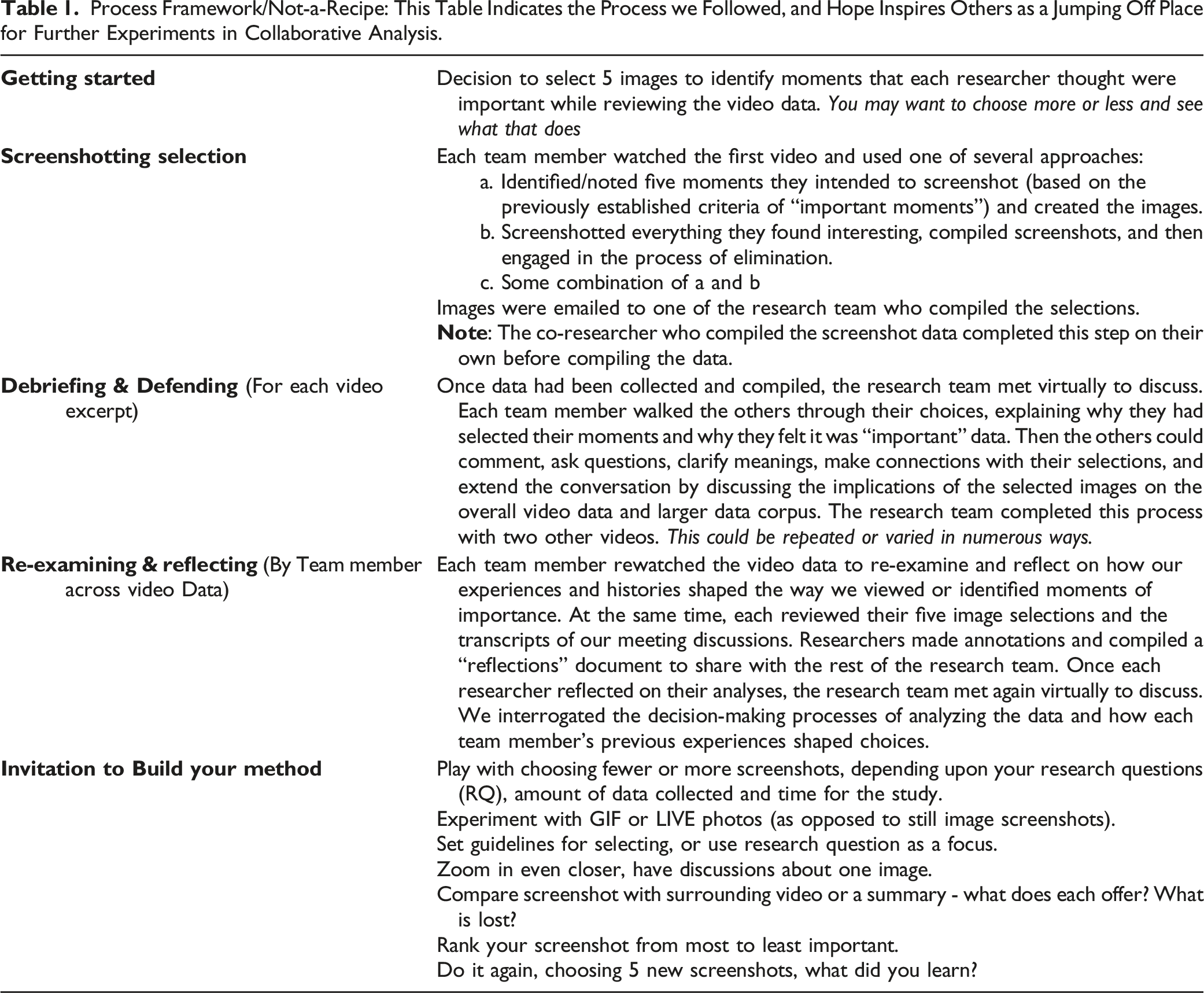
In conclusion, we hope that others will take up this kind of experimental, emergent collaborative analysis, not as a recipe or a formula to follow, but as a provocation to create your own ways of working with video data and to build analyses that embrace multiple perspectives and unfinished answers to the questions posed. The table above gives a starting point for other teams to who want to work across difference and value interpretations and subjectivities coming from diverse subjectivities. Beyond the process that we developed key tenets of respect, trust, taking time, repetition (re-viewing, re-discussing, re-visiting), and surfacing power relations. Beyond the method we explored, our research allowed us to think more deeply about children as learners and to examine closely pedagogical and research contexts in ways that researchers and educators may not often have.
Footnotes
Acknowledgements
The authors would like to thank the children and families who participated in this research. The work is indebted to them. Also, we would like to acknowledge Vithu Thambu-Kesevan who did some early transcription and analysis work and whose perspectives contributed to the work we later did together. We also wish to acknowledge the anonymous reviewers whose generosity and insight pushed our thinking and writing.
Declaration of Conflicting Interests
The author(s) declared no potential conflicts of interest with respect to the research, authorship, and/or publication of this article.
Funding
The author(s) disclosed receipt of the following financial support for the research, authorship, and/or publication of this article: This work was supported by Brock University grant from SJRI / EXPLORE.
