




Abstract
Arts-based research (ABR) provokes different ways of thinking about how art relates to knowledge in research. There are few authors, however, who explicate their view on aesthetics in the context of ABR and the type of knowledge that it generates. Accordingly, this article clarifies an aesthetic view in the context of a phenomenological approach to ABR. Ample arts-based researchers explore questions that touch upon the liminal nature and complexities of our lived experiences. Phenomenology is about that exactly: It leans into the unsayable dimensions of our reality and is interested in poetic and apophatic knowing. Apophatic knowing is a negating approach to understanding the unsayable, that is, a way of “nonknowing.” It can be practiced as a silent receptiveness. Consequently, we propose a Gadamerian approach to aesthetics that perceives ABR as an event. We argue for a poetics of research that is about being open and responsive to the movements of the artwork that ABR generates. Thus, by being receptive to movement, the enigma of phenomenality or life itself becomes the heart of ABR.
Keywords
There is a growing body of literature on arts-based research (ABR) approaches using performative play, poetry, graphic novels, painting, music, and dance that explore how arts-based approaches provoke questioning, foster understanding, and inspire to transform sociopolitical concerns (Bagley & Castro-Salazar, 2012; Barone & Eisner, 2012; Goopy & Kassan, 2019; Søndergaard & Reventlow, 2019). ABR also serves the purposes of private and therapeutic interests, such as learning about grief or trauma (Reilly, Lee, Laux, & Robitaille, 2018). In emancipative and critical research, ABR is used for pedagogical purposes and public issues, for example, to counteract inequality and social and epistemic injustice. Although terminology varies, generally, ABR approaches are defined as “research that uses the arts, in the broadest sense, to explore, understand, and represent human action and experience” (Savin-Baden & Wimpenny, 2014, p. 1). Both ABR and science involve the use of systematic experimentation with the goal of gaining knowledge about certain aspects of life (McNiff, 2008). Numerous approaches are grounded in postmodern, critical pedagogic, post-structuralist, and social constructivist paradigms that aim to transform everyday social practices through research (Savin-Baden & Wimpenny, 2014, p. 3).
The arts have also played an important role in phenomenological research (Cohenmiller, 2018; Gschwandtner, 2014). Although working with the arts in phenomenology has not been framed as ABR, phenomenological researchers engage with the arts in data collection and analysis and when communicating their insights (e.g., Finlay, 2009; Van Manen, 2014, 2016). However, we know of few examples of phenomenological researchers who approach an artistic practice itself as inquiry (one of the exceptions is Blumenfeld-Jones, 2015). In this article, we will propose a rethinking and deepening of a phenomenological approach to ABR because we have several concerns regarding the ABR field as it has unfolded to date.
Our concerns relate to the aesthetics that underpin ABR, including its relationship to knowledge. Although theorizing about knowledge and concepts is central to the doing of ABR (Sullivan, 2006, p. 31), rarely are the philosophical aesthetic underpinnings clarified in depth. For example, what do researchers mean when they speak of a relational aesthetics (Irwin & Springgay, 2008, p. 114)? And how do they view the medium like painting, photography, or drawing from a theoretical perspective?
Of course, there are exceptions, like Chilton (2013) and Bresler (2006), who explicitly articulate their philosophical view of aesthetics (they both favor a relational aesthetics connected to a caring attitude), but these examples are scarce. Although these authors voice their work through language that seems close to phenomenological research—Chilton (2013) speaks of “phenomenological soul knowings” (p. 470)—their approach is not explicitly underpinned by a phenomenological aesthetic.
Other authors also use discourse related to phenomenology, like “being open to phenomena,” “the extraordinary,” and “the sensuous openings” (Neilsen, 1998, p. 274). However, these terminologies are not clarified in the context of a phenomenological aesthetic. In addition, while some arts-based researchers view the artistic mediums as a means to represent a reality, others perceive the mediums as an emergent part of a praxis that do not represent a reality “out there,” but that present a reality. These different stances toward the medium point to distinct, but still rather implicit, theoretical departures worth exploring in depth.
A second concern relates to the critical and constructivist paradigms that accept that reality is socially constructed and can be known or deconstructed by social beings. In general, most arts-based researchers perceive knowledge as constructed through the extraction of information from respondents by inviting them to express their experiences through a medium (photography, drawing, collage). Here, the (re-)construction of lived experience flags. This contrasts, however, with the unintelligible, ineffable, or incomprehensible nature of the practice of ABR that some researchers have addressed as well (Eisner, 2008). We wonder whether ABR should search for a view on “knowing” that honors “that which we cannot know or express” by means of construction? How does the ineffability of the arts-based practice relate to the generally accepted view on ABR as a practice that “generates” knowledge and is constructivist and critical in its nature?
These questions sparked our reflection on the meaning of a phenomenological approach to ABR and aesthetics. In this article, we first take a close look at how ABR has evolved through the years and the four “turns” that can be distinguished in ABR. Subsequently, we argue for making a philosophical distinction between the approaches used in ABR.
On the one hand, we discern approaches that favor an ontic view of our world. Ontic stands for a relationship to the world featured by us using and mastering the factual world through concepts, methods, and skills or ideas. Here, research generates knowledge about the world to report on it.
On the other hand, we distinguish approaches based on an ontological stance to the world. Ontological indicates the poetic, mysterious, and unfathomable dimensions of art and research. Here, research generates knowledge about the world separate from our instrumental use of the factual world through concepts, methods, and skills or ideas. From there, this article presents a fifth turn: A poetic and apophatic 1 view of ABR that favors an approach to nonknowing. This view perceives the researcher as someone to whom something is given, who receives a call, is even surprised at hearing this call, becomes the response to what (s)he hears, and is given responsibility for its manifestation (Marion, 2002, p. 287). Ultimately, our article aims to build a philosophical ground for a phenomenological ABR and to balance sociological, feminist, political, and pedagogical approaches. We acknowledge the importance of these approaches but want to open a discussion on ABR as poetics and praxis based on ontological and phenomenological grounds.
Four Turns in ABR
During recent decades, ABR rapidly developed toward an interdisciplinary approach to research followed by scholars from a wide range of disciplines (e.g., Blumenfeld-Jones, 2015; Finley, 2003, 2015; Finley & Knowles, 1995; Gergen, 2014; Garorian, 2014; McNiff, 1998a, b; Sava & Nuutinen, 2003). 2 The literature marks four “turns” in ABR: the narrative, linguistic, nonlinguistic, and pragmatic turn. In general, these four turns favor an ontic approach to research because they aim to generate knowledge about the world to report on it.
The Narrative Turn
The field of qualitative inquiry became inclusive to artistic approaches with the emergence of the narrative turn (Bochner & Ellis, 1996; Polkinghorne, 1988; Riessman, 1993). Instead of assuming singular truths as captured and understood, researchers searched for ways to represent multipartial realities and meanings through narratives. In philosophy, this was named the postmodern or linguistic turn, in which the existence of grand narratives was contested. Consequently, qualitative researchers sought ways to represent data that respect partiality, incompleteness, and even contradictory findings. It was assumed that narratives provided more space for this than regular texts. During this turn, many researchers were inspired by the literary arts (Lieblich, 1988; Polkinghorne, 1988).
In the field of education and evaluation, researchers and evaluators were encouraged to focus on the arts, including poetry and prose (Eisner, 1991, 1998). Eisner stimulated his students to think through and within material that mediated their thinking (Eisner, 1997, p. 3).
The Nonlinguistic Turn
By putting materials at the center, Eisner was a precursor to the next turn, the nonlinguistic turn (Savin-Baden & Wimpenny, 2014, pp. 16–25). Besides narratives, other means to gather and represent research insights through different genres entered the field of qualitative research, like the use of painting and performance. This turn to the nonlinguistic was “practice epistemological” (Schön, 1984), as social scientists aimed to convey knowledge through new, sensory, and embodied means of expression, learning from “knowing-in-action,” or situated learning (Lave & Wenger, 1991). In the 2000s, hybrid forms emerged where the artist, researcher, and teacher became part of a community of “knowing, doing, and making” (Irwin, 2004; Irwin & Springgay, 2008). This practice was seen as a social interstice: relational art that “centers its attention to the whole of human relations and their social context, rather than an independent and private space of the studio” (Bourriaud, 1998, p. 113). During this turn, art in ABR became much more than a way to collect and represent data: Researchers reached out to large audiences with pedagogical and transformational purposes.
The Critical Turn
A third, critical turn (Savin-Baden & Wimpenny, 2014, pp. 16–25) occurred in the mid- and late 2000s, featured by opposing developments. On the one hand, researchers desired to develop rigorous approaches to ABR based on solid academic criteria, but on the other hand, others rejected structured methodologies. The latter group viewed ABR as an unfolding, fluid praxis that “leads to diverse forms of knowledge production, through novel artistic strategies, as the researcher and the researched are open to be changed by the creative, critical, and reflexive process” (Sullivan, 2006, as cited in Savin-Baden & Wimpenny, 2014, p. 23). Most researchers use mainstream methods of inquiry such as grounded theory, narrative inquiry, and action research, but they also draw from creative approaches in the arts (Denzin & Lincoln, 2005). Simultaneously, they value the uncertainty and playfulness of the creative process (Barone & Eisner, 2012; Leavy, 2009). In the context of this third turn, Denzin and Lincoln’s (2005) third SAGE Handbook of Qualitative Research was published, with a Handbook of Arts in Qualitative Research by Knowles and Cole (2008), Methods Meets Art (Leavy, 2009), and Barone and Eisner’s (2012) Arts-Based Research. These are just a few of the many publications on ABR as it unfolded.
The Transformative Turn
Parallel to and following the third turn, the fourth turn frames ABR as a third space methodology (O’Toole & Beckett, 2010) that stresses the transformative purpose of ABR even more. Researchers simultaneously investigate a topic and work on transformations or practice improvements. They argue that art offers the potential to disrupt, open up, and provoke or present a phenomenon in a dislocated form (Smith & Dean, 2009). The focus is examining and portraying the iterative relationships between the issue, the context, the researcher, and the participants through creative multidimensional work like the use of graphic novels (e.g., Sousanis, 2013).
Along these four turns, there are arts-based researchers who lean into a phenomenological approach, but who do not explicitly position themselves in a philosophical phenomenological field. For example, Smith and Dean’s (2009) “dislocated” the phenomenon that we mentioned previously. Alternatively, Sousanis (2013) argues that his comic drawings in the context of research aim to look afresh at a phenomenon, to “unflatten” it. McNiff (2008) addressed the need for ABR to be “responsive to the unexpected” and the importance of trusting the process (p. 39; 1998b). Here—although not clearly stated—he seems to lean into an ontological approach to the world, with space for the unfathomable dimensions of art and research. He is critical of researchers adopting rigid methods of inquiry; rather, he argues that insights should emerge from sustained reflections on phenomena (McNiff, 2008). This relates to what Neilsen (1998) wrote long ago about ABR: that it can help us to find “sensuous openings into new understandings, fresh concepts, wild possibilities…subvert the ordinary and see the extraordinary” (p. 274).
Again, these researchers do not explicitly discuss their work in the context of phenomenology (rather in the field of psychology). There are exceptions, like Blumenfeld-Jones (2015), who provides a phenomenological account of his ABR practice, following a combination of Husserl’s approach to consciousness and Van Manen’s (2008) phenomenology of practice (p. 3) or the movement researcher Karen Barbour (2011), who positions her work in the phenomenological tradition of Merleau-Ponty (Barbour, 2011, p. 88). Last, the work of Bresler (2006) should be mentioned here. Her “aesthetically based research” is grounded in the phenomenological hermeneutics of Gadamer (1960/1975), among others. Our article adds to their work by offering solid phenomenological grounds to the aesthetic underpinnings of their research.
A New Turn: From Knowing to the Praxis of Life Itself
To deepen our thinking about ABR, we begin by discussing four analytical movements (Hansen, 2018) that explore dimensions of thinking, perceiving, and experiencing in a research practice (see Figure 1). In his work on the phenomenology of wonder, Hansen (2010, 2014, 2015a, 2015b, 2018) presents several analytical movements to perceive different dimensions of our world. He builds on the world of philosophers like Gadamer (1960/1975), Heidegger (1975/1988), Levinas (1998), and Marion (2002), and how they look at the reality of existence. All these dimensions are simultaneously present in our experience of the world and can be visualized by concentric circles.

Four analytical movements (Hansen, 2018).
Ontic Language
The first dimension concerns our everyday existence and entails the empirical facts and observable reality of our world: the ontic dimension of reality (Heidegger, 1975/1988). The ontic dimension can be both individual and collective, but assumes that as researchers, we are able and concerned with controlling and explaining the world that we want to understand. In this dimension, we stand in an empowering, constructivist, and functionalist relation with the world and our concern or question. This dimension includes things and processes that we can know, see, talk about, and use as means, for example, for sociopolitical, psychological, performative, feminist, and pedagogical purposes.
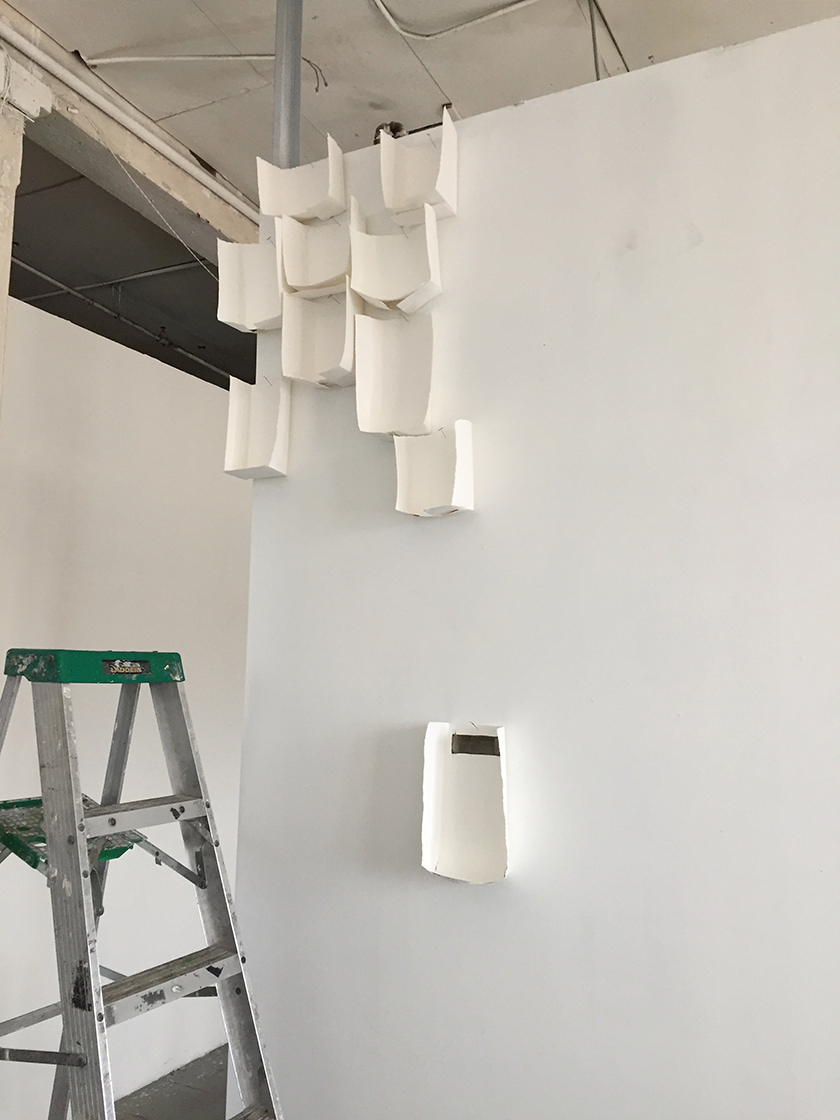
In the context of ABR, in the ontic dimension, knowledge is perceived as a concrete, fixed output, or part of an investigative, creative process. Propositional knowing (knowing that) and procedural knowing (knowing how) are supposed and these forms of knowing are intrinsically interwoven with material, experimental, and communicative spaces. This view on knowledge production uses artistic practice and art (in its broadest sense) to work toward insights, illuminations, transformations, or findings represented in images, performances, words, or through other mediums (Butterworth & Wildschut, 2009). It is accepted that understandings and insights can represent our ontic reality, like the synthesis of data, “out there,” either during or through performance or in art works. In the ontic dimension, art represents (parts of) our reality as a “report” or “Gestalt,” as is illustrated in the vignette below. The vignette is about an arts-based project of Merel, the first author. During the first months of 2018, I worked as an artist and scholar-in-residence at the NARS Foundation in Brooklyn, New York. My arts-based research focused on the topics of “precarity” and “precariousness” in situations of care. In my studio at NARS, I worked on several art works with paper, watercolor, ink, plastic and fiberglass and my artistic practice was informed by theory. I had meet-ups with fellow residents and critics. Every morning, with a cup of coffee, I sat down and read on the topic of precariousness. In the afternoons and evenings, I worked with my materials, had sessions with fellows and made walks. I consider the work, that is still unfinished, to be a layered dialogue between materials, people, ideas, spaces and experiences.
One morning, I find myself standing in my studio, pondering a bit. Hesitant, almost. I take a step back. Thick plain white paper, 300 grams, cold pressed. Dense smell. So enormous. The papers need an extra table. I forget the time. And suddenly it’s cold. Then: bright white pieces teared into unequal rectangles, folded on three sides. Careful. I only have ten slices this time. Expensive. It’s dark outside. Some pieces, filthy and a slightly messy now, are attached loosely, against the wall. Sculptural, almost. They surprise me. I have seen them before. Somewhere. Haven’t I?
For several days, studio visitors respond to the work in progress. One of them, a gallery owner, tells me that I have “definitely mastered the art of watercolor”. A critic is interested in my work on autoethnography and advises me to focus more on my social practice art. The psychoanalyst says: “You definitely cannot deny seeing the erogenous zones in these works. They seem formalistic but I don’t want to take psychology out”. This vignette is primarily a text where the “ontic voice” is heard. This is the language within which we explain, categorize, and see possible uses of and purposes for art and artwork. The ontic language is especially shown at the end of the text where art critics look at the artwork and give their opinions, interpretations, and explanations. In the ontic language, we talk and reflect about things or phenomena. In the next section, we will illustrate that in the ontological language we talk and reflect within and in resonance with the lived experience of the things or phenomena, the work of art.

Ontological Language
The next analytical movement introduces the ontological dimension of our language and thinking about the world (Hansen, 2018). An ontological dimension includes general, universal, and existential dimensions of life. Where the ontic language can be represented as the “report” about a specific phenomenon under study, expressed through an artwork, the ontological language favors a “poetic” discourse. 2 This existential realm is about learning to know through or from the lived experiences of what it means to be human. Poetic and phenomenological discourse is more fitting here than evidence-based scientific discourses (Hirshfield 1997/1998; Taylor, 1998; Ucok-Sayrak, 2017).
Experiences in the ontological realm are hard to grasp, and we need to develop ways to illuminate experiences of our existence in another way than in the ontic dimension like the use of poetry, music, and painting. This ontological, poetic language is not technical or scientific or pragmatic but is an existentially driven and phenomenological language that answers questions like: What is it like to experience….? 3 It is a “truth experience” as the German philosopher Gadamer (1960/1975) has described it, and only the language and experience of art and philosophy (or myth, religion and spiritual wisdom traditions), and not scientific methods and epistemologies are able to open up to this ontological “being dimension”.
The ontological realm and ontological language include attention for our lived experiences of space, time, our body, our mood, and materiality (Van Manen, 2014). Existential phenomenology, a particular strand of phenomenology, focuses on these “existentials” to capture the lived experiences of our everyday reality through processes of intense writing “for ambiguity” (Van Manen, 2016) as it is assumed that reality can never be fully captured. Language creates spaces or small “lagunas” in language, which point beyond language. These “rabbit holes” in language open up to wonder and to the unrepresentable (Van Manen, 2014, p. 369). This relates to the apophatic traditions of philosophers, theologians, and artists in Western history who share a longing and reverence for “the unsayable” of a deeper meaningfulness which only in indirect, negating and unexpected ways can emanate (Franke, 2007a, b, 2014; Rhodes, 2012).
To illustrate this kind of “existential presence” for the unsayable in language and in doing art and ABR, which is not connected to the “ontic” but to the “ontological” dimension, let us show another example from the ABR practice of Merel.
Below, we present a short description of a lived experience that somehow spoke to Merel. This experience did not speak as a self-reflective voice, but as an inspiring mood or reverberation from “being-in-the-world” when she walked along the Green-World Cemetery in Brooklyn.


I walk along the Green-Wood Cemetery, just around the corner of my studio. Rythm, Silence, Death. Back in, I talk with the work. There is silence, chatter and struggle and fun. I cannot find the words though. I don’t know how to turn what I hear into words.
How do we listen to that, which wants to be expressed in our research but is not (yet) in the domain either of the ontic or ontological language? How do we listen to the silence and the impulse or “life utterance” (Løgstrup, 1956) before it hits the coastline of human language?
Prelinguistic Being
A third analytical movement of Hansen (2018) can support us here: the prelinguistic realm, which is of special meaning to the field of ABR. Here, the attention moves to unknowing as a silent, passive reception. This is in contrast with the kind of attitude that we previously described and that acknowledges the limits of what can be put into words and what we can know.
As we mentioned in the previous paragraph on ontic and ontological language, dimensions of our experience like mood, time, and space, or ethical and existential life phenomena like love, hope, joy, loneliness, and inner peace are hard to grasp. To approach these existential and ethical dimensions through verbal means indirectly is a challenge as well. As is the case in the ontic and ontological realms, aiming to grasp a phenomenon directly or indirectly is still concerned with the desire to know or with the process of knowing. In the prelinguistic realm, however we leave the need to grasp or capture a phenomenon behind. We move from knowing or comprehending to being with a phenomenon. No longer are we listening to the conscious insights that a person “has” or can “acquire,” nor to intentional expressions through ontic language. Instead, we are in a state of nonknowing that is like seeing with the heart. In a subtle but significant way this differs from the process of knowing in the ontological realm.
Being in this third realm is especially relevant for the field of ABR, as within this realm, the researcher does not grasp for the expression of a work directly anymore. Here, a deep sense of not knowing, an apophatic unknowing is present (Franke, 2014; Rhodes, 2012). Being in this realm will always be driven by negation and an indirect silence pointing to that which we cannot (in ontic and ontological ways) speak of. In other words, whereas “kataphatic knowing” prevails, that is, a positive confirmation of that, which the ontic language cannot talk about, the apophatic unknowing prevails only negative or indirect pointing to that (the Mystery) that neither the ontic nor the ontological language can reach.
Praxis/Event
If we follow Levinas (1998) and Marion (2002), we might also describe the move from ontological language to this saturated silence as a move from the ontological dimension to a preontological dimension. At least, we would do so when we are, so to speak, “taken” by the phenomena itself, by what Marion calls the “Saturated Phenomenon.” Then, we are moving toward the final border between prelinguistic being and the grand mystery and event of life itself.
Art expressions in apophatic sense are therefore seen as “pointers” toward that, which we can never fully know or linguistically express, maybe not even through the so-called existentials (Heidegger, 1975/1988). It—the enigmatic phenomenon—can never fully be disclosed, but we can “lean into it” indirectly and negatively (by addressing what it is not) through negation and a “poetics of the unsayable” (Franke, 2014; Marion, 2002; Rhodes, 2012).
Here, our attentiveness and gaze move toward receiving a phenomenon or insight passively in silence, which someone can be open toward by being in a listening and dialogical relationship to the world around him or her and others who are part of that world.


I am with the pieces. I am listening. I hear something, again. Yesterday, Powell visited my studio, she seemed to ‘hear’ it too. I don’t know if she really heard it, but she did something with the work. It was like this: for a while, we stand next to each other, following each other’s gaze in silence. She picks up a piece and turns it around. I now know it needed this. I didn’t know that before. she didn’t know it either, but she did what was right, because it needed it.
Some speak of apophatic insights that “occur” through wonder (Fink, 1983; Hansen, 2010, 2018; Rubenstein, 2011), or being in a saturated silence (Picard, 1952), or being open to enter a dialogue with the artistic work (Davey, 2013), or in an I-Thou-relation with the world (Buber, 2004/1923; Bresler, 2006), or, from an ethical perspective, in the moments of seeing the face of the other (Levinas, 1998).
These different articulations share a vision on knowing and nonknowing or being and nonbeing (being-yet-to-come) as intrinsically intertwined. In this, “in-between-ness” or dialogue insights are no longer produced but received, gifted to someone through indirectness, silence, and being in wonder. Here, the researcher (the searcher, the “saying,” the Thou) and work (the “known,” the “said,” the It) are not separated in a subjective and objective dichotomy (inside–outside) but are entangled as in a chiasm (Merleau-Ponty, 1968).
The meaning emanating from an artistic expression is not something that represents or communicates intentionally. Instead, it is received and lived as an event that happens to a receiving person. The work is a personal response to a call, The responsal is the first response of the gifted, but “nothing like an optional act, an arbitrary choice, or a chance”, for the call is not pulled into a subject’s horizon but rather the gifted (the one to whom has been given) lets the call speak, lets the call phenomenalize. (Marion, 2002, p. 288—as discussed by Nistelrooij & Visse, 2018)
This receiving and responding to that which is received cannot occur when the researcher is closed, inclined to categorize or capture “something” out there through language or any other medium in an objective and neutral way. On the contrary, this is an endeavor that asks for a radical opening up. It demands for the researcher to detach from worldly (ontic) concerns in order to become as (ontologically) open and responsive to life as such and to the call of the unknown.
This is what Hansen (2018) names the last analytical movement, the praxis or event of life as such. It is based or called forth by the experience of the phenomenon in question as being a mystery (Marcel, 1950; Rhodes, 2012). Our analysis is then no longer only directed towards solving problems of the world by our ABR, but on relating to them by “living our questions” (Rilke, 2011, p. 46) through our practice, acknowledging their mysterious nature: A problem is something which I meet, which I find completely before me, but which I can therefore lay siege to and reduce. But a mystery is something in which I am myself involved, and it can therefore only be thought of as a sphere where the distinction between what is in me and what is before me loses its meaning and initial validity. (Marcel, 1950, p. 117)
The Apophatic Turn and Poetics
This is the philosophical background for understanding what we call the fifth “apophatic turn,” when working with ABR. It is occupied with the experience of this mystery and what happens if we embrace the mysterious nature of our practice and the phenomenon that it leans toward. This is an undertaking where an apophatic unknowing and maybe even an epiphany prevails (Marion, 2002) because we experience a phenomenon through reverence, awe, and wonder. This requires a particular kind of openness and self-forgetting that can lead to the birth of a phenomenon as if one sees the phenomenon for the first time (Hansen, 2010, 2015a, 2015b; Løgstrup, 1956; Marion, 2002). The midst of February, six weeks into my residency. During a Skype call, Finn (2nd author) mentions that researchers should ‘live the questions’ and he refers to Rilke. What would it be like: to be precarious? I wonder, thinking about my main question in my current art practice. Just minutes later, that same Skype call is cut short by my cell, ringing. I hear my sister telling me, with an unfamiliar, small voice, that my father collapsed and ended up in the hospital. His body caught up to him after all. It’s just a matter of time now, I hear her say far away, because my heart bounces too loud, my stomach turns inside out, and my hands begin to shake. It puts me on the edge. Again.
Uneasily and slowly, in the months following my residency, I become aware of how little I know about being precarious. Because for the next few months, seeing the severity of my father’s illness, I would learn more about what being precarious is like. These events reminded me (Merel) of how our understanding occurs to us beyond our willing and doing. Our understanding is not passive nor active. My ABR is not solely about an ontic grasping of reality, about things in the world as we see them. Art does not represent the things themselves, nor phenomena, and my research practice is not only about what is visible. What makes my art, art is not the form of phenomena, but the very manifestation of their appearance as such, and therefore of life itself.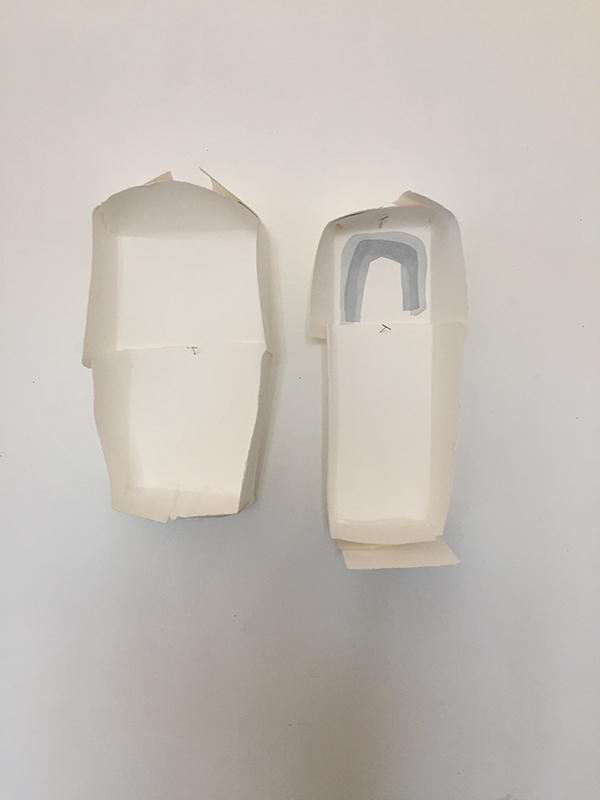
In ABR, seeing the phenomenon for the first time may occur when one is in a dialogical relationship with the work during a poetic and philosophical praxis (Hansen 2015; Hadot, 1995). Praxis denotes a particular way of action that is not instrumental, teleological nor intellectual (that is, mean- and goal-oriented: this action leads to that outcome) but is an activity for the sake of itself. A praxis is informed and embedded in the traditions of action, reflection, and dialogue. From this, ABR is no longer perceived as a methodological practice to produce a work of art or “knowledge” as an outcome (an It as an object) but as a praxis of research that is sensitive and open for a work and insights to emanate (a Thou, cf. Buber, 2004/1923; see also Hansen, 2014, 2018).
In this praxis, we have noticed that the work or understanding may emanate when the researcher practices a particular kind of ethical care for the self and the soul that is characterized by detachment from ontic interests in the world and moves toward an existential and ontological care for the world (Arendt, 1978). In the latter, we experience a nonintentional, self-forgetting, receiving, and caring praxis and attitude toward the other and life as such (Hansen, 2018; Foucault, 1988; Løgstrup, 1956; Patocka, 2002). We dub this view on ABR as a praxis of an apophatic poetics. 4
To sum up, the four dimensions in this apophatic poetics can be displayed in Table 1:
Analytical Movements of Different Dimensions of Our World.

We now turn to a view of aesthetics that is open to these views on knowing, unknowing, and being. In ABR, a wide range of mediums is used, like drawing, photography, collage, and painting. We argue that working with and through, as well as being with these mediums is not only about representation certain aspects of reality in order to develop knowledge or insights (ontic), but it is inclusive of a wider range of prelinguistic expressions as well. What occurs when aesthetic theory includes these prelinguistic and praxis dimensions in its view?
A Dialogical Aesthetic
The field of aesthetics is concerned with the theory and practice of art. Hans-Georg Gadamer was a German philosopher who distanced himself from theories on aesthetics, because he believed they approached the arts too rigidly. Instead, he developed a “poetics of aesthetics” that sees art as experience and event and that attends to the movements of an artwork (Arthos, 2013; Davey, 2013). In his view of aesthetics, he is not interested in art’s pleasure or beauty (a work’s aesthetic properties) but in how art is a partner in conversation. This is about being phenomenologically involved in an artwork, resonating with it, receiving it, and being transformed by it. To him, the experience of art is when a phenomenon speaks to us through the artwork. Gadamer asserts this is the event of art: unfinished, forever ongoing (Davey, 2013, p. 11). The phenomenon befalls us repeatedly. It appears and claims us, one might say, irrespective of what we want or do. We are vulnerable to art’s address because our experience of our world and ourselves is unfinished (p. 18). We sense in our encounter with an artwork a transcendence or surplus of meaning that we cannot grasp but only wonder at.
To Gadamer, art is relational and dialogical. This means a work is not a distant object, an It for our cognitive I, but relational and dialogical. When we are genuinely dialoguing with an artwork, it becomes a Thou or, better, a medium for the Thou of the phenomenon, of which the artwork is a living, meaningful expression. Contemplating art and the artistic process is no longer a passive undertaking but is carried out by two movements—a spectator approach and a participant approach—in bringing forth what a work can disclose (Davey, 2013, p. 1).
The movements are an ongoing, recursive interplay between what a work expresses, asserts, or states (X) and what comes to expression in it (Y). These two movements can be seen as a methodological, cognitive movement (X) and a spontaneous, speculative 5 movement (Y). Movements arise within a broader context (historical, relational, spatial, temporal) of a work. Importantly, what the artwork expresses and gives form to, indeed, also results from something that emanates through the encounter and dialogues with the phenomenon itself (Z).
Thus, there are three movements to consider. The first (X) concerns what Gadamer sees as the cognitive and methodological part of an artistic process. Here, the focus is understanding the ontic dimension of artistic expressions and statements. The second movement (Y) concerns the fact that, during this cognitive, systematic artistic process, spontaneous insights (both ontic and ontological) may occur that the participating and involved researcher (or spectator) did not plan but are given to experience. This gift occurs because the researcher belongs to a context, history, and tradition of language (written, spoken, or visual). However, this gift is to be found in the encounter, resonance, and dialogue with the phenomenon on a precontextual and preontological process level (Z).
Hence, the researcher may experience the ABR process as something surpassing him or her because artistic expression can have a “centrifugal force”: It pushes toward wider frameworks where the colour, media, images, or words are placeholders for plural meanings and wonders the researcher did not intend or see. There is the “text” (the artwork itself) and “context” (history and tradition of language, be it written, spoken, or visual), besides the die Sache selbst, or phenomenon itself that the text wants to express. Again, this expression is colored by context. Thus, an artwork may promise more (Y) than it discloses (X). It withholds from the spectator and makes the presence of that absence felt (Davey, 2013, p. 15). 6
The two movements (X + Y) are not opposites, but two levels in interplay, closely entwined like they reflect each other (Davey, 2016, p. 7). In addition, they “[are] something larger than itself and, indeed, reflects (speculum) that larger actuality within itself” (Davey, online source, 2016). However, between these two movements, a third “term” or movement emerges that reveals itself as the transformation of what the exchange between these movements has left behind (Z). This interplay between (X) and (Y) “opens a space between the ‘once understood’ and the ‘now understood’” (Davey, 2013, p. 13).
Another phenomenologist, Merleau-Ponty, articulated this process of exchange with a context when reading a book: I start to read a book idly, giving it hardly any thought; and suddenly, a few words move me, the fire catches, my thoughts are ablaze, there is nothing in the book which I can overlook, and the fire feeds off everything I have ever read. I am receiving and giving in the same gesture. I have given my knowledge of the language; I have brought along what I already know about the meaning of the words, the phrases, and the syntax. I have also contributed my whole experience of others and everyday events, with all the questions it left in me—the situations left open and unsettled, as well as those with whose ordinary resolution I am all too familiar. (Merleau-Ponty, cited by Arthos, 2013, pp. 4413–4419)
Art as Interlocutor of Mystery
According to Davey (2016; https://plato.stanford.edu/entries/gadamer-aesthetics/), Gadamer views art as an interlocutor of the mystery of the given and its unfolding meanings. However, Gadamer did not explicitly address a prelinguistic or praxis realm where this originates.
7
He does seem to leave the possibility open, though. Davey argues that Gadamer sees the given primarily as an advent, an arrival: …the “event” of Being (the event which is the artwork) [as] an advent—a bringing forth of a complex of meaningfulness which is never reducible to its elements. Hence, the hermeneutic adventure begins—the constant, repeated, and endless attempt to unravel what such profound “events” (the unexpected we surrender to) point to, intimate, suggest, or light up. (personal correspondence of first author with Davey)
From this Gadamerian aesthetic, the meaningfulness of a phenomenon, which the artwork presents/shows indirectly, is primarily found in this “part-whole-relationship” between the work and its context and, indeed, the encounter and dialogue with the phenomenon itself, which can be found in the prelinguistic realm. To us, based on an interview of Zimmerman with Gadamer in 2002, both work and context (the interpretation of a work) are pointers to meaningfulness on a prelinguistic, preontological level, which is the Thou or Mystery of a phenomenon we addressed in the previous section. An artwork always has an eminent quality: It holds something of the mysterious: “a transcendence that constitutes an ultimate barrier to any totalizing understanding” (Zimmerman on Gadamer, 2002, p. 205). The arts, according to Gadamer, touch upon the transcendent when they point toward something outside themselves: A work of art belongs so closely to what is related to it that it enriches the being of that as if through a new event of being. To be fixed in a picture, addressed in a poem…are not incidental and remote from what the thing essentially is; they are presentations of the essence itself. (Gadamer, 1960/1975, p. 141)
What Gadamer calls what the thing essentially is, we have (inspired also by Marion) called the phenomenon in itself. In ABR, this “essence” or “original phenomenon” is maybe most vivid and visible in performing and social practice–based projects because it is through the occasion or event of performing that the work manifests itself. Even then, the truth of an artwork is not its manifestation of meaning; however, we can never fully understand it because of its unfathomableness and depth of meaning (Davey, 2016). Like Gadamer, we are also concerned with the experience of transcendence as a kind of signal of something above (a surplus), that is, the limits of knowledge (Zimmermann, 2002).
Figure 2 visualizes our argument on the aesthetic interplay regarding the prelinguistic realm. On the left and right (yellow) is Gadamer’s double interplay of what a work (like an artistic work or a research project) expresses and what comes to expression in it. The spiral movement in the middle (blue) symbolizes their recursivity and intertwinedness with a prelinguistic realm that we can never fully know. If arts-based researchers would analyze the interplay between the work (i.e., artistic expression) and context solely from a cognitive (X) and contextual (partly Y) stance, without connecting to a prelinguistic realm (the phenomenon itself), they would miss the connection with the phenomenon (Z) the work leans into. Only if researchers are grasped by a personal, genuine wonder about the subject matter (what they are trying to express) is there an insightful “pointing” or “leaning toward”. ABR becomes like a dance: a means of keeping movement between these horizons of meaning in play and open because that might foster new (though always temporary) understandings. Thus, our understandings are dynamic and fluid—“opened up” continuously–by new experiences because of our deep and ongoing relationship to life itself.

The interplay and emergence of meaningfulness.
Consequently, Gadamer’s aesthetics rejects the idea of representation (Vorstellung) and that the artwork can represent a “pure integration of meaning”. It is, therefore, impossible to reduce the work into a single concept (Palmer, 2001, p. 25) or final understanding. Instead, the work is the event of meaning’s “coming into appearance”. We want to emphasize that, for Gadamer, the work is an Ereignis—an event that “appropriates us” (Davey, 2013, p. 46) to itself. Hence, as the German poet Rainer Marie Rilke says (2011, p. 46) we “live the question”, that is, live in the phenomenon, be part of it, and present there in an open, listening, wondrous way (Hansen, 2008, 2010, 2015, 2018). Then, we should be able to see or hear “the salient pointing” of the saturated phenomenon (cf. Marion, 2002).
Conclusion
To be in dialogue with the phenomenon, with that which arts-based researchers within the study express through their work, they must try to live a life that best allows the phenomenon to speak by and from itself (cf. Marion, 2002). Otherwise the phenomenon cannot be received. This does not require that we be active and intentionally interacting with the work, as when we are “in-the-making” or constructive mode. Activeness and participation in Gadamer’s sense is more like a dance as we illustrated; it is not something we construct primarily in the sensory, ontic realm. We are grasped by a calling to create or by a call on the work to appear. This can also be seen as a “re-enchanting process” of the world (Dreyfus & Kelly, 2011), which the researcher of the fifth turn in ABR tries, we propose, to live out.
In other words, ABR in the fifth turn is understood as a praxis of relating to “that which we cannot know about but are called by”. We saw that, to open up for these mysteries and this kind of phenomenological sensitivity, we must not only follow a cognitive logic, but indeed also and primarily a “poetic logic”. Poetic (kataphatic) knowing (Taylor, 1998) and apophatic nonknowing (Franke, 2014) are receptive and indirect, open to what we do not know, rather than imposing knowing (Ucok-Sayrak, 2017, p. 307). Practically, one is, as we say, living the question through the research process and medium (paper, video, performance, data collection, and analysis) by surrendering to it. The research that emerges becomes an event that “appropriates us” to itself. We prefer to speak of a praxis of poetics for ABR concerned with life as such. 8
Footnotes
Acknowledgments
The authors would like to thank the University of Humanistic Studies for funding the residency of the first author by a Dutch Aspasia-NWO grant for female scholars.
Declaration of Conflicting Interests
The author(s) declared no potential conflicts of interest with respect to the research, authorship, and/or publication of this article.
Funding
The author(s) disclosed receipt of the following financial support for the research, authorship, and/or publication of this article: The authors are thankful for receiving funding by the University of Humanistic Studies to that supported the residency of the first author as well as the publication costs of this article.
