




Abstract
This article introduces the Rug Methodology to enhance participation in the qualitative research process. The idea of using rugs to facilitate narratives and expression, and to build reciprocity and activate reflexivity and meaning-making, grew out of a peer-to-peer debate between the authors of this paper on a qualitative research approach for weaving rugs, inventive methods for community action, and drawing as a reflective practice. The article describes the procedure of drawing rugs to encourage people participation. Rugs are everyday objects but they can become a qualitative tool that can be used with in-depth interviews, amplifying the opportunity of collecting participants’ lived experiences, emotions, reflections, and desires. The paper aims to define a framework which connects “to-do activities” with dialogical practices in research and to describe strengths and limitations of drawings rugs in a qualitative research design. Drawings, life events, and stories from the field are described and discussed, showing how everyday objects such as rugs can support expression, participation, reflexivity, and how drawing rugs is suitable for various and vulnerable targets and settings in qualitative studies. Finally, the paper describes the challenges of analysing data from drawings to illustrate lived experiences related to people who stay in rural areas and how they learnt to generate their quality of life.
Introduction
In this article, we discuss the use of drawings of rugs as qualitative tools. Inventive methods integrate sensitive and everyday objects into research practice where participants are active and involved in “to-do” activities. This kind of research can be defined as a dialogical practice with participants, and it can use several tools to activate the relationship researcher/participant: performance, storytelling, photo elicitation, objects from the cultural heritage, lived experiences, narratives, art-based products. The present paper describes a way to adapt and connect methods from social sciences (narratives, drawings, interviews) with objects from fields which are usually external to research: rugs. Creative methods usually connect distinctive studies and disciplinary borders (social sciences and education; qualitative tools and everyday pieces; knowledge building in research or in learning environments). The aim is to enhance participation, be inclusive, stimulate reflection (Mortari, 2015), open discussions, and collect data on interesting topics to the research design. Accordingly, we make explicit the lens through which the authors made choices, and thematized strengths and weakness, and we will illustrate and discuss the contribution that the Rug Methodology makes to qualitative studies by mixing Antonovsky’s model of quality of life and resources generation, drawings, interviewing and the art of weaving (Antonovsky, 1987; Guillemin, 2004; Kearney & Hyle, 2004; Martikainen & Hakoköngäs, 2022; Tachine & Nicolazzo, 2022; Theron et al., 2011).
Consequently, we will describe an example finalised to explore how people, who are living in rural areas, are coping with life events, and how they mobilize or use resources for better health and well-being.
Well-being, quality of life and human relationships are complex as well as generative areas for knowledge building (Antonovsky, 1987). They require inclusive, participatory, and creative methods that can be used to investigate the making of meaning by capturing data flexible with dynamic systems, power relations, and the emotional and latent aspects of human experience (Daniels, 2003; Finley, 2005, 2011; Garista et al., 2019). Art-based inquiry offers theoretical principles to such an aspiration. “Critical arts-based inquiry is the performance of revolutionary pedagogy to advance social justice […] Arts-based research is a multimodal, cross-disciplinary, trans-disciplinary, and multidisciplinary methodology. Despite being somewhat dominated by poetry and ethnodrama in recent years, arts-based researchers are not limited by genre, and examples of arts-based research include music, drama and dance performances, visual arts (collage, paintings, photographs, sculptures, and installations), and narratives, be they fiction or creative nonfiction, short stories or novels, and include narrative and nonnarrative, metaphorical film documentary, and factumentary” (Finley, 2003, p. 285). As we reported elsewhere (Garista et al., 2019), Finley argues that “in educational inquiry, there is a tangible need to utilize a variety of methods through which the educational world may be understood, evaluated and interpreted. Arts-based research provides an opportunity to link the ‘physical dimension to cognition’ “(Finley, 2005, p. 686). In addition to the methods listed by Finley, rugs exemplify a combination of drawing and weaving, mixing ancient human languages with traditional knowledge of people living in several countries of the world, from western Europe to Americas. The Rug Methodology is useful when choosing methods to involve and include people when research questions seek to understand how they cope with life events. It is a guide when choosing which type of data collection and analysis methods to use on the research roadmap. Put succinctly, the Rug Methodology underpins the theoretical rationale, as well as the prism through which we storicized, created and considered our analysis (Denzin & Lincoln, 2000, 2018; Turner, 2003). The Rug Methodology offers a framework to explore and collect how people feel, think and create their personal way to a life path: coping negative and positive events, learning by experience, recognizing and mobilizing resources, meaning-making, human-nature relationship, and well-being (Lindström & Eriksson, 2011).
The story behind Rug Methodology is founded in our autobiography of the question (Burke, 2005; Mortari, 2015; Theron et al., 2011). Penny Burke (2005), opened this focus of reflection on knowledge-production: the importance of starting from oneself and one’s own history, becoming witnesses and processors of knowledge that are not abstracted from people and their contexts, but historicized in the times and spaces from which they are generated. According to Burke, starting from that source of interest, we should move by mapping the meaning we attribute to that specific question/interest, to the spark that aroused it, to arrive at the broader meanings of attention that a wider audience (institutes, literature, the investigated reality), which addresses the same theme. If Theron et al. (2011), introducing their book on “picturing research”, started by narrating their autobiography of the question about the use of drawing in qualitative research, the story behind this paper is grounded in creative activities proposed during a summer school lesson entitled “Lost and found in translation” (Vaandrager et al., 2022), during which disciplines, borders, creative tools and lived experiences were shared and problematised, using critical education theories, a salutogenic perspective, languages, literacies and visual literacy (Garista et al., 2019). A drawing activity was proposed to imagine a concept. Among those drawings there were rugs and they were illustrated as a methodology within a research design. Drawing pedagogies met the drawings of Rugs as a qualitative way to stimulate discussion and reflection, and to explore the human kind and their journey (Annamma, 2017).
Leading questions emerged. May Rugs function as drawings in qualitative research (Guillemin, 2004; Martikainen & Hakoköngäs, 2022; Tachine & Nicolazzo, 2022)? How can researchers analyze compositions and narratives about them (Bodman, 2019; Guillemin, 2004; Rose, 2008)? What is their added value in qualitative studies? Are Rugs and their drawings inclusive tools? These research questions moved from a case study to define a more generalist application of rugs in qualitative research (Guillemin, 2004; Kovach, 2021; Martikainen & Hakoköngäs, 2022; Tachine & Nicolazzo, 2022).
Moving From a Drawing Pedagogy to a Weaving Methodology
During the last decades qualitative research has been invested by a creative wave (Scheller, 2015) opening to multiple tools and methods. They are defined as creative (Gauntlett, 2007; Manney, 2016); inventive (Lury & Wakeford, 2012); art-based (Finley, 2005; Leavy, 2013) and sensorial (Pink, 2012). Drawings are part of art-based methods, they can contribute to the construction of knowledge through their ability to represent thoughts and emotions throughout the course of life (Brady, 2004). Drawings are often limited to the world of childhood. In fact, as the school cycle carries on until adulthood, drawings are gradually replaced by writing. Yet “the experience of drawing can be rediscovered as an arto-graphic memory of an educational world, a communication tool capable of exploring the imaginative processes in knowledge-building, of meaning-making, of grasping flexible and complex dynamics of living systems, of power relations, but also of emotional and latent aspects of life-deep learning” (Garista, 2023; Merleau-Ponty, 1992).
In his writings the French philosopher Merleau-Ponty (1992) argued how painting and drawing constitutes an activity capable of making visible the “phenomenon”. For Merleau-Ponty (1992) art is one of the many ways of living the human experience in the world and a way to reveal the invisible genesis of things, their phenomenology. He invites us to consider art as a journey from experience to expression. “Painting, for Merleau-Ponty, is therefore a primordial experience, an activity that people perform before reflection, or rather a pre-reflective experience during which a purely subjective self and an objective world do not exist. Consequently, arto-graphic activities function as a pre-reflexive exercise to stimulate critical thinking, reflection and the creation of meanings” (Garista, 2023).
The drawing process encourages us to experience the in-between (Caronia, 2018). It is an invitation to explore intersectionality in the creative process (Annamma, 2017), research and teaching through the production of images. Space and time of the in-between are vital to transformative practices. The in-between offers a place for reflection on identities and the humankind. Researching the in-between means being able to imagine and capture the connections between what is manifest or latent, the object and the subject, the visible and the invisible, the individual, and the community (Caronia, 2018).
Drawings reveal the hidden aspects of human experience or unknown abilities. Therefore, drawings can stimulate the creation of a balance between the rational and sensual dimensions in knowledge-building. Kearney and Hyle (2004) highlight the emotional dimensions of drawing by making them visible. A useful definition from the literature on the potential of drawing states that “drawings offer a different kind of glimpse into human sense-making than do written or spoken texts, because they can express phenomena that are not easily put into words: the ineffable, the elusive, the not-yet-thought-through, the subconscious” (Weber & Mitchell, 1996, p. 304).
Drawings bring an added value to knowledge-building both in learning environments (Daniels, 2003) and in a qualitative research setting (Martikainen & Hakoköngäs, 2022). Drawing could be proposed as a general task (draw a metaphor, a scenario, a process, yourself) (Guillemin, 2004; Theron et al., 2011). Drawing as a creative method in qualitative studies can meet the weaving process described in Indigenous research (Kovach, 2021; Tachine, 2018; Tachine & Nicolazzo, 2022).
The Rug Metaphor
Our background in salutogenic thinking enables us to recognize salutogenesis as a personal way of thinking, being and acting during the life course. “It involves all senses of human nature that contribute to understanding, communicating and engaging in the everyday experience of life. If we consider all the components of human nature from a holistic perspective of learning, we should ask whether spoken or written words are sufficient to describe the salutogenic process or whether this type of experience can be enriched with other types of communication tools (visual), such as drawings” (Garista et al., 2019, p. 862).
Drawings are images both to interpret and to create. As Riley states when referring to human communication, “our relationship to the surrounding world is made possible through our special organs that enable us to sense experiences such as seeing, hearing, touching, tasting, smelling” (Riley, 2004, p. 296). This is what happens in Antonovsky’s model by describing the process of overcoming adversities through all senses of human nature (Bodman, 2019). Starting from these assumptions, we can say that people have the skills to build their own knowledge of themselves, of the world, of their relationship with well-being, life, and nature, when they can actively participate with all their senses. That is when they are able to analyze and solve problems and identify and use the different tools to communicate, verbalize, visualize, symbolize and move our bodies (Riley, 2002, 2004). In inclusive and salutogenic words, we learn and build new knowledge when we recognize, and use, all the resources we have to communicate and process information” (Garista et al., 2019, p. 861). But what distinguishes rug drawings from other art-based methodologies? (Ball & Smith, 1992). Qualitative research, on health and disease issues as well as on other dimension of life, has already demonstrated the power of drawings in expressing the understanding of human experience (on an individual and social level) (Davis, 2021; Denzin & Lincoln, 2000; Guillemin, 2004; Lehmann & Brinkmann, 2021; Martikainen & Hakoköngäs, 2022; Tachine & Nicolazzo, 2022; Theron et al., 2011).
If drawings are viewed as expressive methods (Kearney & Hyle, 2004) to show emotions, hidden aspects, learning, and knowledge-building, then the implication of the rug metaphor is that human life can be explained in a rug (Figure 1) (Bodman, 2017, 2019). Interpreting the Rug timeline means to think that humans start to weave their rugs when they are born, and they continue to do so until death. How the person weaves the rug and with which colours is unique to each individual. Our daily lives are full of stressors (the rug warp), that we are exposed to and that lead to tension (the clamping iron). Depending on tensions in the moment, the setting and the person’s feeling, there will be a stripe in the rug. Moreover, depending on how long a person is in that state of tension, or perceive themselves to be in that state, the stripe may be wide or narrow or have a dark or a light colour. A woven rug as a timeline.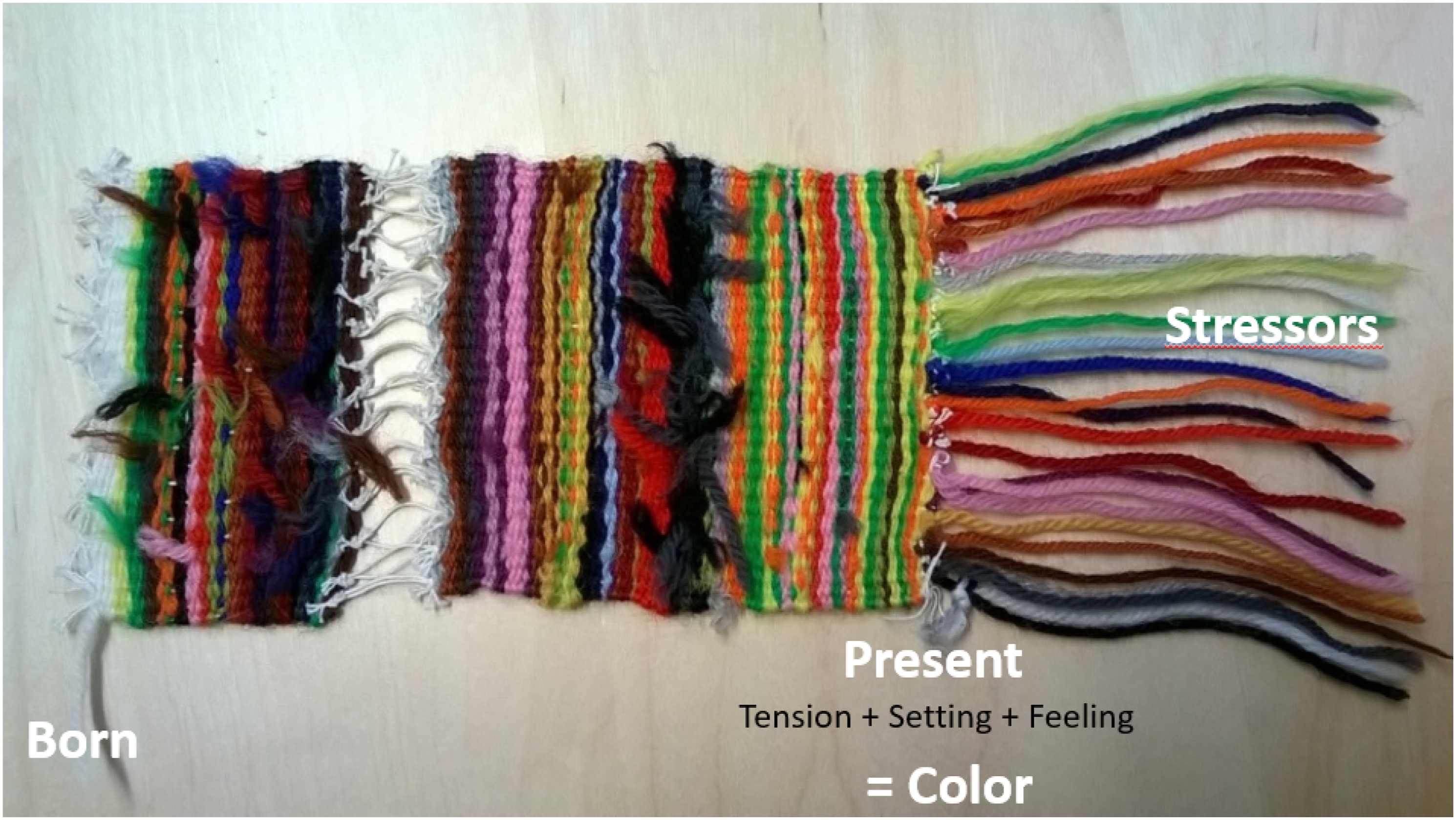
The Rug Methodology
The Rug Methodology (RM) is a qualitative methodology (Bodman, 2017, 2019) to design a salutogenic oriented research study, based on different tools capable of including people through “to-do activities”. We will exemplify RM using a case example woven into Aaron Antonovsky’s (1987) salutogenic model, which studies the origins of quality of life, resilience, and health, by focusing on resources, strengths and assets that support human’s coping style, and a sense of coherence, at the individual, family and societal levels. RM contributes to knowledge building by illustrating history, present and future of a life course through drawing a rug with narrations.
RM is cross-culturally powerful. RM can help us understand “the causes, correlation, and consequences of variability in human behavior” (Graves, 2002, p. 2). As noted, drawing is often used as an inclusive and participatory activity to facilitate the involvement of vulnerable and marginalised people, and also of children and people from different cultural and linguistic backgrounds (Literat, 2013). Using qualitative research as an in-relationship process, encourages researchers to make “connections between themselves as researchers and affect, ancestry, community, family and kinship, space and place, and the more-than-human beings” (Tachine & Nicolazzo, 2022, p. 2).
Drawing on our previous and present research experience, and considering future possibilities, arts-based and inventive methods are proposed as a step toward understanding cultural differences (Huss et al., 2018) such as the aboriginal weaving proposal for storytelling as a method to explore understanding of the cultural process (Radley et al., 2021). “Weaving story with Tess has enabled two Birrbay sisters to connect and share the importance of language and culture to identity” (Radley et al., 2021. p. 430). Tachine regards research as a weaving process used as “metaphors for imagination and ancient wisdom that provides space to visualize and connect difficult thought processes” (Tachine, 2018, p. 66). Tremblay-Dion (2017) mentions that rugs are a woven culture, a heritage of history, culture, and time. Whilst drawing a rug as a time-line enriches the data from in-depth interviews, it invites reflections that are manifest or latent and captures the visible and the invisible of lived experiences. By colouring a rug, people could give emotions and thoughts a different shape, through the rug they could express something unconscious. Some people rely on lines and shapes, while others find colours more useful. Although colours can represent people’s thoughts, perceptions, and physical sensations, they are mostly associated with emotions. We can state that the rug is a metaphor for the life course, investigating how people cope with life events or how they learn from their negative or positive experiences to generate quality of life, learning, and resilience. Coloring rugs captures the silence, invites reflection, and makes resources visible. It is not the drawings as such, but the whole process that may open up knowledge for both the participant and the researcher.
The Rug Task
Colouring Rugs can be proposed as an extension to in-depth interviews to explore the subjective experiences, for instance, in our case-example we will describe the human–nature relationship and how the relationship benefits people’s well-being (Bodman, 2019). During face-to-face conversations, the participants can freely narrate their stories based on semi-structured open questions about health-promoting factors. The purpose is to collect broad-based information about the phenomena studied from the respondents’ view (participatory approach). After the in-depth interview, the participants colour and design their rug as an extension of their narrative in the form of a timeline. The participants will be given a sheet of white paper with a frame of a rug and pencils of different colors (Figure 2). Their task is to represent their life by coloring their life in a rug. They basically explain their life story in a visual form. While they are designing their rugs and when finishing them, they talk about what the design and color illustrates. Doing the rug after the interviews, it may become a repetition of what the participants narrated during the interview. Framework of the rug.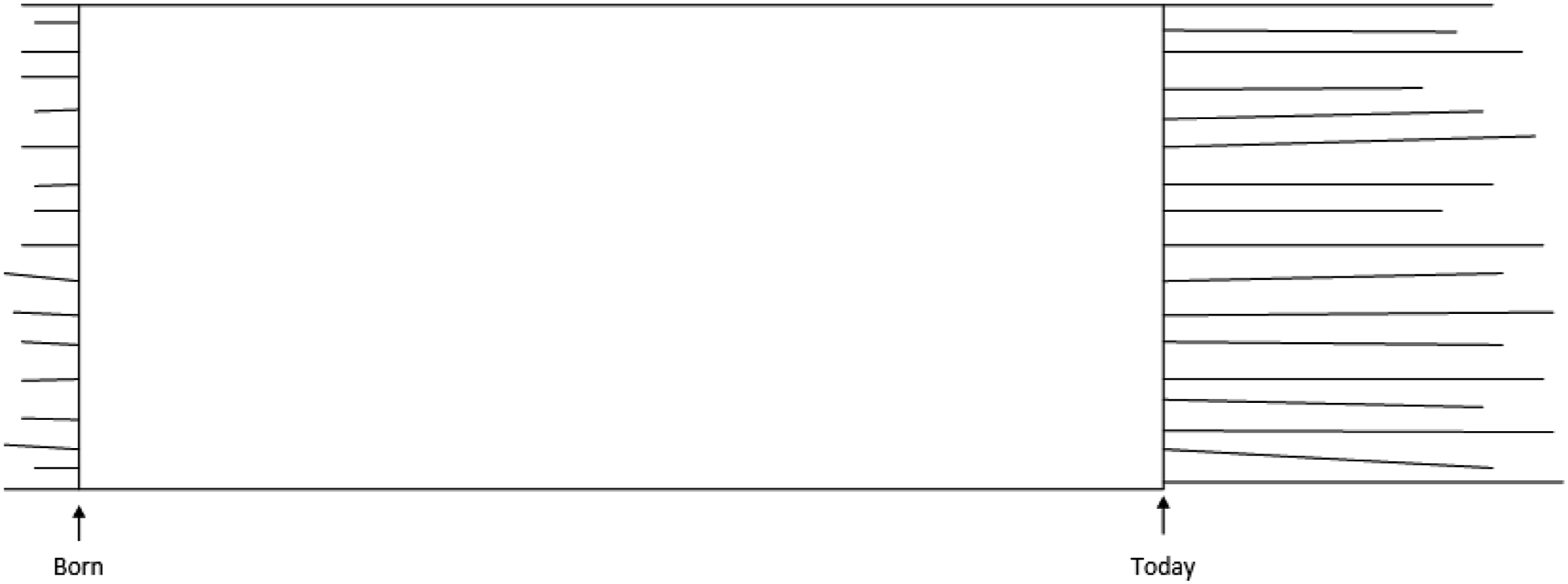
A Rug Analysis Approach
There are different approaches proposed for visual data analysis. For example, Riley (2004) studies signs and their meaning in society. They are based on similarity of appearance and can be divided in codes that the researcher reads and the designers interpret. Rose (2016) explains the process of analysis of an image as identifying its symbols and the meaning of its building blocks (for instance how the rugs have been decoded). The signs can describe something, be denotive (what do the rugs signifiy/sense and summarise). Moreover, Guillemin (2004) suggests images be reviewed from three perspectives: the image producer (production), the image itself (drawing), and how the image is perceived (perception).
For the RM, the use of colours is crucial and needs a deeper reflection. The meaning of colours used in pictures/drawings, according to Malchiodi (1998), are that red stands for birth, blood, fire, feelings, heat, passion, wound, and life. Blue colour means heaven, water, ocean, spirituality, relax, clean, calm, and loyalty. Colours of green gradation indicate soil, fertility, vegetation, nature, plants, renewal, cycle, envy, overprotect, and creativity. Black in turn symbolizes darkness, emptiness, mystery, beginning, uterus, unconscious, death, depression, and loss. While Birren’s (2013) psychology of colour suggested that warm colours, i.e. those colours in the red gradation, are decoding as exciting. Red increases blood pressure and pulse above normal level, but after a while drop the blood pressure below normal. Red colour increases also the noice level, but after a while lower the level. Clarity, loudness and stimulating feelings are generally associated with red and warm colours (Birren, 2013). While cold colours in the blue gradation are calming, blue and cold colours are generally associated with dimness, quietness and calmness. Blue colours lower the blood pressure, but after a while they have the reverse effect. Yellow and yellow-green colours are associated as neutral. In addition, clear colours are decoded as stimulating and dark colours as relaxing. Birren advocated that bizarre and odd designs, as well as garish colours, indicate that people are driven to madness, but a simple and perfectly decorated room may be even worse than a bizarre design with garish colours. He elaborated that a circus would make people less neurotic than the clinical waiting room at a train station. He explained that garish colours with odd designs were used to treat war fatigue during the First World War. Furthermore, anxiety and worry may worsen with monotony, while bizarreness may reduce irritation. Clear colours may be equal with a person’s own inner chaos and thus may be experienced as restful and therapeutic (Birren, 2013), i.e. it may encourage awareness and the idea of taking a new direction (Bodman, 2019).
A Case Example
Rugs were used in a research project conducted in Finland. The research gained ethical approval from the supervising university. The aim of the study was to explore how people who had moved from urban areas to rural areas, and those who always lived in the countryside, cope with life events and how they mobilize or use resources for better health and well-being (Bodman, 2019).
Self-Selected Sampling
All 16 participants in the study were self-selected participants, who had responded to announcements in periodicals about the study. The advertisement presented the study as focusing on the relationship between humans and nature and how this relationship affects individuals’ quality of life. When participants made contact and expressed their interest in participating in the study, they were informed that participation was voluntary and were given pseudonyms to protect their anonymity. With the self-selected method (Holme & Solvang, 1997), you get participants who are eager to express their feelings about the issue. This selection is preferable when you want a deeper knowledge of a special issue. With the 16 participants, nine women and seven men with an average age of 48 years, data saturation (Glaser, 1978) was achieved regarding the impact of nature on well-being, the major aim of the study. It was, so to speak, ‘the already saved’ who participated.
Timing
According to our experience, when planning a qualitative study using RM, a researcher should consider an adaptable timeschedule. This time schedule could vary depending on researchers’ backgrounds and the necessity to revise literature and create innovative connections among guiding principles. The schedule will also be dependent on the number of participants involved, if respondents are vulnerable subjects with special needs, the geographical or climate conditions, and participants availability. Before the interviews take place, one month is reserved for planning the semi-structured open questions which, in the Finnish study, were desined to discover what participants believe to be a healthy way of life, what they think is good about living in their environment, and what they judge is problematic about living there. Then, during the Finnish study, respondents made contact during the following month. Face-to-face in-depth interviews lasted one to 2 hours, and researchers planned this time taking into account the georgraphical allocation of participants. Time reserved for colouring rugs as an extension, is crucial. The research setting must be recognised as a protective and not evaluating space so that creativity and reflection can flow without forcing action or productivity. Considering previous experiences with the use of drawings as a reflective practice (Bodman, 2019; Garista, 2023), a 1 hour time schedule was considered enough for imaging and picturing the rug. The description of the Rug to researcher required 15 minutes.
In addition, we can consider a researchers’ timeline by referring to how the timeline of the research described in ths this article was developed. This timeline was fluid, starting during a dialogical session on drawing in an international context, proceeding in contact meetings after the pandemic period to share results between the two authors of this paper. This process enabled time for reflection on the tool and its implications, and comparison it within emergent literature and shifting rugs into the qualitative methods scenario through the reflective process of writing research (Mortari, 2015; St.Pierre, 2021). We can describe this second phase as a fluid time, not mandatory, but really knowledge generative for researchers, depending on personal and professional tasks.
Trustworthiness
When meeting the 16 people aged 25–76 years living in rural areas and in suburbs of Ostrobothnia in western Finland and Uusimaa in the south of Finland, the aim was to establish trust so that the respondent would feel welcome (Nowell et al., 2017). The location of the interview was chosen by the respondent. This was to make the situation as relaxed and comfortable for the respondent as possible and to ensure that the researcher had as little influence as possible. The participants had previously read newspaper articles or heard the researcher talk about the impact of nature on well-being. The importance of nature connected the participants to the researcher. This connection made it easy for the participants to talk and share their thoughts and feelings on the topic. Respondents’ engagement with what nature means to them resulted in their stories flowing on their own from 1 hour to 2 hours.
The Finnish study reported in this article focuses on the rug task, explores and connects trajectories for analysis of the rugs based on the literature synthesized above. Rose (2016) offered a general framework for reading the research context data. When analyzing drawings/rugs, the researchers decided, according to Rose framework, what the signs are in the rugs, what they signify ‘in themselves’, and what that means. Researchers should think about how rugs signs relate to other signs ‘in themselves’. Then the researchers explored the rugs’ connections to wider systems of meaning, and finally returned to the signs via their codes to explore the metaphor in the rugs. In this framework, Riley (2004) offered a model to describe how participants have built their knowledge of themselves. Moreover, Guillemin (2004) helped to trace three perspectives of an image/drawing production and Malchiodi (1998) and Birren (2013) supported the necessity of coding colours and patterns.
Coding Colours and Design
The reserachers started the process of coding colours (Malchiodi, 1998) with the participant’s colour interpretation. The illustration in the participants rugs follows Birren (2013) and Rose (2016) framework of image analysis. As stated by Guillemin (2004), it can be argued that using an integrated approach that involves both visual and word-based methods for data collection provides a comprehensive perspective of participants’ points of view. Hence, we have the participant’s interpretation of the rugs linked as quotation to the rugs. Finally, we synthesized the image production, drawing and perception, Guillemin’s (2004) three perspectives, carried out into strategies to promote well-being.
The colours used in the 16 rugs were red, blue, yellow, and green, as well as dark colours (Figures 3 and 4). The designer’s colour interpretation was that red was used for feelings and recovery, blue as a change and a calm time and yellow as a creative process towards something good while green symbolises harmony and something fundamental. The participants’ use of the colours in expressing thoughts, perceptions and physical sensations, and emotions coincided with Malchiodi (1998) and Birren (2013) interpretation of colours, except in the case of the participant who made Rug 10 where they associated yellow with something that had been difficult. Rug 1 was put in the red gradation and so be decoded as exciting, and its dark colours as relaxing. While Rug 12 was in the blue gradation perceived as calming. With yellow and green as the dominant colours, Rug 6 and Rug 10 are read as neutral. Rug 11, with its clear colours, was perceived as encouraging. Rug samples by seven participants who used the coping strategy ‘Back to Nature’ (those moving from an urban area to a rural one) to promote their well-being. The rug samples by nine participants who used the coping strategy ‘Roots in the Soil’ (those born in a rural area and stayed there) to promote their well-being.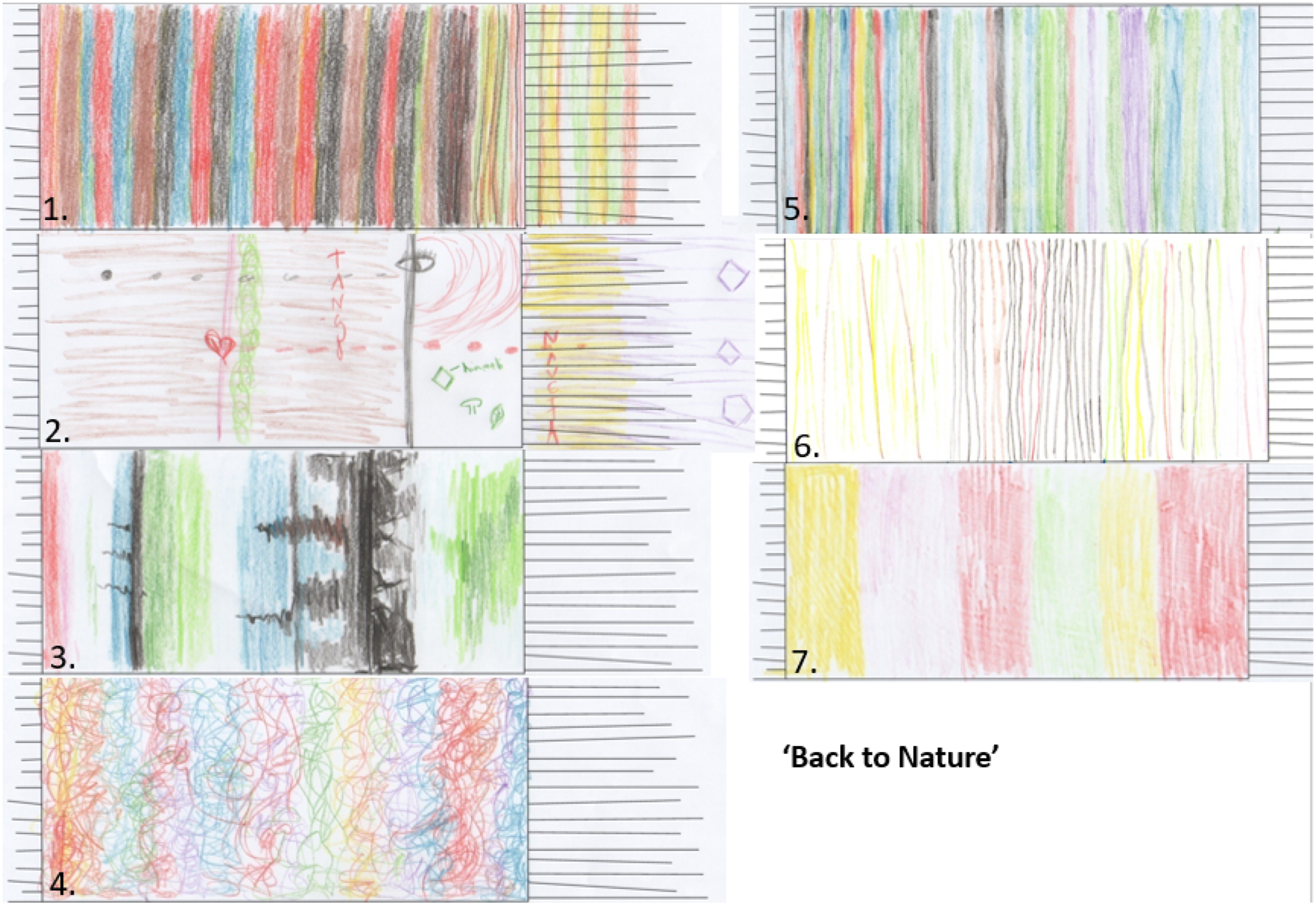

When looking at the designs in the 16 rugs there are both typical and atypical stripes; some rugs have strict patterns and lines, while others have bizarre patterns, and there are dark and light rugs. Regarding the use of black when designing the rugs, there are six rugs without black (Rug 4; Rug 7; Rug 9; Rug 12; Rug 14; Rug 16), and imagining the future is designed into three of the rugs (Rug 1; Rug 2; Rug 13). Two have used lines to express their life (Rug 8; Rug 9).
Illustrated Design
Below we report phrases used by participants to describe their rugs, which provides evidence of the importance of participants’ explanations in the data analysis, as suggested by Rose (2016) and Guillemin (2004). The questions are translated from Swedish to English. Rugs 1–7 are designed by participants using a strategy called ‘Back to Nature’ (those participants that have moved from an urban area to a rural one) to promote their well-being. Rugs 8–16 are designed by those that used the strategy ‘Roots in the Soil’ (those participants that are born and have stayed in a rural area) to increase well-being.
The following quotations report the image production and how the rugs are explained by the participant who made the rug. Rug 14. … The green is a calmer environment when nature came back into my life. …
A complementary text anchors the meaning of the rugs. Rug 5. …The first black line was when I was five years old and my childhood friend disappeared. The second black line was when my fitness ran out and I thought I was going to die. But it turned out to be just poor fitness from all the sitting. The third black was the darkest period of my life. Those were heavy years at work that were stressful. The light blue and light green stripes I think I just sailed and hunted. … Rug 8. … A light green line runs throughout like hills, with peaks of light blue and pink. I have a pink steep peak up there before writing school and when I met my future wife with an extended hill up the time after marriage. The deepest peak down is when my wife died...
These quotations describe the perception of designing the rug. Rug 11. … The teenage and high school years are a blue time, the colour of hope. It is a time when you are excited and positive about things. You wonder what you will be when you grow up. I have two such periods in my life. The time in between was a slightly calmer period. The black one is when I was diagnosed with illness, and I went through a divorce and unemployment. That was a difficult time.... Rug 13. … The wide black strip inside the orange one is the high school years, which I found difficult. Being a teenager is difficult. The red inside the black is the engagement when I met a lot of people. It was quite a destructive time really, but with warmth and care as well. Then comes a traumatic event that was kind of a turning point for me and then love came in, pink. … Green was when I started being in the forest. It was during my illness, which was really difficult. The black in the green is the death of my grandmother. That was also a difficult time and it disrupted the circles. The hub of the family died and the cousins lost each other. The green is now my foundation and the blue is studying where I am very much up in my intellect.... Rug 15. … The first blue is a bit of a quiet time. You don’t have much to think about. You go with the system and everything is set up. The yellow is the moped and driver’s license period, which means freedom. The black is military time. That doesn’t mean I didn’t like it: it was that I had no freedom. I couldn’t do what I wanted.... Rug 16. … The brown stripe symbolises a negative event bullying in primary school and the other colours peace and happiness.…
While these commentaries summarize the significance of changes in a life-course. Rug 2. ... The black line is the change of profession and health problems with the eyes. It is the worst of times and at the same time the best of times. Because it has made me think. What you want out of life and where it is going.... Rug 4. … My childhood was not entirely idyllic. I grew up with my grandmother, as my parents divorced when I was young. It was difficult in its own way, but there were good things about it. I spent a lot of time outdoors.... Rug 9. … The first decline, the dip, is when mom gets sick and then it levels off when she dies. The death felt almost like a relief, because it was nothing remarkable in the sense that it was expected. I had already been dealing with it since she got sick. In the line are marriage and the children are born. The slope of the red curve means that life experience generally increases with age. You build up more experience over the years, so to speak....
The complementary texts show a wider meaning and levels in the rugs. Rug 1. … I did not understand why I felt so bad until I met the right person who opened my eyes. I have started to realise a thousand and one things that improve my quality of life. … I moved to the countryside and sought changes in my life to feel better, and to be able to live my life. … I see a turning point in life.… Rug 3. … During that time [the exchange job] I found out that it is up to me to change my situation. So, the light blue time was healthy in many ways. I have more control now than I did then. Everything is not always light blue.... Rug 10. … Looking back, I think I was a difficult child at times. Hence the yellow stripes. I was in a way then that I don’t want to be today. High school was brown because I didn’t really know who I was. Nothing traumatic but still a time I want to distance myself from. ... The last black stripes are symbolic of a pretty big life change with the new life situation. And the green one is that everything is fine and relatively happy.... Rug 12. … In the beginning, before you know anything about life, you just feel good. You are taken care of. The purple time is the big break and then a slightly worse time came. The yellow is the light at the end of the tunnel. Life took a new turn, which is symbolized by the red color....
The design and the narration may be complex with more than one meaning. For example, the hidden message. Rug 7. … I have had grief, death and illness in my life. But these are my colours [light colors]. I don’t think about such things, you just get so depressed.…
Multiple Rugs for Qualitative Researchers
This case example shows a possible use of rugs in qualitative research. Considering feedback, results, and literature we can summarize two trajectories.
The Rug Task as an Individual Experience and Product
Rugs are both images to interpret and objects to create (Bodman, 2019). Through weaving and picturing, people, are involved in “to do activities”, using their minds and their hands, defined by Merleau-Ponty as pre-reflective actions. From this perspective we can think about drawing rugs as a process, a creative and generative experience which can be introduced in qualitative studies as an individual activity. Weaving or drawing a rug can be proposed as an art-based experience or as an additional tool that precedes or follows the process of research dialogue in data collection. It offers alternative ways of elaborating and communicating stories and knowledge. Weaving and drawing a rug can be also part of an autobiographical method that a researcher can use (Tachine, 2018). Individual Rugs become individual products to be analysed and discussed.
The Rug Task as a Social Experience and Product
Rugs also can become cooperative and can be introduced as a group task, a creative activity to elaborate and synthesize individual thoughts and experiences (Bodman, 2019). Even when rugs are socially producted drawing rugs is a creative process to guide or self-develop in a research group for data collection. Rugs produced collectively by a group of participants can be analysed as a collective representation of a phenomenon that is considered interesting to the researcher’s questions
What Drawing Rugs Add to Qualitative Research?
This case example described above shows the qualitative advantage in using rugs with narratives, by adding value to the stories the participants tell us. People feel they can use all senses and languages to express themselves. Designing rugs to represent a, life story may bring different perspectives to the participant ad the researcher (Bodman, 2019). When formulating thoughts into words and drawings, participants may change the memory, the image and the story of what they experienced and their representations, and the narratives in the interview and accompanying the rug-drawings can coincide or vary (Mey & Dietrich, 2016). Using another metaphor, when we think, our thought looks like a pear. When we put words on our thought, it turns out to be an apple (Bodman, 2017). When colouring our thought in a rug, our thought may look like an orange or turn out in to a banana or a bunch of grapes. This metaphor shows that drawing a rug can give birth to a thought and a reflection can take a new direction. Some of those involved in the study told a completely different story about the rug even though it was a repetition of what they had told during the in-depth interview.
It is important to underline participants’ reactions and to suggest that the researcher accept their refusal to draw as well as the willingness. The participants’ reply to the task of drawing a rug was: I can’t draw (Rug 12), May I make a new one, it went wrong (Rug 10), This was a good method. I’m going to use it when talking to clients (Rug 3), and I want to include the future too (Rug 1; Rug 2). The Rug had contributed to an awareness of their own resources and assets (Bodman, 2017, 2019). If the design of the rug shows an experience that the individual is aware of, then they are able to take on the challenges of the day, which gives meaning and a belief in the ability to construct meaning and see purpose in life that gives meaningfulness. The study showed that Rug Methodology adds value to qualitative research as a creative tool to get another understanding of human thinking, thoughts and behaviour. It is both a product and a process that may reflect how humans cope with the demands of life.
Final Reflections
One of the pedagogical competences is to motivate people and make them participate in a learning setting. Shifting tools and objects of their everyday world to the learning environment is one way to do this. A song, a piece of Opera Lyrica, a novel, a poem, a picture. We used this competence to shift rugs, a “to-do” activity, a product of our cultural heritage, to deepen inquiry into the human-nature relationship and how it is important in building salutogenic paths in the life course. If the active part of this experience was easy to manage: imaging a setting where, after interviewing, a researcher gives objects and asks the participant to create a rug; the rugs qualitative analysis and discussion raises the real challenge. Guided by enthusiasm derived from people’s reactions and from other experience read in the literature, we create connections among what we consider crucial resources for resilience, empowerment, and salutogenesis (traditions, history, biographies, identities, nature, embodiment, expressive methods) and methodology, comparing our approach to the ones described by other scholars. During the last eight years, after interviews and rugs were produced, we asked ourselves about the challenges, the results, the possible research contexts and themes for which rugs may be suitable for qualitative research.
Our debate and reflections lead us to consider the drawing of rugs as a useful way to communicate with people without forcing them to explain or describe with the right words what they feel and experience. We believe rugs are an inclusive methodology, a good way to draw from cultural heritage with the future of qualitative methods close to people’s everyday life. The art of drawing rugs is a part of our identity, as persons and researchers, and the possibility of shifting them into a qualitative methodology gives us a sense of gratitude and connection with people, nature, communities, and culture. Drawing rugs transforms our reality to something new, grounded in our past, projected in the future through words and pictures, between qualitative studies and pedagogy.
Footnotes
Declaration of Conflicting Interests
The author(s) declared no potential conflicts of interest with respect to the research, authorship, and/or publication of this article.
Funding
The author(s) received no financial support for the research, authorship, and/or publication of this article.
Ethical Statement
Data Availability Statement
In addition, about confidentiality, that data will only be archived in the doctoral thesis “Leva ett med naturen” – “Dammråttor kan man ju ge namn åt om man vill”  .
.